Brazilian Journal of Radiation Sciences

Brief Background
|
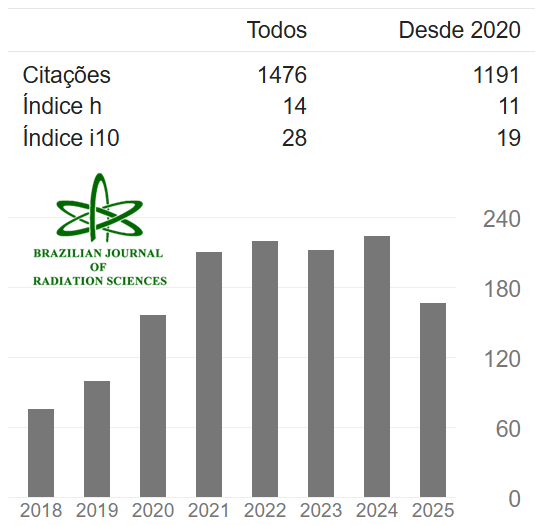
The Brazilian Journal of Radiation Science (BJRS), ISSN 2319-0612, is a Diamond Open Access (DOA) journal published, since 2013, by the Brazilian Radiation Protection Society – (Sociedade Brasileira de Proteção Radiológica, SBPR), an IRPA associate scientific society, also affiliated to the Brazilian Association of Scientific Editors (ABEC). It publishes rigorously peer-reviewed scholarly research. Diamond (or Platinum) Open Access: this term refers to open access journals that don't charge any author fees (APC, Article Processing Charges). They are usually financed by a university or research organization. https://www.unesco.org/es/diamond-open-access. The publisher, the Brazilian Radiation Protection Society – (Sociedade Brasileira de Proteção Radiológica – SBPR, CNPJ 03.967.615/0001-80 - https://ror.org/01brr5229) is a non-profit scientific society also affiliated to SBPC (the Brazilian Society for the Progress of Science).
Start year: 2013 The journal reached the "A2" classification of the old CAPES Qualis System for the interdisciplinary area. Subsequently, after the classification was unified for all areas, it was classified as B1, with Engineering II being the mother area. The "A2" rating from the CAPES Qualis System for the interdisciplinary field signified that the journal was considered to be of very high quality and international excellence, receiving a rating in the second-highest quality stratum (with A1 being the highest). This ranking was a prestigious marker of a journal's academic standing within the Brazilian postgraduate evaluation system.
The editor in chief, advised by the BJRS Editorial Board, possesses delegated responsibility for overall policy matters concerning the Journal. Mission The journal's mission is to consolidate a radiation safety culture by establishing adequate and proper communication processes among all the actors involved in radiation applications, through the dissemination of original research and review scientific articles on the main disciplines of radiation sciences. |
Open Access
|
As recommended by UNESCO, the Brazilian Journal of Radiation Sciences (BJRS) is a DOA Journal (Diamond Open Access). which refers an equitable model of scholarly publication, that, in addition to providing unrestricted virtual access to all scientific texts published by the journal, charges no fees to authors or readers. All content is therefore freely available without charge (APC) to the user or his/her institution. Open Access is the condition where the copyright holder of a scholarly work grants usage rights to others using an open license (Creative Commons Attribution, CC-BY 4.0) allowing for immediate free access to the work and permitting any user to read, download, copy, distribute, print, search, or link to the full texts of articles, crawl them for indexing, pass them as data to software, or use them for any other lawful purpose. Science as Global Public Good SBPR and BJRS endorse the Manifesto on Science as Global Public Good: Non-commercial Open Access, https://globaldiamantoa.org/manifiesto/, result of the community reflection while participating in the Global Summit on Diamond Open Access on October 23-27, 2023 in Toluca, Mexico: |
Open Science Compliance
|
BJRS supports the concept of open science, which seeks to open up the entire research and publication process even further, including open data, open protocols, open code and transparent peer review. However, the opening of the data is conditioned to the authorization of the authors and reviewers involved in a submission. The journal accepts articles previously published in preprint repositories SciELO Preprints and EmeRI |
Ethics in Publication
|
BJRS maintains high ethical standards on publications and strict criteria for published articles. The journal follows the SciELO recommendations contained in the Guidelines on Best Practices for Strengthening Ethics in Scientific Publication and of the Committee on Publication Ethics (COPE), to whom we have already applied to join. The Brazilian Journal of Radiation Sciences has its own policies and procedures to ensure the integrity and credibility of the research we publish: |
Focus and Scope
|
A way to consolidate a radiation protection culture is by establishing adequate and proper communication processes among all the actors involved in radiation protection applications. In this context, the Brazilian Journal of Radiation Science (BJRS), ISSN 2319-0612, as a Diamond Open Access (DOA) journal, published since 2013 by the Brazilian Radiation Protection Society, an IRPA associate society, aims to disseminate scientific articles on the major disciplines on radiation sciences. Covering the Biological, Health, Engineering, Exact and Earth areas and even Law (Nuclear Law), the following topics covered by the journal editorial line stand out:
The focus is: first, to serve researchers through the immediate publication of important advances in all fields of radiation sciences, as well as to promote a forum for discussion and dissemination of science-related issues. Second, ensure that the results of scientific work are quickly disseminated to the general public, in order to express their importance for knowledge, culture and everyday life, in the direction of what the movement in favor of Open Science advocates. Any work that meets the aforementioned scope and that has not been published or accepted for publication elsewhere will be considered for publication in the Brazilian Journal of Radiation Sciences. |
Digital Preservation
|
BJRS follows the standards defined in the SciELO Program Digital Preservation Policy. Archiving BJRS uses the LOCKSS and the CLOCKSS systems to create a file system distributed among participating libraries and allows them to create permanent archives of the journal for preservation and restoration (PKP PN). Self-Archiving Policy BJRS allows authors to deposit publisher’s version (post-print) of their article in an institutional repository. |
Indexing Sources
|
Bibliographic Journal Information
|
Websites and Social Media
Preprints
|
A preprint is a paper that is made available publicly via a community preprint server prior to (or simultaneous with) submission to a journal. Preprint servers, i.e., servers that allow for the posting of papers prior to submission for publication, are becoming more common across a range of disciplines. The article's preprint shares with the BJRS the originality of its publication, inhibiting the use of double-blind peer-review procedures in manuscript evaluation. The use of preprints is an option and choice of the authors. BJRS believes journals should allow for the submission of manuscripts which have already been made available on such a server. Allowing submission does not, of course, guarantee that an article will be sent out for review; it simply reflects a belief that availability on a preprint server should not be a disqualifier for submission. BJRS's Preprints Policy statement BJRS will consider for review articles previously available as preprints. Authors are requested to update any pre-publication versions with a link to the final published article. Authors may also post the final published version of the article immediately after publication. Authors who have published a work on the EmeRI preprint or on SciELO Preprints server must complete the Open Science Compliance Form and submit it through step 2 of the submission form. Preprint server BRJS adopts EmeRI (Emerging Research Information) preprint repository for manuscript preprint submissions, in addition to the SciELO Preprints server. The journal editors will analyse the acceptance of Preprints from other servers. EmeRI is an indexer created to meet a need of journals, and only they can deposit items. For an author to have their text available on EmeRI, they must submit it to BJRS or one of the journals registered on the platform. So, the difference between EmeRI and other existing preprint repositories is noteworthy. The articles are included in it by the editors of the journals, who make a prior assessment of their scientific nature - https://www.unesco.org/en/articles/unesco-supports-brazilian-initiative-emeri-preprint-repository |
Peer Review Process
|
Although BJRS adopts a double-blind peer review process, it also offers reviewers the option of communicating directly with the corresponding author, with or without disclosing their identities. All submitted articles are initially evaluated by the Chief Editor and / or Associate Editors regarding merit and scientific contribution. Then the manuscripts are sent to specialized reviewers. BJRS selects independent and ethical reviewers who are qualified and capable of conducting an impartial review, always seeking constructive and professional criticism. The final decision is based on the editor's recommendation and reviewers' opinions. The final version of the approved article will be published with the name of the editor or editors responsible for the manuscript evaluation process. At the time of submission, authors may indicate potential reviewers for the article and their respective institutions. The reviewers listed may be invited to review the article at Editor's discretion. Professionals close to one of the authors or members of the same institution or who in any way may have some conflict of interest about the work should not be indicated. Authors should prioritize the appointment of highly qualified professionals and experts in the manuscript area. |
Open Data
|
BJRS supports the concept of open science, which seeks to open up the entire research and publication process even further, including open data, open protocols, open code and transparent peer review. Manuscripts must be accompanied by a data availability statement for the data used or generated in the research underlying the texts. |
Fees
|
As a Diamond Open Access (DOA) journal, there is no fee to authors for submitting to BJRS nor Article Processing Charge (APC). |
Ethics and Misconduct, Correction and Retraction Policy
|
Brazilian Journal of Radiation Science is committed to uphold the integrity of the literature and publishes Errata, Expressions of Concerns or Retraction Notices dependent on the situation and in accordance with the COPE Retraction Guidelines. In all cases, these notices are linked to the original article. More information on Brazilian Journal of Radiation Science’s guidelines can be found here. Information on COPE Retraction Guidelines can be found here: Retraction Guidelines. BJRS also recommends the guides published by SciELO as follows: |
Policy on Conflict of Interest
|
BJRS requires that authors disclose any conflicts of interest that could influence their research. Editors must declare any conflicts of interest resulting from competitive, collaborative, or other relationships with manuscript authors and their institutions and abstain from editorial responsibility for such manuscripts. Declaration of any conflicts of interest with authors or their institutions is mandatory, and reviewers should abstain from reviewing such manuscripts. |
Adoption of Similarity Software
|
Plagiarism Policy - Scientific integrity as well as the peer-review process is the heart of scholarly publishing. As a part of our commitment to protect the integrity of scholarly publications, we take the necessary steps in all aspects of publishing ethics. Plagiarism takes many forms, from intentionally passing off someone else’s work as your own to unintentional paraphrasing someone else’s work without proper attribution. Does not matter in which form or to what extent, plagiarism always constitutes unethical behaviour and is unacceptable in academic publishing. Plagiarized articles are not allowed in BJRS. Even though plagiarism is a serious issue but it’s very easy to avoid by giving proper acknowledgment to the work of others. Before submitting the manuscript to BJRS, the authors should ensure that they have written original works. In the case where authors have used someone else’s or own previously published work/words, that should be properly attributed through appropriate citation. The author shall remember not to use information obtained privately without explicit, written permission from the source; for instance, the knowledge gained through peer-reviewing of other’s work or through third party discussion. Similarity Check: BJRS is using iThenticate plagiarism software provided by CrossRef Similarity Check for the initial plagiarism detection but still if later any article is found to be plagiarized then appropriate action will be taken as per our ethical policy and that article might get retracted. Overall similarity index of the manuscript should not be more than 15% for research articles and 20% for review articles with a limitation of less than 3% similarity from any individual source. Similarity Check is a multi-publisher initiative to screen published and submitted content for originality. BJRS uses the iThenticate software to detect instances of overlapping and similar text in submitted manuscripts which compare content against its database of periodicals, the Internet, as well as other wide-range databases of articles. BJRS is committed to actively combating plagiarism and publishing original research. |
Adoption of Software Using Artificial Intelligence Resources
|
The use of tools and resources that assist authors in the preparation of their manuscripts is recommended, as long as attribution rules are followed, and ethics and scientific integrity are upheld. Authors have the right and freedom to use tools and resources that aid in the preparation, writing, review, and translation of their articles, book chapters, or books. Many of these tools and resources are provided by AI applications. However, it is important to note that only humans can be considered authors, following the following rules and practices:
See the Guide to the Use of Artificial Intelligence Tools and Resources in Research Communication on SciELO |
Gender and Sex Issues
|
The editorial team of the Brazilian Journal of Radiation Sciences follows an international set of guidelines to encourage a more systematic approach to reporting sex and gender in research across all disciplines. The Sex and Gender Equity in Research (SAGER) guidelines are a comprehensive procedure for reporting of sex and gender information in study design, data analyses, results and interpretation of findings. Sex refers to a set of biological attributes in humans and animals that are associated with physical and physiological features including chromosomes, gene expression, hormone function and reproductive/sexual anatomy. Sex is usually categorized as female or male, although there is variation in the biological attributes that constitute sex and how those attributes are expressed. Gender refers to the socially constructed roles, behaviours and identities of female, male and gender-diverse people [1]. It influences how people perceive themselves and each other, how they behave and interact and the distribution of power and resources in society. Gender is usually incorrectly conceptualized as a binary (female/male) factor. In reality, there is a spectrum of gender identities and expressions defining how individuals identify with themselves and express their gender. Lack of interest in sex and gender differences may not only be harmful but also present missed opportunities for innovation. The BJRS can play an important role in advancing the quality and transparency of reported data by promoting routine sex- and gender-focused research data analysis, recommending that researchers include representative populations in all study types, provide descriptive data for sex and other relevant demographic variables, and stratify reporting by sex. In particular, articles reporting clinical trial results need to analyse data separately for men and women. The SAGER guidelines are designed primarily to guide authors in preparing their manuscripts. Although editors typically enter the research process late, after the research has already been concluded and the data analysed, they can still play an important role in ensuring effective, transparent and complete sex and gender reporting. Furthermore, the Brazilian Journal of Radiation Sciences strives to adhere to a gender equity policy in the formation of its editorial board. Diversity Statement BJRS is committed to scholarship that is respectful of diversity and inclusion. Diversity in our journal includes considering and publishing scholarship from scholars with different institutional affiliations, different nationalities, and at different stages of their professional careers; In particular, we encourage submissions from those that are underrepresented within academia, due to race, ethnicity, gender identity, disability, or other protected characteristics, thereby ensuring the promotion of diversity, equity, inclusion and accessibility (DEIA principles). We encourage authors to engage with and cite sources historically excluded from academia and engage with the work of scholars based in the countries about which they are writing. We are committed to eliminating the influence of bias in our editorial and review processes and continually work toward identifying and implementing best practices for scientific publishing. |
Ethics Committee
|
When applicable, authors must attach a statement of approval from the ethics committee of the institution responsible for approving the research. |
Copyright
|
Authors have a series of rights, called copyright, that protect their work. If people want to use copyrighted work, they often have to ask for permission from the creator. The author grants the BJRS permission of first publication. Since January 2025, the journal no longer demands that the authors transfer – or “assign” – their copyright to the journal. The authors now, from 2025 onwards, retain unrestricted copyright and all publishing rights by publishing under license adopted by the journal (CC BY 4.0), to inform readers how published content can be used. It enables us to effectively manage, publish and make author work available to the academic community and beyond. Before 2025 copyright was assigned to the publisher/journal. Our current policy is to return copyright even to authors who published in previous editions, without prejudice to the Creative Commons license already used. |
Intellectual Property and Terms of Use
|
As a Diamond Open Access (DOA) journal, BJRS applies the Creative Commons Attribution 4.0 International (CC BY) license to articles we publish. Creative Commons works within copyright law. It allows creators to grant permission to everyone in the world to use their work. If you submit your paper for publication by BJRS, you agree to have the CC BY license applied to your work. BJRS requires that you, as the author, agree that anyone can reuse your article content in whole or part for any purpose, for free, even for commercial purposes. These permitted uses include but are not limited to self-archiving by authors of submitted, accepted and published versions of their papers in institutional repositories. Anyone may copy, redistribute, reuse, or modify the content as long as the author and original source are properly cited. This facilitates freedom in reuse and also ensures that BJRS content can be mined without barriers for the needs of research. If your manuscript contains content such as photos, images, clipart, tables, audio files, videos, proprietary protocols, code, etc., that you or your co-authors do not own or did not create, we will require you to provide us with proof that either: a. the material is in the public domain or available under an open access license compatible with CC BY 4.0, or b. the owner of that content has given you written permission to use and publish the content under an open access CC BY 4.0 license. All content of the journal, except where identified, is licensed under a Creative Commons Attribution (CC BY 4.0) license |
Sponsors and Promotion Agencies
|
Editor-in-Chief
|
Editors
|
Executive Editor/Editorial General Secretary
|
Associate Editors
|
In memoriam
|
Hispanic American Editorial Board
|
Editorial Advisory Board
|
Editorial Assistant/Technical Team
|
|
1.14. Ethical Duties of Authors 1.14.1. Reporting standards Authors of original research should present an accurate account of the work performed and the results, followed by an objective discussion of the significance of the work. The manuscript should contain sufficient detail and references to permit others to replicate the work. Review articles should be accurate, objective and comprehensive, while editorial 'opinion' or perspective pieces should be clearly identified as such. Fraudulent or knowingly inaccurate statements constitute unethical behaviour and are unacceptable. 1.14.2. Data access and retention Authors may be asked to provide the raw data of their study together with the manuscript for editorial review and should be prepared to make the data publicly available if practicable. In any event, authors should ensure accessibility of such data to other competent professionals for at least 10 years after publication (preferably via an institutional or subject-based data repository or other data centre), provided that the confidentiality of the participants can be protected and legal rights concerning proprietary data do not preclude their release. 1.14.3. Originality and plagiarism Authors should ensure that they have written and submit only entirely original works, and if they have used the work and/or words of others, that this has been appropriately cited. Publications that have been influential in determining the nature of the work reported in the manuscript should also be cited. Plagiarism takes many forms, from "passing off" another's paper as the author's own, to copying or paraphrasing substantial parts of another's paper (without attribution), to claiming results from research conducted by others. Plagiarism in all its forms constitutes unethical publishing behaviour and is unacceptable. 1.14.4. Multiple, duplicate, redundant or concurrent submission/publication Papers describing essentially the same research should not be published in more than one journal or primary publication. Hence, authors should not submit for consideration a manuscript that has already been published in another journal. Submission of a manuscript concurrently to more than one journal is unethical publishing behaviour and unacceptable. The publication of some kinds of articles (such as clinical guidelines, translations) in more than one journal is sometimes justifiable, provided that certain conditions are met. The authors and editors of the journals concerned must agree to the secondary publication, which must reflect the same data and interpretation of the primary document. The primary reference must be cited in the secondary publication. 1.14.5. Authorship of the manuscript Authors are fully responsible for the content of their manuscripts submitted for publication. This implies that they must ensure the accuracy, originality and ethical compliance of their work, as well as obtaining the necessary permissions for the use of copyrighted materials. Only persons who meet these authorship criteria should be listed as authors in the manuscript as they must be able to take public responsibility for the content: (i) made significant contributions to the conception, design, execution, data acquisition, or analysis/interpretation of the study; and (ii) drafted the manuscript or revised it critically for important intellectual content; and (iii) have seen and approved the final version of the paper and agreed to its submission for publication. All persons who made substantial contributions to the work reported in the manuscript (such as technical help, writing and editing assistance, general support) but who do not meet the criteria for authorship must not be listed as an author, but should be acknowledged in the "Acknowledgements" section after their written permission to be named as been obtained. The corresponding author should ensure that all appropriate coauthors (according to the above definition) and no inappropriate coauthors are included in the author list and verify that all coauthors have seen and approved the final version of the manuscript and agreed to its submission for publication. 1.14.6. Disclosure and conflicts of interest Authors should - at the earliest stage possible (generally by submitting a disclosure form at the time of submission and including a statement in the manuscript) - disclose any conflicts of interest that might be construed to influence the results or their interpretation in the manuscript. Examples of potential conflicts of interest that should be disclosed include financial ones such as honoraria, educational grants or other funding, participation in speakers’ bureaus, membership, employment, consultancies, stock ownership, or other equity interest, and paid expert testimony or patent-licensing arrangements, as well as non-financial ones such as personal or professional relationships, affiliations, knowledge or beliefs in the subject matter or materials discussed in the manuscript. All sources of financial support for the work should be disclosed (including the grant number or other reference number if any). 1.14.7. Acknowledgement of sources Authors should ensure that they have properly acknowledged the work of others and should also cite publications that have been influential in determining the nature of the reported work. Information obtained privately (from conversation, correspondence or discussion with third parties) must not be used or reported without explicit, written permission from the source. Authors should not use information obtained in the course of providing confidential services, such as refereeing manuscripts or grant applications, unless they have obtained the explicit written permission of the author(s) of the work involved in these services. 1.14.8. Hazards and human or animal subjects If the work involves chemicals, procedures or equipment that have any unusual hazards inherent in their use, the authors must clearly identify these in the manuscript. If the work involves the use of animals or human participants, the authors should ensure that all procedures were performed in compliance with relevant laws and institutional guidelines and that the appropriate institutional committee(s) has approved them; the manuscript should contain a statement to this effect. Authors should also include a statement in the manuscript that informed consent was obtained for experimentation with human participants. The privacy rights of human participants must always be observed. 1.14.9. Peer review Authors are obliged to participate in the peer review process and cooperate fully by responding promptly to editors’ requests for raw data, clarifications, and proof of ethics approval, patient consents and copyright permissions. In the case of a first decision of "revisions necessary", authors should respond to the reviewers’ comments systematically, point by point, and in a timely manner, revising and re-submitting their manuscript to the journal by the deadline given. 1.14.10. Fundamental errors in published works When authors discover significant errors or inaccuracies in their own published work, it is their obligation to promptly notify the journal’s editors or publisher and cooperate with them to either correct the paper in the form of an erratum or to retract the paper. If the editors or publisher learns from a third party that a published work contains a significant error or inaccuracy, then it is the authors’ obligation to promptly correct or retract the paper or provide evidence to the journal editors of the correctness of the paper. INSTRUCTIONS TO AUTHORS - Author’s Guidelines 2.1. Formatting, Structure and Content of Papers
Articles must be written in English with a maximum of 20 pages and submitted preferably in MS Word format or any other compatible text editor. When preparing the article, we recommend using the template supplied here: All approved papers will receive a Digital Object Identifier (DOI) upon final publication in the Brazilian Journal of Radiation Sciences (BJRS). A good way to remember our best practice is to note that DOIs are “citation identifiers” not “work identifiers”. The final version of the approved article will be published with the name of the editor or editors responsible for the manuscript evaluation process. 2.1.1. Formatting All elements formatting (article title, abstract, authors, affiliation, paragraphs, titles, long citation, references, etc) are described on MS Word Template. Author can use pre-formatted styles from MS Word Quick gallery. 2.1.2. Structure Length of manuscripts: maximum of 20 pages Papers will be presented according to the following sequential organization:
The citations should follow the ABNT norms. 2.1.3. Content 2.1.3.1. Acknowledgments (optional) Any acknowledgments must have a header and be placed in their own section. 2.1.3.2. Conflict of Interest (COI) If any of the authors have any competing interests, then these must be declared. Information about competing interests can be found here. If there are no COI to declare, then the following statement must appear in this section: The authors declare that they have no known competing financial interests or personal relationships that could have appeared to influence the work reported in this paper. If there are competing interests to declare, complete the following statement:
2.1.3.3. Disclosure of Funding Sources (if applicable) Authors are required to declare what support they received to carry out their research. Declaring funding sources acknowledges funders' contributions, fulfils funding requirements, and promotes greater transparency in the research process. Please inform the funding agency and the funding award number. 2.1.3.4. References The References at the end of the text must also comply with ABNT norms. We strongly recommend that authors cite and discuss a fair representation of relevant work by members of under-represented groups. Note that we do not place a limit on the number of references in research articles, so you are free to include whatever references and citations you think are relevant. All and only the works of authors cited in the text should appear in the References, which are typed in simple spacing between lines, separated by a simple space, and organized in alphabetical order by the surname of the first author. Whenever there are any, the authors should inform URLs and DOIs of the references used. 2.1.3.5. Link to Preprint (if applicable) If a manuscripts submitted to BJRS has been previously deposited in the EmeRI preprint repository, authors must inform its link on “Comments to the Editor” (1st step of submission form). Preprint manuscript submissions must fill the Open Science Compliance Form. 2.2. Submission Preparation Checklist As part of the submission process, authors are required to check off their submission's compliance with all of the following items, and submissions may be returned to authors that do not adhere to these guidelines.
2.3. Online Submissions The author(s) must register (Login/Password) on the BJRS’s website and correctly complete their profiles. After performing these steps, they should go to "New Submission" button, on OJS Dashboard, and start the submission process, in which they will perform the five basic steps: Start the submission process, confirming that they agree with the conditions established by the Journal (by checking the checkboxes of the conditions and the copyright declaration) and selecting the adequate section; Transfer the manuscript file formatted according to the template and Author’s Guidelines to the system and also all supplementary information, such as the Open Science Compliance Form, certificate of presentation, research instruments, data sets, tables, figures and/or tables that cannot be integrated into the text itself; Metadata: title of the paper, subtitle (if any), abstract, complete information of authors and co-authors, and keywords. Confirmation: complete the submission. After completing the four steps described above, the author(s) must wait for the Editor's email. These are the following steps: If the article complies with the formatting rules of the Journal, it will be inserted into the editorial process. If the article does not comply with the Journal's formatting rules, it will be rejected. The motivation for the rejection is sent exclusively by email. It is the responsibility of the authors: to keep their email addresses updated on the platform and always check their email accounts, including the spam box, for automatic notifications from our system. Please note that some email servers (such as Hotmail) automatically flag messages from OJS as spam; you should avoid using such servers if you wish to receive updates on the reviewing process by email or change the configuration of your spam filter. The Editorial Team is not responsible for any communication failures or errors in the emails registered in our database. Once the manuscript is inserted in the editorial process, authors must follow the submission steps through the platform. Articles inserted in the editorial process will be forwarded to at least two specialists for double-blind or open peer reviews. If modifications are requested in the paper, the author(s) must, within 15 calendar days, count from the date of the "Editorial Decision," edit the article and send the new version through the "Assessments" tab in the system. If reviewers' decision is contradictory, another reviewer will be selected by the Editor to evaluate the paper. When the evaluation process is completed, the editorial committee will send a formal decision to the authors. If the paper is accepted but modifications are requested, the author(s) must, within five calendar days of the request for changes, make the necessary adjustments and send the paper back to the Journal, inserting the file in the system by opening a new conversation in "Evaluation Discussion." |
Types of Documents Accepted
|
BJRS accepts the submission of Original Research Articles, detailing new studies written by the researchers who conducted them, and Review Articles, providing a comprehensive summary and synthesis of existing research on a topic, acting as a secondary source. |
Authors' Contribution
|
Authors should take collective responsibility for submitted and published work and should accurately reflect individuals’ contributions. By submitting their manuscript, all authors declare that they actively participated in the discussion of the results and in the review and approval of the final version of the work, in addition to any other roles or functions specified by the CRediT (Contributor Roles Taxonomy). Adopted by BJRS as criteria for accepting authorship, this taxonomy (a specification system for naming and organizing things) is maintained by NISO (https://credit.niso.org/). CRediT defines 14 different authorship roles or functions, described as follows:
Regardless of contribution and registration system, all authors are equally responsible for the article. As CRediT offers authors the opportunity to share an accurate and detailed description of their diverse contributions to the published work, it is recommended that the specific contributions of each author be stated at the end of the text. |
Manuscript Preparation
|
Brazilian Journal of Radiation Sciences (BJRS) is an open access journal that publishes articles in a continuous flow, only in electronic format and under Creative Commons License (CC-BY 4.0). Our editorial policy follows the research communication in the Open Science modus operandi. Only articles written in English that fit into the topics covered by the journal editorial line are accepted for publication. Covering the Biological, Health, Engineering, Exact and Earth areas and even Law (Nuclear Law), the following topics stand out:
Articles submitted to BJRS must be well structured and at the forefront of Radiation Sciences, with clear scientific merit and innovative content. The submission of an article in BJRS implies that it has not been previously published; it is not under evaluation for publication in any other journal; its publication was approved by all the authors and institution where it was made. |
Article Submission Format
|
Please see item 2.1 above (Formatting, Structure and Content of Papers) |
Digital Assets
|
Adapting to what is established by the ABNT standard, please see the guidance given in this link (by Suzan Last, licensed under a Creative Commons Attribution 4.0 International License): https://pressbooks.bccampus.ca/technicalwriting/chapter/figurestables/ |
Citations and References
|
The citations should follow the ABNT norms to Journal Article Pattern Mendeley is an effective tool for managing references and automatically applying Brazilian Association of Technical Standards (ABNT) citation styles, allowing for easy insertion of in-text citations and generation of a bibliography within documents. However, users must manually review and correct any inconsistencies or missing information in the automatically generated references to ensure accuracy. How to use Mendeley for ABNT formatting:
Manual Review: After generation, carefully review all in-text citations and the bibliography for any formatting errors or missing details and make necessary corrections |
Supplementary Documents
Financing Statement
|
BJRS has received support from FAPERJ in the past and is still awaiting a new Public Notice. |
Contact
|
Sociedade Brasileira de Proteção Radiológica (SBPR)
Adress: Rua General Severiano 90, sl 406, Botafogo,
Principal Contact
Support Contact
Wellington Andrade |
Read our Open Access Statement