The Diptera (Insecta) fauna of Brazil: an online system and two centuries of taxonomic progress
ABSTRACT
Data from the Taxonomic Catalog of the Brazilian Fauna provides an overview of the present knowledge of Diptera diversity in Brazil and an insight into the historical development of the taxonomy of a megadiverse animal order in a large country. Diptera represents 9.3% of the known Brazilian fauna, with 1,986 genera and 12,194 valid species in 102 families. The 15 most species-rich families, with over 300 species each, correspond to 66.5% of all Brazilian known species diversity, of which Phoridae is the richest, followed by Tachinidae, and Chironomidae. The number of species reported grew sharply from the late 19th century. So far, the most productive decade sequence was from 1910 to 1960, when over half of the presently known Brazilian dipterofauna was described. The most productive decade alone was the 2010s, with almost 1,300 species described. Thomas Borgmeier was the most prolific author of species in Brazil (585), followed by Charles Paul Alexander (559), and John Lane (481). Species names based on geographical localities often derive from “Brazil/Brasil” (154), “Amazonia” (57), and “state of São Paulo” (41). The top three honored people with species names are Fritz Plaumann (69), Hugo de Souza Lopes (57), and John Lane (49). In the last 20 years, the number of Brazilian dipterists studying the fauna has increased, with the establishment of several research groups across the country, more authors collaborating in papers describing species, and interconnection between the Brazilian research groups, resulting in more complex studies.
KEY WORDS:
Biodiversity; checklist; flies; Hexapoda; Neotropics; true flies
INTRODUCTION
The Taxonomic Catalog of the Brazilian Fauna (“Catálogo Taxonômico da Fauna do Brasil” - CTFB, see http://fauna.jbrj.gov.br/fauna/listaBrasil) is an online platform of the scientific valid names applied to the known Brazilian fauna. The main goal is to provide a list of all animal species known to occur in Brazil validated by specialists in each respective group. The catalog also provides synonyms, homonyms, distribution data, and pertinent literature for most taxa, which will be further expanded for all taxa in the next steps of the project. The CTFB started in 2015 and now includes about 700 experts in the taxonomy of different groups. Up to now (and counting), approximately 128,000 valid species/subspecies of animals have been reported for Brazil. According to the CTFB, most species are arthropods, with over 104,000 species/subspecies (81.2% of the total of animals), of which the Hexapoda correspond to about 92,000 species/subspecies, 71.2% of the total, followed by other invertebrates (almost 13,000, 10.2%), and by chordates (nearly 11,000, 8.6%). Megadiverse insect orders (with over 100,000 species described worldwide) are also the most diverse in Brazil, each with about 10,000 valid species, in the following order of species-richness: Coleoptera, Lepidoptera, Diptera, Hymenoptera, and Hemiptera. These five orders comprise 90% of all hexapod species reported from Brazil alone.
The CTFB index of scientific names of extant Brazilian animal species includes the following data for each taxon: i) taxonomic hierarchy with author and year of publication, ii) name qualification (availability and validity), iii) synonyms, iv) electronic data (species-id, Zoobank), v) typology (primary, secondary, or collective types), vi) life form and substrate, vii) host (vegetal or animal hosts), viii) distribution (by state, region, and biome in Brazil, and occurrences in other countries, when applicable), and ix) additional references about the taxon. The system, accessed by each expert through their login and password, is dynamic and allows additions and corrections in real-time, such as the inclusion of newly discovered species and new records of taxa for Brazil and its states, as well as corrections concerning nomenclatural decisions. The public interface of the system allows everyone to search for a taxon-e.g., a family, a genus, or a species-, a particular author or authors, and a particular state or region of Brazil, and the results of such search can include a list of all genera and species of a family, distributional data and references of a taxon, and the species described by a particular author and species reported from a certain state or region.
The most comprehensive compilation of Neotropical Diptera was the series “The Catalogue of the Diptera of the Americas South of the United States”, published in several fascicles by different authors from 1966 to 1984, organized and edited by Nelson Papavero (1966-1984). These catalogs brought together taxonomic information on fly families, culminating in 24,075 species of Diptera for the Neotropical Region (Amorim et al. 2002), although not all families known in the region have been compiled (Amorim 2009, Klassa and Santos 2014). Of the Neotropical list of species, about 8,700 species were known to occur in Brazil (Rafael et al. 2012) (see Fig. 1 for a few representatives of the Brazilian fly fauna).
This study compiles and discusses the data available on the Brazilian fauna of Diptera in the CTFB and provides an overview of the knowledge of the diversity of the group in Brazil.

Adults of some Brazilian Diptera families, most living specimens, except for Figures H and O. A. Anisopodidae. B. Culicidae. C. Tabanidae. D. Mydidae. E. Stratiomyidae. F. Mesembrinellidae. G. Empididae. H. Phoridae. I. Hippoboscidae. J. Curtonotidae. K. Pyrgotidae. L. Richardiidae. M. Ropalomeridae. N. Tephritidae. O. Celyphidae. P. Neriidae.
MATERIAL AND METHODS
Data shown in Tables 2-6 and Figs 4-14 were updated as of January 1, 2023, extracted from the CTFB website (http://fauna.jbrj.gov.br/fauna/listaBrasil), with a focus on Diptera (Rafael et al. 2024). Data summarized in Table 1 and Figs 2-3 were updated as of July 1, 2024.
A complete list of species in alphabetical order, arranged by family, genus, and species within each genus is provided in Supplementary File 1. The data from the CTFB were extracted, compiled, and segmented in Excel spreadsheets (Supplementary Files 2 - 5) with the following analyses: i) the total of species and genera for the country; ii) total of species and genera of each family and higher rank taxon (ranked by most species-rich families); iii) the total of described and valid species reported to Brazil per decade since the first species described in 1758; iv) most productive authors in terms of described species; v) authors with more eponyms; vi) authors by gender; and vii) total of names of species described after geographical localities. All tables and graphics were made in Microsoft Excel.
Searching for the names of genera and specific epithets referring to localities and Brazilians was made by manipulating the full dataset of the CTFB in spreadsheets. For genera, names were filtered by similarity with proper nouns of people, especially those of outstanding dipterists. Specific epithets were filtered by similarity with proper nouns of people and also by identifying the genitive singular endings commonly used for this purpose (-i for species named after men and -e or -ae for species named after women). In case of doubts, the etymology of the names was consulted in the original description. The total number of epithets of the Brazilian species honoring people includes scientists and non-scientists, however, Tables 6 and 7 only include scientists, highlighting their relevance amongst the peer dipterists.
Particularly, the progress and speed of fly species descriptions in recent decades were carefully analyzed. Data for this analysis was compiled considering only the last 30 years, separated by three periods of 10 years: i) 1993-2002; ii) 2003-2012; and iii) 2013-2022. We aimed to verify the progress on the number of authors describing species, how collaborative these studies were between authors, and how the main groups of authors interacted. To examine these last two questions, a matrix for each decade was modified using unique codes for each author, to distinguish authors with the same last name (i.e., surname or family name) and initials. Each matrix was loaded in VantagePoint v.9.0 to generate the co-authorship matrices. The analysis of co-authorship was performed in Gephi v.9.0 using a community detection algorithm.
RESULTS
Overall species richness of Diptera in Brazil
A total of 1,986 genera, 12,194 species, and 77 subspecies of Diptera have been recorded for Brazil until July 2024 (Table 1), representing 9.3% of the Brazilian fauna. This gives Diptera the status of the third most species-rich taxon in the country. The overall fly diversity has been compiled by 85 specialists-including researchers, postdocs, and graduate students-, mostly Brazilians, of which 34 are women (about 42%) and 51 are men (about 58%) (Table 2).
Number of genera and species per family of Diptera reported from Brazil, with total per suborder (following the classification of Amorim and Yeates 2006), in the alphabetical order by family within each suborder, as displayed in the Taxonomic Catalog of the Brazilian Fauna (Rafael et al. 2024).
Families reported from Brazil based on CTFB with respective systematists who have compiled data for each family (Rafael et al. 2024). Families are in partial phyletic sequence.
Among the 102 families of Diptera, the 15 most species-rich families, with more than 300 valid species (Table 1, Fig. 2), represent 66.5% of the overall Brazilian species diversity of the order: (1) Phoridae (896), (2) Tachinidae (826), (3) Chironomidae (679), (4) Psychodidae (623), (5) Syrphidae (613), (6) Culicidae (552), (7) Ceratopogonidae (531), (8) Tabanidae (494), (9) Limoniidae (486), (10) Asilidae (480), (11) Mycetophilidae (431), (12) Drosophilidae (395), (13) Sarcophagidae (385), (14) Muscidae (378), and (15) Stratiomyidae (344). The 15 most genera-rich families, with more than 40 genera recognized in each family (Table 1, Fig. 3), represent 65.2% of all the Brazilian generic diversity: (1) Tachinidae (320), (2) Stratiomyidae (108), (3) Chironomidae (103), (4) Phoridae (102), (5) Asilidae (100), (6) Cecidomyiidae (100), (7) Syrphidae (79), (8) Muscidae (61), (9) Psychodidae (55), (10) Tephritidae (49), (11) Chloropidae (47), (12) Tabanidae (44), (13) Lauxaniidae (43), (14) Ephydridae, and (15) Mycetophilidae (41).
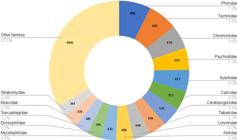

The top 15 genera-rich families of Diptera in Brazil (Mycetophilidae1 also includes Sarcophagidae in the same position, with 41 genera known).
Fly species described by Carolus Linnaeus
The number of species of Diptera known for Brazil has increased since the early taxonomic efforts from Carolus Linnaeus (Linnaeus 1758, 1762). He described 18 species nowadays occurring in Brazil (Table 3). Overall, between the first description of a fly species in 1758, Oestrus ovis Linnaeus, 1758 (Oestridae), until now, the average rate of annual records for Diptera has been 44.71 species/year. At the beginning of the 19th century, the number of new records increased, reaching the highest number in the 1830s, with 402 species described at the end of that decade, mainly by efforts by Christian Rudolph Wilhelm Wiedemann (Wiedemann 1828, 1830), with 242 species described, then dropping in the following decades to as much as only 53 species in the 1870s. From the end of the 19th century, the number of newly described species has been moving up (Figs 4-5). In the 20th century, from the 1910s to 1960s, 5,871 species were described, nearly 50% of the known Brazilian dipteran fauna, with an average rate of 97.9 species/year and close to 1,000 species/decade, emphasizing Charles Alexander, Thomas Borgmeier, John Lane, and Charles Townsend, which described together 1,861 species during this time frame. In the 1970s, 1980s, and 1990s, in which there were additional 1,456 species described, the number of species/year decreased to an average rate of 48.53, less than 500 species/decade (Figs 4-5). In the 2000s, the number increased again and reached the level of the 1960s. In the 2010s, the number of species being described and reported for Brazil was higher than the number of the most productive decades of last century, with 1,277 species described, with an average of 127.7 species/year (Figs 4-5).

Number of described and valid species of Diptera recorded in Brazil per decade, from 1758 to 2022.

Authors of Brazilian Diptera species
The 50 most productive authors described 7,938 species, which represents 67% of all valid species known for Brazil (Table 4). The top five authors described over 300 species each and, at least four of them, focused their research on particular families. Thomas Borgmeier contributed significantly to the current number of Phoridae, while Charles P. Alexander was important for the understanding of the Brazilian fauna of Tipulomorpha, John Lane to the knowledge of Bibionomorpha families, and Charles Henry T. Townsend to Tachinidae. Of the 50 most productive authors, 22 are Brazilians (three with dual nationality), followed by 12 Americans (one with dual nationality), seven are German (one with dual nationality), and another 11 are from other nationalities. Together, Brazilian authors on the list have described 3,790 species, nearly 48% of the total by the 50 most prolific authors of the Brazilian fauna. The number of Brazilians has not only increased among the top 50 in recent years but it is likely to surpass foreigners in the number of species described shortly-11 Brazilian taxonomists on the top most productive list are still active.
Species names based on localities
Naming species is but one of many components of species descriptions. One of the several strategies to compose the specific epithet of a species name is associating the name with the collecting sites, such as continents, countries, states, departments, provinces, municipalities, etc. For the Brazilian fauna, there are 493 species among the 15 most common names of places (Table 5). The most common names are associated with “Brasil/Brazil”, with 154 species named after it, followed by “Amazonia”, with 57, and “São Paulo”, with 41. Although most species are not necessarily restricted to a locality, such as the state of São Paulo or the Amazon Forest, these numbers often reflect where the species was first found.
Top 15 localities named after valid species of Diptera reported from Brazil, according to the CTFB.
Taxa named after people
Another option for naming species is to honor someone who directly or indirectly helped authors or was parti cularly important to the knowledge of an area of research. About 2,320 species reported from the Brazilian fauna were named after some relevant scientist, collector of the species, close relative, or even a dear person using 1,213 unique epi thets. The 20 most honored people comprise 478 species, most dipterists, other entomologists, or collectors of insects (Table 6) who have made outstanding contributions to the knowledge of biodiversity and taxonomy of Diptera and insects, in general, and applied Entomology. Many of the most honored people are Brazilians or lived in Brazil for a long time. The most honored was Fritz Plaumann (1902-1994), with 69 species named after him. He was born in East Europe and moved to Brazil in 1924, where he, in the countryside of the state of Santa Catarina, intensively collected insects from an area with ombrophilous mixed forests (Lubenow 2016, Radin and Corazza 2018). He sent thousands of insects abroad and, as a result, almost all primary types described from his material are deposited outside Brazil. There is an important set of specimens collected by Plaumann in the Museu de Zoologia, Universidade de São Paulo (MZUSP), especially from the late 1960s and early 1970s.
Differently of the species name, it is considerably rarer to loan a person’s name for a genus, and in general, this is used to express greater gratitude for contribution in different parts of the scientific process, collecting specimens, describing species, or even science funding and supporting. We have identified over 150 genera occurring in Brazil named after people, 49 of them are Brazilian scientists, mainly dipterists (Table 7). Messias Carrera, who contributed, mainly to the systematics of Asilidae, was honored with names of four genera, followed by Hugo de Souza Lopes, Thomas Borgmeier, and Adolpho Lutz, with three generic eponyms.
A closer look at the last 30 years
A total of 2,653 species were described in the last 30 years (1993-2022) for Brazil, with 578 between 1993 and 2002, 1,034 between 2003 and 2012, and 1,041 between 2013 and 2022. The increase in the number of species shows similar progress over these decades for 77 fly families, which certainly reflects the distribution of specialists. The top 15 families with more described species in the period comprised 1,929 species, nearly 73% of all described species in the last 30 years. These had at least one species described in each decade. An exception is Clusiidae, which had two species described between 1993 and 2002 and 90 species described from 2003 to 2012-which largely reflects the effort made by Owen Lonsdale and Stephen A. Marshall (Lonsdale and Marshall 2006, 2007, 2012) to deal with the Neotropical fauna of the family.
The increase in the number of species for Brazil in most top 15 fly families in the last decade was as high as the decade before or higher (Fig. 6). The only exceptions were Psychodidae, Phoridae, Cecidomyiidae, and Clusiidae. In the rank of families with more described species in the 30 years, from rank #16 to #30, there is a predominance of species described from 2003 to 2012 (nine). Another five families had more described species from 2013 to 2022 and, only one family (Pipunculidae) had more species described from 1993 to 2002 (Fig. 7). Similarly, from #31 to #45, seven families had more species described from 2003 to 2012, four families with a high number of species described from 2013 to 2022, and another four for which most of their species were described from 1993 to 2002 (Fig. 8). Finally, from #46 to #77 in the rank, families whose species were described in only one of the three periods, 24 out of 32, predominate. Of these, the fauna of 15 families in the last 30 years were all described from 2013 to 2022, while eight families had species described from 2003 to 2012, and only one family from 1993 to 2002 (Figs 9-10).

Diptera families ranked by the total of species described in the last three decades in Brazil: 1993-2002, 2003-2012, and 2013-2022: (6) family list from 1st to 15th; (7) family list from 16th to 30th; (8) family list from 31st to 45th; (9) family list from 46th to 60th; (10) family list from 61st to 77th.
The number of people who have authored species descriptions over the last 30 years has changed, with more authors collaborating on the descriptions in the most recent decade (Fig. 11). From 1993 to 2002, more than half of the species, 54.4% (315 species), were described by a single author, followed by 37% (213) and 8.6% (50), with two and three or more authors, respectively. From 2003 to 2012, the proportion of species described by a single author dropped to 24% (246 species), while species proposed by two or three authors increased substantially, representing 55% (574) and 19% (193) of the names of that decade, respectively. Lastly, from 2013 to 2022, the proportion of species described by a single author dropped even more, to 15% (152) of the total, and species described by two authors represented 45% (468) and those described by three authors increased to 33% (343) of all names of this last decade.

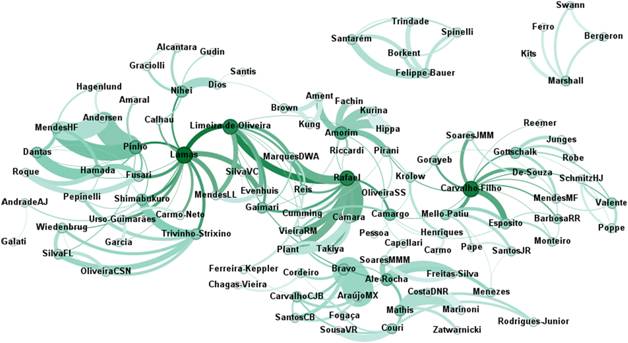
The interaction and collaborative work of the Brazilian research groups while describing species between 1993 and 2022 was analyzed. In Figs 12-13, each circle represents an author with at least five species described. The size of the circles is relative to the number of species names proposed by each author and the intensity of colors represents how central that author is to the network concerning the connections with other authors. Connections between authors result from species names described and the width of the connection is related to the number of species names in collaboration. Comparing the connections over the decades, we found that not only did the number of dipterists expand in Brazil and not only the number of co-authors for each species increased, as referred to above, but the network among authors and research groups became more complex, reflecting an increase of collaboration among Brazilians.


DISCUSSION
Currently, there are approximately 160,000 known species of Diptera worldwide (Evenhuis and Pape 2023, Whitmore et al. 2021), the Brazilian fauna with 12,194 thus represents nearly 7.6% of the world fauna. There are 102 families reported in the country, of close to 160 families known worldwide. Of the families with records for Brazil, five were only recently reported-Austroleptidae (Fachin et al. 2018, 2020), Inbiomyiidae (Riccardi and Amorim 2019), Atelestidae (Amorim et al. 2020), Celyphidae (Rafael et al. 2022), and, more recently, Diastatidae (Costa et al. 2023)-what indicates that there is an important fraction of the fly diversity that is still unknown even at higher taxonomical levels in Brazil.
Of the list of 15 most species-rich families in Brazil, 10 are also present in the inventory of flies in a tropical forest in Zurquí, Costa Rica (Brown et al. 2018, Borkent et al. 2018)-Phoridae, Tachinidae, Mycetophilidae, Tipulidae s.l., Drosophilidae, Ceratopogonidae, Psychodidae, Chironomidae, Muscidae, and Syrphidae. The other five in the Zurquí list were Cecidomyiidae, Sciaridae, Agromyzidae, Lauxaniidae, and Dolichopodidae.
Even though the numbers of Brazilian species correspond to the accumulated effort for over two centuries, there is still a taxonomical bias, dark taxa (in the sense of Hartop et al. 2022) introduce biases. The top-15 list of families with larger number of barcode index numbers found in Canada by Hebert et al. (2016), for temperate environments, shares nine families of their list of most species-rich families with Brazil-Chironomidae, Ceratopogonidae, Mycetophilidae, Phoridae, Dolichopodidae, Tachinidae, Muscidae, and Syrphidae-and their list also includes Cecidomyiidae, Sciaridae, Agromyzidae, Empididae, Anthomyiidae, and Chloropidae. Srivsathsan et al. (2023), dealing with Malaise trap samples from different regions, reported 10 fly families among the 20 most species-rich families of insects: Cecidomyiidae, Ceratopogonidae, Chironomidae, Chloropidae, Dolichopodidae, Muscidae, Phoridae, Psychodidae, Sciaridae, and Sphaeroceridae. These numbers stress the difference between the expected families with more species and those with more described species and highlight to the dipterist community the bias in the distribution of specialists considering the major taxonomical gaps in species diversity.
The data available for other countries or biogeographical areas strongly suggests a deficit of taxonomic investment in some fly families in Brazil and the Neotropical Region. For the sake of comparison, Pape et al. (2009) indicated that, for 152,715 species known in the world, the Palearctic Region had 44,894 species, the Neotropical Region had 31,088, the Oriental Region had 22,543, the Nearctic Region had 21,449, the Afrotropical Region had 20,163, and the Australasian Region had 18,920. Particularly noteworthy are the Cecidomyiidae, which may be the insect family with the largest abundance of species on the planet (Hebert et al. 2016). There is certainly a very high portion of unknown diversity in Brazil in the Sciaridae, Empidoidea, and in some schizophoran families, e.g., Agromyzidae, Chloropidae, Drosophilidae, Lauxaniidae, and Sphaeroceridae. Especially in the last 20 years, the question of lack of investment and continuity of studies in fly families has been addressed in the discussion of long-term faunal surveys, such as the SISBIOTA-Diptera (Lamas et al. 2023), and governmental programs that have focused on poorly studied biomes and areas and neglected taxa, forming a new generation of experts (Rafael et al. 2009).
The fact that the last decade was the most productive ever in terms of unearthing the hidden insect diversity is meaningful. Over the last decades, North America, Europe, Japan, and Australia lost hundreds of taxonomists’ research positions in universities. This is impressive considering the amount of attention given to biodiversity and conservation in a world impacted by climate change. Indeed, the loss of taxonomist positions is revealed to be a large-scale counterintuitive decision when considering the need for urgent actions for biodiversity conservation and the fulfillment of the Paris Agreement-and it is evidence of the biased current methods for measuring scientific impact. Over the last 40 years, Brazil has expanded its baseline of specialists and improved the quality and productivity of its biodiversity community-the fact that the last decade was the most productive ever in terms of species described did not occur by chance. It is the result of planned investment in training, hiring, funding, and valuing biodiversity research in nationwide research funding agencies and universities, but also at state-level funding agencies and universities (Rafael et al. 2009)-not without a fight, though (Bockmann et al. 2018). Nevertheless, improving biodiversity knowledge is not enough to balance the fast loss of natural environments and biodiversity which is considered one of the top five threats to planetary health (World Economic Forum 2023). Biodiversity assessment and monitoring are among the most urgent challenges of modern biology and contemporary society (unpublished data). We hope that we can still expand the size and productivity of the entomologist community in Brazil in terms of describing insect diversity in the country.
Final remarks
The CTFB is a real-time tool to assess and update the knowledge on Brazilian animal diversity and develop new scientific policies for biodiversity. In this sense, more data should be added soon, and inferences that can be built from it should be implemented. Particularly, the information on the geographic distribution of species diversity, for the sake of formal use, gathers elements of the fauna spread across the country, however, most faunal elements overlap in distribution. The improvement of the CTFB system to include distribution by states and biomes will provide much better maps of species distribution and reveal the geographical gaps in our present knowledge. This further step is indispensable to assess local diversity and implement conservation policies.
The CTFB makes public and easily accessible high-quality taxonomic information about the species occurring in Brazil, curated by taxonomic specialists, which may include for each taxon, besides a distributional occurrence map, more complex information, such as the history of nomenclatural changes, classifications, and a reference list. In a manner, it publicly gives information about the Brazilian fauna, which is often found only by the charge of papers that not everyone, Brazilian and non-Brazilian scientists, can afford. Thus, the CTFB may impact positively the quality of the scientific studies covering the Brazilian fauna, as well as the surrounding countries where the fauna overlaps.
The increase in the speed of species descriptions over the last few decades reported here has not happened by chance. This is a reflection of political decisions made on behalf of science by funding agencies in Brazil. This process began with Nelson Papavero’s Special Course on Zoological Systematics, which laid the foundations of biological systematic theory and practice for grad students in the 1980s. The creation of the area of Biodiversity by CAPES (Coordination for the Improvement of Higher Education Personnel) as an independent area of research (with a customized system of quality assessment) was key to promoting research and training in taxonomy. In terms of research funding and training for biodiversity, CNPq (National Council for Scientific and Technological Development) launched the PROTAX program (Program for Capacity Building in Taxonomy) in 2005, which is in its fourth edition, funding biodiversity research nationwide. Other programs, such as the BIOTA program (Biodiversity Characterization, Conservation, Restoration and Sustainable Use), launched in 1999 by the FAPESP (The São Paulo Research Foundation), were also vital for funding research on biological systematics (Noll 2022).
The analysis of the Brazilian Diptera based on the CTFB shows that this insect order presently represents 9.3% of the Brazilian fauna, the third most species-rich taxon in the country. The number of dipterists in Brazil has grown and the number of co-authors for each species has increased in the last decade. The network among authors and research groups became more complex, reflecting an increasing collaboration among Brazilian taxonomists and foreign specialists. We reached a higher number of species described and reported for Brazil in the last decade (2010s), which certainly reflects the distribution of specialists in several families. Soon, the total number of Brazilian species described by Brazilian authors will surpass the number of described species by foreign authors. This shows that the country has reached autonomy in the production of scientific information in this area, and non-Brazilian scientists are welcome to contribute to the knowledge of the Brazilian fauna. Policies should be put in place to address the families with the strongest deficit in the proportion of expected faunal diversity and availability of specialists-e.g., the top 11 species-rich fly families in Malaise trapping, regardless of clade age, continent, climatic region, and habitat type: Cecidomyiidae, Ceratopogonidae, Chironomidae, Psychodidae, Sciaridae, Phoridae, Tipulidae, Dolichopodidae, Muscidae, Chloropidae, and Mycetophilidae (Srivasthan et al. 2023).
ACKNOWLEDGEMENTS
We are very grateful to Ministério da Ciência, Tecnologia e Inovação, Governo Federal, Brazil) and Ministério do Meio Ambiente, Governo Federal, Brazil for the financial support at the beginning of the CTFB project; to all of the coordinators of the CTFB taxa for the management of this enormous project. To the botanist Rafaela Campostrini Forzza for the support and accommodation of the CTFB in the infrastructure of the Botanical Garden of Rio de Janeiro. To all zoologists for participating in this enormous project, and here, especially to all our dipterists (Table 2), who are the backbone of this survey and have been compi ling data on the families since 2015. Without their expertise and commitment, none of this would have been possible. We also want to give special thanks to Raimundo Nonato Macedo dos Santos (Universidade Federal de Pernambuco) for helping us in the analyses with the VantagePoint v. 9.0 and Alejandro Caballero Rivero and Juliana Lazarotto Freitas (Instituto Nacional da Mata Atlântica) for their help with the network analysis in Gephi v.9.0. JAR thanks to Conselho Nacional de Desenvolvimento Científico e Tecnológico (CNPq) and Fundação de Amparo à Pesquisas do Estado do Amazonas (FAPEAM) and DDDC is grateful to CNPq grant #151354/2022-7.
LITERATURE CITED
- Amorim DS (2009) Neotropical Diptera diversity: richness, patterns, and perspectives. In: Pape T, Bickel D, Meier R (Eds) Diptera diversity: status, challenges and tools. Brill Academic Publishers, Leiden, 71-97.
-
Amorim DS, Riccardi PR, Rafael JA (2020) First known extant species of Alavesia (Diptera: Atelestidae) in the Neotropical Region: Alavesia leukoprosopa, sp. nov., from the southern Atlantic Forest, Brazil. American Museum Novitates 2020(3962): 1-12. https://doi.org/10.1206/3962.1
» https://doi.org/10.1206/3962.1 - Amorim DS, Silva VC, Balbi MIPA (2002) Estado do conhecimento dos Diptera neotropicais. In: Costa C, Vanin SA, Lobo JM, Melic A (Eds) Red Iberoamericana de Biogeografía y Entomología Sistemática PrIBES 2002. Zaragosa, vol. 2, 29-33.
- Amorim DS, Yeates D (2006) Pesky gnats: ridding dipteran classification of the “Nematocera”. Studia Dipterologica 13(1): 3-9.
-
Borkent A, Brown BV, Adler PH, Amorim DS, Barber K, Bickel D, et al. (2018) Remarkable fly (Diptera) diversity in a patch of Costa Rican cloud forest: why inventory is a vital science. Zootaxa 4402(1): 53-90. https://doi.org/10.11646/zootaxa.4402.1.3
» https://doi.org/10.11646/zootaxa.4402.1.3 -
Bockmann FA, Rodrigues MT, Kohsldorf T, Straker LC, Grant T, Pinna MCC, et al. (2018) Brazilian government attacks biodiversity. Science 360(6391): 865. https://doi.org/10.1126/science.aat7540
» https://doi.org/10.1126/science.aat7540 -
Brown BV, Borkent A, Adler PH, Amorim DS, Barber K, Bickel D, et al. (2018) Comprehensive inventory of true flies (Diptera) at a tropical site. Nature, Communications Biology 1(21): 1-7. https://doi.org/10.1038/s42003-018-0022-x
» https://doi.org/10.1038/s42003-018-0022-x -
Costa SV, Pirani G, Mathis WN (2023) First record of Diastatidae (Diptera: Ephydroidea from Brazil, with the description of a new species. Zootaxa 5278(2): 378-386. https://doi.org/10.11646/zootaxa.5278.2.10
» https://doi.org/10.11646/zootaxa.5278.2.10 -
Evenhuis N, Pape T (2023) Systema Dipterorum. Version 3.6, http://www.diptera.org/
» http://www.diptera.org/ -
Fachin DA, Santos CMD, Amorim DS (2018) First two species of Austroleptis Hardy (Diptera: Brachycera: Austroleptidae) from Brazil. Zootaxa 4369(4): 557-574. https://doi.org/10.11646/zootaxa.4369.4.6
» https://doi.org/10.11646/zootaxa.4369.4.6 -
Fachin DA, Santos CMD, Amorim DS (2020) Endemism within endemism: a new species of Austroleptis Hardy, 1920 (Diptera: Austroleptidae) from the Brazilian Atlantic Forest highlands. Zootaxa 4803(3): 483-494. https://doi.org/10.11646/zootaxa.4803.3.4
» https://doi.org/10.11646/zootaxa.4803.3.4 -
Hartop E, Srivathsan A, Ronquist F, Meier R (2022) Towards Large-scale Integrative Taxonomy (LIT): resolving the data conundrum for dark taxa. Systematic Biology 71(6): 1404-1422. https://doi.org/10.1093/sysbio/syac033
» https://doi.org/10.1093/sysbio/syac033 -
Hebert PD, Ratnasingham S, Zakharov EV, Telfer AC, Levesque-Beaudin V, Milton MA, et al. (2016) Counting animal species with DNA barcodes: Canadian insects. Philosophical Transactions of the Royal Society of London, Series B, Biological Sciences 371(1702): 20150333. https://doi.org/10.1098/rstb.2015.0333
» https://doi.org/10.1098/rstb.2015.0333 -
Klassa B, Santos CMD (2014) The man who loved flies: a biographical profile of Nelson Papavero. Zootaxa 3793(2): 201-221. https://doi.org/10.11646/zootaxa.3793.2.1
» https://doi.org/10.11646/zootaxa.3793.2.1 -
Lamas CJE, Fachin DA, Falaschi RL, Alcantara DMC, Ale-Rocha R, Amorim DS, et al. (2023) The SISBIOTA-Diptera Brazilian Network: A long-term survey of Diptera from unexplored Brazilian Western Arc of Amazon, Cerrado, and Pantanal. Revista Brasileira de Entomologia 67(4): e20230051. https://doi.org/10.1590/1806-9665-RBENT-2023-0051
» https://doi.org/10.1590/1806-9665-RBENT-2023-0051 - Linnaeus C (1758) Systema Naturae per Regna tria Naturae, Secundum Classes, Ordines, Genera, Species, cum Characteribus, Differentiis, Synonymis, Locis. Stockholm, 10th ed., vol. 1, 824 pp.
- Linnaeus C (1762) Malum Aurantium alterum alteri inclusum; quod Comes Tessin Academiæ exhibuit, descripsit C. Linnaeus. Analecta Trisalpina. Typis & Impensis Nicolai Pezzanae, Venetiis, 414-416.
-
Lonsdale O, Marshall SA (2006) Revision of the New World Craspedochaeta Czerny. Zootaxa 1291: 1-101. https://doi.org/10.11646/zootaxa.1291.1.1
» https://doi.org/10.11646/zootaxa.1291.1.1 - Lonsdale O, Marshall SA (2007) Revision of the New World Heteromeringia (Diptera: Clusiidae: Clusiodinae). Beiträge zur Entomologie 57(1): 37-80.
-
Lonsdale O, Marshall SA (2012) Sobarocephala (Diptera: Clusiidae: Sobarocesphalinae) - Subgeneric classification and Revision of the New World species. Zootaxa 3370(1): 1-307. https://doi.org/10.11646/zootaxa.3370.1.1
» https://doi.org/10.11646/zootaxa.3370.1.1 -
Lubenow AM (2016) Um alemão em Santa Catarina: a coleção entomológica Fritz Plaumann. Museologia & Interdisciplinaridade 5(9): 109-119. https://doi.org/10.26512/museologia.v5i9.17270
» https://doi.org/10.26512/museologia.v5i9.17270 -
Noll FB, Barbosa MFC, Santos EF, Castilho RC, Lamas CJE, Freitas AVL, Moraes GJ (2022) The contribution of the BIOTA/FAPESP Program to the advancement of the knowledge on terrestrial invertebrates. Biota Neotropica 22(spe): e20221398. https://doi.org/10.1590/1676-0611-BN-2022-1398
» https://doi.org/10.1590/1676-0611-BN-2022-1398 - Papavero N (1966-1984) Catalogue of the Diptera of the Americas south of the United States. Museu de Zoologia, Universidade de São Paulo, São Paulo, 2877 pp.
- Pape T, Bickel D, Rudolf M (2009) Diptera diversity: status, challenges and tools. Brill Academic Publishers, Leiden, 459 pp.
-
Radin JC, Corazza G (2018) Museu Fritz Plaumann. In: Radin JC, Corazza G (Eds) Dicionário histórico-social do Oeste catarinense. Editora UFFS, Chapecó, 121-124. https://doi.org/10.7476/9788564905658.0029
» https://doi.org/10.7476/9788564905658.0029 - Rafael JA, Aguiar AP, Amorim DS (2009) Knowledge of insect diversity in Brazil: challenges and advances. Neotropical Entomology 38: 565-570.
-
Rafael JA, Calhau J, Alvarez-Garcia DM, Ament DC, Amorim DS, Andrade AJ, et al. (2024) Diptera. In: Catálogo Taxonômico da Fauna do Brasil. PNUD, http://fauna.jbrj.gov.br/fauna/faunadobrasil/252
» http://fauna.jbrj.gov.br/fauna/faunadobrasil/252 -
Rafael JA, Lima SP, Marques DWA (2022) First record of beetle flies (Diptera: Celyphidae) from Brazil. Entomological Communications 4: ec04020. https://doi/10.37486/2675-1305.ec04020
» https://doi/10.37486/2675-1305.ec04020 - Rafael JA, Melo GAR, de Carvalho CJB, Casari SA, Constantino R (2012) Prefácio. In: Rafael JA, Melo GAR, de Carvalho CJB, Casari SA, Constantino R (Eds). Insetos do Brasil: Diversidade e Taxonomia. Holos Editora, Ribeirão Preto, xiii-xiv.
-
Riccardi PR, Amorim DS (2019) First species of Inbiomyia from the Atlantic Forest of Brazil (Diptera: Inbiomyiidae). American Museum Novitates 2019(3935): 1-20. https://doi.org/10.1206/3935.1
» https://doi.org/10.1206/3935.1 -
Srivathsan A, Ang Y, Heraty JM, Hwang WS, Jusoh WFA, Kutty SN, Puniamoorthy J, Yeo D, Roslin T, Meier R (2023) Convergence of dominance and neglect in flying insect diversity. Nature Ecology & Evolution 7: 1012-1021. https://doi.org/10.1038/s41559-023-02066-0
» https://doi.org/10.1038/s41559-023-02066-0 -
Whitmore D, Gaimari SD, Nihei SS, Evenhuis NL, Kurina O, Borkent CJ, et al. (2021) Twenty years of Dipterology through the pages of Zootaxa. Zootaxa 4979(1): 166-189. https://doi.org/10.11646/zootaxa.4979.1.17
» https://doi.org/10.11646/zootaxa.4979.1.17 - Wiedemann CRW (1828) Aussereuropäische zweiflügelige Insekten. Erster Theil. Schulzischen Buchhandlung, Hamm, 608 pp.
- Wiedemann CRW (1830) Aussereuropäische zweiflügelige Insekten. Zweiter Theil. Schulzischen Buchhandlung, Hamm , 684 pp.
-
World Economic Forum (2023) The Global Risks Report 2023. 18th ed., https:/zurich.com/knowledge/topics/global-risks/the-global-risks-report-2023
» https:/zurich.com/knowledge/topics/global-risks/the-global-risks-report-2023
ADDITIONAL NOTES
- ZooBank register
-
How to cite this article
Rafael JA, Amorim DS, Carmo DDD, Cordeiro DP, Freitas-Silva RAP, Fachin DA (2024) The fauna of Diptera (Insecta) in Brazil: an online system and an overview of over two centuries of taxonomic effort. Zoologia 41: e23096. https://doi.org/10.1590/S1984-4689.v41.e23096
-
Published by
Sociedade Brasileira de Zoologia at Scientific Electronic Library Online - https://www.scielo.br/zool
-
Conselho Nacional de Desenvolvimento Científico e Tecnológico (CNPq) and Fundação de Amparo à Pesquisas do Estado do Amazonas (FAPEAM) and DDDC is grateful to CNPq grant #151354/2022-7. JAR thanks to Conselho Nacional de Desenvolvimento Científico e Tecnológico (CNPq) and Fundação de Amparo à Pesquisas do Estado do Amazonas (FAPEAM) and DDDC is grateful to CNPq grant #151354/2022-7
Supplementary material 1
Supplementary 1. List of all valid species of Diptera recorded in Brazil until January 2023.
Authors: Rafael JA, Amorim DS, Carmo DDD, Cordeiro DP, Freitas-Silva RAP, Fachin DA
Data type: Species data
Supplementary material 2
Supplementary 2. Top 15 most genera and species-rich families (until July 2024).
Authors: Rafael JA, Amorim DS, Carmo DDD, Cordeiro DP, Freitas-Silva RAP, Fachin DA
Data type: Species data.
Supplementary material 3
Supplementary 3. Valid species of Diptera recorded to Brazil per decade (until January 2023).
Authors: Rafael JA, Amorim DS, Carmo DDD, Cordeiro DP, Freitas-Silva RAP, Fachin DA
Data type: Species data.
Supplementary material 4
Authors: Rafael JA, Amorim DS, Carmo DDD, Cordeiro DP, Freitas-Silva RAP, Fachin DA
Data type: Species data.
Supplementary material 5
Authors: Rafael JA, Amorim DS, Carmo DDD, Cordeiro DP, Freitas-Silva RAP, Fachin DA
Data type: Species data.
Copyright notice: These datasets are made available under the Open Database License (http://opendatacommons.org/licenses/odbl/1.0/). The Open Database License (ODbL) is a license agreement intended to allow users to freely share, modify, and use this Dataset while maintaining this same freedom for others, provided that the original source and author(s) are credited.
Data citations
Rafael JA, Calhau J, Alvarez-Garcia DM, Ament DC, Amorim DS, Andrade AJ, et al. (2024) Diptera. In: Catálogo Taxonômico da Fauna do Brasil. PNUD, http://fauna.jbrj.gov.br/fauna/faunadobrasil/252