
 A new species of Heredius (Hymenoptera: Braconidae: Doryctinae) from Brazilian Amazon Rainforest
ABSTRACT
Heredius Marsh, 2002 is a small genus, with only three described species, recorded only in Costa Rica and Brazil. The aim of this paper was to describe a new species of Heridius from Brazilian Amazon Rainforest. The specimen was collected by Malaise trapping in the Adolpho Ducke Forest Reserve (02°57’S, 59°55’W), Manaus, Amazonas, Brazil. A new species, Heredius gadelhai sp. nov. differs from the other three known species mainly having 1.5 mm long, is entirely yellow, ocellar-ocular distance of about 3.5 times the diameter of the lateral ocellus; malar space 0.3 times the height of the eye; first flagellomere 0.8 times the length of the second flagellomere; precoxal groove present and smooth, and ovipositor 0.2 times the length of the body. We illustrate and a key to all described species of Heredius were provided.
KEY WORDS:
Distribution; neotropical; parasitoids; taxonomy
INTRODUCTION
Doryctinae is one of the most diverse subfamilies of Braconidae, with over 2,000 valid species described and more than 200 valid genera (Yu et al. 2016, Chen and van Achterberg 2019, Saleh and Gadallah 2024). This subfamily is mostly composed of idiobiont ectoparasitoids of Coleoptera larvae, although some species are also known to attack Lepidoptera and Hymenoptera larvae (Yu et al. 2016, Belokobylskij et al. 2023). Phytophagy has evolved in one clade of Doryctinae, mainly associated with galls clade (Zaldívar-Riverón et al. 2014). Doryctinae is considered a morphologically diverse subfamily, and the complexity of its morphology and the diversity of its biological habits continue to challenge researchers in fully understanding this group (Belokobylskij et al. 2004). Various molecular phylogenetic studies based both on Sanger and nuclear genome-wide (ultraconserved elements) data have recovered a non-monophyleitic Doryctinae, with a mainly Old World clade not related to a New World, Australian and Holcobraconini clade (Zaldívar-Rive rón et al. 2008, Sharanowski et al. 2011, Jasso-Martínez et al. 2022, Castañeda-Osório et al. 2024).
HerediusMarsh, 2002 is a small genus, with only three described species, recorded only in Costa Rica (H. laselvus Marsh, 2002) and Brazil (H. flavus Castro, Nunes & Penteado-Dias, 2011, and H. assu Castro & Penteado-Dias, 2017). In Brazil, the genus is known to occur in the states of São Paulo (savannah area) and Rio Grande do Norte (caatinga biome) (Castro et al. 2011, Castro and Penteado-Dias 2017, Shimbori et al. 2024), and at least one undescribed species from the state of Espirito Santo (Atlantic Forest biome) (Azevedo et al. 2015). Species of Heredius are rare in collections (Castro and Penteado-Dias 2017) and the biology of this neotropical genus is still unknown. It is distinguished from other members of Doryctinae by its acinose frons, fairly small body length (up to 4.0mm), and presence of hind wing vein cu-a (Marsh 2002). In this study, we describe and illustrate the first species of Heredius from the Brazilian Amazon Rainforest and provide a key to its known species.
MATERIAL AND METHODS
The specimen studied was collected by Malaise trapping in the Adolpho Ducke Forest Reserve (02°57’S, 59°55’W), Manaus, Amazonas, Brazil. For more details on the sample methodology see Silva et al. (2023, 2024, 2025). The type material is deposited in the Invertebrate Collection of Instituto Nacional de Pesquisas da Amazônia (INPA), Marcio L. Oliveira, curator.
Taxonomic concepts and identification. Specimens assigned to Heredius were identified using Marsh (2002). The specimen was compared with the other species, using Castro et al. (2011), Marsh (2002), and Castro and Penteado-Dias (2017). Identification at species level was conducted using the key to species provided by Castro and Penteado-Dias (2017). Morphological terminology mostly follows Sharkey and Wharton (1997), except for the term “precoxal sulcus” which replaces “sternaulus” (Wharton 2006). Surface sculpture nomenclature follows Harris (1979).
Digital images were taken using a Leica DMC4500 digital camera attached to a Leica M205A stereomicroscope and combined using the Leica Application Suite V4.10.0 software. The final images were edited in Adobe Photoshop. The distribution map was created using SimpleMappr software (Shorthouse 2010).
TAXONOMY
Heredius gadelhai sp. nov.
https://zoobank.org/B485A265-30D0-4FE1-B1F9-E25B3709E1ED
Diagnosis. This is the smallest species of the genus at 1.5 mm (other species > 2.7 mm), with fewer antennal segments and the shorter ovipositor (both in relative and absolute terms), and may be distinguished from all other known members of the genus by the following combination of characters: body length 1.5 mm and entirely yellow, ocell-ocular distance about 3.5 times diameter of lateral ocellus; malar space 0.3 times eye height, antenna with 14 flagellomeres, first flagellomere is 0.8 times the length of the second flagellomere, precoxal sulcus smooth; ovipositor, 0.2 times the body length.
Type material. Holotype female: Brazil, Amazonas, Manaus, Reserva Ducke, 2°57’S 59°55”W, L6-3500, Malaise 2, Período 48 hours, X-2014, Azevedo, S.S. leg. (INPA). Holotype condition: Hind legs missing.
Description. Female. Body length 1.5 mm. (Fig. 1)
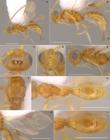
Heredius gadelhai sp. nov., holotype female: (A) lateral habitus; (B) body, lateral view; (C) head, dorsal view; (D) head, front view; (E) head and mesosoma, lateral; (F) mesoscutum, dorsal; (G) body, dorsal; (H) fore wings; (I) propodeum and metasoma, dorsal. Scale bars: = A, B, E, G, H, I = 0.5 mm, C, D, F = 0.1 mm.
Head. Face, front, vertex and temple acinose (Fig. 1C-D); head width 1.4 times median length (dorsal view), 1.4 times width of mesoscutum. Transverse diameter of eye 3.9 times longer than temple in lateral view. Ocell-ocular distance about 3.5 times diameter of lateral ocellus. Ocelli arranged in an isosceles triangle. POL 1.0 times to OD, 0.3 times to OOL. Eye glabrous, 0.7 times wider than high. Height of malar space around 0.3 times height of eye. Hypoclypeal depression rounded, 1.9 times wider than height. Occipital carina complete, ventrally joined with hypostomal carina. Antenna with 16 antennomeres. Scape 1.6 times longer than its maximum width, first flagellar segment straight, 4.9 times longer than apical width, 0.8 times longer than second segment.
Mesosoma. Length of mesosoma1.6 times its height (Fig. 1A-B, E). Pronotum, propleuron, and mesopleuron acinose. Mesoscutum 0.8 times longer than wide (dorsal view). Notauli scrobiculate (1F-G); precoxal sulcus smooth and nearly complete (Fig. 1B). Propodeum mostly rugose and acinose, areolate area slightly rugose and extending across the entire propodeum, forming a diamond shape. Wings (Fig. 1H): Fore wing 3.2 times longer than its maximum width. Pterostigma large, 3.6 times longer than wide. Vein r arising slightly after middle of pterostigma. Marginal cell length 3.3 times maximum width. Vein R1 1.6 times longer than pterostigma. Vein r 0.7 times as long as maximum width of pterostigma. Vein 3RSa straight in its length, 2.1 times longer than vein r, 0.8 times longer than vein 2RS. Vein 2RS 2.7 times longer than vein r, 2.6 times longer than vein m-cu. Vein m-cu in line with vein 2RS. Vein (RS+M) slightly curved. First discal cell 1.4 times longer than width. Veins 1M parallel to m-cu. Vein 1M 2.2 times longer than vein 1RS, 2.6 times longer than vein m-cu. Vein cu-a straight and short, 0.2 times the length of vein 1M. Vein M+CU straight. Hind wing 5.6 times longer than wide; vein cu-a straight. Legs: Hind legs broken/missing; fore tibia with a row of five spines arranged more or less in a line.
Metasoma. Metasoma 1.2 times longer than head and mesosoma combined. Maximum width of first tergite 1.7 times its minimum width; length 0.6 times longer than apical width, 0.6 times length of propodeum. First metasomal tergite rugulose, second metasomal tergite lacunose basally (Fig. 1G, I). Remaining tergites smooth with few setae. Median length of second tergite about 1.2 times its basal width, 2.1 times length of third tergite. Combined length of second and third tergites 0.9 times their maximum width. Ovipositor 0.4 times as long as metasoma, 0.6 times longer than mesosoma, 0.2 times as long as body, 0.2 times as long as fore wing.
Color. Body entirely light yellow (Fig. 1), except for light brown apical flagellomeres and forewing stigma, ovipositor black at the apex, sheaths light brown; palpi, coxae, trochanter, and trochantellus yellowish white; wings hyaline.
Male. Unknown.
Distribution. Amazonas (Brazil) (Fig. 2).

Geographic distribution of species of Heredius in the world. Costa Rica and Brazilian state record is highlighted in gray. The red circle represents the specimens Heredius laselvus. Red star Heredius flavus, red triangle Heredius assu and blue square Heredius gadelhai sp. nov.
Biology. Host unknown.
Etymology. The new species is named in honor of our colleague and friend Sian Gadelha, a taxonomist who specialized in braconid wasps and greatly contributed to the knowledge of the systematics of the Doryctinae.
Remarks. The new species is similar to H. flavus Castro, Nunes & Penteado-Dias, 2011 (Castro et al. 2011), in having the body entirely yellow, small ocelli, head and mesosoma mainly acinose, notauli scrobiculate, and first tergite with basal width 0.6 times the apical width. It differs from H. flavus in having a body length of 1.5 mm (4.0 mm in H. flavus), antenna with 14 flagellomeres (30 in H. flavus), precoxal sulcus smooth (finely scrobiculate in H. flavus), and ovipositor short, 0.2 times the body length (ovipositor as long as the body in H. flavus). Despite the apparent rarity of Heredius specimens in collections, the genus is widely distributed in the Neotropical region, as each of the four described species occurs in four distinct locations (one in Costa Rica and three in Brazil) (Fig. 2), in different vegetations and biomes. Therefore, its actual species richness is likely to be underestimated.
Key to species of Heredius
1. Body entirely yellow, ocell-ocular distance about 3.5-4.0 times diameter of lateral ocellus .................... 2
1’. Body mostly brown or black; ocell-ocular distance 2.0-2.7 times diameter of lateral ocellus .................... 3
2. Body length 4.0 mm, malar space 0.5 times eye height, antenna with 30 flagellomeres, ovipositor as long as body .................... Heredius flavus Castro, Nunes & Penteado-Dias, 2011
2’. Body length 1.5 mm, malar space 0.3 times eye height, antenna with 14 flagellomeres, ovipositor short, 0.2x the body length .................... Heredius gadelhai Silva, Shimbori & Fernandes sp. nov.
3. Antenna mostly dark brown with basal segments yellow; ovipositor 0.4 times longer than body (0.7 times metasoma); scutellum acinose .................... Heredius assu Castro & Penteado-Dias, 2017
3’. Antenna with apical 8-9 segments white; ovipositor nearly as long as body (1.5 times as long as metasoma) .................... Heredius laselvus Marsh, 2002
ACKNOWLEDGMENTS
We thank the Invertebrate Collection of Instituto Nacional de Pesquisas da Amazônia and the Laboratório Temático de Microscopia e Nanotecnologia (INPA) for allowing the use of photographic equipment used in this work. We thank the Programa de Pós-Graduação em Zoologia MPEG/UFPA. ABS thanks Coordenação de Aperfeiçoamento de Pessoal de Nível Superior (CAPES, 88887.679100/2022-00 and Finance Code 001). DRRF thanks Fundação de Amparo à Pesquisa do Estado do Amazonas, Universal Amazonas (FAPEAM, 062.00770/2015); Edital Universal, Conselho Nacional de Desenvolvimento Científico e Tecnológico (CNPq, 432933/2018-2 and 300722/2022-2).
References
- Azevedo CO, Dal Molin A, Penteado-Dias AM, Macedo ACC, Rodriguez-V B, Dias BZK, et al. (2015) Checklist of the genera of Hymenoptera (Insecta) from Espírito Santo state, Brazil. Boletim do Museu de Zoologia Mello Leitão 37(3): 313-343.
-
Belokobylskij SA, Simutnik SA, Vasilenko DV, Perkovsky EE (2023) First record of the parasitoid subfamily Doryctinae (Hymenoptera, Braconidae) in Rovno amber: description of a new genus and species with stigma-like enlargement on the hind wing of the male. Journal of Hymenoptera Research 95: 59-72. https://doi.org/10.3897/jhr.95.96784
» https://doi.org/10.3897/jhr.95.96784 -
Belokobylskij SA, Zaldívar-Riverón A, Quicke DLJ (2004) Phylogeny of the genera of the parasitic wasps subfamily Doryctinae (Hymenoptera: Braconidae) based on morphological evidence. Zoological Journal of the Linnean Society 142(3): 369-404. https://doi.org/10.1111/j.1096-3642.2004.00133.x
» https://doi.org/10.1111/j.1096-3642.2004.00133.x -
Castro CS, Nunes JF, Penteado-Dias AM (2011) A new species of Heredius (Hymenoptera: Braconidae: Doryctinae) from Brazil. Brazilian Journal of Biology 71(1): 175-177. https://doi.org/10.1590/S1519-69842011000100025
» https://doi.org/10.1590/S1519-69842011000100025 -
Castro CS, Penteado-Dias AM (2017) New species of Heredius Marsh 2002 (Hymenoptera: Braconidae: Doryctinae) from Caatinga Biome, Brazil, with an identification key for species. Entomological News 126(5): 405-409. https://doi.org/10.3157/021.126.0509
» https://doi.org/10.3157/021.126.0509 -
Castañeda-Osorio R, Belokobylskij SA, Jasso-Martínez JM, Samacá-Sáenz E, Kula RR, Zaldívar-Riverón A (2024) Mitogenome architecture supports the non-monophyly of the cosmopolitan parasitoid wasp subfamily Doryctinae (Hymenoptera: Braconidae) recovered by nuclear and mitochondrial phylogenomics. Invertebrate Systematics 38(5): IS24029. https://doi.org/10.1071/IS24029
» https://doi.org/10.1071/IS24029 -
Chen XX, van Achterberg C (2019) Systematics, phylogeny, and evolution of the braconid wasps: 30 years of progress. Annual Review of Entomology 64: 1-24. https://doi.org/10.1146/annurev-ento-011118-111856
» https://doi.org/10.1146/annurev-ento-011118-111856 - Harris RA (1979) A glossary of surface sculpturing. Occasional Papers in Entomology 28: 1-31.
-
Jasso-Martínez JM, Santos BF, Zaldívar-Riverón A, Fernández-Triana JL, Sharanowski BJ, Richter R, Kula RR (2022) Phylogenomics of braconid wasps (Hymenoptera, Braconidae) sheds light on classification and the evolution of parasitoid life history traits. Molecular Phylogenetics and Evolution 173: 107452. https://doi.org/10.1016/j.ympev.2022.107452
» https://doi.org/10.1016/j.ympev.2022.107452 - Marsh PM (2002) The Doryctinae of Costa Rica (excluding the genus Heterospilus). American Entomological Institute, Gainsville, vol. 70, 319 pp.
-
Saleh AT, Gadallah NS (2024) Parasitoid wasps (Hymenoptera: Braconidae: Doryctinae) reared from grape cane borer beetle Amphicerus bimaculatus (Olivier) (Bostrichidae) inhabiting pomegranate trees Punica granatum L. (Lythraceae) in Syria, new records and new tritrophic associations. Journal of Natural History 58(13-16): 449-470. https://doi.org/10.1080/00222933.2024.2314967
» https://doi.org/10.1080/00222933.2024.2314967 -
Sharanowski BJ, Dowling AP, Sharkey MJ (2011) Molecular phylogenetics of Braconidae (Hymenoptera: Ichneumonoidea), based on multiple nuclear genes, and implications for classification. Systematic Entomology 36: 549-572. https://doi.org/10.1111/j.1365-3113.2011.00580.x
» https://doi.org/10.1111/j.1365-3113.2011.00580.x - Sharkey MJ, Wharton RA (1997) Morphology and terminology. In: Wharton RA, Marsh PM, Sharkey MJ (Eds) Manual of the New World Genera of the Family Braconidae (Hymenoptera). International Society of Hymenopterists, Washington, D.C., Special Publication 1, 21-40.
-
Shimbori EM, Gadelha SS, Tavares MT, Fernandes DRR (2024) Braconidae in Catálogo Taxonômico da Fauna do Brasil. PNUD, PNUD, http://fauna.jbrj.gov.br/fauna/faunadobrasil/1546 [Accessed: 4/10/2024]
» http://fauna.jbrj.gov.br/fauna/faunadobrasil/1546 -
Shorthouse DP (2010) SimpleMappr, an online tool to produce publication-quality point maps. http://www.simplemappr.net [Accessed: 3/09/2024]
» http://www.simplemappr.net -
Silva AB, Shimbori EM, Fernandes DRR (2023) A new species of Nealiolus Mason, 1974 (Hymenoptera: Braconidae: Brachistinae) from Brazilian Amazon Rainforest. Zootaxa 5258(5): 593-600. https://doi.org/10.11646/zootaxa.5258.5.9
» https://doi.org/10.11646/zootaxa.5258.5.9 -
Silva AB, Ronchi-Teles B, Godoi FSP, Souza JLP, Fernandes DRR (2024) Diversity of Social Hymenoptera (Hymenoptera: Aculeata) and Reduction of Sampling Effort in a Dense “terra-firme” Rainforest in the Amazon. Sociobiology 71(3): e10346. https://doi.org/10.13102/sociobiology.v71i3.10346
» https://doi.org/10.13102/sociobiology.v71i3.10346 -
Silva AB, Shimbori EM, Fernandes DRR (2025) Three new species of Lytopylus Foerster, 1862 (Hymenoptera: Braconidae: Agathidinae) from Brazil. Zootaxa 5594(1): 167-176. https://doi.org/10.11646/zootaxa.5594.1.8
» https://doi.org/10.11646/zootaxa.5594.1.8 -
Wharton RA (2006) The species of Sternaulopius Fischer (Hymenoptera: Braconidae, Opiinae) and the braconid sternaulus. Journal of Hymenoptera Research 15: 317-347. https://biostor.org/reference/375
» https://biostor.org/reference/375 - Yu DS, van Achterberg C, Horstmann K (2016) Taxapad 2016. Ichneumonoidea 2015. Nepean, Ottawa. [database on flash-drive]
-
Zaldívar-Riverón A, Belokobylskij SA, León-Regagnon V, Briceño-G R, Quicke DLJ (2008) Molecular phylogeny and historical biogeography of the cosmopolitan parasitic wasp subfamily Doryctinae (Hymenoptera: Braconidae). Invertebrate Systematics 22: 345-363. https://doi.org/10.1071/IS07028
» https://doi.org/10.1071/IS07028 -
Zaldívar-Riverón A, Martínez JJ, Belokobylskij SA, Pedraza-Lara C, Shaw SR, Hanson PE, Varela-Hernández F (2014) Systematics and evolution of gall formation in the plant-associated genera of the wasp subfamily Doryctinae (Hymenoptera: Braconidae). Systematic Entomology 39(4): 633-659. https://doi.org/10.1111/syen.12078
» https://doi.org/10.1111/syen.12078
ADDITIONAL NOTES
-
Data Availability
All data generated and/or analyzed are included in this article.
-
Funding
Coordenação de Aperfeiçoamento de Pessoal de Nível Superior (88887.679100/2022-00 and Finance Code 001). Fundação de Amparo à Pesquisa do Estado do Amazonas, (062.00770/2015); Conselho Nacional de Desenvolvimento Científico e Tecnológico (432933/2018-2 and 300722/2022-2) ABS thanks Coordenação de Aperfeiçoamento de Pessoal de Nível Superior (CAPES, 88887.679100/2022-00 and Finance Code 001). DRRF thanks Fundação de Amparo à Pesquisa do Estado do Amazonas, Universal Amazonas (FAPEAM, 062.00770/2015); Edital Universal, Conselho Nacional de Desenvolvimento Científico e Tecnológico (CNPq, 432933/2018-2 and 300722/2022-2)
- ZooBank register
-
How to cite this article
Silva AB, Shimbori EM, Fernandes DRR (2025) A new species of Heredius (Hymenoptera: Braconidae: Doryctinae) from Brazilian Amazon Rainforest. Zoologia 42: e24066. https://doi.org/10.1590/S1984-4689.v42.e24066
-
Published by
Sociedade Brasileira de Zoologia at Scientific Electronic Library Online - https://www.scielo.br/zool
All data generated and/or analyzed are included in this article.
Data citations
Shimbori EM, Gadelha SS, Tavares MT, Fernandes DRR (2024) Braconidae in Catálogo Taxonômico da Fauna do Brasil. PNUD, PNUD, http://fauna.jbrj.gov.br/fauna/faunadobrasil/1546 [Accessed: 4/10/2024]
Yu DS, van Achterberg C, Horstmann K (2016) Taxapad 2016. Ichneumonoidea 2015. Nepean, Ottawa. [database on flash-drive]


