Did the climate changes cause the extinction of the Late Pleistocene gomphotheres in South America?
ABSTRACT
A global wave of megafauna extinctions occurred between 50,000 and 10,000 years ago, impacting numerous large continental mammals that are crucial to ecosystem dynamics. Among these are the gomphothe res, Cuvieronius hyodon (Fischer, 1814) and Notiomastodon platensis (Ameghino, 1888), two species closely related to modern elephants. Cuvieronius migrated from North to South America during the Pleistocene. Both species became extinct between 15,000 and 7,000 years ago. Proposed explanations for these extinctions include hunting by early human populations in South America and climatic fluctuations during the Pleistocene. We tested the climate change hypothesis over the past 120,000 years as a critical factor related to the extinction of South American gomphotheres. Our analysis relied on paleoclimatic models spanning the Last Interglacial (120,000 years before present - YBP), the Last Glacial Maximum (21,000 YBP), the Oldest Dryas (18,000 YBP), the Younger Dryas (13,000 YBP), and the Middle Holocene (6,000 YBP), marking the last known occurrence of the Pleistocene megafauna. Geographic distribution records of both species were mapped using data from the scientific literature and open databases. Subsequently, suitable climatic areas for both species in South America were identified through species distribution model projections across these five paleoclimatic periods. Our models revealed significant fragmentation of suitable areas for both species during these critical events. This fragmentation likely contributed to their extinction, possibly exacerbated by additional factors such as the establishment of early human populations in the continent.
KEYWORDS:
Biogeography; Gomphotheriidae; megafauna; paleobiogeography; species distribution model
INTRODUCTION
Although South America is currently poor in megafauna species, this was not always the case. Until the end of the Pleistocene, the continent had sixty species of megafauna, following the threshold of 44 kg used by Barnosky (2008). This included saber-toothed felids Smilodon populator Lund, 1842 (Felidae), a rich diversity of ground sloths (Megatheriidae, Megalonychidae, Mylodontidae, and Nothrotheriidae; Fernández-Jalvo and Andrews 2016), and at least two species of elephants. During the Late Pleistocene (129,000 to 11,700 years ago) and early Holocene (11,700 to 8,200 years ago), the world suffered an unprecedented magnitude of species extinction (Sandom et al. 2014). This led to the extinction of 52 genera (83%) of South American megafauna and 34 North American genera (72%; Barnosky and Lindsey 2010).
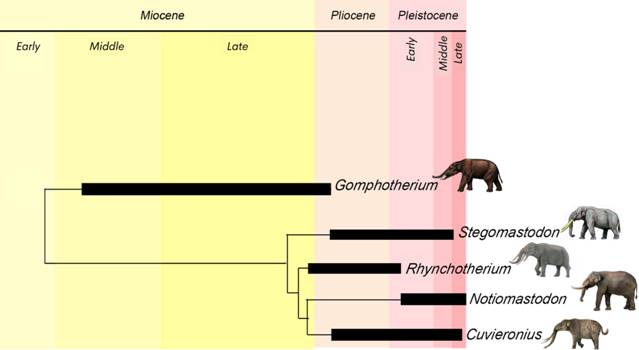
Gomphotheriidae (Fig. 1) is an extinct group of proboscideans closely related to modern elephants (Smith and DeSantis 2020), considered paraphyletic (Baleka et al. 2022), includes approximately 13 described genera and around 40 recognized species. Two of these species dispersed across the Americas during the Pleistocene, Cuvieronius hyodon (Fischer, 1814) and Notiomastodon platensis (Ameghino, 1888). Cuvieronius hyodon was distributed across North, Central, and South America, with a significant presence (but not exclusive) in the Andean region of South America. Notiomastodon platensis was an endemic species of South America (Mothé and Avilla 2015), with a wide geographical distribution and a diverse diet (Sánchez et al. 2004, Asevedo et al. 2012).
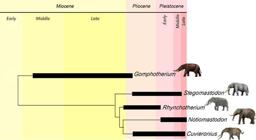
Phylogenetic position of Cuvieronius and Notiomastodon in Gomphotheriidae. Modified from Smith and DeSantis (2020).
Climate change has driven megafauna migrations over geological time. Molecular studies on American mastodons, Mammut americanum (Kerr, 1792), and steppe bison, (Steppe bison (Bojanus, 1825), have revealed complex relationships between population dynamics and climate variability, particularly during glacial and interglacial transitions, such as the last deglaciation, when population expansions coincided with glacial retreat (Karpinski et al. 2020). These findings support the hypothesis that ongoing warming could lead to significant biogeographical changes.
Pleistocene megafauna experienced major climatic events, including the Last Interglacial (LIG, 130,000-115,000 BP), marked by higher temperatures at high latitudes and a sea level seven meters higher than the current one (Van de Berg et al. 2013). During the Last Glacial Maximum (LGM, 21,000 BP), cooler global temperatures and regional hydrological changes were observed, especially in South America (Cook et al. 2006). While the western Amazon became wetter, the eastern portion experienced drier conditions, reflecting the South American Precipitation Dipole, a pattern linked to orbital precession cycles (Cook et al. 2006, Cheng et al. 2013a).
Subsequent climatic episodes, such as the Oldest Dryas (OD, 18,000 to 14,500 BP) and the Younger Dryas (YD, 12,900 to 11,500 BP), brought further environmental fluctuations. Although its impacts on South America remain unclear, similar environmental changes may have affected the distribution and availability of resources for the megafauna. The Younger Dryas caused a return to glacial conditions, shifting westerly winds southward and producing cooler, drier climates in some areas (McCulloch et al. 2000). These events were succeeded by the onset of the Holocene (11,600 BP) brought rapid warming and intensified monsoon activity in parts of Central and South America, driven by ocean-atmosphere interactions (Harrison et al. 2003, Prado et al. 2015).
Understanding these climatic fluctuations is essential to reconstruct the environmental pressures faced by Pleistocene megafauna. These animals likely struggled with habitat loss and shifting food availability due to rapid ecological changes (Lima-Ribeiro et al. 2013, Araújo et al. 2021). However, while climate was a major factor, it may not fully explain extinction patterns. Comparisons with extant species, such as forest-dwelling ungulates (Galetti 2004), provide useful analogs but remain insufficient to capture the complexity of past ecosystems. Vegetation shifts, potentially driven both by climate and by the decline of large herbivores, such as the Gomphotheriidae, likely played a role in reshaping ecological communities (Daskin et al. 2016).
Climate changes alone could have exterminated the megafauna (e.g., Ficcarelli et al. 2003, Sandom et al. 2014). However, only abrupt and severe shifts would likely have been sufficient, possibly in combination with other stressors such as habitat modification and human activity (Barnosky et al. 2004, Faith and Surovell 2009). Increased temperature and precipitation may have promoted forest expansion at the expense of open habitats, reducing suitable environments for savanna-adapted species. While some authors dispute a significant human role, archaeological evidence, though limited, suggests that interactions did occur. Sites like Monte Verde (Meltzer 1993) and Pilauco (Moreno et al. 2019) in southern Chile contain faunal remains, plant materials, tools, and even hominin footprints, supporting pre-Clovis human presence and possible overlap with megafauna.
Our study aims to identify climatically suitable areas for two South American gomphothere species during five major climatic events faced by Pleistocene megafauna, notably the Oldest Dryas, Younger Dryas, and the period of the last occurrence of one of the species during the Holocene. Unlike previous studies that have primarily focused on the broad-scale ecological factors influencing extinction, our study specifically examines the role of climate as a potential primary driver of extinction. By incorporating high-resolution climate data and modeling the species’ climatic suitability across multiple climatic shifts, our analyses provide a more comprehensive understanding of how climatic changes may have influenced species survival and extinction, offering new insights into South America’s Pleistocene megafauna extinction debate.
MATERIAL AND METHODS
Data
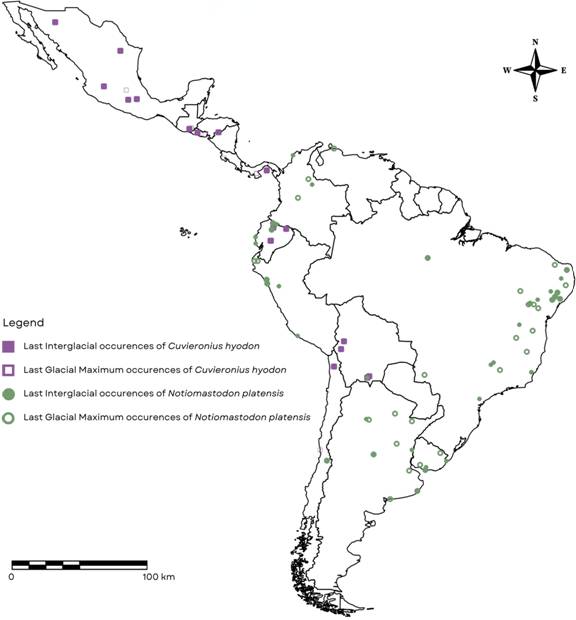
Our records were sourced from the Paleobiology Database (McClennen et al. 2024) and relevant literature, including taxonomic revisions of the Gomphotheriidae (e.g., Mothé et al. 2013), and additional sources such as publications on South American Quaternary gomphotheres (e.g., Ossa and Moseley 1972, Falguères et al. 1994, Kinoshita et al. 2005, Gutiérrez et al. 2005, Alberdi et al. 2004,Robles-Camacho 2010, Ribeiro et al. 2013, Dantas et al. 2013a, Dantas et al. 2013b, Dantas et al. 2017, França 2014, Kerber et al. 2011, Dávila 2019). We also consulted literature from various databases, including Google Scholar, focusing on occurrences with clear indications of the period to which the samples were dated, with an emphasis on records from specific periods, such as interglacial stages. A detailed list of occurrences is provided in the Supplementary Table S1. Cuvieronius hyodon (n = 34) was mainly distributed in the Andean region of South America during the Last Interglacial (120,000 years before present - YBP), with the southernmost point located in southern Bolivia (Fig. 2). More records were abundant in southern North America and Central America (see Fig. 2). According to the known fossil record, Notiomastodon platensis (n = 57) was mainly distributed in Northeastern Brazil, along the Brazilian coast, in the Chaco region of Argentina, and in the Trans-Andean and Caribbean regions of South America (Fig. 2). We found a concentration of points in coastal areas close to the equator on both the east and west coasts of South America (see Fig. 2). Based on these occurrences, we used South America as the modeling background for Notiomastodon and all of Latin America for Cuvieronius.
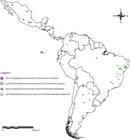
Geographical distribution of Cuvieronius hyodon (square) and Notiomastodon platensis (circle) during the Last Interglacial (120,000 years before present), Last Glacial Maximum (21,000 years before present).
Species distribution modeling
Species distribution models (SDMs) were implemented using bioclimatic data derived from paleoclimate estimations and paleoclimatic data within the R software environment (version 4.2.0, R Core Team 2020). The paleoclimatic variables were obtained from the PALEO-PGEM model, emulated and published by Barreto et al. 2023. This dataset was preferred due to its high temporal resolution (1 kyr) and its global spatio-temporal coverage, making it particularly useful for understanding climate dynamics over the last five million years. Additionally, its relevance to studying biodiversity patterns and climate change in South America further supports its selection. Time slices corresponding to significant climatic events, including the Last Interglacial (LIG), Last Glacial Maximum, Older Dryas (OD), Younger Dryas (YD) periods, and 6,000 YBP, were extracted from the dataset. Using a custom R script, we applied the Inverse Distance Weighting (IDW) method to interpolate these data specifically for South America, generating spatially explicit climate layers. These interpolated climate data were saved as TIFF files and used for species distribution modeling.
Initially, 17 climatic variables were considered for model selection. Given the number of species occurrences available (as discussed in the next section), a maximum of five variables could be retained to avoid overfitting. To assess multicollinearity, Variance Inflation Factors (VIF) were calculated using the USDM package (Naimi 2017). Four variables with low VIF values were selected for further analysis: Annual Mean Temperature (BIO1), Minimum Temperature of Coldest Month (BIO6), Temperature Annual Range (BIO7), and Precipitation of Coldest Quarter (BIO19).
A subsequent step involved evaluating collinearity among these variables. After this evaluation, the final selection for Notiomastodon included BIO1, BIO7, and BIO19, while for Cuvieronius, only BIO1 and BIO7 were retained. The selection of these variables reflects the distinct ecological preferences of each species. For Notiomastodon, the inclusion of both temperature and precipitation variables (BIO1, BIO7, and BIO19) was based on its broader climatic requirements, while Cuvieronius was modeled using only temperature-related variables (BIO1 and BIO7), likely reflecting a more temperature-driven habitat preference. Among the variables that did not show spatial autocorrelation, BIO19 was the only one that involved precipitation, despite being combined with temperature data.
For N. platensis, models were trained using 39 occurrence records from the LGM period (21,000 Ybp). Similarly, C. hyodon’s models were based on 19 occurrence records from the LIG period (120,000 YBP). The selection of these periods for model training was based on the availability of the highest number of occurrence records. To reduce spatial bias, a spatial thinning procedure was applied, and duplicate occurrence records were removed using the spThin package (Aiello-Lammens et al. 2015). A Mantel test was performed to assess spatial autocorrelation among the selected non-collinear predictor variables, with functions from the ecodist (Goslee and Urban 2017) and ecospat (Broennimann et al. 2016) packages, ensuring a minimum distance of 55 km between points. We generated 10 models using a bootstrap approach for each species, for each variable, in each period, and our final model represents a consensus among them.
The SDMs were developed using the SDM package (Naimi and Araújo 2016), employing Generalized Additive Models (GAM), Random Forest (RF), and Boosted Regression Trees (BRT). These algorithms were chosen for their ability to capture non-linear relationships and complex interactions between environmental predictors and species distributions. While simpler models may reduce uncertainties when projecting distributions across different periods (Merow et al. 2014), the complexity of the studied species’ ecological niches and the variability inherent in paleoclimatic data warranted the use of these algorithms.
To address concerns regarding model transferability, we implemented stringent evaluation metrics, including the Area Under the Curve (AUC, Bradley 1997) and the True Skill Statistic (TSS, Allouche et al. 2006), both ranging from 0 to 1. For TSS, values between 0.60 and 0.90 indicate fair to good model performance, with values closer to 1 reflecting a higher degree of agreement (Allouche et al. 2006). For AUC, a threshold above 0.7 is considered indicative of acceptable accuracy in species modeling (Raes and Ter Steege 2007). Additionally, ensemble modeling was used to mitigate variability and improve reliability in projections. This approach allowed us to balance ecological complexity with robust evaluation, ensuring meaningful predictions while acknow ledging the trade-offs associated with algorithm selection.
The modeling focused on the specific climatic periods mentioned earlier, generating predictive maps based on the species distributions predicted by the trained SDMs. These models were designed for the climatic periods of interest and then binarized. A threshold was established based on balanced sensitivity and specificity (sp = se) to create binary presence-absence maps for each species. Sensitivity repre sents the true presence rate, minimizing omission errors. On the other hand, specificity shows the proportion of true absences predicted to reduce commission or over-prediction errors. Thus, this metric defines the threshold for occurrence probabilities that balances omission and commission errors (Fielding and Bell 1997, Giannini et al. 2012). Finally, we produced response curves for each climatic variable’s effect on species suitability and employed the raster function to calculate the proportion of suitable pixels across the South American territory.
RESULTS
The occurrence records indicate the presence of N. platensis in Colombia, Ecuador, Peru, Chile, Argentina, Uruguay, and Brazil during the Pleistocene, while C. hyodon was recorded in Mexico, El Salvador, Honduras, Nicaragua, Panama, Ecuador, Bolivia, and Chile during the same period. Additionally, the climatic suitability for C. hyodon extended beyond these occurrence areas to Guyana, Suriname, French Guiana, Colombia, Venezuela, Peru, Paraguay, Argentina, and Brazil, while for N. platensis, it expanded to Guyana, Suriname, French Guiana, Bolivia, and Paraguay.
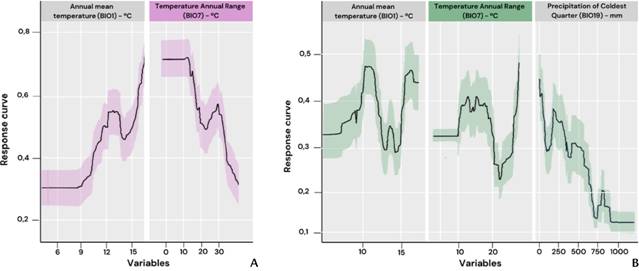
All models were well evaluated, with AUC values greater than 0.79 (GAM; Table 1) and TSS greater than 0.65 (GAM; Table 1). The response curves to climatic variables (Fig. 3) revealed that C. hyodon showed higher climatic suitability at annual temperatures (BIO 1) around 15 °C and in more stable climates, with lower annual temperature variation (BIO 7). In contrast, the climatic suitability of N. platensis is more responsive to lower precipitation (BIO 19), with optimal intermediate values for annual temperature means (BIO 1) and annual temperature variation (BIO 7; Table 1, Fig. 3).
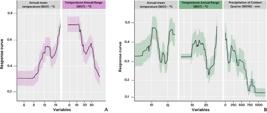
Climate suitability response curves for Cuvieronius hyodon (A) and Notiomastodon platensis (B) for each of the modeled climatic variables.
Contribution of each variable to the models generated for N. platensis and C. hyodon, and evaluation of the Random Forest (RF), Generalized Additive Models (GAM), and Boosted Regression Trees (BRT) using the metrics Area Under the Curve (AUC) and True Skill Statistic (TSS) for both species. (Tavgi) Average temperature for each month, (PPT) Total monthly precipitation.
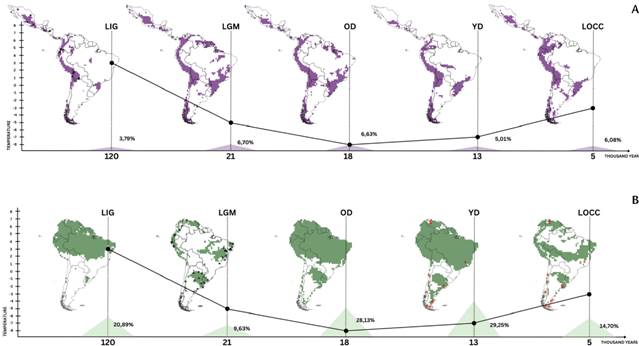
The SDMs generated for C. hyodon (Fig. 4A) and N. platensis (Fig. 4B) exhibit differences in climatic suitability variation across the five analyzed periods. This variation is considerable only for N. platensis, reflecting the influence of past climatic fluctuations on its potential distribution. In contrast, C. hyodon shows more stable areas over time, particularly in the central and northern Andes, where the models indicate relatively stable climatic suitability. This suggests that these regions may have served as potential refugia for C. hyodon during periods of climatic instability, reinforcing its association with more stable environments. The variables that contributed most to the climatic models were BIO 1 (57.80%) for C. hyodon and BIO 19 (27.90%) for N. platensis (Table 1).
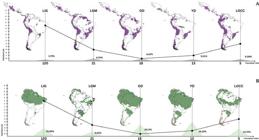
Predicted climatic suitability for Cuvieronius hyodon (A) and Notiomastodon platensis (B) in the following periods: Last Interglacial (LIG, 120,000 YBP), Last Glacial Maximum (LGM, 21,000 YBP), Oldest Dryas (OD, 18,000 YBP), Younger Dryas (YD, 13,000 YBP), and following the last occurrence of megafauna in South America (LOCC, 5,000 YBP). The black line represents temperature variation across these periods - Source: Vostok station ice core data, Antarctica, from Arruda and Schaefer (2020). The percentages highlighted with triangles in each period indicate the proportion of suitable area relative to the total area of South America. In the models for N. platensis for the YD and LOCC periods, occurrences of evidence for human-megafauna interaction on the continent are highlighted in red, according to the Killsite Database (Bampi et al. 2023).
We quantified the percentage of suitable habitat relative to the total land area of South America (Fig. 4) for both species. For C. hyodon, we observed an average of 5.62% of suitable area across different periods (LIG = 3.79%; LGM = 6.70%; OD = 6.53%; YD = 5.01%; LOCC = 6.08%), with the highest suitability during the LGM. On the other hand, N. platensis showed a significantly higher average of 20.5% (LIG = 20.89%; LGM = 9.53%; OD = 28.13%; YD = 29.25%; LOCC = 14.70%), indicating a broader distribution of suitable habitats throughout the periods considered. These variations highlight how the available ecological niches for each species changed over time and how climatic conditions influenced their spatial distribution across the continent.
In the SDMs generated for the Younger Dryas and the period following the last occurrence of megafauna in South America (LOCC), we highlight areas where evidence of human-megafauna interaction has been documented, based on the Killsite Database. However, this overlap was only considered for N. platensis, as there are no confirmed records of C. hyodon in South American paleoarchaeological sites. The absence of C. hyodon in such contexts suggests either a lack of direct human exploitation or preservation biases that may have influenced the fossil record. This difference in documented human interactions may also reflect distinct ecological or behavioral traits between the two taxa, such as habitat prefe rences or migratory patterns, which could have influenced their likelihood of encountering human populations.
DISCUSSION
We reject the Pleistocene climate change hypothesis as the main factor related to the extinction of both species in the Americas based on the geographical distribution patterns of South American gomphotheres. Our results show that N. platensis occurred primarily in the Brazilian Shield, encompassing regions such as the Atlantic Forest, Caatinga in northeastern Brazil, Chaco in northern Argentina, and the Pampas. Fluctuations in its range, including its disappearance and reappearance in the Amazon and Chaco regions, suggest significant climatic disturbances that could have contributed to local extinctions. These findings imply that climate may not have been the primary driver of extinction, but rather, disturbances that led to changes in local habitats. In contrast, C. hyodon experienced a more stable climate, occurring primarily in the Andean region of North America, Central America, and western South America. While our analysis showed overlap in suitable areas for both gomphothere species, competition for resources is unlikely due to the distinct altitudes inhabited by each species, as discussed in studies on the geographic distribution and ecological requirements of Cuvieronius and Notiomastodon (Alberdi et al. 2008, Mothé et al. 2017). Notably, there are records of C. hyodon in the lowlands of Peru, contradicting earlier assumptions of a strict Andean distribution (Alberdi et al. 2008, Mothé et al. 2017). Despite the persistence of climatically suitable areas throughout these periods, species extinction could still occur if individuals were unable to disperse and track these regions, particularly in scenarios where habitat fragmentation restricted movement.
Last Interglacial and Last Glacial Maximum
We observed the smallest suitable area for C. hyodon during the warmer interglacial period (LIG). Subsequently, during the Last Glacial Maximum, there was an expansion of climatically suitable areas (Fig. 4A). This expansion could be explained by the cooler and moister environments, which are more suitable for this species, as well as the expansion of more closed vegetation areas, particularly in regions with abundant C3 plants, such as the Andean highlands. These conditions suggest that C. hyodon adapted to environments with higher humidity, which were more prevalent in the highlands of Bolivia, Chile, Ecuador, and Peru during the LGM. Studies by Wang et al. (2004) and Cruz et al. (2005) further support this by indicating that southeastern Brazil, parts of the Andes, and coastal areas received more moisture during the LGM, aligning with the species’ preference for forested habitats. Despite the increase in temperature from the Last Glacial Maximum to the Middle Holocene, where we have the last occurrence of megafauna recorded, large climatically suitable areas for this species can still be observed, especially in the Andean region and southwestern South America (Fig. 4A). Throughout the five time periods, the Andean region maintained the lowest minimum temperature values in South America, likely influencing the preferential occurrence of C. hyodon in this region.
Large fragmentation of suitable areas was observed during the Last Interglacial and the Last Glacial Maximum. This was a substantial factor indicated for the extinction risk of Eurasian megafauna (Mondanaro et al. 2021), with approximately 38% importance, followed by other variables such as dietary preferences. However, during the Last Glacial Maximum, we recovered a concentration of occurrence records (Fig. 2), as well as a large block of suitable areas in northeastern Brazil (Fig. 4B). Regarding climatically suitable areas, we observed a 2.91% increase for C. hyodon (Fig. 4A), suggesting that this species may have benefitted from environmental conditions during the period under consideration, possibly due to its adaptability to slight climate fluctuations. On the other hand, N. platensis experienced an 11.26% decrease in suitable areas (Fig. 4B), indicating a contraction of its viable habitat. This decline could be attributed to the reduced availability of optimal conditions for the species, which may have been more sensitive to the environmental changes occurring at that time, such as temperature shifts and precipitation patterns. These shifts in the spatial distribution of suitable areas are crucial in understanding the ecological pressures faced by these species and may have contributed to their differing responses during the climatic transitions of the Last Glacial Maximum.
Interpretations of the paleoenvironmental conditions of this northeastern semiarid region allow us to infer that the Caatinga oscillated towards savannas capable of maintaining the Pleistocene megafauna, probably maintaining low rainfall during these periods. De Vivo and Carmignotto (2004) defend the idea that the Pleistocene megafauna went extinct in a scenario with 50% more rain than the present, transforming open areas into extremely dense and closed vegetation areas, difficult to access, with decreasing migrations, when these animals must have become extinct.
Notiomastodon platensis was also mainly affected by the precipitation of the coldest quarter (BIO 19) was an important predictor variable in the models (Table 1), with greater suitability in areas with lower precipitation, preferring warmer and drier conditions. During these glacial cycles, much of the continent was also relatively drier. However, some still humid regions must have favored the expansion of forests, including the Amazon, with rainfall greater than 750 mm, and the southern Atlantic Forest, an area with the highest rainfall values on the continent (Cheng et al. 2013b). Forest-dwelling megafauna are likely underrepresented in the fossil record due to poor preservation in humid tropical forests. There is isotopic evidence that several of the extinct megafauna were browsers, which could plausibly find food in forested environments (Doughty et al. 2013), and extant proboscideans are also regularly found in forests.
From the Dryas until extinction
These two events have been less explored in the overall context of South America so far. However, some studies conducted in Argentina present interesting results that merit discussion regarding their impact on the extinction of Pleistocene megafauna. In the Northern Hemisphere, the transition from the Last Glacial Maximum to the Holocene is characterized by rapid cooling followed by a pulse of rapid warming. However, palynological data indicate that this event occurred 400 years earlier in the Southern Hemisphere (Kröhling and Iriondo 1999, Hajdas et al. 2003, Prado et al. 2015).
For Cuvieronius, the suitability between events and the percentage of suitable areas remained almost constant since the Last Glacial Maximum, with notable area losses in northeastern Brazil during the Younger Dryas (Fig. 4A). The region remained climatically stable for the establishment and persistence of this species, but it may have faced additional pressures during the Younger Dryas. In the Pampas, for instance, sediments contain ichnofossils of extinct megamammals dated to 12,000 YBP, suggesting that the sea level drop may correspond to the Younger Dryas (Prado et al. 2015). During the early Holocene, extensive areas of the exposed continental shelf east of the Pampas coastline were gradually inundated (Prado et al. 2015). Proxy data indicate that eolian deposition ceased at the beginning of the Holocene, with soil development and the presence of temporary ponds indicating a transition to more stable climatic conditions (Prado et al. 2015).
Our models indicate only 1% of increase in climatically suitable areas for Cuvieronius between the Younger Dryas and the Holocene. Overall, there are no significant percentage variations in suitability across the models, and the Andes Mountains appear to have acted as a climatic refuge for the species. However, as discussed by Mothe et al. (2022), these updated geographic distributions challenge the previously proposed migratory routes for South American proboscideans. While it was once thought that Notiomastodon followed the ‘Eastern Savanna’ path and Cuvieronius spread into South America via the ‘Andean corridor’ (Prado et al. 2005, Mothé et al. 2012), recent evidence suggests that the inter-Andean valleys, such as the Cauca Valley, could have provided suitable conditions for both species, supporting their dispersion through the Andean mountains. Climatic fluctuations and vegetation shift during the Last Glacial Maximum likely influenced their distribution, with dry and montane forests in the inter-Andean valleys offering a dry corridor for their movement (Hooghiemstra and Flantua 2019, Jaramillo et al. 2022). Additionally, no archaeological sites have been described for this location so far, suggesting that the extinction of Cuvieronius may have faced pressures beyond climate and hunting.
In contrast, models generated for Notiomastodon indicate a reduction of over 50% in suitable areas during these periods. The reduction in suitable areas between the glacial maximum and the Holocene has previously been identified for N. platensis in earlier studies (Araujo et al. 2021), where the consequent habitat changes caused by this factor are pointed out as playing a significant role in their extinction. This is due to the shift from the dry and cold conditions experienced since the LGM (maintained during the Older Dryas and Younger Dryas) to the warm and humid conditions of the Holocene.
The climate hypothesis
In the Middle Holocene, when C. hyodon and N. platensis likely became extinct, large areas would still be climatically suitable for the persistence of both species of gomphotheres, as predicted by species distribution models (Figs 4A, 4B). Human migrations into North, Central, and South America have been proposed as an alternative hypothesis for megafauna mass extinctions on the continent (Pratez and Peres 2021). The drivers of the global Quaternary megafaunal extinction are constantly being updated and discussed. So far, there is only one known fossil site in Brazil showing evidence of hunting N. platensis, as described by Mothé et al. 2020. For South America, the Kill Site Database (Bampi et al. 2023) provides robust and reliable information with empirical evidence of human-megafauna exploitation during the late Quaternary. These sites overlap with areas suitable for Notiomastodon (Fig. 4A). However, there are no recorded occurrences of Cuvieronius overlapping these archaeological sites (Fig. 4B). Therefore, even if these species did not go extinct primarily due to the fragmentation of suitable areas or population vulnerability caused by major climatic changes, they might have faced additional extinction pressure from the first Paleoindian populations on the continent. However, due to the lack of data on the frequency of their occurrences, it is not possible to directly test the hypothesis of population decline.
When we compare the South American and North American extinctions, there are some inconsistencies related to the climate extinction hypothesis. Changes in climate and vegetation were not synchronized across continents. The southern tip of South America gradually warmed, while the Northern Hemisphere experienced abrupt warming at 14,700 YBP. Meanwhile, southern South America felt the effects of relatively minor cooling (Antarctic Cold Reversal) (Blunier et al. 1997, Fiedel and Haynes 2004).
The presence of early Paleoindian populations in North America dates to during and immediately after the Last Glacial Maximum (approximately 26,500-19,000 YBP), but broader occupation occurred from a period of abrupt warming (Becerra-Valdivia and Higham 2020). In this case, widespread expansion was a key factor in the extinction of large terrestrial mammals (Becerra-Valdivia and Higham 2020), likely due not only to hunting-already well documented at several sites, but also to the increasing overlap and competition for resources between humans and megafauna. However, it is important to note that some taxa, such as Cuvieronius, have not been recorded at archaeological sites in South America, suggesting that human interaction was not a universal extinction mechanism for all species across the continent. The absence of C. hyodon in such contexts suggests either a lack of direct human exploitation or preservation biases that may have influenced the fossil record.
Hunting is considered to have played a significant role in the extinction of South American megafauna. Evidence suggests that widespread hunting by Paleo-Indians led to a substantial decline in megaherbivore populations, particularly in regions with low population densities (Brook and Bowman 2004, Barnosky et al. 2016). These areas were more vulnerable to local extinctions due to combined pressures from human activities and stochastic environmental factors (Galetti 2004, Sandom et al. 2014). The reduction in megafaunal populations likely disrupted ecological networks, further accelerating extinction processes (Malhi et al. 2016). Future studies should further explore the synergistic effects of climate change and human impact on these extinctions.
Final remarks
Different climatic variables may have influenced the geographical distribution of South American gomphotheres, but not their extinction. Cuvieronius hyodon likely benefited more from low temperatures, whereas N. platensis was more influenced by lower rainfall. Our results reject the climatic hypothesis for their extinction, based on species distribution models.
While climate shaped the habitats and ranges of these species, it was not the primary driver of their disappearance. The persistence of climatically suitable areas throughout glacial and interglacial periods suggests that other factors contribu ted to their extinction, with human activity being a plausible cause. The timing of early human migration into the Americas and evidence of human-megafauna interactions, such as hunting, align with declines in gomphothere populations, indicating that anthropogenic pressures were likely critical.
The overlap of human activity with suitable habitats implies that habitat fragmentation, hunting, and potential competition for resources may have synergistically accelerated their decline. Future research should integrate paleontological and archaeological data to clarify the role of humans in megafaunal extinctions. A multidisciplinary approach will better elucidate the complex interactions between climate, human activity, and megafauna survival.
Although climate influenced the distribution of C. hyodon and N. platensis, human activities-particularly hunting and habitat alteration-likely played a more significant role in the decline of these iconic South American megafauna.
ACKNOWLEDGEMENTS
We thank the Coordenação de Aperfeiçoamento de Pessoal de Nível Superior (CAPES - Code 001) and the Gradu ate Program in Evolution and Diversity at Universidade Federal do ABC for their support. The language revision was carried out by the authors themselves, who assume full responsibility for any remaining linguistic inadequacies in the manuscript.
LITERATURE CITED
- Aiello-Lammens ME, Boria RA, Radosavljevic A, Vilela B, Anderson RP (2015) spThin: an R package for spatial thinning of species occurrence records for use in ecological niche models. Ecography 38(5): 541-545.
-
Alberdi MT, Prado JL, Salas R (2004) The Pleistocene Gomphotheriidae (Proboscidea) from Peru. Neues Jahrbuch für Geologie und Paläontologie 231(3): 423-452. https://doi.org/10.1127/njgpa/231/2004/423
» https://doi.org/10.1127/njgpa/231/2004/423 - Alberdi MT, Cerdeño E, Prado JL (2008) Stegomastodon platensis (Proboscidea, Gomphotheriidae) en el Pleistoceno de Santiago del Estero, Argentina. Ameghiniana 45(1): 77-87.
-
Allouche O, Tsoar A, Kadmon R (2006) Assessing the accuracy of species distribution models: Prevalence, kappa and the true skill statistic (TSS). Journal of Applied Ecology 43(6): 1223-1232. https://doi.org/10.1111/j.1365-2664.2006.01214.x
» https://doi.org/10.1111/j.1365-2664.2006.01214.x -
Araújo T, Machado H, Mothé D, dos Santos Avilla L (2021) Species distribution modeling reveals the ecological niche of extinct megafauna from South America. Quaternary Research 104: 25-38. https://doi.org/10.1017/qua.2021.24
» https://doi.org/10.1017/qua.2021.24 -
Arruda DM, Schaefer CEGR (2020) Dinâmica climática e biogeográfica do Brasil no último máximo glacial: O estado da arte. Estudos Avançados 34(98): 185-202. https://doi.org/10.1590/S0103-4014.2020.3498.012
» https://doi.org/10.1590/S0103-4014.2020.3498.012 -
Asevedo L, Winck GR, Mothé D, Avilla LS (2012) Ancient diet of the Pleistocene gomphothere Notiomastodon platensis (Mammalia, Proboscidea, Gomphotheriidae) from lowland mid-latitudes of South America: Stereomicrowear and tooth calculus analyses combined. Quaternary International 255: 62-70. https://doi.org/10.1016/j.quaint.2011.08.037
» https://doi.org/10.1016/j.quaint.2011.08.037 -
Baleka S, Varela L, Tambusso PS, Paijmans JLA, Mothé D, Stafford TW, et al. (2022) Revisiting proboscidean phylogeny and evolution through total evidence and palaeogenetic analyses including Notiomastodon ancient DNA. iScience 25(1): 103559. https://doi.org/10.1016/j.isci.2021.103559
» https://doi.org/10.1016/j.isci.2021.103559 -
Bampi H, Barberi M, Lima-Ribeiro MS (2023) Kill site database: A unified dataset on human-megafauna interactions across time and space. Data in Brief 47: 108998. https://doi.org/10.1016/j.dib.2023.108998
» https://doi.org/10.1016/j.dib.2023.108998 -
Barnosky AD (2008) Megafauna biomass tradeoff as a driver of Quaternary and future extinctions. Proceedings of the National Academy of Sciences of the United States of America 105(Suppl. 1): 11543-11548. https://doi.org/10.1073/pnas.0801918105
» https://doi.org/10.1073/pnas.0801918105 -
Barnosky AD, Koch PL, Feranec RS, Wing SL, Shabel AB (2004) Assessing the causes of late Pleistocene extinctions on the continents. Science 306(5693): 70-75. https://doi.org/10.1126/science.1101476
» https://doi.org/10.1126/science.1101476 -
Barnosky AD, Lindsey EL (2010) Timing of Quaternary megafaunal extinction in South America in relation to human arrival and climate change. Quaternary International 217: 10-29. https://doi.org/10.1016/j.quaint.2009.11.017
» https://doi.org/10.1016/j.quaint.2009.11.017 -
Barnosky AD, Lindsey EL, Villavicencio NA, Bostelmann E, Hadly EA, Wanket J, Marshall CR (2016) Variable impact of late-Quaternary megafaunal extinction in causing ecological state shifts in North and South America. Proceedings of the National Academy of Sciences of the United States of America 113(4): 856-861. https://doi.org/10.1073/pnas.1505295112
» https://doi.org/10.1073/pnas.1505295112 -
Barreto E, Holden PB, Edwards NR, Rangel TF (2023) PALEO-PGEM-Series: A spatial time series of the global climate over the last 5 million years (Plio-Pleistocene). Global Ecology and Biogeography 32(7): 1278-1292. https://doi.org/10.1111/geb.13683
» https://doi.org/10.1111/geb.13683 -
Becerra-Valdivia L, Higham T (2020) The timing and effect of the earliest human arrivals in North America. Nature 584(7819): 93-97. https://doi.org/10.1038/s41586-020-2491-6
» https://doi.org/10.1038/s41586-020-2491-6 -
Blunier T, Schwander J, Stauffer B, Stocker T, Dällenbach A, Indermühle A, et al. (1997) Timing of the Antarctic Cold Reversal and the atmospheric CO2 increase with respect to the Younger Dryas event. Geophysical Research Letters 24(21): 2683-2686. https://doi.org/10.1029/97GL02658
» https://doi.org/10.1029/97GL02658 -
Bradley AP (1997) The use of the area under the ROC curve in the evaluation of machine learning algorithms. Pattern Recognition 30(7): 1145-1159. https://doi.org/10.1016/S0031-3203(96)00142-2
» https://doi.org/10.1016/S0031-3203(96)00142-2 -
Broennimann O, Di Cola V, Petitpierre B, Breiner F, D’Amen M, Randin C, Guisan A (2016) Package “ecospat”: Spatial ecology miscellaneous methods. R package version 3.1. https://CRAN.R-project.org/package=ecospat [Accessed: 01/08/2024]
» https://CRAN.R-project.org/package=ecospat -
Brook BW, Bowman DMJS (2004) The uncertain blitzkrieg of Pleistocene megafauna. Journal of Biogeography 31(4): 517-523. https://doi.org/10.1046/j.1365-2699.2003.00887.x
» https://doi.org/10.1046/j.1365-2699.2003.00887.x -
Cheng H, Sinha A, Cruz FW, Wang X, Edwards RL, D’Horta FM, et al. (2013a) Climate change patterns in Amazonia and biodiversity. Nature Communications 4: 1411. https://doi.org/10.1038/ncomms2415
» https://doi.org/10.1038/ncomms2415 -
Cheng W, Chiang JCH, Zhang D (2013b) Atlantic meridional overturning circulation (AMOC) in CMIP5 Models: RCP and historical simulations. Journal of Climate 26(18): 7187-7197. https://doi.org/10.1175/JCLI-D-12-00496.1
» https://doi.org/10.1175/JCLI-D-12-00496.1 -
Cook KH, Vizy EK (2006) South American climate during the Last Glacial Maximum: Delayed onset of the South American monsoon. Journal of Geophysical Research 111: D02110. https://doi.org/10.1029/2005JD005980
» https://doi.org/10.1029/2005JD005980 -
Cruz FW, Burns SJ, Karmann I, Sharp WD, Vuille M, Cardoso AO, et al. (2005) Insolation-driven changes in atmospheric circulation over the past 116,000 years in subtropical Brazil. Nature 434(7029): 63-66. https://doi.org/10.1038/nature03365
» https://doi.org/10.1038/nature03365 -
Dantas MAT, Dutra RP, Cherkinsky A, Fortier DC, Kamino LHY, Cozzuol MA, Silva FV (2013a) Paleoecology and radiocarbon dating of the Pleistocene megafauna of the Brazilian intertropical region. Quaternary Research 79(1): 61-65. https://doi.org/10.1016/j.yqres.2012.09.006
» https://doi.org/10.1016/j.yqres.2012.09.006 -
Dantas MAT, Xavier MCT, França LM, Cozzuol MA, Ribeiro AS, Figueiredo AMG, et al. (2013b) A review of the time scale and potential geographic distribution of Notiomastodon platensis (Ameghino, 1888) in the late Pleistocene of South America. Quaternary International 317: 55-64. https://doi.org/10.1016/j.quaint.2013.06.031
» https://doi.org/10.1016/j.quaint.2013.06.031 -
Dantas MAT, Cherkinsky A, Bocherens H, Drefahl M, Bernardes C, França LM (2017) Isotopic paleoecology of the Pleistocene megamammals from the Brazilian Intertropical Region: Feeding ecology (δ¹³C), niche breadth and overlap. Quaternary Science Reviews 170: 152-163. https://doi.org/10.1016/j.quascirev.2017.06.030
» https://doi.org/10.1016/j.quascirev.2017.06.030 -
Daskin JH, Stalmans M, Pringle RM (2016) Ecological legacies of civil war: 35-year increase in savanna tree cover following wholesale large-mammal declines. Journal of Ecology 104(1): 79-89. https://doi.org/10.1111/1365-2745.12483
» https://doi.org/10.1111/1365-2745.12483 -
Dávila SL, Stinnesbeck S, González S, Lindauer S, Escamilla J, Stinnesbeck W (2019) Guatemala’s Late Pleistocene (Rancholabrean) fauna: Revision and interpretation. Quaternary Science Reviews 219: 277-296. https://doi.org/10.1016/j.quascirev.2019.07.011
» https://doi.org/10.1016/j.quascirev.2019.07.011 - De Vivo M, Carmignotto AP (2004) Holocene vegetation change and the mammal faunas of South America and Africa. Journal of Biogeography 31(6): 943-957.
-
Doughty CE, Wolf A, Malhi Y (2013) The legacy of the Pleistocene megafauna extinctions on nutrient availability in Amazonia. Nature Geoscience 6(9): 761-764. https://doi.org/10.1038/ngeo1895
» https://doi.org/10.1038/ngeo1895 -
Faith JT, Surovell TA (2009) Synchronous extinction of North America’s Pleistocene mammals. Proceedings of the National Academy of Sciences of the United States of America 106(49): 20641-20645. https://doi.org/10.1073/pnas.0908186106
» https://doi.org/10.1073/pnas.0908186106 - Falguères C, Fontugne M, Chauchat C, Guadelli JL (1994) Datations radiométriques de l’extinction des grandes faunes pléistocènes au Pérou. Comptes Rendus de l’Académie des Sciences, Série II 319(2): 261-266.
- Fernández-Jalvo Y, Andrews P (2016) Atlas of Taphonomic Identifications: 1001+ Images of Fossil and Recent Mammal Bone Modification. Springer, Berlin.
-
Ficcarelli G, Coltorti M, Moreno-Espinosa M, Pieruccini PL, Rook L, Torre D (2003) A model for the Holocene extinction of the mammal megafauna in Ecuador. Journal of South American Earth Sciences 15(8): 835-845. https://doi.org/10.1016/S0895-9811(02)00145-1
» https://doi.org/10.1016/S0895-9811(02)00145-1 -
Fiedel S, Haynes G (2004) A premature burial: Comments on Grayson and Meltzer’s “Requiem for overkill”. Journal of Archaeological Science 31(1): 121-131. https://doi.org/10.1016/j.jas.2003.06.004
» https://doi.org/10.1016/j.jas.2003.06.004 - Fielding AH, Bell JF (1997) A review of methods for the assessment of prediction errors in conservation presence/absence models. Environmental Conservation 24(1): 38-49.
-
França LM, Dantas MAT, Bocchiglieri A, Cherkinsky A, Ribeiro AS, Bocherens H (2014) Chronology and ancient feeding ecology of two upper Pleistocene megamammals from the Brazilian Intertropical Region. Quaternary Science Reviews 99: 31-40. https://doi.org/10.1016/j.quascirev.2014.04.028
» https://doi.org/10.1016/j.quascirev.2014.04.028 - Galetti M (2004) Parks of the Pleistocene: Recreating the Cerrado and the Pantanal. Natureza e Conservação 2: 93-100.
- Giannini TC, Siqueira MF, Acosta AL, Barreto FCC, Saraiva AM, Alves-dos-Santos I (2012) Desafios atuais da modelagem preditiva de distribuição de espécies. Rodriguésia 63(3): 733-749.
-
Goslee S, Urban D (2017) Dissimilarity-based functions for ecological analysis. R package ecodist. Available at: Available at: https://CRAN.R-project.org/package=ecodist [Accessed: 01/08/2024]
» https://CRAN.R-project.org/package=ecodist - Gutiérrez M, Alberdi MT, Prado JL (2005) Late Pleistocene Stegomastodon (Mammalia, Proboscidea) from Uruguay. Neues Jahrbuch für Geologie und Paläontologie 237(3): 273-288.
-
Hajdas I, Bonani G, Moreno PI, Ariztegui D (2003) Precise radiocarbon dating of Late-Glacial cooling in mid-latitude South America. Quaternary Research 59(1): 70-78. https://doi.org/10.1016/S0033-5894(02)00017-0
» https://doi.org/10.1016/S0033-5894(02)00017-0 - Harrison SP, Kutzbach JE, Liu Z, Bartlein PJ (2003) Mid-Holocene climates of the Americas: A dynamical response to changed seasonality. Climate Dynamics 20(7-8): 663-688.
-
Hooghiemstra H, Flantua SGA (2019) Colombia in the Quaternary: An overview of environmental and climatic change. In: Gómez J, Pinilla-Pachon AO (Eds) The Geology of Colombia. Servicio Geológico Colombiano, Bogotá, vol. 4, 43-104. https://doi.org/10.32685/pub.esp.38.2019
» https://doi.org/10.32685/pub.esp.38.2019 -
Jaramillo C, Shuster GK, Rojas CD, Henao A, Ojeda GY, Caballero D, et al. (2022) Upper Pleistocene deposits from the Cauca Valley. Revista de La Academia Colombiana de Ciencias Exactas, Fisicas y Naturales 46(179): 1666. https://doi.org/10.18257/raccefyn.1666
» https://doi.org/10.18257/raccefyn.1666 -
Karpinski E, Hackenberger D, Zazula G, Widga C, Duggan AT, Golding GB, Kuch M, et al. (2020) American mastodon mitochondrial genomes suggest multiple dispersal events in response to Pleistocene climate oscillations. Nature Communications 11(1): 2089. https://doi.org/10.1038/s41467-020-15857-8
» https://doi.org/10.1038/s41467-020-15857-8 -
Kerber L, Kinoshita A, José FA, Figueiredo AMG, Oliveira EV, Baffa O (2011) Electron spin resonance dating of the southern Brazilian Pleistocene mammals from Touro Passo Formation, and remarks on the geochronology, fauna and palaeoenvironments. Quaternary International 245(2): 201-208. https://doi.org/10.1016/j.quaint.2010.10.010
» https://doi.org/10.1016/j.quaint.2010.10.010 -
Kinoshita A, França AM, de Almeida JAC, Figueiredo AM, Nicolucci P, Graeff CFO, et al. (2005) ESR dating at K and X band of northeastern Brazilian megafauna. Applied Radiation and Isotopes 62(2): 225-229. https://doi.org/10.1016/j.apradiso.2004.08.007
» https://doi.org/10.1016/j.apradiso.2004.08.007 -
Kröhling DM, Iriondo M (1999) Upper Quaternary palaeoclimates of the Mar Chiquita area, North Pampa, Argentina. Quaternary International 57-58: 149-163. https://doi.org/10.1016/S1040-6182(98)00056-1
» https://doi.org/10.1016/S1040-6182(98)00056-1 -
Lima-Ribeiro MS, Nogués-Bravo D, Terribile LC, Batra P, Diniz-Filho JAF (2013) Climate and humans set the place and time of Proboscidean extinction in the late Quaternary of South America. Palaeogeography, Palaeoclimatology, Palaeoecology 392: 1-10. https://doi.org/10.1016/j.palaeo.2013.10.008
» https://doi.org/10.1016/j.palaeo.2013.10.008 -
Malhi Y, Doughty CE, Galetti M, Smith FA, Svenning J-C, Terborgh JW (2016) Megafauna and ecosystem function from the Pleistocene to the Anthropocene. Proceedings of the National Academy of Sciences of the United States of America 113(4): 838-846. https://doi.org/10.1073/pnas.1502540113
» https://doi.org/10.1073/pnas.1502540113 -
McClennen M, Jenkins J, Uhen M (2024) Paleobiology Database. [Occurrence dataset], v. 1.3. https://doi.org/10.15468/jfqhiu [Accessed: 11/03/2025]
» https://doi.org/10.15468/jfqhiu - McCulloch RD, Bentley MJ, Purves RS, Hulton NRJ, Sugden DE, Clapperton CM (2000) Climatic inferences from glacial and palaeoecological evidence at the last glacial termination, southern South America. Journal of Quaternary Science 15(4): 409-417. https://doi.org/10.1002/1099-1417(200005)15:4<409::AID-JQS539>3.0.CO;2-%23
-
Meltzer DJ (1993) Pleistocene peopling of the Americas. Evolutionary Anthropology: Issues, News, and Reviews 1(5): 157-169. https://doi.org/10.1002/evan.1360010505
» https://doi.org/10.1002/evan.1360010505 -
Merow C, Smith MJ, Edwards TC, Guisan A, McMahon SM, Normand S, Thuiller W, Wüest RO, Zimmermann NE, Elith J (2014) What do we gain from simplicity versus complexity in species distribution models? Ecography 37(12): 1267-1281. https://doi.org/10.1111/ecog.00845
» https://doi.org/10.1111/ecog.00845 -
Mondanaro A, di Febbraro M, Melchionna M, Maiorano L, di Marco M, Edwards NR, et al. (2021) The role of habitat fragmentation in Pleistocene megafauna extinction in Eurasia. Ecography 44(11): 1642-1656. https://doi.org/10.1111/ecog.05939
» https://doi.org/10.1111/ecog.05939 -
Moreno K, Bostelmann JE, Macías C, Navarro-Harris X, De Pol-Holz R, Pino M (2019) A late Pleistocene human footprint from the Pilauco archaeological site, northern Patagonia, Chile. Plos One 14(4): e0213572. https://doi.org/10.1371/journal.pone.0213572
» https://doi.org/10.1371/journal.pone.0213572 -
Mothé D, Avilla LS (2015) Mythbusting evolutionary issues on South American gomphotheriidae (Mammalia: Proboscidea). Quaternary Science Reviews 110: 23-35. https://doi.org/10.1016/j.quascirev.2014.12.013
» https://doi.org/10.1016/j.quascirev.2014.12.013 -
Mothé D, Avilla LS, Araújo-Júnior HI, Rotti A, Prous A, Azevedo SAK (2020) An artifact embedded in an extinct proboscidean sheds new light on human-megafaunal interactions in the Quaternary of South America. Quaternary Science Reviews 229: 106125. https://doi.org/10.1016/j.quascirev.2019.106125
» https://doi.org/10.1016/j.quascirev.2019.106125 -
Mothé D, Avilla LS, Asevedo L, Borges-Silva L, Rosas M, Labarca-Encina R, et al. (2017) Sixty years after ‘The mastodonts of Brazil’: The state of the art of South American proboscideans (Proboscidea, Gomphotheriidae). Quaternary International 443: 207-228. https://doi.org/10.1016/j.quaint.2016.08.028
» https://doi.org/10.1016/j.quaint.2016.08.028 -
Mothé D, Avilla LS, Cozzuol MA (2013) The South American Gomphotheres (Mammalia, Proboscidea, Gomphotheriidae): Taxonomy, Phylogeny, and Biogeography. Journal of Mammalian Evolution 20: 23-32. https://doi.org/10.1007/s10914-012-9192-3
» https://doi.org/10.1007/s10914-012-9192-3 -
Mothé D, Avilla LS, Cozzuol M, Winck GR (2012) Taxonomic revision of the Quaternary gomphotheres (Mammalia: Proboscidea: Gomphotheriidae) from the South American lowlands. Quaternary International 276-277: 138-150. https://doi.org/10.1016/j.quaint.2011.05.018
» https://doi.org/10.1016/j.quaint.2011.05.018 -
Mothé D, Jaramillo C, Krigsfeld Shuster G, Oikawa N, Escobar-Florez S (2022) Ain’t no mountain high enough? New records of Notiomastodon platensis (Mammalia, Proboscidea) from Colombia and the Quaternary dry corridor of the Cauca valley. Historical Biology 36(2): 241-252. https://doi.org/10.1080/08912963.2022.2155955
» https://doi.org/10.1080/08912963.2022.2155955 -
Naimi B, Araújo MB (2017) sdm: a reproducible and extensible R platform for species distribution modelling. Ecography 39(4): 368-375. https://doi.org/10.1111/ecog.01881
» https://doi.org/10.1111/ecog.01881 - Ossa PP, Moseley ME (1972) La Cumbre: Research into the Early Lithic Preceramic of the Moche Valley, Peru. Nawpa Pacha 9: 1-16.
- Prado JL, Alberdi MT, Azanza B, Sánchez B, Frassinetti D (2005) The Pleistocene Gomphotheriidae (Proboscidea) from South America. Quaternary International 126-128: 21-30.
-
Prado JL, Martinez-Maza C, Alberdi MT (2015) Megafauna extinction in South America: A new chronology for the Argentine Pampas. Palaeogeography, Palaeoclimatology, Palaeoecology 425: 65-75. https://doi.org/10.1016/j.palaeo.2015.02.026
» https://doi.org/10.1016/j.palaeo.2015.02.026 -
R Core Team (2020) R: A language and environment for statistical computing. R Foundation for Statistical Computing, Vienna. https://www.R-project.org/
» https://www.R-project.org/ -
Raes N, ter Steege H (2007) A null-model for significance testing of presence-only species distribution models. Ecography 30(5): 727-736. https://doi.org/10.1111/j.2007.0906-7590.05041.x
» https://doi.org/10.1111/j.2007.0906-7590.05041.x -
Ribeiro RC, Kinoshita A, Figueiredo AMG, Carvalho IS, Baffa O (2013) Electron spin resonance dating of the late Quaternary megafauna fossils from Baixa Grande, Bahia, Brazil. Quaternary International 305: 91-96. https://doi.org/10.1016/j.quaint.2012.07.017
» https://doi.org/10.1016/j.quaint.2012.07.017 - Robles-Camacho J, Corona-Chávez P, Morales-Gámez M, Guzmán AF, Polaco ÓJ, Domínguez-Vázquez G, et al. (2010) Estratigrafía y paleoambiente asociados a un Gomphoteriidae (Cuvieronius hyodon) en Tzintzuntzan, Michoacán, México. Revista Mexicana de Ciencias Geológicas 27(3): 530-544.
- Sánchez B, Prado JL, Alberdi MT (2004) Feeding ecology, dispersal, and extinction of South American Pleistocene gomphotheres (Gomphotheriidae, Proboscidea). Paleobiology 30: 146-161.
-
Sandom C, Faurby S, Sandel B, Svenning JC (2014) Global late Quaternary megafauna extinctions linked to humans, not climate change. Proceedings of the Royal Society B: Biological Sciences 281: 20133254. https://doi.org/10.1098/rspb.2013.3254
» https://doi.org/10.1098/rspb.2013.3254 - Smith GJ, DeSantis LRG (2020) Extinction of North American Cuvieronius (Mammalia: Proboscidea: Gomphotheriidae) driven by dietary resource competition with sympatric mammoths and mastodons. Paleobiology 46(1): 41-57.
-
Van de Berg WJ, Van den Broeke MR, Van Meijgaard E, Kaspar F (2013) The effect of precipitation seasonality on Eemian ice core isotope records from Greenland. Climate of the Past Discussions 9: 269-285. https://doi.org/10.5194/cpd-9-269-2013
» https://doi.org/10.5194/cpd-9-269-2013 -
Wang X, Auler ASA, Edwards RL, Cheng H, Cristalli PS, Smart PL, et al. (2004) Wet periods in northeastern Brazil over the past 210 kyr linked to distant climate anomalies. Nature 432(7018): 740-743. https://doi.org/10.1038/nature03067
» https://doi.org/10.1038/nature03067
ADDITIONAL NOTES
- ZooBank register
-
Data Availability
Datasets generated or analyzed in this study are available from the corresponding author on reasonable request.
-
Funding
Fundação de Amparo à Pesquisa do Estado de São Paulo (2020/12658-4). Conselho Nacional de Desenvolvimento Científico e Tecnológico (307956/2022-9). Coordenação de Aperfeiçoamento de Pessoal de Nível Superior (001) This study was supported by the Fundação de Amparo à Pesquisa do Estado de São Paulo (FAPESP 2020/12658-4) and Conselho Nacional de Desenvolvimento Científico e Tecnológico (CNPq 307956/2022-9). Coordenação de Aperfeiçoamento de Pessoal de Nível Superior (CAPES Code 001)
-
How to cite this article
Cruz ENS, Faurby S, Sawaya RJ (2025) Did the climate changes cause the extinction of the Late Pleistocene gomphotheres in South America? Zoologia 42: e24051. https://doi.org/10.1590/S1984-4689.v42.e24051
-
Published by
Sociedade Brasileira de Zoologia at Scientific Electronic Library Online - https://www.scielo.br/zool
Supplementary material 1
Authors: Evelyn N.S. Cruz
Data type: Database.
Copyright notice: This dataset is made available under the Open Database License (https://opendatacommons.org/licenses/odbl/1.0/). The Open Database License (ODbL) is a license agreement intended to allow users to freely share, modify, and use this Dataset while maintaining this same freedom for others, provided that the original source and author(s) are credited.
Datasets generated or analyzed in this study are available from the corresponding author on reasonable request.
Data citations
McClennen M, Jenkins J, Uhen M (2024) Paleobiology Database. [Occurrence dataset], v. 1.3. https://doi.org/10.15468/jfqhiu [Accessed: 11/03/2025]