 “It Has Been Proven That Only the Catholic Religion Contributed Effectively to the Rehabilitation of Those Sentenced” The Positivist Penitentiaryism of the Rio-Grandense Republican Party and Catholic Re-Christianization in Casa de Correção de Porto Alegre in the 1920s
ABSTRACT
This article analyzed an unprecedented aspect of the Catholic re-Christianization policy in Rio Grande do Sul, which occurred during the 1920s, but in a penitentiary context, specifically, in the Casa de Correção de Porto Alegre. The study was based on the hypothesis that, despite lacking official support from the Castilhistas, a policy implemented and led by the metropolitan archbishopric’s headquarters enjoyed at least unofficial approval from the Rio-Grandense Republican Party representatives, as evidenced by the means used to achieve it. Of the Catholic offensive within the penal walls. As will be seen, this offensive coincides precisely with the period when other religious and/or Christian denominations, such as the Spiritists and Protestants, supported by freedom of religion and worship, and the 1913 regulations, began to dispute the penitentiary land, claiming to serve their members spiritually and faithfully. Finally, it is important to state that, to construct this chapter of penitentiaryism in Rio Grande do Sul, we used newspapers, reports from the Secretaries of State for Interior and Foreign Affairs, messages from governors, regulations, and photographs, in addition to the specialized literature.
KEYWORDS
Casa de Correção de Porto Alegre; Catholic re-Christianization; Rio-Grandense Republican Party
RESUMO
No presente artigo, analisa-se um aspecto inédito da política de recristianização católica no Rio Grande do Sul, ocorrida durante os anos 1920, porém em âmbito penitenciário, concretamente, na Casa de Correção de Porto Alegre. Trabalha-se com a hipótese de que tal política, implementada e capitaneada desde a sede do arcebispado metropolitano, embora não contasse com o apoio oficial dos castilhistas, gozou ao menos oficiosamente do aval dos mandatários do Partido Republicano Rio-Grandense, claramente perceptível nos meios utilizados para a consecução da ofensiva católica no intramuros penal. Conforme se perceberá, essa ofensiva coincide justamente quando outras denominações religiosas e/ou cristãs, a exemplo de espíritas e protestantes, amparadas na liberdade religiosa e de culto, e no regulamento de 1913, passaram a disputar o terreno penitenciário, alegando atender espiritualmente seus membros e fiéis. Por último, é importante avançar que, para a construção deste capítulo do penitenciarismo sul-rio-grandense, lançou-se mão de jornais, relatórios dos secretários de Estado dos Negócios do Interior e Exterior, mensagens de governadores, regulamento e fotografia, além da literatura especializada.
PALAVRAS-CHAVE
Casa de Correção de Porto Alegre; recristianização católica; Partido Republicano Rio-Grandense
INTRODUCTION
Starting in 1895, with the cessation of the federalist1 conflict and the return of Julio de Castilhos to the government of Rio Grande do Sul State (southern Brazil), the reform of the penitentiary system of the region, among other reforms, was undertaken under the guidance of the Rio-Grandense Republican Party (RRP). In 1896, through a government act, the old Civil Jail was renamed Casa de Correção, and this was not the only change. In the same year, a new regulation was implemented, which aimed to apply the Auburn system, characterized particularly by the development of penal labor. However, it is also important to highlight the introduction of school education, the encouragement of reading through the creation of a library, and the strengthening of religious activities for inmates.
There is no doubt that penal labor was by far the most significant element of this disciplinary approach (Cesar, 2021a, 2021b), but this did not devalue the other components. On the contrary, in line with the doctrinal ideas of Comtean positivism that guided educational reform in Rio Grande do Sul, RRP leaders not only authorized the creation of a library but also opened and maintained a primary school within the penal facility, alongside the support provided to the Catholic Church to expand its missionary actions and presence among the incarcerated.
Given the separation between Church and State since 1889 and the Comtean positivism embraced by the key RRP leaders who rose to power following the federalist conflict, one would logically expect these leaders, in addition to promoting freedom of worship, to provide equal and impartial conditions for religious entities willing to work in the prison environment. However, this did not always occur. While one could certainly argue that the Castilhists respected the constitutional provision and granted ministers of other denominations access to prisoners, evidence indicates that the Catholic Church, if not officially, was informally the religious institution that enjoyed greater space and favor within the RRP’s positivist penitentiary framework. Thus, it would not be incorrect to assert that, following Julio de Castilhos’ death, the party eventually allied with the Church, which was, in turn, interested in increasing its influence over the Republican governments and promoting the re-Christianization policy in the State. This would also show that the partnership between Castilhism and Catholicism was not limited to the political (Gertz, 1999) and educational realms (Corsetti, 2007, pp. 296-303), but also extended into the penitentiary.
In accordance with the Romanization policies during the full republican period, the newly appointed Archbishop of Recife and Olinda, D. Sebastião Leme, published a pastoral letter in 1916, which, according to Mainwaring (1989, p. 41), “marked the beginning of a new period in the history of the Church.” D. Sebastião, who years later would assume the archbishopric of Rio de Janeiro and indelibly represent the policy of the Catholic Church in Brazil, questioned in this letter the “fragility of the institutional Church, deficiencies in popular religious practices, the lack of priests, the precarious state of religious education, the absence of Catholic intellectuals, the limited political influence of the Church, and its impoverished financial situation.” He wanted Brazil, historically a Catholic nation, to be seen as fertile ground for its action both in society and in the State. In Mainwaring’s words again (1989, pp. 41, 43), the “Church needed to Christianize major social institutions, develop a body of Catholic intellectuals, and align popular religious practices with orthodox procedures.” Although, as the author points out, D. Sebastião’s vision had predecessors, it would be in the 1920s that the “neo-Christendom model” would flourish, characterized by the Church’s struggle to increase its influence over the educational system, promote Catholic morality, and oppose communism and Protestantism, extending well beyond the temporal scope of this study.
It is emphasized that this policy within the southern Rio Grande do Sul region can be concretely translated into a rapprochement between the Church and RRP leaders, and vice versa, since they would also see advantages of a political nature in this movement. But how was this possible? The intersection points that sealed the partnership, which surely proved to be long-lasting, should be understood from an ideological reading of Castilhista positivism, as conducted by the Church, as well as from the agendas and doctrines of the latter by the former. As Isaia (2007, pp. 24-28) highlights, there was a convergence of mutual interests in the form and conduct of government by the RRP. To begin with, the Castilhistas, based on Comte, were categorically averse to revolutions and any actions that disrupted social order. They were, furthermore, opposed to the contractual individualism advocated by liberalism, and thus characterized themselves by an affinity for an interventionist and anti-democratic form of government. It is important to remember that the organization and moralization of individuals were central elements of Comtean doctrine, as well as respect for hierarchies and deference to the authority figure of the leader.
In this sense, it would be unnecessary to say that the forms of action by the Church leaders responsible for conducting the re-Christianizing political project not only closely resembled the Castilhista mode of governance but also shared a horizon of moral regeneration, with a conservative bent, of society. That said, it becomes easy to understand why government leaders did not see “Catholicism as opposed to progress,” despite Comte considering it anachronistic. “On the contrary, Catholicism was valued as a bearer of a project congruent with their anti-liberal proposal.” In short, for the RRP, Catholicism was seen as a legitimizing force, committed to social peace, indispensable for maintaining order, while the southern Rio Grande do Sul Church valued the Castilhista government project “based on the appeal to order, disdain for liberal democratic practices, and the respect, prestige, and freedom enjoyed by Catholicism” (Isaia, 2007, p. 28).
This understanding makes it clear why it was not difficult for this partnership between Castilhista positivism and re-Christianizing Catholicism to generate an extremely conservative, hierarchical, male-centric, and repressive penitentiary model (Cesar, 2022, 2024). However, in this specific study, the focus is on analyzing how this consortium translated into religious actions and practices directed at the inmates of Casa de Correção de Porto Alegre, in competition, from the 1920s, with other religious and/or Christian denominations.
THE CATHOLIC RE-CHRISTIANIZATION POLICY WITHIN THE PRISON SYSTEM
The Catholic presence in the prisons of Porto Alegre did not lessen with the advent of the Republic in 1889, nor with the rise of the Castilhistas to the state government. Though it may not have been openly acknowledged, the religious attention given to the inmates was part of the traditional disciplinary cocktail ideally comprised of work and education. In addition to masses and other religious celebrations, traces of Catholicism were visible everywhere and in various forms. In the infirmary, for instance, an altar stood against the back wall, adorned with labor, carving, and painting done in-house, where these two inscriptions could be found next to the image of Our Lady of Sorrows: Ignosce quo deliquimus. Tu vince nostra crimina. On the wall opposite the altar was a small niche housing the agonizing Christ.2 When, in 1922, the old chapel was dismantled due to expansion works, it was noted that the aforementioned altar also featured an image of Our Lady of Sorrows, and that Bishop D. Sebastião Dias Laranjeira had donated the missal on October 11, 1875. This original chapel was erected by order of the President of the Province, José Antonio de Azevedo Castro.3
This same chapel, in memory of Júlio de Castilhos, who passed on October 24, 1903, a mass was celebrated for the “repose of the soul of the [...] beloved Chief.”4 Soon after, the diocesan bishop D. Claudio Ponce de Leão would participate in at least two editions of the Feast of the Holy Spirit,5 celebrating mass in the same location.6 The 1905 celebration, notably, had the Casa de Correção’s own administrator, Lieutenant Colonel Ernesto Theobaldo Jaeger,7 as festival emperor. Frederico Ortiz8 wrote in 1913 that the mass celebrated by the Brotherhood of the Holy Spirit that year was attended by “all inmates and many families, with due permission” and “the usual pomp” (Alves, 1913, p. 532).
If we retraced our steps, we would encounter the infamous currency forger and skillful artist, Jorge Reimbault,9 who, in his efforts to garner sympathy to escape prison, not only portrayed the leaders of the RRP and prison authorities but also the bishop of Petrópolis, Francisco Braga.10 To this could be added other forms of expressions that continued to demonstrate the weight of Catholicism in the daily lives of some inmates, such as the case of a prisoner who donated two mil-réis to the Bread for the Poor, “in rejoicing for the day of Our Lady of Conception and who hopes soon to be restored to the peace of home.”11 Or even, the case of “some convicts” who, with the administration’s permission, kept “images of saints” in their cells (Alves, 1921, p. 480).
This blend of examples, on another note, reveals how, during virtually the first two decades of the 20th century, Catholicism reigned uncontested in the penal environment. A presence that, truth be told, remained indelibly significant until the end of the First Republic, although, starting in the 1920s, it ceased to be the sole religious institution allowed access to the Casa de Correção. Certainly, when, already at the beginning of this decade, both Spiritism and Protestantism began to gradually penetrate the walls of the prison, creating an unprecedented situation, the Church, which viewed their work as an intrusion into their domain, quickly reacted through the leadership of the metropolitan archbishopric, revitalizing Catholic practices and ceremonies within the facility, with the clear support of the government. But what was, precisely, the Church’s stance in this new scenario?
On October 31, 1917, the newspaper Estaffetta Rio-Grandense published an article copied from the Catholic publication A Estrella Polar, which, in our view, clearly expressed the mission of the Catholic Church within the penitentiary context, uniting the “neo-Christian model” and the policy of re-Christianization to be undertaken in Rio Grande do Sul. In brief, this article addressed the consequences of a lack of education, immorality, and the de-Christianization of the family, considered collectively as the main causes of male delinquency. However, this diagnosis did not stop there, as the intention seemed to be to genuinely discuss the role of the state “regarding the amendment of delinquents.” An amendment that, for the author of the text, unequivocally involved the religious reeducation of individuals.
Contrary to what one might expect, there was no defense of the importance of religion as a regenerative element from a theological, sacramental argument, or by invoking Catholic tradition/heritage, but instead cunningly basing it on the scientific conclusions of penitentiary congresses, such as the one held in Stockholm in 1878, which expressed: “The institutions aimed at educating minors, vagabonds, and delinquents should be established based on religion, labor, and schooling.” For Paris (1895), it was similarly noted that it recognized “the influence that religious education exerts on public morality,” supported in turn at the VIII Penitentiary Congress in Washington (1910): “The most appropriate means are religious and moral instruction, intellectual and physical education, and suitable work to ensure the detainee can sustain themselves in the future.” As per the National Congress of the American Prison Association, it was added that it also defined: “A true system of reform must acknowledge the highest value to moral and religious instruction. Sunday functions should be regular. A priest living in the house endowed with skill, zeal, prudence, and knowledge should enjoy the widest freedom and independence to be able to be a counselor and guide to the young.”12
As can be seen, this text aligns significantly with the pastoral letter of D. Sebastião Leme, published the previous year, because, according to its author, the Church should enjoy greater freedom of action even within penitentiary establishments. In the case of Rio Grande do Sul, many of these ideas and directives were already present in the policy established between the Church and the castilhistas since the beginning of the century. However, the real impetus came after the appointment of a Catholic priest at the end of July 1913 to attend to the inmates of Casa de Correção de Porto Alegre.13 The newspaper A União, the Organ of the Catholic Center of Brazil, did not let the measure go unnoticed, noting with a small article that the religious would dedicate themselves both to providing religious instruction and administering the sacraments to them. Indeed, since his arrival, the “Holy Sacrifice of the Mass, which they attend devoutly,” was celebrated every Sunday. The priest chosen by the Archbishop of Porto Alegre for this “consoling and highly wholesome mission” was Fr. Miller, SJ.14
As it will be observed, despite the 1913 regulation allowing for “religious ceremonies to be held in the establishment, in an appropriate place, without distinction of creeds” as long as requested in advance and adhering to the predetermined days and times to avoid “disrupting the house’s discipline,”15 it will indisputably be the Catholic Church that stands out among all spiritual care institutions operating within the penal environment during the period under analysis. Frederico Ortiz, for example, observed that the number of Catholic prisoners, which was 421 in 1914, increased to 510 the following year, and that out of the 88 non-religious inmates, only 38 remained. Expressing surprise, he wrote: “I suppose the fact that a Catholic priest was allowed to say Mass every Sunday in this establishment and conduct a religious practice afterwards, focusing on the regeneration of morals, etc., influenced this result” (Alves, 1915, p. 52). We cannot confirm Ortiz’s impressions, but the percentage of Catholics among the inmate population indeed increased, from 88% in the biennium 1915/1916 (Alves, 1915, p. 51; 1916, p. 600) to 95% in 1917 (Alves, 1917, p. 402), 98% in 1921 (Alves, 1921, p. 480), and 90% in 1930.16
Given this scenario, it was not surprising that the Church, with the support of penitentiary and governmental authorities, maneuvered to further intensify its activities within the penal facility, as indeed occurred starting in the 1920s under the administration of Plauto de Azevedo.17 In addition to the priest who enhanced the Catholic presence in the Correction since 1913, another Jesuit whose name would be recorded in the annals of Rio Grande do Sul penology: Fr. Pio Buck, SJ,18 must be mentioned. As we will see later, since at least 1921, Pio had been actively engaging with the inmates in various ways and, thanks to his generous donations, even managed to change the nature of the establishment’s library. Regarding his work, Plauto noted:
The Roman Catholic Apostolic religion continues to be ministered by Rev. Father Pio Buck of the Society of Jesus, who, with words of comfort to the inmates, with his exhortations, and with the distribution of moral reading books, has significantly contributed to the obedience of the detainees and consequent discipline of the Establishment (Alves, 1924, p. 349).
Plauto, perhaps more than any other administrator, did not hide his preference for the Catholic Church, both in official documents and in interviews given to periodicals. Indeed, from the beginning of his active tenure, he advocated a concept of regeneration that involved engaging prisoners in labor, education, and religious assistance (meaning Catholic) (Alves, 1922, p. 539). On one occasion, during the celebrations of the Feast of the Holy Spirit in 1925, after expressing gratitude for the compliments directed at him and his subordinates, he stated, “It is proven that for the regeneration of the sentenced, only the Catholic Religion contributes effectively,” adding that “he recalled the words of a sentenced individual, who found himself with more faith, stronger, and more hopeful after the visit of the banners of the Holy Spirit.”19
Nonetheless, despite the laudatory words of Plauto, and although there was no doubt that the majority of the inmate population identified as at least nominally Catholic, what certainly troubled more than a few was the fact that the percentage of non-Catholics, though statistically insignificant, served to justify opening the doors to the activities of other religious associations/denominations in the Correctional House. This would lead Catholic ecclesiastical authorities to demand a more vigilant and proactive stance from both their clergy and some of their supporters and faithful. For this reason, before proceeding further, it is necessary to minimally understand the ground upon which they stood and the true religious identifications at play. In 1915, among the 12% of non-Catholics, there were: 20 Protestants, 6 Spiritists, 3 Positivists, 4 free thinkers, and 38 without religion (Alves, 1915, p. 51). In 1916, of the 12%: 23 were Protestants, 11 were free thinkers, 9 were Spiritists, 2 were Evangelists, 2 were Positivists, and 28 were without religion (Alves, 1916, p. 600). Among the 5% in 1917, 32 were Protestants and 2 were Spiritists (Alves, 1917, p. 402). In 1921, only 2% claimed other denominations, but without specifying which (Alves, 1921, p. 480). And, in 1930, of the 10%, 32 were Spiritists and 24 were Protestants.20
Even in a generic sense, Protestants, Evangelicals, and Spiritists constituted, more than any other group, the quintessential enemies of the Catholic re-Christianization policy within the penitentiary context. Therefore, especially from 1920 onward, greater attention was paid to some Catholic celebrations held within the prison walls, such as the traditional visit of the Holy Spirit banners.21 Thus, one might say that during this period, a new format was inaugurated, namely, the imposing and multitudinous outdoor masses presided over by none other than the Metropolitan Archbishop D. João Becker.
THE FESTIVITIES OF THE DIVINE-IMPRISONED: A CATHOLIC-CASTILHISTA COVENANT?
At the beginning of the 1920s, the policy of Catholic rechristianization within the penitentiary sphere was in full swing. The new era, moreover, began to demand a type of language that was more visual, staged, solemn, public, and media-oriented, through an authentic “war of images,” as Gruzinski (2006) would say, where catechesis and routine spiritual attention, however important they might be, were not sufficient by themselves to demonstrate power and spur the offensive. We are faced with what we call the era of religious spectacularization, which, in our case, took one of its most complete forms in the multitudinous open-air masses promoted by ecclesiastical and civil authorities within the Casa de Correção in Porto Alegre during the traditional visits of the banners of the Holy Spirit.22
As is well-known, the visits of the Divine to the Porto Alegre prison date back to the monarchical period (Cesar, 2015, p. 145), which explains, to a good extent, why at that time their celebration enjoyed recognition and sympathy from some of the incarcerated. But that is not all; we are convinced that the devotion and social involvement of some administrators, such as Ernesto Jaeger, also contributed significantly to increasing the pomp and solemnity of the much-anticipated visit over time.
This festive event symbolically restored the ties between Church and State by creating a symbiosis between them based on the secular/civil commitments regarding the physical maintenance of poor prisoners and the spiritual attention offered by the brotherhood, with the blessing of the Catholic Church. Frederico Ortiz’s words regarding the 1913 celebration are very suggestive in this regard. After informing us that the mass for that year had already been prayed in the establishment’s chapel by the Brotherhood of the Holy Spirit, with the “customary pomp” and attended by “all the prisoners and many families, with the appropriate permission,”23 Ortiz added that of the 358 “pieces of clothing” and 18 pairs of slippers existing at his arrival, all had been distributed “on the occasion of the Holy Spirit feast in this House” (Alves, 1913, p. 532; p. 517).
But as we have been emphasizing, it was really over the 1920s that the Festival of the Divine reached its phase of greatest splendor, at least concerning its passage through the Correctional Facility. Following the celebrations from 1922, one can get an idea of the improvement of the visit and the attention given to the prisoners. On May 21 of that year, the brotherhood left its chapel at 8:30 am, headed for the Casa de Correção, with the festive emperor Luiz Ferreira and the ensign of the flag, Luiz Pinto Chaves de Barcellos, leading the procession. At the main gate of the establishment, they were received by administrator Plauto de Azevedo and all the house’s staff. According to the narrative, after a short pause, the visitors moved to an improvised chapel where the inmates awaited them. “The altar of Our Lady of Sorrows, set up in a vast corridor, was artistically decorated and illuminated by electric light.”
With seats reserved for the families, the “gentlemen present,” and the members of the brotherhood taken, the mass celebrated by Father Pio Buck was initiated. An improvised choir was conducted by Pedro de Araujo Vianna, followed on the violin by José Morini. Clemencia Pereira Lopes dos Santos sang an Ave Maria with “much feeling.” At the pulpit, Father Germano, SJ, reflected on the “Holy Spirit and the truth,” and twenty prisoners took part in the communion. After the mass, the actual visit to the sentenced awaiting in their respective corridors took place. After the mass, the actual visit to the sentenced individuals, who were waiting in their respective corridors, took place. Subsequently, two prisoners carrying flags went out to let their “peers kiss them,” followed by the brother wardens, who distributed “records” and “small doves”, in addition to the cigarettes offered by the ensign of the flag. Before the visit ended, at 12 o’clock, the administrator handed the brotherhood, on behalf of prisoner Ernesto Toledo Franco, a “delicate work made of bread fragments, forming a heart made of roses inside a small basket.” On that occasion, the brotherhood freed the prisoner Frederico Fritz Dreyff.24
Let us continue making a comparison exercise. The following year, a “large fountain of rockets” was burned, and a band of the Military Brigade25 executed a “beautiful festive march.” The mass celebrated by the interim vicar of the matrix of Our Lady of Sorrows, Father Valentim Armas, was outdoors and properly adorned: “At the main door of the Casa de Correção, which gives access to the large entrance hall, an artistic altar was erected with the 68 incarcerated forming in two large lines, with the flags beside the door at the center.” After the mass with a “beautiful sermon on Faith and Charity,” the visit to the inmates began. At this moment, according to the narrative, the brothers seemed generous in “words of encouragement and comfort for those interned there,” but also in the distribution of “records.” In formation in the courtyard, the two flags were “kissed by all” the incarcerated present, followed by “several photographs of the Brotherhood, the esteemed families, and incarcerated taken by photographer Beck.”
This time, alongside the sermons, words of consolation, and speeches, visual symbols also played a prominent role in the celebrations of the Divine. “Above the central gate of the Correction House, there was a beautiful oval coat of arms, having in the center the symbol of the Divino, which is a white dove, enclosed by the following phrase: ‘Come Holy Spirit, and bring your grace to the incarcerated.’” It is noteworthy that, in addition to the reception given by the administrator to the brotherhood, another etiquette was established: to bid farewell to visitors with a kind of cocktail. That year, specifically, the brothers were offered a “bountiful table of pastries, fine sweets, and excellent Port wine.”26
However, with greater pomp, the Festa do Divino of 1924 was celebrated. That year, the event featured none other than Archbishop Metropolitan João Batista Becker, who, besides attending the festivity, took charge of the sermon, choosing as his theme the word of Jesus Christ, who said: “I was imprisoned, and you came to visit me. Those who visit the incarcerated are visiting me.”27 It does not take much discourse analysis to understand that the archbishop was clearly referring to the presence of the Church and its concern for the incarcerated. They were not alone, much less abandoned! Nevertheless, there is another important element to be considered immediately. On that occasion, the Dia do Encarcerado [Day of the Incarcerated] was celebrated for the first time. This is significant because it once again reveals the symbiosis between the Catholic re-Christianization policy and the penitentiary system of the RRP. Through the materials produced and disseminated, especially by the republican press, one clearly observes an intentional association/fusion between the Festa do Divino and the Dia do Encarcerado, as if the two were one. It is an authentic civic-religious celebration, in the best style of the Catholic-Castilhista consortium.
Returning to the narrative produced about the celebration, as expected, the reception given to the archbishop was very warm. Forty brothers formed “two long lines, forming an aisle” awaiting him. Upon his arrival at the establishment, he posed for photographs and witnessed an intense fireworks display, which was repeated later as he ascended the altar set up for the occasion, accompanied by music, like “a festive march.” Among the guests at the outdoor mass were many authorities, including members of the consular corps. On a platform to the left of the altar, along with administrator Plauto de Azevedo, sat Felippe Fischer28 and his family, Sylvio Barros,29 representing the chief of police, the Uruguayan vice-consul Antonio Di Pasca and his wife, Father Jorge, and Sophia Pinheiro Barbedo.30 In terms of DaMatta (1986, p. 82), it was a festival of order, “with its differences and gradations, its powers and hierarchies.”
The celebration was initiated by Father Henrique Book,31 SJ, and it likely left a profound impression on those present due to its pomp and solemnity. After the consecration and communion, D. João Becker, “clad in the magna cape, moved from his chair to the altar,32 where he distributed numerous communions to the inmates,” assisted by his personal secretary, Canon José Barea,33 and a Jesuit priest, while O Salutaris Hostia by Carlos Hartlich Lima was heard. At the end of the mass and communion, the highest ecclesiastical authority of the Catholic Church in the State “adorned the mitre, asperges cloak, and crosier, then ascended the pulpit, which was placed to the right of the altar,” to deliver the sermon. This occurred right after a deeply emotional song performed by Ritinha Pinheiro Barbedo, daughter of Captain Alcides Barbedo, accompanied on the violin by Maestro Luchesi.
During the festivities, 140 prisoners were confirmed, 25 of whom were sponsored by D. João Becker, 10 by the festival emperor and the standard bearer, José Berta,34 and Marcilio Francisco da Costa Freitas,35 respectively, while others were sponsored by brothers and other “gentlemen”; some “ladies and young ladies” also served as godmothers for the inmates. The moment was enlivened by “various religious and patriotic hymns,” sung by individuals from the Orphanage of Our Lady of Mercy, a fact that also “enhanced the festivity.”36 Before concluding the activities, the program for the first Day of Incarceration at Casa de Correção de Porto Alegre included a speech by an inmate, the traditional procession with flags, but this time accompanied by “ladies and young ladies,” as well as the brotherhood and the classic distribution of registries and doves.
Of all these events, the active participation and the right to speak by an inmate, duly chosen for the moment, should not be overlooked as something trivial or merely secondary and decorative. This inmate was Osorio de Andrade e Silva, also known as Cazuza.37 After the request for permission by the secretary of the Casa de Correção, Antonio da Costa e Silva, Cazuza stated that under such circumstances “only the heart should speak, and it was with the heart on his lips that he spoke.” As the “delegate of his unfortunate companions,” he tried “to faithfully express the intense joy that pervaded their souls.” In summary, his extensive speech was highly commendatory of the religious services, characterized as a “soothing balm” and of “extraordinary comfort.” He emphasized that in the Casa de Correção they worked, had faith, and it was not a “Bastille” or a “living tomb,” but rather a “temple, where we atone for the wrongs committed.” He also characterized it as a “school,” or perhaps more, a “hospital of delinquents, susceptible to amendment, to moral reform, to perfect regeneration,” from where they would one day emerge “qualified for honest work and ready to begin, with our efforts, to enhance the Family, Society, and the Nation.”
It is noteworthy that Cazuza is quite prolific in words and representations regarding the importance of the prison institution, as well as the role of law, order, and religion. The hope they placed in the future, as he would say, “we owe it to the magnanimous laws that govern us and allow the ministers of religion to enter here.” There was no shortage of praise for anyone, not even for the administrator, because, as he emphasized, it was not just the ecclesiastics who helped them
face fatality, allowing us to find redemption for our own guilt in Faith. Their action would be null if it were not for the support, goodwill, and moral support lent by the distinguished young man, Dr. Plauto de Azevedo, in whose person each of us sees not a director but a caring father, and to whose vast knowledge of modern Penology this establishment owes its current moral, scientific, and social standing.38
Extremely political and careful with his words, Cazuza still extended his laudatory speech to the chief of police, characterizing him as “kindness personified,” as well as to the State president, “the personification of goodness, an edifying example of Humanity and Justice, who never took from Caesar what belonged to Caesar.” The doubly public speech of the inmate, delivered during the celebration of the Day of the Incarcerated and the Divine’s visit, and later published in A Federação, should be understood as a fundamental part of the “public discourse” (Scott, 2003, p. 44) about the penitentiary policy implemented and defended by the RRP.
Besides the speeches of civil and ecclesiastical authorities and the civic-religious rituals that reinforced and endorsed the correctional model of the Casa de Correção, the panegyric pronounced by Cazuza (representing a considerable group of inmates)39 served as evidence/testimony of the public administration’s success in this branch of justice in partnership with the Catholic Church. Cazuza represented the material and human side, target and object of the discourses and practices; however, here, his speech and gestures reproduce and simultaneously indicate the “public discourse” of penitentiary management led by the RRP.40
Lastly, some “sports tests”41 were conducted, along with the promotion of a “luncheon for the incarcerated” and a soccer game. It is important to highlight that for the organization and execution of these actions, the work and diverse collaborations of the sentenced were counted upon, as was noted in a “commendatory order” directed to those “invested with commissions (decoration, reception, lunch, tea, etc.) for the correct manner in which they performed.” D. João Becker, before leaving the establishment, “left the inmates the product of the Chrism,” while the host made a “valuable donation” to the Prisoners” Relief Fund. Meanwhile, the employees of the House of Widow Postiga offered the winning team a “rich large crucifix” as a prize.42
In the 1925 edition of the Feast of the Divine, celebrated on May 24th, the outdoor mass that year was conducted by Canon Nicolau Marx of the Metropolitan Cathedral, assisted by a “young seminarian and a sentenced man,” who loudly offered a prayer in “adoration of the Blessed Sacrament, and after the consecration, the same prisoner prayed again, offering another prayer of thanksgiving to Jesus-Host.” Thirty inmates participated in communion. An altar was set up for the occasion on one of the walls, where the “image of the glorious St. Vincent de Paul, patron of the incarcerated, surrounded by flowers and lights” was placed. The courtyard “was decorated with large national flags and Rio Grande do Sul flags, as well as innumerable strings of various small flags.” The prisoners, in addition to a license to dine with their respective families, enjoyed a soccer match and “other entertainments.” It was at this moment that Plauto, while thanking for the received praises, pronounced the famous phrase “it is proven that only the Catholic Religion effectively contributes to the regeneration of the sentenced.”43
It is unnecessary to further tire the readers who have reached this point. Suffice it to say that the “head of the Catholic church of Rio Grande” would return to administer communion, in addition to confirmation/chrism, in 1926, and deliver the sermon in the following year.44 In 1928, the mass was conducted by Monsignor João Emilio Berwanger and, in 1929, by Monsignor Nicolau Marx.45 In 1930, it was reported that D. João Becker would once again celebrate the outdoor mass, but perhaps the most significant information disclosed by the same newspaper was that during this edition of Divino/Dia do Encarcerado, more than two thousand people participated.46
SPIRITISTS AND THE YOUNG MEN’S CHRISTIAN ASSOCIATION: THE CATHOLIC FRONT IN THE INTAMUROS
If the 1910s were relatively calm for the Catholic Church in penitentiary environments, despite religious freedom being guaranteed by law and included in the regulations of the Casa de Correção since 1913, everything would change dramatically with the arrival of the 1920s. It is, certainly, during this period that the first more articulated and systematic actions by other denominations are documented as they also sought to address the needs of their brothers in situations of deprivation of liberty. This is significant because it largely explains the motivation driving the metropolitan archbishopric’s efforts, as seen in the previous section, ensuring that Catholicism did not lose ground behind bars nor wane in the hearts of its imprisoned faithful.
When we began tracking the activities of spiritualists within the Porto Alegre penitentiary, a name that quickly emerged was Egydio Hervé. This professor from the School of Engineering became known for defending Spiritism, according to Gertz, when, on September 6, 1925, he published in the Correio do Povo an “extensive open letter accusing Canon Nicolau Marx of being the author of anonymous pamphlets recently distributed against Spiritism” (Gertz, 2002, pp. 105-106). The mentioned canon was one of the “closest”47 collaborators of D. João Becker, the true architect of the policy to strengthen Catholicism in Rio Grande do Sul, which included promoting a kind of crusade to counter the growth of Protestantism, especially Methodist, but also against the Young Men’s Christian Association and spiritualists, through the dissemination of a Catholic nationalism/patriotism.48 However, Hervé, at that time, was far from an unknown figure. On the contrary, he had an extensive résumé as a public servant, which certainly would only grow over time, and maneuvered like a fish in water within the ruling party.49
The atmosphere was tense, as 1925 was not an ordinary year for political and religious conflicts and disputes; just remember the clashes between Catholic anti-amendment factions and their supporters, which generally managed to mobilize important segments of Brazilian and Gaucho society on both sides. As Gertz analyzes, although these amendments ultimately did not succeed,50 the situation spurred collective action from their main opponents. Freemasons, Spiritists, Protestants, and RRP Republicans (yes, the Catholic-Castilhista consortium had its limitations) emerged victorious, but the stage set would not be immediately dismantled.
On the contrary, we suspect that this victory, rather than cooling animosities, further stimulated the actions of various groups against the Catholic offensive. For instance, the Porto Alegre Spiritist Union inaugurated its new social headquarters on January 30, 1926, located at Rua dos Andradas, No. 399, right in the center of the capital.51 The Spiritist Federation of the State of Rio Grande do Sul, about a year after the incident involving the Spiritist and the Canon, would organize a lecture at the Casa de Correção, entrusted precisely to Hervé.52
Before proceeding further, it must be noted that despite our efforts, we were unable to pinpoint the starting date of Spiritist activity in the Porto Alegre penitentiary environment. It is known that since 1923, there has been an inmate responsible for the “Spiritist Library of the Casa de Correção.”53 This information, however, provides more insight into understanding some of the actions promoted by the Church and its clergy during those years. We would like to reiterate our conviction that the new scenario, strengthened by the policy of Catholic re-Christianization, was a significant factor. This policy was even concerned with the profile and content of the books that composed the library created, still in Jaeger’s time, for the prisoners. This library continued to grow gradually over the successive years, but according to the information provided by authorities, the significant transformation would effectively come after 1920.
In a report on a visit by students from the Law Faculty to the Casa de Correção on the afternoon of October 2, 1923, accompanied by Professor Antonio Vieira Pires, it was stated that the library housed about 1,500 volumes, “all donated” by Father Pio Buck, SJ.54 And, in September 1926, in a message addressed to the Assembly of Rio Grande do Sul, Borges de Medeiros confirmed that a library with more than 1,000 volumes was available to both the students of the primary school and well-behaved inmates, mainly donated by the aforementioned Father Pio Buck, a teacher at the Anchieta Gymnasium (Medeiros, 1926, p. 9).
Although the 1913 regulation specified for the first time that the library would be “composed of easy and edifying reading books,” respecting “the level of intelligence and moral dispositions of each one” (art. 25), aiming to provide inmates with “a healthy and instructive reading” based on “educational and moral subjects,” or, as it was also stated, “suitable for this environment” (Alves, 1913, p. 530; 1915, p. 49; 1917, p. 407), we are led to think that this did not truly materialize until the donations made by Father Pio. Official sources inform us that since 1921, the clergyman had been visiting the institution “assiduously,” seizing these occasions to distribute among the sentenced “many useful books, covering religion, morality, sciences, and light literature, thereby contributing to the growth of the library, which then came to hold about 600 volumes” (Alves, 1921, p. 480). Although at first glance, this might seem merely a philanthropic and individual gesture on the part of the mentioned SJ, both his presence and his actions with the prisoners should, above all, be seen as testimony to the Catholic re-Christianization policy carried out within the penitentiary realm.
Now, even though we do not know exactly how often, how they utilized it, and which works or genres interested the inmates who could enjoy access to the library, it is undeniable that reading, in general, constituted a fundamental practice, greatly appreciated by individuals deprived of freedom.55 After all, its use and that of other types of print (newspapers, magazines, etc.) was not strictly limited to educational purposes. Otherwise, why would permission to read books and newspapers in the cells be considered a reward, just as its deprivation a disciplinary punishment?56 For all these reasons, attempting to give a more religious, moral, and conservative profile to the library catalog of the main penal establishment in Rio Grande do Sul could be anything but insignificant or trivial.
Thus, returning to Father Pio Buck, one must agree that if the existence of the spiritist library was not the main reason that led the Jesuit to concern himself with the distribution of books and the improvement of the former library, it must have at least served as a stimulus for achieving his objectives. However, another fact is added: in 1930, the spiritist library already had “two hundred and some volumes,”57 leading us to think that, if not for Pio’s donations, it might have also rivaled in size with the secular one established during Jaeger’s times. In any case, we must note that the spiritists shared the same conception about the power of reading as a means of regeneration as the Catholics, namely: “In the hours they are allowed, numerous are the inmates who turn to the library to read the works of the Masters with faith, becoming more resigned, regretful of the committed offenses, and then, Divine Justice, the only true one that never fails, will surely descend upon them, supporting them, liberating them from the harsh trial they currently endure.”58
We also believe that the practice of scheduling spiritist lectures, as exemplified by Hervé’s mentioned earlier, and Adalberto Pio Souto’s lecture titled “Forgetting the Past,”59 precisely dates back to the early years of that decade. In a piece from 1930, it was mentioned regarding the “custom” of lectures held at the Casa de Correção, that “some years ago, they started being held there weekly, initiated by the “Spiritist Federation of Rio Grande do Sul.” It was added that it was precisely on these occasions that they managed to “come into contact with several inmates, with whom they discussed the spiritist doctrine, concluding that Spiritism is practiced in our penitentiary by a large number of inmates.”60
If the mere presence of spiritists in the penal premises did not amuse the Catholics, imagine how they would react to this kind of diagnostic-reporting! However, except for the self-promotional role of these words, it is possible that the spiritist authorities were not completely exaggerating. Between 1915 and 1917, inmates officially identified with Spiritism did not reach ten, but a little over a decade later, they numbered 32. For many, this figure would still represent the numerical insignificance of the collective compared to the existing 515 Catholics, thus not constituting a threat to Catholic hegemony within the walls. But if we look at the Roman ecclesiastical authorities, who traditionally did not let anything go unnoticed, we can suppose that this increase was not taken lightly but rather as a stimulus to the ongoing offensive. This might even help to understand the complaints expressed in a spiritist note published that same year, which, although it did not mention names and institutions, had a clear target:
And to conclude, we will say that there are about 700 inmates in the Casa de Correção, and only about 90 of them, who believe in Spiritism, attend the lectures held on Saturdays at our penitentiary. Therefore, it is inferred that the formidable majority of criminals expiating their offenses in the Casa de Correção do not adhere to Spiritism, a fact we note for the necessary ends... and for the awareness of the adversaries of our doctrine!”61
Ten... 32... 90... were numbers that did not allow the clash to fade. Even more so since at least 1929, newspapers had announced that every Saturday afternoon, in front of a “large number of inmates,” conferences were held at the Correction by delegates from the Spiritist Federation of Rio Grande do Sul.62 Among these and other emissaries from the referenced federation, some women were included, such as Affonsina Ribeiro and the normalist teacher Maria dos Anjos Ruiz Ferreira.63 Hence, there seems to be no doubt that the efforts made were clearly aimed at achieving “a program of action that, in some way, [would contribute] to the development of Spiritism in the State.”64
Unfortunately, the sources gathered do not fully address all doubts and gaps, but we understand that those worked on here are sufficient for this study, namely, to reconstruct and analyze, even if fragmentarily, the religious disputes and conflicts that took place within (and from) the walls of the Casa de Correção. As we insist on stating, the Catholic re-Christianization policy was not limited to certain areas, such as education, but expanded in other directions whenever the situation was strategic or opportune for their interests, pastoral or not. In the case of the Porto Alegre penitentiary space, concretely, there is a discernible feeling/understanding from the Church that the spiritual attention work carried out by other institutions/denominations, whether religious or Christian, occurred in a territory considered both historically and legitimately Catholic.
However, this feeling/understanding would inevitably sour as the Spiritists began to adopt some of their strategies of action and self-promotion. In this sense, the creation of the New Year celebration by the Spiritists from Porto Alegre must have been perceived at least as a provocation, because, despite the obvious differences, it closely resembled in its format the Festa do Divino/Day of the Imprisoned or even Christmas, promoted by the Church with full governmental support. Let us undertake a comparative exercise based on the report produced about the said Spiritist ceremony, corresponding to its 1930 edition.
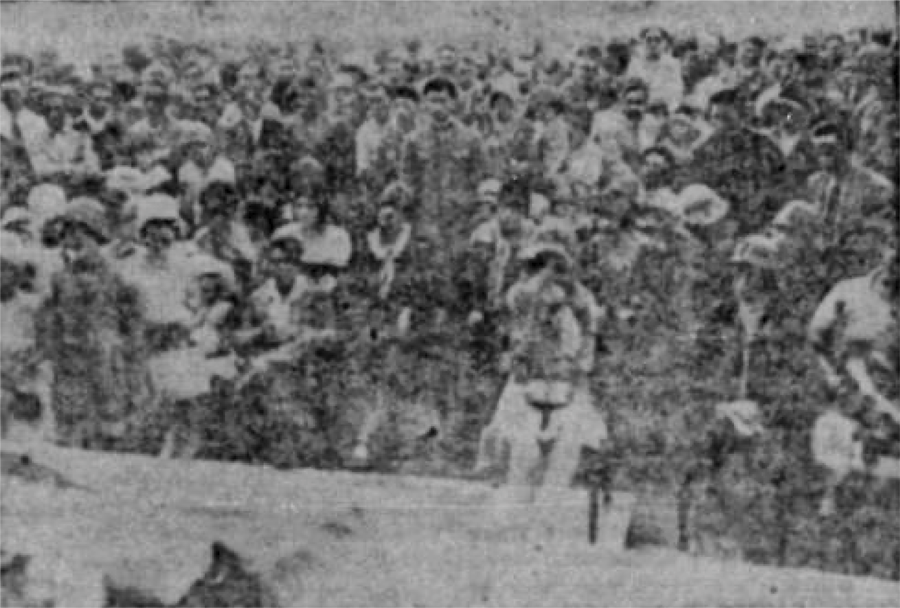
On January 1st, the “Festa Espirita do Detento” society, with the sponsorship of lawyer and merchant Paulo Hecker, held a celebration for the arrival of the new year. Hecker began the ceremony at 3 pm, subsequently inviting Oswaldo Vergara, the president of the Municipal Council, to preside over it. Following this, Vergara invited Alberto de Britto, the first public prosecutor of the district, and Adalberto Pio Souto, the president of the Federação Espírita Rio-grandense, to join the table along with Waldemar Kroeff and Arthur Hoffmann, acting as representatives of the commercial class. After the protocol was finalized and the floor was returned to Hecker, he delivered a thirty-minute lecture on the theme “Temporariness of Sentences.” After him, a few words were addressed to the 674 attendees (Figure 1), “composed mostly of the best elements” of Porto Alegre society, by Alberto de Britto, who alluded to the date of human fraternization and Spiritist faith, ending once again with Oswaldo Vergara. Once this first part was concluded, those present moved to another room in the facility, where sandwiches, pies, sweets, and “various kinds of non-alcoholic drinks” were served “prolifically.” The inmates, including those who remained in their cells, were presented with packages containing: one sandwich, two prawn pies, three sweets, two slices of cake, one cigar, one bottle of refreshment, and one pack of cigarettes. It should be mentioned that the event featured a music band from the Military Brigade.65

Nevertheless, it was not the first edition of that festive event. The previous year, a group of Spiritists under Hecker’s direction had already organized a similar celebration with about 600 attendees, all previously invited, as well as “the majority of the inmates.” Celebrated in the front yard of the facility and presided over by Oswaldo Vergara, the event included a conference by Hecker titled “Spiritism as a Reformer.” The “charity festival,” accompanied by a music band from the Military Brigade, as described, also provided cigarettes, cigars, soft drinks, guaraná, sweets, and sandwiches to those deprived of freedom.66 As can be seen, the Spiritists also managed to celebrate their outdoor events, with notable attendance and institutional/governmental support, as well as addressing convicts with attention and distribution of small gifts.
Nevertheless, this confrontation would not be complete if we left out the actions of another institution that, during those years, also found itself under the Catholic offensive. We are talking about the Young Men’s Christian Association of Porto Alegre (known globally as the YMCA and referred to herein using its original acronym in Portuguese: ACM). According to the specialized literature,
[...] one of the most important movements launched by the archbishop was the creation of the Young Catholic Unions. Publicly, the campaign in favor of founding this movement began at the end of 1923. In the Estrela do Sul of November 8th of that year, abundant material about the topic was published. On the first page, an article titled “ACM = Arapuca Contra Moços” [ACM = Trap for Young Men] stood out, which was a heavy blow against the Young Men’s Christian Association [ACM in Portuguese], stating that despite the generic title of “Christian,” it is a Protestant movement whose objective would be to Protestantize to better Americanize. The text asserted that to counteract the ACM, D. João Becker would have launched the idea of a Young Catholic Unions, which would function as an “effective antidote against the dismal North American association,” “a Yankee Methodist-Baptist-Adventist-Biblist octopus, etc.” (Gertz, 2002, p. 96).
Although we have not been able to find sufficient information to satisfactorily historicize how the ACM confronted the Catholic offensive within the walls of the Casa de Correção, it is a fact that, like the spiritists, they were also present there. As a Christian organization, it was reported in 1928 that the ACM provided attention to both the “little newspaper sellers” and the inmates of the correctional facility through “classes, conferences, and educational lectures, as well as material assistance whenever possible.”67 According to records, “moral, intellectual, and physical education” was the mainstay of the actions and activities that the ACM offered to its members, making it not difficult to imagine the type of discourse directed towards “other classes and other groups in need of support.” Nonetheless, as noted by Szczepaniak (2004, p. 89), it eventually developed “an important socio-sporting work with the prisoners [...], this being considered the first activity aimed at rehabilitating inmates in the city.”
As far as we can determine, ACM’s presence in the Porto Alegre penal facility dates back to the early contentious 1920s. Plauto de Azevedo recorded in his 1922 report that the “useful “Young Men’s Christian Association” of this capital, through its representatives Luiz Alves Rolim, Frank Long, Alvaro Torres, and Lindau Ferreira, has been promoting good customs among the inmates through conferences, also teaching them typing and commercial writing” (Alves, 1922, p. 549). The offering of courses, precisely, seems to have been, in material terms, the main difference between it and the spiritists.
From there, as mentioned, the lack of documentation prevents us from determining whether they successfully promoted large festive outdoor gatherings through their ceremonies, speeches, and gift distribution to the prisoners. The last available information regarding their prison setting activities, though repetitive, indicates at least a regular and continuous presence. This is significant as it demonstrates how the prison intramural effectively became a genuine religious arena throughout that decade, which, in turn, fostered and justified at once the previously studied Catholic offensive.
Thus, in 1924, some ACM members continued to visit the establishment weekly, “who, in addition to ministering religion to the inmates who adhered to Protestantism, maintain, here, a free course” in commercial writing and typing (Alves, 1924, p. 349). The way Plauto de Azevedo portrays this information is, in itself, quite revealing concerning which side of the dispute he stood on, but it must be acknowledged that it also clarifies the strategy used by the ACM to promote, alongside the courses, religious support to those who expressed favor towards Protestantism. This reinforces our observation that the reconstructed history thus far only constitutes a modest page of a much larger chapter in the history of the Catholic-Castilhista consortium and the policy of re-Christianization within the walls of what was the main prison in Rio Grande do Sul until the mid-20th century.
CONCLUSION
What we have just reconstructed, with all its deficiencies and gaps, can be considered an important and certainly unprecedented page in Castilhista penitentiary politics, in consonance with Catholic re-Christianization in Rio Grande do Sul. As manifested, both fed into each other and supported one another to such an extent that, to understand ideologically what happened in the Casa de Correção during the First Republic, especially in the 1920s, one must comprehend how this relationship concretely translated into various actions to strengthen the Catholic presence in the prison environment, to the detriment of the participation of other religious or Christian institutions.
We believe we have made no mistake in asserting that this partnership ended up forming a sui generis penal model because, although religious freedom was respected, the publicly known relations between the Castilhista government and the Catholic Church eventually favored a greater appreciation of Catholic religious practices and rites within the penal environment. The symbiosis between the positivist penitentiary model of the RRP and the re-Christianization policy of the Catholic Church essentially entrusted the latter with the responsibility for the third ingredient of the disciplinary cocktail, namely, religion or religious assistance.
As we have seen, there was an ancient tradition of the visitation of the Holy Spirit to prisoners, which, in the 1920s, reached its peak. However, the key step that led to an initial moment of Catholic revival occurred concurrently with the promulgation of the 1913 regulation, which allowed religious communities to send ministers and/or designated persons to attend to their faithful deprived of freedom. That same year, a Jesuit priest was promptly appointed to work with the prisoners and the authorities of the penal apparatus.
This Church movement was fundamental because it allowed a qualitative leap in its operation within the prison, but also because it served as an initial buffer against the impact of other denominations” penetration from the 1920s onward, such as the spiritists and the Young Men’s Christian Association, which during that decade engaged in activities with the prisoners through visits, lectures, courses, and reading recommendations. It is worth noting, again, that by 1923, there was a prisoner responsible for a Spiritist Library.
Thus, the sending of Fr. Pio Buck, a Jesuit priest who would have a long tenure in the establishment, should not be seen as disconnected or random, but rather as the Church’s response to the new scenario that would transform the Casa de Correção into a veritable arena of struggle, expressed in the intensification of Catholic rites and practices, such as the large field masses that often included the presence of the metropolitan archbishop himself. Nonetheless, although it is not known exactly whose idea it was to associate the traditional Festa do Divino with the Dia do Encarcerado, celebrating them together, it is unsurprising that these events increased considerably in pomp and solemnity over time, thus annually sealing the Catholic-Castilhista consortium in the penitentiary domain.
Lastly, it is impossible to know how the prisoners, the supposed targets of this policy, perceived and utilized the attention received from religious and/or Christian institutions that became more active in prison life. We would venture to say that, beyond the purely spiritual aspect, certain groups certainly benefited in various ways from these competing presences to alleviate or mitigate their needs inherently linked to the deprivation of freedom. We also believe that many of them openly chose a side in the contention and helped intensify internal disputes, although, in the end, all the institutions involved focused on conservative values and principles. For example, Pedro Anthero dos Santos’s lecture discussed “the advantages of the practice of Spiritist doctrine and urged inmates to become humble and obedient for their own good.”68 All of them, in essence, reinforced the importance of honor, family, charity, sobriety, work, order, discipline, hierarchy, patriotism, etc., which, in turn, aligned with the positivist correctional ideology of the RRP, interested in producing well-behaved workers.
ACKNOWLEDGMENTS
I would like to thank the anonymous reviewers for their careful reading and the editorial team for their excellent work.
References
- ABREU, Martha. O império do Divino: Festas religiosas e cultura popular no Rio de Janeiro, 1830-1900. Rio de Janeiro: Nova Fronteira, 1999.
- AGUIRRE, Carlos. La cárcel y la ciudad letrada: hacia una historia cultural de la prisión en el Perú del siglo veinte. In: PALMA ALVARADO, Daniel. (Ed.). Delincuentes, policías y justicias. América Latina, Siglos XIX y XX. Santiago de Chile: Ediciones Universidad Alberto Hurtado, 2015, p. 144-192.
- ALVES, Protasio Antonio. Relatorio apresentado ao Exmo. Sr. Dr. A. A. Borges de Medeiros, Presidente do Estado do Rio Grande do Sul, pelo Dr. Protasio Antonio Alves, Secretario de Estado dos Negocios do Interior e Exterior em 8 de setembro de 1913. Porto Alegre: Officinas Graphicas da Livraria do Globo, 1913.
- ALVES, Protasio Antonio. Relatorio apresentado ao Ex. Sr. General Salvador Ayres Pinheiro Machado, Vice-Presidente em exercicio do Estado do Rio Grande do Sul, pelo Dr. Protasio Antonio Alves, Secretario de Estado dos Negocios do Interior e Exterior em 8 de setembro de 1915. Porto Alegre: Officinas Graphicas da Casa de Correcção, 1915.
- ALVES, Protasio Antonio. Relatorio apresentado ao Exmo. Sr. General Salvador Ayres Pinheiro Machado, Vice-Presidente em exercicio do Estado do Rio Grande do Sul, pelo Dr. Protasio Antonio Alves, Secretario de Estado dos Negocios do Interior e Exterior em 8 de setembro de 1916. Porto Alegre: Officinas Graphicas d'A Federação, v. 1, 1916.
- ALVES, Protasio Antonio. Relatorio apresentado ao Exmo. Sr. Dr. A. A. Borges de Medeiros, Presidente do Estado do Rio Grande do Sul, pelo Dr. Protasio Alves, Secretario de Estado dos Negocios do Interior e Exterior em 27 de agosto de 1917. Porto Alegre: Officinas Graphicas d'A Federação, v. 1, 1917.
- ALVES, Protasio Antonio. Relatorio apresentado ao Exmo. Sr. Dr. A. A. Borges de Medeiros, Presidente do Estado do Rio Grande do Sul, pelo Dr. Protasio Alves, Secretario de Estado dos Negocios do Interior e Exterior em 30 de agosto de 1921. Porto Alegre: Officinas Graphicas d'A Federação, v. 1, 1921.
- ALVES, Protasio Antonio. Relatorio apresentado ao Exmo. Sr. Dr. A. A. Borges de Medeiros, Presidente do Estado do Rio Grande do Sul, pelo Dr. Protasio A. Alves, Secretario de Estado dos Negocios do Interior e Exterior em 4 de setembro de 1922. Porto Alegre: Officinas Graphicas d'A Federação, v. 1, 1922.
- ALVES, Protasio Antonio. Relatorio apresentado ao Exmo. Sr. Dr. A. A. Borges de Medeiros, Presidente do Estado do Rio Grande do Sul, pelo Dr. Protasio A. Alves, Secretario de Estado dos Negocios do Interior e Exterior em 6 de setembro de 1924. Porto Alegre: Officinas Graphicas d'A Federação, 1924.
- BALÉM, João Maria. A primeira Paróquia de Porto Alegre. Porto Alegre: Tipografia do Centro S. A., 1941.
- CESAR, Tiago da Silva. A ilusão panóptica: Encarcerar e punir nas imperiais cadeias da Província de São Pedro (1850-1888). São Leopoldo: Oikos/Editora Unisinos, 2015.
- CESAR, Tiago da Silva. As prisioneiras de Clio. In: SCOTT, Ana Silvia Volpi; CARDOZO, José Carlos da Silva; SILVA, Jonathan Fachini da. (org.). História das mulheres no Brasil Meridional. São Leopoldo: Oikos/Editora Unisinos, 2022, p. 185-243.
- CESAR, Tiago da Silva. As oficinas e o trabalho penal dos condenados da Casa de Correção de Porto Alegre (1895-1930). Tempo, Niterói, v. 28, n. 3, p. 501-529, set./dez. 2021a.
- CESAR, Tiago da Silva. "Que me importa que o governo recolha o meu dinheiro à caixa econômica, se eu tenho que morrer na prisão!?": contestações e resistências ao regime penitenciário da Casa de Correção de Porto Alegre (1897-1930). Anos 90, Porto Alegre, v. 31, p. 1-19, 2024.
- CESAR, Tiago da Silva. Trabalho, lucro e regeneração na Casa de Correção de Porto Alegre durante a República Velha. Millars. Espai I Història, Castellón de la Plana, v. 2, n. 51, p. 135-177, 2021b.
- CORSETTI, Berenice. A educação construindo o cidadão. In: RECKZIEGEL, Ana Luiza Setti; AXT, Gunter. (Dir.). República Velha (1889-1930). Passo Fundo: Méritos, v. 3, tomo 2, p. 287-311, 2007.
- GALEANO, Diego. Un artista del delito. La circulación de moneda falsa entre el Rio de la Plata y Brasil. In: CAI MARI, Lila; SOZZO, Máximo. (Coords.). Historia de la Cuestión Criminal en América Latina. Rosario: Prohistoria Ediciones, 2017. p. 195-233.
- DaMATTA, Roberto. O que faz o brasil, Brasil? Rio de Janeiro: Rocco, 1986.
- GERTZ, René. D. João Becker e o Nacionalismo. Estudos Leopoldenses, São Leopoldo, v. 3, n. 2, p. 155-175, 1999.
- GERTZ, René. O aviador e o carroceiro: Política, etnia e religião no Rio Grande do Sul dos anos 1920. Porto Alegre: EDIPUCRS, 2002.
- GRUZINSKI, Serge. A guerra das imagens: De Cristovão Colombo a Blade Runner (1492-2019). São Paulo: Companhia das Letras, 2006.
- ISAIA, Artur Cesar. Catolicismo e autoritarismo no Rio Grande do Sul. Porto Alegre: EDIPUCRS, 1998.
- ISAIA, Artur Cesar. Catolicismo e castilhismo. In: RECKZIEGEL, Ana Luiza Setti; AXT, Gunter. (Dir.). República Velha (1889-1930). Passo Fundo: Méritos, 2007.v. 3, tomo 2. p. 23-28.
- LEITE, Luiz Osvaldo. Jesuíta gaúcho se doutora em Buenos Aires. In: CLEMENTE, Elvo. (org.). Integração: história, cultura e ciência. Porto Alegre: EDIPUCRS, 2004. p. 85-92.
- LETTI, Nério. Entrevista concedida a Gunter Axt e Lídia Fabrício em 26 de junho de 2003. Revista Justiça & História, Porto Alegre, v. 5, n. 10, p. 311-395, 2005.
- MAINWARING, Scott. Igreja Católica e Política no Brasil (1916-1985) São Paulo: Brasiliense, 1989.
- MEDEIROS, Antonio Augusto Borges de. Mensagem enviada à Assembléa dos Representantes do Rio Grande do Sul pelo Presidente do Estado Antonio Augusto Borges de Medeiros na 2ª sessão ordinaria da 10ª legislatura, em 23 de setembro de 1926. Porto Alegre: Officinas graphicas d'A Federação, 1926.
-
SANTOS, José Antônio dos. 1876-1928: itinerários de um jornalista e burocrata negro. In: XXVII Simpósio Nacional de História: Conhecimento histórico e diálogo social, Natal, Rio Grande do Norte, 22 a 26 de Julho 2013. Disponível em: https://anpuh.org.br/index.php/documentos/anais/category-items/1-anais-simposios-anpuh/33-snh27?start=2000 Acesso em: 26 jul. 2024.
» https://anpuh.org.br/index.php/documentos/anais/category-items/1-anais-simposios-anpuh/33-snh27?start=2000 - SCOTT, James C. Los dominados y el arte de la resistencia. Tafalla: Editorial Txalaparta/Ediciones Era, 2003.
- SEMINÁRIO DE PESQUISAS DO AHRS, 2001. Porto Alegre. Anais [...] 2001, s/p.
- SILVA, Amanda Siqueira da. A História da Brigada Militar pelas páginas da Revista Pindorama. Dissertação (Mestrado em História) - Universidade de Passo Fundo. Passo Fundo, 2013.
- SZCZEPANIAK, Ivone. A busca pelo cárcere perfeito: Casa de Correção de Porto Alegre (1835-1913). Dissertação (Mestrado em História) - Universidade Federal de Santa Maria, Santa Maria, 2004.
-
DATA AVAILABILITY STATEMENT:
All datasets supporting the results of this study have been published within the article itself.
-
1
The civil war, occurring from February 1893 until August 1895 in the south of Brazil, centered in Rio Grande do Sul, was fought between the Federalist Party, led by Gaspar Silveira Martins, which advocated for greater autonomy for the states, and the Rio-Grandense Republican Party, directed by Júlio de Castilhos, who in turn supported a government centralized in the hands of the president of the Republic.
-
2
A CASA de Correcção. A Federação, Porto Alegre, 27 abr. 1900, p. 1.
-
3
CERIMONIA religiosa. A Federação, Porto Alegre, 17 abr. 1922, p. 5.
-
4
DIVERSAS notas. A Federação, Porto Alegre, 6 nov. 1903, p. 2.
-
5
The festivals of the Holy Spirit, in addition to being ancient, enjoyed considerable popular acclaim in various parts of Brazil. Abreu’s study on Rio de Janeiro precisely shows that there was a long-standing custom of providing food on Pentecost to those imprisoned in Aljube, ‘constituting the Brazilian version of concern for the poor and an important reason for the good penetration of the Holy Spirit among the most impoverished and needy’ (Abreu, 1999, p. 41). Moving forward in time and shifting to Porto Alegre during the First Republic, this custom, which also dates back to the monarchical period, continued to exist through the celebration of a mass, the visit of the Holy Spirit flags, and the distribution of small gifts and souvenirs to the inmates.
-
FESTAS do Divino. A Federação, Porto Alegre, 10 jun. 1905, p. 2. FESTA do Espirito Santo. A Federação, Porto Alegre, 15 maio 1906, p. 2.
-
6
FESTAS do Divino. A Federação, Porto Alegre, 10 jun. 1905, p. 2. FESTA do Espirito Santo. A Federação, Porto Alegre, 15 maio 1906, p. 2.
-
7
Born in Porto Alegre on February 21, 1857, he served as secretary of the Police Headquarters and as president of the Military Club of National Guard Officers, as well as the Association of Public Officials. In commission, he frequently held the position of Chief of Police of the State and, for five years, occupied the role of administrator of the House of Correction (1899-1904), succeeding Captain Antonio Leite Mendes Bastos, who passed away between July and September 1899. Appointed as an officer of the mentioned headquarters by a decree from the Ministry of Justice on May 29, 1886, he performed various roles, including director, deputy director of the said secretariat, and police commissioner. When he died in the capital on May 15, 1923, he was described as a very religious man. He was a member of various brotherhoods and congregations, being a retired provost of the Brotherhood of the Holy Spirit, organizing, in 1905, a celebration that no other festival organizer in that brotherhood had matched until then. VIDA Social. A Federação, Porto Alegre, May 15, 1923, p. 3; A Federação, Porto Alegre, July 26, 1899, p. 2; SECÇÃO Judiciaria. A Federação, Porto Alegre, September 21, 1899, p. 2.
-
8
Lieutenant Colonel Frederico Ortiz was the sixth administrator of the Porto Alegre House of Corrections following the implementation of workshops. His appointment was issued on February 4, 1913, but he did not assume the role until the seventh of the same month, succeeding his predecessor, Lieutenant Colonel Francisco Antonio de Oliveira Moraes, who had requested resignation. Before taking over the penal institution and leading it until July 1920, Ortiz held the position of deputy chief of police of the 6th police region and was a recognized affiliate of the RRP (Alves, 1913, p. 508; 1915, p. 67; VARIAS. A Federação, Porto Alegre, 7 fev. 1913, p. 3).
-
9
Regarding this prisoner’s criminal trajectory, see Galeano (2017, p. 195-233).
-
10
A Federação, Porto Alegre, 10 dez. 1912, p. 1.
-
11
A Federação, Porto Alegre, 8 set. 1902, p. 2.
-
12
SECÇÃO Brazileira. Staffetta Rio-Grandense, Garibaldi, 31 out. 1917, p. 1.
-
13
It is quite curious that this appointment occurred even before the enactment of the 1913 regulation itself, which would standardize the manner and conditions for offering religious attention within the penal establishment, as stipulated by decree no. 2,012 on August 22, 1913.
-
14
PELOS encarcerados. A União, Rio de Janeiro, 17 ago. 1913, p. 3.
-
15
Likewise, in the case of serious illness, the condemned were allowed to be attended to by a minister of their religion, if they requested it and one was available. For prisoners facing imminent death (in articulo mortis), marriage was permitted within the establishment, with the sole requirement being that the provisions outlined in Decree No. 181, dated January 24, 1890, “and any other applicable provisions for the effects resulting from the act” be respected. Articles 202, 203, and 204 of the 1913 regulation. SEMINÁRIO DE PESQUISAS DO AHRS, 1, 2001. Porto Alegre. Anais [...] 2001, s/p.
-
16
O NIVEL da criminalidade no Estado e no municipio da Capital. A Federação, Porto Alegre, 8 set. 1931, p. 5.
-
17
Plauto was appointed by the State government to replace Frederico Ortiz “during his impediment” on July 1, 1920. The appointment, however, was only issued on October 6, 1920, by decree No. 2671, “given that retirement was granted” to Ortiz. Before taking office and becoming the seventh administrator of the industrial era of the House of Correction and, apparently, the first civilian, Plauto served as the judicial delegate of the 1st District of Porto Alegre (Alves, 1921, p. 465).
-
18
In a statemente given to the historian Gunter Axt and the architect Lídia Fabrício on June 26, 2003, Judge Nério Letti recalled the uninterrupted work done over 40 years by Father Pio as the chaplain of the House of Correction. According to Letti, the SJ was German and had fought in World War I as an officer of the German forces. In addition to being a botanist and a drawing and mathematics teacher, he also practiced boxing. Later, his name was given to the halfway house for prisoners next to the Central Prison (Letti, 2005). In another source, Pio was actually of Swiss origin, naturalized as a Brazilian, born in Hochdorf on July 22, 1883. He had participated in World War I as a nurse in a field hospital and died in Porto Alegre on August 21, 1972. Available at: https://pt.wikipedia.org/wiki/Pio_Buck. Accessed: February 15, 2020.
-
19
O DIA do encarcerado. A Federação, Porto Alegre, May 25, 1925, p. 3. Years prior, when the chapel had been dismantled due to some expansion works of the establishment, Plauto arranged for the celebration of the resurrection mass to use the “new visiting room” as an improvised space. He and other staff members, along with a “large number” of inmates, participated in the ceremony that was officiated by Father Pio Buck. On this occasion, the Jesuit delivered “words of comfort” to the incarcerated individuals and gave communion to those who had been “properly prepared.” CERIMONIA religiosa. A Federação, Porto Alegre, 17 abr. 1922, p. 5.
-
20
O NIVEL da criminalidade no Estado e no município da Capital. A Federação, Porto Alegre, 8 set. 1931, p. 5.
-
21
The RRP’s own press organization recognized the Feast of the Divine, as well as the Feast of the Navigators, as the most “traditional festivals that the people of Porto Alegre still preserve today.” A TRADICIONAL festa dos Navegantes. A Federação, Porto Alegre, 2 fev. 1929, p. 4
-
22
It is important to emphasize that, although by far the most significant, the Divino was not the only festivity organized through the Catholic-Castilhista partnership. On December 25, 1922, at the initiative of Father Pio Buck, the institution’s chaplain, and Father José Beltran, the “Christmas for the Incarcerated” was celebrated for the first time. Starting at 8:30 in the morning, the event featured, in addition to an audience of more than 500 inmates and prison staff, the participation of the confreres of Saint Vincent de Paul, the Our Lady of Sorrows Conference, “honorable families,” and “Brother Leão.” As in the Divino festivities, an outdoor altar was erected, flanked by the national and Rio Grande do Sul flags, where after consecration, 57 inmates received communion. The “gospel” was delivered by Father Beltran, the Ave Maria by “Miss” Aracy Godoy Gomes, accompanied by another anonymous “Miss” on the harmonium, and Maestro Luchesi on the violin. The choir was the Dores Choir. After the religious ceremony, there was also a raffle among the prisoners, with prizes consisting of “fine sweets, chocolate, cigarettes, cigars, saints, prayer books, and other useful objects,” which were distributed “abundantly.” Lastly, Buck and Beltran visited the sick inmates, delivering the same gifts to them until 11 am. NA CASA de Correcção. A Federação, Porto Alegre, 26 dez. 1922, p. 4.
-
23
For visits to occur, authorization was required from both the administrator and the chief of police.
-
24
BANDEIRAS do Divino. A Federação, Porto Alegre, 22 maio 1922, p. 5.
-
25
The police force established in 1892 is considered the ‘maintainer of the political hegemony of the RRP’s (Silva, 2013). According to the author, the Military Brigade played a crucial role in defending the aforementioned party during the Federalist Revolution (1893-1895) as well as the 1923 Revolution and the Tenentista uprisings between 1924 and 1926.
-
26
VISITA das bandeiras do Divino Espirito Santo á Casa de Correcção. A Federação, Porto Alegre, 14 maio 1923, p. 5.
-
27
O DIA do encarcerado. A Federação, Porto Alegre, 26 maio 1924, p. 2.
-
28
We believe it to be Cristiano Felippe Fischer. “Born in São Leopoldo (RS), December 7, 1869. He graduated in Pharmacy from the University of Ouro Preto (MG) in 1889. He returned to Porto Alegre as an assistant at the Pasquier Pharmacy; two years later, he became a partner. He was one of the main founders of the Free Faculty of Medicine of Porto Alegre in 1898. He also taught Chemistry. In 1906, he founded the Fischer Pharmacy in Porto Alegre (RS).” Available from: https://www.muhm.org.br/biografiasmedicas/biografia/554. Accessed on: July 18, 2024.
-
29
Sylvio do Nascimento Barros held the position of secretary general at the Chief of Police’s Office since at least 1922. EDITAL. A Federação, Porto Alegre, January 1, 1923, p. 31. VIDA social. A Federação, Porto Alegre, 9 jun. 1924, p. 2.
-
30
O DIA do encarcerado. A Federação, Porto Alegre, 26 maio 1924, p. 2. Sophia Pinheiro Barbedo was the wife of Captain Alcides Bello Barbedo, a capitalist in this locality. From this point on, the celebrations of the Day of the Incarcerated, combined with those of the Divine, would feature the presence of doctors, lawyers, judges, prosecutors, promoters, presidents of the penitentiary council, consuls, merchants, and industrialists, as well as members of their families, such as fiancées, daughters, and wives. Their presence had a designated place and role in these celebrations of devotion, modesty, and complex hierarchies, alongside their respective male counterparts (civil, ecclesiastical, or military authorities, fathers, husbands, fiancés, relatives, or friends), ultimately serving as a model of the ideal woman both for the incarcerated and for their own wives, companions, and family members who visited them on this day. In this sense, the silence regarding the existence of inmates in the establishment is quite telling (Cesar, 2022).
-
31
Father Henrique Book (1872-1946) was the rector of the Anchieta College in Porto Alegre. He is remembered as an educator, humanist, an expert in educational legislation, and as the author of the essay. Latim, Base do Ensino Secundário, published in Relatório do Colégio Anchieta de 1944 (Leite, 2004, p. 89).
-
This altar, it was said, originally belonged to an ancient chapel, now defunct, which had been blessed by D. Sebastião Dias Laranjeira 50 years ago. O DIA do encarcerado. A Federação, Porto Alegre, 26 maio 1924, p. 2.
-
José Barea (1893-1951), the first bishop of the Diocese of Caxias do Sul, studied at the Seminary of Our Lady of Conception in São Leopoldo, where he was ordained a priest in 1918. Shortly thereafter, he was appointed the private secretary to D. João Becker, the archbishop of Porto Alegre, serving in this capacity for nine years, during which time he was elected canon. In 1928, he was appointed pastor of the Church of Our Lady of the Rosary. Available at: https://pt.wikipedia.org/wiki/Jos%C3%A9_Barea. Accessed on: February 17, 2020. During the organization of the Regional Council of Catholic Youth Unions in 1927, Bishop João Becker appointed Father Leopoldo Neis as the ecclesiastical assistant. However, when Neis vacated the position in mid-1928, Barea was appointed as his replacement (Gertz, 2002, pp. 97-98).
-
He appears in newspapers as an important merchant in the export trade of goods, but also as a “progressive industrialist of this city.” O DIA do encarcerado. A Federação, Porto Alegre, 26 maio 1924, p. 2.
-
According to Santos (2013, pp. 1-13), Marcílio was a Black journalist, a Catholic, and a bureaucrat who was born in 1876 and died in Porto Alegre in 1928. He helped to establish and maintain the weekly publication O Exemplo, which was notable for its fight against racism. His access to public service (he rose to the position of a clerk in the Treasury Department), his militant Catholicism, and his political participation in the PRR granted him connections among the notable individuals of the capital, along with esteem and recognition. However, it is noted that he participated in the Military Officers Club of the National Guard and the Julio de Castilhos Republican Club, “where he flaunted the titles of major and captain, which were granted to him for serving in the republican ranks.” It is emphasized that the posts of “festive emperor” and “ensign of the flag” were mostly assigned to socially prominent individuals in Porto Alegre society.
-
32
This altar, it was said, originally belonged to an old chapel, now extinct, which, 50 years ago, was blessed by D. Sebastião Dias Laranjeira. O DIA do encarcerado. A Federação, Porto Alegre, 26 maio 1924, p. 2.
-
33
José Barea (1893-1951), the first bishop of the Diocese of Caxias do Sul, studied at the Nossa Senhora da Conceição Seminary in São Leopoldo, where he was ordained as a priest in 1918. Shortly thereafter, he was appointed as the private secretary to D. João Becker, Archbishop of Porto Alegre, serving in this role for nine years, during which he was elected as a canon. In 1928, he was appointed as the parish priest of the Church of Nossa Senhora do Rosário. Available at: https://pt.wikipedia.org/wiki/Jos%C3%A9_Barea. Accessed on: February 17, 2020. During the organization of the Regional Council of Young Men’s Catholic Unions in 1927, D. João Becker appointed Father Leopoldo Neis as ecclesiastical assistant, but when Neis left the position in mid-1928, Barea was appointed to replace him. (Gertz, 2002, p. 97-98).
-
34
He appears in newspapers as an important merchant in the export business of goods, but also as an “advanced industrialist of this area.” O DIA do encarcerado. A Federação, Porto Alegre, 26 maio 1924, p. 2.
-
35
According to Santos (2013, pp. 1-13), Marcílio was a Black journalist, a Catholic, and a bureaucrat born in 1876 and died in Porto Alegre in 1928. He helped to found and sustain O Exemplo, a weekly newspaper noted for its fight against racism. His access to public service (he became a clerk in the Finance Secretariat), his militant Catholicism, and his political involvement in the PRR earned him alliances among the distinguished people of the capital, along with esteem and recognition. It is noted, however, that he was a member of the Military Club of National Guard Officers and the Julio de Castilhos Republican Club, “where he flaunted the titles of major and captain, which were granted to him for serving in the Republican ranks.” Lastly, it is highlighted that the titles of “imperial festival organizer” and “flag ensign” were often given to socially prominent individuals in Porto Alegre society..
-
36
In that year, the brotherhood granted freedom to Pedro Reis. Released on May 18, 1924, Reis, as part of the civic-religious ritual, accompanied the procession to the Correctional House to attend the mass. AS BANDEIRAS do Divino na Casa de Correcção. A Federação, Porto Alegre, 19 maio 1924, p. 3.
-
37
In the report detailing the visit made to the establishment on October 2, 1923, by the law school students, Cazuza is mentioned as Osorio Martins da Silva, the person responsible for managing the kitchen. At that time, as it was also stated, it had been 27 years since he committed the murder of an ‘elderly couple’ in Azenha. VISITA dos academicos de Direito á Casa de Correcção. A Federação, Porto Alegre, 2 out. 1923, p. 6.
-
38
O DIA do encarcerado. A Federação, Porto Alegre, 26 maio 1924, p. 2.
-
39
At the time, the facility housed 617 inmates, including 18 women and 1 minor.
-
40
Cazuza could still be seen as a guardian of this “public discourse,” a role most often, though not exclusively, carried out by trusted prisoners. Of course, other individuals and authorities might organically or otherwise perform this function. Remember that besides clergy and military personnel, politicians, and industrialists, many civilians over the years participated in the outdoor masses, whether as brothers, invited authorities, or influential people from the cream of South Rio Grande’s society. Among this latter group was, for example, the then-professor of the Faculty of Medicine, Raul de Bittencourt, who, in 1927, gave “a brilliant lecture on ‘The Benefit of Pain and the Morality of the Incarcerated.’” O DIA do encarcerado. A Federação, Porto Alegre, May 30, 1927, p. 5. As well as the lawyer Pedro Vergara who, in 1931, would give a “lecture” to the inmates. O DIA do encarcerado. A Federação, Porto Alegre, May 18, 1931, p. 3. By this time, Pedro Leão Fernandes Espinosa Vergara was serving as a public prosecutor in the Federal District, but before this, and before entering politics in late 1932, he served as a public prosecutor in Porto Alegre between 1926 and 1928, and as a lawyer. Available at: https://www.fgv.br/cpdoc/acervo/dicionarios/verbete-biografico/pedro-leao-fernandes-espinosa-vergara. Accessed on: February 17, 2020. Even before his move to Rio de Janeiro, Vergara participated along with other laypeople in activities promoted by the Catholic Institute of Sciences and Letters. In this institution, personally supervised by Archbishop D. João Becker, “transcendental themes of Philosophy and Theology” were discussed. (Gertz, 2002, p. 95).
-
41
Organized by class and under the direction of 1st Army Sergeant João da Costa Saldanha, a clerk at the General Headquarters, “Swedish gymnastics exercises,” “sprint races, sack races, races with tied feet, obstacle races, relay races, etc.,” were conducted. As customary, the distributed gifts consisted of small tokens like records and doves, objects of worship or of religious character, such as the crucifix offered by the employees of the funeral home of the widow of Manoel Luiz Postiga, given to the winning team, or the prayer book gifted by Father Pio Buck to the winners of the sprint race. Furthermore, silver medals were distributed among the winners of some events, like the aforementioned sprint, but also in the barrel races. Father Pio also included, along with the donation of one of these medals, symbolizing individual effort, a book of prayers.. O DIA do encarcerado. A Federação, Porto Alegre, 26 maio 1924, p. 2.
-
42
O DIA do encarcerado. A Federação, Porto Alegre, 26 maio 1924, p. 2. Due to space constraints, it was not possible to analyze the photographs of the event, published by Plauto in his 1924 report (Alves, 1924, pp. 375-377).
-
43
O DIA do encarcerado. A Federação, Porto Alegre, 25 maio 1925, p. 3.
-
44
VISITA da Irmandade do Divino Espirito Santo á Casa de Correcção. A Federação, Porto Alegre, 14 maio 1926, p. 5. O DIA do encarcerado. A Federação, Porto Alegre, 24 maio 1927, p. 4. And this would not be the last time the inmates would see him in 1927. On August 17, just a few months later, D. João Becker would inaugurate the new chapel of the House of Correction. RIO Grande do Sul. O Paiz, Rio de Janeiro, 18 ago. 1927, p. 5.
-
45
VISITA á Casa de Correcção. A Federação, Porto Alegre, 19 maio 1928, p. 2. O DIA do encarcerado. A Federação, Porto Alegre, 11 maio 1929, p. 4.
-
46
A FESTA do encarcerado. Estado do Rio Grande, Porto Alegre, 29 maio 1930, p. 7. A FESTA do encarcerado. Estado do Rio Grande, Porto Alegre, 2 jun. 1930, p. 6. In 1931, the sermon was delivered by Father Ponciano Stenzel dos Santos. He, along with Fathers Pio Buck and Alberto José Colling, sponsored a sort of gathering with “sweets and non-alcoholic drinks” for the participating prisoners. O DIA do encarcerado. A Federação, Porto Alegre, 18 maio 1931, p. 3.
-
47
In 1916, he was one of the ten initially appointed canons of the Chapter of Sé (Balém, 1941, p. 93-94).
-
48
It is also worth adding, along with Gertz, that seeing no incompatibility between religious activism and political activism, D. João Becker would still appoint Nicolau Marx, in 1927, “to run for a seat in the Assembly of Representatives of Rio Grande do Sul, for the ruling party, where, later, he came to defend Getúlio Vargas against the accusations of positivist atheism made by a significant portion of the Brazilian clergy, when he ran for the position of President of the Republic.” (Gertz, 2002, p. 96).
-
49
Hervé was trained as a Civil Engineer and served as a professor of the sanitation course at the School of Engineering in Porto Alegre. In 1921, he took charge of the Borges de Medeiros Institute at the aforementioned school, and from then on, he continually balanced political life with public service. He was first the traffic director and then the superintendent of the Force and Light Company, and before that, he was among those nominated for municipal councilor during a meeting attended by Borges de Medeiros on July 14, 1924, a position he officially assumed in 1926. ASSEMBLÉA dos Representantes. A Federação, Porto Alegre, 21 nov. 1921, p. 1. ESCOLA de Engenharia. A Federação, Porto Alegre, 18 mar. 1921, p. 4. COMPANHIA Força e Luz Porto Alegrense. A Federação, Porto Alegre, 4 maio 1926, p. 6. POLITICA. O Brasil, Caxias, 19 jul. 1924, p. 2. VIAJANTES. A Federação, Porto Alegre, 25 jan. 1926, p. 2. It is further noted that the incident between Hervé and Marx occurred shortly after the former was replaced on the board of the Allan Kardec Spiritualist Society. NOTAS Espíritas. A Federação, Porto Alegre, 9 maio 1925, p. 9.
-
50
“In 1925, the National Congress debated a proposal to reform the 1891 Constitution. Among the amendments presented at that time were two from the Paraná deputy Plínio Marques, known as the ‘Catholic amendments.’ One sought to implement optional religious education in public schools, and the other aimed to include in the constitutional text a statement that Catholicism was the religion of the majority of the Brazilian people.” The first amendment was simply rejected in a vote, and the second was withdrawn by its author before it could be voted on (Gertz, 2002, p. 104, p. 109).
-
51
NOTAS Espíritas. A Federação, Porto Alegre, 29 jan. 1926, p. 3.
-
52
NOTAS Espíritas. A Federação, Porto Alegre, 3 set. 1926, p. 3. A few years later, during the celebration of the Festa do Divino/Encarcerado in 1929, the outdoor mass was to be celebrated by Nicolau Marx.
-
53
The prisoner in charge was named Gabriel M. dos Santos and his assignment came from the Federação Espírita do Rio Grande do Sul itself. NOTAS Espíritas. Estado do Rio Grande, Porto Alegre, 20 jan. 1930, p. 15.
-
54
VISITA dos academicos de Direito á Casa de Correcção. A Federação, Porto Alegre, 2 out. 1923, p. 6.
-
55
Remember that reading books and newspapers in the cells was considered both a reward and its prohibition a punishment, according to the regulations of 1896 and 1913. Indeed, in his 1915 report, Ortiz wrote that the library was frequented on Sundays by well-behaved inmates who deserved ‘this prize’ (Alves, 1915, p. 49). And, almost a decade later, an article stated that, with the administrator’s permission, inmates could take books to read them in the cells. VISITA dos academicos de Direito á Casa de Correcção. A Federação, Porto Alegre, 2 out. 1923, p. 6.
-
56
Sections 2 and 3 of Articles 159 and 160 of the 1896 regulations, and sections 2 and 3 of Articles 86 and 87 of the 1913 regulations. SEMINÁRIO DE PESQUISAS DO AHRS, 1., 2001. Porto Alegre. Anais [...] 2001, s/p. Let us consider an example. In 1906, allegations of supposed mistreatment by the administrator Lieutenant Colonel José Diogo Brochado surfaced in the Porto Alegre newspapers (Cesar, 2024, pp. 12-13). These allegations referred to physical mistreatment and deprivation of reading material. As usual, the newspaper A Federação defended the administrator, attempting to clarify that reading books and newspapers in cells was not a right but a privilege, subject to the administration’s discretion. For this reason, the editorial team reprinted and published the articles from the 1896 regulations that exclusively dealt with rewards and punishments, as well as the library and reading materials. In another short text in the same issue, the case of some prisoners complaining as if they were staying in a hotel was described with much sarcasm: “The convicts must eat from the hotel and enjoy all the comforts, refining themselves with reading magazines, newspapers, etc.” PHILOSOPHIAS. A Federação, Porto Alegre, March 31, 1906, p. 2. Given these observations, we can agree with Aguirre’s words (2015, p. 146; p. 185) concerning the importance of the different forms of writing and the inmates’ relationship with print media in general. According to this historian: “The multiple forms of writing, reading, printing, and circulating books, pamphlets, letters, and other forms of written word also constitute an important part of prison history,” meaning, “it is impossible to imagine the prison experience for any type of inmate without considering the written word in the form of letters, petitions, complaints, diaries, manifestos, poems, songs, plays, testimonies, novels, and books of political, social, or historical analysis.”
-
57
NOTAS Espíritas. Estado do Rio Grande, Porto Alegre, 20 jan. 1930, p. 15.
-
58
NOTAS Espíritas. Estado do Rio Grande, Porto Alegre, 20 jan. 1930, p. 15.
-
59
NOTAS Espíritas. A Federação, Porto Alegre, 4 mar. 1927, p. 5.
-
60
NOTAS Espíritas. Estado do Rio Grande, Porto Alegre, 20 jan. 1930, p. 15.
-
61
NOTAS Espíritas. Estado do Rio Grande, Porto Alegre, 6 set. 1930, p. 9.
-
62
NOTAS Espíritas. Estado do Rio Grande, Porto Alegre, 12 nov. 1929, p. 5.
-
63
NOTAS espíritas. Estado do Rio Grande, Porto Alegre, 14 abr. 1930, p. 2. NOTAS Espíritas. Estado do Rio Grande, Porto Alegre, 22 ago. 1930, p. 7.
-
64
NOTAS espíritas. Estado do Rio Grande, Porto Alegre, 4 jan. 1930, p. 10.
-
65
NA CASA de Correcção. Estado do Rio Grande, Porto Alegre, 3 jan. 1930, p. 7.
-
66
NA CASA de Correcção. A Federação, Porto Alegre, 2 jan. 1929, p. 6.
-
67
ASSOCIAÇÃO Christã de Moços. A Federação, Porto Alegre, 3 jul. 1928, p. 3.
-
68
NOTAS espíritas. Estado do Rio Grande, Porto Alegre, 14 abr. 1930, p. 2.
-
Editor in charge:
Ely Bergo de Carvalho
All datasets supporting the results of this study have been published within the article itself.