 Evolutionary Conservatives The Politics of Time of the “Projeto de Nação” of Brazilian Military Sectors
ABSTRACT
In this text, we analyse the document “Projeto de Nação: O Brasil em 2035,” published in 2022 by groups linked to military and conservative sectors, based on its projections of the future and invocations of the past. To this end, we will use the analytical category “politics of time,” which helps us interpret the temporal framing constructed as a form of self-legitimation and political intervention. We hypothesise that the “Projeto de Nação” explores temporal images and figurations to naturalise historical meanings and understandings linked to an idea of nation and Brazilian culture that privilege homogeneity over difference. To this end, the document resorts to characteristics of the utopian genre and disregard for theoretical reflection as forms of authorial concealment and neutralisation of the situated character of the enunciating subject.
KEYWORDS:
Military; History of Brazil; Temporality
RESUMO
Neste texto, analisamos o documento “Projeto de Nação: o Brasil em 2035”, publicado em 2022 por grupos ligados a setores militares e conservadores a partir de suas projeções de futuro e invocações de passado. Para tanto, lançaremos mão da categoria analítica “políticas do tempo” que nos auxilia na interpretação dos enquadramentos temporais [temporal framing] construídos como forma de autolegitimação e intervenção política. Nossa hipótese é que o “Projeto de Nação” explora imagens e figurações temporais de modo a naturalizar sentidos e compreensões históricas ligados a uma ideia de nação e cultura brasileira que privilegiam a homogeneidade sobre a diferença. Para tanto, o documento recorre a características do gênero utópico e ao desprezo pela reflexão teórica como formas de encobertamento autoral e neutralização do caráter situado do sujeito enunciador.
PALAVRAS-CHAVES:
Militares; História do Brasil; Temporalidade
INTRODUCTION
During a ceremony to launch the “ Projeto de Nação: O Brasil em 2035” (Nation Project: Brazil in 2035) on 19 May 2022, the former Vice-President of the Republic, Hamilton Mourão, hailed the occasion and summed up the idea of nationhood that guided the new project:
We are an amalgam of diverse origins, from white Europeans to black Africans and those who were already here, the Amerindians. We created this distinctive race, which is a winning race because it has always known how to overcome its difficulties (Instituto Sagres, 2022b).
By reviving Von Martius’ well-known and often reworked formula for how Brazil’s history should be written, Mourão believed it would be possible to “overcome our idiosyncrasies” and “fulfil our manifest destiny: to be the most prosperous liberal democracy on the south side of the Equator” (Instituto Sagres, 2022b). Mourão’s statement is aligned with several passages in the Project that envision a Brazil in 2035 that has undergone a “weakening of radical political ideologies, reducing social division and increasing national cohesion” (Instituto Sagres, 2022a, p. 12). The neutralisation of “ideological radicalism,” associated with the utopian dimension, which would advocate “anti-Brazilian cultural values,” seemed to be a sensitive issue for the “Project.” (Instituto Sagres, 2022a, p. 46).
Although envisaging Brazil in 2035 was the main objective of the Project, this would not be possible without a well-established historical foundation. Thus, an understanding of Brazilian history is structured that should be “valued” based on the revival of “historical figures of Brazil, without ideological bias, to rescue national identity” (Instituto Sagres, 2022a, p. 46). In this case, the figures were a set of publications in the wake of João Manuel Pereira da Silva’s “Plutarco brasileiro”, published in 1847, which proposed a national historical pedagogy based on the biographies of great men ‘in a broad undertaking to reconcile the national elites. (Enders, 2000, 47).
The project also recommended the “dissemination of works that have marked the development of our historiography”, such as Coleções Brasilianas, by the philosopher Antônio Paim and published in 2019 under the seal of the Conselho Editorial do Senado Federal (Brazilian Senate Editorial Council). Paim’s work aimed to comment on works such as those of Companhia Editora Nacional, organiser of another Brasiliana collection from the 1930s, as part of the development of a pedagogy of nationality at the time (See: Venancio, 2014, p. 111). In the 1970s, Paim was a teacher of Ricardo Vélez Rodríguez, who held the position of Minister of Education in the Bolsonaro government in 2019, and with whom he shared the same “aversion to socialist ideas and Marxist indoctrination in Brazilian universities” (Evelin, 2019).
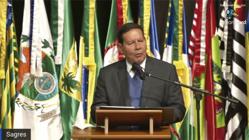
: Launch ceremony for the “ Projeto de Nação: O Brasil em 2035” (Nation Project: Brazil in 2035), May 2022
We will explore the invocations of the past and the future projections made in the document “Projeto de Nação: o Brasil em 2035” (Nation Project: Brazil in 2035), published in 2022 by groups linked to military and conservative sectors. Firstly, we will examine the document’s alleged methodological procedures and, subsequently, consider the descriptive dimension of its projections. Next, we will interpret the document through the politics of time framework, which allows us to understand its temporal operations, so that finally, we can present our hypothesis about the relationship that conservative thinking establishes with the utopian genre and the concealment of the subject who articulates the historical narrative.
THE PROJECT: METHOD AND FICTION
The “Projeto de Nação: O Brasil em 2035” (Nation Project: Brazil in 2035) is a document signed by three institutes: Instituto General Villas Bôas; Instituto Sagres: Política e Gestão Estratégica Aplicadas, and Instituto Federalista1. Published in February 2022, the document has direct links to groups of retired and reserve military personnel linked to former President Jair Bolsonaro’s administration. In addition to Mourão, the aforementioned launch ceremony was attended by Eduardo Villas Bôas, special advisor to the Institutional Security Office of the Presidency, and active-duty General Valério Stumpf Trindade. The development of the document was coordinated by retired General Luiz Eduardo Rocha Paiva, a member of the “Comissão da Anistia” (Amnesty Commission) of the Ministry of Women, Family and Human Rights (MMFDH), created by former President Jair Bolsonaro and headed by Senator Damares Alves. Paiva is the former president of the Non-Governmental Organisation Ternuma (“Terrorismo Nunca Mais” – Terrorism Never Again)2, founded by Colonel Carlos Alberto Brilhante Ustra, a notorious torturer during the military dictatorship, who died in 2015 (Charleaux, 2022).
Right at the beginning of the Project presentation text, we find that its construction was only possible after “extensive consultation with experts and the general public (Consulting Augurs)” and that the document “proposes National (or Political) Objectives and Political-Strategic Guidelines, established after identifying the obstacles to the achievement of those Objectives” (Instituto Sagres, 2022a).
We are informed that the Project is based on methods created by the Instituto Sagres, which they call FIGE (Integrated Strategic Management Tools), and which is characterised by the construction of possible future scenarios that are constituted by the “Consulting Augurs” methodology, providing a link on the Survey Monkey website for citizens to respond to a ready-made table with a given theme and the “uncertainty” related to it, and to discuss and create a scenario based on that. An example is the establishment of a theme called ‘Globalist Movement.’”3, to which guests were asked to respond about how it would operate (Caldeira, 2022).
In the section entitled “necessary explanation”, we are introduced to the ultimate goal of the project: the construction of a “history of the future”. There we read that “the narrator and readers are positioned on the temporal horizon (in this case, 2035) to learn about the evolution of a fictional scenario, as a basis for decision-making, especially at the political-strategic level (objectives, guidelines, and strategies)” (Instituto Sagres, 2022a, p. 9). Still in the “necessary explanation”, we can read that
This is not a futile attempt to predict the future — not least because that is impossible — but rather an exercise based on established methods to: broaden mental maps; visualise key trends and their possible disruptions; identify threats and opportunities; and propose measures to build the best possible future (Instituto Sagres, 2022a, p. 9).

However, twice it is noted that everything there is “fictitious” and “inserted only to give greater verisimilitude and understanding to the content.” Still within the fictional structure of the document, its authorship is attributed to “a report on the current situation by the Brazilian office of an international consulting firm (also fictional), called CPEAZ, Consultoria Política e Empresarial para as Américas – SEÇÃO BRASIL [Political and Business Consulting for the Americas – BRAZIL SECTION]” (Instituto Sagres, 2022a, p. 9). In the following section of this text, we alert the reader to a change in the narrative voice, so that we can follow the story of the future of the “Projeto de Nação: o Brasil em 2035” (Nation Project: Brazil in 2035) from the “inside”.
THE HISTORY OF THE FUTURE
We are in September 2035 and ‘Brazil’s image abroad has been improving steadily, even after frequent attacks orchestrated by entities with ulterior motives’ (Instituto Sagres, 2022a, p. 14). Compared to 15 years ago, i.e. 2020, the country’s economy has grown by 35%, and the reason for this success is Brazilian agribusiness, which has achieved successive productivity gains. In the meantime, the country also overcame other important challenges: a pandemic between 2027 and 2028 of the “Xvirus” and a conflict between the United States, on the one hand, and China and Russia, on the other, with Guyana as the stage and the various Chinese acquisitions of mining areas in that territory. Overcoming these challenges was only possible through the implementation, in the mid-2020s, of the “EN”, i.e. the National Strategy, provided for in the “Projeto de Nação” ([Nation Project])” in 2022.
Overcoming other obstacles along the way was also important. Perhaps the most decisive one was the fight against “globalism”, that is
internationalist movement whose objective is to determine, direct, and control relations between nations and between citizens themselves, through positions, attitudes, interventions, and impositions of an authoritarian nature, but disguised as socially correct and necessary (Instituto Sagres, 2022a, p. 11).
The main player in “globalism” is the global financial elite, which seeks to make decisions on issues such as economic crises, environmental protection and minority rights through a centralised process, a “global agenda” that, in 2035, has not yet materialised, given the strength of the “Projeto de Nação [Nation Project]” and its strategies. Always seeking to ally itself with central countries, international organisations, and non-governmental organisations (NGOs), this elite seeks to ‘interfere in the decisions of government officials and legislators, especially on issues aimed at granting benefits to certain minorities, to the detriment of the majority of the population’ (Instituto Sagres, 2022a, p. 12), leading to a weakening of the nation in its quest for development. One of the main avenues of action for “globalism” would be the coopting of sectors of public institutions to act “from an exclusively ideological perspective”, such as in cases of “political-partisan judicial activism”, undermining the current legal framework and, above all, the Brazilian Constitution.
However, the majority of the country did not bow to judicial activism and the widespread actions of “globalist” forces. Between 2015 and 2035,
successive large-scale demonstrations involved a significant portion of the population that today identifies as conservative and liberal, pressing for structural changes in the education and political systems, in a process that culminated in the emergence of new leaders” (Instituto Sagres, 2022a, p. 12).
These majorities’ efforts were greatly aided by their fight against the old patrimonialist and physiological leaderships that were linked to corruption. However, in 2035, the regime and the fight against corruption are stable after the leadership that emerged since 2015 gained strength. These leaders were guaranteed renewal through a progressively “de-ideologised” education system with curricula that reinforced moral, ethical and civic values, which are fundamental to combating radical political ideologies, reducing social division and increasing national cohesion (Instituto Sagres, 2022a, p. 12).
However, who is acting and has acted to make possible this Brazil that, in 2035, brings together national strategies and objectives in such a harmonious way? It is well known that most Brazilian citizens can be identified as “evolutionary conservatives” (Instituto Sagres, 2022a, p. 15) in the psychosocial field, and liberals who are nevertheless aware of their social responsibility to support the needy segments of society. Nevertheless, conservatives, in order not to become people who merely defend the values of traditional social institutions, add an evolutionary component, which prevents them from becoming “immobilists” and, in this way, advocates that “change and continuous development are necessary and healthy for nations” (Instituto Sagres, 2022a, p. 15). To ensure this permanent mobility, they promote civil liberties, with an emphasis on freedom of expression; they encourage voluntary work, in stark contrast to the involuntary collectivism imposed by the state; they adopt economic liberalism; they defend economic individualism, competition, meritocracy and the free enterprise system. All this, however, with the guarantee that the state will remain attentive and responsible to strategic sectors and issues.
Other endeavours ensured the success of the political-strategic structure during this period: the desire of the majority of the population, which made itself heard at the polls, supporting the project in successive election periods; improved competitiveness with the reduction of the “Brazil Cost”; productivity gains related to investments in Science, Technology and Innovation (ST&I), especially in the agribusiness sector; basic education that began to change “when society [...] began to demand changes and oppose the aggression [...] to which their children and acquaintances were subjected in the school environment by some of those who should have been their leaders and selfless educators” (Instituto Sagres, 2022a, p. 20); higher education with improved performance following the decision to charge monthly/annual fees; and healthcare, in which the government began to charge fees for services provided, but only to people whose family income was greater than three minimum wages.
WAYS OF INVOKING THE PAST, WAYS OF IMAGINING THE FUTURE
I pause this direct immersion in the Project to ask: How can we understand the “history of the future” (Instituto Sagres, 2022a, p. 9) that the military sectors’ “Projeto de Nação” explicitly claims to do? Here, I refer to a text recently presented at a conference in Brazil, in which American historian Joan Scott stated that
when disputes over the direction of the future – at least at this moment – invoke different meanings of “history”, we should not read them as objective determinations or definitive predictions, but as political programmes that imagine futures we may or may not want to inhabit. Our interpretation of these histories, in other words, is a political, an ethical, and probably a moral choice (Scott, 2023, p. 50).
Scott was referring here to cases in the United States of judging history in its most diverse forms: its essentialisation, closure, consolation, redemption, anticipation, inspiration. Aspects that, in some way, led her to examine the ways in which, in our current moment, “history” functions rhetorically for political purposes’ (Scott, 2023, p. 37). In approaching a definition of history as “the study of contested relations of power,” Scott observed that, rather than a factual datum developing in a straight and continuous line, the relations between past, present, and future become a problem to be explored, particularly when the word “history” is often used vaguely to legitimise or challenge prevailing power arrangements.
With political actors invoking “history”, a tone of gravity is also conferred on any subject in question, so that, in the popular imagination, a notion of history survives that is apparently disconnected from those who will write it. “History” simply is, it happens: an autonomous and impartial force with its own moral agency, capable of distinguishing right from wrong (Scott, 2023, p.39).
The conversation about time and temporal framing serves the project of political legitimation, as Nomi Lazar (2019) also stated. Such legitimation is driven by forms of storytelling, with narrative not devoid of intentionality, but rather giving meaning to action and to a given event as a whole. When actors invoke certain historical events, they do not do so in isolation, but rather by inserting the event in question into a meaningful temporal chain and creating effects for the present and the future (Lazar, 2019, p. 3). Therefore, what is decisive is not only the content of the narrative, but its meaning in the sequence of events created over a given period of time.
As much of the literature on the subject has highlighted in recent years, the demarcations and distinctions between past, present, and future are not natural facts defined a priori, but performative acts that aim to generate a certain effect in the present and, above all, political effectiveness (Avelar, 2022; Mudrovcic, 2018). When actors use the future as a “fictional” or imaginative resource, constructing a causal chain in which this future is conditioned by a certain set of actions that must be carried out in the present, they are putting into practice a form of intervention in the world, carrying out a politics of time (Ramalho, 2023, p. 11). Thus, a political analysis of appeals to temporality “identifies the future as a much more active factor in political analysis and suggests that we need to pay more attention in politics to the ‘intermediate’ spaces that lie at the junctions of past, present and future.” (Little, 2022, p. 8).
It is not exactly new to insert national history as a succession of events that happen in time as destiny, with the future revealing an inexorable and essentialised project. The vacuous and homogenous modern notion of time was the necessary mainstay for the construction of discourses about the nation. In this understanding, time, more than an instance of dispute and polychrony, is the exteriority of the phenomenon called nation, to objectify destiny-progress. Succinctly, time reveals itself in national history (Rufer, 2024, pp. 70-71). Imaginations and projects about a “Brazil of the future” have already served important undertakings of exclusion and political segregation of social, cultural, and racial minorities in the past, which we would tire ourselves listing here, but which were recurrent in the difficult relationship between the State, its interpretation of national history, and the country’s population. In general, the vision of politically hegemonic groups about a supposed cultural homogeneity of the country was perpetuated, mainly reflected in how the future would confirm the projections of the present.
CONSERVATIVE UTOPIA
Despite the mention of institutes that organised the “Projeto de Nação: O Brasil em 2035 [Nation Project: Brazil in 2035]” and their members on the first and last pages, a fictional author is chosen for the document: ’the “ history of the future” is told as a current scenario report from the Brazilian office of an international consultancy (also fictional) [sic], called CPEAZ” (Intituto Sagres, 2022a, p. 9). There is no great elaboration around CPEAZ - Consultoria Política e Empresarial para as Américas [Political and Business Consultancy for the Americas], beyond the information that it is a document produced by the “BRAZIL SECTION”, which appears to be a subsidiary that, we can assume, reports to a North American headquarters. The choice of an international consultancy also arouses curiosity: would this be a more impartial consultancy, removed from the passions and polarisation of recent Brazilian history? If the document were not linked to a sector, the military, which has played a prominent role in our political history, we might believe so. Similarly, in a country with a long history of international consulting, it is intriguing that “CPEAZ” was chosen to produce a report that, as emphasised in the Project, is fictitious.
In any case, it is worth dwelling a little longer on the neutrality operations described in the document. In the guidelines for “Theme 11: national cohesion and collective sense of homeland,” include the following directive in the very first topic: “neutralise the power of radical and utopian ideological currents of thought that advocate anti-Brazilian cultural values” (Instituto Sagres, 2022a, p. 46). Therefore, in a narrative centred on 2035, the document’s text envisages a reinvigoration of patriotism and traditional moral values, in contrast to social values contaminated by radical ideologies. This scenario made it possible to weaken the “internal division in Brazil, particularly in its ideological, ethnic and religious nuances” (Instituto Sagres, 2022a, p. 46). In other words, the country’s “success” necessarily involved reducing its internal diversity and utopian currents in favour of national cohesion.
Well, the concept of utopia has a long history4, Well, the concept of utopia has a long history, as Miguel Abensour reminds us, navigating a sea of ambiguities that are not fortuitous, but rather the result of a certain history and a certain political practice. So, to determine the content of utopia, it is always advisable to ask two questions: who is speaking? To whom are they speaking? Or even further, consider the pairs of opposites and the set of notions: in relation to which other notion is utopia defined? What kind of relationship is it? A relationship of contradiction, perhaps of exclusion, or else of differentiation or transcendence? (Abensour, 1990, pp. 26-28)5. Utopia is usually associated by representatives of a certain group with conceptions of existence that can never be realised in principle from their point of view. However, it may contain an important nuance, as observed by Abensour in the case of conservative thinking.6. If one of its characteristics is the erasure of the distinction between nature and history and the placement of historical matters on the side of nature, would this not be the best approach for composing a map of human impossibilities? (Abensour, 1990, p. 26). In other words, would there not lie at the heart of conservative thinking a devotedly cultivated utopia?
Therefore, a consistent hypothesis seems to be that the conservative problem does not exactly resemble the idea of utopia, but rather the utopia of the other, so that its own remains hidden and concealed by a notion of fiction that is not so naive. However, none of this is new. We should continue with Abensour and emphasise the mobilisation that the “Projeto de Nação [Nation Project]” makes of what could be called, in the utopian tradition, “the power of the false” in the creation of worlds and the liberation of the imagination. Nevertheless, it would be useful to revisit Joan Scott’s question about political programmes that imagine futures and which - let us emphasise this - we may or may not want to inhabit.
In conservative utopia, the projection for homogeneity stands out and, as also noted by Scott in relation to the cases studied in the United States, the promise to recover the national history of those who sought to expand and revise it (minorities – sexual, racial, ethnic, religious – and women) (Scott, 2023, p. 39). The fundamental contrast of the ‘Projeto de Nação’ is that its “EN [National Strategy] is non-partisan and without ideological, ethnic, religious, identity or any other kind of radicalism, hence in complete harmony with the predominant profile of the Brazilian people” (Instituto Sagres, 2022a, p. 27). So, there would be a predominant profile of the Brazilian people, namely, “conservative evolutionists who are not immobilists,” which would counteract the affirmation of differences. Even in 2035, despite the rapid identification of this unequivocal profile of the Brazilian people, the threat of a “cultural revolution promoted by radical ideological currents” remained alive (Instituto Sagres, 2022, p. 47).
This interpretation echoes what João Cézar de Castro Rocha had already observed regarding the thesis of a “cultural hegemony of the left in Brazil.”7, which is very present in the discourse of one of Bolsonaro’s gurus, Olavo de Carvalho.
Similarly, this interpretation also seems to echo two other references that were also discussed by Castro Rocha when studying the phenomenon of Bolsonaro’s cultural war: the adoption of the conspiracy narrative surrounding the Brazilian Army’s secret project, Orvil, and the adaptation of the so-called Doutrina de Segurança Nacional [National Security Doctrine] in democratic times (Rocha, 2021). The Doutrina de Segurança Nacional [National Security Doctrine] was also highlighted by retired Colonel Marcelo Pimentel, former Chief of Staff of the 7th Army Region, covering the state of Pernambuco and part of the Northeast, and a prominent critic of political activism among military personnel. According to Pimentel, the “Projeto de Nação: o Brasil em 2035 [Nation Project: Brazil in 2035]” would be a remake of the National Security Doctrine8 from the dictatorship era, now with a managerialist and neoliberal slant (Charleaux, 2022). Mattos e Silva and Waldmann Júnior (2024, p. 318) also observed the revival of the fundamentals of the Doctrine by sectors of the armed forces, now adapted to the linguistic context of the new right.
The instrumentalisation of the supposed cultural revolution underway in Brazil would thus catalyse what appears to us to be a covert conservative cultural revolution, which would act to affirm the unequivocal principles of a “predominant profile of the Brazilian people”. For historian and president of the Associação Brasileira de Estudos de Defesa [Brazilian Association for Defence Studies- ABED], Manuel Domingos Neto, “this liberal-conservative idea is an extremist movement that emerged a few decades ago, flourished, and gained momentum during the Reagan administration.” According to Domingos Neto, the document reflects ideas copied from currents among the “extremist wings of the United States” (Domingos Neto, 2022, p. 23). As a result of Bolsonaro’s cultural war, the “Projeto de Nação” develops its “rhetoric of essence, whose corollary is the intolerant rejection of anything that does not mirror itself”. It is therefore explicit “the meaning of Bolsonarista’s cultural war: the summary elimination of the other, always seen as the enemy” (Rocha, 2021, p. 117).
Therefore, the document establishes a movement whereby the only entity capable of temporalisation is the cohesive and unified nation. Elements that may escape consideration of the “predominant profile of the Brazilian people” are reserved for error, deviation, irrelevance, or even oblivion. Thus, there would be a natural movement in history towards the diachronic confirmation of national cohesion, whilst moments in which this cohesion suffers a slight shock can be interpreted as deviations from the route or crises that, sooner or later, will be overcome by a destiny already mapped out. Among the nine appearances of the word “crisis” in the document, I draw attention to two of them. First, associated with the fight against “chronic corruption of values that, for decades, has weakened morals, ethics, civility and authentic citizenship” (Instituto Sagres, 2022a, p. 45). Second, in the criticism of the globalist movement, which, with “agendas designed to grant benefits to certain minorities, to the detriment of the majority of the population [...] causes crises that weaken the nation in its quest for development” (Instituto Sagres, 2022a, p. 12, our italics).
Rodrigo Turin identifies in discourses of emerging reactionary forces a use of “crisis” as a means of managing temporalities, operating a strategy of synchronisation, previously guaranteed, for example, by the notion of progress. According to Turin, the main effect of this synchronisation around the concept of “crisis” is what it seeks to neutralise: “the sedimentation and duration of other times that threaten it” (Turin, 2022, p. 90). In the name of the ‘predominant profile of the Brazilian people,’ the “Projeto de Nação [Nation Project]” understands crisis as the affirmation of differences that may be, once again, sexual, racial, ethnic, and religious.
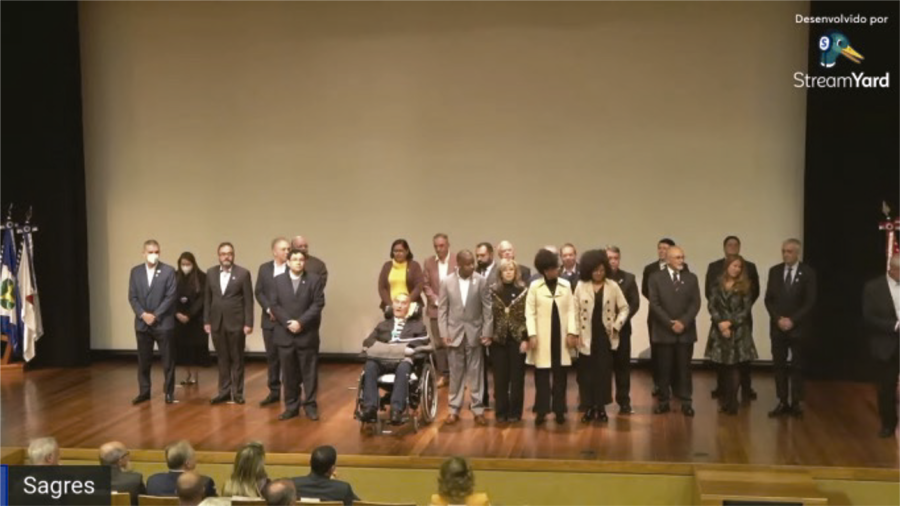
Also revealing is the scene at the launch ceremony for the “Projeto de Nação [Nation Project]” in May 2022, when, amongst retired military personnel, white gentlemen and ladies, led by General Villas Boas, a predominantly black family is called to the stage. They are introduced as follows: Paulo Henrique Gregório, his wife Elaine, and their daughters Camila and Carolina. They have received a copy of the document as a family, “on behalf of the Brazilian people.” The master of ceremonies resumes his speech and emphasises: “as already stated, the owner of this project is the Brazilian people.”
The attempt to create a “long-term homogeneity” for Brazilian history, reminiscent of the modern Western concept of history studied by Reinhart Koselleck, was also observed by Fernando Nicolazzi when investigating the historical narrative of the documentary “Brasil: uma cruzada [Brazil: a crusade]”, produced by the denialist company Brasil Paralelo (Nicolazzi, 2023). The documentary also highlights a Eurocentric understanding of the historical formation of Brazilian society, linked to Christian conservatism, nineteenth-century patriarchy, and national affections, loaded with dramatic visual and sound effects and monumentalised scenes. As seen in the “Projeto de Nação [Nation Project]”, based on the proposal to revisit the “historical figures of Brazil”, there is an underlying vision of history divided between vice and virtue, good and evil, as a moralising force for the nation. As Vicente Detoni (2022) demonstrated when studying monarchist groups in contemporary Brazil, the recovery of nineteenth-century Brazilian history in these groups ultimately takes on the meaning of Brazilian society rediscovering its deepest identity, that is, the Luso-European and Catholic roots of Brazilian society – a kind of “Euro-Christian identitarianism” (Araujo, 2023, p. 26) – presented not as the only one that exists, but as the one that occupies the position of the contemporary and the future.
Indeed, the chronopolitics of national-populism, to borrow the term used by scholar Hakki Tas, are not unique to Brazil, and a recently published collection analysed the ‘claims of a people’s past’ in several countries (Bevernage et al., 2024). In Recep Erdogan’s Turkey, Hakkı Taş emphasised the strategy of national-populist historical discourse in locating contingents within a broader temporal order and establishing historical continuity. In these narratives, a dynamic is sometimes repeated, but its true meaning seems hidden: a group of good people are reclaiming power from corrupt elites. Along with this come understandings of a mythical past, a present in crisis, and a utopian future, in which these deviations give way to the nation’s manifest destiny. Yes, destiny, because more than a past and a future, the Nation, in national-populism, has a heritage and a destiny, with a place and a mission assured and exclusive throughout history (Tas, 2022, p. 128). In this model, Tas believes that the future is not set in stone and therefore inspires both hope and despair, presenting people with only two options: the future as a promising extension of a glorious past, or as a bleak and chaotic picture, marking the defeat of the people in their war for survival (Tas, 2022, p. 136).
WHO IS AFRAID OF THEORY?
It should also be noted that the document analysed here can be considered part of a long history of relations between the military and politics. Manuel Domingos Neto (2022, p. 25) observes in the document the presence of the authoritarian military spirit inherited from the military dictatorship, but also from the Estado Novo period, since it was there that “the idea of Army politics emerged, with General Góes Monteiro, who said: ‘we should not engage in politics in the Army, but rather engage in the politics of the Army’”. Similarly, Mattos e Silva and Waldmann Júnior (2024) highlighted the important political role of reserve officers, establishing specific alliances and endorsing the opinions of active military personnel and active officers who take advantage of the fact that retired military personnel have no restrictions on their political activities.
All of this could eventually lead to more serious situations, in which “the military authorities begin to challenge the legitimately elected authorities, undermining civilian control over the armed forces and the principles of popular sovereignty” (Mattos e Silva; Waldmann Júnior, 2024, p. 317). Therefore, acknowledging that there are ways to consider the document analysed here as part of a larger movement linked to the long history of Brazilian military interference in politics, the growth of the new right, and cultural warfare in the digital environment, I would like to conclude this text by returning directly to the “Projeto de Nação [Nation Project]” and a point that is of most direct interest to us here: its relationship with history and its teaching.
Given some uncertainty that 2035 still presented on the topic of “The evolution of national cohesion, civic spirit, and collective sense of homeland,” the “Projeto de Nação [Nation Project]” guideline was clear and states: “Prioritise the content present in historical events over theoretical and methodological aspects in the process of teaching Brazilian history” (Instituto Sagres, 2022a, p. 47). The exalted contempt for theoretical and methodological aspects in historical knowledge is completely consistent with the rest of the document, as can be seen. Why should there be any appreciation for something whose function is to ask questions, discuss concepts, and bring about a productive shift in the enunciating subject? The history of Brazil that would be of interest is that of Mourão’s “distinct and victorious race” and the biographies of great men, as outlined in the ‘historical figures’ project. Prioritising “content” as given, unconstructed entities, raw facts, over theoretical and methodological aspects is exactly what the document constructs from beginning to end: an obscuring of its conditions of production and of those most directly interested under the mask of a future seen as destiny.
As Arthur Ávila (2021) observed by pointing out that denialism is based less on empirical falsification than on omitted representations, we may be facing a phenomenon that omits representations, as well as omitting the character exposed in the Project and its enunciator, behind the veil of the nation as an entity that would bring everyone together equally. In the time frame covering 2015 to 2035, a period seen in the document as the awakening of a sleeping giant, we would then have that, until mid-2021, as we have read, “data, dates, information and facts were normally described, but from then on, everything in the text of the scenario is, again, fictional” (Instituto Sagres, 2022a, p. 9). Therefore, let us say that we have come from the future and that, in October 2022, perhaps the “Projeto de Nação [Nation Project]” was aborted by Brazilians themselves, after all, it lacked votes.
References
- ABENSOUR, Miguel. O novo espírito utópico. Campinas: Editora da Unicamp, 1990.
- ALMEIDA, Ronaldo de. Bolsonaro presidente: Conservadorismo, evangelismo e crise brasileira. Novos estudos CEBRAP, v. 38, n. 1, p. 185-213, jan./abr. 2019.
- ARAUJO, Valdei Lopes de. Independência, atualismo e negacionismo: Como enviar histórias para o futuro. Fronteiras: Revista Catarinense de História, n. 41, p. 15-36, 2023.
- AVELAR, Alexandre. Por que a derrubada de estátuas não deveria incomodar os historiadores? Tempo, anacronismo e disputas pelo passado. ArtCultura, v. 24, n. 44, p. 134-156, jan.-jun. 2022.
- ÁVILA, Arthur Lima de. Qual passado escolher? Uma discussão sobre o negacionismo histórico e o pluralismo historiográfico. Revista Brasileira de História, v. 41, n. 87, p. 161-184, ago. 2021.
- BEVERNAGE, B. et al. (eds.). Claiming the People's Past: Populist Politics of History in the Twenty-First Century. Cambridge University Press; 2024.
-
CALDEIRA, Pedro Custódio. O retorno da grande estratégia brasileira: o projeto de nação dos militares. Direitos Fundamentais, 15 jun. 2022. Disponível em: https://direitosfundamentais.org.br/o-retorno-da-grande- estrategia-brasileira-o-projeto-de-nacao-dos-militares/ Acesso em: 27 ago. 2024.
» https://direitosfundamentais.org.br/o-retorno-da-grande- estrategia-brasileira-o-projeto-de-nacao-dos-militares/ - CESARINO, Letícia. Identidade e representação no bolsonarismo: Corpo digital do rei, bivalência conservadorismo-neoliberalismo e pessoa fractal. Revista de antropologia, v. 62, n. 3, p. 530-557, 2019.
-
CHARLEAUX, João Paulo. Qual o projeto de nação de militares ligados ao governo. Nexo Jornal, 24 maio 2022. Disponível em: https://www.nexojornal.com.br/expresso/2022/05/24/qual-o-projeto-de-nacao-de- militares-ligados-ao-governo Acesso em: 27 ago. 2024.
» https://www.nexojornal.com.br/expresso/2022/05/24/qual-o-projeto-de-nacao-de- militares-ligados-ao-governo - DETONI, Vicente Silveira. O que faz o passado do Império do Brasil presente? Sentidos, historicidades e ativismo monárquico no ocaso da Nova República (2013-2021), Lusotopie, v. XXI, n. 2, 2022.
- DOMINGOS NETO, Manuel. O projeto de poder do Partido Militar até 2035. Tensões Mundiais, v. 18, n. 37, p. 21-35, 2022.
-
ENDERS, Armelle. O Plutarco Brasileiro: A produção dos vultos nacionais no Segundo Reinado. Estudos Históricos, v. 14, n. 25, p. 41-62, 2000. Disponível em: https://periodicos.fgv.br/reh/article/view/2114 Acesso em: 27 ago. 2024.
» https://periodicos.fgv.br/reh/article/view/2114 -
EVELIN, Guilherme. Quem é Antonio Paim, o filósofo baiano que fez a cabeça do Ministro da Educação. Época, 2019. Disponível em: https://oglobo.globo.com/epoca/quem-antonio-paim-filosofo-baiano-que-fez- cabeca-do-ministro-da-educacao-23361323 Acesso em: 27 ago. 2024.
» https://oglobo.globo.com/epoca/quem-antonio-paim-filosofo-baiano-que-fez- cabeca-do-ministro-da-educacao-23361323 - INSTITUTO SAGRES. Projeto de Nação - Cenário Prospectivos Brasil 2035 - Cenário Foco - Objetivo, Diretrizes e Óbices. Brasília: Sagres, 2022a.
-
INSTITUTO SAGRES. Projeto de Nação - Solenidade de Lançamento. YouTube, 22 de maio de 2022b. Disponível em: https://www.youtube.com/watch?app=desktop&v=ZNhzTSaDF4&feature=youtu.be&ab_channel=InstitutoSagres Acesso em: 16 ago. 2024.
» https://www.youtube.com/watch?app=desktop&v=ZNhzTSaDF4&feature=youtu.be&ab_channel=InstitutoSagres - JAMESON, Fredric. Arqueologias do futuro: O desejo chamado Utopia e outras ficções científicas. Belo Horizonte: Autêntica, 2021.
- LAZAR, Nomi Claire. Out of joint: Power, crisis and the rethoric of time. New Haven/ London: Yale University Press, 2019.
- LIEBEL, Sílvia (org.) Das utopias modernas às distopias contemporâneas: Conceito, prática e representação. Belo Horizonte: Fino Traço, 2021.
- LITTLE, Adrian. Temporal Politics: Contested Pasts, Uncertain Futures. Edinburgh University Press, 2022.
- MATTOS e SILVA, Ivan Henrique de; WALDMANN JÚNIOR, Ludolf. O Projeto de Nação e o Weltanschauung da extrema-direita militar contemporânea. Revista Brasileira de História & Ciências Sociais, v. 16, n. 33, jul./dez. 2024.
- MORAIS, João Rafael Gualberto de Souza. O que resta da doutrina de segurança nacional? O legado da DSN na Segurança Pública Pós-1988. Teoria & Pesquisa: Revista de Ciência Política, v. 32, n. esp. 2, e023014, 2023.
- MUDROVCIC, María Inés. Políticas del tiempo, políticas de la historia: ¿Quiénes son mis contemporáneos? ArtCultura, v. 20, n. 36, 2018.
- NICOLAZZI, Fernando. Negacionismo e usos afetivos do passado no Brasil contemporâneo. Passés futurs, v. 13, p. 1, 2023.
- NUNES, Rodrigo. Do transe à vertigem: Ensaios sobre bolsonarismo e um mundo em transição. São Paulo: Ubu Editora, 2022.
- PENIDO, Ana; MATHIAS, Suzeley Kalil; BARBOSA, Lisa Sousa. A defesa da Amazônia e sua militarização. Novos cadernos NAEA, v. 25, n. 1, p. 103-128, jan./abr. 2022.
- PINHEIRO-MACHADO, Rosana. Amanhã vai ser maior: O que aconteceu com o Brasil e possíveis rotas de fuga para a crise atual. São Paulo: Editora Planeta, 2019.
- RAMALHO, Walderez. Sobre os limites do tempo: história do tempo presente, policronia e performatividade. História, v. 42, p. e2023036, 2023.
- ROCHA, Camila. O boom das novas direitas brasileiras: Financiamento ou militância? In: SOLANO, Esther (org.). O ódio como política: A reinvenção das direitas no Brasil. São Paulo: Boitempo editorial, 2018.
- ROCHA, João Cézar de Castro. Guerra cultural e retórica do ódio: Crônicas de um país pós-político. São Paulo: Editora Caminhos, 2021.
- RUFER, Mario. Às voltas com o pós-colonial: O conceito e suas implicações. Serra: Editora Milfontes, 2024.
- SANTOS, Eduardo Heleno de Jesus. Ativismo e extrema direita no meio militar: tensões e discursos que antecedem o bolsonarismo (1984-1998 ). Brasiliana: Journal for Brazilian Studies, v. 10, n. 2, 2021.
- SCOTT, Joan. Os usos políticos da história. Fronteiras: Revista Catarinense de História, n. 41, p. 37-52, jan. 2023.
- SOLANO, Esther. La bolsonarización de Brasil. Documentos de Trabajo (IELAT - Instituto Universitario de Investigación en Estudios Latinoamericanos), n. 121, 2019.
- TAS, Hakki. The chronopolitics of national populism, Identities, v. 29, n. 2, p. 127-145, 2022.
- TURIN, Rodrigo. País do futuro? Conflitos de tempos e historicidade no Brasil contemporâneo. Estudos Avançados, v. 36, n. 105, p. 85-104, 2022.
- VENANCIO, Giselle Martins. Julgou o jury a Brasiliana, não julgou os concorrentes: Coleção e produção intelectual no Brasil dos anos 50. Revista Maracanan, v. 10, n. 10, p. 108-119, jan./dez. 2014.
-
DATA AVAILABILITY STATEMENT:
The entire dataset underpinning the results of this study has been published in the article itself.
-
1
A more detailed analysis of the foundation, the characteristics, and the members of each institute can be consulted in Mattos e Silva and Waldmann Júnior (2024).
-
2
According to Santos (2021, p. 290), Ternuma was created as a military reaction in the context of Fernando Henrique Cardoso’s term in office and the implementation of a public policy focused on human rights, with a wave of groups questioning the compensation given to victims of rights violations during the dictatorship and the revelation of those involved in crimes against humanity. Thus, ‘Ternuma, through its website, will be the visible face of reserve military personnel linked to the intelligence and security community.’
-
3
Rodrigo Nunes (2022) provided a more detailed presentation of the “globalist” thesis. With neoliberal hegemony consolidating from the 1990s onwards, social democratic parties that accepted financial deregulation, offshoring and increasing inequality as irreversible processes, and proposed only to manage their risks and excesses, began to give them a ‘human face’. In this way, what these governments offered was progressive neoliberalism – neoliberal in terms of distributive policy, but progressive in its recognition policy, promoting multiculturalism, gender equality, sexual diversity, a ‘post-racial’ world and market-mediated environmentalism. The fact is that, while this strategy enabled the old social democratic parties to ally with minorities, it “ended up abandoning the “white working class” even more to its own fate – and to the preaching of the far right, [...] which told the losers of this process: ‘you are losing because they – women, blacks, gays... – are winning’” (Nunes, 2022, p. 19-20). In the end, if it is impossible to imagine economic conditions different from the existing ones, with everyone in a total and permanent struggle, what remains is a zero-sum confrontation reinterpreted as a clash between “cultures” or moral values. From this would arise the thesis of “globalism” exploited by the far right.
-
4
As evidenced by Thomas More when he combined the Greek neologisms eutopia (good place) and outopia (nowhere), the concept of utopia has no uniform definition, and it seems much more productive to think about it in terms of the practices and representations to which it has been subjected over the last few centuries. Thus, since Morus’s work, this literary genre has come to express a hope that is sometimes chimerical, but always disruptive. Although its meaning varies depending on the context, it is worth noting that utopia has always been linked to the profound needs of an era, and can be found in the past, the future, or even in the celebration of an eternal present. See: Liebel (2021).
-
5
Fredric Jameson also made an important observation about the formal dimension of the Utopian text. According to the author, the study of the utopian phenomenon should shift the discussion from content to representation. Thus, along with observing the social and historical raw material of the Utopian construct, it is necessary to investigate ‘the representational relationships established between them – such as closure, narrative, and exclusion or inversion.’ In this way – and here lies our main interest in emphasising the discursive operations of authorial obscuring in the “Projeto de Nação ” – the most revealing thing “is not what is said, but what cannot be said, what is not recorded in the narrative apparatus” (Jameson, 2021, p. 17).
-
6
According to Almeida (2019), even though it is associated with specific historical processes and contexts, conservative criticism of the French Revolution, through the preservation of institutions, prudence and in the name of order, is the canonical reference of modern conservative thought. In Brazilian public debate, the term conservative has been constantly used “in reasonably broad senses; sometimes identified excessively and imprecisely with fascists, in politics, or with fundamentalists, in religion” (Almeida, 2019, p. 186). For this text, and again in agreement with Almeida, it’s worth noting that in the recent Brazilian scene, conservatism has emerged as the main result of different political forces that point to the direction and meaning of the social process underway.
-
7
I would like to take this opportunity to contextualise the document under study here within the broader movement of the New Right in Brazil. Various arguments and interpretations that appear throughout the “Projeto de Nação” resonate with elements highlighted by a series of recent studies in Brazil. Thus, it is necessary to recognise that, since at least the events of ‘June 2013’, new political agents and new understandings have emerged and highlighted a discursive appreciation of neoliberal logic in various areas of life, such as the exacerbation of individualism and a theology of prosperity affecting, above all, the working classes (Pinheiro-Machado, 2019). Alongside this, a legitimacy crisis in democratic institutions, marked by the view of politics as something dispensable and negative, has taken hold, reinforced by an increasingly widespread anti-establishment sentiment (Solano, 2019). This context seems to have been further aggravated by the crystallisation of new identities and affections linked to conservative values through social media and its internal operating logic (Rocha, 2018). Similarly, digital technology also appears to be at the root of changes in politics and knowledge production, such as, once again, the deepening of neoliberalism and, in the post-truth era, the rise of conservative populism and even evangelical Christianity (Cesarino, 2019, p. 551). Therefore, we can say that the groups that drafted the “ Projeto de Nação” also took advantage of an environment abundantly conducive to the production and dissemination of their understandings of history, identity, the future, etc.
-
8
According to Morais (2023, p. 9), the National Security Doctrine has its roots in the very foundation of the Escola Superior de Guerra (ESG) [Higher War College], at the beginning of the Cold War. Thus, there has been a slow maturation in the institutional culture of the Armed Forces of understandings characteristic of the Doctrine, such as the persistence of military interventionism based on a sense of guardianship over the nation, whose leadership is considered inaccessible to popular sovereignty. Furthermore, the Doctrine suggests that the security/development binomial and democratic order are incompatible. From this perspective, “war and strategy are the only reality and the answer to everything, and internal order must be secured (against the unprepared people or communism).”
-
Editor in Charge:
Ely Bergo de Carvalho.
The entire dataset underpinning the results of this study has been published in the article itself.

 Source: Instituto Sagres, 2022b.
 Source: Reproduction.