 Filming Up: Brazilian Elites Through an Ethnographic Lens
Abstract
This article is based on the idea of filming up, contextualizing it in both visual anthropology and documentary history. We will first offer a brief analysis of audiovisual production concerning elites to reflect on how they are pictured and how this is of interest to anthropological studies. Considering the category of production infrastructure, we will then focus on the cinema scene in the city of Recife (Brazil), underlining how it enables the production of documentaries that focus on elites. Social inequalities within and outside cinema production infrastructure allow the affirmation of several directors, who implicitly contest this postcolonial order through their production focused on empowered groups. The analysis will show that movies are potential tools for creating ephemeral communities, enabling critical confrontation between separated social groups. Moreover, we will underline how these production practices potentially stress visual anthropological theory, forcing us to reconsider both the practices of visual fieldwork and the mainstream linguistic form that circulates within festivals and teaching institutions.
Keywords:
Ethnography; visual; elites; Recife; Brazil
Resumo
Este artigo tem como ponto de partida a ideia de filmar para cima, contextualizando tanto a antropologia visual quanto a história do documentário. Em primeiro lugar, apresentamos uma breve análise da produção audiovisual sobre as elites, a fim de refletir sobre a forma como são retratadas e como isso seja de relevante interesse para os estudos antropológicos. Considerando a categoria de infraestrutura de produção, focalizaremos na cena cinematográfica da cidade de Recife (Brasil), destacando como ela possibilitou a produção de documentários que retratam as elites. As desigualdades sociais dentro e fora da infraestrutura de produção cinematográfica permitiram a afirmação de vários cineastas que, implicitamente, contestaram esta ordem pós-colonial através da sua produção centrada em grupos com poder. A análise mostrará que os filmes são ferramentas potenciais para a criação de comunidades efêmeras, permitindo o confronto crítico entre grupos sociais separados. Além disso, destacamos o modo como estas práticas de produção colocam potencialmente em tensão a teoria antropológica visual, forçando-a a reconsiderar tanto as práticas de trabalho de campo visual como a forma linguística dominante que circula nos festivais e nas instituições de ensino.
Palavras-chave:
Etnografia; visual; elites; Recife; Brasil
Introduction
Fictional cinema has historically been one of the most widely used means to give visibility to groups of society that stand out for some reason or another - whether due to economic or political power or any other type of capital they possess. In several cinematographic traditions, elites are groups that control the media, but are also, in many cases, protagonists of the representations that the big screen convey, as Orson Welles (1941) films showed in his famous Citizen Kane, which is a film that described media power and, at the same time, instituted a model of elites as controllers of large media outlets in the popular imagination. Fiction in this sense has a specific metonymic function, showing something that can be considered “real”, but that also enables dominant groups to continually reinvent their own image. However, if we turn our gaze to the field of documentary filmmaking, whose specificity is to “index” something that may be considered “real”, elites become a typology of subjects that rarely appear on the screen as protagonists. Clearly, in documentaries that are spread through large platforms of on-demand video, we often find power elites - political, economic, military, etc. - as Wright Mills (2000) defined them. However, if we address a cinematographic language grounded on the proximity that is typical of the ethnographic encounter, these elites disappear nearly completely. This partially reflects ethnographic literature based on writing, which is more directed at the study of subaltern and colonized groups.
A relevant example is Australian cinematography, where we find pioneering works that have been incorporated into the history of visual anthropology, such as Cannibal Tours by Dennis O’Rourke (1988), in which the protagonists are American tourists on a trip to Papua New Guinea or First Contact by Robin Anderson and Bob Connolly (1983), which is based on interviews with gold prospectors that exploit New Guinea. In both films, the protagonists are people who are at the top of the hierarchical structure that defines the contexts in which the films are recorded, and the images enable us to perceive how they relate to subaltern groups. However, the most relevant example in the entire history of visual anthropology is probably the Doon School Chronicle Quintet directed by David MacDougall (2004), which is a series of five films shot at a school for elites in India. In these films, we have an emblematic proximity of the camera, where the evidently elitist dimension of the context in which the director circulates is, however, mediated by the interest in youth and education.
Brazilian cinematography, which is the focus of our analysis, reveals, as in many other contexts, a non-recurring presence of elites in the documental field, as individuals in situations of social vulnerability are generally the focus of such works. However, there are other documentarists in the country who have made films linked to the field of the elites, such as Theodorico, Emperor of the Semiarid1 by Eduardo Coutinho (1978), Intermissions2 by João Moreira Salles (2004) and the more recent The Edge of Democracy3 directed by Petra Costa (2019). These works are more focused on influential political figures - generally known locally or nationally. Their main objective is to show the personalities of these public figures and their involvement in political arrangements, power games, corruption, embezzlement and other actions linked more to politics. More properly ethnographic cinema in Brazil rarely addresses elites directly, notwithstanding those present in the films, as in the case of Martyrdom4 by Vincent Carelli (2017), with co-direction by Ernesto de Carvalho and Tita, in which rural elites are seen but do not have any true encounter with the camera, appearing only as passive actors in the exploitation process of indigenous peoples.
All those movies underline how proximity with elites imply the embodiment of specific habitus, that involve taste, convention and ideologies that in many cases are abject to visual ethnographers. Embodying a specific gaze (Tiragallo 2007) in this case is a play that needs specific strategies where transculturality often is developed through oppositional glances. Through an ethnography of audiovisual production, we will underline strategies and infrastructures that enable these directors to “film up” (Nader 1972), directing their cameras at elites.5 Firstly, we can consider these documentaries as tools for viewing subjectivities that do not want to be viewed and that enable a theoretical reflection on the “production” of elites. Secondly, these productions are extreme examples of critical engagement that nevertheless exclude a priori a more intimate proximity to the subjects portrayed, which is fundamental to an ethnographic approach. This limit, however, is also a challenge for ethnography, particularly visual ethnography, when it seeks to show class inequalities by “looking up” rather than at the exploited. We will focus on the production of Brazilian documentary films, particularly in the city of Recife, which is the capital of the state of Pernambuco. In this scene, we found several recent documentaries that aim to place local elites on the screen.
Picturing elites
As several analyses have demonstrated (Abbink, Salverda 2013), the definition of the term “elites” is complex. Some examples in the literature show us how “elite” can be considered a group of subjects who exert a type of power or, adopting the category of hegemony, a group who dominates the symbolic production that establishes norms for society. As Shore points out, “an anthropology of elites is necessarily an exercise in political reflexivity since it obliges us to position ourselves more self-consciously in relation to the wider systems of power and hierarchy within which anthropological knowledge is constructed” (Shore 2002: 2). Consequently, the term elite can be considered a social commutator (Durham 2000), that is, a term that, depending on its reference, imposes different interpretations of the networks of relationships considered. The position of the anthropologist or filmmaker who is producing written or visual knowledge on a specific context can be considered a reference that defines the term elite.
To analyze what people the term elite is “indexing”, the category of frontier becomes interesting here: “Elites only exist vis-à-vis other social groups - be they the marginalized, dependents, supporters, or the counter-elites” (Salverda, Abbink 2013: 16). Starting from the Latin etymology of the term “elite”, we encounter its relational dimension. Elite is associated with concepts such as choice or the chosen, elected, selected, that is, groups who are differentiated from others due to specific characteristics. It is therefore fundamental to walk down an ethnographic path and address, in the first place, the frontiers that separate such “elected ones” from the “others”. These boundaries, as the wealth of ethnographic studies on elites produced in Brazil in recent decades has shown, are configured differently in each field. However, they always involve a different kind of tension between researcher and researched, in a context marked by inequalities, in which "writing is an instrument of power and segregation" (Castilho, Souza Lima, Costa Teixeira 2014: 11). Ethical dilemmas, such as whether the researcher would be willing to incorporate traits of these elites, protect themselves from possible attacks, or attack the otherness of the students, are common in this field, even more so if it focuses on image production.
One of the most outstanding ethnographies of elites in the recent history of anthropology passed through the lens of a camera. The Act of Killing by Joshua Oppenheimer (2012) is a documentary in which, through ethnographic research conducted in Indonesia, the director dialogues with men who tortured and killed opponents to the violent coup d’état that established the military dictatorship in 1965. When the film was made, these men were still considered “national heroes”. The director encourages these “heroes” to produce a fictional film about their past, mobilizing a psychodrama that reveals the complexity of this ethnographic relationship. In the film, we find an implicitly critical linguistic experimentation on the protagonists of this ethnography that reflects an innovative use of a “number of theoretical sources, analytic styles, rhetorics and descriptive procedures” (Marcus, Fischer 1999:162).
This project of complexity that we find in the film can be a starting point for a reflection on visual ethnography of elites. If access to the field is mediated in some cases by the insertion of the anthropologist in the same social network as the subjects involved, as in the pioneering ethnography about the upper-middle classes of Rio de Janeiro by Gilberto Velho (1998), such access is completely unviable in other cases. To allow ethnography, as Nader has stated, “The use of personal documents, memoirs, may substitute for anthropological participation in some areas of culture that take long years of participation to really understand” (Nader 1972: 307).
In the current scenario of public virtual networks enabling access to personal information, we may think that anthropologists have never had similar access to exclusive groups. Concerning the ethnography of elites, the biographical dimension, which Velho (1998: 63) highlighted as one of the most relevant narrative constructions mobilized to differentiate themselves from others, is often considered a fundamental “trace” in more recent literature (Comaroff, Comaroff 1992). As Coehn points out, “an elite is forced to organize itself particularistically, to keep itself in existence, and enhance its image” (Cohen 1981: XII). The symbolic dimension of the “image” leads us to think again about Oppenheimer’s work. When we see the director engaged with such powerful men, we watch these images with an uncanny feeling (Marcus 2010). This feeling of uneasiness, however, is related to the opportunity that the killers are given to renegotiate their image and, in some way, justify their actions.
The public image of elites, in many cases, reflects this uneasiness. Studying the philanthropic activities of sugarcane elites in the state of São Paulo, Jessika Sklair (2018) stresses how a project of critical ethnography addressing elites necessarily has to consider the possibility that the anthropologists “did not always share the same political views and interpretations of the subjects and events we discussed in the field” (Sklair 2018: 32). Studying elites means dealing with subjectivities - which often reveal one’s own unease - and pendulating between “these elite universes and those of others on whom elite activity bears an influence, within and beyond the ethnographer’s field” (Sklair 2018: 40). Incorporating uneasiness into ethnography allows developing critical ethnographies that enable us both to explore the field as well as its effects on “others”.
In this sense, filming elites becomes an even more complex practice than ethnography finalized in the production of texts. Tracking the history of visual anthropology and documentary film, we find that the category of device should be central to understanding processes of imagetic production regarding the elites. The device is based on an explicit agency of the director-ethnographer, who creates a specific field of relationships between humans and non-humans that enables “shooting” interactions (Migliorin 2006) and requires some criteria for its functioning, such as an agreement/pact between the participating parties to ensure a minimally possible mutual understanding, enabling the interlocutor to feel inclined to participate based on that which the film exposes as its objective. Thus, the device is mutable; it is a flexible proposal and to the taste of the one who performs it and, to a certain extent, to those who are disposed to this. The rules are defined by the one who idealizes the device; they may be strict, limiting the interaction between people, creating an alternative space or a “chosen universe” (Migliorin, 2006: 1) by the direction of the film. The counterbalance of all this is the result of the part of a larger aperture generated by the filmic device - of the interaction of individuals themselves throughout the proposed process.
From this, we may think that we then have a different narrative approach from the more traditional of an investigative documentary focused on the quest for “truth”, in which filmmakers wish to prove some theory presented in their hypothesis, developing it in such a way as to prove their point of view and often polarizing the narrative through the personification of a character as an enemy. There is a problem in dealing with narratives of this type, which theoretically seek to present distinct viewpoints, but that come up against the difficulty of impartiality, supporting only the viewpoint that most pleases the one who directs the film and the target audience. Looking at the history of visual anthropology, we perceive how the use of the filmic device is not recent. Edgar Morin and Jean Rouch (1961), to some extent, used some principles of this approach in Chronique d’un eté. Although the directors did not explicitly use the category of device as a concept per se, is it evident from the visual standpoint that they experienced, in particular Jean Rouch mode, the use of fictional moments as elicitors of interactions and performances from the social actors involved in the films. Reflecting on the work of director Oppenheimer, we see how he opts for the presentation of an experience in which individuals reenact deaths and the procedures of murderers of their enemies, performed in an apparently very “natural” manner, without demonstrating any shame or regret. There is considerable meaning in the way this information is placed on the screen through the staging of the actors-subjects, who at the same time stage and tell about their lives. Although the end of the film offers an explicit reflection from one of them, Anwar Congo, the film already says much by showing those staged scenes of the murders and the stories behind them.
Returning to Jean Rouch, he also presented his interlocutors through an ethno-fiction, activating a narrative collaboration that constructed the film - albeit a limited collaboration, as the director continued to have more power of control over the end product. Therefore, like Rouch, Oppenheimer presented his characters through a fictional (re)construction of their roles, acting out the very actions that consecrated them as national heroes. The main issue we want to highlight with these examples is the broadening of the scope of ethnographic methods, offering anthropologists another option as a research tool. The application is diverse and adaptable; it can and should be explored more, always taking into account methodological and ethical issues as well as contexts that may be applicable. It should be stressed that, in both cases and more explicitly in The Act of Killing, the strategies adopted enabled filming a specific type of elite.
Production infrastructure
Attention to the infrastructure of audiovisual production is a methodological theoretical requirement that emerges from the circulation of both authors of this paper in the productive and distributive context of cinema and audiovisual produced in the state of Pernambuco. Our specific focus is on the metropolitan region of Recife, where the largest audiovisual production center in the state is found. Ethnography is the result of an immersion in this medium whether as social scientists, directors of films or organizers of events, which, in turn, involve other films and directors on whom a light is cast in this paper. Looking at productive infrastructure, which is comprised of a socio-technical set of items that enables the production and circulation of sensible forms, becomes a means for investigating relationships and sutures between political and representational dimensions (Larkin 2013)
Our circulation in this field, whether through the structural inequalities that constitute the field of cinematographic production or through the specific context in which this study was developed, brought attention to how the elites become very present subjects in documentarist production in this region in comparison to other contexts. To understand how this set of productions took a place in the local and national cinematography, it is necessary to cross the linguistic analysis of the sensible with an exploration of the productive dynamics of these film materials. In her study on cinematographic production in the region, Amanda Mansur Nogueira (2014) points out how the films are the result of a set of relationships founded on proximity, defined with the emic category of “brodagem” derived from the English term “brother” and used in the sense of comradery, which highlights networks of relationships that enable the sharing of a gamut of feelings that evidently influence the sensitive forms of the films produced.
Offering a brief account of local history, the economy of the state of Pernambuco originated through a tradition of sugarcane agriculture, sugar mills and a profoundly, unequal, enslaving society dominated by patriarchism. This configuration, however, is supported by a long and important tradition of cinematographic production that is still founded on a past strongly influenced by colonialism and landownership. The importance of the capital, Recife, comes from its strategic geographic location in relation to the former capital, Olinda, as well as its commercial and maritime development over the years.
Despite having undergone an economic decline with the demise of the old sugar mills and consequent impoverishment of part of the sugar elites, the city constructed other forms of economic activity, such as technological development and the service industry. Whether historically or in contemporaneity, Recife figures as one of the most important Brazilian centers of audiovisual production and as an economically strategic location for the northeastern region of Brazil.
Since the emergence of the first Brazilian films with more regionalized productive cycles at the beginning of the 20th Century, the “Recife cycle” was one of the hotspots of Brazilian cinematography. Although the major centers of cinematographic and television production remain located in the southeastern region of the country (Rio de Janeiro and São Paulo), directors from Pernambuco have been gaining greater visibility due to films that have won awards in both national and international film festivals. “Pernambucano cinema”, which is a term often automatically applied as a synonym for referencing all films made in the state of Pernambuco or by Pernambucanos(as), is the form that commonly classifies the most recent film production derived from the state. Nonetheless, this international visibility has to be considered a result of the multiple productive cycles experienced by local production, which are commonly classified as the “Recife Cycle”6, “Super 8 cycle” and the cycle of “Pernambucano cinema”, which is the most current (Nogueira 2009).
What this brief background also presents us is the emergence and consolidation of an infrastructure dedicated to audiovisual production in the state. Although Pernambuco had already historically been a site of production, albeit in a discontinuous manner but with some kind of relevance in the Brazilian scenario, it only became constant with the installation of a technological infrastructure that “creates material channels that organize the movement of energy, information, and economic and cultural goods between societies but at the same time creates possibilities for new actions” (Larkin 2008: 292).
Pedro Severien and Cristina Teixeira de Melo (2016) provide a very good contextualization of how the political-social situation of Recife is reflected in the relationship with the films produced here. The authors offer an in-depth discussion of the essayist film Self-portrait (2012) of anonymous authorship, whose focus is one of the businessmen responsible for the enterprise in the area of the José Estelita Wharf. The camera in the film attempts to subvert the relationship with financial elites, represented by the character Eduardo Moura, filmed begrudgingly: “looking at him is, to some extent, like looking at a certain tradition of our elite who think that their privileges are inalienable rights” (Severien, Melo 2016: 108). Starting from the viewpoints of the filmmakers and researchers, who share the same position from many standpoints, the film functions as an urgent denouncement of the current form of occupation in the city - of inequalities and their perpetuation.
Some of the most recent fictional films also cast their gaze on the local elites. Neighboring Sounds (Mendonça Filho 2012)7 and Divine Love (Mascaro 2019)8 are two important examples. The first film explores the decadent sugarcane elites implanted in an upscale neighborhood in the capital of Pernambuco (Recife), representing issues of class, social status, security and patriarchal authority. The second film presents a dystopic future in 2027, with a Brazil dominated by the Christian religion, without Carnival and with new forms of relationships, directly questioning the new evangelical elites who have become drivers of institutional policy in recent years through conservative, reactionary discourse.
Strategies
The focus of our analysis will be on four recent productions that stand out for an approach to an alterity that may be considered distant and oppositive to the subjectivities of the filmmakers. Considering the proposed interpretation of the categories of elites, the position of the filmmakers in relation to the topic developed in the films turns these alterities into a set of individuals who, with regards to specific attributes, have greater power than anyone who researches or films.
The first film, High-Rise directed by Gabriel Mascaro (2009), addresses residents and their luxury penthouse apartments in the cities of Recife, São Paulo and Rio de Janeiro. The second film, Câmara Escura9, a short by filmmaker Marcelo Pedroso (2012), was filmed through an experiment with a box and an embedded camera in a middle and upper-class residential neighborhood of Recife. To some extent, the issue of habitation and occupation of the city is also present here but placed in relation to the social structure that creates fortified cities surrounded by walls, cameras and surveillance. The third film analyzed, Mirror Camera10 directed by Dea Ferraz (2016), places several men in a room surrounded by cameras registering their interactions and conversation on different topics related to women, sexuality, family and religion. Lastly, the short The Grand Club11 by Joelton Ivson (2016) addresses leisure and sports social clubs of the elites of Recife, which are privileged places of whites and rich people contrasted with the presence of generally black employees.
It would be inevitable to comment on this issue without considering the work of Jean-Louis Comolli (2008) and his study on how to interact with and film the enemy or the abject - to use the common term in contemporary anthropological literature - that is, those with whom the director does not share the same ideas and beliefs. This means dialoguing directly with individuals situated in opposing political and social spectra, establishing with them an atypical, unexpected relationship. Unlike filming someone admired or with whom there is some affinity, the difficulty is determining in what way an individual that we consider to be the “enemy” should be filmed.
Although Comolli’s reflection is situated in a specific context of political disputes and a particular time in history, our focus is not to analyze the character of the enemy, but rather how the films cited use the tool of the audiovisual device to enter a universe previously inaccessible by other means - to achieve an encounter with the elites.
For such, we begin with the perspective of Marcelo Pedroso (Jesus 2014), director of the film Camara Escura, who can be considered one of our main interlocutors in this study. To a certain extent, the filmmaker also approaches Comolli by stating that, regardless of whoever the other being filmed is, the filmmaker is moved by a tendency toward conformity or adversity in relation to the subjects. We are, therefore, speaking about the “proneness toward the anonymity of the filmmaker” (Jesus 2014: 40) - it is not a question of sympathy or antipathy with the other, but rather a field of convergence or divergence involving the director and the subject filmed. The duration of this state of anonymity is variable and may or may not be altered throughout the process.
There are what we may call regimes or states - the state of conformity, in which “although the filmmaker may be situated in a completely adverse context to that to the subject being filmed, he nourishes a feeling of affinity, of alignment, in relation to the other” (Jesus 2014: 41). Thus, there is a kind of convergence between these individuals. In the cases of the regime of adversity, however, “contrary feelings arise - of non-affinity, of discordance” (Jesus 2014: 41) in a field of divergence. Pedroso also states that the director could establish a relationship of complicity with those he films, but this would not necessarily mean that there is conformity (agreement) between the director and the subject being filmed.
In the regime of adversity, it is necessary to find a kind of “reconcilable arrangement” between opposing forces, “[...] the proneness of the filmmaker to adversity toward the subjects being filmed and the imperative of complicity as a constructor [sic] of the relational theme that gives rise to the film” (Jesus 2014: 42). He also speaks about the ethical arrangement that takes this duality into consideration and seeks to overcome this impasse. However, the key word for us regarding this regime is the issue of enabling to humanize and complexify the filmed subjects (Jesus 2014: 42) and not combat them; which would be a difference for the regime of adversity in comparison to documentaries based on other types of regimes the author discusses.
It is important to add here the use of these categories and concepts for two reasons. In the first place, because the director himself is analyzing part of his film work and trajectory from this standpoint of the regime of adversity. In this sense, these reflections can be considered emic - the result of the experience of one of the filmmakers in the field of Recife cinematography. In second place, because of the relationship that the author established with other directors, as Marcelo Pedroso and Gabriel Mascaro worked together and collaborated on other films, whereas Dea Ferraz also had interlocutions with the literature that is also shared in Pedroso’s perspective, which strengthens our interest in these reflections.
“However, I can say that it makes all the difference to watch the film knowing that the choices were conscious and that the issue is not to make a film about people I like or don’t like, on the contrary, to make a film that, through its characters, with their own faces and lives, is capable of making us think about society and its patriarchal, colonial, racist modus operandi.” (Ferraz 2021)
Thus, the four films analyzed here have the similarity of the directors placing themselves at opposites poles to that of the interlocutors in the documentary - especially in the cases of the film by Dea Ferraz, in which the director films two groups of cisgender men with the aim of understanding sexism through their speech and interactions, and in the film by Joelton Ivson, who is a young black man - at the time a film student - trying to enter exclusive clubs of the elites to film a project for college. He attributes his success at gaining access to these places - where he would normally be barred - solely to the fact that he is a student at a public university.
Regarding the other two films, Marcelo Pedroso and Gabriel Mascaro are white men with university diplomas and who come closer to the spectrum of the elite, which may be taken into account in the contact with the elites that they filmed. Especially Marcelo Pedroso, who was - as shown in his film - taken to the police station during the filming process and assured of his right to defense with regards to the episodes that brought him there.
We could state that they focus specifically on alterities distinct from themselves, with whom they do not share any conformity, speaking of a concept aligned with that proposed by Marcelo Pedroso. While he and Gabriel Mascaro address economic elites, Dea Ferraz - a white woman with a higher education - works with individuals who are in a privileged position in the context of gender relations because of sexism. In all these films, each director used different strategies to gain access to their respective interlocutors and their “worlds”. They developed specific strategies, creating, to a greater or lesser degree, a type of “device” to be able to make the recordings.
We can understand “device” as “unscriptable experience” (Migliorin 2006: 2), a kind of element that has attributes defined by the director, who creates a unique social world with previously determined rules, limits and settings with the intention of resulting in interactions between these individuals and all people involved in their filming.
In Mirror Camera (Ferraz 2016), the director and her team remained isolated in a room with no contact with the interviewees but with a view into and direct contact with the recording room where the characters interacted with each other so that they would be filmed. Dea Ferraz commanded the transition of the topics discussed by inserting videos in the TV in the room,12 which served as the jumping off point for the discussions. An infiltrator from the film team was also among the subjects, exercising the function of presenting counterpoints to what the other participants were saying, thereby giving more impetus to the discussions.

The director herself classified it with a division in four layers: 1) The box where the interactions take place, serving therefore as a cutout of the social space into which sexism is inserted on a daily basis; 2) The archival images serving as “triggers” of the interactions of the subjects in the box; 3) The characters (men) from diverse contexts and backgrounds who agreed to participate in the selection for the film; 4) The director and the relationship with these subjects, who was not to have contact during the recordings - an imposed rule to establish a certain distancing and so that she would not “contaminate” the material of the film (Ferraz 2021).
The room created for the recording is a device used to give support to the narrative, which could only be developed from the presence of the subjects and their interactions throughout the process of filming. The documentary exists due to this experience with the device and the pact created between the filmmakers and participants, which ensured its functioning.
Thus, we may assume that the director developed her device to be able, as a woman, to gain access the world of a certain group of individuals - cisgender, heterosexual men expressing sexist thoughts. According to our interpretation, as a woman who suffers sexism on a daily basis, the director also used her film as a form of political struggle by revealing sexism in its simplest form: the commonplace interactions of men in a space that simulates the daily environment of the reproduction of this sexism - something that she experienced, like other women, throughout her existence in different settings.
For Dea Ferraz, contact with the film still generates anguish and implications even after so much time:
Returning to it is a reminder of a process of violence, because films not only can and should place us before the day-to-day forms of violence of a colonial, patriarchal, racist society. They also make us experience such violence in their very construction - in the very process of making them. (Ferraz 2021)
Generally present at public showings of the film, Dea Ferraz’s discomfort becomes explicit in many cases and her description of the productive process of the film, which required ample periods of reflection and re-working, does not hide the difficulties of pitting oneself against abject alterities, particularly through the visual medium.
In the case of the full-length documentary by Gabriel Mascaro, which is the second film analyzed here, the director uses false information that he is a famous director wanting to make a film about penthouse apartments.13 This is the key that enables him access to some individuals of the elite and to make the film. Here, the ethical issue regards the rupture of the collaboration due to the lack of an explicit pact between the director and the other party being filmed, as the proposal presented to record the interviews diverges from that which permeates the final cut of the film, creating a different narrative from that which the subject expected (the glorification of penthouses), with a characterized representation of the subjects filmed, placing them on the screen in an even jocular manner.

Gabriel Mascaro selected the participants using a book that registered 125 owners of luxury penthouse homes in the country, only nine of whom agreed to participate in the film (Guimarães 2011). The participants were presented with the notion that the film would address the lifestyle linked to life in penthouses, the sensation of being in such places - treated in a positive, complimentary way.
In the film, Mascaro placed himself in an ethical dilemma with regards to how he chose to portray his characters. It is evident that the director opted for open criticism of the lifestyle and thinking of the individuals interviewed. Even with this issue in vogue due to the imminent difference between the final product and the initial proposal of the film, he opted for an approach that divides analyses on the ethical validity of the film due to the “trap” used to get the recordings. This is confirmed in the following excerpt from the official educational support material of the film:
“The director pretended to be an important filmmaker to gain the trust of the interviewees, saying that he would make a film about the day-to-day life of residents of penthouses. He was only 22 years of age at the time of the filming and this trick was used to ensure that he could approach these people, since it is rare to gain access to this social group. It is noteworthy that the production of documentaries of this nature is practically null in Brazil.”14
The discussion is complex if we consider that, on the one hand, subjects of the elites have economic and political powers that facilitate the creation of a positive image or one that matches their expectations. On the other hand, however, Mascaro’s trick is questionable from an ethical standpoint, as it subverts the pact established with the subjects of the film. This debate merits a more detailed discussion, as it requires numerous considerations that go beyond the scope of the present article, the aim of which is to present a panorama of possibilities and tools for anthropology. In the case of a scientific study, approaching subjects with a “false” research proposal would compromise our code of ethics15 due to the breakdown of the trust between researcher and researched, which could render its adoption in the anthropological field unviable and even cause complications with ethics committees and among peers.16 Nonetheless, we can speak with greater liberty and flexibility regarding the adoption of such as approach in the film by Gabriel Mascaro, although it is not free of retaliations and court disputes, as the director expressed to us veiledly on several occasions. Without the intention of exhausting the discussion here, the director’s film undeniably enables us a little access to the lifestyle of Brazilian elites.
In the third film of our analysis, “Câmara Escura” (2012), the director Marcelo Pedroso placed a black box with a hidden camera at the door of some residences of a middle/upper class neighborhood in Recife. He rang the doorbell, announcing a supposed delivery at the door and then left without placing it in the hands of the residents, but waited at a distance to determine whether they would pick up the box or not. After some time, he returned to the residence to recover the product and, at this point, interacted with the characters, being asked about what he had done, what was the purpose and about the way he had decided to make his film. In the same work, the director presents images of the conversation with police, who called him in due to the complaints of the residents who received these boxes and became frightened.

Pedroso’s film differs from Mascaro’s due to the intention of not previously agreeing anything with the subject - the film would only work when the individuals picked up the unknown box and took it inside the house without knowing who had sent it. However, both directors did not establish a previous pact of participation in their films, but rather used “traps”. Although Pedroso returned to retrieve the boxes and subsequently presented himself to the characters, his film faces a similar ethical dilemma as that found in Mascaro’s.
In terms of the applicability of a procedure more common to documentaries or ethnographic research, we once again bring up the film by Ferraz; would the result have been the same if she dialogued directly with the men? Even if there was period of interaction to establish familiarity with them, there would probably have been some resistance or some form of intimidation when speaking about those subjects directly with her, as she would question them face to face about their behaviors and opinions with regards to women. The notion of exploring the male universe through dialogues among men themselves while replicating a setting of comradery was quite effective, as it created a greater sense of comfort and freedom that led them to express their opinions openly.17
The lack of direct contact with Ferraz in this case can also be justified by the intention to not establish ties with the participants - something that would interfere in the result of the filming - as well as the director’s wish to experiment with an approach that contributed to the simulation of a day-to-day space in which such thoughts are recurrent and widespread. Her presence in the room could be felt through the instructions given to the infiltrated Djair Falcão, who was instructed to present counterpoints and tension in the discussion, differing from a speech of agreement or unison on the issues. Another form by which the director is present is through the previously selected videos.
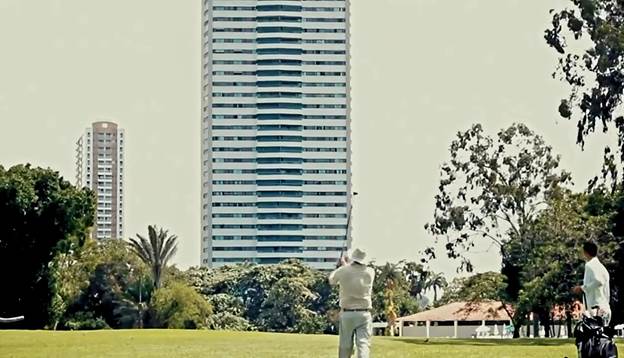
In the case of the film “O Grande Clube” directed by Joelton Ivson, we perceive another example of an “outsider’s” look, who, as the result of a specific strategy, is ensured entrance in a world to which he would otherwise not have access. Through the language of so-called visual symphonies, the film portrays the day-to-day functioning of a golf club and nautical club in the city of Recife that can be considered spaces for the most exclusive (VIPs). The film is the result of a documentary project developed for the film course at the university and the director, who was a student at the time of the filming, highlights the difficulties suffered by a black student from the lower class taking a course in a field of knowledge still supposedly of elites (cinema) - a report that coincides with what much literature has stated.

These contrasts permeate the linguistic dimension of the film, in which day-to-day life in these exclusive clubs is the result of an economic contraposition between the members - the majority of whom are white and from the upper classes - and the employees who enable the functioning of the leisure spaces, who, on the screen, are all black. In this case, the device that enabled the director’s entrance into the field was to identify himself as a student whose work would have its legitimacy ensured by the most important university in the city - something that could have been interpreted as a confirmation of the prestige of the golf club.
In this sense, the director’s gaze is relevant because it incorporates ambiguous attitudes. On the one hand, we see distancing - the result of contact with a context to which he would otherwise never gain access and that generates a strong discomfort with respect to the existence of the space, which, according to the director, brings to mind the book “The Master and the Slaves” (Freyre, 1956) - the spatial separation of the homes of the masters from those of the slaves, which remains emblazed in the urban imagination of the city. On the other hand, this distancing allows creating forms that enable a dual identification: the identification of the elites with the space, whose gaze is virtually not trained to perceive the structural inequalities that the film reveals, and the identification of the director and a possible view of a black subject, who precisely reveals the same symbols of inequality.
The experience of spectatorship is also an important particularity in these films, as there is an extension of the screen beyond the imagetic space of the film, something perceptible to the audience, an impactful topic and the naturality of sexist discourse in the case of Ferraz or racism in the case of Ivson - it is disconcerting and generates a kind of inclusion within the filmic space, which is comprised of a black box in the first case and an apparently inclusive open space in the second. In the case of Mascaro and Pedroso, the dilemma was also not trivial. Although we can say that the end result would have been affected by the presentation of the real intentions of the film with the interviewees, we are reminded of the previously cited work by Oppenheimer and the strategy that the filmmaker used for the presentation of the tales of murder committed by his characters. In the film, the mechanism for the conduction of the narrative starts with the creation of a fiction that would be the adequate portrait for those men to demonstrate their actions in a film, allowing them to show their procedures in times of a civil war, leaving the judgment on what was presented up to the spectator.
The difference in the adoption of the approach also exerts a direct influence on the level of cooperation and a deepening of the conversation permitted by the interlocutors. The first needed to interrupt the filming in the middle of recording with an interviewee who no longer wanted to answer questions, although the director nevertheless continued. It seems to us that the possibility of rendering a film unviable due desistance on the part of interviewees who perceive some duality in the questions is always hanging overhead due to the path taken by the documentarist throughout the interview. Regarding Pedroso’s experience, he faced legal problems when being called by the police to clarify the situation of the strange boxes at people’s doors. Hence, the strategies chosen by the filmmakers also brought adverse consequences that could have rendered the execution of the films completely unviable.
Especially in the latter two films, but to a certain extent in all others addressed here, we can highlight the difficulty and presence of relevant counterpoints that are inevitably linked to any option that directors may create as a device. However, the four films cited here have quite distinct approaches, with difficulties and important considerations. None of them is exhaustive or infallible; all were burdened with a possibility of failing. However, as the difficulty in gaining access to elites is not novel, the approaches of the directors, although diverse, resulted in films that managed to present to the audience a part of this restricted world of the elites. Thus, we can consider that they reached their goals, which was to show this world.
These open windows into the world of the elites clearly passed through choices related to the background and path of each film and each director. This does not mean that the films by Mascaro and Pedroso are wrong or have less value; to the contrary, they give rise to an ethical discussion, with which anthropology has historically dedicated considerable care, on what strategies ethnographic research has to adopt, especially when dealing with subjects who explicitly play an important role in the oppression of other groups. In this sense, these films are examples of possible configurations in which empathy and cultural criticism converge and diverge into different modalities and cannot therefore be ignored by ethnographic theory. Lastly, it should be stressed that strategies need to be considered taking into account ethical issues linked to anthropology for a possible reapplication.
Filming up
In a time of continual reconfigurations of digital technologies, being invisible from the mediatic standpoint has become and will be in the future something that can be achieved by a small part of the population. Thus, control over the production of representations becomes a fundamental issue for the maintenance of social differences. If elites normally have control over the representations that they produce through a broad apparatus of photographers, filmmakers, biographers and lawyers (Marcus, 2019), the cases analyzed here become spaces that clearly break from this thinking, making visible traits that even the subjects represented did not wish to reveal.
In the context of Recife, where both visible and invisible walls mark spatial class divisions, the same contact unmediated by labor relations becomes a nearly impossible option. The films presented here can be analyzed as spaces populated by “ephemeral communities” (Sansi 2015: 10), in which the devices employed enable unprecedented contacts. Besides making visible subjectivities that do not what to be visible, these films become sensitive devices that permanently address one of the greatest postcolonial traumas - social inequality. Considering the diversities among the directors with whom we interacted, we underline the importance of their subjective positioning and their habitus, which, depending on class, gender or race, enables them to approach - or not - a specific elite defined through peculiar parameters.
If we see in these films an engagement that seeks to include new forms of social experimentation - the coexistence of subjects that belong to different social groups -, on the one hand, we find forms that can be problematized in light of ethnographic experience. These films are evidently an attack on the elites represented, developed through devices that remove, from many points of view, a possible agency of the subject involved, revealing a common problem in ethnography. However, we can consider the recent discussion on how critical ethnography can be developed among the elites. As Gilbert and Sklair state, “to maintain an openness to critical language (and the language of class and capital) is to make space for the possibility of getting closer to our ethnographic subjects than might be possible where a language of class, capital, and inequality is treated a priori with suspicion” (Gilbert, Sklair 2018:10). In the case of a visual ethnography of elites, this problem becomes all the more complex, considering that the visibility of the subjects is infinitely greater with the audiovisual compared to writing. Moreover, their habitus are often considered as dominant The films analyzed here are extreme examples of critical engagement that do not exclude a priori a more intimate proximity to the subjects portrayed, which is fundamental for an ethnographic approach, but that may be something to be dismissed by the same actors when they explicitly do not wish to become part of a research project.
Ethical reflections, which often limit the field of ethnography due to its colonial heritage, are reconfigured in this case. When dealing with elites of some kind, ethnographers necessarily have to think in terms of the exposure (Vailati, 2024) of them. This could be through text or images, which will turn autonomous subjects and which provide the abduction of agency, emphasized by Gell (1998). In the case analyzed in this article, ethnography becomes complementary to the image production processes, in providing an overview of this "exposure"
This limit, however, is simultaneously a challenge for ethnography, particularly visual ethnography, when one intends to show class inequalities by looking up rather than at the exploited. However, it is also a response to the incipience of documentary productions that seek to encounter elites whether in the national Brazilian context or internationally. The potentialities of the filmic materials analyzed here are explicit results of productive dynamics founded on the association and creation of a dialog among the filmmakers. These films question implicit inequalities in the field of cinematographic productions and the elitist structure of Pernambuco society, regardless of the parameter that distinguishes who is on top and who looks down.
We will therefore conclude this article with a problematization of this point through the cross between an anthropological approach to elites and a contemporary reflection on art and anthropology. This enables us to intertwine the films analyzed here with social theory, which has widely questioned the representational dimension of the forms produced to consider artistic practices as meeting places between alterities (Sansi 2015, Schneider, Pasqualino 2014 Schneider, Wright 2013). Crossing legal and ethical boundaries, which are often impediments in the field of academic production, the films analyzed here can signal new paths for ethnographic practice. Ethical reflections, which often limit the field of ethnography due to its colonial heritage, are reconfigured in this case. When dealing with some kind of elites, ethnographers necessarily have to think in terms of the exposure. This could happen through written or imagetic forms production, which will turn autonomous subjects and which provide the abduction of agency, emphasized by Gell (1998). In the case analyzed in this article, ethnography becomes complementary to the image production processes, in providing an overview of this "exposure" processes that films made possible.
References
- ABBINK, J.; SALVERDA, Tijo, eds. 2013. The anthropology of elites: power, culture, and the complexities of distinction 1st ed. New York: Palgrave Macmillan.
- ANDERSON, Robin; Bob CONNOLLY, directors. 1982. First contact Arundel Productions. 58 min.
-
Autorretrato 2012. 2012. Autorretrato 7min. https://www.youtube.com/watch?v=AYoFxd9rQwA
» https://www.youtube.com/watch?v=AYoFxd9rQwA - CARELLI, Vincent. Codirector. CARVALHO, Ernesto; Tita, directors. 2017. Martírio Papo amarelo e Vídeo nas aldeias. 2 hrs., 22 min.
- CASTILHO, Sergio Ricardo Rodrigues; SOUZA LIMA, Antonio Carlos; COSTA TEIXEIRA, Carla (orgs.). 2014. Antropologia das práticas de poder: reflexões etnográficas entre burocratas, elites e corporações Rio de Janeiro: Contra Capa; Faperj.
- COHEN, Abner. 1981. The politics of elite culture: explorations in the dramaturgy of power in a modern African society Berkeley: University of California Press.
- COMAROFF, John L.; COMAROFF, Jean. 1992. Ethnography and the historical imagination Boulder: Westview Press.
- COMOLLI, Jean-Louis. 2008. “Como filmar o inimigo?”. In: Jean-Louis, Comolli, Ver e poder Belo Horizonte: Editora Universidade Federal de Minas Gerais. pp. 123-134.
-
COSTA, Petra, director. 2019. Democracia em vertigem Produção: Joanna Natasegara; Shane Boris; Tiago Pavan. 121 min. https://www.netflix.com/br/title/80190535
» https://www.netflix.com/br/title/80190535 - COUTINHO, Eduardo, director. 1978. Theodorico, imperador do sertão Globo Reporter. 50 min.
- DURHAM, Deborah. 2000. "Youth and the social imagination in Africa: Introduction to parts 1 and 2." Anthropological quarterly, (73). 3: 113-120.
- FERRAZ, Dea, director. 2016. Câmara de espelho Alumia Produção e Conteúdo; Ateliê Produções; Parêa Filmes. 2 hrs.
- FREYRE, Gilberto. 1956. The master and the slaves: a study in the development of Brazilian civilization New York: Alfred A. Knopf.
- GELL, Alfred. 1998. Art and agency: an anthropological theory. Oxford: Oxford University Press.
- GILBERT, Paul Robert; SKLAIR, Jessica. 2018. “Introduction: ethnographic engagements with global elites.” Focaal, (81): 1-15.
- GUIMARÃES, Victor. 2011. “Imagens da elite no documentário brasileiro contemporâneo: o desafio de filmar o inimigo em Um lugar ao sol, de Gabriel Mascaro”. Imagofagia, 0 (4): 1-15.
-
IVSON, Joelton, director. 2016. O grande clube Universidade Federal de Pernambuco. 8 min. https://vimeo.com/167507654
» https://vimeo.com/167507654 - JESUS, Marcelo Pedroso Holanda de. 2014. Jauara Ichê - notas sobre a adversidade no documentário Recife: Universidade Federal de Pernambuco.
- LARKIN, Brian. 2008. Signal and noise: media, infrastructure, and urban culture in Nigeria Duke University Press.
- LARKIN, Brian. 2013. “The politics and poetics of infrastructure.” Annual Review of Anthropology, 42(1): 327-43.
- LARKIN, Brian. 2018. “Promising forms: the political aesthetics of infrastructure”. In: Nikhil Anand et al. (eds.), The Promise of Infrastructure Durham: Duke University Press. pp. 175-202.
- MACDOUGALL, David, director. 2004. The Doon School Chronicle Quintet CCR Media Works. 8 hrs., 14 min.
- MARCUS, George E. 2010. Elites, ethnographic issues Albuquerque: University of New Mexico Press.
- MARCUS, George E. 2019. “The deep legacies of dynastic subjectivity: the resonances of a famous family identity in private and public spheres”. In: Antónia Pedroso de Lima; João de Pina Cabral (eds.), Elites: choice, leadership and succession Lisboa: Etnográfica Press. pp. 9-29.
- MARCUS, George E.; FISCHER, Michael M. J. 1999. Anthropology as cultural critique: an experimental moment in the human sciences
-
MASCARO, Gabriel, director. 2009. Um lugar ao sol Símio Filmes. 1 hr. https://mubi.com/films/high-rise
» https://mubi.com/films/high-rise - MASCARO, Gabriel, director. 2019. Divino amor Desvia. 1 hr, 41 min.
- MENDONÇA FILHO, Kleber, director. 2012. O som ao redor CinemaScpópio 2 hrs, 11 min.
- MIGLIORIN, Cezar. 2006. “O dispositivo como estratégia narrativa”. In: André Lemos; Christa Berger; Marialva Barbosa, Narrativas midiáticas contemporâneas Porto Alegre: Sulina. p. 82-94.
- MORIN, Edgar; Jean ROUCH, directors. 1961. Chronique d’un été Argos Films. 1 hr, 25 min.
- NADER, Laura. 1972. “Up the anthropologist: perspectives gained from studying up”. In Dell Hymes. Reinventing Anthropology New York: Pantheon. pp. 284-311.
-
NOGUEIRA, Amanda Mansur Custódio. 2009. “O novo ciclo de cinema em Pernambuco a questão do estilo”. Master’s thesis, UFPE, 2009. https://repositorio.ufpe.br/handle/123456789/3013
» https://repositorio.ufpe.br/handle/123456789/3013 -
NOGUEIRA, Amanda Mansur Custódio. 2014. “A Brodagem no Cinema em Pernambuco”. PhD diss., UFPE, 2014. https://repositorio.ufpe.br/handle/123456789/13147
» https://repositorio.ufpe.br/handle/123456789/13147 - OPPENHEIMER, Joshua, dir. 2012. The act of killing. Final Cut for Real, Spring Films, Piraya Film A/S, Novaya Zemlya, 2hs, 18 min.
- O’ROURKE, Dennis, dir. 1988. Cannibal tours Institute of Papua New Guinea Studios. 1 hr, 10 min.
-
PEDROSO, Marcelo, dir. 2012. Câmara escura Símio Filmes. 25 min. https://embaubaplay.com/catalogo/camara-escura/
» https://embaubaplay.com/catalogo/camara-escura/ - SALLES, João Moreira, director. 2004. Entreatos VideoFilmes. 1 hr, 57 min min.
- SANSI, Roger. 2015. Art, anthropology and the gift London; New York: Bloomsbury Academic.
- SCHNEIDER, Arnd; PASQUALINO, Caterina (eds.). 2014. Experimental film and anthropology London: Bloomsbury.
- SCHNEIDER, Arnd; WRIGHT, Christopher (eds.). 2013. Anthropology and art practice London, New York: Bloomsbury.
- SEVERIEN, Pedro; MELO, Cristina Teixira Vieira de. 2016. “Autorretrato de um outro? Versos e reversos de um olhar para o inimigo”. DEVIRES-Cinema e Humanidades, 13(1): 24.
- SHORE, Cris. 2002. “Introduction: towards an anthropology of elites”. In Cris Shore; Stephen Nugent (eds.). “Elite cultures." Anthropological Perspectives London: Routledge. pp 1-22.
- SKLAIR, Jessica. 2018. Closeness and critique among Brazilian philanthropists: Navigating a critical ethnography of wealth elites. Focaal, (81): 29-42.
- TIRAGALLO, Felice. 2007. “Embodiment of the gaze: vision, planning, and weaving between filmic ethnography and cultural technology”. Visual Anthropology, 20(2-3): 201-219.
- VAILATI, Alex. 2024. O campo das elites. Percursos etnográficos para a exposição da desigualdade Rio de Janeiro: Papéis Selvagens.
- VAILATI, Alex; ZAMORANO VILLARREAL, Gabriela. 2021. Ethnographies of “on demand” films: anthropological explorations of commissioned audiovisual productions New York: Palgrave.
- VELHO, Gilberto. 1998. Nobres & anjos: um estudo de tóxicos e hierarquia 1st ed. Rio de Janeiro: Fundação Getulio Vargas Editora.
- WELLES, Orson, director. 1941. Citizen Kane RKO Radio Pictures Inc.; Mercury Productions. 1 hr, 59 min.
- WRIGHT MILLS, Charles. The power elite New York: Oxford University Press, 2000.
Notes
-
1
The original title in Portuguese: Theodorico, o Imperador do Sertão.
-
2
The original title in Portuguese: Entreatos.
-
3
The original title in Portuguese: Democracia em Vertigem.
-
4
The original title in Portuguese: Martírio.
-
5
“Film up” is in reference to the important article by Laura Nader, in which she explores the category of “studying up”, defining an important agenda for ethnological research on elites.
-
6
Pernambuco stood out quite early in the scenario of national production, which, in turn, started out in a more regionalized manner, as with other states and their respective cycles, such as São Paulo and Cataguazes.
-
7
Released in 2012, directed by Kleber Mendonça Filho. The original title in Portuguese: O Som ao Redor.
-
8
Released in 2019, directed by Gabriel Mascaro. The original title in Portuguese: Divino Amor.
-
9
We can translate it by Dark Chamber.
-
10
The original title in Portuguese: Câmara de Espelhos.
-
11
The original title in Portuguese: O Grande Clube.
-
12
The selection was made to instigate the men to talk about the topics expected by the film team. The choice of the scenes of this material was made by Ferraz in partnership with the researcher Tatyane Oliveira (UFPB), specialist in gender studies.
-
13
Information available in the educational material on the film created by the producer.
-
14
“Um Lugar ao Sol um Filme de Gabriel Mascaro - material Pedagógico para Escolas Do Ensino Médio” [A Place in the Sun a Film by Gabriel Mascaro - Educational material for high schools] (2010).
-
15
The code of ethics of the Brazilian Association of Anthropology states that “populations” who are objects of research have the “1) Right to be informed regarding the nature of the research. (...) 4) Assurance that the cooperation offered to the investigation is not used with the intention of harming the investigated group.” Available at: http://www.portal.abant.org.br/codigo-de-etica/.
-
16
The perspective can and should be discussed, as we could consider a break from this ethical element when the result is beneficial to historically oppressed populations, which goes beyond a discussion of elites, including the action of diverse groups who normally do not enable us access to their thoughts and actions. As an example, we may cite cases of infiltration in “Bolsonarist” groups on social media or groups of fascists by anthropologists, journalists, etc. The elite would fit in this field, but this debate requires more elaboration than we could analyze in the present article.
-
17
It should be noted that the director deleted several scenes that she considered to be excessively heavy and that could generate some problems for the individuals speaking. Hence, she demonstrated the care of someone who participated in the film, even with the individual not being close to her and having explicitly agreed to participate in the film. She tried in several ways to not personify each individual as responsible for sexism, but rather attempted to understand them from a macro perspective.