
 University of Cape Town ten years after Rhodes Must Fall: visual and political transformations
Abstract
In this visual essay, I invite the reader to take a walk through the University of Cape Town (UCT), South Africa. Throughout my fieldwork and the development of my ethnography, photography has been a crucial tool for engaging with my research questions. My aim is to interrogate the meanings and memories that circulate within the university around the Rhodes Must Fall (RMF) movement, which led to the removal of the statue of the colonizer Cecil John Rhodes from campus in 2015 and is often considered the most significant South African mobilization in the “post-apartheid” period. I engage with the disputes surrounding the statues of Rhodes and Sarah Baartman, which were displaced from their usual locations at UCT. I then move through photographs taken by me during my fieldwork in the first semester of 2025, when RMF marked its tenth anniversary.
Keywords:
Photographic Essay; Ethnography; South Africa; Rhodes Must Fall; Decolonization
Resumo
Neste ensaio visual, convido a pessoa que lê para um passeio pela University of Cape Town (UCT), na África do Sul. Nas minhas idas a campo e no decorrer da etnografia, a fotografia tem sido uma ferramenta crucial de engajamento com as perguntas de pesquisa. Meu objetivo é interpelar os significados e memórias que atravessam a universidade ao redor do movimento Rhodes Must Fall (RMF), que levou à retirada da estátua do colonizador Cecil John Rhodes do campus em 2015 e é considerado a maior mobilização sul-africana no “pós-apartheid”. Parto das disputas ao redor das estátuas de Rhodes e Sarah Baartman que foram deslocadas de seus lugares habituais na UCT. Em seguida, percorro fotos produzidas por mim durante estadia de campo no primeiro semestre de 2025, quando RMF completava dez anos.
Palavras-chave:
ensaio fotográfico; etnografia; África do Sul; Rhodes Must Fall; descolonização
INTRODUCTION
In this photo essay, I invite the reader to walk through the University of Cape Town (UCT) ten years after the Rhodes Must Fall (RMF) movement, which addressed important demands for visual transformation made in that context. In addition, I highlight structural, symbolic, and material continuities present in everyday life on campus.
On April 9, 2015, after protests in various forms, including the occupation of the administration building, RMF led to the removal of the statue of Cecil John Rhodes1 from campus, leaving behind an empty concrete base and a silhouette painted on the steps in black paint, marking the shadow of the statue that is no longer there, as shown in Figure 4.
Rhodes is recognized as a nineteenth-century English colonizer and businessman who extracted wealth through land and diamond mines and financed British expansion in southern Africa. He is a controversial and complex figure who also served as Prime Minister of the Cape Colony between 1890 and 1896 and after whom what were then known as Southern and Northern Rhodesia were named - present-day Zambia and Zimbabwe (Nyamnjoh 2016).
The statue, by the artist Marion Walgate, dates from 1934 and was transferred to UCT in 1962 (Nielsen 2021). Rhodes was depicted seated, with his elbow resting on his knee and his head supported by his hand, evoking a trace of Rodin’s The Thinker: a colonizer contemplating the extent of his possessions. (Figure 1)
The location of the statue was due to the fact that the land on which UCT is situated was donated by the Rhodes Foundation after his death. In addition to his role in colonial expansion, he created this Foundation to offer scholarships at Oxford to young people from colonized territories. Part of his fortune was also donated to Oxford, where his statue became the target of contestation inspired by the RMF movement at UCT. It is worth noting that RMF locally spearheaded “a [international] movement to redefine official histories and national identities” (Neves et al. 2019: 13).

Statue of Cecil John Rhodes at the University of Cape Town. Photograph by Danie van der Merwe, licensed under CC BY 2.0, via Wikimedia Commons, 12 January 2007.
For Black2 students at UCT, who were only able to attend this university in larger numbers after the end of apartheid, the statue was, however, a symbol of colonial persistence. It made them feel that this was not their place, that they did not belong at the university. It evoked the pain of the exploitation and dispossession to which their ancestors had been subjected by men like Rhodes, whose consequences remain alive in the present (Neves et al. 2019).
The statue had already been called into question before 2015. In the 1950s, Afrikaner students demanded its removal due to Rhodes’s involvement in the Anglo-Boer War. Later, in the 1960s and 1970s, Black activists made the same demand (Nielsen 2021; Price 2023). In the democratic period, which began in 1994, Black faculty members and students engaged with the statue in a variety of ways (Cornell and Kessi 2016; Schmahmann 2016; Davids and Matebeni 2017).
Despite these demands, its removal was not a consensual decision within the university community and society as a whole. In different instances of public debate, concerns were raised about a possible “erasure of history” (Neves et al. 2019). In many contexts, student activists were portrayed as lazy and as criminals (Naidoo 2020). In addition, the historical and artistic importance of the statue was emphasized, as it had been produced by one of the few women sculptors of that period (Schmahmann 2016).
It was not only Rhodes’s statue that the movement questioned. At the entrance to the university’s main library stood a statue of Sarah Baartman3 by the artist Willie Bester, made from steel gears. For Black women, walking past that representation every day on their way to their place of study was a silent reminder of what place their bodies were expected to occupy within the university and in the production of scientific knowledge (Naidoo 2020).
The statue of Sarah Baartman was acquired by the university in 2000. Its placement in the Library was repeatedly questioned, from 2001 onwards, by women at the institution, both students and faculty (Davids and Matebeni 2017; Naidoo 2020; Lewis and Wicomb 2021; Schmahmann 2025). In some of these actions, the statue was dressed, and a headwrap and impepho4 were also added. These interventions were systematically undone and generated much debate5.
In 2018, it was moved to a temporary exhibition on campus, as shown in the image below, and later to storage. Currently, her name is displayed on the largest and most prominent building at UCT, the Sarah Baartman Hall (Figure 8). The former name of this building referred to another English man involved in the colonization of the African continent.

Statue of Sarah Baartman (view from the back) on display in 2018. In front of it are representations of the statue dressed, as in the interventions carried out when it was still located in the university library. Photograph by Je’Nine May, licensed under CC BY-ND 4.0, via University of Cape Town website, 21 September 2018.
An important immediate outcome of RMF was the creation of the Council Artworks Task Team in September 2015, composed of faculty and students to examine “statues, plaques and artworks on campus that may be seen to recognize or celebrate colonial oppressors and/or which may be offensive or controversial” (UCT Council Artworks Task Team 2016). This initiative led to a reconfiguration of the university’s art catalogue. During my time on campus in 2024 and 2025, I was repeatedly struck by the number and diversity of artworks portraying and celebrating Black people, such as the beautiful pieces by Lakin Ogunbanwo displayed between the main library and a food court, which can be seen in Figure 10.
UCT is a public university; however, it is not free of charge and charges fees that are inaccessible to the majority of the South African population. The national minimum wage is approximately 5,000 to 6,000 rands per month, while UCT fees range between 6,000 and 9,000 rands per month. RMF also had consequences in relation to this issue. It unfolded into the Fees Must Fall (FMF) movement, which began at the University of the Witwatersrand and spread to universities across the country following the announcement of annual tuition fee increases. Students engaged in FMF demanded, in particular, free education and an end to the outsourcing of workers (Naidoo 2020). Under increasing pressure from the mobilizations, Zuma announced in December 2017 an expansion of the National Student Financial Aid Scheme (NSFAS) (SA News 2017), and many workers were also hired directly (UCT News 2015; SA Labour News 2017).
Despite all these efforts to transform the university, such as the expansion of NSFAS, the increase in the number of Black students and staff, changes to the curriculum, and shifts in the curation of artworks, at the beginning of 2025, while I was in Cape Town, I witnessed a repetition of situations denounced ten years earlier in the context of RMF. Among them is UCT’s student housing crisis, which at the start of every academic year leaves Black students unhoused, sleeping in student representative offices, as a result of debts incurred in the previous year (fee blocks) (Pongweni 2025).
Finally, there is an open wound in UCT’s landscape. It reveals the stubborn persistence of colonial elements and stands in contrast to the empty concrete plinth on which Cecil Rhodes once sat. From the bus stop that takes students to the residences, one can see, on the mountainside, at a distance, or uncomfortably close, the Rhodes Memorial: an immense structure, with a long staircase and many columns, where there is a bust of the colonizer and, below it, an excerpt from a poem by Rudyard Kipling in his honor: “The immense and brooding Spirit still shall quicken and control; living, he was the land and dead, his soul shall be her soul” (Figures 11, 12 and 13). These verses echo a well-known idea articulated by Hendrik Verwoerd, regarded as the “architect of apartheid”, who stated, in the century following Rhodes’s existence, that the concept of apartheid would be implemented so deeply in South African society that no future government would be able to undo it (Moutinho 2018).
The fieldwork conducted in Cape Town, over a period of nine months and consisting of participant observation, interviews and engagement with South African academia, in addition to the production of photographs, has pointed to these blurred boundaries between the periods of colonialism and apartheid by mobilizing the past in order to understand the present. Transformation is neither easy nor quick. It is undoubtedly underway; it is visible. And it undoubtedly encounters resistance, like roots growing through concrete.
From here, I invite you to look at this university, a decade after the Rhodes Must Fall movement, through photographs I took during my fieldwork in the first half of 2025. Before the images, I will share a map of our route.

Hand-drawn map of the route we will follow, created by the author. We begin upon arriving at Upper Campus, where the concrete base that once supported the Rhodes statue is located. We then pass by Sarah Baartman Hall and the Central Library (Chancellor Oppenheimer Library), continue through the Food Court area to the bus stop, and finally reach Rhodes Memorial. The route touches on key interventions of the movement while also prompting reflections on the persistence of colonial elements.

The location of the Rhodes statue was carefully chosen. To reach this place, in the Upper Campus, we have already climbed many steps like these. We are at the foot of Devil’s Peak. Along the ascent, the university asserts itself, imprinting on the mountain the image of British occupation. The statue once crowned a scene of full British pride. Its absence preserves the force of the 2015 movement, yet it may even go unnoticed. There is no sign, no plaque explaining the emptiness of the base-only the black paint on the ground, which marks the statue’s former shadow, like a trace of what once stood there.

By climbing a little further up the steps and passing the concrete plinth, we can get a sense of the view that Rhodes’s statue once had as it looked out over the landscape while reflecting on its imperial ambitions. Beyond the rugby fields and the suburb in which the university is located, Rondebosch, lie the Cape Flats. This is a sandy plain where townships were established: segregated areas to which Black people were forcibly removed from the colonial period onward, with a dramatic intensification under apartheid. The act that triggered the Rhodes Must Fall movement was the throwing of a bucket of human excrement at the statue. The waste was collected in Khayelitsha, the largest township in the Cape Flats, which, like the others, is not served by adequate sanitation infrastructure. Many homes do not have bathrooms and rely instead on shared portable chemical toilets. The act brought Cape Town’s scandalous inequality into the heart of an elite university. After that moment and the collective mobilization that followed, Rhodes’s statue no longer looked out over this landscape.

Interacting with the empty concrete base where Rhodes’s statue once stood, I leaned the camera and produced this image. This photograph speaks to the act of reflecting on the unfolding consequences of Rhodes Must Fall.

On this path, I recall the words of one interlocutor: “one of the things that I think RMF did was to give us all a sense of what history does in shaping knowledge, building spaces, memorials, all of that. It suddenly made us conscious of how British the campus felt”.

We arrived at the largest and most central building on campus, which gradually came into view as we made our way up, another key site of intervention by the movement. The current Sarah Baartman Hall is the center of student life on this campus. Situated among buildings from various academic departments, it is a passageway that is constantly in sight, close to the library and the food court, and also a space of everyday meeting and sociability, where students sit in groups to eat and talk.
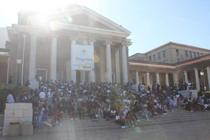
A gathering of students on the steps of the Sarah Baartman Hall as part of the agenda of mobilizations around the issue of fee blocks, already mentioned, which affects the experience of the poorest UCT students most acutely, since debts from the previous year prevent enrollment and, without it, students are not admitted to student housing. In UCT’s housing model, students from all years leave their apartments during the end-of-year holidays and return at the beginning of the following academic year.

Entering the building to the right of Sarah Baartman Hall, we passed the entrance to the Library, where the statue depicting her was previously located. Between the Library and the Food Court, a route that I walked daily for certain periods, as do many students, are these artworks by the Nigerian artist Lakin Ogunbanwo (Untitled III and Untitled IV, 2019). They form part of the post-RMF collection, which represents and celebrates, in diverse ways, Black and queer subjects across the university.

Upon reaching the bus stop and looking towards the mountain, a distant building comes into view, contrasting with the emptiness of the concrete base that once supported the Rhodes statue. The building, in turn, points to the continuity of Cecil Rhodes’s legacy, despite sustained efforts toward transformation.

There is no direct path from the bus stop to the Memorial. One must, in a sense, take a detour along a stretch of the mountain. Upon arrival, a series of stairways comes into view, guarded by eight lion statues. At the center stands a man on horseback, beneath which one can read: “Energy, the work of G. F. Watts, and by him given to the genius of Cecil Rhodes.” This is a celebration of ideals of expansion and conquest, and of the colonizer cast as a hero. If the route taken thus far reveals layered disputes around the presence of colonial elements, this site stands in stark contrast to the empty concrete base, to the name Sarah Baartman on the central building, and to the more recent artworks on campus. It is not a place of everyday passage for students or for the wider university community, but it remains there, marking its presence.
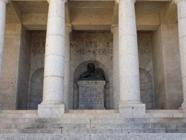
Bust of Rhodes inside the Rhodes Memorial at UCT, bearing the inscription, as previously cited, “To the spirit and the life and work of Cecil John Rhodes, who loved and served South Africa (1853-1902),” and, below it, an excerpt from Rudyard Kipling’s poem in his honour: “The immense and brooding spirit still shall quicken and control; living, he was the land and dead his soul shall be her soul.”
CONCLUSION
In this essay, I have proposed a route through the University of Cape Town in which it is possible to observe a space in dispute, in the wake of the Rhodes Must Fall movement, which led to the removal of the English man’s statue from the center of campus and called into question a series of other artworks and building names for celebrating colonial figures or being considered offensive by Black, women, and queer students and staff. The visual transformations presented here are thus constitutive of the movement’s own claims, which mobilized the materiality of space as a field of political struggle.
By intervening in the UCT landscape, students and activists challenged a particular institutional order and, along with it, a broader project of society. Demands for the remodeling of space therefore also constitute an effort to question and rework a certain colonial memory (Neves et al. 2019), while at the same time expanding the possibilities of belonging within that universe.
The purpose of this essay is to offer a visual and sensorial experience of the transformations that have traversed the university, drawing attention to tensions and complexities. The images gathered here do not function merely as records of a campus in transition but as fragments of a contested landscape, in which memory, power, historical violence, and projects for the future are intertwined. To photograph the university, in this context, is also to interrogate the layers of time that inhabit its buildings, its statues, its voids, and its still-visible marks of colonialism and apartheid.
REFERENCES
-
CORNELL, Josephine, and Shose KESSI. 2016. “Black Students’ Experiences of Transformation at a Previously ‘White Only’ South African University: A Photovoice Study”. Ethnic and Racial Studies, 3(2): 1-16. https://doi.org/10.1080/01419870.2016.1206586
» https://doi.org/10.1080/01419870.2016.1206586 -
DAVIDS, Nadia, and Zethu MATEBENI. 2017. “Queer Politics and Intersectionality in South Africa”. Safundi: The Journal of South African and American Studies, 18(2): 161-167. https://doi.org/10.1080/17533171.2016.1270015
» https://doi.org/10.1080/17533171.2016.1270015 -
LEWIS, Desiree, and Zoë WICOMB. 2021. “Representing Sara Baartman in the New Millennium”. In: Desiree Lewis, Gabeba Baderoon (eds.), Surfacing: On Being Black and Feminist in South Africa Johannesburg: Wits University Press. pp. 28-46. https://doi.org/10.18772/22021046093
» https://doi.org/10.18772/22021046093 - MATEBENI, Zethu. 2017. “Perspectivas do Sul sobre relações de gênero e sexualidades: uma intervenção queer”. Revista de Antropologia, 60(3): 26-44.
- Mbembe, Achille, et al. 2015. “UCT Rhodes Must Fall Mission Statement”. The Johannesburg Salon, 9: 06-18.
- MOUTINHO, Laura. 2018. Des braves gens qui s’aiment de détester ensemble Tese (Livre-docência), Faculdade de Filosofia, Letras e Ciências Humanas, Universidade de São Paulo - São Paulo.
- NAIDOO, Leigh-Ann. 2020. Black Student Intellectuals and the Complexity of Entailment in the #RhodesMustFall Movement PhD diss., Wits School of Education, Faculty of Humanities, University of the Witwatersrand - Johannesburg.
-
NEVES, Paulo, MOUTINHO, Laura, and Lilia SCHWARCZ. 2019. “Herança colonial confrontada: reflexões sobre África do Sul, Brasil e Estados Unidos”. Revista Estudos Feministas, 27(3): 01-18. https://doi.org/10.1590/1806-9584-2019v27n366960
» https://doi.org/10.1590/1806-9584-2019v27n366960 -
NIELSEN, Vibe. 2021. “In the Absence of Rhodes: Decolonizing South African Universities.” Ethnic and Racial Studies 44(3): 396-414. https://doi.org/10.1080/01419870.2021.1851380
» https://doi.org/10.1080/01419870.2021.1851380 - NYAMNJOH, Francis B. 2016. #RhodesMustFall: Nibbling at Resilient Colonialism in South Africa Bamenda, Cameroon: Langaa RPCIG.
-
PONGWENI, Takudzwa. 2025. “UCT Faces Housing Crisis as Students Sleep in SRC Offices and Lecture Halls”. Daily Maverick, February 5, 2025. https://www.dailymaverick.co.za/article/2025-02-05-uct-students-sleep-in-src-offices-and-lecture-halls-as-university-faces-housing-crisis/
» https://www.dailymaverick.co.za/article/2025-02-05-uct-students-sleep-in-src-offices-and-lecture-halls-as-university-faces-housing-crisis/ - PRICE, Max. 2023. Statues and Storms: Leading through Change Cape Town: Tafelberg.
-
SA NEWS. 2017. “Free Higher Education for Poor, Working Class Students”. SA News, December 16. https://www.sanews.gov.za/south-africa/free-higher-education-poor-working-class-students
» https://www.sanews.gov.za/south-africa/free-higher-education-poor-working-class-students -
SA LABOUR NEWS. 2017. “Beginning of the End for Outsourcing at Wits University”. SA Labour News, January 5. https://salabournews.co.za/35551-beginning-of-the-end-for-outsourcing-at-wits-university
» https://salabournews.co.za/35551-beginning-of-the-end-for-outsourcing-at-wits-university -
SCHMAHMANN, Brenda. 2016. “The Fall of Rhodes: The Removal of a Sculpture from the University of Cape Town”. Public Art Dialogue 6(1): 90-115. https://doi.org/10.1080/21502552.2016.1149391
» https://doi.org/10.1080/21502552.2016.1149391 -
SCHMAHMANN, Brenda. 2025. “Addressing a Difficult History: Representations of Sarah Baartman by Three South African Artists”. Critical Arts https://doi.org/10.1080/02560046.2024.2438131
» https://doi.org/10.1080/02560046.2024.2438131 - UCT COUNCIL ARTWORKS TASK TEAM. 2016. Interim Statement of the Council’s Artworks Task Team University of Cape Town.
-
UCT NEWS. 2015. “UCT Abolishes Outsourcing”. UCT News, October 29. https://www.news.uct.ac.za/article/-2015-10-29-uct-abolishes-outsourcing
» https://www.news.uct.ac.za/article/-2015-10-29-uct-abolishes-outsourcing
-
1
For further information, see: Cecil John Rhodes, South African History Online, “Our Story,” accessed August 19, 2025, https://sahistory.org.za/people/cecil-john-rhodes; The Mandela Rhodes Foundation, “About / Story,” accessed August 19, 2025, https://www.mandelarhodes.org/about/story/.
-
2
It is important to highlight that these categories hold markedly different meanings in South Africa and in Brazil and do not carry fixed or stable definitions; rather, they are part of an ongoing field of dispute, as Moutinho (2004) has pointed out. Here, the category Black is mobilized as a political identity, in line with the formulation advanced by Steve Biko and the Black Consciousness Movement (BCM), encompassing all those positioned as non-white and subjected to oppression under apartheid, a framing that was subsequently adopted by the movements under analysis (Mbembe et al. 2015).
-
3
Sarah Baartman, also known as Saartjie, was a Khoikhoi woman from what is now South Africa who was taken to England, where her body was exhibited in shows and fairs. She became known as the “Black Venus” or the “Hottentot Venus” (the latter being a term historically used to refer to Khoisan peoples and now considered offensive). Her body was instrumentalized in the construction of so-called scientific racism and, even after her death, continued to be displayed at the Musée de l’Homme in Paris until 1986. Only in 2002 were her remains repatriated to South Africa, where a traditional Khoisan ceremony was held. For further information, see: University of Cape Town, “Renaming Memorial Hall Sarah Baartman Hall,” News, December 13, 2018, https://www.news.uct.ac.za/article/-2018-12-13-renaming-memorial-hall-sarah-baartman-hall, accessed October 14, 2025.
-
4
An incense made from dried herbs, used in rituals in South Africa for purification, protection, and communication with ancestors.
-
5
In the interview “Representing Sara Baartman in the New Millennium,” conducted by Desiree Lewis with Zoë Wicomb (2021), they introduce further nuances to the debate surrounding the Baartman statue, such as the fact that the artist, Willie Bester, is a Coloured, anti-apartheid activist, and that the artwork cannot be understood outside this context. Wicomb engages with the work as one that draws attention to certain paradoxes and even dignifies Sarah within the library space. She regards the acts of dressing the statue as forms of disrespect toward both the artwork and the artist. Schmahmann (2025) raises similar concerns.
-
Funding
This article was produced in the context of the master’s research entitled “The unfinished transformation: (re)thinking democratic South Africa based on recent mobilizations for decolonization”, which is funded by FAPESP and is also linked to the projects “(Un)bearable conditions: bureaucratic imperatives, spaces, subjects and relations in Southern Africa” (process no. 2023/08413-4), funded by FAPESP; and “Sowing the seeds of segregation: interrogating social inequality in South Africa” (process no. 421871/2023-7), funded by the Universal Call/CNPq, both coordinated by Professor Laura Moutinho (PPGAS/USP).
-
Data Availability Statement
The participants of this study did not give written consent for their data to be shared publicly, so due to the sensitive nature of the research supporting data is not available.
Edited by
-
Editors
Laura Moutinho (https://orcid.org/0000-0001-6479-2711) Gisele Fonseca Chagas (https://orcid.org/0000-0003-3798-8721) Vinicius Kauê Ferreira (https://orcid.org/0000-0001-9925-3304) Vinícius Venancio (https://orcid.org/0000-0003-3245-1204)
The participants of this study did not give written consent for their data to be shared publicly, so due to the sensitive nature of the research supporting data is not available.


