
 ACCESSIBLE TOURISM IN DESTINATIONS IN THE STATE OF RIO DE JANEIRO: ANALYSIS OF THE CURRENT SCENARIO, MAIN CHALLENGES AND PRIORITIES FOR ACTIO
Abstract:
Purpose - Mapping accessibility conditions in municipalities in the State of Rio de Janeiro and their implications for tourism. The survey included the participation of representatives from tourism management bodies in municipalities across the State.
Design/methodology/approach - The approach was quantitative and descriptive, of an exploratory nature, involving the tourism departments of the 92 municipalities in the State. Data collection was carried out through an online questionnaire completed by representatives of municipal tourism agencies. Data analysis used descriptive statistics and georeferencing using QGIS® software to process the information collected on accessibility in each municipality.
Findings - The research covered 62 of the 92 municipalities in the State of Rio de Janeiro (67.4%). The results highlight the lack of monitoring of accessibility conditions in tourist destinations and the lack of information on visitors with disabilities and reduced mobility, which indicates that the issue is not a priority in the tourism policies of these locations.
Practical implications - The research presents the perspective of public agents on the level of adequacy of the tourist offer and provides an overview of the reach of political instruments aimed at promoting accessibility in the 62 municipalities participating in the study. The diagnosis provides a deeper understanding of the accessible tourism scenario in the State of Rio de Janeiro, identifying bottlenecks and indicating priorities to support the development of strategies.
Originality/value - This article contributes to the theme of accessibility in the tourism sector by offering a diagnosis of accessibility conditions in tourist destinations in the State of Rio de Janeiro, Brazil.
Research limitations - The research faced limitations due to the difficulty in obtaining responses from municipal tourism secretariats and the need to prioritize objective questions of a quantitative nature.
Key-words:
accessibility; tourism; tourist offer; municipal management; Rio de Janeiro
Resumo:
Objetivo - Mapear as condições da acessibilidade nos municípios do estado do Rio de Janeiro e suas implicações para o turismo. A pesquisa contemplou a participação de representantes dos órgãos gestores do turismo nos municípios desse estado.
Desenho/metodologia/abordagem - A abordagem foi quantitativa e descritiva, de natureza exploratória, junto às secretarias de turismo dos 92 municípios do estado. A coleta de dados foi realizada por meio da aplicação de um questionário online pelos representantes dos órgãos municipais de turismo. A análise dos dados utilizou estatística descritiva e georreferenciamento por meio do software QGIS® para processar as informações coletadas sobre acessibilidade em cada município.
Resultados - A investigação alcançou 62 dos 92 municípios dos municípios do estado do Rio de Janeiro (67,4%). Os resultados destacam a falta de monitoramento das condições de acessibilidade nos destinos turísticos e a carência de informações sobre visitantes com deficiência e mobilidade reduzida, que indicam a falta de prioridade do tema nas políticas de turismo dessas localidades.
Implicações práticas - A pesquisa apresenta a perspectiva dos agentes públicos sobre o nível de adequação da oferta turística e tece um panorama do alcance dos instrumentos políticos voltados à promoção da acessibilidade nos 62 municípios participantes no estudo. O diagnóstico proporciona uma compreensão mais aprofundada do cenário do turismo acessível no estado do Rio de Janeiro, identificando gargalos e indicando prioridades para subsidiar a elaboração de estratégias.
Originalidade/valor - Este artigo contribui para a temática da acessibilidade na área do turismo ao oferecer um diagnóstico sobre as condições de acessibilidade em destinos turísticos do estado do Rio de Janeiro, no Brasil.
Limitações da pesquisa - A pesquisa enfrentou limitações devido à dificuldade de obtenção de respostas junto às secretarias municipais de turismo e à necessidade de priorizar questões objetivas de natureza quantitativa.
Palavras-chave:
Acessibilidade; Turismo; Oferta turística; Gestão municipal; Rio de Janeiro
Resumen:
Propósito - Mapear las condiciones de accesibilidad en los municipios del estado de Río de Janeiro y sus implicaciones para el turismo. La investigación contó con la participación de representantes de organismos de gestión turística de los municipios de este estado.
Diseño/metodología/enfoque - El enfoque fue cuantitativo y descriptivo, de carácter exploratorio, y se llevó a cabo con las secretarías de turismo de los 92 municipios del estado. La recolección de datos se realizó mediante un cuestionario en línea aplicado por representantes de los organismos municipales de turismo. El análisis de datos utilizó estadística descriptiva y georreferenciación con el software QGIS® para procesar la información recopilada sobre accesibilidad en cada municipio.
Hallazgos - La investigación abarcó 62 de los 92 municipios del estado de Río de Janeiro (67,4%). Los resultados evidencian la falta de monitoreo de las condiciones de accesibilidad en los destinos turísticos y la falta de información sobre visitantes con discapacidad y movilidad reducida, lo que indica una falta de prioridad para este tema en las políticas turísticas de estas localidades.
Implicaciones prácticas - Esta investigación presenta la perspectiva de los agentes públicos sobre el nivel de adecuación de la oferta turística y ofrece una visión general del alcance de los instrumentos políticos destinados a promover la accesibilidad en los 62 municipios participantes en el estudio. El diagnóstico permite comprender mejor el panorama del turismo accesible en el estado de Río de Janeiro, identificando obstáculos y señalando prioridades para apoyar el desarrollo de estrategias.
Originalidad/valor - Este artículo contribuye al tema de la accesibilidad en el sector turístico al ofrecer un diagnóstico de las condiciones de accesibilidad en los destinos turísticos del estado de Río de Janeiro, Brasil.
Limitaciones de la investigación - La investigación se vio limitada por la dificultad para obtener respuestas de las secretarías municipales de turismo y la necesidad de priorizar preguntas objetivas de carácter cuantitativo.
Palabras Clave:
Accesibilidad; Turismo; Oferta turística; Gestión municipal; Rio de Janeiro
INTRODUCTION
The promotion of accessibility in tourism has evolved from a framework initially limited to disjointed initiatives without public policy support (Sassaki, 2003) to a robust regulatory repertoire that recognizes the rights of people with disabilities (PwD) to leisure and tourism and has contributed to the proposal of policies and regulatory frameworks aimed at accessible tourism (Duarte & Lemos, 2017). This study consists of an exploratory and descriptive survey that investigating the conditions of accessibility in tourism in municipalities in the state of Rio de Janeiro. The study involved the participation of public tourism managers, who assessed the level of adequacy of tourist attractions and facilities, as well as the existence of political instruments aimed at promoting accessibility in their respective municipalities. The research presents an overview of accessible tourism offerings in the state of Rio de Janeiro, highlights the main bottlenecks, and points out factors that can contribute to improving the inclusion of PwD and reduced mobility (MR) in tourism.
It is estimated that around 15% of the world's population has some form of disability, while in Brazil this segment represents approximately 24% of the population (Ministry of Tourism, 2021). A broad regulatory framework has sought to ensure the rights of PwD in Brazil, consolidated by the Brazilian Law for the Inclusion of Persons with Disabilities (LBI) - Law No. 13,146/2015 (Brazil, 2015), considered a milestone in the recognition of these rights, including in the field of leisure and tourism.
In the context of tourism, the significant number of PwD and MR has attracted growing interest from tourism organizations and destinations. It is projected that more than one-third of all trips taken worldwide by 2050 will correspond to travel by this segment of the population (Sisto et al., 2021). This contingent is even larger when considering family members and people close to PwD and MR, given that in Brazil, almost 95% of tourists with disabilities travel accompanied (Ministry of Tourism & UNESCO, 2023). Although accessibility has become a competitive advantage for tourist destinations (Ferst et al., 2020), PwD and MR still face different barriers in their travels, such as lack of information, poor communication, and lack of qualification of tourism service providers. These barriers require coordination between the public and private sectors, as well as effective social participation (De La Fuente-Robles et al., 2020).
In this context, the effectiveness of municipal tourism policies, which are supported by federal guidelines, depends largely on the commitment of different administrations. In this scenario, the guiding questions of this research were: How do public actors perceive the level of adequacy of tourism offerings in terms of accessibility? In the view of public actors, what is the scope and effectiveness of policy instruments designed to promote accessibility in tourism?
Thus, the main objective of the research was to map accessibility conditions in municipalities in the state of Rio de Janeiro and their implications for tourism. Specifically, the aim was to: (a) Identify accessibility conditions in tourist attractions and facilities in municipalities in Rio de Janeiro; (b) Analyze how municipal administrations integrate accessibility into their policies and practices.
To this end, a quantitative methodology was adopted, based on sending questionnaires to the municipal tourism departments (or similar) of the 92 municipalities in the state of Rio de Janeiro. The questionnaire, formulated based on parameters from the ABNT NBR 9050 standard (Brazilian Association of Technical Standards, 2020), the data collection included information about accessibility management in tourist destinations, the level of adequacy of the tourist offer in the localities, and the availability of information and qualified teams to welcome tourists with disabilities and MR.
The survey identified the current accessibility conditions in destinations in the state of Rio de Janeiro, recognized as one of the main gateways to the country, responsible for around 20% of international tourist arrivals in Brazil (Rio de Janeiro, 2022). The survey points out the main limitations to promoting accessibility in tourism in the region, highlights factors that help to understand these gaps, and indicates priorities that can contribute to decision-making by public and private managers in the sector. Studies of this nature highlight the challenges and opportunities presented to tourist locations on a local scale and foster debate on the need to coordinate the roles of the different actors involved in tourism management with regard to promoting accessibility.
THEORETICAL REVIEW
Accessibility can be defined as the possibility and condition of safely and independently using spaces, furniture, urban equipment, buildings, transportation, information, and communication, as well as other services and facilities open to the public, by PwD and MR. PwD are individuals with long-term physical, mental, intellectual, or sensory impairments which, in interaction with various barriers, may hinder their full and effective participation in society on an equal basis with others. In turn, persons with MR are those who, for whatever reason, have permanent or temporary difficulty moving, reducing their mobility, flexibility, motor coordination, or perception (Brazil, 2015).
The commitment to promoting accessibility shapes a global agenda of actions and strategies based on the premise of striving for a society for all. Indeed, the Sustainable Development Goals (SDGs) proposed by the 2030 Agenda (United Nations, 2015) seek to equalize opportunities for all citizens, including PwD and MR. However, a more careful analysis of the tourism sector around the world reveals that contemporary society is still far from meeting these goals (Traverso et al., 2023).
In line with more systematic efforts to include social groups historically marginalized from conventional tourism experiences, the debate surrounding accessibility has given rise to the concept of accessible tourism (Nascimento, 2018). This type of tourism has been widely debated in academic circles and, despite the diversity of nomenclatures, the central concern is the relationship between accessible tourism experiences and social inclusion objectives (Buhalis & Darcy, 2011; Darcy & Dickson, 2009; Lam, Cham & Peters, 2020; Qiao et al., 2022). In this sense, accessible tourism can be understood as a set of tourism practices motivated by the principle of social inclusion, seeking to expand the participation of all people in tourism and overcome exclusionary experiences that reinforce discriminatory behaviors (Duarte et al., 2015).
The topic of accessible tourism has gained visibility and growing importance in the market, whether by public or private entities. This growing perspective also includes the production of knowledge about accessible tourism, both internationally (Rodrigues & Valduga, 2025) and in Brazil (Conti et al. 2024). With regard to international production, the growth in the number of investigations has been fostered by the World Tourism Organization's greater dedication to the topic, resulting in research that emphasizes accessibility in natural spaces and the role of digital technologies for accessibility (Henriquez et al., 2022). In Brazil, the approach to the topic in national journals is not consistent, and the emphasis is on urban spaces, technical standards, and infrastructure aspects (Nascimento, 2018; Rodrigues & Valduga, 2021).
In Brazil, a broad regulatory framework has sought to ensure the rights of persons with disabilities since the 1960s. However, it was the Federal Constitution of 1988 that consolidated the debate around these rights, defined the State's responsibilities in protecting and integrating persons with disabilities, reinforced the need to combat forms of discrimination, and expanded the social rights of all citizens. Since then, a set of specific policies and technical standards have been formulated to meet the diverse demands of the disabled population, notably the Brazilian Inclusion Law (Brazil, 2015), considered a milestone in the recognition of rights related to accessibility, including in the field of leisure and tourism (Duarte & Lemos, 2017).
In the field of tourism policy, the institutionalization of accessibility in the Brazilian tourism agenda has evolved from initial efforts to include the issue in the debate to more coordinated actions that have enabled the development of specific and integrated policies for accessible tourism. In recent times, the emphasis has been placed on parameters for evaluating and structuring accessible tourism products and services. In fact, over the last two decades, tourism policies in Brazil have broadened their focus, previously restricted to architectural and urban barriers, and have begun to promote initiatives aimed at overcoming attitudinal and communication barriers (Juliano et al., 2024). Also during this period, Lima and Duarte (2025) consider that the discontinuity of public policies in the country fuels a culture of lack of planning for long-term results, linking the results of actions to the instability of transitions between different governments.
Currently, discussions surrounding accessibility in tourism are covered in versions of the General Tourism Law (Brazil, 2008; 2024), in editions of the National Tourism Plans (PNT), and in the Accessible Tourism Program, created by the Federal Government in 2012 and revised in 2021 (Brazil, 2021). According to Duarte et al. (2015), the interventions suggested by tourism policies can be grouped into six main categories of actions, which focus on: guidance and promotion; diagnostics; infrastructure improvement; qualification; tax incentives; monitoring and evaluation.
However, PwD and MR continue to face several barriers in the context of tourist travel. Nigg et al. (2025) highlight that 50% of PwD refrain from traveling due to limitations in the provision of accessible services, emphasizing that the removal of structural barriers alone is insufficient to ensure a complete travel experience.
In Brazil, 60% of tourists with disabilities surveyed by the Ministry of Tourism and UNESCO (2023) reported having suffered some form of discrimination or ableism during tourist trips. Lack of information, poor communication, and lack of qualification of tourism service providers are some of the factors that limit the autonomous and safe experience of PwD and MR (De La Fuente-Robles et al., 2020). The path to promoting accessibility in tourism calls for coordination between different decision-making bodies and the participation of all social actors involved in tourism.
Medeiros et al. (2019) highlight the importance of social awareness and monitoring processes regarding the enforcement of accessibility legislation, investments in inclusion policies, and public promotion of accessible tourism. In this context, Rubio-Escuderos et al. (2025) point out that the motivation to promote accessibility in tourism companies is not only economic (formal rationality) but also based on moral values (substantive rationality). Thus, to ensure the effectiveness of the improvement process, all guidelines must be defined using a participatory approach that involves all stakeholders (Sisto et al., 2021).
Lima and Duarte (2025) emphasize that the lack of coordination between different political levels hinders the effective implementation of public accessibility policies, highlighting social participation as a crucial element for promoting accessible tourism. In fact, even though municipal tourism policies are supported by federal guidelines, the effectiveness of the proposals depends, to a large extent, on the commitment of different administrations to the continuity of these actions (Vilela & Costa, 2022).
Information and communication management, mediated by technology, is also a crucial pillar, as the information accessed during the trip planning phase is a decisive element that can help or hinder PwD in organizing their trip (Vila & Darcy, 2025). Globally, the accessible information available on the websites of National Tourism Organizations (NTOs) is unreliable and lacks standardization and consistency in its structure (Vila & Darcy, 2025). The incorporation of technology is an essential pillar for understanding Smart Cities, which may be the solution to making destinations more accessible and understandable, offering contextual services, provided they are adapted to accessibility.
The state of Rio de Janeiro is characterized by a diversity of tourism segments, with leisure travel accounting for 74.5% of tourist trips. Considering the twelve tourist regions that make up the state, tourism generates a Gross Domestic Product (GDP) equivalent to more than R$40 billion, registering more than 650,000 formal jobs (Rio de Janeiro, 2022).
In the context of the State of Rio de Janeiro's tourism policies, accessibility is addressed by the Rio+10 Strategic Tourism Plan (Rio de Janeiro, 2022), which emphasizes actions related to the adaptation of attractions and urban and tourist infrastructure. At the municipal level, the main policy instruments for promoting accessibility are the Municipal Master Plans and the establishment of Municipal Councils for the Rights of Persons with Disabilities. However, the level of coordination between these instruments and tourism policies is not sufficient to effectively promote accessibility in the tourist destinations in question (Vilela & Costa, 2022).
METHODOLOGY
The study adopts a quantitative and descriptive approach of an exploratory nature (Creswell & Creswell, 2021), seeking to assess accessibility conditions in tourist destinations in the state of Rio de Janeiro.
The survey was conducted in the first half of 2024 with the tourism departments of the 92 municipalities in the state of Rio de Janeiro. This survey of tourism departments was one of the activities of a 12-month interinstitutional project, which involved an academic team composed of researchers and undergraduate and graduate scholarship students affiliated with a federal university, as well as a technical team specializing in accessibility and social inclusion, hired by a civil society organization (CSO). Contact with the agencies responsible for tourism management was made by email, and their representatives were invited to respond to a questionnaire made available on a digital platform.
The quantitative questionnaire, with closed questions, addressed 37 issues organized into three areas: a) aspects related to public management, such as the existence of participatory bodies, municipal accessibility laws, and tourism plans; b) adaptation of tourist attractions and facilities; and c) availability of accessible information and qualified staff to assist PwD and MR. The questions in the collection instrument used dichotomous formats (Yes/No/I don't know), multiple choice, and nominal scales (No/Partially/Totally/Does not apply/I don't know).
The parameters used to investigate the accessibility and adaptation conditions of physical spaces were based on the NBR 9050:2020 standard. The questions were validated by the project's technical team, composed of three specialists in Accessibility and Social Inclusion, and a pre-test of the questionnaire was conducted with one of the municipalities in the state. Subsequently, data collection was carried out between February and August 2024 and obtained responses from 62 municipalities.
The participation of representatives from municipal tourism agencies was voluntary and anonymous. To ensure ethical compliance and transparency in the process, participants completed and signed an informed consent form before accessing the questionnaire. This procedure ensured that managers were aware of the research objectives and how the data would be used, respecting the privacy of respondents and the confidentiality of management information.
The nature of the data collected allowed for an analysis based primarily on descriptive statistics. The data were tabulated using Microsoft Excel 2010® software and analyzed using descriptive statistics (absolute frequencies). The processing consisted of using absolute and relative frequencies to map the prevalence of policies (existence of a Municipal Council for the Rights of PwD, municipal laws) and quantify the perceived level of adequacy of tourism offerings.
In addition, the study included georeferencing of information using QGIS® software. This feature allowed for spatial visualization of the results, presenting the accessibility scenario in each of the state's tourist regions, which enriched the analysis of data on the adequacy of city halls, CATs, and tourist facilities. The results are presented in the following section.
RESULTS AND DISCUSSION
The survey presents the perspectives of representatives from municipal tourism departments in the state of Rio de Janeiro regarding accessibility conditions in their municipalities. All participants are professionals working in municipal tourism agencies. The survey covered municipalities in all twelve tourist regions of the state, with a larger sample from the Águas do Noroeste (10 municipalities), Vale do Café (9 municipalities), and Baixada Verde (8 municipalities) regions. Of the 62 municipalities that returned the questionnaire, 39 are included in the Brazilian Tourism Map (Brazil, 2024), with 5 municipalities in category A, 8 in category B, 10 in category C, and 16 in category D. This categorization is a tool developed by the Ministry of Tourism to identify the economic performance of the tourism sector in the municipalities included in the Brazilian Tourism Map (Brazil, 2024).
When characterizing the tourism segments existing in the municipalities participating in the survey, it is noted that historical-cultural tourism is the most representative, being present in almost the entire sample (n=58). There are also other segments that stand out, such as religious tourism (n=49), nature tourism (n=46), and rural tourism (n=46). There is, therefore, a diversity in the tourism offer in the state of Rio de Janeiro, as can be seen in Graph 1. This diversity is an important fact because it implies the existence of different types of attractions and public spaces, which present particular accessibility barriers.

Regarding the existence of Municipal Tourism Councils in the municipalities, the vast majority of participants (n=54) indicated that there was an active Council. However, two municipalities pointed out that there was no such forum for negotiation.
Regarding the analysis of the adequacy of municipal public policy documents on the topic of accessibility, consideration was given to the existence or absence of a Municipal Law on Accessibility and whether the municipality's Master Plan for Tourism addresses the issue of accessibility. Regarding management negotiation spaces, the existence or absence of a Municipal Council for the Rights of Persons with Disabilities, a Municipal Body focused on Persons with Disabilities, and a Permanent Accessibility Commission (CPA) was identified. Graph 2 below shows the situation found in the 62 responding municipalities.

According to the previous figure, 23 municipalities have a Municipal Accessibility Plan and an agency dedicated to serving PwD, which suggests progress in institutional recognition of the need for regulation on the issue. In addition, among the existing regulations and legislation in favor of accessibility, it was observed that half of the participants (n=31) indicated the existence of a Municipal Council for the Rights of PwD (CONDEFI). This data indicates the presence of a formal body for discussing and monitoring the rights of this group, although its effectiveness depends on its autonomy and ability to implement changes.
The analysis suggests that the mere existence of legislation is not sufficient to solve accessibility problems. In addition, it is essential to have a system for monitoring, tracking results, and applying sanctions in cases of non-compliance with the legislation. Collaboration between local agencies, such as CONDEFI and tourism entities, may be a solution. As discussed by Santos, Oliveira, and Flórez (2024), studies are needed on the specific conditions that affect standards and legislation aimed at PwDs, in order to investigate how the standards are being applied and how they meet or fail to meet the needs of PwDs. It is important to note that policies are of paramount importance in reducing inequalities and promoting accessibility, given that the lack of such policies is a factor that generates social exclusion (Yamamoto, 2021). In addition, leisure is one of the structuring spaces for reducing discrimination and prejudice against PwDs (Mazzotta; D'antino, 2011). Therefore, access to spaces by the public, whether tourists or not, is fundamental.
In addition, it is worth noting the scenario of Tourism Master Plans with regard to accessibility, as only seven indicated the existence of such a plan, reflecting a lack of strategic planning that considers accessibility needs in tourism development. This limitation is in line with Devile's (2009) observations on the need to develop a culture of accessibility that involves different actors in an organized and collaborative manner, something that begins with planning. Therefore, from the point of view of the organization of public management and the guiding documents for accessibility policies in tourism, it is clear that there is still an important gap to be filled in order for accessibility and inclusion to be relevant issues in municipal tourism management.
Still within the scope of legislation, it was questioned whether the municipal body responsible for tourism applies accessibility legislation and standards (especially NBR 9050: 2020) when drafting terms of reference and/or projects for tourist attractions. The results show that compliance with technical accessibility standards is a major challenge for participants, given that only 13 indicated that they meet the requirements of the standards. In addition, 20 participants pointed out their lack of knowledge of this information. In fact, as pointed out in the literature (Henriquez et al., 2022; Rodrigues & Valduga, 2021), compliance with accessibility standards is still a major challenge in the field of tourism, but not only there.
The questionnaire also asked whether the municipal agency responsible for tourism was aware of the Ministry of Tourism's “Accessible Tourism Program,” created in 2012. Twenty-seven responded yes, 19 responded no, and 16 did not know how to respond. In this regard, when asked about searching for information on Accessible Tourism, just over half (n=32) said they did so.
When asked about the existence of credit lines for adapting buildings and tourist attractions to the needs of PwD, most participants said they were unaware of this possibility. However, according to Duarte and Honorato (2020), public managers point to financial difficulties as one of the barriers to promoting adaptations in cultural spaces. In this sense, these data reinforce the existing gap at the municipal level for promoting more inclusive tourism, highlighting the limited knowledge presented by municipal tourism agencies.
When analyzing the accessibility of the City Hall headquarters (Figure 1), it is noted that less than one-third of the participants (n=18) indicated that the headquarters was adequate for PwD, with the majority being inadequate or only partially adapted (n=44). Among the adaptations made to the headquarters, the most notable are those aimed at MR, indicated by 45 participants. These actions focus on relatively simple changes, such as parking spaces for PwD (n=36) and some type of accessibility at building entrances (n=40). More significant adaptations, such as tactile flooring for PwD (n=05) and professionals trained to assist PwD (n=03), are present in a few city halls. According to Law No. 13,146/2015 (Brazil, 2015), there must be reserved parking spaces near pedestrian access points, properly marked, for vehicles transporting PwD or with mobility impairments.

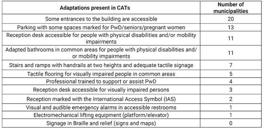
In terms of tourism offerings, more than half (n=33) of the participating municipalities have Tourist Information Centers (TICs), but only 22 of them are partially adapted to serve PwD (Figure 2). Regarding the nature of the adaptations, accessible entrances to the building predominate (n=20). Other recurring adaptations are parking lots with marked spaces (n=13), reception desks accessible to people with physical and motor disabilities (n=11), and adapted bathrooms in common areas (n=11).

As observed in the results regarding adaptations for persons with disabilities in city halls, the same pattern is repeated in CATs, with the most common adaptations being entrances with some accessibility (n=20) or parking spaces for persons with disabilities (n=13), as shown in Box 1.
Regarding the presence of Libras (Brazilian Sign Language) interpreters, which is an important resource for serving part of the disabled population, only seven municipalities indicated that they had such professionals available.
With regard to the accessibility of tourist attractions, 51 municipalities have some tourist facilities (parks, museums, observation decks, or other tourist attractions) adapted to receive people with PwD and/or MR (Figure 3). However, tourist facilities tend to offer only partial accessibility (Graph 3).


It should be noted that natural attractions, such as resorts, parks, viewpoints, and beaches, are the least adapted to receive PwD. On the other hand, facilities designed to host events, such as exhibition parks, event centers, and cultural centers, are better prepared to receive this audience. It is possible that some of these spaces are managed by the private sector, which may encourage managers to pay greater attention to this issue. In addition, it is important to highlight the existence of accessible public squares, which, in addition to serving tourists, are essential for promoting leisure activities for residents.
Although historical and cultural tourism is the main tourist segment in the state of Rio de Janeiro, only nine municipalities reported having adequately adapted listed properties. Partial adaptations to listed properties were reported in 27 municipalities (Figure 4). It is worth noting that historical and cultural tourism involves visits to museums, historic centers, monuments, religious sites, among others, which are often old and may present accessibility barriers. As Yamamoto (2021) suggests, different strategies are needed to address accessibility in listed sites, which in many cases are poorly adapted to accessibility standards.

Considering the tourism promotion strategies of municipal tourism agencies in the state of Rio de Janeiro, the main communication resource pointed out by participants was the existence of an accessible website (n=20) (Graph 4). Other forms of promotion include videos with subtitles (n=18) and websites without accessibility features (n=17). A minimal number of municipalities have a call center for deaf people, printed material with enlarged font, accessible publications on social media (such as alternative text for images, audio description, subtitles, and/or sign language for audio and videos), or accessible apps, as shown below (Graph 4).

Although websites are the main form of tourism promotion, a portion of respondents (n=29) stated that city hall websites do not meet accessibility principles, with the most common accessibility features being visual contrast and enlarged font (n=7), image audio description (n=7), keyboard navigation (n=6), window with sign language interpreter (n=3), and automatic translation from Portuguese to sign language (n=1). Website accessibility in the context of tourism is, in fact, a global challenge. The low level of reliability and lack of standardization in the structure of accessible content on the websites of National Tourism Organizations (NTOs) have been widely identified as crucial barriers, as they limit the ability of PwD to plan safe trips (Vila & Darcy, 2025). Furthermore, as identified in the study by Tonini et al. (2022), accessibility and compliance with the principles of universal design are limitations in tourism websites that can impact the visibility and promotion of destinations in digital media.
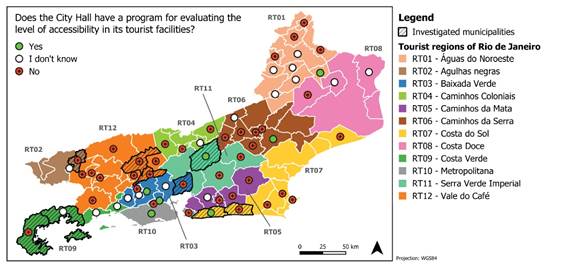
Finally, a lack of information was found regarding tourism supply and demand, as well as the local accessibility conditions of tourist facilities, which can hinder the monitoring and evaluation of accessible tourism. Less than half of the participants (n=27) have information on the tourist profile, and an even smaller percentage (n=9) indicate having data on PwD tourists. The capacity to serve tourists with disabilities is also limited by the lack of information on adapted accommodation units, since only 26 municipalities have this information. Specific programs to evaluate accessibility conditions in tourist facilities exist in only 7 municipalities (Figure 5).

This result reveals a lack of monitoring aimed at advancing and improving accessibility in tourist areas. The lack of accessibility assessment programs also demonstrates a disconnect between national legislation, such as the Statute of Persons with Disabilities (Brazilian Inclusion Law) (Brazil, 2015), and the practices adopted by municipal entities, because without monitoring, there is no way to produce indicators that can point to improvements or deficiencies in tourist facilities in terms of accessibility.
Another important issue concerns the awareness-raising actions promoted by the bodies responsible for tourism. Of the 62 participants, 39 indicated that there were no campaigns to raise awareness in the tourism production chain. This suggests a failure to raise awareness among the various actors in the production chain, such as hotels, restaurants, tourism agencies, and other services. This failure to coordinate and educate stakeholders prevents the overcoming of interpersonal barriers, which are considered increasingly relevant in the development of accessible tourism (Nigg et al., 2025). Without educational and awareness campaigns, it is likely that tourism service providers are not aware of or motivated to implement good accessibility practices.
The lack of training and awareness can result in the perpetuation of exclusionary practices and ableist discourse (Rubio-Escuderos et al., 2025), without changing (at least in the short and medium term) the accessibility landscape in tourist destinations in the state of Rio de Janeiro.
FINAL CONSIDERATIONS
This study aimed to map accessibility conditions in municipalities in the state of Rio de Janeiro and their implications for tourism. The study, based on a survey of 62 municipalities (67.4% of the sample), showed that, although accessibility is a constitutional right and an ethical commitment, management challenges and institutional gaps are the main obstacles to the consolidation of accessible tourism in the state's tourist destinations. The results reinforce that accessibility and inclusion are not yet priority issues in the management of tourism in these locations, reflecting a fragile and insufficient approach in municipal plans.
The diagnosis revealed that the level of adequacy of tourism offerings in city halls, tourist assistance centers (CATs), and listed properties is predominantly partial or nonexistent. The most common adaptations tend to be those of lesser complexity, such as parking spaces for people with reduced mobility (MR) or accessible entrances. On the other hand, more structural or informational adaptations, such as tactile flooring, trained professionals, and Braille signage, are present on an ad hoc basis. This finding confirms that compliance with technical accessibility standards, such as NBR 9050:2020, is a major challenge, which is in line with the literature that points to low adequacy in tourist spaces and listed properties.
The research identified profound institutional gaps that weaken political alignment and accessibility management. Although half of the municipalities (n=31) have a Municipal Council for the Rights of Persons with Disabilities (CONDEFI), indicating the presence of formal bodies, the existence of these instruments does not translate into effective accessible tourism policies. This situation reflects the inconsistency in the governance structure of accessible tourism, which, according to the literature, is intrinsically contingent on collaboration and coordination among stakeholders (Rubio-Escuderos et al., 2025).
The main bottleneck lies in the lack of monitoring and evaluation of accessibility conditions. Only seven municipalities have specific programs to assess the level of accessibility in their tourist facilities, which reveals a disconnect between national legislation and the practices adopted by municipal entities. Without systematic monitoring, it is impossible to produce indicators that point to improvements or deficiencies. This finding reinforces the analysis of Lima and Duarte (2025), who consider that the discontinuity of public policies fuels a culture of lack of planning for long-term results.
In this sense, the lack of data on the general profile of tourists and tourists with disabilities, as well as on the level of accessibility of tourist attractions and equipment, hinders the strategic planning of accessible tourism, harming the competitiveness of organizations and tourist destinations.
In addition, the survey revealed the lack of knowledge among municipal managers about federal programs, such as the Accessible Tourism Program (from the Ministry of Tourism), and about credit lines intended for the adaptation of buildings. This data reinforces that financial difficulty is a perceived barrier, but also highlights the lack of information and the limited institutional capacity of municipal tourism agencies.
Based on the diagnosis, the main challenges identified are the lack of information on demand (tourists with disabilities), the lack of monitoring of supply, and the low number of awareness campaigns aimed at the tourism production chain. These challenges are critical, as the promotion of accessible tourism requires social awareness and coordination between different political levels. The lack of awareness and training perpetuates exclusionary practices, preventing articulation between public and private actors.
In summary, the main conclusion of the study is that overcoming architectural and urban barriers, while essential, is not the only obstacle. Managerial, political, and informational obstacles in municipal administrations are the most decisive factors in the current scenario, preventing the prioritization of the topic.
The diagnosis contributes to a deeper understanding of the accessible tourism scenario in the State of Rio de Janeiro, identifying bottlenecks and indicating priorities to support the formulation of strategies. To advance the agenda in the state, the following is recommended:
-
Prioritize the development of programs for continuous evaluation and monitoring of accessibility in tourist facilities;
-
Promote the training of managers on technical standards (NBR 9050) and existing federal programs;
-
Invest in awareness campaigns aimed at the production chain and society, as emphasized in the literature.
The main limitations of this research involved the difficulty in obtaining responses from the municipal tourism secretariats of the state, which required more time for its completion; and the need to prioritize objective questions, considering the questionnaire response time.
The panorama indicated by the data collected also made it possible to identify opportunities for future research, such as conducting longitudinal and qualitative studies to delve deeper into specific issues related to the theme or the geographic and socioeconomic context of each municipality; comparative research involving the public and private sectors; and research aimed at understanding the effective influence of participatory bodies in the planning of accessible tourism.
References
-
Associação Brasileira de Normas Técnicas. (2020). NBR 9050 Acessibilidade a edificações, mobiliário, espaços e equipamentos urbanos. Rio de Janeiro: ABNT. Recuperado de: https://www.abntcolecao.com.br/mpf/norma.aspx?ID=461490#
» https://www.abntcolecao.com.br/mpf/norma.aspx?ID=461490# - Brasil. (1988). Constituição da República Federativa do Brasil: Texto constitucional promulgado em 5 de outubro de 1988. Brasília: Senado Federal.
- Brasil. (2015). Lei n. 13.146, de 07 de julho de 2015. Institui a Lei Brasileira de Inclusão da Pessoa com Deficiência. Estatuto da Pessoa com Deficiência. Brasília: Presidência da República.
- Brasil. (2018). Lei n. 11.771 de 17 de setembro de 2008. Dispõe sobre a Política Nacional de Turismo, define as atribuições do Governo Federal no planejamento, desenvolvimento e estímulo ao setor turístico. Brasília: Presidência da República .
- Brasil. (2024). Lei n. 14.978, de 18 de setembro de 2024. Altera as Leis n. 7.064, de 6 de dezembro de 1982, 7.565, de 19 de dezembro de 1986 (Código Brasileiro de Aeronáutica), 11.771, de 17 de setembro de 2008 (Lei Geral do Turismo), 12.462, de 4 de agosto de 2011, 13.097, de 19 de janeiro de 2015, e 13.146, de 6 de julho de 2015 (Estatuto da Pessoa com Deficiência), para promover a modernização do turismo. Brasília: Presidência da República .
-
Brasil (2024). Mapa do Turismo Recuperado de: https://www.mapa.turismo. gov.br/mapa/init.html#/home
» ttps://www.mapa.turismo. gov.br/mapa/init.html#/home - Buhalis, D., & Darcy, S. (2011). Accessible tourism. Concepts and Issues. Aspects of tourism Bristol: Channel View Publications.
- Conti, B. R., Casemiro, I. de, Costa, K. A. de S., Lavandoski, J., Elicher, M. J., & Juliano, T. (2024). Turismo e Acessibilidade: uma revisão sistemática da literatura do contexto brasileiro. In: XXI SEMINÁRIO ANPTUR, 21., 2024, São Paulo. Anais…São Paulo: ANPTUR, 2024.
- Creswell, J. W., & Creswell, J. D. (2021). Projeto de pesquisa: Métodos qualitativo, quantitativo e misto Porto Alegre: Penso Editora.
- Darcy, S., & Dickson, T. J. (2009). A whole-of-life approach to tourism: The case for accessible tourism experiences. Journal of Hospitality and Tourism Management, 16(1), 32-44.
- De La Fuente-Robles, Y. M., Mudarra-Fernández, A. B., & Rocoy-Can, A. J. (2020). Understanding stakeholder attitudes, needs and trends in accessible tourism: a systematic review of qualitative studies. Sustainability, 12(24), 1-23.
- Deville, E. L. (2009). O desenvolvimento do Turismo Acessível: dos argumentos sociais aos argumentos de mercado. Revista Turismo & Desenvolvimento, 11, 39-46.
- Duarte, D. C., Borda, G. Z., Moura, D. G., & Spezia, D. S. (2015). Turismo acessível no Brasil: um estudo exploratório sobre as políticas públicas e o processo de inclusão de pessoas com deficiência. Revista Brasileira de Pesquisa em Turismo, 9(3), 537-553.
- Duarte, D. C., & Honorato, T. S. (2020). Turismo cultural acessível: a percepção dos gestores dos principais teatros de Brasília. Turismo: Visão e Ação, 22(3), p. 575-596.
- Duarte, D. C., & Lemos, G. S. (2017). Turismo acessível: estudo da legislação brasileira e internacional sobre direitos das pessoas com deficiência. Inc. Soc., 10(2), 119-131.
- Ferst, M. C., Coutinho, H. R. M., & Chaves, P. C. P. R. (2020). Destino turístico e acessibilidade como diferencial de competividade. Brazilian Journal of Development, 6(10), 83989-84007.
- Henriquez, C. S., Cano, A. J. R., Galan, J. H., & De la Fuente-Robles, Y. M. (2022). The past, present and future of acessible tourism research: a bibliometric analysis using Scopus Database. Journal of Acessibility and Design for All, 7(2), 26-60.
- Juliano, T., Lavandoski, J., Pimentel Lopes, B., Matos Gomes, R., & Casemiro, Ítalo de P. (2024). Acessibilidade como agenda política: análise da trajetória das políticas de turismo no brasil. Humanidades em Revista, 6(2), 109-126.
- Lam, K. L., Chan, C-S., & Peters, M. (2020). Understanding technological contributions to accessible tourism from the perspective of destination design for visually impaired visitors in Hong Kong. Journal of Destination Marketing & Management, 17, 100434.
- Lima, L. B. B. M., & Duarte, D. C. (2025). Políticas públicas de acessibilidade em turismo no Brasil. Turismo Visão e Ação, 27(1), 1-14.
- Mazzotta, M. J. S., & D’Antino, M. E. F. (2011). Inclusão social de pessoas com deficiências e necessidades especiais: cultura, educação e lazer. Saúde e sociedade, 20(2), 377-389.
- Medeiros, M. M., Santana, S. P, & Ruiz da Silva, L. A. (2019). Reflexões sobre o turismo inclusivo. Revista Hospitalidade, 16(1), 93-108.
- Ministério do Turismo. (2021). Programa Turismo Acessível Brasília: Ministério do Turismo.
- Ministério do Turismo, & Organização das Nações Unidas para a Educação, a Ciência e a Cultura. (2023). Turismo Acessível: mapeamento de atrativos, empreendimentos, produtos e serviços Brasília: Ministério do Turismo , 2023.
- Nascimento, E. D. (2018). Análise da produção teórica brasileira sobre turismo e acessibilidade 1987 a 2016 (Dissertação de Mestrado). Universidade de São Paulo, São Paulo, Brasil.
- Nigg, J. J., Plaikner, A., Peters, M., & Haid, M. (2025). Leisure constraints towards accessible tourism: self-characteristics of people with disability along tourism value chains. Current Issues in Tourism, 28(18), 3031-3045.
-
Organização das Nações Unidas. (2015). 17 objetivos para transformar o nosso mundo Recuperado de: https://nacoesunidas.org/pos2015/
» https://nacoesunidas.org/pos2015/ - Qiao, G., Ding, L., Zhang, L., & Yan, H. (2022). Accessible tourism: a bibliometric review (2008-2020). Tourism Review, 77(3), 713-730.
-
Rio de Janeiro. (2022). Plano Estratégico do Turismo RJ+10 anos Rio de Janeiro: Secretaria Estadual de Turismo. Recuperado de: https://drive.google.com/drive/folders/1GvWHa_ekgv0gnR0isZ2LTmGmB02PCfHg
» https://drive.google.com/drive/folders/1GvWHa_ekgv0gnR0isZ2LTmGmB02PCfHg - Rodrigues, I. M., & Valduga, V. (2021). Turismo acessível para pessoas com deficiências: a produção científica dos periódicos de turismo do Brasil. Revista Turismo em Análise, 32(1), 59-78.
- Rodrigues, I. M., & Valduga, V. (2025). Turismo acessível a pessoas com deficiência: um estudo bibliométrico. Revista Brasileira de Pesquisa em Turismo , 19, e-2972, 1-23.
- Rubio-Escuderos, L., García-Andreu, H., & Ullán de la Rosa, J. (2025). What is leading destinations towards inclusivity? Analysis of accessible tourism drivers from a stakeholders’ perspective. Tourism Planning & Development, 22(1), 19-40.
- Santos, L. O. S., Oliveira, J. L. S., & Flórez, D. F. (2024). Acessibilidade em turismo: identificando padrões e tendencias. Cenário: Revista Interdisciplinar em Turismo e Território, 12(1), 1-21.
- Sassaki, R. (2023). Inclusão no lazer e turismo: em busca da qualidade de vida São Paulo: Áurea.
- Sisto, R., Cappelletti, G., Bianchi, P., & Sica, E. (2021). Sustainable and accessible tourism in natural areas: a participatory approach. Curren Issues in Tourism, 25(8), 1307-1324.
- Tonini, H., Lavandoski, J., Pareira, G. O., & Annoni, A. L. R. (2022). Avaliação de Websites de Regiões de Ecoturismo: casos brasileiros e internacionais. Revista Brasileira de Pesquisa em Turismo , 16, e-2684.
- Traverso, L. D., Patias, T. Z., Toselli, C., & da Silva, L. D. (2023). Turismo e Objetivos de Desenvolvimento Sustentável: uma análise a partir da produção nacional e das políticas públicas brasileiras. Caderno Virtual de Turismo, 23(1), 79-91.
- Vilela, G. J. P; & Costa, H. A. (2020) Políticas públicas de turismo: uma análise dos planos nacionais de turismo do Brasil (2003-2022). Revista Turismo em Análise , 31(1), 115-132.
- Vilela, G. J. P. & Costa, H. A. (2022). Políticas Públicas de Turismo: uma análise dos planos nacionais de turismo do Brasil (2003-2022). Revista Turismo em Análise - RTA ECA-USP, 31(1), 115-132.
- Yamamoto, T. (2021). Patrimônio histórico e acessibilidade: um estudo de caso no entorno da Igreja de Nossa Senhora da Glória do Outeiro na cidade do Rio de Janeiro (Dissertação de Mestrado). Fundação Getúlio Vargas, Rio de Janeiro, Brasil.
-
Editor
Luiz Carlos da Silva Flores
-
Section Editor
Ana Paula Sohn
-
Assistente Editorial
Bruno Fernandes Mendes

 Source: Survey data (2024)
 Source: Survey data (2024)

 Source: Survey data (2024)
 Source: Survey data (2024)
 Source: Survey data (2024)
 Source: Survey data (2024)
 Source: Survey data (2024)
 Source: Survey data (2024)
 Source: Survey data (2024)