
 Economic Impacts of International Tourism in Brazil: Evaluation Using the Input-Output Model
Abstract:
Purpose - To estimate the direct, indirect, and induced economic impacts of inbound international tourism in Brazil
Design/methodology/approach - The assessment is based on the input-output model and the combination of tourism statistics from different sources.
Findings - The results include estimates of the effects of international tourism revenues on output, Gross Domestic Product (GDP), taxes, and the amount and compensation of employees for the year 2023. The estimates show that the indirect multiplier effect of tourism on the output is 0.75, and the induced effect is 1.55. Therefore, the total multiplier effect is 3.31. In 2023, international tourism revenue had an estimated total impact of BRL 114.1 billion on gross output and BRL 66.2 billion on GDP (i.e., 0.6% of Brazil's GDP). In the same year, international tourism generated 1,175,000 direct, indirect, and induced jobs, representing 1.1% of the total employment in the country.
Practical implications - This research enables more accurate interpretations of the role of tourism in the Brazilian economy, as well as the development of policies and strategies better suited to reality.
Originality/value - This research is innovative in proposing an alternative methodology that combines available statistics to produce consistent estimates of the economic impact of international tourism in the country.
Research limitations - The main limitations of this work stem from the quality of tourism statistics available in Brazil and from the assumptions of the input-output model.
Keywords:
International Tourism; Inbound Tourism; Tourism Multipliers; Tourism Economics; Input-Output
Resumo:
Objetivo - Estimar os impactos econômicos diretos, indiretos e induzidos do turismo internacional receptivo no Brasil
Desenho/metodologia/abordagem - A avaliação é feita com base no modelo de insumo-produto e na combinação de estatísticas de turismo de diferentes fontes.
Resultados - Os resultados incluem estimativas dos efeitos da receita turística internacional do ano de 2023 sobre o Valor Bruto da Produção (VBP), o Produto Interno Bruto (PIB), a arrecadação de impostos, a remuneração dos trabalhadores e o número de empregos. As estimativas apontam que o efeito multiplicador indireto do turismo internacional sobre o VBP é 0,75 e o induzido é 1,55, totalizando um multiplicador de 3,31. Em 2023, a receita turística internacional teve um impacto total estimado de R$ 114,1 bilhões sobre o VBP e de R$ 66,2 bilhões sobre o PIB (0,6% do PIB brasileiro). Nesse mesmo ano, o turismo internacional foi responsável pela geração de 1.175.000 empregos diretos, indiretos e induzidos, quantidade correspondente a 1,1% do total de empregos da economia brasileira.
Implicações práticas - Esta pesquisa permite interpretações mais ajustadas do papel do turismo na economia brasileira, bem como o desenvolvimento de políticas e estratégias mais adequadas à realidade.
Originalidade/valor - Esta pesquisa inova ao apresentar uma metodologia alternativa de combinação das estatísticas disponíveis com o propósito de produzir resultados consistentes acerca do impacto econômico do turismo internacional no país.
Limitações da pesquisa - As principais limitações deste trabalho são intrínsecas à qualidade das estatísticas sobre o turismo disponíveis no Brasil e aos pressupostos do modelo de insumo-produto.
Palavras-chave:
Turismo internacional; Turismo receptivo; Multiplicadores do turismo; Economia do turismo; Insumo-produto
Resumen:
Objetivo - Estimar los impactos económicos directos, indirectos e inducidos del turismo receptivo internacional en Brasil
Diseño/metodología/enfoque - La evaluación se basa en el modelo insumo-producto y al combinar estadísticas de turismo de diferentes fuentes.
Hallazgos - Los resultados incluyen estimaciones de los efectos de los ingresos del turismo internacional sobre la producción, el Producto Interno Bruto (PIB), la recaudación de impuestos, la compensación de los trabajadores y el empleo para el año 2023. Las estimaciones indican que el efecto multiplicador indirecto del turismo internacional sobre la producción es de 0,75, y el efecto multiplicador inducido, de 1,55. Por lo tanto, el efecto multiplicador total es de 3,31. En 2023, los ingresos por turismo internacional tuvieron un impacto total estimado de R$ 114,1 mil millones en la producción y un impacto total de R$ 66,2 mil millones en el PIB (0,6% del PIB brasileño). En ese mismo año, el turismo internacional también fue responsable de la generación de 1.175.000 empleos directos, indirectos e inducidos, cantidad correspondiente al 1,1% del total de empleos del país.
Implicaciones prácticas - Esta investigación permite realizar interpretaciones más precisas del papel del turismo en la economía brasileña, así como el desarrollo de políticas y estrategias más acordes con la realidad.
Originalidad/valor - Esta investigación es innovadora al presentar una metodología alternativa que combina las estadísticas disponibles con el propósito de producir resultados consistentes sobre el impacto económico del turismo internacional en el país.
Limitaciones de la investigación - Las principales limitaciones de este trabajo son inherentes a la calidad de las estadísticas de turismo disponibles en Brasil y a los supuestos del modelo de insumo-producto.
Palabras Clave:
Turismo Internacional; Turismo Receptivo; Multiplicadores Del Turismo; Economía Del Turismo; Insumo-Producto
INTRODUCTION
When it comes to tourism, the international inbound flow is usually the center of attention. International tourism is, for instance, the main element of the general objective of the Brazilian National Tourism Plan 2024-2027 (Ministério do Turismo, 2024), even though the document is intended for public tourism policies in a broader sense, including also domestic and outbound tourism. Although international tourism has much smaller social and economic dimensions than domestic tourism in Brazil (Santos, 2023c), foreign tourist arrivals receive great prominence in the media and public debate. The very notion of a tourist is usually associated with international travel rather than national travel (Santos Junior et al., 2024).
The emphasis on international inbound tourism, to the detriment of domestic and outbound flows, has various explanations and justifications. From an economic perspective, the inbound flow is a source of external revenue-resources that enter the local economy and promote exogenous impacts-whereas the domestic flow is driven by resources internal to the country's own economic system (Dwyer et al., 2020; Santos, 2023a). This is a fundamental economic difference between international and domestic tourism. For example, when a Brazilian travels to another place in the country, the resources employed originate from the national economy itself. Domestic tourism expenditure, while constituting revenue for the destination, represents, from a national point of view, merely a displacement of resources that are no longer employed in other places or industries within the country's economic system. Conversely, when a foreigner travels to Brazil, the spending does not imply a reduction of resources in other parts of the Brazilian economy. Instead, it constitutes a true new injection of resources into the national economic system. For this reason, international tourism constitutes a prominent source of economic impacts. Even if the volume of economic resources involved in this flow is lower than that of domestic tourism, each monetary unit of international revenue tends to generate a final effect on the economy much greater than each unit of revenue generated by domestic tourism (Dwyer et al., 2020).
Despite international tourism having considerable and justified prominence, Brazil currently lacks consistent and up-to-date estimates of the economic impacts of this activity. The information available on this topic does not constitute a specific and detailed description of the national economy. On the one hand, data on the country's international tourism revenue are provided by the Brazilian Central Bank (Banco Central do Brasil, 2024b). However, this information refers only to revenue. It does not comprehensively represent the economic impacts, as it does not address production costs or the indirect and induced effects.
On the other hand, some technical and scientific research has focused on estimating the economic impacts of tourism in Brazil. Part of these works dealt exclusively with the direct impacts of the activity. Among these, some did not specifically address tourism but rather the set of tourism characteristic industries (Gonçalves et al., 2020; IBGE, 2012). At this point, it is fundamental to highlight that the differences between the economic aggregates relevant to tourism characteristic industries and to tourism itself are considerable. According to Santos (2023b), tourism accounts for a minority share of important tourism characteristic industries, such as food services (17.1%) and land transport (13.3%). In contrast, few studies that measure the direct impact adopt the proper concept of tourism, departing from a demand perspective (Kadota & Rabahy, 2003; Santos, 2023b).
Some works ventured beyond direct economic impacts, also estimating the indirect and induced impacts of tourism in Brazil (Santos, 2016). Among the works of national scope, the pioneering analysis developed by Embratur (1991) based on the input-output model stands out. This model was also adopted by Casimiro Filho and Guilhoto (2003) to estimate the total economic impacts of tourism in Brazil. Regionalized versions of the same approach were also used to analyze economic impacts of tourism in different regions and states (Ribeiro et al., 2013, 2014). Considering the structure of the economic system in a more comprehensive and complex way, some studies evaluated the total economic impacts of tourism in Brazil using computable general equilibrium models (Andrade et al., 2008; Takasago et al., 2010). This type of model was also used at the regional level to evaluate the impacts of the National Tourism Development Program - Prodetur (Araújo Júnior et al., 2020; Viana et al., 2014). It is also worth highlighting the World Travel & Tourism Council's (WTTC, 2023) estimates of the total economic impact of tourism. Despite its relevance to estimating the economic impacts of tourism, the literature has raised concerns about its transparency, excessive extrapolation of parameters based on other countries, and the possible conflict of interest between the description and the advocacy of the sector (Figini & Patuelli, 2022; Mihalic & Aramberri, 2015).
The research on the economic impact of tourism in Brazil published to date, despite exploring various relevant aspects, leaves a central gap: the economic impact of international inbound tourism. Despite the prominence this tourist flow receives across multiple domains, the total economic impacts of this activity are largely unknown in Brazil.
To fill this gap, the present research aims to estimate the direct, indirect, and induced economic impacts of international inbound tourism in Brazil for the year 2023. The evaluation is based on the input-output model, from estimates of Brazil's tourism revenue. To this end, various data sources were combined, including those from the Central Bank, Ministry of Tourism, and the Brazilian Tourist Board (Embratur). Information from the 2019 Brazilian International Tourist Survey (BITS) of the Tourism Ministry was used to estimate international tourists' expenditure patterns. The results include estimates of the impacts of the international tourism revenues on gross output, Gross Domestic Product (GDP), tax revenues, labor compensation, and the number of jobs. The effects are estimated both in relative terms, via multipliers, and in monetary terms. Special analyses are developed to describe the contribution of each directly impacted tourism industry and the final impact across all industries.
In summary, the estimates indicate that, by adding the indirect multiplier of international tourism on gross output (0.75), and the induced multiplier (1.55), to the direct effect (1.0), the total multiplier effect on gross output is 3.31. In 2023, international tourism revenue had an estimated total impact of BRL 114.1 billion on gross output and BRL 66.2 billion on GDP (0.6% of the Brazilian GDP). In the same year, international tourism was responsible for the generation of 1,175,000 direct, indirect, and induced jobs, representing 1.1% of total national employment.
LITERATURE REVIEW
Measuring the economic impacts of tourism on exports, income, and employment has long been a primary research topic in tourism economics (Liu et al., 2022). Estimating these impacts is fundamental for assessing the relevance of tourism as an economic activity. Studying these impacts also allows for a better understanding of the dynamics of the economic effects generated by tourist spending, providing support for the development of policies and strategies to better leverage the activity.
The economic impacts of tourism can be considered at three levels (Dwyer et al., 2020; Santos & Kadota, 2012):
-
Direct impact: the effect of international tourist spending on the productive units (firms) that provide goods and services directly to tourists. The direct economic impact stems from purchases made by tourists at firms of both tourism characteristic industries and from non-tourism characteristic industries (e.g., gas stations, supermarkets, and telecommunications companies).
-
Indirect impact: the effect of international tourist spending on the productive units that are part of the tourism supply chain but do not serve tourists directly. Examples include the sale of fuel for aircraft, the production of food items to supply restaurants, and the sale of inputs to hotels.
-
Induced impact: the effect of increased consumption in the economy, generated by the expansion of labor income created by tourism. For example, hotel employees spend part of their wages on housing services, health care, and education, as well as on purchasing products from supermarkets, clothing, vehicles, and other goods. Industries that produce and sell these goods and services are affected by tourism through induction.
Different methods exist to estimate the economic impacts of tourism on a destination. The measurement of impacts can be done through national accounting instruments adapted for recording values from the perspective of tourism demand, an alternative known as the Tourism Satellite Account (European Communities et al., 2009; United Nations, 2010). This approach has been used in several studies focused on the direct impacts of tourism (Diakomihalis & Lagos, 2008; Nordström, 1996; Odunga et al., 2020; Pham et al., 2008; Wu et al., 2022), including in Brazil (Kadota & Rabahy, 2003; Santos, 2023b).
Estimating the indirect and induced economic impacts of tourism requires more complex methods capable of modeling the dynamics of the national economy. The oldest and most widely used method for this is based on the input-output (IO) matrix (Leontief, 1986), a matrix structure that records values and quantifies the relationships between different industries and agents of the national economy (Feijó & Ramos, 2013). This approach is among the first and most widely used for estimating the economic impact of tourism (Comerio & Strozzi, 2019). Extensions of the IO model analysis include regional (Frechtling & Horváth, 1999; Freeman & Sultan, 1997; Tohmo, 2018) and dynamic models (Wu et al., 2022). Another relevant extension is the social accounting matrix, an instrument that allows for the description of the distribution of tourism's economic impacts among different agents (Akkemik, 2012; Croes & Rivera, 2017; Tchouamou Njoya, 2023; West, 1993).
The IO model is based on the IO matrix, which constitutes an essential information base for the System of National Accounts (SNA). The IO matrix incorporates data on national supply, domestic and imported demand, trade and transport margins, and taxes net of subsidies. Due to its comprehensiveness, the IO matrix is widely used in economic literature, within the scope of the IO model itself, for structural analyses of economies, allowing the examination of industries’ contribution to different products, production technologies, and the pattern of final demand. The IO matrix presents supply and demand under the premise of equilibrium, considering that everything offered is consumed either by final demand or by other industries (Alves-Passoni & Freitas, 2020; Baggio, 2019; Miller & Blair, 2022).
The IO model presents a series of advantages but also limitations. Briassoulis (1991) specifically addresses its use in tourism, highlighting that the model allows for the analysis of the chain effects of an industry or group of industries, tracing the impacts of tourism across other segments of the economy and mapping the circulation of resources within the economic structure. Its use is recommended to understand the direct, indirect, and induced effects of tourism spending on the local economy and to support public policies by estimating multipliers and identifying priority industries according to the magnitude of the impacts. However, it is not recommended for long-term analyses or for treating tourism as a single, traditional sector. It is essential to understand tourism as a fragmented ecosystem of services, complementing the analysis with other data sources or methods that capture its complexity (Briassoulis, 1991). In the same vein, Miller and Blair (2022) reinforce the utility of the methodology based on the Leontief matrix for its capacity to measure multi-sectoral effects. Its mathematically robust structure consolidates it as a tool for creating scenarios and formulating public policies across various industries (Miller & Blair, 2022).
The IO model assumes simplifying hypotheses about the economy's dynamics, among which are price rigidity and the abundance of resources (Dwyer et al., 2004). The main alternative to the IO model is the Computable General Equilibrium (CGE) model, which accounts for substitution between resources and products due to scarcity and price variations. Furthermore, CGE models can include elements not captured by the IO model, such as labor, credit, and foreign exchange markets, as well as fiscal and household consumption dynamics (Dwyer et al., 2004). This type of approach has also been widely used in the study of the economic impacts of tourism (Wickramasinghe & Naranpanawa, 2022). Despite the advantages of the CGE over the IO model, this instrument is also subject to relevant criticism. The main disadvantages of the CGE model are the lack of methodological standardization and presentation of results, the flexibility in defining model equations, the high data requirements, and the consequent usual calibration of parameters based on limited evidence, and the high dependence of results on the assumed premises (Wyk et al., 2015). Due to a lack of transparency, CGE models have frequently been described as "black boxes" (Robson et al., 2018).
The IO model calculates multiplier effects and enables impact analyses on economic production and various components of value added, such as Gross Domestic Product (GDP), income (compensation and/or wages), employment (occupations), taxes, and others (Alves-Passoni & Freitas, 2020; Baggio, 2019; Fletcher, 1989). The study by Fletcher (1989) argues for the use of this model for tourism, citing empirical evidence demonstrating its efficiency in impact analysis. In South Korea, tourism proved to be among the most efficient activities in retaining foreign exchange, with lower income leakage, surpassing industrial activities with greater external dependence; in the Philippines, the indirect impact of tourist spending was greater than the direct impact, highlighting the linkage effects and economic interconnections; in Hong Kong, the hotel industry showed high potential for job generation and direct value added significantly higher than other industries; in Gibraltar, even with a predominance of military spending, tourism presented a higher marginal contribution on income and employment; in Palau, Solomon Islands, and Western Samoa (Pacific island economies), hybrid models enabled the estimation of multiplier effects on income, tax revenue, and imports, providing alternative approaches for destination contexts with data limitations (Fletcher, 1989). In this sense, a wide range of applications for the IO model is observed, considering its limitations and the study's context, which motivates the methodology of this article.
METHODOLOGY
Data Sources
The analysis of the economic impact of international tourism was based on two central pieces of information: the estimates of international tourism revenues for each industry and the structure of the Brazilian economy as described by the IO matrix. International tourism revenues by industry were estimated from a combination of five data sources:
-
International tourism revenue in Brazil was obtained from the Central Bank (Banco Central do Brasil, 2024b)-monthly data for 2023 in dollars.
-
Average monthly exchange rate for dollar purchase operations recorded by the Central Bank (Banco Central do Brasil, 2024a) in 2023.
-
Average tourism expenditure by country of origin and mode of transport. Consolidated data from the 2019 Brazilian International Tourist Survey (BITS) conducted by the Ministry of Tourism (Ministério do Turismo, 2021).
-
Tourism expenditure by industry, country of origin, and mode of transport. Data estimated from special tabulations of the 2019 BITS microdata.
-
Number of tourist arrivals in 2023 from the Brazilian Tourist Board (Embratur, 2024).
The structure of the Brazilian economy was based on the IO matrix. The official version of the IO matrix is prepared by the Brazilian Institute of Geography and Statistics (IBGE) approximately every 10 years (IBGE, 2018). The 2015 IO matrix was the most recent official version available to this study. Given the long timeframe for IBGE updates, Alves-Passoni and Freitas (2020) maintain a recognized project to estimate and update the IO matrix. To obtain more up-to-date estimates, the present research used that source as a reference. Specifically, we used the 2019 matrix with 67 industries. The choice of the 2019 IO matrix is justified, since the 2022 and 2023 matrices were not yet available, and the 2020 and 2021 matrices describe a very peculiar economic reality due to the COVID-19 pandemic. Box 1 summarizes the main data used in the research.

In summary, data about the international tourism revenue (Banco Central do Brasil, 2024), the average exchange rate (Banco Central do Brasil, 2024a), and the Number of International Tourist Arrivals (Embratur, 2023) refer to 2023, while the data regarding the international tourist expenditure patterns (Ministério do Turismo, 2019) and the updated structure of the IO matrix referred to 2019. It is important to emphasize that the final estimates refer to 2023, using the international tourism expenditure pattern and the IO matrix as of 2019.
The industries defined by IBGE consist of sets of specific economic codes (CNAE). Some codes refer to extensive labels that, in this work, will be simplified for presentation purposes, as shown in Box 2. The box also lists other non-specified service industries.

International Tourism Revenue by Industry
Although the Central Bank records total international tourism revenue, this statistic is not broken down by the tourist-serving industries. This information is also unavailable in any other data source. Therefore, it was necessary to develop original estimates of international tourism revenue by tourist-serving industries.
The Central Bank records monthly international tourism revenues in dollars (R*m). The correspondent values in national currency (R) were obtained by using the average monthly exchange rate for purchase operations (Em), where m is the month index (Equation 1).
(1)
The total international tourism revenue (D) was disaggregated by country of origin (o) and mode of transport (t) by using the number of arrivals (C) and the average tourism expenditure per country of origin as recorded at the BITS (G*). The distribution of international tourism revenue by country of origin and mode of transport is given according to Equation 2.
(2)
The mode of transport used for the international trip was classified as air or non-air, with the latter category including land, river, and sea transport. The estimated distribution of international tourism revenue by country of origin and mode of transport was applied to the international tourism revenue recorded by the Central Bank, yielding an estimate of tourism revenue by country and mode of transport (Equation 3).
(3)
For each country of origin and mode of transport, international tourism revenues by industry were estimated by disaggregating Rot. To this end, the proportions of tourism expenditure (G) carried out in establishments by each industry were used. These estimates were obtained from special tabulations of the BITS microdata (Equation 4).
(4)
In the BITS, expenditure is classified into six categories: accommodation, food, transport, shopping, attractions, and others. However, to apply economic impact estimation methods, it is fundamental that tourism revenue be classified within the same industries found in the IO matrix. For this purpose, the BITS categories were associated with IO matrix industries as shown in Box 3.
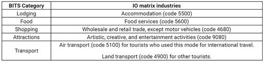
The BITS also includes a generic category for other expenditures. The items in this category (e.g., events, health, education, etc.) are identified, but the values corresponding to each item are not differentiated. In the absence of more precise information, the frequency of occurrences of different expenditure items was used as an approximation to disaggregate the category of other expenditures into specific industries. Expenditures in "others" were allocated as described below, resulting in the identification of 11 industries:
-
Events: Artistic, creative, and entertainment activities (code 9080);
-
Nightlife: 50% in artistic, creative, and entertainment activities (code 9080) and 50% in food services (code 5600);
-
Study: Private education (code 8592);
-
Courses: Private education (code 8592);
-
Health: Private health (code 8692);
-
Esthetics: Private health (code 8692);
-
Documentation: Public administration, defense, and social security (code 8400);
-
Communication: Telecommunications (code 6100);
-
Family event: Wholesale and retail trade, except motor vehicles (code 4680);
-
Cruises: Water transport (code 5000);
-
Tips: 50% in food services (code 5600) and 50% in accommodation (code 5500).
Finally, the international tourism revenue by industry (Ri) was calculated as the sum of the estimates of international tourism revenues by industry for each country of origin and mode of transport (Riot), according to Equation 5.
(5)
IO Analysis
The estimation of the economic impacts of international inbound tourism in Brazil was based on the IO model. The model represents the national productive structure, including data on supply, demand, imports, taxes, intermediate and final consumption, as well as the components of the value added. Following Feijó and Ramos (2013), the IO matrix can be simplified as presented in Box 4.

The IO model has various applications. In particular, this framework allows the estimation of the impacts on the entire economy from an exogenously defined demand. In many applications, the exogenous shock refers to additional government spending or an increase in international demand. Therefore, the IO model fits international tourism analysis very well (Liu et al., 2022), as variations in this flow can be consistently represented by exogenous demand shocks (Dwyer et al., 2004). Economic impact analysis based on the IO matrix enables the evaluation of effects on different economic aggregates. In this study, five aggregates were evaluated:
-
Gross output: the value of all goods and services produced.
-
Gross Domestic Product (GDP): the primary measure of a country's economic activity. It is equivalent to gross output, net of intermediate consumption by industries in production.
-
Tax revenues: the sum of taxes on products (Brazilian taxes, such as ICMS, IPI, import taxes) and taxes on production (Brazilian taxes, such as IRPJ, IPTU, etc.).
-
Labor compensation: wages and social contributions.
-
Employment: number of formal and informal jobs.
The IO model also allows for the assessment of impacts at three levels of relationship with tourism revenue (Dwyer et al., 2020; Santos & Kadota, 2012): direct, indirect, and induced impacts. The dynamics of direct, indirect, and induced impacts generated by international tourist spending are illustrated in Figure 1.

The economic impacts of international inbound tourism can be assessed through two types of measures. Multiplier effects are relative measures, that indicate the impact of each BRL 1 of international tourism revenue. Tourism impacts can also be assessed through absolute measures, such as monetary values or the number of jobs generated by tourism revenue.
The estimates developed in this study were based on the reference guide developed by Vale and Perobelli (2020). The total demand of industry i (xi) is composed of final demand (yi) and the intermediate demand from other industries j (zij). In equilibrium, final demand equals the gross output of each industry (xi=GOi). The technical coefficient (aij) is defined as the ratio zij/xj. In the open model, which allows for the calculation of indirect impacts, the total demand of industry i is given by xi=∑jaijxj+yi, or, in matrix notation, x=Ax+y. The Leontief inverse matrix (B) is provided by B=(I-A)-1, where I is an identity matrix. Given bij as the elements of matrix B, the direct and indirect multiplier of the gross output of industry j is given by ∑ibij. Although Vale and Perobelli (2020) define the indirect production multiplier as ∑ibij-∑iaij, in this work, it is defined as ∑ibij-1. The difference is that Vale and Perobelli (2020) consider all impacts on tourist-serving industries to be direct. Alternatively, in this study, all intermediate purchases throughout the tourism supply chain are treated as indirect impacts, even for tourist-serving industries (e.g., hotels purchasing air tickets to transport their own employees). This definition is consistent with the tourism economics literature (Dwyer et al., 2020).
In the closed model, which includes induced impacts, the matrix of technical coefficients (A*) is augmented with a column for household consumption and a row for labor compensation. The total production multiplier, including direct, indirect, and induced impacts, is given by ∑ib*ij, where b*ij are the elements of the matrix B*=(I-A*)-1. The induced production multiplier is given by ∑ib*ij-∑ibij. Multipliers for other economic aggregates, including GDP, tax revenues, labor compensation, and the number of jobs, are obtained by applying the proportions of these aggregates relative to production.
RESULTS
International Tourism Revenue
In 2023, Brazil's international tourism revenue reached BRL 34.5 billion. According to estimates of this revenue's distribution by industry based on BITS microdata, food services received approximately BRL 10.9 billion (31.5%), while the accommodation industry generated international tourism revenue of BRL 9.2 billion (26.7%). It is noteworthy that the retail industry, although not a tourism characteristic industry, received substantial tourism revenues, totaling BRL 5.1 billion. Other non-tourism characteristic industries directly impacted by tourism include health, education, and telecommunications services.
Gross output
The results indicate that every BRL 1 of international tourism revenue generates an indirect impact of BRL 0.75 on gross output. Therefore, the sum of direct and indirect impact multipliers on gross output is 1.75. The induced impact multiplier of international tourism revenue on gross output is 1.55. Consequently, the total economic impact on gross output, including direct, indirect, and induced impacts, is BRL 3.31 for every BRL 1 of international tourism revenue, as illustrated in Figure 2.

Thus, considering the multiplier effects, in 2023, the international tourism revenue of BRL 34.5 billion generated indirect impacts of BRL 26.0 billion and induced impacts of BRL 79.0 billion. The total economic impact of international tourism revenues was BRL 139.5 billion (Figure 3).

Economic impacts of tourist-serving industries
The same amount of international tourism revenue can have different impacts depending on the type of service the tourist purchases. Thus, specific multiplier effects were calculated for each of the primary industries directly impacted by international inbound tourism. The multipliers for the six tourist-serving industries with the highest revenues were evaluated.
The direct and indirect multiplier effects on gross output vary across tourist-serving industries, ranging from 1.57 (retail) to 2.02 (land transport). The total multiplier effect, which accounts for direct, indirect, and induced impacts, ranges from 3.03 (air transport) to 3.61 (accommodation). Therefore, BRL 1 of international tourism revenue in accommodation generates an increase of BRL 3.61 in the Brazilian gross output. The lowest total multiplier effect is observed in the air transport service (Figure 4).

Total economic effect on industries
The effects of Brazil's international tourism revenue are distributed across almost the entire economy. The most impacted is the services sector, which incurred BRL 80 billion in impact. However, industry (BRL 29.9 billion) and agriculture and livestock (BRL 4.0 billion) were also significantly impacted by international tourism.
The most impacted tourism characteristic industry was food services, which recorded an increase of more than BRL 13 billion in gross output. However, although not a tourism-characteristic industry, retail had an even higher total impact on gross output, reaching BRL 15 billion (Table 1).
Figure 5 illustrates the network of direct and total impacts of international tourism on gross output. The chart consists of three columns of bars. The leftmost column, in blue, represents the 2023 international tourism revenue. The central column represents direct impacts by industry, while the right column represents indirect and induced impacts. In the central column, the proportions between the left (direct impacts) and right (indirect and induced impacts) flows reveal the total multiplier effect of each tourist-serving industry.

Distribution of International tourism direct, indirect, and induced impacts on gross output, by sectors and industries
Gross Domestic Product (GDP)
The international inbound tourism has a direct multiplier effect of 0.59 on GDP. This means that every BRL 1 of international tourism revenue results in an increase of BRL 0.59 in the Brazilian GDP. The indirect multiplier for international tourism is 0.41. Therefore, the direct and indirect impact multiplier on GDP is 1.0. The induced impact multiplier is 0.92, such that the total multiplier effect is equal to 1.92. Thus, every BRL 1 of international tourism revenue generates a total impact on GDP of BRL 1.92 (Figure 6).

The international tourism revenue of BRL 34.5 billion of Brazil in 2023 generated a GDP increase of BRL 66.2 billion. Of this amount, BRL 20.2 billion was generated directly, BRL 14.2 billion through indirect impacts, and BRL 31.8 billion by induction (Figure 7).

Tax revenues
International inbound tourism has a direct multiplier effect of 0.10 on tax revenues. The indirect multiplier of international tourism is 0.09, and the induced multiplier is 0.16. The total multiplier effect is 0.35. Therefore, every BRL 1 of international tourism revenue generates a BRL 0.35 impact on tax revenues in Brazil (Figure 8).

The direct impact of Brazil's international tourism on tax revenue in 2023 was BRL 3.6 billion. The indirect impact was BRL 3.0 billion, and the induced impact was BRL 5.5 billion. The total impact of international tourism on tax revenue reached BRL 12.1 billion.
Labor compensation
International inbound tourism has a direct multiplier effect of 0.28 on labor compensation, including wages and social contributions. The indirect multiplier is 0.14, and the induced multiplier is 0.33. The total multiplier effect is 0.74. Therefore, every BRL 1 of international tourism revenue generates a BRL 0.74 impact on total labor compensation in Brazil (Figure 9).

The direct impact of Brazil's international tourism on labor compensation in 2023 was BRL 9.5 billion. The indirect impact was BRL 4.9 billion, and the induced impact was BRL 11.0 billion. The total result of international tourism revenue on labor compensation was BRL 25.4 billion.
Employment
An international tourism revenue of BRL 1 million supports 15 direct and 5 indirect jobs in Brazil. Including the induced effects, the total impact of a BRL 1 million international tourism revenue is 34 jobs (Figure 10).
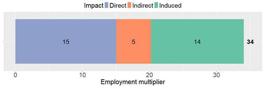
Brazil's international tourism revenue in 2023 supported 519,000 direct jobs and 179,000 indirect jobs. The induced impact of international tourism was 477,000 jobs. In total, 1,175,000 jobs were supported by international inbound tourism in the country. This amount represents 1.1% of the total jobs in the country.
FINAL CONSIDERATIONS
International inbound tourism is a major source of revenue for the Brazilian economy. In 2023, according to data from the Central Bank, international tourism revenues totaled BRL 34.5 billion. In addition to the direct impact on tourist-serving industries, tourism also generates indirect and induced impacts. The effects of inbound tourism revenue spread throughout the entire economy through the supply chain and the income flows. The result is a web of broad and multifaceted impacts.
The indirect multiplier effect on gross output is 0.75. An international tourist expenditure of BRL 1.00 generates additional BRL 0.75 of gross output in industries that do not directly serve tourists but are part of the tourism supply chain. Economic production is also multiplied by household expenditures enabled by the increase in income generated from international tourism. The induced gross output multiplier is 1.55. The total multiplier effect of international tourist spending on gross output of the Brazilian economy-considering direct, indirect, and induced effects-is 3.31. In 2023, the total impact of international tourist spending on the Brazilian economy's gross output reached BRL 114.1 billion.
The impact of international tourism on other economic aggregates is also significant. The direct and indirect multiplier of international tourism on the Brazilian GDP is 1.0. This value is higher than the multipliers found in countries such as Portugal and Spain, but lower than those calculated for countries such as Italy and the Czech Republic (Figini & Patuelli, 2022). Including the induced impact, the tourism multiplier on GDP totals 1.92. Consequently, international tourism revenue is estimated to have generated a total impact of BRL 66.2 billion on GDP in 2023, equivalent to 0.6% of Brazilian GDP.
In 2023, tourism generated BRL 12.1 billion in tax revenues (total multiplier of 0.35). The activity was also responsible for generating BRL 25.4 billion in labor compensation (total multiplier of 0.74). The direct and indirect multiplier on the number of jobs was 20 for every BRL 1 million, while the total job multiplier was 34 for every BRL 1 million. Thus, inbound tourism generated 698,000 direct and indirect jobs and 477,000 induced jobs, totaling 1,175,000 jobs, which corresponds to 1.1% of Brazil’s total jobs.
Among the different types of economic impact of international tourism, the induced effect stands out as the most expressive and comprehensive. Although direct and indirect impacts are more evident and recognized, the total impact of international tourism revenue is much larger than it appears at first glance. This result highlights that the benefits of international inbound tourism extend far beyond tourist-serving firms, reaching broad segments of the national and especially local economies. The increase in tourism workers' income generates a virtuous cycle of consumption in housing, food, retail, education, and health services, stimulating industries that, at first glance, have no direct relationship with tourism. Thus, the induced impact reveals the potential of international tourism as a driver of territorial economic dynamism, strengthening local supply chains, stimulating entrepreneurship, and promoting a broader redistribution of the economic gains generated by this activity.
Across industries, accommodation services have the highest multiplier effects, except for job generation, in which entertainment has the highest multiplier. Air transport has the lowest multiplier effects due to high dependence on imported inputs and taxation.
Some sectors and industries, although not directly impacted by foreign tourist spending, are nevertheless considerably affected by international tourism. For example, the industrial sector does not serve tourists directly but has had its production increased by nearly BRL 30 billion due to the indirect and induced impacts of inbound tourism in Brazil. Agriculture and livestock, real estate and finance are also heavily impacted by international tourism through indirect and induced mechanisms, even though they have minimal direct shares of the tourism services supply.
International tourism generates much more tax than it seems. For every BRL 1.00 of international tourism revenue, although direct taxes increase by only BRL 0.10, total government collection increases by BRL 0.35 when the indirect and induced effects are considered. Industry is responsible for paying 45% of the total taxes generated by international tourism.
This research has methodological contributions for the estimation of tourism economic impacts. Although the methodological basis employed is widely disseminated, its specific application to Brazil constitutes a significant challenge, especially given the limitations in data availability. Thus, this research innovates by presenting an alternative combination of available statistics to produce consistent results regarding the economic impact of international tourism in the country. Furthermore, this work contributes to the availability of statistical information on the topic, thereby facilitating more accurate interpretations of the role of tourism in the Brazilian economy and the development of policies and strategies better suited to reality. The scarcity of consistent estimates in this field has led to distortions in Brazilians' impressions about tourism in the country. The availability of information without solid grounds or that is purposefully distorted is a serious problem in Brazil, often leading to an overestimation of the economic relevance of tourism. Therefore, this work promotes a more realistic understanding of the Brazilian tourism scenario.
The importance of international tourism for the Brazilian economy, as measured and highlighted in this work, contrasts with the country's difficulty in expanding this activity in recent decades. The dimension of Brazil's international inbound flow stood practically stagnant in the first quarter of the 21st century (Rabahy, 2020). There are many problems affecting Brazilian competitiveness in international tourism, including poor access conditions to the country and its destinations, public insecurity, and a scarcity of tourism products suited to the needs and preferences of foreign tourists (Lohmann et al., 2022). The country's socioeconomic and political conditions, as well as deficiencies in public management of tourism, contribute to the persistence of tourism competitiveness problems (Trigo, 2020). However, the significant multiplier effects of international tourism in the country indicate potential gains that would follow the growth of inbound flows. Thus, the present work reinforces the need to establish effective policies to increase national tourism competitiveness and inbound flow, thereby promoting improvements in the quality of life for Brazilians.
Finally, the results presented in this study open space for new research agendas and practical applications beyond the field of public policy. Future studies can deepen the analysis of the distributive effects of international tourism by examining how economic benefits are distributed across different social segments and Brazilian regions. It would also be relevant to investigate the environmental and sociocultural impacts associated with the expansion of inbound tourism, integrating sustainability indicators into economic models. The practical applicability of this work's findings can also contribute to strategic business planning, the formulation of investment strategies for tourism infrastructure, the strengthening of local supply chains, and the creation of shared economic governance instruments among the public sector, the private sector, and communities.
References
-
Akkemik, K. A. (2012). Assessing the importance of international tourism for the Turkish economy: A social accounting matrix analysis. Tourism Management, 33(4), 790-801. https://doi.org/10.1016/j.tourman.2011.09.002
» https://doi.org/10.1016/j.tourman.2011.09.002 -
Alves-Passoni, P., & Freitas, F. N. P. (2020). Estimação de matrizes insumo-produto anuais para o Brasil no sistema de contas nacionais: Referência 2010. Textos Para Discussão, 025 /2020 https://repositorio.ipea.gov.br/handle/11058/13345
» https://repositorio.ipea.gov.br/handle/11058/13345 - Andrade, J. P. de, Divino, J. A., Mollo, M. de L. R., & Takasago, M. (2008). A economia do turismo no Brasil Editora SENAC.
-
Araújo Júnior, I. de, Almeida, A. T. C. de, Levy, D., & Banerjee, O. (2020). Avaliação ex-post de um Programa de Desenvolvimento do Turismo no Brasil a partir da integração de avaliação de impacto com Equilíbrio Geral Computável: Evidências para o Prodetur-Pernambuco. IDB Working Paper Series, IDB-WP-01130 https://doi.org/10.18235/0002572
» https://doi.org/10.18235/0002572 -
Baggio, R. (2019). Measuring Tourism: Methods, Indicators, and Needs. In E. Fayos-Solà & C. Cooper (Eds.), The Future of Tourism: Innovation and Sustainability (pp. 255-269). Springer International Publishing. https://doi.org/10.1007/978-3-319-89941-1_13
» https://doi.org/10.1007/978-3-319-89941-1_13 -
Banco Central do Brasil. (2024a). Taxas de Câmbio [Dataset]. https://dadosabertos.bcb.gov.br/dataset/taxas-de-cambio-todos-os-boletins-diarios
» https://dadosabertos.bcb.gov.br/dataset/taxas-de-cambio-todos-os-boletins-diarios -
Banco Central do Brasil. (2024b). Viagens: Receita [Dataset]. https://dadosabertos.bcb.gov.br/dataset/22741-viagens---mensal---receita
» https://dadosabertos.bcb.gov.br/dataset/22741-viagens---mensal---receita -
Briassoulis, H. (1991). Methodological issues: Tourism input-output analysis. Annals of Tourism Research, 18(3), 485-495. https://doi.org/10.1016/0160-7383(91)90054-F
» https://doi.org/10.1016/0160-7383(91)90054-F -
Casimiro Filho, F., & Guilhoto, J. J. M. (2003). Matriz de insumo-produto para a economia turística brasileira: Construção e análise das relações intersetoriais. Análise Econômica, 21(40). https://doi.org/10.22456/2176-5456.10743
» https://doi.org/10.22456/2176-5456.10743 -
Comerio, N., & Strozzi, F. (2019). Tourism and its economic impact: A literature review using bibliometric tools. Tourism Economics, 25(1), 109-131. https://doi.org/10.1177/1354816618793762
» https://doi.org/10.1177/1354816618793762 -
Croes, R., & Rivera, M. A. (2017). Tourism’s potential to benefit the poor: A social accounting matrix model applied to Ecuador. Tourism Economics , 23(1), 29-48. https://doi.org/10.5367/te.2015.0495
» https://doi.org/10.5367/te.2015.0495 -
Diakomihalis, M. N., & Lagos, D. G. (2008). Estimation of the economic impacts of yachting in Greece via the Tourism Satellite Account. Tourism Economics , 14(4), 871-887. https://doi.org/10.5367/000000008786440139
» https://doi.org/10.5367/000000008786440139 - Dwyer, L., Forsyth, P., & Dwyer, W. (2020). Tourism Economics and Policy (2nd ed., Vol. 5). Channel View Publications.
-
Dwyer, L., Forsyth, P., & Spurr, R. (2004). Evaluating tourism’s economic effects: New and old approaches. Tourism Management , 25(3), 307-317. https://doi.org/10.1016/S0261-5177(03)00131-6
» https://doi.org/10.1016/S0261-5177(03)00131-6 - Embratur. (1991). Sistema de contas nacionais do turismo: Análise econômica Embratur.
-
Embratur. (2024). Chegadas de turistas internacionais ao Brasil [Dataset]. https://dados.embratur.com.br/inicio/chegadas-de-turistas
» https://dados.embratur.com.br/inicio/chegadas-de-turistas -
European Communities, International Monetary Fund, Organisation for Economic Co-operation and Development, United Nations, & World Bank. (2009). System of National Accounts 2008 https://unstats.un.org/unsd/nationalaccount/docs/SNA2008.pdf
» https://unstats.un.org/unsd/nationalaccount/docs/SNA2008.pdf - Feijó, C., & Ramos, R. L. O. (2013). Contabilidade social: Referência atualizada das contas nacionais do Brasil Elsevier Brasil.
-
Figini, P., & Patuelli, R. (2022). Estimating the economic impact of tourism in the European Union: Review and computation. Journal of Travel Research, 61(6), 1409-1423. https://doi.org/10.1177/00472875211028322
» https://doi.org/10.1177/00472875211028322 -
Fletcher, J. E. (1989). Input-output analysis and tourism impact studies. Annals of Tourism Research , 16(4), 514-529. https://doi.org/10.1016/0160-7383(89)90006-6
» https://doi.org/10.1016/0160-7383(89)90006-6 -
Frechtling, D. C., & Horváth, E. (1999). Estimating the multiplier effects of tourism expenditures on a local economy through a regional input-output model. Journal of Travel Research , 37(4), 324-332. https://doi.org/10.1177/004728759903700402
» https://doi.org/10.1177/004728759903700402 -
Freeman, D., & Sultan, E. (1997). The economic impact of tourism in Israel: A multi-regional input-output analysis. Tourism Economics , 3(4), 341-359. https://doi.org/10.1177/135481669700300404
» https://doi.org/10.1177/135481669700300404 -
Gonçalves, C. C. S., Faria, D. M. C. P., & Horta, T. de A. P. (2020). Metodologia para mensuração das Atividades Características do Turismo: Uma aplicação para o Brasil e suas unidades da federação. Revista Brasileira de Pesquisa em Turismo, 14(3), 89-108. https://doi.org/10.7784/rbtur.v14i3.1908
» https://doi.org/10.7784/rbtur.v14i3.1908 -
IBGE. (2012). Economia do turismo: Uma perspectiva macroeconômica: 2003-2009 IBGE. https://biblioteca.ibge.gov.br/visualizacao/livros/liv61658.pdf
» https://biblioteca.ibge.gov.br/visualizacao/livros/liv61658.pdf -
IBGE. (2018). Matriz de Insumo-Produto: Brasil: 2015 IBGE. https://biblioteca.ibge.gov.br/visualizacao/livros/liv101604.pdf
» https://biblioteca.ibge.gov.br/visualizacao/livros/liv101604.pdf -
Kadota, D. K., & Rabahy, W. A. (2003). Conta Satélite de Turismo no Brasil: Método de avaliação do impacto econômico do turismo. Revista Turismo em Análise, 14(1), 65-84. https://doi.org/10.11606/issn.1984-4867.v14i1p65-84
» https://doi.org/10.11606/issn.1984-4867.v14i1p65-84 - Leontief, W. (1986). Input-output economics Oxford Press.
-
Liu, A., Kim, Y. R., & Song, H. (2022). Toward an accurate assessment of tourism economic impact: A systematic literature review. Annals of Tourism Research Empirical Insights, 3(2), 100054. https://doi.org/10.1016/j.annale.2022.100054
» https://doi.org/10.1016/j.annale.2022.100054 -
Lohmann, G., Lobo, H. A. S., Trigo, L. G. G., Valduga, V., Castro, R., Coelho, M. de F., Cyrillo, M. W., Dalonso, Y., Gimenes-Minasse, M. H., Gosling, M. de S., Lanzarini, R., Leal, S. R., Marques, O., Mayer, V. F., Moreira, J. C., Moraes, L. A. de, Netto, A. P., Perinotto, A. R. C., Neto, A. Q., Uvinha, R. R. (2022). O futuro do turismo no Brasil a partir da análise crítica do período 2000-2019. Revista Brasileira de Pesquisa em Turismo , 16, 2456-2456. https://doi.org/10.7784/rbtur.v16.2456
» https://doi.org/10.7784/rbtur.v16.2456 -
Miller, R. E., & Blair, P. D. (Eds.). (2022). Foundations of Input-Output Analysis. In Input-Output Analysis: Foundations and Extensions (3rd ed., pp. 10-62). Cambridge University Press; Cambridge Core. https://doi.org/10.1017/9781108676212.003
» https://doi.org/10.1017/9781108676212.003 -
Mihalic, T., & Aramberri, J. (2015). Myths of top tourism countries, tourism contribution and competitiveness. Tourism Review, 70(4), 276-288. https://doi.org/10.1108/TR-08-2014-0048
» https://doi.org/10.1108/TR-08-2014-0048 -
Ministério do Turismo. (2021). Estudo da demanda turística internacional 2019: Fichas sínteses [Dataset]. http://www.dadosefatos.turismo.gov.br/2016-02-04-11-54-03/demanda-tur%C3%ADstica-internacional/item/download/1282_853ba144ccc8d45663b8fd9dd8e7a348.html
» http://www.dadosefatos.turismo.gov.br/2016-02-04-11-54-03/demanda-tur%C3%ADstica-internacional/item/download/1282_853ba144ccc8d45663b8fd9dd8e7a348.html - Ministério do Turismo. (2024). Plano Nacional de Turismo 2024-2027: O turismo como protagonista do desenvolvimento sustentável e inclusivo
-
Nordström, J. (1996). Tourism Satellite Account for Sweden 1992-93. Tourism Economics , 2(1), 13-42. https://doi.org/10.1177/135481669600200102
» https://doi.org/10.1177/135481669600200102 -
Odunga, P. O., Manyara, G., & Yobesia, M. (2020). Estimating the direct contribution of tourism to Rwanda’s economy: Tourism satellite account methodology. Tourism and Hospitality Research, 20(3), 259-271. https://doi.org/10.1177/1467358419857786
» https://doi.org/10.1177/1467358419857786 -
Pham, T. D., Dwyer, L., & Spurr, R. (2008). Constructing a regional Tourism Satellite Account: The case of Queensland. Tourism Analysis, 13(5-6), 445-460. https://doi.org/10.3727/108354208788160397
» https://doi.org/10.3727/108354208788160397 -
Rabahy, W. A. (2020). Análise e perspectivas do turismo no Brasil. Revista Brasileira de Pesquisa em Turismo , 14(1), 1-13. https://doi.org/10.7784/rbtur.v14i1.1903
» https://doi.org/10.7784/rbtur.v14i1.1903 -
Ribeiro, L. C. de S., Andrade, J. R. de L., & Motta, G. P. da. (2014). Impactos económicos de los gastos turísticos en Sergipe u sus efectos colaterales en el resto de Brasil. Estudios y Perspectivas En Turismo, 23, 447-466. http://ref.scielo.org/zqvg87
» http://ref.scielo.org/zqvg87 -
Ribeiro, L. C. de S., Andrade, J. R. de L., & Pereira, R. M. (2013). Estimação dos benefícios econômicos do Prodetur Nacional em Sergipe. Revista Econômica do Nordeste, 44(4), 975-1000. https://doi.org/10.61673/ren.2013.399
» https://doi.org/10.61673/ren.2013.399 -
Robson, E. N., Wijayaratna, K. P., & Dixit, V. V. (2018). A review of computable general equilibrium models for transport and their applications in appraisal. Transportation Research Part A: Policy and Practice, 116, 31-53. https://doi.org/10.1016/j.tra.2018.06.003
» https://doi.org/10.1016/j.tra.2018.06.003 -
Santos, G. E. de O. (2016). Pesquisa científica em economia do turismo no Brasil. Revista Turismo & Desenvolvimento, 26, 79-88. https://doi.org/10.34624/rtd.v0i26.10773
» https://doi.org/10.34624/rtd.v0i26.10773 -
Santos, G. E. de O. (2023a). Impactos do turismo: Aspectos micro e macroeconômicos. In Lazer e turismo: Perspectivas no âmbito da pós-graduação no Brasil (pp. 177-187). Edições EACH. https://doi.org/10.11606/9786588503447
» https://doi.org/10.11606/978658850344 -
Santos, G. E. de O. (2023b). PIB do turismo no Brasil: Estimativas pelo método do quociente de participação do turismo. Revista Turismo em Análise , 34, 124-147. https://doi.org/10.11606/issn.1984-4867.v34i1p124-147
» https://doi.org/10.11606/issn.1984-4867.v34i1p124-147 -
Santos, G. E. de O. (2023c). Turistas brasileiros: Quem são? Onde vivem? Quanto consomem? Revista Acadêmica Observatório de Inovação do Turismo, 66-91. https://doi.org/10.61564/raoit.v17n2.7491
» https://doi.org/10.61564/raoit.v17n2.7491 - Santos, G. E. de O., & Kadota, D. K. (2012). Economia do Turismo Aleph.
-
Santos Junior, J. J. dos, Fonseca, C. G., Candido, D. R. C., & Santos, G. E. de O. (2024). O que Define um Turista? Da teoria à compreensão dos gestores de destinos. Revista Turismo em Análise , 35, 1-15. https://doi.org/10.11606/issn.1984-4867.v35p1-15
» https://doi.org/10.11606/issn.1984-4867.v35p1-15 -
Takasago, M., Guilhoto, J. J. M., Mollo, M. de L. R., & Andrade, J. P. de. (2010). O potencial criador de emprego e renda do turismo no Brasil. Pesquisa e Planejamento Econômico, 40(3), 431-460. http://repositorio.ipea.gov.br/handle/11058/5092
» http://repositorio.ipea.gov.br/handle/11058/5092 -
Tchouamou Njoya, E. (2023). Assessing the poverty impact of the COVID-19-induced tourism crisis in Tanzania: A social accounting matrix microsimulation analysis. Journal of Sustainable Tourism, 31(3), 801-820. https://doi.org/10.1080/09669582.2021.2024552
» https://doi.org/10.1080/09669582.2021.2024552 -
Tohmo, T. (2018). The economic impact of tourism in Central Finland: A regional input-output study. Tourism Review, 73(4), 521-547. https://doi.org/10.1108/TR-04-2017-0080
» https://doi.org/10.1108/TR-04-2017-0080 -
Trigo, L. G. G. (2020). Viagens e turismo: Dos cenários imaginados às realidades disruptivas. Revista Brasileira de Pesquisa em Turismo , 14(3), 1-13. https://doi.org/10.7784/rbtur.v14i3.2107
» https://doi.org/10.7784/rbtur.v14i3.2107 -
United Nations. (2010). Tourism Satellite Account: Recommended methodological framework 2008 https://unstats.un.org/unsd/publication/seriesf/seriesf_80rev1e.pdf
» https://unstats.un.org/unsd/publication/seriesf/seriesf_80rev1e.pdf -
Vale, V. A., & Perobelli, F. S. (2020). Análise de insumo-produto: Teoria e aplicações no R NEDUR/LATES. https://nedur.ufpr.br/cursos/insumo-produto-r/
» https://nedur.ufpr.br/cursos/insumo-produto-r/ -
Viana, F. D. F., Domingues, E. P., & Diniz, C. C. (2014). Infraestrutura turística no Nordeste: Uma análise de projeção de impactos do Programa de Desenvolvimento do Turismo no Nordeste - PRODETUR/NE II. Revista Econômica do Nordeste , 45(2), 54-69. https://doi.org/10.61673/ren.2014.98
» https://doi.org/10.61673/ren.2014.98 -
West, G. R. (1993). Economic significance of tourism in Queensland. Annals of Tourism Research , 20(3), 490-504. https://doi.org/10.1016/0160-7383(93)90005-N
» https://doi.org/10.1016/0160-7383(93)90005-N -
Wickramasinghe, K., & Naranpanawa, A. (2022). Systematic literature review on computable general equilibrium applications in tourism. Tourism Economics , 28(6), 1647-1668. https://doi.org/10.1177/13548166211006988
» https://doi.org/10.1177/13548166211006988 -
World Travel & Tourism Council (WTTC). (2023). Travel & Tourism Economic Impact 2023 - Brazil https://assets-global.website-files.com/6329bc97af73223b575983ac/647f263e229ecf941b98af01_EIR2023-Brazil.pdf
» https://assets-global.website-files.com/6329bc97af73223b575983ac/647f263e229ecf941b98af01_EIR2023-Brazil.pdf -
Wu, D. C., Cao, C., Liu, W., & Chen, J. L. (2022). Impact of domestic tourism on economy under COVID-19: The perspective of tourism satellite accounts. Annals of Tourism Research Empirical Insights, 3(2), 100055. https://doi.org/10.1016/j.annale.2022.100055
» https://doi.org/10.1016/j.annale.2022.100055 -
Wyk, L. V., Saayman, M., Rossouw, R., & Saayman, A. (2015). Regional economic impacts of events: A comparison of methods. South African Journal of Economic and Management Sciences, 18(2), 155-176. https://doi.org/10.4102/sajems.v18i2.593
» https://doi.org/10.4102/sajems.v18i2.593
-
Editor
Luiz Carlos da Silva Flores
-
Section Editor:
Thamires Foletto Fiuza
-
Editorial Assistant
Maria Fernanda Ferreira Soster

 Source: the authors
 Source: the authors
 Source: the authors
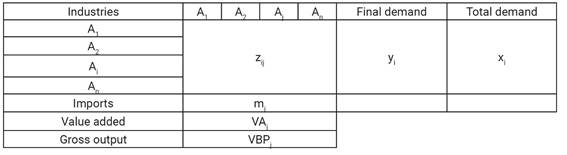 Source: the authors, adapted from Feijó and Ramos (2013). Legend: A ≡ Industries; zij ≡ intermediate consumption; yi ≡ final demand; xi ≡ total demand; mj ≡ imports; VAj ≡ value added; GO ≡ gross output
 Source: the authors based on Santos and Kadota (2012)
 Source: the authors
 Source: the authors
 Source: the authors
 Source: the authors
 Source: the authors
 Source: the authors
 Source: the authors
 Source: the authors
 Source: the authors