
 Realizing legal modernization through Marxist philosophy: theoretical basis and institutional evolution
Abstract:
This study addresses a critical gap in the literature by providing a philosophical analysis of China’s legal system modernization. Moving beyond conventional institutional or technical accounts, this paper analyzes the underlying logic of this transformation through Marxist philosophy. Grounded in dialectical and historical materialism, the analysis employs practical rationality as a core concept to argue that China’s legal modernization is not a simple adaptation of Western models, but an organic and evolving process rooted in the nation’s unique social practices and historical contradictions. This process is characterized by three core dimensions: (1) the institutionalization of human-centered values, (2) the alignment of legal frameworks with evolving productive forces, and (3) the advancement of national governance capacity. By examining key institutional developments, such as the codification of the Civil Code and procedural justice reforms, the paper concludes that China’s path exemplifies the practical application of Marxist legal theory. This approach not only innovates upon socialist legal principles, but also offers unique philosophical insights and practical knowledge to the global discourse on legal civilization.
Keywords:
Marxism; Law; Institutions; Subjectivity; Rationality; Historical materialism
Resumo:
Este estudo aborda uma lacuna crítica na literatura, ao fornecer uma análise filosófica da modernização do sistema jurídico chinês. Indo além das abordagens institucionais ou técnicas convencionais, este artigo analisa a lógica subjacente a essa transformação, através da filosofia marxista. Fundamentada no materialismo dialético e histórico, a análise emprega a racionalidade prática, como conceito central, para argumentar que a modernização jurídica da China não é uma simples adaptação de modelos ocidentais, mas, de fato, um processo orgânico e evolutivo, enraizado nas práticas sociais únicas da nação e em suas contradições históricas. Esse processo é caracterizado por três dimensões centrais: (1) a institucionalização de valores centrados no ser humano, (2) o alinhamento das estruturas jurídicas com as forças produtivas em evolução, e (3) o avanço da capacidade de governança nacional. Ao examinar desenvolvimentos institucionais-chave, como a codificação do Código Civil e as reformas da justiça processual, o artigo conclui que o caminho da China exemplifica a aplicação prática da teoria jurídica marxista. Essa abordagem não apenas inova os princípios jurídicos socialistas, mas também oferece insights filosóficos únicos e conhecimento prático ao discurso global sobre a civilização jurídica.
Palavras-chave:
Marxismo; Direito; Instituições; Subjetividade; Racionalidade; Materialismo histórico
INTRODUCTION
The construction of the rule of law is a central component of modernizing China’s national governance system and capacity. Simultaneously, it serves as a crucial practical field for applying Marxist philosophy in the contemporary era. The rule of law is seen as an important guarantee of Chinese modernization, emphasizing the need to fully implement the Constitution, safeguard its authority, synergistically promote reforms in all aspects of legislation, law enforcement, administration of justice and law-abidingness, and comprehensively promote the rule of law in all aspects of the state’s work (People’s D, 2024). “The road of socialist rule of law with Chinese characteristics is essentially the concrete embodiment of the road of socialism with Chinese characteristics in the field of the rule of law” (People’s D, 2020). Its conceptualization and implementation not only advance Marxist legal theories, but also enhance the theoretical framework of Chinese socialism. Although burdened, the paradigm “modernization” can still function as a basic explanatory framework for the development of Chinese socialist legality in the past forty years (Zhang; Yan, 2022, p. 691). The ongoing evolution of China’s legal modernization constitutes both theoretical innovation and practical experimentation in state governance under Marxist philosophical guidance.
Current academic research on the modernization of the rule of law mainly focuses on institutional aspects. These include the optimization of legislative techniques and judicial system reform. However, it seldom explores the generative logic from a philosophical perspective. In other words, why is the rule of law an inevitable choice for modernization? Is there a deeper philosophical stipulation behind the institutional change? Without a solid theoretical basis, analyses of legal modernization usually stay at the level of instrumental rationality.
This view makes it hard to disclose the internal connection between legal institutions and the evolution of social formations. As a result, it limits a comprehensive understanding of the uniqueness, regularities and global significance of China’s path. The analytical foundation of this study rests on Marxist philosophical constructs, utilizing dialectical and historical materialism as dual analytical lenses to reconstruct theoretical paradigms. Moving beyond phenomenological descriptions of legal systems, the analysis uncovers the inherent philosophical dynamics and historical contradictions within China’s unique modernization trajectory. By philosophically examining the tripartite interplay among material practices, axiological frameworks and institutional architectures, this philosophical examination enhances comprehension of institutional transformation dynamics within national governance modernization contexts.
1 THEORETICAL FOUNDATIONS AND CORE PROPOSITIONS OF MARXIST PHILOSOPHY OF LAW
It is widely assumed that the rule of law is essential for economic growth. Some scholars have proposed four major theoretical routes from the rule of law to economic growth: through the mitigation of violence; through protection of property rights; through institutional checks on government; and through control of private capture and corruption (Haggard; Tiede, 2011, p. 674). The value of “rule of law” itself is clearer and more explicit from the perspective of Marxist legal philosophy. This represents the theoretical reflection or highest abstraction of Marxism concerning the state’s system (Mou; Tang, 2020, p. 5). Marxist philosophy of law is not a set of isolated legal norms doctrine, but its overall philosophical worldview, in the field of the rule of law, is a specific display. It profoundly reveals the social and historical nature of the legal phenomenon, the internal logic of operation and its ultimate direction.
1.1 The material grounding of Law, historical trajectory and emancipatory purpose: a historical materialist perspective
From a Marxist perspective, the rule of law is a difficult matter to deal with. The rule of law ideal functions, in the first place, as a key concept of the well-established, more traditionally and liberally inclined legal theory (Piekarska, 2023, p. 270). The cornerstone of the Marxist philosophy of law is historical materialism. Its fundamental point of departure is that legal phenomena do not originate from abstract principles of reason, the spirit of the nation, or transcendental “ideas of law,” but are deeply rooted in a given society’s material conditions of life. Instead of either blindly valorizing existing forms, or dismissing them out of hand, Marxist analyses should focus on tracing the concrete material relationships that produce and sustain given legal or state forms (O’Connell, 2018, p. 650). As Marx and Engels articulated, “The relations of law, like the forms of the state, can be understood neither in their own right nor in terms of the so-called general development of the human spirit; on the contrary, they are rooted in the material relations of life” (Marx; Engels, 2009, p. 591). This principle posits that the nature, content and form of law are ultimately determined by society’s economic base - the state of its productive forces and relations of production. The process of institution generation, therefore, must find its roots in the specific socioeconomic structure. Consequently, “Rights must not go beyond the economic structure of the society and the cultural development of the society conditioned by the economic structure” (Marx; Engels, 2009, p. 435). Law is, thus, not an immutable category, but a historical product, whose changes reflect the evolution of society’s material mode of production and attendant class relations.
This historical and materially conditioned nature of law also informs its ultimate trajectory and purpose within Marxist thought: the comprehensive emancipation of humankind. Indeed, the ultimate goal of Marxist legal philosophy is to realize this emancipation. In Marx’s view, the state apparatus, including the law as a coercive instrument tied to class society, will ultimately “perish of its own accord” with the classes’ demise. The envisioned future communist society is a “union of free men” beyond class antagonisms and coercive norms, “[…] where the free development of each man is the condition of the free development of all” (Marx; Engels, 2009, p. 2). This philosophical framework establishes human emancipation as the cornerstone principle guiding socialist legal development. Accordingly, socialist jurisprudence must prioritize the working populations’ essential needs and, systematically, advance equitable social conditions that foster multidimensional human growth, establishing prerequisites for equitable resource distribution and participatory governance to cultivate environments conducive to individual self-realization within collective prosperity.
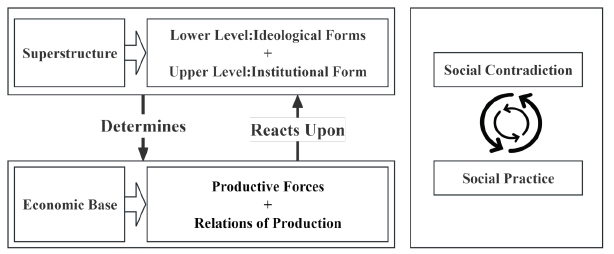
The Marxist philosophical framework of this study centers on the dialectical interplay between the societal economic base and its legal superstructure. This framework is modeled in Figure 1. It posits that material production relations mainly determine legal forms and consciousness. However, these superstructural elements have relative autonomy. They actively react to and shape the economic foundation. Social practice propels this entire dynamic. The emergence and resolution of contradictions in social practice drive historical and institutional evolution.
Historical materialism, class analysis and dialectical development have some foundational principles. These principles offer a macro-level framework. This framework helps us understand law. However, if we want to analyze the specific mechanisms of institutional change during China’s modernization, we need a more focused concept. In the following section, we are going to apply these principles. We are going to do this from the perspective of Marxist practical rationality. This concept acts as an analytical bridge. It links the abstract logic of historical progress to the real - world, problem - solving and value-guided activities. These activities shape legal institutions in practice. When we focus on practical rationality, we can shift. We move from what the law reflects to how it is actively and consciously created. It is created in response to societal needs and contradictions.
These foundational principles offer a macro-level framework. This framework helps in understanding law. However, if we want to analyze the specific mechanisms of institutional change in China’s modernization, this study makes use of these principles. It does so through the perspective of Marxist practical rationality. For this analysis, practical rationality is not just defined as pragmatism. It is seen as a particular way of reasoning. This reasoning is part of Marxist philosophy. It assesses and forms institutions. It does this based on their dialectical ability. First, they can resolve specific societal contradictions. These contradictions come from the economic base. Second, they can stay in line with the developmental needs of productive forces. Third, they can actively promote a people-centered society’s emancipatory values. This concept is like an important analytical bridge. It links the abstract logic of historical materialism. It also connects to the concrete, problem-solving and value-guided activities. These activities create legal institutions to meet societal needs.
1.2 Class and ideological attributes of law
The Marxist philosophy of law delves deep. It reveals the class attributes of law in a class society. Law is not a show of universal public will. Instead, it is often a concentrated reflection of the ruling class’s will. It serves as a tool. It maintains the ruling order and the ruling class’s economic interests. In analyzing capitalist legal rights, Marx pointed out that “[…] here equal rights are still bourgeois rights according to principle, although principle and practice no longer contradict each other here” (Marx; Engels, 2009, p. 434). This means formal equality might hide substantive inequality. Take labor law for example. A contract between a big corporation and an individual worker seems like an agreement between two equal legal parties on the surface. But it actually covers up a big difference in bargaining power. Based on this understanding, socialist legal systems do something. They bring in protective regulations for workers. This corrects the imbalance. It aims for real social justice.
Law has a normative, coercive and universal appearance. It also has a critical ideological function. It tries to make a particular class’s interests seem like the whole society’s interests and make them legitimate. By doing this, it keeps social order and power structures. Recognizing the class nature of law is not about denying its objective role in social governance. Instead, it is to stress the need to look through the form of law. This way, we can understand the power relations and interest dynamics hidden beneath.
1.3 Dialectics of legal development: practice, contradiction and dynamism
The Marxist philosophy of law attaches great importance to the dialectical process of legal development and the human beings’ subjective initiative. According to the understanding of dialectical materialism, the world is universally connected and eternally developing. The contradiction is the fundamental driving force of the development of things. Then, the development of law also follows this dialectical law. For one thing, the law originates from social practice and serves the practice. Its validity should ultimately be tested in practice. The rule of law practice theory scientifically grasps the core requirements of Marxist historical materialism on the basic principles of the law of human subjectivity. Marxist philosophy fully embodies the people’s position, and the theory of the rule of law, based on Marxist philosophy, is bound to fully embody the people’s position (Zhao; Liu, 2024, p. 8). Secondly, the legal system is full of various contradictions within it and between it and the social reality, and as the contradictions continue to arise and be resolved, the same in turn drives the evolution of the law. Third, although the law is constrained by the economic base, the law is not a passive reflection. As a superstructure, the law has relative independence and reacts to the economic base and social life in a dynamic way. By recognizing and following objective laws, people actively shape and reform the legal system through practices, such as legislation and justice, to serve specific social goals.
2 MARXIST PRACTICAL RATIONALITY: A THEORETICAL LENS ON LEGAL INSTITUTIONAL EVOLUTION
The core of Marxist philosophy lies in practice. Its “practical reason” emphasizes the unity of theory and practice, and the unity of understanding the world and transforming it. Based on the socialist system with Chinese characteristics, the theoretical resources for the modernization of the rule of law in China should be drawn from Marxist philosophy first (Zhang, 2023, p. 159). In particular, its dialectical ideas about social practice driving institutional change.
2.1 Practice- driven institutionalization: the genesis of legal norms from societal activity
Marx’s assertion that “[…] the material productive forces of society, having reached a certain stage of development, come into contradiction with the existing relations of production or property relations (which is only the legal term for the relations of production) in which they have been in motion” (Marx; Engels, 2009, p. 591) provides the foundational logic for practice-driven institutional change. This principle is vividly illustrated in the codification of the Chinese Civil Code. The impetus for this monumental legislative project was not an abstract pursuit of legal perfection, but a direct confrontation with the contradictions generated by decades of rapid economic development. The maturation of the socialist market economy gave rise to complex social and commercial relationships that the existing and fragmented civil statutes - products of an earlier economic base - could no longer adequately govern. This disjuncture between evolving material practices and outdated legal forms was the central contradiction that necessitated institutional innovation.
The codification of the Civil Code was not a top-down design achieved overnight, but rather a dialectical process involving long-term practical exploration, theoretical summation and consensus-building. It is not only a systematic integration of the achievements of existing civil legislation, but also a profound grasp of the laws of economic and social development during China’s social transition and a dynamic response. For example, the establishment of the “right of abode” in the Property Rights Section is a practical response to the changes in the family structure, the aging trend and the diversified needs for the use of housing in Chinese society. The standardization of e-commerce contracts and form clauses, in the Contracts Section, is a direct result of the practical challenges posed by the rapid development of the digital economy. This process fully embodies what Marxist practical reason emphasizes: from practice to practice. Legal system evolution remains profoundly rooted in active societal engagement, requiring acute perception of shifting relational dynamics and their subsequent crystallization into authoritative juridical standards. The advancement of the rule of law is essential in order to protect the environment and achieve sustainable development (Zhai; Chang, 2019, p. 294). The successful codification of the Civil Code is, thus, a concrete realization of key Marxist legal principles in contemporary China. It exemplifies how the economic base determines the superstructure and demonstrates the function of law in serving socioeconomic development.
2.2 Contradiction and adaptation: dialectical dynamics in legal system development
Marxist philosophy posits contradiction as the fundamental engine of all development. Applied to the legal system, this means that law is not a static and harmonious structure, but a dynamic field of dialectical tensions. The entire rule of law system is a complex system, and the various sub-systems may promote one another or constrain one another (Zhang, 2024, p. 126). It is the emergence and resolution of these internal contradictions that drive the evolution and adaptation of system. The iterative reforms of China’s procedural law, particularly in the criminal justice system, serve as a compelling case study of this dialectical process.
Taking the reform of the criminal procedure system as an example, from the early emphasis on combating crime and maintaining social order to the gradual emphasis on human rights safeguards, procedural fairness and the prevention of wrongful convictions, the trajectory of its evolution clearly demonstrates the new requirements placed on the legal system by the change in the main contradictions in society. Traditional Chinese criminal justice philosophy takes objectivity as the starting point in matters of fact-finding, and has long upheld the doctrine of ‘objective truth’ as the standard of proof, assuming that judicial adjudication can restore the objective reality of past events (Song, 2025, p. 193). For example, the “trial-centered” reform of the litigation system is designed to address the procedural imbalance brought about by investigation-centrism, and to strengthen the decisive role of the trial in ascertaining the facts, determining the evidence and protecting the right of appeal.
The impetus for this reform comes not only from the problems exposed in judicial practice, but also from the people’s higher expectations for judicial justice. It reflects the ruling party’s deepening understanding of the rule of law. This dynamic process confirms the Marxist principle that the superstructure must adapt to the economic base by dynamically adjusting to resolve internal contradictions. The concept of the rule of law emphasizes the organic unity of the rule of law and party leadership. In procedural reform, party leadership ensures the correct direction and political guarantee of reform, while the principle of the rule of law provides the normative framework and value guidelines for reform.
2.3 Value-quided institutionalization: the people-centered ethos in Marxist legal philosophy
The fundamental position of Marxist legal philosophy is its popular character, a principle that finds concrete expression in a people-centered ethos. The concept of the rule of law of socialism, with Chinese characteristics, is the scientific expression and concrete presentation of the Chineseization of the Marxist philosophy of law. The rule of law is the core content of the socialist rule of law, which is the proper meaning of the country’s socialist governance (Wang, 2018). Legal system modernization extends beyond mere technical advancements in institutional frameworks, inherently encompassing distinct axiological dimensions. The principle of ‘putting the people at the center’ embodies the value commitment of Marxist legal philosophy (Mou, 2020). Within the framework of China’s distinctive path to legal system modernization, Marxist practical rationality mandates the consistent application of the human-centric philosophy throughout legislative architecture, juridical enforcement mechanisms and judicial operational practices.
The construction of numerous systems reflects this value-led approach. At the law-enforcement level, law-enforcement behavior has been standardized and the “three systems” of administrative law-enforcement have been implemented, with the aim of solving the problems of non-standardized, non-transparent and uncivilized law-enforcement. The underlying logic of these institutional reforms lies in the implementation of the abstract “people’s subject position” into concrete legal systems and procedures. Such a focus reflects the Marxist philosophical emphasis on law not merely as a reflection of social relations, but also a tool for realizing the people’s will and safeguarding their rights and interests.
The reconstruction of the traditional view of the rule of law is to build a worldview framework with Marxist philosophy (Li; Zhu, 2021, p. 10). And the core value of this framework is peoplehood. Xi Jinping’s thought on the rule of law attaches great importance to the use of the systemic concept of Marxist philosophy to guide the practice of the rule of law. The systemic concept and systemic thinking are its distinctive scientific method (Yu, 2024, p. 49). Ultimately, this approach seeks to optimize protection and realization of fundamental benefits for the majority population through structured legal mechanisms.
3 CHINESE RULE OF LAW MODERNIZATION IN PRACTICE: PATHWAYS, INSTITUTIONAL ARTICULATIONS AND IMPLICATIONS
The modernization of rule of law in the Chinese context embodies the vivid practice of Marxist theory of rule of law across the domains of legislation, law enforcement, adjudication and legal compliance (Liu, 2024, p. 22). The modernization of the rule of law in China is not a simple transplantation of a set of preconceived ideals; rather, it is a process in which Marxist practical rationality is constantly exploring and shaping an institutional structure that is compatible with specific historical conditions and social needs. The core of this process lies in how to make the legal system not only effectively respond to and solve the complex problems emerging from social practice, but also reflect the fundamental value pursuit and governance logic of a particular social form. The purpose of this chapter is to examine, from the philosophical perspective of practical rationality and the appropriateness of the institutional structure, the specific paths of the modernization of the rule of law in the key areas of legislation, law enforcement, judiciary and social governance in the Chinese style, and to reveal its inner philosophical implications.
3.1 Legislative modernization: crafting responsive legal frameworks for a changing society
The modernization of legislation, from the perspective of the Marxist philosophy of practice, is fundamentally concerned with ensuring that the legal system can, as a superstructure, dynamically adapt to and effectively respond to the constantly evolving conditions of material life in society and the practical needs arising therefrom. Marx pointed out, in the Critique of Political Economy, that “[…] the mode of production of material life governs the whole process of social, political and spiritual life” (Marx; Engels, 2009, p. 591). This determines that legislative activity cannot be subjective or divorced from practical “rational design”, but must be a continuous and scientific process of adjustment tested by practice.
The core feature of Chinese legislative modernization lies in its profound understanding of “practical rationality”. This practical rationality manifests first in the demand-oriented nature of legislation. The rapid advancement of legislation, in emerging areas, is a direct response to the new problems and contradictions brought about by the new technological revolution and changes in social structure. This “issue-driven” legislative model avoids the disconnection between the law and social reality, and ensures the effectiveness of the system supply.
Secondly, the legislation is democratic and consultative. Emphasis on opening the door to legislation and extensive consultation is not a simple procedural embellishment, but a reflection of practical rationality in the main body of legislation - recognizing the complexity and plurality of social practice, and enhancing the tolerance and acceptability of legal norms to social relations by absorbing the different groups’ wisdom and demands. Again, the dynamic balance and systematic coordination of the legal system. Marxist legal philosophy not only emphasizes respect for the objective laws governing various social relations beyond the legal sphere, but also underscores the embodiment of these objective laws in the legislative process and the legal system itself (Yang, 2025, p. 167).
Marx mentioned in the Communist Manifesto: “The main mode of economic production and exchange of each historical epoch, and the social structure which necessarily results therefrom, are the basis on which the political and spiritual history of that epoch is established” (Marx; Engels, 2009, p. 14). This requires that the legal system, as a whole, must match the socioeconomic structure. Therefore, legislative modernization focuses not only on the enactment of individual laws, but also on the logical consistency within the legal system and the adaptability to the external environment, and the continuous optimization of the institutional structure through mechanisms, such as filing reviews and legal cleanups, in order to achieve the overall effectiveness of the legal system.
The Chinese-style road of modernization of the rule of law has the generalization, distillation and summary of the theoretical achievements of the past exploration of the road of the rule of law of socialism with Chinese characteristics, as well as the achievements of the rule of law in practice, and the theoretical innovations and development of various realities at the stage of the rule of law construction in the new era (Jiang, 2024, p. 56).
3.2 Law enforcement and judicial reform: enhancing justice and accountability in practice
If legislation is the institutional expression of practical rationality, then, law enforcement and justice are the concrete unfolding of practical rationality in the operation of system. Their core focuses on two aspects. One is how to achieve the unity of legal certainty and individual justice. The other is about balancing state power and civil rights within complex social interactions and individual cases.
The Marxist philosophy of law emphasizes the people’s nature of the law. Law enforcement for the people is the core essence of the socialist rule of law, which fully embodies the idea of realizing the people’s right to law in the Marxist philosophy of law (Wang, 2018, p. 10). The philosophical foundation of standardized enforcement lies in establishing procedural constraints and objective criteria to govern discretionary powers, thereby improving behavioral predictability and equitable implementation while protecting civil liberties.
This approach transcends mere procedural compliance, reflecting practical wisdom in understanding power dynamics. For instance, the implementation of the “three mechanisms” of administrative law enforcement. These are transparency requirements, comprehensive documentation protocols and critical decision review processes. Essentially, they translate the abstract concept of “law-based governance” into actionable procedures. These procedures have operational clarity and oversight capacity. Such institutionalization curbs subjective interpretations. It also strengthens enforcement reliability. The principle of the rule of law in governance requires the government to strengthen law enforcement in the digital transformation (Sun, 2024, p. 8). The application of science and technology provides technical support for such standardization. It further strengthens the power constraints in practice.
Judicial justice is the last line of defense for the rule of law. Marx had criticized the formalism of bourgeois law, pointing out that “[…] your law is nothing more than the same as the will of your class which is consecrated as law, and the content of this will is determined by the material conditions of life of your class” (Marx; Engels, 2009, p. 48). Marx’s critique reveals that judicial justice requires more than the mechanical application of legal provisions. It demands the pursuit of substantive justice, responding to the people’s simple feelings and realistic needs for fairness and justice. Guiding judicial practice with Marxist legal philosophy is not only an inherent requirement of judicial conduct, but also a fundamental driving force behind proactive adjudication (Zhang, 2011, p. 17).
Many of China’s judicial reforms are philosophically rooted in the pursuit of substantive justice. Initiatives, such as ensuring judicial independence, optimizing judicial resources and advancing judicial openness, are systemic designs intended to achieve this goal. By eliminating interference, enhancing competence and increasing transparency, these reforms are designed to converge in practice toward substantive justice. For example, the reform of the case registration system has solved the practical pain point of “difficult to file a case”. The exploration of the case guidance system attempts to follow the uniformity of the law and, at the same time, provides closer to the social rationale of the adjudication of complex cases. These reforms reflect the efforts of practical reason to forge better institutional arrangements in the judicial field.
3.3 Social governance modernization: cultivating order through legally framed pluralistic participation
The philosophical connotation of building a society, based on the rule of law, lies in internalizing the spirit of the rule of law as a general consensus and code of conduct for the society’s members and, through institutionalized channels, guiding the participation of pluralistic subjects in the society’s governance to form a benign order of co-construction, shared governance and sharing in practice. This transcends the traditional mode of governance, which relies solely on the state’s coercive power and embodies the Marxist practical view that the people are the creators of history. Especially in the area of human rights protection for socially disadvantaged groups, this holds particularly true. Safeguarding the vulnerable populations’ rights and interests and promoting social fairness and justice are not only important indicators of social progress, but also concrete manifestations of the Marxist legal philosophy of human rights protection in social practice (Zhou, 2016, p. 333).
The “practical rationality”, inherent in China’s construction of a rule-of-law society, manifests in two key dimensions: first, the practical cultivation of public faith in the rule of law. Through legal education, legal services, role models and other forms, the abstract legal norms will be transformed into the people’s perceptible, understandable and applicable life practices, so as to enhance the rule of law literacy in a subtle manner. Secondly, the institutional construction of participatory governance.
Encouraging and regulating the social organizations’ development, promoting grass-roots consultation and democracy, and improving the mechanism for the diversified settlement of conflicts and disputes, the essence of these institutional arrangements is to partially transfer or share the responsibility and capacity for social governance from the state to the social body, so as to stimulate the society’s vitality and form the synergy of governance. This logic of governance, “from the masses and to the masses”, is a vivid manifestation of practical rationality, aimed at facilitating the society’s members’ transformation from passive administrators to active participants through concrete institutional practices.
3.4 Integrating technology with legal governance: balancing innovation with ethical safeguards
The synthesis of legal frameworks and scientific innovation necessitates harmonizing pragmatic operational efficiency with foundational moral principles. With the development of new technologies, such as big data and artificial intelligence, Marxist philosophy is facing a new historical opportunity (Lan, 2025, p. 149). Instrumental rationality prioritizes systematic problem-solving through measurable outcomes and optimized processes, while value-oriented reasoning emphasizes upholding human dignity, social equity and democratic accountability. This integration guarantees that technological progress complies with established legal parameters while preserving fundamental rights and cultural values. By maintaining this equilibrium, society can cultivate responsible innovation that, simultaneously, drives economic development and safeguards collective welfare through transparent governance mechanisms.
The convergence of technological advancements and legal governance presents novel challenges in contemporary rule of law modernization. From a pragmatic rationality perspective, the central challenge revolves around leveraging technological innovations to enhance legal efficacy while safeguarding alignment with fundamental juridical values and ethical frameworks.
The dual imperative demands that technological implementation, within legal systems, transcends mere operational efficiency optimization, requiring heightened awareness of potential impacts on civil liberties, procedural integrity and societal equity. For example, the application of artificial intelligence in judicial assistance must be vigilant against algorithmic discrimination and the “digital divide”. The use of big data in social governance must strictly protect personal information and privacy. Therefore, the establishment of a sound mechanism for the ethical review of science and technology, data security laws and regulations, and algorithmic transparency requirements has become an inevitable requirement for practical rationality in exploring institutional suitability in this new field, with the aim of ensuring that science and technology are always used as a tool to serve the goals of the rule of law and the human beings’ comprehensive development, rather than undermining their value foundations.
3.5 Navigating dialectical tensions in practice
A Marxist analysis of legal modernization would be incomplete. That is because it needs to examine the inherent dialectical tensions. These tensions shape the trajectory of legal modernization. Practical rationality does not view these as simple contradictions. Instead, it engages them as driving forces. These driving forces are for institutional adaptation. Three core tensions are particularly salient in the Chinese context.
First, it is the relationship between party leadership and legal norms. From a dialectical point of view, this is not a zero-sum conflict. Instead, it is a unity of opposites. The party’s leadership gives the political direction and value orientation. It represents the collective will. This will is rooted in the socialist economic base. The rule of law, on the other hand, provides a stable, predictable and normative framework. Through this framework, the will is institutionalized and carried out. For example, major reforms, like the nationwide anti-corruption campaign, are politically started by the party. But they are executed through established legal and judicial procedures. These procedures include investigation by the National Supervisory Commission, prosecution by the procuratorate and public trials in courts. This dynamic makes sure political goals are achieved within a structured legal order. It stops arbitrariness. At the same time, it strengthens the authority and legitimacy of law.
Second, the tension between formal equality and substantive one is central. Take the codification of the Civil Code for example. It sets up all subjects’ formal equality before the law. This is a cornerstone of any modern legal system. Marxist practical rationality, though, realizes that formal equality may hide substantive inequalities coming from material conditions. China’s legal practice tries to solve this actively. It does this through targeted legislative and judicial measures. For example, the Labor Contract Law offers specific protections for workers. This helps counterbalance the power asymmetry between workers and employers. Likewise, the system of legal aid and targeted judicial relief for vulnerable groups are institutional efforts. They aim to turn formal rights into real - life situations, trying to reach genuine social justice.
Finally, the tension between law and its relative autonomy is critical. Historical materialism states that law is determined by the economic base and serves political ends. However, for law to function effectively, it has to maintain relative autonomy. Suppose the law was just a direct tool of immediate political will. In that case, it would lose its ability for systemic coordination, predictability and legitimacy. There are institutional mechanisms. They emphasize judicial professionalism, procedural justice and the principle of “basing every case on facts and taking law as the criterion”. These mechanisms are designed to safeguard this necessary autonomy. This guarantees that the legal system can mediate social conflicts. It can also regulate the economy with a certain degree of internal consistency and integrity. In turn, this serves the long - term stability and development of the socialist system.
3.6 China’s path in comparative perspective
To fully understand the distinctiveness of China’s legal modernization, a comparative perspective can be quite useful. If we compare China with other socialist and post - socialist states, especially Russia and Vietnam, then, the unique character of China’s application of Marxist practical rationality will become clear.
Russia’s post-Soviet transition involved a rapid and large-scale transplantation of Western legal models, a form of “legal shock therapy” that often ran parallel to its economic reforms. There was a disconnect between the formal legal superstructure and the actual socioeconomic base below. As a result, there were big challenges in how well the law worked and how society accepted it. China, on the other hand, took a different route. It chose a gradual and experimental path. Its legal modernization was closely linked to its economic reforms. Legal institutions in China changed as they dealt with real problems that came up in practice. This method clearly shows the Marxist idea. That is, the economic base decides the superstructure.
Vietnam offers a closer parallel, as it also navigates legal reform within a socialist framework. However, China’s modernization is distinguished by its sheer scale and the depth to which it has institutionalized the dialectical relationship between party leadership and the rule of law. Vietnam also places importance on party leadership. But in China, the ‘intra - Party regulations’ work together with national law. This is a more formalized and deeply integrated way to handle this key dialectical tension. Looking at this comparison, we can see that China’s path is not just another model. It is a distinct application of Marxist theory. It focuses on endogenous evolution instead of exogenous adoption, and on dialectical synthesis rather than linear progression.
CONCLUSION
This study is grounded in the practical rationality of Marxist philosophy. It systematically examines the theoretical cornerstone and institutional evolutionary path of Chinese rule of law modernization. The analysis identifies practical rationality as the core driving force, demonstrating that China’s legal modernization is not a logical deduction from abstract concepts. Instead, it is a dialectical development wherein practical rationality responds to societal contradictions, meets the people’s fundamental needs, and promotes the liberation and development of productive forces, all while constantly seeking adaptation and dynamic adjustment within specific institutional structures. From the practice-driven codification of the Civil Code to the adaptation evident in legal procedural reforms and the institutionalized implementation of the people’s subject position across governance domains, the trajectory reflects the fundamental Marxist methodological principle of “from practice, and to practice.”
Philosophically, this research advances beyond superficial observations or abstract evaluations of legal governance. By constructing a conceptual framework, rooted in historical materialism and dialectical reasoning, this study enhances comprehension of socialist rule-of-law development with Chinese characteristics, illuminating its grounding in societal evolution and the practical manifestations of human agency. The analysis underscores that effective legal system construction must be anchored in China’s unique socio-political context and lived realities, evolving through continuous problem-solving and institutional refinement. This approach not only guarantees the adaptive vitality and operational efficacy of the legal framework, but also secures its socialist essence. In this regard, promoting the transformation of international law from a ‘tool of rules’ to a ‘mechanism for discourse’ is not merely a strategic approach for China to participate in reshaping the global order, but more fundamentally, it is the jurisprudential expression of the national development philosophy of the new era. “This will help shift China’s international law practice from passive adaptation to active shaping, thereby contributing a unique and constructive Chinese approach to the evolution of global governance” (Liu, 2025, p. 113).
Looking ahead, Marxist practical reason will remain an indispensable guide for China’s rule of law as it navigates emergent complexities and fosters institutional innovation, particularly in adapting legal frameworks to rapid sociotechnological transformations and evolving governance demands, ensuring that legal development continues to serve national progress and the people’s well-being.
REFERENCES
- HAGGARD, S.; TIEDE, L. The rule of law and economic growth: where are we? World development, v. 39, n. 5, p. 673-685, 2011.
- JIANG, B. X. On the Path of Chinese-style Rule of Law Modernization. National Governance, n. 14, p. 53-58, 2024.
- LAN, J. The Material Premise and Subjective Dimension of Productive Forces in the New Technological Era: On the Issue of Productive Forces from the Perspective of Western Marxism. Theoretical Exploration, n. 2, p. 149-159, 2025.
- LI, Z. C.; ZHU, Y. Y. A Value Exploration of the Marxist View of Law. Journal of Shanxi Radio and Television University, n. 4, p. 8-11, 2021.
- LIU, Y. On the Political Elements of Chinese-style Rule of Law Modernization. Legal Science, n. 8, p. 19-30, 2024.
- LIU, Z. P. Implications of Global Financial Regulation for International Law: From Legitimacy Dilemmas to a Focus on Effectiveness. Financial Regulation Research, n. 8, p. 113, 2025.
- MARX, K.; ENGELS, F. The Marx-Engels Collected Works, v. 2. Beijing: People’s, 2009, p. 2-591.
- MOU, C. W. The People’s Will: The Ideological Character of Marxist Philosophy of Law. Chinese Social Sciences, n. 3, p. 25-43, 2020.
- MOU, C. W.; TANG, M. On Engels’ Later Contributions to the Enrichment and Development of Marxist Philosophy of Law. Theoretical Horizon, n. 7, p. 5-13, 2020.
- O’CONNELL, P. Law, Marxism and Method. Triple C: Communication, Capitalism & Critique. Open Access Journal for a Global Sustainable Information Society, v. 16, n. 2, p. 647-655, 2018.
-
PEOPLE’S DAILY. Upholding the Rule of Law in China to Provide Strong Legal Support for the Comprehensive Construction of a Modern Socialist Country. People.cn, 2020. Available in: https://www.peopleapp.com/column/30035568989-500005068071 Accessed in: May 6, 2025.
» https://www.peopleapp.com/column/30035568989-500005068071 -
PEOPLE’S DAILY. On the Further Deepening of Reform and Advancing Chinese Modernization. People.cn, 2024. Available in: http://politics.people.com.cn/n1/2024/0722/c1001-40282120.html Accessed in: May 6, 2025.
» http://politics.people.com.cn/n1/2024/0722/c1001-40282120.html - PIEKARSKA, A. Challenging the Rule of Law Universalism: Why Marxist Legal Thought Still Matters. Law Critique, v. 34, p. 269-285, 2023.
- SONG, L. C. A New Academic Discourse System of Evidence Science in China: A Comprehensive Study Centered on Professor Zhang Baosheng’s Scholarly Exploration. Journal of China University of Political Science and Law, n. 2, p. 184-194, 2025.
- SUN, Q. S. Principles and Paths for Promoting the Digital Transformation of Government Governance in the New Era. Journal of Shaanxi Administration College, n. 3, p. 5-10, 2024.
- WANG, F. Socialist Rule of Law State: The Practical Logic and Achievements of Sinicized Marxist Legal Philosophy. Exploration, n. 1, p. 5-12, 2018.
- YANG, J. An Investigation into the Origins and Evolution of “Scientific Legislation” from the Perspective of the Development of Marxism. Journal of Jiangsu Administration Institute, n. 2, p. 160-168, 2025.
- YU, F. A Deep Understanding of the Essence of Xi Jinping’s Thought on the Rule of Law. Advancement, n. 3, p. 47-50, 2024.
- ZHAI, T. T.; CHANG, Y. C. The Contribution of China’s Civil Law to Sustainable development: Progress and Prospects. Sustainability, v. 11, n. 1, p. 294, 2019.
- ZHANG, D. Promoting the Development of Chinese Modernization through Legal Theory Innovation. Journal of East China Normal University (Philosophy and Social Sciences), n. 1, p. 113-128, 2024.
- ZHANG, J. Adhering to the Methodology of Marxist Legal Philosophy in Judicial Practice. Qiushi, v. 4, p. 16-17, 2011.
- ZHANG, X. D.; YAN, W. Y. Forty-Years of the Modernization of Chinese Socialist Legality: Strategy, Lacuna, and Outlook. German Law Journal, v. 23, n. 5, p. 691-712, 2022.
- ZHANG, Y. X. The Concept and Perfection of China’s Administrative Rule of Law Modernization from an Integrated System View. Jiangsu Social Sciences, n. 2, p. 157-165, 2023.
- ZHAO, K.; LIU, Y. F. On the People’s Stance and Practical Value of Xi Jinping’s Thought on the Rule of Law. Shenyang Cadre Journal, n. 3, p. 7-11, 2024.
- ZHOU, X. L. A Study on the Right to Barrier-Free Passage from the Perspective of Legal Philosophy. Journal of Tianjin University (Social Sciences), n. 4, p. 333-337, 2016.
-
1
Shanghai Philosophy and Social Sciences Planning Project “Research on Hybrid Online-Offline Adjudication” (2022BFX004).
-
Data availability statement:
The dataset for this article is available in the SciELO Dataverse of the Trans/Form/Ação Journal, at the link: https://doi.org/10.1590/0101-3173.2025.v48.n5.e025163
The dataset for this article is available in the SciELO Dataverse of the Trans/Form/Ação Journal, at the link: https://doi.org/10.1590/0101-3173.2025.v48.n5.e025163

 Source: Created by the author.