| Transition |
Transition to unplanned motherhood at an advanced age is a complex process that occurs over time and involves transformation, self-reflection, resilience, maturity and social support. Transition denotes a change in women’s family and self-relationships as well as in their expectations, and requires adaptations of needs. Transition requires a person to incorporate new knowledge, change behavior and, therefore, transform the definition of self in the social context. |
Focus |
The focus is on facilitating the unplanned transition to late motherhood, with the concept of transition being central to nursing care. |
| Nature of transition |
The type is developmental, because it belongs to a phase of the life cycle that has the properties of changing women’s understanding based on awareness of the responsibilities and challenges of motherhood at a socially unconventional age. There is an engagement in child care and protection, in addition to commitment to prepare and train for unplanned motherhood, which is the milestone/critical point for the beginning of transition. It is also of the health/disease type because there may be developmental conditions that interfere with women’s state of well-being. The patterns that guide transition are characterized as multiple, simultaneous and related, as there are numerous related transitions that occur at the same time for women who transition to late motherhood without planning. |
Customer |
This is a woman who becomes pregnant after the age of 35 without any reproductive planning. This woman faces a complex and challenging transition, involving emotional, psychosocial and identity changes. She deals with social stigmas, health challenges and the need to adapt to a new life role. She goes through a redefinition of priorities, identity and interpersonal relationships that require emotional, informational and health support. |
| Transition conditions |
Factors that interfere or influence the transition process to unplanned late motherhood. Factors can be facilitators or inhibitors of the transition, such as support network and social relationships, beliefs, spirituality, socioeconomic level, preparation/planning, physical limitations and fatigue, self-knowledge, shame/stigma, guilt, social and cultural impositions of motherhood. |
Nursing |
Nursing has a multifaceted role that encompasses not only clinical care but also education, counseling, and support for women in this age group. Nursing in this context involves understanding the complexities associated with late motherhood, such as health risks, psychosocial challenges, and specific information and support needs. The role of nurses is fundamental in promoting healthy and informed reproductive planning, providing crucial information and emotional support, and tailoring care to women’s individual needs, thus promoting a positive and safe motherhood experience. |
| Response patterns |
These refer to the various ways in which older women without reproductive planning go through transition. They are determined by women’s reaction and adaptation to late motherhood. This includes emotional adjustments, changes in self-image and self-perception, development of new parenting skills/abilities, and restructuring of personal and professional relationships. Response patterns are dynamic and can be influenced by facilitating or inhibiting factors. |
Health |
It is a dynamic and multidimensional state that encompasses a woman’s physical, emotional, social and reproductive well-being. In this scenario, health is not limited to the absence of disease, but also includes the ability to adapt to the changes and complexities of late pregnancy, including awareness and management of increased risks for obstetric and neonatal conditions. It also involves engagement in prenatal care, emotional and social support conditions, and information on sexual and reproductive health, highlighting the importance of planning and preparation for a healthy pregnancy. |
| Nursing care |
In the context of transition to late motherhood without reproductive planning, it involves an integrated approach that considers the physical, emotional and social complexities faced by women. Care should be tailored to promote health and well-being, support adaptation to motherhood and strengthen parenting skills/abilities. This includes educational actions, emotional support, promotion of a supportive social environment and health care appropriate to advanced maternal age. |
Environment |
It is the context in which women live and interact with significant people who can affect their health. The family is an environment that welcomes but also rejects. An environment of friendship, health and spirituality strengthens their health and them as a human being. |
| Metamotherhood |
It is the process of transformation that women go through after an unplanned pregnancy after the age of 35. The term “metamotherhood” indicates a transformation that integrates previous experiences with new ones, enriched by the experience of unplanned motherhood. This transformation culminates in a new identity, which transcends previous limits or states and incorporates a new understanding of the worldview, self-image and motherhood. |
Nurse-customer interaction |
It is a process that occurs throughouttransition and is based on bonding and trust. It is through interaction with nurses that women receive guidance, support and assistance, feeling reassured to face the transition. |
| |
|
Nursing therapy |
Nursing care is characterized by actions and interventions that will facilitate a woman’s healthy transition to unplanned motherhood at age 35 or older. Nursing therapy helps women develop self-confidence and coping strategies in order to adapt to new challenges. |
| |
|
Resilience |
A woman’s ability to face, overcome and emerge stronger from the physical, health, psychosocial and emotional challenges imposed by unplanned late motherhood. It is a recovery skill, maintaining a positive outlook in the face of difficulties and adapting to the new realities of life. Resilience is demonstrated by a woman’s ability to reorganize their life, priorities and identity, transforming adverse experiences into opportunities for growth and personal development. |
| |
|
Adaptation |
Dynamic process by which women adjust their expectations, behaviors and attitudes to the new reality of motherhood at an advanced age. It includes the ability to modify lifestyle, redefine personal values and goals, and integrate the new maternal role into their identity while dealing with the physical, emotional and social challenges arising from late pregnancy. |
| |
|
Transformation |
An evolutionary process that women go through, resulting in important changes in their self-perception, their interpersonal relationships and worldview due to the experience of late motherhood. This process involves rebuilding their identity, reformulating their priorities and developing a new understanding of life and themselves as a mother. |
| |
|
Maturity |
It is a stage of psychological and emotional development achieved by women that allows them to face the period of late motherhood in a conscious and prepared manner. It is the ability to make conscious decisions, to reflect deeply on the meaning of motherhood and, with this, the development of a realistic view of the challenges and rewards of being a mother at a later age. Maturity serves as a strength that will allow adaptation to the new reality and will contribute to making changes in the life, for the better, of women and their family. |

 METAMATERNIDAD PASÓ SIN PLANIFICACIÓN DESPUÉS DE LOS 35 AÑOS: TEORÍA DE LA SITUACIÓN ESPECÍFICA DE ENFERMERÍA
 Thumbnail
 Thumbnail
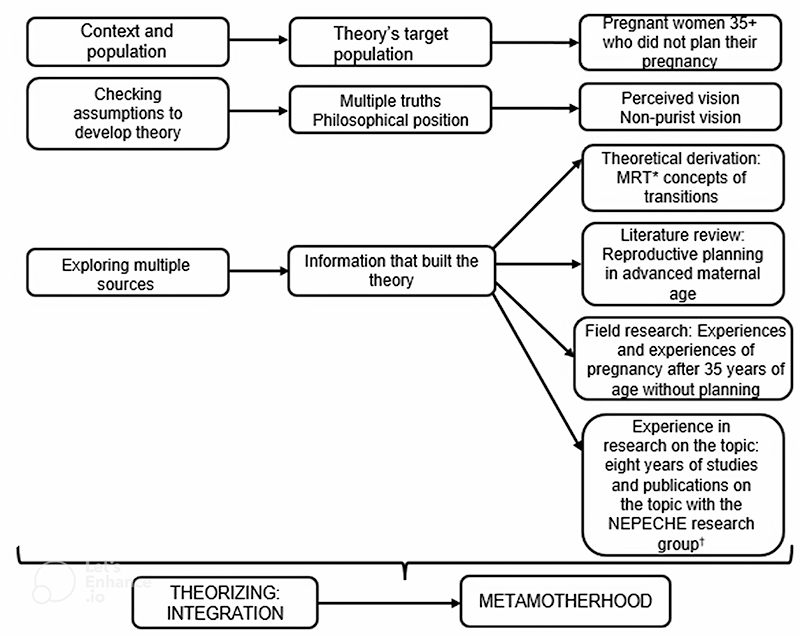 *MRT: Middle-Range Theory; †NEPECHE: Núcleo de Estudos, Pesquisa e Extensão em Cuidado Humano de Enfermagem.
