
 METAMOTHERHOOD TRANSITIONED WITHOUT PLANNING AFTER AGE 35: SITUATION-SPECIFIC THEORY IN NURSING
ABSTRACT
Objective: to develop an situation-specific theory in nursing to explain women’s transition to motherhood after age 35 without reproductive planning.
Method: a theoretical study, in which a specific situation theory of the explanatory type was developed. The methodological framework used was integrative approach. The concepts of Meleis’s Transition Theory were deduced and data on the phenomenon were induced from a literature review, qualitative research and experience as a researcher on the subject.
Results: statements were developed about the derived concepts, nine propositions, five assumptions for women who transition to motherhood after the age of 35 without reproductive planning and a graphic representation of the theory.
Conclusion: the theory developed contributes to theoretical and practical knowledge in nursing, providing a theoretical framework for differentiated care that addresses the clinical and psychosocial needs of women who experience late motherhood without planning. It is necessary to develop guidelines for maternal and child health practices and policies emphasizing the importance of informed reproductive planning and emotional and social support in this age group.
DESCRIPTORS:
Nursing theory; Pregnant women; Maternal age; Nursing care; Family development planning
RESUMO
Objetivo: desenvolver uma Teoria de Situação Específica de Enfermagem para explicar a transição da mulher para a maternidade após os 35 anos sem planejamento reprodutivo.
Método: estudo teórico, no qual desenvolveu-se uma teoria de situação específica do tipo explicativa. O referencial metodológico utilizado foi a Abordagem Integrativa. Foi realizada a dedução dos conceitos da Teoria das Transições de Meleis e induzidos dados do fenômeno a partir de revisão de literatura, pesquisas qualitativas e da experiência como pesquisadora no tema.
Resultados: foram desenvolvidas declarações acerca dos conceitos derivados, nove proposições, cinco pressupostos para a mulher que transiciona para a maternidade após os 35 anos sem planejamento reprodutivo e uma representação gráfica da teoria.
Conclusão: a teoria desenvolvida contribui para o conhecimento teórico e prático em Enfermagem, fornecendo uma estrutura teórica para cuidados diferenciados que abordam as necessidades clínicas e psicossociais de mulheres que vivenciam a maternidade tardia sem planejamento. É necessário o desenvolvimento de diretrizes para a prática e políticas de saúde materno-infantil enfatizando a importância do planejamento reprodutivo informado e do suporte emocional e social nessa faixa etária.
DESCRITORES:
Teoria de enfermagem; Gestantes; Idade materna; Cuidados de enfermagem; Planejamento familiar
RESUMEN
Objetivo: desarrollar una teoría de situaciones específicas de enfermería para explicar la transición de una mujer a la maternidad después de los 35 años sin planificación reproductiva.
Método: estudio teórico, en el que se desarrolló una teoría de situación específica de tipo explicativo. El marco metodológico utilizado fue el enfoque integrador. Se dedujeron los conceptos de la Teoría de las Transiciones de Meleis y los datos sobre el fenómeno se derivaron de la revisión de la literatura, la investigación cualitativa y la experiencia como investigador en el tema.
Resultados: se desarrollaron afirmaciones sobre los conceptos derivados, nueve proposiciones, cinco supuestos para mujeres que pasan a la maternidad después de los 35 años sin planificación reproductiva y una representación gráfica de la teoría.
Conclusión: la teoría desarrollada contribuye al conocimiento teórico y práctico en enfermería, proporcionando una estructura teórica para la atención diferenciada que aborda las necesidades clínicas y psicosociales de las mujeres que viven una maternidad tardía sin planificación. Es necesario desarrollar directrices para prácticas y políticas de salud maternoinfantil, enfatizando la importancia de una planificación reproductiva informada y el apoyo emocional y social en este grupo de edad.
DESCRIPTORES:
Teoría de enfermería; Mujeres embarazadas; Edad materna; Atención de enfermería; Planificación familiar
INTRODUCTION
The ongoing changes in civilization have transformed the areas in which women have been socially and professionally active and have deconstructed their social tasks of personal development, career and family life. These positions have been questioned and reformulated socially and individually. This social transformation has significant consequences in the reproductive sphere, culminating in a growing tendency to postpone motherhood. The phenomenon of late motherhood, defined as pregnancy in women over 35 years of age, has become increasingly common. This postponement can be attributed to several factors, including, but not limited to, career advancement, economic instability, the search for stability in relationships, or increased access to education and contraceptive methods1-3.
Although the decision to delay motherhood may be a conscious choice, there are situations in which it occurs without reproductive planning. This particularity poses unique challenges, both psychologically and physically, for women who transition to motherhood at this stage of life. Pregnant women of advanced age often face increased risks of complications during pregnancy and childbirth, in addition to distinct psychosocial issues3.
In the context of nursing, care provided to this specific group of women requires a differentiated approach, considering their unique needs. Nursing literature, however, presents a significant gap in this aspect. Although there are studies focused on biopsychosocial aspects of late motherhood1,4, nursing care for women in this context remains little explored. Thus, the construction of a situation-specific theory (SST) that supports nursing practice, offering a comprehensive structure that addresses both the clinical and psychosocial needs of these women, is a scientific advance in this field and ensures care based on a specific theory to promote a healthy pregnancy.
This gap in the literature highlights the need for research that specifically addresses these women’s experiences, challenges, and needs as well as how nursing professionals can best care for them. Therefore, the proposal of an SST that describes how women experience late unplanned motherhood can support nursing care prediction and prescription in this area.
Thus, this study aimed to develop an SST in nursing to explain women’s transition to motherhood after the age of 35 without reproductive planning.
METHOD
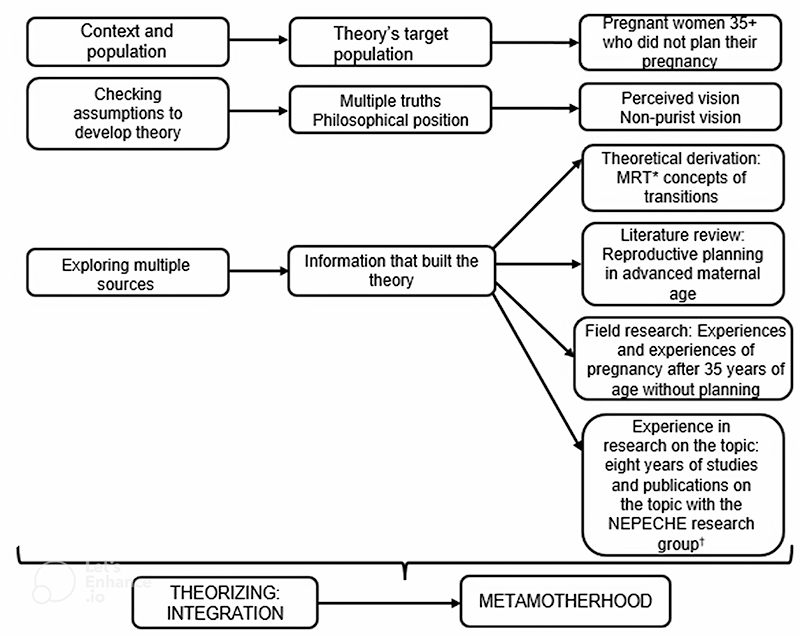
This is a theoretical study, in which an explanatory SST of a basic nature was developed5. The integrative approach6-8 was used to construct this SST, as shown in Figure 1.

This strategy involves the integration of data from various sources, either deductively or inductively. In the deductive process, the theoretical derivation of transition theory (TT)9 was carried out to signify the phenomenon based on the main concepts of the theoretical structure. In the inductive process, the following were used: 1) an integrative review to synthesize data from the scientific literature, with the aim of seeking nursing care for reproductive planning for women aged 35 or over10; 2) qualitative research that interviewed six pregnant women aged 35 or over, with the aim of analyzing the experience of transition to unplanned motherhood in this age group; 3) analysis of research group production on late pregnancy, with the analysis of a master’s dissertation on the experience of late motherhood that interviewed 21 pregnant women of advanced age, of which 13 did not plan their pregnancy11; and 4) consolidated experience in the role of researchers on the topic for eight years.
From a methodological point of view, the integrative review followed six stages to synthesize the findings12. The qualitative studies had a qualitative and descriptive approach and were analyzed separately in light of TT, based on an inductive-deductive analytical matrix. The result of the integration of information obtained from these sources was the construction of categories that enabled the theorizing stage with the construction of the elements of this SST.
The theorizing stage represents the culmination of the methodological process. In this phase, the information and data collected were synthesized into statements, assumptions, propositions, and a graphical representation. This effort culminated in the development of a robust theoretical framework that serves to describe the manifestation of the phenomenon under study.
The search for data for this construction, which was carried out with human beings, complied with the ethical precepts of Resolution 466/2012 of the Brazilian National Health Council.
Context and population
The target audience for this SST included women aged 35 and over who experienced an unplanned transition to motherhood. These women faced unique challenges due to their advanced age, such as social stigma, emotional and psychosocial difficulties, and pregnancy complications. They came from diverse socioeconomic and cultural backgrounds, with different levels of education and occupations, reflecting a wide range of experiences and social contexts1,13.
These were women who did not plan their pregnancy for various reasons, such as disbelief in the possibility of pregnancy due to their age, discontinuity and inadequate or inconsistent use of contraception, limited knowledge about different contraceptive methods, failures in using the chosen methods, and lack of access to the resources necessary for their effective implementation1. These unexpected pregnancies are often not well accepted by partners, family members, and even by the women themselves11.
These women were living in a social context that often imposes pressures and expectations on motherhood and the ideal age to be pregnant, dealing with balance between career and maternal care, changes in family dynamics and reflections on identity and life priorities. Despite the challenges, they sought to adapt and find support in their faith, family and community11.
Theoretical foundations and philosophical position
TT was developed from a philosophical perspective and worldview that emphasizes the interconnectedness, complexity, and contextual nature of human experiences. This perspective is influenced by several philosophical currents, including humanism, symbolic interactionism, and feminism, which contribute to its holistic and person-centered approach9.
TT provides a framework for understanding individuals’, families’, and social groups’ transitional experiences. These transitions are understood as events or periods of change that occur in different life contexts, such as health, illness, recovery, aging, and significant life events such as motherhood. The theory highlights the importance of recognizing these transitions, understanding them as complex processes that affect individuals’ well-being, adaptation, and quality of life9.
The main concepts of this theory include the types of transitions (developmental, situational, health/illness, organizational), the properties of transitions (consciousness, engagement, change and difference, time and critical points) and the transition response patterns (process and outcome indicators), which help to assess the transition process in terms of well-being and adaptation. Moreover, the theory identifies conditions that influence the transition experience, including personal, community, and sociocultural factors. Meleis’s approach emphasizes the need for person-centered nursing therapies to facilitate healthy transitions by supporting individuals in understanding, coping, and adapting to change9.
From this perspective, this SST adopts a philosophical perspective that integrates poststructuralist and postmodernist concepts to analyze the advancement of scientific knowledge in nursing. Poststructuralism allows a critical reassessment of established practices and concepts in nursing, encouraging a deconstruction of existing narratives and structures. This approach highlights the construction of knowledge within specific social and cultural contexts, recognizing that health care transcends technical procedures and is influenced by these contexts. On the other hand, postmodernism promotes a pluralistic view of knowledge and questions the notion of universal truths in health and nursing. This encourages nurses to recognize and value diverse experiences and realities, contributing to a nursing practice that is more individualized and inclusive, reflecting the complexity of human experiences6,14.
Additionally, the study explores the perception of late motherhood, particularly at age 35 without prior planning, as a complex and multifaceted social phenomenon. This experience is viewed through an approach that values subjectivity and diversity, recognizing that nursing knowledge is based on both objective data and subjective and intuitive experiences. This open and flexible perspective allows for a deeper understanding of concrete phenomena, considering the plurality of truths and the complexity of nursing phenomena. By focusing on late and unplanned motherhood, the study highlights how this experience transforms women’s perceptions and identities, leading to a reassessment of previous beliefs and the development of a new understanding of themselves as mothers, illustrating the richness of experiences and perceptions that shape the journey of motherhood.
Theoretical derivation and theorizing process
The Transitions Middle-Range Theory (MRT) is the conceptual basis of this SST, from which the main concepts were derived. The purpose of theoretical derivation is to develop a new theory using analogies drawn from theories already consolidated in various areas of knowledge. It is a process that allows the transposition of concepts so that they can be adjusted to the phenomenon studied15.
RESULTS
Chart 1 presents the derived statements as well as a new concept, metamotherhood, developed from data sources and the theorization process.
Concepts and functional elements of Specific Situation Theory. Curitiba, PR, Brazil, 2024.
In view of this, relationships between concepts and elements were constructed, resulting in nine propositions for this SST:
-
Transition to unplanned motherhood after age 35 is an ongoing process that begins with identifiable transitional characteristics but has no set end, since motherhood is permanent.
-
Transition involves deep self-reflection, which is necessary for the construction of a new identity as a woman and mother.
-
To cope with life changes and adaptations, women require comprehensive support that includes individualized nursing care, social, emotional and community support.
-
Women’s response patterns and well-being during transition are influenced by a confluence of factors, such as social network support, spiritual beliefs, socioeconomic conditions and the environment, including family and friendships, all acting to facilitate or inhibit their ability to adapt.
-
Nurse-customer interaction is essential and valued by women in monitoring the transition, offering guidance, emotional support and crucial information for managing the challenges associated with late motherhood.
-
Nursing therapy should be individualized, focusing on developing women’s self-confidence and coping strategies to promote a positive and safe motherhood experience.
-
Women’s health encompasses physical, emotional, social and reproductive well-being and is essential for a healthy transition, requiring attention to both objective factors related to obstetric and neonatal risks as well as subjective factors that align with psychosocial factors.
-
Conscious and informed reproductive planning emerges as a vital component in promoting women’s health and well-being, highlighting the importance of nurses in facilitating access to adequate sexual and reproductive health information.
-
The experience of unplanned motherhood after the age of 35 is a transformative process that challenges women to redefine priorities, identity and interpersonal relationships, in a context of emotional and health support.
Thus, five assumptions/presuppositions were established:
-
Adaptation to unplanned motherhood at an advanced age is a complex process that is significantly influenced by social and emotional support, in which a robust support network mitigates the health, psychological and social challenges faced.
-
Nurses’ active involvement in facilitating transition to unplanned motherhood at an advanced age improves the experience of motherhood, which indicates that nursing care and informational support are fundamental.
-
Women’s self-confidence and the development of coping strategies during transition are directly affected by the quality of the nurse-customer interaction, implying that effective communication and a bonded relationship are fundamental for a healthy transition.
-
Access to adequate information on sexual and reproductive health contributes to the empowerment of women and to a more conscious and informed transition to late motherhood, in which health education mediated by nurses is a crucial component for family and reproductive planning.
-
The multidimensionality of the health of women aged 35 and over during transition to unplanned motherhood requires a comprehensive approach to care, which assumes that attention to physical, emotional, social and spiritual needs is essential to promote a healthy transition.
To understand how all these elements relate, Figure 2 was constructed to graphically represent an SST.

Graphical representation of a specific situation theory for nursing care for women transitioning to motherhood after age 35 without planning.
Considering the transformative nature of this transitional experience, this new identity was named metamotherhood, as it is understood that there is a transformation that women go through after an unplanned pregnancy after the age of 35 that goes beyond the social role of becoming a mother (even if again), but this transition occurs in a context of personal development and learning that changes women. Hence, there is a transformative metamorphosis through this experience that accumulates knowledge and modifies their thinking without abandoning their previous foundations. It is believed that there is a transcendence in this transformation, in which there is a movement of going beyond previous limits or states, incorporating and overcoming past experiences to reach a new level of understanding of motherhood and of themselves.
DISCUSSION
This SST proposal, although presenting descriptive and predictive elements, aims to explain the transition process, highlighting the importance of socioeconomic, spiritual, social support and health factors as essential for a healthy transition. These elements are particularly relevant for women over 35 years of age facing unplanned motherhood, a phase that requires adaptation and remodeling of identity. The coping capacity of these women not only anticipates healthy response patterns, but also triggers a reassessment of their social and personal role, culminating in the formation of a new maternal identity. This overview highlights the interconnection between theory and practical experience of late motherhood, underlining the need for a careful look at the multiple factors that influence this transition.
Women over 35 who experience unplanned motherhood go through a path marked by changes and challenges that affect their overall well-being and require a deep level of self-reflection and a remodeling of identity. Studies show that late motherhood can lead to a substantial reassessment of the role of women in both the social and personal spheres, triggering the development of a new maternal identity16-17.
Given this context, the importance of comprehensive support becomes indisputable. An environment that offers nursing care, community resources and an active social network is essential to foster the necessary adaptations for a positive transition experience6. Such support is particularly valuable for women facing unintended pregnancy after the age of 35, for whom comprehensive nursing care - including emotional support and essential information - is essential to manage the challenges of late motherhood and mitigate adverse factors such as anxiety, shame and social impositions18.
Thus, it is understood that transition to unplanned motherhood is an ongoing process and it is assumed that there is no closure or finality to this transition, as TT assumes. Motherhood and all the issues linked to it imply a continuity in the reconstruction of the meaning of this event in a woman’s life story, and this is linked to the subjective and cultural weight that women attribute to transition. Thus, it can be said that there is a transition from a relatively stable state to another that is also relatively stable, but without necessarily having an end point, since motherhood is a lifelong commitment.
In this context, women’s ability to respond to life-changing events is affected by a combination of internal and external factors, including socioeconomic conditions, social support systems such as family and friends, and spiritual and health support. Moreover, the quality of the interaction between nurses and customers is a crucial element, being highly valued by women who, through bonding and trust, provide indispensable care, guidance, and emotional support. Conscious and informed reproductive planning, with access to accurate information about sexual and reproductive health, is also an essential component of promoting women’s health and well-being. Thus, adaptation and resilience to life-changing events are profoundly influenced by nursing care interventions.
In this regard, nursing therapies, translated into nursing care, with a focus on developing self-confidence and coping strategies, are essential to encourage a safe and positive transition experience. Women’s health, encompassing the physical, emotional and social dimensions, highlights the complexity of female well-being during this period of change, requiring multidimensional care and ongoing support19.
This SST proposes that actions such as prenatal consultations, both the bonding and subsequent ones, discussion groups with pregnant women, prenatal courses, home visits, visits to the maternity ward, birth plan and breastfeeding plan should be nursing care, considering the theoretical framework described. These are not innovative interventions, but they need to be carried out with the perspective of this theorization aimed at women aged 35 or over who became pregnant without planning, considering the nature, conditions and patterns of transition.
Unplanned motherhood after the age of 35 thus unfolds as a transformative process, demanding a redefinition of priorities and interpersonal relationships within a context of emotional and health support. This process invites deep reflection on personal identity and adaptation to new maternal responsibilities, reiterating the importance of the availability and adequacy of nursing care and social support systems.
Finally, it is imperative to recognize the multifaceted nature of transition to unplanned motherhood in later life. While potentially enriching, the experience can also introduce challenges that require substantial adjustments in women’s lives.
The limitations of this study are imposed as knowledge is continuous and dynamic, and generalizations cannot be taken as certain, since each nursing phenomenon is situated in time, space and context. Thus, it is also understood that the lack of longitudinality of maternal monitoring may limit this SST about understanding the evolution of care needs over time. In this sense, a cohort study can be carried out for a more detailed follow-up of women who transition without planning in this age group.
CONCLUSION
This study resulted in the development of an SST that explains the complex transition to late motherhood without reproductive planning in women over 35 years of age. The findings indicate that these women face unique challenges involving social, emotional, and health aspects, requiring a differentiated approach to nursing care. The SST emphasizes the importance of understanding the transition experiences of these women, proposing care strategies that address both clinical and psychosocial needs. This suggests a theory-based nursing practice to promote a healthy pregnancy and transition.
The contribution of this study to theoretical and scientific knowledge in nursing lies in the formulation of an SST that offers detailed insights into the specificities of unplanned late motherhood. This work highlights the need for an evidence-based nursing practice capable of meeting the unique demands of this population, contributing to training nurses and developing maternal health policies. The practical applicability of the theory is reflected in the promotion of holistic and personalized nursing care, highlighting the importance of informed reproductive planning and emotional and social support.
To develop public policies, a guideline is proposed that focuses on educating health professionals about the complexities of late motherhood and integrating psychosocial and reproductive health support services, ensuring access to information and resources for women and families. Such an approach requires interdisciplinary collaboration and a commitment to maternal health as a public health priority, aiming at comprehensive support that addresses the particularities of late motherhood.
REFERENCES
-
1. Molina-García L, Hidalgo-Ruiz M, Cocera-Ruíz EM, Conde-Puertas E, Delgado-Rodríguez M, Martínez-Galiano JM. The delay of motherhood: Reasons, determinants, time used to achieve pregnancy, and maternal anxiety level. PLoS One [Internet]. 2019 [cited 2024 Sep 19];14(12):e0227063. Available from: https://doi.org/10.1371/journal.pone.0227063
» https://doi.org/10.1371/journal.pone.0227063 -
2. Temmesen CG, Frandsen TF, Svarre-Nielsen H, Petersen KB, Clemensen J, Andersen HLM. Women’s reflections on timing of motherhood: A meta-synthesis of qualitative evidence. Reprod Health [Internet]. 2023 [cited 2024 Sep 19];20:30. Available from: https://doi.org/10.1186/s12978-022-01548-x
» https://doi.org/10.1186/s12978-022-01548-x -
3. Nazaré PF, Fernandes Pais AS, Figueiredo-Dias M. Postponing motherhood: A demographic and contemporary issue. Curr Womens Health Rev [Internet]. 2022 [cited 2024 Sep 19];18(1):28-36. Available from: https://doi.org/10.2174/1573404817666210208203220
» https://doi.org/10.2174/1573404817666210208203220 -
4. Meyer DF. Psychosocial needs of first-time mothers over 40. J Women Aging [Internet]. 2020 [cited 2024 Sep 19];32(6):636-57. Available from: https://doi.org/10.1080/08952841.2019.1593798
» https://doi.org/10.1080/08952841.2019.1593798 - 5. Polit DF, Beck CT. Nursing research: Generating and assessing evidence for nursing practice. 10th ed. Philadelphia, PA: Wolters Kluwer; 2021.
- 6. Meleis AI. Theoretical nursing: Development and progress. 6th ed. Philadelphia: Wolters Kluwer; 2018.
-
7. Im EO. Development of situation-specific theories: an integrative approach. ANS Adv Nurs Sci [Internet]. 2005 [cited 2024 Sep 19];28(2):137-51. Available from: https://doi.org/10.1097/00012272-200504000-00006
» https://doi.org/10.1097/00012272-200504000-00006 -
8. Aldrighi JD, Dalmolin A, Girardon-Perlini NMO, Lacerda MR, Trigueiro TH, Wall ML. Integrative approach to the development of situation specific theories: Theoretical reflection. Texto Contexto Enferm [Internet]. 2023 [cited 2024 Sep 19];32:e20220255. Available from: https://doi.org/10.1590/1980-265X-TCE-2022-0255en
» https://doi.org/10.1590/1980-265X-TCE-2022-0255en - 9. Meleis AI. Transitions theory: Middle-range and situation-specific theories in nursing research and practice. New York: Springer; 2010.
-
10. Aldrighi JD, Chemim AK, Bruscato IL, Martins RP, Santos BP, Lapchenski AS, et al. Planejamento reprodutivo de mulheres em idade materna avançada: revisão integrativa. REVISA [Internet]. 2024 [cited 2024 Sep 19];13(2):406-19. Available from: https://rdcsa.emnuvens.com.br/revista/article/view/155/272
» https://rdcsa.emnuvens.com.br/revista/article/view/155/272 -
11. Aldrighi JD, Wall ML, Souza SRRK. Experience of pregnant women at an advanced age. Rev Gaúcha Enferm. [Internet]. 2018 [cited 2024 Sep 19];39:e2017-0112. Available from: https://doi.org/10.1590/1983-1447.2018.2017-0112
» https://doi.org/10.1590/1983-1447.2018.2017-0112 -
12. Whittemore R, Knalf K. The integrative review: Updated methodology. J Adv Nurs [Internet]. 2005 [cited 2024 Sep 19];52(5):546-53. Available from: https://doi.org/10.1111/j.1365-2648.2005.03621.x
» https://doi.org/10.1111/j.1365-2648.2005.03621.x -
13. Moreira LR, Ewerling F, Santos IS, Wehrmeister FC, Matijasevich A, Barros AJD, et al. Trends and inequalities in unplanned pregnancy in three population-based birth cohorts in Pelotas, Brazil. Int J Public Health [Internet]. 2020 [cited 2024 Sep 19];65:1635-45. Available from: https://doi.org/10.1007/s00038-020-01505-0
» https://doi.org/10.1007/s00038-020-01505-0 -
14. Gadea CA. El interaccionismo simbólico y sus vínculos con los estudios sobre cultura y poder en la contemporaneidad. Sociológica (Méx) [Internet]. 2018 [cited 2024 Sep 19];33(95):39-64. Available from: http://www.scielo.org.mx/scielo.php?script=sci_arttext&pid=S0187-01732018000300039&lng=es&nrm=iso
» http://www.scielo.org.mx/scielo.php?script=sci_arttext&pid=S0187-01732018000300039&lng=es&nrm=iso - 15. Walker LO, Avant KC. Strategies for theory construction in Nursing. 6th ed. New York: Prentice Hall; 2018.
-
16. Santos MAF, Lopes MAP, Botelho MAR. Maternidade tardia: da consciencialização do desejo à decisão de ser mãe. Ex aequo [Internet]. 2020 [cited 2024 Sep 19];41:89-105. Available from: https://doi.org/10.22355/exaequo.2020.41.06
» https://doi.org/10.22355/exaequo.2020.41.06 -
17. Santos MAF, Lopes MAP, Botelho MAR. Metamorphosis into mother after 35 years of age: A study of Grounded Theory. Rev Esc Enferm USP [Internet]. 2019 [cited 2024 Sep 19];53:e03485. Available from: https://doi.org/10.1590/S1980-220X2018033403485
» https://doi.org/10.1590/S1980-220X2018033403485 -
18. Aldrighi JD, Wall ML, Souza SR, Cancela FZ. The experiences of pregnant women at an advanced maternal age: An integrative review. Rev Esc Enferm USP [Internet]. 2016 [cited 2024 Sep 19];50(3):512-21. Available from: https://doi.org/10.1590/S0080-623420160000400019
» https://doi.org/10.1590/S0080-623420160000400019 -
19. Lagadec N, Steinecker M, Kapassi A, Magnier AM, Chastang J, Robert S, et al. Factors influencing the quality of life of pregnant women: A systematic review. BMC Pregnancy Childbirth [Internet]. 2018 [cited 2024 Sep 19];18:455. Available from: https://doi.org/10.1186/s12884-018-2087-4
» https://doi.org/10.1186/s12884-018-2087-4
NOTES
-
ORIGIN OF THE ARTICLE
Article extracted from thesis - “Transição para a maternidade não planejada após os 35 anos: Teoria de Situação Específica”, presented to the Graduate Program in Nursing, Universidade Federal do Paraná, in 2024.
-
APPROVAL OF ETHICS COMMITTEE IN RESEARCH
Approved by the Ethics Committee in Research of the Hospital das Clínicas Complex, Universidade Federal do Paraná, under Opinion 3.959.789/2020 and Certificado de Apresentação para Apreciação Ética (Certificate of Presentation for Ethical Consideration) 30071720.0.0000.0096.
-
TRANSLATED BY
Letícia Belasco.

 *MRT: Middle-Range Theory; †NEPECHE: Núcleo de Estudos, Pesquisa e Extensão em Cuidado Humano de Enfermagem.
