 Graphiola phoenicis causing leaf spot on date palm in Mato Grosso, Brazil
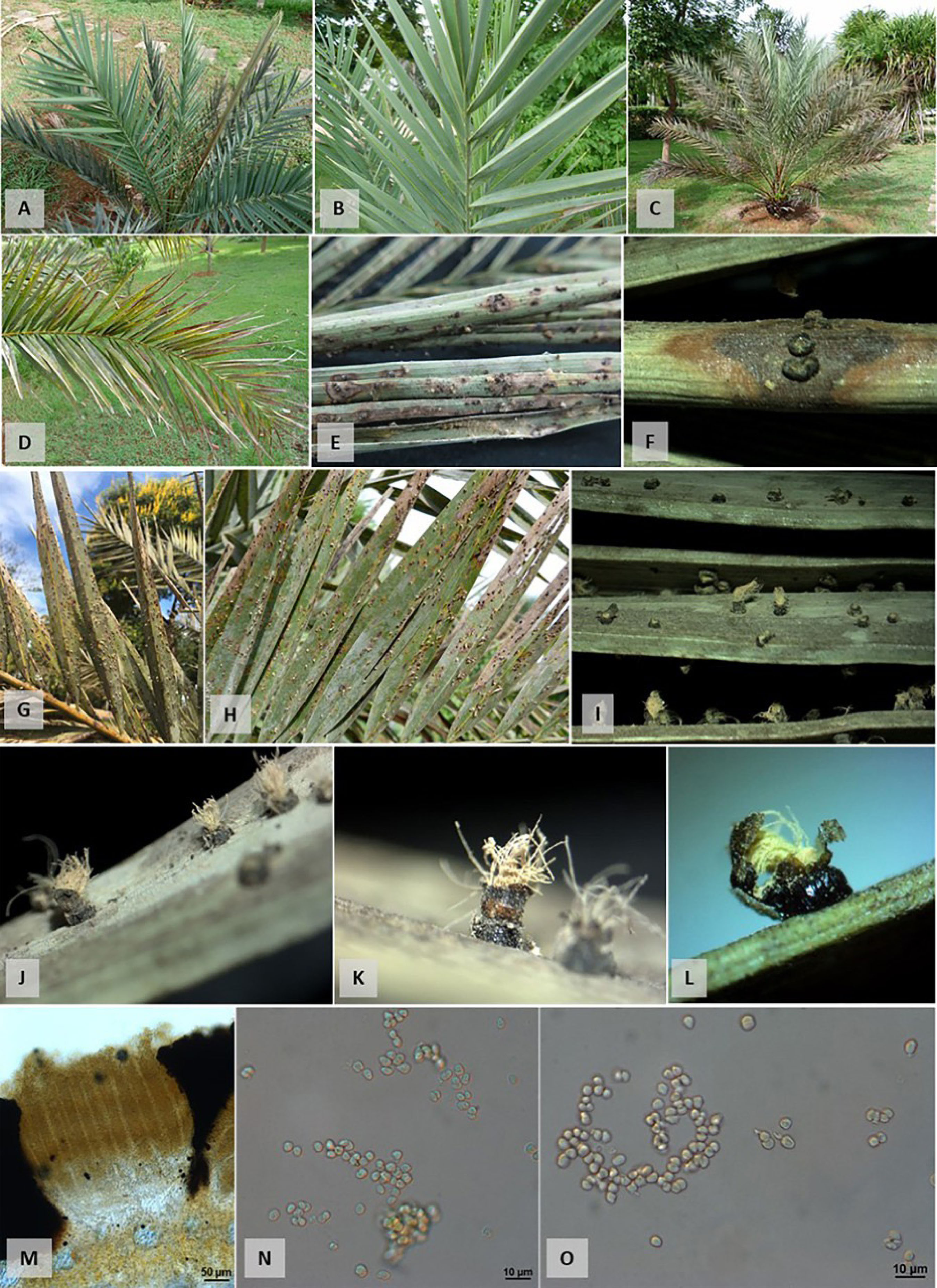
Phoenix dactylifera L., popularly known as date palm, is an economically important crop that is predominantly cultivated in arid and semi-arid regions due to its tolerance to high temperatures, drought and salinity (3). The total global area under date palm cultivation is approximately 1.1 million hectares, producing 7.6 million tons of fruits per year (4). Traditionally, date palm has been cultivated in the Arabian Peninsula, North Africa, the Middle East, Australia, India, Pakistan, Mexico, Southern Africa, South America, and the United States (2). In Brazil, P. dactylifera was introduced between the 1930s and the 1940s, with plantations established in Pernambuco State for the production of its sweet fruits and for ornamental purposes, especially in the semiarid region of northeastern Brazil, where the climatic conditions are favorable (7). Although date palm grows in very hot and dry climates and is relatively tolerant of saline and alkaline soils, several diseases have been reported from different producing countries, resulting in declined growth and production (1). Currently, there are 525 disease reports on date palm worldwide, the majority of which are related to Graphiola leaf spot, caused by Graphiola phoenicis (Moug.) Poit. (4). However, in Brazil, studies on date palm diseases are still incipient; thus, identifying the causal agents involved is crucial for developing efficient control measures and consequently improving fruit production. In August 2018, during a survey, date palm plants were observed showing severe necrotic leaf spot typical of Graphiola leaf spot or false smut caused by G. phoenicis. The symptoms of this disease include small necrotic leaf lesions and brownish-to-black spots with yellowish borders on both surfaces of the leaf blade. A cup-shaped protruding structure (sorus) emerges from the infected tissues. The sorus is a black fruiting body, measuring 201-413 μm in diameter, from which short, light-colored filaments emerge, measuring 321-387 μm in length. Yellow powdery spores are produced in this black body. The spores are spherical to ellipsoid, measuring 2.9−4.2 x 2.0−4.0 μm (Figure 1).
Graphiola leaf spot on Phoenix dactylifera. A – B: Healthy plant of P. dactylifera; C – F: Date palm plants with yellowing and necrotic leaf spots caused by Graphiola phoenicis; G – I: Reproductive structures of G. phoenicis on infected tissues; J – L: Close-up of black fruiting bodies with protruding filaments (sori) of G. phoenicis erupting through the leaflet epidermis; M: Anatomical view of G. phoenicis sorus under a light microscope (Bar = 50 μm), and N – O: Spores of G. phoenicis (Bar=10 μm).
The fungal haustorium was not observed and the pathogenicity test was not performed; however, based on disease symptoms, fungal morphological features and literature information (8), Graphiola phoenicis was confirmed as the causal agent of the necrotic leaf spot on date palm in Mato Grosso State, Brazil. Graphiola leaf spot or false smut has been reported worldwide (5). In Brazil, it has been found in the states of Pernambuco, São Paulo, Maranhão, Espírito Santo, Rio de Janeiro and Minas Gerais (6). However, this is the first report of G. phoenicis on P. dactylifera in Mato Grosso. Severe infections can reduce tree growth and fruit production by causing premature death of the leaf tissues. In Brazil, no fungicides are registered for controlling this disease, while management practices such as pruning and burning infected leaves are recommended to decrease the inoculum density and reduce leaf wetness.
Declaração de disponibilidade de dados
Os dados de pesquisa estão disponíveis no corpo do artigo.
REFERENCES
- 1 Ammar, M.I.; El-Naggar, M.A. Date palm (Phoenix dactylifera L.) fungal diseases in Najran, Saudi Arabia. International Journal of Plant Pathology, Deira, v.2, n.3, p.126-135, 2011.
- 2 Chao, C.T.; Krueger, R.R. The Date palm (Phoenix dactylifera L.): Overview of biology, uses, and cultivation. HortScience, Alexandria, v.42, n.5, p.1077-1082. 2007.
- 3 El-Juhany, L.I. Degradation of date Palm trees and date production in Arab Countries: Causes and potential rehabilitation. Australian Journal of Basic and Applied Sciences, Amman, v.4, n.8, p.3998-4010, 2010.
-
4 Food and Agriculture Organization. Food and Agriculture Organization statistical database (FAOSTAT) Rome: FAO, 2014. Available at: <http://faostat3.fao.org/>. Accessed on: 22 Apr. 2019.
» http://faostat3.fao.org/ -
5 Farr, D.F.; Rossman, A.Y. Fungal Databases - U. S. National Fungus Collections. Beltsville: USDA, 2019. Available at: <https://nt.ars-grin.gov/fungaldatabases/>. Accessed on: 06 Sept. 2019.
» https://nt.ars-grin.gov/fungaldatabases/ -
6 Mendes, M.A.S.; Urben, A.F. Fungos relatados em plantas no Brasil Available at: <http://pragawall.cenargen.embrapa.br/aiqweb/michtml/fgbanco01.asp>. Accessed on: 06 Sept. 2019.
» http://pragawall.cenargen.embrapa.br/aiqweb/michtml/fgbanco01.asp - 7 Nunes, R.F.M.; Silva, C.M.M.S; Giacometti, D.C. Viabilidade do cultivo da tamareira irrigada no vale do São Francisco. Pesquisa em Andamento, Petrolina, n.53, p.1-5, 1988.
- 8 Piepenbring, M.; Nold, F.; Trampe, T.; Kirschner, R. Revision of the genus Graphiola (Exobasidiales, Basidiomycota). Nova Hedwigia, Stuttgart, v.94, n.1, p.67-96, 2012.
Edited by
-
EDITOR CIENTÍFICO:
Edson Luiz Furtado https://orcid.org/0000-0002-6924-835X
-
EDITOR ASSOCIADO:
José Otávio Machado Menten https://orcid.org/0000-0002-9644-5770