 Use of mining tailings in compacted earth fill
Abstract
The growing number of researchers dedicated to finding efficient solutions for the disposal or reuse of tailings material is explained due to mining intrinsic environmental issues such as large areas needed for tailings disposal and the severe destructive impact of recent mining dam failures. This paper summarizes comprehensive research on geotechnical parameters of compacted iron tailings ore in the southeast of Brazil, with focus on how to define the ideal tailings mixture for building static barriers against the impact of an eventual tailings dam failure. The study was based on field and laboratory results from experimental earth fills, built with compacted tailings mixtures under various combinations of conditions and equipment. It was also based on the need to understand the behavior of tailings under compaction in order to ensure the proper use of its parameters. The main purpose of this paper is to suggest the best tailing mixture to improve future design based on field tests results.
Keywords:
Degree of compaction; Tailings dam; Experimental earth fill; Tailings parameters
1. Introduction
The Iron Quadrangle, a region in Brazil renowned for its rich mineral resources, stands as the largest mineral province in the country. Since the late 17th century, this area has been a focal point for the discovery of metallic ores and precious stones, significantly contributing to Brazil's economic development (Ávila et al., 2021). However, the extraction and processing of these minerals, particularly iron ore, present substantial environmental challenges. The conventional methods of iron ore processing—crushing, washing, and sieving—result in various products, including granulated iron, hematite, sinter-feed, and wash mud (Aristimunho & Bertocini, 2012). As the demand for iron ore continues to rise, so does the volume of waste generated, particularly in the form of tailings, which poses a significant environmental concern.
The management of tailings has become increasingly critical, as these by-products can occupy vast areas of land and pose risks to local ecosystems and communities. The failure of tailings dams, as witnessed in several catastrophic incidents in Brazil, has underscored the urgent need for effective tailings management strategies. The environmental implications of tailings disposal are profound, leading to soil and water contamination, habitat destruction, and long-term ecological damage. Furthermore, the increasing number of tailings dams exacerbates these issues, creating a pressing need for innovative solutions to repurpose these materials and reduce their environmental footprint.
Recent studies have highlighted the potential of repurposing tailings from various mining operations as construction materials. For instance, research has shown that tailings can be utilized in concrete production, road construction, and as backfill material, thereby reducing the environmental burden associated with their disposal (Tiwari & Das, 2024). Further demonstrated that iron ore tailings possess favorable geotechnical properties, such as adequate shear strength and compaction behavior, when properly processed and compacted. Their study also emphasized the importance of assessing environmental risks, including heavy metal leaching and acid mine drainage potential, to ensure safe reuse. The findings suggest that not only can tailings be effectively repurposed, but they can also enhance the mechanical properties of construction materials, thereby providing a dual benefit of waste reduction and improved material performance.
The primary problem associated with iron ore tailings lies in their management and disposal, which has become a critical environmental issue. As the volume of tailings generated increases with rising iron ore production, the risks associated with their storage and disposal escalate. Tailings dams, designed to contain these waste materials, have been the site of catastrophic failures, leading to devastating environmental and social consequences. The 2015 and 2019 dam failures in Brazil serve as stark reminders of the potential hazards posed by inadequate tailings management, resulting in loss of life, destruction of ecosystems, and long-term contamination of water sources (Tiwari & Das, 2024).
Moreover, the environmental implications of tailings disposal extend beyond immediate risks. The accumulation of tailings can lead to soil degradation, water pollution, and the disruption of local biodiversity. Contaminants such as heavy metals and toxic chemicals can leach into surrounding environments, posing health risks to nearby communities and wildlife. The increasing number of tailings dams further complicates the situation, as many regions are now grappling with the challenge of managing multiple waste storage sites, each with its own set of risks and environmental impacts.
In light of these challenges, the need for innovative solutions to repurpose tailings has never been more urgent. The potential for utilizing iron ore tailings as construction materials not only addresses the pressing issue of waste disposal but also contributes to sustainable development in the mining sector. By exploring alternative uses for tailings, the industry can reduce its environmental footprint while simultaneously enhancing the performance of construction materials. This dual approach not only mitigates the risks associated with tailings management but also promotes a circular economy within the mining sector.
Previous studies have highlighted the complexities associated with iron ore extraction and processing. Yellishetty et al. (2008) noted that the removal of overburden to access ore can create significant challenges for storage and reclamation, with stripping ratios for surface mining typically ranging from 2:1 to 5:1. The solid waste produced, including overburden and processed tailings, has become a pressing environmental issue (Sakthivel et al., 2010). Martins et al. (2002) demonstrated that employing column flotation can effectively reduce the volume of tailings stored in dam reservoirs, thereby mitigating environmental impacts and prolonging the lifespan of these structures.
Luz (2008) emphasized that the characteristics of tailings vary based on the processing techniques and ore types used. Concentration steps are crucial, as simple size separation often results in products with elevated iron content, while finer fractions tend to accumulate contaminants such as silica and alumina. Araujo (2006) further illustrated the evolution of iron ore production in Brazil, noting that prior to the 1970s, production was largely limited to high-grade hematite. The introduction of large-scale projects, such as Samarco's concentration of low-grade itabirite at the Germano Mine, marked a significant shift in the industry. Gravity separation, magnetic concentration, and flotation remain the predominant methods for iron ore concentration in Brazil.
Despite the extensive research on iron ore processing and tailings management, the environmental implications of tailings disposal continue to escalate, particularly with the increasing number of tailings dams in Brazil. The potential for these tailings to be repurposed as construction materials presents a novel solution to mitigate environmental impacts while addressing the growing waste problem. USDA (2016) highlighted that understanding the mineralogical and geotechnical properties of tailings is essential to optimize their reuse and ensure environmental safety. This research aims to explore the feasibility of utilizing iron ore tailings in construction applications, thereby contributing to sustainable practices in the mining industry. By investigating the geotechnical properties of these tailings, this study seeks to provide a comprehensive understanding of their potential applications and benefits.
The primary objective of this research is to investigate the geotechnical properties of iron ore tailings when used as a construction material. By conducting a series of experimental earth fill tests, this study aims to establish acceptable parameters for tailings mixtures, focusing on optimal conditions for compaction, including water content, compaction performance, and degree of compaction. The novelty of this work lies in a different approach to previously conducted experimental earth fill. The author would like to thank ®BVP Geotecnia e Hidrotecnia for granting access to the data. Its comprehensive analysis of the geotechnical outcomes associated with different tailings mixtures, providing valuable insights into their potential applications in construction. This research not only addresses the pressing issue of tailings disposal but also promotes sustainable practices within the mining sector, paving the way for innovative solutions to environmental challenges. By contributing to the body of knowledge on tailings utilization, this study aims to inspire further research and development in the field, ultimately leading to more sustainable mining practices.
In conclusion, the pressing environmental challenges posed by tailings management necessitate innovative approaches to repurpose these materials effectively. By exploring the potential of iron ore tailings as construction materials, this research not only addresses the immediate concerns of waste disposal but also contributes to the broader goal of sustainable development in the mining industry.
2. Experimental earth fills methodology
According to Freire et al. (2023), the experimental earth fills were built with filtered sandy tailings and filtered total tailings at the following percentages.
-
Earth fills 1: Total filtered tailings (80/20);
-
Earth fills 2: Total filtered tailings (90/10);
-
Earth fills 3: Filtered sandy waste.
The compacted soils used the common construction method to build the experimental earth fills 01, 02, and 03, utilizing loose layers of approximately 30, 60, and 100 cm thicknesses.
2.1 Technological control
In the context of earth fill construction, achieving optimal compaction is crucial for ensuring the stability and durability of the structure. For the first layers of Earth fill-01 and Earth fill-03, three compaction control methods were employed: Hilf, Sand Bottle, and Nuclear Density Meter. These methods are widely recognized in geotechnical engineering for their effectiveness in assessing the compaction of soil and fill materials. The choice of these methods aligns with best practices in the field, as highlighted by various studies that emphasize the importance of accurate compaction control in construction projects (Das, 2022; Bowles, 1996).
The Standard Proctor tests conducted for each layer served as a fundamental step in calibrating and obtaining the necessary compaction parameters. This approach is consistent with established methodologies in geotechnical engineering, where Proctor tests are utilized to determine the maximum dry density and optimum moisture content of soil materials ASTM D698-12 (ASTM, 2021). The decision to discard the compaction test results from the middle of the 60 cm layer after evaluation reflects a critical assessment of data quality, ensuring that only the most reliable measurements are used for analysis. This practice is supported by the findings of other researchers who have noted that compaction uniformity is essential for the structural integrity of earth fills (Mitchell & Soga, 2005).
The selection of sampling points associated with technological control points is a vital aspect of this study. By correlating field results with laboratory results, the research ensures a comprehensive evaluation of the compaction process. This approach is reinforced by the guidelines set forth by the Brazilian Association of Technical Standards (ABNT, 2024), which advocate for rigorous sampling techniques to maintain data integrity and traceability. The use of undisturbed block samples, as specified, allows for a more accurate representation of the material's properties, which is crucial for subsequent laboratory testing.
The implementation of precision topography and GPS technology for data traceability further enhances the reliability of the study. Accurate geolocation of sample retrieval points is essential for addressing potential issues that may arise during construction, as it allows for targeted investigations of specific compacted layers.
Regarding the maximum dry densities and optimum moisture content obtained for the tailings mixture, as shown in Figure 1, the findings align with the work of Pirete et al. (2023), which indicates that the addition of ultrafine materials can significantly influence the compaction characteristics of tailings. The observed reduction in optimal water content with the incorporation of ultrafines can be attributed to their ability to fill voids within the sandy matrix, thereby enhancing the overall densification process. This phenomenon is consistent with previous research that has demonstrated how the inclusion of finer particles can improve the packing efficiency of granular materials (Li, 2018).

The implications of these findings are significant for the design and construction of earth fills using tailings. By optimizing the moisture content and maximizing dry density through the strategic use of ultrafines, engineers can enhance the mechanical properties of the fill material, leading to improved stability and performance. This approach not only contributes to the structural integrity of the earth fill but also promotes sustainable practices by repurposing mining waste materials.
In conclusion, the methodologies employed in this study reflect a comprehensive approach to compaction control in earth fill construction. By integrating established testing methods, precise sampling techniques, and innovative material enhancements, this research contributes valuable insights into the effective management of tailings in construction applications. Future studies should continue to explore the long-term performance of these materials under various environmental conditions to further validate the findings and enhance the understanding of their behavior in practical applications.
3. Analysis of experimental earth fill
In order to evaluate the best combination of layer thickness of released material versus number of passes with compaction equipment, each experimental earth fill was divided into three different lanes, namely:
-
Treadmill track;
-
Controlled track;
-
Monitored track.
Furthermore, the controlled track was sectioned into five lanes, where the compaction test was carried out with about 2 to 10 passes of a smooth drum vibrating roller.
Briefly, the material deposition at the earth fill sites was made by dump trucks. They were subsequently spread by the bulldozer so that, once the spreading stage was completed, the layer of material was level, without the need for grading with a motor grader.
According to Freire et al. (2023); Pirete et al. (2023), regarding the compaction performance, the analyses were conducted with a focus on the results obtained from Standard Proctor Tests. In total, twelve layers were constructed, with different thicknesses, compaction energies (number of passes, with or without vibration), and moisture content (dry, wet, and optimum). Figure 2 displays the layout of tracks within the experimental earth fill.

Three different methods were considered for checking the in-situ density in the tests carried out at the experimental earth fill, namely the beveled cylinder, the sand bottle, and the nuclear density meter, the first two methods being the most common for obtaining in-situ density, so that it is possible to get the degree of compaction. In the case of the beveled cylinder, a metallic cylinder with standard weight and dimensions is driven into the fill layer, giving a direct value of the soil's wet density. The Sand Bottle is an indirect method, where a soil sample is taken from a standard small hole, and then the hole is filled with a standard sand, previously weighed within the sand bottle, making it possible to compute the in-situ density of the soil. The Nuclear Density meter method is unique, and its procedure is based on the principle that the radiation of a radioactive element, when passing through a material, is attenuated in proportion to its density. Many manufacturers of this instrument warn that better results are obtained in homogeneous soils.
In order to obtain the geotechnical water content in the tests carried out in the experimental earth fill, three different methods were used, namely the oven-drying method, the Speedy Test, and the Nuclear Density meter. The oven-drying method and the Speedy Test are direct methods, well known in geotechnical engineering. The Speedy Test method allows water content to be quickly obtained, but the results are subject to errors, making it essential to get a previous calibration against the oven-drying method, which is considered the most accurate technique for determining soil water content.
A comparison of the tests results carried out in the experimental earth fills is discussed in item 3.1.
Figure 3 shows the first layer's water content results, from different methods, for example, Nuclear Density meter, Speedy Test, and oven test. The results were similar, when comparing all three methodologies.
In the experimental earth fill it was possible to observe that during the tests using the density meter to check water content showed fluctuations in relation to the other methods. As shown in Figure 3, the most significant variation observed was for ten passes, with a difference of 1.9% between the nuclear density meter and the oven-drying method. In the case of the Speedy Test, for example, values close to the oven-drying method were observed, and in the case shown in Figure 3, the most significant variation was 0.9%.
3.1 In-situ density tests comparison
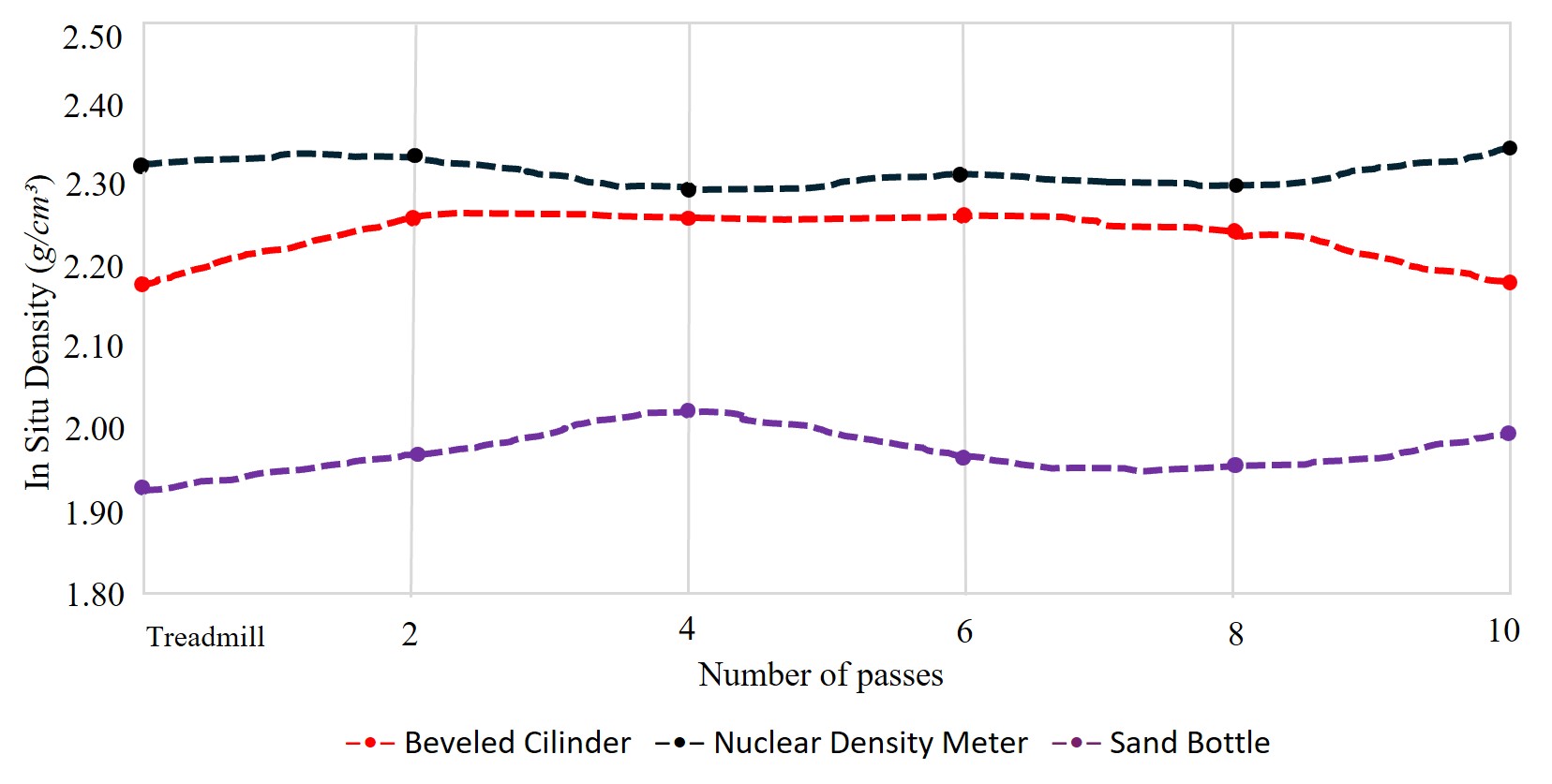
Figure 4 shows the results of the “in-situ” densities of the first layer using different methods, namely the Nuclear Density meter, Beveled Cylinder, and Sand Bottle. The results presented were similar for all layers in which the three methods were compared. The Sand Bottle method was carried out only on the first layer.

It is possible to observe a considerable disagreement between the sand bottle method and the other methods presented. In all tests, the values from the sand bottle were lower than the different methods used to obtain the "in-situ" density. Furthermore, it is also possible to note in Figure 4 that the in-situ densities from the Nuclear Density meter were higher than those from the Beveled Cylinder.
The water content or in-situ densities obtained with the beveled cylinder and by the sand bottle methods diverged significantly, influencing the degree of compaction results. For constructive monitoring of a pile of filtered tailings, it is recommended to maintain a single test for in-situ density, with the beveled cylinder method being the most used test in the control of compacted fills.
Regarding the in-situ density, the nuclear density meter presented the highest values in all layers tested, when compared to the other methods herein considered. The nuclear density meter results, being a radioactive method, were probably affected by the iron content in the tailings material, giving incorrect values of in-situ density.
To evaluate the best method for clearing the layer in the field, the results in experimental earth fills showed that the direct method, with the beveled cylinder, presented more reliable results. Furthermore, the nuclear density meter showed better results than the beveled cylinder, with higher degree of compaction. Therefore, it is suggested that the nuclear density meter should not be used in earth fills of filtered tailings, due to the material's heterogeneity.
3.2 Field results
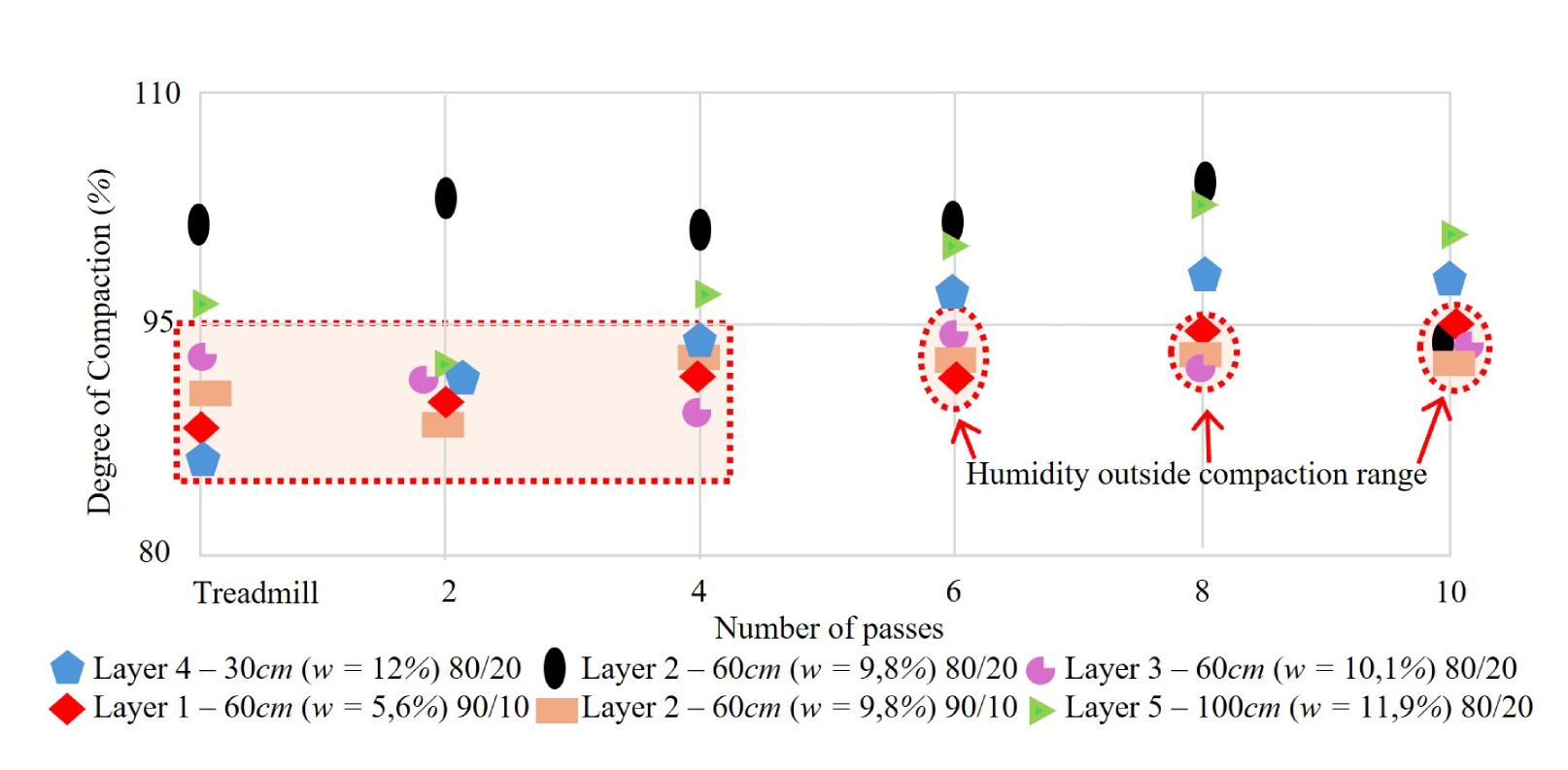
This item presents and discusses the results of the degree of compaction observed after the compaction of the earth fill 01 and earth fill 03 layers. Figure 5, Figure 6, and Figure 7 show the results found in all layers tested in the earth fills in question.


Figure 5, shows the compaction results in the 30 cm thick layer, with good compaction performance from 4 passes, water content within the limit, and a degree of compaction close to 95%.
As shown in Figure 6, it is possible to verify that, on top of the layers tested at 60 and 100 cm thicknesses, the tests carried out with a smooth compaction roller over six passes were satisfactory, reaching a degree of compaction greater than 95%. Some degree of compaction results were below 95% with 6, 8, and 10 passes. However, the water content was lower than the target water content (10.5% – 12% for the dry branch).
In relation to the belt conveyed with a bulldozer and the belts with 2 and 4 passes with a smooth roller, the compaction at the top of the layer did not perform well, especially in the belt, where only some samples had a degree of compaction lower than 95%. However, it is possible to verify the increase in the degree of compaction as the number of roll passes increases.
Regarding the compaction results at the base of the layers Figure 7, in the layers made with 60 cm thickness, after six passes, it is possible to verify that there is an increase in the degree of compaction, reaching close to 95%. However, some results were below expectations; they are layer one and layer 2 (total tailings 90/10), which were tested below the target moisture, and layer 3 (total tailings 80/20). For the 100 cm layer thickness, it was only possible to obtain a degree of compaction greater than 95% after 8 passes.
It is essential to highlight that it is crucial to control the water content during the management of total tailings, as it was observed in the test results that the layers that were compacted with water content levels below 10%, in general, did not obtain satisfactory results.
In order to examine the results, a minimum degree of compaction of 95% was considered as a reference due to the dilatant behavior of the tested samples. Based on the results herein presented, it is suggested that 4 passes with a smooth drum roller in 30 cm thickness layers, 6 passes with a smooth drum roller in 60 cm thickness layers, and 8 passes with a smooth drum roller in 100 cm thickness layers (Table 1). However, the monitoring reference should be driven by the assessment of the LEC (Critical State Line) of the base case waste, with the proposed layer compaction void ratio for the average stresses expected in future earth fill filtered tailings designs.
3.3 Experimental earth fill 01 and 03 laboratory results
In experimental earth fill 01, seven undeformed blocks were removed, and in experimental earth fill 03, 02 undeformed blocks were retrieved in the different layers tested. The blocks were used to perform drained (CIDsat) and undrained (CIUsat) triaxial shear tests. In each block, undrained (CIUsat) and drained (CIDsat) triaxial tests were performed.
It was observed that in the matted layers, the degree of compaction varied between 89 and 96%, and in the layers with roller compaction, the performance was better; except for layer 02, there was also a low compaction performance.
As a reference for good compaction performance, the contracting or expanding behavior under shear conditions in the triaxial tests were observed. In this evaluation, it was observed that specimens with degree of compaction equal to and above 95% showed a tendency to expand under various confining stresses. From this analysis, the effective stress paths (Figure 8) of specimens with degree of compaction above 95% are presented below. It is noted that all of them showed dilatant behavior. Given the similar behavior, it was possible to obtain a single strength envelope for the total tailings of earth fill-01 and earth fill-03 with dilatant behavior, as well as a lower and an upper envelope, as shown in Figure 9.
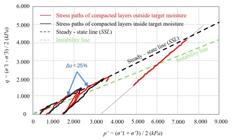

In Figure 10, it is noted that at the beginning of the stress strain, there is a development of positive pore pressures (tendency towards contraction) and subsequent dissipation of the same. Due to this behavior, it is possible to calculate an envelope disregarding the resistance gain due to pore pressure dissipation, which resulted in a cohesion of zero kPa and a friction angle of 25.4°. In addition to the analysis of maximum pore pressure during the shear phase, parameters of maximum obliquity and maximum deviation were also removed. In this configuration, earth fills with contraction behavior in the initial loading phase can be suggested as undrained strength parameters, and analysis of liquefaction susceptibility.

4. Conclusion
The primary acknowledgment in monitoring the experimental earth fills was that the analysis and interpretation of the mixtures depended on the variety of the types of ores in the Mine. In this context, it was possible to identify acceptable limits for better efficiency in compacting the tested waste and the difficulties identified in managing disposal in experimental earth fills.
Water content limits varying from 10.5% and 13.5% to achieve better efficiency in compacting mixed tailings;
The water content limits allow adequate compaction performance for dilatant layers, with degree of compaction above 95%;
With adequate compaction energy of the waste mixtures within the water content limits, achieves a degree of compaction greater than 95% and a void ratio less than 0.65. The dilating mechanical behavior was satisfactory.
The average water content at the exit of the sandy tailings filter was 2% to 3% below the optimum target, so there was no need to wait for the tailings to dry before carrying out layer preparation and compaction activities.
A tendency to contract, especially in conditions of high confining stresses, was identified for degrees of compaction below 92%.
List of symbols and abbreviations
c´ Lambe, 1979 Cohesion base on effective stress
p Lambe, 1979 Stress
p’ Lambe, 1979 effective stress
q Lambe, 1979 Stress
u Lambe, 1979 pore pressure
w Lambe, 1979 water content
x Line Equation variable
y Line Equation
ABNT Associação brasileira de normas técnicas
ASTM American society for testing and materials
BVP Company name
CIU Isotropic consolidated undrained triaxial test
CIUsat Isotropic consolidated undrained triaxial test saturated
CID Isotropic consolidated and drained triaxial test
CIDsat Isotropic consolidated and drained triaxial test saturated
GPS Global positioning system
LEC Critical state line
PEX Experimental earth fill
SSL Steady state line
ϕ Lambe, T.W., 1951 Angle of internal friction
σ Lambe, T.W., 1951 Stress perpendicular to the surface to which it is applied
σ1 Lambe, 1979 Principal stress
σ3 Lambe, 1979 Horizontal stress
Δu Lambe, 1979 pore-pressure variation
Acknowledgements
The authors would like to mention a special thanks to Dr Bruno Delgado, from Vale, for allowing publication and for kindly sharing all necessary information. Special thanks are also due to Dr Paulo Cella, from BVP Geotecnia e Hidrotecnia, for sharing field data on the earth fills.
Data availability
All data produced or examined in the course of the current study are included in this article.
-
Discussion open until November 30, 2026.
-
Declaration of use of generative artificial intelligence
This work was not prepared with the assistance of generative artificial intelligence (GenAI). The authors assume full responsibility for the content of the publication that involved the aid of GenAI.
References
- ABNT NBR 9604. (2024). Soil – Opening of a well or inspection trench, with removal of disturbed and undisturbed samples – Procedure ABNT - Associação Brasileira de Normas Técnicas, Rio de Janeiro, RJ (in Portuguese).
- Araujo, F.S. (2006). Evolution of iron ore beneficiation in Brazil: from high-grade hematite to low-grade itabirite. Brazilian Journal of Mining, 59(4), 215-223.
-
Aristimunho, P.B., & Bertocini, S.R. (2012). Aplicação de lama de minério de ferro em forma de póna presença de cimento portland. Revista IBRACON de Estruturas e Materiais, 5, 153-165. https://doi.org/10.1590/S1983-41952012000200003
» https://doi.org/10.1590/S1983-41952012000200003 - ASTM D698-12. (2021). Standard Test Methods for Laboratory Compaction Characteristics of Soil Using Standard Effort (12,400 ft-lbf/ft3) ASTM International, West Conshohocken, PA.
-
Ávila, J.P., Sawaya, M., Sayão, A.S.F., & Ferreira, L.A. (2021). Segurança de barragens de rejeitos no Brasil: avaliação dos acidentes recentes. Geotecnia Journal, 152(152), 435-464. https://doi.org/10.14195/2184-8394_152_13
» https://doi.org/10.14195/2184-8394_152_13 - Bowles, J.E. (1996). Foundation analysis and design McGraw-Hill Publishing.
- Das, B.M. (2022). Principles of geotechnical engineering Cengage Publishing.
- Freire, A., Pirete, W., Cella, P., Silva, D., Andrade, P., Oliveira, A., & Rissoli, A. (2023). Compaction performance of iron ore tailings mixture in the iron quadrangle. In F. Schnaid, R. Cudmani, & R. Verdugo (Eds.), Proceedings of the 1st International Conference on Geotechnics of Tailings and Mine Waste (Vol. 2, pp. 114-126). London: International Society for Soil Mechanics and Geotechnical Engineering.
- Li, X. (2018). Effects of fine particles on the compaction characteristics of granular materials. Journal of Soils and Foudation, 58(4), 1023-1032.
-
Luz, M.P. (2008). Aproveitamento do filer de pedreiras da região metropolitana de Goiânia em pavimentos flexíveis urbanos [Doctoral thesis]. Goiânia Federal University (in Portuguese). Retrieved in December 18, 2023, from http://repositorio.bc.ufg.br/tede/handle/tde/341
» http://repositorio.bc.ufg.br/tede/handle/tde/341 - Martins, J., Lima, R.M.F., Borges, A.A.M., Borges, A.A., & Junior, G.G.O. (2002). O aproveitamento de lamas de minério de ferro por flotação colunar. In E. Bento (Ed.), Proc. XIX Encontro Nacional de Tratamento de Minérios e Metalurgia Extrativa (Vol. 2, pp. 211-215). Recife: ENTMME (in Portuguese).
- Mitchell, J.K., & Soga, K. (2005). Fundamentals of soil behavior John Wiley &Sons Publishing.
- Pirete, W., Cella, P., Rissoli, A., Freire, A., Silva, D., Andrade, P., & Augusto, T. (2023). Mechanical behavior of the compaction of the mixture of sandy and ultrafine tailings in experimental earth fills. In F. Schnaid, R. Cudmani, & R. Verdugo (Eds.), Proceedings of the 1st International Conference on Geotechnics of Tailings and Mine Waste (Vol. 2). London: International Society for Soil Mechanics and Geotechnical Engineering.
-
Sakthivel, P., Kumar, S., & Raj, A. (2010). Environmental concerns and management of iron ore tailings. Environmental Earth Sciences, 61(5), 1023-1030. https://doi.org/10.1016/j.jclepro.2023.136145
» https://doi.org/10.1016/j.jclepro.2023.136145 - Tiwari, S., & Das, S. (2024). Intelligent prediction of critical state parameters for non-plastic tailings and soils using evolutionary algorithms. Mining, Metallurgy & Exploration, 41(1), 431-448. https://doi.org/10.1007/s42461-023-00894-z.
- USDA. (2016). Fundão tailings dam review panel - report on the immediate causes of the failure of the fundão dam Department of Agriculture.
-
Yellishetty, M., Karpe, V., Reddy, E.H., Subhash, K.N., & Ranjith, P.G. (2008). Reuse of iron ore mineral wastes in civil engineering constructions: A case study. Resources, Conservation and Recycling, 52(11), 1283-1289. https://doi.org/10.1016/j.resconrec.2008.07.007
» https://doi.org/10.1016/j.resconrec.2008.07.007
Edited by
-
Editor:
Renato P. Cunha https://orcid.org/0000-0002-2264-9711