 Performance of geocell reinforced rubber sand mixtures under undrained triaxial test
Abstract
Large quantities of scrap tires are produced by the automobile industry each year, which causes disposal challenges and impacts the environment. However, scrap tires exhibit various properties, including tensile strength, abrasion resistance, durability, thermal conductivity, elasticity, and more. Due to their versatile characteristics, these scrap tires can be utilized as construction materials for various civil engineering works to reduce their negative environmental effects and conserve natural resources. This study aims to understand the shear strength behaviours exhibited by geocell-reinforced mixtures of rubber and sand through the unconsolidated undrained triaxial test. Various parameters, including rubber sizes (425 μm to 12 mm), rubber contents (10% to 40% by volume), confining pressures (50 to 300 kPa), and geocell heights (0.2H to 0.8H, where H is the height of triaxial sample), were systematically examined to understand their impact on shear strength characteristics. The experimental findings reveal that deviatoric stress is enhanced with increasing confining pressure and rubber sizes. The maximum benefits of the rubber-sand mixture were observed at 30% rubber content. Geocell-reinforced rubber sand mixture has a higher shear strength with respect to the unreinforced mixture. Furthermore, the energy absorption capacity of the geocell-reinforced rubber sand mixtures was much better as compared to either the clean sand or rubber-sand mixture. The findings of this research demonstrate that geocell-reinforced rubber sand mixtures are suitable for various geotechnical engineering works.
Keywords:
Rubber sand mixture; Geocell; Shear strength; Energy absorption capacity
1. Introduction
The growing world population and the globalization of the automobile sector have collectively contributed to a substantial increase in scrap tire generation over the past few decades (Tajabadipour & Marandi, 2017). It has led to a serious environmental problem with their disposal because of their high production volume, durability, and availability of environmentally unfavourable components (Hennebert et al., 2014; Mrad & El Samra, 2020; Tajabadipour & Marandi, 2017). Scrap tires also affect the entire world because they are non-biodegradable, easily ignited, able to produce dangerous vapours when burned, release toxins that contaminate the soil and water, and are able to leach poisonous compounds into the environment (Attom, 2006; Ganjian et al., 2009). Therefore, it would be important to propose some remedies to such a problem. To minimize these problems, waste tires can now be recycled into fibres, strips, chips, granules, crumbed rubber, or shreds that can be utilized as building materials in several civil engineering works (Anvari & Shooshpasha, 2016; Attom, 2006; Das & Bhowmik, 2020; Edinçliler et al., 2010; Ganjian et al., 2009; Lee et al., 1999; Oikonomou & Mavridou, 2009; Yang et al., 2020; Yoon et al., 2006). Utilizing waste tires mixed with soil is becoming more and more frequent because of the scarcity of natural resources and the high cost of tire waste disposal (Moghaddas Tafreshi et al., 2019; Oikonomou & Mavridou, 2009). Waste tires have certain characteristics that make them desirable as soil-reinforcing materials, such as high flexibility, thermal insulation, durability, tensile strength, elasticity, abrasion resistance, low weight, and more (Abdullah et al., 2022; Akbarimehr et al., 2020; Lee et al., 1999; Madhusudhan et al., 2021; Yang et al., 2020; Zhang et al., 2018).
The use of waste tires mixed with sand is gaining popularity since it can enhance several engineering characteristics of sand, including improving shear strength characteristics, lowering deformation, raising friction angle, enhancing energy absorption capacity, etc. (Al-Neami, 2018; Anbazhagan et al., 2017; El-Sherbiny et al., 2013; Neaz Sheikh et al., 2013; Rouhanifar et al., 2021; Silva et al., 2020). A study conducted by Anbazhagan et al. investigated the influence of rubber contents on the strength characteristics of rubber-sand mixtures. Their findings demonstrated that the rubber-sand mixture achieves its highest shear strength when the rubber content is optimally set at 30% by volume (Anbazhagan et al., 2017). Most of the research on rubber sand mixtures suggested that a rubber content of 20–35% provided the greatest advantage (Li et al., 2020; Madhusudhan et al., 2021; Yang et al., 2020). Furthermore, several investigations have reported that rubber sand mixtures can be effectively used as vibration seismic isolation for small structures due to the dampness characteristics of the waste tire (Bandyopadhyay et al., 2015; Chew & Leong, 2019; Senetakis et al., 2012; Shariatmadari et al., 2018; Tsang, 2008). Tsang et al. performed the seismic isolation method by mixing the rubber into the soil and placing it around the building foundation, which provides a function like a cushion, and their results showed that the rubber-sand mixture reduced the ground motion by around 40-60%, making it suitable for use as vibration isolation for low-to medium-rise buildings (Tsang et al., 2012).
In the past few decades, a range of geosynthetic materials, such as geotextile, geocell, geogrid, etc., have found successful applications in soil reinforcement. These materials have proven effective in improving bearing capacity, minimizing settlement, enhancing shear strength, and increasing the frictional angle, showcasing their versatility in geotechnical applications (Adams & Collin, 1997; Ansari & Roy, 2023a; Das et al., 1994; Mittal & Shukla, 2020; Palmeira, 2010; Patra et al., 2005; Sitharam & Sireesh, 2004; Xu et al., 2019). A geocell is a three-dimensional structure designed to provide comprehensive confinement to infilled materials. Normally, materials like sand or gravel, which allow for effective drainage, are used to fill these geocells. An innovative approach involves utilizing a mixture of waste rubber and sand as the infill material, presenting a potential solution to mitigate issues associated with waste tire disposal. Existing literature widely acknowledges that soil reinforced with either geocell or waste rubber can enhance various engineering properties. However, there is limited literature available that highlights the use of waste rubber and geocell together as reinforcement materials for the sand to enhance their properties and performance (Benessalah et al., 2022; Mehrjardi et al., 2015; Tavakoli Mehrjardi et al., 2012). To overcome this limitation, more comprehensive investigations are still needed to understand the performance, behaviours, and impacts of the incorporation of a geocell-reinforced rubber sand mixture.
The aim of this paper is to investigate the potential benefits of incorporating geocell-reinforced rubber sand mixtures in engineering applications, focusing on soil stabilization, foundation design, and other geotechnical practices. The research explores variations in geocell heights, rubber contents, rubber sizes, and confining pressure to understand their influence on shear strength characteristics. Through unconsolidated undrained triaxial tests, the study analyzes stress-strain responses and evaluates the energy absorption capacity of the reinforced mixtures. By elucidating performance and behaviors, this research aims to advance sustainable and efficient engineering practices, offering valuable insights for practitioners seeking innovative solutions.
2. Materials used
2.1 Sand
In this investigation, the study utilized river sand, Figure 1(a), readily available in the Begusarai district of Bihar, India. Laboratory tests were performed to assess the index properties of the soil, encompassing particle size distribution, specific gravity, coefficient of curvature, coefficient of uniformity, and minimum and maximum dry density. The specific gravity of the sand was determined in adherence to ASTM D854 (ASTM, 2010). As per the unified soil classification system (USCS) outlined in ASTM-D2487 (ASTM, 2017), the soil falls under the category of poorly graded sand (SP). The detailed physical properties of the sand are outlined in Table 1.The specific gravity of sand of 2.7 is notably high, mainly due to its composition rich in silica, a dense mineral. Throughout the experiments, the relative density of the sand was taken as 80%.

2.2 Geocell
The material utilized for the preparation of geocells was purchased from a local market in Begusarai, Bihar, India. The photographic view of the material utilized for the fabrication of the geocell is shown in Figure1(b). The geocells were fabricated by stitching the material, ensuring that the diameter matched that of the triaxial sample. For finding the optimal height of the geocell, variations in geocell height were introduced. Nylon threads were employed for stitching the geocells consistently throughout the entire experiment. To determine the physical properties of geocell materials, including the properties of the seams, tensile strength tests and seam strength tests were conducted. These tests were performed in accordance with ASTM D 4595 (ASTM, 2009a) and ASTM D 4884 (ASTM, 2009b) standards, respectively. The mass per unit area of geocell was found to be 138.2 g/m2, its tensile strength was 32.4 kN/m, and its seam strength was 15.6 kN/m.
2.3 Rubber
The waste tire rubbers utilized in the study were obtained from a scrap metal facility situated in Begusarai, Bihar, India. These used scrap rubber tires were cut into different sizes, as shown in Figure 1(c). As per ASTM D6270 (ASTM, 2020) standards, granular rubber refers to sizes extending from 425 μm to 12 mm, while tire chips are defined by sizes from 12 mm to 50 mm. The sieve analysis was performed to segregate these rubbers into different groups as per grain size. The present study utilized five varying sizes of granular rubber, denoted as S1 (425 μm to 2 mm), S2 (2 mm to 4.75 mm), S3 (4.75 mm to 8 mm), S4 (8 mm to 9.5 mm), and S5 (9.5 mm to 12 mm). The specific gravity of these granular rubbers was found as per ASTM-D854 (ASTM, 2010), yielding values of 1.13 (S1), 1.14 (S2), 1.15 (S3), 1.16 (S4), and 1.16 (S5). Furthermore, the water absorption capacity of each rubber size was evaluated using ASTM-C128 (ASTM, 2015), resulting in respective measurements of 3.35 (S1), 3.37 (S2), 3.36 (S3), 3.38 (S4), and 3.39 (S5).
3. Experimental program
3.1 Preparation of rubber sand mixture
The study considered four different granular rubber contents ranging from 10% to 40% by volume (volume of the rubber/total volume of the specimen) and five granular rubber sizes labelled as S1 to S5. The required quantity of sand and granular rubber was estimated for every percentage of the rubber mixture and for every size of the rubber content. Volumetric measurement was applied to mix the granular rubber with oven-dried sand manually, as volumetric measurement is simpler to use on the site. However, triaxial samples were prepared by weighing the sand and granular rubber instead of using volume in the laboratory. To determine the volume, the weight and specific gravity were taken into account. The dry sand and granular rubber were thoroughly mixed using hand-mixing techniques to achieve homogeneity for various compositions.
3.2 Preparation of rubber sand mixture with geocell
Conventional UU triaxial tests were employed to assess the geocell-reinforced rubber sand mixture, adopting the same testing protocols applied to the unreinforced mixture. The required amounts of sand and granular rubber were calculated for each percentage of rubber content and size variation. Through manual mixing, the dry sand and granular rubber were mixed thoroughly to ensure uniformity across different compositions. The geocell was positioned at the center of the triaxial sample, and the height of the geocell (Hg) was varied as shown in Figure2. The height of the geocell was kept smaller than the height of the sample (H) because of the stability of the sample. Following the placement of the triaxial membrane inside the split mould, the geocell was securely fixed within the membrane. The rubber sand mixture was then layered into the geocell in five layers and compacted to achieve the desired relative density of 80%. Porous stones were then positioned both top and bottom of the sample before removing the split mould.

3.3 Triaxial test setup
Unconsolidated undrained (UU) tests were conducted using a triaxial apparatus, as depicted in Figure 3. A split cylindrical mould, measuring 200 mm in height and 100 mm in diameter, was utilized to prepare the triaxial test sample. A latex membrane was inserted into the split cylindrical mould, and the required volume of rubber-sand mixture was poured into it in five layers. Employing a rammer for static compaction, the mixture underwent a gentle compaction process to achieve the intended height and density, preventing any potential segregation. After partially compacting the final layer, the top cap was introduced, and further compaction ensued to reach the specified density.

Following this, the specimen was positioned vertically between two rigid ends within the triaxial pressure cell. The recording of both the load and deformation of the test sample during the triaxial test was facilitated through the utilization of a load cell with a capacity of 50 kN and an LVDT with a capacity of 50 mm. A constant strain rate of 1.2 mm/min was consistently applied throughout the entirety of the experimental procedures. To ensure the stabilization of the test sample before the initiation of shearing, distinct cell pressures of 50 kPa, 100 kPa, 200 kPa, and 300 kPa were successively applied for durations ranging from 10 to 15 minutes.
4. Results and discussion
Unconsolidated undrained triaxial tests were performed for homogeneous sand as well as the sand-rubber mixture with and without geocell reinforcement. The effects of rubber sizes, rubber contents, confining pressures as well as the heights of the geocell on the shear strength were investigated by varying these parameters.
4.1 Effects of the rubber content
Figure 4 illustrates the axial strain versus deviatoric stress behavior in unconsolidated undrained triaxial compression tests for rubber size S5, covering rubber contents from 0% to 40% by volume under a confining pressure of 300 kPa. The graph demonstrates a clear influence of rubber content on the stress-strain dynamics of the rubber-sand mixtures. Notably, at 10% rubber content, the deviatoric stress is marginally lower compared to the clean sand (0% rubber content). This decrease is attributed to a stronger interaction between sand particles, surpassing interactions between sand and rubber or among rubber particles. Consequently, the rubber fails to serve its reinforcing function in the sand-rubber mixture. Similar findings were reported by previous researchers, indicating a decrease in the strength of the sand rubber mixture at 10% rubber content (Li et al., 2020).

Moreover, an increase in deviatoric stress is observed with an increasing rubber content from 10% to 30%. However, a subsequent decline in deviatoric stress occurs with a further rise in granulated rubber content from 30% to 40%, as depicted in Figure 4. This decrease is ascribed to the rearrangement of the rubber-sand mixes and a reduction in the density of the overall mixes. The higher rubber content creates additional void space, resulting in reduced deviatoric stress (Manohar & Anbazhagan, 2021). Exceeding 30% rubber content leads to a significantly softer response from the sample, enhancing its deformability. At a confining pressure of 300 kPa, the sand rubber mixture exhibited peak deviatoric stresses of 616 kPa, 674 kPa, 749 kPa, and 697 kPa for rubber contents of 10%, 20%, 30%, and 40%, respectively.
The axial strain at failure was observed to increase, particularly with a higher percentage of rubber. However, due to the absence of clear-cut failure, the 20% strain level was considered for the stress-strain curve analysis. It is noteworthy that all samples experienced failure beyond the 20% strain level.
4.2 Effect of the confining pressure
Laboratory triaxial experiments were performed under varying confining pressures (50 kPa to 300 kPa) involving both clean sand (with 0% rubber content) and rubber sand mixtures. The deviatoric stress versus axial strain plots produced under the UU tests at 30% rubber content and 80% relative density of sand are depicted in Figure 5. This illustration demonstrates that the rubber-sand mixture, possessing the same relative density and rubber content, shows an increased capacity to withstand loads as the confining pressure of the cell increases. The increased shear strength is likely a consequence of the rubber-sand mixture densifying under higher confining pressure (Ansari & Roy, 2023b; El-Sherbiny et al., 2013). The soil tested at 300 kPa revealed a stress capacity around 3.37 times higher than the soil tested at 50 kPa, despite both possessing the same relative density and rubber content. Stress-strain curves displaying nonlinearity at higher confining pressures illustrated the ductile nature inherent in rubber-sand mixtures.

4.3 Effect of the rubber sizes
UU triaxial tests were performed for investigating how the rubber sizes in the rubber sand mixture affect stress-strain behaviours. In sequence to achieve this, various rubber sizes—S1 (425 μm to 2 mm), S2 (2 mm to 4.75 mm), S3 (4.75 mm to 8 mm), S4 (8 mm to 9.5 mm), and S5 (9.5 mm to 12 mm)—were taken and mixed with sand separately. Variations in deviatoric stress relative to axial strain are highlighted in Figure 6, considering different rubber sizes at 30% rubber content and 300 kPa confining pressure. The illustration highlights the significant impact of rubber size on stress-strain characteristics in triaxial tests conducted on rubber sand mixtures. The incorporation of rubber particles of size S1 (425 μm to 2 mm) resulted in a minor decrease in the deviatoric stress of the sand (620 kPa to 612 kPa). This occurrence can be explained by the similarity in size between rubber and sand particles, where voids created by rubber particles may not have been filled by sand particles. Consequently, under such circumstances, rubber particles of size S1 failed to perform as effective reinforcement in the rubber-sand mixture.

Conversely, as the rubber size increased from S2 to S5 in the rubber-sand mixture, a corresponding increase in deviatoric stress was observed. This suggests that larger rubber particles within the mixture contribute to reinforcement, enhancing the deviatoric stress. This result highlights the complex interconnection between rubber size and the mechanical characteristics of the rubber-sand mixture, a critical aspect for comprehending and enhancing the mixture's functionality in geotechnical engineering applications. At a confining pressure of 300 kPa and 30% rubber content, the peak deviatoric stresses for rubber sizes S1 to S5 were found to be 612 kPa, 668 kPa, 684 kPa, 706 kPa, and 749 kPa, respectively.
4.4 Effect of the geocell height
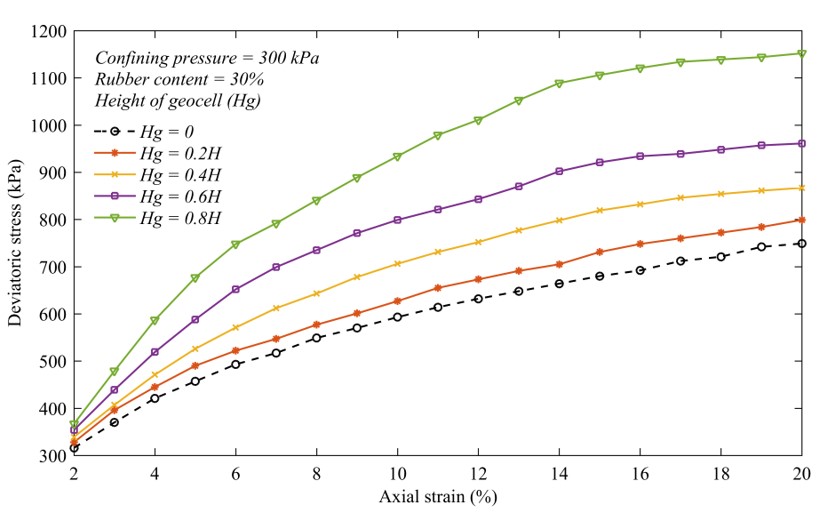
In this study, a comprehensive examination was carried out to investigate the influence of geocell heights on the shear strength characteristics of a rubber sand mixture through an extensive series of UU triaxial tests, covering a confining pressure range from 50 kPa to 300 kPa. The results depicted in Figure 7 present the findings for four distinct geocell heights (Hg = 0.2H, 0.4H, 0.6H, and 0.8H) at a constant confining pressure of 300 kPa and a rubber content of 30%. The figure clearly indicates a consistent rise in deviatoric stress with increasing geocell height. This significant increase in deviatoric stress is credited to the geocell's effectiveness in introducing additional confining pressure, thereby enhancing the soil's load-bearing capacity while minimizing settlement. The recorded peak deviatoric stress values at geocell heights of 0.2H, 0.4H, 0.6H, and 0.8H were 799 kPa, 867 kPa, 961 kPa, and 1152 kPa, respectively.

A significant parameter, the improvement factor, was calculated as the ratio of deviatoric stress observed with geocell-reinforced soil to that without geocell reinforcement. The improvement factors corresponding to geocell heights of 0.2H, 0.4H, 0.6H, and 0.8H were determined as 1.067, 1.158, 1.283, and 1.538, respectively. These enhancement factors emphasize the positive impact of geocell reinforcement on the shear strength characteristics of the rubber sand mixture, highlighting the potential of geocell in improving the overall stability and load-bearing capacity of such soil systems.
4.5 Energy absorption capacity
The study emphasizes the critical significance of energy absorption, particularly in the context of seismic isolation, with a focus on the rubber-sand mixture. While existing literature extensively investigates into the static strength characteristics of rubber-sand mixtures, there exists a noticeable research gap regarding their energy absorption capacity. The assessment of energy absorption entails evaluating the total energy per unit volume absorbed by the material under specific deformation values, quantified by the area under the stress-strain plot up to a defined point (Manohar & Anbazhagan, 2021), expressed as:
Here, E, σ, and ε denote energy absorption, stress, and strain, respectively. The area beneath the stress-strain curve, obtained through triaxial tests, serves as a crucial indicator of the energy absorption capacity of the rubber-sand mixture, both with and without geocell reinforcement.
Figure 8 presents the energy absorption capacity of pure sand, a rubber sand mixture with 30% rubber content, and a geocell-reinforced rubber sand mixture with 30% rubber content and a geocell height of 0.8H. The illustration underscores a gradual increase in the energy absorption capacity of sand with the incorporation of rubber content. Furthermore, the introduction of geocells in the rubber-sand mixture leads to a further augmentation in energy absorption capacity. This observed enhancement can be attributed to the increased peak stress and ultimate stress facilitated by the inclusion of rubber, geocell, or a combination of both in the sand mixture. These findings shed light on the multifaceted contributions of rubber and geocell in enhancing the energy absorption capabilities of the sand, underscoring their potential in seismic isolation applications.

4.6 Failure mode of the samples
The failure patterns of the triaxial samples varied across different compositions: pure sand, sand-rubber mixture, and sand-rubber mixture with geocell reinforcement, as shown in Figures 9(a), 9(b), and 9(c) respectively. Pure sand samples exhibited bulging failure, likely due to their higher lateral expansion and ineffective confinement. Conversely, samples with sand-rubber mixture showed reduced bulging. Moreover, samples with sand-rubber mixture with geocell reinforcement demonstrated no clear failure plane, indicating effective lateral confinement by the geocell. Failure in these samples primarily occurred at the seam of the geocell due to its higher strength compared to the seam strength, resulting in bursting of the seam.
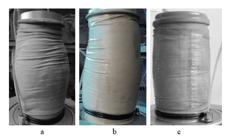
Failure of samples: (a) pure sand; (b) sand rubber mixture; and (c) sand rubber mixture with geocell.
4.7 Applicability of rubber-sand mixtures in geotechnical field
Incorporating waste tire rubber into sand, especially when reinforced with geocell, represents a promising and sustainable solution with versatile applications in geotechnical practices. This environmentally conscious approach effectively addresses the disposal challenges stemming from the substantial volume of scrap tires generated by the automotive industry. Repurposing tire rubber in civil engineering projects not only significantly contributes to waste reduction but also plays a crucial role in preserving natural resources. Comprehensive studies on the shear strength behaviours of geocell-reinforced rubber-sand mixes highlight substantial improvements, making them advantageous for ensuring stability in diverse geotechnical structures. The adaptability of these mixtures, complemented by their impressive energy absorption capacity essential for seismic isolation, positions them as ideal materials for a broad range of geotechnical engineering applications. Furthermore, the incorporation of geocell-reinforced rubber sand mixtures results in higher deviatoric stress and enhanced load-bearing capacity. In summary, rubber-sand mixtures emerge as durable, adaptable, and eco-friendly solutions, demonstrating significant potential for effectively addressing diverse challenges in geotechnical engineering.
The findings of this research demonstrate that a geocell-reinforced rubber sand mixture can be utilized in various geotechnical engineering projects like seismic design, lightweight filling materials in many civil engineering works, the base material in vibration isolation for low-rise buildings, etc. In this way, a huge amount of waste tires will be easily used all over the world, which reduces significant disposal costs and prevents environmental as well as aesthetic damage.
5. Conclusion
Throughout the triaxial testing of geocell-reinforced rubber-sand mixtures, where the aim was to examine the effects of geocell heights, rubber contents, rubber sizes, and confining pressure on the shear strength characteristics of the soil, the following significant conclusions can be derived from the test results:
-
The shear strength of rubber-sand mixtures is optimized at a rubber content of 30%, emphasizing the pivotal role of rubber content in determining shear strength.
-
Rubber particle size significantly impacts stress-strain behaviors, with larger particles yielding higher deviatoric stress, highlighting the importance of particle size selection.
-
Higher confining pressures positively correlate with shear strength, indicating densification of the mixture under increased pressure.
-
Geocell reinforcement enhances shear strength by providing additional confinement, enabling the mixture to withstand higher loads with reduced settlement.
-
Geocell-reinforced mixtures exhibit superior energy absorption capacity compared to conventional mixtures, suggesting enhanced performance in dynamic loading scenarios. These findings underscore the potential of geocell-reinforced rubber-sand mixtures for diverse engineering applications requiring robust and resilient materials.
List of symbols and abbreviations
ASTM American Society for Testing and Materials
Cc Coefficient of curvature
Cu Coefficient of uniformity
D10 Effective Size
E Energy absorption capacity
G Specific gravity of soil
H Height of the triaxial sample
Hg Height of the geocell
LVDT Linear Variable Differential Transformer
S1 Rubber size of 425 μm to 2 mm
S2 Rubber size of 2 mm to 4.75 mm
S3 Rubber size of 4.75 mm to 8 mm
S4 Rubber size of 8 mm to 9.5 mm
S5 Rubber size of 9.5 mm to 12 mm
SP Poorly graded sand
USCS Unified Soil Classification System
UU Unconsolidated Undrained
γmim Minimum dry density
γmax Maximum dry density
ε Strain
σ Stress
ϕ Frictional angle
Data availability
All data produced or examined in the course of the current study are included in this article
Acknowledgements
The authors express their gratitude to Rashtrakavi Ramdhari Singh Dinkar College of Engineering Begusarai and National Institute of Technology Patna for generously allowing the use of their laboratory facilities to conduct experiments and for providing access to their library resources.
-
Discussion open until February 28, 2025.
References
-
Abdullah, W., Ashkanani, A., Eid, W., Al-Fares, R., & AlKhamis, M. (2022). Evaluation of sand–tire crumb mixtures as lightweight fill materials. Geomechanics and Geoengineering, 18(3), 208-221. http://dx.doi.org/10.1080/17486025.2021.2024897
» http://dx.doi.org/10.1080/17486025.2021.2024897 - Adams, M.T., & Collin, J.G. (1997). Large model spread footing load on geosynthetic reinforced soil foundation. Journal of Geotechnical and Geoenvironmental Engineering, 123(1), 66-72.
-
Akbarimehr, D., Eslami, A., & Aflaki, E. (2020). Geotechnical behaviour of clay soil mixed with rubber waste. Journal of Cleaner Production, 271, 122632. http://dx.doi.org/10.1016/j.jclepro.2020.122632
» http://dx.doi.org/10.1016/j.jclepro.2020.122632 -
Al-Neami, M.A. (2018). Stabilization of sandy soil using recycle waste tire chips. International Journal of GEOMATE, 15(48), 175-180. http://dx.doi.org/10.21660/2018.48.180228.
» https://doi.org/ http://dx.doi.org/10.21660/2018.48.180228 -
Anbazhagan, P., Manohar, D.R., & Rohit, D. (2017). Influence of size of granulated rubber and tyre chips on the shear strength characteristics of sand–rubber mix. Geomechanics and Geoengineering, 12(4), 266-278. http://dx.doi.org/10.1080/17486025.2016.1222454
» http://dx.doi.org/10.1080/17486025.2016.1222454 -
Ansari, M.A., & Roy, L.B. (2023a). Experimental and ANN-based model of footing pressure of a layered soil reinforced with geogrid. Innovative Infrastructure Solutions, 8(3), 100. http://dx.doi.org/10.1007/s41062-023-01069-x
» http://dx.doi.org/10.1007/s41062-023-01069-x -
Ansari, M.A., & Roy, L.B. (2023b). Effect of geogrid reinforcement on shear strength characteristics of a rubber-sand mixture under undrained triaxial test. Jordan Journal of Civil Engineering, 17(2), 177-184. http://dx.doi.org/10.14525/JJCE.v17i2.01
» http://dx.doi.org/10.14525/JJCE.v17i2.01 -
Anvari, S.M., & Shooshpasha, I. (2016). Influence of size of granulated rubber on bearing capacity of fine-grained sand. Arabian Journal of Geosciences, 9(18), 707. http://dx.doi.org/10.1007/s12517-016-2744-8
» http://dx.doi.org/10.1007/s12517-016-2744-8 - ASTM C128 (2015). Standard Test Method for Relative Density (Specific Gravity) and Absorption of Fine Aggregate ASTM International, West Conshohocken, PA.
- ASTM D2487 (2017). Standard Practice for Classification of Soils for Engineering Purposes (Unified Soil Classification System) ASTM International, West Conshohocken, PA.
- ASTM D4595 (2009a). Standard Test Method for Tensile Properties of Geotextiles by the Wide-Width Strip Method ASTM International, West Conshohocken, PA.
- ASTM D4884 (2009b). Standard Test Method for Strength of Sewn or Thermally Bonded Seams of Geotextiles ASTM International, West Conshohocken, PA.
- ASTM D6270 (2020). Standard Practice for Use of Scrap Tires in Civil Engineering Applications ASTM International, West Conshohocken, PA.
- ASTM D854 (2010). Specific Gravity of Soil Solids by Water Pycnometer ASTM International, West Conshohocken, PA.
-
Attom, M.F. (2006). The use of shredded waste tires to improve the geotechnical engineering properties of sands. Environmental Geology, 49(4), 497-503. http://dx.doi.org/10.1007/s00254-005-0003-5
» http://dx.doi.org/10.1007/s00254-005-0003-5 -
Bandyopadhyay, S., Sengupta, A., & Reddy, G.R. (2015). Performance of sand and shredded rubber tire mixture as a natural base isolator for earthquake protection. Earthquake Engineering and Engineering Vibration, 14(4), 683-693. http://dx.doi.org/10.1007/s11803-015-0053-y
» http://dx.doi.org/10.1007/s11803-015-0053-y -
Benessalah, I., Sadek, M., Villard, P., & Arab, A. (2022). Undrained triaxial compression tests on three-dimensional reinforced sand: effect of the geocell height. European Journal of Environmental and Civil Engineering, 26(5), 1694-1705. http://dx.doi.org/10.1080/19648189.2020.1728581
» http://dx.doi.org/10.1080/19648189.2020.1728581 -
Chew, J.H., & Leong, E.C. (2019). Field and numerical modelling of sand-rubber mixtures vibration barrier. Soil Dynamics and Earthquake Engineering, 125, 105740. http://dx.doi.org/10.1016/j.soildyn.2019.105740
» http://dx.doi.org/10.1016/j.soildyn.2019.105740 -
Das, B.M., Shin, E.C., & Omar, M.T. (1994). The bearing capacity of surface strip foundations on geogrid-reinforced sand and clay: a comparative study. Geotechnical and Geological Engineering, 12(1), 1-14. http://dx.doi.org/10.1007/BF00425933
» http://dx.doi.org/10.1007/BF00425933 -
Das, S., & Bhowmik, D. (2020). Dynamic behaviour of sand–crumbed rubber mixture at low strain level. Geotechnical and Geological Engineering, 38(6), 6611-6622. http://dx.doi.org/10.1007/s10706-020-01458-4
» http://dx.doi.org/10.1007/s10706-020-01458-4 -
Edinçliler, A., Baykal, G., & Saygili, A. (2010). Influence of different processing techniques on the mechanical properties of used tires in embankment construction. Waste Management (New York, N.Y.), 30(6), 1073-1080. http://dx.doi.org/10.1016/j.wasman.2009.09.031
» http://dx.doi.org/10.1016/j.wasman.2009.09.031 -
El-Sherbiny, R., Asce, M., Youssef, A., & Lotfy, H. (2013). Triaxial testing on saturated mixtures of sand and granulated rubber. In Geo-Congress 2013: Stability and Performance of Slopes and Embankments III (pp. 82-91). ASCE. https://doi.org/10.1061/9780784412787.009
» https://doi.org/10.1061/9780784412787.009 -
Ganjian, E., Khorami, M., & Maghsoudi, A.A. (2009). Scrap-tyre-rubber replacement for aggregate and filler in concrete. Construction & Building Materials, 23(5), 1828-1836. http://dx.doi.org/10.1016/j.conbuildmat.2008.09.020
» http://dx.doi.org/10.1016/j.conbuildmat.2008.09.020 -
Hennebert, P., Lambert, S., Fouillen, F., & Charrasse, B. (2014). Assessing the environmental impact of shredded tires as embankment fill material. Canadian Geotechnical Journal, 51(5), 469-478. http://dx.doi.org/10.1139/cgj-2013-0194
» http://dx.doi.org/10.1139/cgj-2013-0194 -
Lee, J.H., Salgado, R., Bernal, A., & Lovell, C.W. (1999). Shredded tires and rubber-sand as lightweight backfill. Journal of Geotechnical and Geoenvironmental Engineering, 125(2), 132-141. http://dx.doi.org/10.1061/(ASCE)1090-0241(1999)125:2(132)
» http://dx.doi.org/10.1061/(ASCE)1090-0241(1999)125:2(132) -
Li, W., Kwok, C.Y., & Senetakis, K. (2020). Effects of inclusion of granulated rubber tires on the mechanical behaviour of a compressive sand. Canadian Geotechnical Journal, 57(5), 763-769. http://dx.doi.org/10.1139/cgj-2019-0112
» http://dx.doi.org/10.1139/cgj-2019-0112 -
Madhusudhan, B.R., Boominathan, A., & Banerjee, S. (2021). Engineering properties of sand–rubber tire shred mixtures. International Journal of Geotechnical Engineering, 15(9), 1061-1077. http://dx.doi.org/10.1080/19386362.2019.1617479
» http://dx.doi.org/10.1080/19386362.2019.1617479 -
Manohar, D.R., & Anbazhagan, P. (2021). Shear strength characteristics of geosynthetic reinforced rubber-sand mixtures. Geotextiles and Geomembranes, 49(4), 910-920. http://dx.doi.org/10.1016/j.geotexmem.2020.12.015
» http://dx.doi.org/10.1016/j.geotexmem.2020.12.015 - Mehrjardi, G.T., Moghaddas Tafreshi, S.N., & Dawson, A.R. (2015). Numerical analysis on Buried pipes protected by combination of geocell reinforcement and rubber-soil mixture. International Journal of Civil Engineering, 13(2).
- Mittal, A., & Shukla, S. (2020). Effect of geogrid reinforcement on strength, thickness and cost of low-volume rural roads. Jordan Journal of Civil Engineering, 14(4), 2020-2587.
-
Moghaddas Tafreshi, S.N., Joz Darabi, N., Tavakoli Mehrjardi, G., & Dawson, A. (2019). Experimental and numerical investigation of footing behaviour on multi-layered rubber-reinforced soil. European Journal of Environmental and Civil Engineering, 23(1), 29-52. http://dx.doi.org/10.1080/19648189.2016.1262288
» http://dx.doi.org/10.1080/19648189.2016.1262288 - Mrad, M., & El Samra, R. (2020). Waste tire management: lebanon case study. J Waste Manag Disposal, 3(1), 1-12.
-
Neaz Sheikh, M., Mashiri, M.S., Vinod, J.S., & Tsang, H.-H. (2013). Shear and compressibility behavior of sand–tire crumb mixtures. Journal of Materials in Civil Engineering, 25(10), 1366-1374. http://dx.doi.org/10.1061/(asce)mt.1943-5533.0000696
» http://dx.doi.org/10.1061/(asce)mt.1943-5533.0000696 -
Oikonomou, N., & Mavridou, S. (2009). The use of waste tyre rubber in civil engineering works. In J.M. Khatib (Ed.), Sustainability of construction materials (pp. 213-238). Elsevier. https://doi.org/10.1533/9781845695842.213
» https://doi.org/10.1533/9781845695842.213 -
Palmeira, E.M. (2010). Influence of geogrid geometrical and mechanical properties on the performance of reinforced veneers. Soils and Rocks, 33(1), 33-44. http://dx.doi.org/10.28927/SR.331033
» http://dx.doi.org/10.28927/SR.331033 -
Patra, C.R., Das, B.M., & Atalar, C. (2005). Bearing capacity of embedded strip foundation on geogrid-reinforced sand. Geotextiles and Geomembranes, 23(5), 454-462. http://dx.doi.org/10.1016/j.geotexmem.2005.02.001
» http://dx.doi.org/10.1016/j.geotexmem.2005.02.001 -
Rouhanifar, S., Afrazi, M., Fakhimi, A., & Yazdani, M. (2021). Strength and deformation behaviour of sand-rubber mixture. International Journal of Geotechnical Engineering, 15(9), 1078-1092. http://dx.doi.org/10.1080/19386362.2020.1812193
» http://dx.doi.org/10.1080/19386362.2020.1812193 -
Senetakis, K., Anastasiadis, A., & Pitilakis, K. (2012). Dynamic properties of dry sand/rubber (SRM) and gravel/rubber (GRM) mixtures in a wide range of shearing strain amplitudes. Soil Dynamics and Earthquake Engineering, 33(1), 38-53. http://dx.doi.org/10.1016/j.soildyn.2011.10.003
» http://dx.doi.org/10.1016/j.soildyn.2011.10.003 -
Shariatmadari, N., Karimpour-Fard, M., & Shargh, A. (2018). Undrained monotonic and cyclic behavior of sand-ground rubber mixtures. Earthquake Engineering and Engineering Vibration, 17(3), 541-553. http://dx.doi.org/10.1007/s11803-018-0461-x
» http://dx.doi.org/10.1007/s11803-018-0461-x -
Silva, A.C., Fucale, S., & Ferreira, S.R. de M. (2020). Hydromechanical behavior of soil with tire fibers. Soils and Rocks, 43(2), 191-198. http://dx.doi.org/10.28927/SR.432191
» http://dx.doi.org/10.28927/SR.432191 -
Sitharam, T.G., & Sireesh, S. (2004). Model studies of embedded circular footing on geogrid-reinforced sand beds. Proceedings of the Institution of Civil Engineers - Ground Improvement, 8(2), 69-75. http://dx.doi.org/10.1680/grim.2004.8.2.69
» http://dx.doi.org/10.1680/grim.2004.8.2.69 -
Tajabadipour, M., & Marandi, M. (2017). Effect of rubber tire chips-sand mixtures on performance of geosynthetic reinforced earth walls. Periodica Polytechnica. Civil Engineering, 61(2), 322-334. http://dx.doi.org/10.3311/PPci.9539
» http://dx.doi.org/10.3311/PPci.9539 -
Tavakoli Mehrjardi, G., Moghaddas Tafreshi, S.N., & Dawson, A.R. (2012). Combined use of geocell reinforcement and rubber-soil mixtures to improve performance of buried pipes. Geotextiles and Geomembranes, 34, 116-130. http://dx.doi.org/10.1016/j.geotexmem.2012.05.004
» http://dx.doi.org/10.1016/j.geotexmem.2012.05.004 -
Tsang, H.-H. (2008). Seismic isolation by rubber-soil mixtures for developing countries. Earthquake Engineering & Structural Dynamics, 37(2), 283-303. http://dx.doi.org/10.1002/(ISSN)1096-9845
» http://dx.doi.org/10.1002/(ISSN)1096-9845 -
Tsang, H.-H., Lo, S.H., Xu, X., & Neaz Sheikh, M. (2012). Seismic isolation for low-to-medium-rise buildings using granulated rubber-soil mixtures: numerical study. Earthquake Engineering & Structural Dynamics, 41(14), 2009-2024. http://dx.doi.org/10.1002/eqe.2171
» http://dx.doi.org/10.1002/eqe.2171 -
Xu, C., Liang, C., & Shen, P. (2019). Experimental and theoretical studies on the ultimate bearing capacity of geogrid-reinforced sand. Geotextiles and Geomembranes, 47(3), 417-428. http://dx.doi.org/10.1016/j.geotexmem.2019.01.003
» http://dx.doi.org/10.1016/j.geotexmem.2019.01.003 -
Yang, Z., Zhang, Q., Shi, W., Lv, J., Lu, Z., & Ling, X. (2020). Advances in properties of rubber reinforced soil. Advances in Civil Engineering, 2020, 1-16. http://dx.doi.org/10.1155/2020/6629757
» http://dx.doi.org/10.1155/2020/6629757 -
Yoon, S., Prezzi, M., Siddiki, N.Z., & Kim, B. (2006). Construction of a test embankment using a sand-tire shred mixture as fill material. Waste Management (New York, N.Y.), 26(9), 1033-1044. http://dx.doi.org/10.1016/j.wasman.2005.10.009
» http://dx.doi.org/10.1016/j.wasman.2005.10.009 -
Zhang, T., Cai, G., & Duan, W. (2018). Strength and microstructure characteristics of the recycled rubber tire-sand mixtures as lightweight backfill. Environmental Science and Pollution Research International, 25(4), 3872-3883. http://dx.doi.org/10.1007/s11356-017-0742-3
» http://dx.doi.org/10.1007/s11356-017-0742-3