
 Impact of the BR-282 highway on the mortality of wild felids in the extreme west of Santa Catarina, Brazil: threat to conservation
Abstract
Among human impacts, road kills are an important source of mortality for wild animals, as highways and roads result in the fragmentation of natural habitats. Felids are strongly negatively impacted and, although roads are mentioned as potential threats, few studies address how felids interact with these environments. We aimed to describe the richness and composition of wild felids, analyze the spatial and temporal effect, and identify road-kill hotspots of these species on a stretch of the BR-282 highway between the cities of São Miguel do Oeste and Paraíso, in the extreme west of the State of Santa Catarina, southern Brazil. From December 2021 to November 2022, we traveled a 28-km stretch weekly to collect data on road-killed wild felids, and at each carcass sighted, the vehicle was parked to collect information, photographs, and geographical coordinates. During this period, 26 specimens of three different species were found, viz. Leopardus guttulus (southern tiger cat), Leopardus wiedii (margay), and Herpailurus yagouaroundi (jaguarundi). In addition to the significant number of wild felids found, a hotspot for road kills of these species was identified.
Keywords:
Leopardus guttulus; Leopardus wiedii; Herpailurus yagouaroundi; Road kills; Hotspots
Resumo
Dos impactos antrópicos, os atropelamentos estão entre as principais causas de morte de animais silvestres, já que as rodovias e estradas acarretam na fragmentação dos habitats naturais. Dentre esses, os felídeos são fortemente impactados de maneira negativa e apesar das estradas serem citadas como potenciais ameaças, poucos estudos abordam como os indivíduos da família Felidae interagem com esses ambientes. Com isso, o objetivo do estudo foi descrever a riqueza e composição de felídeos silvestres, analisar o efeito espacial e temporal, e identificar hotspots de atropelamentos dessas espécies em um trecho da BR-282 entre as cidades de São Miguel do Oeste e Paraíso, no extremo oeste do Estado de Santa Catarina. Durante o período de dezembro de 2021 a novembro de 2022, percorremos um trecho de 28 km semanalmente para coleta de dados de felídeos silvestres atropelados, sendo que em cada carcaça avistada, o veículo era estacionado para realizar a coleta de informações, o registro fotográfico e as coordenadas geográficas. Nesse período encontramos 26 exemplares de três diferentes espécies, sendo elas Leopardus guttulus (gato-do-mato-pequeno), Leopardus wiedii (gato-maracajá) e Herpailurus yagouaroundi (jaguarundi). Além do número expressivo de felídeos silvestres encontrados, foi identificado um hotspot de atropelamentos dessas espécies.
Palavras-chave:
Leopardus guttulus; Leopardus wiedii; Herpailurus yagouaroundi; Atropelamentos; Hotspots
INTRODUCTION
Humans cause significant impacts on ecosystems worldwide, often leading to high-magnitude effects on biodiversity (Ripple et al., 2017). Although some species present adaptive responses to new habitats, feeding, predators, and parasites, others face substantial challenges in the face of anthropogenic pressure (Sih, 2013; Bastianelli et al., 2021). Poaching, deforestation, and pollution are included in the statistics of causes of death of wild animals. However, road kills have been considered a significant threat to biodiversity (Seiler; Helldin, 2006; Laurance et al., 2009; Van der Ree et al., 2015; Ramos-Abrantes et al., 2018) since highways reduce the connectivity between habitats (Lauxen, 2012).
Mortality in traffic accidents can lead to severe declines in population size for several species (Ceia-Hasse et al., 2017; Grilo et al., 2020), and those that have a low density become more vulnerable to extinction (Ceia-Hasse et al., 2017) because the loss of individuals, besides reducing the abundance of a population, involves a decrease in genetic diversity (Jackson; Fahrig, 2011). Thus, the collision of vehicles with wild animals is considered one of the main causes of human-induced mortality and is responsible for the loss of millions of vertebrates annually (Hill et al., 2019; Grilo et al., 2020).
Studies indicate that the occurrence of road kills is not random, and some stretches of the highways concentrate the road kills of wild fauna (Forman; Alexander, 1998; Forman et al., 2003; Freitas, 2009; Bueno; Almeida, 2010; Bueno et al., 2015). These data are fundamental to implementing mitigation measures in adequate places, which include habitat reconnection to reduce mortality.
Carnivorans are vulnerable to collision with vehicles due to their high dispersion capacity, wide home ranges, low density, and dependence on prey availability to eat (Crooks, 2002; Cardillo et al., 2004). Among them, wild felids are negatively impacted by roads. This family has an important biological role as top predators of the food chain, regulating the population of other species. Therefore, the decrease of this group can be a great threat to the whole ecosystem since it can lead to an increase in the population of species in the trophic level below, leading to an imbalance of the food chain (Reis et al., 2006; Peroni; Hernández, 2011; ICMBio, 2020).
Although roads are mentioned as potential threats and important determinants of space use by these species, few studies address how felids interact with these environments. It is, therefore, urgent to identify the factors that affect the long-term persistence of felid populations in anthropogenic landscapes such as roads (Bastianelli et al., 2021). This study aimed to (1) describe the richness and composition of wild felids occurring in the region, (2) analyze the spatial and temporal effect, and (3) identify road-kill hotspots for these species in a stretch of the BR-282 highway between the cities of São Miguel do Oeste and Paraíso in the extreme west of the state of Santa Catarina, Brazil.
MATERIAL AND METHODS
Study Area
The study was conducted in a stretch of the BR-282 highway between the cities of São Miguel do Oeste (26º76’12” S; 53º50’04” W), which has about 44 thousand inhabitants and 40 thousand vehicles, and Paraíso (26º76’12” S; 53º50’04” W), with 4 thousand inhabitants and 3 thousand vehicles (IBGE, 2022), both located in the extreme west of the state of Santa Catarina, southern Brazil. The stretch between the cities is 28 km long and has a traffic speed that varies from 60 to 80 km/h. It is a two-way paved road with shoulders and stands out as an important connection between the state of Santa Catarina and Argentina. During the monitoring days, we observed that the average daily vehicle flow on weekdays is about 100 and 50 vehicles per hour in the morning and the afternoon, respectively.
Considering that the state of Santa Catarina has an extension of 2,345km of federal highways (CNT, 2021), the sampled stretch represents only 1.19% of these highways and lies in the region belonging to the Uruguay River's Dissected Plateau, which has as its main relief feature the strong dissection, with deep valleys and slopes in steep levels (Santa Catarina, 1991). The period from December 2021 to June 2022 was characterized as the dry period, whereas that from July to November 2022 corresponded to the rainy period (INMET, 2022). The climate, according to the Köppen's system, is of the Cfa type, humid subtropical mesothermal, having hot summers and frequent occurrence of frost during the coldest season (Peel et al., 2007). The precipitation for 2022 was 705 mm at the São Miguel do Oeste Weather Station (INMET, 2022).
The region's landscape consists of a mosaic of native and human-disturbed habitats, which consists mainly of small private agricultural properties (usually < 10 hectares) of family farming (Preuss et al., 2020) and patches of Atlantic Forest, including Araucaria Forest forming a mosaic with grasslands in the highlands and sandbank forests in the lowlands.
Data collection
We monitored the studied stretch between December 2021 and November 2022, covering it by car weekly at speeds varying between 40 and 60 km/h with one observer on board, starting in the city of São Miguel do Oeste, driving toward the city of Paraíso and then returning to São Miguel do Oeste, with the sampling only occurring in the first direction. Whenever the carcass of a wild felid was sighted, we parked the vehicle at the shoulder. We then identified the species (taxonomy) and sex of the specimen, photographed it, and recorded the coordinates-using a GPS receiver (Garmin Etrex 10)-as well as the date, time, temperature, weather conditions, and surrounding vegetation. At the end of the record, if the animal was on the lane, we removed it from the road safely.
Data analysis
The collected data were added to a Microsoft Excel spreadsheet. To identify the presence of stretches with higher concentrations of road kills, we used the 2D hotspot analysis of the program Siriema 2.0 (Coelho et al., 2014) using a 200-meter radius with 1000 simulations, 500 divisions, and a confidence interval of 95%. The mortality rate was also obtained using the program Siriema 2.0 (Coelho et al., 2014), which considers the highway's length, the number of road kills, the number of inspections, and the interval between them.
To assess the difference in abundance of the road-kill records between the dry and rainy periods and between spring and winter, the data were analyzed through a Shapiro-Wilk test using the Student’s t procedure and obtaining a normal distribution. The data were processed using the program Past 3.23 (Hammer et al., 2001) with significant results for α ≤ 0,05.
RESULTS AND DISCUSSION
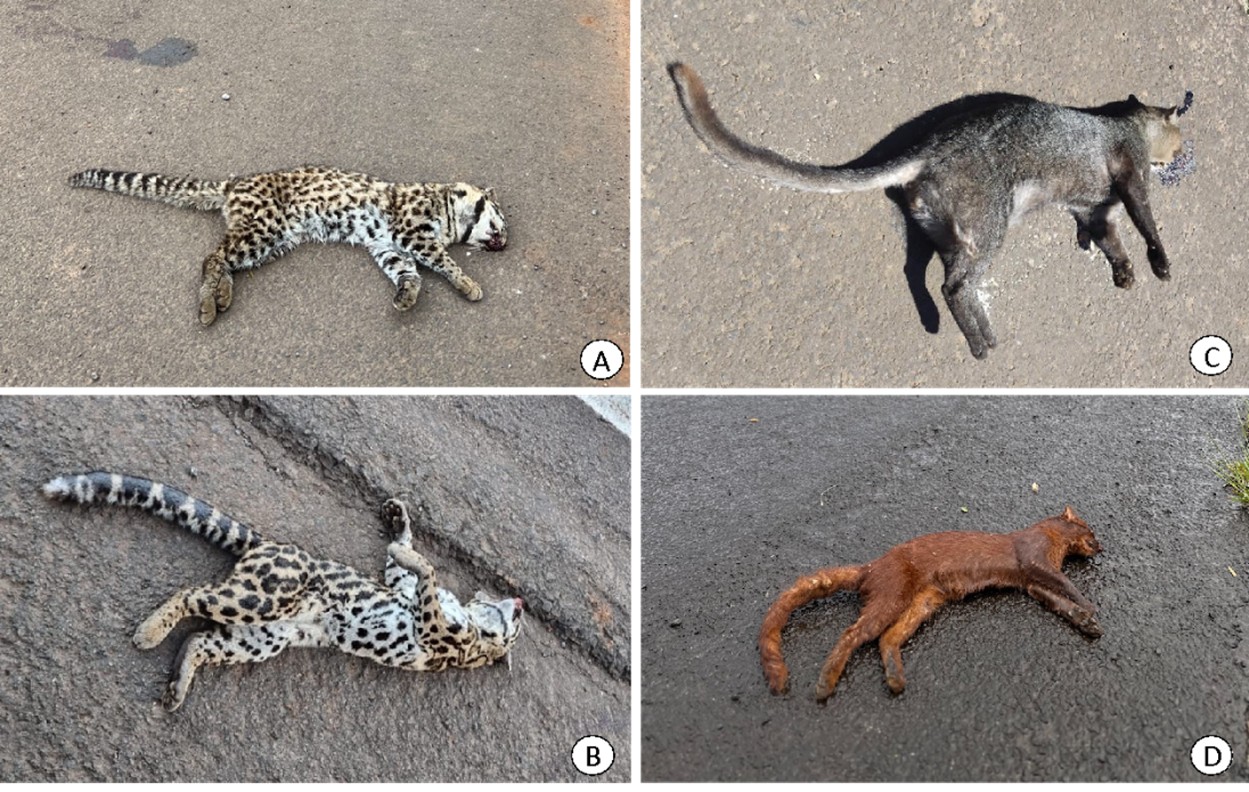
From December 2021 to November 2022, in a 28-km stretch between the cities of São Miguel do Oeste and Paraíso, we covered a total of 1,344 km and recorded 26 road-killed wild felids belonging to three species, viz. southern tigrina (Leopardus guttulus; 50%), margay (Leopardus wiedii; 30,76%) and jaguarundi (Herpailurus yagouaroundi; 19,24%; Figure 1).

Species of road-killed wild felids in a stretch of the BR-282 highway between the cities of São Miguel do Oeste and Paraíso, state of Santa Catarina, Brazil. A) Leopardus guttulus (Hensel, 1872); B) Leopardus wiedii (Schinz, 1821); C and D) Herpailurus yagouaroundi (É. Geoffroy, 1803).
A study conducted between October 2013 and September 2014 in a 145-km stretch of the BR-282 highway between the cities of São Miguel do Oeste and Chapecó in the state of Santa Catarina recorded 13 road kills of felids belonging to two species (Leopardus wiedii and Herpailurus yagouaroundi) (Preuss, 2015). In that same study, a road-kill rate of 0,001 animals/kilometer/day was observed, whereas in our study we found a road-kill rate of 0.019 animals/kilometer/day. This demonstrates that the studied stretch, despite being short, has a large impact on the mortality of these species. The recorded species are classified as vulnerable by the Lista Nacional de Espécies Ameaçadas de Extinção (National List of Threatened Species) (MMA, 2022), which makes this area a priority for the development of conservation strategies. We highlight that L. guttulus, besides being the species with more records in our study, has a severely fragmented population with a continuous reduction of adult individuals (De Oliveira et al., 2016) due to habitat loss, which reduces the capacity of the landscape to support the populations, reducing the connectivity of the population, subdividing it and increasing its isolation (Cushman, 2006; Cushman et al., 2013; Haddad et al., 2015; Haddad et al., 2017). Small and isolated populations are more prone to inbreeding problems and genetic loss, which increases the probability of extinction (Gibbs, 2001; Traill et al., 2010).
The individuals were distributed along the whole stretch analyzed, but a hotspot was detected on a 500-m stretch between the coordinates 26º39’35” S, 53º36’19” W and 26º39’23” S, 53º36’27” (Figure 2), where we found five road-killed specimens. Next to that location is the bridge over the Índio River, which suggests that these animals use the riparian forests as corridors for their displacement (Freitas et al., 2015; Ascensão et al., 2017). Souza et al. (2010) also recorded a larger number of road kills near water bodies.
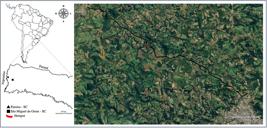
Mapping of the stretch of the BR-282 highway (black line) between the cities of São Miguel do Oeste and Paraíso, state of Santa Catarina, Brazil, with highlight (red) of the area identified as a road-kill hotspot for wild felids.
Regarding the location of the carcasses, L. guttulus and L. wiedii were found in locations with dense vegetation on at least one of the sides of the highway, which is related to the habits of these animals since L. guttulus has forests as its preferable habitat (De Oliveira et al., 2016) and is recorded even in small forest patches and altered areas (Rinaldi et al., 2015; Regolin et al., 2017; Cruz et al., 2018), and L. wiedii is a tree-dwelling species, depending on forest habitats (Sunquist; Sunquist, 2014). The whole studied stretch is located in semi-urban and rural areas, which often have a larger amount of vegetation on the sides of the roads, increasing the risks of road kills of the wild fauna (Kreling et al., 2019; Kent et al., 2021).
Individuals of H. yagouaroundi were found in regions with open vegetation (grasslands/pastures). However, since they are found in all biomes (Oliveira, 1998; Michalski et al., 2007; Lyra-Jorge et al., 2008, Stone et al.; 2009; Melo et al., 2012), they can inhabit more preserved areas to highly altered landscapes (Giordano, 2016; Magioli et al., 2016) and are associated with more open habitats (Oliveira, 1998).
The difference in the number of records between the species can be related to several factors. Among them are the habits of these animals. Both L. guttulus and L. wiedii, because they have predominantly nocturnal habits, become more vulnerable to road kills since at night the lights of the vehicles can immobilize them and hinder their vision as they cross the roads (Gárcia-Sánchez et al., 2023). On the other hand, H. yagouaroundi has predominantly diurnal and terrestrial habits and may show arboreal behavior at night when they are not seeking food (Konecny, 1989; Oliveira, 1998; Giordano, 2016). During the day, they are more easily noticed when they walk on the roads, but at night their coloration can camouflage with the highway, making them difficult to see and favoring road kills.
Another factor interfering with species records is population density. L. guttulus has a density varying between 0.08 and 0.87 animals/km² (Tortato; Oliveira, 2005; Kasper et al., 2016), but its population estimation varies between 1.844 and 9.174 individuals (Trigo et al., 2018). The population of L. wiedii has densities that vary between 0.01 and 0.05 animals/km² but can reach 0.1-0.25 animals/km² in areas considered of high density. Its size is estimated at 4,700 individuals, being notably more abundant in forested areas of the Atlantic Forest in Brazil's South and Southeast regions (Tortato et al., 2018). H. yagouaroundi has population densities that vary from 0.01 to 0.05 animals/km², and the estimations of its population size vary from 5,200 to 26,400 individuals, and it occurs across the whole country (Almeida et al., 2018).
The state of Santa Catarina has been considered the most important area for the conservation of L. guttulus because it harbors the best and likely most viable population of the species, with numbers estimated from 1,500 to 2,600 individuals (most probably near the lower limit) (De Oliveira et al., 2016). This is due to the extension of the Atlantic Forest remnants in the state (Oliveira et al., 2008). Thus, the studied stretch is very important for the record of road kills of these individuals and has a negative impact on the conservation of this species.
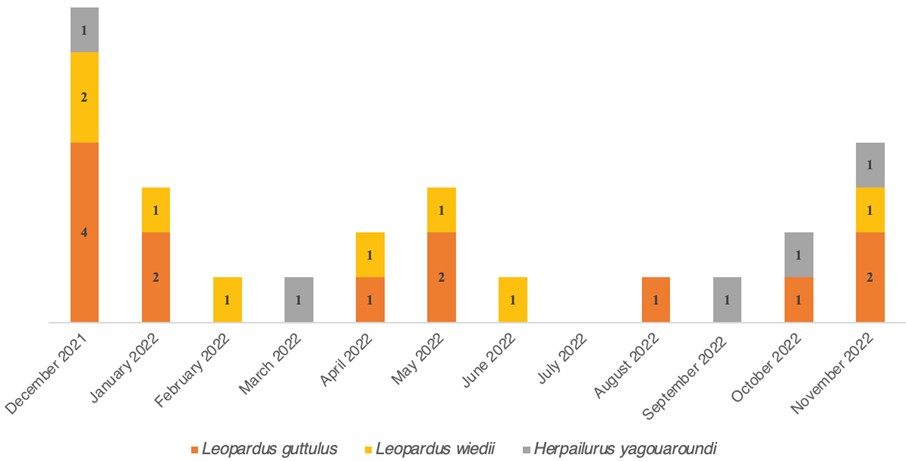
Over the year in which these animals were found, we can observe, in Figure 3, the number of individuals of each species per month. In December 2021 and November 2022, we had the largest number of road-kill records, whereas July 2022 was the only month without records. The lack of records in that month can be related to the reduced displacement of mammals on very cold days since July had the lowest monthly mean temperature in 2022 (INMET, 2022).
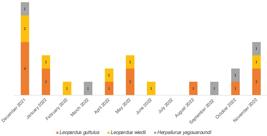
Number of road-killed individuals found per month between December 2021 and November 2022, separated according to species.
When we analyze road kills per period, we notice that there was a higher tendency of road kills in the dry period (n=18) than in the rainy period (n=8), but it was not statistically significant (t =1.6308, p=0.133). Bueno and Almeida (2010) also found a larger number of road-killed animals in the dry period, which was significantly different from the rainy season. They attributed this difference to the scarcity of resources, which forces the animals to increase displacement in search of water and food, thus increasing the need to cross roads that go through their home range.
There was also a larger number of road kills recorded in spring (n=11) than in winter (n=2), but the difference was not statistically significant (t=1.6713, p=0.169). Weiss and Vianna (2012) also found a larger number of road-killed animals in spring, with a statistically significant difference. This larger number of records in spring may be the result of higher food availability or due to the mating period, which increases displacement through the highways in search of food or mating partners (Silva; Vianna, 2009).
Regarding the sex of the carcasses, the number of males (17 specimens) was almost twice as large (sex rate of about 1.9:1) than that of females (nine specimens). These included seven males and six females of L. guttulus, five males and three females of L. wiedii, and five males of H. yagouaroundi, with no female individuals of this species found. December had the largest number of records. Of the seven found, five were males, and this may be related to the reproductive period of these animals, especially regarding L. guttulus and L. wiedii, which have a reproductive seasonality that depends on photoperiod and food availability, beginning in spring and extending until summer (Moreira, 2007). On the other hand, H. yagouaroundi reproduces throughout the whole year (Ewer, 1973; Weigel, 1975).
Another factor that may cause a larger number of road kills of male individuals is the home range of these animals since some studies on wild felids showed that males have a larger home range than females (Konecny, 1989; Sana et al., 2006). This may result in males finding highways more often and, consequently, having a higher risk of being road-killed.
Finally, the studied stretch is located near the border between Brazil and the Province of Misiones, Argentina, where the Yaboti Biosphere Reserve is located and is considered an area of high endemism and high species diversity (Bertonatti; Corcuera, 2000; Myers et al., 2000; Szumik et al., 2012; Brum et al., 2017). Although human-disturbed, we can consider the studied area to be important due to the number of road-killed individuals in a short stretch, which shows the need to increase the protection and connectivity of the local remnants to ensure the ecological viability of the populations.
Among the recommended mitigation measures, we can mention fauna passages (tunnels or bridges), information panels, warning signs, fences, reflective, fauna repellents and speed reducers (Glista et al., 2009; Clevenger; Ford, 2010; Huijser; McGowen, 2010).
CONCLUSIONS
The present study recorded an expressive number of wild felids victims of road kills in a short stretch of the BR-282 highway over one year and identified a road-kill hotspot of these species in an area near a watercourse.
Of the identified species, L. guttulus had the largest number of recorded road kills. Regarding sex, most were males.
Concerning the distribution across the months, we noticed a higher concentration of road kills in the drier months and, regarding the seasons, most road kills occurred in spring.
References
- ALMEIDA, L. B.; QUEIROLO, D.; BEISIEGEL, B. M.; OLIVEIRA, T. G. Puma yagouaroundi In: Instituto Chico Mendes de Conservação da Biodiversidade. INSTITUTO CHICO MENDES DE CONSERVAÇÃO DA BIODIVERSIDADE. (Org.). Livro Vermelho da Fauna Brasileira Ameaçada de Extinção. Brasília: ICMBio, 2018. p. 366-369.
-
ASCENSÃO, F.; DESBIEZ, A. L. J.; MEDICI, E. P.; BAGER, A. Spatial patterns of road mortality of medium-large mammals in Mato Grosso do Sul, Brazil. Wildlife Research, v. 44, n. 2, p. 135-146, 2017. Doi: 10.1071/WR16108
» https://doi.org/10.1071/WR16108 -
BASTIANELLI, M. L.; PREMIER, J.; HERRMANN, M.; ANILE, S. et al Survival and cause specific mortality of European wildcat (Felis silvestris) across Europe. Biological Conservation, v. 261, n. 109239, 2021. Doi: 10.1016/j.biocon.2021.109239
» https://doi.org/10.1016/j.biocon.2021.109239 - BERTONATTI, C.; CORCUERA, J. Situación Ambiental Argentina 2000. Buenos Aires: Fundación Vida Silvestre, 2000. 437 p.
-
BRUM, F. T.; GRAHAM, C. H.; COSTA, G. C.; HEDGES, S. B.; PENONE, C.; RADELOFF, V. C.; RONDININI, C.; LOYOLA, R.; DAVIDSON, A. D. Global priorities for conservation across multiple dimensions of mammalian diversity. The Proceedings of the National Academy of Sciences, v. 144, n. 29, p. 7641-7646, 2017. Doi: 10.1073/pnas.1706461114
» https://doi.org/10.1073/pnas.1706461114 - BUENO, C.; ALMEIDA, P. J. A. L. Sazonalidade de atropelamentos e os padrões de movimentos em mamíferos na BR-040 (Rio de Janeiro - Juiz de Fora). Revista Brasileira de Zoociências, v. 12, n. 3, p. 219-226, 2010.
-
BUENO, C.; SOUSA, C. O. M.; FREITAS, S. R. Habitat or matrix: which is more relevant to predict road-kill of vertebrates? Brazilian Journal of Biology, v. 75, n. 4 suppl 1, p. 228-238, 2015. Doi: 10.1590/1519-6984.12614
» https://doi.org/10.1590/1519-6984.12614 -
CARDILLO, M.; PURVIS, A.; SECHREST, W.; GITTLEMAN, J. L., et al Human population density and extinction risk in the world’s carnivores. PLoS Biology, v. 2, n. 7, p. 0909-0914, 2004. Doi: 10.1371/journal.pbio.0020197
» https://doi.org/10.1371/journal.pbio.0020197 -
CEIA-HASSE, A.; BORDA-DE-ÁGUA, L.; GRILO, C.; PEREIRA, H. M. Global exposure of carnivores to roads. Global Ecology and Biogeography, v. 26, n. 5, p. 592-600, 2017. Doi: 10.1111/geb.12564
» https://doi.org/10.1111/geb.12564 - CLEVENGER, A. P.; FORD, A. T. Wildlife crossing structures, fencing, and other highway design considerations. In: BECKMANN, J. P.; CLEVENGER, A. P.; HUIJSER, M. P.; HILTY, J. A. (eds). Safe passages: highways, wildlife, and habitat connectivity. Washington: Island Press. 2010. p. 17-49.
-
CNT - Confederação Nacional do Transporte. Painel de Consulta Dinâmica aos Resultados da Pesquisa CNT de Rodovias. 2021. Disponível em: https://pesquisarodovias.cnt.org.br/. Acesso em: 12 nov. 2023.
» https://pesquisarodovias.cnt.org.br -
COELHO, A. V. P.; COELHO, I. P.; TEIXEIRA, F. T.; KINDEL, A. Siriema: road mortality software. Manual do Usuário V. 2.0. NERF, UFRGS, Porto Alegre, Brasil. 2014. Disponível em: http://www.ufrgs.br/siriema Acesso em: 2 abr. 2024.
» http://www.ufrgs.br/siriema -
CROOKS, K. R. Relative sensitivities of mammalian carnivores to habitat fragmentation. Conservation Biology, v. 16, n. 2, p. 488-502, 2002. Doi: 10.1046/j.1523-1739.2002.00386.x
» https://doi.org/10.1046/j.1523-1739.2002.00386.x -
CRUZ, P.; IEZZI, M. E.; DE ANGELO, C.; VARELA, D.; DI BITETTI, M. S.; PAVIOLO, A. Effects of human impacts on habitat use, activity patterns and ecological relationships among medium and small felids of the Atlantic Forest. PLoS ONE, v. 13, n. 8, p. 1-21, 2018. Doi: 10.1371/journal.pone.0200806
» https://doi.org/10.1371/journal.pone.0200806 -
CUSHMAN, S. A. Efeitos da perda e fragmentação de habitat em anfíbios: uma revisão e prospecto. Biological Conservation , v. 128, n. 2, p. 231-240. 2006. Doi: 10.1016/j.biocon.2005.09.031
» https://doi.org/10.1016/j.biocon.2005.09.031 -
CUSHMAN, S. A.; LANDGUTH, E. L.; FLATHER, C. H. Avaliando a conectividade populacional para espécies de interesse para a conservação nas Grandes Planícies Americanas. Biodiversity and Conservation, v. 22, n. 11. p. 2583-2605, 2013. Doi: 10.1007/s10531-013-0541-1
» https://doi.org/10.1007/s10531-013-0541-1 -
DE OLIVEIRA, T.; TRIGO, T.; TORTATO, M.; PAVIOLO, A.; BIANCHI, R.; LEITE-PITMAN, M. R. P. Leopardus guttulus The IUCN Red List of Threatened Species. 2016: e.T54010476A54010576. 2016. Doi: 10.2305/IUCN.UK.2016-2.RLTS.T54010476A54010576.en.
» https://doi.org/10.2305/IUCN.UK.2016-2.RLTS.T54010476A54010576.en -
EWER, R. F. The carnivores. Cornell University Press, v. 181, n. 4098, p. 433-434, 1973. Doi: 10.1126/science.181.4098.433.b
» https://doi.org/10.1126/science.181.4098.433.b -
FORMAN, R. T. T.; ALEXANDER, L. E. Roads and their major ecological effects. Annual Review of Ecology and Systematics, v. 29, p. 207-231, 1998. Doi: 10.1146/annurev.ecolsys.29.1.207
» https://doi.org/10.1146/annurev.ecolsys.29.1.207 - FORMAN, R. T. T.; SPERLING, D.; BISSONETTE, J. A.; CLEVENGER, A. P.; CUTSHALL, C. D.; DALE, V. H.; FAHRIG, L.; FRANCE, R.; GOLDMAN, C. R.; HEANUE, K.; JONES, J. A.; SWANSON, F. J.; TURRENTINE, T.; WINTER, T. C . Road Ecology: Science and Solutions. Washington: Island Press , 2003.
-
FREITAS, C. H. Atropelamento de vertebrados nas rodovias MG-428 e SP-334 com análise dos fatores condicionantes e valoração econômica da fauna. 2009. 106 p. Tese (Doutorado em Ciências Biológicas) - Universidade Estadual Paulista Júlio de Mesquita Filho, Rio Claro, Brasil. 2009. Disponível em: https://repositorio.unesp.br/server/api/core/bitstreams/3ea61153-3ead-4059-8988-f1fb3f8f7670/content Acesso em: 14 dez. 2023.
» https://repositorio.unesp.br/server/api/core/bitstreams/3ea61153-3ead-4059-8988-f1fb3f8f7670/content -
FREITAS, S. R.; OLIVEIRA, A. N.; CIOCHETI, G.; VIEIRA, M. V.; MATOS, D. M. S. How landscape features influence road-kill of three species of mammals in the Brazilian savanna? Oecologia Australis, v. 18, p. 35-45, 2015. Doi: 10.4257/oeco.2014.1801.02
» https://doi.org/10.4257/oeco.2014.1801.02 -
GÁRCIA-SÁNCHEZ, S.; JUARÉZ-AGIS, A.; ALVAREZ-ALVAREZ, E. A.; SALOME, B. O.; TORRES, J. Z.; GONZÁLEZ, M. R.; OSORIO-RODRIGUEZ, A. N. Vertebrados silvestres atropellados en asentamientos humanos del Pacífico sur Mexicano. Revista de Biología Tropical, v. 71, n. 1, 2023. Doi: 10.15517/rev.biol.trop..v71i1.53600
» https://doi.org/10.15517/rev.biol.trop..v71i1.53600 -
GIBBS, J. P. Demografia versus fragmentação de habitat como determinantes da variação genética em populações selvagens. Biological Conservation , v. 100, n. 1, p. 15-20. 2001. Doi: 10.1016/S0006-3207(00)00203-2
» https://doi.org/10.1016/S0006-3207(00)00203-2 -
GIORDANO, A. J. Ecology and status of the jaguarundi Puma yagouaroundi: a synthesis of existing knowledge. Mammal Review, v. 46, n. 3, p. 30-43, 2016. Doi: 10.1111/mam.12051
» https://doi.org/10.1111/mam.12051 -
GLISTA, D. J.; DEVAULT, T. L; DEWOODY, J. A. A review of mitigation measures for reducing wildlife mortality on roadways. Landscape and Urban Planning, v. 91, n. 1, p. 1-7. 2009. Doi: 10.1016/j.landurbplan.2008.11.001
» https://doi.org/10.1016/j.landurbplan.2008.11.001 -
GOOGLE EARTH WEBSITE. 2023. Disponível em: https://earth.google.com/web Acesso em: 8 abr. 2024.
» https://earth.google.com/web -
GRILO, C.; KOROLEVA, E.; ANDRÁSIK, R.; BÍL, M.; GONZÁLEZ-SUÁREZ, M. Roadkill risk and population vulnerability in European birds and mammals. Frontiers in Ecology and the Environment, v. 18, n. 6, p. 323- 328, 2020. Doi: 10.1002/fee.2216
» https://doi.org/10.1002/fee.2216 -
HADDAD, N. M.; BRUDVIG, L. A.; CLOBERT, J.; DAVIES, K. F.; GONZALEZ, A.; HOLT, R. D.; LOVEJOY, T. E.; SEXTON, J. O.; AUSTIN, M. P.; COLLINS, C. D.; COOK, W. M. Habitat fragmentation and its lasting impact on Earth’s ecosystems. Sciences Advances, v. 1, n. 2, p. 1-9, 2015. Doi: 10.1126/sciadv.1500052
» https://doi.org/10.1126/sciadv.1500052 -
HADDAD, N. M.; HOLT, R. D.; JR FLETCHER, R. J.; LOREAU, M.; CLOBERT, J. Conectando modelos, dados e conceitos para compreender os efeitos da fragmentação em todo o ecossistema. Ecografia, v. 40, n. 1, p. 1-8. 2017. Doi: 10.1111/ecog.02974
» https://doi.org/10.1111/ecog.02974 - HAMMER, Ø.; HARPER, D. A. T.; RYAN, P. D. PAST: Paleontological Statistics Software Package for Education and Data Analysis. Palaeontologia Electronica, v. 4, n. 1, p. 1-9, 2001.
-
HILL, J. E.; DEVAULT, T. L.; BELANT, J. L. Cause-specific mortality of the world’s terrestrial vertebrates. Global Ecology and Biogeography , v. 28, n. 5, p. 680-689, 2019. Doi: 10.1111/geb.12881
» https://doi.org/10.1111/geb.12881 - HUIJSER, M. P.; MCGOWEN, P. T. Reducing wildlife-vehicle collisions. In: BECKMANN, J. P.; CLEVENGER, A. P.; HUIJSER, M. P.; HILTY, J. A. (eds.). Safe passages. Washington: Island Press, 2010; 51-74p.
-
IBGE - Instituto Brasileiro de Geografia e Estatística. Panorama do censo. 2022. Disponível em: https://censo2022.ibge.gov.br/panorama/. Acesso em: 12 dez. 2023.
» https://censo2022.ibge.gov.br/panorama -
ICMBIO - Instituto Chico Mendes de Conservação da Biodiversidade. Carnívoros Brasileiros. 2020. Disponível em: https://www.icmbio.gov.br/cenap/carnivoros-brasileiros.html Acesso em: 11 out. 2023.
» https://www.icmbio.gov.br/cenap/carnivoros-brasileiros.html -
INMET - Instituto Nacional de Meteorologia. Histórico de dados meteorológicos. 2022. Disponível em: https://portal.inmet.gov.br/. Acesso em: 01 abr. 2024.
» https://portal.inmet.gov.br -
JACKSON, N. D.; FAHRIG, L. Relative effects of road mortality and drecresed connectivity on population genetic diversity. Biological Conservation , v. 144, n. 12 p. 3143-3148, 2011. Doi: 10.1016/j.biocon.2011.09.010
» https://doi.org/10.1016/j.biocon.2011.09.010 -
KASPER, C. B.; SCHNEIDER, A.; OLIVEIRA, T. G. Home range and density of three sympatric felids in the southern Atlantic Forest, Brazil. Brazilian Journal of Biology , v. 76, n. 1, p. 228-232, 2016. Doi: 10.1590/1519-6984.19414
» https://doi.org/10.1590/1519-6984.19414 -
KENT, E.; SCHWARTZ, A. L. W.; E PERKINS, S. E. Life in the fast lane: roadkill risk along an urban-rural gradient. Journal of Urban Ecology, v. 7, n. 1, p. 1-11, 2021. Doi: 10.1093/jue/juaa039
» https://doi.org/10.1093/jue/juaa039 - KONECNY, M. J. Movement patterns and food habits of four sympatric carnivore species in Belize, Central America. Advances in Neotropical mammalogy, p. 243-264, 1989.
-
KRELING, S. E. S.; GAYNOR, K. M.; COON, C. A. C. Roadkill distribution at the wildland-urban interface. The Journal of Wildlife Management, v. 83, n. 6, p. 1427-1436, 2019. Doi: 10.1002/jwmg.21692
» https://doi.org/10.1002/jwmg.21692 -
LAURANCE, W. F.; GOOSEM, M.; LAURANCE, S. G. Impacts of roads and linear clearings on tropical forests. Trends in Ecology & Evolution, v. 24, n. 12, p. 659-669, 2009. Doi: 10.1016/j.tree.2009.06.009
» https://doi.org/10.1016/j.tree.2009.06.009 -
LAUXEN, M. S. A mitigação dos impactos de rodovias sobre a fauna: um guia de procedimentos para tomada de decisão. 2012. 163 p. Trabalho de conclusão de curso (Pós-graduação em Diversidade e Conservação da Fauna). Universidade Federal do Rio Grande do Sul, Porto Alegre, Brasil. 2012. Disponível em: https://lume.ufrgs.br/bitstream/handle/10183/72378/000877896.pdf?sequence=1 Acesso em: 14 dez. 2023.
» https://lume.ufrgs.br/bitstream/handle/10183/72378/000877896.pdf?sequence=1 -
LYRA-JORGE, M. C.; CIOCHETI, G.; PIVELLO, V. R. Carnivore mammals in a fragmented landscape in northeast of São Paulo State, Brazil. Biodiversity and Conservation , v. 17, p. 1573- 1580, 2008. Doi: 10.1007/s10531-008-9366-8
» https://doi.org/10.1007/s10531-008-9366-8 -
MAGIOLI, M.; FERRAZ, K. M. P. M. B.; SETZ, E. Z. F.; PERCEQUILLO, A. R.; RONDON, M. V. S. S.; KUHNEN, V. V.; CANHOTO, M. C. S.; SANTOS, K. E. A.; KANDA, C. Z.; FREGONEZI, G. L.; PRADO, H. A.; FERREIRA, M. K.; RIBEIRO, M. C.; VILLELA, P. M. S.; COUTINHO, L. L.; RODRIGUES, M. G. Connectivity maintain mammal assemblages functional diversity within agricultural and fragmented landscapes. European Journal of Wildlife Research , v. 62, n. 4, p. 431-446, 2016. Doi: 10.1007/s10344-016-1017-x
» https://doi.org/10.1007/s10344-016-1017-x -
MELO, G. L.; SPONCHIADO, J.; CACERES, N. C. Use of camera-traps in natural trails and shelters for the mammalian survey in the Atlantic Forest. Iheringia, Série Zoologia, v. 102, p. 88-94, 2012. Doi: 10.1590/S0073-47212012000100012
» https://doi.org/10.1590/S0073-47212012000100012 -
MICHALSKI, F.; CRAWSHAW JR, P. G.; OLIVEIRA, T. G.; FABIÁN, M. E. Efficiency of box-traps and leg-hold traps with several bait types for capturing small carnivores (Mammalia) in a disturbed area of Southeastern Brazil. Revista de Biología Tropical , v. 55, n. 1, p. 315-320, 2007. Acesso em Doi: 10.15517/rbt.v55i1.6083
» https://doi.org/10.15517/rbt.v55i1.6083 -
MMA - Ministério do Meio Ambiente. Portaria nº 148 de 7 de julho de 2022. Altera os Anexos da Portaria nº 443, de 17 de dezembro de 2014, da Portaria nº 444, de 17 de dezembro de 2014, e da Portaria nº 445, de 17 de dezembro de 2014, referentes à atualização da Lista Nacional de Espécies Ameaçadas de Extinção, 2022. Disponível em: https://www.icmbio.gov.br/cepsul/images/stories/legislacao/Portaria/2020/P_mma_148_2022_altera_anexos_P_mma_443_444_445_2014_atualiza_especies_ameacadas_extincao.pdf Acesso em: 13 nov. 2023.
» https://www.icmbio.gov.br/cepsul/images/stories/legislacao/Portaria/2020/P_mma_148_2022_altera_anexos_P_mma_443_444_445_2014_atualiza_especies_ameacadas_extincao.pdf -
MOREIRA, N. Reprodução e estresse em felídeos silvestres. Revista Brasileira de Reprodução Animal, v. 31, n. 3, p. 333-338, 2007. Disponível em: http://www.cbra.org.br/pages/publicacoes/rbra/download/333.pdf Acesso em: 8 nov. 2023.
» http://www.cbra.org.br/pages/publicacoes/rbra/download/333.pdf -
MYERS, N.; MITTERMEIER, R. A.; MITTERMEIER, C. G.; FONSECA, G. A. B.; KENT, J. Biodiversity hotspots for conservation priorities. Nature, v. 403, p. 853-858, 2000. Doi: 10.1038/35002501
» https://doi.org/10.1038/35002501 -
OLIVEIRA, T. G. Herpailurus yagouaroundi Mammalian Species, v. 578, p. 1-6, 1998. Doi: 10.2307/3504500
» https://doi.org/10.2307/3504500 - OLIVEIRA, T. G.; KASPER, C. B.; TORTATO, M. A.; MARQUES, R. V.; MAZIM, F. D. E.; SOARES, J. B. G. Aspectos ecológicos de Leopardus tigrinus e outros felinos de pequeno-médio porte no Brasil. In: Oliveira, T. G. (ed.), Plano de ação para conservação de Leopardus tigrinus no Brasil. Atibaia: Instituto Pró-Carnívoros/Fundo Nacional do Meio Ambiente, 2008.
-
PEEL, M. C.; FINLAYSON, B. L.; MCMAHON, T. A. Updated world map of the Köppen-Geiger climate classification. Hydrology and Earth System Sciences, v. 11, p. 1633-1644, 2007. Doi: 10.5194/hess-11-1633-2007
» https://doi.org/10.5194/hess-11-1633-2007 -
PEREIRA, A. P. F. G.; ANDRADE, F. A. G.; FERNANDES, M. E. B. Dois anos de monitoramento dos atropelamentos de mamíferos na rodovia PA-458, Bragança, Pará. Boletim Museu Paraense Emílio Goeldi, v. 1, n. 3, p. 77-83, 2006. Doi: 10.46357/bcnaturais.v1i3.731
» https://doi.org/10.46357/bcnaturais.v1i3.731 -
PERONI, N.; HERNÁNDEZ, M. I. M. Ecologia de populações e comunidades. Florianópolis: CCB/EAD/UFSC, 2011. Disponível em: https://antigo.uab.ufsc.br/biologia//files/2020/08/Ecologia-de-Popula%C3%A7%C3%B5es-e-Comunidades.pdf Acesso em: 1 de abril de 2024.
» https://antigo.uab.ufsc.br/biologia//files/2020/08/Ecologia-de-Popula%C3%A7%C3%B5es-e-Comunidades.pdf - PREUSS, J. F. Composição e caracterização da fauna de mamíferos de médio e grande porte atropelados em trecho da BR-282, oeste do Estado de Santa Catarina. Unoesc & Ciência - ACBS Joaçaba, v. 6, n. 2, p. 179-186, 2015.
-
PREUSS, J. F.; GREENSPAN, S. E.; ROSSI, E. M.; LUCAS GONSALES, E. M.; NEELY, W. J.; VALIATI, V. H.; WOODHAMS, D. C.; BECKER, C. G.; TOZETTI, A. M. Widespread Pig Farming Practice Linked to Shifts in Skin Microbiomes and Disease in Pond-Breeding Amphibians. Environmental Science & Technology, v. 54, p. 11301-11312, 2020. Doi: 10.1021/acs.est.0c03219
» https://doi.org/10.1021/acs.est.0c03219 -
RAMOS-ABRANTES, M. M.; CARREIRO, A. N.; ARAÚJO, D. V. F.; SOUZA, J. G.; LIMA, J. P. R.; CEZAR, H. R. A.; LEITE, L. S.; ABRANTES, S. H. F. Vertebrados silvestres atropelados na rodovia BR-230, Paraíba, Brasil. Pubvet, v. 12, n. 1, p. 1-7, 2018. Doi: 10.22256/pubvet.v12n1a5.1-7
» https://doi.org/10.22256/pubvet.v12n1a5.1-7 -
REGOLIN, A. L.; CHEREM, J. J.; GRAIPEL, M. E.; BOGONI, J. A.; RIBEIRO, J. W.; VANCINE, M. H.; TORTATO, M. A.; OLIVEIRA-SANTOS, L. G.; FANTACINI, F. M.; LUIZ, M. R.; CASTILHO, P. V.; RIBEIRO, M. C.; CÁCERES, N. C. Forest cover influences occurrence of mammalian carnivores within Brazilian Atlantic Forest. Journal of Mammalogy, v. 98, n. 6, p. 1721-1731, 2017. Doi: 10.1093/jmammal/gyx103
» https://doi.org/10.1093/jmammal/gyx103 -
REIS, N. R.; PERACCHI, A. L.; PEDRO, W. A.; LIMA, I. P. Mamíferos do Brasil. In: REIS, N. R.; PERACCHI, A. L.; PEDRO, W. A.; LIMA, I. P. (eds). Divisão de Processos Técnicos da Biblioteca Central da Universidade Estadual de Londrina. 2. ed. Londrina: EDUEL, 2006. p. 17-25. Disponível em: https://pos.uel.br/biologicas/wp-content/uploads/2021/06/Livro-completo-Mamiferos-do-Brasil.pdf Acesso em: 14 dez. 2023.
» https://pos.uel.br/biologicas/wp-content/uploads/2021/06/Livro-completo-Mamiferos-do-Brasil.pdf -
RINALDI, A. R.; RODRIGUEZ, F. H.; CARVALHO, A, L.; PASSOS, F. C. Feeding of small Neotropical felids (Felidae: Carnivora) and trophic niche overlap in anthropized mosaic landscape of South Brazil. Biotemas, v. 28, n. 4, p. 155-168, 2015. Doi: 10.5007/2175-7925.2015v28n4p155
» https://doi.org/10.5007/2175-7925.2015v28n4p155 -
RIPPLE, W. J.; WOLF, C.; NEWSOME, T. M.; GALETTI, M.; ALAMGIR, M.; CRIST, E.; MAHMOUD, M. I.; LAURANCE, W. F. World scientists’ warning to humanity: a second notice. BioScience, v. 67, n. 12, p. 1026-1028, 2017. Doi: 10.1093/biosci/bix125
» https://doi.org/10.1093/biosci/bix125 -
SANA, D. A.; CULLEN, J. R. L.; EIZIRIK, E. Ecologia, conservação e manejo in situ e ex situ de grandes felinos do Alto Rio Paraná. Instituto para a conservação dos carnívoros neotropicais. Pró-carnívoros, 2006. Disponível em: https://www.imasul.ms.gov.br/wp-content/uploads/2015/06/15-conservacaomanejodegrandesfelinos2004-2006.pdf Acesso em: 18 dez. 2023.
» https://www.imasul.ms.gov.br/wp-content/uploads/2015/06/15-conservacaomanejodegrandesfelinos2004-2006.pdf - SANTA CATARINA. Gabinete de Planejamento e Coordenação Geral. Atlas de Santa Catarina. Rio de Janeiro: Aerofoto Cruzeiro, 1991. 173 p.
-
SEILER, A. E.; HELLDIN, J. O. Mortality in wildlife due to transportation. In: DAVENPORT, J.; DAVENPORT, J. L. (eds). The ecology of transportation: managing mobility for the environment. Environment pollution, v. 10, p. 165-189, 2006. Doi: 10.1007/1-4020-4504-2_8
» https://doi.org/10.1007/1-4020-4504-2_8 -
SIH, A. Understanding variation in behavioral responses to human-induced rapid environmental change: a conceptual overview. Animal Behaviour, v. 85, n. 5, p. 1077-1088, 2013. Doi: 10.1016/j.anbehav.2013.02.017
» https://doi.org/10.1016/j.anbehav.2013.02.017 - SILVA, G. J. T.; VIANNA, V. O. Levantamento de animais atropelados em trecho da Rodovia BR-376 nas proximidades no Parque Estadual de Vila Velha, Ponta Grossa, Paraná. 2009. Trabalho de conclusão de curso, Universidade Estadual de Ponta Grossa, Paraná, 2009.
-
SOUZA, S. A.; LUCCA, A. L. T.; DICKFELDT, E. P.; OLIVEIRA, P. R. Impactos de atropelamentos de animais silvestres no trecho da Rodovia SP-215 confrontante ao parque estadual de Porto Ferreira - Porto Ferreira, SP (Nota Científica). Revista do Instituto Florestal, v. 22, n. 2, p. 315-323, 2010. Doi: 10.24278/2178-5031.2010222271
» https://doi.org/10.24278/2178-5031.2010222271 -
STONE, A. I.; LIMA, E. M.; AGUIAR, G. F. S.; CAMARGO, C. C.; FLORES, T. A.; KELT, D. A.; MARQUES-AGUIAR, S. A.; QUEIROZ, J. A. L.; RAMOS, R. M.; JÚNIOR, J. S. S. Nonvolant mammalian diversity in fragments in extreme eastern Amazonia. Biodiversity and Conservation , v. 18, p. 1685-1694, 2009. Doi: 10.1007/s10531-008-9551-9
» https://doi.org/10.1007/s10531-008-9551-9 -
SUNQUIST, F.; SUNQUIST, M. The Wild Cat Book: Everything you ever wanted to know about cats. Chicago: University Of Chicago Press, 2014. 280 p. Doi: 10.7208/chicago/9780226145761.001.0001
» https://doi.org/10.7208/chicago/9780226145761.001.0001 -
SZUMIK, C.; AAGESEN, L.; CASAGRANDA, D.; ARZAMENDIA, V.; BALDO, D.; CLAPS, L. E.; CUEZZO, F.; GÓMEZ, J. M. D.; GIACOMO, A. D.; GIRAUDO, A.; GOLOBOFF, P.; GRAMAJO, C.; KOPUCHIAN, C.; KRETZSCHMAR, S.; LIZARRALDE, M.; MOLINA, A.; MOLLERACH, M.; NAVARRO, F.; NOMDEDEU, S.; PANIZZA, A.; PEREYRA, V. V.; SANDOVAL, M.; SCROCCHI, G.; ZULOAGA, F. O. Detecting areas of endemism with a taxonomically diverse data set: plants, mammals, reptiles, amphibians, birds and insects from Argentina. Cladistics, v. 28, n. 3, p. 317-329, 2012. Doi: 10.1111/j.1096-0031.2011.00385.x.
» https://doi.org/10.1111/j.1096-0031.2011.00385.x. - TORTATO, M. A.; OLIVEIRA, T. G. Ecology of the oncilla (Leopardus tigrinus) at Serra do Tabuleiro State Park, Southern Brazil. Cat News, v. 42, p. 28-30, 2005.
- TORTATO, M. A.; OLIVEIRA, T. G.; ALMEIDA, L. B.; BEISIEGEL, B. M. Leopardus wiedii In: Instituto Chico Mendes de Conservação da Biodiversidade. (Org.). Livro Vermelho da Fauna Brasileira Ameaçada de Extinção. Brasília: ICMBio , 2018. p. 349-352.
-
TRAILL, L. W.; BROOK, B. W.; FRANKHAM, R. R.; BRADSHAW, C. J. Metas pragmáticas de viabilidade populacional em um mundo em rápida mudança. Biological Conservation , v. 143, n. 1, p. 28-34, 2010. Doi: 10.1016/j.biocon.2009.09.001
» https://doi.org/10.1016/j.biocon.2009.09.001 - TRIGO, T.; OLIVEIRA, T. G.; TORTATO, M. A.; ALMEIDA, L. B.; CAMPO, C. B.; BEISIEGEL, B. M. Leopardus guttulus In: Instituto Chico Mendes de Conservação da Biodiversidade. (Org.). Livro Vermelho da Fauna Brasileira Ameaçada de Extinção . Brasília: ICMBio , 2018. p. 340-344.
-
VAN DER REE, R.; SMITH, D. J.; GRILO, C. The ecological effects of linear infrastructure and traffic. In: VAN DER REE, R.; SMITH, D. J.; GRILO, C. (eds). Handbook of Road Ecology. Hoboken: Wiley Blackwell, 2015. 560 p. Doi: 10.1002/9781118568170
» https://doi.org/10.1002/9781118568170 - WEIGEL, I. Small felids and clouded leopards. In: ALTEVOGT, R.; ANGERMANN, R.; DATHE, H.; GRZIMEK, B.; HERTER, K.; MÜLLER-USING, D.; RHAM, U.; THENIUS, E. Grzimek’s animal life encyclopedia. New York: Van Nostrand Reinhold, v. 12, n. 1, p. 281-332, 1975.
-
WEISS, L. P.; VIANNA, V. O. Levantamento do impactos das rodovias BR-376, BR-373 e BR-277, trecho de Apucarana a Curitiba, Paraná, no atropelamento de animais silvestres. Publicatio UEPG: Ciências Biológicas e da Saúde, v. 18, n. 2, p. 121-133, 2012. Doi: 10.5212/publicatio%20uepg.v18i2.4009
» https://doi.org/10.5212/publicatio%20uepg.v18i2.4009

 Source: The authors (2022).
 Source: Software Siriema 2.0 (
 Source: The authors (2022).