
 Origin and Impact of Territorial Enclaves from the Perspective of Fragmentation
Abstract
The research presents new perspectives on understanding a socio-spatial process, clearly distinguishing between the center-periphery segregation pattern and the fragmentation model. This article analyzes the expansion of territorial enclaves at various scales, offering a comparative investigation of the growth and concentration of horizontal residential condominiums in major Brazilian cities. Therefore, the categories, various levels of analysis, temporal and geographical scales, types of impacts, and socio-spatial processes were defined. The terms "row house" or "condominium house" were used in the category of permanent private households in the demographic census conducted by the Brazilian Institute of Geography and Statistics (IBGE) in 2022. Additionally, data from the Economic Research Institute Foundation (FIPE) were utilized to identify sectors with a high concentration of horizontal residential enclaves. In this context, the socio-spatial structure of the Metropolitan Region of Fortaleza has undergone significant changes due to new developments featuring physical barriers and controlled access. These changes create social distancing despite physical proximity. The study points to a reorganization of the metropolitan urban fabric towards urban fragmentation in specific sections of Fortaleza and its neighboring municipalities, Aquiraz and Eusébio. There is an emergence of diverse types of residential enclaves that offer a wide range of leisure facilities, commerce, and services within their perimeters. This provides them with significant autonomy compared to the traditional city. In this context, residential patterns are influenced by urban insecurity, which reshapes daily life and establishes new forms of social separation and physical divides.
Keywords:
Urban Insecurity; Segregation; Horizontal Condominiums
Resumo
A pesquisa vislumbra novas perspectivas para compreensão de um processo socioespacial com distinções nítidas do padrão de segregação centro-periferia para o modelo de fragmentação. Este artigo analisa a expansão dos enclaves territoriais em diferentes escalas, fazendo uma investigação comparativa da ampliação e concentração dos condomínios residenciais horizontais nas principais cidades brasileiras. Desse modo, foram definidas as categorias, os diferentes níveis de análise, as escalas temporal e geográfica, os tipos de impactos e processos socioespaciais. Foi utilizado a variável casa de vila ou em condomínio, na categoria dos domicílios particulares permanentes, no censo demográfico do Instituto Brasileiro de Geografia e Estatística (IBGE), referente ao ano de 2022 e dados da Fundação Instituto de Pesquisas Econômicas (FIPE) para delimitar os setores de alta concentração de enclaves residenciais horizontais. Nesse âmbito, o tecido socioespacial da Região Metropolitana de Fortaleza vem passado por significativas transformações resultantes de novos empreendimentos com barreiras físicas e acessos controlados e vigiados que produzem um distanciamento social com proximidade física. O estudo aponta para uma reorganização do tecido urbano metropolitano em direção à fragmentação urbana em trechos específicos de Fortaleza e dos municípios do seu entorno (Aquiraz e Eusébio). Há um aparecimento de diversos tipos de enclaves residenciais, nos quais possuem uma grande variedade de equipamentos de lazer, comércio e serviços dentro de seus perímetros, que confere a eles uma enorme autonomia em relação à cidade tradicional. Nessa situação, os padrões residenciais têm como base a insegurança urbana que redimensiona a vida cotidiana e implanta novas formas de separação dos grupos e rupturas físicas.
Palavras-chave:
Insegurança Urbana; Segregação; Condomínios Horizontais
INTRODUCTION
The first exclusive residential areas, which share some characteristics with today's gated communities, emerged from a mix of varied urban proposals in Anglo-Saxon countries. However, nowadays, the widespread development of these real estate products has become a global phenomenon, observed in numerous countries around the world. In Brazil, the restructuring of the real estate and financial market, along with the rise in urban insecurity since the 1990s, has prompted a shift in real estate strategies, which emphasizes the development and availability of gated residential communities with restricted access, particularly in large and medium-sized cities, focusing on the Metropolitan Region of Fortaleza (RMF).
This article discusses the rise of horizontal residential enclaves in major Brazilian cities. The expansion in residential developments can be attributed to heightened fear and urban insecurity in many cities, significantly impacting the urban fabric. Therefore, they adopt a residential model that emphasizes limiting social interactions to shared spaces exclusively for condominium owners. This proposal combines physical barriers and controlled entry points, such as guardhouses, with security devices, monitoring, and surveillance services, as well as patrols and armed guards in and around the enterprises.
In this perspective, residential patterns have been redesigned based on an aesthetic of fear. The architecture of fear conditions everyday life, modifies urban paths, and establishes new forms of physical separation and rupturing of territories. The traditional place of interactions between people - public spaces - "acquire a new meaning in a city that is progressively surrounded by walls" (Schachter, 2015, p. 86, our translation).
In this context, the idea of "suppressing" public spaces (Davis, 1993) and the rise of social phobia (Bauman, 2007) or elitist escapism (Souza, 2008) is promoted. The fear of engaging in authentic urban life, driven by the perception of danger and threats, fosters the creation of homogeneous communities that isolate themselves from external otherness. (Caldeira, 2000; Gomes, 2006).
The concept of territorial enclaves, initially introduced by the Portuguese geographer Salgueiro (1998, p. 39), describes enterprises that lack continuity with the surrounding socio-spatial environment. This situation highlights a significant rise in differentiation and disconnection among various groups, organizations, and territories. Caldeira (2000, p. 259) uses the term "fortified enclaves" to describe modern segregation, characterized by new urban developments that share a common feature: they are residential, commercial, or leisure spaces surrounded by monitored and guarded walls or fences. Furthermore, they prioritize the private and despise what is public and open; "They are relatively autonomous spaces, independent from their surroundings."
Most residential developments, whether multi-family or single-family, today exhibit some characteristics of gated communities. However, the term "horizontal residential enclave" refers explicitly to walled single-family developments that include security features, leisure facilities, and services.
This article aims to explain the origin and growth of territorial enclaves at various scales. It provides a comparative analysis of the expansion and concentration of horizontal residential condominiums in major Brazilian cities, with a particular focus on the Metropolitan Region of Fortaleza. The shift from the dual segregation model (center-periphery) to urban fragmentation in certain areas of the MRF is emphasized.
Methodological procedures were established, defining categories, various levels of analysis, temporal and geographical scales, and the types of impacts and socio-spatial processes relevant to the study. From a theoretical and methodological perspective, the relationship between metropolitan and municipal scales enables us to analyze and assess the impacts of the excessive development of horizontal residential condominiums in the Metropolitan Region of Fortaleza.
The row house or condominium variable, in the category of permanent private households from the Instituto Brasileiro de Geografia e Estatística, (Brazilian Institute of Geography and Statistics), enabled comparisons of residential properties defined by some type of physical barrier and entry control. Based on these data, the selection of São Paulo, Rio de Janeiro, Belo Horizonte, Porto Alegre, Salvador, Recife, and Fortaleza was established to evaluate the identified problem (IBGE, 2022). Data from the Zap Imóveis platform, using a variable for condominium houses, were used to identify sectors with a high concentration of horizontal residential enclaves in Fortaleza (FIPE, 2025).
Through this study, it is possible to describe and discuss the intensification of socio-spatial differentiation and physical-spatial and socio-territorial discontinuities in the Fortaleza Metropolitan Region. Since the 2000s, there has been an increase in horizontal residential condominiums that offer a variety of leisure facilities and services in their communal areas, leading to a reduced reliance on the city. This housing model is based on various urban concepts, but its widespread growth has had significant effects on the urban fabric of many cities.
ORIGIN AND EXPANSION OF TERRITORIAL ENCLAVES
Many characteristics of today's residential enclaves are rooted in the Garden City model and New Urbanism. However, as early as the 1970s, gated communities, using a broader range of terminology, became a significant aspect of the development and organization of contemporary urban spaces, influencing the production of large Brazilian cities.
The growing concern about vulnerability to everyday crime-and, in some countries, anxiety over occasional terrorist attacks and ethnic-racial issues-has given rise to a new form of spatial segregation: gated communities. These are enclosed, walled, and private residential areas designed to enhance security. To avoid intrusions into their private domains, Americans were the first to choose to live behind walls, protected by residential security mechanisms. (Blakely; Snyde, 1997; Souza, 2008; Davis, 1993).
These new residential patterns are already part of the urban landscape of countries such as Portugal, France, England, Holland, Turkey, China, Russia, Bulgaria, Lebanon, Brazil, Mexico, Argentina, Chile, South Africa, Angola, India, Malaysia, Singapore and Australia (Caldeira, 2000; Landman, 2000; Janoschka, 2002; Barajas, 2006; Souza, 2008; Raposo, 2012).
The Garden City model, which became prominent in the twentieth century, is recognized as a highly influential urban planning concept in the Anglo-Saxon world. Many authors also suggest that it has shaped the principles behind what are now known as gated communities. (Caldeira, 2000; Raposo, 2012; Bizzio; Zuin, 2016).
The Garden City model has influenced urban planning in several cities worldwide, including those in Brazil, during the 1950s and 1960s. However, many of the ideals from traditional urban planning have been reinterpreted in modern urban projects. Notable features adopted by residential enclaves include a degree of autonomy from the traditional city, lower population density, and the placement of these developments in suburban areas or the outskirts of metropolitan regions.
Nevertheless, asserting that gated communities originate solely from the Garden City concept oversimplifies a complex phenomenon. According to Caldeira (2000), many principles associated with exclusive condominiums arise from a range of complex and diverse influences.
According to Freitas (2019), the 1970s were characterized by a reaction against traditional ways of 'thinking' about cities. In this context, New Urbanism has emerged as a significant contemporary urban trend that blends current and historical styles, notably influencing the model of gated communities. Aesthetically, this movement is associated with Post-Modernism and originated in the USA, gaining prominence during the 1980s and 1990s.
As a result, many concepts of New Urbanism, which were formally established in 1996, have been selectively applied to residential enclaves. This includes practices such as the private management of residential areas, the creation of socioeconomically homogeneous neighborhoods, the provision of leisure facilities and private services, the preservation of natural spaces for the exclusive enjoyment of condominium owners, and the revival of several principles from the Garden City ideal.
It is important to note that the influence of the first gated communities often confuses the concept of a gated community with a sense of community, leading them to be occasionally considered synonymous. However, over time, real estate developments have incorporated defensive architectural features, altering the way dominant social groups interact with various spaces in the city (Caldeira, 2000). From this perspective, Blackely and Snyder (1997) emphasize that the combination of residents' associations and gated communities-literally defined as communities with barriers-has led to a housing pattern defined by status and social isolation.
The current model of exclusive condominiums is shaped by heterogeneous influences that incorporate both urban practices and principles from the past into contemporary projects. As a result, particular strategies for territorial control reinforce the desire to separate middle- and high-income social groups within gated communities. (Blackely; Snyder, 1997; Caldeira, 2000; Souza, 2008).
The increased sense of insecurity is a subterfuge "alleged" by the elites to protect themselves in walled and guarded residential complexes in Latin American cities such as Guadalajara (Barajas, 2006; Núñez; Alvis, 2014), Buenos Aires (Prévôt-schapira, 2001; Janoschka, 2002), Santiago de Chile (Lencioni, 2011), São Paulo (Caldeira, 2000; D'ottaviano, 2008), Rio de Janeiro (Lago, 2002) and Fortaleza (Freitas; Costa, 2022); and even in medium-sized Brazilian cities such as Marília, Presidente Prudente and Ribeirão Preto (Miño, 2004; Zandonadi, 2008; Dal Pozzo, 2015).
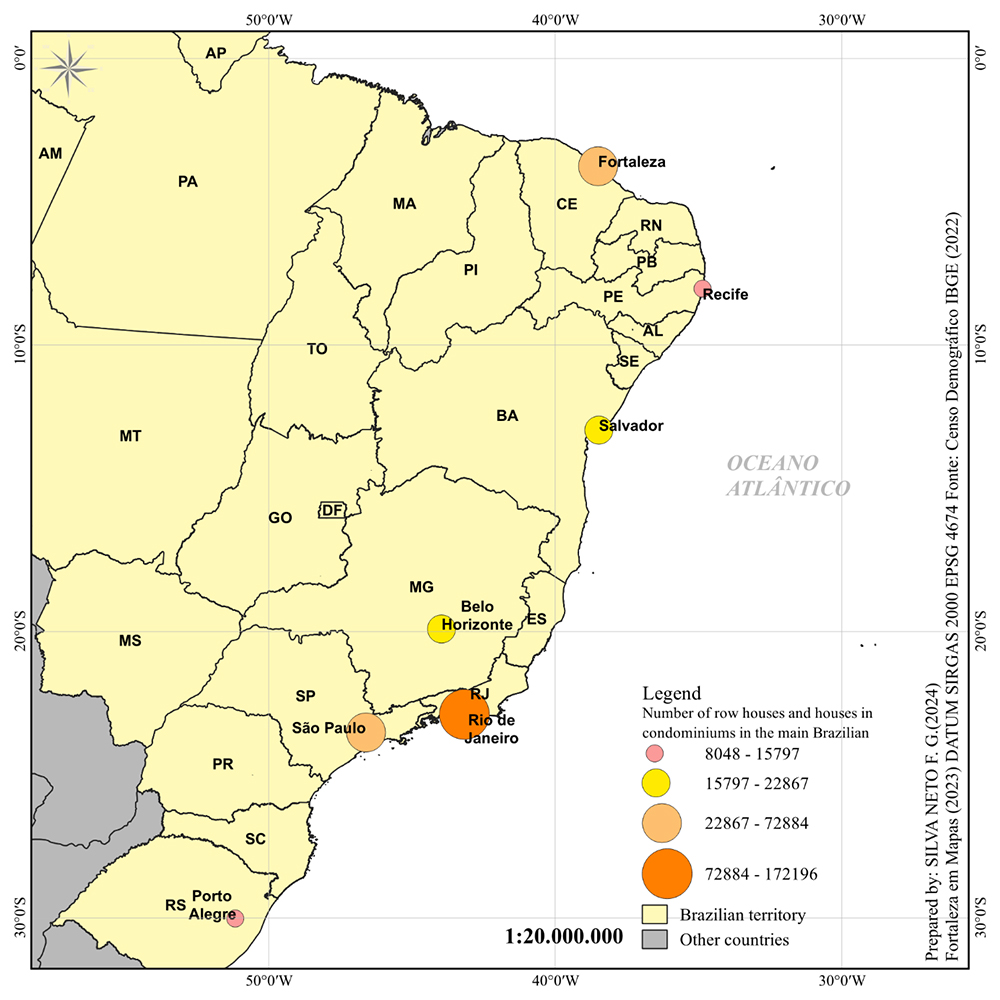
In this context, the number of residential complexes with some form of access restriction reached 172,196 households in Rio de Janeiro, 72,884 households in São Paulo, and 59,310 households in Fortaleza. Notably, Fortaleza saw an increase of 8.3% compared to the figures reported in the IBGE (2010) demographic census. According to the IBGE Census (2022), the cities of Rio de Janeiro and Fortaleza had significantly higher concentrations than the other highlighted capitals, with percentages around 5.90% and 5.73%, respectively (see Table 1 and Figure 1).
An intriguing fact about Fortaleza is the city's large number of small- and medium-sized residential communities. As a result, the growth of row houses or condominiums has become a significant aspect of ongoing urban renewal and residential reorganization for middle- and high-income residents. In the metropolitan area of Fortaleza, the predominant trend is the growth of horizontal residential condominiums and gated communities located on large plots in the city's peripheral regions. The municipality of Aquiraz has the highest concentration of exclusive condominiums in the MRF, with 10,633 homes in residential complexes that have restricted access. This number represents 22.94% of the total households in the area. Eusébio has the second largest, with 16.08% (4,732 households) of people living in row houses or condominiums.
Several studies (Caldeira, 2000; D'ottaviano, 2008; Dal Pozzo, 2015; Santos, 2015; Freitas; Costa, 2022) stress that the significant increase in the number of gated communities has altered the spatial configuration of these urban agglomerations. As a result, many scholars have focused on evaluating the impact of these territorial enclaves on the structure of urban fabric (Becker, 2005; Souza, 2008; Sposito; Goes, 2013; Turczyn, 2013; Alas, 2013; Sciota, 2016).
Therefore, the levels of physical-spatial and social segmentation differ based on the morphological characteristics of closed residential complexes. Both horizontal condominiums designed solely for residential use and those that combine housing, commerce, and services share a fundamental principle: they lack connections to the traditional city. This results in control and socio-territorial containment between public and private spaces, leading to significant socio-spatial impacts on urban development.
Large gated subdivisions and supercondominiums (sizable vertical developments with a wide variety of leisure and service options) produce significant impacts on urban organization due to their enormous size and advanced degree of autonomy.
Closed and mixed-use subdivisions, in particular, have significant socio-spatial impacts on the urban fabric. However, the rise in insecurity, exploited in advertising, has also justified the expansion of leisure and service areas in small residential spaces. Medium and large single-family complexes often include shopping malls, gyms, sports and recreational facilities, banks, and schools. This trend is creating residential developments with decreasing interaction with traditional urban environments. (Freitas, 2019).
The intensity and nature of the effects on urban space differ based on the size of the residential enclave, the strategies used for socio-spatial containment (such as physical barriers, guardhouses, and security systems), and the social practices developed between the upper and middle social classes, who are disconnected from their surroundings and the rest of the city.
Janoschka and Glasze (2003) suggest a comprehensive exploration of the disruption of the socio-spatial fabric by examining three analytical levels: physical-material fragmentation, political-territorial fragmentation, and social fragmentation. Also, Freitas and Costa (2022) developed a typology that synthesizes these analytical levels and is explicitly tailored to the MRF context.
In this context, the quest for greater control over unpredictability and urban insecurity redirects socio-spatial practices toward segmented consumption spaces such as shopping malls, supermarkets, and hypermarkets. (Dal Pozzo, 2015). The constraints of urban mobility lead to selective spatial choices for conducting work, leisure, and service activities in enterprises deemed safe.
The origin of territorial enclaves lies in historical urban proposals. However, there has been a diversification in the types of fortified enclaves promoted by real estate agents. This trend emphasizes the inclusion of consumption and leisure facilities within housing developments. Additionally, there is a noticeable increase in the physical size of various residential enclaves, which contributes to the fragmentation of the urban fabric in the MRF.
EXPANSION AND IMPACT OF HORIZONTAL RESIDENTIAL CONDOMINIUMS IN THE MRF
Since the late 1990s, there has been more intense production of territorial enclaves, particularly horizontal condominiums, closed subdivisions, and multiple-use subdivisions in the MRF. These enterprises, enclosed by walls, railings, and fences, operate with a degree of autonomy. They began to establish themselves in the southeastern sector of Fortaleza, contributing to the process of socio-spatial fragmentation, and are spreading to other areas in municipalities neighboring the capital of Ceará.
In territorial enclaves, social groups tend to be geographically close. However, physical barriers and security measures limit or completely impede interaction between these different groups. This has led to the emergence of areas near Av. Washington Soares in Fortaleza, characterized by a high density of small and medium-sized horizontal condominiums. These areas show a notable trend of physical, spatial, socio-territorial, and social fragmentation. (Figure 2).

Sectors of high concentration of residential enclaves in the southeast vector of metropolitan expansion
In this context, there is residential displacement of specific medium- to high-income groups towards the east-southeast. However, this movement is characterized by its spatial proximity to lower-income communities, along with the construction of walls that physically and socially separate these different social groups. It is important to note that, while there remains a significant concentration of the elite in the neighborhoods of Aldeota, Meireles, Varjota, Dionísio Torres, Fátima, Cocó, and Papicu, there is an observable trend of this group redistributing to peri-urban areas or surrounding regions of Fortaleza. (Bernal, 2004; Fuck Junior, 2004; Monteiro, 2007; Diógenes, 2012; Santos, 2015).
The business model with the most significant potential for fragmentation in the MRF is the Alphaville-type multiple-use condominium. These developments feature comprehensive infrastructure, including services, commerce, and leisure activities within the residential communities themselves. Examples include Alphaville Fortaleza, Alphaville Eusébio, and Alphaville Ceará. These territorial enclaves are actual cities, featuring squares, bars, skate parks, streetball courts, a large green area, swimming pools, restaurants, and shopping centers, among various other facilities and services.
Freitas (2019) argues that the rising sense of insecurity has become a crucial factor in the reorganization of metropolitan areas. The anxiety about violent crime and the pervasive culture of fear contribute to the city's growth in both vertical and horizontal dimensions, resulting in a fragmented urban landscape. The high rates of violent crime verified in neighborhoods in the central-eastern sector are a significant factor contributing to the self-segregation of middle-high income groups. These groups are relocating to residential enclaves in southeastern Fortaleza. This area features large walls and electric fences that encircle entire blocks of horizontal condominiums in neighborhoods populated by middle and upper-income social strata.
In the Metropolitan Region of Fortaleza, it is important to relativize the notion that gated communities are primarily concentrated in the areas surrounding the municipality. In fact, Fortaleza itself has the highest number of horizontal residential enclaves, particularly in the southeastern area of urban growth and metropolitan expansion. It is noteworthy that, according to the Land Use and Occupation Law (Fortaleza, 2017), each condominium is restricted to occupying a single block, measuring either 10,000 or 12,500 square meters. In contrast, condominiums in metropolitan municipalities can occupy much larger areas, leading to substantial developments that effectively integrate residential, commercial, tourism, and leisure uses within a single project.
In the municipality of Fortaleza, there is an area consisting of the De Lourdes and Manuel Dias Branco neighborhoods, located along Av. Santos Dumont. This road connects the central Aldeota area to the eastern part of the city. The area is characterized by multiple horizontal residential complexes that stand out from the multi-family housing patterns typical of the surrounding neighborhoods, such as Papicu, Cocó, and Guararapes. In this context, the luxury horizontal condominiums located in the neighborhoods of De Lourdes and Manuel Dias Branco stand out as unique features within the real estate development of the central-eastern sector. (Figure 3).

The analysis of the locations of residential enclaves revealed a significant spatial concentration in several neighborhoods. This concentration extends from De Lourdes, Manuel Dias Branco, and Praia do Futuro I and II, to a broader area that includes Edson Queiroz, Sapiranga/Coité, José de Alencar (formerly known as Alagadiço Novo), Lagoa Redonda, Cidade dos Funcionários, Engenheiro Luciano Cavalcante, Parque Manibura, and Cambeba, among others (see Figure 3).
Reiterating, most other real estate developments of this type are situated along key municipal roads or state highways, particularly near Av. Washington Soares/CE-040 (the initial section of the southeast expansion vector) and Av. Maestro de Lisboa/CE-025. The residential neighborhoods near the central thoroughfare of Av. Washington Soares/CE-040 offer excellent accessibility to a variety of public and private facilities. These include shopping centers, malls, offices, large stores, hypermarkets, a convention center, the Clóvis Beviláqua Forum, schools, and private universities in the area.
In the southern part of Fortaleza, there has been a notable increase in single-family condominiums aimed at the middle and lower-middle income classes. These developments are primarily located in the neighborhoods of Passaré, Maraponga, and Mondubim. This trend has led to a blend of horizontal housing structures alongside apartment buildings, creating a striking contrast with the traditional urban landscape. These neighborhoods are experiencing significant changes in both their landscapes and real estate values. This transformation is driven mainly by strong commercial development along the main roads that provide access to the areas, specifically Av. Godofredo Maciel, Presidente Costa e Silva (Perimetral), and Av. Silas Munguba. Additionally, these neighborhoods fall within the influence zone of the Parangaba centrality.
In this segment, the self-segregation of elites into territorial enclaves, which are often protected by physical barriers and private security services, plays a significant role in the fragmentation of contemporary cities (Salgueiro, 1998; Caldeira, 2000; Souza, 2008; Sposito, 2013; Dal Pozzo, 2015). As a result, the current patterns of urban growth in Fortaleza, particularly in the recent expansion areas of the southeast and south sectors, have developed in a manner distinct from the traditional center-periphery model.
It is clear that the spatial contiguity between the center and the periphery is "depreciated" by the proliferation of territorial enclaves that differ significantly from the surrounding areas. This situation redefines our understanding of the segregation process and contributes to the formation of a fragmented urban structure, imposing significant limitations on urban accessibility and mobility.
Urban fragmentation is particularly intense in a specific area of the municipality of Eusébio and Porto das Dunas, driven by the CE 025 highway (Via Litorânea). This fragmentation also extends to other parts of the eastern coast of the municipality of Aquiraz.
In the municipalities of Eusébio and Aquiraz, the main types of urban fragmentation structures are medium- and large-scale horizontal condominiums, often referred to as "closed subdivisions," as well as multiple-use subdivisions and resort-style beach condominiums. All these developments are situated on the outskirts of Fortaleza and became popular trends during the first two decades of the twentieth century. (Freitas; Costa, 2022).
These areas are marked by the significant presence of residential and commercial complexes, which are enclosed by walls, creating sharp contrasts with the surrounding socio-spatial fabric. Among the megaprojects surrounding the municipality of Fortaleza, several subdivisions stand out. These include Alphaville, Quinta das Fontes, Park Eusébio, Quintas do Lago, Jardins Ibiza, as well as beachfront condominiums such as Aquaville Resort, Beach Park Living, Resort Oceani, Condomínio Portugal Village, Porto Beach Residence, and Resort Atlantic Palace.
The process of urbanization is increasingly driven by large real estate developments that integrate residential, commercial, tourism, and leisure components within a single project. In this sector, a trend characterized by theme parks, residential subdivisions, and multiple beach condominiums is evident along the coastal strip of Aquiraz municipality.
Alphaville Ceará is a large real estate complex with significant potential to fragment the MRF. The lots within this development range in size from 450 to 794 m² and include areas designated for commercial, residential, service, and green spaces. This mixed-use subdivision offers a variety of amenities and services, with a core advertising focus on security and leisure. The total area covers 18,000 km², distributed in Alphaville Ceará 1, Alphaville Ceará 2, Alphaville Ceará 3, Alphaville Terras Brasil 1, Alphaville Terras Brasil 2, Alphaville Terras Brasil 3, and Alphaville Terras Brasil 4. This large enterprise strategically utilizes access through BR 116 and CE 040, which has significant physical, spatial, territorial, and social impacts. As a result, this large enterprise has strategic access via BR 116 and CE 040, leading to significant physical, spatial, territorial, and social impacts. (Alphaville, 2024).
Overall, the urban structure of the Metropolitan Region of Fortaleza has undergone significant changes due to new separation patterns, including the emergence of physical barriers and controlled access, as well as increased social distance. There is a combination of traditional segregation and a more pronounced segmentation in certain areas of Fortaleza and its surroundings. This is evident in the emergence of various types of residential enclaves, which feature a wide range of leisure facilities, services, and urban amenities within their walled perimeters.
FINAL CONSIDERATIONS
The concept of territorial enclaves originated from the urban models of Garden City and New Urbanism. These enclaves are characterized by real estate developments enclosed by walls, often justified by concerns over rising urban insecurity. However, excessive implementation of these isolating features can significantly impact the urban fabric of cities.
In the Metropolitan Region of Fortaleza, higher-income social groups tend to abandon common public spaces to reside in gated residential complexes with leisure facilities and private services.
The collective fear of common crimes, and more recently, the actions of organizations involved in local and national drug trafficking, has led to increased demand for residential security systems. This also includes a rise in the popularity of new types of residential and commercial enclaves within the MRF.
Consequently, the city is fragmented into numerous autonomous residential units, lacking continuity with the surrounding socio-spatial fabric, thereby intensifying differences between residential areas of various social groups that are spatially remarkably close to each other.
The excessive presence of various territorial enclaves is detrimental to urban development, as public and open spaces are crucial. It is essential to manage the rapid expansion and high autonomy of horizontal enterprises more effectively to prevent worsening the socio-spatial inequalities that are prevalent in Brazilian cities.
It is vital to evaluate the impact of horizontal residential complexes, taking into account the types of territorial enclaves, the level of autonomy, and their consequences for mobility and accessibility. The study recommends establishing criteria and indices to evaluate the impacts of closed residential developments. This approach aims to encourage critical assessment and discussion of the limitations of this residential model, particularly regarding physical, territorial, and social fragmentation.
ACKNOWLEDGMENT
The Postgraduate Program in Geography at the Federal University of Ceará.
The Observatory of Metropolises research network (INCT/CNPq).
To the CAPES-UFC Geography PRINT - CAPES Internationalization Program (PrInt) applied to the Postgraduate Program in Geography (PPGGeo) at UFC.
DATA AVAILABILITY
The data that support the findings of this study can be made available, upon reasonable request, from the corresponding author [Maria Clélia Lustosa].
References
-
ALAS, P. O fenômeno dos supercondomínios: a verticalização da metrópole paulistana no início do século XXI. 2013. Dissertação (Mestrado em Arquitetura e Urbanismo). Faculdade de Arquitetura e Urbanismo - Universidade de São Paulo. São Paulo, 2013. Disponível em: https://teses.usp.br/teses/disponiveis/16/16135/tde-13082013-160537/pt-br.php Acesso em: 21 nov. 2019.
» https://teses.usp.br/teses/disponiveis/16/16135/tde-13082013-160537/pt-br.php -
ALPHAVILLE. Cidade Alpha Ceará. 2024 Disponível em: https://cidadealphaceara.com/lancamento-alphaville Acesso em: 18 nov. 2024.
» https://cidadealphaceara.com/lancamento-alphaville - BARAJAS, L. F. C. Tendencias recientes de las urbanizaciones cerradas y polarización residencial en Guadalajara. In: En Segregación social del espacio. Nuevos enfoques y patrones emergentes en México y Chile. São Paulo: Universidade de São Paulo, 2006.
- BAUMAN, Z. Tempos líquidos. Rio de Janeiro: Jorge Zahar Ed. 2007.
- BERNAL, M. C. C. A Metrópole Emergente: a ação do capital imobiliário na estruturação urbana de Fortaleza. Fortaleza: Editora UFC/Banco do Nordeste do Brasil S.A, 2004.
-
BECKER, D. Condomínios horizontais fechados: avaliação de desempenho interno e impacto físico-espacial no espaço urbano. 2005. Dissertação (Mestrado em Planejamento Urbano e Regional). Faculdade de Arquitetura e Urbanismo - Universidade Federal do Rio Grande do Sul. Porto Alegre, 2005. Disponível em: https://lume.ufrgs.br/handle/10183/7150 Acesso em: 02 nov. 2017.
» https://lume.ufrgs.br/handle/10183/7150 -
BIZZIO, M. R.; ZUIN, J. C. A apropriação do ideário cidade-jardim nos condomínios residenciais fechados brasileiros, 2016. Disponível em: https://vitruvius.com.br/index.php/revistas/read/arquitextos/17.198/6300 Acesso em: 24 fev. 2025.
» https://vitruvius.com.br/index.php/revistas/read/arquitextos/17.198/6300 - BLAKELY, E. J.; SNYDER, M. G. Fortress America: gated communities in the United States. Washington: Brookings Institution Press, 1997.
- CALDEIRA, T. P. R. Cidades de Muros: crime, segregação e cidadania em São Paulo. 34ª ed. São Paulo: Edusp, 2000.
-
DAL POZZO, C. F. Fragmentação socioespacial em cidade médias: o território do consumo segmentado de Ribeirão e Presidente Prudente. 2015. Tese (Doutorado em Geografia). Faculdade de Ciências e Tecnologia - Universidade Estadual Paulista. Presidente Prudente-SP, 2015. Disponível em: http://www2.fct.unesp.br/pos/geo/dis_teses/15/dr/clayton_pozzo.pdf Acesso em: 12 fev. 2017.
» http://www2.fct.unesp.br/pos/geo/dis_teses/15/dr/clayton_pozzo.pdf -
DIÓGENES, B. H. N. Dinâmicas urbanas recentes da área metropolitana de Fortaleza. 2012. Tese (Doutorado em Arquitetura e Urbanismo). Faculdade de Arquitetura e Urbanismo da Universidade de São Paulo - FAU-USP. São Paulo, 2012. Disponível em: https://teses.usp.br/teses/disponiveis/16/16133/tde-03122012-131144/en.php Acesso em: 18 fev. 2018.
» https://teses.usp.br/teses/disponiveis/16/16133/tde-03122012-131144/en.php - DAVIS, M. Cidade de quartzo: escavando o futuro em Los Angeles. São Paulo: Editora Página Aberta, 1993.
-
D’OTTAVIANO, M. C. L. Condomínios fechados na Região Metropolitana de São Paulo: fim do modelo rico versus periferia pobre? 2008. Tese (Doutorado em Arquitetura e Urbanismo). Faculdade de Arquitetura e Urbanismo da Universidade de São Paulo - FAUUSP. São Paulo, 2008. Disponível em: https://teses.usp.br/teses/disponiveis/16/16137/tde-25032010-091246/pt-br.php Acesso em: 08 ago. 2019.
» https://teses.usp.br/teses/disponiveis/16/16137/tde-25032010-091246/pt-br.php - FORTALEZA. CÂMARA MUNICIPAL. Lei Complementar nº 236, de 11 de agosto de 2017. Dispões sobre a Lei de Parcelamento, Uso e Ocupação do Solo. Diário Oficial do Município, n. 16.078, 2017. Suplemento.
- FORTALEZA. Fortaleza em mapas. DATUM SIRGAS 2000 EPSG 4674. 2023.
- FIPE. Fundação Instituto de Pesquisas Econômicas (2025). São Paulo, 2025.
-
FREITAS, L.S.F. Fragmentação e Expansão urbana: Espaços do Medo na Região Metropolitana de Fortaleza-Ceará. 2019. Tese (Doutorado em Geografia). Universidade Federal do Ceará - UFC. Fortaleza - CE, 2019. Disponível em: http://www.repositorio.ufc.br/handle/riufc/52894 Acesso em: 16 out. 2024.
» http://www.repositorio.ufc.br/handle/riufc/52894 -
FREITAS, L.S.F.; COSTA, M.C. L. Insegurança urbana, fragmentação e enclaves Fortificados na Região Metropolitana de Fortaleza. Mercator. Fortaleza, v. 21, p.1-12, 2022. https://doi.org/10.4215/rm2022.e21029iiI
» https://doi.org/10.4215/rm2022.e21029iiI -
FUCK JÚNIOR, S. C. F. Aspectos históricos da expansão urbana no sudeste do município de Fortaleza, Ceará - Brasil. Caminhos de Geografia. Uberlândia, v. 5, n.13, p.141-157, 2004. https://doi.org/10.14393/RCG51315358
» https://doi.org/10.14393/RCG51315358 - GOMES, P. C. C. A condição urbana: ensaios da Geopolítica da cidade. 2ª ed. Rio de Janeiro: Bertrand Brasil, 2006.
- HALL, P. Cidades do amanhã: uma história intelectual do planejamento e dos projetos urbanos no século XX. 4ª ed. São Paulo: Perspectiva, 2016.
-
JANOSCHKA, M. El nuevo modelo de la ciudad latinoamericana: fragmentación y privatización. EURE (Santiago). Santiago, v. 28, n.85, dez. 2002. https://doi.org/10.4067/S0250-71612002008500005
» https://doi.org/10.4067/S0250-71612002008500005 -
JANOSCHKA, M; GLASZE, G. Urbanizaciones cerradas: um modelo analítico. CIUDADES, México: Puebla, n. 59, p.9-20, 2003. Disponível em: http://www.michael-janoschka.de/en/urbanizaciones-cerradas-un-modelo-analitico /. Acesso em: 24 nov. 2025.
» http://www.michael-janoschka.de/en/urbanizaciones-cerradas-un-modelo-analitico - IBGE. Instituto Brasileiro de Geografia e Estatística. Censo Demográfico, 2010. Rio de Janeiro: IBGE, 2010.
- IBGE. Instituto Brasileiro de Geografia e Estatística. Censo Demográfico, 2022. Rio de Janeiro: IBGE , 2022.
- LAGO, L. A lógica segregadora na metrópole brasileira: novas teses sobre antigos processos. Rio de janeiro, Cadernos IPPUR, n. 15-16, p.155- 176. 2002.
- LAMAS, J. M. R. G. Morfologia urbana e desenho da cidade. 2ª ed. Lisboa: Fundação Calouste Gulbenkian/Junta Nacional de Investigação Científica e Tecnológica, 2004.
-
LANDMAN, K. Gated communities and urban sustainability: taking a closer Look at the future. 2000. In: Southern African Conference on Sustainable Development in the Built: Environment Strategies for a Sustainable Built Environment. 2nd South Africa, 2000. Disponível em: https://researchspace.csir.co.za/dspace/handle/10204/2823 Acesso em: 23 de jan. 2016.
» https://researchspace.csir.co.za/dspace/handle/10204/2823 - LENCIONI, S. La ciudad fragmentada em la América latina y la globalización: resultados de Santiago. In: Transformações socioterritoriais nas metrópoles de Buenos Aires, São Paulo e Santiago. São Paulo, 2011.
-
MIÑO, O. A. S. Espaços de sociabilidade segmentada: a produção do espaço público em Presidente Prudente. 2004. Tese (Doutorado em Geografia). Universidade Estadual Paulista - Faculdade de Ciências e Tecnologia. Presidente Prudente-SP, 2004. Disponível em: https://repositorio.unesp.br/handle/11449/105050 Acesso em: 30 maio 2016.
» https://repositorio.unesp.br/handle/11449/105050 - NÚÑEZ, V. L. D.; ALVIS, A. O. La ciudad y la arquitectura del miedo. Estudio conceptual comparativo entre el fraccionamiento habitacional cerrado de lujo contemporáneo y la bastida medieval. Revista nodo. Bogotá, Colômbia, n 16, vol. 8, p. 25-41, 2014.
- MONTEIRO, E. R. Deslocamentos da forma urbana na zona sudeste de Fortaleza. 2007. Dissertação (Mestrado em Urbanismo). Programa de Pós-graduação em Urbanismo da Universidade Federal do Rio de Janeiro (PROURB.). Rio de Janeiro, 2007.
- RAPOSO, R. Condomínios fechados, tempo, espaço e sociedade: uma perspectiva histórica. Caderno Metrópole. São Paulo, v. 14, n. 27, p. 171-196. 2012.
-
SCHACHTER, S. Violencia y Degradación Urbana. In: Movimento Revista Educação, ano, 2, n. 3, p.75-96, 2015. Rio de Janeiro: Universidade Federal Fluminense. Disponível em: https://periodicos.uff.br/revistamovimento/article/view/32561/18696 Acesso em: 24 nov. 2025.
» https://periodicos.uff.br/revistamovimento/article/view/32561/18696 - SOUZA, M. J. L. Fobópole: O medo generalizado e a militarização da questão urbana. Rio de Janeiro: Bertrand Brasil , 2008.
- SALGUEIRO, B. T. Cidade pós-moderna: espaço fragmentado. Revista Território. Rio de Janeiro, ano 3, n. 4, p.39-53, 1998.
-
PRÉVÔT-SCHAPIRA, M. F. Fragmentación espacial y social: conceptos y realidades. Perfiles Latinoamericanos. México, v.9, n.19, p.33-56, 2001. Disponível em: https://perfilesla.flacso.edu.mx/index.php/perfilesla/article/view/315 Acesso em: 24 nov. 2025.
» https://perfilesla.flacso.edu.mx/index.php/perfilesla/article/view/315 -
SCIOTA, A. A. Critérios de avaliação de morfologia urbana em modelos de segregação residencial. 2016. Tese (Doutorado em Urbanismo). Centro de Ciências Exatas da Pontifícia Universidade Católica de Campinas. Campinas-SP, 2016. Disponível em: http://tede.bibliotecadigital.puc-campinas.edu.br:8080/jspui/handle/tede/931 Acesso em: 27 out. 2017.
» http://tede.bibliotecadigital.puc-campinas.edu.br:8080/jspui/handle/tede/931 - SILVA, F. G. N. Número de casa e vilas nas principais cidades brasileiras. [Mapa]. 2024.
- SILVA, F. G. N. Setores de elevada concentração de enclaves residenciais no vetor sudeste de expansão metropolitana [Mapa]. 2024.
- SILVA, F. G. N. Vetores de concentração de condomínios horizontais em Fortaleza. [Mapa]. 2024.
- SPOSITO, M. E.; GOES, E. M. Espaços fechados e cidades: insegurança e fragmentação socioespacial. 1ª. ed. São Paulo: Unesp, 2013.
-
TURCZYN, D. T. Mutação urbana em Campinas: sua forma e paisagem. 2013. Dissertação (Mestrado em Arquitetura, Tecnologia e Cidade). Faculdade de Engenharia Civil, Arquitetura e Urbanismo Universidade Estadual Paulista, 2013. https://doi.org/10.47749/T/UNICAMP.2013.919874
» https://doi.org/10.47749/T/UNICAMP.2013.919874 -
ZANDONADI, J. C. Novas Centralidades e Novos Habitats: Caminhos para a Fragmentação Urbana em Marília (SP). 2008. Dissertação (Mestrado em Geografia). Faculdade de Ciências e Tecnologia - Universidade Estadual Paulista. Presidente Prudente, 2008. Disponível em: https://repositorio.unesp.br/handle/11449/96729 Acesso em: 07 ago. 2018.
» https://repositorio.unesp.br/handle/11449/96729

 Source:
  Source: Prepared by
  Source: Prepared by