
 The Paradox of Social Capital in Mangrove Conservation: Evidence from Indonesia's Border Island
Abstract
Indonesia is an archipelago, and some of its islands are located on the border and in remote areas, far from city centers. Therefore, the state's presence among them is often limited. Similarly, mangrove conservation often relies on community initiatives. Meanwhile, studies on social capital are often considered positive. In fact, social capital has a dual nature. Therefore, this research analyzes the dual nature of social capital on Rupat Island, Indonesia, the outermost island on the border between Indonesia, Malaysia, and Singapore. The island is planned to be crossed by a bridge connecting two countries, Indonesia and Malaysia. This study employs a qualitative narrative approach, engaging conservation group members and government officials selected through purposive sampling. Data was collected through in-depth interviews and observations to understand the subjective meaning of social protection mechanisms. The results reveal a paradox: strong bonding social capital, rooted in Javanese ethnic kinship, successfully resisted erosion and land conversion by companies but created exclusivity. Weak social bonds and bridges have isolated the surrounding Malay ethnic groups and only produced symbolic legitimacy. This study highlights the "dark side" of social capital, demonstrating that while independent internal brotherhood serves as a survival mechanism, the absence of inclusive networks and state support makes governance fragile and socially fragmented. Ultimately, this research suggests that the government must move beyond physical aid and act as a bridging institution to integrate diverse community groups for sustainable conservation.
Keywords:
Bonding and Bridging; Coastal Governance; Social Exclusion; Community Resilience
INTRODUCTION
Globally, Indonesia is known as the country with the largest mangrove ecosystem, covering approximately 20-23% of the world's total mangrove ecosystem (Giri et al., 2011; Arifanti et al., 2021; Sasmito et al., 2023), see also the report The Mangrove Alliance (2025). In Indonesia, Riau is one of the areas with many swamps, peatlands, and mangrove habitats. Mangrove ecosystems are an important natural component for maintaining the environment, providing various benefits such as helping to reduce the impact of climate change through blue carbon sequestration and protecting coastlines from erosion (Van Hespen et al., 2023, p.10).
Oktorini's research findings indicate that the area of mangroves in Riau Province has decreased by up to 13.4%, with an average annual decline of approximately 2,495.9 hectares. More than 98% of changes in mangrove function are due to human activities, such as pond development, agriculture, settlements, and industry. Therefore, we must seriously manage mangroves to ensure their preservation for future generations. In 2000, the area of mangrove forests in Riau reached approximately 180,952 hectares, while in 2019, the mangrove area decreased to 161,655 hectares, with an average annual decline of about 2,495 hectares (Oktorini et al., 2022).
Recent research also found that in some locations, such as Rupat Island and Rangsang Island, there has been a decrease in mangrove area over the past decade; for example, on Rupat Island, land cover decreased from 13,903 hectares in 2013 to 11,749 hectares in 2023 (Agusti et al., 2025). This ecological loss leads to massive carbon loss and directly impacts the social and economic resilience of coastal communities that depend on natural resources (Li et al., 2023, p. 9-10).
In fact, Riau Province, with its waters covering 19.91% of its total area, is one of the most important ecological defenses in Sumatra. The Malacca Strait bridge connecting Indonesia and Malaysia and Singapore will be built in this region. However, the ecological importance of this area is inversely proportional to its level of threat. In Indonesia, the rate of mangrove deforestation continues to increase due to the expansion of freshwater aquaculture and land use changes, resulting in the loss of over 182,000 hectares of land cover between 2009 and 2019 (Arifanti et al., 2021). This ecological damage leads to significant carbon emissions and directly weakens the economic and social lives of coastal communities that depend on natural resources (Ali et al., 2024).
This problem feels heavier in the border areas or small outermost islands, which are the country's territorial boundaries but often lack sufficient oversight. One example is Rupat Island in Sumatra, which is located next to the Malacca Strait. This region faces two pressures: ecological vulnerability and limited access to resources (Husaini et al., 2021; Fathurrahman et al., 2025). The survey results indicate that coastal abrasion in the area is worsening due to the accumulation of waste, which is weakening the marine ecosystem (Ondara; Purnawan, 2021). Given the remote geographical conditions and the limited presence of state institutions in border areas and increasing environmental pressures, local communities often have to use their own methods to survive (Matandirotya et al., 2024, p. 278-279).
Shared responsibility among the community through conservation efforts starting at the local level can be a solution when the government's ability to reach remote areas is limited (Valenzuela et al., 2020, p. 580). In the field of environmental sociology, social capital comprising trust, networks, and rules is considered capable of bringing people together, enabling collective action in environmental protection (Listiana; Ariyanto, 2024, p. 2041).
Typically, social capital is categorized into bonding (internal ties), bridging (external networks), and linking (relations with authority). Traditional theories state that high levels of social capital are directly linked to the performance of natural resource management, as shared values can reduce environmental monitoring costs (Suharti et al., 2016). In this context, social capital is often viewed as a shared asset that has a positive impact in reducing environmental damage (Wibowo et al., 2021).
However, there are still gaps in research that need improvement. Many studies emphasize social capital as a bonding force without considering its negative aspects, such as inequality within groups (Claridge, 2024). Conceptually, the paradox of social capital refers to a dialectical tension where strong internal ties (bonding) can actually hinder the formation of external collaboration (bridging), creating a 'dark side' of group exclusivity that closes off access to outside resources and innovation (Baycan; Öner, 2023, p. 784).
This phenomenon confirms that social capital is not always benign; rather, it possesses detrimental potential when excessive solidarity transforms into a barrier against community adaptation to environmental pressures (Villamayor-Tomas; García-López, 2021).
Previous research also tends to focus more on communities in easily accessible coastal areas of large islands, while conditions in remote small islands are rarely discussed (Salampessy et al., 2024). In fact, in border areas, reliance on family ties is not just a social choice but also a means of survival. This study offers a new approach by analyzing both sides of social capital in border areas, especially in islands directly bordering Malaysia and Thailand. On one hand, strong social capital helps the community deal with environmental pressures; on the other hand, this homogeneity creates barriers to cross-group cooperation (Chen et al., 2025).
In theory, social capital in natural resource management translates into three distinct dimensions: bonding, bridging, and linking. Bonding social capital involves strong internal connections in homogeneous communities based on shared identity or ethnicity and is a mechanism for community self-defense. Linking social capital means external networks that link these various groups laterally - vital for informative cross-community work and communication.
On the other hand, "linking social capital" refers to a type of vertical relationships between local society and formal institutions or those in power in order to achieve resources or policy legitimacy. These three dimensions are of key relevance in order to analyze how on the one hand excessive strength of internal cohesion can generate processes of social exclusion and, on the other, the lack of backing by the state weakens conservation’s sustainability in border regions.
Based on this framework, this study aims to (1) identify the components of social capital that support mangrove conservation efforts, (2) analyze the relationships among the factors involved in these activities, and (3) evaluate the dual impact of social capital on the sustainability of conservation efforts in remote areas.
METHODOLOGY
This research employs a qualitative design using a narrative approach to deeply examine the dynamics of social capital within the mangrove protection movement in Indonesia's outermost island regions (Huberman; Miles, 2002). The choice of a qualitative approach is based on the urgency to understand complex social realities, where researchers need to explore the subjective meanings, shared values, and interaction patterns (Bowen, 2009) constructed by coastal communities in the face of ecological pressures.
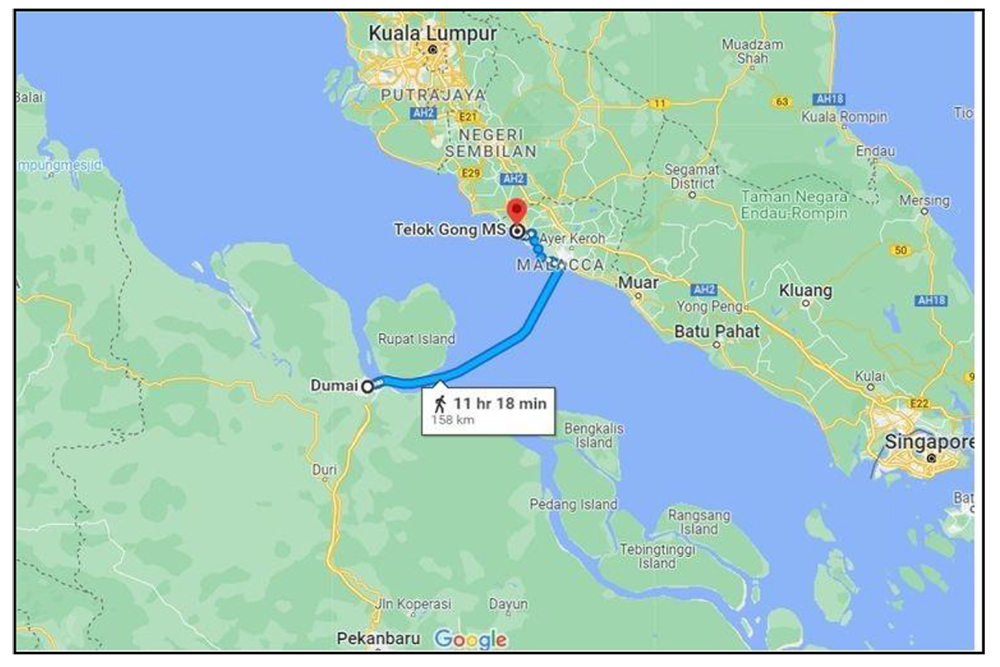
This study discusses the outer border of Rupat Island, where national sovereignty is clearly integrated with environmental aspects. Two main factors determined the selection of this location. First, Rupat Island is one of 111 outermost small islands according to Presidential Decree No. 6/2017, (Indonesia, 2017) which highlights the strategic importance of this island within Indonesia's maritime boundaries (see Figure 1).

Second, because the island will be the location of the large Malacca Strait bridge (see Figure 2). The research location was deliberately centered on Rupat Island, Bengkalis Regency, an archipelago in Sumatra Island that borders exclusively with the Malacca Strait and to the north with Thailand and to the south with Singapore, an area highly vulnerable to coastal abrasion and the threat of land conversion.
The fundamental reason for choosing this location is that it borders exclusively with Malaysia, where a bridge is planned to be built by both countries. Of course, this development will have both positive and negative impacts, which will affect the mangrove ecosystem. This cross-border infrastructure plan acts as a catalyst for socio-spatial urgency; major connectivity projects in the Malacca Strait region are projected to alter maritime logistics and trigger land development pressures, thereby increasing the risk of ecological degradation (Kamarudin, 2024).
In this context, existing social capital becomes critical not merely as a cohesive force, but as a communal defense mechanism to protect coastal tenure from the anticipated spike in land speculation and conversion threats associated with such transnational integration.
This approach, the research not only captures the physical condition of mangroves but also delves deeper into how social networks and trust operate as community defense procedures in the country's front lines.
Rupat Island was selected as the sole research site due to its unique status as one of Indonesia’s Outermost Small Islands (PPKT) under Presidential Decree No. 6/2017 (Indonesia, 2017). This status places the island at a critical intersection of national sovereignty and local environmental governance. Furthermore, its inclusion in specific regional planning, such as Bengkalis Regency Regulation No. 15/2023 (Bengkalis, 2023) on Detailed Spatial Planning, distinguishes Rupat as a high-priority conservation area compared to other islands in the regency. Its strategic location bordering Malaysia and Singapore provides a complex socio-political backdrop for analyzing the dual nature of social capital amidst rapid regional development
Thus, this method allows for the rich and comprehensive disclosure of data on the role of social capital in the sustainability of community-based environmental management. The research subjects were determined using purposive sampling, a non-probability sampling technique that selects informants based on specific criteria relevant to the research objectives in order to obtain in-depth information.
The established inclusion criteria include active participation in protection activities for a minimum of 2 years, in-depth knowledge of the movement's history, and a strategic role within the village's social structure. Based on these criteria, the detailed breakdown of the informants is as follows (Chart 1):
This composition validates data from various perspectives, ensuring the narrative reflects the intersubjective reality between field practitioners and local policymakers. The data was analyzed in a structured manner according to the steps of data reduction, data display, and drawing of conclusions. Interview transcripts were coded manually in accordance with a thematic analysis framework; coding that was initiated deductively from the social capital dimensions (bonding, bridging and linking), further emerged inductively through patterns found in the field. To foster credibility of the data, we exercised a technique of source and method triangulation (Patton, 2015; Malik et al., 2025), by cross examining interview constructs with field interview notes and document photographs.
The trustworthiness of the finding was further supported by the discussion among researcher to ensure consistency in interpretation. Furthermore, the researchers ensured reflexivity with respect to their status as outsiders. The authors recorded each phase in field notes as consciously as possible to avoid personal bias, and perceive the dynamics within Rupat Island’s Javanese ethnic group from the neutral view of sociological perspective.
RESULTS AND DISCUSSION
Bonding Social Capital: Kinship Solidarity and Internal Trust
The research findings reveal that bonding social capital acts as the core strength of the Coastal Environment Conservation Group (CECG) in the focal coastal settlement. Based on field observations and documentation, this group is characterized by a homogeneous membership structure, predominantly Javanese, with strong kinship ties concentrated within a specific residential enclave. Bonding Social Capital: Kinship Solidarity and Internal Trust The research findings reveal that bonding social capital acts as the core strength of the Coastal Environment Conservation Group (CECG). Based on field observations, this group is characterized by a Javanese homogeneous membership with strong kinship ties.
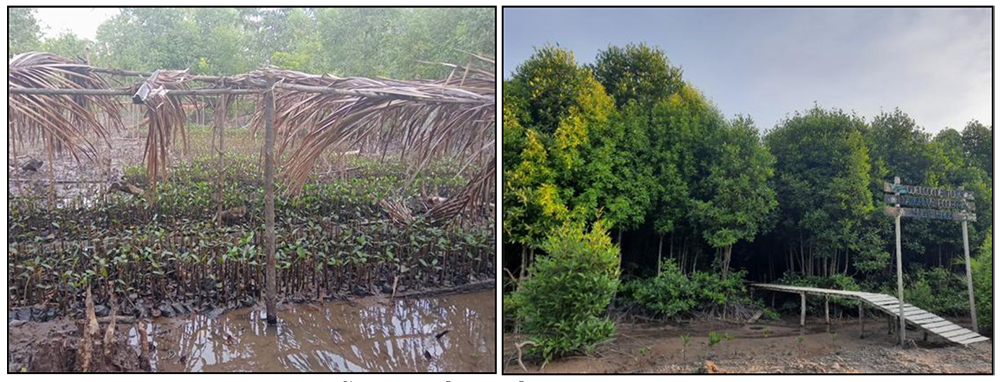
This bonding social capital creates high internal trust, allowing for collective nursery management without formal sanctions. However, as the "dark side" of this bond, internal cohesion is solidified by a "shared threat" which, while effective for self-defense, isolates the conservation burden to a single cluster. Key activities such as nursery management and coastal monitoring are carried out collectively, founded on a high level of internal trust among members. The division of labor and attendance in communal work relies not on rigid formal sanctions but on familial reprimands and shared moral obligation (Setyaningrum et al., 2023, p. 453-454). The group interactions are characterized by informal and compact meetings at the nursery site (Figure 3).

This strong internal cohesion is further evidenced by the direct statement from one of the key informants regarding their motivation to reject land conversion: "We all disagree if the shrimp farm company comes in, because the bad impact is that the mangroves will be gone and there will be nothing to hold back the ocean waves." (Summary of an interview with an IP-3 informant, August 16, 2024). The solidarity captured explains that internal cohesion is formed not merely due to shared identity but is solidified by a "shared threat" in the form of abrasion and potential land conversion into shrimp ponds.
Member compliance with group norms is driven by a collective consciousness to protect their immediate living space rather than material incentives alone. This emotional bond creates an effective self-defense mechanism, where members voluntarily dedicate personal time and resources to maintain mangrove seedlings without intensive external supervision (Putri; Sadono, 2025).
The relation between this descriptive data and the explanation confirms the research problem's reality in outermost island regions: when external support is minimal, communities rely entirely on bonding social capital for survival. Strong group homogeneity acts as a "final fortress" against ecological pressure. However, this also isolates the burden of conservation to a single residential cluster, making the resilience of mangroves in the area factually dependent on the solidarity of this specific community group.
Social Capital as a Bridge and Limit to Group Expansion
This research found a lack of social capital bridges, characterized by an imbalance of participation among residents. Conservation activities are concentrated in ethnic Javanese areas, while the involvement of ethnic Malay groups is very limited. The absence of social bridges creates a “wall” for outsiders, where programs are considered exclusive to certain settlement groups. Without strong social capital bridges, the burden of supervision becomes too heavy and causes social jealousy.
In this case, the research proves that there is an imbalance in participation among residents within a residential area, which differs in each region of the island. Conservation activities are only concentrated in residential areas, which serve as the main initiators, while the involvement of local residents, who have different ethnic backgrounds, is very limited. Social access to land management is not evenly distributed across all socio-spatial boundaries (La Ola et al., 2020).
Conservation activities are more prevalent within the Javanese ethnic community, while they are less common in other areas, which are predominantly Malay ethnic groups. Activities in other villages/areas on this island are still limited to individual activities; no groups have been formed, and there are no initiators among them. In fact, group activities are informal, and they can even meet anywhere. The collective results of mangrove conservation are shown in Figure 4.
The limitations of social bridges actually lead to the fragmentation of social groups and movements. The exclusive network between island regions (the initiators) failed to attract participation from neighboring communities. Strong social capital at one point actually creates a "wall" for outsiders, where programs are considered to belong only to certain settlement groups (Yurike; Syafruddin, 2022, p. 63-74). This network of primordialism will lead to social jealousy in the long run. Without strong bridging capital, the supervisory burden becomes too heavy. Vulnerability arises from the absence of mechanisms capable of "bridging" trust from one settlement cluster to another.
Social Capital: Symbolic Legitimacy and Temporary Support
The role of the state on Rupat Island is not one of total absence, but rather a complex symbolic presence within a multi-level governance framework. The Bengkalis Regency Government has demonstrated its institutional commitment through various legal products, such as Regional Regulation No. 5/2018 (Bengkalis, 2018) on Mangrove Ecosystem Damage Control and Regent Regulation No. 15/2023 on the Detailed Spatial Plan for Rupat Island. These regulations are implemented through infrastructure development and technical assistance in collaboration with national institutions such as the Mangrove Forest and Peatland Restoration Agency and the Forest Management Unit.
However, a paradox arises in the implementation of this connected social capital. Although the legal framework is solid-including integration into the Regional Spatial Plan (RTRW 2022-2042) and the Tourism Master Plan (RIPPAR 2021-2035), the interaction between the state and local actors remains top-down. The state's presence is often felt by groups only through administrative requirements or physical assistance, rather than through deep institutional integration. This creates a gap where “symbolic legality” exists only on paper, while community groups continue to rely on internal (kinship) ties for survival, as formal connecting mechanisms have not yet materialized in inclusive local governance.
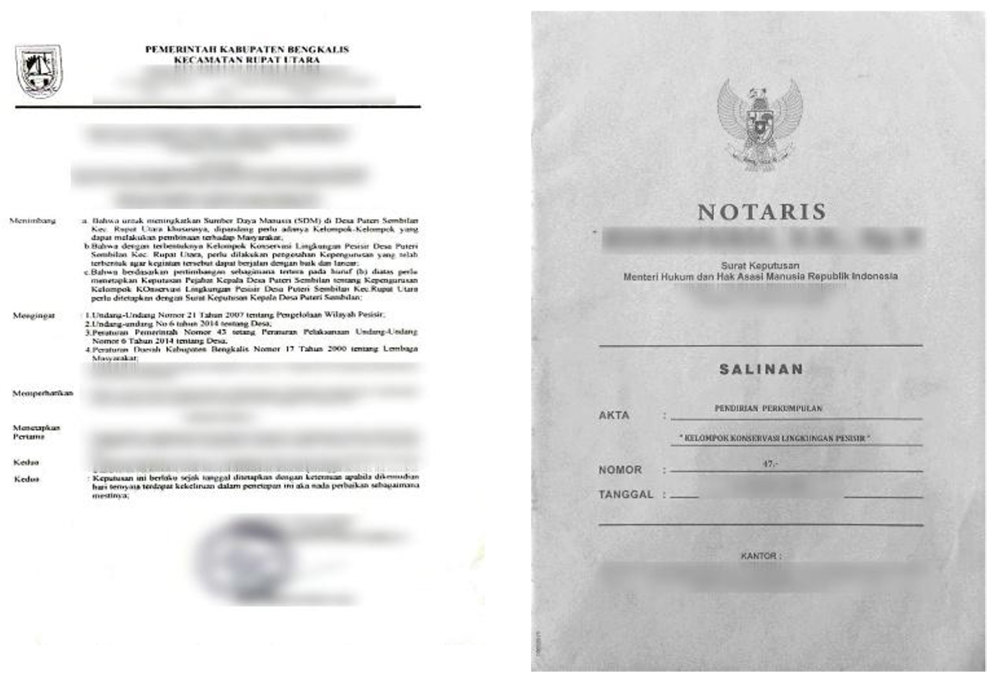
Study evidence shows that environmental conservation groups have formal legal standing in the form of official recognition from the local government and a notarial deed of establishment. However, field data reveals that this legality is largely symbolic; it has not been followed by routine fund allocation or concrete land protection policies from the district government level. As a result, this structural partnership is merely an administrative formality that only receives incidental assistance. Proof of official recognition from the local government (village head) and the notary's deed of establishment is shown in Figure 5.

The assistance received was in the form of seedlings from the Environmental Services, but the donation provided was not sustainable and only happened once (Interview with IP-5, 2024). The results of this interview indicate that the structural relationship pattern is solely based on temporary projects. The notarial deed and the decision only serve as administrative prerequisites for the group to qualify for assistance, but they have not yet become a strong political bargaining tool to secure the conservation area’s status from the threat of external investment. This was found from the results of group discussions with village officials and mangrove conservation groups, as shown in Figure 6.

The relationship between formal legality and existing reality explains why the community on Rupat Island is still vulnerable in its bargaining position against existing structures. Their social capital is still weak, leaving conservation groups without strong "protectors" at the policy level. As a result, despite being recognized de jure by the state, in practice communities struggle alone in tenure uncertainty, relying solely on internal strength to compensate for the absence of a sustained state presence. Under the lens of political ecology, the representation of the state in land is seen as embodying a tension between local ecological needs and national economic priorities in border regions' and protecting local ecologies.
Power asymmetry in this governance structure reflects that on-the-ground conservation efforts are carried out at local community level in which the internal social capital represents a necessary individual burden and from top-down, regulations tend to make political legitimacy and authority for advocates without providing with real tenure protection in the field. This creates a dangerous situation where local conservation efforts remain vulnerable to large-scale land conversion pressures due to a lack of vertical political integration (Wati et al., 2025).
FINAL CONSIDERATIONS
The main finding of this study reveals that the sustainability of mangrove conservation in Indonesia's outermost island regions depends on a form of "autonomous" social capital, where strong internal cohesion serves as a substitute for the absence of effective state protection. Data shows that the conservation of mangrove ecosystems is not the result of a well-integrated state governance system, but rather the outcome of self-defense mechanisms used by community groups to cope with ecological threats and capital penetration.
Although this exclusive solidarity successfully secured the physical landscape from abrasion and industrial encroachment, at the same time it created socio-spatial segregation that alienated neighboring (ethnic) village communities and created fragile pockets for only one group of actors, in this case, the Javanese ethnic group. This confirms that in peripheral areas, social capital operates as a paradox: it becomes an important asset for emergency collective action but transforms into a structural barrier for long-term inclusive environmental governance.
The novelty of this research encourages critical dialog with previous studies that tend to glorify social capital as a universal and always positive solution for natural resource management. Unlike the findings of Setyaningrum et al., (2023), which emphasize the linear contribution of social networks to conservation success, this study highlights the "dark side" or negative externalities of bonding social capital in the context of ethnically segregated settlements.
This research demonstrates that on small and outermost islands with limited resources, strong bonds without bridges can trigger "social exclusion," where conservation claims are dominated by a single group, thus hindering the spread of environmental awareness to the wider population. This finding offers novelty to the environmental sociology literature by demonstrating that ecological resilience in border zones is often built upon social fragility and exclusion, rather than comprehensive community integration.
The existence of conservation groups signifies the community's capacity to navigate the "institutional vacuum" often found in remote areas. The group's rejection of shrimp pond investors, as revealed in the interview, reflects that local knowledge and attachment to the village can outweigh short-term economic rationality. However, this reflection also implies danger; society's dependence on informal mechanisms and symbolic legality (village decisions/notarial deeds) without structural power makes their conservation efforts fragile. The benefit of this research is that it is able to show that the mangrove forest conservation currently visible is merely a "mask" covering the lack of security guarantees for the community and the absence of a strong cross-community regeneration system.
The implications of this research are twofold. Theoretically, this research rejects the notion that "community-based management" is inherently beneficial; instead, the findings reveal that "community" is fragmented, and conservation can be a source of conflict if not managed with inclusive bridging mechanisms. Practically, this finding implies that the current government intervention model, which focuses solely on physical assistance (seeds), is proven ineffective and potentially wasteful if it does not address the underlying social segregation. Aid that is distributed only to target groups without encouraging participation and involving the entire inter-village (ethnic) community actually creates barriers between residents that can erode the legitimacy of conservation in the long run.
This is due to geographical isolation and ethnic homogeneity. Strong social bonds were formed not because of shared Javanese culture but were catalyzed by a common perception of threats related to the loss of living space due to abrasion and foreign investors. They felt their livelihoods were threatened, which forced them to consolidate internally. Meanwhile, the state should be able to bridge citizens to develop social capital. As the data shows, government presence is limited to administrative legalization, so groups must navigate the complex ecological-political landscape on their own. The absence of this "liaison institution" allows primordial sentiments to dominate the conservation narrative, preventing the formation of a unified environmental movement across the island.
Therefore, a metamorphosis is needed from "community conservation" toward "inclusive social forestry." States don't just provide physical aid; they need to step in by facilitating discussion forums that bridge existing social institutions with other communities. Institutional formalities are necessary. Thus, while this research offers a fine-grained understanding of social capital paradox in Rupat Island, these results should be contextualized and not generalized universally across various border areas. Ethnic and ecological factors are the main hindrances encountered in the research area. Thus, future studies are suggested to examine this social capital paradox model using other borderland or island areas with more diverse social compositions in order to further unravel the mechanisms of exclusion and inclusion in environmental governance.
DATA AVAILABILITY:
The data that support the findings of this study can be made available, upon reasonable request, from the corresponding author [Achmad Hidir].
REFERENCES
-
AGUSTI, D. R.; MUBARAK, M.; EFRIYELDI, E.; RIFARDI, R.; MULYADI, A.; ZULKIFLI, Z.; ILAHI, I. Analysis of Mangrove Forest Changes Using Satellite Image Data on Rupat Island. Jurnal Natur Indonesia, v. 23, n. 1, p. 50-57, 2025. https://doi.org/10.31258/jnat.23.1.50-57
» https://doi.org/10.31258/jnat.23.1.50-57 -
ALI, M.R.; ESSU, E. J.; ISLAM, M. A.; ISLAM, H.; ALI, K.; MATHIN, T. T.; JANY, M. R. Exploring the effect of climate transformation on biodiversity in coastal ecosystems. Global Journal of Engineering and Technology Advances, v. 21, n. 3, p. 168-177, 2024. https://doi.org/10.30574/gjeta.2024.21.3.0240
» https://doi.org/10.30574/gjeta.2024.21.3.0240 -
ARIFANTI, V. B.; NOVITA, N.; SUBARNO; TOSIANI, A. Mangrove deforestation and CO2 emissions in Indonesia. IOP Conference Series: Earth and Environmental Science, v. 874, n. 1, 2021. https://doi.org/10.1088/1755-1315/874/1/012006
» https://doi.org/10.1088/1755-1315/874/1/012006 -
BAYCAN, T.; ÖNER, Ö. The dark side of social capital: a contextual perspective. The Annals of Regional Science, v. 70, n. 3, p. 779-798, 2023. https://doi.org/10.1007/s00168-022-01112-2
» https://doi.org/10.1007/s00168-022-01112-2 - BENGKALIS. Regional Regulation No 5, of 2018. Concerning Mangrove Ecosystem Damage Control. Bengkalis: Government of Bengkalis Regency, 2018.
- BENGKALIS. Regent Regulation No 15, of 2023. Concerning the Detailed Spatial Plan for the Rupat Planning Area and Its Surroundings. Bengkalis: Government of Bengkalis Regency , 2023.
-
BOWEN, G. A. Document Analysis as a Qualitative Research Method. Qualitative Research Journal, v. 9, n. 2, p. 27- 40, 2009. https://doi.org/10.3316/QRJ0902027
» https://doi.org/10.3316/QRJ0902027 -
CHEN, H.C.; LIN, T.C.; CHEN, Y.H. The Impact of Social Capital and Community Empowerment on Regional Revitalization Practices: A Case Study on the Practice of University Social Responsibility Programs in Wanli and Jinshan Districts. Sustainability, v. 17, n. 10, p. 46-53, 2025. https://doi.org/10.3390/su17104653
» https://doi.org/10.3390/su17104653 -
CLARIDGE, T. Social Capital and Natural Resource Management. Institute for Social Capital, 2024. Available: https://www.socialcapitalresearch.com/literature/nrm/. Accessed on: dec. 15, 2025
» https://www.socialcapitalresearch.com/literature/nrm -
FATHURRAHMAN, F.; MUBARAK, M.; NURRACHMI, I.; RIFARDI, R.; ILAHI, I. Study of Waves, Currents and Coastline Changes in North Rupat Sub-District, Bengkalis Regency, Riau. Jurnal Natur Indonesia, v. 23, n. 1, p. 42-49, 2025. https://doi.org/10.31258/jnat.23.1.42-49
» https://doi.org/10.31258/jnat.23.1.42-49 -
GIRI, C.; OCHIENG, E.; TIESZEN, L.L.; ZU, Z.; SING, A.; LOVELAND, T.; MASEK, J.; DUKE, N. Status and distribution of mangrove forests of the world using earth observation satellite data. Global Ecology and Biogeography, v. 20, n. 1, p. 154-159, 2011. https://doi.org/10.1111/j.1466-8238.2010.00584.x
» https://doi.org/10.1111/j.1466-8238.2010.00584.x -
GLOBAL MANGROVE ALLIANCE. The Mangrove Alliance. Available: https://www.mangrovealliance.org Accessed on: dec. 15, 2025.
» https://www.mangrovealliance.org -
HUBERMAN, A.; MILES, M. The Qualitative Researcher’s Companion. Thousand Oaks: SAGE Publications, 2002. https://doi.org/10.4135/9781412986274
» https://doi.org/10.4135/9781412986274 -
HUSAINI, R. R.; DARFIA, N. E.; SANDHYAVITRI, A.; YAZID, M.; NURSETIAWAN, N.; RIANDI, D. Determination of Coastal Vulnerability Level Based on CVI Method and GIS in Rupat Island, Riau Province. 2021. In: 4TH INTERNATIONAL CONFERENCE ON SUSTAINABLE INNOVATION 2020-TECHNOLOGY, ENGINEERING AND AGRICULTURE (ICOSITEA 2020)2021. Anais […]. Yogyakarta, Indonesia. https://doi.org/10.2991/aer.k.210204.027
» https://doi.org/10.2991/aer.k.210204.027 - INDONESIA. Presidential Decree of the Republic of Indonesia no. 6, 2017. Concerning the Determination of Outer Small Islands. Jakarta: Government of the Republic of Indonesia, 2017.
-
ISWARA, A. J. Indonesia dan Malaysia Akan Terhubung Jembatan 120 Km dari Sumatera, 2022. Available: https://www.kompas.com/global/read/2022/09/12/133300270/indonesia-dan-malaysia-akan-terhubung-jembatan-120-km-dari-sumatera Accessed on: dec. 15, 2025.
» https://www.kompas.com/global/read/2022/09/12/133300270/indonesia-dan-malaysia-akan-terhubung-jembatan-120-km-dari-sumatera -
KAMARUDIN, M. S. I. Thailand Road Bridge: Impact of Marine Traffic in Straits of Malacca. Journal of Maritime Logistics, v. 4, n. 2, p. 82 - 92, 2024. https://doi.org/10.46754/jml.2024.12.005
» https://doi.org/10.46754/jml.2024.12.005 -
LA OLA, T.; WIANTI, N. I; TADJUDDAH, M. Bridging and Bounding Social Capital: Social Interaction Analysis of Islets Islanders in Wakatobi Marine National Park. Sodality: Jurnal Sosiologi Pedesaan, v. 8, n. 1, p. 30-46, 2020. https://doi.org/10.22500/8202028593
» https://doi.org/10.22500/8202028593 -
LI, J.; LENG, Z.; YUGADA, T. K.; WEI, L.; XIA, J.; ZHUO, C.; NIE, Z.; DU, D. Increasing coastal reclamation by Invasive alien plants and coastal armoring threatens the ecological sustainability of coastal wetlands. Frontiers in Marine Science, v. 10, 2023. https://doi.org/10.3389/fmars.2023.1118894
» https://doi.org/10.3389/fmars.2023.1118894 - LISTIANA, I.; ARIYANTO, D. Structural equation modeling for social capital empowerment in supporting mangrove rehabilitation. Global Journal of Environmental Science and Management, v. 10, n. 4, 2024.
-
MALIK, R.; SUSANTI, R.; HIDIR, A.; IHSAN, R. M.; DZULQARNAIN, M. F. Triangulasi dan Analisis Domain; Meningkatkan Kredibilitas dan Kedalaman Penelitian Kualitatif. KAMBOTI: Jurnal Sosial dan Humaniora, v. 6, n. 1, p. 33-41, 2025. https://doi.org/10.51135/kambotivol6issue1page33-41
» https://doi.org/10.51135/kambotivol6issue1page33-41 -
MATANDIROTYA, N. R.; FILHO, W.L.; MAHED, G.; DINIS, M.A.P.; MATHE, G. Local knowledge of climate change adaptation strategies from the vhaVenda and baTonga communities living in the Limpopo and Zambezi River Basins, Southern Africa. Inland Waters, v. 14, n. 3, p. 268-280, 2024. https://doi.org/10.1080/20442041.2024.2437932
» https://doi.org/10.1080/20442041.2024.2437932 -
OKTORINI, Y.; PRIANTO, E.; DARLIS, V.V.; RAHMATDILLAH; MISWARDI; JHONNERIE, R. Mangrove Riau: sebaran dan status perubahan. Dinamika Lingkungan Indonesia, v. 9, n. 1, 2022. https://doi.org/10.31258/dli.9.1.p.50-57
» https://doi.org/10.31258/dli.9.1.p.50-57 -
ONDARA, K.; PURNAWAN, S. Numerical models of hydrodynamics and marine debris in the Malacca Strait. IOP Conference Series: Earth and Environmental Science , v. 869, n. 1, 2021. https://doi.org/10.1088/1755-1315/869/1/012053
» https://doi.org/10.1088/1755-1315/869/1/012053 - PATTON, M. Q. Qualitative Research & Evaluation Methods: integrating theory and practice. 4. ed. Thousand Oaks: SAGE Publications , 2015.
-
PUTRI, A. V. Y; SADONO, R. Determinant socio-factors to rehabilitate mangrove forests in Mangunharjo Village, Semarang City. Forest Science and Technology, p. 1-11, 2025. https://doi.org/10.1080/21580103.2025.2537890
» https://doi.org/10.1080/21580103.2025.2537890 -
SALAMPESSY, M. L.; NUGROHO, B.; KARTODIRJO, H.; KUSMANA, C. Local Institutions Performance in Mangrove Forest Management on Small Islands: Case Study in Buano Island, Maluku Province, Indonesia. Jurnal Sylva Lestari, v. 12, n. 2, p. 296-323, 2024. https://doi.org/10.23960/jsl.v12i2.840
» https://doi.org/10.23960/jsl.v12i2.840 -
SASMITO, S.D.; BASYUNI, M.; KRIDALAKSANA, A.; SARAGI-SASMITO, M.F.; LOVELOCK, C.E.; MURDIYARSO, D. Challenges and opportunities for achieving Sustainable Development Goals through restoration of Indonesia’s mangroves. Nature Ecology & Evolution, v. 7, n. 1, p. 62-70, 2023. https://doi.org/10.1038/s41559-022-01926-5
» https://doi.org/10.1038/s41559-022-01926-5 -
SETYANINGRUM, A.; WIDYAPUTRA, P.K.; FEBRIARTA, E.; PUTRO, S.T. The Role of Social Capital in Management of Baros Mangrove Conservation Area Yogyakarta. Proceeding ISETH (International Summit on Science, Technology, and Humanity), p. 405-412, 2023. https://doi.org/10.23917/iseth.2964
» https://doi.org/10.23917/iseth.2964 -
SUHARTI, S.; DARUSMAN, D.; NUGROHO, B.; SUNDAWATI, L. Strengthening social capital for propelling collective action in mangrove management. Wetlands Ecology and Management, v. 24, n. 6, p. 683-695, 2016. https://doi.org/10.1007/s11273-016-9496-9
» https://doi.org/10.1007/s11273-016-9496-9 -
TOMAS, S.V.; LÓPEZ, G.A.G. Commons Movements: Old and New Trends in Rural and Urban Contexts. Annual Review of Environment and Resources, v. 46, n. 1, p. 511-543, 2021. https://doi.org/10.1146/annurev-environ-012220-102307
» https://doi.org/10.1146/annurev-environ-012220-102307 -
VALENZUELA, R.B.; YEO-CHANG, Y.; PARK, M.S; CHUN, J.N. Local Peoples Participation in Mangrove Restoration Projects and Impacts on Social Capital and Livelihood: A Case Study in the Philippines. Forests, v. 11, n. 5, p. 580, 2020. https://doi.org/10.3390/f11050580
» https://doi.org/10.3390/f11050580 -
VAN HESPEN, R.; HU, Z.; BORSJE, B.; DE DOMINICIS, M.; FRIESS, D. A.; JEVREJEVA, S.; KLEINHANS, M.G.; MAZA, M.; VAN BIJSTERVELDT, C.E.J.; VAN DER STOCKEN, T.; VAN WESENBEECK, B.; XIE, D.; BOUMA, T. J. Mangrove forests as a nature-based solution for coastal flood protection: Biophysical and ecological considerations. Water Science and Engineering, v. 16, n. 1, p. 1-13, 2023. https://doi.org/10.1016/j.wse.2022.10.004
» https://doi.org/10.1016/j.wse.2022.10.004 -
WATI, R.; SUJIANTO; HERIYANTO, M.; ADIANTO, A.; SUTIKNO, S.; FEBRIAN, A. F. Community-Based Social Capital as a Pillar of Disaster Mitigation in Coastal Areas. E3S Web of Conferences, v. 611, 2025. https://doi.org/10.1051/e3sconf/202561105001
» https://doi.org/10.1051/e3sconf/202561105001 -
WIBOWO, A.; KARSIDI, R.; SUDARDI, B.; WIJAYA, M. Strategy for reducing environmental disaster based on social capital (A case study in Indonesia). IOP Conference Series: Earth and Environmental Science , v. 637, n. 1, 2021. https://doi.org/10.1088/1755-1315/637/1/012001
» https://doi.org/10.1088/1755-1315/637/1/012001 -
YURIKE, Y.; SYAFRUDDIN, Y.S. Analisis Aset Penghidupan Masyarakat Pada Dua Kondisi Kawasan Mangrove. Jurnal Sosial Ekonomi Kelautan dan Perikanan, v. 17, n. 1, p. 63, 2022. https://doi.org/10.15578/jsekp.v17i1.10934
» https://doi.org/10.15578/jsekp.v17i1.10934

 Source:
  Source:
  Source: The authors, (2024).
 Source: The authors, (2024).
 Source: The authors, (2024).
 Source: The authors, (2024).