| Barreto25
|
2018, Brazil |
Evaluative research employing both quantitative and qualitative approaches. Questionnaires developed by the researchers, based on the Implementation Analysis document of the Brazil Breastfeeding Network and the Breastfeeding and Municipalities Project, were used. The development and validation stages of the evaluation instrument are not mentioned. The participation of the actors involved in the intervention in the development of the evaluation model is not discussed. |
Evaluation of the process and effects of implementing the Brazil Breastfeeding and Feeding Strategy in a health unit. |
5 months (June to November 2017). |
Increased number of e-SUS records; increased proportion of home visits, breastfeeding support, and guidance on Complementary Feeding after the implementation of the Strategy. Positive effects were identified four months after the strategy's implementation, namely: professional involvement in workshops, understanding of the importance of counseling on breastfeeding and healthy complementary feeding, and improved data entry in the agreed-upon and current information system. |
| Guarda et al.24
|
2021, Brazil |
Evaluative study, using a normative approach, developed a theoretical and logical model and a judgment analysis matrix. This evaluation model was validated in consensus workshops with experts. Data collection consisted of questionnaires developed based on the indicators from the validated matrix. The participation of the actors involved in the intervention in the development of the evaluation model is not discussed. |
Evaluation of the structure and process dimensions related to the process of implementation work of the Health Academy Program. |
2 months (November 2017 to January 2018). |
The low level of implementation of the Health Academy Program, especially related to multi-professional coordination, and the difficulty in coordinating with other sectors or social actors, shows the need for a reorganization of actions. The program is partially implemented (intermediate). The highest score was in the structure dimension, the lowest in the process dimension. |
| Morera Llorca, Niclos Esteve e Egea Ronda27
|
2022, Spain |
Descriptive qualitative evaluative study with a predominantly phenomenological perspective, conducted through focus groups of participants in the Group Walking Program. The data collection instrument was a semi-structured questionnaire developed by the researchers based on the literature. The development and validation stages of the evaluative instrument are not mentioned. The participation of the actors involved in the intervention in the development of the evaluation model is not discussed. |
Interviews were conducted with 90-minute duration, following a semi-structured script, with a moderator and two observers. The sessions aimed to create a dialogical environment to explore different perspectives on the program, and were recorded and transcribed in full. |
Not informed. |
Participants identified benefits in physical health: improved biological parameters, greater mobility, and less fear of falling; emotional benefits: release of tension, increased self-esteem, feelings of joy; and social benefits: establishing new relationships and strengthening existing ones. |
| Neves, Zangirolani e Medeiros23
|
2017, Brazil |
Qualitative and quantitative evaluation of nutritional care through a census conducted in 28 Primary Care services and 4 Secondary Health Care services. The data collection instrument was a semi-structured questionnaire based on an existing one. The development and validation stages of the evaluation instrument are not mentioned. The participation of the actors involved in the intervention in the development of the evaluation model is not discussed. |
Assessment of nutritional care provided to overweight adults by Primary and Secondary Health Care services. |
Conducted between 2013 and 2015. |
Nutritional diagnosis and health promotion only occur in cases of excess weight associated with other diseases. The referral and counter-referral system and intersectoral collaborations were ineffective. In Secondary Care services, nutritional care focused on clinical treatment with traditional nutritional education approaches. Limiting factors for the promotion of comprehensive care included unproductive actions and a lack of effective dialogue between Primary and Secondary Care services. |
| Penn et al.28
|
2018, England |
Qualitative evaluation of the implementation phase of the National Health Service (NHS) Diabetes Prevention Program in England. Document analysis, interviews, and focus groups were used. The data collection instrument was a semi-structured questionnaire developed by the researchers, based on scientific literature and refined from stakeholder feedback. Patients participated in the review of intervention materials intended for service users, as well as questionnaires developed by the researchers. |
Intensive behavioral intervention with goals of weight loss, diet, and physical activity. |
9 months. |
The NHS offers an effective, evidence-based behavioral intervention for the prevention of type 2 diabetes in high-risk adults. Furthermore, the implementation of the program has shown positive results. |
| Silveira Filho et al.21
|
2016, Brazil |
Quantitative evaluation of the potential effectiveness of Oral Health Promotion (OHP) strategies in Primary Health Care. The evaluation instrument was the OHP Strategy Effectiveness Assessment tool, as it is the instrument validated in the E.N.PRO. SA. The framework for the construction of the tool (evaluation indicator matrix) was based on a theoretical model that emphasizes the state of the art regarding the pillars and values of Health Promotion. The participation of the actors involved in the intervention in the development of the evaluation model is not mentioned. |
Evaluation of the effectiveness of oral health promotion strategies, composed of 23 indicators, grouped into three dimensions: oral health, healthy public policies, and human and social development. |
Not informed. |
The OHP strategies identified in the study were heterogeneous, with better results favoring the South-Southeast regions and disadvantages for people living in the capitals of the Central-North-Northeast regions of Brazil. The results do not allow us to determine which dimensions, sub-dimensions, and indicators were well-evaluated or fell short of expectations. |
| Venâncio et al.22
|
2013, Brazil |
Evaluative research, implementation analysis type, using a qualitative approach to study the Brazil Breastfeeding Network in primary care. A theoretical and logical model and an analysis and judgment matrix were developed, based on official documents and ordinances. Document analysis, interviews, and focus groups were conducted. The data collection instrument used was not stated. Although the evaluation model was constructed based on the regulations, the development/validation stages of the data collection instrument used are not mentioned. The participation of the actors involved in the intervention in the development of the evaluation model is not mentioned. |
Development of a theoretical and logical model, and definition of indicators and categories related to the organizational context and degree of implementation. Data collection techniques: document analysis, focus groups, and interviews. Definition of criteria for evaluation. |
19 months (March 2009 to December 2010). |
The promotion of breastfeeding is not fully implemented in primary care. Different organizational contexts were identified, with implementation levels ranging from 18% to 100% in municipalities. The influence of context on the implementation of the strategy was observed, highlighting the relationship between more favorable contexts and more advanced levels of implementation. |
| Zhong et al.26
|
2015, China |
Qualitative evaluation of the implementation of the support program for diabetes management and self-management in Community Health Service Centers (CHSCs) in Anhui Province, China. Implementation was analyzed using CHSC records and forms. Advantages, disadvantages, and barriers to implementation were assessed through focus groups and interviews with community and health unit leaders, peer supporters, and patients at the end of the Peer Support Program. The development and validation stages of the evaluation instrument are not mentioned. The participation of the actors involved in the intervention in the development of the evaluation model is not mentioned. |
Leaders and staff from the CHSCs co-led educational meetings and bi-weekly discussions, promoted regular care, organized informal health promotion activities (such as walking and tai chi groups), and offered individual support to participants through casual contacts. |
18 months, (June 2009 to December 2010). |
The program was positively received by patients, leaders, and staff at the CHSCs. Implementation was successful in two of the three communities, with a third facing difficulties due to a shortage of staffing resources. Reported benefits included peer support as a bridge between the CHSCs and their patients. Analyses showed significant benefits in knowledge, self-efficacy, BMI, systolic and diastolic blood pressure, and blood glucose. Following evaluation, the program was extended to other communities. |

 Evaluation studies on health promotion in primary care: A scoping review Estudos de avaliação em promoção da saúde na atenção primária: uma revisão de escopo
 Thumbnail
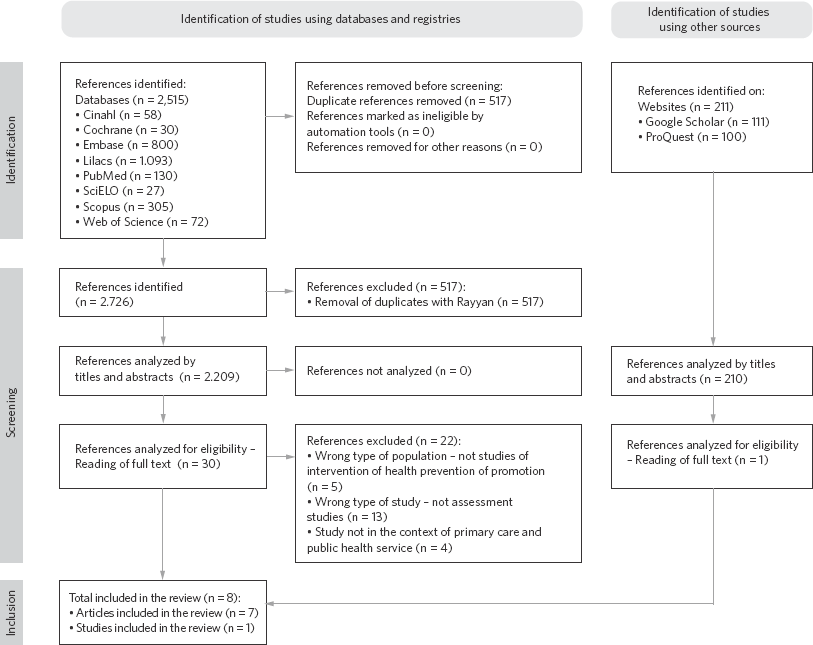 Source: Prepared by the authors, adapted from PRISMA-ScR