
 Poetry and Music Relationship in Let my Love be Heard by Jake Runestad
Abstract
This article has as its object of study the text-music relationship of Let my Love be Heard by Jake Runestad, composed for mixed choir. Traditional and contemporary analytical approaches were used, such as harmonic, thematic, formal, and musical topic analysis, in order to elaborate an analytical hypothesis that can reveal the structural relationships of the music in dialogue with the pre-existing poetry that constitutes the sung text of the work. For the realization of the topic analysis, it was necessary to propose a definition for the "elegiac topic," due to the absence of a clear definition of it by the theory authors.
Keywords:
Music Analysis; Contemporary Choral Music; Music and Language; Topical Analysis; Elegiac Topic
Resumo
O presente artigo tem como objeto de estudo a relação texto-música de Let my Love be Heard de Jake Runestad, composta para coro misto. Foram utilizadas abordagens analíticas tradicionais e contemporâneas, tais como análise harmônica, temática, formal e de tópicas musicais, a fim de se elaborar uma hipótese analítica que possa revelar as relações estruturais da música em diálogo com a poesia previamente existente que constitui o texto cantado da obra. Para a concretização da análise tópica foi necessário propor uma definição para a “tópica elegíaca”, devido ausência de definição clara da mesma por parte dos autores da teoria.
Palavras-chave:
Análise Musical; Música Coral Contemporânea; Música e linguagem; Análise Tópica; Tópica Elegíaca
While the relationship between poetic text and musical composition constitutes a fundamental element in virtually all vocal music, the art song1 repertoire presents specific characteristics in this relationship between musical and textual dimensions. These arise from the necessity of melodic, rhythmic, harmonic, textural, and agogic choices that accommodate the composer's interpretation of the text. As Carol Kimball (2013, p. 105) states in her book Art Songs: Linking Poetry and Music: "Most composers strive to create a synthesis of music and words by using melody, rhythm, harmony, and accompaniment to transform poetic images into musical images." The author discusses methodologies for the creation, analysis, and interpretation of this genre, emphasizing its importance as a form of integration between literature and music. Such an approach finds a parallel in the contemporary choral repertoire, where one can also observe the practice of setting poetry to music, albeit oriented toward collective vocal formations, in contrast to the voice and piano performance characteristic of the art song.
Building upon this foundation, the approach adopted here is that musical analysis should go beyond a purely theoretical description of musical events and address the creative interactions between textual and musical aspects, in accordance with Kofi Agawu's (1991, p. 4) position in his book Playing with Signs: A Semiotic Interpretation of Classic Music: "To analyze is to take apart and to show how constituent elements interact with one another to create a larger, not necessarily unified whole. To criticize is to spice this analytical activity with evaluative comment, to return the clinical dissection to a humane environment". Although Agawu distinguishes analysis from criticism, the present study is primarily analytical in scope, incorporating interpretive commentary without advancing evaluative criticism.
From this perspective, the present study proposes an analysis of Jake Runestad's Let My Love Be Heard for mixed choir a cappella, with emphasis on the relationship between text and music. The objective is to investigate how musical elements are employed to expand the meanings of the original poem, demonstrating the process of artistic recreation fostered by musical composition, as Kimball (2013, p. 15) asserts: "In the best of art songs, the composer's musical 'recreation' or 'transformation' of the text unites the poetry and music in such a way that is impossible to think of them apart. We do not hear poetry set to music; we hear an art song."
This union of musical qualities with poetry represents something far more profound than a mere musical adaptation of the poem, according to composer Ned Rorem:
Song is the reincarnation of a poem that was destroyed in order to live again in music. The composer, no matter how respectful, must treat poetry as a skeleton on which to borrow flesh, breaking a few bones in the process. He does not render a poem more musical (poetry isn’t music, it’s poetry); he weds it to sound, creating a third entity of different and sometimes greater magnitude than either parent. (Rorem 1988 apudKimball 2013, p. 107)
Jake Runestad, born in 1986 in Illinois, is an American composer, music educator, and conductor who holds a master's degree from Winona State University and a bachelor's degree from the Peabody Institute of Johns Hopkins University. Although he is best known for his choral compositions-both accompanied and a cappella-he has also composed works for orchestra, wind ensemble, chamber ensembles, and opera. Throughout his career, he has been gaining recognition within the global choral music scene through his expressive compositions that address pressing contemporary themes "such as suicide awareness and prevention, immigration, gender equality, disabilities, loss, and the climate crisis" (Runestad, 2025). Winner of prestigious industry awards, including the EMMY® Award for his composition Earth Symphony, Runestad has been conducting concerts and leading masterclasses as a guest conductor across various countries, promoting his belief that music should serve a higher positive purpose and spark societal change. Among his most widely performed works in digital media are Please Stay, Nyon Nyon, Aleluia, and A Silence Haunts Me.
This article is organized into five sections: (1) the theoretical and musical foundation, which presents the analytical frameworks employed; (2) the poetic analysis of the text used by Runestad; (3) an examination of the compositional resources and context used to convey the poem's meaning through music; (4) a discussion of the text-music relationship proper; and (5) concluding remarks.
1. Theoretical Foundation
The analysis of text-music relationships in a work demands an approach that extends beyond the identification of word-painting techniques, the use of onomatopoeia, or prosodic adaptation. It is essential to observe whether the musical style suits the poetic content and whether all principal textual and imagery elements are somehow represented in the music, as composer Francis Poulenc (1982 apudKimball 2013, p. 107.) argues: "It is not only the lines of the poem that must be set to music, but all that lies between the lines and in the margins." To conduct this analysis with the depth required by such compositional complexity, this study proposes its analytical approach based on four theoretical pillars: poetic analysis, harmonic analysis, musical topic theory, and formal analysis.
The analysis of poetry presents variable complexity depending on the text; therefore, it is necessary to consult specific literary references to understand how to conduct a consistent poetic analysis. This article draws primarily on Antônio Candido's (2006) work O Estudo Analítico do Poema which addresses the structure and formal aspects of literary works, and the aforementioned book by Kimball (2013), which proposes a semantic understanding and appropriation of the poem's natural recitation-a key element for perceiving the sonic flow generated by words, according to the author. Studies on Lied and art song analysis that emphasize text-music interaction and interpretive performance perspectives (e.g., Stein & Spillman, 1996) also provide contextual support for this approach.
The second pillar supporting this analytical study concerns the harmonic language employed by the composer and will be grounded in Walter Piston's (1959) discussions of seventeenth- and eighteenth-century harmony, as well as twentieth-century approaches presented in the works of Vincent Persichetti (1961) and Ludmila Uleha (1994).
Beyond harmony, an analysis investigating the relationship between text and music can employ a concept from semiotics and musical rhetoric: musical topic theory, initially proposed as the study of recurring musical archetypes observed by Leonard Ratner (1980) in Classical music and subsequently developed by a series of authors who continued his work, including Allanbrook (1983), Monelle (2006), Agawu (1991), and Hatten (2004), among others. In summary, topics are musical structures that reference recurring images of conventional meaning, functioning as a shared code between composers and listeners. For example, a march with trumpet lines evokes the military topic2, which in turn references images of heroism, glory, and army parades. This recognition and association is only possible through historical repetition, as well as the listener's insertion into the culture that employed these structures, as Hatten and Monelle (2010, p. 17) state:
The topic is essentially a symbol, its iconic or indexical features governed by convention and thus by rule. However, topics may be glimpsed through a feature that seems universal to them: a focus on the indexicality of the content, rather than the content itself [...] Thus, it is possible for a musical syntagma to signify iconically an object which itself functions indexically in a given case; the example given above of the cuckoo’s call (cited by Karbusicky) is such an item, for the heralding of spring is an indexical function of the cuckoo itself, not of its musical representation. However, if it is culturally prescribed that the imitation of a cuckoo by an orchestral instrument inevitably signifies the heralding of spring, then this icon has been transformed into a topic. (Hatten, Monelle, 2010, p. 17)
In this passage, the authors explain that, since there already exists a relationship between the sound of the cuckoo and the announcement of spring-the cuckoo's sound evokes spring-and there exists a historical repetition that has conventionalized that, when musically imitated, this icon comes to represent, through a metonymic relationship, spring as well, so that the icon becomes understood as a topic. In other words, for a topic to stabilize as such, it is necessary for an extramusical attribution of image to meaning to occur (as if they were archetypal images) alongside the historical repetition of musical gestures that have become consolidated in evoking such an image.
Finally, Arnold Schoenberg (1967) will provide the foundation for the fourth and final theoretical pillar of this work: formal analysis. In his book Fundamentals of Musical Composition, the composer examines music in structures of varying sizes (motifs, themes, phrases, periods, sections) in order to demonstrate how music is organized and transformed over time. This type of analysis serves to reveal how each element fulfills a function in constructing musical discourse, allowing one to understand how musical structure dialogues with the organization of the poetic text.
Once the theoretical foundations of the analysis have been established, the present study proceeds with the examination of the poem used by Jake Runestad in his composition. Following the methodology of Antônio Candido (2006) and Carol Kimball (2013), the text will be analyzed through its structural, semantic, sonic, and imagery characteristics, establishing the groundwork for subsequent understanding of how these elements were musically translated by the composer.
2. Literary Analysis
At the outset of the textual analysis, a notable inconsistency arises concerning the attribution of the poem's authorship. According to the published score of Let My Love Be Heard, the text is identified as an excerpt from the poem A Prayer by Alfred Noyes. However, upon consulting Noyes's original works, one finds that the text used by the composer differs significantly from any known version of A Prayer, raising questions about the source's accuracy.
After contacting the composer by email, it was established that the poem was found in his grandfather’s house without attribution of authorship. Although this represents a limitation, the analysis is not compromised because, regardless of who wrote it, Runestad used this poem to create his music. The only analytical limitation this issue would impose would be a comparative literary analysis between the present poem and others by the same author in order to study their style.
According to Candido (2006, p. 68, our translation), rhythm is the element that immediately attracts our attention when reading a poem through an "undulatory movement that characterizes verse and distinguishes it from another"3. This undulation is generated by the different accentual weights of the verse's syllables, which can be classified as strong, less strong, and weak sounds. To conduct this analysis, we must seek the natural and fluid sonority of the text, and for this purpose, reading the text aloud is necessary, as this reading, according to Kimball (2013, p. 53) makes us "physically experience the sounds in the poem's phrases in a way that is different from reading them silently on the printed page. We notice even more the sound and rhythm, and the word order in the poetic phrase". Applying this method to the poem in the musical work, we obtain the following rhythm:
Note that there are two markings in this analysis: The syllables in bold are the strong syllables, while those that are underlined, despite their prominence in the syllabic division, possess less accentual weight due to the grammatical class of the word-prepositions and conjunctions carry less weight than nouns and verbs. Still regarding rhythm in poetry, Candido (2006, p. 76) establishes that "rhythm is formed by the succession, in verse, of rhythmic units, constituted by an alternation of long and short vowels, or stressed and unstressed ones"4, and that such rhythmic units are called "metrical foot," of which the four principal ones5 are:
Relating this division to metrical feet, we have the following structure in the poem's verses: (1) trochee + anapest, (2) anapest + iamb, (3) trochee + extra syllable, (4) anapest + iamb, (5) anapest + iamb, (6) trochee + trochee + iamb, (7) trochee + extra syllable, (8) dactyl + anapest, as you can see in the following table. All verses are pentasyllabic (containing five syllables up to the last stressed syllable), with the exception of the sixth and eighth verse, which is hexasyllabic.
Regarding the rhyme structure, the poem can be analyzed in two ways: the first with an ABA'B scheme in both stanzas, where A-"soar" and "bird" or "more" and "heard"-is a near rhyme, but not perfect6 (due to the absence of the '-d' sound in "soar"), and B-"light" and "tonight" or "sings" and "wings"-is a perfect rhyme; and the second with an ABCB scheme, composed only of perfect rhymes that occur between stanzas: "soar" and "more", "light" and "tonight", "bird" and "heard", "wings" and "sings".
Analyzing the semantic aspect of the poem, it is quite clear that this is a poem of mourning, in which the lyrical voice asks angels to carry a beloved person who has died to heaven, and for this journey from Earth to Heaven to be sung by the angels through the love prayers of the lyrical voice who remains alive. As a prayer possesses a fluid, constant, and meditative character, the poem also follows these characteristics; however, the character of lament is expressed through the breaking of metrical foot uniformity: the use of the anapest brings a disruption to the binary uniformity generated by the iamb and trochee, and the lack of an ordered pattern of such cells evokes the naturalness and intensity of prayer, creating the image of someone who prays while suffering, accelerating and decelerating their speech. The rupture in the syllabic pattern found in the sixth verse brings unexpected tension related to the poem's climax, the moment when the pain of mourning rises to heaven in the form of song. At this moment, it is natural, in reading, to make a brief pause before proceeding with "Let my love be heard / Whispering in your wings." Due to this religious character, the rhyme scheme that makes the most sense is "ABCB," because perfect rhymes are expected in prayers, since there is "communication" with the divine.
In synthesis, the analysis reveals how the formal elements of the poem-metrical naturalness, meditative rhythm, and rhyme scheme-converge to create the expression of an elegiac prayer, in which the pain of mourning is transformed into song through angelic mediation. Having established these poetic characteristics, it now remains to investigate how Jake Runestad musically transposes this lyrical structure and amplifies its expressive effects.
3. Musical Analysis
The musical analysis that will be presented below aims for an approach through multiple lenses that focus on different compositional aspects of the analyzed work at various levels. However, before delving into each of these different perspectives, we will present a general overview with information about the analyzed work. Let My Love Be Heard was commissioned by the "Choral Arts" and "UMKC Conservatory Singers" groups and published in 2014 (Runestad, 2014). Runestad conceives it with tonal/modal ambiguity-which will be discussed later-with a slow tempo featuring expressive variations, accelerandi and ritardandi, numerous dynamic variations that reach fortissimo only at its climax, and a choral texture that alternates between accompanied melody and a brief passage of contrapuntal writing. Among the performance recordings available on the YouTube platform, the interpretation by the Bob Cole Conservatory Chamber Choir (conducted by Jonathan Talberg) stands out (with over one million views), performed in memory of chorister Nohemi Gonzalez, who was a victim of a terrorist attack in November 2015, one day before the rehearsal in which this music was rehearsed and recorded.7 This recording will serve as a reference for listening to excerpts for exemplification throughout this work.
The first analytical approach will consist of a formal structural view (FIGURE 1): a binary form.

Formal Structure view of Let My Love be Heard. “M.H.” denotes Harmonic Motif, “M.M” denotes Melodic Motif.
The music begins with an introductory section of eight measures of vocalization on "Oo" and proceeds to verses one through six of the poem, in what we will call section A, with the melody in the tenor line and the other voices in counterpoint with "Oo". The seventh verse of the poem is then presented for three measures, and we will call this single verse b, musical material that is not part of A and that will be used for the development of section B, which will reach the musical climax. Before this occurs, we return to section A with the same verses of the poem, but with a different musical structure: the melody in the sopranos being accompanied by the other voices in homophony. In the same way as the first time, b appears, but with a repetition. The eighth verse appears as a brief transition to section B-constructed from b-where we have the tenor and bass voices repeating verse seven and the alto and soprano voices (both with divisi) performing vocalizations, until reaching the expressive peak of the music. The composer then closes the work similarly to a "summary": one measure of A, three measures of vocalizations from B, and the poetic verse of b.
Harmonic analysis revealed the following points of interest: The composer avoids traditional tonal system cadences based on dominant-tonic progressions; the most frequently used harmonic progression consists of the chords B major (unison on B), E major (with omitted third), C-sharp minor with seventh, and A major with seventh and ninth; and the absence of any altered pitches; only in the verse "Whispering in your wings" does a complete cadence in E occur, but it is weakened by resolution only in the female voices in unison. Through these points, it becomes evident that the chords used do not possess strong hierarchy, where even the sequence "B major - E major" loses its tonal strength through the non-use of the tritone in B and omission of the third in E. In other words, the music can be viewed under the modal system, and within this context, we see the progression cited above as cadences under the finalis, which is the A chord; therefore, we can affirm that the music is in A Lydian mode (since we have four sharps in the key signature, no altered pitches and the final chord).
However, parallel to the modal reading, Runestad brings weakened tonal relationships around E major through melodic arpeggios, leaps from B to E at the beginning of phrases, the perfect ii - V - I cadence in measures 29 and 30, and the return to the E chord after the suspension and expressive pause of the climax. These relationships, even though subtle, may suggest to ears accustomed to tonality that the music is indeed in E major, which makes the D-sharp in measures 12 and 21, for example, sound like appoggiaturas rather than characteristic notes of A Lydian mode. Thus, the music presents us with a tonal-modal ambiguity that enriches the interpretive possibilities of the work.8.
We can add a new perspective to observe in greater detail the materials that form each of the described sections. In his book Fundamentals of Musical Composition, Schoenberg (1967) uses the following definition for the musical motif:
The motive generally appears in a characteristic and impressive manner at the beginning of a piece. The features of a motive are intervals and rhythms, combined to produce a memorable shape or contour which usually implies an inherent harmony. In as much as almost every figure within a piece reveals some relationship to it, the basic motive is often considered the 'germ' of the idea. (Schoenberg, 1967, p. 8)
Following this conceptualization, we identify two motifs that are used in the piece: the first being a harmonic motif (H.M.), presented already in the introduction, and a rhythmic and melodic motif (M.M.) presented at the beginning of the first verse of the poem.
The figure below shows how the motifs are presented, as well as a motivic analysis of the main melody, showing its variations. In the repetition of section A, the melody behaves in the same manner, but in the soprano voices; therefore, the motivic analysis remains the same.
Before entering the "lens" that will open the discussion proper regarding the musical choices to illustrate the poetic text, it is necessary to point out that section B is characterized by polyrhythm of three (in the soprano and alto voices) against two (in the tenor and bass voices). This highlight will be revisited later in the work.

The "lens" referenced in the previous paragraph refers to musical topics, as it enables the identification of topics and tropes significant for understanding the music as a unified whole. Although topic theory was originally developed for the Classical-Romantic repertoire, its application to contemporary choral music has proven productive in comprehending how Runestad mobilizes culturally and historically established musical conventions to amplify the poetic meaning of his work.
It was possible to identify topics and tropes. According to Hatten (1994, p. 170), tropes are "the manipulation of topics through the juxtaposition of contradictory or unrelated [topic] types, as well as emerging from the same location or functional process". An important point to highlight is that topics may be present both in a solid and unequivocal form as well as in diluted form, what Monelle (2006) terms "topical allusion."
Elegiac Topic
During the analytical process, the hypothesis emerged that an elegiac topic may be present in this work. Agawu (2009, p. 49) refers to this topic as being “expressed in a static or passive atmosphere.” Although other researchers, such as Márta Grabócz (2013, 2014), employ the notion of an elegiac topic in their studies on Bartók and Liszt, the concept has not been extensively defined in the literature. For this reason, we will investigate what may characterize this topic.
Elegy is a literary genre that supposedly derives from songs of mourning and sadness that were accompanied by bamboo flute in ancient Greece. Over the years this term-which began to be used in the 7th century BCE-has been modified and adapted alongside the literary movements of history. Today, it is understood that the content of an elegy consists of "feelings, especially painful ones, that may be said to be natural and common to all mortal beings, such as, for example, those awakened by absence, by unrequited love, by the loss of one's homeland, or of any other bonds of the heart" (Carvalho, 1867 apudMoisés, 2004, p. 139. our translation).
Following a survey of several works from different periods and musical aesthetics - including Flow my Tears by John Dowland (1596), Lacrimosa from Mozart's Requiem (1791), Elegie by Tchaikovsky (1884) in homage to Ivan Samarin, Nun seh' ich wohl, warum so dunkle Flammen from Mahler's Kindertotenlieder (1901), and When David Heard by Eric Whitacre (2012) - the following characteristics are proposed as elements that may be associated with the elegiac topic:
-
Slow Tempo;
-
Texture: homophonic or accompanied melody;
-
At least one static element (suspensive and/or modal harmony, ostinatos, note repetition, etc.);
-
Progressive climax with the combination of dynamics and high note;
-
Sixths leaps;
-
Presence of dissonances;
-
Undulatory melody contour;
-
Use of appoggiaturas in the end of phrases;
-
Expressive rests.
It is important to note that these musical characteristics, when isolated from context explicitly pointing to elegiac content, may serve other expressive functions. However, when combined with contextual typical of the elegiac literary genre, they contribute to the formation of an elegiac topic.
The Renaissance song Flow my Tears presents in its poetry an expression of pain and isolation that corresponds to the elegiac essence. Musically, two elements merit attention for their expressive function: the sixths leaps (V) and the undulatory melodic contour (VII).
The sixth leap in FIGURE 3-a (E-C) gains expressive prominence through its longer rhythmic duration, coinciding with the character indication "Lacrime" at the beginning of the score. This procedure demonstrates how Dowland employs the interval as a rhetorical device for emotional intensification. In turn, the undulatory contour (FIGURE 3-b) manifests itself in the G#-C-G# movement repeated twice, creating a melodic gesture that evokes the pendular movement characteristic of lament, together with vocal naturalness.

Excerpts from Flow my Tears by John Dowland. a) passage in which the 6th leap is used in the melody. b) Example of pendular melody.9
In addition to also beginning with a sixth leap, Mozart's Lacrimosa clearly presents the elements: homophonic texture (II) and at least one static element (III) to represent the fear of final judgment and the plea for mercy made to God. In stark contrast to the first movement (Kyrie) which is a contrapuntal fugue, Lacrimosa was conceived with homophonic texture from beginning to end with a single element that deviates from the homophony: the eighth notes of the first violin (marked in blue in the figure below) that remain throughout the entire movement articulating only the weak beats of the measure. This element is what we consider as item III, which should be the concept of "static or passive atmosphere" mentioned at the beginning of this section. Another characteristic present in Mozart, but which will be seen in more detail in another musical example, is the dynamic climax coinciding with the highest note of the movement (marked in red).

Tchaikovsky's composition titled “Grateful Greeting” was composed in 1884 at the request of the Moscow Artists' Society as a tribute to Ivan Samarin, a great actor and professor of dramatic arts at the Moscow Conservatory. Samarin died in 1885 and, five years later, the music was published in his honor under the name “Elegy - in memory of Ivan Samarin”.
Unlike the other examples, this music is entirely instrumental and, even so, possesses elegiac character based on the characteristics discussed, among which the use of appoggiatura (VIII) and the use of expressive pauses (IX) merit attention, as we can see below:
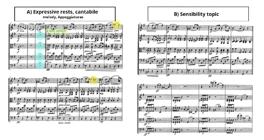
Excerpts from Tchaikovsky’s "Elegy". a) elegiac topic characteristic. b) sensibility topic11.
Observing FIGURE 5-a we see that after the introductory phrase we have a fermata on a rest (which is repeated throughout the music several times) bringing expressiveness beyond a simple separation of parts; furthermore, the melodic phrases that end with appoggiatura (marked in yellow) are constructed under the expression "molto cantabile." This expression informs the performer that this passage should be played in the same manner as it would be executed if sung, respecting airflow, breathing, and phrasing, for example. This is the definition of the Cantabile topic proposed by Ratner (1980). Therefore, we can affirm that item VII can be replaced by the presence of the Cantabile topic.
Another point that Tchaikovsky's example shows us is that the elegiac topic does not prevent the use of another topic at the same time. As we can see in letter "b" of the figure above, even though the elegiac topic is present, Tchaikovsky also employs the sensibility topic, which is marked primarily by sudden expressive contrast: whereas “a” presents fluid melodic phrases, predominantly in pianissimo dynamics with crescendo, “b” is more articulated, marked fortissimo, and features a more chordal and texturally dense construction rather than a primarily melodic one.
Still within the Romantic aesthetic, the second song of the Kindertotenlieder cycle stands out, titled Nun seh' ich wohl, warum so dunkle Flammen by Gustav Mahler, composed from Friedrich Rückert's poems that express profound mourning for the death of children. This second song, in particular, addresses the retrospective perception of the father (or mother), who, after the loss of the child, comes to understand that certain glances and gestures already silently announced the imminent departure-signs that could only be recognized belatedly, in the light of absence.
In this composition we can find, primarily, the characteristics referring to slow tempo (I), the presence of dissonances (VI), and the use of appoggiatura (VIII). Agawu (1983) shows that Mahler uses appoggiatura in intimate relation with the text, emphasizing that "the most striking feature of the musical surface is the predominance of appoggiatura", as we can observe in the small excerpt highlighted below (marked in blue).

Excerpts from Kindertotenlieder n° 2 by Mahler. 12 (a) e (c) elegiac topic characteristic; (b) Agawu’s analysis of non-chords tones (1983).
Agawu also argues that the complex harmonies that appear are due to dissonances from the development of voice leading that result in "non-chordal" harmonies. In FIGURE 6-b we see an analysis of the four measures of introduction, where it is detailed what the chord would be (G, D, and B-flat) and which are the notes outside this chord (C-sharp, E-flat, and A-natural).
Despite the music containing many examples of harmonies that are difficult to understand through this musical procedure, the following point of Agawu's analysis draws attention when analyzing the relationship between harmony and melodic line through the Schenkerian method:
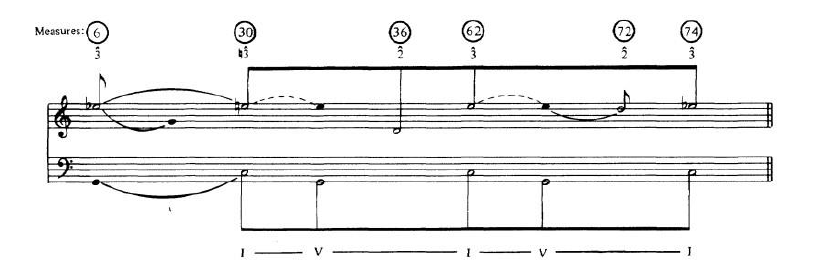
The overall melodic structure may be described as a 3-2-3 motion, which means that the normative descent through a third (3-2-1), fifth (5-4-3-2-1) or eighth (8-7-6-5-4-3-2-1) does not take place. Instead, the primary melodic tone or Kopfton13 (E♭/E♮) is prolonged through its lower neighbor-note, D. On this deep structural level therefore, the melodic process is relatively static, rather like the "asserted" C triad in the macrotonal structure. (Agawu, 1983, p. 90)

This passage about melodic stability makes us realize that even in a harmonically complex and active music, item (III) of the elegiac topic is still present.
Finally, we selected the work When David Heard by Eric Whitacre-a choral composer with the aesthetic closest to Runestad among the previous examples. The text presents the biblical moment when David hears about the death of his son, Absalom and, in despair, runs to his chambers and begins to cry lamenting his son's death and wishing he had died in his place.
Among all the resources employed by Whitacre to create the atmosphere of despair and pain of mourning, particularly notable is his construction of a musical climax through a slow crescendo (III) and with the gradual addition of dissonances (VI) representing David's pain during his lament: "my son… my son… my son…":

With this, we propose that the elegiac topic, previously simply described as possessing "a static or passive atmosphere," be represented by the sum of the characteristics presented, with the demonstration that, culturally, such elements have been incorporated into musical language over time for the representation of elegy15.
Note that this topic is different from the funeral trope structured by Hatten (2023, p. 14) as being "[...] a trope of the tragic, heroic and religious modes," where tragic "is in minor mode, enhanced in dissonant intervals and harmonies," heroic "is marked by dotted rhythms, fanfares/arpeggios on the tonic and in triad, Mannheim rocket technique, and march meter," and religious "marked by learned style, or chorale, a monumental texture, sarabande, French overture, etc.," for representing the suffering and pain of loss, instead of the funerary ritual that is justified by the presence of heroic topics (the exaltation of the deceased) and religious (by the rite itself). Thus, the funeral trope operates in the public-ceremonial domain, organizing death as a social event that demands appropriate ritual, while the elegiac topic inhabits the intimate-personal space of individual mourning.
Having established these characteristics through historical examples that demonstrate the cultural continuity of the elegiac topic, its identification in Jake Runestad's music is perceptible as we can see in the table below:
Soaring trope
The fact that topic theory was developed with the Classical repertoire in mind does not mean that the theory has stabilized; on the contrary, as Monelle (2006, p. 7) argues against the creation of a topic dictionary, since "new topics continually emerge from analysis." The study of this area is receiving so much dedication that, annually, the International Symposium on Musical Topics and Topic Theory takes place, where not only topics from Western music are discussed, but also from popular music, film, and video games.
Sean Atkinson, in 2019, published an article titled "Soaring through the sky: Topics and tropes in video game music," where he discusses how the musical trope of flight has multiple approaches depending on the narrative and symbolic context of the game, relating a repetitive structure to aircraft flight, the Lydian mode as a source of supernatural flight. In this way we can highlight that Section B also features a flight: the alto and soprano voices performing a predominantly ascending movement, together with an accelerando that has the word "soaring" as expressive text, the vocalization with the syllable "Ah" as we can see in FIGURE 9 transforms the flight trope into an angelic flight trope.

With this, we conclude the exposition of the musical elements in Runestad's composition; it now remains to associate all the points found here with those found in the literary analysis previously discussed.
4. Text-Music Relationship
The true expressive force of Let my love be heard emerges from the convergence between sonority and poetic meaning, where musical resources combine with literary resources for the creation of something new. This section will investigate how semantic bridges are established between these two elements.
Just as the poem possesses a devotional, meditative, and supplicatory character, the music brings this atmosphere through the elegiac topic discussed earlier, where after the loss of a loved one, the lyrical voice begins a prayer of mourning through the tenor voices. This melody maintains the natural rhythm of the poem, using only the iambic, trochaic, and anapestic metric feet in the same inflection as the poem, as can be observed below:

Rhythmic analysis of the melody based on metric feet for comparison with what was found in the literary analysis
Note that in only two moments-highlighted with a square-the metric feet do not correspond to those in the analysis of TABLE 2 - Rhythmic and metric analysis of the verses. in the score. However, in the performance of the music this is entirely correctable, since the conductor can ask for greater stress on the word "own" (in the first highlighted case), and use the ritardando that is present in the passage "mounts to heaven and sings" to make it possible to stress the word "mounts," which would result in the rhythm found in the poetry.
Although the musical climax differs from the poetic climax that occurs in verse 6, the composer respects this tension created in the poem using a fermata, together with a ritardando at the end of this phrase followed by an expressive pause in both times it appears, as seen in FIGURE 11.

The composer's acknowledgment in maintaining the poetic climax aligned with phrase endings in both appearances of the verse. At 1'09'' and 2'11 in the reference video for sections A and A' respectively.
Concerning climax, Runestad constructs his musical apex in section B (FIGURE 11) utilizing the symbolic content of the poem. The male voices in quaternary meter reiterating the expression "Let my love be heard," combined with the harmonic motif as it gradually increases in dynamics and modifies the chordal spacing toward the upper register, presents the image of the lyrical voice’s anguish while offering the prayer to carry his beloved to the heavens. Simultaneously, the female voices invoke the angelic soaring trope, characterized by notes in triplets vocalized on "Ah," initially in descending motion (reaching the lowest pitch in measure 32) and subsequently ascending until concluding the Section on the highest pitches of each voice in that passage, representing the angels seeking the lost soul and carrying it heavenward, propelled by the anguish and love of the lyrical voice.
It should be observed that this atmosphere of supplication, anguish, and love is gradually constructed through the presence of the elegiac topic that supplements the character previously established. As with every sonic resource, silence-indicated by the fermata on the rest-at the conclusion of the Section is semantically significant, as the reverberation of the final chord (the omnipresent IV9) is expected to resonate throughout the performance hall, in the same manner that the prayer ascends to the heavens.
At this juncture we encounter a polyrhythm of three against two, as previously observed in the text, and to comprehend the rationale for this construction, we must examine the field of numerical symbolism. While the number two is associated with polarity and division (Schimmel, 1993, p. 46), the number three has become emblematic of divinity across multiple cultures, as Vincent Hopper observes (1938, p. 6.): "Many numbers have been employed to express divinity or divine attributes, but, whether due to its antiquity or its numerous simple analogies in the physical and social world, the comprehensive number 3 has become the most universal number of divinity." Thus, it is entirely logical for the angelic representation to employ the ternary foundation, representing divine perfection, while the human supplication employs the binary foundation, signifying the distinction between humanity and divinity.
Regarding this question of angelic representation, Runestad employs harmony to further illustrate that the female voices, from the commencement of Section B, represent the angels: the only perfect cadence in E major occurring in the composition is in the measure preceding the onset of B (FIGURE 12), wherein we find the ii7 - V - I cadence, a cadence that only the female voices complete.
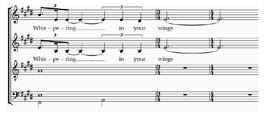
All tension generated at the musical apex appears to approach resolution with the return of the principal melody, yet in the immediately following measure the angelic material reappears in all voices, concluding the composition with the supplication, in piano dynamics and without harmonic resolution (ending on the fourth degree), “let my love...be...heard”16.
5. Conclusions
Returning to Agawu's conception (1991), the analysis of a musical work should serve a greater purpose than the mere description of technical elements found in the score. In this regard, this study employed analytical tools not as ends in themselves, but as means to identify points of convergence between music and poetry, demonstrating how both languages articulate to create a "third" art, in accordance with Kimball (2013). The analysis revealed that Runestad not only set a text to music while respecting prosody, but created an expanded semantic field wherein musical and poetic elements mutually enhance one another.
We acknowledge that this analysis could extend toward interpretive practice, utilizing the findings presented here to propose specific approaches in the performance of the music. Issues such as more fluid conducting gestures, textual articulation, group timbre to maintain the meditative and devotional character, emphasis on expressive pauses, among other aspects, emerge naturally from the identified elements. However, since the motivation for this work was the discussion of text-music relationships in their structural and semantic aspects, it was preferable to concentrate efforts on this analytical dimension, leaving performative implications as future developments.
The methodology employed in this analysis can be expanded and adapted for the study of any other work from the contemporary choral repertoire, opening important questions for the field. It is significant to note that in the majority of the consulted bibliography, semiotic analyses focus on instrumental music under the argument that the presence of text already predetermines the reception of the work. However, this study demonstrates that such a perspective underestimates the complexity of the text-music relationship: even when explicit text is present, a skillful composer must attend precisely to the creation of an expanded meaning that transcends the mere superimposition of elements, transmitting through musical resources a discursive concordance that potentiates the meanings of the text.
Thus, it is hoped that this work will assist conductors, singers, and researchers in the field of musical analysis in investigating the union between text and literature, whether with the intention of seeking in-depth interpretations or for the mere analytical exercise, as musicologist Philip Miller (1973) stated: "Savoring the original text as poetry is the way to the heart of songs."
REFERENCES
-
ACADEMY OF AMERICAN POETS. (n.d.). Poets.org: https://poets.org
» https://poets.org - AGAWU, Kofi. Music as Discourse: Semiotic adventures in romantic music. New York: Oxford University Press, 2009. 336 p.
- AGAWU, Kofi. The Music Language of Kindertotenlieder No. 2. Journal of Musicology. Berkley: University of California Press, v. 2. pp. 81 - 93. 1983.
- AGAWU, Kofi. Playing with signs: a semiotic interpretation of classic music. Nova Jersey: Princeton University Press, 1991. 154 p.
- ALLANBROOK, Jamison. Rhythmic gesture in Mozart: Le nozze di Figaro and Don Giovanni. Chicago: University of Chicago Press, 1983.
-
ALL POETRY. (n.d.). Allpoetry.com: https://allpoetry.com
» https://allpoetry.com -
BOB COLE CONSERVATORY CHAMBER CHOIR. Let my love be heard. Conductor: Dr. Jonathan Talberg. Available at https://www.youtube.com/watch?v=bh5uH5ojFto
» https://www.youtube.com/watch?v=bh5uH5ojFto - CANDIDO, Antonio. O estudo analítico do poema. São Paulo: Associação Editorial Humanitas, 2006. 164 p.
- DOWNLAND, John. Flow my tears. For voice, lute and bass. Edited by Yixi Lin, 2024. 1 score edited from the original 1600 version.
- GRABOCZ, Marta. Narrative strategies of the Romantic ‘philosophical epics’ in the piano works of Franz Liszt. Interdisciplinary Studies in Musicology. Poznan: PTPN & Wydawnictwo Naukowe UAM, v. 14. pp. 108 - 129. 2014.
- GRABOCZ, Marta. Topos y Dramaturgia. Pensamiento, palabra y obra. Bogotá: Universidad Pedagógica Nacional. n. 9. pp. 88 - 155. 2013.
-
HATTEN, R.; MONELLE, R. The Search for Topics IN: The Sense of Music. Nova Jersey: Princeton University Press, 2010. 40 p. Available at: https://music.arts.uci.edu/abauer/4.3/readings/Monelle_Sense_of_Music_Semiotic_Essays_2.pdf
» https://music.arts.uci.edu/abauer/4.3/readings/Monelle_Sense_of_Music_Semiotic_Essays_2.pdf - HATTEN, Robert. Interpreting Musical Gestures, Topics and Tropes. Bloomington: Indiana University Press, 2004. 384 p.
-
HATTEN, Robert. On Musical Topics and Tropes. Definitions, History, Theoretical, Amplifications, Pedagogical Applications, and Extensions. Krakow: Polskie Wydawnictwo Muzyczne, 2023. 14 p. Available at: https://pressto.amu.edu.pl/index.php/rfn/article/view/45602
» https://pressto.amu.edu.pl/index.php/rfn/article/view/45602 - HOPPER, Vincent. Medieval number symbolism: it sources, meaning, and influence on thought and expression. New York: Columbia University Press. 1938. 241 p.
- KIMBALL, Carol. Art Song: Linking Poetry and Music. Milwaukee: Hal Leonard Corporation, 2013. 397 p.
- MAHLER, Gustav. Kindertotenlieder GMW 45 mov II. Leipzig: C. F. Kant, 1905. 1 score for Orchestra and soloist.
- MILLER, Philip. The ring of words: an anthology of song texts. New York: W. W. Norton & Co, 1973.
- MOISÉS, Massaud. Dicionário de Termos Literários. São Paulo: Cultrix. 2004. 520 p.
- MONELLE, Raymon. The Musical Topic: Hunt, Military and Pastoral. Bloomington: Indiana University Press, 2006. 304 p.
- MOZART, Amadeus. Lacrimosa, IN: Réquiem K. 626. Leipzig: Breitkopf & Härtel, 1877. 1 score for Orchestra and mixed choir.
- NATTIEZ, Jean-Jacques. Music and discourse: toward a semiology of music. New Jersey: Princeton University Press, 1990. 296 p.
- NOYES, Alfred. Collected Poems. Vol. 1. New York: Frederick A. Stokes Company Publisher, 1913. 426 p.
- PERSICHETTI, Vincent. Twentieth-Century Harmony: Creative Aspects and Practice. New Yorl: W. W. Norton & Company. 1961. 288 p.
- PISTON, Walter. Harmony. London: Victor Gollancz LTD, 1959, 344 p.
- RATNER, Leonard. Topics IN: The Sense of Music. Londres: Collier Macmillan Publishers, 1980. 30 p.
-
RUNESTAD, Jake. Full Biography. Available at < https://jakerunestad.com/pages/about>. Accessed on: Aug. 5, 2025.
» https://jakerunestad.com/pages/about -
RUNESTAD, Jake. Let my love be heard. Minessota: JR Music, 2014. Available for purchase at: https://jakerunestad.com/products/let-my-love-be-heard 1 score for mixed choir.
» https://jakerunestad.com/products/let-my-love-be-heard - SCHIMMEL, Annemarie. The mystery of numbers. New York: Oxford University Press, 1993. 314 p.
- SCHOENBERG, Arnold. Fundamentals of Music Composition. London: Faber and faber. 1967, 224 pp..
-
TCHAIKOVSKI, Pyotr. [Letters about Samarin’s jubilee]. Correspondent: Pyotr Jurgenson. Moscou, 7/19 nov. 1884. 2 letters. Available at: <https://en.Tchaikovski-research.net/pages/Elegy>.
» https://en.Tchaikovski-research.net/pages/Elegy - TCHAIKOVSKI, Pyotr. Elegie Th 51. Moscow: P. Jungerson, 1890. New York: E. F. Kalmus, 1933 (reprint). 1 score for orchestra.
- TURCO, Lewis. The new book of forms: a handbook of poetics. Lebanon: University Press of New England, 1986. 279 p.
- ULEHLA, Ludmila. Contemporary Harmony: Romanticism through the Twelve-Tone Row. Mainz: Advance Music. 1994. 534 p.
- WHITACRE, Eric. When David Heard. Illinois: Walton Music. 2012. 1 score for mixed choir.

 Source: By the author.
 Source: Jake
  Source: John Downlad (1600), edited by Yixi Lin (2024, bars 1 and 15)
 Source:
  Source: Tchaikovsky (1890, bars 9 - 20 [A], and 40 - 44 [B])
 Source:
  Source:
  Source: Eric
  Source: Jake
  Source: Music by Jake
  Source: Jake
  Source: Jake