
 Access to specialized outpatiecare: an analysis of regulation in Brazilian settings
ABSTRACT
OBJECTIVE To analyze how different subnational governments, based on common national guidelines, have developed their own models for regulating access to specialized care, with varying degrees of innovation, institutionalization, and integration of telehealth.
METHOD A descriptive and exploratory study with a qualitative approach that comparatively analyzes the implementation of regulations governing access to specialized care. Data were collected through document analysis, literature review, and, in some cases, interviews with key stakeholders, consolidated into detailed descriptions of each scenario to form the research corpus. Analysis was conducted using the Consolidated Framework for Implementation Research (CFIR). Experiences were selected from the municipalities of Curitiba (PR), Belo Horizonte (MG), Porto Alegre (RS), and São Paulo (SP), as well as the states of Ceará, Santa Catarina, Rio Grande do Sul, and the Federal District.
RESULTS The eight Brazilian experiences with outpatient regulation are characterized by diversity in organizational models, degrees of institutionalization of teleconsultation, and integration across levels of care. The adoption of technologies, access regulation protocols, and computerized systems varied across locations, influenced by structural, regulatory, and contextual factors. When integrated, teleconsultation improved the quality of referrals and increased problem-solving capacity in primary care, but its implementation remains uneven across the country.
CONCLUSION The implementation of access regulation to specialized care in the Unified Health System varied according to institutional, organizational, and technological capacities. Weaknesses were identified in the integration of health information systems in the organization and delivery of specialized care, with structural inequalities; in governance, with low standardization of protocols; limited integration between Primary Health Care and specialized care; and professional resistance to change. Regions with better outcomes integrated teleconsultation into outpatient regulation; clinical and access protocols adopted health information systems integrated with analytical intelligence resources and institutionalized regulatory guidelines. The CFIR highlighted the influence of contexts, actors, and processes, reinforcing the importance of national guidelines for improving local organizations.
DESCRIPTORS:
Unified Health System; Health Care Coordination and Monitoring; Health Services Accessibility; Secondary Health Care; Health Policy, Planning and Management; Telemedicine
RESUMO
OBJETIVO Analisar de que maneira diferentes governos subnacionais, partindo de diretrizes nacionais comuns, desenvolveram modelos próprios de regulação do acesso à atenção especializada, com distintos graus de inovação, institucionalização e integração da telessaúde.
MÉTODO Estudo descritivo e exploratório, de abordagem qualitativa, que analisa de forma comparada a implementação da regulação do acesso à atenção especializada. Dados coletados por meio de análise documental, revisão da literatura e, em alguns casos, entrevistas com atores-chave, consolidados em descrições detalhadas de cada cenário, para composição do corpus da pesquisa. Análise realizada com a aplicação do Consolidated Framework for Implementation Research (CFIR). Foram selecionadas as experiências dos municípios de Curitiba (PR), Belo Horizonte (MG), Porto Alegre (RS) e São Paulo (SP) e dos estados do Ceará, Santa Catarina, Rio Grande do Sul e do Distrito Federal.
RESULTADOS As oito experiências brasileiras de regulação ambulatorial se caracterizam pela diversidade nos modelos organizacionais, graus de institucionalização da teleconsultoria e integração entre níveis de atenção. A adoção de tecnologias, protocolos de regulação do acesso e sistemas informatizados variou entre os locais, influenciada por fatores estruturais, normativos e contextuais. A teleconsultoria, quando integrada, qualificou os encaminhamentos e aumentou a resolutividade na atenção primária, mas sua implementação permanece desigual no território nacional.
CONCLUSÃO A implementação da regulação do acesso à atenção especializada no SUS variou conforme capacidades institucionais, organizacionais e tecnológicas. Foram identificadas fragilidades na integração entre sistemas de informação em saúde na organização e oferta da atenção especializada com desigualdades estruturais, na governança com baixa padronização de protocolos, integração limitada entre Atenção Primária à Saúde e atenção especializada e resistência profissional a mudanças. Territórios com melhores resultados integraram a teleconsultoria à regulação ambulatorial, protocolos clínicos e de acesso adotaram sistemas de informação em saúde integrados com recursos de inteligência analítica e diretrizes regulatórias institucionalizadas. O CFIR evidenciou a influência de contextos, atores e processos, reforçando a importância de diretrizes nacionais para aperfeiçoar as organizações locais.
DESCRITORES:
Sistema Único de Saúde; Regulação e Fiscalização em Saúde; Acesso aos Serviços de Saúde; Atenção Secundária à Saúde; Políticas, Planejamento e Administração em Saúde; Telemedicina
INTRODUCTION
The federative and decentralized structure of Brazil’s Sistema Único de Saúde (SUS - Unified Health System) has facilitated expanded access to Primary Health Care (PHC), but it still perpetuates the fragmentation of Redes de Atenção à Saúde (RAS - Health Care Networks ) and inequality in the provision of specialized care across the country’s regions1 , especially in small municipalities, due to technical, operational, and financial constraints2 . Among the strategies to address this scenario, the Política Nacional de Regulação em Saúde (PNR - National Health Regulation Policy)3 stands out, promoting intergovernmental cooperation, resource sharing, and integration across levels of care. Published in 2008 and revised in 2025, the PNR has a regulatory framework, operational structure, financing, and information system aimed at organizing care flows, mediating the relationship between supply and demand, and promoting the rational use of available resources4. Its implementation, however, reveals significant heterogeneity in the Brazilian context, due to the federal nature of the system, the coexistence with the private sector, and inequalities in institutional capacity among federal entities5.
In Brazil, health regulation is organized into three interdependent dimensions: access, care, and health systems6. Access regulation plays an essential role in the coordination between PHC and specialized care, through regulation centers, protocols, and computerized systems7,8. The concept has evolved in official documents (Figure) as a set of actions aimed at organizing and controlling access to specialized care, based on criteria of risk, vulnerability, health needs, and resource availability9,10.
Health regulation has gained significant visibility and strength since mid-2010 through the National Telehealth Brazil Networks Program, by qualifying referrals and optimizing the use of outpatient care services11. New modes of interaction were created, notably teleconsultation, defined as a consultation between health professionals to clarify clinical questions, conducted via bidirectional telecommunication, whether synchronous or asynchronous. Evidence indicates that this practice has been effective in reducing waiting lists, expanding the problem-solving capacity of PHC, and improving the quality of clinical decisions14,15. However, its implementation has varied according to contextual, political, and institutional factors16.
This study aims to analyze how different subnational governments, based on common national guidelines, have developed their own models for regulating access to emergency care, with varying degrees of innovation, institutionalization, and integration of telehealth.
METHODS
Study Design
A descriptive and exploratory study with a qualitative approach that comparatively analyzes the implementation of regulations governing access to primary care in three states—Ceará (CE), Santa Catarina (SC), and Rio Grande do Sul (RS); four municipalities—Belo Horizonte-MG (BH), Porto Alegre-RS (POA), São Paulo-SP (SPO), Curitiba-PR (CUT)—and the Federal District (DF), organized politically and administratively as a state and municipality.
The selection of settings sought to represent different contexts and institutional arrangements, based on criteria of institutional relevance, availability of public information, and national recognition, enabling the comparison of distinct models of governance and integration between PHC and specialized care. The settings exhibit demographic, socioeconomic, and organizational heterogeneity (Table), share autonomy in the management of the SUS, and face common challenges related to access to specialized care.
Project approved by the Research Ethics Committees of the institutions where interviews were conducted and the Conselho Nacional de Ética em Pesquisa (Conep - National Research Ethics Council). All interviewees digitally signed the Informed Consent Form.
Variables and Data Sources
Data were collected through a combination of document analysis, literature review, and complementary semi-structured interviews with key actors, when necessary (Chart 1). The interviews were conducted via Google Meet, with simultaneous recording and transcription using the Tactiq app, following prior approval by the respective Research Ethics Committees (CUT, SC, DF, CE). The eight key stakeholders interviewed were physicians (3), a dentist (1), nurses (3), and an educator (1), each with at least three years of experience working in the Regulatory Complexes they represented.
The variables were defined based on the domains of the Consolidated Framework for Implementation Research (CFIR), a conceptual meta-framework designed to identify factors that influence the implementation of innovations and determine their success or failure. It is organized into five main domains: intervention characteristics, external and internal context, individual characteristics, and the implementation process. For each domain, organizational, political, and operational factors related to the implementation of regulatory strategies were examined. Although the model includes several subdomains, it is recognized that its scope may not fully reflect the contexts of low- and middle-income countries. For this reason, an inductive approach was adopted, allowing for the incorporation of emerging variables and the contextual adaptation of the framework to the Brazilian scenario17.
Data Analysis
Documentary analysis, literature review, and supplementary interviews enabled the description of the normative and institutional framework of the interventions, as well as the contextualization of the formulation and implementation of the innovations studied. Interview transcripts were reviewed and subjected to qualitative thematic analysis18 . Both techniques enabled the organization of the research corpus according to the CFIR domains, through discussion and consensus among the researchers, to avoid redundancies in the categorization of information within each domain.
RESULTS
Chart 2 summarizes the patterns identified in state and municipal experiences with specialized outpatient regulation and teleconsultation. The results, organized according to the CFIR analytical domains, allowed us to identify determinants of implementation, advances, weaknesses, and unique contextual factors of the scenarios (Chart 3).
(1) Characteristics of the intervention
Regulation of access to specialized care, with or without the use of teleconsultation, consists of monitoring wait times, reducing user no-shows for scheduled appointments and unnecessary procedures, coordinating the care pathway, and improving communication between teams and users19,20. These actions are carried out by regulation centers or regulatory complexes.
Access regulation protocols are used that establish referral criteria, case prioritization, and user pathways and flows within the RAS. Care prioritization is based on clinical severity and user vulnerabilities, regardless of the order of entry on the waiting list21.
Since 2008, the Ministry of Health has developed and made available to state and municipal governments the Regulation System (SISREG) as an important operational support tool. Some states and municipalities have opted to develop their own technological solutions for regulation management, often customized to address local realities and integrated with other municipal management platforms.
Teleconsultation, when integrated into referral systems, promotes interaction between PHC professionals and specialists and aims to clarify doubts regarding clinical procedures, health interventions, and issues related to the workflow22. It is used to support access regulation, improving clinical decision-making and reducing unnecessary patient travel. Its use, although guided by national guidelines, depends on local organization. In some settings, it is established as a mandatory step preceding referral from PHC to specialized care. In this model, the active agent initiating the process is the requesting professional themselves, who contacts the teleconsultation team.
(2) External scenario
In all scenarios, national SUS guidelines and local legislation influenced the organization of emergency care regulation. In addition, pressure from regulatory bodies, increasing litigation, and social demands for transparency and accountability served as decisive factors in driving institutional changes. The Covid-19 pandemic had a widespread impact across all territories, leading to the suspension of elective care and longer waiting lists. The need to ensure access during the health crisis led to the reorganization of schedules, accelerated digitization, and greater adoption of telehealth tools.
Among the states, SC and RS stand out, with a regulatory framework consolidated in laws, decrees, and specific resolutions on regulation and telehealth. CE structures its actions primarily around protocols and operational initiatives of the State Telehealth Center, without a formalized regulatory framework. In municipalities, greater regulatory autonomy is observed, with local legislation and their own decrees guiding regulatory flows. POA and SPO stand out, with integrated protocols between specialized care regulation and teleconsultation.
Institutional partnerships have also proven decisive. The states of SC and RS maintain ongoing cooperation with universities and telehealth centers, which are responsible for training, evaluation, and technical-scientific support. In municipalities, academic support is equally significant, and in some cases, such as in CUT, collaboration with the Regional Medical Council (CRM) was cited as relevant to the technical legitimacy of the actions.
External factors such as institutional crises, natural disasters, and regional inequalities directly influenced the implementation of regulation in the states. In the municipalities, social and media pressure for transparency and local health emergencies, such as dengue outbreaks, stood out, requiring rapid reorganization of agendas and prioritization of cases.
(3) Internal context
The internal organization of emergency care regulation varied across states and municipalities, reflecting different institutional arrangements, levels of technological adoption, and management capacity. In all settings, progress was observed in the hierarchization and regionalization of care pathways, as well as in criteria for access and user prioritization. The exception was the Federal District, characterized by institutional instability, fragile governance, and fragmentation of health information systems (HIS), with significant compromises to the traceability of referrals by primary care and the continuity of care.
Team training proved to be a cross-cutting element in all contexts. The states of SC and RS maintain ongoing programs and partnerships with universities. In municipalities, continuing education is also prioritized, with POA and CUT standing out for their digital platform-based training.
Integration among SIS is limited in the analyzed scenarios. SC and RS have more structured processes, with intensive use of Information and Communication Technologies (ICT) and Business Intelligence (BI) systems to monitor waiting lists and access indicators in real time. BI tools are also used in the Federal District, although integration between systems remains limited. In municipalities, SPO, POA, and CUT stand out for also promoting public access to information, with greater transparency. In BH, despite the digitization of processes, public visibility of data was still evolving.
Teleconsultation was incorporated in a heterogeneous manner. The states of RS, SC, and CE use teleconsultation platforms distinct from the regulation systems, even when they have their own telehealth platforms. The lack of interoperability between these systems was noted by CE and in the municipality of SPO. The municipality of POA also adopts separate platforms, with greater integration between the regulation and telehealth systems.
(4) Characteristics of the individuals
The roles of actors in emergency care regulation and teleconsultation are similar. Consolidated functional structures were identified in the Dispatch Centers, which centralize activities such as managing the SIS, organizing waiting lists, validating referrals, and monitoring care provision. These structures operate through a complex network of institutional and individual actors, with continuous functions, although with local variations in the forms of execution and coordination.
In all scenarios, PHC professionals were identified as key actors in entering requests, recording clinical information, and complying with regulatory and clinical protocols. Regulating physicians perform technical mediation, assessing demands and deciding on authorization, return with guidance, denial, or referral.
In the municipality of SPO, there was an expansion of the professional profile of regulators, including nurses, physical therapists, and speech-language pathologists with different regulatory competencies. This includes technicians who support triage, document ver, and the organization of requests, suggesting greater professionalization of administrative functions.
In various contexts, teleconsultations were observed between coordinating physicians and PHC professionals to provide technical and clinical support in analyzing requests. Such integration represents an expansion of the coordinator’s role, who now acts as an access manager, clinical consultant, and educational support agent.
Institutional and academic partnerships are structural elements of the sustainability of the analyzed models, in the training of consultants, in innovation projects, in the shared management of SIS, in clinical support, and in the technical improvement of teams. Furthermore, these partnerships have enabled the continuous updating of clinical and operational protocols.
(5) Implementation process
There are recurring strategies, advances, and weaknesses in the process of implementing regulations for access to specialized care and teleconsultation. Although each scenario has followed its own trajectory, a convergent trend toward technological modernization, institutionalization of protocols, and expansion of the educational role of telehealth has been observed.
Between 2019 and 2023, the CE restructured outpatient regulation, prioritizing critical specialties. Teleconsultation, initially focused on educational activities, became part of the regulation, incorporating both synchronous and asynchronous clinical interactions. The observed weaknesses included fragmented systems, the absence of a unified medical record, and professional resistance. The integration of teleconsultation into the regulation represented a step forward.
In SC, outpatient regulation began in 2009, with the adoption of SISREG in 2010 and the Regulation Centers in 2013. Between 2018 and 2019, the quota-based model was abandoned, and access regulation protocols with risk classification were adopted. Teleconsultation, implemented in 2007, was consolidated through training, specific protocols, an asynchronous platform, coordination with primary care, and the use of informational channels, such as messaging services. Weaknesses included initial resistance to change, technical disparities among the state’s municipalities, and a limited supply of emergency care services due to a shortage of specialists. The standardization of e protocols and the consolidation of a widespread teleconsultation system were the advances observed.
In RS, the current model for regulating access to specialized care began in 2016, inspired by the experience in POA, with gradual expansion starting in 2021. Teleconsultation was implemented in 2007 and strengthened by the TelessaúdeRS program, which, since 2012, has contributed to the standardization of protocols and integration of tools, coordinating teleconsultation, training, and the SIS. The main weaknesses were limited connectivity in some municipalities and resistance to change. Advances included the statewide expansion of the regulatory model, with the integration of telehealth.
In the Federal District, the first initiatives to regulate access to outpatient care began in 2004 with the establishment of the Appointment and Test Scheduling Coordination Center, which was consolidated in 2007 with the creation of the Regulatory Directorate. Protocols and monitoring dashboards created starting in 2024 with the support of state regulatory agencies, along with training programs, were implemented, albeit amid resistance, contractual limitations, and high turnover among managers.
Teleconsulting, initiated in 2017 through the Regula+Brasil Project, used an asynchronous model to address waiting lists; however, it was not fully integrated into outpatient regulation, as it was limited to the duration of the Project. Weaknesses were identified, such as low adherence and/or a lack of updated protocols and poor integration with primary care. The advances highlighted in the interviews included the creation of BI dashboards for decision support, shared with regulatory agencies, and greater transparency of information for the public.
In the municipalities, experiences were more varied. In CUT, regulation began in 2013 and was formalized in 2017, with strengthened clinical regulation in the basic health units and the creation of protocols with support from the Paraná Medical Council (CRM). The local SIS integrated regulation into the electronic medical record. Teleconsulting, also initiated in 2017, facilitated the regulation of access to priority specialties and the definition of care pathways. The weaknesses identified were professional resistance and a shortage of specialists, while the advances included the integration of SIS and specialty-based teleregulation.
In POA, teleconsulting, used since 2012 in partnership with TelessaúdeRS led by the university, develops and applies protocols, uses BI dashboards, and supports primary care. However, outpatient regulation gained momentum in 2015 , with the implementation of integrated proprietary SIS systems. The main weaknesses identified were: judicialization, long waiting lists, inequality in service provision, and professional resistance. Notable advances include: technological investment, technical-academic support, and the positioning of teleconsultation as a structural pillar of regulation.
In the municipality of SPO, regulation began in 2003 and was restructured in 2015 with the creation of the Municipal Coordination of Regulation, Evaluation, and Control. Local SISs were partially integrated, with regulatory protocols and telehealth initiatives. Teleconsultation began in 2017, with teledermatology in partnership with an external institution. Weaknesses included the poor integration of the SIS, professional resistance, and the lack of protocols in some areas. Advances included the professionalization of the regulation teams and the implementation of teleconsultation by care pathways.
In Belo Horizonte, outpatient triage was intensified starting in 2020 with the implementation of the local SIS, which definitively replaced SISREG in 2022, integrating with the electronic medical record and improving the traceability of care. Teleconsultation began in 2003–2004 with BH-Telessaúde and advanced with the Regula+Brasil Project (2018–2022). Investments were made in training, platform integration, and clinical triage. There are weaknesses in the formalization of protocols, monitoring, professional adherence, and the uneven incorporation of technologies. There have been advances in expanding care pathways and applying teleconsultation as a clinical screening tool.
DISCUSSION
Although subnational governments start from common guidelines, the implementation of regulations governing access to emergency care in the SUS takes on distinct forms, determined by institutional capacity, organizational arrangements, technological innovation, and the use of telehealth. Regions that more consistently integrated clinical protocols, integrated health information systems (SIS), and teleconsultation demonstrated greater institutionalization of specialized care access regulation, better-qualified referrals, and greater potential for reducing waiting lists and wait times. Contexts marked by fragmented systems, unstable governance, and professional resistance faced greater difficulties in consolidating effective regulatory models.
The regulation of emergency care has established itself, since the 2000s, as a model that involves teams of regulators responsible for prioritizing requests originating from primary care by applying previously defined technical criteria, mediating the relationship between demand and healthcare supply through the organization of waiting lists, definition of care pathways, and continuous monitoring, to ensure orderly, equitable, and timely access to health services6,23 .
National policies establish guidelines for regulating access but do not define minimum parameters for operational protocols, delegating responsibility for structuring them to local managers. Although this flexibility preserves federal autonomy, it may compromise equity in access due to divergent interpretations and limit the dissemination of systematically evaluated and replicable adaptations in health policies17 .
The heterogeneity of regulatory processes among states and municipalities can undermine the consolidation of SUS principles. Ideally, national regulations with standardized clinical protocols guide implementation, defining margins for local adaptation without compromising effectiveness and equity. In practice, however, fragmented regional strategies prevail, with low technological integration and limited use of clinical management tools1,17 .
Adjustments and improvements to outpatient regulation have been occurring since 2003, with gradual advances driven by new national policies. The Covid-19 pandemic represented a disruptive milestone, accelerating the adoption of digital technologies and the reconfiguration of access regulation. Addressing this health crisis propelled telehealth as an essential tool to ensure continuity of care11,12,15,24 . In several countries, the pandemic led to the relaxation of regulatory standards to allow for the rapid adoption of digital tools and emergency protocols that would ensure the maintenance of services24. This experience also highlighted the need for advance planning and proactive policies, as formulating protocols in crisis situations can compromise the quality and consistency of care provision25 .
The findings of this study indicate that teleconsultation has significant potential to improve the quality of referrals, enhance the effectiveness of primary care, and reduce user wait times for specialist care, as evidenced by experiences in states such as Rio Grande do Sul, Santa Catarina, Belo Horizonte, and Recife, as reported in the literature12,26,27 In addition to optimizing the regulatory flow , the integration between regulation and telehealth encourages spontaneous teleconsultations, which promote coordination between PHC professionals and specialists, strengthening continuing education, interprofessional collaboration, and collaboration across levels of care28 .
The lack of interoperability and integration among HISs remains a weakness that hinders monitoring, evaluation, and transparency, compromising social control and evidence-based management. This challenge is shared by other countries with decentralized public systems, according to a comparative study on the integration between PHC and specialized care in Brazil and Spain29 .
The CFIR proved consistent for analyzing the interaction of institutional, technological, and human factors and their influence on health innovation, favoring a more structured and comparable approach across different contexts17,30 . There are limitations to extrapolating the results of this study to the country as a whole, although the experiences are representative of recurring patterns in policies regulating access to specialized care.
CONCLUSION
The implementation of regulations governing access to emergency care in the SUS, analyzed using the CFIR, varied according to institutional, organizational, and technological capacities. We identified weaknesses in interoperability and integration among SIS, in the organization of specialized care provision with inequalities in care and regulatory infrastructure, in health system governance with low standardization of clinical protocols, incipient integration between PHC and specialized care, and professional resistance to change.
The regions that stood out integrated clinical and access protocols, information systems integrated with analytical intelligence resources to support regulatory processes, and strong institutionalization of regulatory guidelines. The integration of teleconsultation into regulation stood out in health system governance, particularly in improving coordination between PHC and specialized care.
The CFIR framework allowed us to understand how the interaction between contexts, actors, and processes influences the implementation of interventions, reinforcing the relevance of national guidelines capable of strengthening RAS.
REFERENCES
-
1 Santos AM, Giovanella L. Regional governance: strategies and disputes in health region management. Rev Saúde Pública. 2014;48(4):622-31. https://doi.org/10.1590/S0034-8910.2014048005045
» https://doi.org/10.1590/S0034-8910.2014048005045 - 2 Lima LD, Viana ALd'A, Machado CV, Albuquerque MV, Oliveira RG, Fusaro ER et al. Regionalização e acesso à saúde nos estados brasileiros: condicionantes históricos e político-institucionais. Cien Saude Colet. 2012;17(11):2881-92.
- 3 Machado CV, Guim MAM. Descentralização e igualdade no acesso aos serviços de saúde: o caso do Brasil. Rev Serv Público. 2017;68(4):639-60.
-
4 Bastos LBR, Oliveira VL, Andrade MP, Magalhães R, Lima LD, Oliveira RG et al. Practices and challenges on coordinating the Brazilian Unified Health System. Rev Saúde Pública. 2020;54:25. https://doi.org/10.11606/s1518-8787.2020054001940
» https://doi.org/10.11606/s1518-8787.2020054001940 - 5 Vilarins GCM, Shimizu HE, Gutierrez MMU. A regulação em saúde: aspectos conceituais e operacionais. Saude Debate. 2012;36(95):640-7.
-
6 Figueiredo TA, Angulo-Tuesta A, Hartz Z. Avaliabilidade da política nacional de regulação no SUS: uma proposta preliminar. Physis. 2019;29:e290215. https://doi.org/10.1590/S0103-73312019290215
» https://doi.org/10.1590/S0103-73312019290215 -
7 Damasceno RF, Caldeira AP. Fatores associados à não utilização da teleconsultoria por médicos da Estratégia Saúde da Família. Cien Saúde Colet. 2019;24(8):3089-98. https://doi.org/10.1590/1413-81232018248.22662017
» https://doi.org/10.1590/1413-81232018248.22662017 -
8 Barbosa DVS, Barbosa NB, Najberg E. Regulação em Saúde: desafios à governança do SUS. Cad Saúde Colet. 2016;24(1):49-54. https://doi.org/10.1590/1414-462X201600010073
» https://doi.org/10.1590/1414-462X201600010073 -
9 Ministério da Saúde (BR). Política nacional de atenção especializada em saúde (PNAES). Brasília: Ministério da Saúde; 2023 [cited 2025 Aug 2]. Available from: https://www.in.gov.br/en/web/dou/-/portaria-gm/ms-n-1.604-de-18-de-outubro-de-2023-517547992
» https://www.in.gov.br/en/web/dou/-/portaria-gm/ms-n-1.604-de-18-de-outubro-de-2023-517547992 - 10 Ministério da Saúde (BR). Portaria GM/MS nº 9.262, de 30 de dezembro de 2025. Institui a política nacional de regulação em saúde do Sistema Único de Saúde - SUS e revoga o Anexo XXVI da portaria de consolidação GM/MS nº 2, de 28 de setembro de 2017. Diário Oficial União. 31 dez 2025.
-
11 Lapão LV, Ferreira A, Gregório J, Silva MJ, Almeida A, Pinto P et al. Implementation of digital monitoring services during the COVID-19 pandemic for patients with chronic diseases: design science approach. J Med Internet Res. 2021;23(8):e24181. https://doi.org/10.2196/24181
» https://doi.org/10.2196/24181 -
12 Cezário LRA, Ranzani OT, Vasconcelos SM, Lopes FM, Silva RC, Machado CV et al. Telessaúde no Brasil: uma revisão de escopo. Rev Bras Saúde Pública. 2024;48(2):4010. https://doi.org/10.22278/2318-2660.2024.v48.n2.a4010
» https://doi.org/10.22278/2318-2660.2024.v48.n2.a4010 -
13 Lisboa KO, Hajjar AC, Sarmento IP, Sarmento RP, Gonçalves SHR. A história da telemedicina no Brasil: desafios e vantagens. Saúde Soc. 2023;32(1):1-14. https://doi.org/10.1590/S0104-12902022210170pt
» https://doi.org/10.1590/S0104-12902022210170pt -
14 Schmitz CAA, Harzheim E. Oferta e utilização de teleconsultorias para atenção primária à saúde no programa telessaúde Brasil redes. Rev Bras Med Fam Comun. 2017;12(39):1-11. https://doi.org/10.5712/rbmfc12 (39)1453
» https://doi.org/10.5712/rbmfc12 (39)1453 -
15 Almeida RS, Santos MFL, Costa LA, Gomes LBS, Lemos SM, Pires VCF et al. Teleconsultation as a strategy to support primary health care professionals: a scoping review. Health Policy Technol. 2025;14:100971. https://doi.org/10.1016/j.hlpt.2024.100971
» https://doi.org/10.1016/j.hlpt.2024.100971 -
16 Maeyama MA, Calvo MCM. A integração do telessaúde nas centrais de regulação: a teleconsultoria como mediadora entre a atenção básica e a atenção especializada. Rev Bras Educ Med. 2018;42(2):63-72. https://doi.org/10.1590/1981-52712015v42n2rb20170105
» https://doi.org/10.1590/1981-52712015v42n2rb20170105 -
17 Callaghan-Koru JA, Nonyane BAS, Shaikh N, Shah R, Winch PJ, Baqui AH et al. Factors that influence the scale up of new interventions in low-income settings: a qualitative case study of the introduction of chlorhexidine cleansing of the umbilical cord in Bangladesh. Health Policy Plan. 2020;35(4):44-51. https://doi.org/10.1093/heapol/czaa006
» https://doi.org/10.1093/heapol/czaa006 -
18 Dias EG, Mishima SM. Análise temática de dados qualitativos: uma proposta prática para efetivação. Rev Sustinere. 2023;11(1):402-11. https://doi.org/10.12957/sustinere.2023.71828
» https://doi.org/10.12957/sustinere.2023.71828 -
19 Almeida PF, Medina MG, Fausto MCR. Coordenação do cuidado e atenção primária à saúde no Sistema Único de Saúde. Saúde Debate. 2018 ;4(esp.1):244-60. https://doi.org/10.1590/0103-11042018S116
» https://doi.org/10.1590/0103-11042018S116 -
20 Konkewicz LR. Coordenação ou competição? A regulação do acesso à atenção especializada pela Atenção Primária à Saúde da cidade do Rio de Janeiro. Physis. 2023;33:e33012,. https://doi.org/10.1590/S0103-7331202333012
» https://doi.org/10.1590/S0103-7331202333012 -
21 Peiter CC, Lanzoni GMM, Oliveira WF. Regulação em saúde e promoção da equidade: o Sistema Nacional de Regulação e o acesso à assistência em um município de grande porte. Saúde Debate. 2016;40(111):63-73. https://doi.org/10.1590/0103-1104201611105
» https://doi.org/10.1590/0103-1104201611105 -
22 Ministério da Saúde (BR). Manual Instrutivo do Programa SUS Digital. Brasília: Ministério da Saúde, 2024 [cited 2025 May 20]. Available from: https://www.gov.br/saude/pt-br/centrais-de-conteudo/publicacoes/guias-e-manuais/2024/manual-instrutivo-do-programa-sus-digital/view
» https://www.gov.br/saude/pt-br/centrais-de-conteudo/publicacoes/guias-e-manuais/2024/manual-instrutivo-do-programa-sus-digital/view -
23 Melo EA, Oliveira RR, Lima LD, Machado CV, Iozzi FL, Silva EV. A regulação do acesso à atenção especializada e a Atenção Primária à Saúde nas políticas nacionais do SUS. Physis. 2021;31(1):e310109. https://doi.org/10.1590/S0103-73312021310109
» https://doi.org/10.1590/S0103-73312021310109 -
24 Qi M, Ren J. An overview and visual analysis of research on government regulation in healthcare. Front Public Health. 2023;11:1272572. https://doi.org/10.3389/fpubh.2023.1272572
» https://doi.org/10.3389/fpubh.2023.1272572 -
25 Mello MM, Cohen IG. Regulation of health and health care artificial intelligence. JAMA. 2025;333(20):1769-70. https://doi.org/10.1001/jama.2025.3308
» https://doi.org/10.1001/jama.2025.3308 -
26 Gadenz SD, Benzano D, Anziliero F, Klarmann MHS, Harzheim E, Molina-Betancur V et al. Telehealth to support referral management in a universal health system: a before-and-after study. BMC Health Serv Res. 2021;21(1):1012. https://doi.org/10.1186/s12913-021-07028-5
» https://doi.org/10.1186/s12913-021-07028-5 -
27 Araújo MDS, Pinto LF, Andrade LOM, Almeida PF, Machado CV, Silva EV et al. Avaliação da implantação de um projeto de telerregulação assistencial em uma capital brasileira. Cad Saude Publica. 2023;39(7):e00009623. https://doi.org/10.1590/0102-311XPT009623
» https://doi.org/10.1590/0102-311XPT009623 -
28 Katz N, Moretti-Pires RO, Oliveira RR, Fontanive LV, Klarmann MHS, Schenkel JA et al. Acesso e regulação ao cuidado especializado no Rio Grande do Sul: a estratégia RegulaSUS do TelessaúdeRS-UFRGS. Cien Saude Colet. 2020;25(4):1389-400. https://doi.org/10.1590/1413-81232020254.28942019
» https://doi.org/10.1590/1413-81232020254.28942019 - 29 Almeida PF, Santos AM, Farias LO, Cortes MS, Silva EV. Estratégias de integração entre atenção primária à saúde e atenção especializada: paralelos entre Brasil e Espanha. Saude Debate. 2013;37(98):400-15.
-
30 Strehlenert H, Richter-Sundberg L, Nyström ME, Hasson H. Implementation of a national policy for improving health and social care: a comparative case study using the Consolidated Framework for Implementation Research. BMC Health Serv Res. 2019;19:730. https://doi.org/10.1186/s12913-019-4591-2
» https://doi.org/10.1186/s12913-019-4591-2

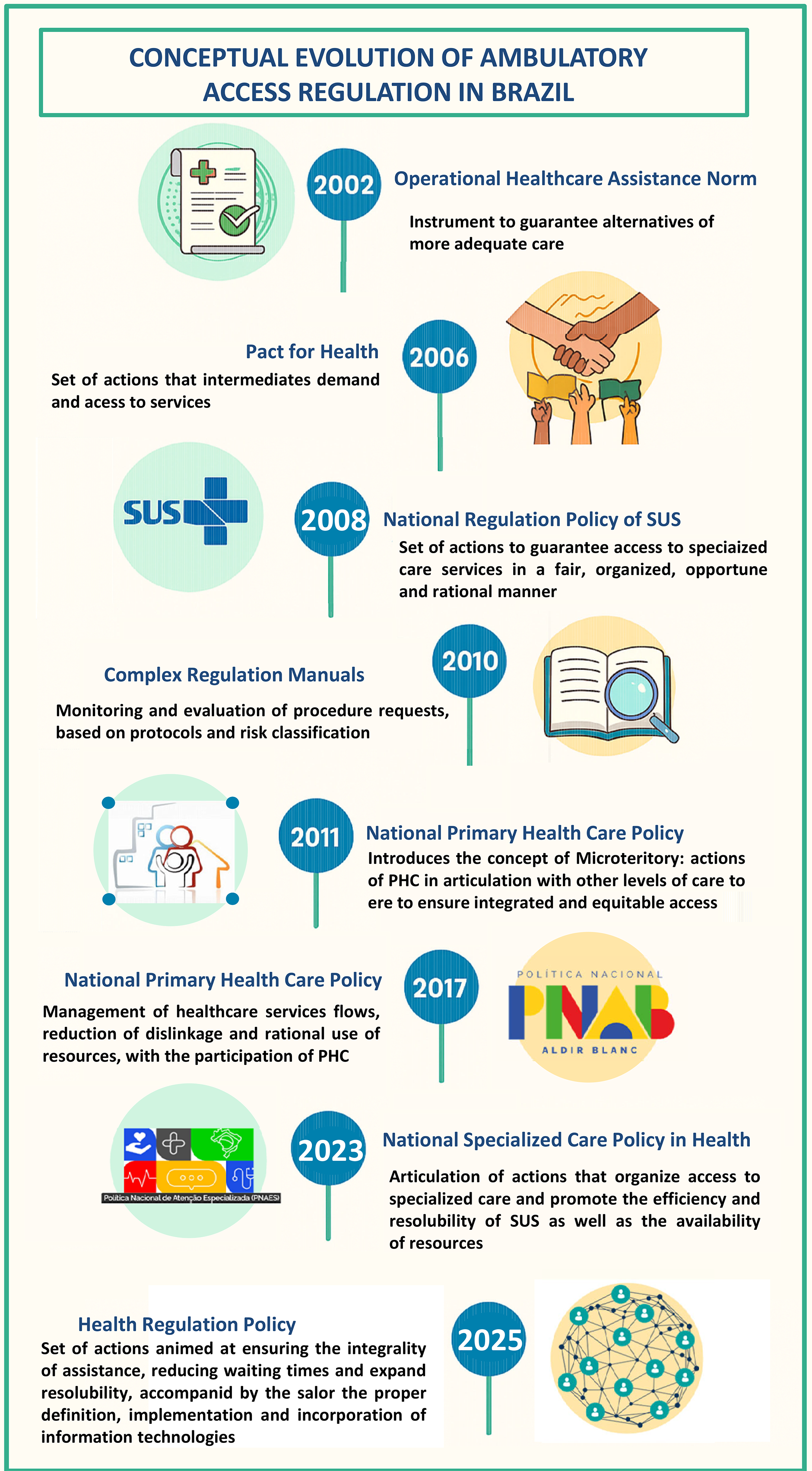 Source: prepared based on references 9,10,21,22.