
 Is it plausible that Lutzomyia longipalpis (Psychodidae: Phlebotominae) waited until European colonizers introduced Leishmania (L.) infantum to the New World to become a vector of American visceral leishmaniasis? An Opinion
One of the most contentious issues regarding American visceral leishmaniasis (AVL) is the true origin and taxonomic classification of its etiological agent. The debate over the species Leishmania chagasi Cunha & Chagas, 1937 [subsequently revised to Leishmania (Leishmania) chagasi Lainson & Shaw, 1987] began in the 1980s. It was then suggested that Leishmania (L.) infantum Nicolle, 1908 was actually the causative agent of AVL1. This claim was based on comparative enzyme profile analyses at 11 loci involving 110 Brazilian isolates of L. (L.) chagasi, sourced from humans, dogs, and Didelphis spp. (opossums), which displayed no significant differences from the World Health Organization (WHO) reference strain of L. (L.) infantum. In the same period, Grimaldi et al.2, using 16 Leishmania (L.) donovani-specific monoclonal antibodies, and Kreutzer et al.3, analyzing 20 enzyme loci, were also unable to distinguish L. (L.) chagasi isolates from Brazil, Honduras, Panama, and Colombia from the WHO reference strain of L. (L.) infantum. In the 1990s, Momen et al.4 provided additional evidence through enzyme electrophoresis and schizodeme analysis that supported the theory of a recent New World origin for L. (L.) chagasi, showing it to be indistinguishable from L. (L.) infantum. Towards the decade's end, Mauricio et al.5 reported the first findings of genomic diversity within the L. (L.) donovani complex and proposed that L. (L.) chagasi be recognized as synonymous with L. (L.) infantum.
In this century, Maurício et al.6 utilized restriction fragment length polymorphism (RFLP) and random amplified polymorphic DNA (RAPD) methods to study this issue. Their findings reinforced the earlier conclusion that L. (L.) chagasi is synonymous with L. (L.) infantum, suggesting that the latter was likely introduced into the New World primarily by Portuguese and/or Spanish colonizers. Lukes et al.7 subsequently conducted a multifactorial genetic analysis, also based on RFLP and RAPD techniques. Their results confirmed that L. (L.) chagasi could not be distinguished from L. (L.) infantum, leading to the proposal that L. (L.) donovani and L. (L.) infantum should be the only recognized species within the L. (L.) donovani complex.
While acknowledging the taxonomic importance of these molecular/genomic methodologies, it is essential to consider other factors such as clinical, epidemiological, and ecological parameters, including parasite-host interactions and vectors, which are critical for the specific identification of Trypanosomatidae parasites, including Leishmania species. It is also important to note that AVL is endemic to a region, Central and South America (Latin America), that exhibits remarkable heterogeneity within the genus Leishmania. This region encompasses the three currently recognized subgenera: L. (Leishmania) Ross, 1903; L. (Viannia) Lainson & Shaw, 1987; and L. (Mundinia) Shaw, Camargo & Teixeira, 2016. It includes the highest number of Leishmania species (19 in total), with 16 pathogenic to humans [15 causing cutaneous leishmaniasis: L. (V.) braziliensis, L. (V.) peruviana, L. (V.) guyanensis, L. (V.) panamensis, L. (V.) lainsoni, L. (V.) shawi, L. (V.) naiffi, L. (V.) lindenbergi, L. (V.) utingensis, L. (L.) mexicana, L. (L.) amazonensis, L. (L.) venezuelensis, L. (L.) waltoni, L. (L.) ellisi, L. (M.) martiniquensis; and one causing AVL: L. (L.) chagasi], and three [L. (L.) aristidesi, L. (L.) garnhami, and L. (L.) forattini] non-pathogenic to humans. Additionally, the origins of these parasites are linked to wild enzootic cycles involving multiple species of sandflies (Psychodidae: Phlebotominae) and a variety of mammals, including rodents, primates, edentates, marsupials, and even felines. This reflects an extraordinary eco-epidemiological factor, underscoring the unique role of Latin American biodiversity in the evolutionary diversity of the genus Leishmania, making it the only region globally with representative species across all three recognized subgenera: L. (Leishmania), L. (Viannia), and L. (Mundinia).
Based on the premise outlined, the question arises as to why the evolutionary history of the genus Leishmania was not more favorable to the Neotropical sandfly Lutzomyia longipalpis, which was deprived of interacting with a native New World parasite that could adapt to the microenvironment of its digestive tract. Instead, this interaction occurred only millions of years later with the introduction of L. (L.) infantum to the region by European colonizers. It is unlikely that this scenario unfolded as previously speculated. Instead, we have evidence, not merely conjecture, that L. (L.) chagasi has an established wild enzootic cycle in the New World, primarily involving its main vector, the sandfly Lu. longipalpis. This is supported by the fact that parasites isolated from their wild canid reservoir, the fox Cerdocyon thous, in Salvaterra municipality, northern Pará State in Amazonian Brazil8, have been dated using molecular clock analysis of the DNA polymerase alpha subunit gene-a highly conserved region in Leishmania genomes-to be approximately 143,300 years old, predating L. (L.) infantum9.
Furthermore, evidence of the wild enzootic cycle of L. (L.) chagasi has been discovered in an isolated forest area within the Canaã dos Carajás municipality, southeast Pará State ('Serra dos Carajás'), part of the iron mineral exploration project 'Serra Sul' by the company 'Vale do Rio Doce'. This area, characterized by restricted human activity and an absence of domestic animals (mainly dogs), hosts Lu. longipalpis in caves inhabited by infected C. thous foxes (60% seropositive by ELISA using soluble axenic amastigote antigen of the parasite)10. Moreover, natural infection by L. (L.) chagasi has been confirmed in the viscera (liver and spleen) of the wild rodent Proechimys sp. (Rodentia: Echimyidae)11 (Figure 1). Additionally, in neighboring Amapá State within the Wajãpi Indigenous Territory-a densely forested area spanning over 12 million hectares-natural infections of L. (L.) infantum (chagasi) were detected in two wild rodent species, Dasyprocta sp. and Proechimys cuvieri12.
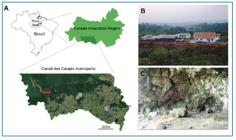
A: Geographical placement of Canaã dos Carajás municipality, within the Carajás Integration Region, Pará State, Brazil: blue cycle, urban area of the municipality; red cycle, mineral project area (“Serra Azul”), where biological material (blood and fragments of skin and viscera) from animals (foxes and rodents) and sandflies (Lutzomyia longipalpis) were collected; B: Mineral enterprise project prospection office; C: Speleological cavity; Map processed on QGIS 3.10.7 (https://qgis.org/); vector source: https://www.ibge.gov.br/; raster source:https://earth.google.com/.
Based on the eco-epidemiological scenario of Leishmania parasites in Latin America, the speculative hypothesis suggesting the introduction of L. (L.) infantum into the New World lacks ecological plausibility. There is no substantial basis to believe that the infection in domestic animals, brought from Europe, could spread to remote ecotopes of L. (L.) chagasi deep within the tropical forests of Amazonian Brazil-areas like the mineral prospecting zone in 'Serra dos Carajás', Pará State, where domestic animals are absent. Furthermore, the notion that such a parasite could transition from a domestic cycle (parasite-vector-dog) to thrive within a wild cycle (parasite-vector-fox or rodent) is unsupported, given that vectors from domestic cycles do not typically revert to wild environments.
In conclusion, while the taxonomic significance of molecular/genomic methodologies in specifically identifying parasites of the genus Leishmania is well acknowledged, they should not be considered the definitive tools for determining speciation. In the particular case of L. (L.) chagasi, the eco-epidemiological evidence presented here regarding its origin and evolutionary history is compelling and should not be overlooked.
REFERENCES
- 1 Momen H, Grimaldi Junior G, Deane LM. Leishmania infantum, the aetiological agent of American visceral leishmaniasis (AVL)? Mem Inst Oswaldo Cruz. 1987;82:447-8.
- 2 Grimaldi Junior G, David JR, McMahon-Pratt D. Identification and distribution of New World Leishmania species characterized by serodeme analysis using monoclonal antibodies. Am J Trop Med Hyg. 1987;36:270-87.
- 3 Kreutzer RD, Souraty N, Semko ME. Biochemical identities and differences among Leishmania species and subspecies. Am J Trop Med Hyg. 1987;36:22-32.
- 4 Momen H, Pacheco RS, Cupolillo E, Grimaldi Junior G. Molecular evidence for the importation of Old World Leishmania into the Americas. Biol Res. 1993;26:249-55.
- 5 Mauricio IL, Howard MK, Stothard JR, Miles MA. Genomic diversity in the Leishmania donovani complex. Parasitol. 1999;119:237-46.
- 6 Mauricio IL, Stothard JR, Miles MA. The strange case of Leishmania chagasi Parasitol Today. 2000;16:188-9.
- 7 Lukes J, Mauricio IL, Schönian G, Dujardin JC, Soteriadou K, Dedet JP, et al. Evolutionary and geographical history of the Leishmania donovani complex with a revision of current taxonomy. Proc Nat Acad Sci USA. 2007;104:9375-80.
- 8 Silveira FT, Lainson R, Shaw JJ, Póvoa MM. Leishmaniasis in Brazil: XVIII. Further evidence incriminating the fox Cerdocyon thous (L.) as a reservoir of Amazonian visceral leishmaniasis. Trans R Soc Trop Med Hyg. 1982;76:830-2.
- 9 Silveira FT, Sousa Junior EC, Silvestre RV, Costa-Martins AG, Pinheiro KC, Sosa-Ochoa W, et al. Whole-genome sequencing of Leishmania infantum chagasi isolates from Honduras and Brazil. Microbiol Res Ann. 2021;10:48e00471-21.
- 10 Haber GZ, de Souza TN, da Costa LD, Santos Ramos PK, Vasconcelos dos Santos T, Campos MB, et al. Sorodiagnóstico da infecção zoonótica por Leishmania (L.) chagasi no canídeo silvestre (Cerdocyon thous) em área de floresta tropical, Serra dos Carajás, Estado do Pará, Brasil. 58th Con Soc Bras Med Trop. Salvador (BA), Brasil. 2023;ID 3096, p.1202.
- 11 Vasconcelos dos Santos T, Ramos PKS, da Silva FMM, Alves AC, Lima LVR, Campos MB, et al. Presence of Lutzomyia longipalpis (Diptera: Psychodidae) and natural Leishmania (L.) infantum chagasi-infection in the wild rodent, Proechimys sp. (Rodentia: Echimydae), in the “Serra dos Carajás”, southern of Pará State, Brazil. 6th W Cong Leishmaniasis. Toledo, Spain. 2016;Poster Section.
-
12 Moreno ES, Sabioni LA, de Seixas MMM, de Souza Filho JA, Marcelino AP, Shimabukuro PHF. Evidence of a sylvatic enzootic cycle of Leishmania infantum in the State of Amapá, Brazil. Rev Soc Bras Med Trop. 2020:53:e20190169 doi: 10.1590/0037-8682-0169-2019.
» https://doi.org/10.1590/0037-8682-0169-2019
Edited by
-
Editor-in-Chief:
Prof. Dalmo Correia Filho. Orcid: https://orcid.org/0000-0002-2174-5058

