 Acral Exogenous Cutaneous Pigmentation Caused by Contact with a Darkling Beetle (Coleoptera: Tenebrionidae) in a Young Patient in the state of Amazonas
A 27-year-old male patient from Manaus, the capital of the Amazonas state, sought medical attention after reporting direct contact with a beetle found in his shoe. Approximately 2 hours after wearing the shoe, the patient experienced burning sensation and paresthesia in the toes of his right foot, without presenting any systemic complaints. Physical examination revealed blackened oval macules surrounded by an erythematous halo, predominantly affecting the first and second toes of the right foot (Figure 1). Dermoscopic assessment showed a brown pigmentation pattern along the ridge (Figure 2). The patient was admitted for observation and underwent laboratory tests, which yielded normal results. After 3 days, the lesions showed gradual improvement, and the patient was discharged.


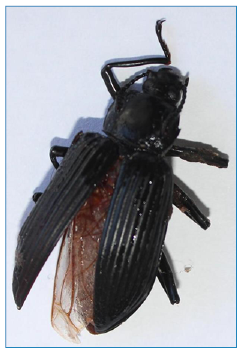
The beetle involved belongs to the order Coleoptera and family Tenebrionidae, which are known for their widespread global distribution, predominance in tropical and temperate regions (Figure 3). Although the family Tenebrionidae is not commonly associated with bites or dermatitis in humans, occasional reports indicate the possibility of cutaneous reactions due to contact with these insects. These beetles produce hemolymph containing various chemical substances such as hydrocarbons and quinones, which can cause significant pigmentation when in contact with human skin1,2. As a defense mechanism, they release dark-red chemical substances when threatened3. Conservative treatment with vigilant observation is the preferred treatment approach. This report describes a rare case of exogenous cutaneous pigmentation caused by direct contact with a beetle from the family Tenebrionidae, which resolved spontaneously.

REFERENCES
-
1 Haddad VJ, Cardoso JL, Lupi O, Tyring SK. Venomous and poisonous arthropods: identification, clinical manifestations of envenomation, and treatments used in human injuries. Rev Soc Bras Med Trop. 2015;48(6):650-6. Available at: https://doi.org/10.1590/0037-8682-0242-2015.
» https://doi.org/10.1590/0037-8682-0242-2015 -
2 Mokni S, Boussofara L, Saidi O, Aounallah U, Belajouza C, Ghariani N, et al. Four cases of exogenous acral pigmentation related to a darkling beetle (coleoptera: Tenebrionidae: Blaps). J Eur Acad Dermatol Venereol. 2017;31(7):e330-e331. Available at: https://onlinelibrary.wiley.com/doi/10.1111/jdv.14118.
» https://doi.org/10.1111/jdv.14118 -
3 Lima CAJ, Cardoso JLC, Magela A, Oliveira FGM, Talhari S, Haddad Jr V. Pigmentação exógena em pododáctilos simulando isquemia de extremidades: um desafio diagnóstico provocado por artrópodos da classe Diplopoda (“piolhos-de-cobra”). An Bras Dermatol. 2010;85(3):391-2. Available at: https://doi.org/10.1590/S0365-05962010000300018.
» https://doi.org/10.1590/S0365-05962010000300018
Edited by
-
Editor-in-Chief:
Prof. Dalmo Correia Filho. Orcid: https://orcid.org/0000-0002-2174-5058