 Eriocaulaceae from Serra da Canastra, Minas Gerais, Brazil
Abstract
Eriocaulaceae exhibit wide diversity within the Campo Rupestre, with the Serra do Espinhaço as their richest region. However, other mountain ranges featuring Campo Rupestre, like Serra da Canastra, also harbor a significant number of species. The present work consists of the taxonomic treatment of Eriocaulaceae occurring in the Serra da Canastra, as well as an analysis of the species distribution in three main surrounding Campo Rupestre areas: the Espinhaço and Mantiqueira Ranges, and the Chapada dos Veadeiros and neighbor mountains. Thirty-one species were recorded: 19 of Paepalanthus, six of Syngonanthus, four of Comanthera, one of Eriocaulon, and one of Leiothrix. Canastra shares eight species with Espinhaço, Mantiqueira, and Veadeiros; seven with Espinhaço and Mantiqueira; two with Espinhaço and Veadeiros; five exclusively with the Espinhaço and two exclusively with Veadeiros. Seven species are endemic to Canastra: Paepalanthus claussenianus, P. canastrensis, P. polycladus, P. sericiscapus, P. sinuosus, P. uai, and Syngonanthus culcitosus. Photographs, descriptions, identification key and comments on the morphological variations and geographic distribution for each species are presented, in addition to maps of the occurrence and distribution of species in different locations.
Key words:
Campo rupestre; flora; microendemics; Monocots; taxonomy.
Resumo
Eriocaulaceae são amplamente diversificadas nos Campos Rupestres, sendo que a Serra do Espinhaço é a região mais rica em espécies. Entretanto, outras áreas também abrigam um número expressivo de espécies, como a Serra da Canastra. O presente trabalho consiste na flora de Eriocaulaceae na Serra da Canastra, bem como na análise de distribuição das espécies compartilhadas com as três maiores áreas de Campo Rupestre vizinhas: a Cadeia do Espinhaço, a Serra da Mantiqueira e a Chapada dos Veadeiros e montanhas vizinhas. Foram registradas 31 espécies, sendo 19 de Paepalanthus, seis de Syngonanthus, quatro de Comanthera, uma para Eriocaulon e uma para Leiothrix. A Canastra compartilha oito espécies com o Espinhaço, Mantiqueira e Veadeiros; sete com Espinhaço e Mantiqueira; duas com Espinhaço e Veadeiros; cinco exclusivamente com o Espinhaço e duas exclusivamente com Veadeiros. Sete espécies são endêmicas da Canastra: Paepalanthus claussenianus, P. canastrensis, P. polycladus, P. sericiscapus, P. sinuosus, P. uai e Syngonanthus culcitosus. São apresentadas fotografias, descrições, chave de identificação e comentários sobre as variações morfológicas e distribuição geográfica para cada uma delas, além de mapas de ocorrência e distribuição das espécies nas diferentes localidades.
Palavras-chave:
Campo rupestre; flora; microendemismo; Monocotiledôneas; taxonomia.
Introduction
Eriocaulaceae are Monocots easily recognized for their capituliform inflorescences. The family comprises approximately 1,400 species (Giulietti et al. 2012) highly diversified in the Campo Rupestre. In Brazil, most of the Campo Rupestre areas are in the Espinhaço Range (Bahia and Minas Gerais states) and in the Chapada dos Veadeiros (Goiás state), but they are also found in many other mountains, such as the Serra da Mantiqueira and the Serra da Canastra (Minas Gerais state) (Fernandes et al. 2014; Silveira et al. 2016). The Serra da Canastra is situated in western Minas Gerais, holding an intermediate position among other Campo Rupestre areas: the Espinhaço Range to the northeast, the Chapada dos Veadeiros to the north, and the Serra da Mantiqueira to the south, sharing species with all these areas (Silveira et al. 2016).
Álvaro da Silveira collected Eriocaulaceae in the Serra da Canastra and described new species and varieties (Silveira 1928). Broad systematic floristic surveys for the entire flora began in 1994, primarily conducted by the HUFU herbarium team. A parallel floristic study, which did not include the HUFU specimens, documented 269 species (Santana et al. 2011), with no mention of Eriocaulaceae. Romero & Nakajima (1999) reported 768 species in the area but did not provide a species list and did not recognize any endemism for Eriocaulaceae. A meticulous analysis of the HUFU collection revealed the presence of several Eriocaulaceae species in the Serra da Canastra, including many that are endemic to the area and three that were new to science (Echternacht et al. 2021). There is thus an urge for floristic treatments focusing on Eriocaulaceae conducted by specialists. Our study presents a survey of Eriocaulaceae in Serra da Canastra and an analysis of the species distribution within the Serra da Canastra and other Campo Rupestre areas to evaluate its biogeographical connections.
Material and Methods
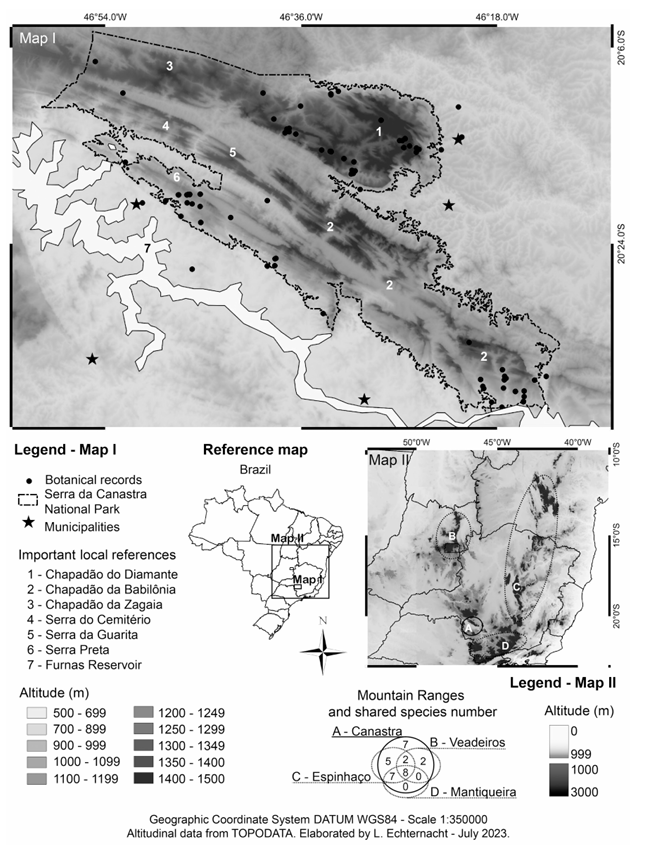
Serra da Canastra extends from approximately 100 km in a northwestern-southeastern direction, within the Cerrado biome (Fig. 1, Map I and II). Most of the area is protected as the Serra da Canastra National Park, which covers approximately 200,000 hectares, including Chapadão da Canastra and Chapadão da Babilônia (MMA/IBAMA 2005). The relief is mainly influenced by the geological formation of the Canastra group, consisting of quartzite and mica/schist (Silva et al. 2012). This formation gives rise to plateaus known as ‘Chapadões’, with altitudes ranging from 1,100 to 1,496 meters above the sea level, and the steepest slopes facing southwest (MMA/IBAMA 2005). Savanna vegetation dominates the Chapadões, with Campos Rupestres found at higher altitudes and slopes, often associated with outcrops and shallow quartzose soils (Silveira et al. 2016). In the valleys, Semi-deciduous Forest, Cerrado, and Cerradão vegetation are present (Romero & Nakajima 1999; MMA/IBAMA 2005).
The taxonomic survey relied on herbarium specimens and fieldwork. The primary collection under analysis is HUFU. Furthermore, the taxonomic information for each species was also sourced from studies conducted at the following herbaria: ALCB, B, BHCB, BOCH, BR, C, CEN, CEPEC, CESJ, CVRD, ESA, G, GFJP, HB, HBG, HEPH, HRCB, HUEFS, IBGE, INPA, K, LE, LL, M, MBM, MBML, MO, NY, OUPR, P, R, RB, RFA, S, SP, SPF, UB, UEC, UPS, VIES, W, and WU (acronyms according to Thiers, continuously updated). The HUFU collection was revised and updated based on the taxonomic literature for Eriocaulaceae (Koernicke 1863; Bongard 1831; Ruhland 1903; Silveira 1928; Giulietti 1984; Tissot-Squalli 1997; Sano 1999, 2004; Parra 2000; Costa 2005; Parra et al. 2010; Trovó 2010; Trovó & Sano 2010; Echternacht 2012; Costa & Sano 2013; Echternacht et al. 2015; Watanabe 2015). Paepalanthus scleranthus Ruhland (1903: 199) and Syngonanthus densiflorus (Körn.) Ruhland (1903: 263) were collected after the conclusion of the herbarium studies, as kindly informed by the collectors Renato Ramos and Luana Sauthier. Since specimens were not available for analysis, their descriptions relied on the type collection, other vouchers, and protologues. Synonyms are cited only for those whose types originate from the Canastra region. In this manuscript, we treat only names valid and accepted at the species level. We adopt the Paepalanthus s.l. concept as proposed by Christenhusz et al. (2018, 2020) and supported by Stützel et al. (2024), therefore not adhering to the splitter classification by Andrino et al. (2023).
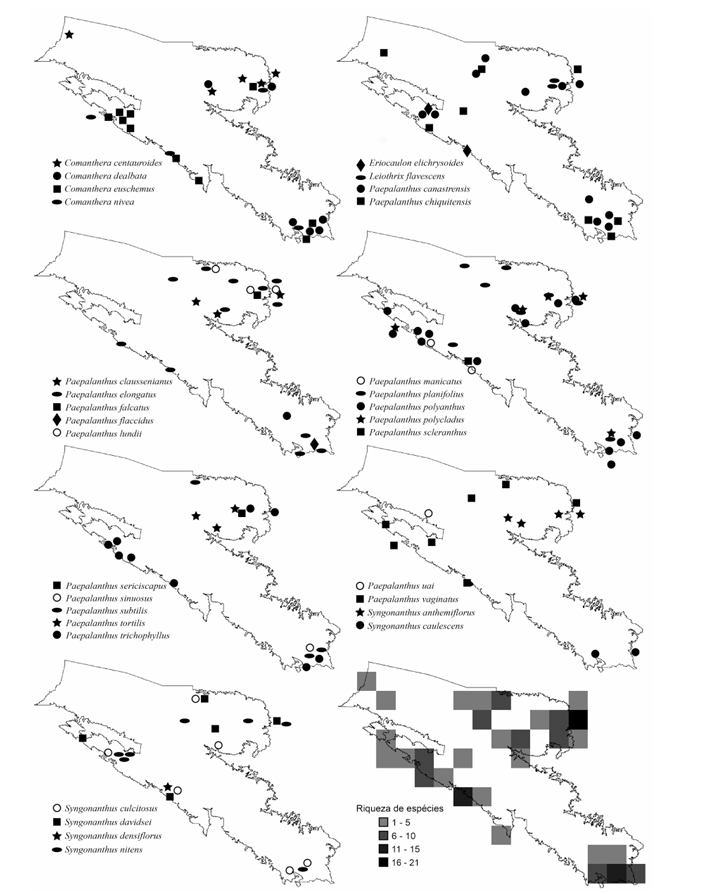
For the records that were not originally georeferenced, geographic coordinates were assigned based on the information from the sheet labels using the Google Earth (2023) software (<www.earth.google.com>) and the Specieslink geoLoc (2023) tool (<https://splink.cria.org.br/geoloc>). Distribution maps for each species and species richness in the Serra da Canastra are provided (Fig. 2). The species richness of Eriocaulaceae was analyzed and compared with the main Campo Rupestre areas surrounding the Serra da Canastra (Fig. 1, Map II): the Chapada dos Veadeiros and associated mountains (detailed below), the Espinhaço Range (including the Quadrilátero Ferrífero) and the Mantiqueira Range. Hereafter, these areas are referred to as Canastra, Veadeiros, Espinhaço, and Mantiqueira, respectively. The Veadeiros area was expanded to include Campo Rupestre in the geological formations of the Paranoá and Canastra Groups within the Faixa Brasília. The geographical delimitation of these areas follows the geological structure as detailed in Hasui et al. (2012). Each species occurrence in these Campo Rupestre areas was assessed based on taxonomic revisions and/or a search in the Specieslink database (<www.splink.org.br>); vouchers identified by expert taxonomists are provided in Table 1.
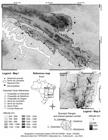
Map I. Botanical records of Eriocaulaceae in the Serra da Canastra and the boundaries of the Serra da Canastra National Park. Map 2. Main campos rupestres areas: A = Serra da Canastra; B = Chapada dos Veadeiros; C = Cadeia do Espinhaço; D = Serra da Mantiqueira.
Results and Discussion
Canastra hosts 31 Eriocaulaceae species. Paepalanthus is the richest genus (19 species), followed by Syngonanthus (6 spp.), Comanthera (4 spp.), Eriocaulon, and Leiothrix (1 sp. each). As shown in Figures 1 and 2, Eriocaulaceae richness is not uniformly distributed throughout Canastra but concentrates on specific sites, especially associated with the quartzitic outcrops and Campo Rupestre, which are mainly on the borders of the mountains and Chapadões (Figs. 1-2). The eastern border of the Chapadão do Diamante is the richest region, with 21 species. Other rich areas are the southwestern border near Delfinópolis and the southeastern border near Furnas. Most of the Chapadões are covered by dense savanna vegetation occupied by only a few species of Eriocaulaceae, such as P. chiquitensisHerzog (1924: 86), P. planifolius (Bong.) Körn. (1863: 413), P. canastrensisSilveira (1928: 228), and P. elongatus Ruhland (1863: 312). This partially explains why, despite its large extension, Canastra is relatively poor in Eriocaulaceae than other quartzitic mountain ranges. For example, the Ibitipoca State Park (1,532 ha), in Mantiqueira, hosts 22 species (Ferreira et al. 2011); the Rio Preto State Park (10,755 ha), in Espinhaço, has 44 species (Echternacht et al. 2012), and the Chapada dos Veadeiros National Park (240,000 ha), in Central Brazil, hosts at least 53 species (Trovó & Echternacht 2022).
Table 1 shows the distribution of species that occur in Canastra in the main surrounding Campo Rupestre areas, in the Espinhaço, Mantiqueira, and Veadeiros, which is summarized by a Venn diagram in Fig. 1. Canastra shares 22 species with Espinhaço, 15 with Mantiqueira, and 12 with Veadeiros. We expect a higher similarity with the Espinhaço, as it is a center of Eriocaulaceae diversity (Giulietti & Hensold 1990; Stützel 1998), and probably the richest area in the world. Seven species are shared by Canastra, Mantiqueira, and Espinhaço, but not found in Veadeiros. Two species are found exclusively in Canastra, Espinhaço, and Veadeiros, while they are absent in Mantiqueira. Five species are present in Canastra and Espinhaço, while two are shared between Canastra and Veadeiros. No species exclusively occurs in Canastra and Mantiqueira.
Eight species are present in the four areas, of which none is endemic to Campo Rupestre, and most of them are widespread in Brazil (Sano et al. 2024). The fact that endemics from Campo Rupestre could not occupy these four areas might be explained by habitat heterogeneity, biogeographical barriers, and time for dispersal or extinction. Habitat heterogeneity is expected because of the wide latitudinal range, climatic conditions, and the distinct influence of Cerrado, Caatinga, and Mata Atlântica between the areas (Silveira et al. 2016). Another reasonable argument is that connections among these Serras are not effective for most endemics of Campo Rupestre.
Seven species are endemic to Canastra: Paepalanthus claussenianus Körn. (1863: 323), P. canastrensis, P. uaiAndrino, F.N.Costa & Sano (2021: 129), P. polycladusSilveira (1928: 189), P. sericiscapusTrovó (2013: 329), P. sinuosus Echtern. & Trovó (2021: 29), and Syngonanthus culcitosus Echtern. (2021: 31). This number is quite expressive and places Eriocaulaceae in the third position in the number of endemics from Canastra, behind Asteraceae (22 endemics) and Melastomataceae (9), according to Romero & Nakajima (1999). These numbers, however, should be updated, as several new endemic species have been described since then (e.g., Farinaccio & Mello-Silva 2004; Versieux & Wanderley 2008; Batista et al. 2010; Oliveira et al. 2013).
Regarding the threatened status of the endemic taxa, Paepalanthus claussenianus is the only endemic species formally included in the Brazilian Red List (MMA 2022) as Vulnerable. Other works applied the IUCN criteria (IUCN 2001, 2019) for five other species, but these evaluations have not yet been officially validated: Paepalanthus polycladus, P. sericiscapus, and P. sinuosus are accessed as Critically Endangered; P. uai as Endangered; and Syngonanthus culcitosus as Vulnerable (Trovó 2010; Trovó et al. 2013; Echternacht et al. 2021). Paepalanthus canastrensis is the only endemic species not yet assessed as threatened with extinction.
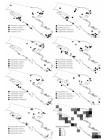
Geographic distribution of the species of Eriocaulaceae in the Serra da Canastra National Park.
Species occurrences in Serra da Canastra, Cadeia do Espinhaço, Serra da Mantiqueira, and Chapada dos Veadeiros and surrounding mountains, with corresponding vouchers.
Taxonomic synonyms are cited here for accepted species with heterotypic types from Serra da Canastra. Syngonanthus canastrensisSilveira (1928: 228) is synonymous with Comanthera dealbata (Silveira) L.R.Parra & Giul. (2010: 1139), and S. angustifolius Silveira (1928: 235), with C. nivea (Bong.) L.R.Parra & Giul. (2010: 1141), according to Parra et al. (2010). Paepalanthus falcatus (Bong.) Koern. (1863: 387) is considered an accepted name with P. callocephalus Silveira var. ciliatus Silveira (1928: 31) under its synonym, following Andrino et al. (2022). Paepalanthus flaccidus (Bong.) Kunth (1841: 511) has priority over Paepalanthus babyloniensis Silveira (1928: 121) according to Trovó & Sano (2010), and further studies regarding these names are underway. Following Sano (2004), Paepalanthus percrassus Silveira (1928: 142) is a synonym of Paepalanthus claussenianus Körn. (1863: 232) [=Actinocephalus claussenianus (Körn.) Sano (2004: 102)]. Furthermore, Paepalanthus vaginatus Koern. (1863: 313) has priority over P. cylindraceus Silveira (1828: 81) following Flora e Funga do Brasil (Andrino et al. 2024).
Two records have not been identified at the species level, but we lacked sufficient material to assess whether they represent new taxa. The specimen Nakajima 3934 was misidentified as Paepalanthus albidusGardner (1843: 525), which is a very tiny species, with a stem barely reaching 5 cm long, while the Canastra plant has a very elongated stem, up to 13 cm. The other specimen, Romero 7809, was identified as Paepalanthus strictus Körn. (1863: 319), but this has a more elongated stem and shorter scapes.
Identification key for the Eriocaulaceae from Serra da Canastra
1. Spathes, scapes, and involucral bracts absent 4.12. Paepalanthus scleranthus
1’. Spathes, scapes, and involucral bracts present 2
2. Involucral bract series dissimilar, external involucral bracts golden to stramineous, darker than the internal series, these cream and surpassing the floral disc 3
2’. Involucral bract series similar in color or the external series lighter than the internal series, these not surpassing the floral disc 6
3. Scapes emerging from a conspicuous reproductive axis; spathes and scapes with glandular hairs; sepals and petals similar in size; petals fused in the upper third, with short triangular lobes soon involute after anthesis 5.1. Syngonanthus anthemiflorus
3’. Scapes emerging from the stem apex or leaf axil; spathes and scapes without glandular hairs; sepals shorter than petals; petals fused in the middle third, with long spathulate apex, erect after anthesis 4
4. Leaves caespitose; spathes pilose adaxially at the apex 1.2. Comanthera dealbata
4’. Leaves in basal rosettes; spathes glabrous adaxially at the apex 5
5. Leaves with contrasting indumentum on the abaxial and adaxial surfaces, with predominantly simple patent hairs abaxially, and appressed malpighiaceous hairs adaxially; leaves not surpassing the spathes 1.3. Comanthera euschemus
5’. Leaves with similar indumentum on both surfaces, with similar proportions of appressed malpighiaceous and patent simple hairs; leaves surpassing the spathes 1.4. Comanthera nivea
6. Fertile plants with leaves in basal rosettes; stem subterranean or restricted to the basal rosette 7
6’. Fertile plants with leaves spiraled throughout an elongated aerial stem or throughout a central reproductive axis 19
7. Involucral bracts pilose abaxially 8
7’. Involucral bracts glabrous abaxially 16
8. Scape bearing numerous capitula 9
8’. Scape bearing a single capitulum 10
9. Numerous capitula in the scape split at the apex 4.1. Paepalanthus canastrensis
9’. Numerous capitula in the scape not split to the apex 4.9. Paepalanthus planifolius
10. Spathe opening truncate to lacerate 11
10’. Spathe opening oblique 12
11. Leaves fenestrate at the base (more visible in translucence); involucral bracts stramineous; diplostemonous flowers with black glands at petals; stem without ferruginous hairs 2.1. Eriocaulon elichrysoides
11’. Leaves non-fenestrate; involucral bracts dark brown; isostemonous flowers with petals lacking glands; stem covered by ferruginous hairs 4.18. Paepalanthus uai
12. Involucral bracts brown in the center, cream in the margins, slightly surpassing the flower disc, tufted at apex; flowers dimerous 4.4. Paepalanthus elongatus
12’. Involucral bracts castaneous, stramineous to golden, not surpassing the flower disc, not tufted at apex; flowers trimerous 13
13. Scapes emerging from a conspicuous reproductive axis 5.5. Syngonanthus densiflorus
13’. Scapes emerging at the stem apex or leaf axil 14
14. Flower disc stramineous to yellowish; gynoecium with nectariferous branches inserted below the stigmatic branches 3.1. Leiothrix flavescens
14’. Flower disc whitish; gynoecium with nectariferous and stigmatic branches free at the same level 15
15. Fertile lateral branch absent; horizontal rhizome, not thickened by leaf sheaths, lateralized rosette; involucral bracts triangular to elliptic, whitish lanose abaxially; stigmatic branches bifid 4.5. Paepalanthus falcatus
15’. Fertile lateral branch present, foliose (more easily seen when detaching the inflorescence from the stem); stem and rosette erect, frequently thickened by leaf sheaths; involucral bracts linear to lanceolate, pubescent to glabrescent abaxially; stigmatic branches simple 4.7. Paepalanthus lundii
16. Involucral bracts dark brown; flowers dimerous 4.19. Paepalanthus vaginatus
16’. Involucral bracts cream, golden, or stramineous; flowers trimerous 17
17. Leaves caespitose; apex round; capitulum cyathiform; sepals shorter than petals; petals with long spathulate apex, erect after anthesis 1.1. Comanthera centauroides
17’. Leaves rosulate, apex obtuse to acuminate; capitulum hemispheric to obconic; sepals equaling the petals; petals with short triangular lobes, soon involute after anthesis 18
18. Roots cream, fibrous; involucral bracts of different series equaling in height; leaves homogeneous in color 5.4. Syngonanthus davidsei
18’. Roots orangish, spongy; involucral bracts progressively longer from the external to the internal series; leaves with a lighter longitudinal band in the middle (more visible in dry specimens) 5.6. Syngonanthus nitens
19. Plants delicate, flexible stem 20
19’. Plants robust, stem or central reproductive axis rigid 27
20. Pistillate flowers with petals fused at distal half, free at base and lobes; stem whitish lanose at internodes 21
20’. Pistillate flowers with petals free; stem not whitish lanose at internodes 22
21. Involucral bracts acute to apiculate; stem usually unbranched, not forming cushions, up to 26 cm long; petals spongy 5.2. Syngonanthus caulescens
21’. Involucral bracts round to obtuse; stem profusely branched, forming cushions, up to 5.5 cm long; petals membranaceous 5.3. Syngonanthus culcitosus
22. Flores dimerous 23
22’. Flores trimerous 24
23. Involucral bracts cream to golden, abaxially glabrous 4.6. Paepalanthus flaccidus
23’. Involucral bracts castaneous to brown, abaxially pilose to glabrescent 4.17. Paepalanthus trichophyllus
24. Stem 28-80 cm long; scapes in pseudo-lateral fascicles, leaves similar in length along the stem, not congested at the stem apex 4.14. Paepalanthus sinuosus
24’. Stem up to 15 cm long; pseudo-lateral fascicles absent; leaves congested at the stem apex 25
25. Involucral bracts stramineous 4.15. Paepalanthus subtilis
25’. Involucral bracts light to dark brown 26
26. Involucral and floral bracts lanceolate; sepals brown 4.8. Paepalanthus manicatus
26’. Involucral and floral bracts obovate to oblong; sepals dark brown to blackish 4.16. Paepalanthus tortilis
27. Scapes emerging from conspicuous foliose lateral reproductive axis; flowers trimerous 28
27’. Scapes emerging from the reproductive central axis; flowers dimerous 29
28. Lateral reproductive axis emerging from the rosette; scapes sericeous 4.3. Paepalanthus claussenianus
28’. Lateral reproductive axis emerging from an elongated central axis; scapes pubescent to glabrescent 4.10. Paepalanthus polyanthus
29. Reproductive central axis small (up to 4 cm long); scapes sericeous; involucral bracts light brown 4.13. Paepalanthus sericiscapus
29’. Reproductive central axis long (up to 2 m); scapes glabrous; involucral bracts dark brown 30
30. Axis bracts shortening toward the apex, with acute apex; leaves glabrous, not ciliate; rhizome absent 4.2. Paepalanthus chiquitensis
30’. Axis bracts similar in size, with round apex; leaves densely pilose, then glabrescent, ciliate; rhizome present 4.11. Paepalanthus polycladus
1. Comanthera.
Herbs terrestrial. Leaves in basal rosette or caespitose, not fenestrated. Scapes free, not emerging from a conspicuous reproductive axis, without glandular hairs, as well as the spathes. Involucral bract series dissimilar, external involucral bracts golden to stramineous, darker than the internal series, these cream and surpassing the floral disc. Floral bracts absent. Flowers 3-merous, isostemonous, petals eglandular. Staminate flowers pedicellate, sepals and petals fused at the base, stamens free from the corolla, anthers dorsifixed, carpellodes present. Pistillate flowers pedicellate or sessile, sepals free, shorter than petals, petals fused at the middle, free at base and apex, forming long spathulate lobes, stigmatic branches simple, liberating at the same level as nectariferous branches.
Comanthera is sister to Syngonanthus, as evidenced by the petals of pistillate flowers fused at the middle and free at the base and top. It differs, however, by sepals of the pistillate flowers smaller than the petals, these narrow-spatulated with long lobes, and seeds with rough seed surface (Parra et al. 2010; Giulietti et al. 2012).
1.1. Comanthera centauroides (Bong.) L.R. Parra & Giul., Taxon (59): 1143. 2010.Fig. 3a
Herbs 24‒41 cm tall. Stem subterranean, branched. Leaves caespitose, linear, apex round, 5‒1 cm × 1‒3 mm, longer than spathes, sinuous, glabrescent on both surfaces, hairs patent. Spathes 2‒4 cm long, abaxial surface pubescent to glabrescent, adaxially glabrous, oblique opening. Scapes 17‒30 cm, glabrescent. Capitula 4.5‒7.9 mm wide. Involucral bracts below the floral disc, with an apparent fringe of flowers (capitula cyathiform), the external series elliptic, apex round, ca. 2.5 mm, progressively longer toward the internal series, these narrow-elliptic, apex round, ca. 5 mm, all series stramineous except for the cream inner series, glabrous on both surfaces. Staminate flowers ca. 4‒7 mm, including the pedicel, this ca. 2.5 mm; sepals elliptic, apex obtuse, 3.5‒4 mm, cream, glabrous on both surfaces; petals ovate, apex obtuse, 3.5‒4 mm, cream, glabrous on both surfaces; carpellodes castaneous. Pistillate flowers 2.5‒3.5 mm, sessile; sepals free, narrow-ovate, apex obtuse, 2‒2.5 mm, cream, glabrous on both surfaces; petals spathulate, apex round, 2‒2.5 mm, cream, pilose on both surfaces; gynoecium ca. 1.5 mm, ovary ca. 0.5 mm.
Examined material: São Roque de Minas, primeiro morro à direita após a portaria de São Roque, atrás do alojamento, 22.VI.2001, N.M. Castro 07 (HUFU); morro do Córrego da Fazenda, 22.VI.2001, N.M. Castro 12 (HUFU); portaria Sacramento em direção à captação de água, 24.VI.2001, N.M. Castro 20 (HUFU); percurso entre a Portaria 2 (São João Batista da Canastra) e a nascente do Rio São Francisco, próximo à parte alta da Casca D’Anta, 29.V.2014, L. Echternacht 2472 (HUFU); Parque Nacional da Serra da Canastra, após a nascente do Rio São Francisco, 21.VIII.1994, J.N. Nakajima 428 (HUFU); morro atrás do centro de visitantes, 25.IX.1995, J.N. Nakajima 1343 (HUFU); trilha para a parte de baixo da Cachoeira da Casca D’Anta, 29.IX.1995, J.N. Nakajima 1395 (HUFU); estrada para o sítio João Domingos, 20.VIII.1997, J.N. Nakajima 2634 (HUFU); estrada São Roque de Minas - Sacramento, 5 km da sede, 16.X.1994, R. Romero 1269 (HUFU); morro após a nascente do Rio São Francisco, 16.VII.1995, R. Romero 2428 (HUFU); Serra Brava, próximo ao Mirante, 28.IX.1995, R.Romero 2990 (HUFU); cachoeira Casca D’Anta, parte de cima, 23.VIII.1997, R. Romero 4510 (HUFU).
Comanthera centauroides is the only species of C. subg. Thysanocephalus (Körn.) L.R.Parra & Giul. (2010: 1143) in the area; this subgenus is characterized by cyathiform capitula, i.e., with involucral bracts below the flower level, forming a fringe of flowers. Other features are the senescent involucral bracts, pedicel not elongating during fruit development, and seed surface with micropapillae. In addition, this species has caespitose leaves round at the apex (Echternacht et al. 2015).
Comanthera centauroides occurs in Chapadão do Diamante and Chapadão da Zagaia, forming abundant populations (Fig. 2a). Its distribution extends eastwards in the whole Espinhaço in the states of Bahia and Minas Gerais, and to the south as far as São João Del Rei in the Mantiqueira range, as well as in the restingas of Rio de Janeiro state (Echternacht 2012; Silva & Trovó 2014; Echternacht et al. 2015).
The records of collections with reproductive material are mainly dated in the second semester, particularly in August and September.
1.2. Comanthera dealbata (Silveira) L.R. Parra & Giul., Taxon (59): 1139. 2010.
= Syngonanthus canastrensisSilveira, Floral. Mont.: 368. 1928. Type:-BRAZIL. Minas Gerais: “In campis arenosis siccisque in Serra da Canastra”, April 1925, Silveira 743 (holotype: R!).Fig. 3b-c
Herbs 18‒37 cm tall. Stem subterranean, branched. Leaves caespitose, linear, apex acute, 5‒8 × 0.02‒0.06 cm, surpassing the spathes, ascending to recurved, hairy on both surfaces, with appressed malpighiaceous hairs adaxially mainly, and patent simple hairs mainly abaxially. Spathes 2‒7 cm long, abaxial surface hairy, adaxial surface hairy at apex, oblique opening. Scapes 20‒33 cm, hairy to glabrescent. Capitula 4‒10 mm wide. Involucral bracts surpassing the floral disc, clearly dimorphic, the external series circular to obovate, apex round, ca. 1‒2 mm, stramineous to golden, progressively longer toward the internal series, these spatulate, apex round, ca. 5 mm, cream, glabrous. Staminate flowers ca. 2‒2.3 mm, including the pedicel, this ca. 0.1 mm; sepals oval, apex obtuse, ca. 1.5 mm, cream, glabrous; petals oval, apex obtuse, ca. 2 mm, cream, glabrous; carpellodes cream. Pistillate flowers 2‒3 mm, pedicel increasing in size during fruit maturation; sepals free, oval, apex obtuse, ca. 1 mm, cream, glabrous; petals spathulate, apex round, ca. 2.5 mm, cream, glabrous abaxially, hairy adaxially at middle; gynoecium ca. 2.5 mm, ovary ca. 0.7 mm.
Examined material: Capitólio, região de Furnas, estrada para Pedreira, próximo à cachoeira, 21.III.2007, P.O. Rosa 544 (HUFU); Paraíso Perdido, 22.III.2007, P.O. Rosa 592a (HUFU); estrada para Gabi Exploração II, 23.III.2007, P.O. Rosa 627 (HUFU). Delfinópolis, trilha do S. Cannyon, 16.V.2003, R. Romero 6919 (HUFU). São Roque de Minas, Parque Nacional da Serra da Canastra, Furnas, Chapadão da Babilônia, Serra do Turvo, próximo às pedreiras, no alto da pedreira Gabi Exploração, próximo a curso d’água, 2.II.2015, L. Echternacht 2616 (HUFU); estrada da bifurcação entre a cachoeira Casca D’anta, parte alta e a torre de observação, 30.V.2014, M.S. Freitas 028 (HUFU); Paraíso Perdido, 16.II.2006, E.K.O. Hattori 480 (HUFU); estrada da Serra Brava, 23.XI.1995, J.N. Nakajima 1608 (HUFU); estrada para Pedreira Souza, ca. de 2 km da rodovia MG-050, 17.II.2006, R. Romero 7691 (HUFU).
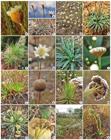
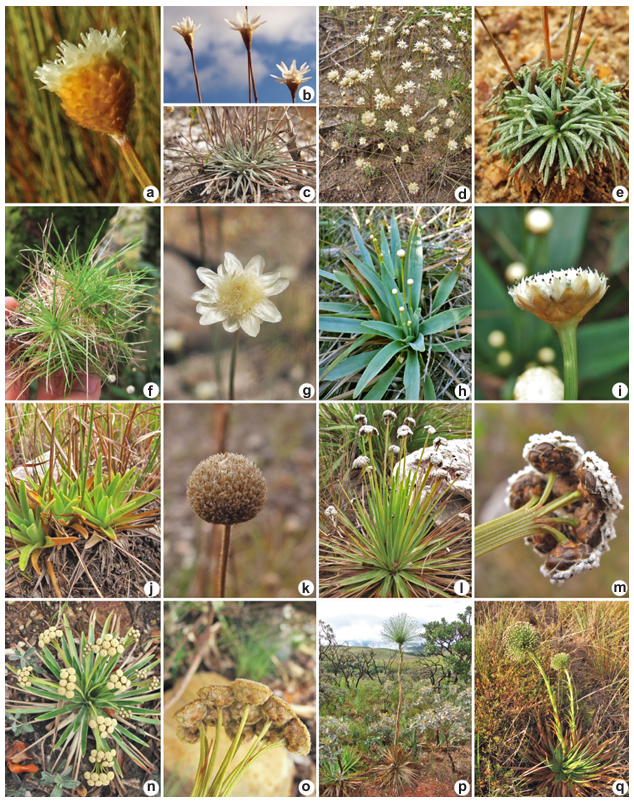
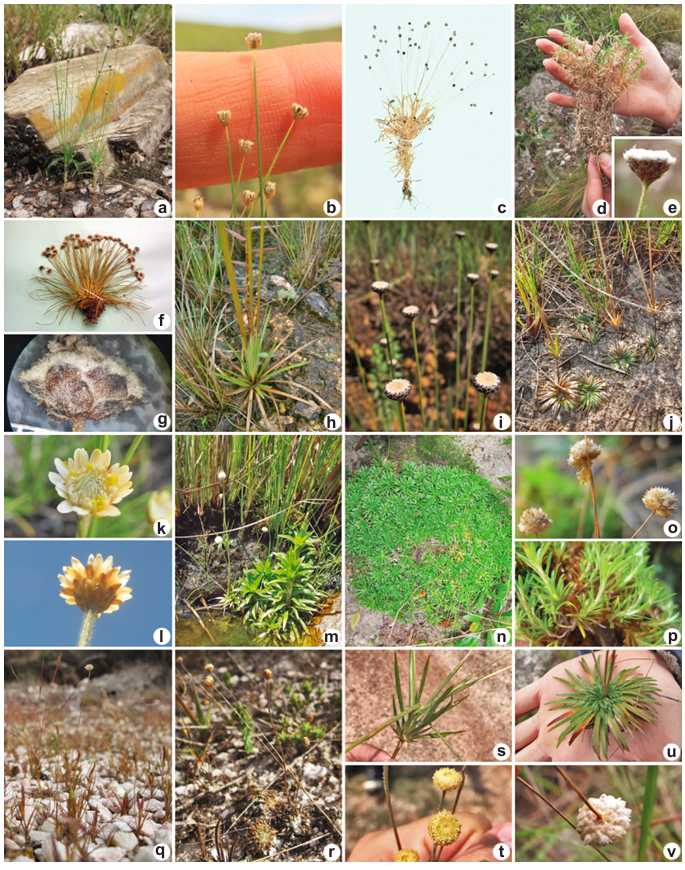
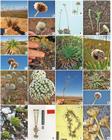
a-q. Species of Eriocaulaceae in the Serra da Canastra - a. Comanthera centauroides - capitulum; b-c. Comanthera dealbata - b. capitula; c. leaves and spathes; d-e. Comanthera euschemus - d. habit; e. leaves and spathes; f-g. Comanthera nivea - f. leaves; g. capitulum; h-i. Eriocaulon elichrysoides - h. habit; i. capitulum; j-k. Leiothrix flavescens - j. leaves and spathes; k. capitulum; l-o. Paepalanthus canastrensis - two morphotypes (l-m and n-o) - l. habit; m. capitula; n. habit; o. capitula; p. Paepalanthus chiquitensis - habitat and habit; q. Paepalanthus claussenianus - habit. (Photos by L. Echternacht from Serra da Canastra, except: a, k, l. from Biribiri State Park; h, i. from Caraça; and b. by M.S. Freitas).
Comanthera dealbata is recognized among the other species C. subg. Comanthera for its caespitose leaves, and spathe apex adaxially pilose (Echternacht & Parra 2024). Leaf indumentum is also remarkable, glaucous mainly by appressed malpighiaceous hairs on both surfaces.
This species is recorded in Canastra, specifically in Chapadão do Diamante, as well as in the southern Chapadão da Babilônia (Fig. 2a). It also has a distribution to the northeast of the Espinhaço Range in Minas Gerais (Parra 2000; Parra et al. 2010).
There are records of fertile plants in January, February, March, May, and November, however, the greater number of collections occurs in the first trimester, coinciding with the period of greatest rainfall.
1.3. Comanthera euschemus (Ruhland) L.R. Parra & Giul., Taxon (59): 1140. 2010.Fig. 3d-e
Herbs 15‒38 cm tall. Stem subterranean, branched. Leaves in basal rosette, linear, apex acute, 0.5‒3.5 × 0.02‒0.05 cm, not surpassing the spathes, recurved, with surfaces distinctly indumented, adaxially by appressed hairs mainly, and abaxially by patent hairs mainly. Spathes 2‒4 cm long, abaxially hairy, adaxially glabrous, oblique opening. Scapes 10‒30 cm, glabrescent. Capitula 4.3‒7.3 mm wide. Involucral bracts surpassing the floral disc, clearly dimorphic, the external series circular, apex round, ca. 1.5 mm, castaneous to golden, progressively longer toward the internal series, these spatulate, apex round, ca. 4 mm, cream, glabrous. Staminate flowers ca. 1‒1.5 mm, including the pedicel, this ca. 0.2 mm; sepals elliptical, apex acuminate, ca. 1‒1.5 mm, cream, glabrous; petals elliptical, apex round, ca. 1‒1.2 mm, cream, glabrous; carpellodes cream. Pistillate flowers 2‒2.5 mm, pedicel increasing in size during fruit maturation; sepals fused at base, elliptical, apex obtuse, ca. 1 mm, cream, glabrous; petals spathulate, apex round, ca. 1.7‒2 mm, cream, hairy abaxially at middle, glabrous adaxially; gynoecium ca. 1.7 mm, ovary ca. 0.6 mm.
Examined material: Capitólio, trilha da Pedreira Souza, ca. de 2 km da MG-050, 12.VII.2006, A.A. Arantes 1937 (HUFU); região da Represa de Furnas, estrada para Pedreira, próximo à cachoeira da rodovia, 22.V.2007, J.N. Nakajima 4430 (HUFU). Delfinópolis, Serra Preta, chapadão no alto da Serra Preta, 30.I.2015, L. Echternacht 2598 (HUFU); entre a Cachoeira dos Coqueirinhos e o Paraíso Perdido, 31.I.2015, L. Echternacht 2604 (HUFU); trilha da Escada de Pedra, 14.IX.2004, C.A. Faria 29 (HUFU); 14.IX.2004, E.K.O. Hattori 361 (HUFU); Fazenda Águas da Serra, trilha das cachoeiras, 13.III.2003, J.N. Nakajima 3493 (HUFU); Fazenda Zé Antunes, trilha Casinha Branca, 11.IV.2002, R.A. Pacheco 134 (HUFU); Fazenda Água da Serra, trilha Escada de Pedras, 10.III.2003, R.A. Pacheco 470 (HUFU); Condomínio de Pedras, 17.V.2003, R.A. Pacheco 597 (HUFU); estrada para Casa Branca, Fazenda Paraíso, Sete Cidades, 10.IV.2002, R. Romero 6261 (HUFU); trilha da Escada de Pedra, 15.V.2003, R. Romero 6865 (HUFU); 14.IX.2004, R. Romero 7083 (HUFU); Condomínio de Pedras, 23.VI.2010, R. Romero 8275 (HUFU); Cidade de Pedras, 12.III.2003, R.L. Volpi 562 (HUFU); trilha “Muro de Pedras’’, 12.III.2003, R.L. Volpi 596 (HUFU); Condomínio de Pedras, 17.V.2003, R.L. Volpi 694 (HUFU). São Roque de Minas, primeiro morro à direita após a portaria de São Roque, atrás do alojamento, 22.VI.2001, N.M. Castro 08 (HUFU); Parque Nacional da Serra da Canastra, estrada do Chapadão Diamante, 18.III.1995, J.N. Nakajima 852 (HUFU); estrada para Sacramento, 3 km da sede administrativa, 17.III.1995, R. Romero 1978 (HUFU); vale da nascente do Rio São Francisco, 17.III.1995, R. Romero 1991 (HUFU); Paraíso Perdido, Parque Nacional da Serra da Canastra, morro próximo à nascente do Rio São Francisco, 19.II.1997, R. Romero 3886 (HUFU); Morro do Facão, 30.I.2002, R. Romero 6227A (HUFU).
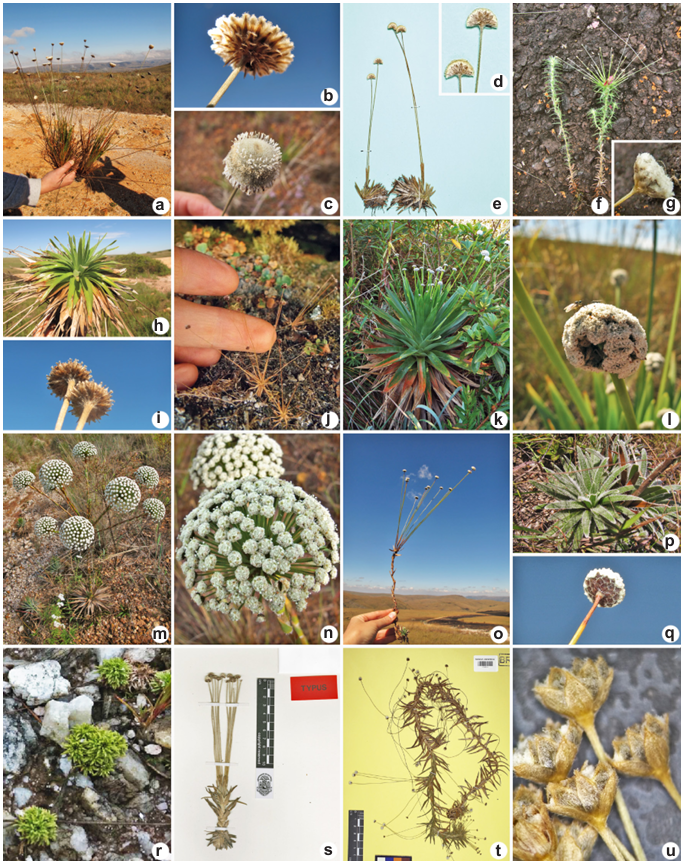
a-u. Species of Eriocaulaceae in the Serra da Canastra - a-c. Paepalanthus elongatus - a. habit; b. capitulum (abaxial view); c. mature old capitulum (adaxial view); d-e. Paepalanthus falcatus - d. capitula; e. habit; f-g. Paepalanthus flaccidus - f. habit; g. capitulum; h-i. Paepalanthus lundii - h. leaves and old inflorescences; i. capitula; j. Paepalanthus manicatus - habit under boulder; k-l. Paepalanthus planifolius - k. habit; l. capitula and floral visitor; m-n. Paepalanthus polyanthus - m. habit; n. umbellate inflorescence; o-q. Paepalanthus polycladus - o. habit; p. leaves; q. capitulum; r. Paepalanthus scleranthus - habit; s. Paepalanthus sericiscapus - habit; t-u. Paepalanthus sinuosus - t. habit; u. capitula. (Photos by L. Echternacht from Serra da Canastra, except: d-e. from Nakajima et al. 282 [HUFU 5449]; f, g. from Serra de Capanema; s. from Romero et al. 2464 [HUFU 9387]; t, u. from Arantes et al. 1760 [HUFU 44801]; vk. by M.S. Freitas; r. by R. Ramos).
Comanthera euschemus can be distinguished from other species within C. subg. Comanthera in Canastra by its recurved leaves, which are shorter than spathes, and with surfaces distinctly indumented, primarily consisting of appressed hairs on the adaxial side and patent hairs on the abaxial side (Echternacht & Parra 2024).
Comanthera euschemus forms abundant populations in Canastra, encompassing Chapadão do Diamante, Chapadão da Babilônia, and Serra Preta (Fig. 2a). Its range extends westward into Goiás and Distrito Federal, covering Serra do Paraná, Serra dos Cristais, and Serra dos Pireneus (Parra 2000; Parra et al. 2010).
There are collection records during almost every month of the year, mainly in the first semester, except for August, October, November, and December.
1.4. Comanthera nivea (Bong.) L.R. Parra & Giul., Taxon (59): 1141. 2010. = Syngonanthus angustifoliusSilveira, Floral. Mont.: 370. 1928. Type:-BRAZIL. Minas Gerais: “In campis arenosis in Serra da Babylonia, prope Passos”, April 1925, Silveira 743 (holotype: R!).Fig. 3f-g
Herbs 15‒35 cm tall. Stem subterranean, branched or not. Leaves in basal rosette, linear, apex acute to mucronate, 0.8‒8.5 × 0.03‒0.05 cm, surpassing the spathes, ascending, pubescent to glabrescent, appressed malpighiaceous and patent simple hairs, ciliate. Spathes 1.5‒4 cm long, abaxially glabrescent, adaxially glabrous, oblique opening. Scapes 10‒30 cm, glabrescent. Capitula 4.5‒6.8 mm wide. Involucral bracts surpassing the floral disc, clearly dimorphic, the external series oboval, apex round, ca. 2 mm, stramineous, progressively longer toward the internal series, these spathulate, apex round, ca. 4 mm, cream, glabrous. Staminate flowers ca. 1.5‒2 mm, including the pedicel, this ca. 0.5 mm; sepals ovals, apex round, ca. 1‒1.2 mm, cream, glabrous; petals ovals, apex round, ca. 1‒1.2 mm, cream, glabrous; carpellodes cream. Pistillate flowers 2‒3 mm, pedicel increasing in size during fruit maturation; sepals joined at the base, elliptical, apex obtuse, ca. 1.2 mm, cream, glabrous; petals spathulate, apex round, ca. 2‒2.5 mm, cream, glabrous; gynoecium ca. 2 mm; ovary ca. 0.5 mm.
Examined material: Delfinópolis, Paraíso Selvagem, ao lado do estacionamento, 1.II.2015, L. Echternacht 2605 (HUFU); Cânion do Alpinista, dentro do cânion, local sombreado, com mata de galeria, epífita nas duas paredes do cânion, 1.II.2015, L. Echternacht 2607 (HUFU); trilha para Cachoeira Salto Solitário, 11.III.2003, J.N. Nakajima 3458 (HUFU); trilha para Mata do Canyon, 22.X.2003, J.N. Nakajima 3566 (HUFU); região da Represa de Furnas, estrada para Pedreira Souza, ca. de 2 km da rodovia MG-050, 30.IX.2005, J.N. Nakajima 3930 (HUFU); trilha para Cachoeira do Alpinista, 16.V.2003, R.A. Pacheco 570 (HUFU); Fazenda José Antunes, trilha da Escada de Pedras, 11.X.2002, R. Romero 6467 (HUFU); trilha para Cachoeira do Salto Solitário, 11.III.2003, R. Romero 6721 (HUFU); Paraíso Perdido, córrego Quebra Anzol, 4,5 km da rodovia MG-050, 29.IX.2005, R. Romero 7245 (HUFU); Cachoeira Águas Claras, Serras de Delfinópolis, Complexo Canastra, trilha da cachoeira, 23.VI.2010, P.O. Rosa 1312 (HUFU). São Roque de Minas, estrada da Serra Brava, 23.XI.1995, J.N. Nakajima 1604 (HUFU).
Comanthera nivea differs from the other C. subg. Comanthera in Canastra due to its flat leaves, which are longer than spathes, usually occupying more shaded habitats.
Within the Canastra, this species is recorded in Chapadão da Babilônia and Serra Preta (Fig. 2a). Its distribution extends eastward from Espinhaço to Mantiqueira ranges and also reaches the restingas in Espírito Santo (Parra 2000; Parra et al. 2010; Silva & Trovó 2022).
The records of reproductive material are primarily dated in the first, second, and third trimesters of the year.
2. Eriocaulon.
2.1. Eriocaulon elichrysoides Bong., Mém Acad. Imp. Sci. St-Pétersbourg, Sér. 6, Sci Math.1: 631. 1831.Fig. 3h-i
Herbs semi-aquatic, 30‒80 cm tall. Stem restricted to the rosette, branched or not. Leaves in basal rosette, fenestrated, lanceolate, apex obtuse, 6‒20 × 0.5‒2 cm, erect, glabrescent on both surfaces. Spathes ca. 15 cm, glabrescent, truncate opening. Scapes free, not emerging from a conspicuous reproductive axis, 15‒75 cm, glabrescent. Capitula 10.4‒13.1 mm wide. Involucral bracts oval to lanceolate, apex obtuse, ca. 5 mm, series similar in color, stramineous, sparsely hairy abaxially in the median region of the internal series, glabrous adaxially, ciliate. Floral bracts lanceolate, apex acute, ca. 4 mm, cream, adaxial surface hairy distally, glabrous adaxially, ciliate. Flowers 3-merous, diplostemonous. Staminate flowers ca. 4 mm including the pedicel, this ca. 0.5 mm; sepals fused at base, lanceolate, apex acute, ca. 4 mm, cream, glabrous on both surfaces, tufted; petals free, ca. 4 mm, cream, glabrous on both surfaces, black glands adaxially; stamens free, anthers black, dorsifixed; carpellodes black, papillose. Pistillate flowers ca. 3 mm, sessile; sepals free, oblanceolate, apex obtuse, ca. 3 mm, stramineous, glabrous on both surfaces, tufted; petals oblanceolate, with black glands adaxially, apex obtuse, ca. 2.5 mm, cream, glabrous abaxially, densely pilose adaxially; gynoecium ca. 2.5 mm, ovary ca. 1 mm, stigma simple, nectariferous branches absent.
Examined material: Delfinópolis, Serra Preta, córrego na Escadaria de Pedras, 31.I.2015, L. Echternacht 2601 (HUFU); trilha “Escada de Pedras”, Fazenda José Antunes, 11.X.2002, R. Romero 6486 (HUFU).
Eriocaulon elichrysoides is the sole species of the genus observed in the area. It can be identified by its fenestrated leaves (more apparent in translucence), truncate spathes, diplostemonous flowers with black glands on the petals, and black anthers.
In Canastra, the species is only known from Serra Preta (Fig. 2b). It is broadly distributed beyond Canastra to the east and south, encompassing the Espinhaço and Mantiqueira regions (Tab. 1).
There are two records from Canastra: one from October, quite fertile, and another from January, featuring old inflorescences.
3. Leiothrix.
3.1. Leiothrix flavescens (Bong.) Ruhland, Pflanzenr. (Engler) IV. 30: 231. 1903.Fig. 3j-k
Herbs terrestrial, 38‒47 cm tall. Stem restricted to the rosette, unbranched. Leaves in basal rosette, not fenestrated, lanceolate, apex obtuse, 2‒5 × 0.3‒0.5 cm, sparsely pilose to glabrescent on both surfaces. Spathes ca. 5‒7 cm, sparsely pilose to glabrescent, oblique opening. Scapes free, not emerging from a conspicuous reproductive axis, 30‒40 cm, sparsely pilose to glabrescent. Capitula 6.7‒9.1 mm wide, flower disc stramineous to yellowish. Involucral bracts oval to oblong, apex acute, 1.5‒2.5 mm, series similar in color, dark brown to golden, abaxially hairy at apex, glabrous adaxially, ciliate. Floral bracts oblanceolate, apex acute, ca. 2.5 mm, castaneous, pilose abaxially, glabrous adaxially, ciliate. Flowers 3-merous, isostemonous. Staminate flowers ca. 3 mm including the pedicel, this ca. 1 mm; sepals free, elliptical, apex round to truncate, ca. 1.5 mm, light brown, glabrous on both surfaces, ciliate; petals fused, infundibuliform, ca. 1.5 mm, light brown, glabrous on both surfaces; stamens free, anthers basifixed; carpellodes cream, papillose. Pistillate flowers ca. 3.5 mm, including the pedicel, this ca. 1 mm; sepals free, elliptical, carinate, apex round, ca. 2.5 mm, light brown, sparsely pilose abaxially, glabrous adaxially; petals free, elliptical, apex acute, ca. 2.5 mm, light brown, glabrous on both surfaces, hairy ring between sepals and petals; gynoecium ca. 2.5 mm, ovary ca. 0.5mm, stigmatic branches simple, and liberating above the nectariferous branches.
Examined material: São Roque de Minas, Parque Nacional da Serra da Canastra, percurso entre São João Batista da Canastra e a Portaria 1 (São Roque - Centro de Visitantes), estrada entre a nascente do Rio São Francisco e a Portaria 1, em direção à vertente sul da Serra, 31.V.2014, L. Echternacht 2494 (HUFU); beira da estrada chegando na nascente do Rio São Francisco, 31.V.2014, M.S. Freitas 035 (HUFU).
Leiothrix flavescens is the only of the genus recorded in the area. It can be distinguished by the yellowish capitula, the leaves with round apices, and the gynoecium with nectariferous appendices liberating below the stigmatic appendices.
The collections took place at the end of May and plants were already in its final flowering stage, quite aged, which suggests that its reproductive period is in the first quarter.
This species has few records in Canastra, all from Chapadão do Diamante (Fig. 2b). However, it usually forms abundant populations, and it is broadly distributed in eastern Brazil, occurring in Mantiqueira and Espinhaço and throughout South America, reaching Peru, Venezuela, and Guyana (Giulietti 1984).
4. Paepalanthus.
Herbs terrestrial. Leaves in basal rosette or spiraled throughout the stem, not fenestrated. Scapes bearing a single or multiple capitula, axillary, terminal, or emerging from a conspicuous reproductive axis in a terminal or lateral position. Involucral bract series similar in color or the external series lighter than the internal series. Floral bracts present. Flowers 2 or 3-merous, isostemonous, petals eglandular. Staminate flowers pedicellate, sepals fused at the base, petals fused, anthers dorsifixed, carpellodes present. Pistillate flowers sessile or pedicellate, sepals and petals free, stigmatic branches simple or bifid, liberating at the same level as the nectariferous branches, or rarely nectariferous branches absent.
Paepalanthus is distinguished by the following character set in Canastra: isostemonous flowers with free petals in the pistillate flowers, and gynoecium with the stigmatic and nectariferous branches separating at the same level, or rarely nectariferous branches absent.
4.1. Paepalanthus canastrensis Silveira, Floral. Mont.: 228. 1928.Fig. 3l-o
Herbs 5‒40 cm tall. Stem restricted to the rosette, unbranched, sometimes forming caudex. Leaves in basal rosette, lanceolate, apex acute, 1‒25 × 0.1‒1.3 cm, flat, pubescent to glabrescent on both surfaces, glaucous or not. Spathes 1‒18.7 cm long, glabrous, sometimes tufted at apex, truncate opening. Scapes bearing numerous capitula, split at apex, (3-)15‒34 cm, pilose to glabrescent, not emerging from a conspicuous reproductive axis. Capitula 3.8‒9.6 mm wide. Involucral bracts oval to lanceolate, apex acute, 2‒3 mm, light to dark brown, abaxially sericeous, pilose to glabrescent or glabrous, adaxially glabrous, ciliate or not. Floral bracts lanceolate, apex obtuse, 2‒2.5 mm, cream, homogeneously castaneous, or castaneous in the upper region, abaxially hairy from middle to apex, or glabrous on both surfaces, ciliate, tufted. Flowers 3-merous. Staminate flowers ca. 3 mm, including the pedicel, this ca. 0.7 mm; sepals obovate, apex acute, ca. 3 mm, castaneous, glabrous; petals fused, tubulose, ca. 2.5 mm, cream, glabrous; stamens free; carpellodes cream, filiform. Pistillate flowers ca. 3 mm, pedicellate; sepals obovate, apex obtuse, ca. 3 mm, cream to distally brown, glabrous, tufted; petals lanceolate, apex acute, ca. 3 mm, cream, glabrous, ciliate, tufted; gynoecium ca. 3 mm, ovary ca. 0.1 mm, stigmatic branches bifid, liberating at the same level of the nectariferous branches.
Examined material: Delfinópolis, região da Represa de Furnas, estrada depois do Paraíso Perdido, 25.X.2006, J.N. Nakajima 4246 (HUFU); estrada para Mineradora Gabi Extrações, depois do terceiro córrego, 26.X.2006, J.N. Nakajima 4360 (HUFU); estrada MG-050, Capitólio - Passos, 500 m antes do Trevo de Furnas, ca. de 15 km, em direção à Serra, 1.X.2005, R. Romero 7259 (HUFU). São Roque de Minas, Parque Nacional da Serra da Canastra, Garagem das Pedras, 21.VI.2001, N.M. Castro 02 (HUFU); morro a cerca de 2 km da sede, 23.VI.2001, N.M. Castro 17 (HUFU); nascente do Rio São Francisco, 20.XI.2002, P.C. Duarte 104 (HUFU); percurso entre a Portaria 2 (São João Batista da Canastra) e a nascente do Rio São Francisco, próximo à Garagem de Pedras, 29.V.2014, L. Echternacht 2468 (HUFU); próximo à parte alta da Casca D’Anta, 29.V.2014, L. Echternacht 2473 (HUFU); estrada entre São Roque e a nascente do Rio São Francisco, 31.V.2014, M.S. Freitas 031 (HUFU); lado direito da estrada no vale do São Francisco, 17.IV.1994, J.N. Nakajima 274 (HUFU); base do morro próximo à sede administrativa, 15.X.1994, J.N. Nakajima 517 (HUFU); estrada São Roque de Minas - Sacramento, morro após a nascente do Rio São Francisco, 18.III.1995, J.N. Nakajima 802 (HUFU); estrada para Sacramento, Garagem das Pedras, 20.III.1995, J.N. Nakajima 924 (HUFU); Chapadão do Diamante, após a antena, 9.VII.1996, J.N. Nakajima 1917 (HUFU); colina próximo à sede, lado esquerdo da estrada, 20.II.1994, R. Romero 629 (HUFU); Morro da Casca D’Anta, 24.II.1994, R. Romero 728 (HUFU); primeiro morro próximo à sede, 26.VI.1994, R. Romero 1020 (HUFU); km 19 da estrada de São Roque - Sacramento, 28.VI.1994, R. Romero 1071 (HUFU); próximo à torre de observação, 23.VIII.1994, R. Romero 1159 (HUFU); guarita de Sacramento, 14.X.1994, R. Romero 1239 (HUFU); morro próximo à sede administrativa, 10.I.1995, R. Romero 1653 (HUFU); 17.III.1995, R. Romero 1946 (HUFU); 15.VII.1995, R. Romero 2375 (HUFU); 3 km da sede administrativa, 15.VII.1995, R. Romero 2403 (HUFU); Chapadão do Diamante, 16.VII.1995, R. Romero 2450 (HUFU); guarita de Sacramento, 24.IX.1995, R. Romero 2677 (HUFU); Córrego da Fazenda, morro após o vale do rio São Francisco, 26.IX.1995, R. Romero 2864 (HUFU); guarita de Sacramento, 18.XI.1995, R. Romero 3051 (HUFU); estrada para o Sítio João Domingos, 25.V.1996, R. Romero 3507 (HUFU); final da estrada do Retiro de Pedras, saída do parque, 23.II.1997, R. Romero 4009 (HUFU); Morro do Careca, 30.I.2002, R. Romero 6349 (HUFU).
Paepalanthus canastrensis has scapes bearing numerous capitula, which are split at the apex. The taxon is very variable in Canastra and apparently could correspond to more than one species. However, upon comparing all specimens in herbaria, we have observed a morphological gradient. Some subpopulations have leaves covered by a glaucous wax (Fig. 3n) while others do not; spathes vary from reduced and membranaceous, translucent, to developed and papery; involucral bracts vary from sericeous and castaneous (Fig. 3o) to pubescent and dark brown (Fig. 3m), among other features. This gradient could be the result of hybridization, or the subpopulations may indeed freely exchange genes. The existing uncertainty has led us to maintain it as a single taxon, but ongoing taxonomic studies should help clarify the issue (L. Sauthier, personal communication).
This species is endemic to Canastra, where it is broadly recorded from Chapadão do Diamante, Chapadão da Babilônia, and Serra Preta (Fig. 2b). Morphological variation is remarkable in the field and herbarium specimens. Populations were observed to be green and prosperous in burned fields, indicating that the species is tolerant to fire events that are not strong enough to destroy the rhizome and caudex. The species has not yet been assessed as threatened to extinction.
There are records of collections of reproductive material throughout the year, except in December.
4.2. Paepalanthus chiquitensis Herzog, Repert. Spec. Nov. Regni Veg. 20: 86. 1924.Fig. 3p
Herbs 1‒2 m tall. Rhizome absent, stem restricted to the rosette in sterile plants, developing into a central reproductive axis, unbranched. Leaves in basal rosette, lanceolate, apex acute, 18‒37 × 1‒3 cm, flat, glabrous. Reproductive axis erect, 80‒190 cm tall. Axis bracts spiraled, progressively smaller from the base to the apex, lanceolate, apex acute, 5‒20 × 0.5‒1.5 cm, glabrescent. Spathes 3‒5 cm long, glabrescent, oblique opening. Scapes 10‒30 cm, glabrous. Capitula 6‒11.4 mm wide, arranged in the reproductive axis apex. Involucral bracts triangular to obovate, apex acute, 2‒5 mm, dark brown, glabrescent abaxially, glabrous adaxially, ciliate or not. Floral bracts linear to spatulate, apex acute to obtuse, 2‒2.5 mm, cream, densely pilose to glabrescent abaxially, glabrous adaxially, ciliate. Flowers 2-merous. Staminate flowers ca. 3 mm, including the pedicel, this ca. 0.5 mm; sepals oblanceolate, apex acute, ca. 3 mm, cream to brown, hairy in abaxial surface apex; petals fused, tubulose, ca. 3 mm, cream, glabrous; stamens free; carpellodes cream to brown, papillose. Pistillate flowers ca. 3 mm, sessile; sepals obovate, apex truncate, ca. 3 mm, cream, hairy abaxially, glabrous adaxially, tufted; petals spathulate, apex acute, ca. 3 mm, cream, glabrous, ciliate, tufted; gynoecium ca. 3 mm, ovary ca. 1 mm, stigmatic branches bifid, liberating at the same level of the nectariferous branches.
Examined material: Capitólio, região de Furnas, estrada para pedreira, próximo à cachoeira da rodovia, 22.V.2007, P.H.N. Bernardes 165 (HUFU); estrada depois do Paraíso Perdido, 23.V.2007, P.H.N. Bernardes 228 (HUFU); estrada para Pedreira Souza, ca. 2 km da rodovia MG-050, 30.IX.2005, J.N. Nakajima 3976 (HUFU). Delfinópolis, Condomínio de Pedras, estrada para Casinha Branca, 12.III.2003, R.A. Pacheco 527 (HUFU); Paraíso Selvagem, saída para a trilha Salto Solitário, 16.V.2003, R.A. Pacheco 576 (HUFU); região da Represa de Furnas, estrada para Pedreira Souza, ca. de 2 km da rodovia MG-050, 17.II.2006, R. Romero 7711 (HUFU). Sacramento, estrada Sacramento - Franca, 8.VI.1984, R.C. Vieira 245 (HUFU). São Roque de Minas, percurso entre a Portaria 2 (São João Batista da Canastra) e a nascente do Rio São Francisco, entre a Garagem de Pedras e a parte alta da Casca D’Anta, 29.V.2014, L. Echternacht 2469 (HUFU); estrada para Sacramento, morro da Garagem de Pedras, 22.III.1995, J.N. Nakajima 974 (HUFU); Parque Nacional da Serra da Canastra, 16.IV.1994, R. Romero 878 (HUFU); Cachoeira Casca D’Anta, 10.XII.1994, R. Romero 1581 (HUFU).
Paepalanthus chiquitensis is easily recognized for its robust habit, being the only species in Serra da Canastra that reaches a height of two meters. Another striking difference of P. chiquitensis is the varying sizes of the bracts along the reproductive axis, progressively larger from the base to the apex, with an acute apex (Trovó 2010).
Paepalanthus chiquitensis occurs throughout the Canastra complex, from Chapadão da Babilônia to Chapadão da Zagaia, and Serra Preta (Fig. 2b), forming dense populations. Its distribution extends westward in the Cerrado domain, occurring in Espinhaço and Veadeiros, being widely distributed in Brazil and extending to Bolivia, Venezuela, and Colombia (Trovó 2010; Trovó & Sano 2010). Among the morphological variants of this species by Trovó (2010), the specimens collected in Canastra are clearly related to those from Veadeiros.
The species was collected in the reproductive stage in several months, but the highest concentration of collection dates were in May.
4.3. Paepalanthus claussenianus Körn., Fl. bras. (Martius & Eichler) 3(1): 323. 1863.
= Paepalanthus percrassusSilveira, Floral. Mont.: 214. 1928. Type:-BRAZIL. Minas Gerais: “In campis in Serra da Canastra”, April 1925, Silveira 751 (holotype: R!).Fig. 3q
Herbs 30‒80 cm tall. Stem restrict to the rosette, unbranched. Leaves in basal rosette, lanceolate, apex acute, 6‒35 × 0.5‒1.5 cm, ascending, flat, pubescent to glabrescent, hairs appressed, ciliate. Reproductive axis emerging from the leaf axil, 26‒74 cm long; axis bracts lanceolate, apex acute, 4‒7 cm × 2.8‒6.2 mm, patent to appressed, pubescent to glabrescent, ciliate, hairs appressed. Spathes 0.5‒1.2 cm long, pilose to glabrescent abaxially, oblique opening. Scapes 1.7‒9.5 cm, sericeous, emerging at the apex of the lateral reproductive axis as spherical umbels. Capitula 1.7‒4.5 mm wide. Involucral bracts oblong, apex acuminate, 1‒1.5 mm, light brown. Floral bracts linear, slightly navicular, apex acute, ca. 1.5 mm, castaneous, tufted. Flowers 3-merous. Staminate flowers ca. 2 mm, including the pedicel, this ca. 0.3 mm; sepals oblong, apex obtuse, ca. 1.5 mm, light brown, glabrous, ciliate; petals fused, tubulose, 6-lobed, ca. 1 mm, light brown, glabrous; carpellodes dark. Pistillate flowers ca. 2.7 mm, sessile, sepals obovate, navicular, apex acute, ca 2.7 mm, castaneous, glabrescent; pilose ring present; petals oblong, apex acute, ca. 1 mm, cream, pilose abaxially, glabrous adaxially; gynoecium ca. 2 mm, ovary ca. 0.6 mm, columns ca. 1.4 mm long, stigmatic branches simple, liberating at the same level of the nectariferous branches.
Examined material: São Roque de Minas, percurso entre a Portaria 2 (São João Batista da Canastra) e a nascente do Rio São Francisco, parte alta da Casca D’Anta, 29.V.2014, L. Echternacht 2478 (HUFU); estrada da bifurcação entre a cachoeira Casca D’anta, parte alta e a torre de observação, alto da estrada para a torre de observação, 30.V.2014, M.S. Freitas 029 (HUFU); Parque Nacional da Serra da Canastra, 20.III.1998, P.T. Sano 1000 (HUFU).
Paepalanthus claussenianus is distinguished from P. polyanthus (Bong.) Kunth (1841: 516) by its reproductive axis arising from the leaf axil, in addition to having sericeous scapes. According to Sano (1999), the species also possesses an exclusive set of diagnosable features in the capitula, including a receptacle with long hairs, blackish pyriform carpellodes, and a gynoecium with a long column.
This species is endemic to Canastra (Sano 1999) and is represented only by a few records in herbaria, specifically from Chapadão do Diamante (Fig. 2c). Individuals are sparse, not forming dense populations, but the species is not rare in the region, as we frequently find it during our fieldwork. There is one additional record from outside the Serra da Canastra National Park, in the Furnas region, Pimenta municipality (Goldenberg 544). The species is considered Vulnerable to extinction (MMA 2022).
Plants were collected with young flowers in March and May.
4.4. Paepalanthus elongatus (Bong.) Körn., Fl. bras. (Martius & Eichler) 3: 312. 1863.Fig. 4a-c
Herbs 20‒100 cm tall. Stem subterranean, branched. Leaves caespitose, linear, apex round, 4‒27 × 0.07‒0.5 cm, flat to canaliculate, pubescent to glabrescent at both surfaces, velutinous at the base. Spathes 7‒14 cm, glabrous, oblique opening. Scapes 18‒60 cm, densely pilose, not emerging from a conspicuous reproductive axis. Capitula 5‒20 mm wide. Involucral bracts lanceolate, apex acuminate, 3‒5 mm, brown at middle, cream and hyaline at margins, slightly surpassing the flower disc, glabrescent abaxially, glabrous adaxially, ciliate, tufted at the apex. Floral bracts lanceolate, apex acuminate, ca. 3 mm, cream to light brown, glabrous, tufted. Flowers 2-merous. Staminate flowers ca. 3 mm, including the pedicel, this ca. 0.1 mm; sepals obovate, apex obtuse, ca. 3 mm, cream, upper portion castaneous, glabrous, tufted at apex; petals fused, tubulose, ca. 2.5 mm, yellowish, glabrous; filaments adnate to corolla; carpellodes cream, papillose. Pistillate flowers ca. 2.5 mm, sessile; sepals oblanceolate, apex acute, ca. 2.5 mm, castaneous, glabrous, tufted; petals oblong, apex obtuse, ca. 2 mm, cream, glabrous, tufted; gynoecium ca. 2.5 mm, ovary ca. 1 mm, stigmatic branches bifid, liberating at the same level of the nectariferous branches.
Examined material: Capitólio, região da Represa de Furnas, estrada para Pedreira Souza, ca. 2 km da rodovia MG-050, 30.IX.2005, A.A. Arantes 1510 (HUFU); 12.VII.2006, A.A. Arantes 1949 (HUFU); estrada para Gabi Explorações II, 23.III.2007, P.H.N. Bernardes 117 (HUFU); próximo à cachoeira da rodovia, 22.V.2007, P.H.N. Bernardes 176 (HUFU); 22.V.2007, P.H.N. Bernardes 182 (HUFU); região do primeiro córrego, 26.X.2006, J.N. Nakajima 4305 (HUFU); Represa de Furnas, estrada para Pedreira Souza, ca. 2 km da rodovia MG-050, 17.II.2006, R. Romero 7689 (HUFU); próximo à cachoeira, 21.III.2007, P.O. Rosa 522 (HUFU). Delfinópolis, estrada para Casa Branca, Fazenda Paraíso, Sete Cidades, 10.IV.2002, R. Romero 6291 (HUFU); trilha Escada de Pedra, 15.V.2003, R. Romero 6882 (HUFU); Condomínio de Pedra, 17.V.2003, R.L. Volpi 688 (HUFU). Sacramento, 4 km da sede administrativa, 11.V.1995, R. Romero 2218 (HUFU); Parque Nacional da Serra da Canastra, estrada São Roque de Minas - Sacramento, próximo ao Córrego dos Passageiros, 13.V.1995, R. Romero 2240 (HUFU); Garagem das Pedras, 13.V.1995, R. Romero 2242 (HUFU); região da Represa de Furnas, estrada para Pedreira Souza, ca. de 2 km da rodovia MG-050, 17.II.2006, R. Romero 7686 (HUFU); estrada Sacramento - Franca, 8.VI.1984, R.C. Vieira 242 (HUFU). São Roque de Minas, Garagem das Pedras 21.VI.2001, N.M. Castro 01 (HUFU); 21.VI.2001, N.M. Castro 03 (HUFU); Primeiro morro à direita após a portaria de São Roque, atrás do alojamento, 22.VI.2001, N.M. Castro 09 (HUFU); Chapada dos Diamantes, 22.VI.2001, N.M. Castro 14 (HUFU); 22.VI.2001, N.M. Castro 15 (HUFU); estrada Cachoeira Casca D’Anta, parte de cima, 23.VI.2001, N.M. Castro 19 (HUFU); percurso entre a Portaria 2 (São João Batista da Canastra) e a nascente do Rio São Francisco, próximo à Garagem de Pedras, 29.V.2014, L. Echternacht 2467 (HUFU); trilha da Casca D’Anta, 19.XI.2002, H.R. Fleury-Silva 226 (HUFU); próximo ao vale do São Francisco, 17.IV.1994, J.N. Nakajima 277 (HUFU); Parque Nacional da Serra da Canastra, 25.VI.1994, J.N. Nakajima 369 (HUFU); 27.VI.1994, J.N. Nakajima 381 (HUFU); morro próximo à sede, 15.X.1994, J.N. Nakajima 459 (HUFU); base do morro próximo à sede, 15.X.1994, J.N. Nakajima 463 (HUFU); Garagem de Pedras, 20.III.1995, J.N. Nakajima 904 (HUFU); cachoeira da Casca D’Anta, 12.V.1995, J.N. Nakajima 1052 (HUFU); estrada São Roque de Minas - Sacramento, guarita de Sacramento, 14.VII.1995, J.N. Nakajima 1156 (HUFU); trilha da Casca D’Anta, 18.VII.1995, J.N. Nakajima 1244 (HUFU); 18.VII.1995, J.N. Nakajima 1266 (HUFU); estrada da Serra Brava, 23.XI.1995, J.N. Nakajima 1607 (HUFU); estrada para sítio João Domingos, 26.V.1996, J.N. Nakajima 1813 (HUFU); base do morro próximo à sede, 20.II.1994, R. Romero 620 (HUFU); Parque Nacional da Serra da Canastra, 16.IV.1994, R. Romero 862 (HUFU); estrada São Roque de Minas - Sacramento, guarita de Sacramento, 14.X.1994, R. Romero 1249 (HUFU); estrada para Sacramento, 3 km da sede administrativa, 17.III.1995, R. Romero 1957 (HUFU); nascente do Rio São Francisco, 17.III.1995, R. Romero 1982 (HUFU); estrada para Sacramento, 3 km da sede administrativa, 17.III.1995, R. Romero 2090 (HUFU); morro próximo à sede, 15.VII.1995, R. Romero 2358 (HUFU); estrada para Sacramento, 3 km da sede administrativa, 15.VII.1995, R. Romero 2402 (HUFU); Chapada dos Diamantes, 16.VII.1995, R. Romero 2448 (HUFU); 16.VII.1995, R. Romero 2490 (HUFU); morro próximo ao córrego dos Passageiros, 19.VII.1995, R. Romero 2614 (HUFU); Serra Brava, próximo ao mirante, 28.IX.1995, R. Romero 2994 (HUFU); 25.V.1996, R. Romero 3464 (HUFU); Chapada dos Diamantes, 29.VI.1997, R. Romero 4333 (HUFU); parte de cima, 23.VIII.1997, R. Romero 4511 (HUFU); Chapadão da Zagaia de frente para a Serra das Sete Voltas, após a torre de observação, 18.X.1997, R. Romero 4738 (HUFU).
Paepalanthus elongatus is recognized for its linear leaves and silvery scapes of its dense hairiness. It also exhibits a cespitous habit and capitula with bicolored bracts, brown at the center grading to cream and hyaline at the margins. Additionally, the flowers bear a yellow corolla tube. It is worth noting that the species displays considerable variability in size and pilosity, with individuals in the Canastra region ranging from smaller to more robust forms. Silveira (1928) described two infraspecific taxa for this species, whose types are from the Serra da Canastra, P. elongatus var. angustifolius Silveira (1928: 133) (Silveira 792 R) and P. elongatus var. pubescens Silveira (1928: 133) (Silveira 746 R).
Paepalanthus elongatus is found throughout the Canastra region (Fig. 2c), forming abundant populations. It also has a broad distribution in central Brazil, extending to Espinhaço, Mantiqueira, and Veadeiros.
The species has been collected fertile in almost every month of the year.
4.5. Paepalanthus falcatus (Bong.) Körn, Fl. bras. (Martius & Eichler) 3: 387. 1863.
= Paepalanthus callocephalusSilveira var. ciliatus Silveira, Bih. Kongl. Svenska Vetensk.-Akad. Handl.: 31. 1928. Type:-BRAZIL. Minas Gerais: “In campis in Serra do Chapadão, prope Serra da Canastra”, April 1925, Silveira 749 (holotype R!).Fig. 4d-e
Herbs 16‒36 cm tall. Stem subterranean, horizontal, unbranched. Leaves in basal rosette, lateralized, lanceolate, apex acute to round, 1‒8 × 0.1‒0.3 cm, flat, densely pilose to glabrescent abaxially, glabrescent adaxially, ciliate. Spathes 3‒7 cm, densely pilose to glabrescent, oblique opening. Scapes 13‒35 cm, densely pilose to glabrescent, not emerging from a conspicuous reproductive axis. Capitula 7.5‒12.8 mm wide. Involucral bracts triangular to elliptical, apex acute, ca. 4 mm, castaneous, whitish lanose abaxially, glabrous adaxially, ciliate. Floral bracts lanceolate, apex acute to acuminate, ca. 3 mm, cream, glabrous at both surfaces, ciliate. Flowers 3-merous. Staminate flowers ca. 4 mm including the pedicel, this ca. 1 mm; sepals elliptical, apex acute, ca. 3.5 mm, cream, glabrous; petals fused, tubulose, ca. 3.5 mm, cream, adaxially hairy; stamens free; carpellodes cream, papilose. Pistillate flowers ca. 3.5 mm, sessile; sepals obovate, apex acute, ca. 3 mm, stramineous, glabrous; petals lanceolate, apex acute, ca. 3 mm, stramineous, glabrous, ciliate, tufted; gynoecium ca. 3 mm, ovary ca. 1 mm, stigmatic branches bifid, liberating at the same level of the nectariferous branches.
Examined material: São Roque de Minas, Parque Nacional da Serra da Canastra, Atrás da nascente do Rio São Francisco, 17.IV.1994, J.N. Nakajima 282 (HUFU); estrada São Roque de Minas - Sacramento, morro após a nascente do Rio São Francisco, 18.III.1995, J.N. Nakajima 803 (HUFU); estrada do Chapadão Diamante, 18.III.1995, J.N. Nakajima 832 (HUFU); 16.VII.1995, R. Romero 2451 (HUFU).
Paepalanthus falcatus has a peculiar feature: the rosettes appear lateralized, probably due to the stem rhizome sympodial development. In addition, leaves are conspicuously ciliated, the spathes long surpass the leaves, and the scapes are densely pilose to glabrescent. Plants in Canastra vary from the type locality in the Espinhaço Range, as the involucral bracts are more triangular, acute, and whitish lanose; however, this species shows a relatively wide distribution and morphological variation in general.
Paepalanthus falcatus is recorded in Canastra from Chapadão do Diamante (Fig. 2c). Its distribution is shared with the Espinhaço only. Paepalanthus falcatus forms a species complex with P. callocephalus, P. subfalcatusRuhland (1903: 151), and others. These taxa may belong to a single, highly variable species. Paepalanthus callocephalus var. ciliatus was described from Canastra, differing from the type of variety by having leaves ciliate at the margin, 1-2 cm shorter, and 1 mm wider, as described by Silveira (1928). These characteristics are part of the extensive morphological variability of the vegetative parts of P. falcatus. Inflorescences fully correspond: the scapes pilose with patent simple hairs, the lanceolate stramineous involucral bracts densely covered by whitish indumentum, and similar flower morphology. Therefore, Paepalanthus callocephalus var. ciliatus is treated here as a synonym of Paepalanthus falcatus according to Andrino et al. (2022).
The collections of reproductive material are dated to March, April, and July.
4.6. Paepalanthus flaccidus (Bong.) Kunth, Enum. Pl.: 511. 1841.
= Paepalanthus babyloniensisSilveira, Floral. Mont.: 188. 1928. Type:-BRAZIL. Minas Gerais: “In campis arenosis in serra da Babylonia, inter Passos et Piumhy”, April 1925, Silveira 428 (holotype: R!).Fig. 4f-g
Herbs ca. 80 cm tall. Stem aerial, up to 30 cm, branched. Leaves spiraled throughout the stem, lanceolate, apex acute, 1‒0.5 × 0.1‒0.08 cm, flat, glabrescent abaxially, densely pilose adaxially. Spathes 2‒3.5 cm, glabrescent, oblique opening. Scapes 15‒40 cm, glabrescent, not emerging from a conspicuous reproductive axis. Capitula 2.8‒6.9 mm wide. Involucral bracts lanceolate to oval, apex acute, 1.5‒3.5 mm, cream to golden, glabrous, ciliate. Floral bracts lanceolate, apex acute, ca. 2 mm, cream, glabrous at both surfaces, ciliate, tufted. Flowers 2-merous. Staminate and pistillate flowers immature.
Examined material: Capitólio, região de Furnas, morro atrás da Pousada do Rio Turvo, 19.III.2007, P.O. Rosa 475 (HUFU).
Paepalanthus flaccidus is similar to P. trichophyllus in its slender habit with an elongated stem and spiraled small lanceolate leaves, along with dimerous flowers. However, it is identifiable by its straw-colored to golden involucral bracts, abaxially glabrous.
There is only one record of Paepalanthus flaccidus in the area, from southern Chapadão da Babilônia (Fig. 2c). Apart from Canastra, it is also found in the Espinhaço and Veadeiros regions. This specific record was made in March.
Trovó & Sano (2010) considered Paepalanthus babyloniensis a synonym of P. flaccidus. However, a more detailed analysis of the types revealed that P. babyloniensis may be more closely related to P. trichophyllus. As further taxonomic treatments regarding those names are underway, we follow the Flora e Funga do Brasil website (Andrino et al. 2024).
4.7. Paepalanthus lundii Körn., Fl. bras. (Martius) 3(1): 385. 1863.Fig. 4h-i
Herbs 34‒48 cm tall. Stem restricted to the rosette, unbranched, erect, thickened by the leaf sheaths, eventually forming a caudex. Leaves in basal rosette, lanceolate, apex acute, 6‒16 × 0.3‒1.2 cm, flat, pubescent to glabrescent in both surfaces. Reproductive axis emerging from the leaf axil, ca. 1 cm long, axis bracts similar to the leaves. Spathes 4‒7.5 cm, glabrous, oblique opening. Scapes 15‒42 cm, glabrescent, emerging from a short (ca. 1 cm) lateral foliose branch. Capitula 7.8‒11.3 mm wide. Involucral bracts in 5‒6 series, linear to lanceolate, apex acute, 4‒4.5 mm, castaneous, pubescent to glabrescent abaxially, glabrous adaxially, ciliate. Floral bracts lanceolate, apex acute, ca. 2.8 mm, dark brown, glabrous, ciliate, tufted. Flowers 3-merous. Staminate flowers ca. 3 mm including the pedicel, this ca. 0.5 mm; sepals lanceolate, apex acute, ca. 3 mm, castaneous, glabrous on both surfaces, ciliate, tufted; petals fused, tubulose, ca. 2.7 mm, cream, glabrous on both surfaces; stamens free; carpellodes cream, papilose. Pistillate flowers ca. 2.6 mm, sessile; sepals obovate, apex acute, ca. 2.6 mm, dark brown, glabrous on both surfaces, tufted; petals lanceolate, apex acute, ca. 2.5 mm, cream, hyaline, glabrous on both surfaces; gynoecium ca. 2.5 mm, ovary ca. 1 mm, stigmatic branches simple, liberating at the same level of the nectariferous branches.
Examined material: São Roque de Minas, Chapadão do Diamante, nascente do Rio São Francisco, 3.II.2015, L. Echternacht 2618 (HUFU); estrada para Sacramento, 3 km da sede administrativa, 10.V.1995, J.N. Nakajima 1005 (HUFU); Parque Nacional da Serra da Canastra, 16.IV.1994, R. Romero 897 (HUFU).
Paepalanthus lundii has fertile short lateral branches, foliose, and usually bearing more than one scape; these become more noticeable when separating the inflorescence from the stem. Furthermore, the stem is thickened by the leaf sheath and eventually forms a caudex, and the stigmatic branches are simple (Trovó & Echternacht 2023).
In Canastra, Paepalanthus lundii occurs in Chapadão do Diamante (Fig. 2c). Outside Canastra, it occurs in Veadeiros.
There are records of fertile plants throughout several months, but the highest concentration is observed in the fourth quarter, coinciding with the rainy period.
4.8. Paepalanthus manicatus Poulsen ex.Malme, Bih. Kongl. Svenska Vetensk.-Akad. Handl. 27, Afd. 3: 28. 1901.Fig. 4j
Herbs 3‒6 cm tall. Stem aerial, 0.5‒2 cm, unbranched. Leaves spiraled throughout the stem, linear, apex acute, 0.5‒2 × 0.05‒0.1 cm, flat, glabrous abaxially, glabrescent adaxially. Spathes ca. 5.5 mm, glabrescent, oblique opening. Scapes 0.8‒4 cm, sparsely pilose, not emerging from a conspicuous reproductive axis. Capitula 2‒3 mm wide. Involucral bracts lanceolate, apex acute, 0.3‒0.6 mm, dark brown, glabrous, ciliate. Floral bracts lanceolate, apex acute, ca. 0.6 mm, brown, glabrous at both surfaces, ciliate, tufted. Flowers 3-merous. Staminate flowers ca. 0.8 mm including the pedicel, this ca. 0.3 mm; sepals obovate, apex obtuse, ca. 0.6 mm, brown, glabrous on both surfaces; pilose ring between sepals and petals; petals fused, tubulose, ca. 0.6 mm, cream, glabrous; filaments adnate to corolla; carpellodes cream, papilose. Pistillate flowers ca. 1 mm, sessile; sepals obovate, apex acute, ca. 0.8 mm, brown, glabrous, tufted; petals linear, apex acute, ca. 0.8 mm, cream to brown, glabrous, ciliate, tufted; gynoecium ca. 1 mm, ovary ca. 0.3 mm, stigmatic branches bifid, liberating at the same level of the nectariferous branches.
Examined material: Delfinópolis, trilha para Cachoeira do Alpinista, 16.V.2003, R.A. Pacheco 583 (HUFU); Condomínio de Pedras, 17.V.2003, R.A. Pacheco 605 (HUFU).
Paepalanthus manicatus is a tiny species, like P. subtilis Miq. (1851: 221), but it differs in having brown involucral bracts. It is very similar to P. tortilis (Bong.) Mart. (1863: 354), but is typically smaller, with lanceolate involucral and floral bracts, as well as brown sepals.
Paepalanthus manicatus occurs within Canastra in Serra Preta (Fig. 2d), and also in the Veadeiros, Espinhaço, and Mantiqueira regions.
The fertile collections were made in May.
4.9. Paepalanthus planifolius (Bong) Körn., Fl. bras. (Martius & Eichler) 3: 413. 1863.Fig. 4k-l
Herbs 41‒66 cm tall. Stem restricted to the rosette, unbranched. Leaves in basal rosette, lanceolate, apex acute, 10‒38 × 1‒4 cm, flat, glabrescent on both surfaces. Spathes 10‒23 mm, glabrous, truncate opening. Scapes bearing numerous capitula, completely fused, 20‒46 cm, glabrescent, not emerging from a conspicuous reproductive axis. Capitula 2‒5 cm wide. Involucral bracts oval, apex acute, ca. 3.5 mm, light brown to dark brown, pilose to glabrescent abaxially, glabrous adaxially, ciliate. Floral bracts lanceolate, apex acute, ca. 2.5 mm, cream, glabrous, ciliate, tufted. Flowers 3-merous. Staminate flowers ca. 3 mm including the pedicel, this ca. 0.5 mm; sepals lanceolate, apex acute, ca. 2.5 mm, castaneous, glabrescent abaxially, glabrous adaxially; petals fused, tubulose, ca. 3 mm, cream, glabrous; filaments adnate to corolla; carpellodes cream, papilose. Pistillate flowers ca. 3 mm, sessile; sepals lanceolate, apex acute, ca. 3 mm, castaneous, pilose abaxially, glabrous adaxially, tufted; petals obovate, apex obtuse, ca. 3 mm, cream, glabrous, ciliate, tufted; gynoecium ca. 2.5 mm, ovary ca. 0.5 mm, stigmatic branches bifid, liberating at the same level of the nectariferous branches.
Examined material: Delfinópolis, Furnas, Chapadão da Babilônia, Serra do Turvo, próximo às pedreiras, nos flancos do Rio da Capivara, no caminho para a Cachoeira da Pedreira, 1.II.2015, L. Echternacht 2614 (HUFU); Parque Nacional da Serra da Canastra, estrada vicinal 29 km de Delfinópolis, Cachoeira Bateia, 21.VIII.2013, M.F. Simon 1963 (HUFU). São Roque de Minas, primeira pontinha após a garagem das pedras em direção a São Roque, 21.VI.2001, M.N. Castro 04 (HUFU); nascente do Rio São Francisco, 20.XI.2002, P.C. Duarte 105 (HUFU); percurso entre a Portaria 2 (São João Batista da Canastra) e a nascente do Rio São Francisco, próximo à parte alta da Casca D’Anta, 29.V.2014, L. Echternacht 2474 (HUFU); nascente do rio São Francisco, 29.V.2014, L. Echternacht 2479 (HUFU); próximo a uma nascente, 17.IV.1994, J.N. Nakajima 273 (HUFU); próximo à estátua do São Francisco, 17.IV.1994, J.N. Nakajima 285 (HUFU); beira do rio, 10.V.1995, J.N. Nakajima 1025 (HUFU); Parque Nacional da Serra da Canastra, 20.XI.2002, R.A. Pacheco 395 (HUFU); proximidades do córrego dos Passageiros, 19.VII.1995, R. Romero 2673 (HUFU).
Paepalanthus planifolius is recognized by the short stem restricted to the rosette, the long flat leaves, and the completely united scapes, as observed by Andrino et al. (2015).
Paepalanthus planifolius has scapes bearing numerous capitula, not split in the apex. A remarkable feature of this species, especially in the field, is the presence of membranaceous margins at the base of the leaves, which help seal the rosette tank and retain water.
This species is widely distributed in Canastra, including Chapadão do Diamante, Chapadão da Zagaia, Chapadão da Babilônia, and Serra Preta (Fig. 2d). Its distribution extends eastward throughout the Mantiqueira and Espinhaço regions in MG, widely throughout the Atlantic Forest domain, reaching its southern limit in RS (BFG 2015).
There are fertile records in February, April, May, June, July, August, and November, suggesting a continuous bloom throughout the year.
4.10. Paepalanthus polyanthusKunth, Enum. Pl. [Kunth] 3: 516. 1841.Fig. 4m-n
Herbs 19‒70 cm tall. Stem restricted to the rosette in sterile plants, unbranched, then developing into a central reproductive axis. Leaves in basal rosette, lanceolate, apex acute, 5‒26 × 0.5‒3 cm, ascending, flat, pubescent to glabrescent abaxially, tomentose to glabrescent adaxially, hairs appressed, ciliate. Reproductive central axis erect, with conspicuous lateral reproductive branches, spiraled, foliose, 7‒32 cm long; lateral axis bracts lanceolate, apex acute, 1‒3 × 0.4‒1 cm, patent, pubescent to glabrescent, hairs appressed, ciliate. Spathes 0.6‒1 cm, pilose to glabrescent abaxially, oblique opening. Scapes 1.5‒4.2 cm, pubescent to glabrescent, emerging at the apex of the lateral axis as spherical umbels. Capitula 2.2‒4.4 mm wide. Involucral bracts obovate to oblong, apex round, 0.8‒2 mm long, brown, distally pilose, and ciliate. Floral bracts oblong, navicular, apex round, ca. 1.5 mm, light brown, tufted. Flowers 3-merous. Staminate flowers ca. 2.1 mm, including the pedicel, this ca. 0.5 mm; sepals obovate, apex obtuse to round, ca. 1.6 mm, light brown, glabrous, ciliate; petals fused, tubulose, 6-lobed, ca. 1.3 mm, stramineous, glabrous; carpellodes castaneous. Pistillate flowers ca. 2 mm, sessile, sepals obovate, apex obtuse, ca. 1.8 mm, light brown, glabrous; petals elliptic, apex acute, ca. 1 mm, cream and hyaline, ciliate from the median to the apical portion; gynoecium ca. 1.2 mm, ovary ca. 0.5 mm, columns ca. 0.7 mm, stigmatic branches simple, liberating at the same level of the nectariferous branches.
Examined material: Capitólio, próximo à cachoeira da estrada, 21.III.2007, P.H.N. Bernardes 54 (HUFU); 22.V.2007, P.H.N. Bernardes 179 (HUFU); Serra Preta, Casinha Branca, 30.I.2015, L. Echternacht 2595 (HUFU); estrada para Pedreira Souza, ca. 2 km da rodovia MG-050, 30.IX.2005, J.N. Nakajima 3975 (HUFU); 7.XII.2005, R. Romero 7396 (HUFU); 17.II.2006, R. Romero 7700 (HUFU); 17.II.2006, R. Romero 7702 (HUFU); estrada atrás do Paraíso Perdido, ca. de 5 km da rodovia MG-050, 12.VII.2006, R. Romero 7781 (HUFU); região de Furnas, estrada para pedreira Gabi Explorações II, ca. 8 km, 8.XI.2007, R. Romero 8041 (HUFU). Delfinópolis, trilha da Escada de Pedras, 14.IX.2004, E.K.O. Hattori 420 (HUFU); Paraíso Selvagem, trilha para Salto Solitário, 4.XII.2002, J.N. Nakajima 3315 (HUFU); Fazenda Zé Antunes, trilha Casinha Branca, 11.IV.2002, R.A. Pacheco 168 (HUFU); Condomínio de Pedras, 12.III.2003, R.A. Pacheco 526 (HUFU); 17.V.2003, R.A. Pacheco 603 (HUFU); Fazenda Paraíso, Sete Cidades, 10.IV.2002, R. Romero 6284 (HUFU); trilha da Escada de Pedras, 11.X.2002, R. Romero 6481 (HUFU); estrada para Gurita, 14.V.2003, R. Romero 6845 (HUFU); região da Represa de Furnas, estrada para Cachoeira Feixo da Serra, Rio Turvo, próximo a trecho de asfalto, 15.II.2006, R. Romero 7560 (HUFU); Cachoeira Águas Claras, Serras de Delfinópolis, Complexo Canastra, trilha da cachoeira, 23.VI.2010, P.O. Rosa 1328 (HUFU); Fazenda Paraíso, Sete Cidades, 8.X.2002, R.L. Volpi 226 (HUFU); trilha da Escada de Pedras, 10.III.2003, R.L. Volpi 510 (HUFU). Sacramento, Estrada São Roque de Minas - Sacramento, Garagem das Pedras, 13.V.1995, R. Romero 2244 (HUFU); Parque Nacional da Serra da Canastra, estrada Sacramento - Franca, 8.VI.1984, R.C. Vieira 244 (HUFU). São Roque de Minas, primeiro morro à direita após a portaria de São Roque, atrás do alojamento, 22.VI.2001, N.M. Castro 06 (HUFU); estrada São Roque de Minas - Sacramento, morro próximo ao alojamento, 20.XI.2002, P.C. Duarte 95 (HUFU); percurso entre a Portaria 2 (São João Batista da Canastra) e a nascente do Rio São Francisco, parte alta da Casca D’Anta, 29.V.2014, L. Echternacht 2470 (HUFU); estrada a caminho da nascente do Rio São Francisco, 23.III.1999, S.I. Elias 337 (HUFU); estrada São Roque de Minas - Sacramento, morro próximo ao alojamento, 17.XII.1999, M.A. Farinaccio 326 (HUFU); próximo à guarita de Sacramento, 11.XII.1994, J.N. Nakajima 793 (HUFU); Parque Nacional da Serra da Canastra, estrada do Chapadão Diamante, 18.III.1995, J.N. Nakajima 853 (HUFU); estrada para Sacramento, morro próximo à sede administrativa, 10.V.1995, J.N. Nakajima 990 (HUFU); trilha para a guarita de baixo, 12.V.1995, J.N. Nakajima 1062 (HUFU); guarita de Sacramento, 14.VII.1995, J. N. Nakajima 1188 (HUFU); base da colina próximo à sede, 20.II.1994, R. Romero 619 (HUFU); Cachoeira Casca D’Anta, 10.XII.1994, R. Romero 1582 (HUFU); estrada para Sacramento, morro próximo à sede administrativa,17.III.1995, R. Romero 1923 (HUFU); nascente do Rio São Francisco, 15.VII.1995, R. Romero 2417 (HUFU); Garagem de Pedras, 19.VII.1995, R. Romero 2645 (HUFU); próximo à torre de observação, 22.XI.1996, R. Romero 3809 (HUFU); estrada para Serra da Chapada, 14.X.1997, R. Romero 4584 (HUFU); captação de água, 11.I.1998, R. Romero 4976 (HUFU); nascente do Rio São Francisco, 20.XI.2002, R. Romero 6565 (HUFU); estrada São Roque de Minas - Sacramento, morro próximo ao alojamento, 20.XI.2002, R. Romero 6588 (HUFU).
Paepalanthus polyanthus differs from P. claussenianus in that it features a central axis elongating from the rosette in fertile plants, which bears spiraled fertile lateral branches and pubescent scapes.
This species occurs throughout the Canastra region, forming abundant populations in Chapadão do Diamante, Chapadão da Babilônia, and Serra Preta (Fig. 2d). It extends eastward in Minas Gerais and Bahia, including the Espinhaço and Mantiqueira mountain ranges, and continues southward to Rio de Janeiro, São Paulo, Paraná, Santa Catarina, and Rio Grande do Sul (Sano et al. 2024).
There are records of fertile material every month of the year, except for August.
4.11. Paepalanthus polycladusSilveira, Floral. Mont.: 189. 1928.Fig. 4o-q
Herbs 60‒100 cm tall. Stem subterranean (rhizome), densely branched, forming numerous rosettes that develop into a reproductive axis. Leaves in basal rosette, lanceolate, apex acute, 1‒7 × 0.1‒0.4 cm, flat, densely pilose in both surfaces, then glabrescent. Reproductive axis erect, 16‒60 cm long; axis bracts spiraled, similar in size, lanceolate, apex round, 2‒4 × 0.2‒0.8 cm, glabrescent to glabrous on both surfaces. Spathes 3‒7 cm, glabrous, oblique opening. Scapes 20‒50 cm, glabrous, emerging at the reproductive axis apex. Capitula 6.8‒10.2 mm wide. Involucral bracts in 4‒5 series, obovate, apex acute, 1.5‒3 mm, dark brown, glabrous on both surfaces, ciliate. Floral bracts linear, apex acute, ca. 2.5 mm, ligth brown, glabrous, ciliate toward the apex, tufted. Flowers 2-merous. Staminate flowers ca. 3 mm including the pedicel, this ca. 0.5 mm; sepals navicular, apex acute, ca. 3 mm, light brown, pilose at the distal third of the abaxial surface, glabrous adaxially, ciliate toward the apex, tufted; petals fused, tubulose, ca. 2 mm, cream, glabrous; filaments adnate to corolla; carpellodes cream, papilose. Pistillate flowers ca. 3 mm, sessile; sepals dolabriform, apex obtuse, ca. 3 mm, light brown, hairy in the center and in the abaxial surface apex, glabrescent, tufted; petals elliptical, apex obtuse, ca. 2 mm, light brown, hairy like the sepals; gynoecium ca. 2 mm, ovary ca. 1 mm, stigmatic branches bifid, liberating at the same level of the nectariferous branches.
Examined material: Delfinópolis, Serra Preta, estrada para a fazenda do Antônio Lopes, beira do Rio Santo Antônio, base da Serra Preta, 23.V.1996, J.N. Nakajima 1755 (HUFU). Sacramento, Furnas, Chapadão da Babilônia, Serra do Turvo, próximo às pedreiras, nos flancos do Rio da Capivara, no caminho para a Cachoeira da Pedreira, 1.II.2015, L. Echternacht 2613 (HUFU); Parque Nacional da Serra da Canastra, Chapadão do Diamante, 11.V.1995, R. Romero 2219 (HUFU). São Roque de Minas, parte de cima, 23.VI.2001, N.M. Castro 18 (HUFU); morro da entrada do Parque Nacional, 18.IV.1992, N.M. Castro 307 (HUFU); percurso entre a Portaria 2 (São João Batista da Canastra) e a nascente do Rio São Francisco, próximo à parte alta da Casca D’Anta, 29.V.2014, L. Echternacht 2475 (HUFU); estrada para Sacramento, após o Curral de Pedras, 18.III.1995, J.N. Nakajima 867 (HUFU); estrada para Chapadão do Diamante, 18.III.1995, J.N. Nakajima 882 (HUFU); estrada para São Roque - Sacramento, 3 km da sede administrativa, 10.V.1995, J.N. Nakajima 1009 (HUFU); caminho para a cachoeira Casca D’Anta, 18.VII.1995, J.N. Nakajima 1257 (HUFU); guarita de Sacramento, cerca de 1 km, 15.IV.1997, J.N. Nakajima 2291 (HUFU); Parque Nacional da Serra da Canastra, 16.IV.1994, R. Romero 844 (HUFU); cerca de 2 km da sede administrativa, 15.VII.1995, R. Romero 2420 (HUFU); Chapadão da Zagaia de frente para a Serra das Sete Voltas, após a torre de observação, 18.X.1997, R. Romero 4733 (HUFU).
Paepalanthus polycladus is distinguished by its branched rhizome, which gives rise to numerous rosettes with densely pilose leaves that later become glabrescent. The center of each rosette develops into a reproductive axis with scapes at the apex, and its bracts are equally large and rounded at the apex.
Paepalanthus polycladus is endemic to Canastra and forms abundant populations in Chapadão do Diamante, Chapadão da Babilônia, and Serra Preta (Fig. 2d). According to Trovó (2010), the species should be considered Critically Endangered based on the criteria B1a, B1b, B2a.
There are collections of fertile material throughout the year, but the highest concentrations occur during the months of the first semester.
4.12. Paepalanthus scleranthusRuhland, Pflanzenr. (Engler) IV, Fam. 30: 199. 1903.Fig. 4r
Herbs 2‒5 cm tall. Stem aerial, 1‒4 cm, branched or not. Leaves spiraled throughout the stem, linear, apex acute, 0.5‒1 × 0.01‒0.3 cm, flat, glabrescent on both surfaces. Spathes absent. Scapes absent. Capitula 0.8‒2.8 mm wide. Involucral bracts absent. Floral bracts ovate, apex acuminate, ca. 1.5 mm, translucid with black apex, glabrous on both surfaces, shortly ciliate. Flowers 2-merous. Staminate flowers ca. 1.5 mm including the pedicel, this ca. 0.5 mm; sepals oblong, apex truncate, ca. 1 mm, translucid with black apex, glabrous on both surfaces, shortly ciliate; petals fused, tubulose, ca. 0.7 mm, translucid, glabrous on both surfaces; stamens free; carpellodes cream, papillose. Pistillate flowers ca. 1 mm, sessile; sepals ovate, apex obtuse, ca. 1 mm, translucid with black apex, glabrous on both surfaces, shortly ciliate; petals elliptic, apex round to obtuse, ca. 1 mm, translucid, glabrous on both surfaces; gynoecium ca. 1 mm, ovary ca. 0.5 mm, stigmatic branches bifid, nectariferous branches absent.
Examined material: São Roque de Minas, Parque Nacional da Serra da Canastra. Serra Brava, -20,361713S, -46,752277W, 13.III.2020, R. Ramos 963 (SPF).
Paepalanthus scleranthus is easily recognized by its small size, the absence of spathes and scapes, and involucral bracts with blackish capitula.
Paepalanthus scleranthus occurs in the Serra Brava region of Canastra (Fig. 2d) and is widely distributed in the Espinhaço and Mantiqueira mountain ranges.
It was collected fertile in March.
4.13. Paepalanthus sericiscapusTrovó, Novon, 22: 329. 2013.Fig. 4s
Herbs 15‒20 cm tall. Stem restricted to the rosette in sterile plants, unbranched, than developing into a central reproductive axis. Leaves in basal rosette, lanceolate, apex acute, 1.5‒2 × 0.4‒0.6 cm, flat, glabrous on both surfaces. Reproductive axis erect, 3.5‒4 cm long; axis bracts spiraled, similar in size, lanceolate, apex acute, 2.5‒3.5 × 0.3‒0.5 cm, glabrous on both surfaces. Spathes 2.5‒3 cm, glabrous, oblique opening. Scapes 13.5‒15 cm, sericeous, emerging at the reproductive axis apex. Capitula 7‒9 mm wide. Involucral bracts in 3‒4 series, oval, apex acute to obtuse, ca. 3 mm, light brown, glabrous on both surfaces, ciliate. Floral bracts linear, apex acute, ca. 2 mm, cream, glabrous, ciliate, tufted. Flowers 2-merous. Staminate flowers ca. 3 mm including the pedicel, this ca. 0.5 mm; sepals navicular, apex acute, ca. 3 mm, light brown, glabrous on both surfaces, ciliate, tufted; petals fused, tubulose, ca. 1 mm, cream, glabrous internally; stamens free; carpellodes cream, papilose. Pistillate flowers ca. 3 mm, including the pedicel, this ca. 0.3 cm; sepals dolabriform to navicular, apex acute, ca. 3 mm, light brown, glabrous on both surfaces, tufted; petals elliptical, apex round, ca. 1 mm, cream, glabrous on both surfaces; gynoecium ca. 1 mm, ovary ca. 0.5 mm, stigmatic branches bifid, liberating at the same level of the nectariferous branches.
Examined material: São Roque de Minas, Parque Nacional da Serra da Canastra, Chapadão do Diamante, 16.VII.1995, R. Romero 2464 (HUFU).
Paepalanthus sericiscapus, along with P. polycladus and P. chiquitensis, has scapes emerging at the apex of a central axis. It is distinct due to its sericeous scapes and a small reproductive axis (4 cm).
This species is endemic to Canastra, with only one record from Chapadão do Diamante (Fig. 2e). It has never been recollected despite our field efforts to survey the area of this record. According to Trovó et al. (2013), the species should be considered Critically Endangered based on criteria B1a.
The record was made in July, and it featured mature male flowers and young pistils.
4.14. Paepalanthus sinuosus Echtern. & Trovó, Syst. Bot. 46(1): 29. 2021.Fig. 4t-u
Herbs 28‒80 cm tall. Stem aerial, up to 80 cm, prostrate, branched. Leaves spiraled throughout the stem, lanceolate, apex acute to acuminate, 1‒3 × 0.08‒0.2 cm, flat, patent to slightly recurved, pilose to glabrescent on both surfaces. Spathes 1‒3 cm, pilose to glabrescent abaxially, oblique opening. Scapes in pseudo-lateral fascicula, 4‒13 cm, pilose to glabrescent, not emerging from a conspicuous reproductive axis. Capitula 3.8‒4.7 mm wide. Involucral bracts in 3‒4 series, ovate, apex acute, 1.6‒1.9 mm, the external light brown, the internal dark brown, pilose to glabrescent abaxially, glabrous adaxially, ciliate. Floral bracts lanceolate, apex obtuse, ca. 1.5 mm, light brown, pilose at the apex of the abaxial surface, glabrous adaxially, ciliate, tufted. Flowers 3-merous. Staminate flowers ca. 1.7 mm including the pedicel, this ca. 0.5 mm; sepals oblanceolate to obovate, apex obtuse to mucronate, ca. 1.5 mm, light brown, pilose as the flower bracts, ciliate; petals fused, tubulose, ca. 1 mm, light brown, glabrous on both surfaces; filaments adnate to the corolla; carpellodes brown, filiform. Pistillate flowers ca. 2 mm, including the pedicel, this ca. 0.1 cm; sepals oblanceolate to obovate, apex obtuse, ca. 1.5 mm, light brown, pilose as the floral bracts; petals oblanceolate, apex obtuse, ca. 2 mm, light brown, densely pilose abaxially, adaxial surface pilose at apex, tufted; gynoecium ca. 1.5‒2 mm, ovary ca. 0.5 mm, stigmatic branches simple, liberating at the same level of the nectariferous branches.
Examined material: Capitólio, região da represa de Furnas, cachoeira abaixo da trilha da Pedreira Souza, campo rupestre, 17.II.2006, A.A. Arantes et al. 1760 (HUFU); estrada p/ pedreira Gabi exploração II ca. 8 km, cerrado, campo rupestre, 8.XI.2007, P.H.N. Bernardes et al. 339 (HUFU).
Paepalanthus sinuosus differs from other species by its architecture, featuring an elongated stem and scapes in terminal fascicles that become lateralized after the growth of lateral buds. Other similar species in Canastra with elongated stems include P. trichophyllus and P. flaccidus, but these have dimerous flowers.
This species is endemic to Canastra and is known from the type collection only, made near the Furnas Dam at Chapadão da Babilônia (Fig. 2e) (Echternacht et al. 2021). We failed to find the species during fieldwork. We presume it to be rare or locally extinct since the region has experienced severe habitat loss due to mining. The species is assessed as Critically Endangered by Echternacht et al. (2021), according to criteria B1B2ab (ii, iii) of IUCN (2019).
Reproductive material was collected in November and February.
4.15. Paepalanthus subtilis Miq., Stirp. Surinam. Slect.: 221. 1851.Fig. 5a-b
Herbs 4‒10 cm tall. Stem aerial, 0.7‒2 cm, unbranched. Leaves spiraled throughout the stem, linear, apex acute, 0.2‒1.5 × 0.03‒0.1 cm, flat, glabrous on both surfaces. Spathes 4.9‒8.6 mm, glabrous, oblique opening. Scapes 2‒6 cm, pilose to glabrescent, not emerging from a conspicuous reproductive axis. Capitula 1.8‒3.9 mm wide. Involucral bracts in 4 series, triangular, apex acute, 0.8‒1.6 mm, stramineous, glabrous on both surfaces, ciliate. Floral bracts lanceolate, apex acute, ca. 1.4 mm, dark brown, glabrescent abaxially, glabrous adaxially, ciliate. Flowers 3-merous. Staminate flowers ca. 1.4 mm including the pedicel, this ca. 0.5 mm; sepals lanceolate, apex acute, ca. 1 mm, light brown to dark brown, glabrous on both surfaces, ciliate; petals fused, tubulose, ca. 1 mm, cream, glabrous on both surfaces; filaments adnate to the corolla; carpellodes cream, papilose. Pistillate flowers ca. 1.3 mm, sessile; sepals lanceolate, apex acute, ca. 1.3 mm, light brown to dark brown, glabrous on both surfaces, tufted; petals lanceolate, apex acute, ca. 1.3 mm, cream, glabrous on both surfaces, tufted; gynoecium ca. 1.3 mm, ovary ca. 0.5 mm, stigmatic branches simple, liberating at the same level of the nectariferous branches.
Examined material: Delfinópolis, estrada para pedreira Souza, ca. de 2 km da MG-050, 17.II.2006, A.A. Arantes 1712 (HUFU); região da Represa de Furnas, cachoeira abaixo da trilha da Pedreira Souza, 17.II.2006, A.A. Arantes 1756 (HUFU); Paraíso Selvagem, trilha para cachoeira Salto Solitário, 11.III.2003, R. Romero 6722 (HUFU); Fazenda José Antunes, trilha da Escada de Pedras, 10.III.2003, R.L. Volpi 523 (HUFU). São Roque de Minas, Furnas, Chapadão da Babilônia, Serra do Turvo, próximo às pedreiras, no alto da pedreira Gabi Exploração, próximo ao curso d’água, 2.II.2015, L. Echternacht 2617 (HUFU); Parque Nacional da Serra da Canastra, 16.IV.1994, R. Romero 852 (HUFU).
Paepalanthus subtilis are tiny plants with cream involucral bracts, as P. albidus. It is distinguished by glabrous leaves, simple stigmatic branches, and brown sepals.
In Canastra, this species occurs in Chapadão do Diamante and southern Chapadão da Babilônia (Fig. 2e). It is widely distributed in Brazil, reaching also Venezuela and Suriname (Hensold 1999).
Plants were collected in the reproductive period in February, March and April.
4.16. Paepalanthus tortilis (Bong.) Mart. ex Körn., Fl. bras. (Martius) 3: 354. 1863.Fig. 5c
Herbs 3‒13 cm tall. Stem aerial, 1‒4 cm, unbranched. Leaves spiraled throughout the stem, linear, apex acute, 0.5‒2.6 × 0.08‒0.1 cm, flat, glabrescent in both surfaces. Spathes 3.9‒9.5 mm, sparsely pilose, oblique opening. Scapes 1‒8 cm, pilose, not emerging from a conspicuous reproductive axis. Capitula 0.8‒2.8 mm wide. Involucral bracts obovate, apex acute, 1 mm, dark brown to blackish, glabrous on both surfaces, ciliate. Floral bracts oblong, apex obtuse, ca. 1 mm, brown, glabrous on both surfaces, ciliate. Flowers 3-merous. Staminate flowers ca. 1 mm including the pedicel, this ca. 0.5 mm; sepals obovate, apex obtuse, ca. 1 mm, dark brown to blackish, glabrous on both surfaces, ciliate, tufted; petals fused, tubulose, ca. 0.7 mm, cream, glabrous on both surfaces; stamens free; carpellodes cream, papilose. Pistillate flowers ca. 1 mm, sessile; sepals obovate, apex obtuse, ca. 1 mm, dark brown to blackish, glabrous on both surfaces, tufted; petals obovate, apex obtuse, ca. 1 mm, cream, glabrous on both surfaces, tufted; gynoecium ca. 1 mm, ovary ca. 0.5 mm, stigmatic branches bifid, liberating at the same level of the nectariferous branches.
Examined material: São Roque de Minas, estrada para Sacramento, Garagem das Pedras, 20.III.1995, J.N. Nakajima 903 (HUFU); estrada para a Cachoeira Casca D’Anta, 20.III.1995, J.N. Nakajima 931 (HUFU); Parque Nacional da Serra da Canastra, estrada São Roque de Minas - Sacramento, próximo à torre de observação, 15.V.1995, J.N. Nakajima 1115 (HUFU).
Paepalanthus tortilis is a highly variable species, with stems ranging from very elongated to short. In the Canastra region, it typically appears relatively small, reaching heights of up to 13 cm. Therefore, it may be confused with P. manicatus; however, it can be distinguished by its obovate involucral bracts and oblong floral bracts, as well as its dark brown sepals, which are nearly black.
Paepalanthus tortilis is found in the Chapadão do Diamante region of Canastra (Fig. 2e) and has a wide distribution across South America, particularly in eastern Brazil, including the Espinhaço region.
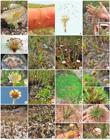
- a-v. Species of Eriocaulaceae in the Serra da Canastra - a-b. Paepalanthus subtilis - a. habit; b. capitula; c. Paepalanthus tortilis - habit; d-e. Paepalanthus trichophyllus - d. elongated stems and leaves; e. capitulum; f-g. Paepalanthus uai - f. habit; g. capitulum; h-i. Paepalanthus vaginatus - h. leaves, spathes and scapes; i. capitula; j-l. Syngonanthus anthemiflorus - j. leaves and inflorescence axis, axis bracts and spathe; k. capitulum with yellow flowers (adaxial view); l. capitulum (abaxial view); m. Syngonanthus caulescens - habit; n-p. Syngonanthus culcitosus - n. cushion habit; o. capitula; p. elongated stem and leaves. q-r. Syngonanthus gracilis - two morphotypes (q and r) - q. habit, with patent flat leaves; r. habit, with recurved terete leaves; s-t. Syngonanthus densiflorus - s. axis bracts and spathes; t. capitula; u-v. Syngonanthus nitens - u. leaves and spathes; v. capitulum. (Photos by L. Echternacht from Serra da Canastra, except: c. from Nakajima et al. 1115 [HUFU 9004]; f, g. from Nakajima & Romero 726 [HUFU 7128]).
It was collected in March and May while fertile.
4.17. Paepalanthus trichophyllus (Bong.) Körn., Fl. bras. (Martius & Eichler) 3: 318. 1863.Fig. 5d-e
Herbs 10‒48 cm tall. Stem aerial, 1‒18 cm, branched. Leaves spiraled throughout the stem, linear, apex acute, 0.2‒1.8 × 0.04‒0.2 cm, flat, glabrous abaxially, densely pilose to glabrescent adaxially. Spathes 1‒3.5 cm, denselly pilose to glabrescent, oblique opening. Scapes 4‒26 cm, denselly pilose, not emerging from a conspicuous reproductive axis. Capitula 2.8‒7.6 mm wide. Involucral bracts in 3‒4 series, elliptical, apex acute, 1‒2.5 mm, castaneous to brown, denselly pilose to glabrescent abaxially, glabrous adaxially, ciliate. Floral bracts oblong, apex acute, ca. 2 mm, castaneous, glabrous in both surface, ciliate, tufted. Flowers 2-merous. Staminate flowers ca. 2 mm including the pedicel, this ca. 0.5 mm; sepals obovate, apex acute, ca. 2 mm, castaneous, glabrous on both surfaces, ciliate, tufted; petals fused, tubulose, ca. 1.7 mm, cream, glabrous on both surfaces; filaments adnate to corolla; carpellodes cream, papilose. Pistillate flowers ca. 1.5 mm, sessile; sepals obovate, apex obtuse, ca. 1.5 mm, castaneous, glabrous on both surfaces, tufted; petals obovate, apex obtuse, ca. 1.5 mm, cream, glabrous on both surfaces, tufted; gynoecium ca. 1.5 mm, ovary ca. 0.5 mm, stigmatic branches bifid, liberating at the same level of the nectariferous branches.
Examined material: Capitólio, região da Represa de Furnas, estrada da Pedreira Souza, ca. de 2 km da MG-050, 17.II.2006, A.A. Arantes 1730 (HUFU); 12.VII.2006, A.A. Arantes 1945 (HUFU); próximo à cachoeira da rodovia, 22.V.2007, P.H.N. Bernardes 172 (HUFU); 21.III.2007, P.O. Rosa 534 (HUFU). Delfinópolis, Paraíso Selvagem, trilha entre o estacionamento e o Cânion do Alpinista, 1.II.2015, L. Echternacht 2606 (HUFU); Fazenda Zé Antunes, trilha Casinha Branca, 11.IV.2002, R.A. Pacheco 109 (HUFU); Fazenda Água da Serra, trilha Escada de Pedras, 10.III.2003, R.A. Pacheco 500 (HUFU); Condomínio de Pedras, 17.V.2003, R.A. Pacheco 606 (HUFU); estrada para Casa Branca, Fazenda Paraíso, 10.IV.2002, R. Romero 6250 (HUFU); trilha para cachoeira Salto Solitário, 11.III.2003, R. Romero 6724 (HUFU); trilha Escada de Pedra, 15.V.2003, R. Romero 6878 (HUFU); Sete Cidades, 8.X.2002, R. L. Volpi 212 (HUFU); Cidade de Pedras, 12.III.2003, R.L. Volpi 565 (HUFU); 17.V.2003, R. L. Volpi 674 (HUFU). São Roque de Minas, Percurso entre São João Batista da Canastra e a Portaria 1 (São Roque - Centro de Visitantes), estrada entre a nascente do Rio São Francisco e a Portaria 1, em direção à vertente sul da Serra, 31.V.2014, L. Echternacht 2496 (HUFU); nascente do Rio São Francisco, 31.V.2014, M.S. Freitas 034 (HUFU); na base do morro próximo ao alojamento, 7.XII.1994, J.N. Nakajima 652 (HUFU); estrada para a cachoeira dos Rolinhos, 21.XI.1995, J.N. Nakajima 1533 (HUFU); estrada para cachoeira Casca D’Anta, 23.XI.1995, J.N. Nakajima 1614 (HUFU); 20.III.1995, R. Romero 938 (HUFU); estrada São Roque de Minas - Sacramento, 3 km da sede administrativa, 10.I.1995, R. Romero 1682 (HUFU); Vale do Rio São Francisco, 3 meses após queimada, 10.I.1995, R. Romero 1698 (HUFU); Vale do Rio São Francisco, 3 meses após queimada, 17.III.1995, R. Romero 1983 (HUFU); 17.III.1995, R. Romero 1986 (HUFU); Parque Nacional da Serra da Canastra, próximo à entrada do Minério, 11.I.1998, R. Romero 5021 (HUFU).
Paepalanthus trichophyllus is similar to P. flaccidus due to its slender habit, elongated stem, spiraled small lanceolate leaves, and dimerous flowers. However, it can be distinguished by its brown involucral bracts, which are abaxially pilose to glabrescent.
It is fertile throughout the year, but especially during the first semester.
In Canastra, this species has a wide distribution, encompassing Chapadão do Diamante, Chapadão da Babilônia, and Serra Preta (Fig. 2e). It also occurs in Campo Rupestre regions within Espinhaço, Mantiqueira, and Veadeiros.
4.18. Paepalanthus uaiAndrino, F.N.Costa & Sano, Phytotaxa 509(1): 129. 2021.Fig. 5f-g
Herbs 6‒11 cm tall. Stem restricted to the rosette, unbranched. Leaves in basal rosettes, linear, apex acute, 6‒8 × 0.1‒0.06 cm, flat, glabrescent on both surfaces. Spathes 0.4‒1.5 mm, glabrous, truncate opening. Scapes 5‒8 cm, pilose, not emerging from a conspicuous reproductive axis. Capitula 6.5‒7.4 mm wide. Involucral bracts in 3‒4 series, ovate to obtrulate, apex acute to obtuse, 2.2‒2.9 mm, dark brown, pubescent abaxially, glabrous adaxially, ciliate. Floral bracts lanceolate, apex obtuse, ca. 2.6 mm, ligth brown to brown, pilose to glabrescent at the distal third of the abaxial surface, glabrous adaxially, ciliate, tufted. Flowers 3-merous. Staminate flowers ca. 3.2 mm including the pedicel, this ca. 0.5 mm; sepals oblanceolate, apex obtuse, ca. 2 mm, ligth brown to brown, pilose to glabrescent at the distal third of the abaxial surface, glabrous adaxially, ciliate, tufted; petals fused, tubulose, ca. 2 mm, cream, glabrous; filaments adnate to corolla; carpellodes cream at base, brown at the fimbriate apex, clavate. Pistillate flowers ca. 2.5 mm, including the pedicel, this ca. 0.3 mm; sepals oblanceolate to obtrullate, apex obtuse to cuspidate, ca. 2.5 mm, ligth brown to brown, pilose to glabrescent at the distal third of the abaxial surface, glabrous adaxially, ciliate, tufted; petals oblanceolate, apex obtuse, ca. 2 mm, cream, glabrous, ciliate, tufted; gynoecium ca. 2.5 mm, ovary ca. 0.5 mm, stigmatic branches bifid, liberating at the same level of the nectariferous branches.
Examined material: Delfinópolis, Parque Nacional da Serra da Canastra, trilha do Zé Carlinho, subida para a Serra do Cemitério, 9.XX.2002, J.N. Nakajima et al. 3214 (HUFU). São Roque de Minas, Parque Nacional da Serra da Canastra, Garagem de Pedras, estrada para Sacramento, campo limpo, solo arenoso-pedregoso, 3 meses após a queimada, 9.XII.1994, J.N. Nakajima & R. Romero 726 (HUFU); estrada S.R. Minas Sacramento, Garagem de Pedras, campo rupestre, 18.XX.1994, R. Romero et al. 1367 (HUFU, OUPR, SPF); Campo rupestre, 12.I.1995, R. Romero et al. 1763 (HUFU, SPF); Campo sujo, 16.XX.1997, R. Romero et al. 4646 (HUFU).
Paepalanthus uai is distinguished from other species by its woolly stem thickened by the leaf sheath and covered in ferruginous hairs, as well as truncate to lacerate spathes.
This species is endemic to Serra da Canastra, with recorded populations in Chapadão do Diamante and Serra do Cemitério (Fig. 2f). Notably, it has not been collected in the past 18 years, despite recent efforts to recover it, and might be considered Critically Endangered (Echternacht et al. 2021).
Reproductive material was collected in October and December.
4.19. Paepalanthus vaginatus Körn., Fl. bras. (Martius & Eichler) 3: 313. 1863.
= Paepalanthus cylindraceusSilveira, Florf Gerais: “In arenosis in Serra do Chapadão”, April 1925, Silveira 748 (holotype R!).Fig. 5h-i
Herbs 30‒80 cm tall. Stem restricted to the rosette, sometimes branched. Leaves in basal rosette, lanceolate, apex acute, 2‒17 × 0.08‒0.5 cm, flat, glabrescent in both surfaces. Spathes 3‒13 cm, glabrescent, oblique opening. Scapes 20‒70 cm, glabrous, not emerging from a conspicuous reproductive axis. Capitula 6.9‒11.8 mm wide. Involucral bracts in 4‒5 series, triangular to oval, apex acute to obtuse, 1‒2.5 mm, dark brown, glabrous on both surfaces, ciliate in the apex. Floral bracts linear to lanceolate, apex obtuse, ca. 1.5 mm, castaneous, glabrous on both surfaces, ciliate, tufted. Flowers 2-merous. Staminate flowers ca. 2 mm including the pedicel, this ca. 0.5 mm; sepals lanceolate, apex obtuse, ca. 2 mm, castaneous, glabrous on both surfaces, ciliate in the apex, tufted; petals fused, tubulose, ca. 1.7 mm, cream, glabrous on both surfaces; stamens free; carpellodes cream, papilose. Pistillate flowers ca. 3 mm, including the pedicel, this ca. 0.5 mm; sepals lanceolate, apex obtuse, ca. 3 mm, castaneous, glabrous on both surfaces, tufted; petals lanceolate, apex round, ca. 2.7 mm, light brown, glabrous on both surfaces, tufted; gynoecium ca. 3 mm, ovary ca. 1 mm, stigmatic branches bifid, liberating at the same level of the nectariferous branches.
Examined material: Delfinópolis, Furnas, região da Represa de Furnas, morro próximo a Pousada do Rio Turvo, beira da represa, 30.IX.2005, A.A. Arantes 1535 (HUFU); Serra Preta, chapadão no alto da Serra Preta, 30.I.2015, L. Echternacht 2596 (HUFU); estrada para guarita, 14.V.2003, R.A. Pacheco 549 (HUFU); 14.V.2003, R. Romero 6819 (HUFU); trilha Escada de Pedra, 15.V.2003, R. Romero 6870 (HUFU). Sacramento, Parque Nacional da Serra da Canastra, próximo à guarita de Sacramento, 16.III.1995, R. Romero 1843 (HUFU); 16.III.1995, R. Romero 1861 (HUFU); 16.III.1995, R. Romero 1897 (HUFU); estrada São Roque de Minas - Sacramento, próximo ao Córrego dos Passageiros, 13.V.1995, R. Romero 2238 (HUFU). São Roque de Minas, morro da entrada do Parque Nacional, 18.IV.1992, N.M. Castro 305 (HUFU); percurso entre a portaria 2 (São João Batista da Canastra) e a nascente do Rio São Francisco, aproximadamente 7 km após a portaria 2, 29.V.2014, L. Echternacht 2466 (HUFU); estrada para Casa de Pedra, 23.II.1994, J.N. Nakajima 196 (HUFU); próximo ao vale do São Francisco, 17.IV.1994, J.N. Nakajima 275 (HUFU); Parque Nacional da Serra da Canastra, 25.VI.1994, J.N. Nakajima 371 (HUFU); estrada São Roque de Minas - Sacramento, guarita de Sacramento, 14.VII.1995, J.N. Nakajima 1148 (HUFU); cerca de 1 km, 15.IV.1997, J.N. Nakajima 2295 (HUFU); Parque Nacional da Serra da Canastra, 15.IV.1994, R. Romero 805 (HUFU); 3 km da sede administrativa, 17.III.1995, R. Romero 1952 (HUFU); 17.III.1995, R. Romero 1971 (HUFU); vale da nascente do Rio São Francisco, 17.III.1995, R. Romero 1987 (HUFU); lagoa rodeada por plantações de pinheiros, 26.I.2002, R. Romero 6361 (HUFU).
Paepalanthus vaginatus can be distinguished by its highly elongated spathes, long glabrescent scapes, and dimerous flowers. The dark brown involucral bracts and the discoid young capitula are also remarkable.
The collections of reproductive material date from several months of the year; however, the greatest concentration refers to the first semester.
Paepalanthus vaginatus forms abundant populations in Canastra, specifically in Chapadão do Diamante and Serra Preta (Fig. 2f).
Paepalanthus vaginatus was described from the Quadrilátero Ferrífero and also occurs in the Espinhaço Range, forming abundant populations. The type of P. cylindraceus, which was described from Serra da Canastra, exhibits all the diagnostic characteristics of P. vaginatus and is here considered synonymous with it, according to Andrino et al. (2024).
5. Syngonanthus.
Herbs terrestrial. Stem subterranean or aerial, short to elongate. Leaves in basal rosette or spiraled throughout the stem, not fenestrated. Scapes emerging at the stem apex or leaf axil, or from a conspicuous reproductive axis. Floral bracts absent or present. Flowers 3-merous, isostemonous, petals eglandular. Staminate flowers pedicellate, sepals fused at the base, petals tubulose, stamens adnate to the corolla, anthers dorsifixed, carpellodes present. Pistillate flowers pedicellate, sepals free, petals fused in the upper third, free at base and middle, as well as at the very apex, forming short triangular lobes soon involute after anthesis, stigmatic branches simple, liberating at the same level of the nectariferous branches, or rarely nectariferous branches absent.
Syngonanthus is sister to Comanthera, as evidenced by the petals of pistillate flowers fused at the middle and free at the base and top. It differs, however, by the sepals of the pistillate flowers equalling the petals, these with short triangular lobes, and seeds with reticulated surface (Parra et al. 2010; Giulietti et al. 2012).
5.1. Syngonanthus anthemiflorus (Bong.) Ruhland, Pflanzenr. (Engler) IV. 30: 258. 1903.Fig. 5j-l
Herbs 15‒25 cm tall. Stem subterranean, branched. Leaves in basal rosette, linear, apex acute to acuminate, 6‒12 × 0.6‒1.4 mm, recurved, flat, densely pilose abaxially, pilose adaxially, hairs patent. Reproductive axis conspicuous, 1 per rosette, 1.5‒4 cm. Axis bracts absent along the axis, restricted to a distal whorl, linear, apex acuminate, 5.8‒11.8 mm, ascending to erect, pilose on both surfaces, with patent simple and glandular hairs abaxially, and appressed hairs adaxially, ciliate. Spathes 1.5‒2.5 cm, densely pilose abaxially, with simple and glandular patent hairs, oblique opening. Scapes emerging at the reproductive axis apex, 11‒18 cm, densely pilose, simple and glandular patent hairs. Capitula 9‒12 mm wide. Involucral bracts in 4‒7 series, clearly dimorphic, the external series oval to oboval, apex acute to acuminate, 1‒4 mm, light brown to stramineous, glabrescent, progressively longer toward the internal series, these spathulate, apex round, 3‒4 mm, surpassing the floral disc, cream, glabrous. Floral bracts narrow obovate to spathulate, apex acuminate, ca. 3 mm, cream, hairy in the central region, abaxially and sometimes also adaxially. Flowers 3-merous. Staminate flowers 2‒2.5 mm, including the pedicel, this ca. 0.5 mm; sepals fused at base, elliptical, apex acute, ca. 2 mm, cream, hairy as the flower bracts; petals fused, ca. 1.5 mm, cream, membranaceous, glabrous; filaments adnate to corolla; carpellodes present. Pistillate flowers 2‒2.5 mm, including the pedicel, this 0.3‒0.5 mm; sepals elliptical, apex acute, ca. 2.5 mm, cream, abaxially pilose at middle, glabrous adaxially; pilose ring present; petals obovate, apex acuminate, ca. 1.5 mm, cream, adaxially slightly pilose, adaxially glabrous; gynoecium ca. 1.5 mm, ovary ca. 1 mm, nectariferous branches present.
Examined material: Delfinópolis, trilha Escada de Pedra, 15.V.2003, R. Romero 6879 (HUFU). São Roque de Minas, Parque Nacional da Serra da Canastra, percurso entre a Portaria 2 (São João Batista da Canastra) e a nascente do Rio São Francisco, próximo à parte alta da Casca D’Anta, 29.V.2014, L. Echternacht 2476 (HUFU); estrada entre São Roque e a nascente do Rio São Francisco, 31.V.2014, M.S. Freitas 030 (HUFU); estrada do Chapadão Diamante, 18.III.1995, J. N. Nakajima 820 (HUFU); base da colina próximo à sede, 20.II.1994, R. Romero 649 (HUFU); estrada para Sacramento, 3 km da sede administrativa, 17.III.1995, R. Romero 1952 (HUFU); estrada para Sacramento, 3 km da sede administrativa, 19.II.1997, R. Romero 3841B (HUFU).
Syngonanthus anthemiflorus is distinguished from the congenerics in the area by involucral bracts long surpassing the flower disc (Fig. 5k-l), a feature that approaches it to Comanthera subg. Comanthera (i.e., C. dealbata, C. euschemus, and C. nivea). However, it differs from these species by the scapes emerging from a conspicuous reproductive axis (Fig. 5j) and the presence of glandular hairs on the axis bracts, spathes, and scapes. Syngonanthus anthemiflorus is a morphologically highly variable species, with two varieties recognized. Plants from Canastra resemble S. anthemiflorus var. similis (Ruhland) L.R.Parra & Giul. (1997: 228), as they correspond to larger plants and have clearer involucral bracts.
In Serra da Canastra, this species occurs in Chapadão do Diamante (Fig. 2f), representing a disjunction with its occurrence in the Espinhaço Range in Minas Gerais, where it is widely distributed and forms abundant populations (Echternacht 2012).
Collections date from the first semester, but as noted by Parra (1998), reproductive plants can be found practically throughout the year.
5.2. Syngonanthus caulescens (Poir.) Ruhland, Pflanzenr. (Engler) IV. 30: 267. 1903.Fig. 5m
Herbs 9‒21 cm tall. Stem aerial, up to 26 cm, usually unbranched, internodes with whitish lanose indumentum. Leaves spiraled throughout the stem, lance-linear, apex acute, 1.7‒1 × 0.1‒0.2 cm, ascending to patent, flat to canaliculate, sparsely hairy on both surfaces, hairs appressed. Spathes 1‒2.5 cm, sparsely hairy, simple appressed hairs, apex tufted, oblique opening. Scapes 4‒16 cm, hairy to glabrescent, simple patent hairs, not emerging from a conspicuous reproductive axis. Capitula 4.2‒5.5 mm wide. Involucral bracts in ca. 4 series, similar in color, gradual in shape, longer inwardly, the external oval, apex acuminate to apiculate, ca. 1.5 mm, cream with stramineous basis, glabrous, internal series elliptical, apex acuminate to acute, ca. 2 mm, not surpassing the floral disc, cream, glabrous. Floral bracts absent. Flowers 3-merous. Staminate flowers 1.8‒2 mm, including the pedicel, this ca. 0.5 mm; sepals free, elliptical, apex acuminate, ca. 1.8 mm, cream, glabrous; petals fused at base ca. 1/3 their length, ca. 0.7 mm, spongy, cream, glabrous; filaments adnate to the corolla at base; carpellodes present. Pistillate flowers 1.5‒2 mm, including the pedicel, this ca. 0.2 mm; sepals elliptical, apex acuminate, ca. 2 mm, cream, glabrous; petals spathulate to unguiculate, apex acuminate, ca. 1.5 mm, cream, abaxially hairy in the upper region, adaxially glabrous; gynoecium ca. 1.5 mm, ovary ca. 1 mm, nectariferous branches present.
Examined material: Capitólio, região de Furnas, estrada para Pedreira Gabi Exploração II, ca. de 8 k m, 8.XI.2007, P.H.N. Bernardes 340 (HUFU); Paraíso Perdido, próximo à pousada Pé da Serra, rio nos fundos da pousada, 1.II.2015, L. Echternacht 2609 (HUFU); Cachoeira da Filó, 24.V.2007, J.N. Nakajima 4539 (HUFU); estrada para Cachoeira Feixo da Serra, 13.VII.2006, R. Romero 7849 (HUFU).
Syngonanthus caulescens is morphologically similar to S. culcitosus but can be distinguished by its acute to acuminate involucral bracts, lanceolate leaves, and pistillate flowers with spongy petals (Echternacht et al. 2021).
Syngonanthus caulescens is recorded in southern Chapadão da Babilônia (Fig. 2f) and is widely distributed throughout Brazil and South America (Watanabe 2015).
It was collected fertile in February, May, July, and November.
5.3. Syngonanthus culcitosus Echtern., Syst. Bot. 46(1): 31. 2021.Fig. 5n-p
Herbs 6‒32 cm tall. Roots whitish, spongy. Stem aerial, 1‒5.5 cm, profusely branched, forming cushions up to 50 cm wide, internodes with whitish lanose indumentum. Leaves spiraled throughout the stem, linear to oblanceolate, apex obtuse, 0.5‒2.5 cm × 0.05‒0.2 cm, ascending to patent, flat, densely pilose to glabrescent in both surfaces, appressed simple hairs and also scattered patent glandular hairs. Spathes 15‒4 cm, pilose to glabrescent, with glandular patent hairs, oblique opening. Scapes 5‒32 cm, sparsely pilose to glabrescent, glandular patent hairs not emerging from a conspicuous reproductive axis. Capitula 3.2‒6 mm wide. Involucral bracts in 4‒6 series, similar in color, gradual in shape, series longer inwardly, round to oblanceolate, apex round to obtuse, 1.3‒2.7 mm, cream with stramineous basis, glabrescent to glabrous abaxially, glabrous adaxially, as long as the flower disc. Floral bracts absent. Flowers 3-merous. Staminate flowers 2‒2.5 mm, incluiding the pedicel, this 0.5‒1 mm; sepals fused at base, narrow elliptic, apex obtuse, 1.5‒2 mm, cream, pilose abaxially at the upper half, glabrous adaxially; petals fused, tubulose, ca. 1.8 mm, membranaceous, cream, glabrous; filaments adnate to the corolla; carpellodes papilose. Pistillate flowers ca. 3 mm, including the pedicel, this ca. 1 mm; sepals lanceolate, apex round to obtuse, ca. 2 mm, cream, glabrous; petals oblong, apex round to obtuse, ca. 1.5 mm, cream, glabrous; gynoecium 1.5‒2 mm, ovary ca. 0.6 mm, nectariferous branches present.
Examined material: Capitólio, região da represa de Furnas, Chapadão da Babilônia, Serra do Turvo, próximo às pedreiras, nos flancos do Rio da Capivara, em cachoeira que corta a estrada, no caminho para a Cachoeira da Pedreira, -46.293056°, -20.613611°, SAD69, 1.II.2015, L. Echternacht et al. 2612 (HUFU, B, OUPR, SPF); Paraíso Perdido, córrego Quebra Anzol, 4.5 km da rodovia MG-050, -46.323333°, -20.624444°, 29.XI.2005, R. Romero et al. 7246 (HUFU). Delfinópolis, Cânion do Alpinista, dentro do cânion, no pé da Cachoeira do Alpinista, -46.642222°, -20.434444°, SAD69, 1.II.2015, L. Echternacht et al. 2608 (HUFU, OUPR); Faz. José Antunes, trilha “Escada de Pedras”, -46.3872°, -20.2604°, 11.XX.2002, R. Romero et al. 6453 (HUFU, OUPR). São Roque de Minas, PARNA Serra da Canastra, nascente do Rio São Francisco, -46.446667°, -20.243611°, WGS84, 29.IV.2015, L. Echternacht et al. 2480 (HUFU, OUPR); nascente do Rio São Francisco, borda de capão, 15.VI.1995, R. Romero et al. 2407 (HUFU, OUPR, SPF); Cachoeira da Casca D’Anta, parte de cima, campo rupestre, 17.VII.1995, R. Romero et al. 2508 (HUFU, OUPR); Cachoeira dos Rolinhos, ilhota, borda do córrego, 21.VIII.1997, R. Romero et al. 4481 (HUFU, OUPR).
Syngonanthus culcitosus distinguishes itself from other species by its cushion-like growth habit, characterized by elongated, densely branched, woolly stems. It can also be differentiated from S. caulescens by its round involucral bracts, linear to oblanceolate leaves, and pistillate flowers with membranaceus petals (Echternacht et al. 2021).
This species is endemic to Canastra, where it is commonly observed near the rivers at humid and often shadowed sites. It has been collected in Chapadão do Diamante, Chapadão da Babilônia, and Serra Preta (Fig. 2g) (Echternacht et al. 2021). It is assessed as Vulnerable following the criteria B1B2ab(i, ii, iii) of IUCN (2019), according to Echternacht et al. (2021).
It was collected fertile in February, April, July, August, October, and November, suggesting a more or less continuous flowering period.
5.4. Syngonanthus davidsei Huft, Ann. Missouri Bot. Gard. 72(2): 448. 1985.Fig. 5q-r
Herbs 6‒28 cm tall. Roots cream, fibrous. Stem subterranean, branched or not. Leaves in basal rosette, linear, apex obtuse to acute, 0.3‒1.9 × 0.03‒0.1 cm, patent to recurved, flat to semiterete, pilose to glabrescent on both surfaces, hairs patent. Spathes 1‒3 cm, pilose to glabrescent, with glandular patent hairs, oblique opening. Scapes 4‒27 cm, pilose to glabrescent, with glandular and simple patent hairs, not emerging from a conspicuous reproductive axis. Capitula 2.2‒6.4 mm wide. Involucral bracts in 5‒6 series, similar in color and shape, equaling in height, elliptical to obovate, apex obtuse to round, 0.3‒0.5 mm, cream to golden, glabrous, not surpassing the floral disc. Floral bracts absent. Flowers 3-merous. Staminate flowers 1‒2.5 mm, including the pedicel, this ca. 0.5‒1 mm; sepals fused in the lower half, elliptical, apex acute, ca. 0.5‒2 mm, cream, abaxially hairy at the center of the apex to glabrescent, glabrous adaxially; petals fused, ca. 0.5‒1 mm, membranaceous, cream, glabrous; filaments adnate to corolla; carpellodes present. Pistillate flowers ca. 1.5‒2.5 mm, including the pedicel, this ca. 0.3‒1 mm; sepals ovate to elliptical, apex acuminate, 1.5‒2 mm, cream, glabrous; petals oblong, apex acuminate, 1‒1.5 mm, membranaceous, cream, glabrous; gynoecium 1‒1.5 mm, ovary 0.5‒1 mm, nectariferous branches absent.
Examined material: Capitólio, região de Furnas, estrada para Gabi Explorações II, 23.III.2007, P.H.N. Bernardes 114 (HUFU). Delfinópolis, estrada para Gurita, 14.V.2003, R. Romero 6817 (HUFU); trilha Escada de Pedras, 15.V.2003, R.L. Volpi 646 (HUFU). São Roque de Minas, Chapada dos Diamantes, 22.VI.2001, N.M. Castro 16 (HUFU); Parque Nacional da Serra da Canastra, 18.IV.1992, N.M. Castro 321 (HUFU); percurso entre a Portaria 2 (São João Batista da Canastra) e a nascente do Rio São Francisco, próximo à parte alta da Casca D’Anta, 29.V.2014, L. Echternacht 2471 (HUFU); estrada da bifurcação entre a cachoeira Casca D’anta, parte alta e a torre de observação, 30.V.2014, M.S. Freitas 025A (HUFU); 30.V.2014, M.S. Freitas 025B (HUFU); 30.V.2014, M.S. Freitas 026 (HUFU); 30.V.2014, M.S. Freitas 027 (HUFU); 25 km da guarita de Sacramento, 22.III.1995, J.N. Nakajima 967 (HUFU); Guarita de Sacramento, cerca de 1 km, 15.IV.1997, J.N. Nakajima 2298 (HUFU); 15.IV.1997, J.N. Nakajima 2301 (HUFU); estrada para Sacramento, vale da nascente do Rio São Francisco, 17.III.1995, R. Romero 1985 (HUFU); nascente do córrego dos Peixes, 16.IV.1997, R. Romero 4039 (HUFU); trilha do córrego da Fazenda, 16.IV.1997, R. Romero 4076 (HUFU).
Syngonanthus davidsei is morphologically close to Syngonanthus nitensRuhland (1903: 254) in Canastra, with scapes emerging from the rosette; it is, however, a smaller plant, with cream fibrous root, and involucral bracts equaling in height among the series. The species displays morphological variety in the area: some populations have a stem reduced to the rosette, these solitary, and patent flat leaves (Fig. 5q), while others are rhizomatous, branched, with terete recurved leaves (Fig. 5r), more similar to the Syngonanthus gracilis (Bong.) Ruhland (1903: 249) species concept (Echternacht 2012). The morphological complexity and an apparent gradient led us to recognize one single taxon, determined as S. davidsei, due to the absence of nectariferous appendices in the gynoecium. A population analysis in Canastra could test the species circumscription.
This species occurs in Chapadão da Babilônia and Serra Preta in Canastra (Fig. 2g), with a broad distribution in Brazil and South America (Echternacht 2012).
It was collected fertile in the first semester.
5.5. Syngonanthus densiflorus (Körn.) Ruhland, Pflanzenr. (Engler) IV, Fam. 30: 263. 1903.Fig. 5s-t
Herbs ca. 1 m tall. Roots withish, spongy. Stem subterranean, branched or not. Leaves cespitose, linear, apex obtuse, 10‒45 × 0.3‒0.5 cm, recurved, flat, hairy on both surfaces, soon glabrescent, hairs patent, simple and glandular, ciliate. Reproductive axis conspicuous, 1 per rosette, ca. 12‒30 cm. Spiraled bracts sparse along the axis, ca. 0.5‒1 cm, and also whorled at the apex, these lanceolate to linear, acute, up to 15 cm, erect, pilose on both surfaces as the leaves. Spathes 4‒17 cm, pilose as the leaves, oblique opening. Scapes 25‒73 cm, hairy, malpighiaceous appressed and simple patent hairs, glabrescent, emerging from the reproductive axis apex. Capitula 0.8‒1.5 cm wide. Involucral bracts in 8-10 series, uniformly stramineous, triangular to lanceolate, apex obtuse to acute, simple hairs abaxially, not surpassing the floral disc. Floral bracts lanceolate to oblong, apex obtuse, ca. 3 mm, cream, hyaline, abaxially hairy in the central region. Flowers 3-merous. Staminate flowers ca. 3 mm, including the pedicel, this ca. 0.5 mm; sepals fused at base, elliptical, apex acute, ca. 2.5 mm, cream, abaxially distally hairy; petals fused, tubulose, ca. 2.5 mm, cream, membranaceous, glabrous; filaments adnate to corolla; carpellodes clavate. Pistillate flowers ca. 4 mm, including the pedicel, this up to 5 mm; sepals elliptical, apex acute, ca. 3.5 mm, cream, abaxially pilose at middle, glabrous adaxially; pilose ring present; petals obovate, apex obtuse, ca. 3 mm, cream, adaxially slightly pilose, adaxially glabrous; gynoecium ca. 3 mm, ovary ca. 1 mm, nectariferous branches present.
Examined material: Delfinópolis, Parque Nacional da Serra da Canastra, Chapadão da Babilônia, estrada para Cachoeira do Paraíso, lado esquerdo, 20º21’57.48’’S, 46º43’44.44’’W, 13.III.2020, L.J. Sauthier et al. 115 (SPF).
Syngonanthus densiflorus also has a conspicuous reproductive axis subtending the scapes, as S. anthemiflorus, but its involucral bracts equal the floral disc in height. It is the tallest Syngonanthus in the area.
There is one record only of this species, collected in March, at Chapadão da Babilônia, on the road to Paraíso waterfall (Fig. 2g). Although rare in Canastra, it is widespread in the Cerrado and occurs beyond Brazil in Peru and Bolivia (Echternacht 2012; Echternacht & Watanabe 2024).
The specimen Sauther 115 was seen by photo only. Description was based on the syntypes (Riedel 2348 [B, S, UPS], Weddel 2383 [P], Gardner 2966[BM, F, G, K, NY, OXF,]; flowers were described based on Evangelista 72 (BHCB), complemented by the protologue.
5.6. Syngonanthus nitens (Bong.) Ruhland, Pflanzenr. (Engler) IV. 30: 254. 1903.
= Syngonanthus retrorsociliatusSilveira, Floral. Mont.: 347. 1928. Type:-BRAZIL. Minas Gerais: “In campis arenosis in serra do Chapadão et serra da Babylonia”, April 1925, Silveira 747 (syntype: R!).Fig. 5u-v
Herbs 14‒60 cm tall. Roots orangish, spongy. Stem subterranean, branched or not. Leaves in basal rosette, linear, apex acuminate, 1.3‒3.1 × 0.04‒0.2 cm, recurved, flat, with a lighter longitudinal band in the middle (more visible in dry specimens), hairy abaxially, sparsely pilose adaxially, hairs patent. Spathes 2‒7 cm, densely pilose to glabrescent adaxially, whit glandular patent hairs, tufted abaxially at apex, oblique opening. Scapes 13‒54 cm, glabrous, golden, not emerging from a conspicuous reproductive axis. Capitula 5.2‒10 mm wide. Involucral bracts in 5‒6 series, similar in color, gradual in shape and size, the external oblong, apex obtuse to round, ca. 1 mm, golden, pale with age, glabrous, internal series progressively longer, ovate, apex round, ca. 2.5 mm, glabrous, not surpassing the floral disc. Floral bracts absent. Flowers 3-merous. Staminate flowers 3‒4 mm, including the pedicel, this ca. 0.5‒1 mm; sepals fused in the lower half, elliptical, apex acute, 2.5‒3 mm, cream, pilose on both surfaces in the distal half; petals fused, ca. 0.5‒1 mm, membranaceous, cream, glabrous; filaments adnate to the corolla; carpellodes present. Piltillate flowers 3‒4 mm, including the pedicel, this ca. 0.5‒1 mm; sepals elliptical, apex acute, 1.5‒2 mm, cream, pilose to glabrescent on both surfaces; petals oblong, apex acuminate, 1‒1.5 mm, membranaceous, cream, glabrous; gynoecium 1.5‒2 mm, ovary 1.5‒2 mm, nectariferous branches present.
Examined material: Delfinópolis, Serra Preta, chapadão no alto da Serra Preta, 30.I.2015, L. Echternacht 2597 (HUFU); córrego na Escadaria de Pedras, 31.I.2015, L. Echternacht 2603 (HUFU); Fazenda Zé Antunes, trilha para Cachoeira Triângulo, 6.XII.2002, J.N. Nakajima 3396 (HUFU); região da Represa de Furnas, estrada depois do Paraíso Perdido, 25.X.2006, J.N. Nakajima 4227 (HUFU); Fazenda Águas da Serra, trilha das cachoeiras, 13.III.2003, R. Romero 6758 (HUFU); estrada para Casinha Branca, próximo à entrada da Fazenda Águas da Serra, 12.III.2003, R.L. Volpi 550 (HUFU). Sacramento, Parque Nacional da Serra da Canastra, estrada São Roque de Minas - Sacramento, próximo ao Córrego dos Passageiros, 13.V.1995, R. Romero 2233 (HUFU); 13.V.1995, R. Romero 2239 (HUFU); estrada Sacramento - Franca, perto da Cemig, 3.VIII.1984, R.C. Vieira 297 (HUFU). São Roque de Minas, primeira pontinha após a garagem das pedras em direção a São Roque, 21.VI.2001, N.M. Castro 05 (HUFU); morro do córrego da fazenda, 22.VI.2001, N.M. Castro 11 (HUFU); Parque Nacional da Serra da Canastra, 18.IV.1992, N.M. Castro 315 (HUFU); nascente do Rio São Francisco, 31.V.2014, M.S. Freitas 032 (HUFU); próximo ao vale do São Francisco, 17.IV.1994, J.N. Nakajima 276 (HUFU); estrada do Chapadão Diamante, 18.III.1995, J.N. Nakajima 857 (HUFU); caminho para a Cachoeira Casca D’Anta, 18.VII.1995, J.N. Nakajima 1265 (HUFU); base da colina próximo à sede, 20.II.1994, R. Romero 621 (HUFU); morro próximo à sede administrativa, 17.III.1995, R. Romero 1940 (HUFU); estrada para Sacramento, 3 km da sede administrativa, 17.III.1995, R. Romero 1959 (HUFU); morro após a nascente do Rio São Francisco, 16.VII.1995, R. Romero 2421 (HUFU); Chapadão do Diamante, 16.VII.1995, R. Romero 2447 (HUFU); proximidade do córrego dos Passageiros, 19.VII.1995, R. Romero 2617 (HUFU); morro após a nascente do Rio São Francisco, 19.II.1997, R. Romero 3879 (HUFU); nascente do córrego dos Peixes, 16.IV.1997, R. Romero 4055 (HUFU); estrada para Sacramento - São Roque de Minas, próximo à entrada do Minério, 11.I.1998, R. Romero 5024 (HUFU).
Syngonanthus nitens is remarkable for its golden scapes, popularly called “capim dourado” (golden grass). It differs from S. davidsei by its orangish spongy roots and involucral bracts gradually longer from the external to the internal series, usually taller. Dry materials also frequently display leaves with a lighter longitudinal band in the middle.
Syngonanthus nitens is widely distributed in Canastra, in Chapadão do Diamante, Chapadão da Babilônia, and Serra Preta (Fig. 2g), being widespread in Brazil from south to north, and occurring in Colombia, Venezuela, and Paraguay (Echternacht 2012).
It was collected in the reproductive stage throughout the year, but more frequently in the first semester.
Acknowledgements
We are grateful to Luana Sauthier, Mara Tissot-Squali, and Renato Ramos, for kindly informing us of two collections made by them in 2020, recording two new species for the area: Syngonanthus densiflorus and Paepalanthus scleranthus. We thank the HUFU herbarium, for providing images of some specimens for the photographic plates. Financial support was provided by Universidade Federal de Uberlândia (INBIO/PROPP 6/2013), Fapemig (2014 - BIO032 EDITAL 09/2013 - PIBIC/FAPEMIG/UFU), and Universidade Federal de Ouro Preto (PROPPI).
Data availability statement
In accordance with Open Science communication practices, the authors inform that there is no data sharing of this manuscript
References
- Andrino CO, Costa FN & Sano PT (2015) O gênero Paepalanthus Mart. (Eriocaulaceae) no Parque Estadual do Biribiri, Diamantina, Minas Gerais, Brasil. Rodriguésia 66: 393-419.
- Andrino CO, Costa FN, Sauthier LJ & Sano PT (2021) Paepalanthus uai (Eriocaulaceae), a new name for the later homonym Paepalanthus petraeus Echtern. & Trovó. Phytotaxa 509: 129-130.
- Andrino CO, Costa FN, Hensold N, Ramos R & Sano PT (2022) Paepalanthus (Eriocaulaceae) of the Brazilian flora: nomenclatural survey reveals twenty-five new synonyms and widely applied illegitimate names. Systematic Botany 47: 635-641.
- Andrino CO, Costa FN, Simon MF, Missagia RV & Sano PT (2023) Eriocaulaceae: a new classification system based on morphological evolution and molecular evidence. Taxon 72: 515-549.
-
Andrino CO, Sano PT, Costa FN, Echternacht L, Sauthier LJ, Hensold N, Ramos R, Tissot-Squalli M & Trovó M (2024) Paepalanthus in Flora e Funga do Brasil. Jardim Botânico do Rio de Janeiro. Available at <Available at https://floradobrasil.jbrj.gov.br/FB7558 >. Access on 18 June 2024.
» https://floradobrasil.jbrj.gov.br/FB7558 - Batista JA, Carvalho BM, Ramalho AJ & Bianchetti LB (2010) Three new species of Habenaria (Orchidaceae) from Serra da Canastra, Minas Gerais, Brazil. Phytotaxa 13: 27-39.
- BFG - The Brazil Flora Group (2015) Growing knowledge: an overview of seed plant diversity in Brazil. Rodriguésia 66: 1085-1113.
- Bongard M (1831) Essai monographique sur les espèces d’Ériocaulon du Brésil. Mémoires de L´académie Impériale des sciences de St.-Pétersbourg 6: 601-655.
- Christenhusz MJ, Fay MF, & Byng J (2018) The Global Flora Special Edition: GLOVAP nomenclature. Part 1, Vol. 4. Plant Gateway, Bradford. 155p.
- Christenhusz MJM, van den Berg C & Byng JW (2020) Proposal to conserve Paepalanthus, nom. cons. against the additional name, Tonina (Eriocaulaceae). Taxon 69: 1109-1110.
- Costa FN (2005) Recircunscrição de Actinocephalus (Körn.) Sano (Eriocaulaceae). Tese de Doutorado. Universidade de São Paulo, São Paulo. 138p.
- Costa FN & Sano PT (2013) New circumscription of the endemic Brazilian genus Actinocephalus (Eriocaulaceae). Novon: a Journal for Botanical Nomenclature 22: 281-287.
- Echternacht L (2012) Sistemática de Comanthera e de Syngonanthus (Eriocaulaceae). Tese de Doutorado. Universidade de São Paulo, São Paulo. 294p.
- Echternacht L, Trovó M, Costa FN & Sano PT (2012) Análise comparativa da riqueza de Eriocaulaceae nos parques estaduais de Minas Gerais, Brasil. MG. Biota 4: 17-31.
- Echternacht L, Sano PT & Dubuisson J-Y (2015) Taxon omic study of Comanthera subg. Thysanocephalus Systematic Botany 40: 136-150.
- Echternacht L, Freitas MS & Trovó M (2021) Three new and endemic species of Eriocaulaceae from Serra da Canastra, Minas Gerais, Brazil. Systematic Botany 46: 24-33.
-
Echternacht L & Parra LR (2024) Comanthera in Flora e Funga do Brasil. Jardim Botânico do Rio de Janeiro. Available at <Available at https://floradobrasil.jbrj.gov.br/FB116316 >. Access on 18 June 2024.
» https://floradobrasil.jbrj.gov.br/FB116316 -
Echternacht L & Watanabe MTC (2024) Syngonanthus in Flora e Funga do Brasil.. Available at <Available at https://floradobrasil.jbrj.gov.br/FB7658 >. Access on 18 June 2024.
» https://floradobrasil.jbrj.gov.br/FB7658 - Farinaccio MA & Mello-Silva R (2004) Ditassa insignis (Apocynaceae, Asclepiadoideae), a new species from the Serra da Canastra, Minas Gerais, Brazil. Kew Bulletin 59: 145-148.
- Fernandes GW, Barbosa NPU, Negreiros D & Paglia AP (2014) Challenges for the conservation of vanishing megadiverse rupestrian grasslands. Natureza & Conservação 12: 162-165.
- Ferreira CSAM, Trovó M & Forzza RC (2011) A família Eriocaulaceae no Parque Estadual do Ibipitoca, Minas Gerais, Brasil. Boletim de Botânica da Universidade de São Paulo 29: 19-35.
- Gardner G (1843) Paepalanthus speciosus In: Hook WJ (ed.) Icones Plantarum, Ser. 6. Hippolyte Bailliêre, London. 512p.
- Giulietti AM (1984) Estudos taxonômicos no gênero Leiothrix Ruhland. Tese de Doutorado. Universidade de São Paulo, São Paulo. 270p.
- Giulietti AM, Andrade MJG, Scatena VL, Trovó M, Coan AI, Sano PT, Santos FAR, Borges RLB & van den Berg C (2012) Molecular phylogeny, morphology and their implications for the taxonomy of Eriocaulaceae. Rodriguésia 63: 1-19.
- Giulietti AM & Hensold N (1990) Padrões de distribuição geográfica dos gêneros de Eriocaulaceae. Acta Botanica Brasilica 4: 133-158.
-
Google Earth (2023) Website. Available at <Available at http://earth.google.com/ >. Access on 14 August 2023.
» http://earth.google.com/ - Hasui Y, Carneiro CDR, Almeida FFM & Bartorelli A (2012) Geologia do Brasil. Beca, São Paulo. 900p.
- Hensold N (1999) Eriocaulaceae. In: Berry PE, Yatskievych K & Holst BK (eds.) Flora of Venezuelan Guayana. Vol. 5. Missouri Botanical Garden Press, St. Louis. Pp. 1-57.
- Herzog T (1924) Neue Südamerikanische Eriocaulonaceae. Repertorium Specierum Novarum Regni Vegetabilis 20: 82-88.
- IUCN - International Union for Conservation of Nature and Natural Resources (2001) IUCN Red List categories and criteria: version 3.1. IUCN Species Survival Commission. IUCN, Switzerland and Cambridge. ii + 30p.
-
IUCN Standards and Petitions Committee (2019) Guidelines for Using the IUCN Red List categories and criteria. Version 14. Prepared by the Standards and Petitions Committee. Available at <Available at http://www.iucnredlist.org/ >. Access on 14 August 2023.
» http://www.iucnredlist.org/ - Koernicke F (1863) Eriocaulaceae . In: Martius KFP & Eichler AW (eds.) Flora brasiliensis Tipografia Regia, Munique. Vol. 3, pars 1, pp. 271-508.
- Kunth CS (1841) Eriocauleae. In: Enumeratio Plantarum. Vol. 3. J.G. Cottae, Stuttgart. Pp. 492-580.
- Malme GOA (1901) Adjumenta ad floram phanerogamicam Brasillae terrarumque adjacentium cognoscendam. Bihang til Kongliga Svenska Vetenskaps-Akademiens Handlingar 27, Afd. 3: 1-42.
- Miquel FAG (1851) Eriocauloneae. In: Miquel FAG & Societate Hollanda Scientiarum Harlemensi (eds.) Stirpes surinamenses selectae. Natuurkundige verhandelingen van de Bataafsche Hollandsche Maatschappye der Wetenschappen te Haarlem. Verzamel 2:d.7. Arnz & Comp., Leiden. Pp. 221-223.
- MMA - Ministério do Meio Ambiente (2022) Portaria MMA no 148, de 7 de junho de 2022 - Lista nacional de espécies ameaçadas de extinção. MMA, Brasília. 116p.
- MMA/IBAMA - Ministério do Meio Ambiente / Instituto Brasileiro do Meio Ambiente e dos Recursos Naturais Renováveis (2005) Plano de Manejo do Parque Nacional da Serra da Canastra. MMA/IBAMA, Brasília. 250p.
- Oliveira RS, Semir J & Dutilh JHA (2013) Four new endemic species of Hippeastrum (Amaryllidaceae) from Serra da Canastra, Minas Gerais state, Brazil. 145: 38-46.
- Parra LR & Giulietti AM (1997) Nomenclatural and taxonomic changes in Brazilian Syngonanthus (Eriocaulaceae ). Willdenowia 27: 227-233.
- Parra LR (1998) Flora da Serra do Cipó, Minas Gerais: Syngonanthus Ruhland (Eriocaulaceae ). o 17: 219-254.
- Parra LR (2000) Redelimitação e revisão de Syngonanthus sect. Eulepis (Bong. ex Koern.) Ruhland -Eriocaulaceae . Tese de Doutorado. Universidade de São Paulo, São Paulo. 201p.
- Parra LR, Giulietti AM, Andrade MJG & van den Berg C (2010) Reestablishment and new circumscription of Comanthera (Eriocaulaceae ). Taxon 59: 1135-1146.
- Romero R & Nakajima JN (1999) Espécies endêmicas do Parque Nacional da Serra da Canastra, Minas Gerais. Revista Brasileira de Botânica 22: 259-265.
- Ruhland W (1903) Eriocaulaceae . In: Engler A (ed.) Das Pflanzenreich. Regni vegetabilis conspectus IV. 30. Engelmann, Leipzig. 294p.
- Sano PT (1999) Revisão de Actinocephalus (Koern.) Sano -Eriocaulaceae . Tese de Doutorado. Universidade de São Paulo, São Paulo. 264p.
- Sano PT (2004) Actinocephalus (Körn.) Sano (Paepalanthus sect. Actinocephalus), a new genus of Eriocaulaceae , and other taxonomic and nomenclatural changes involving Paepalanthus Mart. Taxon 53: 99-107.
-
Sano PT, Andrino CO, Chagas ECO, Costa FN, Echternacht L, Hensold N, Oliveira ALR, Parra LR, Ramos R, Sauthier LJ, Tissot-Squalli M, Trovó M, Watanabe MTC & Giulietti AM (2024) Eriocaulaceae in Flora e Funga do Brasil. Jardim Botânico do Rio de Janeiro. Available at <Available at https://floradobrasil.jbrj.gov.br/FB110 >. Access on 18 June 2024.
» https://floradobrasil.jbrj.gov.br/FB110 - Santana OA, Carvalho Júnior OA de, Gomes RAT, Couto Júnior AF, Souza VV, Oliveira SN, Freitas LF, Guimarães RF & Martins ES (2011) Inventário das espécies vegetais na Serra da Canastra, Parque Nacional da Serra da Canastra, Minas Gerais, Brasil. Espaço & Geografia 14: 53-77.
- Silva CH, Simões LSA, Damázio WL, Ferreira SN & Luvizotto GL (2012) O grupo Canastra em sua área-tipo: região de Tapira, sudoeste do estado de Minas Gerais. Revista do Instituto de Geociências - USP 12: 83-98.
- Silva LEF & Trovó M (2014) A família Eriocaulaceae nas restingas do Rio de Janeiro, Brazil. Rodriguésia 65: 871-883.
- Silva LEF & Trovó M (2022) Flora of Espírito Santo: Eriocaulaceae . Rodriguésia 73: e02132020.
- Silveira AA (1928) Floralia Montium. Vol. 1. Imprensa Official, Bello Horizonte. 426p.
- Silveira FAO, Negreiros D, Barbosa NPU, Buisson E, Carmo FF, Carstensen DW, Conceição AA, Cornelissen TG, Echternacht L, Fernandes GW, Garcia QS, Guerra TJ, Jacobi CM, Lemos-Filho JP, le Stradic S, Morellato LPC, Neves FS, Oliveira RS, Schaefer CE, Viana PL & Lambers H (2016) Ecology and evolution of plant diversity in the endangered campo rupestre: a neglected conservation priority. Plant and Soil 403: 129-152.
-
SpeciesLink (2023) Available at <Available at http://splink.cria.org.br/tools?criaLANG=pt >. Access on 14 August 2023.
» http://splink.cria.org.br/tools?criaLANG=pt - Stützel T (1998) Eriocaulaceae . In: Kubitzki K (ed.) The families and genera of vascular plants IV. Flowering plants monocotyledons - Alismatanae and Commeliananae (except Gramineae). Springer-Verlag, New York. Pp. 197-207.
-
Stützel T, Trovó M, Echternacht L, Coan AI, Lima Silva A, Watanabe M & Hensold N (2024) In support of a broad concept of Paepalanthus (Eriocaulaceae ). Taxon 00: 1-13. DOI: 10.1002/tax.13221
» https://doi.org/10.1002/tax.13221 - Tissot-Squalli ML (1997) Monographische Bearbeitung von Paepalanthus subgenus Platycaulon In: Cramer J (ed.) Dissertationes botanicae 280. J. Cramer, Berlin. 242p.
-
Thiers B (continuously updated) Index Herbariorum: a global directory of public herbaria and associated staff. New York Botanical Garden’s Virtual Herbarium. Available at <Available at http://sweetgum.nybg.org/science/ih/ >. Access on 12 June 2024.
» http://sweetgum.nybg.org/science/ih/ - Trovó M (2010) Systematics of Paepalanthoideae (Eriocaulaceae ): phylogeny, morphology, and taxonomy of Diphyomene (Ruhland) Trovó. Tese de Doutorado. Universidade de São Paulo, São Paulo . 245p.
- Trovó M & Sano PT (2010) Taxon omic survey of Paepalanthus section Diphyomene (Eriocaulaceae ). Phytotaxa 14: 49-55.
- Trovó M, Echternacht L & Sano PT (2013) Three new species of Paepalanthus sect. Diphyomene (Eriocaulaceae ) from Minas Gerais, Brazil. Novon 22: 325-331.
- Trovó M & Echternacht L (2022) The Paepalanthoideae (Eriocaulaceae ) of the Chapada dos Veadeiros National Park, Brazil: taxonomic novelties, identification key, and illustrated list of species. European Journal of Taxonomy 834: 58-93.
- Trovó M & Echternacht L (2023) Notes on Paepalanthus (Eriocaulaceae ) from central Brazil and Paraguay. 598: 145-156.
- Versieux LM & Wanderley MDGL (2008) A new species of Vriesea Lindl. (Bromeliaceae, Tillandsioideae) from serra da Canastra, Minas Gerais state, Brazil. Acta Botânica Brasílica 22: 71-74.
- Watanabe MTC (2015) Sistemática de Syngonanthus (Eriocaulaceae ). Tese de Doutorado. Universidade de São Paulo, São Paulo. 182p.