 Molluscicidal activity of Schinus molle essential oil against Achatina fulica
Abstract
Achatina fulica is an invasive snail that is a threat to local biodiversity and human health. Essential oils from the leaves of S. molle were extracted by hydrodistillation and characterised by GC/FID/MS. Bioassays were carried out with 180 eggs at 100, 150 and 200 mg/mL. A total of 75 thirty-day-old molluscs were exposed to 25, 50 and 75 mg/mL. Control groups consisted of distilled water and Tween® (2%). Mortality and hatchability were recorded at 24, 48 and 72 h. Hatchability was also verified from 13 days after the last observation. Our study identified thirty compounds, with cubenol (27.1%), caryophyllene oxide (15.3%) and spathulenol (12.4%) being the major ones. No hatching occurred in the first 72 hours; however, by 13 days after the last observation, 100% hatching was recorded in the control group, while the treated groups showed 10% (100 mg/mL), 16.5% (150 mg/mL), and 6.6% (200 mg/mL) hatching. Hatchability differed significantly between the control and treated groups. Mortality rates in the young groups were 53.3% (25 mg/mL), 60% (50 mg/mL), and 66% (75 mg/mL), and in the control groups, 20% (25 mg/mL) and 26.6% (50 mg/mL). The treated and control groups differed significantly in mean mortality values. These results suggest that S. molle essential oil may offer a viable approach to the alternative control of molluscs.
Key words:
Achatina fulica; molluscicidal activity; Schinus molle
Resumo
Achatina fulica é uma espécie invasora que representa uma ameaça à biodiversidade local e à saúde humana. Óleos essenciais das folhas de S. molle foram extraídos por hidrodestilação e caracterizados por CG/DIC/EM. Bioensaios foram realizados com 180 ovos nas concentrações de 100, 150 e 200 mg/mL. Um total de 75 moluscos de trinta dias de idade foram expostos às concentrações de 25, 50 e 75 mg/mL. Grupos controle consistiam em água destilada e Tween® (2%). Mortalidade e eclodibilidade foram avaliadas em 24, 48 e 72 h. A eclodibilidade também foi analisada a partir de 13 dias da última observação. A análise do óleo essencial de S. molle revelou a presença de 30 compostos, sendo cubenol (27,1%), oxido de cariofileno (15,3%) e espatulenol (12,4%) as principais substâncias. Não ocorreu eclosão nas primeiras 72 h; contudo, desde 13 dias da última observação 100% de eclosão foi registrada no grupo controle, e nos grupos tratados 10% (100 mg/mL), 16,5% (150 mg/mL) e 6,6% (200 mg/mL). Grupos controle e tratados diferiram significativamente na eclodibilidade. As taxas de mortalidade nos grupos jovens foram 53,3% (25 mg/mL), 60% (50 mg/mL) e 66% (75 mg/mL) e nos grupos controle 20% (25 mg/mL) e 26,6% (50 mg/mL). Grupos tratados e controles diferiram significativamente nos valores médios de mortalidade. Esses resultados sugerem que o óleo essencial pode oferecer uma abordagem viável para o controle alternativo de moluscos.
Palavras-chave:
Achatina fulica; atividade moluscicida; Schinus molle
Introduction
Achatina fulica Bowdich (1822) is a terrestrial mollusc, known as the African giant snail. Adult specimens can reach up to 20 cm in length and 8 cm in width and weigh more than 200 g. They are hermaphroditic, but cross-fertilisation is preferred, exhibiting a high reproductive capacity (Salgado 2010; Teles & Fontes 2002).
The African giant snail is an exotic species that was introduced to Brazil through an agricultural exhibition in the city of Curitiba, Paraná, in 1988, to cultivate and commerciale it for human consumption. The farming of A. fulica, when compared to the well-known “escargot”, would be more profitable since the African giant snail is larger and heavier than Helix aspersa Müller, 1774, the European edible mollusc. However, the breeders of the African giant snail abandoned farming and released the snails, resulting in their spread and environmental invasion (Teles & Fontes 2002; Brasil 2008).
The introduction of A. fulica brings with it several problems, including agriculture issues in the countries where it was introduced, as well as the transmission of diseases to domestic animals and humans. In Brazil, A. fulica has been found naturally infected with the larvae of nematodes of veterinary interest, such as Aelurostrongylus abstrusus (Railliet 1898), Rhabditis sp., Strongyluris sp. and Angiostrongylus cantonensis (Chen 1935). (Teles & Fontes 2002; Thiengo et al. 2008; Oliveira et al. 2010; Zanol et al. 2010; Andrade-Porto et al. 2012; Kumar 2020; Ramos-de-Souza et al. 2023).
Due to the rapid spread of A. fulica, control of the mollusc is necessary, as eradication is unlikely due to the high infestation levels. Thus, control measures that keep the population of the African giant snail at acceptable levels are needed (Zanol et al. 2010).
Control measures for A. fulica can be biological (pathogens, parasites, and predators), physical (targeted planting, where plant species that A. fulica does not appreciate are used), and chemical (synthetic molluscicides) (Raut & Barker 2002; Colley 2010). Synthetic molluscicides have considerable toxicity, requiring the development of natural and specific pesticides for mollusc control (Colley 2010).
The use of plant-derived extracts has shown significant results against aquatic molluscs, however, there is limited literature on the molluscicidal activity of plants on terrestrial molluscs, despite their agricultural and parasitological relevance (Afonso-Neto et al. 2010). Kashyap et al. (2019) carried out a literature review on molluscicidal plants. They found that the number of terrestrial molluscs tested was minimal when compared to that of aquatic molluscs, and in this case, the genus Biomphalaria was the most cited.
Schinus molle L., known as Brazilian pepper, belongs to the Anacardiaceae family and has several compounds such as essential oils, terpenes, and phenolics (dos Santos Cavalcanti et al. 2015). Studies with S. molle verified antibacterial, cytotoxic (Malca-García et al. 2017), insecticidal (Batista et al. 2016), antiparasitic (Molina-Garza et al. 2014) and other activities. Therefore, due to these effects, the present study tested the molluscicidal activity of this essential oil. However, few studies have used this plant species and its genus as a molluscicidal agent. Schinus molle exhibited moderate toxicity on the terrestrial mollusc Theba pisana (Müller 1774) (Saad & Abou-Taleb 2015).
Therefore, the present study focuses on the molluscicidal and ovicidal action of essential oils from S. molle, aiming for the future development of a natural product with molluscicidal activity.
Materials and Methods
Plant material and extraction of essential oil
Schinus molle L. was collected at Seropédica/Rio de Janeiro (-22°71’38’’S, 43°42’28’’W, March 2022), Brazil. Leaf samples were separated for drying at room temperature, protected from light and moisture and stored until the time of distillation. A voucher specimen has been deposited in the herbarium of the Biology Institute (UFRRJ) with the following ID: RBR 35791. Samples of air-dried leaves (200 g) were extracted in triplicate using hydrodistillation (4 h) in a Clevenger-type apparatus. The residual humidity was removed using Anhydrous sodium sulfate (Na2SO4), and the essential oil was stored at -20 °C before the analysis.
Chromatographic analysis and identification
To separate, detect and quantify the constituents, 1 µl of essential oil sample (10 µl mL-1 in acetonitrile) was injected into the gas chromatography (GC). A Hewlett-Packard 5890 Series II (Palo Alto, USA) equipped with flame ionisation detection (FID) and a split/splitless injector with a split ratio of 1:20. was used to separate and detect the constituents in the essential oil. The substances were separated using a fused silica capillary column approximately 30 m × 0.25 mm (i.d.) × 0.25 µm (film thickness). Helium served as the carrier gas at a flow rate of 1.0 mL/min. The column temperature was programmed as follows: 60 °C for 2 min, followed by heating at a rate of 5 °C min−1 to 110 °C. then at 3 °C min−1 to 150 °C. and finally heating at 15 °C min−1 until reaching 290 °C. holding constant for 15 min. The injector temperature was set to 220 °C, while the detector temperature was 290 °C. To separate and identify the substances. 1 µl of essential oil sample (10 µl/mL) was injected into the gas chromatograph coupled with a mass spectrometer (GC-MS) QP-2010 Plus (Shimadzu, Japan). The flow of the helium carrier gas. The capillary column and the temperature conditions for the GC-MS analysis were the same as those described for the GC. The injector temperature was 220 °C, and the interface temperature was 250 °C. Mass spectra were obtained using a quadrupole detector operating at 70 eV, with a mass range of 40-400 m/z and a scanning rate of 0.5 scans per second. The identification of volatile compounds was based on Linear Retention Indices (LRI) and mass spectra of the samples, with the NIST database (2008) and Adams 2007. The LRI was calculated based on the co-injection of the alkane series (Van Den Dool & Kratz 1963).
Origin of Achatina fulica
Adults of A. fulica were collected in Seropédica/Rio de Janeiro (22°44’38’’S, 43°42’28’’W), using rubber gloves. They were placed in plastic containers for transportation to the Laboratory of Physiology of Parasitic Relations (LFRP), Department of Physiological Sciences, Institute of Biological and Health Sciences, UFRRJ. For the bioassays, the egg masses of these specimens were used.
The molluscs were placed in plastic boxes, labelled with the collection site information. Nylon muslin was used to seal the boxes, ensuring proper ventilation and an effective physical barrier against the penetration of insects and other organisms. The animals were kept with sterilised vegetal soil, and moistened with distilled water every three days, which was also the interval for cleaning the plastic containers. Their ad libitum diet included vegetables such as lettuce, cucumber, and carrot, along with a supplement of calcium carbonate (Temperature 28.4 ± 5.7 ºC; humidity 49.0 ± 11.3 %).
Preparation of Bioassays
The methodology was adapted from the works of Vieira et al. (2016) and Gusmão et al. (2018).
For the bioassays with eggs, concentrations of 100, 150, and 200 mg/mL of S. molle essential oil were used. The experiment consisted of 180 eggs, divided into triplicate groups for each solution. It was conducted in 18 beakers, with 10 eggs in each, along with substrate, for both the treatment and control groups. The preparation of the different S. molle concentrations required solubilization with 2% Tween®. The control group received water and additional Tween® (2%) at concentrations of 100, 150 and 200 mg/mL.
For the bioassay with 30-dayold juveniles, concentrations of 25, 50, and 75 mg/mL of S. molle essential oil were used, with 15 specimens per concentration in triplicates, without substrate, the same number for the control group that received water and additional Tween® (2%) at concentrations of 25 and 50 mg/mL to prove that this concentration would not be toxic to the molluscs. The molluscs were separated into 15 beakers of equal volumes, with 5 molluscs in each (n = 75).
From each solution, 330 µl was sprayed onto the eggs of both the treated and control groups, which were covered with a thin layer of earth enriched with vegetable substrate. The same amount was also applied to the young molluscs and control groups, but without the substrate. The oil was dispersed onto the eggs and young molluscs using electronic micropipettes with variable volumes.
After applying the solutions to the eggs and young molluscs, observations were conducted at 24 h, 48 h, and 72 h to assess mortality. The hatching percentage was analysed over the same period, with an additional analysis conducted from 13 days after the final observation. After 24, 48 and 72 hours of exposition, terraria were observed, and the dead snails were counted and removed. By this procedure, the number of snails killed in 24h was added to that in 48 h, and both values were added to that observed in 72 h (= cumulative mortality). After 72 h of observation, the exposed unhatched eggs were kept in the same beaker for three more days. Then the eggs were transferred to another recipient and were examined to assess their influence on hatching, along with the control group.
Statistical analysis
The results regarding mortality and hatchability were expressed as mean ± standard deviation (X ± SD) and submitted to one-way ANOVA, followed by the Tukey-Kramer test (P < 0.001) for mean comparison (GraphPad v.5.00 2008) (Sampaio 2007).
Results
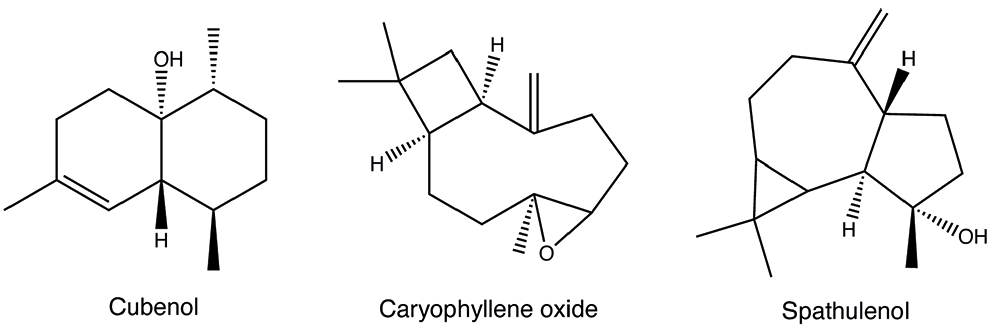
The essential oil (d = 0.876 g/L) yielded 4.2 % (w/v). The chemical characterisation led to the identification of 30 essential oil constituents. The major ones (> 10 %) were cubenol (27.1 %), caryophyllene oxide (15.3 %) and spathulenol (12.4 %) (Tab. 1 and Fig. 1).
Chemical structures of the major compounds identified from Schinus molle essential oil from leaves.
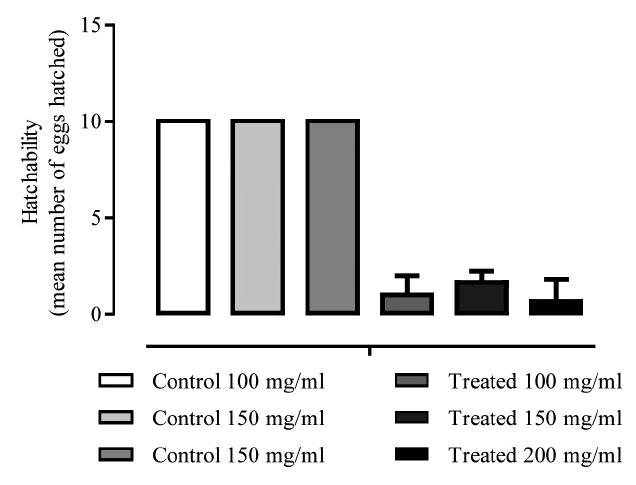
No hatching was observed during the first 72 h for the eggs; however, hatchability data were obtained 13 days from the final observation (Tab. 2). All eggs in the control group hatched within 13 days, achieving a total hatching rate of 100%. After two days, the observed hatching rates were 10%, 16.5%, and 6.6% for concentrations of 100 mg/mL, 150 mg/mL, and 200 mg/mL, respectively. Through statistical analysis, it is possible to verify that there is no significant difference when the comparison occurs between the different periods. However, there is a significant difference when the comparison is made between the treated groups and the control groups (Tab. 3). With the bar graph (Fig. 2), it is possible to verify the progression of mortality over the observation time.
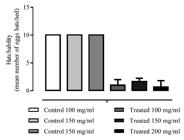
Hatchability of eggs of Achatina fulica, expressed as mean number of hatched eggs, from 13 days of unique exposition to different concentrations of Schinus molle essential oil. T = error bar.
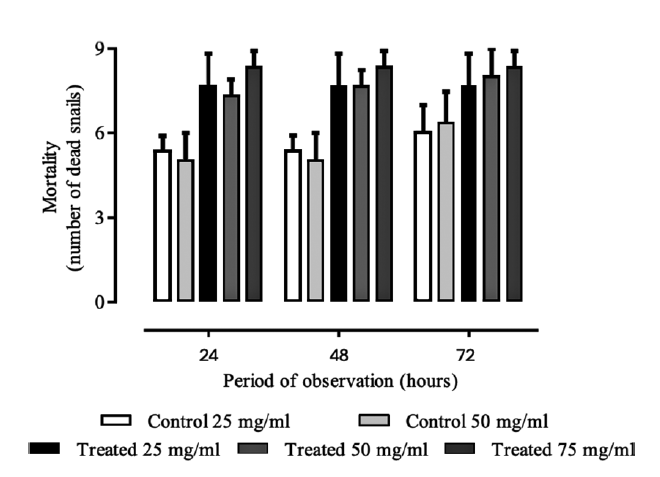
Mortality observations were recorded in young molluscs every 24 h until the 72 h were completed. At the end of this period, the following mortality percentages were observed: 53.3%, 60%, and 66.6% for the concentrations of 25 mg/mL, 50 mg/mL, and 75 mg/mL, respectively. The control group exhibited mortality rates of 20% and 26.6% for the 25 mg/mL and 50 mg/mL concentrations, respectively. These results are shown in Table 4, which also presents the number of molluscs that died in each observation period for both the treated and control groups. In Figure 3 it is possible to visually compare the difference in mortality of snails from treated groups with the control groups. With the statistical analysis, it is possible to verify the significant difference between the treated groups and the control groups (Tab. 5).
Percentage of mortality of young mollusks of Achatina fulica exposed to the Schinus molle essential oil.
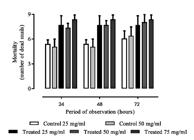
Mortality of Achatina fulica, expressed as mean number of dead snails, exposed to different concentrations of Schinus molle essential oil, for 24, 48 and 72 h. T = error bar.
Discussion
The present study characterised young individuals based on the age of the mollusc rather than its size, as there may be variation in the sizes of molluscs of the same age due to population density, which can negatively affect growth. This was observed by Meireles et al. (2010) in Bulimulus tenuissimus (d’Orbigny 1835). Eggs and young molluscs of A. fulica, representing developmental stages distinct from those of adults, were used in this study. This approach is supported by previous studies conducted with the same species of mollusc and various plant extracts.
According to Leite et al. (2024), it is crucial to conduct tests not only with adult A. fulica molluscs, as some substances may have a more significant effect in other life stages. Silva Júnior et al. (2018) evaluated the aqueous extract of Capsicum frutescens L. in tests with A. fulica at 30 days of age, resulting in 100 % mortality at all nine concentrations tested, from 2 g/L to 10 g/L, and in molluscs 120 days old, with 100% mortality in the first four decreasing concentrations tested. Silva Júnior et al. (2018) found that each developmental stage was susceptible to different concentrations and the toxicity of the extract. Therefore, the authors suggested that the effects of the extract may be related to ontogeny. This relationship is interesting because the mollusc’s strong shell serves as one of its protective mechanisms, and its growth is related to sexual maturity, which can occur as early as 5 months of age (Upatham et al. 1988; Tomiyama 1993; Fischer & Nering 2010). Therefore, young molluscs may be more susceptible to the substances present in the extracts.
Two-day post-hatching A. fulica were used in tests by Miranda et al. (2012) with the aqueous extract of Morus rubra L. leaves, in concentration 1g 10 mL-1, diluted in concentrations of 10, 30, 50, 70 and 100 % which interfered with their growth (final mass) with increasing concentration but did not affect the survival rate or egg hatching. In the study by Gusman et al. (2014), the aqueous extract of the floral buds of Syzygium aromaticum (L.) Merr. & L.M.Perry caused a significant reduction in survival and final mass 24 days after the experiment, in 2-day-old molluscs. However, it did not significantly affect hatching. Vieira et al. (2016) also used 2-day-old A. fulica and observed a reduction in the survival of molluscs treated with aqueous extracts of S. aromaticum and Euphorbia heterophylla, though the authors did not find a significant difference in the hatching percentage, which remained high in the treated groups, regardless of the concentration used.
Saad & Abou-Taleb (2015) determined the lethal concentration of 50 % to be 27.38 µl/mL and 8.36 µl/mL, respectively, for Schinus molle and S. terebinthifolius Raddi, on the mollusc T. pisana. Schinus molle exhibited moderate toxicity. In the present study, when analysing the effect of the S. molle extract on young molluscs, the mortality rate was above 50% for all concentrations tested. The literature indicates that the extracts used have a more effective action on young molluscs compared to their use on eggs, as the hatching rate remains high in the treated groups when compared to the control group. This may be related, according to Gusman et al. (2014), to the permeability barrier provided by the eggshell. In the present study, however, low hatching percentages were observed at all tested concentrations, compared to the control group, which exhibited 100 % hatching.
Radwan & Gad (2021) noted in their review that all the data obtained supported the use of essential oils and/or their components in controlling gastropods that cause agricultural or medicinal damage.
Considering the results obtained in this study, the exposure of young molluscs and A. fulica eggs to the essential oil extracted from S. molle positions this extract as a promising agent for mollusc control, though further testing is necessary. Since this product will be exposed to the environment, it will be essential to develop a formulation that stabilises the active ingredient, preventing its rapid volatilisation.
Acknowledgements
À Fundação Carlos Chagas Filho de Amparo à Pesquisa do Estado do Rio de Janeiro (FAPERJ) n° E-26/200.056/2021.
References
- Adams RP (2007) Identification of essential oil components by gas chromatography/mass spectrometry. 4th ed. Allured Publishing, Carol Stream. 698p.
-
Andrade-Porto SM, Souza KCP, Cardenas MQ, Roque RA, Pimpão DM, Araújo CS & Malta JCO (2012) Occurrence of Aelurostrongylus abstrusus (Railliet. 1898) larvae (Nematoda: Metastrongylidae) infecting Achatina (Lissachatina) fulica Bowdich, 1822 (Mollusca: Gastropoda) in the Amazon region. Acta Amazonica 42: 245-250. DOI: 10.1590/S0044-59672012000200010
» https://doi.org/10.1590/S0044-59672012000200010 -
Afonso-Neto IS, Bessa EA & Soares GLG (2010) Avaliação da atividade moluscicida do látex de três espécies de Euphorbia (Euphorbiaceae) sobre Leptinaria unilamellata D’Orbigny, 1835 (Gastropoda - Subulinidae). Revista Brasileira de Plantas Medicinais 12: 90-95. DOI: 10.1590/S1516-05722010000100013
» https://doi.org/10.1590/S1516-05722010000100013 -
Batista LCDSO, Cid YP, Almeida AP, Prudêncio ER, Riger CJ, Souza MA, Coumendouros K & Chaves DS (2016) In vitro efficacy of essential oils and extracts of Schinus molle L. against Ctenocephalides felis felis Parasitologia 143: 627-638. DOI: 10.1017/S0031182016000081
» https://doi.org/10.1017/S0031182016000081 - Brasil (2008) Ministério da Saúde. Secretaria de Vigilância em Saúde. Departamento de Vigilância Epidemiológica. Vigilância e controle de moluscos de importância epidemiológica: diretrizes técnicas. 2a ed. Ministério da Saúde, Brasília. 178p.
- Colley E (2010) Medidas de controle de Achatina fulica In: Fischer ML & Costa LC (eds.) O caramujo gigante africano Achatina fulica no Brasil. Champagnat, Curitiba. Pp. 203-229.
-
Dos Santos Cavalcanti A, Souza Alves M, Silva LCP, Patrocinio DS, Sanches MN, Chaves DSA & Souza MAA (2015) Volatiles composition and extraction kinetics from Schinus terebinthifolius and Schinus molle leaves and fruit. Revista Brasileira de Farmacognosia 25: 356-362. DOI: 10.1016/j.bjp.2015.07.003
» https://doi.org/10.1016/j.bjp.2015.07.003 - Fischer ML & Nering IS (2010) História natural da Achatina fulica In: Fischer ML & Costa LC (eds.) O caramujo gigante africano Achatina fulica no Brasil. Champagnat, Curitiba. Pp. 49-100.
- GraphPad (2008) GraphPad Prism, version 5.00. GraphPad Software Inc., San Diego.
-
Gusman GS, Vieira LR & Vestena S (2014) Atividade alelopática e moluscicida de Syzygium aromaticum (L.) Merr. & Perry (Myrtaceae). Evidência 14: 113-128. Available at <https://periodicos.unoesc.edu.br/evidencia/article/view/3753>. Access on 05 September 2025.
» https://periodicos.unoesc.edu.br/evidencia/article/view/3753 - Gusmão MHA, Guedes MS & Leandro AC & Abreu PF (2018) Atividade moluscicida do extrato aquoso de Agave americana (Asparagaceae) sobre Bradybaena similaris (Férussac, 1821) (Mollusca, Bradybaenidae). Analecta 4: 149-161.
- Kashyap SK, Khagta S, Guleria K & Arya V (2019) Plants as Molluscicides: a recent update. International Journal of Botany Studies 4: 50-26.
-
Kumar PA (2020) Review - on molluscs as an agricultural pest and their control. International Journal of Food Science and Agriculture 4: 383-389. DOI: 10.26855/ijfsa.2020.12.004
» https://doi.org/10.26855/ijfsa.2020.12.004 -
Leite JCVA, Silva MA, Santos JAA & Faria RX (2024) Natural products as a control measure of the Achatina fulica (Gastropoda: Achatinidae). Brazilian Journal of Biology 84: 1-10. DOI: 10.1590/1519-6984.260065
» https://doi.org/10.1590/1519-6984.260065 -
Malca-García GR, Hennig L, Ganoza-Yupanqui ML, Piña-Iturbe A, Bussmann RW (2017) Constituents from the bark resin of Schinus molle Revista Brasileira de Farmacognosia 27: 67-69. DOI: 10.1016/j.bjp.2016.07.004
» https://doi.org/10.1016/j.bjp.2016.07.004 - Meireles LMO, Silva LC, Junqueira FO, Lopes JFS & Bessa ECA (2010) Influência da densidade populacional sobre crescimento e fecundidade de Bulimulus tenuissimus (d’Orbigny, 1835) (Mollusca, Bulimulidae). Revista Brasileira de Zoociências 12: 51-58.
- Miranda ACM, Batista AS, Gusman GS & Vestena S (2012) Efeito alelopático e moluscicida de amora (Morus rubra L.). Revista Caatinga 25: 28-36.
-
Molina-Garza ZJ, Bazaldúa-Rodríguez AF, Quintanilla-Licea R & Galaviz-Silva L (2014) Trypanosoma cruzi activity of 10 medicinal plants used in northeast Mexico. Acta Tropica 136: 14-18. DOI: 10.1016/j.actatropica.2014.04.006
» https://doi.org/10.1016/j.actatropica.2014.04.006 - NIST (2008) NIST/EPA/NIH Mass Spectral Library (NIST 08) and NIST Mass Spectral Search Program (Version 2.0f). National Institute of Standards and Technology, Gaithersburg.
-
Oliveira APM, Torres EJL, Maldonado Jr A, Araújo JLB, Fernandez MA & Thiengo SC (2010) Achatina fulica como hospedeiro intermediário de nematódeos de interesse médico-veterinário em Goiás, Brasil. Revista de Patologia Tropical 39: 199-210. DOI: 10.5216/rpt.v39i3.12211
» https://doi.org/10.5216/rpt.v39i3.12211 -
Radwan M & Gad AF (2021) Essential oils and their components as promising approach for gastropod mollusc control: a review. Journal of Plant Diseases and Protection 128: 923-949. DOI: 10.1007/s41348-021-00484-5
» https://doi.org/10.1007/s41348-021-00484-5 -
Ramos-de-Souza J, Gomes SR, Mattos AC, Sousa AKP, Silva EF, Maldonado-Junior A & Thiengo SC (2023) Achatina fulica infected by Angiostrongylus cantonensis in Manaus, Brazilian amazon region, and the risk of transission of eosinophilic meningitis. Journal of Tropical Pathology 52: 295-303.DOI: 10.5216/rpt.v52i4.77199
» https://doi.org/10.5216/rpt.v52i4.77199 - Raut SK & Barker GM (2002) Achatina fulica Bowdich and other Achatinidae as pests in tropical agriculture. In: Barker GM (ed.) Molluscs as crop pests. CAB Publishing, Wallingford. Pp. 55-114.
- Saad MMG & Abou-Taleb HK (2015) Chemical composition, fumigant toxicity and biochemical effects of essential oils on Spodoptera littoralis (Lepidoptera: Noctuidae) and Theba pisana (Mollusca: Gastropoda: Helicidae). Egyptian Journal of Plant Protection Research Institute 3: 1-20.
- Salgado NC (2010) Morfologia e taxonomia: recaracterização de Achatina (Lissachatina) fulica (Mollusca, Gastropoda, Stylommatophora, Achatinidae). In: Fischer ML & Costa LCM (eds.) O caramujo gigante africano Achatina fulica no Brasil. Champagnat, Curitiba. Pp. 13-48.
- Sampaio IBM (2007) Estatística aplicada à experimentação animal. 3a ed. Fundação de Estudo e Pesquisa em Medicina Veterinária e Zootecnia, Belo Horizonte. 264p.
-
Silva Júnior VO, Toledo AMO & Abreu PF (2018) Uso de extrato aquoso de pimenta malagueta (Capsicum frutescens L.) em teste de sobrevivência sobre Achatina fulica Revista Brasileira de Zoociências 19: 142-150. DOI: 10.34019/2596-3325.2018.v19.24714
» https://doi.org/10.34019/2596-3325.2018.v19.24714 -
Thiengo SC, Fernandez MA, Torres EJ, Coelho PM & Lanfredi RM (2008) First record of a nematode Metastrongyloidea (Aelurostrongylus abstrusus larvae) in Achatina (Lissachatina) fulica (Mollusca. Achatinidae) in Brazil. Journal of Invertebrate Pathology 98: 34-39. DOI: 10.1016/j.jip.2007.10.010
» https://doi.org/10.1016/j.jip.2007.10.010 - Teles HMS & Fontes LR (2002) Implicações da introdução e dispersão de Achatina fulica Bowdich, 1822 no Brasil. Boletim do Instituto Adolfo Lutz 12: 3-5.
- Tomiyama K (1993) Growth and Maturation Pattern in the African Giant Snail. Achatina fulica (Ferussa) (Stylommatophora: Achatinidae) . Venus 52: 87-100.
- Upatham ES, Kruatrachue M & Baidkul V (1988) Cultivation of de giant african snail. Achatina fulica Journal of the Science Society of Thailand 14: 25-40.
-
Van Den Dool H & Kratz PD (1963) A generalization of the retention index system including linear temperature programmed gas-liquid partition chromatography. DOI: 10.1016/S0021-9673(01)80947-X>
» https://doi.org/10.1016/S0021-9673(01)80947-X> -
Vieira LR, Gusman GS & Vestena S (2016) Avaliação da atividade moluscicida de extratos vegetais sobre Achatina fulica Bowdich (Mollusca, Achatinidae). Arquivos do Instituto Biológico 83: e1032013-6. DOI: 10.1590/1808-1657001032013
» https://doi.org/10.1590/1808-1657001032013 -
Zanol J, Fernadez MA, Oliveira AP, Russo CAM & Thiengo SC (2010) O caramujo exótico invasor Achatina fulica (Stylommatophora, Mollusca) no estado do Rio de Janeiro (Brasil): situação atual. Biota Neotropica 10: 447-451. DOI: 10.1590/S1676-06032010000300038
» https://doi.org/10.1590/S1676-06032010000300038
Data availability statement
In accordance with Open Science communication practices, the authors inform that there is no data sharing of this manuscript.