|
Barlett, 2011 (USA) [27] |
To show the capacity to contribute to transformational change toward an alternative food system in academic programs |
It evaluated campus sustainability projects related to purchasing goals, academic programs, direct marketing, and experiential learning across 30 colleges and universities |
Higher education institutions have transitioned from initiating a few pilot projects to broadly adopting alternative sustainable food chains. They have developed new metrics for food service practices and launched campus projects with regional, state, and national impact |
|
Matthews, 2013 (CAN) [35] |
To assist students in comprehending and valuing the complete food cycle |
Case study conducted with 165 undergraduate students in a food and nutritional sciences program. Using collaborative problem-based learning. Food miles and CO2 emissions were calculated for foods purchased in their assigned neighborhood |
Details about food production, processing, distribution, and waste were present in photographs and discussed in in-class focus groups. Students were more surprised by the travel distance of food transported globally than by the level of carbon emissions |
|
Wilson et al., 2015 (AUS) [16] |
To evaluate the Indigenous health curriculum of the Bachelor and Master of Nutrition and Dietetics |
Research process to review the curricula involving stakeholders to co-create knowledge relevant to local contexts, and interviews with academic nutrition staff |
Curriculum related to Indigenous health, lifestyle, and food supply/availability of traditional Indigenous peoples. Discussion of nutrition issues of Indigenous communities; and social determinants of food choice |
|
Hartle et al., 2017 (USA) [17] |
To enhance awareness of the expanding field of interdisciplinary food-related academic programs |
A comprehensive strategy to identify interdisciplinary undergraduate and graduate research and study programs related to food in the U.S. |
This study identified 82 interdisciplinary undergraduate programs focused on food. Among these, 19 programs had a core focus on sustainable agriculture. A few programs were integrated, indicating traditional academic silos |
|
Wegener, 2017 (CAN) [52] |
The perspective that dietitians are increasingly recognizing sustainable food systems is being communicated, alongside advocacy for specialized education, hands-on training, and professional growth centered on sustainable food systems for both trainees and practitioners at different stages of their careers |
|
|
|
Maher and Burk, 2017 (AUS) [49] |
To describe students’ self-reported learning from engaging in an experiential learning task designed and to develop their understanding of sustainable food systems and dietary practices |
143 first-year students participated in a weekly eco-friendly food challenge as part of a food and nutrition subject. They documented their experiences through content analysis and responded to reflective questions focused on actions, learning, and responses. |
Students identified social barriers and time/energy constraints as key obstacles to adopting sustainable food practices and solutions. They also noted various community, government, and multi-sector efforts and initiatives supporting behavior changes. |
|
Knobloch et al., 2019 (USA) [24] |
To outline the motivations and learning experiences in a multi-institutional, interdisciplinary graduate course |
Case study design with questionnaires, which included rating scales and open-ended questions. Data were analyzed and triangulated into key findings |
Students who engaged in interdisciplinary learning enhanced their communication and education skills through experiential place-based learning. They gained insights into global challenges with different disciplinary perspectives, identifying similar challenges in their local communities |
|
Carino et al., 2019 (AUS) [44] |
To describe how sustainable food systems are taught to nutrition students |
A cross-sectional study was conducted which involved a qualitative content analysis of documented online program outlines and an online survey with coordinators. The study was conducted in 2016 |
Of 130 identified degrees, only 8% included modules about sustainable food systems with the most learning outcomes. The types of assessment tasks included essays, reflection papers, policy analysis, reflective blogs, food system audits, eco-friendly food challenges, media analysis, case study presentations, analysis, and exams. |
|
Finn, 2020 (USA) [48] |
To highlight the role of the nutritionist in achieving the United Nations Sustainable Development Goals |
The article was structured around the stages of achieving sustainability: knowledge, trust, and partnerships to advance the profession in sustainable food systems |
Curriculum for dietetic interns focusing on sustainable, resilient, and healthy food and water systems; creating a sustainable food systems nutrition-focused framework for action |
Burkhart et al., 2021
(USA) [18] |
To examine the local and practice viewpoint of sustainability in a nutrition and dietetic program |
Participatory action research process using an online survey, workshop, and interviews. The study was conducted in 2016 |
Generation of proposed sustainability statements in dietetic practice: sustainability thinking, future-oriented perspectives; stewardship and maintaining the nutrition field |
|
Mahn and Ded, 2021 (CAN) [19] |
To introduce a community garden laboratory in a foods course within a nutrition program |
A descriptive survey methodology was used to explore the observations and opinions of participants |
Analysis revealed four interrelated themes: connection and exposure, food preparation, benefits of using local food, and explicit learning. The garden was valued by students as a curriculum component as well as an opportunity for personal growth and development |
|
Hege et al., 2021 (USA) [20] |
To describe the nature of interest in sustainable food systems, identify facilitators and barriers to educational opportunities related to sustainable food systems, and professional skills, and to identify ways to enhance the quality of instruction to expand the availability of educational opportunities. |
Description of lessons learned from the sustainable food system curriculum implementation within dietetics education programs in the United States. |
Nearly 20% of respondents had a general interest in working in sustainable food systems, 15% identified they already worked in sustainable food systems, and nearly 10% of those who downloaded the curriculum were learners interested in completing the curriculum. Fifteen programs implemented the curriculum from 2018 to 2020. |
|
Mota et al., 2021 (BRA) [21] |
The garden-based learning method can play a strategic role in biodiversity education in nutrition training. |
Qualitative and exploratory approach, experience report type in the laboratory community garden. |
Garden-based learning method addresses biodiversity challenges by enhancing professors’ skills and the institutionalization of the lab, adding the sustainable food systems course, collaborating with a multi-professional team, establishing connections and adapting tools for different cultural contexts. |
| Araujo et al., 2021 (BRA) [22] |
To present the experience at the garden lab to exemplify how unconventional food plants can be approached based on garden-based learning |
Garden-based learning method, which includes teaching nutrition through plants, explored integrating components from agronomy, botany, ecology, and nutrition |
Educational experiences focused on plants enhance skills in food biodiversity. Garden-based learning is an effective method for creating pathways toward sustainable environments and food systems. |
|
Spiker et al., 2021 (USA) [25] |
To share perspectives on how food systems educators can use online learning to facilitate the development of systems thinking for future food systems professionals. |
The working group conducted pilot tests of two interactive webinars covering themes such as policy, systems, and environmental issues. The webinar examined the application of systems thinking to malnutrition, and the impacts of nutrition interventions across five areas: ecological, agricultural, economic, socio-cultural, and health |
Offers insights from a teaching approach that involves a varied group of stakeholders in food systems, addressing challenges like collaboration across multiple universities, sectors, and geographic locations |
|
Higgins et al., 2022 (CAN) [47] |
To evaluate the integration of sustainable food systems concepts in dietetic training standards |
A content analysis of dietetic training standards was conducted on the websites of 47 national dietetics associations. Document search terms included ‘sustain’ or ‘sustainable’, ‘food systems’, and/or ‘diets’ |
From the 47 associations, researchers obtained 23 dietetics training standards documents, of which 16 included food system-related content. Thirty-one of 52 mentions of content fell into the shallower depths of knowledge in understanding (n=12) and apply (n=19) |
|
Boak et al., 2022 (AUS) [43] |
To explore the future roles and capabilities of nutrition and dietetics professionals |
A qualitative method was used and involved interviews with focus groups composed of nutrition and dietetics graduates |
Future roles for nutrition professionals include food and diet optimizers, knowledge translators, equity advocates, food systems activists, and change-makers. Essential skills for these roles – such as adaptability, resilience, advocacy, critical thinking, embracing diversity, and solution-focused approaches –can be integrated into curricula |
|
Gerstein et al., 2022 (USA) [26] |
To provide a snapshot of how a clinical, retail, and public health dietitian supports sustainability in their local food system every day |
Shared dialogue on issues and opportunities for advancing agriculture, nutrition, health, and sustainable food systems with stakeholders in the supply chain, food environments (retailers, schools, hospitals, and food banks) and providing guidance (to physicians, nurses, dietitians, fitness professionals, and culinary experts). |
Themes in food production and nutrition include working with a multidisciplinary team, utilizing hospital rooftop gardens to provide ingredients for hospital meals and local restaurants, and supporting local farmers and the economy. Additionally, there is a focus on delivering dietary guidance and reducing food waste. |
|
Goodridge et al., 2022 (CAN) [46] |
To identify ways dietitians can contribute to sustainable food systems as well as opportunities for collaboration within the profession |
Drawn from research capturing how dietitians define their role in sustainable food systems, reports, and the small body of peer-reviewed literature available |
Canadian dietetic programs are divided into four practice areas: clinical, food service, community, and industry. Redefining these programs requires addressing health, consumer demand, and food systems. Strategic approaches include collaboration, advocacy, policy change, knowledge dissemination, research, and management |
|
Nix 2022 (USA) [50] |
To contribute to the discussion on revising nutrition curricula, it is crucial to emphasize the importance of whole foods, complex dietary behaviors, and food systems, aligning with advancements in the field of nutrition |
Opinion and perspective based on the author’s interpretation, reflection, and argumentation on proposed changes to nutrition curricula in higher education |
Proposed models for a course on general dietary health should include personal application components, and introduce students to current issues, key actors, organizations, and systems in nutrition. This approach offers a promising opportunity to implement change, provide holistic dietary strategies, and assess the interdisciplinary and complex nature of the field |
Carlsson and Callaghan, 2022
(CAN) [45] |
To collectively define a vision of sustainable food systems, and discuss barriers, supports, needed
actions, and roles for integrating sustainability into dietetic practice |
Researchers used Delphi inquiry methods to explore how nutritionists and dietitians in 30 nations perceive sustainable food systems, their perceived roles, barriers, and support needed. They used sustainability principles in socio-ecological systems |
Results show that not everyone agrees it falls within their scope of practice and highlight barriers at various levels, including an unsupportive professional culture and societal and ecological obstacles |
|
Maher et al., 2023 (AUS) [51] |
To understand the perceived opportunities for integrating a sustainability focus on nutrition and dietitian practice, from the lens of Australian professionals |
Qualitative methodology using semi-structured online interviews with 10 professionals. Thematic analysis was used to understand how they perceive opportunities and barriers for integrating sustainability into practice |
Future practice themes include preparing academics and practitioners for both individual-level and system-level work with a focus on policy. Barriers to implementing changes include a lack of contextual evidence, complexity, and competing priorities |

 Sistemas alimentares em programas de Nutrição no ensino superior: evidências de uma revisão de escopo e de um estudo de caso brasileiro
 Thumbnail
 Thumbnail
 Thumbnail
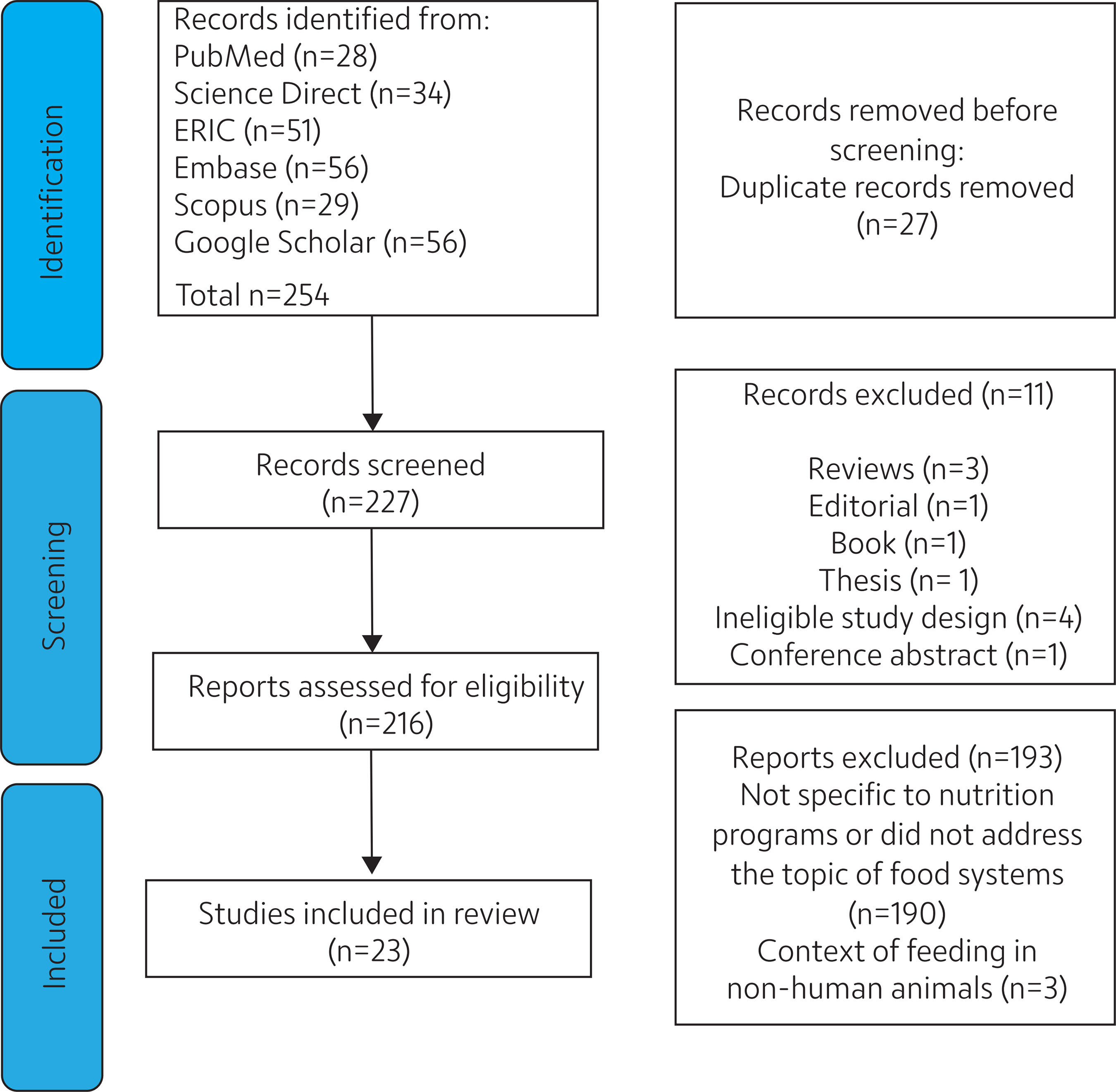 Source: Adapted from PRISMA protocol.