 Domestic Cooking Skills in Primary Health Care in the municipality of São Paulo: Challenges and needs from the perspective of health care professionals
ABSTRACT
Objective The objective of this study was to understand the main needs, difficulties and opportunities for implementation of Domestic Cooking Skills in Primary Health Care, in accordance with the Dietary Guidelines for the Brazilian Population, from the perspective of healthcare personnel.
Methods This qualitative research was conducted between June 2020 and November 2021 involving two focus groups. The first group consisted ff emale Primary Health Care professionals with a complete higher education (n=6) while the second group comprised individuals with high school and technical education (n=5) working in the Municipality of São Paulo. The mean age was 42 years old (SD=8), and with 11 years old (SD=10) of experience in Primary Health Care. We developed a semi-structured script of triggering questions and conducted discussions using the funnel technique. Interviews were recorded and transcribed. Thematic Analysis was employed for data analysis and our findings were compiled in a conceptual model.
Results This study revealed that the difficulties in implementing Domestic Cooking Skills in Primary Health Care are related to the Culinary Transition, combined with reductionist health practices, and identified the need for professional qualification. An opportunity identified is the centralization of Domestic Cooking Skills activities in Community Health Workers and prioritization of the agenda of Domestic Cooking Skills actions, in a scenario where professionals report that, for managers, the quantity of care provided seems to be more important than quality. These aspects provided the basis for building the conceptual model.
Conclusion There is a need for raising awareness and providing professional training regarding Domestic Cooking Skills, especially among Community Health Workers. In addition, it is mportante that managers prioritize this agenda over targets and figures that do not reflect the quality and comprehensiveness of Primary Health Care. A conceptual model is presented, encompassing all professional categories, with a focus on Community Health Workers as key professionals for implementing Domestic Cooking Skills actions in Primary Health Care.
Keywords:
Brazil; Cooking; Focus groups; Health personnel; Primary health care; Qualitative research
RESUMO
Objetivo Buscou-se compreender as principais necessidades, dificuldades e oportunidades para implementação das Habilidades Culinárias Domésticas na Atenção Primária à Saúde, de acordo com o Guia Alimentar para a População Brasileira, na perspectiva de profissionais de saúde.
Métodos Trata-se de pesquisa qualitativa realizada entre junho de 2020 e novembro de 2021 por meio de dois grupos focais com profissionais do sexo feminino da Atenção Primária à Saúde com ensino superior completo (n=6) e com ensino médio e técnico (n=5) atuantes no Município de São Paulo. A média de idade foi de 42 (DP=8) anos, com 11 anos (DP=10) de atuação na Atenção Primária à Saúde. Desenvolvemos um roteiro semiestruturado de perguntas disparadoras e conduzimos as discussões por meio da técnica de funil. Gravamos e transcrevemos as entrevistas. Usamos a Análise Temática para análise de dados e compilamos nossas descobertas em um modelo conceitual.
Resultados Este estudo revelou que as dificuldades para a implantação das Habilidades Culinárias Domésticas na Atenção Primária à Saúde estão relacionadas à Transição Culinária, aliada a práticas reducionistas em saúde e identificou-se necessidade de qualificação profissional. Como oportunidade tem-se a centralização de atividades de Habilidades Culinárias Domésticas nos Agentes Comunitários de Saúde e priorização da agenda de ações de Habilidades Culinárias Domésticas em um cenário em que profissionais reportam que, para os gestores, a quantidade de atendimentos realizados parece ser mais importante do que a qualidade. Esses aspectos deram bases para a construção do modelo conceitual.
Conclusão Conclui-se que há necessidade de sensibilização e qualificação profissional sobre a temática das Habilidades Culinárias Domésticas, principalmente dos Agentes Comunitários de Saúde. Além disso, é importante que os gestores priorizem essa agenda em detrimento de metas e números que não refletem a qualidade e a integralidade da Atenção Primária à Saúde. Apresenta-se modelo conceitual que envolve todas as categorias profissionais, com foco no Agente Comunitário de Saúde compreendido enquanto profissional-chave para a implementação das ações de Habilidades Culinárias Domésticas na Atenção Primária à Saúde.
Palavras-chave:
Brasil; Culinária; Grupos focais; Profissionais de saúde; Atenção primária à Saúde; Pesquisa qualitativa
INTRODUCTION
Domestic Cooking Skills (DCS) are a set of practices and skills, still under discussion in the scientific literature, utilized for cooking at home. These skills, along with other determinants such as culture, gender, time and personal relationships between individuals, are associated with the preparation of home-cooked meals [1].
The definition proposed by Teixeira et al. [2], and adopted as a construct definition in this research, encompasses Domestic Cooking Skills as a broad range of aspects. These include selecting and purchasing ingredients, planning, combining, preparing food from scratch (using fresh, minimally processed and culinary ingredients) and organizing stages related to home cooking. This definition supports and complements the concept of culinary skills pointed out in the Dietary Guidelines for the Brazilian Population [3], which is an important document providing accessible information for health personnel and users of the Sistema Único de Saúde (SUS, Brazilian Unified Health System). This conceptualization differs from propositions made by other actors in that it emphasizes the need for meal providers in domestic environments to engage in activities that are parallel to and disassociated from food preparation [2]. Furthermore, if the meal provider lacks the ability to plan and organize a meal, he or she may opt to purchase convenience products that requires a minimal effort to select and consume, thus saving time and energy [4]. Therefore, the concept of a category of cooking skills at the household level may prove more useful for understanding the practice of preparing home-cooked meals, as they are broader range of skills used solely in the cooking process.
Monteiro et al. [5] described a positive association between the consumption of Ultra-Processed Food (UPF) and the incidence of Chronic Non-Communicable Diseases (NCDs), which account for 74% of all deaths registered in Brazil [6]. In this regard, DCS are a component of a larger dietary framework, that could contribute to the prevention of NCDs. Improving the diet has the potential to prevent one in every five deaths globally [7]. In addition, the devaluation of home cooking practices is associated with the weakening of commensality [8], culinary transition [9] and promotes the medicalization of food [10]. It is worth mentioning that cooking and eating at home are closely intertwined with sustainability and environmental health [11], enabling the recognition of counter-hegemonic food systems and the rejection of the technological arsenal sold by advanced capitalism, which encompasses massive use of transgenic seeds and pesticides [12,13].
Therefore, it is salutary to systemize food and nutrition actions, such as Food and Nutrition Education initiatives and Permanent Health Education actions, to promote adequate and healthy eating habits in the Primary Health Care (PHC) scenario, as an effort to guarantee the human right to adequate food and food sovereignty for individuals and communities [10,14]. The discussion on the topic of Cooking Skills as a strategy for promoting health and reducing the incidence of NCDs has been addressed in the scientific literature around the world. For example, Tani et al.’s study [15] conducted in Japan explored the association between a low level of cooking skills and unhealthy dietary behaviors. In the Norwegian context, a study [16] investigated the impact of food skills on food security and dietary diversity among asylum seekers living in reception centers, demonstrating an association between these skills and the adequacy of dietary diversity. In Kansas, Alnaim et al. [17] demonstrated that combined interventions involving nutrition education and hands-on cooking skills represent feasible approaches for improving attitudes and behaviors related to vegetable consumption among families with low-income status. In the US context, an evaluative study [18] was developed in Detroit to assess the effectiveness of a community-tailored, food agency-based cooking program on cooking confidence. In India, Ali and colleagues [19] assessed the improvement of participants’ knowledge and self-efficacy by conducting hands-on sessions on participatory cooking demonstrations focusing on nutrition concepts and basic cooking skills. Da Costa Pelonha et al. [20] showed that overweight and obesity were associated with lower cooking skills among the undergraduates studied. In addition to the aforementioned studies, Oliveira et al. [21] evaluated 73 dietary guidelines from different countries and observed that some guidelines recognize cooking skills for health promotion and the Promotion of Adequate and Healthy Eating, with the Brazilian guideline being the first to encourage culinary practices. However, the authors pointed out the lack of practical strategies for the development and implementation of these skills. In this sense, Teixeira proposed in 2022 the new concept of DCS aforementioned and created [14], in the Brazilian context, an instrument to measure the DCS of health professionals involved with the Promotion of Adequate and Healthy Eating in PHC, since these are key individuals with a relevant multiplier potential of these skills among users of the SUS. Added to this are the guidelines present in the Matrix for Organization of Care in Food and Nutrition in Primary Health Care regarding the importance of encouraging and guiding the development of culinary skills of SUS users, highlighting the importance of actions focused on children and providers historically exempt from food care, such as men [22]. Given this context, the objective of this work is to understand the main needs, difficulties and opportunities for implementation Domestic Cooking Skills in Primary Health Care, in accordance with the Dietary Guidelines for the Brazilian Population, from the perspective of health personnel.
METHODS
Ethical Considerations
This study is part of a research titled “Instrument for measuring home cooking skills in primary health care” [14]. The main objective of the primary study was to develop and validate an instrument to measure DCS among health professionals working in PHC. This project was submitted for consideration by the Research Ethics Committee of the Municipal Health Department of São Paulo, based on the terms of the 466/12 Resolution (approval registration nº 4.289.743), and by the Research Ethics Committee of the Faculty of Public Health (approval registration nº 4.285.955).
Study Design and Sampling
The methodological framework of the abovementioned study was psychometrics. The main outcome of the research was the reporting of an instrument titled EHAPS (Primary Health Care Domestic Culinary Skills Scale). The EHAPS is a Likert-type scale, with response options regarding the frequency of actions centered on DCS attributes, with 29 items. The score on the scale is calculated by summing the scores corresponding to the options “never” = 0, “rarely” = 1, “sometimes” = 2, “frequently” = 3 and “always” = 4. Four score ranges are proposed with the following status: low DCS (0 to 29 points); moderately low DCS (30 to 58 points); moderately high DCS (59 to 87 points) and high DCS (88 to 116). The interpretation of the final score is accompanied by instructional messages aimed at encouraging the development of DCS. A total of 472 professionals working in PHC in the city of São Paulo participated in the process of construct validity and scale reliability. More details can be accessed in the conducted by Teixeira et al. [14].
We conducted qualitative research between June 2020 and November 2021. Data generation was carried out through focus groups with PHC professionals working in the Municipality of São Paulo, such as nurses, nursing technicians, nutritionists, physicians and community health workers. Considering that participants must be competent to position themselves on the topics of interest, it is convenient to consult key informants who comprehend the particularities of the phenomenon under study [23]. For this reason, the inclusion criteria were as follows: 1) professionals with EHAPS score 88 points (high level of DCS) from the original EHAPS database; 2) signing the Free and Clarified Consent Term.
We recruited 11 participants and organized them into two focus groups with homogeneous socioeconomic characteristics (education level and financial income), according to the participants’ education level, aiming a comfortable atmosphere for exchanging experiences and sharing impressions about the central topic of discussion in both groups. Sex, gender and race or ethnicity data were collected only for the description of the sample and were not incorporated into the design. Scientific literature recommends group size of six to fifteen members per group [23,24].
Data Collection
Given the ongoing COVID-19 pandemic, it was necessary to adapt the focus groups to virtual environment. We created online meeting rooms [24], through Google Meet® and Zoom® platforms at a pre-established time, prioritizing participants’ schedules, to ensure focus and less communication noise. Participants were submitted to a 2-hour encounter, which achieved saturation. We developed a semi-structured script of triggering questions (Chart 1).
Semi-structured Script of Triggering Questions for the Conduction of Focus Groups. São Paulo, Brazil, 2021.
Two pre-tests were conducted with six participants from the same database with similar socioeconomic characteristics. The aim was to improve and adapt the questions. Participants were informed about the objectives of the study, basic rules and the role of the moderator, who had extensive experience in conducting focus groups. Discussions were conducted based on the adapted script, using the funnel technique (from broader to more specific topics) to encourage immediate participation from all participants. The interviews were recorded, and six reporters registered expressions and other non-verbal behaviors. The discussions were transcribed in fully. We reported the details on the conducting of the focus groups in the COREQ (COnsolidated criteria for REporting Qualitative research) checklist (25) (Chart 2).
Consolidated Criteria for Reporting Qualitative Research (COREQ) Checklist (Tong et al., 2007) [25]. São Paulo, Brazil, 2021.
Data Analysis
This stage used the Thematic Analysis (TA) technique, proposed by Braun and Clarke [26] apud Souza [27], which is a specific type of content analysis. The TA is a qualitative analysis methodology employed to identify, analyze, interpret and report data patterns contained in the database. It involves six well-defined steps: (i) familiarization with data (deep immersion through repeated readings by JSPC, the author who had more contact with the study); (ii) generating initial codes; (iii) searching for themes (two authors discussed the initial codes and combined them into broader themes, pre-establishing possible relationships between the themes); (iv) reviewing the themes (themes were refined and illustrated with representative quotes); (v) defining and naming themes; (vi) producing the report [26,27]. All data was produced and analyzed in Portuguese, with quotes selected to illustrate themes in the results section, were later translated to English.
After conducting all the TA stages, we sought to identify the most relevant terms regarding the topic addressed in participants’ speeches from both groups. Finally, we compiled and illustrated our findings in a conceptual model, using the graphic design tool Canva®.
RESULTS
Participants' Characteristics and Sampling
Participants referred themselves as cisgender women (n=11; 100%) from a list that included options such as cisgender woman, transgender woman, cisgender man, transgender man, rather not answer and other (specify). Race or ethnicity was self-reported by the participants form a list including white (n=7; 64%), yellow, brown (n=3; 27%), black (n=1; 9%), indigenous, rather not answer and other (specify). The mean age was 42 (SD=8) years old, with 11 years (SD=10) of experience in Primary Health Care. This demographics data was collected only for the description of the sample and was not part of the design.
The first group, composed of health professionals with complete higher education (n=6), had an adequate sample size. The second group, composed of health professionals with high school and technical education, had a lower number of participants (n=5). This can be attributed to the difficulty of recruitment in the context of the COVID-19 pandemic, given that participants with lower education level indicated to have low level of digital skills and reported difficulties connecting to the internet.
Thematic Analysis
Through Thematic Analysis, we developed four themes, presented in Chart 3.
Description of the Themes that Generated Through the Thematic Analysis. São Paulo, Brazil, 2021.
The themes encompass the perspectives of both health professionals with complete higher education and those with secondary and technical education revealing visible differences according to the perspective from which they are observed. In summary, professionals with high school and/or technical education tend to focus their approach of DCS in the family and teamwork contexts. The five most cited words by this group were “food” (69); “family” (39); “group” (37); “team” (35); “eat” (32). Conversely, the higher education group, considering approach, is guided in the individual and the performance of specific professionals. The five most cited words were “unit” (42); “feeding” (40); “person” (37); “nutritionist” (36); “professionals” (34).
Challenges and Impacts of The Culinary Transition
Professionals from both groups establish connections between the lack of DCS and food monotony among the individuals they assist. They identify an increase in the consumption of ready-to-eat meals and UPF to the detriment of culinary preparations made at home. They also highlight the negative impact on food traditions and affective relationships established between the subjects through food: “(...) nobody cooks anymore; everyone just unpacks products (...). So (...), it’s very easy to buy industrialized products today (...). People (...) living in the northeast of Brazil used to make tapioca [tapioca is an edible starch, extracted from the roots of cassava, used as ingredient of sweet and savory dishes], the starch, but here [in São Paulo] they buy the packet version of tapioca, ready to eat (...)” (L. Dietitian).
Moreover, these professionals correlate the lack of culinary skills and poor-quality diet and with the increased incidence of NCDs: “(…) This issue (the lack of culinary skills) and what they eat is frequently linked to their health condition (...), various comorbidities (...) obesity, for example, dyslipidemia, hypertension, diabetes, huh. (...) most of the comorbidities we deal with in Primary Health Care Centers are linked to food (…), there’s no way to exclude it” (L. Family and Community Physician).
Finally, professionals with high school and/or technical education share their perceptions regarding the limited access to healthy foods, such as vegetables, fruits and legumes in nearby markets in specific regions of the territory: “(...) in my micro [area], (...) I find it easy to buy fruits like oranges and bananas. However, people only have access to pear and apple when a fruit truck passes by. As for other foods considered healthy, the small markets we have here do not offer them, and the supermarket, where there is a larger variety of food, is a little distant” (M.P. Community Health Worker).
Reductionism X Integrality of Health Care
Although both groups recognize cooking and eating as complex phenomena composed of psychological, social and cultural factors, and acknowledge the significance of eating in relation to affection and family, these professionals do not appear to address the topic in all its complexity during their health care practices, they often rely on reductionist approaches “(...) we talk a lot about general guidance, like: oh, okay, you must have carbohydrates, the meal has to be colorful… but not, specifically, about culinary skills” (V. Family and Community Physician).
The dialogue among professionals with high school and technical education highlights the social vulnerabilities experienced by the individuals they assist. This emphasis was particularly evident in the speeches of Community Health Workers, who are frontline health workers who provide informal counseling and possess deep understanding of the communities they serve. Thus, these professionals are able to appropriate and bring, vividly, in their speeches the social intermediaries that most impact people’s daily lives: “(...) when I visit people’s homes, I observe what they own, because it’s no use saying: ‘look, you have to do this, you have to do that’, if the person can’t afford to accomplish those recommendations’ (...). Then, depending on what I observe, I reach an agreement with the family” (M.P. Community Health Worker).
The hierarchy of care is also observed in their oratory: “Well, at the PHC Center, we do it like this: we call [the] nursing assistant, then during a process of checking BP [blood pressure] or blood glucose, they start the conversation with the patient and start to provide food counseling. If it is not successful, we talk to the nurse, because then the nurse has a different approach (...). And if it still doesn’t work, then the way is to call [a] health team meeting” (M.P. Community Health Worker).
The Community Health Workers also reinforce that they are part of a professional category formed by and for the community, which means that these professionals are part of the population living in the territory they serve. In this sense, they emphasize the urgency of valuing and including this category in health team meetings and professional qualification actions, so that they can express their contributions and receive guidance for better attending the community: “(...) the CHW [Community Health Workers] come from the community, they basically have the same knowledge that the community has. So, it’s no use putting the guy inside the primary health care unit with (...) no guidance on what he’s going to do” [M. Pharmacy Technician].
Overcoming barriers and limitations through professional qualification
This theme highlights the importance of professional qualification regarding the use of DCS as an important strategy for promoting adequate and healthy eating habits and overcoming barriers and limitations associated with counseling on cooking practices.
Professionals from both groups expressed their own limitations regarding DCS and reported difficulty in addressing these skills in their encounters with the community: “(...) it is very difficult for us to pass on something that we cannot, [that] we do not know. Therefore, first, we have to be qualified (...) to be able to guide (cooking practices)” (M. Nurse).
The groups suggested qualification themes such as: purchasing, planning and organization; food pre-preparation steps; cooking safety measures; combinations of ingredients and adequacy in the proportion of recipes; hygiene practices; use of non-conventional food plants; seasonings and reuse of leftovers. However we observed, that professionals still prioritize reductionist themes for adequate and healthy eating guidance their discourses. These include the need to know more about functional foods, like foods or ingredients that produce beneficial effects on health, in addition to its basic nutritional functions. Regarding the format of qualification activities, higher education professionals exemplify remote learning options, such as videoconferences and the availability of digital consultation materials (booklets, podcasts and videos), and face-to-face activities (at their workplace), such as theoretical-practical workshops and lectures. They highlighted the importance to implement actions that can integrate theory and practice, a step considered essential for the learning process: “(...) maybe with parts of physical demonstration, because it would be very boring to participate in a course to develop skills, which is such a palpable thing, without actually being able to practice, right?” (L. Family and Community Physician).
Management: Raising awareness for prioritization
Participants emphasize the necessity of engaging and expanding dialogue with PHC Center managers regarding professional qualification. This theme reveals the prioritization of achieving goals and intensifying the number of attendances in PHC Centers by managers, to the detriment of the quality of health care services. This context was exacerbated during the COVID-19 pandemic: “(...) it was an outburst, (...) in the day-to-day experience [during the COVID-19 pandemic] I (...) no longer do activities I used to do. Let me put it this way: it is like a firefighter putting out a fire... Not just me, but all the professionals (...) in primary health care” (M. Nurse).
Health professionals reported scarcity of financial, structural and human resources to implement activities involving culinary practices at work in PHC; however, they stated that these limitations could be circumvented with community support. They emphasized that managers lack engagement and commitment to implement these actions. “(...) so, back there we had a lot of qualification courses. For some time now, it seems that they just want numbers, not quality of life, qualified people” (L. Nursing assistant).
The category of high school and technical education professionals reinforces this perception and understands that they should be empowered and included in health team meetings by their managers. “Our leadership lacks (...) engagement (...) so that (...) permanent health education actions improve (...), that they come back at least (...) to improve our education (...), to improve what we are going to pass along to individuals we serve” (Ax. Community Health Worker).
Conceptual Model
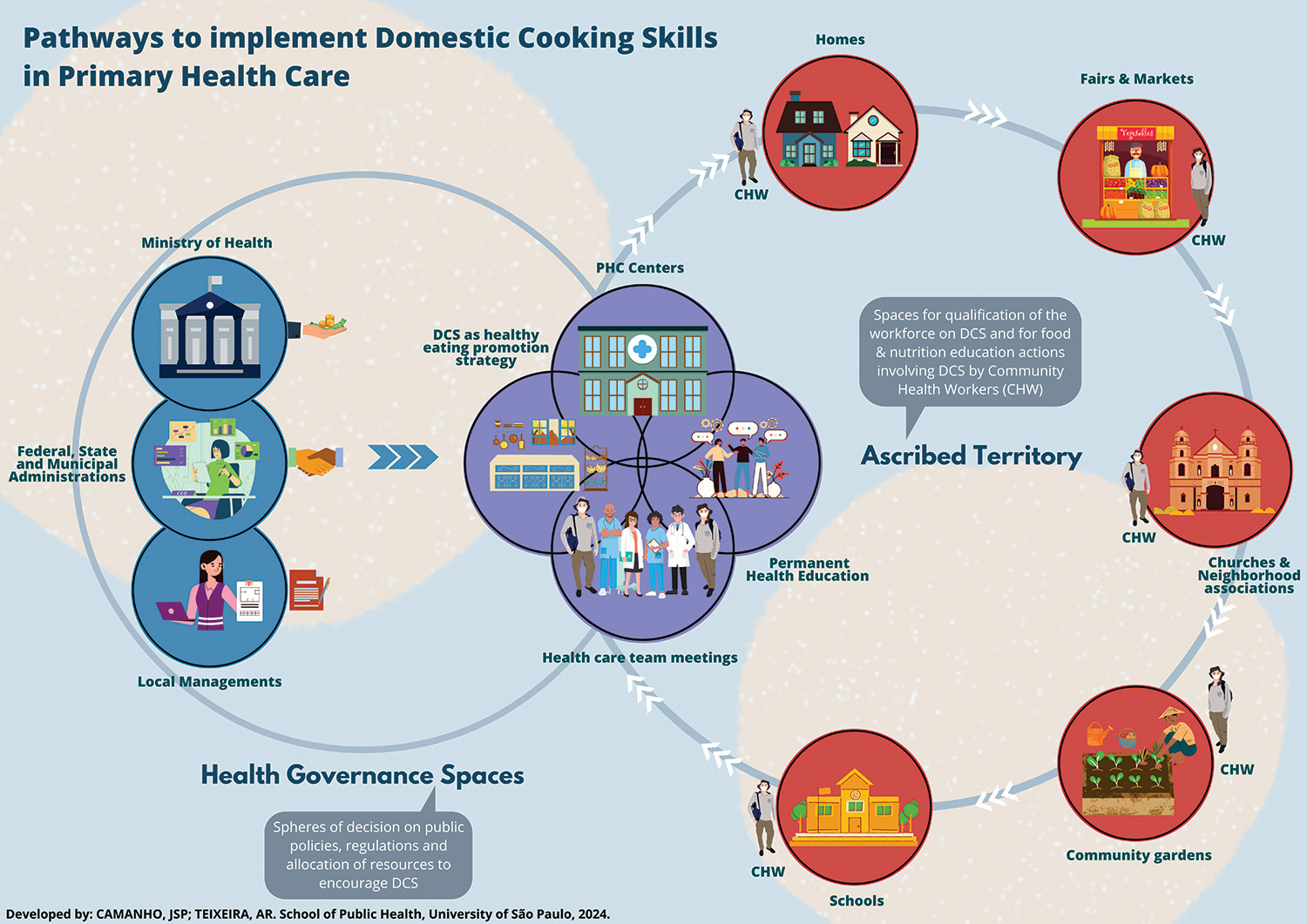
We synthesized our findings in a conceptual model that presents the paths for the implementation of Domestic Cooking Skills in PHC (Figure 1).

These paths permeate spheres of decision on public policies, regulations and resource allocation which could engage local managers in providing ongoing health education actions regarding the development of DCS. These actions could take place at schools, community gardens, churches, street markets and PHC Centers. Moreover, these spaces could host food and nutrition education programs for the development of DCS aimed at the community, through consultations with health professionals and Community Health Workers, who deeply understand the limitations and potentials of the territory. Thus, these professionals play a crucial role to link the community to the public health system.
DISCUSSION
Our results show that difficulties regarding the implementation of Domestic Cooking Skills in Primary Health Care are linked to the Culinary Transition process, combined with reductionist health counseling. There is a clear need for raising awareness and professional training on this subject, as well as engaging PHC managers. These perceptions were reported by participants of all education levels, especially by Community Health Workers, whose actions should be considered essential for promoting adequate and healthy eating habits and ensuring food security.
The Culinary Transition encompasses a series of transformations regarding dietary patterns and cooking skills [9], with an evident increase in UPF consumption [6]. Recent systematic review and meta-analysis studies [28,29] have highlighted positive association between UPF consumption and increased cardio metabolic risk, overweight and obesity, cardiovascular and cerebrovascular disease, depression and all-cause mortality.
Participants in this study perceived and pointed out these negative health outcomes in their discussions, aligning with recent findings on food consumption and prevalence of NCDs in Brazil. According to consumption data from 787.567 individual’s, registered in the Brazilian Food and Nutrition Surveillance System (SISVAN) in 2019, the Brazilian diet was composed of hamburgers and/or sausages (37%), sweetened beverages (54%), instant noodles, packaged snacks or crackers (33%), stuffed cookies, sweets or treats (35%). Data from 12.776.938 adults attending PHC in Brazil, in the same year, revealed a 63% prevalence of overweight and 28,5% obesity [6].
It important to note that the globalization of diets directly affects food sovereignty, by devaluing culture, knowledge, food traditions [30,31] and preserves hegemonic food systems, based on commodities production. These complex food systems disadvantage ethical, fair and sustainable food production initiatives and intensify inequities in access to adequate and healthy food, resulting in food deserts [13] and food swamps [32], areas with little availability of fresh/minimally processed food for commercialization and areas where establishments selling ultra-processed foods predominate, respectively. Changes in culinary practices and lack of Domestic Cooking Skills are also part of these systems and operate in their maintenance [30,31]. The participants in this research reported experiencing these scenarios.
Therefore, strategies to promote adequate and healthy eating habits employed by professionals in PHC must encompass not only the encouragement of DCS, but also the concept of Culinary Autonomy. Oliveira defines this concept as the ability to think, decide and act, to cook meals at home, using mostly fresh and minimally processed foods, under the influence of interpersonal relationships, the environment, cultural values, access to opportunities and guarantee of rights [33].
Thus, it is crucial to contextualize healthy eating in a broad and complex framework composed of factors that go beyond individual choices, as the power of choice may not be feasible in vulnerable regions of the territory. In this context, the rescue of Domestic Cooking Skills and culinary traditions, orchestrate an important movement that aims to stop the advanced capitalism, the participation of ultra-processed foods in the Brazilian diet and promoting Culinary Autonomy.
It is also important to consider individuals within their biological, psychological, social and cultural singularities aiming health care production. However, we observed that reductionism counseling prevails to the detriment of an expanded view of care, violating the principles of the Brazilian Unified Health System [34]. The PHC Centers no longer seem as cohesive centers of care, reinforcing segmentation and hierarchy within services, in which professionals with complete higher education, especially physicians, are considered more competent and important for care, while technical professionals, such as Community Health Workers, are marginalized [35].
Regarding culinary practices and food consumption, reductionism translates into Nutritionism, wich focuses on nutrients without considering the interaction, or the quality of food and how various combinations can constitute different traditional dietary patterns [36,37]. Our results show that Nutritionism is present in PHC and corroborates health practices that make sociocultural and geographic determinants and affective practices, represented through food, invisible. These patterns are represented by the demand for professional training topics that address the function of nutrients in food, such as functional foods, which contradicts cultural traditions and popular knowledge, as well as the autonomy of food choices through culinary practices [38].
In this sense, the role of the Community Health Worker emerges as a crucial agent for change. Originating from the community itself, these professionals seamlessly navigate between community settings and health governance spaces, facilitating dialogue between these spheres [34]. Therefore, the inclusion of this category in health team meetings may represent a catalyst for more significant and effective actions for the communities they serve. It seems essential that these professionals feel confident provide counseling and enable actions that involve the use of domestic cooking skills. However professional training, should not be restricted to Community Health Workers, being essential to all professionals working in PHC, to overcome barriers and limitations related on cooking practices counseling.
Participants highlighted the importance of qualification activities extending beyond dialogic exposure, as the development of DCS require practical implementation. The Food and Nutritional Education Reference Framework for Public Policies [39] encompasses the importance of educational actions targeting health professionals, especially those working in PHC. Likewise, the sixth guideline of the Política Nacional de Alimentação e Nutrição (PNAN, National Food and Nutrition Policy in Brazil) [40] highlights PHE as a strategic practice for professional qualification aimed at the promotion of adequate and healthy eating habits. Additionally, the 13th National Health Conference (NHC) in Brazil advocated for permanent Health Education as a form of relating scientific and popular knowledge, aiming for clearer dialogues, connected to the reality of the community served [41-43].
For professional qualification actions to take place, it is essential to sensitize managers working in PHC. The fourth guideline of the PNAN points out the role of managers in the formation of partnerships and inter-institutional articulations, aimed at strengthening and converging the policy with the Health and Sovereignty and Food and Nutrition Security Plans in Brazil [40,44].
Finally, it is important to contextualize this work in space-time, given the increasing Food Insecurity (FI) in Brazilian households. The COVID-19 pandemic has not only exposed but also exacerbated existing inequities in this context. According to data from the research coordinated by the Food for Justice: Power, Politics and Food Inequalities in a Bio economy group, as a result of the pandemic, there was a reduction of more than 85% in the consumption of healthy foods in those households with some degree of FI [45-46]. Uggioni et al. [47] showed that lack of cooking skills, unemployment, social vulnerability, and lack of access to basic sanitation during COVID-19 pandemic were barriers to home cooking, suggesting public policies should focus on food and nutrition programs and actions for the development of these skills to promote healthy eating and encourage self-care. Thus, the COVID-19 pandemic does not only precipitated health, political and economic crisis, but also a food security and sovereignty crisis. In this context, the professionals’ statements reinforced the worsening of demands made by PHC Center managers regarding the increase in the number of services provided, to the detriment of the quality of the service, reinforcing the importance of valuing and prioritizing the quality of care and in professional qualification.
Therefore, valuing and prioritizing the agenda of Domestic Cooking Skills to promote healthy food, to the detriment of the quantitative logic based on goals and numbers that do not reflect the quality and comprehensiveness of health care, is essential to preserve, or at least protect, the human and constitutional right to food for the Brazilian population, which is continuously violated on a daily basis.
CONCLUSION
This study showed that the main difficulties for the implementation of Domestic Cooking Skills in PHC in the city of São Paulo are attributed to reductionist counseling in association with Culinary Transition. This transition process perpetuates hegemonic food systems that intensify inequities in access to adequate and healthy eating habits. Professionals working in PHC recognize their own limitations regarding the appropriation of DCS. The appreciation of actions involving the utilization of these skills still seems embryonic, lacking moments of permanent education and qualification of the workforce, especially Community Health Workers, often subjugated and devalued in terms of their potential as health promoters. Permanent health education rooted in the concept of culinary autonomy is essential for the integrality of care to be achieved. It is recommended to provide themes and training formats that favor meaningful learning and sensitization of health professionals working in PHC Centers. It is important engage the managers in the agenda of DCS, in alignment with the principles and guidelines of public health policies, which must be sustained in contexts of economic and health crisis, such as the COVID-19 pandemic, with the aim of mitigating minimize inequities related to adequate and healthy food, recognized as a constitutional and universal right.
This study is subject to limitations, as it only includes participants from the city of São Paulo. Therefore, we recommend the production of further studies on this subject with professionals in other regions of the country, in order to support the construction of a national protocol for the implementation of Domestic Cooking Skills in PHC. Furthermore, we propose conducting focus groups with managers and individuals assisted in PHC Centers for better comprehension of their perceptions and expectations on this subject, enabling the planning of interventions that are more effective.
This study aims to contribute to the development of an EPS protocol focusing on PAAS actions and guidelines in PHC through HCD, by elucidating these skills as precious tools that can be used by health professionals during their interactions with the population, considering the main needs, difficulties and opportunities for their development in the city of São Paulo.
REFERENCES
-
Mazzonetto AC, Dean M, Fiates GMR. Perceptions about home cooking: An integrative review of qualitative studies. Ciên Saúde Colet. 2020;25(11):4559-71. https://doi.org/10.1590/1413-812320202511.01352019
» https://doi.org/10.1590/1413-812320202511.01352019 -
Teixeira AR, Bicalho D, Slater B, Lima TM. Systematic review of instruments for assessing culinary skills in adults: What is the quality of their psychometric properties? PLoS One. 2021;16(8):e0235182. https://doi.org/10.1371/journal.pone.0235182
» https://doi.org/10.1371/journal.pone.0235182 - Ministério da Saúde (Brasil). Guia alimentar para a população brasileira. 2nd ed. Brasília: Ministério da Saúde; 2014.
-
Ternier S. Understanding and measuring cooking skills and knowledge as factors influencing convenience food purchases and consumption. SurgJ. 2010;3(2):69-76. https://doi.org/10.21083/surg.v3i2.1122
» https://doi.org/10.21083/surg.v3i2.1122 - Monteiro CA, Cannon G, Lawrence M, Louzada MLC, Machado PP. Ultra-processed foods, diet quality, and health using the NOVA classification system. 1st ed. Rome: FAO; 2019.
- Ministério da Saúde (Brasil). Situação alimentar e nutricional no Brasil: Excesso de peso e obesidade da população adulta na Atenção Primária à Saúde. Brasília: Ministério da Saúde ; 2020.
-
Afshin A, Sur PJ, Fay KA, Cornaby L, Ferrara G, Salama JS, et al. Health effects of dietary risks in 195 countries, 1990-2017: A systematic analysis for the Global Burden of Disease Study 2017. Lancet. 2019;393(10184):1958-72. https://doi.org/10.1016/S0140-6736(19)30041-8
» https://doi.org/10.1016/S0140-6736(19)30041-8 -
Oliveira MSDS, Santos LADS. Dietary guidelines for Brazilian population: An analysis from the cultural and social dimensions of food. Ciên Saúde Colet. 2020;25(7):2519-28. https://doi.org/10.1590/1413-81232020257.22322018
» https://doi.org/10.1590/1413-81232020257.22322018 - Lang T, Caraher M. Is there a culinary skills transition? Data and debate from the UK about changes in cooking culture. J HEIA. 2001;8(2):2-14.
-
Burlandy L, Castro IRR, Recine E, Carvalho CMP, Peres J. Reflections on ideas and disputes in the context of the promotion of healthy eating. Cad Saude Publica. 2022;37 Suppl 1:e00195520. https://doi.org/10.1590/0102-311X00195520
» https://doi.org/10.1590/0102-311X00195520 - Burlingame B, Dernini S, Division NCP eds. Sustainable diets and biodiversity: Directions and solutions for policy, research and action. Rome: FAO ; 2012.
-
Martinelli SS, Cavalli SB. Healthy and sustainable diet: A narrative review of the challenges and perspectives. Ciên Saúde Colet. 2019;24(11):4251-62. https://doi.org/10.1590/1413-812320182411.30572017
» https://doi.org/10.1590/1413-812320182411.30572017 -
Pineda AMR, Amorim TMAX, Villarreal VIH, Mendivil LLL, Oliveira JS, Cesse EP, et al. From production to impacts on health and the environment: An analysis of food systems in Brazil, Colombia and Panama. Ciên Saúde Colet. 2023;28(4):1101-12. https://doi.org/10.1590/1413-81232023284.13382022
» https://doi.org/10.1590/1413-81232023284.13382022 -
Teixeira AR, Camanho JSP, Miguel FDS, Mega HC, Slater B. Instrument for measuring home cooking skills in primary health care. Rev Saude Publica. 2022;56:78. https://doi.org/10.11606/s1518-8787.2022056003473
» https://doi.org/10.11606/s1518-8787.2022056003473 -
Tani Y, Fujiwara T, Kondo K. Cooking skills related to potential benefits for dietary behaviors and weight status among older Japanese men and women: A cross-sectional study from the JAGES. Int J Behav Nutr Phys Act. 2020;17(1):82. https://doi.org/10.1186/s12966-020-00986-9
» https://doi.org/10.1186/s12966-020-00986-9 -
Terragni L, Arnold CD, Henjum S. Food skills and their relationship with food security and dietary diversity among asylum seekers living in Norway. J Nutr Educ Behav. 2020;52(11):1026-34. https://doi.org/10.1016/j.jneb.2020.05.009
» https://doi.org/10.1016/j.jneb.2020.05.009 -
Alnaim L, Taylor M, Gibbs H, Spaeth K, Sullivan D. A pilot nutrition and cooking skills program improves fruit intake, nutrition knowledge, and attitudes toward fruit and vegetable. Curr Dev Nutr. 2021;5 Suppl 2:957. https://doi.org/10.1093/cdn/nzab051_001
» https://doi.org/10.1093/cdn/nzab051_001 -
Garcia T, Ford B, Pike D, Bryce R, Richardson C, Wolfson JA. Development and implementation of a community health centre-based cooking skills intervention in Detroit, MI. Public Health Nutr. 2021;24(3):549-60. https://doi.org/10.1017/S1368980020003481
» https://doi.org/10.1017/S1368980020003481 -
Ali SI, Begum J, Badusha M, Reddy ES, Rali P, Lalitha DL. Participatory cooking demonstrations: A distinctive learning approach towards positive health. J Family Med Prim Care. 2022;11(11):7101-5. https://doi.org/10.4103/jfmpc.jfmpc_998_22
» https://doi.org/10.4103/jfmpc.jfmpc_998_22 -
da Costa Pelonha RN, Jomori MM, Maciel TG, Rocha JAD, Passos TS, Maciel BLL. Low cooking skills are associated with overweight and obesity in undergraduates. Nutrients. 2023;15(11):2424. https://doi.org/10.3390/nu15112424
» https://doi.org/10.3390/nu15112424 -
Oliveira MFB, Martins CA, Castro IRR. The (scarce and circumscribed) culinary content in food-based dietary guidelines around the world: 1991-2021. Public Health Nutr. 2022;25(12):1-9. https://doi.org/10.1017/S1368980022001938
» https://doi.org/10.1017/S1368980022001938 - Ministério da Saúde (Brasil). Matriz para organização dos cuidados em alimentação e nutrição na atenção primária à saúde. Brasília: Ministério da Saúde . Secretaria de Atenção Primária à Saúde, Departamento de Promoção da Saúde; 2022.
-
Trad LAB. Grupos focais: Conceitos, procedimentos e reflexões baseadas em experiências com o uso da técnica em pesquisas de saúde. Physis. 2009;19(3):777-96. https://doi.org/10.1590/S0103-73312009000300013
» https://doi.org/10.1590/S0103-73312009000300013 -
Oliveira JC, Penido CMF, Franco ACR, Santos TLA, Silva BAW. Especificidades do grupo focal on-line: Uma revisão integrativa. Ciênc Saúde Coletiva. 2022;27(5):1813-26. https://doi.org/10.1590/1413-81232022275.11682021
» https://doi.org/10.1590/1413-81232022275.11682021 -
Tong A, Sainsbury P, Craig J. Consolidated criteria for reporting qualitative research (COREQ): A 32-item checklist for interviews and focus groups. Int J Qual Health Care. 2007;19(6):349-57. https://doi.org/10.1093/intqhc/mzm042
» https://doi.org/10.1093/intqhc/mzm042 -
Braun V, Clarke V. Using thematic analysis in psychology. Qual Res Psychol. 2006;3(2):77-101. https://doi.org/10.1191/1478088706qp063oa
» https://doi.org/10.1191/1478088706qp063oa -
Souza LK. Pesquisa com análise qualitativa de dados: Conhecendo a Análise Temática. Arq Bras Psicol. 2019;71(2):51-67. https://doi.org/10.36482/1809-5267.ARBP2019v71i2p.51-67
» https://doi.org/10.36482/1809-5267.ARBP2019v71i2p.51-67 -
Askari M, Heshmati J, Shahinfar H, Tripathi N, Daneshzad E. Ultra-processed food and the risk of overweight and obesity: A systematic review and meta-analysis of observational studies. Int J Obes (Lond). 2020;44(10):2080-91. https://doi.org/10.1038/s41366-020-00650-z
» https://doi.org/10.1038/s41366-020-00650-z -
Pagliai G, Dinu M, Madarena MP, Bonaccio M, Iacoviello L, Sofi F. Consumption of ultra-processed foods and health status: A systematic review and meta-analysis. Br J Nutr. 2021;125(3):308-18. https://doi.org/10.1017/S0007114520002688
» https://doi.org/10.1017/S0007114520002688 - Hawkes C, Walton S, Haddad L, Fanzo J. 42 policies and actions to orient food systems towards healthier diets for all. London: Centre for Food Policy; 2020.
- FAO, IFAD, UNICEF, WFP, WHO. The State of Food Security and Nutrition in the World (SOFI) 2021. Transforming food systems for food security, improved nutrition and affordable healthy diets for all. Rome: FAO ; 2021.
-
Vandevijvere S, Mackay S, D’Souza E, Swinburn B. The first INFORMAS national food environments and policies survey in New Zealand: A blueprint country profile for measuring progress on creating healthy food environments. Obes Rev. 2019;20 Suppl 2:141-60. https://doi.org/10.1111/obr.12850
» https://doi.org/10.1111/obr.12850 -
Oliveira MFB, Castro IRR. Cooking autonomy: A multilevel conceptual model on healthy home cooking. Cad Saude Publica. 2022;38(4):EN178221. https://doi.org/10.1590/0102-311XEN178221
» https://doi.org/10.1590/0102-311XEN178221 - Ministério da Saúde (Brasil). Portaria nº 2.436, de 21 de setembro de 2017. Aprova a Política Nacional de Atenção Básica, estabelecendo a revisão de diretrizes para a organização da Atenção Básica, no âmbito do Sistema Único de Saúde (SUS). Brasília: Ministério da Saúde ; 2017.
-
Bezerra Y, Feitosa MZS. The affection of the community healthcare agent in the territory: A study with affective maps. Ciên Saúde Colet. 2018;23(3):813-22. https://doi.org/10.1590/1413-81232018233.00292016
» https://doi.org/10.1590/1413-81232018233.00292016 -
Cediel GG, Pérez E, González-Zapata L, Gaitan D. Perspectivas actuales sobre alimentación: Del nutricionismo a la alimentación saludable, solidaria y sustentable. Ver Fac Med. 2021;70(3):e300. https://doi.org/10.15446/revfacmed.v70n3.94252
» https://doi.org/10.15446/revfacmed.v70n3.94252 -
Paiva JB, Magalhães LM, Santos SMC, Santos LAS, Trad LAB. A confluência entre o “adequado” e o “saudável”: Análise da instituição da noção de alimentação adequada e saudável nas políticas públicas do Brasil. Cad Saúde Pública. 2019;35(8):e00250318. https://doi.org/10.1590/0102-311X00250318
» https://doi.org/10.1590/0102-311X00250318 -
Viana MR, Neves AS, Camargo KR, Prado SD, Mendonça ALO. A racionalidade nutricional e sua influência na medicalização da comida no Brasil. Ciênc Saúde Colet. 2017;22(2):447-56. https://doi.org/10.1590/1413-81232017222.25432015
» https://doi.org/10.1590/1413-81232017222.25432015 - Ministério do Desenvolvimento Social e Combate à Fome (Brasil). Marco de referência de educação alimentar e nutricional para as políticas públicas. Brasília: Ministério do Desenvolvimento Social e Combate à Fome; 2012.
- Ministério da Saúde (Brasil). Política Nacional de Alimentação e Nutrição. 1st ed. Brasília: Ministério da Saúde , Secretaria de Atenção à Saúde, Departamento de Atenção Básica; 2013.
- Ministério da Saúde (Brasil). Relatório Final da 13ª Conferência Nacional de Saúde: Saúde e Qualidade de vida: Políticas de estado e desenvolvimento. Brasília: Editora do Ministério da Saúde; 2008.
-
Carvalho MS, Merhy EE, Sousa MF. Repensando as políticas de Saúde no Brasil: Educação Permanente em Saúde centrada no encontro e no saber da experiência. Interface (Botucatu). 2019;23:e190211. https://doi.org/10.1590/Interface.190211
» https://doi.org/10.1590/Interface.190211 -
Dias MSA, Oliveira IP, Silva LMS, Vasconcelos MIO, Machado MFAS, Forte FDS, et al. Política Nacional de Promoção da Saúde: Um estudo de avaliabilidade em uma região de saúde no Brasil. Ciênc Saúde Colet. 2018;23(1):103-14. https://doi.org/10.1590/1413-81232018231.24682015
» https://doi.org/10.1590/1413-81232018231.24682015 -
Bortolini GA, de Oliveira TFV, da Silva SA, Santin RDC, de Medeiros OL, Spaniol AM, et al. Ações de alimentação e nutrição na atenção primária à saúde no Brasil. Rev Panam Salud Publica. 2020;44:e39. https://doi.org/10.26633/RPSP.2020.39
» https://doi.org/10.26633/RPSP.2020.39 - Galindo E, Teixeira MA, Araújo M, Motta R, Pessoa M, Mendes L, et al Effects of the pandemic on food and the food security situation in Brazil. Berlin: Food for Justice, Power, Politics, and Food Inequalities in a Bioeconomy; 2021.
-
Sarreta FO, Reis de Carvalho Liporoni AA, Braga Bisco GC, Teixeira Alves dos Santos E, Dias Lima E, da Silveira DH. Educação permanente de trabalhadores da saúde em tempos de pandemia. Cadernos ESP. 2022;16(3):24-32. https://doi.org/10.54620/cadesp.v16i3.855
» https://doi.org/10.54620/cadesp.v16i3.855 -
Uggioni PL, Elpo CMF, Geraldo APG, Fernandes AC, Mazzonetto AC, Bernardo GL. Cooking skills during the Covid-19 pandemic. Rev Nutr. 2020;33:e200172. https://doi.org/10.1590/1678-9865202033e200172
» https://doi.org/10.1590/1678-9865202033e200172
-
1
Article elaborated from dissertation by JSP CAMANHO, entitled “A condução de estratégias envolvendo Habilidades Culinárias Domésticas na Atenção Primária à Saúde do município de São Paulo”. Universidade de São Paulo; 2021.
-
Support:
Fundação de Amparo à Pesquisa do Estado de São Paulo (Fapesp), (Process nº 2019/14348-5).

 Note: CHW: Community Health Workers; DCS: Domestic Cooking Skills; PHC: Primary Health Care.