 A novel approach and zero waste concept for making geopolymer-based bauxite residue tiles
ABSTRACT
With the increasing demand for sustainable building materials, researchers have developed geopolymer-based tiles using bauxite residue (BR) and other industrial by-products. This approach supports the zero-waste concept by converting waste from alumina refineries, steel plants, and coal-fired power stations into value-added products. The primary constituents include BR, ground granulated blast furnace slag (GGBS), and fly ash (FA), while manufactured sand (MS) and quarry chips (QC) were used as fillers. A small I-Crete (IC) dosage was incorporated as an admixture to improve overall performance. BR exhibits moderate reactivity compared to conventional binders, and its influence was studied at different replacement levels. The optimum mix was 30% BR, 20% GGBS, and 50% FA, with a filler-to-binder ratio of 1:1.5 and 2% I-Crete (R30G20F50I02). Sodium silicate and sodium hydroxide with 4M concentration were alkaline activators. After 28 days of curing, the developed tiles showed excellent flatness (0.6 mm), perpendicularity (<1%), straightness (<0.8%), wet transverse strength of 6.285 N/mm2, wear resistance of 3.26 mm, and water absorption of 5.59%. All properties satisfied IS 13801-2013 standards, making the tiles suitable for outdoor flooring such as walkways, patios, warehouses, and factory surfaces.
Keywords:
Bauxite residue; Wet transverse strength; Wear resistance; Water absorption; Sustainability
1. INTRODUCTION
The increasing global population, rapid industrial growth, and urban development have intensified the demand for natural resources while simultaneously generating vast amounts of industrial waste [1,2,3]. This trend has given rise to one of the most pressing environmental challenges of the modern era: effective waste management. Among the sectors contributing significantly to this issue, the construction industry stands out as one of the largest raw materials and energy consumers. Traditional construction practices, which rely heavily on ordinary Portland cement (OPC), not only deplete finite natural resources but also account for substantial carbon dioxide emissions, thereby worsening the environmental footprint of infrastructure development [4]. This has spurred worldwide interest in developing sustainable alternatives that align with circular economy principles—where waste materials are no longer viewed merely as byproducts to be discarded, but as valuable secondary resources that can be repurposed into functional construction materials.
Within this context, bauxite residue (commonly referred to as red mud), a byproduct of alumina extraction through the Bayer process, has emerged as a particularly challenging waste material [1]. Globally, the alumina industry generates enormous volumes of bauxite residue, with estimates ranging between 0.3 and 2.5 tons of residue per ton of alumina produced. This residue exhibits wide compositional variation, typically consisting of iron oxides, aluminum hydroxides, silica, and trace amounts of hazardous elements, including heavy metals [2]. Its alkaline nature and the risk of leaching contaminants into soil and groundwater make its storage and disposal a severe environmental liability. In India, vast disposal ponds are used to contain red mud, as shown in Figure 1 and Table 1, underscoring the urgency of addressing its safe management. Over time, disposal sites not only occupy valuable land resources but also present air, soil, and water pollution risks, thereby necessitating innovative waste valorization strategies [3, 4].

Sustainable construction practices provide an opportunity to address these challenges by diverting bauxite residue and other industrial byproducts away from landfills and into productive use. By integrating these wastes into building materials, industries can simultaneously reduce environmental hazards, conserve virgin raw materials, and achieve economic benefits [3]. Various industrial byproducts have already been recognized as effective supplementary materials in construction. Fly ash from coal combustion and Ground Granulated Blast Furnace Slag (GGBS), a byproduct of iron manufacturing, are widely known for their pozzolanic and latent hydraulic properties [5, 6]. Their incorporation into cement and concrete production has demonstrated improved strength, durability, microstructural refinement, and reductions in carbon emissions [7, 8]. Similarly, blending GGBS with rice husk ash (RHA), an agricultural byproduct, has yielded benefits in synthesizing geopolymer concrete under ambient curing conditions [9]. Ground Granulated Blast Furnace Slag (GGBS), an economical material, is a byproduct of the iron manufacturing [10]. The replacement of cement with such binders – whether partial or total – not only reduces reliance on OPC but also enhances long-term performance [11, 12]. The study is essential for preparing silica fume/slag-based geopolymers by using waste steel and iron powder as a partial substitute for slag aggregate and thus to provide an effective solution to the disposal problems of waste metals [13].
Parallel efforts have focused on sustainable aggregates. Manufactured sand (M-sand), produced by crushing rocks and stones, offers a viable substitute for depleting river sand resources. It is characterized by consistent quality and grading, which improve the workability and strength of concrete mixes [14,15,16]. M-sand thus plays a dual role: mitigating the environmental damage caused by excessive sand mining while ensuring reliable performance in construction applications [17]. Quarry chips, derived from crushed stone, are also used as coarse aggregates and are valued for their strength characteristics. However, the mix design must consider its water absorption properties [18]. Together, these alternative aggregates represent essential steps in reducing ecological strain and advancing circular material flows in construction. This work aimed to produce geopolymer tiles using commercial metakaolin (MK) and flue gas desulfurization waste (FGD). The results demonstrate that using FGD improved the tiles’ mechanical behavior due to the formation of phases different from geopolymerization of metakaolin alone [19]. The ceramic waste, named grog, presented as main mineralogical characteristics the absence of kaolinite and possible presence of amorphous metakaolinite, besides the desirable density and consistency [20].
In addition to binders and aggregates, mineral admixtures such as I-Crete have gained attention for enhancing the performance of concrete and tile products. I-Crete effectively reduces shrinkage, thereby minimizing cracking and warping during curing. It also lowers permeability to water and corrosive agents, making it suitable for structures exposed to aggressive environments. Moreover, the unique hydration products of I-Crete help retain additional water, further countering issues of shrinkage and bleeding, thus improving structural stability and long-term durability [21]. The Indian tile industry, in particular, stands to benefit from these advancements, as it represents a rapidly growing sector essential for infrastructure development. Tiles, including specialized products like checkered tiles, fulfill functional requirements and provide diverse aesthetic solutions in flooring applications [22,23,24].
Amidst these innovations, alkaline-activated materials and geopolymer technologies are recognized for their superior mechanical and durability properties compared to OPC-based systems [25]. Geopolymers can withstand harsh environments, exhibit high strength, and endure elevated temperatures, making them promising candidates for sustainable construction. In this light, bauxite residue presents an untapped opportunity as a raw material in geopolymer tile production. Research has shown that its incorporation into clay and ceramic tiles can improve mechanical properties and optimize water absorption [26,27,28]. This work investigated geopolymer tiles’ behavior in standard, high temperature, and saturation conditions utilizing metakaolin, water, hydroxide, and sodium silicate, varying molar ratios of SiO2/Al2O3 from 2.25 to 4.00 [29]. Furthermore, geopolymer-based bauxite residue tiles (GBRT) have demonstrated environmental advantages, with significantly lower energy requirements and carbon emissions than conventional cementitious products [30]. Importantly, these tiles can achieve mechanical and durability properties that meet the standards required for construction applications, establishing them as viable substitutes for traditional Portland cement-based tiles [31].
The ceramic waste, named grog, presented the main mineralogical characteristics of the absence of kaolinite and possible presence of amorphous metakaolinite, besides the desirable density and consistency. Twenty-seven geopolymer mixtures were produced to model the effect of four synthesis parameters, namely SiO2/Al2O3 molar ratio (Si/Al), NaOH concentration (NaOH), Na2SiO3/NaOH mass ratio (NS/NH), and curing temperature (T). The impact of their interactions on the compressive strength at 28 days (CS28) of synthesized geopolymers was analyzed using response surface methodology (RSM) and Box-Behnken design [32]. The multi-objective optimization of the comprehensive properties of geopolymer mortar was realized, followed by the verified experiments of the proposed optimized mix. To investigate the microstructure and composition of the hydration products, the optimally proportioned and neat fly ash-based specimens were tested by scanning electron microscopy (SEM) and X-ray diffraction (XRD) [33]. Accordingly, this study aimed to optimize the production parameters of geopolymer cement using response surface methodology (RSM) with rice husk ash (RHA), metakaolin (MK), and an alkaline activator as reactants [34]. Proper material selection and mix proportioning can diminish the material cost. The derived statistical Response Surface Methodology can develop cost-effective GPC mixes. The estimated responses are not likely to contrast in linear mode with selected variables; a plan was chosen to enable the model to account for any reaction in a quadratic manner [35].
Nevertheless, despite growing interest, the potential of bauxite residue in geopolymer tile production remains underexplored. Most studies have focused either on conventional cementitious systems or limited ceramic applications, leaving a gap in the systematic evaluation of GBRT as a sustainable alternative to OPC tiles. Specifically, there is limited research examining how the synergy of bauxite residue with other industrial byproducts (such as GGBS, fly ash, and M-sand) and mineral admixtures (like I-Crete) can be harnessed to produce cost-effective, dimensionally stable, and durable tiles. Addressing this research gap is crucial, as it would not only provide a sustainable solution for red mud disposal but also contribute significantly to reducing the environmental footprint of the construction industry.
1.1. Novelty of this research
-
A novel approach and zero-waste concept of a building construction material – Geo-polymer-based bauxite residue tiles.
-
To consume three different industrial by-products effectively.
-
In this invention, the source, time, energy, and simple process are applied.
1.2. Distinction of previous and current research work
In this study, the use of bauxite residue in geopolymer tiles is distinguished from existing works by its integrated approach to utilizing high percentages of residue combined with supplementary binders such as GGBS and fly ash, optimized for tile production rather than conventional tiles. The present research focuses on achieving improved mechanical and microstructural performance while addressing the environmental management of bauxite residue, which has not been extensively explored in prior studies. Most previous studies on bauxite residue have focused on its use as a minor additive or partial replacement material in cement or geopolymer mortars. In contrast, the present work explores the direct utilization of bauxite residue as a major aluminosilicate precursor for geopolymer tile production, emphasizing sustainable tile manufacturing. The study differentiates itself by:
-
Using higher bauxite residue content (e.g., 10–60%) with optimized alkaline activation to achieve workable and durable geopolymer tiles.
-
Incorporating GGBS and fly ash as supplementary sources to balance calcium and silica for enhanced geopolymerization.
-
Targeting tile applications, where surface quality, dimensional stability, and microstructural compactness are critical, unlike bulk geopolymer concrete studies.
-
Comprehensive microstructural analysis (FESEM, XRD, EDAX) to correlate phase formation with mechanical strength and densification behavior.
These aspects establish a clear distinction between the current research and earlier studies that primarily focused on bauxite residue as a partial cement substitute rather than a principal component for geopolymer-based bauxite residue tiles.
2. MATERIALS AND METHODS
2.1. Materials used
The materials utilized in this study are classified into fines, fillers, and additives, as shown in Figure 2. Fines consist of bauxite residue (BR), ground granulated blast furnace slag (GGBS), and fly ash (FA), and fillers consist of manufactured sand (MS), quarry chips (QC), and I-Crete (IC) as an additive. The bauxite residue (BR) was sourced as a by-product from alumina refineries operated by HINDALCO in Odisha, India. A small quantity of ground granulated blast furnace slag (GGBS), a steel industry by-product, was procured from the JSW industry in Salem, Tamil Nadu. Additionally, fly ash, collected directly from the electrostatic precipitators of a thermal power plant in Mettur, Tamil Nadu, was incorporated into the mix. The fillers, comprising manufactured sand (MS) and quarry chips (QC), were obtained from local quarries. I-Crete, a composition of inorganic polymers, naturally occurring minerals, and chemically modified high-performance supplementary cementitious materials, was sourced from Amaze Crete, Mangalore. To activate the mix, commercially available alkali activators (AA), specifically sodium silicate and sodium hydroxide flakes, were added at a low molarity (4 M), resulting in the formation of a geopolymer solution, which helps to blend all the dry ingredients. Several trials were conducted to establish the appropriate proportion of each component, leading to the identification of the optimal mix. Table 2 presents the physical properties of the fines, while Table 3 details the physical properties of the fillers and alkali activators. The chemical compositions of the penalties are provided in Table 4.

Raw materials employed in the study: (a) Bauxite residue, (b) GGBS, (c) fly ash, (d) I-Crete, (e) M-sand, (f) Quarry chips, (g) Sodium silicate, and (h) Sodium hydroxide pellets.
Due to the high iron content, the BR is red, whereas GGBS and IC are off-white, and FA is light grey, reflecting their mineral composition. GGBS and IC have a higher specific gravity, indicating denser than FA and BR, influencing their mass in composite mixtures. All materials used are in powder form. GGBS and IC are the finest, followed by FA and BR. Higher fineness improves reactivity and blending in cementitious materials. Higher pH (>10) in materials like BR, GGBS, and IC promotes pozzolanic reactions, enhancing strength development in the mix. Fly Ash (FA) has a lower pH compared to other cementitious materials, and its reaction with calcium hydroxide (Ca (OH)2) is slower, leading to a gradual strength gain over time. MS has a higher water absorption (3%) than QC (1%), affecting the moisture retention properties of the mix. The chemical composition of all the industrial by-products used in the manufacturing of tiles is mentioned in Table 4.
2.2. Preparation of specimens
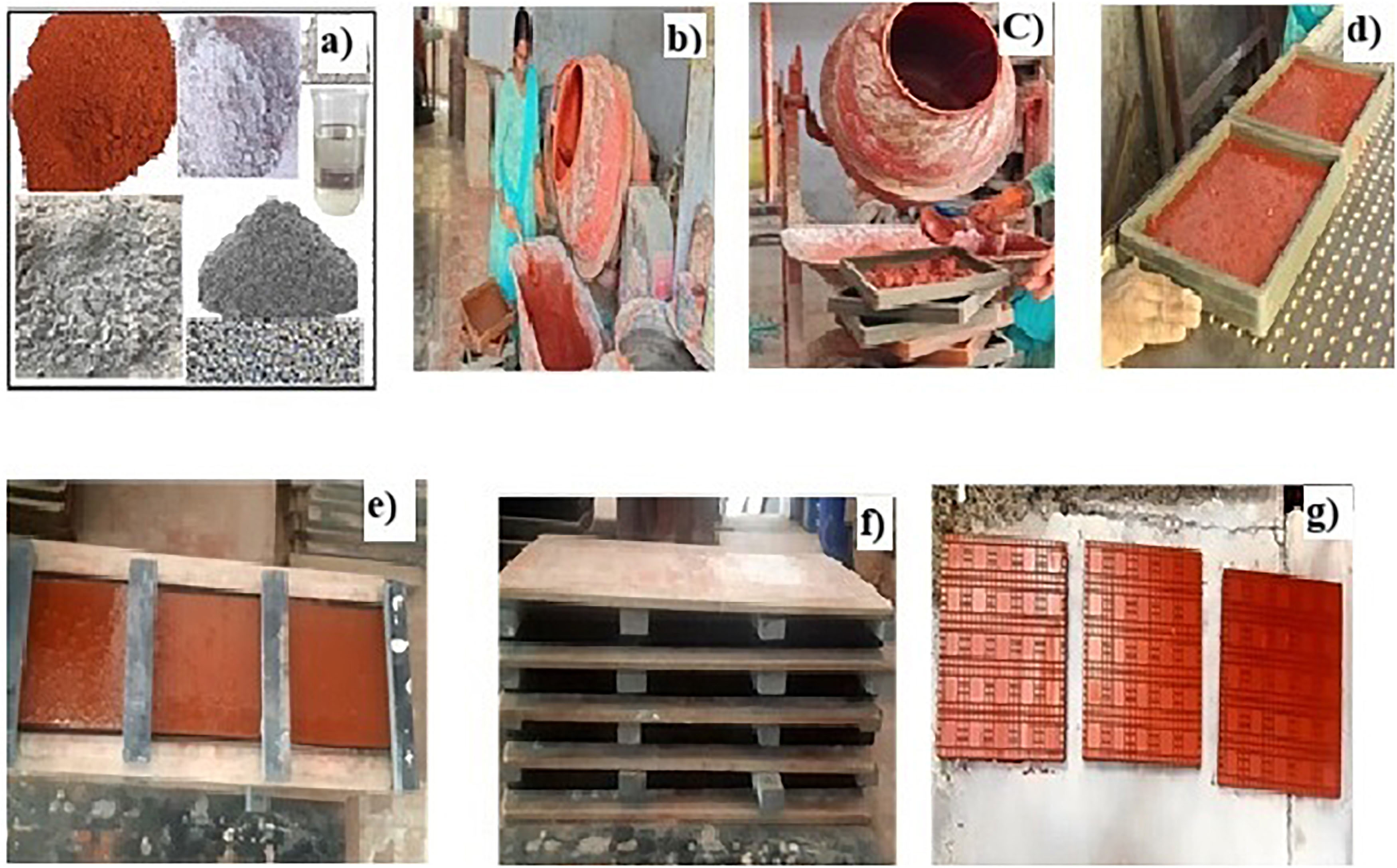
Sixteen different mixes were cast and tested to assess the behavior of GBRT. The method involves pulverizing fine materials (BR, GGBS &FA) into powder and blending them with filler materials (MS & QC), along with I-Crete (IC), an admixture, and also the alkali activators, namely sodium silicate and sodium hydroxide, forming a flowable and self-leveling mixture with mild vibrations. The resulting mixture is continuously poured into the rubber mould of the required shape and size and vibrated using a vibrating table, at the rate of 2000 to 2500 vibrations per minute (VPM), for 3 to 5 seconds to achieve the desired shape (square), size (300 × 300 × 20 mm), and finished surface. This whole assembly is kept at room temperature for 6 hours; after that, it is demolded and kept for curing at ambient temperature for 7 days. The tiles were set and ready to handle, reaching approximately 50% of the 28-day strength. Thereafter, continually gaining wet transverse strength up to and after 28 days. The mixing procedure for the preparation of specimens is shown in Figure 3. In all mixes, the proportions of MS and QC remained constant. The P-series (P1–P4) consists solely of BR and FA, with no GGBS, where an increase in BR corresponds to a decrease in FA. The Q-series (Q1–Q4) incorporates 10% GGBS while reducing the FA content. The R-series (R1–R4) further increases GGBS to 20%, leading to a further reduction in FA. Similar to the R-series, the S-series (S1–S4) includes a small addition of I-Crete to 0.00018 kg per cubic meter of the mixture, likely as an additive to enhance shrinkage-reducing properties. The abbreviations for the different mixes are presented in Table 5, and the mix proportions of the materials for making tiles are shown in Table 6.
Preparation of specimens (a) Batching of materials, (b) Mixing of materials, (c) Placing of the mixture into the molds, (d) Vibration of the specimen molds, (e, f, and g) Ambient curing.
3. EXPERIMENTAL PROGRAMME
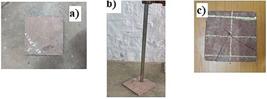
As per the IS:13801-2013, six full-sized tiles were used for testing the flatness, perpendicularity, and straightness of the GBRT, whose test setup is shown in Figure 4. The flatness test is conducted to evaluate the concavity or convexity of GBRT, which is done using a metal ruler that should be longer than the diagonal length of the tile. To check the accuracy of the tile corners, the perpendicularity test is done using a try square. To check whether the tiles are perfectly linear and free from warping or bending, a straightness test is done, using a fine thread. To evaluate the strength behavior of GBRT, wet transverse strength and resistance to wear tests were performed after 28 days, 56 days, and 90 days of ambient curing, whose test setup is shown in Figure 5. Apart from the above tests, the water absorption test is also performed on tiles after 28 days, 56 days, and 90 days of water immersion to assess the tiles’ absorption capacity. To determine the water absorption of tiles, the tiles are initially placed in the oven, and their dry weight is noted after achieving a constant mass. Thereafter, the tiles were placed in the water for the required period, and then the tiles were removed from the water and wiped using a cloth. Their wet weight was noted. The percentage of water absorption was calculated. The compressive strength test and impact resistance test performance for conventional tiles and optimum mix proportions of GBRT tiles for 28 days, 56 days, and 90 days were also considered. The microstructural studies are performed on the ingredients used in the research and are discussed in the following section.


4. RESULTS AND DISCUSSION
4.1. Flatness test
According to IS:13801-2013, the flatness of a tile is deemed acceptable if the surface does not exhibit more than 1 mm of concavity or convexity. The experimental data indicated that the average deviation is 0.6 mm, below the specified IS threshold, confirming that the tiles meet the flatness criteria. By ensuring that tiles keep a consistent surface, this flatness criterion reduces the potential of problems during installation and use. The experimental results suggest a high level of quality control in the manufacturing process, as the average deviation is significantly below the maximum allowable limit.
4.2. Perpendicularity test
The results of the perpendicularity test showed a deviation of 1%, which is well within the specified limit of 2% as per IS:13801-2013. This indicates that the sides of the tiles are accurately right-angled. Such precision reflects the high standards of quality control maintained during manufacturing. Adhering to these tight tolerances ensures that the tiles will fit together seamlessly during installation, minimizing the need for adjustments and reducing visible gaps between tiles.
4.3. Straightness test
The straightness test results showed that the average of the most significant gaps was 0.80%, within the 1% limit specified by IS:13801-2013. This confirms compliance with the standard and reflects high precision in the manufacturing process. The minimal deviation from perfect straightness indicates that the evaluated components are well within acceptable tolerances, contributing to better overall quality and performance in their intended applications.
4.4. Water absorption test
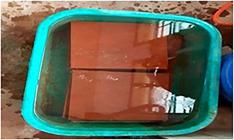
The experimental study examined the effects of different proportions of BR, GGBS, FA, and IC on alkali-activated materials, focusing on the water absorption of GBRT. Figure 6 shows the GBRT immersed in water to evaluate the water absorption. As shown in Figure 7, water absorption decreased from 28 to 90 days, highlighting its impact on durability. Reducing fly ash from 80% to 50% while increasing BR from 10% to 40% (P1 to P4) led to higher water absorption, peaking at 4.60% at 90 days, indicating enhanced compactness and reduced porosity. Adding 10–20% GGBS and 2% I-Crete slightly raised water absorption (S2) to 5.59% at 90 days. A higher alkali activator concentration (4M) reduced water absorption due to improved reaction kinetics and polymerization. Particle size distribution across formulations also influenced water absorption, underscoring the importance of controlling raw material proportions. Optimizing BR dosage is crucial to achieving the desired properties per IS 13801-2013.

4.5. Wet transverse strength test
The study examined wet transverse strength in alkali-activated materials (P1 to S4) for 28, 56, and 90-day periods. Figure 8 shows the wet transverse strength test outcomes, and Figure 9 shows the typical failure patterns. As shown in Figure 8, strength increased from 28 to 90 days. Increasing BR (10% to 40%) while reducing fly ash (90% to 60%) (P1 to P4) negatively impacted strength, failing to reach 3 N/mm2 per IS 13801-2013. However, replacing cementitious material with 10–20% GGBS (Q1 to R4) improved strength from 2.294 to 5.589 N/mm2 at 28 days due to enhanced pozzolanic reactivity. Adding 2% I-Crete (S1 to S4) further increased the strength to 6.285, 7.856, and 8.652 N/mm2 at 28, 56, and 90 days, respectively. This combination enhanced tensile resistance, making it viable for high-strength applications. A 4M alkali activator improved strength, confirming its key role in polymerization. The correlation with particle size distribution highlights its impact on mechanical performance.


4.6. Resistance to wear test
The test setup is shown in Figure 10, which shows the outcomes of the resistance-to-wear test. Figure 11 represents the resistance to wear test results, measured in mm, showing a decrease from 28 to 90 days. The study examined the effects of BR, GGBS, FA, and alkali activator concentrations (P1 to S4). Also, tile mixes using quarry chips exhibit decreased surface degradation and higher resistance to grinding and impact, ensuring longer service life. The optimized mix (R30F50G20I05) met IS standards, highlighting improved wear resistance with a 4 M alkali activator. Increasing the alkali activator concentration increased wear resistance, underscoring its key role in polymerization. While alkali activators enhance durability, their effect on abrasion resistance depends on the overall mix composition, emphasizing the need for balance in material formulation.


4.7. Compressive strength test
The test setup as per codal provision (ASTM C1731–16) is shown in Figure 12, which shows the outcomes of the compressive strength test. The optimum mix (R30F50G20I05) results for GBRT are compared with conventional tiles. The average load on the specimen was calculated by determining the compressive strength (N/mm2) of the floor tiles (N) divided by the calculated area of the bearing surface (300 mm × 300 mm). The test specimen (mm2) values were compared with conventional tiles. The compressive strength for GBRT (R30F50G20I05) at 28 days, 56 days, and 90 days was 18 N/mm2, 22 N/mm2, and 24 N/mm2, respectively. The compressive strength for conventional tiles at 28 days, 56 days, and 90 days was 16 N/mm2, 20 N/mm2, and 23 N/mm2, respectively. However, the highest compressive strength (23 N/mm2) of floor tiles was obtained for conventional tiles (without industrial by-products), and GBRT was obtained (24 N/mm2). Still, the objective is to get tile products using waste materials to reduce the cost of tile and environmental pollution and preserve natural resources for sustainability. The percentage of increase was 4.349%. The purpose was relevant and could be successfully implemented.

(a) Tile sample (b) Placing the sample into Compressive strength test Machine (c) Failure pattern.
4.8. Impact resistance test
The test setup as per codal provision (ASTM C1870–18) is shown in Figure 13, which shows the outcomes of the impact resistance test. The optimum mix (R30F50G20I05) results for GBRT are compared with conventional tiles. The impact resistance (N/mm2) of the floor tiles is determined by dropping heavy weights or pointed objects (1 m height) on tiles that could damage or shatter their surface. The impact resistance values of GBRT (R30F50G20I05) at 28 days, 56 days, and 90 days were 1.2 m, 1.3 m, and 1.5 m, respectively. The impact resistance values of conventional tiles for 28 days, 56 days, and 90 days were 1 m, 1.2 m, and 1.4 m, respectively. However, the highest impact resistance value (1.4 m) of floor tiles was obtained for conventional tiles (without industrial by-products), and GBRT was obtained (1.5 m). Still, the objective is to get tile products using waste materials to reduce the cost of tile and environmental pollution and preserve natural resources for sustainability. The percentage of increase was 7.143%. The purpose was relevant and could be successfully implemented.
4.9. Interaction between the materials used for making the GBRT
When the red mud content in the mix was increased from 10% to 30% in mixes No. P1 to P4, the mixture exhibited a muddy consistency, making it challenging to handle. Incorporating 10–20% GGBS into the mixes from Q1 to Q4 and R1 to R4 eliminated the muddy consistency and improved handling. For mixes No. S1 to S4, I-Crete was added as an admixture, which resulted in tiles with no warping and complete flatness. In contrast, the tiles from mixes P, Q, and R showed slight warping. The handling of sodium hydroxide pellets was highly sensitive, as they readily reacted with environmental moisture. Furthermore, when the pellets were dissolved in sodium silicate solution, the solution became intensely hot during the first 5–10 minutes due to the exothermic reaction.
5. RESPONSE SURFACE METHODOLOGY
The Response Surface Method (RSM) uses explicit functions to express a relationship between random output and input random variables, which is an effective method for solving random analysis problems with complex implicit relationships [37]. It helps identify which variables significantly impact the desired outcome and predicts the best combination for achieving optimal results. Using experimental data, RSM creates mathematical models and visual response surfaces, making it easier to understand how changes in one factor influence others [38].
RSM provides visual tools like contour and surface plots, making interpreting results easier and understanding how different factors interact. RSM was applied to estimate the effects of the variables on the responses.
In the current study, RSM was employed to interpret the interactions between the inputs and output parameters using contour plots and surface plots. Analysis of Variance (ANOVA) was conducted to analyze and validate the regression models, facilitating the interpretation of the results [39].
In the current research, fly ash, I-Crete, and GGBS were input variables in kg for generating the equation. Figures 12, 13, and 14 show Pareto charts and surface and contour plots for the wet transverse strength.

The response surface equation for the wet transverse strength is given below.
5.1. Significance of the Pareto chart
A Pareto chart of standardized effects is used in statistical analysis to determine which factors have the most significant impact on a response variable. It ranks variables in descending order of their effect size, helping identify the most influential factors in a process.
5.2. Inference from the Pareto chart
From Figure 14, it can be seen that C (IC) and A (GGBS) have the highest standardized effects, indicating they have the most significant influence on Wet Transverse Strength (WTS). BC interaction (FA × IC) is also substantial. Still, it has a negligible effect compared to C and A. Factors AA, AB, BB, and B (FA) have lower effects and fall below the significance threshold, suggesting they have minimal or negligible impact on WTS. The red reference line represents the threshold value (2.306) at a 95% confidence level (α = 0.05). Any factor beyond this line is considered statistically significant, significantly affecting the response variable.
5.3. Surface plots
Surface plots in Minitab are 3D graphical representations illustrating the relationship between three variables, typically a response variable and two independent factors. These plots help visualize interactions, identify optimal conditions, and understand non-linear effects in experimental data. The shape and gradient of the surface indicate trends, such as maxima, minima, or saddle points, that influence process optimization. Steeper slopes suggest strong effects, while flat regions indicate minimal impact. Surface plots are widely used in designing experiments (DOE), process improvement, and response surface methodology (RSM) to refine formulations, enhance quality control, and optimize performance in various engineering and scientific applications. For the present study, the contour plots are plotted using fly ash, GGBS, and I-Crete as variables.
5.4. Inference from surface plots
Figure 15 shows that the GGBS contributes significantly to strength due to its cementitious properties. FA acts as a supplementary binder, enhancing durability but having a more negligible direct effect than GGBS. The increase in WTS suggests that a balanced proportion of GGBS and fly ash is essential for optimal tile strength. From Figure 15, it can be seen that GGBS is the dominant factor, reinforcing the matrix and improving overall strength. I-Crete, though used in small amounts, enhances the binding efficiency and improves particle cohesion. This graph suggests that I-Crete works best with GGBS, making it an essential additive in the mixture. From Figure 15, it can be seen that fly ash provides some strength but does not act as a primary binder. I-Crete improves the binding properties of the mix, but its impact on WTS is smaller than that of GGBS. The graph suggests that fly ash and I-Crete alone are insufficient to maximize strength, and their role is more of an enhancement than a core strength contributor. From the surface plots, GGBS has the most significant impact on WTS, making it the primary material to optimize. I-Crete enhances the performance of GGBS, but its effect is minor when used alone. Fly ash plays a supplementary role, improving durability but contributing less strength. An optimal balance of GGBS, fly ash, and I-Crete is necessary for the best results.

5.5. Contour plots
Contour plots in Minitab are powerful visualization tools that analyze the relationship between two independent variables and their effect on a dependent response variable. These plots display response values as contour lines or color gradients, helping identify optimal operating conditions, trends, and interactions between factors. They are widely used in process optimization, quality control, and experimental design (DOE) to determine the best material proportions, temperature settings, or other process parameters. By interpreting contour plots, users can pinpoint regions of maximum or minimum response, detect curvature in relationships, and make informed decisions for process improvements or material formulations. For the present study, the contour plots are plotted using fly ash, GGBS, and I-Crete as variables.
5.6. Inference from contour plots
From Figure 16, it can be seen that higher GGBS content significantly improves WTS, as indicated by the darker region. Fly ash contributes to strength but has a secondary effect compared to GGBS. The transition from light to dark shades suggests an optimal fly ash mix, and GGBS is needed to maximize strength. From Figure 16, it can be seen that GGBS is the dominant factor, with darker regions appearing as its proportion increases. I-Crete has a smaller but noticeable effect, enhancing the binding efficiency of GGBS. The darker area at higher I-Crete and GGBS concentrations confirms that these materials work well together to improve WTS. Figure 16 shows that fly ash has some influence on WTS, but the increase is not as substantial as in the previous plots. I-Crete shows minimal improvement in WTS when combined with FA alone. The lighter regions suggest that without sufficient GGBS, fly ash, and I-Crete alone cannot achieve high WTS values. From the contour plots, GGBS is the most influential factor in improving WTS. I-Crete enhances strength when used with GGBS, but its impact is minor. Fly ash is supplementary and needs to be optimized with GGBS for maximum benefit. The best WTS values occur when GGBS and I-Crete are combined at higher concentrations.

The regression model summary indicates an excellent fit between the experimental and predicted values. The standard deviation of the residuals (S) is 0.1928, which is very low, signifying minimal variation between observed and model-predicted responses. The coefficient of determination (R2) is 99.27%, confirming that the model explains almost all the variability in the response data. The adjusted R2 value of 98.64% further validates the model’s reliability, as it accounts for the number of predictors without inflating the explanatory power. Notably, the predicted R2 value of 95.10% demonstrates strong agreement between predicted and actual results, indicating that the model possesses excellent predictive capability even for new data points not included in the regression development. In summary, the high R2, adjusted R2, and predicted R2 values, coupled with the low residual error, confirm that the developed model is statistically robust, highly reliable, and suitable for accurately predicting the influence of GGBS, Fly Ash, and I-Crete on the concrete properties.
The Analysis of Variance (ANOVA) confirms that the developed regression model is statistically significant (F = 156.01, p = 0.000), with a very low residual error, indicating strong predictive accuracy. Among the linear factors, Ground Granulated Blast Furnace Slag (GGBS) and I-Crete (IC) were highly significant, while Fly Ash (FA) alone showed no notable effect. The quadratic terms were also insignificant, suggesting a linear relationship between the input variables and the response.
An important outcome is the highly significant interaction between Fly Ash and I-Crete (F = 36.99, p = 0.000), which highlights the synergistic role of I-Crete in enhancing the effectiveness of Fly Ash. In contrast, the GGBS–FA interaction was insignificant.
In conclusion, the results demonstrate that GGBS and I-Crete are the primary contributors to concrete performance. At the same time, the influence of Fly Ash becomes meaningful only when combined with I-Crete. This underlines the importance of optimizing interactive effects in designing sustainable concrete mixes.
6. MICROSTRUCTURAL INVESTIGATIONS
6.1. For materials
Scanning Electron Microscopy (SEM) and Energy Dispersive X-ray Analysis (EDAX or EDS) are powerful techniques widely used in materials science for detailed surface characterization and elemental analysis. SEM provides high-resolution, three-dimensional-like images by scanning a material’s surface with a focused beam of electrons, allowing researchers to observe delicate surface structures and morphology at the micro- and nanoscale. Complementing this, EDAX is typically integrated with SEM to identify the sample’s elemental composition by detecting characteristic X-rays emitted from the surface when the electron beam bombards it. Together, SEM and EDAX offer a comprehensive toolset for analyzing the microstructure and chemical makeup of materials, making them essential in fields such as metallurgy, nanotechnology, forensics, and quality control in manufacturing. SEM and EDAX are performed on the raw materials used for the present study and are shown in Figures 17–20.


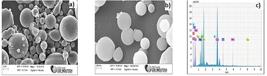
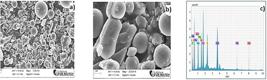
The SEM image of bauxite residue displays irregular, angular, and flaky particles with coarse surfaces and low roundness, suggesting a high surface area and dense particle packing.
The EDAX spectrum of bauxite residue exhibits prominent Fe peaks, indicating a high presence of iron oxides, accompanied by elements like Al, Ti, Si, and Ca, reflecting a composition rich in industrial oxides. The abundance of oxygen corresponds to various oxide phases, while trace amounts of Na, Ba, and C likely originate from processing residues or contamination.
SEM analysis of GGBS shows angular and irregular particles with partially crystalline textures, confirming its processed nature and high reactivity. At high magnification, the dense and jagged morphology suggests enhanced surface area.
The EDAX spectrum shows dominant peaks for Ca, Al, Si, and Mg, indicating the presence of key oxides in GGBS. Minor elements like K, Ti, Mn, and Cu suggest trace impurities or residues from processing.
The SEM images of fly ash show predominantly smooth, spherical particles of varying sizes, typical of its vitreous, glassy nature. This spherical morphology enhances flowability and improves the packing density, contributing to better workability.
The EDAX spectrum of fly ash reveals major elements like Si, Al, and Ca, confirming its siliceous and aluminous composition typical of pozzolanic materials. Trace elements such as K, Mg, Mn, Ti, and Cu indicate minor impurities from combustion and collection processes.
The SEM images show the microstructure of I-Crete particles, revealing a heterogeneous mix of spherical and angular particles. The variation in shape and size suggests a combination of processed and natural materials, enhancing packing density and mechanical properties.
The EDAX spectrum of I-Crete reveals the presence of key elements such as Ca, Si, Al, Fe, and Mg, indicating the presence of cementitious and pozzolanic materials. The dominant calcium and silicon peaks confirm the material’s suitability for concrete applications.
6.2. For products
6.2.1. Geopolymer-based bauxite residue tiles (GBRT)
The FESEM images of GBRT at varying magnifications, as shown in Figure 21, The FESEM micrographs of bauxite residue–based geopolymer tiles exhibit dense, compact, and well-bonded matrices, particularly in mixes containing GGBS and fly ash. Adding GGBS (10–20%) noticeably refines the microstructure, producing a smooth and continuous gel-like phase, indicative of extensive geopolymer gel formation. Angular and irregular particles observed correspond to unreacted bauxite residue, while the surrounding gel indicates reaction progression. The voids and microcracks visible in the control mix diminish significantly with increasing GGBS content, reflecting enhanced matrix densification and reduced porosity. The microstructural refinement is attributed to the calcium-rich nature of GGBS, which contributes to the simultaneous formation of C-A-S-H (calcium aluminosilicate hydrate) alongside N-A-S-H (sodium aluminosilicate hydrate) gels from bauxite residue and fly ash. This hybrid gel system (C-A-S-H + N-A-S-H) enhances structural integrity, reducing pore connectivity and improving mechanical strength. Overall, FESEM images confirm a progressive transition from a porous to a dense and continuous matrix with the incorporation of GGBS, validating the mechanical strength results.

The EDAX image, as shown in Figure 22, GBRT shows prominent peaks for Si, Al, Fe, Ca, Na, and O, confirming the geopolymeric nature of the matrix. High Si and Al concentrations indicate the formation of an aluminosilicate framework, the backbone of the geopolymer gel. Elevated Ca content in GGBS-containing mixes signifies the presence of C-A-S-H gel, which coexists with N-A-S-H, contributing to improved strength and reduced permeability. Fe peaks originate mainly from bauxite residue, and their uniform distribution suggests incorporating Fe3+ ions within the gel network, potentially enhancing matrix densification. A moderate Na peak confirms the participation of the alkaline activator (NaOH/Na2SiO3), which facilitates dissolution of aluminosilicate species and their subsequent polycondensation. Moreover, the even distribution of Fe, Si, and Al indicates homogeneous reaction throughout the material, minimizing localized weaknesses.

The XRD image of image as shown in Figure 23, the diffraction pattern showed a dominance of orthorhombic and cubic crystalline phases, with Strontium Stannate (SnSrO3) being the principal constituent (46%). This phase typically indicates a stable, well-crystallized structure, often formed under high-temperature conditions. Lanthanum-based and niobate complexes suggest partial substitution or trace elements from the raw materials, possibly bauxite residue. The relatively high crystallinity and presence of complex metal oxides point to a chemically stable. Figure 23 exhibits a highly crystalline matrix dominated by metal oxides and stannates, implying geopolymerization and a high-temperature reaction pathway rather than complete amorphous gel development.

6.2.2. Conventional tiles
The FESEM images of GBRT at varying magnifications, as shown in Figure 24, The FESEM morphology of conventional cement tiles reflects the hydration reaction of clinker phases (C3S and C2S), which form C–S–H and CH as the main binding compounds. The C–S–H gel appears as an amorphous, continuous phase that provides structural strength, while the CH crystals contribute to porosity and potential durability issues. Microcracks and pores indicate incomplete packing or evaporation of mixing water. The high Ca and Mg content suggests the formation of dense fibrous or layered C–S–H and M–S–H gels, visible under FESEM as compact, interlocking structures.

The EDAX results for this Sample indicated, as shown in Figure 25, that the tile matrix consists mainly of calcium and magnesium silicate hydrates, with minor alumina and iron oxides. The elemental composition and Ca/Si ratio confirm a hydration-based reaction mechanism rather than a geopolymeric one. This composition correlates with a microstructure dominated by crystalline C–S–H phases, which are responsible for mechanical integrity but may result in moderate porosity and lower chemical stability than amorphous geopolymer systems.

The XRD image, as shown in Figure 26, displayed a greater diversity of crystalline compounds, particularly silicate and oxide phases. Tridymite, a high-temperature crystalline form of silica, indicated significant geopolymer reaction or thermal treatment, where amorphous silica reorganized into crystalline form. Lead niobate and Ni–Thulium phases point to trace metallic oxide crystallization, possibly derived from mineral impurities or activator reactions. However, the higher proportion of Tridymite and cubic phases suggests partial amorphous-to-crystalline transformation, meaning this sample underwent a more geopolymeric extensive response. Figure 25 shows moderate crystallinity with more silica-based phases. The presence of Tridymite reflects stabilized Si–O–Al frameworks, typical of matured gel matrices.

7. COST COMPARISON OF CHEQUERED TILES
Table 7 shows the costs of conventional chequered tiles and geopolymer-based bauxite residue tiles for the present study.
From Table 7, the cost of conventional tiles was approximately 16.84 rupees, while GBRT tiles cost around 14.77 rupees. Although the costs are relatively similar, GBRT production incorporates three different industrial byproducts, which aid in managing industrial waste and enhance sustainability.
8. CONCLUSION
This study broadly highlights the potential of utilizing industrial by-products and innovative techniques to develop environmentally sustainable geopolymer bauxite residue tiles, addressing the need for eco-friendly solutions. Although bauxite residue exhibits moderate properties compared to traditional cementitious materials, its integration with supplementary materials significantly enhances the overall performance of GBRT. When compared to conventional tiles, GBRT is produced using three different industrial byproducts, making it more environmentally friendly and sustainable. Conventional tiles, on the other hand, use cement, which contributes to carbon emissions. By adjusting bauxite residue replacement levels and strategically incorporating GGBS and fly ash as supplementary cementitious materials, the mix achieves improved strength and durability. Ultimately, geopolymer-based bauxite residue tiles (GBRT) provide a sustainable approach to repurposing industrial waste into valuable architectural materials. Their eco-friendly nature and potential as alternatives to traditional tiles support sustainable construction, reducing environmental impact. This research contributes to creating a more sustainable built environment by minimizing reliance on conventional materials and promoting greener construction practices.
Further, the conclusions derived from the research are presented below.
-
The wet transverse strength efficiency of GBRT in mix S2 improved by up to 1.03% compared to the conventional mix at 28 days.
-
Water absorption in mix S2 decreased by 0.51% relative to the conventional mix.
-
The wear and tear of GBRT in mix S2 was reduced by 0.38 mm compared to the conventional mix.
-
After 28 days, the water absorption of GBRT in the P, Q, and R series was reduced by 23.56%, 11%, and 19.43% due to an increase in the proportion of bauxite residue and a decrease in the proportion of fly ash.
-
For the mix S1, the water absorption at 28 days is found to be reduced to 6.24% from 12.52% for the mix P1, which is due to the presence of GGBS.
-
Among the 16 different mixes, the mix (R30G20F50I02), having 30% of bauxite residue, 20% GGBS, 50% fly ash, and 2% of I-Crete after 28 days, had a high wet transverse strength of 6.285 MPa, and resistance to wear of 3.26 mm.
-
The average gap measured for flatness was 0.6 mm, an average maximum gap for perpendicularity was 1%, and the average of the most significant gaps for straightness recorded was 0.8%, for GBRT falling within the prescribed limits of IS:13801-2013.
-
Incorporating 10–20% GGBS significantly enhanced early strength due to improved pozzolanic activity. Adding 2% I-Crete further boosted the strength up to 8.642 N/mm2 at 90 days, demonstrating its effectiveness in strengthening wet transverse strength at later ages.
-
Adding GGBS and I-Crete, along with BR and FA, decreased the water absorption to the tune of 6.28%.
-
The wet transverse strength after 28 days increased from 1.886 MPa (P1) to 6.285 MPa (S2), showing enhanced performance of GBRT.
-
Resistance to wear after 28 days decreases from 4.51 mm to (P1) to 3.26 mm (S2), showing better wear resistance.
-
Percentage of increase in compressive strength test for optimum GBRT mix proportions and conventional tiles at 90 days is 4.348%.
-
Percentage of increase in impact resistance test values for optimum GBRT mix proportions and conventional tiles at 90 days is 7.143%.
-
The incorporation of bauxite residue, ground granulated blast furnace slag, fly ash, and I-Crete in combination contributes to enhanced tile properties through sustainable and performance-oriented material optimization.
-
The cost difference per tile between GBRT and the conventional mix tile is about 2.07 rupees.
9. BIBLIOGRAPHY
- [1] DANSO, H., BOADI, J.K., “Replacement of sand with bauxite mining waste in concrete production”, Journal of Materials and Engineering Structures, v. 6, n. 4, pp. 525–534, 2019.
-
[2] SCRIBOT, C., MAHERZI, W., BENZERZOUR, M., et al, “A laboratory-scale experimental investigation on reusing a modified Bauxite residue in ceramic materials production”, Construction & Building Materials, v. 163, pp. 21–31, 2017. doi: https://doi.org/10.1016/j.conbuildmat.2017.12.092.
» https://doi.org/10.1016/j.conbuildmat.2017.12.092 -
[3] JIANG, J., SU, J., OU, X., et al, “Study on the physical and mechanical properties of bauxite residue by laboratory and field in-situ tests”, Environmental Earth Sciences, v. 80, n. 10, pp. 377, 2021. doi: https://doi.org/10.1007/s12665-021-09679-3.
» https://doi.org/10.1007/s12665-021-09679-3 -
[4] MOURATIDIS, A., NIKOLIDAKIS, P., “Engineering properties of bauxite residue”, International Journal of Sustainable Development and Planning, v. 15, n. 3, pp. 319–325, 2020. doi: https://doi.org/10.18280/ijsdp.150308.
» https://doi.org/10.18280/ijsdp.150308 -
[5] AFOLABI, L.O., ARIFF, Z.M., MEGAT-YUSOFF, P.S.M., et al, “Red-mud geopolymer composite encapsulated phase change material for thermal comfort in the built sector”, Solar Energy, v. 181, pp. 464–474, 2019. doi: https://doi.org/10.1016/j.solener.2019.02.029.
» https://doi.org/10.1016/j.solener.2019.02.029 -
[6] SINGH, R.P., VANAPALLI, K.R., CHEELA, V.R.S., et al, “Fly ash, GGBS, and silica fume-based geopolymer concrete with recycled aggregates: properties and environmental impacts”, Construction & Building Materials, v. 378, pp. 131168, 2023. doi: https://doi.org/10.1016/j.conbuildmat.2023.131168.
» https://doi.org/10.1016/j.conbuildmat.2023.131168 -
[7] SRUTHI, S., GAYATHRI, V., “Synthesis and evaluation of eco-friendly, ambient-cured, geopolymer-based bricks using industrial by-products”, Buildings, v. 13, n. 2, pp. 510, 2023. doi: https://doi.org/10.3390/buildings13020510.
» https://doi.org/10.3390/buildings13020510 -
[8] PROVIS, J.L., BERNAL, S.A., “Geopolymers and related alkali-activated materials”, Annual Review of Materials Research, v. 44, n. 1, pp. 299–327, 2014. doi: https://doi.org/10.1146/annurev-matsci-070813-113515.
» https://doi.org/10.1146/annurev-matsci-070813-113515 -
[9] GANESH, A.C., MUKILAN, K., SRIKAR, B.P.V., et al, “Effect of fly ash- rice husk ash blend in the energy efficient geopolymer tiles using industrial wastes”, Materials Science Forum, v. 1048, pp. 403–411, 2022. doi: https://doi.org/10.4028/www.scientific.net/MSF.1048.403.
» https://doi.org/10.4028/www.scientific.net/MSF.1048.403 -
[10] BAYRAK, B., MOSTAFA, S.A., ÖZ, A., et al, “The effect of clinker aggregate on acid resistance in prepacked geopolymers containing metakaolin and quartz powder in the presence of ground blast furnace slag”, Journal of Building Engineering, v. 69, pp. 106290, 2023. doi: https://doi.org/10.1016/j.jobe.2023.106290.
» https://doi.org/10.1016/j.jobe.2023.106290 -
[11] TAYEH, B.A., BAYRAK, B., ZEYAD, A.M., et al, “Effect of hybrid fibers and high temperatures on the properties of geopolymer composites based on slag, metakaolin, and natural zeolite”, Construction & Building Materials, v. 451, pp. 138898, 2024. doi: https://doi.org/10.1016/j.conbuildmat.2024.138898.
» https://doi.org/10.1016/j.conbuildmat.2024.138898 -
[12] RIOS, L.M., TRIVIÑO, A.F.H., VILLAQUIRÁN-CAICEDO, M.A., et al, “Effect of the use of waste glass (as precursor and alkali activator) in the manufacture of geopolymer rendering mortars and architectural tiles”, Construction & Building Materials, v. 363, pp. 129760, 2023. doi: https://doi.org/10.1016/j.conbuildmat.2022.129760.
» https://doi.org/10.1016/j.conbuildmat.2022.129760 -
[13] GÜLMEZ, N., KOÇKAL, N.U., ÖZEN, Ş., et al, “Corrosion potential and electromagnetic shielding effectiveness of geopolymer tiles produced with waste metal particles”, Sadhana, v. 47, n. 3, pp. 115, 2022. doi: https://doi.org/10.1007/s12046-022-01891-6.
» https://doi.org/10.1007/s12046-022-01891-6 - [14] BALAKUMARAN, M., XAVIER, C.T., KUMAR, P.P., et al, “Comparative studies on floor tiles using geopolymer concrete and cement concret”, International Journal of Engineering Research & Technology (Ahmedabad), v. 3, n. 11, pp. 1–4, 2015.
-
[15] MURTHI, P., POONGODI, K., REDDY, I.R., “Effect of bacteria on strength and porosity of M-sand based pumpable concrete”, IOP Conference Series. Materials Science and Engineering, v. 981, n. 3, pp. 032078–032078, 2020. doi: https://doi.org/10.1088/1757-899X/981/3/032078.
» https://doi.org/10.1088/1757-899X/981/3/032078 - [16] WESCHE, K., Fly ash in concrete: properties and performance, New York, Taylor & Francis, 2011.
- [17] PAVITHRAA, R., PORKODI, N., “Experimental study on the behaviour of geopolymer tiles with GGBS and M-Sand”, International Research Journal of Engineering and Technology, v. 8, n. 9, pp. 611–615, 2021.
-
[18] KANYAL, K.S., AGRAWAL, Y., GUPTA, T., “Properties of sustainable concrete containing red mud: a review”, Journal of Scientific Research and Reports, v. 27, n. 3, pp. 15–26, 2021. doi: https://doi.org/10.9734/jsrr/2021/v27i330366.
» https://doi.org/10.9734/jsrr/2021/v27i330366 -
[19] MARVILA, M.T., AZEVEDO, A.R.G., GAMA, F.D., et al, “Application of flue gas desulfurization waste for the production of geopolymer tiles”, In: Zhang, M., Li, J., Li, B., et al (eds), Characterization of minerals, metals, and materials 2022, Cham, Springer, pp. 39–46, 2022. doi: https://doi.org/10.1007/978-3-030-92373-0_4.
» https://doi.org/10.1007/978-3-030-92373-0_4 -
[20] AZEVEDO, A.R.G., VIEIRA, C.M.F., FERREIRA, W.M., et al, “Potential use of ceramic waste as precursor in geopolymerization reaction for the production of ceramic roof tiles”, Journal of Building Engineering, v. 29, pp. 101156, 2020. doi: https://doi.org/10.1016/j.jobe.2019.101156.
» https://doi.org/10.1016/j.jobe.2019.101156 - [21] KOWSHIKA, V.R., BHASKARAN, V., NATARAJAN, R.K., “Increasing profits of ready-mix concrete by using cutting-edge new additive”, Journal of Emerging Technologies and Innovative Research, v. 9, n. 4, pp. 428–432, 2022.
- [22] DESHMUKH, M., SHAIKH, S., IYER, C.B., et al, “Recycling of raw bauxite-residue from the alumina industry for the production of chequered tile”, International Journal of Engine Research, v. 9, n. 4, 2021.
- [23] MALIK, P., MALHOTRA, J., VERMA, A., “Mix design for concrete with crushed ceramic tiles as coarse aggregate”, International Journal of Civil Engineering Research, v. 5, n. 2, pp. 151–154, 2014.
- [24] SEKHAR, S., THOMAS, A., CLYDIN, P.A., “Strength characteristics of geopolymer concrete floor tiles on various mix proportions”, International Journal of Engine Research, v. 10, n. 6, pp. 431–436, 2021.
-
[25] ZEYAD, A.M., BAYRAKTAR, O.Y., TAYEH, B.A., et al, “Impact of rice husk ash on physico-mechanical, durability, and microstructural features of rubberized lightweight geopolymer composite”, Construction & Building Materials, v. 427, pp. 136265, 2024. doi: https://doi.org/10.1016/j.conbuildmat.2024.136265.
» https://doi.org/10.1016/j.conbuildmat.2024.136265 - [26] KUMAR, N., JAGLAN, A., “Utilization of bauxite residue in construction: a review”, International Research Journal of Engineering and Technology, v. 7, n. 11, pp. 469, 2020.
- [27] SHAH, A., AKHILA, A., JAISAN, D.M., et al, “Development of clay tiles based on novel materials from red mud: a case study analysis”, International Journal of Engine Research, v. 9, n. 9, pp. 63–65, 2021.
- [28] BHASKAR, M., AKHTAR, S., BATHAM, G., “Development of the bricks from bauxite residue by industrial waste (red mud)”, International Journal of Emerging Science and Engineering, v. 2, n. 4, pp. 7–12, 2014.
-
[29] MARVILA, M.T., AZEVEDO, A.R.G., DELAQUA, G.C.G., et al, “Performance of geopolymer tiles in high temperature and saturation conditions”, Construction & Building Materials, v. 286, pp. 122994, 2021. doi: https://doi.org/10.1016/j.conbuildmat.2021.122994.
» https://doi.org/10.1016/j.conbuildmat.2021.122994 -
[30] AKARKEN, G., YILDIRIM, Y., CENGIZ, U., “Innovative geopolymer tiles for indoor humidity control: a comparative study of moisture buffering performance”, ACS Omega, v. 10, n. 9, pp. 9197–9209, 2025. doi: https://doi.org/10.1021/acsomega.4c09422.
» https://doi.org/10.1021/acsomega.4c09422 - [31] KUMAR, K., HARISH, K.S., “Experimental study on utilization of bauxite residue and used foundry sand in cement concrete”, International Research Journal of Engineering and Technology, v. 4, n. 6, 2017.
-
[32] HAMDI, O.M., BOUMAZA, A., ALIOUI, H., et al, “Response surface methodology to model the effects of key synthesis parameter interactions on mechanical and microstructural properties of natural pozzolan-based geopolymers”, Construction & Building Materials, v. 478, pp. 141411, 2025. doi: https://doi.org/10.1016/j.conbuildmat.2025.141411.
» https://doi.org/10.1016/j.conbuildmat.2025.141411 -
[33] SHI, X., ZHANG, C., WANG, X., et al, “Response surface methodology for multi-objective optimization of fly ash-GGBS based geopolymer mortar”, Construction & Building Materials, v. 315, pp. 125644, 2022. doi: https://doi.org/10.1016/j.conbuildmat.2021.125644.
» https://doi.org/10.1016/j.conbuildmat.2021.125644 -
[34] BUYONDO, K.A., OLUPOT, P.W., KIRABIRA, J.B., et al, “Optimization of production parameters for rice husk ash-based geopolymer cement using response surface methodology”, Case Studies in Construction Materials, v. 13, pp. e00461, 2020. doi: https://doi.org/10.1016/j.cscm.2020.e00461.
» https://doi.org/10.1016/j.cscm.2020.e00461 -
[35] KATHIRVEL, P., KALIYAPERUMAL, S.R.M., “Probabilistic modeling of geopolymer concrete using response surface methodology”, Computers and Concrete, v. 19, n. 6, pp. 737–744, 2017. doi: https://doi.org/10.12989/CAC.2017.19.6.737.
» https://doi.org/10.12989/CAC.2017.19.6.737 - [36] INDIA, MINISTRY OF ENVIRONMENT, FOREST AND CLIMATE CHANGE, Guidelines for Handling and Management of Red Mud Generated from Alumina Plants, Central Pollution Control Board, Ministry of Environment, Forest and Climate Change, Delhi, 2023.
-
[37] JI, X., WANG, Z., ZHANG, H., et al, “Optimization design and characterization of slag cementitious composites containing carbide slag and desulfurized gypsum based on response surface methodology”, Journal of Building Engineering, v. 77, pp. 107441, 2023. doi: https://doi.org/10.1016/j.jobe.2023.107441.
» https://doi.org/10.1016/j.jobe.2023.107441 -
[38] GOVARDHAN, C., GAYATHRI, V., “Experimental investigation on ternary blended recycled aggregate concrete using glass fibers”, Buildings, v. 13, n. 8, pp. 1961, 2023. doi: https://doi.org/10.3390/buildings13081961.
» https://doi.org/10.3390/buildings13081961 -
[39] BILONDI, M.P., GHAFFARIAN, V., DALUEE, M.A., et al, “Experimental studies on mix design and properties of ceramic-glass geopolymer mortars using response surface methodology”, Scientific Reports, v. 15, n. 1, pp. 282, 2025. doi: https://doi.org/10.1038/s41598-024-82658-3.
» https://doi.org/10.1038/s41598-024-82658-3