 Evaluation of the toxicity of pervious concretes with WFS through germination tests with Eruca sativa (arugula) and Triticum aestivum (wheat) seeds
ABSTRACT
Concrete is the most used construction material, which results in harmful impacts on the environment due to the consumption of natural resources. Hence the need to use alternative materials, e.g., waste from the construction sector and even from other production sectors. This context includes the development of concrete with sustainable functionality, such as pervious concrete with the incorporation of waste foundry sand (WFS), a waste generated by the foundry sector. However, there is a scientific gap focusing on the environmental viability of pervious concretes. In this sense, this study aims to evaluate the toxicity of pevious concretes with WFS, through germination tests with Eruca sativa (arugula) and Triticum aestivum (wheat) seeds. The statistical analysis of the results showed that there was no significant harmful effect from the incorporation of WFS on the germination rate for both seeds used. Regarding root growth, it was observed that WFS II concrete (>% Portland cement) had a lower impact on arugula seeds (more sensitive). Therefore, the pervious concrete with WFS developed was found to be safe in relation to phytotoxicity.
Keywords:
Sustainable concrete; Leachate; Environmental safety; Environmental impact
1. INTRODUCTION
Due to the global trend towards sustainable development requirements, the generation of solid waste must be reduced and the remainder must be reused, either through the practice of reverse logistics, or as an alternative raw material. When this is not possible, these become waste and sending them to licensed landfills becomes the most viable option [1, 2]. In this sense, the productive sectors must operate with a focus on reducing the solid waste generated, and when it is not possible to eliminate it, propose and encourage the use of this waste as raw material for the sector itself or in other productive sectors, as long as it has been previously studied. This will make it possible to reduce environmental and socio-economic impacts and achieve the zero-waste goal. It is worth highlighting that possibility of reusing this solid waste can bring important aspects of the circular economy in civil construction [3, 4]. In addition, there are regard is the increasing consumer demand for environmentally friendly materials and construction systems, in addition to optimizing and increasing the useful life of landfills [2, 4].
The correct selection of eco-friendly materials for concrete mixes must take into account not only the fresh, mechanical, and durability properties, but also the sustainability and circular economy aspects of these materials [5].
In this scenario, it is possible to include several productive sectors as generators of solid waste with co-product characteristics, for example, the metal casting sector, which generates several types of solid waste, with emphasis on waste foundry sand (WFS). According to recent data, a global generation of 100 million tons per year is estimated. This waste is already considered a co-product due to its various uses, mainly in civil construction [2, 6]. When focusing on the use of WFS in cementitious materials, there are several studies on its use as fine aggregate in different types of concrete (structural and non-structural, highly compactable, permeable), which presented promising results [1, 7,8,9].
Some studies report that the partial replacement of sand with WFS in conventional concrete does not bring about negative changes in its mechanical properties [2, 10, 11]. Unlike, BHARDWAY and KUMAR 12 reportin that the use of WFS in concrete provided better performance and durability, contingent on a material dosage study. In addition, the use of WFS as a replacement for natural sand in concrete production is an ecologically viable alternative, considering a more sustainable approach to current construction systems [2].
Among the various types of concrete, there is a significant increase in the demand for permeable concrete, mainly in urban paving, due to the need to maintain a minimum permeable area, respecting the requirements imposed by laws and guidelines (municipal master plans for land use and occupation). The use of pervious concrete, either as paving or in precast paving pieces, allows greater infiltration of rainwater due to its porous surface. This makes it possible to reduce surface runoff during periods of heavy rainfall, which can prevent flooding and landslides on slopes. In addition to these benefits, permeable concrete also helps to maintain groundwater volumes and reduce the harmful effects of urbanization, such as urban heat islands [13, 14].
However, with the increase in porosity required for this type of concrete, there is a reduction in mechanical properties, directing its use to light traffic pavements, such as sidewalks, cycle paths and walking paths, or even parking lots for small vehicles [15, 16]. One way to reduce these problems is to use other materials to compose permeable concrete, for example, industrial solid waste. Therefore, there are several studies on permeable concrete with waste (from construction and demolition; ornamental rocks; slag and waste foundry sand) [17,18,19].
BRASILEIRO et al. [17] studied pervious concrete made by replacing fine aggregate with construction and demolition waste (CDW), at rates of 40%, 50% and 60%. These authors concluded that pervious concrete with 40% CDW aggregate presented the best results regarding compressive strength and permeability when compared to the reference. In addition, by incorporating of the solid waste, it becomes an environmental friendly material, as it reduces the volume of waste sent to landfills, besides reducing the extraction of natural resources.
Among the studies cited, those that used WFS to replace sand in permeable concrete reported promising results [7]. CANDIAN FILHO et al. [7] studied the use of WFS in two pervious concrete mixes (consumption of 150 kg and 250 kg of Portland cement per m3 of concrete), replacing 100% of fine aggregate with WFS. The results indicated that the presence of this type of waste did not significantly alter hydraulic conductivity, the most important property for this type of concrete.
The pervious concrete has been gaining ground in the national and international market due to its hydraulic properties, which make it possible to increase the pervious surface in urban areas [15, 20]. The advantages of pervious concrete include reduced formation of water puddles on sidewalks and parking lots thanks to infiltration. Consequently, this increases downstream runoff systems and regulation of underground water sources.
The fine particle material in concrete can be leached by the natural action of rain, wind and temperature, or by wear and tear from mechanical abrasion, which can cause environmental contamination of soils and groundwater, when used in paving. Hence the need for studies on the environmental impact of the percolation of these leachates [21].
One way to assess this is through the toxicity of the materials leached from pervious concrete. In this study, we suggest adapting the methodology already widely applied to soils for this purpose, through the germination tests with Eruca sativa (arugula) and Triticum aestivum (wheat) seeds.
1.1. Environmental parameters of concretes with waste foundry sand
Although there are studies on replacing fine concrete aggregate (common sand) with WFS, most of these are conducted to verify the mechanical parameters of resistance and durability, without addressing environmental safety, both of the waste used in these concretes, and the possibility of contamination of leachate and groundwater when coming into contact with these materials.
Although the WFS batches most commonly used in civil construction are classified as II-A (non-hazardous and non-inert), there is a risk of some metallic compounds (Cd, Hg and As) being leached into the environment [22]. On the other hand, it is known that cementitious matrices have the capacity to encapsulate metals, which may avoid possible contamination (soil and water) through leachate [23, 24]. However, it is still important to obtain environmental parameters from leachate samples that are representative of solutions percolated by cementitious materials, which may come into contact with soil and surface and groundwater. This can occur with conventional or permeable concretes, but the percolation of solutions in permeable concretes is even more significant.
BOCHARE et al. [1] studied the environmental parameters of conventional concretes with 30% replacement of fine aggregate by WFS. These authors concluded that there was an increase in pH and alkalinity values, and on the other hand, a reduction in total dissolved solids in the leached extracts.
MARQUES et al. [19] studied a methodology for dosing concrete mixes with fine aggregate replaced by 25%, 50% and 100% of WFS. The results indicated that the presence of WFS improved the mechanical properties of the concrete, which was attributed to the coal dust present in the WFS sample used in the study. This occurred due to the deposition of carbon particles inside the matrix pores, i.e., filler effect.
Prominent among the analysis methods that can be used for environmental impact categories related to toxicity is phytotoxicity of solubilized materials. This test is recommended by environmental agencies such as the United States Environmental Protect Agency (EPA) and the Environmental Company of the State of São Paulo - Brazil (CETESB). In addition, toxicity tests have the advantage of being low cost and providing quick answers [25].
Toxicity tests with seeds have been applied in studies with cementitious materials composed of solid waste [8, 26,27,28]. STAROŃ et al. [27] evaluated the toxicological risk of concrete blocks with the addition of cooking oil through phytotoxicological tests with sweet sorghum.
This attests to the versatility of this kind of test, which can be used to assess the toxicity of different materials. ALIAS et al. [26] who evaluated the potential of concrete containing steel slag as a partial replacement for natural aggregates, also evaluated the effect on seeds in the soil. In leaching tests on concrete mixtures (traits), phytotoxicity was tested on seeds of Lepidium sativum, Cucumis sativus and Allium cepa, none of the samples caused a phytotoxic effect, what was observed an increase in root elongation of Cucumis sativus and Allium cepa seeds.
Therefore, the objective of this study is to obtain toxicity parameters through toxicity testing of pervious concrete with WFS replacing aggregate (quartz sand). The results, obtained from the germination and root elongation of two types of seed (arugula and wheat), will be compared with data from reference concrete and the literature.
Thus, it will be possible to fill this gap in the knowledge of the use of WFS in cementitious materials, more specifically pervious concrete, due to its function of enabling percolation. Some studies have already been conducted on the mechanical performance (strength) and hydraulic behavior of concretes using waste, but environmental characterization research is still incipient in the literature. In this sense, this study presents an innovative approach focusing on the environmental viability of permeable concretes using WFS through the evaluation of the toxicity parameter using wheat and arugula seeds. This methodology, which consists of quantifying seed germination and elongation of germinated roots, is consolidated for soil studies and is adapted for analysis of leachate extracted from permeable concretes.
Therefore, it is worth mentioning that comparative literature is still incipient, since toxicity analysis with seed germination is standardized for detecting pollutants in soils, and this methodology is adapted for leachates obtained from permeable concretes. Thus, this study has an innovative character, by proposing this environmental analysis for concretes with sustainable materials, in addition to being considered an effective method, with fast results and low cost [29]. Research that explores the environmental conditions of the use of industrial and construction waste meets global solid waste management policies and is a concern for the political, private and scientific spheres.
2. MATERIALS AND METHODS
The methodology stage followed the following criteria:
-
a)
mechanical, hydraulic and physical-chemical characterization of materials – quartz sand (QS) and waste foundry sand (WFS);
-
b)
determination of 4 mixtures of development of concrete (reference - QS I and QS II) and pervious concrete with WFS (innovation - WFS I and WFS II);
-
c)
determination of the mechanical properties of the four concrete mixes;
-
d)
physicochemical analysis of leachate from pervious concrete with WFS;
-
e)
solubilized material phytotoxicity tests with WFS through germination tests with Eruca sativa (arugula) and Triticum aestivum (wheat) seeds;
-
f)
statistical treatment of datas.
2.1. Mechanical, hydraulic and physical-chemical characterization of materials
The concretes analyzed in this research were developed with CP V-ARI (High Initial Strength) Portland cement. The batch of WFS used was identified as “greensand” that is, composed of sand, coal and bentonite, without the addition of organic-based resins (Figure 1). As a result, the WFS was classified, according to NBR 10004 [30], as II-A (non-hazardous and non-inert). In turn, quartz sand (QS) and coarse aggregate were obtained from the crushing of natural rocks. The results of the characterization of the materials are shown in Table 1. According to the particle size analysis, WFS was classified in the lower usable zone, the same classification given to quartz sand (QS), according to ASTM C 136 [31] and ISO 6274:1982 [32]. In relation to the fineness modulus (FM), QS was classified as “fine” and WFS as “very fine”, which corroborates other studies on the use of WFS as fine aggregate [33, 34].

Physical characterization of samples of quartz sand (QS), coarse aggregate and waste foundry sand (WFS).
The difference between the specific mass values of quartz sand (2.62 g/cm3) and WFS (2.50 g/cm3) resulted in an additional 0.5 kg of WFS for each m3 of pervious concrete (Figure 2). The proportion of materials used to four concretes (kg/m3 of concrete) is shown in Table 2.

The determination of the mechanical properties of the four concrete mixes studied included compressive strength tests on 120 pieces of pervious concrete (pavers), in accordance with NBR 5738 [35]. The results of these tests are shown in Figure 3 and compressive strength minimum value to pavers (NBR 16416). The average values obtained were between 14.9 MPa and 33 MPa, considering 7 and 28 days of curing.

When comparing the compressive strength results with the NBR 16416 [35] standard, it appears that only mix II (trait II) (451.5 to 452.5 kg/m3 concrete), reached the minimum strength of 20 MPa (light traffic). In relation to the data available in the literature, it appears that there are no other studies on the use of WFS in pervious concrete [17]. Therefore, it is worth comparing these results with pervious concrete composed of other types of waste (construction and demolition waste; rock powder waste). The use of WFS did not impair this property, reaching values higher than those found in the literature, even with the total replacement of QS by WFS. In turn, regarding the minimum resistance limit that the pieces must reach after 28 days of curing, it is observed that the mixes with the highest PC consumption met the minimum value of 20 MPa, adopted for light traffic (parking lots, sidewalks, cycle lanes).
Regarding the percolation capacity of concrete pieces with WFS, permeability tests were carried out according to the recommendations of the AMERICAN CONCRETE INSTITUTE [36], adapted by BATEZINI and BALBO [37]. According to ACI 522-R-10, K must be from 0.93 to 1.67 cm/s, which was met with the results of the mixes with WFS (1: 1.27 cm3/s; 2: 1.13 cm3/s).
2.2. Solubilized material phytotoxicity tests
For the phytotoxicity tests, solubilized extracts were obtained in accordance with NBR 10006 [30] from the cementitious matrix of concrete with quartz sand (QS), pervious concrete with foundry sand (WFS) and from distilled water, used as positive control.
The toxicity tests were carried out with Eruca sativa (arugula) and Triticum aestivum (wheat) seeds, separately and in triplicate, in accordance with EPA 850.4200 [38] and adapted OECD 208 [39]. This standard recommends the use of seeds from monocotyledonous and dicotyledonous species, due to their different sensitivity to germination and root elongation when in contact with potentially toxic materials. Figure 4 illustrates the phytotoxicity test setup.

The test was set up by preparation of the petri dish with filter and addition of 4 ml of the solution, plus arugula seeds, after 5 days, reading the root of the seeds. The plates were incubated for 120 hours in an environment with no light and at a controlled temperature of 20+ 2ºC (OPPTS 850.4200 EPA, 1996) (4).
2.3. Statistical treatment
The tests were performed in triplicate and the statistical analysis was performed using the Statistica 7.0® software, which was used for normality analysis by Shapiro-Wilk and ONE-WAY Analysis of Variance (ANOVA) when the data presented normality or Kruskal-Wallis when not parametrics [29]. Tukey HSD test was used to evaluate statistical differences between tests e Rstudio 2023.12.1 [40]. The methodology for analyzing results followed CHAN-KEB et al. [25] and OSMAN et al. [41], by calculating seed germination and the relative elongation inhibition index, enabling inference about the potential toxicity of the tested materials.
3. RESULTS AND DISCUSSION
3.1. Physicochemical analysis of leachate from pervious concrete with WFS
Regarding the physical-chemical characterization of the materials studied, solubilized extracts were analyzed for pH parameters, total hardness, electrical conductivity, alkalinity and total solids, the results of which are shown in Table 3, according to the APHA 1998 methodology.
Also conducted were X-RAY fluorescence (XRF) analyses using a Zetium XRF spectrometer (PANalytical). Loss by fire was conducted at 1020°C for two hours. The results obtained and the comparison with recent literature are shown in Table 4.
Chemical composition of WFS used in this study and WFS reported by different authors obtained by XRF.
WFS has a very significant amount of SiO2 in its composition, in addition to Al2O3 (2.71%) and Fe2O3 (2.37%), resulting from the bentonite clay used as a natural binder for this type of WFS, originating from the “green sand” [3]. MEHTA and ASHISH [42] verified that they studied the strength and properties of concrete improved with the inclusion of silica fume to a certain content in concretes. In this sense, concretes composed of WFS’s (composed basically of silica oxides) can be improved in their mechanical behavior [8].
Therefore, the aluminum concentration values in the WFS sample is higher compared to the samples with QS. This is due to the fact that WFS used in the study is based on bentonite. Other component such Cr2O3 (1.25%) result are bound in the silica matrix, not representing a compound that is harmful to the environment. The pH, electrical conductivity, total alkalinity, total solids and iron (Fe) element values are described in Table 5.
It is important to evaluate the chemical composition of concrete leachates to ensure environmentally safe use [21]. The alkaline character of the samples of the concrete solubilized (pH>7) is compatible with the pH of the permeable concrete (>11). According to POMPERMAIER et al. [9], the high pH value of the solubilized product can be attributed to the presence of alkaline ions in the concrete. However, according to JUSTNES et al. [43], the pH tends to decrease over time, due to the Ca(OH)2 in the concrete paste being consumed by the carbonation of the concrete, a physicochemical process between CO2 and the cement paste compounds, which occurs under alkaline conditions. Furthermore, it is observed that the solubilized samples with WFS presented higher values compared to QS.
According to MIKAMI et al. [44], the total solids are probably originated by the solubilization of inorganic compounds in the cement paste. The total hardness of the solubilized samples is greater than 300 mg.L–1 of CaCO3, therefore they are defined as very hard.
Furthermore, according to VADAMALAI and PARAMASIVAM [34], the presence of calcite in the form of CaCO3 determines high presence of calcium in cement paste, which causes the rise in binding strength and increases impermeability by acting as a barrier to hazardous substances, which may be interesting to reduce the infiltration of leachate in concretes with a higher cement content, as observed in this study (QS II and WFS II), causing an increase in total alkalinity.
Regarding electrical conductivity, an increase in value was observed for mix II, with greater cement consumption (QS II), which is related to the higher ionic concentration (electrolytes) of the solution. Regarding iron metal (Fe), the samples of the 4 concretes presented values below the detection limit (DL), according to the precision of the analysis method used. Therefore, none of the mixes reached values above those indicated by the regulations CONAMA 460 e EPAs (Guiding values for groundwater and maximum concentration of metals for toxicity characteristic and National primary drinking water regulations, respectively).
Considering the iron element, the values for all samples, all study mixtures (traits), we have as a result that the detection limit (DL) is greater than the values found in the analyses, thus being very small values, not presenting significance in its use for the production of pavers.
3.2. Toxicity of pervious concretes with WFS through germination tests with Eruca sativa (arugula) and Triticum aestivum (wheat) seeds
The root elongation results for the arugula and wheat seeds were treated statistically using the Shapiro-Wilk test to assess the similarity of normality with p > 0.05 and homogeneity p > 0.05 for Levene. They were then subjected to One-way Analysis of Variance (ANOVA) with p < 0.05 for arugula seeds and p > 0.05 for wheat seeds.
In order to identify statistical differences between the treatments, Tukey’s test for multiple comparisons was applied, which showed a statistical difference of p < 0.05 between WFS I and QS I; and WFS II and QS II for arugula seed. In both treatments, no statistical difference was observed for wheat seed p > 0.05.
Figure 5 shows the relative germination index (%) obtained for wheat and arugula seeds, applied to solubilized extracts of two concrete mixes with quartz sand (QS I and QS II) and two pervious concrete mixes with WFS (WFS I and WFS II). It is also possible to observe that there was no negative and significant effect of the incorporation of WFS on the germination rate for both seeds.

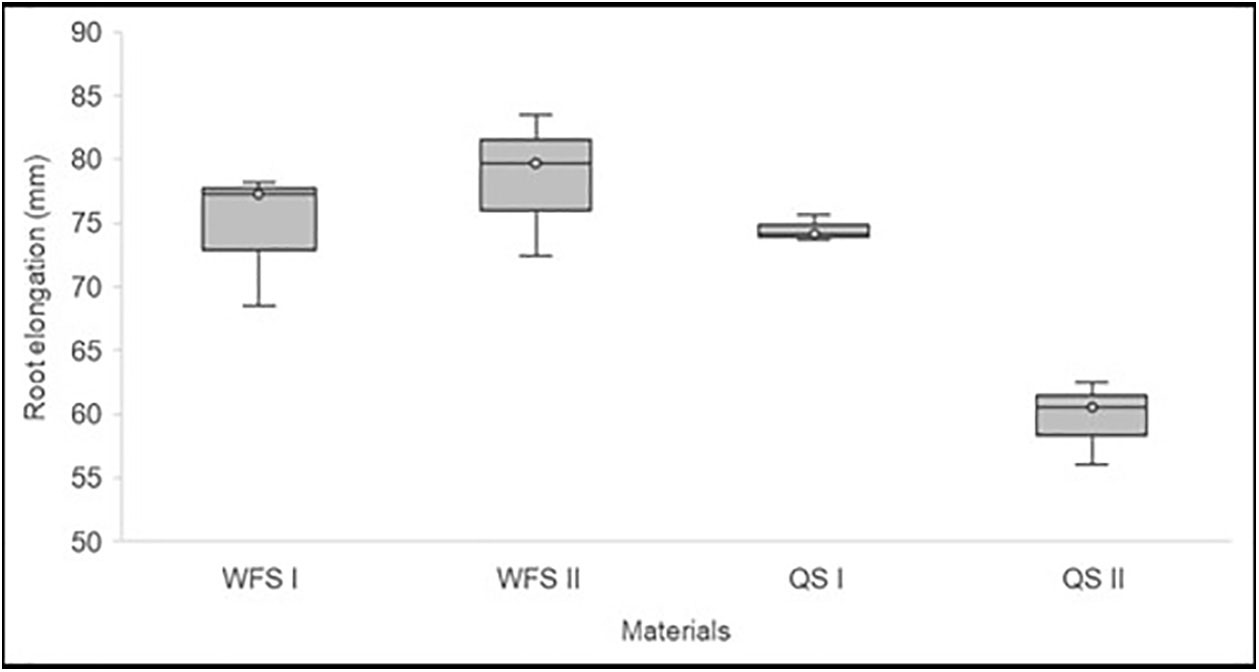
Figures 6 and 7 show the root growth percentage of wheat and arugula seeds, respectively, for the two mixes with quartz sand (QS I and QS II) and the two mixes of pervious concrete with WFS (WFS I and WFS II).


Regarding the exposure of the monocot wheat to the WFS I and QS I mixes, it was observed that there was no significant difference in root elongation in the wheat seeds (p > 0.05), Tukey’s test. However, when comparing exposure to the QS II and WFS II mixes, a statistically significant difference (p < 0.05) was found in the same parameter (root elongation), with greater root elongation when the seeds were exposed to WFS II.
When arugula was exposed to the WFS I and QS I mixes, root elongation showed a statistical difference (p < 0.05), with greater growth when exposed to QS I. The same occurred with exposure to WFS II and QS II, with a statistically significant difference between root elongation and greater root length when exposed to QS II.
Regarding the germination parameter, there was no germination inhibition in the wheat seed, while the arugula seed had inhibition of less than 8% when exposed to the extracts, Tukey’s test (p > 0.05).
This behavior can be explained in two ways: by the presence of some chemical compounds in the WFS and by the ability of the cementitious material to encapsulate chemical compounds present in the leachate, originating from the WFS. Some oxides, present in the WFS (Table 4) and probably present in the leachate, may have affected the (dicotyledonous) arugula seeds more than the (monocotyledonous) wheat seeds. When evaluating the phytotoxicological effects of microplastics in the soil through tests with seeds (wheat, corn, rice and lettuce), ZHANG et al. [45] identified different sensitivities in the seeds used in the study. The authors argued that the seed’s size may influence its resistance to contaminants present in solutions or in the soil.
The higher concentration of cement results in greater precipitation of CaCO3 (calcium carbonate) and, consequently, the filling up of pores between the aggregate particles and the cementitious paste. This causes the chemical compounds, deposited in those pores, to be encapsulated by the calcium carbonate resulting from the chemical hydration reactions of the concrete [19, 24, 46]. These chemical reactions are responsible for the alkalinity of the solubilized concrete, proven by the higher levels of total alkalinity of concrete with a higher content of Portland cement (QS II and WFS II). KURDA et al. [47,48], in their systematic review study of concrete leachates, they report that the reaction between CaO e H2O results in Ca(OH)2, causing the alkalization of the pH of concrete to a range of 10 to 12.
In addition, MARQUES et al. [19] reported that chemical reactions between hydrated calcium silicate, carbon dioxide and portlandite (Ca (OH)2) result in the formation of calcite (CaCO3). This process changes the solubility of the components and immobilizes potentially toxic metals, which may occur through adsorption or chemical interactions with the cementitious matrix. Additionally, the same authors report that free CaOH2+ deposits may have influenced greater root elongation. However, it is worth noting that this process decreases over time, since the pH decreases because the Ca (OH)2 in the concrete paste is consumed by the carbonation of the concrete, a physical-chemical process between CO2 and the compounds in the cementitious paste [19]. Therefore, the combination of these chemical reactions contributed to controlling the toxicity of leachate solutions obtained from pervious concrete samples with WFS.
SITHOLE et al. [24] conducted studies with concrete composed of ground granulated blast-furnace slag (GGBS) and waste foundry sand. They observed that the leaching of metals was immobilized after 30 days of curing, due to the alkaline phase, in which atomic replacement occurred between bivalent Ca2+ and heavy metal ions such as Cu2+ and Cd2+ within the cementitious matrices. Considering that the pervious concrete samples used in this study had already undergone at least 365 days of curing, this process had already been completed.
This physical-chemical behavior can be corroborated by images obtained with a digital magnifying glass (50 × magnification) in samples of pervious concrete in this study (Figure 8).

Images of pervious concrete samples with WFS for both mixes (WFS I and WFS II), obtained with a digital magnifying glass (50 × magnification). (a) WFS I, (b) WFS II.
Figure 8. Images of pervious concrete samples with WFS for both mixes (WFS I and WFS II), obtained with a digital magnifying glass (50 × magnification).
The images show a greater presence of pores in the WFS I pervious concrete (PC consumption of 150 kg/m3), compared to the WFS II concrete (PC consumption of 250 kg/m3). It should be noted that despite the lower porosity of WFS II, it nevertheless met the hydraulic conductivity limit required for this type of concrete (6.415 µS/cm).
4. CONCLUSIONS
The environmental analyses, in this case, defined by the phytotoxicity parameter with germination of wheat and arugula seeds in extracts leached from pervious concrete, demonstrate that the incorporation of WFS had no significant harmful effect on the germination rate of both seeds used (wheat and arugula). Regarding root growth, in turn, it was observed that WFS II (>% Portland cement) had a lower impact on arugula seeds (more sensitive), while for wheat seeds the values were statistically equal.
The free CaOH2+ deposits present in the concrete may have influenced the greater root elongation. However, this tends to decrease over time, as the pH decreases with the concrete carbonation process. Moreover, some oxides present in the WFS and, consequently, in the leachate may have affected the (dicotyledonous) arugula seeds more than the (monocotyledonous) wheat seeds, considering the degree of sensitivity of these plants.
Therefore, the pervious concrete with WFS developed in this research was found to be safe regarding phytotoxicity. In addition, the incorporation of this waste to replace fine aggregate (conventional sand) affords environmental advantages by reducing the extraction of natural resources, and economic advantages due to the functional use of WFS, which is primarily disposed of in landfills.
5. ACKNOWLEDGEMENTS
The authors gratefully acknowledge the Faculdade de Tecnologia da Universidade Estadual de Campinas – FT/UNICAMP and Espaço da Escrita and Coordenação de Aperfeiçoamento de Pessoal de Nível Superior (CAPES), Brazilian agencies for financial support.
6. AUTHOR CONTRIBUTION
The authors Domingues, Ferreira e Pires ][contributed to the ideological and written conception of the manuscript. Authors Candian Filho and Pozza contributed to the experimental methodology of the manuscript. The author Moreira contributed to the statistical analysis of the data generated, preparation of figures and some theoretical concepts.
7. REFERENCES
-
[1] BOCHARE, R., DAGLIYA, M., PALIWAL, N., et al, “Sustainable concrete production using toxic foundry sand and its subsequent effect on water contamination”, The Science of the Total Environment, v. 923, pp. 171551, 2024. doi: http://doi.org/10.1016/j.scitotenv.2024.171551. PubMed PMID: 38458456.
» https://doi.org/10.1016/j.scitotenv.2024.171551 -
[2] GARCIA, G., CABRERA, R., ROLON, J., et al, “Systematic review on the use of waste foundry sand as a partial replacement of natural sand in concrete”, Construction & Building Materials, v. 430, pp. 136460, 2024. http://doi.org/10.1016/j.conbuildmat.2024.136460.
» https://doi.org/10.1016/j.conbuildmat.2024.136460 -
[3] DOMINGUES, L.G.F., FERREIRA, G.C.S., PIRES, M.S.G., “Physicochemical and microbiological characteristics of waste foundry sand used in landfills”, Environmental Monitoring and Assessment, v. 194, n. 10, pp. 725, 2022. doi: http://doi.org/10.1007/s10661-022-10355-7. PubMed PMID: 36063217.
» https://doi.org/10.1007/s10661-022-10355-7 -
[4] KANDASAMY, S., ARULSELVAN, S., “Sustainable enhancement of concrete performance through waste foundry sand: a comprehensive analysis of mechanical and microstructural properties”, Matéria (Rio de Janeiro), v. 29, n. 3, pp. e20240251, 2024. doi: http://doi.org/10.1590/1517-7076-rmat-2024-0251.
» https://doi.org/10.1590/1517-7076-rmat-2024-0251 -
[5] ASHISH, D.K., VERMA, S.K., “Determination of optimum mixture design method for self-compacting concrete: Validation of method with experimental results”, Construction & Building Materials, v. 217, n. 30, pp. 664–678, Aug. 2019. doi: http://doi.org/10.1016/j.conbuildmat.2019.05.034.
» https://doi.org/10.1016/j.conbuildmat.2019.05.034 -
[6] GUPTA, N., SIDDIQUE, R., BELARBI, R., “Sustainable and greener self-compacting concrete incorporating industrial by-products: a review”, Journal of Cleaner Production, v. 284, pp. 124803, 2021. doi: http://doi.org/10.1016/j.jclepro.2020.124803.
» https://doi.org/10.1016/j.jclepro.2020.124803 -
[7] CANDIAN FILHO, E.L., FERREIRA, G.C.D.S., NOGAROTTO, D.C., et al, “Pervious concrete with waste foundry sand: mechanical and hydraulic properties”, Matéria (Rio de Janeiro), v. 27, n. 1, pp. e13154, 2022. doi: http://doi.org/10.1590/s1517-707620220001.1354.
» https://doi.org/10.1590/s1517-707620220001.1354 -
[8] LIJA, R.L., PHILIPS, J., DEVI, V.V., “Influence of waste foundry sand on microstructural and mechanical behavior of self consolidated concrete filled steel columns”, Materials Today: Proceedings, 2023. doi: http://doi.org/10.1016/j.matpr.2023.04.440.
» https://doi.org/10.1016/j.matpr.2023.04.440 -
[9] POMPERMAIER, C.L., FERRAZO, S.T., LEVANDOSKI, W.M., et al, “Stabilization of waste foundry sand with alkali-activated binder: mechanical behavior, microstructure and leaching”, Construction & Building Materials, v. 444, pp. 137772, 2024. doi: http://doi.org/10.1016/j.conbuildmat.2024.137772.
» https://doi.org/10.1016/j.conbuildmat.2024.137772 -
[10] MARTINS, M.A.B., SILVA, L.R.R., KUFFNER, B.H.B., BARROS, R.M., MELO, N.L.M.N. “Behavior of high strength self-compacting concrete with marble/granite processing waste and waste foundry exhaust sand, subjected to chemical attacks”, Construction and Building Materials 323 (2022) 126492, 2022. doi: https://doi.org/10.1016/j.conbuildmat.2022.126492.
» https://doi.org/10.1016/j.conbuildmat.2022.126492 -
[11] SIDDIQUE, R., SINGH, G., SINGH, M. “Recycle option for metallurgical by-product (Spent Foundry Sand) in green concrete for sustainable construction”, Journal of Cleaner Production, Volume 172, 20 January 2018, Pages 1111–1120, 2018. doi: https://doi.org/10.1016/j.jclepro.2017.10.255.
» https://doi.org/10.1016/j.jclepro.2017.10.255 -
[12] BHARDWAJ, B., KUMAR, P., “Waste foundry sand in concrete: a review”, Construction & Building Materials, v. 156, pp. 661–674, 2017. doi: http://doi.org/10.1016/j.conbuildmat.2017.09.010.
» https://doi.org/10.1016/j.conbuildmat.2017.09.010 -
[13] NWAKAIRE, C.M.N., ONN, C.C., YAP, S.P., et al, “Urban Heat Island Studies with emphasis on urban pavements: a review”, Sustainable Cities and Society, v. 63, pp. 102476, Dec. 2020. doi: http://doi.org/10.1016/j.scs.2020.102476.
» https://doi.org/10.1016/j.scs.2020.102476 -
[14] YAO, R., ZHANG, Y., WANG, L., et al, “Estimation of the surface urban heat island intensity across 1031 global cities using the regressionmodification-estimation (RME) method”, Journal of Cleaner Production, v. 434, pp. 140231, Jan. 2024. doi: http://doi.org/10.1016/j.jclepro.2023.140231.
» https://doi.org/10.1016/j.jclepro.2023.140231 -
[15] ESMAIL, B.K., SAEED, N.M., MANGURI, S.R., et al, “Engineering properties of pervious concretes produced with recycled aggregate at different aggregate-to-cement ratio”, Advances in Concrete Construction, v. 17, n. 1, pp. 13–26, 2024. doi: http://doi.org/10.12989/acc.2024.17.1.013.
» https://doi.org/10.12989/acc.2024.17.1.013 -
[16] SINGH, D., SINGH, S.P., “Influence of recycled concrete aggregates and blended cements on the mechanical properties of pervious concrete”, Innovative Infrastructure Solutions, Article, v. 5, n. 66, pp. 66, 2020. doi: http://doi.org/10.1007/s41062-020-00314-x.
» https://doi.org/10.1007/s41062-020-00314-x -
[17] BRASILEIRO, K.P.T.V., NAHIME, B.O., LIMA, E.C., et al, “Influence of recycled aggregates and silica fume on the performance of pervious concrete”, Journal of Building Engineering, v. 82, pp. 108347, 2024. doi: http://doi.org/10.1016/j.jobe.2023.108347.
» https://doi.org/10.1016/j.jobe.2023.108347 - [18] DEEPA, K., MURUGESAN, P., VALLIAPPAN, V., et al (2023). “Experimental research on pervious concrete performance with partial replacement of foundry sand nano and GGBS”, Materials Today, v. 103, pp. 534–540, 2024.
-
[19] MARQUES, E.N., BERGMANN, C.P., MASUERO, A.B., “Analysis of the technical feasibility of sustainable concrete production using waste foundry sand as a fine aggregate”, ACS Omega, v. 8, n. 49, pp. 46406–46413, 2023. doi: http://doi.org/10.1021/acsomega.3c02998. PubMed PMID: 38107888.
» https://doi.org/10.1021/acsomega.3c02998 -
[20] RAHUL, R., KUMAR, M.S.R., “Influence of nano-silica and shredded plastics in pervious concrete”, Matéria (Rio de Janeiro), v. 29, n. 3, pp. 2024, 2024. doi: http://doi.org/10.1590/1517-7076-rmat-2024-0127.
» https://doi.org/10.1590/1517-7076-rmat-2024-0127 -
[21] ESTERHUIZEN, M., VON WOLFF, M.A., KIM, H.J., et al, “Ecotoxicological implications of leachates from concrete demolition debris on oligochaetes: survival and oxidative stress status”, Heliyon, v. 8, n. 10, pp. e11237, 2022. doi: http://doi.org/10.1016/j.heliyon.2022.e11237. PubMed PMID: 36339987.
» https://doi.org/10.1016/j.heliyon.2022.e11237 -
[22] KUMAR, A., PARIHAR, A., “Experimental study on waste foundry sand as partial replacement of retaining wall backfill”, Construction & Building Materials, v. 402, pp. 132947, 2023. doi: http://doi.org/10.1016/j.conbuildmat.2023.132947.
» https://doi.org/10.1016/j.conbuildmat.2023.132947 -
[23] GOSWAMI, R.K., AGRAWAL, K., UPADYHAYA, H.M., et al, “Microalgae conversion to alternative energy, operating environment and economic footprint: an influential approach towards energy conversion, and management”, Energy Conversion and Management, v. 269, pp. 116118, 2022. doi: http://doi.org/10.1016/j.enconman.2022.116118.
» https://doi.org/10.1016/j.enconman.2022.116118 -
[24] SITHOLE, N.T., TSOTETSI, N.T., MASHIFANA, T., et al, “Alternative cleaner production of sustainable concrete from waste foundry sand and slag”, Journal of Cleaner Production, v. 336, pp. 130399, 2022. doi: http://doi.org/10.1016/j.jclepro.2022.130399.
» https://doi.org/10.1016/j.jclepro.2022.130399 -
[25] CHAN-KEB, C.A., AGRAZ-HERNÁNDEZ, C.M., PEREZ-BALAN, R.A., et al, “Acute toxicity of water and aqueous extract of soils from Champotón river in Lactuca sativa L”, Toxicology Reports, v. 5, pp. 593–597, 2018. doi: http://doi.org/10.1016/j.toxrep.2018.05.009. PubMed PMID: 29854629.
» https://doi.org/10.1016/j.toxrep.2018.05.009 -
[26] ALIAS, C., PIOVANI, G., BENASSI, L., et al, “Evaluation of toxicity and genotoxicity of concrete cast with steel slags using higher terrestrial plants”, Environmental Toxicology and Chemistry, v. 42, n. 10, pp. 2193–2200, 2023. doi: http://doi.org/10.1002/etc.5709. PubMed PMID: 37401854.
» https://doi.org/10.1002/etc.5709 -
[27] STAROŃ, A., PAPLA, A., MIDURA, A., et al, “Physicochemical properties, strength and phytotoxicity of building blocks with waste cooking oil as binder”, Journal of Cleaner Production, v. 335, pp. 130316, 2022. doi: http://doi.org/10.1016/j.jclepro.2021.130316. PubMed PMID: 38068093.
» https://doi.org/10.1016/j.jclepro.2021.130316 -
[28] YANG, X., BAI, X., ZHANG, Z., et al, “Metal oxide nanomaterials as rice transgenic carriers”, Advances in Materials Science and Engineering, v. 2022, pp. 1–15, 2022. doi: http://doi.org/10.1155/2022/4375986.
» https://doi.org/10.1155/2022/4375986 -
[29] MOREIRA, B.J., SIVIERO, M.G.P. “Assessing soil toxicity of the pharmaceutical nimesulide using edaphic fauna Enchytraeus crypticus” Applied Soil Ecology 199 (2024) 105397, 2024. doi: https://doi.org/10.1016/j.apsoil.2024.105397.
» https://doi.org/10.1016/j.apsoil.2024.105397 - [30] BRAZILIAN ASSOCIATION OF TECHNICAL STANDARDS, NBR 10004: Solid waste – Classification, Rio de Janiero, ABNT, 2004. (in Portuguese).
- [31] AMERICAN SOCIETY FOR TESTING MATERIALS, ASTM C136 M-19: Standard Test Method for Sieve Analysis of fine and coarse aggregates, West Conshohocken, ASTM, 2019.
- [32] INTERNACIONAL ORGANIZATION FOR STANDARDIZATIONS, ISO 20290-1: Aggregates for concrete — Test methods for mechanical and physical properties — Part 1: Determination of bulk density, particle density, particle mass-pervolume and water absorption, Genebra, ISO, 2021.
-
[33] PAUL, P., BELHAJ, E., DILIBERTO, C., et al, “Comprehensive characterization of spent chemical foundry sand for use in concrete”, Sustainability (Basel), v. 13, n. 22, pp. 12881, 2021. doi: http://doi.org/10.3390/su132212881.
» https://doi.org/10.3390/su132212881 -
[34] VADAMALAI, P., PARAMASIVAM, S.K., “Performance analysis of bacterial self-compacting concrete-workability, mechanical, durability and micro analysis”, Matéria (Rio de Janeiro), v. 29, n. 1, pp. e20230238, 2024. doi: http://doi.org/10.1590/1517-7076-RMAT-2023-0238.
» https://doi.org/10.1590/1517-7076-RMAT-2023-0238 - [35] BRAZILIAN ASSOCIATION OF TECHNICAL STANDARDS, NBR 16416: Pervious concrete pavements - Requirements and procedures. Rio de Janiero, ABNT, 2015. (in Portuguese).
- [36] AMERICAN CONCRETE INSTITUTE, ACI 522R-10: Report on pervious concrete, Farmington Hills, ACI, 2010.
-
[37] BATEZINI, R., BALBO, J.T., “Study on the hydraulic conductivity by constant and falling head methods for pervious concrete”, Revista IBRACON de Estruturas e Materiais, v. 8, n. 3, pp. 248–259, 2015. doi: http://doi.org/10.1590/S1983-41952015000300002.
» https://doi.org/10.1590/S1983-41952015000300002 - [38] UNITED STATES ENVIRONEMNTAL PROTECTION AGENCY, Ecological Effects Test Guidelines OPPTS (850.4200): Seed Germination/Root Elongation Toxicity Test, Washington, EPA, 1996.
-
[39] OECD, OECD Guidelines for the Testing of Chemicals: Section 2 – Test No. 208: Terrestrial Plant Test: Seedling Emergence and Seedling Growth Test, Paris, OECD Publishing, 2006. doi: https://doi.org/10.1787/9789264070066-en.
» https://doi.org/10.1787/9789264070066-en -
[40] HOFSTÄTTER, K., SCHNEIDER, S.I., ALTISSIMO, C.S., et al, “Water quality, pesticides, and phytotoxicity in seeds of Lactuca sativa, Solanum lycopersicum, and Eruca sativa”, International Journal of Environmental Science and Technology, v. 21, n. 7, pp. 5971–5980, Apr. 2024. doi: http://doi.org/10.1007/s13762-023-05381-y.
» https://doi.org/10.1007/s13762-023-05381-y -
[41] OSMAN, M.S., INC, M., LIU, J.-G., et al, “Different wave structures and stability analysis for the generalized (2+1)-dimensional Camassa-Holm-Kadomtsev-Petviashvili equation”, Physica Scripta, v. 95, n. 3, pp. 035229, 2020. doi: http://doi.org/10.1088/1402-4896/ab52c1.
» https://doi.org/10.1088/1402-4896/ab52c1 -
[42] MEHTA, A., ASHISH, D.K., “Silica fume and waste glass in cement concrete production: a review”, Journal of Building Engineering, v. 29, n. May, pp. 100888, 2020. doi: http://doi.org/10.1016/j.jobe.2019.100888.
» https://doi.org/10.1016/j.jobe.2019.100888 -
[43] JUSTNES, H., SKOCEK, J., OSTNOR, T.A., et al, “Microstructural changes of hydrated cement blended with fly ash upon carbonation”, Cement and Concrete Research, v. 137, pp. 106192, 2020. doi: http://doi.org/10.1016/j.cemconres.2020.106192.
» https://doi.org/10.1016/j.cemconres.2020.106192 -
[44] MIKAMI, R.J., KUMMER, A.C.B., DÖLL, M.M.R., “Leaching of pervious concrete produced using mixed recycled aggregates”, Brazilian Archives of Biology and Technology, v. 63, pp. e20180408, 2020. doi: http://doi.org/10.1590/1678-4324-2020180408.
» https://doi.org/10.1590/1678-4324-2020180408 -
[45] ZHANG, Y., CAI, C., GU, Y., et al, “Microplastics in plant-soil ecosystems: a meta-analysis”, Environmental Pollution, v. 308, pp. 119718, 2022. doi: http://doi.org/10.1016/j.envpol.2022.119718. PubMed PMID: 35809716.
» https://doi.org/10.1016/j.envpol.2022.119718 -
[46] GUO, R., WANG, J., BING, L., et al, “Global CO2 uptake by cement from 1930 to 2019”, Earth System Science Data, v. 542, n. 4, pp. 1791–1805, 2021. doi: http://doi.org/10.5194/essd-13-1791-2021.
» https://doi.org/10.5194/essd-13-1791-2021 -
[47] KURDA, R., SILVESTRE, J.D., BRITO, J., “Toxicity and environmental and economic performance of fly ash and recycled concrete aggregates use in concrete: A review”, Heliyon, v. 4, n. 4, pp. e00611, 2018. doi: http://doi.org/10.1016/j.heliyon.2018.e00611. PubMed PMID: 29862372.
» https://doi.org/10.1016/j.heliyon.2018.e00611 -
[48] DOMINGUES, L.G.F., FERREIRA, G.C.S., PIRES, M.S.G., “Waste foundry sand used to cover organic waste in landfills”, Journal of Material Cycles and Waste Management, v. 23, pp. 2021, 2021. doi: http://doi.org/10.1007/s10163-021-01327-z.
» https://doi.org/10.1007/s10163-021-01327-z