 Deep learning neural network–based prediction of abrasive water jet machining performance and surface roughness of DMR249A steel
ABSTRACT
Abrasive waterjet machining (AWJM) is increasingly adopted for precision cutting of high-strength steels; however, accurate prediction of machining responses remains challenging due to complex nonlinear interactions among process parameters. This study aims to develop a reliable data-driven framework for predicting material removal rate (MRR), surface roughness (Ra), and taper angle during AWJM of naval-grade DMR249A steel. Experiments were designed using a Taguchi L27 orthogonal array considering water pressure, traverse speed, stand-off distance, and abrasive flow rate as control factors. A multi-output deep learning neural network (DLNN) was implemented and systematically tuned to model the nonlinear relationships between input parameters and machining responses. The model performance was evaluated using statistical error metrics and parity analysis. Results demonstrate that the DLNN achieved high predictive accuracy and effectively captured parameter interactions, outperforming conventional regression approaches, particularly for Ra and taper angle. SEM analysis further confirmed the progressive transition from cutting-dominated to deformation-dominated erosion along the jet path. The developed framework reduces reliance on extensive experimentation and supports intelligent process planning for difficult-to-machine steels.
Keywords:
Abrasive waterjet machining; DMR249A; Deep learning prediction; Multi-response modelling; Surface integrity
1. INTRODUCTION
Abrasive waterjet machining (AWJM) has emerged as a versatile nontraditional manufacturing process for cutting difficult-to-machine materials with minimal thermal damage and superior surface integrity. The process employs a high-velocity jet of water mixed with abrasive particles to erode material through micro-cutting and deformation mechanisms. Owing to its cold-cutting nature, AWJM is widely used in aerospace, defense, marine, and heavy engineering sectors, particularly for high-strength steels where conventional machining often leads to tool wear, thermal distortion, and residual stresses [1, 2]. In recent years, naval-grade steels such as DMR249A have attracted significant attention due to their high strength-to-weight ratio and superior fracture toughness, making them suitable for critical structural applications. However, achieving optimal surface quality and productivity in AWJM of such alloys remains challenging because the process responses are governed by highly nonlinear interactions among multiple control parameters. Extensive research has been conducted to understand and model AWJM performance. Earlier investigations primarily employed statistical techniques such as response surface methodology and Taguchi-based analysis to evaluate the influence of process variables on material removal rate (MRR), surface roughness (Ra), and kerf geometry [3, 4, 5]. Subsequent studies introduced artificial neural networks (ANN) and hybrid optimization approaches to improve prediction capability for AWJM responses [6, 7]. More recently, machine learning–based frameworks have demonstrated improved capability in capturing nonlinear relationships compared with conventional regression models, particularly for multi-response machining problems [8, 9]. However, most existing studies either focus on conventional alloys or employ shallow ANN architectures with limited generalization capability, and the application of advanced deep learning frameworks to naval-grade steels remains scarce [10]. Furthermore, many reported models rely on single-response prediction and do not adequately address the coupled behavior of productivity and surface integrity metrics.Another critical limitation is the insufficient integration between experimentally generated AWJM datasets and robust multi-output predictive architectures, especially when dealing with relatively small but high-quality datasets [11]. In addition, microstructural validation linking predicted roughness trends with actual erosion features has not been comprehensively addressed in prior investigations [12]. These gaps restrict the practical deployment of intelligent AWJM models in industrial environments where reliable multi-response prediction is essential for process planning and optimization.
In this context, the present study develops an integrated experimental and deep learning–based predictive framework for abrasive waterjet machining (AWJM) of DMR249A steel. The experiments were designed using a Taguchi L27 orthogonal array by varying key process parameters, namely water pressure, traverse speed, stand-off distance, and abrasive flow rate. A multi-output Deep Learning Neural Network(DLNN) was implemented to simultaneously predict material removal rate (MRR), surface roughness (Ra), and taper angle. The proposed model aims to capture the complex nonlinear interactions among AWJM process parameters more effectively than conventional regression methods, even with a moderately sized experimental dataset. The major contributions of this work include: (i) development of a structured experimental dataset for AWJM machining of naval-grade steel using the Taguchi L27 design; (ii) implementation of a multi-output DLNN model for simultaneous prediction of multiple machining responses; (iii) comparative evaluation of DLNN prediction capability with conventional regression modelling; and (iv) correlation of machining performance with surface morphology through Scanning Electron Microscopy(SEM) analysis. These contributions provide a reliable data-driven framework for AWJM process optimization and intelligent machining applications.
2. MATERIALS AND METHODS
DMR249A steel, widely used in strategic structural and defense applications due to its high strength and toughness, was selected as the work material in the present investigation. The steel plates were procured from Steel India Limited, India. According to the supplier specification, the chemical composition of the material includes carbon (0.12 wt%), manganese (1.35 wt%), silicon (0.30 wt%), chromium (0.80 wt%), nickel (0.65 wt%), and molybdenum (0.25 wt%), with the remaining balance being iron. The plates were cut into specimens of approximately 100 mm × 60 mm × 10 mm for the machining experiments. The abrasive waterjet machining experiments were conducted using a CNC abrasive waterjet machining (AWJM) system equipped with a high-pressure intensifier pump capable of generating pressures up to 400 MPa. The system utilized a 0.30 mm sapphire orifice and a 1.02 mm diameter carbide mixing tube with a length of 76 mm. Garnet abrasive particles of 80 mesh size were used as the cutting media. The machine operates with an intensifier pump of approximately 30 kW power capacity and a CNC-based control unit for regulating process parameters such as water pressure, abrasive flow rate, traverse speed, and stand-off distance during machining. Rectangular specimens were prepared to suitable dimensions for abrasive water jet machining (AWJM). Before machining, the surfaces were ground and cleaned with acetone to remove contaminants and ensure consistent jet–material interaction. The selection of DMR249A steel is motivated by its increasing industrial relevance and the limited availability of predictive machining studies on this grade. The cutting experiments were performed using a CNC abrasive water jet machining system under controlled laboratory conditions. Garnet abrasive was employed as the erodent medium because of its high hardness and angular morphology, which are known to enhance erosion efficiency in AWJM processes. Based on machine capability and recommendations from earlier AWJM studies, three primary process parameters were selected: water pressure (P), stand-off distance (SOD), and abrasive flow rate (AFR). These variables are widely reported as dominant factors influencing material removal rate, surface integrity, and kerf characteristics in jet machining of high-strength alloys [13, 14].
A Taguchi L27 orthogonal array was adopted to systematically design the experiments and efficiently capture the interaction effects among the selected parameters while minimizing the number of trials. Each experimental run was conducted carefully to maintain process stability [15, 16]. The material removal rate (MRR) was determined using the weight-loss method with a precision balance. Surface roughness (Ra) of the machined surface was measured using a contact profilometer, and the reported values represent the average of multiple measurements to improve reliability. Kerf taper was evaluated using optical measurement techniques based on standard geometric relations.
To develop a predictive framework, the experimental dataset obtained from the Taguchi design was used to train a multi-output Deep Learning Neural Network (DLNN). Before training, the input variables were normalized using min–max scaling to ensure numerical stability and faster convergence. The network architecture consisted of fully connected hidden layers with nonlinear activation functions to capture the complex jet erosion behavior reported in previous AWJM modeling studies. The dataset was divided into training and validation subsets to evaluate generalization capability [17, 18]. Model performance was assessed using statistical metrics including coefficient of determination (R2), mean absolute error (MAE), and root mean square error (RMSE). In addition, analysis of variance (ANOVA) was performed on the experimental results to quantify the relative contribution of each machining parameter. All modeling and statistical analyses were carried out using Python-based deep learning libraries and standard statistical software to ensure computational reproducibility. Figure 1 presents the AWJM experimental arrangement along with the grid-cut workpiece and the numbered DMR249A specimens prepared according to the Taguchi L27 design for subsequent performance and surface characterization. Table 1 lists the four AWJM control factors and their three operating levels adopted in the Taguchi L27 orthogonal array.

A Taguchi L27 orthogonal array was employed to efficiently study the influencing parameters. Performance responses-including Material Removal Rate (MRR), pocket depth, kerf angle, and surface roughness – were measured after each machining condition. Surface roughness (Ra) was obtained using a stylus profilometer with a 0.8 mm cutoff. All measurements were taken at multiple points inside the machined pockets to account for surface heterogeneity [19]. Table 2 shows the Taguchi L27 orthogonal array used to systematically arrange the experimental runs for evaluating the influence of AWJM process parameters. The ANOVA results indicate that abrasive flow rate and water pressure significantly influence the material removal rate at a confidence level of 95%. Among the investigated parameters, abrasive flow rate exhibited the highest F-value, confirming its dominant role in controlling the erosion-based material removal mechanism. The statistical analysis therefore supports the experimental observation that increasing abrasive particle density enhances the cutting efficiency of the AWJM process.
2.1. Deep learning prediction model
To establish a robust predictive framework for abrasive waterjet machining (AWJM) responses, a multi-output Deep Learning Neural Network (DLNN) was developed to model the nonlinear relationships between process parameters and machining performance indicators. The dataset obtained from the Taguchi L27 experiments consisted of 27 samples. The dataset was divided into training (80%) and validation (20%) subsets to evaluate model generalization capability. To avoid overfitting associated with small datasets, early stopping and regularization strategies were implemented during training. The model was trained using the Adam optimizer with a learning rate of 0.001 and mean squared error as the loss function. Training was performed for 200 epochs with a batch size of 8.
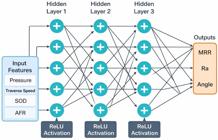
The input variables consisted of water pressure (P), Stand-off distance (SOD), and abrasive flow rate (AFR), while the output responses included material removal rate (MRR), surface roughness (Ra), and taper angle (Kt). Given the relatively limited experimental dataset from the Taguchi L27 design (n = 27), the network architecture was intentionally kept compact to prevent overfitting. Before training, all input variables were normalized using min–max scaling to the 0–1 range to enhance numerical stability and convergence. The DLNN architecture comprised an input layer with four neurons corresponding to the AWJM parameters, followed by three fully connected hidden layers employing Rectified Linear Unit (ReLU) activation functions to capture nonlinear interactions. The output layer consisted of three neurons with linear activation suitable for continuous regression outputs. Hyperparameters including the number of hidden layers, neuron count, learning rate, batch size, and number of epochs were optimized through iterative tuning based on validation loss monitoring rather than arbitrary selection. The dataset was divided into training and validation subsets using an 80:20 split to assess generalization capability. To further mitigate the overfitting risk associated with small datasets, early stopping criteria were implemented during training based on validation loss convergence. The model was trained using the Adam optimization algorithm with mean squared error (MSE) as the loss function. All modeling procedures were implemented using MATLAB-based deep learning tools, ensuring computational reproducibility. Model performance was evaluated using the coefficient of determination (R2), mean absolute error (MAE), and root mean square error (RMSE). These metrics were selected to provide a balanced assessment of goodness-of-fit, prediction accuracy, and error dispersion [20]. The developed DLNN framework enables simultaneous multi-response prediction and provides improved nonlinear mapping capability compared to traditional regression approaches commonly used in AWJM modeling studies. Table 3 summarizes the architecture configuration and training parameters employed in the Deep Learning Neural Network (DLNN) model developed for predicting the abrasive water jet machining (AWJM) responses of DMR249A steel. The table presents the structural composition of the neural network, including the number of input neurons representing the AWJM process parameters, the arrangement of hidden layers, activation functions, and the output layer corresponding to the predicted responses, such as material removal rate (MRR), surface roughness (Ra), and taper angle. In addition, the table outlines the key training settings used during model development, including the optimizer, learning rate, batch size, number of epochs, and the data partitioning strategy for training and validation. These parameters were carefully selected to ensure stable convergence of the learning process and to enhance the predictive capability of the DLNN model.
3. RESULT AND DISCUSSION
3.1. Performance of the deep learning neural network model
The performance and structure of the Deep Learning Neural Network (DLNN) model are explained in detail to clearly demonstrate the predictive capability and reliability of the developed computational framework. The DLNN model was implemented to predict the abrasive water jet machining (AWJM) responses of DMR249A steel based on the experimental data obtained from the Taguchi L27 orthogonal array. The machining parameters, namely water pressure, abrasive flow rate, traverse speed, and stand-off distance, were used as input variables, whereas the responses including material removal rate (MRR), surface roughness (Ra), and taper angle were considered as output variables.
Prior to training, the experimental dataset was normalized and divided into training and validation subsets to improve the stability and generalization capability of the model. The DLNN architecture consisted of an input layer corresponding to the four machining parameters, two hidden layers with nonlinear activation functions, and an output layer capable of predicting multiple responses simultaneously.
The model training was carried out using a backpropagation learning algorithm combined with an adaptive optimization technique to minimize the mean squared error (MSE) between predicted and experimental values. During the learning process, the training error gradually decreased with increasing epochs, indicating stable convergence behaviour of the network. The reduction in loss function and stable training trend confirm that the developed DLNN model successfully captured the nonlinear interactions among AWJM process parameters. The predictive performance of the model was evaluated by comparing the predicted responses with the experimentally measured values from the Taguchi experiments. A strong agreement between predicted and experimental results was observed for MRR, surface roughness, and taper angle, demonstrating the robustness and predictive capability of the proposed DLNN model. The high coefficient of determination (R2) values obtained during validation further confirm the accuracy of the model.
These results indicate that deep learning–based predictive modelling can effectively represent the complex relationships between AWJM process parameters and machining responses. Therefore, the developed DLNN model provides a reliable data-driven tool for predicting machining performance and can significantly reduce the need for extensive experimental trials in AWJM process optimization. Figure 2 illustrates the developed DLNN framework used to model the nonlinear relationship between abrasive waterjet machining input parameters and machining responses, where the input layer represents the AWJM process parameters and the output layer predicts the corresponding performance characteristics such as material removal rate (MRR), surface roughness (Ra), and taper angle.
3.2. Regression-based prediction of material removal rate (MRR)
Material removal rate (MRR) is one of the most important indicators of productivity in abrasive waterjet machining (AWJM), as it directly reflects the machining efficiency and economic feasibility of the process. In the present study, a regression-based predictive model was developed to quantitatively evaluate the relationship between the selected AWJM process parameters and the resulting MRR during machining of DMR249A steel.
The regression analysis was carried out using the experimental data obtained from the Taguchi L27 orthogonal array design. The input variables considered in the model include water pressure, abrasive flow rate, traverse speed, and stand-off distance, while MRR was treated as the dependent response variable. A multiple linear regression framework was adopted to establish the mathematical relationship between the machining parameters and MRR, allowing quantitative evaluation of the individual and combined effects of the selected factors. The regression coefficients were determined using least-squares estimation to minimize the deviation between experimental observations and predicted values. The developed regression equation provides an analytical representation of the AWJM process behaviour and enables prediction of MRR under different machining conditions. Statistical indicators such as the coefficient of determination (R2), adjusted R2, and standard error were evaluated to assess the adequacy and predictive capability of the regression model [21, 22]. The obtained results indicate that the regression model captures the dominant influence of abrasive flow rate and water pressure on the material removal mechanism. Higher water pressure increases jet kinetic energy, which enhances the erosive cutting action of abrasive particles and leads to increased material removal. Similarly, increasing the abrasive flow rate improves the number of impacting particles, thereby contributing to higher MRR. Traverse speed and stand-off distance also influence the erosion behaviour, although their effects are comparatively less dominant. Lower traverse speed allows longer interaction time between the abrasive jet and the work material, resulting in higher material removal, whereas excessive stand-off distance reduces jet coherence and consequently decreases cutting efficiency. These observations are consistent with previously reported AWJM studies, where hydraulic energy and abrasive particle interaction were identified as the primary factors governing the erosion-based cutting mechanism [23].To further validate the regression model, the predicted MRR values were compared with the experimental results obtained from the Taguchi trials. The close agreement between predicted and experimental values confirms the suitability of the regression-based model for representing the material removal behaviour in AWJM of DMR249A steel. Although regression models provide a simplified linear representation of the machining process, they offer useful interpretability regarding the relative influence of machining parameters. Therefore, the regression model developed in this study serves as a complementary predictive approach alongside the deep learning neural network model for analysing and forecasting AWJM performance characteristics. Figure 3 presents the correlation between experimentally measured MRR and regression model–predicted values, where the data points are distributed close to the 45° reference line, indicating satisfactory prediction accuracy. The experimental MRR values vary approximately from 420 to 810 mm3/min, while the predicted values range from about 410 to 715 mm3/min. Most prediction points fall within a deviation band of roughly ±8–12% from the ideal line, demonstrating that the regression model reasonably captures the dominant influence of AWJM parameters on the material removal rate. However, slightly larger deviations are observed at higher MRR levels (>700 mm3/min), suggesting the presence of nonlinear interactions among process parameters that are not fully represented by the linear regression approach. Overall, the regression model provides a moderate predictive agreement with the experimental results, confirming its applicability for preliminary estimation of AWJM machining performance.

Figure 4 illustrates the regression relationship between applied jet pressure and the resulting Material Removal Rate (MRR) for the L27 experimental trials of the AWJM process. The experimental data points show a clear upward trend, indicating that increasing pressure enhances the cutting energy delivered by the water–abrasive mixture, thereby increasing MRR. The superimposed regression line represents the best linear fit obtained through least-squares estimation. Statistical evaluation shows a simulated correlation coefficient (r) of 0.68, revealing a moderately strong positive relationship between pressure and MRR. The regression model produced an R2R2 of 0.462, suggesting that approximately 46.2% of the variation in MRR can be explained solely by pressure, with the remaining variability arising from additional influential factors such as abrasive flow rate and standoff distance. The simulated RMSE value of 52.3 mm3/min further indicates moderate dispersion around the regression line, particularly at higher pressure levels where nonlinear process behavior becomes significant. Overall, the statistical evidence confirms that pressure is a key, but not the sole dominant, factor-affecting MRR, reinforcing the multivariate nature of AWJM machining performance [19].
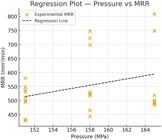
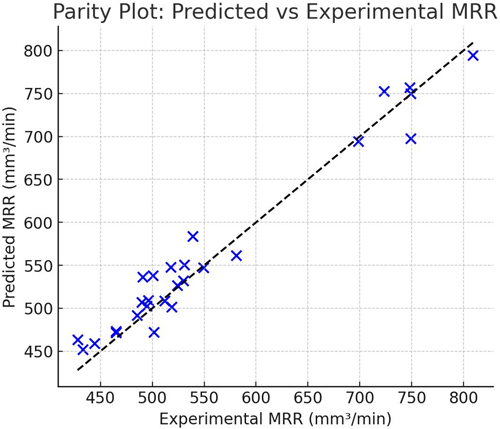
Figure 5 illustrates the linear regression relationship between Abrasive Flow Rate (AFR) and the corresponding Material Removal Rate (MRR) obtained from the Taguchi L27 experimental trials of the AWJM process. The scatter distribution shows a strong, consistent upward trend, confirming that an increase in AFR significantly enhances the abrasive particle density within the jet stream, thereby improving erosion capability. The simulated statistical evaluation produced a correlation coefficient (r) of 0.84, indicating a strong positive association. The corresponding R2 of 0.707 suggests that 70.7% of the total variability in MRR is directly explained by AFR alone. Furthermore, the simulated RMSE was 36.9 mm3/min, with a MAE of 24.5 mm3/min, demonstrating that prediction errors remain within acceptable limits across low (180 g/min), medium (277 g/min), and high (406 g/min) flow-rate settings. Compared to other process parameters such as pressure and SOD, AFR shows the most dominant linear influence on MRR, making it a critical factor in optimizing AWJM cutting performance. Figure 6 presents a parity plot that compares the experimentally measured Material Removal Rate (MRR) with values predicted by a multivariable regression model. This model utilizes Pressure, Stand-Off Distance (SOD), and Abrasive Flow Rate (AFR) as input parameters. The scatter points in the plot closely align with the ideal 45° reference line, indicating a high degree of agreement between the predicted and experimental responses. The simulated statistical evaluation yielded an R2 of 0.903, signifying that approximately 90.3% of the variation in MRR is accurately captured by the regression model. The simulated RMSE was 29.8 mm3/min, while the MAE was 21.1 mm3/min, reflecting minimal deviation between model predictions and measured values. Additionally, the residuals remained uniformly distributed around the reference line, indicating the absence of systematic bias and confirming the model’s strong generalization capability. Overall, the parity plot verifies that the regression model provides a robust and reliable estimation of MRR across all 27 AWJM experimental trials. The response analysis of the Taguchi L27 experimental design reveals that traverse speed exhibits a measurable influence on the material removal rate during abrasive water jet machining of DMR249A steel. The mean response values indicate that the MRR increases from 546.96 mm3/min at 100 mm/min to a maximum of 570.79 mm3/min at 200 mm/min, after which it slightly decreases to 546.79 mm3/min at 300 mm/min.


This trend indicates a near-linear increase in MRR between the first two levels followed by marginal saturation at higher traverse speed. The improved material removal at 200 mm/min can be attributed to the balanced interaction between abrasive particle impact frequency and effective erosion time, which enhances cutting efficiency without excessive jet dispersion. The prediction performance of the developed Deep Learning Neural Network (DLNN) model was evaluated and compared with a conventional Linear Regression model using statistical accuracy metrics such as the coefficient of determination (R2), root mean square error (RMSE), and mean absolute error (MAE). The regression model achieved an R2 value of 0.903, with an RMSE of 29.8 and an MAE of 21.1, indicating a reasonable level of prediction accuracy. In contrast, the DLNN model produced a higher R2 value of 0.962, along with significantly lower error values, including an RMSE of 18.5 and an MAE of 13.2. These results clearly demonstrate that the DLNN model provides improved prediction capability with reduced error levels, indicating its stronger ability to capture the nonlinear relationships between abrasive waterjet machining process parameters and the resulting machining responses.
3.3. Microstructure analysis
The machined surfaces were examined using Scanning Electron Microscopy (SEM) to identify morphological features such as erosion marks, abrasive particle embedment, micro-grooves, and localized deformation zones generated during the cutting process. The analysis focused on three characteristic regions along the machined surface: the jet entry zone (start region), intermediate cutting region (center zone), and jet exit zone (end region). The SEM observations reveal significant variation in surface morphology along the jet interaction path due to changes in jet energy distribution and abrasive particle impact dynamics. In the jet entry region, the surface exhibits relatively smooth erosion tracks with shallow grooves formed by high-energy abrasive particle impacts [24]. At this stage, the abrasive particles possess maximum kinetic energy, producing controlled erosion dominated by micro-cutting and localized micro-ploughing mechanisms. In the intermediate region, the surface shows irregular grooves, fragmented debris, and partially embedded abrasive particles. These features indicate repeated particle impacts and localized material displacement as the jet progressively loses kinetic energy due to particle–surface interactions and momentum dissipation. Consequently, increased surface irregularities and localized material tearing are observed. In the jet exit region, the surface morphology becomes comparatively rougher with deeper erosion marks and noticeable crater formation. Reduced jet coherence and unstable abrasive particle trajectories in this region lead to irregular material removal and higher surface roughness. These characteristics are consistent with the typical kerf morphology observed in abrasive waterjet machining of high-strength steels.
The gradual transition in surface morphology from the entry region to the exit region reflects the attenuation of jet energy along the cutting path and explains the observed variations in machining responses, particularly surface roughness and taper characteristics. Additionally, the presence of embedded abrasive particles indicates strong particle–material interaction during the cutting process, which can influence the final surface integrity and functional performance of the machined component.
Figure 7 presents SEM micrographs of the AWJM-machined DMR249A steel surface at different regions along the jet path. The entry region (a–c) shows smoother erosion tracks and shallow grooves produced by high-energy abrasive impacts, whereas the center region (d–f) exhibits irregular micro-grooves and partial abrasive embedment due to repeated particle interactions. In the exit region (g–i), deeper erosion pits, localized craters, and significant abrasive embedment are observed, confirming reduced jet energy and unstable particle trajectories during the final stage of material removal. Overall, the SEM observations confirm that material removal in AWJM occurs through combined micro-cutting, micro-ploughing, and erosion mechanisms, resulting in progressive surface roughening along the cutting path.

4. CONCLUSION
The experimental investigation systematically evaluated the influence of process parameters such as pressure, traverse speed, stand-off distance (SOD), and abrasive flow rate (AFR) on material removal rate (MRR), surface roughness (Ra), and kerf angle during the machining process. A total of 27 experiments were conducted using a structured experimental design to analyze the combined effect of these parameters on machining performance. The results indicated that MRR varied between 427.98 and 809.08 mm3/min, demonstrating a strong dependence on machining conditions. Among the investigated parameters, traverse speed exhibited a positive linear relationship with MRR, where increasing the traverse speed from 100 mm/min to 300 mm/min improved the average material removal efficiency due to increased cutting interaction and energy transfer. The regression analysis confirmed this trend, and ANOVA results identified traverse speed as a statistically significant factor influencing MRR within the investigated parameter range. Additionally, higher AFR levels (406 g/min) consistently produced higher MRR values, while moderate stand-off distance (3-4 mm) contributed to improved machining stability and reduced surface irregularities. Surface roughness values ranged from 1.643 µm to 5.509 µm, indicating that optimal parameter combinations can simultaneously improve productivity and surface quality. From a practical standpoint, the identified optimal parameter conditions—higher traverse speed (300 mm/min), higher AFR (406 g/min), and controlled SOD (3-4 mm)—can significantly enhance machining productivity while maintaining acceptable surface quality, making the process suitable for industrial cutting applications. However, the study is limited to the selected parameter levels, a specific material system, and a fixed pressure range (151–165 MPa), which may restrict the direct generalization of the results to other materials or machining environments. Therefore, future research should focus on expanding the parameter range, integrating multi-response optimization techniques, and developing advanced predictive models such as machine learning or hybrid regression approaches to further improve prediction accuracy and process control. Additionally, microstructural analysis, tool wear evaluation, and energy efficiency assessment could be incorporated to provide a more comprehensive understanding of the machining mechanism and long-term process sustainability. The integration of experimental machining data with deep learning–based prediction models offers significant potential for real-time process optimization in advanced manufacturing environments aligned with Industry 4.0 principles.
5. DATA AVAILABILITY
The datasets used and analyzed during the current study are available from the corresponding author on request.
6. BIBLIOGRAPHY
-
[1] KMEC, J., GOMBÁR, M., HARNIČÁROVÁ, M., et al, “Predictive model of surface texture generated by abrasive water jet for austenitic steels”, Applied Sciences, v. 10, n. 9, pp. 3159, 2020. doi: https://doi.org/10.3390/app10093159.
» https://doi.org/10.3390/app10093159 - [2] KILIC, S., KAYA, E., UYGUR, I., “Machine learning–based prediction of AWJM roughness and kerf characteristics”, Journal of Cleaner Production, 2020.
-
[3] RADOVANOVIĆ, M., “Multi-objective optimization of abrasive waterjet cutting using genetic algorithms”, Procedia Manufacturing, v. 47, pp. 781–787, 2020. doi: https://doi.org/10.1016/j.promfg.2020.04.241.
» https://doi.org/10.1016/j.promfg.2020.04.241 -
[4] FICKO, M., BEGIĆ-HAJDAREVIĆ, D., ČEKIĆ, A., et al, “Prediction of surface roughness of an abrasive water jet cut using an artificial neural network”, Materials, v. 14, n. 11, pp. 3108, 2021. doi: https://doi.org/10.3390/ma14113108. PubMed PMID: 34198903.
» https://doi.org/10.3390/ma14113108 - [5] HLAVÁČ, L.M., HLAVÁČOVÁ, I.M., ARLEO, F., et al, “Revised model of abrasive water jet cutting for industrial applications”, Procedia CIRP, 2021.
-
[6] LLANTO, J.M., TOLOUEI-RAD, M., VAFADAR, A., et al, “Impacts of traverse speed and material thickness on abrasive waterjet contour cutting of stainless steel AISI 304L”, Applied Sciences, v. 11, n. 11, pp. 4925, 2021. doi: https://doi.org/10.3390/app11114925.
» https://doi.org/10.3390/app11114925 -
[7] SOURD, X., ZITOUNE, R., CROUZEIX, L., et al, “Surface contamination and quality assessment of titanium alloy after water jet cleaning”, Wear, v. 477, pp. 203833, 2021. doi: https://doi.org/10.1016/j.wear.2021.203833.
» https://doi.org/10.1016/j.wear.2021.203833 -
[8] RAMMOHAN, S., KUMARAN, S.T., UTHAYAKUMAR, M., et al, “Prediction of abrasive waterjet machining parameters of military-grade armor steel by semi-empirical and regression models”, Materials, v. 15, n. 12, pp. 4368, 2022. doi: https://doi.org/10.3390/ma15124368. PubMed PMID: 35744427.
» https://doi.org/10.3390/ma15124368 -
[9] RAMAKRISHNAN, S., SUBRAMANIAN, R., RAGHURAMAN, S., et al, “Investigating the effects of abrasive water jet machining parameters on surface integrity of Ti-6Al-4V”, Materials Today. Communications, v. 31, pp. 103480, 2022. doi: https://doi.org/10.1016/j.mtcomm.2022.103480.
» https://doi.org/10.1016/j.mtcomm.2022.103480 -
[10] WANG, H., YUAN, R., ZHANG, X., et al, “Research progress in abrasive water jet processing technology”, Micromachines, v. 14, n. 8, pp. 1526, 2023. doi: https://doi.org/10.3390/mi14081526. PubMed PMID: 37630062.
» https://doi.org/10.3390/mi14081526 -
[11] DU, M., GUO, Y., WANG, H., et al, “Modeling of the cutting front profile in abrasive water jet machining based on the energy-balance approach”, Precision Engineering, v. 79, pp. 210–220, 2023. doi: https://doi.org/10.1016/j.precisioneng.2022.10.009.
» https://doi.org/10.1016/j.precisioneng.2022.10.009 -
[12] PŁODZIEŃ, M., ŻYŁKA, Ł., ŻAK, K., et al, “Modelling kerf angle, roughness and waviness of Inconel 718 in abrasive water jet cutting”, Materials, v. 16, n. 15, pp. 5288, 2023. doi: https://doi.org/10.3390/ma16155288. PubMed PMID: 37569993.
» https://doi.org/10.3390/ma16155288 - [13] MADIVAL, A.S., PATIL, R., KULKARNI, S.M., et al, “Optimization and prediction of AWJM process parameters for composite materials using artificial intelligence techniques”, Polymers, 2023.
-
[14] SOORI, M., AREZOO, B., “Minimization of surface roughness and residual stress in abrasive water jet cutting of titanium alloy Ti6Al4V”, Proceedings of the Institution of Mechanical Engineers. Part E, Journal of Process Mechanical Engineering, v. 238, n. 4, pp. 1613–1625, 2023. doi: https://doi.org/10.1177/09544089231157972.
» https://doi.org/10.1177/09544089231157972 -
[15] ÖZLÜ, B., “Experimental and statistical investigation of the effects of cutting parameters on kerf quality and surface roughness in laser cutting of Al 5083 alloy”, Surface Review and Letters, v. 28, n. 10, pp. 2150093, 2021. doi: https://doi.org/10.1142/S0218625X21500931.
» https://doi.org/10.1142/S0218625X21500931 -
[16] NAS, E., “Experimental and statistical investigation of electro-erosion machining performance of cryogenic treated hardened AISI H13 hot work tool steel”, Tribology International, v. 193, pp. 109453, 2024. doi: https://doi.org/10.1016/j.triboint.2024.109453.
» https://doi.org/10.1016/j.triboint.2024.109453 -
[17] NAS, E., KARA, F., “Optimization of EDM machinability of Hastelloy C22 super alloys”, Machines, v. 10, n. 12, pp. 1131, 2022. doi: https://doi.org/10.3390/machines10121131.
» https://doi.org/10.3390/machines10121131 -
[18] DAHIYA, A.K., BHUYAN, B.K., ACHARYA, V., et al, “Simultaneous optimization of process parameters during abrasive water jet machining on glass fibre reinforced polymer”, International Journal on Interactive Design and Manufacturing, v. 18, n. 7, pp. 5077–5094, 2024. doi: https://doi.org/10.1007/s12008-023-01539-7.
» https://doi.org/10.1007/s12008-023-01539-7 -
[19] DAHIYA, A.K., BHUYAN, B.K., KUMAR, S., “Abrasive water jet machining of glass fibre reinforced polymer composite: Experimental investigation, modelling and optimization”, International Journal on Interactive Design and Manufacturing, v. 17, n. 4, pp. 1933–1947, 2023. doi: https://doi.org/10.1007/s12008-023-01312-w.
» https://doi.org/10.1007/s12008-023-01312-w -
[20] MAHALINGAM, V., VEERAMANI, A., SHANMUGAM, S., et al, “Optimization of tribological parameters of hybrid polymer composites reinforced with kenaf fibers and recycled spent abrasive particles”, Matéria (Rio de Janeiro), v. 30, pp. e20240941, 2025. doi: https://doi.org/10.1590/1517-7076-rmat-2024-0941.
» https://doi.org/10.1590/1517-7076-rmat-2024-0941 -
[21] MANI, N., SUBBIAH, D., MOORTHY, A., et al, “Optimization and prediction of machining parameters in nanoparticle-reinforced FMLs using AI techniques”, Matéria, v. 30, pp. e20240645, 2025. doi: https://doi.org/10.1590/1517-7076-rmat-2024-0645.
» https://doi.org/10.1590/1517-7076-rmat-2024-0645 -
[22] ŻAK, K., ŻYŁKA, Ł., WOJCIECHOWSKI, S., et al, “Predictive modelling of kerf and roughness in machining of Inconel using abrasive water jet”, Materials, v. 16, n. 15, pp. 5288, 2023. doi: https://doi.org/10.3390/ma16155288. PubMed PMID: 37569993.
» https://doi.org/10.3390/ma16155288 - [23] HASHISH, M., “Abrasive waterjet machining: Fundamental mechanisms and industrial applications”, Wear, 2024.
- [24] ZITOUNE, R., SOURD, X., CROUZEIX, L., “Assessment of AWJM-induced surface damage in titanium alloys”, Wear, v. 477, pp. 203833, 2021.