
 Rapid molecular testing for diagnosing tuberculosis in people experiencing homelessness: a scoping review
Objective: to map the literature on the use of Rapid Molecular Tests in the diagnosis of tuberculosis in people experiencing homelessness.
Method: this is a scoping review guided by the Joanna Briggs Institute and the Preferred Reporting Items for Systematic reviews and Meta-Analyses extension for Scoping Reviews. A search was conducted in gray literature databases and websites, and the results were summarized narratively.
Results: the 10 publications included in the scoping review allowed us to categorize the dimensions of Rapid Molecular Test use into cost-effectiveness, including reduction in isolation and hospitalization time; time to implement diagnosis and start treatment; effectiveness in implementing measures and strategies for active tuberculosis case finding; case management based on the repercussions of bacteriological confirmation on therapeutic management; decentralization of diagnosis through strategic location of technologies to increase case detection; and diagnostic efficacy, considering the strong predictive power of the diagnosis.
Conclusion: the use of the test contributed to the early detection of tuberculosis and, as benefits, reduced disease transmission and saved resources. However, many studies conducted with people experiencing homelessness include other vulnerable populations, revealing a significant gap in the literature for this specific group.
Descriptors:
Tuberculosis; Pulmonary Tuberculosis; Ill-Housed Persons; Molecular Diagnostic Techniques; Diagnosis; Health Policy
Highlights:
(1) Scoping review on the use of RMT for the diagnosis of TB in people experiencing homelessness. (2) RMT has good diagnostic performance in vulnerable populations. (3) Need for research evaluating the use of RMT in isolation in people experiencing homelessness.
Objetivo: mapear a literatura sobre a utilização do Teste Rápido Molecular no diagnóstico da tuberculose na População em Situação de Rua.
Método: trata-se de uma revisão de escopo orientada pelo Joanna Briggs Institute e pelo Preferred Reporting Items for Systematic reviews and Meta-Analyses extension for Scoping Reviews. Realizou-se a busca em bases de dados e sites de literatura cinzenta, e os resultados foram sintetizados de forma narrativa.
Resultados: as 10 publicações incluídas na revisão de escopo permitiram categorizar as dimensões sobre a utilização do Teste Rápido Molecular em custo-benefício, permeando a redução no tempo de isolamento e internação; tempo na implementação do diagnóstico e início de tratamento; efetividade na implementação de medidas e estratégias na busca ativa de casos de tuberculose; gestão de casos mediante repercussões decorrentes da confirmação bacteriológica na condução terapêutica; descentralização do diagnóstico por meio de localização estratégica de tecnologias para aumento da detecção de casos; e eficácia do diagnóstico, considerando o forte poder preditivo para o diagnóstico da tuberculose.
Conclusão: a utilização do teste contribuiu para a detecção precoce da tuberculose e, como benefícios, a redução da transmissão da doença e economia de recursos. Contudo, muitos estudos realizados com a população em situação de rua englobam outras populações vulneráveis, revelando uma significativa lacuna na literatura sobre este grupo específico.
Descritores:
Tuberculose; Tuberculose Pulmonar; Pessoas Mal Alojadas; Técnicas de Diagnóstico Molecular; Diagnóstico; Política de Saúde
Destaques:
(1) Revisão de escopo sobre a utilização do TRM no diagnóstico da TB na PSR. (2) TRM tem bom desempenho no diagnóstico em população vulnerável. (3) Necessidade de pesquisas que avaliem a utilização do TRM na PSR isoladamente.
Objetivo: mapear la literatura sobre el uso de la Prueba Rápida Molecular en el diagnóstico de la tuberculosis en la Población en Situación de Calle.
Método: se trata de una revisión de alcance orientada por el Joanna Briggs Institute y por el Preferred Reporting Items for Systematic reviews and Meta-Analyses extension for Scoping Reviews. Se realizó la búsqueda en bases de datos y sitios de literatura gris, y los resultados fueron sintetizados de forma narrativa.
Resultados: las 10 publicaciones incluidas en la revisión de alcance permitieron categorizar las dimensiones sobre el uso de la Prueba Rápida Molecular en costo-beneficio, abarcando la reducción del tiempo de aislamiento e internación; tiempo en la implementación del diagnóstico e inicio de tratamiento; efectividad en la implementación de medidas y estrategias en la búsqueda activa de casos de tuberculosis; gestión de casos mediante repercusiones derivadas de la confirmación bacteriológica en la conducción terapéutica; descentralización del diagnóstico mediante localización estratégica de tecnologías para aumentar la detección de casos; y eficacia del diagnóstico, considerando el fuerte poder predictivo para el diagnóstico de la tuberculosis.
Conclusión: el uso de la prueba contribuyó a la detección precoz de la tuberculosis y, como beneficios, a la reducción de la transmisión de la enfermedad y al ahorro de recursos. Sin embargo, muchos estudios realizados con la población en situación de calle engloban otras poblaciones vulnerables, revelando una brecha significativa en la literatura sobre este grupo específico.
Descriptores:
Tuberculosis; Tuberculosis Pulmonar; Personas con Mala Vivienda; Técnicas de Diagnóstico Molecular; Diagnóstico; Política de Salud
Destacados:
(1) Revisión de alcance sobre el uso de la PRM en el diagnóstico de la TB en la PSC. (2) La PRM presenta buen desempeño en el diagnóstico en poblaciones vulnerabilizadas. (3) Necesidad de investigaciones que evalúen el uso de la PRM en la PSC de forma aislada.
Introduction
It is believed that approximately a quarter of the world’s population is infected with the bacillus Mycobacterium tuberculosis (MTB), with the risk of developing active tuberculosis (TB)(1). Despite being a treatable and curable disease, TB is part of a group of diseases prevalent among populations in situations of social vulnerability, especially in low- and middle-income countries. These countries face problems such as lack of basic sanitation, high population density, poor living conditions, and poor access to food and health services. TB is characterized as a disease strongly linked to the social determinants of health (SDH), influenced by factors of social exclusion and poverty(2).
The World Health Organization (WHO) defines SDH as related to social, economic, cultural, ethnic/racial, psychological, and behavioral factors that influence the occurrence of health problems and conditions that affect the health of the population(3). There is a strong association between the socioeconomic status of individuals and social groups and their health status, creating conditions and contexts permeated by poorer health indicators. Health inequities generated by social determinants are systematic, significant, preventable, and unfair, representing a significant public health challenge(4-5).
In the context of TB, a strong interaction is identified between the disease and the individual and collective socioeconomic indicators of the exposed population, directly relating it to living conditions and the social environment, the latter being a crucial factor in the health-disease process(4,6-7).
In this scenario, one of the priority groups for TB prevention and care actions is the people experiencing homelessness (PEH), which, due to poverty, lack of permanent housing, lack of knowledge about the disease and the presence of factors such as the use of alcohol and other drugs, greater exposure to violence, discrimination and precarious or non-existent social support ties, is 56 times more likely to become ill when compared to the general population(8-11). Among global efforts to control the disease, TB was included as a target (3.3) of the United Nations (UN) Sustainable Development Goals (SDGs)(12), aiming for a 90% reduction in deaths and an 80% reduction in TB incidence by 2030. In parallel, the End TB strategy(13), whose first pillar is integrated, person-centered care and prevention, aims to modernize TB care and prevention, as well as ensure equitable access to early TB diagnosis, including universal drug susceptibility testing and systematic screening of contacts and high-risk groups.
As this population has difficulty perceiving time and recognizing cough symptoms, and is marked by high rates of treatment failure, lack of adherence, and loss to follow-up(4), PEH benefit from the early identification of respiratory symptoms, followed by diagnostic testing, to ensure timely initiation of treatment(6-8). Considering the time constraints and specificity of traditional diagnostic methods, as well as the increase in TB and rifampicin-resistant TB cases, the WHO recommends the Rapid Molecular Test (RMT) as a valuable diagnostic tool for TB, including among groups facing extreme vulnerability, such as those living with the population of the living with HIV(14-15).
RMT is a molecular method capable of detecting the presence of MTB deoxyribonucleic acid (DNA) and mutations associated with rifampicin resistance directly from biological material samples within two hours. It is more sensitive than sputum smear microscopy and has similar accuracy to culture(16-17).
However, to date, the use of RMT for TB diagnosis among PEH and its impacts still requires in-depth investigation, since a review study conducted in 2018 that evaluated the cost-benefit of various diagnostic tools for TB among PEH noted the scarcity of data specific to this population(18). Therefore, the present study seeks to map the literature on the use of RMT in the diagnosis of TB in people experiencing homelessness.
Method
Study design
This is a scoping review that followed the recommendations of the Preferred Reporting Items for Systematic Reviews and Meta-Analyses for Scoping Reviews (PRISMA-ScR) extension and adopted the five-step method proposed by the Joanna Briggs Institute(19). These steps include identifying the research question and relevant studies, selecting studies, analyzing data, and grouping, synthesizing, and presenting the results(20-21). The protocol for this study was registered with the Open Science Framework Registries platform (OSFREGISTRIES - https://doi.org/10.17605/OSF.IO/WS8YN).
Data collection
To answer the guiding question “What is the evidence on the use of RMT in the diagnosis of TB in PEH?”, eligible studies were screened using the PCC strategy(20), where the Population (P) corresponded to people with TB, the Concept (C) to use RMT for case diagnosis, and the Context (C) to homelessness.
To achieve this, keywords identified in the literature related to these terms were initially searched, as well as descriptors indexed in the Health Sciences Descriptors (DeCS) platform and their respective synonyms in Portuguese, English, and Spanish. For the English-language search, descriptors indexed in the Medical Subject Headings (MeSH) platform were considered.
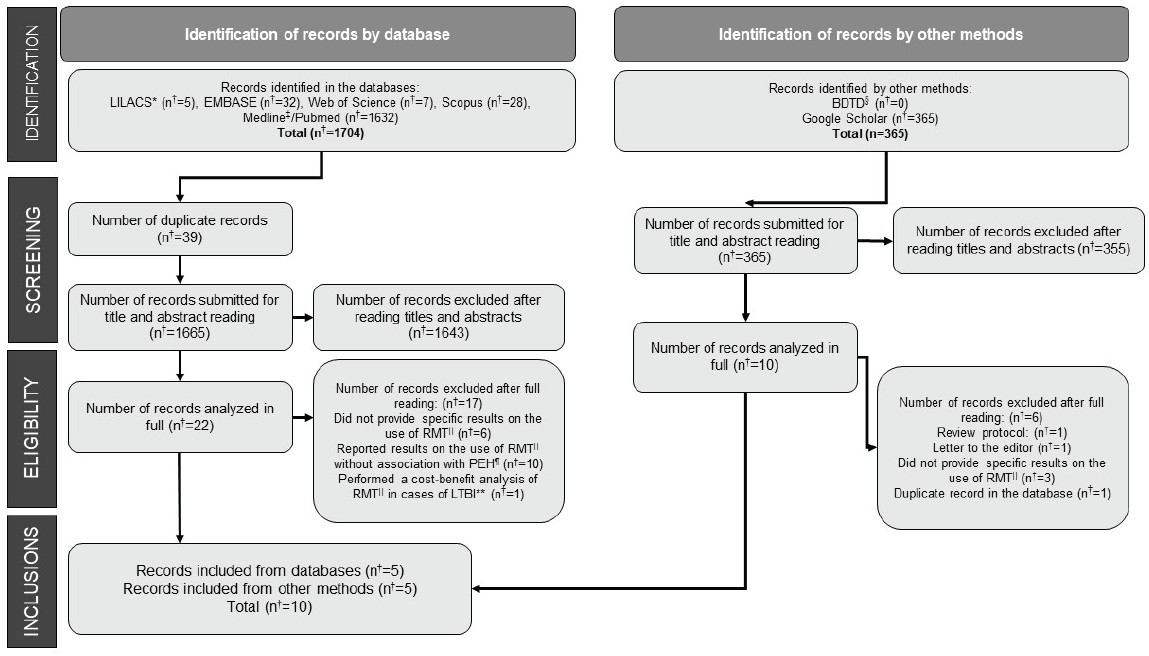
Three sets of descriptors and synonyms for each keyword comprised the free and controlled vocabularies, which were combined in the search strategies using the Boolean operators OR and AND. Searches were conducted in the following databases: Scopus, Web of Science, Medical Literature Analysis and Retrieval System Online (MEDLINE), Latin American and Caribbean Literature in Health Sciences (LILACS), and Excerpta Medica Database (EMBASE). For gray literature searches, Google Scholar and the Brazilian Digital Library of Theses and Dissertations (Figure 1) were used.
Selection criteria
The review included scientific and gray literature published between 2011 and May 2025. This timeframe was chosen based on the importance of 2011, when the WHO launched the RMT recommendation for the testing and diagnosis of TB and multidrug-resistant TB(15). The review also included studies in English, Portuguese, and Spanish, which could be primary and secondary, peer-reviewed or not, as long as their scope included specific results on the use of RMT in the diagnosis of TB for PEH, using quantitative method, qualitative approach, or mixed-method and any methodological design. Theses, dissertations, and undergraduate papers were also considered, as well as conference abstracts and study summaries unavailable in full even after contacting the corresponding authors. Letters to the editor, review protocols, and studies that analyzed the performance of RMT in priority populations without specifically mentioning PEH in their results were excluded. Studies whose scope, as reflected in the title and abstracts, encompassed RMT and PEH, either individually or in conjunction with other vulnerable populations, were considered, provided this was clearly cited in the text.
The results of the database searches were exported and compiled in the Rayyan platform(21), a tool to aid review research, to identify and eliminate duplicates and subsequently select studies. This selection stage was conducted by two independent reviewers who read and analyzed the titles and abstracts of the studies found, considering their relevance to the review question.
The results of the searches conducted on Google Scholar and the Brazilian Digital Library of Theses and Dissertations were transferred to a Word file for publication selection, which was performed by reading their titles by the same two independent reviewers. Discrepancies in the selection process between the Rayyan platform and the Word file were resolved by a third author or through a complete reading of the materials.
Data collection instrument
Subsequently, data were extracted from the studies included in the review. For this purpose, a form developed by the authors based on PRISMA-ScR recommendations was used. It consisted of the following items: title, authors, journal, year of publication, country of study, objective, methodological design, characteristics of the PEH under study (demographic, clinical, and epidemiological data), details on the use of RMT, and the main results related to the use of RMT in the diagnosis of TB in PEH.
Data processing and analysis
The collected data were analyzed descriptively through a narrative synthesis, in order to allow a comprehensive understanding of the results obtained.
Results
A total of 2,069 publications were identified, of which 2,030 were subjected to title and abstract reading. Despite the large number of publications found through the search strategies, many were excluded at this stage, as the studies either addressed the use of RMT in general, without delimiting the population of interest, or addressed the diagnosis of TB in PEH without mentioning RMT as a diagnostic tool. Thus, 32 publications were selected for eligibility assessment through full reading. Of the studies analyzed in full, 10 addressed the research question, addressing both RMT and PEH, and were therefore included in the scope of this review (Figure 2).

Flowchart of inclusion and exclusion of publications found according to the recommendations of the Preferred Reporting Items for Systematic reviews and Meta-Analyses extension for Scoping Reviews (PRISMA-ScR)
The studies were published between 2014 and May 2025, with eight studies published between 2018 and 2025, three in 2018. Seven were available in English and three in Portuguese. Regarding the countries of the studies, three were conducted in Brazil, two in the United States, one in England, one in Ukraine, one in Kyrgyzstan, and the last one in Ethiopia. The review article was conducted in England.
Regarding the objectives of the studies, most sought to compare different strategies, technologies, and diagnostic tests for TB detection, including the RMT, in the general population and in priority groups, including PEH. A predominance of quantitative epidemiological studies was observed, including five cross-sectional studies, two cohort studies, and one that used dynamic transmission modeling. The review article is a narrative review (Figure 3).
Based on the studies, it was possible to categorize the literature obtained on the use of RMT into the following dimensions: cost-benefit, permeating the reduction in isolation and hospitalization time; time to implement diagnosis and start of treatment; effectiveness in implementing measures and strategies in the active search for TB cases; management of TB cases through repercussions resulting from bacteriological confirmation in therapeutic management; decentralization of TB diagnosis through strategic location of technologies to increase case detection and effectiveness in the diagnosis of pulmonary TB, with an emphasis on high predictive value, which indicates the probability that an individual with a positive test result actually has the disease (Figure 4).
The RMT was associated with a reduction in the mean time to discontinuation of isolation and hospital discharge, reducing TB treatment costs(26). A literature review highlighted the “high cost” of the test as a factor hindering active screening and initial screening in low-incidence regions(25).
This same review indicated that the implementation of rapid molecular tests allows for a microbiological diagnosis on the day of initial screening, especially if the machines are located in the care settings, making them an attractive diagnostic alternative(25). One study mentioned the reduction in time to receive a negative RMT result, which allows for a reduction in the use of empirical treatments without diagnostic confirmation(26).
In Kyrgyzstan, rapid treatment initiation after MDR-TB diagnosis was demonstrated; however, delays of up to 20 days were observed, particularly among migrants and PEH(30). In Brazil, a long mean time to treatment initiation was also identified among the PEH after the use of the RMT(29).
Active screening among PEH using RMT, combined with chest radiographs and improved case management, has been shown to be effective in reducing the burden of active TB, enabling early identification and treatment of cases and fewer hospital referrals compared to approaches based solely on radiographs. In areas with high incidence of the disease, these strategies were even more effective than in low- or medium-incidence settings(24). A survey of PEH treated by StCl teams observed twice as many RMTs as conventional health units, allowing PEH greater access to TB diagnosis(23).
One study found that the use of RMT helps guide initial treatment decisions, reducing overtreatment time, which decreased from 46 days to just one day. If RMT had been used to guide treatment decisions in all patients studied, 2,169 unnecessary days of treatment for the TB program would have been eliminated, as well as the number of contact investigations and nights of subsidized accommodation for PEH(22).
In Brazil, low RMT testing was found for new TB cases in PEH living with HIV, with three tests performed among the seven reported cases(28).
The study conducted in Ukraine highlighted the importance not only of the availability of new TB diagnostic tools, but also of their strategic placement in decentralized facilities, aiming to significantly improve early detection and treatment, as well as reduce barriers to access to health services, thus ensuring that the most affected communities have access to the resources needed to combat the disease(27).
Finally, in Ethiopia, a ROC curve analysis of 34 PEH samples, consisting of 17 positive and 17 negative RMT results compared to conventional Lowenstein-Jensen (LJ) culture, demonstrated that RMT had an area under the curve (AUC) of 1.000 and p < 0.001, indicating strong predictive power for the diagnosis of pulmonary tuberculosis in that population(31).
Discussion
Although this scoping review mapped and synthesized important information on the use of RMT in TB diagnosis in PEH settings and priority groups, it is important to highlight that most available studies were not designed to exclusively address PEH, as these were considered in conjunction with other priority groups.
Among the studies included in the review, it was observed that the implementation of the technology translates into good performance and faster diagnosis, allowing for faster treatment initiation and, consequently, reducing TB transmission(24-25,31). This advancement is particularly important in populations that face significant barriers to accessing healthcare, as is the case with PEH(32).
Furthermore, it is worth highlighting that the speed with which results are obtained allows healthcare professionals to make more assertive decisions based on bacteriological confirmation, allowing for a faster process, which is crucial for combating TB(24).
A comparison of different technologies for active TB case detection reveals that RMT stands out for its effectiveness and cost-effectiveness. In a hospital setting, the implementation of this technology was associated with a significant reduction in the costs associated with hospitalization and isolation(26). On the other hand, in regions with a low TB incidence, the use of RMT as an initial screening method is not as beneficial because it is a high-cost technology. It is more appropriate to use it as a diagnostic confirmation tool for individuals identified as having a high risk of TB early in the screening algorithm(25). Therefore, the decision on which technology to adopt must consider the specific context of each region, including epidemiological factors and resource availability.
However, there are still significant delays in treatment initiation among PEH, the causes of which lack investigation but may be associated with structural weaknesses experienced by this group, as well as delays in seeking health services by those affected by the disease(30).
A Brazilian study found that the average time to treatment initiation among PEH after using RMT was 6.87 days. However, no data on this time were available before the implementation of this diagnostic technology, which represents an important gap for comparative purposes regarding the impact of RMT use in this priority group(29).
Regarding the dimensions of active case finding and management, and the clinical management of TB among PEH, the results demonstrated the impact of RMT by significantly reducing the number of days of overtreatment, the need for empirical treatment, as well as the number of hospital referrals and unnecessary hospitalizations. Furthermore, RMT accelerates and improves most of the initial decisions that influence case management, benefiting both people affected by TB and public health programs(22,24).
However, in the Brazilian scenario, considering the high TB burden in the country, the low use of RMT for new cases among PEH in a municipality with a high incidence of the disease stood out. This allows reflections on the integration and coordination between the different Brazilian health care actions, strategies, and services that address this population. For example, the StCl(28), which has a high performance in diagnosing TB among PEH using RMT, as shown in another study included in the scope of this review(23).
These results suggest the importance not only of implementing new diagnostic technologies, such as RMT, but also of producing greater impacts through the strategic location of tests in decentralized health units to ensure access to TB diagnosis for priority groups(27).
In this scoping review, it is worth highlighting the limited number of published studies on the use of RMT in PEH, which highlights a significant gap in the scientific literature related to this topic. Studies focused on TB in PEH mostly superficially address, or do not address at all, the performance of RMT as a diagnostic tool, which prevents a comprehensive understanding of its performance in this context. The same applies vice versa. Although the studies included in this review addressed both the use of RMT and PEH, the lack of research dedicated exclusively to this topic reveals a significant gap in knowledge.
It was observed that among the studies addressing the use of RMT in the diagnosis of TB, PH tends to be studied in other priority groups, such as migrants, people deprived of liberty, people living with HIV, drug users, among others(22,25-27,29-30). It should be noted that many of the studies excluded during the publication screening stage presented the category “priority groups” or “priority populations” vaguely, without clearly specifying who these populations were, resulting in the homogenization of a diverse demographic. This lack of clarity limits understanding of the specific challenges faced by PEH in the context of TB diagnosis.
Furthermore, the results of this review are not generalizable due to the different epidemiological (high or low TB incidence) and socioeconomic contexts of the countries where the studies were analyzed, as well as the diverse approaches and methodologies employed. Another limitation is the lack of an assessment of the quality of the scientific evidence included.
Conclusion
This scoping review mapped and synthesized the use of RMT in TB diagnosis in PEH, based on the available literature, revealing a gap in knowledge. Available evidence points to the test’s contribution to early disease detection, rapid diagnosis, and subsequent benefits, such as reduced TB transmission, resource savings, and decreased overtreatment. However, it is important to consider that including PEH alongside other vulnerable populations can influence the results and their interpretation. The resulting synthesis highlights the need for further research to deepen understanding of this topic. RMT is a diagnostic technology recommended by the WHO, whose application may be especially important for TB diagnosis in PEH, a population facing factors that hinder screening and access to treatment. This technology enables rapid and accurate diagnosis, enabling timely treatment initiation, which can significantly contribute to reducing disease transmission in this group. To confirm these hypotheses, focused studies are needed that evaluate the use and performance of RMT in PEH, promoting a better understanding of the specific landscape and the identification of possible bottlenecks and priority areas for intervention when considering the End TB strategy and SDG agenda.
References
-
1. Houben RMGJ, Dodd PJ. The global burden of latent tuberculosis infection: a re-estimation using mathematical modelling. PLoS Med. 2016;13(10):e1002152. https://doi.org/10.1371/journal.pmed.1002152
» https://doi.org/10.1371/journal.pmed.1002152 -
2. Pereira AGL, Escosteguy CC, Valencia LIO, Magalhães MAFM, Medronho RA. Spatial analysis of tuberculosis cases and association with socioeconomic factors: an experience in the city of Rio de Janeiro. Cad Saude Colet. 2018;26(2):203-10. https://doi.org/10.1590/1414-462X201800020013
» https://doi.org/10.1590/1414-462X201800020013 -
3. World Health Organization. A conceptual framework for action on the social determinants of health [Internet]. Geneva: World Health Organization; 2010 [cited 2024 Jan 22]. Available from: https://iris.who.int/bitstream/handle/10665/44489/9789241500852_eng.pdf?sequence=1
» https://iris.who.int/bitstream/handle/10665/44489/9789241500852_eng.pdf?sequence=1 -
4. Macedo LR, Maciel ELN, Struchiner CJ. Vulnerable populations and tuberculosis treatment outcomes in Brazil. Cien Saude Colet. 2021;26(10):4749-59. https://doi.org/10.1590/1413-812320212610.24132020
» https://doi.org/10.1590/1413-812320212610.24132020 -
5. Comissão Nacional sobre Determinantes Sociais da Saúde (BR). As causas sociais das iniquidades em saúde no Brasil: relatório final da Comissão Nacional sobre Determinantes Sociais da Saúde (CNDSS) [Internet]. Brasília-DF: CNDSS; 2008 [cited 2024 Jan 22]. Available from: https://bvsms.saude.gov.br/bvs/publicacoes/causas_sociais_iniquidades.pdf
» https://bvsms.saude.gov.br/bvs/publicacoes/causas_sociais_iniquidades.pdf -
6. Delpino FM, Arcêncio RA, Nunes BP. Social determinants and mortality from tuberculosis in Brazil: a literature review. Rev Baiana Saude Publica. 2021;45(1):228-41. https://doi.org/10.22278/2318-2660.2021.v45.n1.a3479
» https://doi.org/10.22278/2318-2660.2021.v45.n1.a3479 -
7. Moreira ASR, Kritski AL, Carvalho ACC. Social determinants of health and catastrophic costs associated with the diagnosis and treatment of tuberculosis. J Bras Pneumol. 2020;46(5):e20200015. https://doi.org/10.36416/1806-3756/e20200015
» https://doi.org/10.36416/1806-3756/e20200015 -
8. Hino P, Yamamoto TT, Bastos SH, Beraldo AA, Figueiredo TMRM, Bertolozzi MR. Tuberculosis in the street population: a systematic review. Rev Esc Enferm USP. 2021;55:e03688. https://doi.org/10.1590/S1980-220X2019039603688
» https://doi.org/10.1590/S1980-220X2019039603688 -
9. Santos ACE, Brunfentrinker C, Pena LS, Saraiva SS, Boing AF. Analysis and comparison of tuberculosis treatment outcomes in the homeless population and in the general population of Brazil. J Bras Pneumol. 2021;47(2):e20200178. https://doi.org/10.36416/1806-3756/e20200178
» https://doi.org/10.36416/1806-3756/e20200178 -
10. Alecrim TFA, Mitano F, Reis AA, Roos CM, Palha PF, Protti-Zanatta ST. Experience of health professionals in care of the homeless population with tuberculosis. Rev Esc Enferm USP. 2016;50(5):808-15. https://doi.org/10.1590/S0080-623420160000600014
» https://doi.org/10.1590/S0080-623420160000600014 -
11. Brito C, Silva LN, Xavier CCL, Antunes VH, Costa MS, Filgueiras SL. The way of life of the unhoused people as an enhancer for COVID-19 care. Rev Bras Enferm. 2021;74(Suppl 1):e20200832. https://doi.org/10.1590/0034-7167-2020-0832
» https://doi.org/10.1590/0034-7167-2020-0832 -
12. United Nations. Resolution adopted by the General Assembly on 25 September 2015 [Internet]. New York: United Nations; 2015 [cited 2024 Jan 24]. Available from: https://www.un.org/en/development/desa/population/migration/generalassembly/docs/globalcompact/A_RES_70_1_E.pdf
» https://www.un.org/en/development/desa/population/migration/generalassembly/docs/globalcompact/A_RES_70_1_E.pdf -
13. World Health Organization. The End TB Strategy [Internet]. Geneva: World Health Organization; 2015 [cited 2024 Jan 24]. Available from: https://www.who.int/publications/i/item/WHO-HTM-TB-2015.19
» https://www.who.int/publications/i/item/WHO-HTM-TB-2015.19 -
14. World Health Organization. Automated real-time nucleic acid amplification technology for rapid and simultaneous detection of tuberculosis and rifampicin resistance: Xpert MTB/RIF system: policy statement [Internet]. Geneva: World Health Organization; 2011 [cited 2024 Jan 24]. Available from: https://www.who.int/publications/i/item/9789241501545
» https://www.who.int/publications/i/item/9789241501545 -
15. Berra TZ, Bruce ATI, Alves YM, Ramos ACV, Giacomet CL, Arcêncio RA. Impact of the GeneXpert MTB/RIF rapid molecular test on tuberculosis detection: temporal trends and vulnerable territories. Rev. Latino-Am. Enfermagem. 2021;29:e3441. https://doi.org/10.1590/1518-8345.4412.3441
» https://doi.org/10.1590/1518-8345.4412.3441 -
16. Boehme CC, Nabeta P, Hillemann D, Nicol MP, Shenai S, Krapp F, et al. Rapid molecular detection of tuberculosis and rifampin resistance. N Engl J Med. 2010;363(11):1005-15. https://doi.org/10.1056/nejmoa0907847
» https://doi.org/10.1056/nejmoa0907847 -
17. Boehme CC, Nicol MP, Nabeta P, Michael JS, Gotuzzo E, Tahirli R, et al. Feasibility, diagnostic accuracy, and effectiveness of decentralized use of the Xpert MTB/RIF test for diagnosis of tuberculosis and multidrug resistance: a multicenter implementation study. Lancet. 2011;377(9776):1495-505. https://doi.org/10.1016/S0140-6736(11)60438-8
» https://doi.org/10.1016/S0140-6736(11)60438-8 -
18. Silva EN, Pereira ACES, Araujo WN, Elias FTS. A systematic review of economic evaluations of interventions to tackle tuberculosis in homeless people. Rev Panam Salud Publica. 2018;42:e40. https://doi.org/10.26633/RPSP.2018.40
» https://doi.org/10.26633/RPSP.2018.40 -
19. Tricco AC, Lillie E, Zarin W, O’Brien KK, Colquhoun H, Levac D, et al. PRISMA extension for scoping reviews (PRISMA-ScR): checklist and explanation. Ann Intern Med. 2018;169(7):467-73. https://doi.org/10.7326/M18-0850
» https://doi.org/10.7326/M18-0850 -
20. Peters MDJ, Godfrey C, McInerney P, Munn Z, Tricco AC, Khalil H. Scoping reviews. In: Aromataris E, Munn Z, editors. JBI Manual for Evidence Synthesis. Adelaide: JBI; 2024. https://doi.org/10.46658/JBIMES-24-09
» https://doi.org/10.46658/JBIMES-24-09 -
21. Ouzzani M, Hammady H, Fedorowicz Z, Elmagarmid A. Rayyan—a web and mobile app for systematic reviews. Syst Rev. 2016;5:210. https://doi.org/10.1186/s13643-016-0384-4
» https://doi.org/10.1186/s13643-016-0384-4 -
22. Davis JL, Kawamura LM, Chaisson LH, Grinsdale J, Benhammou J, Ho C, et al. Impact of GeneXpert MTB/RIF on patients and tuberculosis programs in a low-burden setting: a hypothetical trial. Am J Respir Crit Care Med. 2014;189(12):1551-9. https://doi.org/10.1164/rccm.201311-1974OC
» https://doi.org/10.1164/rccm.201311-1974OC -
23. Rocha MS, Pinheiro RS, Pelissari DM, Oliveira PB, Khuleis DC, Alves KBA, et al. Diagnóstico e tratamento da tuberculose na população em situação de rua no Brasil [Internet]. In: Anais do Congresso Brasileiro de Epidemiologia; 2017; Campinas, Brasil. São Paulo: Galoá; 2017 [cited 2024 Feb 02]. Available from: https://proceedings.science/epi/trabalhos/diagnostico-e-tratamento-da-tuberculose-na-populacao-em-situacao-de-rua-no-brasi?lang=pt-br
» https://proceedings.science/epi/trabalhos/diagnostico-e-tratamento-da-tuberculose-na-populacao-em-situacao-de-rua-no-brasi?lang=pt-br -
24. Mugwagwa T, Stagg HR, Abubakar I, White PJ. Comparing different technologies for active TB case-finding among the homeless: a transmission-dynamic modelling study. Sci Rep. 2018;8:1433. https://doi.org/10.1038/s41598-018-19757-5
» https://doi.org/10.1038/s41598-018-19757-5 -
25. Gupta RK, Lipman M, Story A, Hayward A, de Vries G, van Hest R, et al. Active case finding and treatment adherence in risk groups in the tuberculosis pre-elimination era. Int J Tuberc Lung Dis. 2018;22(5):479-87. https://doi.org/10.5588/ijtld.17.0767
» https://doi.org/10.5588/ijtld.17.0767 -
26. Chaisson LH, Duong D, Cattamanchi A, Roemer M, Handley MA, Schillinger D, et al. Association of rapid molecular testing with duration of respiratory isolation for patients with possible tuberculosis in a US hospital. JAMA Intern Med. 2018;178(10):1380-8. https://doi.org/10.1001/jamainternmed.2018.3638
» https://doi.org/10.1001/jamainternmed.2018.3638 -
27. Kamenska N, Nabirova D, Davtyan K, Davtyan H, Zachariah R, Aslanyan G. Strategies for active detection of tuberculosis in Ukraine: comparative effectiveness amongst key populations (2014-2018). J Infect Dev Ctries. 2019;13(Suppl 7.1):89S-94S. https://doi.org/10.3855/jidc.11294
» https://doi.org/10.3855/jidc.11294 -
28. Orfão NH, Silva KM, Ferreira MRL, Brunello MEF. Homeless people: profile of tuberculosis and HIV coinfection cases. Rev Enferm Contemp. 2021;10(1):94-102. https://doi.org/10.17267/2317-3378rec.v10i1.3565
» https://doi.org/10.17267/2317-3378rec.v10i1.3565 -
29. Freitas GL, França GEM, Souza TR, Macário VM, Camargo AF, Protti-Zanatta S, et al. Diagnosis and monitoring of tuberculosis: differences between the general population and those with vulnerabilities. Cogitare Enferm. 2022;27:e87364. https://doi.org/10.5380/ce.v27i0.83607
» https://doi.org/10.5380/ce.v27i0.83607 -
30. Kyrbashov B, Kulzhabaeva A, Kadyrov A, Toktogonova A, Timire C, Satyanarayana S, et al. Time to treatment and risk factors for unsuccessful treatment outcomes among people who started second-line treatment for rifampicin-resistant or multidrug-resistant tuberculosis in the Kyrgyz Republic, 2021. Trop Med Infect Dis. 2023;8(8):407. https://doi.org/10.3390/tropicalmed8080407
» https://doi.org/10.3390/tropicalmed8080407 -
31. Kenu S, Teklu T, Bisetegn FS, Alemu G. Prevalence of pulmonary tuberculosis and its associated factors among people who experience homelessness living in selected towns in Wolaita zone, southern Ethiopia. J Health Popul Nutr. 2025;44:130. https://doi.org/10.1186/s41043-025-00870-x
» https://doi.org/10.1186/s41043-025-00870-x -
32. Ministério da Saúde (BR). Manual de recomendações para o controle da tuberculose no Brasil [Internet]. 2. ed. Brasília: Ministério da Saúde; 2019 [cited 2024 Feb 02]. Available from: https://www.gov.br/saude/pt-br/centrais-de-conteudo/publicacoes/svsa/tuberculose/manual-de-recomendacoes-e-controle-da-tuberculose-no-brasil-2a-ed.pdf/view
» https://www.gov.br/saude/pt-br/centrais-de-conteudo/publicacoes/svsa/tuberculose/manual-de-recomendacoes-e-controle-da-tuberculose-no-brasil-2a-ed.pdf/view
-
Data Availability Statement
All data generated or analysed during this study are included in this published article.
-
*
This study was financed in part by the Coordenação de Aperfeiçoamento de Pessoal de Nível Superior (CAPES) - Finance Code 001, Brazil. Supported by Fundação de Amparo à Pesquisa do Estado de São Paulo (FAPESP), Grant # 2022/00025-2, Brazil and form Conselho Nacional de Desenvolvimento Científico e Tecnológico (CNPq), Grant # 308451/2025-2, Brazil.
-
How to cite this article
Valença ABM, Silva DHM, Ferreira MRL, Abreu PD, Andrade-Gonçalves RLP, Monroe AA. Rapid molecular testing for diagnosing tuberculosis in people experiencing homelessness: a scoping review. Rev. Latino-Am. Enfermagem. [cited]. Available from: https://doi.org/
Edited by
-
Associate Editor:
Maria Lúcia Zanetti
All data generated or analysed during this study are included in this published article.

 *LILACS = Latin American and Caribbean Literature in Health Sciences; †N = Number; ‡MEDLINE = Medical Literature Analysis and Retrieval System Online; §BDLTD = Brazilian Digital Library of Theses and Dissertations; ||RMT = Rapid Molecular Test (RMT); ¶PEH = People experiencing homelessness; **LTBI = Latent Tuberculosis Infection