 The second victim phenomenon in Latin America: a scoping review
Objective: to map the existing evidence on the phenomenon of second victims in Latin American countries.
Method: an exploratory review was carried out according to guidelines from the Joanna Briggs Institute, including studies on the second victim phenomenon among health personnel and health students in Latin America. The search was performed on the Scopus, PubMed, Ebsco, ProQuest, Journal Storage, Virtual Health Library and Google Scholar databases. Quantitative, qualitative, mixed, editorial, and case reports published between 2014 and 2025 in English, Spanish, and Portuguese, were considered.
Results: 25 studies were included, most of them conducted in Brazil (52.0%), which focused on a range of healthcare professionals and students. The main psychological consequences included guilt, recurrent thoughts and sleep disturbances. The lack of studies on structured support programs in Latin America is a highlight.
Conclusion: the second victim phenomenon is frequent in Latin America, predominantly impacting psychological aspects on health personnel. Lack of regional interventions underscore the need for specific support programs, highligthing the importance of coping strategies and institutional support to strengthen patient well-being, retention, and safety culture.
Descriptors:
Psychological Stress; Health Personnel; Adverse Events; Patient Safety; Latin America; Scoping Review
Highlights:
(1) The second victim is the professional affected by an unexpected adverse event. (2) The alterations are psychological, physical, and related to professional performance. (3) Support measures are provided by colleagues, supervisors, and institutional actions. (4) Coping strategies contribute to the recovery of second victims. (5) There are no publications on support programs for second victims in Latin America.
Objetivo: mapear as evidências existentes sobre o fenômeno da segunda vítima em países latino-americanos.
Método: realizou-se uma revisão de escopo segundo as diretrizes do Joanna Briggs Institute, incluindo estudos sobre a segunda vítima entre profissionais e estudantes da área da saúde na América Latina. A busca foi conduzida nas bases Scopus, PubMed, EBSCO, ProQuest, Journal Storage, Biblioteca Virtual em Saúde e Google Scholar. Foram considerados estudos quantitativos, qualitativos, mistos, editoriais e relatos de caso, publicados entre 2014 e 2025, em inglês, espanhol e português.
Resultados: incluíram-se 25 estudos, a maioria conduzida no Brasil (52%). Os estudos concentraram-se em diversos profissionais de saúde e estudantes. As principais consequências psicológicas foram culpa, pensamentos recorrentes e distúrbios do sono. Observou-se a ausência de estudos sobre programas de apoio estruturados na América Latina.
Conclusão: o fenômeno da segunda vítima é frequente na América Latina, com predomínio do impacto psicológico entre profissionais da saúde. Ressalta-se a falta de intervenções regionais e a necessidade de programas de apoio específicos. Enfatiza-se a importância das estratégias de enfrentamento e do apoio institucional para fortalecer o bem-estar, a retenção e a cultura de segurança do paciente.
Descritores:
Estresse Psicológico; Pessoal de Saúde; Eventos Adversos; Segurança do Paciente; América Latina; Revisão de Escopo
Destaques:
(1) Segunda vítima é o profissional que se vê afetado por um evento adverso inesperado. (2) As alterações são psicológicas, físicas e no desempenho profissional. (3) As medidas de apoio provêm de colegas, supervisores e ações institucionais. (4) As estratégias de enfrentamento auxiliam na recuperação das segundas vítimas. (5) Não há publicações sobre programas de apoio a segundas vítimas na América Latina.
Objetivo: mapear la evidencia existente sobre el fenómeno de segunda víctima en países latinoamericanos.
Método: se llevó a cabo una revisión exploratoria según lineamientos de Joanna Briggs Institute que incluyó estudios sobre la segunda víctima en personal sanitario y estudiantes de salud en Latinoamérica. La búsqueda se efectuó en las bases Scopus, PubMed, Ebsco, ProQuest, Journal Storage, Biblioteca Virtual de Salud y Google Scholar. Se consideraron estudios cuantitativos, cualitativos, mixtos, editoriales y reportes de casos, publicados entre 2014 y 2025 en inglés, español y portugués.
Resultados: se incluyeron 25 estudios, la mayoría conducidos en Brasil (52,0%). Los estudios se centraron en diversos profesionales sanitarios y estudiantes. Las principales consecuencias psicológicas fueron la culpa, pensamientos recurrentes y alteraciones del sueño. Destacó la falta de estudios de programas de apoyo estructurados en Latinoamérica.
Conclusión: el fenómeno de segunda víctima es frecuente en Latinoamérica, con predominio del impacto psicológico en el personal sanitario. Resalta la falta de intervenciones regional y la necesidad de programas de apoyo específicos. Se subraya la importancia de estrategias de afrontamiento y apoyo institucional para fortalecer el bienestar, la retención y la cultura de seguridad del paciente.
Descriptores:
Estrés Psicológico; Personal de Salud; Evento Adverso; Seguridad del Paciente; América Latina; Revisión de Alcance
Destacados:
(1) Segunda víctima es el profesional que se ve afectado por un evento adverso imprevisto. (2) Las alteraciones son psicológicas, físicas y en el desempeño profesional. (3) Las medidas de apoyo están dadas por colegas, supervisores y acciones institucionales. (4) Las estrategias de afrontamiento ayudan a la recuperación de las segundas víctimas. (5) No hay publicaciones de programas de apoyo a segundas víctimas en Latinoamérica.
Introduction
By 2030, the number of healthcare professionals is estimated to reach 18 million, predominantly in low- and lower-middle-income countries(1-2), due to population aging, greater demand for care and the increase in chronic diseases(3). Moreover, personnel shortage was aggravated by the 115,000 deaths left by the COVID-19 pandemic and by the international migration of healthcare professionals to high-income countries, which perpetuates health care inequalities in regions with fewer resources such as Latin America(1-2). In low and middle-income countries, health systems typically operate under precarious working conditions that include work overload, low wages and insecure environments, which contribute to greater health workforce shortages and turnover compared to high-income countries(1-2). Thus, promoting personnel training and offering them better working conditions, such as fair wages, safe conditions, emotional support and professional development opportunities, is essential to encourage professional retention(1-2).
The recognition of the second victim (SV) phenomenon plays a fundamental role in health personnel retention, since several studies have shown that being a SV significantly predicts absenteeism and a greater intention to rotate(4-5). This phenomenon refers to when healthcare professionals experience emotional and/or physical alterations due to involvement in an adverse event (AE)(6-8). Main alterations include sleep disorders, shame, guilt, depression or desire to leave the profession(7-9), and more serious problems such as post-traumatic stress(10-11), suicide attempt(7 , 12) and substance abuse(13-14). Despite the multiple strategies already implemented to prevent AEs during health care(15), they will continue to occur and knowing the prevalence and characteristics of this phenomenon is important to design strategies that promote personnel resilience and prevent professionals from abandoning their duties. Evidence on the SVs phenomenon comes mainly from Asia(16-18), the United States of America (USA)(8-9 , 19-20) and Europe(6 , 8 , 11 , 21-22) where its prevalence ranges from 25% to 45.2%(8 , 23). In Latin America, where the gap in health personnel is greater(2), no reviews synthesizing the available evidence on this topic were identified. According to the United Nations Economic Comission for Latin America and the Caribbean (Comisión Económica para Latinoamerica y el Caribe –CEPAL), inequalities in access to health and quality of care generate work contexts that can worsen the difficulties faced by health systems(24). Given this scenario, a recent PAHO document highlighted that the chronic shortage of health professionals in Latin America and the Caribbean is escalated by job insecurity, the absence of psychosocial support and limited occupational psychological security, factors that affect personnel retention(25). Moreover, absenteeism and job abandonment resulting from SV phenomenon(4) further deepens the shortage of qualified personnel, increasing the operational difficulties of the region’s health systems. In this scenario, making the existence of this phenomenon visible in the sociocultural context can be a key step to generate official data on the magnitude of this problem, thereby promoting policies aimed at staff retention and the creation of work environments with greater emotional and psychological security. A preliminary search on international registries of review protocols—Open Science Framework (OSF) and PROSPERO—retrieved no studies published or registered with an equivalent approach, underscoring the absence of systematized background on this topic which justifies the relevance of this review. Thus, this study mapped the existing evidence on the SV phenomenon in Latin American countries. This will allow us to identify research gaps and provide evidence for more precise and contextualized policymaking and intervention programs.
Method
Type of study
A scoping review was conducted following the Joanna Briggs Institute (JBI) guidelines(26) and the Preferred Reporting Items for Systematic reviews and Meta-Analyses extension for Scoping Reviews (PRISMA-ScR 2020 report)(27). Scoping reviews seek to map and summarize evidence by identifying gaps in knowledge or research(26), thus constituting an appropriate methodology for evaluating, understanding and mapping the extent of a given field. This study presents evidence on the SV phenomenon in Latin America. The review’s protocol was registered on OSF under the title: Second victim in Latin America(28): doi 10.17605/osf.io/q6sh.
Research question
The question was structured using the population, context and concept (PCC) framework(26). Regarding population (P), the studies included healthcare professionals affected by an AE or unintentional medical error working in any area of the health care system, including students. The context (C) focused on publications whose participants were from Latin America, that is, countries in the Americas where languages derived from Latin (Spanish, Portuguese or Latin) are spoken(29). This review adopted the concept (C) of SV proposed by the ERNST (European Researchers’ Network Working on Second Victim) group, that is, any care worker negatively impacted by being involved, directly or indirectly, in an unforeseen adverse event, involuntary medical error or patient injury(30). Our guiding question was formulated: what evidence exists in the literature on the SV phenomenon among healthcare professionals and health sciences students in Latin American countries, as defined by the ERNST group?
Eligibility criteria
Eligible articles included quantitative studies, qualitative studies, mixed designs, editorials, case reports and theses, when they had field data collection. Conference reports, conference abstracts and news summaries were excluded. Previous reviews identified were not included as primary sources because the aim was to map the primary literature. Following the JBI guidelines(31), they were considered only as a complementary input for the discussion and to verify references of potentially relevant studies not retrieved in the initial search. The analysis period included articles published between 2014 and 2025, selected with the purpose of covering a sufficiently recent time frame to ensure the inclusion of up-to-date and pertinent literature on the researched topic.
Search strategies
Our search strategy (Figure 1) followed the three-phase approach recommended by JBI(31): an initial limited search in relevant databases (PubMed-Scopus) to identify keywords and indexing terms; a second phase that expands the search by incorporating these terms in all the aforementioned databases; and a third phase that manually examines the references of retrieved studies to locate additional sources.
Between September and October 2024, with an update in July 2025, bibliographical search was conducted on seven electronic databases: Scopus, PubMed, Ebsco, ProQuest, Journal Storage (JSTOR), Virtual Health Library (BV) and Google Scholar. The descriptors used were (second victim) AND (adverse event) OR (medical error). In all cases, the context was added to the conceptual terms to limit the search to studies published in Latin America. Through the authors’ affiliations, the term “Latin American” was searched with the OR followed by the names of the countries under study, namely: Argentina, Chile, Uruguay, Brazil, Colombia, Bolivia, Paraguay, Peru, Ecuador, Venezuela, Costa Rica, Cuba, El Salvador, Guatemala, Honduras, Nicaragua, Panama, Puerto Rico, Dominican Republic, Mexico. Finally, the search was restricted to studies published between 2014 and 2025.
Selection of articles
The search results were imported into the Covidence platform, a web-based collaborative software platform that streamlines the production of systematic reviews and other types of literature(32). Three researchers independently checked titles and abstracts against the inclusion criteria. Subsequently, two researchers independently evaluated the selected full texts based on the established criteria. In case of disagreements, a third reviewer resolved the issue. All three evaluators received training in the methodology used, had a background in research on the SV phenomenon and previous healthcare experience and knowledge of health systems. The information was compiled in the PRISMA-ScR diagram(27).
Data extraction and synthesis
Using the Covidence platform, data were extracted independently by two reviewers, including the following: general information (year, country where the study was developed, type of publication, type of study, general objective), data on the context of publication (number and characteristic of participants: profession, field of professional practice), the consequences for professionals, the support measures received and the coping strategies reported. All included studies underwent data extraction. A quality analysis of the included articles was not performed, as per the JBI methodology for scoping reviews(26). Tables 1 and 2 and Figure 3 summarize the analysis results, which are presented using a narrative approach to achieve the proposed objective.
Ethical aspects and use of artificial intelligence
This research followed the principles of the Declaration of Helsinki. The authors declare the use of ChatGPT-4 for the order of references, according to journal instructions, and to summarize some very long paragraphs. Manuscript creation and editing is exclusive to the authors.
Results
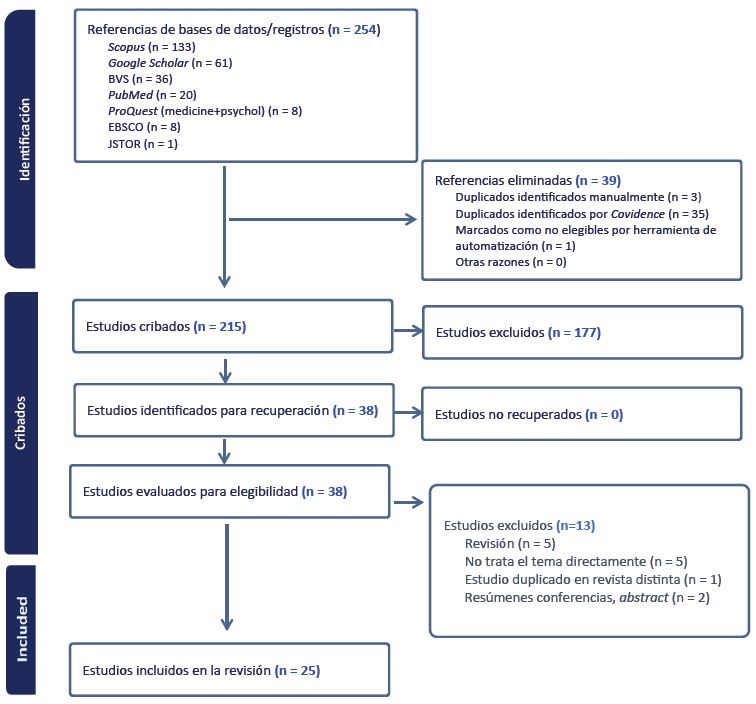
Of the 254 articles imported, 39 were duplicates and therefore excluded. After examining the title and abstract of the remaining 215 papers, 177 were excluded for not meeting the inclusion criteria. Subsequently, a full-text reading of the remaining articles excluded another 13 papers, totaling 25 studies included. Figure 2 presents the study selection flowchart.

Study characteristics
Table 1 presents the general characteristics of the studies. Brazil was responsible for 52.0% of the studies (n=13)(33-45). Regarding study population, some articles address different health professionals in the same research (36.0%; n=9)(36 , 41 , 46-52) or exclusively nursing personnel (40.0%; n=10)(35 , 37-39 , 42-44 , 53-55) whereas two studies focus on nursing students as SVs(40 , 45). Publications on the topic increased since 2022 (Table 1).
Within the included studies, 44.0% (n=11) use a quantitative approach. Of the 11 quantitative studies(36 , 41 , 43-44 , 46-50 , 53 , 55), seven use the Second Victim Experience and Support Tool (SVEST) as a data collection tool(35 , 40 , 44 , 46-47 , 53 , 55), two studies developed ad hoc instruments and the remaining two articles(43 , 48) take pre-existing instruments and modify them for their own research purposes(49-50). SV was assessed by individual self-reporting in 10 studies(40 , 43-44 , 46 , 48-49 , 52-53 , 55), with the remaining one inquiring about the experience of others in the workplace(50). The analysis identified one publication offering a National Guideline(52) for SV care, but detected no study that reported care programs aimed at SVs.
Second victim: consequences, coping strategies and perceived support
Study results are reported in three areas: those that mention the consequences for SV, those that present the coping strategies and those that report the support measures perceived by the professionals. Figure 3 describes the articles included in this review.
As mentioned above, seven articles used SVEST as an instrument to objectively measure the SV phenomenon(36 , 41 , 44 , 46-47 , 53 , 55). One study only reports data from the validation analysis of the instrument, lacking any descriptive statistics(41). Table 2 summarizes the descriptive results of the remaining five studies that used SVEST, with one study not reporting a mean by dimension(44). Psychological consequences like guilt and shame predominate in all cases. Regarding support measures, peer support ranked first in the studies from Chile(47 , 53). Absenteeism and dropout desires presented the lowest mean score in all studies that applied SVEST compared to the other dimensions (Table 2). Notably, in one studies 80% of the participants had no knowledge of the term SV(53).
Consequences for the second victims
All studies reported emotional-psychological damage among the consequences for SVs, with feelings of guilt and anguish predominating(35 , 41-44 , 46 , 49-50 , 56-57). In this case, psychological impact prevails in the SVEST report, and guilt is one of the items in this dimension that predominates in several of the studies(44-47 , 53). Blame is assigned for the possible harm caused to the patient(42 , 57) and for the lack of action to prevent the error(34). Feelings of guilt arise even when implication in the incident occurs through the team due to one’s commitment and responsibility to the group(42). Similarly, negative feelings are reported towards the judicialization process that originates from AEs(34). Recurrent thoughts(37 , 51 , 53) and insecurity to perform routine tasks occur on several occasions(42-43 , 48 , 51 , 57), generating feelings of impossibility to continue to work(57) or concentrate(42 , 49) and the fear of making another mistake(43 , 50-51), as well as work(43 , 56) and professional uncertainty(42 , 49). In parallel, SV report a fear of stigmatization(42 , 51 , 57) which makes them believe that they may lose professional prestige(50). This leads professionals to take measures to reinforce safety in routine tasks(51). Physical manifestations, especially sleep disturbances like insomnia or nightmares, were also reported by some authors(51 , 57).
Coping strategies or reactions of the second victims
One notable result is learning after and adverse event(51 , 57). Authors(42) add that after being involved in AE, professionals required time to reflect and indicated this period as useful to assuage internal questioning and loss of self-confidence, which can help to avoid new situations of similar incidents(42). Another author highlights that managers valued the training of SVs as a support strategy(37) through continuous training strategies and incident analysis(37), which probably offers them opportunities to understand what happened. In Argentina, SV is reported as an experience process in which professionals get started, try to remedy the situation, learn from the event and contribute to improvement processes and to the accompaniment of peers who are going through similar situations(51 , 57).
Reported support measures
Although support from family and close friends is considered important(46), receiving support in the workplace(43 , 46 , 55-56), either from colleagues, superiors or the institution, can greatly help cope with the event(54). Support from colleagues was the most valued by professionals in Chile who answered the SVEST(47 , 53). In Brazil, studies report that individual support is often given by colleagues when there is a pre-existing relationship, helping to promote effective acceptance and reduce the feeling of judgment for being involved in an AE(36). However, support from superiors does not seem to be well received by some participants(54), who mentioned trying to hide it and not reporting it. Consequently, the occupational support measures reported are considered inadequate or insufficient in some cases(36 , 43) and even punitive measures were reported(40 , 43).
The work environment is marked throughout the adverse event process by an institutional culture(35 , 57). As part of it, students perceived a deficient educational culture and a lack of training in key aspects of patient safety in a study conducted in Brazil(40). Similarly, a study highlights that safety culture is a fundamental pillar for SV support strategies(39). Another paper adds that feelings of guilt can be reinforced by institutional culture(42).
On the other hand, lack of institutional support seems to contribute to persistent negative feelings(38 , 42). Studies report the need for structured support backed by established protocols or procedures(37), with the possibility of receiving mental health support outside the institution(38). Development of a SV care program was highly valued by Argentinian participants, where they found containment, open listening and space for reflection(36).
In Brazil, service supervisors considered recognizing the emotional stress caused by the error as a strategy, highlighting it as an important step to build support strategies to be implemented and improved in hospital institutions(39). Additionally, professional embracement occurs when the supervisor recognizes the emotional condition of the SV and tries to understand the event through conversation, active listening and interviews(40). This process is based on empathy and a systemic approach oriented towards problem solving rather than blame-finding(40). Similarly, supervisors’ search for psychological support for their team’s SVs stands out among the attitudes valued by professionals(39). Other authors reported that their participants highlighted the possibility of seeking professional help after an AE((48-49). On the other hand, a study pointed out that the participants expressed feeling unprotected by institutions and professional associations(35).
Discussion
Evidence on the SV phenomenon in Latin America shows key similarities and differences compared to other regions of the world. Regarding similarities, the studies reviewed identified that healthcare professionals in Latin America predominantly experience feelings of guilt, recurrent thoughts, and sleep disturbances, findings consistent with those reported in Asia(16 , 18-19), the USA(8 , 20), and Europe(8 , 21-22). Unlike these regions, Latin American countries show no evidence on the development and evaluation of intervention programs aimed at supporting SVs, reflecting a relevant regional gap.
This review also highlights that most studies on SVs in Latin America were conducted in Brazil, possibly because research on patient safety produced in the last 20 years has been vastly concentrated in that country(58).
As for the consequences of the phenomenon, the studies reviewed show a predominance of psychological impact on healthcare professionals after facing an AE. Most common symptoms include guilt(35 , 38 , 46 , 50 , 53) and recurrent thoughts(35 , 39 , 51 , 57). Result similar to that reported by studies in other countries(8 , 59-60) where guilt and anguish predominate as SV symptoms. One meta-analysis identified anxiety and worry (76%, 95% CI = 33-95), as well as anger (75%, 95% CI = 59-86) as the most frequent SV symptoms(8). Similarly, fear, shame and guilt were the symptoms prevalent in over 50%(8) of the sample. This may stem from healthcare professionals’ deep sense of responsibility when having patients in their care. For example, one qualitative study highlights that professionals who feel responsible for the error perceive the AE as more severe(61). This feeling of guilt can be generated by the empathy one develops in patient care(35 , 45 , 51), and because professionals are trained to observe the principle of non-maleficence(62). As for recurrent thoughts as a persistent symptom, this can affect patient safety as it can reduce professional self-efficacy and favor new AEs(35 , 39 , 51 , 54). This coincides with previous reviews in other geographical contexts. One meta-analysis showed that 81% of the participants in the included studies reported recurrent disturbing memories(8). Additionally, one systematic review found that 20% of ICU nurses took over one year to recover from the phenomenon, or did not fully recover(60). Consequently, some authors recommend that after a severe AE, professionals should be temporarily removed from clinical work to reduce the likelihood of new errors(63).
As for physical symptoms, this review identified sleep disturbance as the most prevalent symptom(36 , 43-44 , 53), similar to other international studies(8 , 59). Lack of sleep can further aggravate the psychological symptoms of the SV phenomenon, increase anxiety(64), affect concentration and become an additional risk factor for new AEs(64).
Regarding coping strategies, studies in Latin America highlight the role of peer support as a key resource to overcome the phenomenon(38-39 , 47 , 53), reflecting that professionals seek the approval of their peers after an AE(38 , 54). Moreover, one scoping review found that by implementing organizational coping strategies, institutions show a commitment to the well-being of healthcare professionals and thus to strengthening of a culture oriented towards patient safety(20).
As for support programs aimed at SVs, the present review found no concrete efforts in Latin America geared towards support programs. Guidelines have been outlined(52), but their effectiveness has yet to be evaluated. Conversely, in the USA and Europe, studies not only evaluated the structure and impact of the support programs(20 , 65), but also evinced their economic efficiency for health systems. For example, a study conducted in Germany revealed that the peer support program can generate annual savings of over 6 million euros for hospitals by reducing costs associated with absenteeism and staff turnover(66). In the USA, studies found that the success of a SV support program lies in the loyalty of volunteers and its sustainability over time(65 , 67). However, several studies stress the importance of institutional support as part of professionals’ recovery(38-39 , 47-48 , 53). A recent review reported that support programs and services, mentioned in 37 studies (predominantly implemented in the United States and Spain), are characterized by offering immediate and structured support to professionals after an AE. Most prominent ones are forYOU, which provides a three-level support depending on impact severity; Medically Induced Trauma Support Services (MITSS), a nonprofit organization which provides emotional and legal assistance; and Resilience in Stressful Events (RISE), which uses multidisciplinary teams to provide support in the workplace(21). Together, these initiatives prioritize early intervention, confidentiality, and peer support, helping to reduce stigma, absenteeism, and favor job retention. The same review found no studies in Brazil that addressed support strategies for SVs, which reinforces the absence of Latin American studies on care programs for this phenomenon(21). Another review adds that the cited programs also include tools for communicating with patients and families, and an explicitly non-punitive approach(61). Although peer support is highly valued by the programs, it is insufficient as a single solution(21 , 63). Institutional culture is a critical mediating factor, since the perception of organizational support influences participation and recovery(65). One review found that institutional support showed significant improvements in studies that used SVEST to measure the efficacy of proposed interventions(65). These findings contrast with the absence of structured interventions in Latin America and reinforce the urgency of adapting these models, considering the prevailing resource constraints in the region. This is because Latin America faces additional challenges in ensuring support to healthcare professionals due to lack of resources and more precarious working conditions(43) and that the SVs phenomenon was studied much later. In this regard, the first study in Latin America dates back to 2018(55) after authors presented a review in 2013 with primary studies of SVs in European countries, the USA and Israel(59).
The present review stands out for its regional focus, rigorous methodology, and diversity of sources, filling an important gap in the literature and identifying existing research gaps. The methodological quality of the included studies was not formally assessed, in accordance with the recommendations of the Joanna Briggs Institute guideline for scoping reviews. Regarding limitations, since the concept of SVs is a relatively new term in the literature, some evidence may have evaded the search strategy used or some articles were not identified due to the language filter adopted. Importantly, some of the reviewed studies are validation research of the SVEST instrument, reporting data generated in contexts designed mainly to evaluate the tool’s psychometric properties that should be interpreted with caution. Finally, the heterogeneity of the population included in the studies, together with the lack of information regarding professionals’ area of specialty, limits accurately identifying particularities of the phenomenon in the different health professions and specialties. However, the findings reveals SVs as a reality present in all areas of health care.
Conclusion
Our study provides a comprehensive view of the SV phenomenon in Latin America, highlighting the prevalent significant psychological impact on healthcare professionals as observed in other countries. Given the lack of intervention studies in the region, the findings underscore the urgent need to develop and tailor targeted support programs. Implementing effective coping strategies and strengthening institutional support are crucial to improve healthcare professionals’ well-being and retention without implying a greater burden on the system. Rather, it rests on the ability to organize teams to provide the necessary support to SVs and generate an environment of psychological safety that favors containment and a better patient safety culture.
Acknowledgments
We thank the Library of the Faculty of Biomedical Sciences of the Universidad Austral for its collaboration in article retrieval and the search strategies used.
References
-
1. The Lancet Global Health. Health-care workers must be trained and retained. Lancet Glob Health. 2023;11(5):e629. https://doi.org/10.1016/s2214-109x(23)00172-9
» https://doi.org/10.1016/s2214-109x(23)00172-9 -
2. World Health Organization. Global strategy on human resources for health: workforce 2030 [Internet]. Geneva: WHO; 2016 [cited 2025 Mar 10]. Available from: https://www.who.int/publications/i/item/9789241511131
» https://www.who.int/publications/i/item/9789241511131 -
3. Kroezen M, Dussault G, Craveiro I, Dieleman M, Jansen C, Buchan J, et al. Recruitment and retention of health professionals across Europe: a literature review and multiple case study research. Health Policy. 2015;119(12):1517-28. https://doi.org/10.1016/j.healthpol.2015.08.003
» https://doi.org/10.1016/j.healthpol.2015.08.003 -
4. Alfar Z, Hakamy E, Innab A. The impacts of second victim experiences on nurses’ absenteeism and intention to leave: a multi-site cross-sectional study. J Adv Nurs. 2025;81(8):4817-27. https://doi.org/10.1111/jan.16695
» https://doi.org/10.1111/jan.16695 -
5. Al Sabei S, Qutishat M. Second victim syndrome and turnover intention among critical care nurses. Discov Ment Health. 2025;5(1):110. https://doi.org/10.1007/S44192-025-00256-9
» https://doi.org/10.1007/S44192-025-00256-9 -
6. Klemm V, Rösner H, Bushuven S, Strametz R. The second victim phenomenon: what personnel in anesthesiology should know about it. Anaesthesiologie. 2023;72(11):803-8. https://doi.org/10.1007/s00101-023-01337-6
» https://doi.org/10.1007/s00101-023-01337-6 -
7. Magaldi M, Perdomo JM, Lopez-Baamonde M, Chanza M, Sanchez D, Gomar C. Second victim phenomenon in a surgical area: online survey. Rev Esp Anestesiol Reanim (Engl Ed). 2021;68(3):123-9. https://doi.org/10.1016/j.redar.2020.11.009
» https://doi.org/10.1016/j.redar.2020.11.009 -
8. Busch IM, Moretti F, Purgato M, Barbui C, Wu AW, Rimondini M. Psychological and psychosomatic symptoms of second victims of adverse events: a systematic review and meta-analysis. J Patient Saf. 2020;16(2):e61-e74. https://doi.org/10.1097/PTS.0000000000000589
» https://doi.org/10.1097/PTS.0000000000000589 -
9. Burlison JD, Quillivan RR, Scott SD, Johnson S, Hoffman JM. The effects of the second victim phenomenon on work-related outcomes: connecting self-reported caregiver distress to turnover intentions and absenteeism. J Patient Saf. 2021;17(3):195-9. https://doi.org/10.1097/PTS.0000000000000301
» https://doi.org/10.1097/PTS.0000000000000301 -
10. Kruper A, Domeyer-Klenske A, Treat R, Pilarski A, Kaljo K. Secondary traumatic stress in Ob-Gyn: a mixed methods analysis assessing physician impact and needs. J Surg Educ. 2021;78(3):1024-34. https://doi.org/10.1016/j.jsurg.2020.08.038
» https://doi.org/10.1016/j.jsurg.2020.08.038 -
11. Wahlberg Å, Sachs MA, Johannesson K, Hallberg G, Jonsson M, Svanberg AS, et al. Post-traumatic stress symptoms in Swedish obstetricians and midwives after severe obstetric events: a cross-sectional retrospective survey. BJOG. 2017;124(8):1264-71. https://doi.org/10.1111/1471-0528.14259
» https://doi.org/10.1111/1471-0528.14259 -
12. Grissinger M. Too many abandon the “second victims” of medical errors. P T [Internet]. 2014 [cited 2025 Jan 10];39(9):591-2. Available from: https://www.ncbi.nlm.nih.gov/pmc/articles/PMC4159062/
» https://www.ncbi.nlm.nih.gov/pmc/articles/PMC4159062/ -
13. Van Gerven E, Vander Elst T, Vandenbroeck S, Dierickx S, Euwema M, Sermeus W, et al. Increased risk of burnout for physicians and nurses involved in a patient safety incident. Med Care. 2016;54(10):937-43. https://doi.org/10.1097/MLR.0000000000000582
» https://doi.org/10.1097/MLR.0000000000000582 -
14. Stehman CR, Testo Z, Gershaw RS, Kellogg AR. Burnout, drop out, suicide: physician loss in emergency medicine, part I. West J Emerg Med. 2019;20(3):485-94. https://doi.org/10.5811/westjem.2019.4.40970
» https://doi.org/10.5811/westjem.2019.4.40970 -
15. Busch IM, Moretti F, Campagna I, Benoni R, Tardivo S, Wu AW, et al. Promoting the psychological well-being of healthcare providers facing the burden of adverse events: a systematic review of second victim support resources. Int J Environ Res Public Health. 2021;18(10):5080. https://doi.org/10.3390/ijerph18105080
» https://doi.org/10.3390/ijerph18105080 -
16. Choi EY, Pyo J, Lee W, Jang SG, Park YK, Ock M, et al. Nurses’ experiences of patient safety incidents in Korea: a cross-sectional study. BMJ Open. 2020;10(10):e037741. https://doi.org/10.1136/bmjopen-2020-037741
» https://doi.org/10.1136/bmjopen-2020-037741 -
17. Luk LA, Lee FKI, Lam CS, Soh Y, Wong YYM, Lui WSW. Healthcare professional experiences of clinical incident in Hong Kong: a qualitative study. Risk Manag Healthc Policy. 2021;14:947-57. https://doi.org/10.2147/RMHP.S292875
» https://doi.org/10.2147/RMHP.S292875 -
18. Mok W, Chin GF, Yap SF, Wang W. A cross-sectional survey on nurses’ second victim experience and quality of support resources in Singapore. J Nurs Manag. 2020;28(2):286-93. https://doi.org/10.1111/jonm.12920
» https://doi.org/10.1111/jonm.12920 -
19. Pyo J, Choi EY, Lee W, Jang SG, Park YK, Ock M, et al. Physicians’ difficulties due to patient safety incidents in Korea: a cross-sectional study. J Korean Med Sci. 2020;35(17):e118. https://doi.org/10.3346/jkms.2020.35.e118
» https://doi.org/10.3346/jkms.2020.35.e118 -
20. Finney RE, Torbenson VE, Riggan KA, Weaver AL, Long ME, Allyse MA, et al. Second victim experiences of nurses in obstetrics and gynaecology: a second victim experience and support tool survey. J Nurs Manag. 2021;29(4):642-52. https://doi.org/10.1111/jonm.13198
» https://doi.org/10.1111/jonm.13198 -
21. Quadrado ERS, Tronchin DMR, Maia FOM. Strategies to support health professionals in the condition of second victim: scoping review. Rev Esc Enferm USP. 2021;55:e03669. https://doi.org/10.1590/S1980-220X2019011803669
» https://doi.org/10.1590/S1980-220X2019011803669 -
22. Santana-Domínguez I, González-de la Torre H, Martín-Martínez A. Cross-cultural adaptation to the Spanish context and evaluation of the content validity of the Second Victim Experience and Support Tool (SVEST-E) questionnaire. Enferm Clin (Engl Ed). 2021;31(6):334-43. https://doi.org/10.1016/j.enfcli.2020.12.042
» https://doi.org/10.1016/j.enfcli.2020.12.042 -
23. Carrillo I, Tella S, Strametz R, Vanhaecht K, Panella M, Guerra-Paiva S, et al. Studies on the second victim phenomenon and other related topics in the pan-European environment: the experience of ERNST Consortium members. J Patient Saf Risk Manag. 2022;27(2):59-65. https://doi.org/10.1177/25160435221076985
» https://doi.org/10.1177/25160435221076985 -
24. Comisión Económica para América Latina y el Caribe. Panorama social de América Latina 2021 [Internet]. Santiago: CEPAL; 2022 [cited 2025 Feb 04]. Available from: https://repositorio.cepal.org/entities/publication/ddf540fc-6e83-4db9-9be5-ff5eb11c0e65
» https://repositorio.cepal.org/entities/publication/ddf540fc-6e83-4db9-9be5-ff5eb11c0e65 -
25. Organización Panamericana de la Salud. Política sobre el personal de salud 2030: fortalecimiento de los recursos humanos para la salud a fin de lograr sistemas de salud resilientes [Internet]. Washington, D.C.: OPS; 2023 [cited 2025 Mar 01]. Available from: https://www.paho.org/es/documentos/cd606-politica-sobre-personal-salud-2030-fortalecimiento-recursos-humanos-para-salud-fin
» https://www.paho.org/es/documentos/cd606-politica-sobre-personal-salud-2030-fortalecimiento-recursos-humanos-para-salud-fin -
26. Peters MDJ, Marnie C, Tricco AC, Pollock D, Munn Z, Alexander L, et al. Updated methodological guidance for the conduct of scoping reviews. JBI Evid Synth. 2020;18(10):2119-26. https://doi.org/10.11124/JBIES-20-00167
» https://doi.org/10.11124/JBIES-20-00167 -
27. Tricco AC, Lillie E, Zarin W, O’Brien KK, Colquhoun H, Levac D, et al. PRISMA extension for scoping reviews (PRISMA-ScR): checklist and explanation. Ann Intern Med. 2018;169(7):467-73. https://doi.org/10.7326/M18-0850
» https://doi.org/10.7326/M18-0850 -
28. Victoria MSK, Fajreldines A. Second victim in Latinoamerica [Registration]. Open Science Framework. 2024 Aug 06 [cited 2025 Feb 13]. Available from: https://doi.org/10.17605/OSF.IO/Q6SH5
» https://doi.org/10.17605/OSF.IO/Q6SH5 -
29. Real Academia Española. Latinoamérica. In: Diccionario panhispánico de dudas [Internet]. Madrid: RAE; 2024 [cited 2025 Feb 10]. Available from: https://www.rae.es/dpd/Latinoamérica
» https://www.rae.es/dpd/Latinoamérica -
30. Vanhaecht K, Seys D, Russotto S, Strametz R, Mira JJ, Sigurgeirsdóttir S, et al. An evidence and consensus-based definition of second victim: a strategic topic in healthcare quality, patient safety, person-centeredness and human resource management. Int J Environ Res Public Health. 2022;19(24):16869. https://doi.org/10.3390/ijerph192416869
» https://doi.org/10.3390/ijerph192416869 -
31. Peters MDJ, Godfrey C, McInerney P, Munn Z, Tricco AC, Khalil H. Scoping reviews. In: Aromataris E, Munn Z, editors. JBI manual for evidence synthesis [Internet]. Adelaide: JBI; 2024 [cited 2025 Jan 08]. Available from: https://doi.org/10.46658/JBIMES-24-09
» https://doi.org/10.46658/JBIMES-24-09 -
32. Covidence [software]. Veritas Health Innovation. 2024 [cited 2025 Dec 20]. Available from: https://www.covidence.org/
» https://www.covidence.org/ -
33. Bohomol E. Nurses as second victims: a Brazilian perspective. Nurs Health Sci. 2019;21(4):538-9. https://doi.org/10.1111/nhs.12630
» https://doi.org/10.1111/nhs.12630 -
34. Tartaglia A, Matos MAA. Second victim: after all, what is this? Einstein (Sao Paulo). 2020;18:eED5619. https://doi.org/10.31744/einstein_journal/2020ed5619
» https://doi.org/10.31744/einstein_journal/2020ed5619 -
35. Souza VS, Matsuda LM, Freitas GF, Marcon SS, Costa MAR. The hidden experience of nursing professionals sued for error. Rev Esc Enferm USP. 2021;55:e03668. https://doi.org/10.1590/S1980-220X2019036703668
» https://doi.org/10.1590/S1980-220X2019036703668 -
36. De Sordi LP, Lourenção DCA, Gallasch CH, Baptista PCP. The second victim experience: cross-cultural adaptation of an instrument for the Brazilian context. Rev Gaucha Enferm. 2022;43:e20210010. https://doi.org/10.1590/1983-1447.2022.20210010.en
» https://doi.org/10.1590/1983-1447.2022.20210010.en -
37. Quadros DV, Magalhães AMM, Wachs P, Severo IM, Tavares JP, Dal Pai D. Modeling of adult patient falls and the repercussions to nursing as a second victim. Rev. Latino-Am. Enfermagem. 2022;30:e3617. https://doi.org/10.1590/1518-8345.5830.3617
» https://doi.org/10.1590/1518-8345.5830.3617 -
38. Quadros DV, Magalhães AMM, Boufleuer E, Tavares JP, Kuchenbecker RS, Dal Pai D. Falls Suffered by Hospitalized Adult Patients: Support to the Nursing Team as the Second Victim. Aquichan. 2022;22(4):e2246. https://doi.org/10.5294/aqui.2022.22.4.6
» https://doi.org/10.5294/aqui.2022.22.4.6 - 39. Ribeiro RN. Strategies to support nursing professionals as second victims during the covid-19 pandemic [thesis]. Salvador: Universidade Federal da Bahia; 2021 [cited 2024 Dec 01]. Available from: https://repositorio.ufba.br/handle/ri/38501
-
40. Tavares APM, Barlem JGT, Rocha LP, Oliveira ACC, Avelino FVSD, Paloski GDR. Patient safety incidents and the second victim phenomenon among nursing students. Rev Esc Enferm USP. 2022;56:e20220005. https://doi.org/10.1590/1980-220X-REEUSP-2022-0005en
» https://doi.org/10.1590/1980-220X-REEUSP-2022-0005en - 41. Lima APA. Tradução e validação da ferramenta de experiência e apoio à segunda vítima - revisada (SVEST-R) para o português brasileiro [thesis]. Salvador: Escola Bahiana de Medicina e Saúde Pública; 2023 [cited 2025 Jan 12]. Available from: https://repositorio.bahiana.edu.br/bitstreams/147150d7-a25b-4413-a5db-06cac8b191da/download
-
42. Silveira SE, Tomaschevski-Barlem JG, Tavares APM, Paloski GR, Feijó GS, Cabral CN. Patient safety incidents: second victim. Rev Enferm UERJ. 2023;31:e73147. https://doi.org/10.12957/reuerj.2023.73147
» https://doi.org/10.12957/reuerj.2023.73147 -
43. Alevi JO, Draganov PB, Gonçalves GCS, Zimmermann GS, Giunta L, Mira JJ, et al. The newly graduated nurse as a second victim. Acta Paul Enferm. 2024;37:eAPE02721. https://doi.org/10.37689/acta-ape/2024AO0002721
» https://doi.org/10.37689/acta-ape/2024AO0002721 -
44. Rodrigues FM, Santos LL, Costa MA, Garzin ACA, Hamano L, Garcia PC. Second Victim: Experience and Perception of Nursing Team Professionals. Nursing (Ed Bras). 2025;29(321):10595-605. https://doi.org/10.36489/nursing.2025v29i321p10595-10605
» https://doi.org/10.36489/nursing.2025v29i321p10595-10605 -
45. Abrantes MP, Montanari JVO, Garzin ACA. Undergraduate Nursing students’ perception of the second victim phenomenon. Nursing (Ed Bras). 2024;28(317):10226-31. https://doi.org/10.36489/nursing.2024v28i317p10226-10231
» https://doi.org/10.36489/nursing.2024v28i317p10226-10231 -
46. Brunelli MV, Estrada S, Celano C, Bandriwskyj C, Riquelme RJ, Ortega A, et al. Segunda víctima: experiencia y medidas de apoyo percibidas por los profesionales sanitarios. Medicina (B Aires). 2023;83(6):918-26. Available from: https://www.medicinabuenosaires.com/revistas/vol83-23/n6/918.pdf
» https://www.medicinabuenosaires.com/revistas/vol83-23/n6/918.pdf -
47. Mallea-Salazar F, Ibaceta-Reinoso I, Vejar-Reyes C. Second victims: perceived support quality and its relationship with the consequences of the adverse event. Rev Chil Salud Pública. 2021;25(1):76-85. https://doi.org/10.5354/0719-5281.2021.65197
» https://doi.org/10.5354/0719-5281.2021.65197 -
48. Flores García SL. Evaluación del conocimiento sobre segundas víctimas y su repercusión en el personal de salud del Área Quirúrgica del Hospital Pablo Arturo Suárez, en el 2023 [dissertation]. Quito: Pontificia Universidad Católica del Ecuador; 2023 [cited 2025 Jan 10]. Available from: https://repositorio.puce.edu.ec/handle/123456789/41075
» https://repositorio.puce.edu.ec/handle/123456789/41075 -
49. Fuentes Chuquisala EP. Estrategia de apoyo y seguimiento a profesionales de la salud como segundas víctimas de eventos adversos del área de emergencia del Hospital General Francisco de Orellana enero-agosto 2023 [thesis]. Quito: Universidad de las Américas; 2023 [cited 2025 Jan 10]. Available from: https://dspace.udla.edu.ec/handle/33000/15382
» https://dspace.udla.edu.ec/handle/33000/15382 -
50. Flórez F, López L, Bernal C. Prevalencia de eventos adversos y sus manifestaciones en profesionales de la salud como segundas víctimas. Biomédica. 2022;42(1):184-95. https://doi.org/10.7705/biomedica.6169
» https://doi.org/10.7705/biomedica.6169 -
51. Brunelli MV, Seisdedos MG, Martinez MM. Second victim experience: a dynamic process conditioned by the environment. A qualitative research. Int J Public Health. 2024;69:1607399. https://doi.org/10.3389/ijph.2024.1607399
» https://doi.org/10.3389/ijph.2024.1607399 -
52. Gallo EBR, Delgado MG, Solves JJM, Toquica CV, Ruiz JCM, Dimate AE, et al. Guía nacional de respuesta al fenómeno de las segundas víctimas en instituciones de salud en Colombia [Internet]. Bogotá: Fundación Universitaria Sanitas; 2024 [cited 2025 Jan 02]. Available from: https://repositorio.unisanitas.edu.co/bitstreams/454e683e-f11b-4691-bde4-924c208d7b92/download
» https://repositorio.unisanitas.edu.co/bitstreams/454e683e-f11b-4691-bde4-924c208d7b92/download -
53. Kappes M, Delgado-Hito P, Contreras VR, Romero-García M. Prevalence of the second victim phenomenon among intensive care unit nurses and the support provided by their organizations. Nurs Crit Care. 2023;28(6):1022-30. https://doi.org/10.1111/nicc.12967
» https://doi.org/10.1111/nicc.12967 -
54. Kappes M, Romero-García M, Sanchez M, Delgado-Hito P. Coping trajectories of intensive care nurses as second victims: a grounded theory. Aust Crit Care. 2024;37(4):606-13. https://doi.org/10.1016/j.aucc.2024.01.001
» https://doi.org/10.1016/j.aucc.2024.01.001 -
55. Brunelli MV, Estrada S, Celano C. Cross-cultural adaptation and psychometric evaluation of a Second Victim Experience and Support Tool (SVEST). J Patient Saf. 2021;17(8):e1401-e1405. https://doi.org/10.1097/PTS.0000000000000497
» https://doi.org/10.1097/PTS.0000000000000497 -
56. Brunelli V. Comentario del artículo: son demasiados los que abandonan a las “segundas víctimas” de los errores médicos. Enferm Neonatal [Internet]. 2019 [cited 2025 Feb 03];30. Available from: https://www.revista.fundasamin.org.ar/comentario-del-articulo-son-demasiados-los-que-abandonan-a-las-segundas-victimas-de-los-errores-medicos/index.html
» https://www.revista.fundasamin.org.ar/comentario-del-articulo-son-demasiados-los-que-abandonan-a-las-segundas-victimas-de-los-errores-medicos/index.html -
57. Rocabado CN, Franco JVA, Garegnani-Pisi LI, Benitez FE, Roson-Rodriguez P, Barraza AD. Surgical Technologists as Second Victims in a Teaching Hospital in Buenos Aires: A Qualitative Study. Rev Colomb Enferm. 2021;20(2):e034. https://doi.org/10.18270/rce.v20i2.3118
» https://doi.org/10.18270/rce.v20i2.3118 -
58. Aguirre MH. Scientific production on patient safety in the field of nursing in Latin America. Salud Cienc Tecnol. 2021;1:17. https://doi.org/10.56294/saludcyt202117
» https://doi.org/10.56294/saludcyt202117 -
59. Seys D, Wu AW, Van Gerven E, Vleugels A, Euwema M, Panella M, et al. Health care professionals as second victims after adverse events: a systematic review. Eval Health Prof. 2013;36(2):135-62. https://doi.org/10.1177/0163278712458918
» https://doi.org/10.1177/0163278712458918 -
60. Naya K, Aikawa G, Ouchi A, Ikeda M, Fukushima A, Yamada S, et al. Second victim syndrome in intensive care unit healthcare workers: a systematic review and meta-analysis on types, prevalence, risk factors, and recovery time. PLoS One. 2023;18(10):e0292108. https://doi.org/10.1371/journal.pone.0292108
» https://doi.org/10.1371/journal.pone.0292108 -
61. Kappes M, Romero-García M, Delgado-Hito P. Coping strategies in health care providers as second victims: a systematic review. Int Nurs Rev. 2021;68(4):471-83. https://doi.org/10.1111/inr.12694
» https://doi.org/10.1111/inr.12694 -
62. Catalán L, Alvarado-Peña J, Torres-Soto G, Lorca-Sepúlveda B, Besoain-Cornejo AM, Kappes M. Second victim phenomenon among healthcare students: a scoping review. Nurse Educ Pract. 2024;79:104094. https://doi.org/10.1016/j.nepr.2024.104094
» https://doi.org/10.1016/j.nepr.2024.104094 -
63. Finney RE, Czinski S, Fjerstad K, Arteaga GM, Weaver AL, Riggan KA, et al. Evaluation of a second victim peer support program on perceptions of second victim experiences and supportive resources in pediatric clinical specialties using the Second Victim Experience and Support Tool (SVEST). J Pediatr Nurs. 2021;61:312-7. https://doi.org/10.1016/j.pedn.2021.08.023
» https://doi.org/10.1016/j.pedn.2021.08.023 -
64. Chen L, Luo C, Liu S, Chen W, Liu Y, Li Y, et al. Excessive daytime sleepiness in general hospital nurses: prevalence, correlates, and its association with adverse events. Sleep Breath. 2019;23(1):209-16. https://doi.org/10.1007/s11325-018-1684-9
» https://doi.org/10.1007/s11325-018-1684-9 -
65. Ong TSK, Goh CN, Tan EKYE, Sivanathan KA, Tang ASP, Tan HK, et al. Second victim syndrome among healthcare professionals: a systematic review of interventions and outcomes. J Healthc Leadersh. 2025;17:225-39.https://doi.org/10.2147/JHL.S526565
» https://doi.org/10.2147/JHL.S526565 -
66. Roesner H, Neusius T, Strametz R, Mira JJ. Economic value of peer support program in German hospitals. Int J Public Health. 2024;69:1607218. https://doi.org/10.3389/ijph.2024.1607218
» https://doi.org/10.3389/ijph.2024.1607218 -
67. Connors CA, Dukhanin V, Norvell M, Wu AW. RISE: exploring volunteer retention and sustainability of a second victim support program. J Healthc Manag. 2021;66(1):19-32. https://doi.org/10.1097/jhm-d-19-00264
» https://doi.org/10.1097/jhm-d-19-00264
-
Data Availability Statement
Datasets related to this article will be available upon request to the corresponding author.
-
How to cite this article
Brunelli MV, Fajreldines AV, Catalán L, Kappes M. The second victim phenomenon in Latin America: a scoping review. Rev. Latino-Am. Enfermagem. [cited]. Available from: https://doi.org/10.1590/1518-8345.7978.4828
Edited by
-
Associate Editor:
Maria Lúcia Zanetti
Datasets related to this article will be available upon request to the corresponding author.