 Association between atmospheric SO2 exposure and severity of respiratory infections in infants: a systematic review
ABSTRACT
Environmental factors may influence the severity of lower respiratory infections, a major cause of morbidity and mortality in infants. Sulfur dioxide (SO2) has biologically plausible pro-inflammatory and epithelial effects. This PRISMA 2020–compliant systematic review synthesized observational studies published between 2015 and 2025, selected to ensure methodological comparability and contemporary relevance, examining the association between atmospheric SO2 exposure and severity-related respiratory outcomes in infants. Thirteen studies met eligibility criteria. Most evaluated short-term exposure using daily lag structures (lag01 to lag03) or 1–2 week averages, whereas one birth cohort assessed annual exposure during the first year of life. All studies adjusted for meteorological variables, and most incorporated multipollutant regression models. Owing to substantial heterogeneity in exposure metrics, increments, lag structures, and effect scales, a meta-analysis was not performed. Across studies, short-term SO2 exposure was most consistently associated with increased hospitalization for ALRIs, longer length of stay, and progression to severe disease. Effect estimates per 10 µg/m3 were modest but statistically significant in specific lag windows. In one cohort, higher annual exposure was associated with severe ALRI (IRR 2.81; 95% CI 1.35–5.83), and one hospital-based study reported increased mortality (OR 2.04; 95% CI 1.33–3.13). Associations were less consistent in low-exposure settings or in models with strong multipollutant collinearity. Overall, the evidence suggests context-dependent associations between short-term SO2 exposure and increased severity of respiratory infections in infants, particularly hospitalization, longer length of stay, and progression to severe disease. Given the observational and heterogeneous nature of the data, findings should be interpreted cautiously.
KEYWORDS:
SO2; Air pollution; Infants; Respiratory infections; Bronchiolitis; Pneumonia
INTRODUCTION
Acute lower respiratory infections (ALRI), particularly bronchiolitis and pneumonia, remain the leading causes of morbidity and mortality in infants worldwide1-5. Immature respiratory and immune systems may increase infant susceptibility to environmental stressors such as air pollutants6,7. According to the World Health Organization (WHO), more than 90% of the global urban population is exposed to air pollution levels exceeding recommended standards8,9. In addition to urbanization and traffic-related emissions, broader environmental changes may influence air pollution patterns and respiratory vulnerability. Climate change may further modify pollutant dispersion, atmospheric chemistry, and viral circulation dynamics, potentially affecting exposure profiles and host susceptibility10,11.
Particulate matter (PM) and nitrogen oxides have been extensively studied in pediatric respiratory epidemiology, whereas sulfur dioxide (SO2) has received comparatively less attention in infant populations12. SO2 is a soluble pollutant capable of inducing airway irritation, oxidative stress, and inflammatory responses; these mechanisms are compatible with worsening respiratory infections, though not proof of direct causation13,14. Current WHO air quality guidelines define exposure limits for SO2; however, these standards are based on general population data and do not specifically address infants with ALRI15,16.
Epidemiological studies in general and pediatric populations have reported associations between SO2 exposure and respiratory morbidity, including pneumonia, ALRIs, and respiratory failure17-20. However, most investigations include broad pediatric age ranges and do not specifically focus on infants.
Given the heterogeneity of existing findings and the absence of infant-specific synthesis, this systematic review evaluated whether ambient SO2 exposure is associated with increased severity of ALRIs in infants. Following a PECO framework, the review focused on infants (including studies of children up to 5 years when infant-specific estimates were available), ambient SO2 exposure compared with lower exposure levels, and severity-related outcomes such as hospitalization, length of stay (LOS), respiratory failure, and mortality.
MATERIALS AND METHODS
This systematic review followed PRISMA 2020 guidelines21. The protocol was registered in OSF (Nº 10.17605/OSF.IO/5TPGC). Studies published between 2015 and 2025 were eligible. The restriction refers to year of publication (not exposure period) and was applied to ensure methodological comparability and contemporary relevance, particularly in light of advances in exposure assessment including higher spatial resolution monitoring and satellite-based estimates, the increasing use of multipollutant models, and improved age-specific analyses in infant populations, as well as to reduce heterogeneity related to earlier analytical approaches. Only studies evaluating severity-related outcomes were included: hospitalization due to ALRI, ICU admission, LOS, need for respiratory support, disease severity scores, or mortality. Eligible clinical conditions included bronchiolitis, pneumonia, and other ALRI. Studies including children aged 0–5 years were eligible if infant-specific results were reported separately. Differences in exposure windows were considered during qualitative synthesis. Eligible study designs included observational studies, cohort studies, time-series analyses, case-crossover studies, and ecological studies. Studies assessing only gestational exposure; systematic reviews; meta-analyses; editorials, commentaries, and letters; and animal or in vitro experimental studies were excluded.
Information sources and search strategies
A systematic search was conducted in PubMed/MEDLINE, Web of Science (Core Collection), and Embase (Elsevier) to identify studies evaluating the association between atmospheric air pollution, particularly SO2, and severity-related outcomes of ALRIs in infants.
PubMed
The PubMed search strategy combined controlled vocabulary (MeSH terms) and free-text terms. The following search structure was applied: ("Air Pollution"[Mesh] OR "Air Pollutants"[Mesh] OR "SO2"[Mesh] OR "SO2"[tiab] OR "sulphur dioxide"[tiab] OR sulfur dioxide[tiab]) AND ("Respiratory Tract Infections"[Mesh] OR "Bronchiolitis, Viral"[Mesh] OR "Influenza, Human"[Mesh] OR "Respiratory Syncytial Virus Infections"[Mesh] OR "Respiratory Failure"[Mesh] OR "viral respiratory infection*"[tiab] OR "respiratory virus*"[tiab] OR RSV[tiab] OR influenza[tiab] OR bronchiolitis[tiab] OR "hypoxemic acute respiratory failure"[tiab] OR "hypoxaemic acute respiratory failure"[tiab] OR ("acute respiratory failure"[tiab] AND hypoxem*[tiab])) AND ("Infant"[Mesh] OR "Infant, Newborn"[Mesh] OR "Child, Preschool"[Mesh] OR infant*[tiab] OR newborn*[tiab] OR baby[tiab] OR babies[tiab]) AND ("Severity of Illness Index"[Mesh] OR "Hospitalization"[Mesh] OR "Mortality"[Mesh] OR severity[tiab] OR hospitalization[tiab] OR "length of stay"[tiab] OR mortality[tiab]) AND (association*[tiab] OR correlation*[tiab] OR relationship[tiab] OR effect*[tiab] OR exposure[tiab] OR risk[tiab] OR impact[tiab]). Filters were applied for human studies, publication period (2015–2025), and age categories corresponding to Newborn (0–1 month), Infant (0–23 months), and Preschool Child (2–5 years).
Web of Science (Core Collection)
The search was performed using topic field (TS), combining terms related to air pollution and SO2, respiratory infections and respiratory failure, pediatric age groups, severity outcomes, and association measures: ("air pollution" OR "air pollutants" OR "SO2" OR "sulphur dioxide" OR sulfur dioxide) AND ("respiratory tract infection*" OR bronchiolitis OR influenza OR "respiratory syncytial virus" OR RSV OR "respiratory failure" OR "hypoxemic acute respiratory failure" OR "hypoxaemic acute respiratory failure") AND (infant* OR newborn* OR baby OR babies OR "child preschool") AND (severity OR hospitalization OR "length of stay" OR mortality) AND (association* OR correlation* OR relationship OR effect* OR exposure OR risk OR impact). The publication period filter was directly applied (2015–2025).
Embase (Elsevier)
In Embase, both Emtree controlled vocabulary and free-text terms were used. The search strategy included: (‘air pollution’/exp OR ‘air pollution’ OR ‘air pollutant’/exp OR ‘air pollutant’ OR ‘SO2’/exp OR ‘SO2’ OR ‘sulphur dioxide’/exp OR ‘sulphur dioxide’ OR sulfur dioxide) AND (‘respiratory tract infection’/exp OR ‘respiratory tract infection’ OR ‘bronchiolitis’/exp OR ‘bronchiolitis’ OR ‘influenza’/exp OR ‘influenza’ OR ‘respiratory syncytial virus infection’/exp OR ‘respiratory syncytial virus infection’ OR ‘respiratory failure’/exp OR ‘respiratory failure’ OR ‘hypoxemic acute respiratory failure’/exp OR ‘hypoxemic acute respiratory failure’ OR ‘hypoxaemic acute respiratory failure’/exp OR ‘hypoxaemic acute respiratory failure’) AND (‘infant’/exp OR ‘infant’ OR ‘newborn’/exp OR ‘newborn’ OR infant* OR newborn* OR ‘baby’/exp OR baby OR babies) AND (‘severity of illness’/exp OR ‘severity of illness’ OR ‘hospitalization’/exp OR ‘hospitalization’ OR ‘mortality’/exp OR ‘mortality’ OR ‘length of stay’/exp OR ‘length of stay’ OR ‘severity’/exp OR severity) AND (association* OR correlation* OR ‘relationship’/exp OR relationship OR effect* OR ‘exposure’/exp OR exposure OR ‘risk’/exp OR risk OR ‘impact’/exp OR impact)
The publication period filter was directly applied (2015–2025). The search was restricted to human studies.
A total of 361 records identified across databases were exported to Rayyan22 for duplicate removal and two-stage screening (title/abstract followed by full-text review). Initial screening was performed by one reviewer (SEV), with all inclusion and exclusion decisions independently verified by a second reviewer (AAF). Discrepancies, including six records classified as uncertain, were resolved by discussion and consensus.
Data extraction was conducted by one reviewer (SEV) using a standardized form and independently verified by a second reviewer (AAF). Extracted data included study characteristics (title, authors, year, country, design, age range), SO2 exposure measures and windows, evaluated outcomes, association estimates, confounder adjustments, and subgroup analyses.
Quality assessment
Risk of bias in the included studies was assessed using the National Institutes of Health/National Heart, Lung, and Blood Institute (NIH/NHLBI) quality assessment tools, selected according to study design23. Cohort studies were evaluated using the NIH Quality Assessment Tool for Observational Cohort and Cross-Sectional Studies. For time-series studies, the NIH Quality Assessment Tool for Before–After (Pre–Post) Studies With No Control Group was applied, with adaptations to reflect characteristics of ecological time-series analyses, including assessment of exposure measurement methods, control for temporal trends and seasonality, lag structure specification, and adjustment for meteorological variables and co-pollutants. Case-crossover studies were evaluated using the NIH Quality Assessment Tool for Case-Control Studies, with items interpreted in light of the case-crossover design, particularly regarding selection of control periods, exposure comparability, and control of time-varying confounders. Ecological studies were assessed using the NIH Quality Assessment Tool for Cross-Sectional Studies, with consideration of aggregated exposure metrics and population-level outcome assessment.
Items not applicable to specific study designs were recorded as such and were not considered in the overall judgment.
Each study was classified as Good, Fair, or Poor according to NIH/NHLBI guidance. Particular emphasis was placed on exposure assessment validity, given its central relevance in environmental epidemiology. Studies using high-resolution or individual-level exposure modeling were eligible for a Good rating when other domains were adequately addressed, whereas studies relying on ecological or fixed-site monitoring exposure metrics were classified as Fair due to the potential for non-differential exposure misclassification. For time-series and case-crossover designs, domains explicitly evaluated included exposure validity, temporality, lag specification, adjustment for meteorological variables and seasonality, and co-pollutant control. Domain-level assessments are summarized in Table 1 to ensure transparency and reproducibility.
Certainty of the evidence
In addition to the study-level risk of bias assessment, the overall certainty of the evidence across outcomes was evaluated using an adapted GRADE approach. This assessment considered risk of bias, inconsistency, indirectness, imprecision, and publication bias. Given the heterogeneity in study designs, exposure metrics, and outcome definitions, the assessment was conducted qualitatively without quantitative pooling. The overall certainty was classified as high, moderate, low, or very low for each outcome.
Data synthesis
A descriptive narrative synthesis was performed, structured by type of outcome and by the magnitude and direction of associations. The data synthesis was conducted by authors SEV and AAF. When studies reported multiple lag structures, the lag identified by the authors as the primary exposure window or emphasized in the main results was considered in the qualitative synthesis. Additional lag estimates were described when clinically or methodologically relevant. When multiple exposure increments were reported (e.g., per 1 µg/m3, per 10 µg/m3, per interquartile range, or percentile-based comparisons), the increment specified in the primary model of the study was retained. When standardized increments (e.g., per 10 µg/m3) were available, these were preferentially described to facilitate comparability across studies. When both single-pollutant and multipollutant models were presented, estimates from the most fully adjusted model were prioritized. Subgroup analyses (e.g., by age or sex) were reported when relevant to infant populations. A consistent hierarchical approach was applied during data extraction to ensure transparency and minimize selective reporting bias.
Heterogeneity across studies (designs, exposure windows, measurement units, and SO2 concentrations) precluded conducting a meta-analysis.
RESULTS
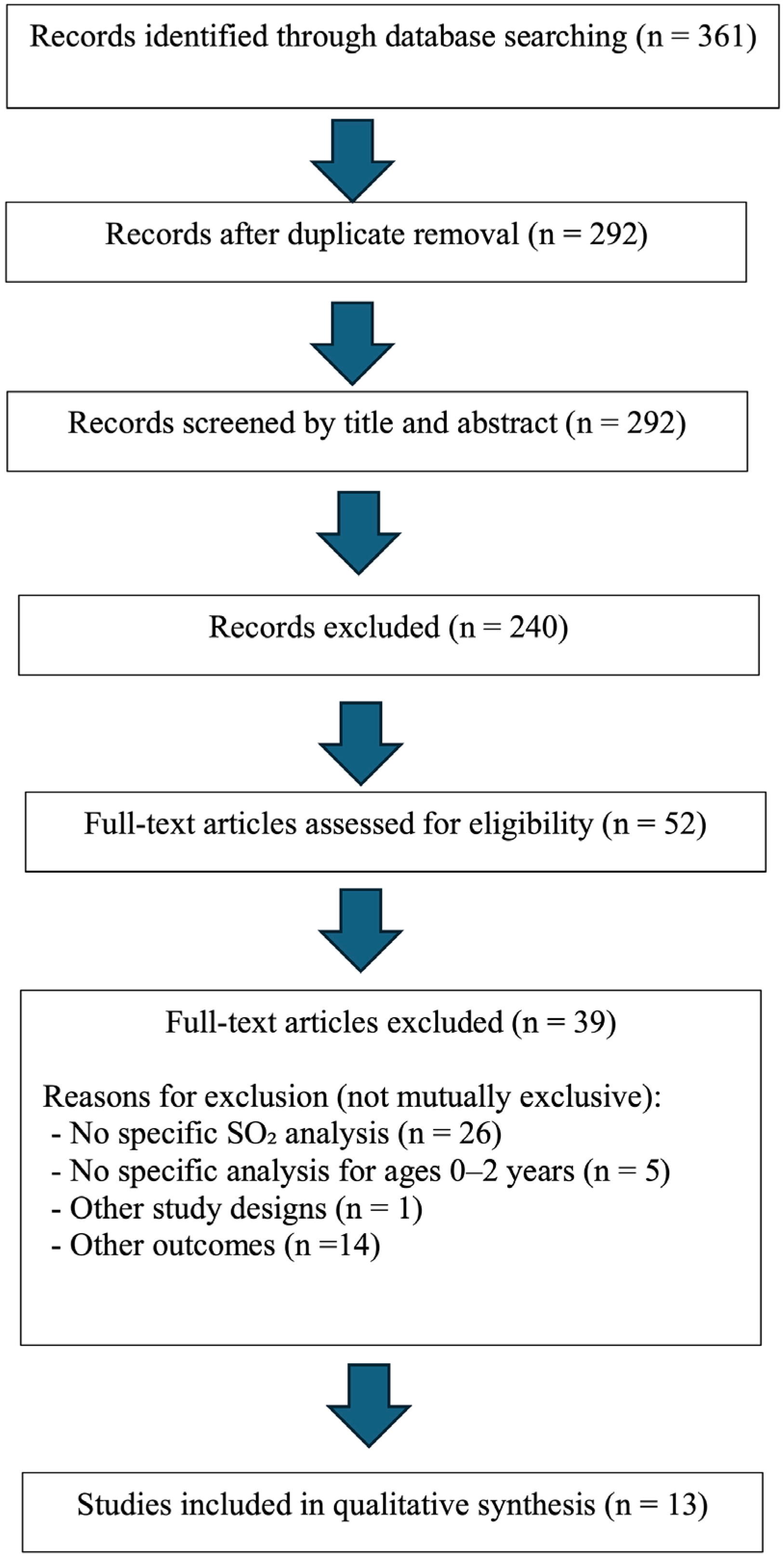
A total of 361 records were identified via database searching. After removal of duplicates, 292 records remained and were screened by title and abstract. Of these, 240 were excluded based on predefined eligibility criteria. Fifty-two full-text articles were assessed for eligibility. Of these, 39 were excluded after full-text review. The primary reasons for exclusion were absence of specific SO2 analysis (n = 26), lack of age-specific estimates for children aged 0–2 years (n = 5), outcomes not related to disease severity (n = 14), and non-eligible study design (n = 1). Some studies met more than one exclusion criterion; therefore, counts are not mutually exclusive. Thirteen studies met all inclusion criteria and were included in the qualitative synthesis (Figure 1).
Among the thirteen included studies, four were classified as Good and nine as Fair quality according to NIH/NHLBI tools (Table 1). Domain-level assessment demonstrated that population definition, outcome ascertainment, temporality, lag specification, and adjustment for meteorological variables and seasonality were adequately addressed across studies. However, exposure validity was classified as partially addressed in nine studies due to reliance on ecological exposure assignment (e.g., fixed-site monitoring, municipal-level aggregation, or spatial interpolation), reflecting the inherent risk of non-differential exposure misclassification. This methodological limitation may attenuate effect estimates and therefore informed the Fair classification. Studies rated as Good incorporated higher-resolution or individual-level exposure modeling and fulfilled all major NIH/NHLBI domains without exposure-related limitations warranting partial classification.
A total of thirteen studies published between 2017 and 2024 were conducted in Israel, China, Hong Kong, Italy, Vietnam, Finland, Brazil, and Spain. Study designs included time-series, case-crossover, cohort studies, and population-based observational analyses. Exposure assessment methods varied in spatial resolution and modeling approach.
Reported mean ambient SO2 concentrations varied substantially across studies, ranging from 0.9–1 µg/m3 in Italy and 4.8 µg/m3 in Israel to approximately 10–12 µg/m3 in Finland and Brazil and 12–14 µg/m3 in one Chinese cohort. Higher mean concentrations were reported in other studies from China and Vietnam (28.7–39 µg/m3). One Spanish study did not report concentration values. Overall, the included studies covered a broad range of ambient SO2 exposure levels across diverse settings.
Eight studies reported statistically significant positive associations between short-term SO2 exposure and increased risk or severity of respiratory outcomes in infants; one study observed a positive but non-significant trend, and four reported no statistically significant associations. Reported severity outcomes included hospitalization for pneumonia or bronchiolitis, acute lower respiratory infections requiring hospital care, length of stay, and mortality. Cross-study patterns are summarized in Table 2.
Most included studies evaluated short-term exposure using daily lag structures or moving averages preceding the outcome, whereas one birth cohort study assessed annual exposure during the first year of life.
Quantitative synthesis
Given variability in exposure metrics (per 1 µg/m3, per 10 µg/m3, per IQR, or percentile-based comparisons), lag structures, modeling strategies, and outcome definitions, quantitative pooling was not performed.
Statistically significant associations were more frequently observed in time-series and case-crossover designs evaluating short-term cumulative exposure windows (lag01–lag03 and 1–2-week averages). Effect estimates per 10 µg/m3 increase were generally modest but statistically significant in specific lag structures. Cohort-based and mixture-model analyses also identified associations with severity-related outcomes, including hospitalization, progression to severe ALRI, longer LOS, and mortality.
Null findings were frequently observed in low-exposure settings or in analyses relying on ecological exposure metrics without refined spatial modeling. Overall, effect magnitude varied across regions and exposure distributions, with greater consistency observed in short-term exposure analyses conducted in urban contexts with higher SO2 variability.
The certainty of the evidence across outcomes was assessed using an adapted GRADE approach (Table 3). All included studies contributed to at least one outcome, and several contributed to more than one outcome. For hospitalization-related outcomes, contributing studies included He et al.18, Zhou et al.19, Belachew et al.24, Álvaro-Meca et al.25, Xu et al.26, Leung et al.27, Yitshak-Sade et al.28, Huang et al.29, and Nhung et al.30. For length of stay, contributing studies included Barbosa Neto et al.20 and Nhung et al.31. For progression to severe disease, studies included Belachew et al.24 and Wang et al.32 Mortality outcomes were primarily evaluated in the study by Barbosa Neto et al.20 Overall, the certainty was judged as low to very low. This reflects the observational nature of the included studies, heterogeneity in exposure assessment, lag structures, and outcome definitions, as well as potential residual confounding. Certainty was relatively higher for hospitalization-related outcomes, although still limited, and lower for outcomes such as mortality and progression to severe disease due to the small number of studies and imprecision.
DISCUSSION
This systematic review suggests that short-term atmospheric SO2 exposure in early life is associated with increased severity of respiratory infections in infants, particularly hospitalization, LOS, and progression to severe disease. Across the 13 included studies, eight reported statistically significant positive associations, four did not observe significant associations, and one identified an inverse association for LOS in the primary analysis. This inverse finding was attenuated in subgroup and multipollutant models, suggesting limited stability. The magnitude of reported effects varied according to exposure increment and lag structure. This variability likely reflects substantial methodological heterogeneity across studies, including differences in exposure windows (annual averages versus short-term daily lags and cumulative structures), exposure metrics (per 1 µg/m3, per 10 µg/m3, or per interquartile range), outcome definitions, and analytical strategies such as multipollutant adjustment and alternative modeling approaches. These considerations are consistent with the overall certainty of the evidence, which was judged as low to very low using an adapted GRADE approach. This reflects not only the observational design of the included studies but also heterogeneity in exposure assessment, variability in analytical approaches, and potential residual confounding across settings.
Within this clinical framework, hospitalization for ALRI constitutes a meaningful marker of disease severity. In the study by Belachew et al.24, the mean first-year SO2 concentration was 10.43 µg/m3 (SD 4.76; 75th percentile 12.59 µg/m3; maximum 43.16 µg/m3). Infants in the highest exposure quartile had a significantly higher rate of hospital-diagnosed ALRIs compared with those in the lowest quartile (IRR 2.81, 95% CI 1.35–5.83). SO2 was the largest contributor to the multipollutant mixture index. Notably, this study used high-resolution temporal and spatial exposure modeling and a weighted quantile sum approach to account for pollutant mixtures.
A similar severity indicator was used in the Spanish study by Álvaro-Meca et al.25, conducted with more than 30,000 infants with ALRI, in which SO2 exposure on the day of admission showed a significant association with hospitalization. Although the exposure method was based on fixed monitoring stations assigned to postal codes, without fine spatial modeling, the wide spatial coverage and large number of cases provide robustness to the finding. The study population consisted predominantly of infants with bronchiolitis, and more than half of the cases were infections caused by RSV, reinforcing that the results mainly reflect associations between pollution exposure and typical RSV-related severe conditions in early childhood.
Similarly, hospital-based analyses in other urban settings have reported comparable patterns. In Wuhan, short-term SO2 exposure was associated with pneumonia hospitalization at specific lags, particularly during colder periods and among males. However, SO2 exposure was estimated using inverse distance weighting (R2 = 0.65), a method with lower spatial resolution than land-use regression models used for other pollutants, which may have attenuated effect estimates29.
Large-scale time-series studies conducted in different Chinese regions show a broadly consistent pattern of association between short-term SO2 exposure and severity-related respiratory outcomes. In a multi-city analysis including nearly 900,000 hospitalizations, Xu et al.26 observed a statistically significant increase in respiratory admissions per 10 µg/m3 increment, with stronger effects among children under one year of age. Similarly, He et al.18 reported consistent associations even with small per-unit increments (1 µg/m3), particularly at cumulative lags. Zhou et al.19, using generalized additive models, identified a substantial increase in hospitalization risk at short cumulative lags. In contrast, Leung et al.27, applying distributed lag non-linear models in Hong Kong, observed a positive but non-significant association, highlighting the influence of exposure distribution and local pollutant mixtures on effect magnitude.
Beyond hospitalization risk, some investigations assessed in-hospital severity progression. In the study by Barbosa Neto et al.20, conducted in Sao Paulo, the mean daily SO2 concentration was 3.7 µg/m3 (SD 2.4; IQR 2.7 µg/m3). An increase of one IQR in SO2 (2.7 µg/m3) was associated with a 6.8% increase in LOS (95% CI 0.3%–13.7%) and with higher in-hospital mortality (OR 1.68, 95% CI 1.03–2.75). Associations were observed for acute and subchronic exposure windows and were amplified on hot and dry days. These findings were derived from infants hospitalized with acute respiratory failure, a condition frequently triggered by viral respiratory infections. In the study by Zhi-Bo Wang et al.32, conducted in Chongqing, SO2 was part of the group of pollutants associated with the likelihood of progression to severe pneumonia, contributing significantly to the predictive model of severity.
The positive associations between SO2 exposure and severity outcomes contrast with studies conducted in Hanoi, Vietnam. The time-series study examining daily risk of ALRI admissions found no effect of SO2 on increased hospitalizations among infants31. Another study by the same group found no consistent associations between SO2 exposure and LOS for respiratory infections26. These findings suggest that, in the specific context of Hanoi, SO2 was not the main marker of respiratory toxicity in infants, unlike NO2 and particulate matter, which showed consistent effects30,31.
Null or inverse associations should be interpreted cautiously, as they may reflect methodological limitations rather than a true absence of pollutant impact. The study by Yitshak-Sade et al.28 did not find associations between daily mean SO2 and bronchiolitis hospitalizations in Israel. Unlike PM, which had its concentration modeled with high spatial resolution using satellite data and environmental variables, SO2 concentration was obtained exclusively from a single central monitor, without accounting for intra-urban variation or the actual locations of residences, potentially leading to non-differential exposure misclassification and attenuation of effect estimates28.
Comparison among these studies also shows that the impact of SO2 on severity appears more evident in urban scenarios where pollutant mixtures are dominated by vehicular or stationary combustion, such as Sao Paulo and Finland, but less evident in regions where particles and NO2 play a predominant role, such as Hanoi20,24,30,31.
While epidemiological associations do not establish causality, several biological mechanisms have been described that are compatible with the observed patterns. These mechanisms provide biological plausibility but should not be interpreted as direct confirmation of the epidemiological findings. After inhalation, SO2 is rapidly converted into sulfite and bisulfite, which are reactive metabolites capable of generating reactive oxygen species, inducing oxidative stress, and triggering inflammation, causing epithelial damage, increased permeability, release of pro-inflammatory cytokines, and neutrophil recruitment13-15. SO2 also impairs host defense against inhaled viruses by compromising epithelial barrier integrity and ciliary function33-35. In infants with viral infection, this combination of epithelial damage, more viscous mucus, and reduced clearance facilitates higher viral load in small airways, promotes mucus plugging, and worsens gas exchange, which may contribute to increased LOS and mortality, consistent with the epidemiological associations reported in studies such as Barbosa Neto et al.20. Although these mechanisms are biologically plausible and supported by experimental evidence, the observational nature of the included studies does not allow definitive causal inference.
SO2 also modulates innate and antiviral immunity by altering interferon production, macrophage and dendritic cell function, and the balance between Th1 and Th2 responses. Experimental models suggest that urban pollution amplifies virus-induced airway inflammation and delays viral clearance36-39. In infants, such dysregulation may contribute to exaggerated inflammatory responses and more severe respiratory outcomes20,24.
The greater vulnerability of infants to SO2 also results from physiological characteristics of this age group, such as higher respiratory rate, greater inhaled volume per body weight, smaller airway caliber, and pulmonary and immunological immaturity. Lower antioxidant and detoxification capacity and greater pollutant deposition in small airways amplify cytotoxic and inflammatory effects of SO2 metabolites40. In addition, pulmonary microRNAs, which regulate inflammation, antiviral responses, and epithelial integrity, are undergoing rapid developmental changes early in life41,42. This developmental instability may reduce regulatory control of inflammatory and epithelial repair responses following environmental insults40. These factors, combined with innate immune limitations in neonates, such as lower production of regulatory cytokines, reduced antigen-presenting cell activity, and less efficient antiviral responses, intensify SO2 effects in this age group5.
Finally, SO2 rarely acts in isolation and is commonly present in mixtures with NO2, CO, and PM, contributing to secondary sulfate formation in fine and ultrafine PM43. In some contexts, SO2 may function primarily as an indicator of broader combustion-related mixtures, and observed associations may reflect combined pollutant effects. Similar challenges in disentangling independent effects arise for other traffic- and combustion-related pollutants due to shared sources and strong intercorrelations; therefore, epidemiological associations should be interpreted within the context of complex atmospheric mixtures rather than as strictly independent effects in all settings. In scenarios where SO2 appears as a strong risk marker (Belachew et al.24, Barbosa Neto et al.20, and Álvaro-Meca et al.25), it may reflect both its own biological activity and correlation with combustion-related mixtures. Conversely, in settings such as Hanoi and Rome, other pollutants, mainly NO2 and PM, appeared more strongly associated with severity outcomes.
Among the included studies, approaches to co-pollutant adjustment were heterogeneous. Some investigations relied on single-pollutant models, while others incorporated multipollutant frameworks including PM2.5, PM10, and NO2. In several settings (Wuhan and Vietnam), SO2 associations attenuated after adjustment for PM or NO2, suggesting shared source contributions. These differences highlight the methodological challenges of isolating independent pollutant effects in observational air pollution research.
Additionally, co-exposure to SO2 and fine PM is biologically compatible with enhanced oxidative stress and airway inflammation within multipollutant environments. This is biologically plausible given the established role of SO2 as a precursor of secondary sulfate formation, which contributes to the mass and physicochemical properties of fine PM in combustion-related atmospheres43. Accordingly, observed associations in multipollutant models may reflect not only statistical collinearity but also the integrated effects of chemically related pollutants acting within complex atmospheric mixtures.
The associations observed for SO2 should be interpreted within the context of pollutant mixtures. In some settings, such as Wuhan and Vietnam, SO2 effects attenuated after adjustment for PM2.5, PM10, or NO2, suggesting shared combustion sources and collinearity. In contrast, in studies such as those by Belachew et al.24 and Barbosa Neto et al.20, SO2 remained associated with severity-related outcomes in multipollutant models, and in the Finnish cohort it contributed substantially to the mixture index. These patterns are consistent with the possibility that SO2 may act both as an indicator of broader combustion-related pollution and, in certain contexts, as a contributor within complex atmospheric mixtures. Given the observational design and intercorrelation among pollutants, these findings support a mixture-related interpretation rather than definitive evidence of independent or synergistic effects.
Although some studies propose a possible protective effect of SO2, suggesting that acidic environments might reduce viral survival and transmission, these findings are weak, mostly ecological, based on general populations, and influenced by climatic confounders44,45. Time-series analyses often reflect meteorological patterns affecting viral seasonality, making it difficult to separate pollution effects from climate influences. Laboratory experiments suggesting antiviral effects of SO2 were conducted under artificial conditions without direct relevance to human exposure46.
These findings have implications for public health policies. Air quality standards based on population averages may fail to protect vulnerable groups such as infants. In several included studies, statistically significant associations were observed within exposure ranges below the current WHO 24-hour guideline (40 µg/m3)15. However, most studies evaluated short-term exposure increments rather than specific exposure thresholds, and therefore do not establish a safe or unsafe concentration level. These findings highlight the need for further research focusing on vulnerable populations such as infants.
Measures specifically targeting infant health may be needed. Policies for vehicle fleet renewal, low-emission zones, improved monitoring near childcare centers and health services, enhanced filtration in indoor environments, guidance for families on pollution peaks, and urban planning that reduces heavy-vehicle traffic and expands green areas may help mitigate SO2 effects.
In addition to classical gaseous and particulate pollutants, emerging evidence suggests that air pollution–related health effects may be influenced by broader environmental dynamics and complex exposure patterns. Recent studies have highlighted substantial variability in gaseous pollutant concentrations and associated health risks across different urban contexts, including during periods of abrupt emission changes such as the COVID-19 pandemic, as well as in rapidly urbanizing regions with heterogeneous pollution profiles47-50. Although these aspects were not the primary focus of the present review, which specifically addressed SO2 exposure and severity-related respiratory outcomes in infants, they reinforce the concept that pollution-related morbidity is context-dependent and may reflect interactions within complex atmospheric mixtures. These considerations support interpreting SO2 not only as an isolated pollutant but also as a component of broader environmental exposure profiles.
Limitations of the study
The main limitations of this review include heterogeneity in study designs and exposure assessment methods, which reduce comparability. Exposure based on aggregated means may have introduced non-differential misclassification, while collinearity among pollutants may have contributed to residual confounding. Limited variability in SO2 levels in certain regions also restricted the ability to detect associations. Additionally, null findings in some settings may reflect true contextual differences in pollutant mixtures and dominant emission sources rather than solely methodological limitations. Standardized methods and improved exposure characterization are needed. Importantly, most of the included studies were observational and subject to residual confounding, including meteorological factors, viral seasonality, socioeconomic status, healthcare access, and co-pollutant correlations. Differences in statistical modeling strategies (e.g., lag structure, single vs. multipollutant models, exposure metrics) may also explain variability in effect estimates. Therefore, the observed associations should be interpreted as evidence of potential contribution rather than definitive causal attribution. As this review synthesized heterogeneous observational studies without producing pooled quantitative estimates, formal assessment of publication bias (e.g., funnel plots or Egger's regression test) was not performed. The small number of included studies (n = 13) and substantial heterogeneity in study design, exposure metrics, lag structures, and outcome definitions precluded meaningful application of these methods. Nevertheless, publication bias cannot be excluded.
This systematic review identified evidence suggesting that short-term exposure to SO2 may be associated with increased severity of respiratory infections in infants, including higher risk of hospitalization, longer LOS, and progression to severe disease in certain settings. However, findings were heterogeneous across regions, and effect estimates varied according to exposure assessment methods and multipollutant modeling approaches.
Given the observational design of the included studies and the challenges of disentangling independent pollutant effects within complex atmospheric mixtures, the evidence does not allow definitive causal inference.
These findings have potential public health relevance, particularly for infants as a physiologically vulnerable population. Although the evidence does not support specific regulatory thresholds or definitive causal claims, it is compatible with precautionary efforts to reduce infant exposure to combustion-related urban air pollution15,16. Further high-quality epidemiological research is needed to clarify independent pollutant effects and inform proportionate policy decisions.
CONCLUSION
This review suggests that short-term atmospheric SO2 exposure may be associated with increased severity of respiratory infections in infants, particularly hospitalization in some urban settings. The most consistent associations were observed for short-term exposure and hospitalization-related outcomes, especially in time-series and case-crossover studies conducted in urban environments with higher pollutant variability. However, given the observational and heterogeneous nature of the evidence, these results should be interpreted cautiously. Further high-quality studies with standardized exposure assessment and multipollutant modeling are needed to clarify independent effects and inform public health policy.
From a precautionary perspective, these findings support efforts to reduce infant exposure to combustion-related air pollution, including strengthening air quality monitoring in areas frequented by infants and considering whether current air quality guidelines, including WHO recommendations, adequately protect vulnerable populations.
DATA AVAILABILITY
The complete anonymized dataset supporting the findings of this study is included within the article itself.
REFERENCES
- 1 Shi T, McAllister DA, O’Brien KL, Simoes EA, Madhi SA, Gessner BD, et al Global, regional, and national disease burden estimates of acute lower respiratory infections due to RSV in young children in 2015: a systematic review and modelling study. Lancet. 2017;390:946-58.
- 2 Nair H, Simões EA, Rudan I, Gessner BD, Azziz‐Baumgartner E, Zhang JSF, et al Global and regional burden of hospital admissions for severe acute lower respiratory infections in young children in 2010: a systematic analysis. Lancet. 2013;381:1380-90.
-
3 World Health Organization. Pneumonia fact sheet. [cited 2026 May 15]. Available from: https://www.who.int/news-room/fact-sheets/detail/pneumonia
» https://www.who.int/news-room/fact-sheets/detail/pneumonia - 4 Gama TB, Ferraro AA, Vieira SE. The impact of the COVID-19 pandemic on respiratory failure caused by respiratory viruses in children and adolescents. Front Pediatr. 2024;12:1392426.
- 5 Levy O. Innate immunity of the newborn: basic mechanisms and clinical correlates. Nat Rev Immunol. 2007;7:379-90.
- 6 Jobe AH, Kallapur SG. Long term consequences of oxygen therapy in the neonatal period. Semin Fetal Neonatal Med. 2010;15:230-5.
- 7 Thurston GD, Kipen H, Annesi-Maesano I, Balmes J, Brook RD, Cromar K, et al A joint ERS/ATS policy statement: what constitutes an adverse health effect of air pollution? An analytical framework. Eur Respir J. 2017;49:1600419.
-
8 World Health Organization. Ambient air pollution. [cited 2026 May 15]. Available from: https://www.who.int/data/gho/data/themes/topics/topic-details/GHO/ambient-air-pollution
» https://www.who.int/data/gho/data/themes/topics/topic-details/GHO/ambient-air-pollution - 9 Manisalidis I, Stavropoulou E, Stavropoulos A, Bezirtzoglou E. Environmental and health impacts of air pollution: a review. Front Public Health. 2020;8:14.
-
10 Brasseur GP. Implications of climate change for air quality. World Meteorological Organ Bul. 2009;58. [cited 2026 May 15]. Available from: https://wmo.int/media/magazine-article/implications-of-climate-change-air-quality
» https://wmo.int/media/magazine-article/implications-of-climate-change-air-quality - 11 Chang JH, Lee YL, Chang LT, Chang TY, Hsiao TC, Chung KF, et al Climate change, air quality, and respiratory health: a focus on particle deposition in the lungs. Ann Med. 2023;55:2264881.
- 12 Nhung NT, Amini H, Schindler C, Kutlar Joss M, Dien TM, Probst-Hensch N, et al Short-term association between ambient air pollution and pneumonia in children: a systematic review and meta-analysis of time-series and case-crossover studies. Environ Pollut. 2017;230:1000-8.
- 13 Kelly FJ. Oxidative stress: its role in air pollution and adverse health effects. Occup Environ Med. 2003;60:612-6.
- 14 Menzel A. The toxicity of air pollution in experimental animals and humans: the role of oxidative stress. Toxicol Lett. 1994;72:269-77.
-
15 World Health Organization. WHO global air quality guidelines: particulate matter (PM2.5 and PM10), ozone, nitrogen dioxide, sulfur dioxide and carbon monoxide. Geneva: WHO; 2021 [cited 2026 May 15]. Available from: https://www.who.int/publications/i/item/9789240034228
» https://www.who.int/publications/i/item/9789240034228 -
16 World Health Organization. WHO air quality guidelines for particulate matter, ozone, nitrogen dioxide and sulfur dioxide: global update 2005: summary of risk assessment. Geneva: WHO; 2006. [cited 2026 May 15]. Available from: https://iris.who.int/handle/10665/69477
» https://iris.who.int/handle/10665/69477 - 17 Orellano P, Reynoso J, Quaranta N. Short-term exposure to sulphur dioxide (SO2) and all-cause and respiratory mortality: a systematic review and meta-analysis. Environ Int. 2021;150:106434.
- 18 He Y, Jiang W, Gao X, Lin C, Li J, Yang L. Short-term effects and economic burden of air pollutants on acute lower respiratory tract infections in children in Southwest China: a time-series study. Environ Health. 2023;22:6.
- 19 Zhou X, Guo M, Li Z, Yu X, Huang G, Li Z, et al Associations between air pollutant and pneumonia and asthma requiring hospitalization among children aged under 5 years in Ningbo, 2015-2017. Front Public Health. 2023;10:1017105.
- 20 Barbosa Neto A, Ferraro AA, Vieira SE. Acute and subchronic exposure to urban atmospheric pollutants aggravate acute respiratory failure in infants. Sci Rep. 2023;13:16888.
- 21 Page MJ, McKenzie JE, Bossuyt PM, Boutron I, Hoffmann TC, Mulrow CD, et al The PRISMA 2020 statement: an updated guideline for reporting systematic reviews. BMJ. 2021;372:n71.
- 22 Ouzzani M, Hammady H, Fedorowicz Z, Elmagarmid A. Rayyan: a web and mobile app for systematic reviews. Syst Rev. 2016;5:210.
-
23 National Heart, Lung, and Blood Institute. Study quality assessment tools. [cited 2026 May 15]. Available from: https://www.nhlbi.nih.gov/health-topics/study-quality-assessment-tools
» https://www.nhlbi.nih.gov/health-topics/study-quality-assessment-tools - 24 Belachew AB, Rantala AK, Jaakkola MS, Hugg TT, Sofiev M, Kukkonen J, et al Prenatal and early life exposure to air pollution and the risk of severe lower respiratory tract infections during early childhood: the Espoo Cohort Study. Occup Environ Med. 2024;81:209-16.
- 25 Álvaro-Meca A, Goez MD, Resino R, Matías V, Sepúlveda-Crespo D, Martínez I, et al Environmental factors linked to hospital admissions in young children due to acute viral lower respiratory infections: a bidirectional case-crossover study. Environ Res. 2022;212:113319.
- 26 Xu H, Wang X, Tian Y, Tian J, Zeng Y, Guo Y, et al Short-term exposure to gaseous air pollutants and daily hospitalizations for acute upper and lower respiratory infections among children from 25 cities in China. Environ Res. 2022;212:113493.
- 27 Leung SY, Lau SY, Kwok KL, Mohammad K, Chan PK, Chong KC. Short-term association among meteorological variation, outdoor air pollution and acute bronchiolitis in children in a subtropical setting. Thorax. 2021;76:360-9
- 28 Yitshak-Sade M, Yudovich D, Novack V, Tal A, Kloog I, Goldbart A. Air pollution and hospitalization for bronchiolitis among young children. Ann Am Thorac Soc. 2017;14:1796-1802.
- 29 Huang ZH, Liu XY, Zhao T, Jiao KZ, Ma XX, Ren Z, et al Short-term effects of air pollution on respiratory diseases among young children in Wuhan city, China. World J Pediatr. 2022;18:333-42.
- 30 Nhung NT, Schindler C, Dien TM, Probst-Hensch N, Perez L, Künzli N. Acute effects of ambient air pollution on lower respiratory infections in Hanoi children: an eight-year time series study. Environ Int. 2018;110:139-48.
- 31 Nhung NT, Schindler C, Dien TM, Probst-Hensch N, Künzli N. Association of ambient air pollution with lengths of hospital stay for Hanoi children with acute lower-respiratory infection, 2007-2016. Environ Pollut. 2019;247:752-62.
- 32 Wang ZB, Ren L, Lu QB, Zhang XA, Miao D, Hu YY, et al The impact of weather and air pollution on viral infection and disease outcome among pediatric pneumonia patients in Chongqing, China, from 2009 to 2018: a prospective observational study. Clin Infect Dis. 2021;73:e513-22.
- 33 Nenna R, Evangelisti M, Frassanito A, Scagnolari C, Pierangeli A, Antonelli G, et al Respiratory syncytial virus bronchiolitis, weather conditions and air pollution in an Italian urban area: an observational study. Environ Res. 2017;158:188-93.
- 34 Li N, Hao M, Phalen RF, Hinds WC, Nel AE. Particulate air pollutants and Asthma: a paradigm for the role of oxidative stress in PM-induced adverse health effects. Clin Immunol. 2003;109:250-65.
- 35 Esposito S, Tenconi R, Lelii M, Preti V, Nazzari E, Consolo S, et al Possible molecular mechanisms linking air pollution and asthma in children. BMC Pulm Med. 2014;14:31.
- 36 Glencross DA, Ho TR, Camiña N, Hawrylowicz CM, Pfeffer PE. Air pollution and its effects on the immune system. Free Radic Biol Med. 2020;151:56-68.
- 37 Rezaee F, Georas SN. Breaking barriers: new insights into airway epithelial barrier function in health and disease. Am J Respir Cell Mol Biol. 2014;50:857-69.
- 38 Hackett TL, Singhera GK, Shaheen F, Hayden P, Jackson GR, Hegele RG, et al Intrinsic phenotypic differences of asthmatic epithelium and its inflammatory responses to respiratory syncytial virus and air pollution. Am J Respir Cell Mol Biol. 2011;45:1090-100.
- 39 Nakahira Y, Otomo D, Okuda T, Onodera A. Sub-toxic exposure to DEPs and PM2.5 impairs dendritic cell function through intracellular particle accumulation. J Xenobiot. 2025;15:142.
- 40 Heinrich J, Slama R. Fine particles, a major threat to children. Int J Hyg Environ Health. 2007;210:617-22.
- 41 Ameis D, Khoshgoo N, Iwasiow BM, Snarr P, Keijzer R. MicroRNAs in lung development and disease. Paediatr Respir Rev. 2017;22:38-43.
- 42 O’Connell RM, Rao DS, Baltimore D. microRNA regulation of inflammatory responses. Annu Rev Immunol. 2012;30:295-312.
- 43 Seinfeld JH, Pandis SN. Atmospheric chemistry and physics: from air pollution to climate change. 3rd ed. Hoboken: Wiley; 2016.
- 44 Li X, Xu J, Wang W, Liang JJ, Deng ZH, Du J, et al Air pollutants and outpatient visits for influenza-like illness in Beijing, China. PeerJ. 2021;9:e11397.
- 45 Liu XX, Li Y, Qin G, Zhu Y, Li X, Zhang J, et al Effects of air pollutants on occurrences of influenza-like illness and laboratory-confirmed influenza in Hefei, China. Int J Biometeorol. 2019;63:51-60.
- 46 Andersen I, Jensen PL, Reed SE, Craig JW, Proctor DF, Adams GK. Induced rhinovirus infection under controlled exposure to sulfur dioxide. Arch Environ Health. 1977;32:120-5.
- 47 Singh BP, Nair A, Kumari S, Kumari S, Kumar K, Gupta J. Potential changes in air pollution associated with challenges over South Asia during COVID-19: a brief review. Asia Pac J Atmos Sci. 2024;60:211-30.
- 48 Singh BP. Insights into India's temporary air pollution relief: a systematic review for green recovery amid and post-COVID-19. MRS Energy Sustain. 2024;11:343-68.
- 49 Singh B, Pandey P, Wabaidur SM, Avtar R, Kumar P, Rahman S. Substantial changes in gaseous pollutants and health effects during COVID-19 in Delhi, India. PeerJ. 2023;11:e14489.
- 50 Sicard P, De Marco A, Agathokleous E, Feng Z, Xu X, Paoletti E, et al Amplified ozone pollution in cities during the COVID-19 lockdown. Sci Total Environ. 2020;735:139542.
Edited by
-
Editor:
Marcelo Genofre Vallada https://orcid.org/0009-0009-0291-1987