
 BEHIND THE SCENES OF A WORKERS’ NEWSPAPER: THE CHALLENGES OF PRODUCTION AND CIRCULATION OF THE ANARCHIST PRESS IN SÃO PAULO (1901 - 1935)
Abstract
This article examines key anarchist periodicals published in the city of São Paulo between 1901 and 1935. The analysis focuses on three main aspects: graphic design (layout), administration (funding and printing), and circulation (distribution networks). Additionally, it explores the role of their creators – here referred to as workerjournalists – in the production of these print materials, highlighting the contentious relationship between these publications and the commercial press. Ultimately, the study demonstrates that São Paulo’s anarchist press succeeded in developing a distinctive journalistic framework, whose shared features reflect the mobilization of libertarian sympathizers to exchange experiences and ideals, driven by the pursuit of a more just, borderless, and egalitarian world.
Keywords
Labor press; journalism; anarchism; libertarian culture; sociability networks
Resumo
Este artigo tem como objetivo analisar alguns dos principais periódicos anarquistas publicados na cidade de São Paulo entre 1901 e 1935. A análise prioriza três eixos principais: o projeto gráfico (diagramação), a administração (financiamento e impressão) e a circulação (redes de distribuição). Além disso, examina-se o papel de seus idealizadores, destacados aqui como jornalistas operários, na produção desses impressos, demonstrando a relação conflituosa entre esses periódicos e a imprensa comercial. Ao final, espera-se demonstrar que a imprensa anarquista paulistana conseguiu construir um arcabouço técnico-jornalístico singular, cujos traços comuns refletem a mobilização de simpatizantes da causa libertária para o compartilhamento de experiências e ideais, marcados pela busca de um mundo mais justo, sem fronteiras e sem divisões entre os seres humanos.
Palavras–chave
Imprensa operária; jornalismo; anarquismo; cultura libertária; redes de sociabilidade
Introduction
What motivated the publication of newspapers in the early 20th century? What led ordinary men and women whether factory workers or liberal professionals, some with little formal education – engage in the production of small-scale publications, often with limited resources and uncertain prospects for their print endeavors? Challenging as it was, this was the reality of working-class newspapers produced in São Paulo at the turn of the century, particularly those linked to the anarchist movement, which had been active in the city since the late 1800s. In his analysis of Italian labor newspapers, Gramsci aptly identified some of these motivations: “to foster the need for popular agitation, to cultivate an audience concerned with labor and unionist issues, and to broaden the reach of ideological influence among the proletariat” (GRAMSCI, 2014, p. 197). While insightful, this assertion invites further questions, as the circumstances of these historical actors did not always replicate themselves in different contexts or across publications
The question, therefore, remains: what motivated these workers to produce their own press, whose nuances displayed distinct characteristics when compared to other newspapers circulating in São Paulo at the time? Analyzing these newspapers in isolation does not reveal – whether from the perspective of motivations, or the technological and creative process – if there was a “standard” pattern in the production process of the labor press. Furthermore, it was unclear how this same pattern might have changed over time, given that a significant number of newspapers were published in São Paulo during the first decades of the twentieth century, a period of considerable anarchist influence among the city’s working class. One might hypothesize that the production process of São Paulo’s labor and anarchist press ultimately, exhibited unique particularities and continuities across its various publications.
Therefore, to develop a methodological framework capable of testing this hypothesis, it was necessary to adopt a comparative approach, situated within a long-term temporal framework. The objective was to understand the historicity of these newspapers in order to account for the process of conception, production, and circulation of these anarchist publications, a specific sector of the São Paulo press. In doing so, the aim was to highlight the conditions of production, which were quite diverse, especially considering the extensive period covered, from 1901 to 1935. These conditions varied considerably, as the development of São Paulo’s printing industry had a direct impact on the production and technical quality of these newspapers. The hypothesis was that a newspaper circulating at the beginning of the period under study would differ significantly from one published at it send. However, to what extent did they retain similarities and/or accumulated experiences?
Having established the motivations, a comparative study of this press entails addressing the various challenges inherent in its production and circulation. This line of inquiry is justified insofar as a newspaper constitutesa complex object, requiring analysis not only of its content but also of its internal organization, graphic design, and layout. Such a press is often replete with nuances and intricacies that a simple perusal cannot fully capture; the relationships embedded within its pages demand deeper scrutiny. To analyze the processes of creation and printing process of the anarchist press is, therefore, to understand how a newspaper articulates itself within its social context and makes an (inevitably selective) reference to events within that context. This approach allows for the identification of the logic, intentions, and interactions of its writers with the social world. Given that the primary objective of these publications was not provide information or news in the sense of corporate journalism, but rather to articulate ideological positions and engage in political struggle, they constitute a vital source for understanding the perspective from which their creators interpreted the reality they sought to transform.
Likewise, it is relevant to consider that these periodicals were integrated into a network of transnational exchanges and connections, a hallmark of the labor movement, as historiography has shown (HARDMAN, 1983; PRADO, 1986). Materials such as books, periodicals, pamphlets, and letters circulated among militants, aiming to equip writers and readers with the means to interpret the events affecting the working class. In the case of anarchists and socialists, as the historian Benedict Anderson rightly reminds us, the proliferation of their newspapers across the globe only became possible because the last two decades of the 19th century witnessed the genesis of what he termed “incipient globalization” (ANDERSON, 2014). An environment of unrestricted circulation of newspapers and immigrants enabled organized groups to produce their printed matter and disseminate the rapidly growing socialist and anarchist theories worldwide.
A primary aim of these publications was to use the press to instill in workers the conviction that transforming their reality and living conditions was possible, provided they embraced the revolutionary cause. These spaces were open to anyone interested in debating the agendas advanced by libertarians or willing to contribute to the production, distribution, and financing of the newspapers.
Regarding the sources, it is important to note that they are far from unpublished, as they consist of newspapers that have already been extensively examined in decades of historiographical production on the Brazilian labor movement (HALL; PINHEIRO, 1979; MAGNANI, 1982; HARDMAN, 1983; PRADO, 1986; FAUSTO, 1986; FERREIRA, 1988; TOLEDO, 2004; BIONDI, 2011; TRENTO, 2013; SANTOS; SILVA, 2018). However, although this work is strongly anchored in this historiography, the questions posed in this article are of a different nature. The primary interest lies in the conceptualization, production, and circulation of these newspapers, an aspect still underexplored by specialized scholarship, which has predominantly focused on content and on the experiences of organized workers.
Consequently, the selection of sources begins in 1901, with the launch of the newspaper A Lanterna. This publication did not strictly belong to the anarchist movement, yet it frequently intersected with the libertarian struggle in São Paulo, given their shared interest in disseminating anti-clericalism. The other titles relate to the development of the anarchist movement in São Paulo, such as the newspapers O Amigo do Povo and Germinal, both launched in 1902, which marked the early stages of anarchist activity in the state. La Battaglia and A Terra Livre, published between 1904 and 1912, were distinguished by their differing objectives and by the characteristics of their intended audiences, reflecting the anarchist and syndicalist organization of the period. Germinal-La Barricata, A Lanterna (in its second run), and Guerra Sociale were titles launched between 1909 and 1918, a period defined by intensified police and government actions against anarchist immigrants. Finally, A Plebe emerged from a collective sentiment of worker discontent in the face of the consequences of the First World War. It is important to emphasize that this particular title has been extensively studied in numerous significant works on the labor movement, primarily through analyses focusing on the newspaper›s ideological influence, and that of its writers, in the context of organizing collective actions for the general strikes of 1917 and 1919 in São Paulo and Rio de Janeiro, respectively (LOPREATO, 1996; SANTOS, 2015; BIONDI; TOLEDO, 2018). Without dismissing the relevance of these historiographical analyses, the question here is a different one: to interrogate this newspaper’s emergence as the result of an intellectual production context, one that involved years of anarchist publications and was the product of a continuous learning process that began with the earliest presence of libertarians in São Paulo.
The Development of a Graphic Design Project for the Anarchist Press in São Paulo
Envisioning the circulation of a labor newspaper was never an easy task. It required a group of individuals willing to conceptualize a project and to secure its economic viability of the publication to ensure its distribution. In early twentieth-century São Paulo, besides the anarchists – with their internal differences – there were socialists and revolutionary syndicalists, a significant proportion of whom were immigrants. They were joined in the 1920s by communists. What makes the issue particularly intriguing is that these were not homogeneous or monolithic groups. On the contrary, their understanding of the situation they faced, their proposed solutions for overcoming it, and the practical strategies they advanced differed considerably.
As historiography on the labor movement has often pointed out (TOLEDO, 1993; OLIVEIRA, 2001; BIONDI, 2011), newspaper often come to personify the ideals of the groups that gain control over their publication. However, it is crucial to consider that printed materials attempt to prescribe certain readings, even though the appropriation of what is published escapes the control of its creators, as readers interpret the pages through the lens of their own cultural repertoires. In other words, the act of reading itself involves a creative process that is not predetermined. The production of newspapers, in turn, involves a diverse set of actors who do not always achieve their objectives, as they face competition from other groups both within and outside the movement. After all, this press operated under the scrutiny of government authorities and police forces, business owners, and mainstream press outlets, all attentive to what was printed in the newspapers that challenged the status quo (OLIVEIRA, 2001).
The obstacles they faced were considerable. The demographic composition of the wage earners living in the city of São Paulo was one such challenge, marked by linguistic plurality, with Italian and Spanish being prominent. The historiography of the labor movement has highlighted the difficulties faced by foreign anarchists, who needed to master Portuguese to engage with Brazilians workers and persuade them of the validity of their ideals (LEAL, 1999). An analysis of the selected newspapers reveals the significance of this barrier, which, however, tended to diminish in centrality as the 20th century progressed. Thus, while many publications were produced in Italian, the use of bilingualism and the subsequent predominance of Portuguese indicate that these dilemmas were not static over time.
It is also important to highlight that these workers were at the forefront of labor journalism: they were literate, some had university education, such as lawyers who practiced their profession while also contributing to this press (SAMIS, 2009; BRITO, 2016). Others were immigrant manual laborers with little formal schooling, but extensive experience acquired through work in the labor press in their countries of origin (BIONDI, 2011; TRENTO, 2013). Yet others were employees in newspaper printing offices and thus had daily, practical experience in the production of printed materials. Typesetters, in particular, whether compositors or pressmen, by the very nature of their work, which brought them into daily contact with texts of the most diverse genres, occupied a position of prominence within labor movements around the world, an aspect well established in historiography (VITORINO, 2000). Indeed, the labor movement produced its own journalists, who had little in common with professionals working for major commercial newspapers, although some degree of contact between them did exist. These militants can be considered labor journalists – that is, women and men who edited and fought for the success of the labor press.
It was, in fact, their belief in these ideals that justified the sacrifices made and the search for strategies to ensure the newspaper’s continued existence. he production of printed materials also fundamentally involved the notion of agency, understood as a range of choices and attitudes concerning how the newspaper should present itself to its readership. This included aesthetic decisions regarding typography and design, as well as political and ideological choices in the selection of events, content, and articles to be published, all framed within a specific narrative. Agency meant action and decision-making; it meant making choices within the technical limitations of the printing process and the financial constraints of each anarchist propaganda group. The result was a model that sought the most efficient balance between cost and output at the moment of producing each issue of the newspaper.
To the concept of agency, one may add the notion of positioning, that is, taking into account the reader’s perspective, with whom one seeks to establish a relationship of complicity, someone who is expected to also share (or come to share) the same concerns and values. This aspect is important because reader preferences point to forms of identifications, which materialized not only in donations that sustained the publication but also in the sharing of the same reading and worldview – aspects directly related to the very possibility of the existence of these printed materials.
The primary marker in the set of strategies for creating a newspaper concerns its graphic design, which refers directly to its materiality. Layout is a distinguishing factor for newspapers in general, and particularly for those examined here. It is through layout that editors outlined the visual identity of the periodical. If this element was a factor of differentiation, it is necessary to ask to what extent the publications produced by labor militants distanced themselves from commercial newspapers in terms of their materiality and production processes. Could layout be one of the factors that brought these two models of newspapers closer?
There is no doubt regarding the differences in objectives: the latter aimed at profit, were capitalist enterprises concerned with technological advancements in their printing machinery to produce increasingly cheaper and more attractive editions, which implied a complex system of administration, conceptualization, and distribution. In contrast, labor publications adopted a collectivist stance in organization and production, seeking to disseminate libertarian ideals and symbolic values, and to train militants for the anarchist cause.
However, while their purposes were quite distinct, they can be compared in terms of their production practices, taking into account the inherent differences in how content, both textual and visual, was produced, as well as in print runs and the technologies employed. This issue, nevertheless, deserves more detailed analysis.
For even though it was produced under a different logic and with distinct objectives, the labor newspaper shared with the mainstream press the fundamental condition of being both a producer of information and a disseminator of symbolic values.
Furthermore, the production of each issue followed a technical sequence inherent in newspaper production, whether corporate or working-class. Decisions had to be made regarding format, an attractive graphic design had to be chosen, and some form of funding had to be secured, not to remunerate those producing the paper, but to cover the costs of paper, ink, typesetting, printing, and distribution, however rudimentary.
Thus, when initiating the newspaper’s editorial process, all these aspects had to be taken into account. Given the characteristics of the labor press, it can be assumed that, from the outset, it was necessary to conceptualize and mobilize ways of obtaining resources. Once funds were secured, a printing shop had to be selected to carry out the work, and the means of printing had to be ensured, whether by paying a print shop for the job or by adopting alternative strategies, such as acquiring typographical equipment. With the means of printing secured, another crucial decision, closely linked to the number of resources obtained, was the format of the newspaper, a choice which logically precedes the stages of typesetting and printing.
When determining the newspaper’s format, those responsible already faced constraints stemming from the conditions of printing and typesetting. Far from being a mere detail, these constraints had a direct impact on the publication’s appearance and page count, forcing decisions about what to publish. In contrast to commercial newspapers, workers operated within very narrow printing margins; for this reason, the strategic use of available page space in service of the class and the cause assumed greater importance.
Indeed, although these constraints were more pronounced for such publications, it is worth noting that commercial newspapers also faced this problem. In both cases, the texts arranged on the pages were never isolated; they formed part of what is now termed the dispositif (MOUILLAUD; PORTO, 2012) – that is, the spatial organization of print, namely the pages, which simultaneously limited and expanded it. The choice of format changed either due to the financial conditions of each group responsible for the newspapers or because of technological innovations in the print shops where they were produced. Hence the importance of paying attention to the manufacturing process of each issue, not just the content printed within it.
Based on the analysis of sources, a labor newspaper can be defined as a device created within a graphic space typically composed of four pages. This device was printed in a variable format that ranged between what are now known as tabloid (28 cm wide by 43 cm long) and standard broadsheet (60 cm wide by 75 cm long).
During the period analyzed, labor newspapers averaged 32 cm in width, sometimes reaching up to 37 cm, with heights varying between 47 and 53 cm. This format was known as ofício (foolscap) and featured a printable area averaging 25 to 32 cm in width. These dimensions were not arbitrary and were related to the widths of the mechanical presses in the print shops of the era. This constituted the graphic space that anarchist propaganda groups responsible for the newspapers had at their disposal to disseminate the information and ideals they deemed pertinent.
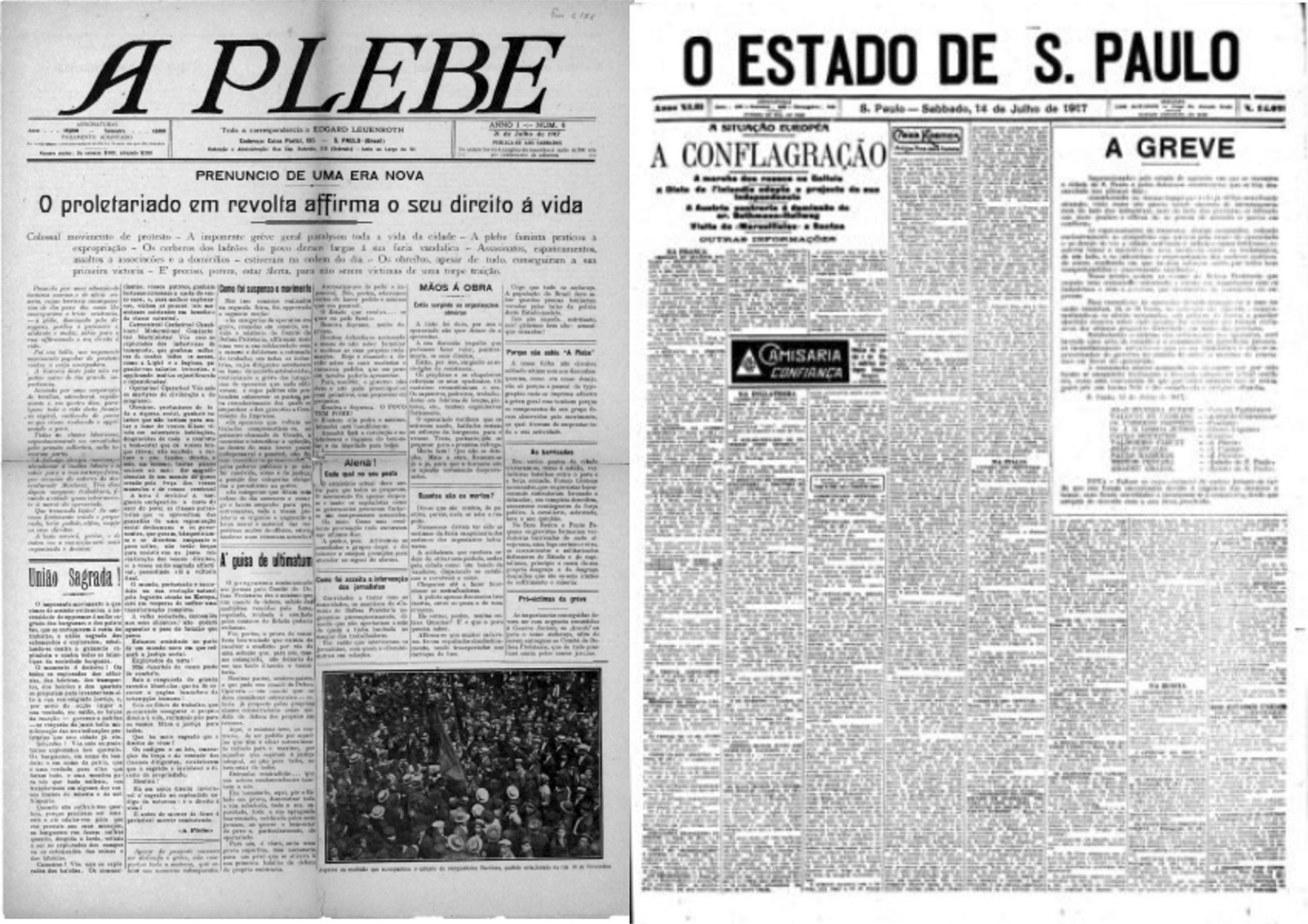
When compared to a commercial newspaper like O Estado de S. Paulo from the same period, the dimensions of the labor press were at times very similar. However, this model changed drastically following the mechanization of typographical workshops, a trend also observed in other commercial titles like the Correio Paulistano or Il Fanfulla. The rotary press, an innovation quickly adopted, imposed the standard format of 63 cm in height by 45 cm in width when closed (VITORINO, 2005), dimensions used by the Mesquita family’s newspaper in 1917. In the same year, the anarchist newspaper A Plebe used measurements of 53 cm x 37 cm when closed. This difference may seem small, but in terms of the spatial area available for text, it resulted in a reduction of two columns between the libertarian and the commercial newspaper, reducing the textual space by approximately 25% of the printed area. This is a considerable difference, highlighting the importance of the selection made by the editors, as this was the space they had available, as shown in Figure 1:
Furthermore, some labor newspapers were compelled to adopt smaller formats due to the financial difficulties faced by their publishers, as seen in O Amigo do Povo and Germinal. The former, in 1902, adopted an intermediate size compared to commercial newspapers printed at the time, measuring 32 cm in width by 45 cm in height, with a printable area averaging 25 cm, largely due to the limitations of the printing shop where it was produced. In its second year of publication, likely to reduce printing costs, indicating serious financial troubles, the periodical further reduce its size, adopting dimensions of 29 cm in width by 38 cm in length. It is evident that this reduction in internal space also limited the amount of content that could be published.
Financial challenges were widespread in this model of the press, as exemplified by the newspaper Germinal, also published in 1902, which adopted standards similar to those of O Amigo do Povo. Like most labor newspapers, it typically consisted of four pages, although some issues were released with only two. The format of the newspaper was the same as that of O Amigo do Povo (32 cm in width by 45 cm in height, with a printable area averaging 25 cm). However, unlike its counterpart, the publishers of Germinal chose to reduce the number of pages while maintaining the layout and sheet size, as illustrated in Figure 2:

Whereas a corporate newspaper could accommodate up to eight columns per page, the aforementioned publications employed only four or, at most, five. Given the imperative to maximize the use of printed space, it is unsurprising that page composition suffered in terms of legibility. Consequently, aesthetic quality was often sacrificed in order to increase textual content. This circumstance relates to another issue: the use of images. One may infer a preference for more textual elements over images, driven by the objective of disseminating doctrine and denouncing living and working conditions. This was compounded by the challenges associated with the production of iconography, which required artistic skills not always available, an aspect already discussed in the historiography (POLETTO, 2017). However, the output of these newspapers also included publications that adopted larger formats, which can be explained by the possibility of securing greater resources from propaganda groups, whether through donations, single-copy sales, or the insertion of advertisements. Greater resources allowed for improved layout, as seen in A Lanterna, A Plebe, and La Battaglia, which were able to adopt technical innovations that enhanced their visual quality and even the legibility of these publications.
In the case of the newspaper A Lanterna, between 1901 and 1904, its layout distinguished itself from the prevailing standards of anarchist media, aiming to make an impact on potential readers. The individual responsible was its editor, Benjamim Mota, who opted for a larger format (37 cm in width by 52 cm in height, when closed). This approach was made possible, in part, by donations and by the newspaper’s reach among readers across Brazil, attributable to its anti-clerical stance, which attracted sympathizers from diverse ideological currents. Due to its more generous dimensions compared to its anarchist contemporaries, it was divided into five columns, with the last page dedicated exclusively to advertising. This initial phase lasted until 1904, when activities were suspended, only to resume in 1909 under the responsibility of the anarchist militant Edgard Leuenroth (RUDY, 2017). Although the format was maintained, the publication declined in terms of visual resources but improved in periodicity, which became more regular than that observed in its early years of circulation.
The final title, and arguably the most significant one to be analyzed at this point, is undoubtedly A Plebe (São Paulo, 1917-1935). This is not only because it was the most important anarchist publication circulating in São Paulo, but also because it represents the pinnacle of e working-class newspaper publishing, an achievement largely attributable to the trajectory of its editor, Edgard Leuenroth, an experienced typesetter, who had been active in the anarchist press since 1899 (KHOURY, 1988).
It is possible to identify in A Plebe elements of continuity and learning derived from nearly two decades of working-class newspaper publishing in São Paulo. It is worth noting that this publication was a continuation of A Lanterna and, from its inception, adopted an expanded format (53cm in heightby 37cm in width) with six columns. It also exhibited numerous similarities in terms of graphic design, such as typographical ornaments (florets, column rules, headlines, and the main title, etc.). A comparison of the publications’ pages reveals that the graphic layout of the final issue of A Lanterna is remarkably similar to the first issue of A Plebe (GRIGOLIN, 2019), as illustrated in Figure 3:

Such similarity was not merely coincidental and can be attributed to the actions of Edgard Leuenroth, who most likely intended to attest, through the very materiality of the publications, the continuity between the two titles. Leuenroth’s departure from the newspaper’s editorial team, following his arrest for his involvement in the 1917 strike events and his subsequent replacement by Rodolfo Felipe (BIONDI; TOLEDO, 2018), did not result in significant changes to the publication’s graphic design. While it is true that between 1917 and 1935 the newspaper underwent several redesigns, the decision to adopt the extended format remained unchanged, with the publication maintaining the same physical dimensions until its cessation.
A comparative analysis of these newspapers indicates that such experiences should not be considered in isolation. While it is evident that these publications were fragile, faced financial difficulties, had irregular periodicity, and relatively short lifespans, the analysis reveals, when they are considered collectively, a process of continuous learning acquired over many years in the conceptualization, typesetting, printing, and distribution of publications. This accumulated knowledge enabled militants to make informed choices, within their constraints, regarding format and graphic design solutions, all while remaining attentive of the technical possibilities and limitations of printing and typesetting, as will be discussed.
The Funding of Publications
The analysis of the printed formats demonstrates the strategic importance of material means for the publication and circulation of working-class newspapers. It is impossible to analyze the graphic design without considering the resource mobilization strategies implemented by the various groups engaged in producing the press. The decisions made for each edition were subordinate to the number of available resources, a problem that reemerged with the completion of every issue. There was no medium or long-term planning for the anarchist workers’ press.
Historiography has clearly shown that to meet the challenge of launching a publication, even prior its design, it was necessary to mobilize networks of militants to raise funds (TOLEDO, 1993; OLIVEIRA, 2001). To finance the first edition, the strategy was to solicit donations obtained through subscription lists, or via conferences, meetings, raffles, or benefit events. To this end, it was essential to have access to collective working-class social spaces such as small theaters, union headquarters, or mutual aid societies (HARDMAN, 1983; PRADO, 1986). However, these practices were constrained by prevailing wages and by the living, housing, and dietary conditions in early twentieth-century São Paulo (MARAM, 1979). Consequently, these mobilizations did not always yield the expected financial returns. It is evident that the difficulties in launching the inaugural issue were significant; however, if the newspaper was well received among anarchist militants, it could rely on the collaboration of comrades from other regions of the state.
Once the challenge of publishing the first issue had been overcome, subsequent editions had to be financed through new donations, meetings, and militant activities, supplemented, from the second issue onward, by subscriptions, single-copy sales, and advertisements, although the latter were rarer due to the ideological nature of these publications. However, the predominant strategy was voluntary subscription, that is, mutual aid organized among workers and grounded in anarchist solidarity. It was this form of fundraising that enabled the printing of newspapers, books, pamphlets, and leaflets. According to scholar Cláudia Leal, voluntary subscription was “a widely disseminated form of acquisition, through which readers sent any amount to contribute to a newspaper’s maintenance and received copies for sale or donation” (LEAL, 1999, p. 75).
These subscription lists were distributed throughout working-class neighborhoods, both in the city of São Paulo and in the interior, as well asin other states. When contributing, interested parties stipulated the amount to be donated, which was often done anonymously or under pseudonyms, for fear of reprisals from police authorities or at the behest of their employers. Periodicals customarily published the list of subscribers on their final page, thereby establishing a strong bond between the readers and financiers of the newspaper. It was through this method that various working-class newspapers were able to circulate (LEAL, 1999; OLIVEIRA, 2001).
But why was voluntary subscription so important? For the anarchist militants, social relations among members were a significant act for building notions of solidarity and direct political action (SANTOS, 2021). Participation in propaganda groups, as well as contributions to the maintenance of printed materials, fostered bonds of fraternity and a sense of belonging to a collective struggle. It provided this network of militants with the possibility of participating in decision-making and to of acting in accordance with their interests, thereby contributing the consolidation of anarchism in Brazilian (SANTOS, 2019).
The strong presence of European immigration in São Paulo was also a determining factor for the success or failure of subscription lists. In the early years of anarchist circulation n Brazilian, the militant base in São Paulo was still heavily characterized by the presence of Europeans, particularly Italians, which is why newspapers published in the Italian language were more successful than those in Portuguese or other languages (CARNEIRO; CROCI; FRANZINA, 2010). The influence of Italian immigrants explains, at least in part, the success of newspapers like La Battaglia in comparison to other contemporary publications such as O Amigo do Povo, Germinal, or even A Terra Livre. This situation changed over the years due to the integration of Brazilians, Spaniards, and Portuguese into the anarchist militancy, as well as the necessity for immigrants to learn the basics of the Portuguese language (BIONDI, 2011). It is important to emphasize that, from 1910 onward, almost all libertarian newspapers were published in Portuguese, with few titles still utilizing the Italian language, such as the newspaper Guerra Sociale (São Paulo, 1915-1919). The major libertarian newspaper, A Plebe, was almost entirely written in Portuguese, with the exception of a few sporadic articles in Italian or Spanish.
Immigration, militant experiences, and the formation of a class identity in a transnational perspective were important elements in the production of newspapers. Owing to many shared structural characteristics and the existence of extensive social networks which even facilitated the organization of international donor networks for their newspapers Italian immigrant propaganda groups achieved a degree of success in circulating La Battaglia. It is also noteworthy that this newspaper was financed exclusively through subscriptions which, on average, reached higher amounts than those observed for other Portuguese-language titles. The result was a significant volume of donations; at times, the newspaper’s accumulated positive balance even exceeded 1:200$0005, a considerable sum, especially when compared to O Amigo do Povo, which at its peak had a negligible positive balance of only 2$4006.
While La Battaglia was financed by the Italian community sympathetic to anarchism, which granted it longevity and regularity, the case of the newspaper A Terra Livre also reveals a greater volume of donations from its readers. This was largely a consequence of the phenomenon already observed with La Battaglia, which benefited the growth of adherents to anarchist and syndicalist causes, as the newspaper aligned itself with revolutionary syndicalist militants and unions in São Paulo. When compared, one observes an increase in both the pace of donations and the regularity of contributors. However, despite this, an analysis of cash flow reveals persistent difficulties for newspapers that relied on voluntary subscriptions as their primary source of income.
A second finding concerns the influence of the French press on the technical organization of these newspapers, as attested by Benjamim Mota in A Lanterna and also in A Terra Livre, which claimed to maintain a constant dialogue with the French syndicalist newspaper Les Temps Nouveaux7. Such influences are observable in their organizational methods, as they shared printing techniques, layout and design, as well as strategies for obtaining revenue through advertising. It is evident that the methods for producing these newspapers were shared among different groups, many of which were in direct contact with publications abroad, either through travel to these countries or via transnational networks that distributed all sorts of publications. The production of these newspapers was not an isolated fact; on the contrary, it constituted a transnationally shared experience among militants and intellectuals.
The Composition, Printing, and Circulation of Newspapers
The composition and printing of newspapers were tasks performed by the professional known as typesetter-compositor. Their work consisted of the harmonious arrangement of graphic elements (lines, drawings, photographs) within the printed area of the publication, in other words, the graphic design of the newspaper. These visual elements defined the publication’s identity for its readers and distinguished it from other newspapers circulating in the city. From a visual standpoint, they constituted key markers of differentiation.
Regarding graphic composition, it is pertinent to ask whether the creators themselves given that many of them practiced the trade of typesetting were responsible for composing the newspaper pages, or if, on the contrary, the service was contracted out to one of the numerous printing houses located throughout the working-class neighborhoods and downtown São Paulo. Although it is not always possible to determine the editors’ decisions with certainty, one must consider that the composition and printing of these publications were often carried out by the militants themselves involved in the newspaper project. These workers, who were obviously literate, had always been notable for their politicization and unionization since the 19th century (VITORINO, 2005).
Prominent labor leaders were often typesetters and stood at the forefront of several important publications, such as Edgard Leuenroth, who had been active in the labor press since 1899 and was a key figure in the newspapers A Terra Livre, A Lanterna, and A Plebe; Rodolfo Felipe, who was involved with Germinal-La Barricata in 1913, and from 1919 to 1935 with A Plebe; and Manuel Moscoso, Giulio Sorelli, and Luigi Magrassi, responsible for O Amigo do Povo and A Terra Livre. In the case of Italian anarchist newspapers, individuals with experience in press work participated, even if they were not formally trained typesetters, as historiography has pointed out (BIONDI, 1993-94; TRENTO, 2013), such as the militants Gigi Damiani, Angelo Bandoni, and Oreste Ristori. They were anarchists, some with little formal education, who began their careers as assistants in newspaper editorial offices in their countries of origin. Upon immigrating, they brought this experience to newspaper publishing in Brazil, in line with the anarchist ideal’s commitment to using the press as the primary means of disseminating revolutionary ideals.
In the city of São Paulo, there were numerous printing workshops located in working-class districts such as Brás and Ipiranga, and even in the central region, between Sé and the Liberdade neighborhood, managed by Brazilian professionals and by immigrants from various countries. It was in these printing houses that a large portion of the working-class newspapers circulating in the city during the first decades of the twentieth century were printed. However, there are also examples of newspapers that sought to acquire their own machinery for composition and printing, as in the case of O Amigo do Povo. After having been printed in several different establishments, those responsible for the publication mobilized to organize funding methods aimed at acquiring their own printing press, which materialized with the installation of a small workshop8 in February 1903. This printing house, named Typografia Libertária9, printed the newspaper’s issues and also produced material for anarchist propaganda. The initiative was short-lived, which suggests the difficulties of such a solution, as the costs of maintaining the machinery, in addition to the purchase of supplies for composition and printing, sealed the workshop’s fate. There is no information on the specific causes of its failure, and the workshop was eventually sold in December 190310.
It is evident that the strategy of owning a printing press was not viable, even though a few other newspapers maintained their own workshops, such as A Plebe in the brief period between 1917 and 1919. The second option available to the creators was to pay for composition and printing services. However, this was not a simple matter of outsourcing in contemporary terms. The proliferation of small printing shops in the neighborhoods, many with rudimentary technology, offered a wide range of service contracting possibilities at relatively modest prices, compounded by potential personal, ideological, and solidarity relationships; it cannot be ruled out that some of the creators themselves worked in these establishments themselves (VITORINO, 2005).
Once the issues related to contracting a printing house for composition and printing had been resolved, it became necessary to organize the channels for circulating the publications. This task required intense mobilization by the militants to ensure the copies reached their intended recipients. Thus began the struggle for free distribution, the sale of copies, and the collection of subscriptions (monthly, semi-annual, or annual), which indicated a certain optimism on the part of those responsible regarding the challenge of ensuring the newspaper’s longevity. The propaganda group’s efforts could resonate positively among sympathizers of the workers’ cause, even if many were outside the immediate working-class milieu but interested in the topic. For the workers and militants themselves, those in charge recommended voluntary subscription as the most viable means to raise resources and disseminate issues11. As for paid subscriptions, while possible, they did not constitute a widely used method within the working-class press. The very structural uncertainties surrounding the responsible groups ultimately favored voluntary subscription, the most widespread method for this type of press.
Regarding their distribution, working-class newspapers, like the periodic press, relied on railway lines. In the first decades of the twentieth century, driven by the needs of São Paulo’s coffee economy, the rails already cut across practically the entire state and extended to other areas of the country (ANDRADE, 2016). Obviously, transportation implied costs, which is why it was common for militants to travel carrying the printed materials themselves. It is possible to trace the itineraries of workers’ lecture tours, which constituted an important strategy and were concentrated along the cities flourishing beside the main stations and even the railway branch lines.
Some militants, referred to by the newspaper editors as ‘conferencistas’ (lecturers), took on the responsibility of traveling throughout the state to disseminate anarchist ideal among working communities in the interior. This was the case for the Italian militants Oreste Ristori and Angelo Bandoni, who had been performing this function since 1900. In 1902, when they were among the founders of the newspapers O Amigo do Povo and Germinal, they undertook trips at least once a month along the São Paulo Railway, traveling to cities such as Jundiaí, Sorocaba, Salto de Itu, and Santos. In these cities, they typically gathered in industrial districts, holding small lectures to discuss anarchist principles and strategies for creating unions and organizing strikes12. Naturally, these occasion were also used to distribute issues of the working-class newspapers. It should be noted that the expenses were covered by the newspapers’ funds, which therefore had to budget for such propaganda costs.
In Rio de Janeiro, the distribution of newspapers such as O Amigo do Povo, Germinal, La Battaglia, and later, A Terra Livre, was the responsibility of the anarchists Luigi Magrassi and Nilo Pereira. The latter was also responsible for securing affordable printing for Germinal-La Barricata in the city of Rio de Janeiro in 191313. In Curitiba, distribution was handled by the anarchist Gigi Damiani, a painter by trade, who resided temporarily in the city and received newspapers via railway dispatch. By the end of the 1910s, Oreste Ristori was still performing the role of lecturer and donation collector, working for the periodicals La Battaglia and A Terra Livre between 1904 and 1912. After this period, there are no further references to Ristori’s activities; after facing successive expulsion proceedings due to his militant, he decided to leave Brazil in 1912 (ROMANI, 1998).
After 1912, with Ristori’s departure from leading the lecture tours, other militants assumed this role. This was the case for Rodolfo Felipe, editor of the newspaper Germinal-La Barricata, who, starting in 1913, began traveling throughout the state to distribute the publication14. He also performed this task for other titles, such as Guerra Sociale in 1915, accompanied by Gigi Damiani,who had by then returned to reside in the city of São Paulo, and for A Plebe between 1919 and 1935, a period during which he also served as its editor-in-chief. Prior to that, between 1917 and 1919, the collection of subscriptions and the distribution of the newspaper in the interior were the responsibility of the militant Zeferino Oliva, who traveled along the entire Bragantina line, between São Paulo and Minas Gerais, and the Santos-Jundiai line15. On the Noroeste branch, which connected São Paulo to Mato Grosso do Sul, passing through Penápolis and reaching Corumbá, these tasks were carried out by the militant Alfredo Massena16.
To reach more distant locations, other states or abroad, or those not served by railway branches, the solution was mailing via the postal service. The average cost for dispatching one thousand copies was approximately 1$450 réis, a value that did not change significantly during the period under study. Evidently, sending issues to these remote places was cheaper than resorting to other means of transport. Postal distribution was closely linked to subscription lists, as they involved sending copies to those who had contributed to or subscribed to the publication. It is likely that those responsible shared a preliminary list of militants present in various regions of the state, to whom they sent the initial issues, expecting the support of their comrades to donate and to secure donations. Subsequently, propaganda and discussions among militants would work to expand the circle of readers, whether they were workers or sympathizers of the cause17. As more issues were published, additional subscription lists were incorporated into the existing ones, thereby increasing the newspaper’s circulation.
Single-copy sales also provide insight into the distribution channels of the working-class press. For the most part, newspapers were not sold on a per-copy basis; however, it was possible to identify the presence of copies at newsstands, made available o anyone interested in becoming acquainted with the publications, as was the case with O Amigo do Povo, A Terra Livre, La Battaglia, and Germinal-La Barricata. Nevertheless, some titles did practice single-copy sales, possibly with the aim of increasing available financial balance for printing subsequent issues. The newspapers A Lanterna, in both phases of its publication phases, and A Plebe engaged in this practice, charging 100 réis per copy and 200 réis for back issues. Typically, the newspapers were sold by “official representatives” of those responsible, individuals designated to sell the publications on city streets, as well as at specialized newspaper retail locations, referred to by those in charge as “journalistic agencies.” Furthermore, the newspapers were sold in establishments scattered throughout the cities, such as shoeshine stands, bookstores etc.
As can be observed, the analysis of the data presented here demonstrates the construction of an extensive network of collaborators, a factor that was fundamental to the circulation and survival of the newspapers. The data reveal that militants were responsible for distributing, on average, more than half of all editions produced, in addition to constituting the majority of those who financed the publications. Thus, it becomes evident that the solidarity network among militants was the viable strategy for the survival, albeit ephemeral in some cases, of these newspapers. It is also crucial to bear in mind that, even though the militants involved in the conception and production of the newspapers represented a small fraction of the anarchists present in São Paulo, these individuals spared no effort to realize the ideal of disseminating anarchism through the pages of these publications, working for years on end, even under the threat of constant persecution by employer-backed authorities and the police. It is indeed accurate to state that these militants were largely responsible for the conception and consolidation of a tradition in the production of an anarchist press in São Paulo during the period under analysis.
Confrontations between the working-class press and the commercial press
The previous section highlighted how economic challenges threatened the survival of small anarchist newspapers, a situation compounded by technological advances that streamlined the format of commercial newspapers. This development directly affected pricing, which became progressively lower, thereby contributing to wider circulation. Although some labor newspapers also invested in technological advancements (purchasing printing presses, focusing on layout and graphic design, etc.), the chasm created between the two press models intensified over time, significantly widening the gap between them.
It is unsurprising that the rivalry expressed by the labor press writers towards commercial newspapers intensified as they grew further apart in financial and technological terms, given that workers’ newspapers were not profit-oriented and had a clear objective of educating and politically mobilizing the class towards social revolution; an objective that, obviously, did not apply to commercial newspapers, which gradually became large financial enterprises, generating profits from their primary product: the news.
In the case of anarchist newspapers in São Paulo, the fact that the mainstream press had its economic interests tied to industrial capital was a point of criticism among militants. This issue was intensified for ideological reasons, since the articles published in the large press attacked working-class militancy, especially the anarchists. This was compounded by the fact that many issues concerning working conditions in factories and on farms, as well as ideals dear to the leadership, such as the fight against the Church and the State, were not part of the mainstream press agenda.
The labor press, as soon as it emerged in the streets and poor neighborhoods of large Brazilian cities, set about fiercely opposing the way other newspapers reported on daily life in the factories. It also criticized proposals that did little or nothing to change the conditions experienced by workers, who were subjected to long working hours, low wages, and unhealthy living conditions. In the case of anarchist newspapers, the criticism was directed at journalists, indiscriminately seen as those who wrote for periodicals, be they newspapers or magazines:
The modern newspaper is not a platform for r struggle, but a counter, a commercial enterprise, a joint-stock company for the exploitation of scandal and the assault on the treasury by the powerful. Now, with variation in methods and abilities, all the great and small journalists of the bourgeois press are and cannot fail to be like their employers. The bourgeois press today is a direct instrument of capitalism. And its journalists are either typewriters, their keys pressed by the finger of the capitalist, or they turn their pens into lockpicks and crowbars, aiming for the capitalist’s strongbox. The history of modern journalism constitutes one of the most ignoble chapters in the customs of the capitalist era18.
From the militants’ perspective, the press defended a project of economic and social domination, of which it was the spokesperson. The oligarchic-republican project in force in the country found receptiveness in the pages of the major newspapers, which contributed to its dissemination in the public sphere. Indeed, what was at stake were different conceptions of society, justice, and the economy, in short, distinct worldviews: on one side, the republican order; on the other, the revolutionary proposal in favor of the workers.
A recurring aspect concerns the chronic problems related to social inequality that have long affected the working class. There was an expectation that journalism, more broadly, should demonstrate an ethical and moral commitment to solving this problem. It seemed evident to them that injustices were not being denounced, and they blamed “journalists” indiscriminately for reproducing the oligarchic ideology and, consequently, perpetuating inequality. On the other hand, social mobilization, seen as a means of transforming the prevailing system, was portrayed by the commercial press as agitation, disorder, and revolt against the established order, thereby clearly highlights these differing social readings and worldviews:
Whenever workers mobilize anywhere in the world, the “press” immediately sides with the legal government, in the name of order and the public interest. The worker is never in the right. Their demands are always deemed unreasonable and exaggerated. [...] The newspaper, the great modern daily, is an industrial enterprise like any other. It has machines, workers, and shareholders. And as a capitalist enterprise, it defends capital. [...] Therefore, a newspaper’s opinion in the conflict between capital and labor should be as laughable as that of an industrialist engaged in any other branch of business. The press is in the hands of capitalists, just like the means of production and transport, everything. And there are still many people, many workers even, who buy “O Estado,” who read “O Comércio,” who consume “A Gazeta”19.
The citations, dated 1920 and 1921, exemplify some of the attacks directed against the mainstream press and, in these specific cases, were directly related to the intensification of state repression, especially following the strike movements of 1917 in São Paulo and 1919 in Rio de Janeiro (BIONDI; TOLEDO, 2018). The widespread unrest, which disrupted urban life, became news and occupied the pages of the major newspapers, which predominantly portrayed these actions in a negative light. One should not assume, however, that this tension arose only when workers occupied public space. The question of the press’s role was already being thematized as early as 1902, therefore in the initial period of the press produced by wage earners in São Paulo, as can be read in O Amigo do Povo:
Poor humanity! When the propertied classes appropriate an invention, it is transformed in their hands into a new and powerful instrument of exploitation and domination. The press did not escape this fate: instead of serving as a great means of educating the masses, it became nothing more than a machine that pours prejudices and errors, so favorable to the maintenance of social injustice, into the only partially conscious multitude. Since the great daily newspapers play the role of enemies towards us, since while showing the appearance of being competing businesses, they know fully how to adopt the same stance in the exploitation of the ignorant and the crushing of the weak, why do we, the workers, accept this moral yoke? Why do we not combat the pernicious influences of this press that lives at our expense?20
It becomes evident that, from the very beginning, there was a concern with using the newspaper as a tool for the raising class consciousness, the mediator par excellence of social transformation, as the existing literature has already reported (LEAL, 2002). This is the reason it was regarded as an instrument of education and not a source of profit, as was the case, in the militants’ view, with major newspapers. Even recognizing the heterogeneity of the currents embraced by the militancy active in the city of São Paulo in the early 20th century namely socialists, anti-clerical freethinkers, and anarchists - there was a consensus regarding the pedagogical function of the newspaper.
For labor newspapers, the challenge was to overcome the disbelief or resistance of society, and even of their own fellow workers. By launching combative attacks against the major newspapers, the militants hoped not only to win the sympathy of those who were averse to political issues - often due to fear of employer persecution, deportation, or the difficulties of providing for their families - but also to emphasize the vast distance that separated them. After all, in order to ensure the existence of these publications, they had to rely on donations, and to distribute them, they needed to mobilize an extensive network:
However, it is important to note that our strength should not be measured solely by our press. Our newspapers, with few exceptions, do not have a regular and secure existence. They do not live off advertisements, nor off hidden and ample subsidies which so many periodicals profit from, nor from government blackmail: they live off the meager coins of poor workers. Sometimes it is the police who kill them, because the freedom of thought is a sham – whether in the face of police violence or the arbitrariness of bosses who, by denying work to the editors in sight, often force them into a wandering and miserable existence. Let us not even speak of the potent infiltration of our ideas into the literary, philosophical, and scientific worlds; but let us recall the effectiveness of our method within the proletarian movement, the action of the anarchists who do not know what they are21.
In the narrative of the mainstream press, the presence of anarchist immigrants in workers’ associations and suburban societies was consistently denounced. The subversive immigrant was contrasted with the Brazilian worker, who was portrayed as obedient, patient, and orderly, and as being in need of protection against contamination by values and behaviors that were not in harmony with the local reality. In the cited excerpt, there is a begrudging acceptance that workers may organize; the problem identified, however, concerns the objectives of these organizations and the presence of such individuals:
Our editorial office receives numerous reports about the recent growth of the ‘anarchist movement among us. We must add that it becomes all the more dangerous for the workers’ associations in which individuals are striving for the common good through orderly and peaceful means, as these individuals insinuate themselves by attending workers’ meetings uninvited, and solely with the intention of splitting and disorganizing the societies that do not align with their method of agitation revolt. They deliver violent and incendiary speeches, offend individuals, religions, corporations; nothing escapes them and they see only one thing as pure revolt and disorganization22.
It is worth noting that, despite all the difficulties, the organized movement managed to carry out mobilizations, halt production, and achieve victories, even if not always permanent. Contributing to this process was the growth of the wage-earning population, as well as the results of the efforts to raise class consciousness carried out by militant activists, who were no longer composed solely of immigrants. The intensification of clashes between the commercial press and that produced by socialists and anarchists is therefore understandable. It is significant that it was precisely in the year 1906, marked by agitations and strikes that saw massive worker participation, that the First Workers’ Congress was organized, alongside the creation of the Brazilian Labor Confederation (COB - Confederação Operária Brasileira). These events did not go unnoticed by the commercial press. Consider, for example, the analysis published in O Paiz by the journalist Alcindo Guanabara, who wrote for the newspaper under the pseudonym Pangloss (COUTINHO; SOUSA, 2001), addressing the developments of the strike at the Companhia Paulista de Estrada de Ferro, which erupted that same year:
The foreign revolutionaries who emigrate here, preachers of social revolution, extremists who assert that the working class must scorn legal resources and rely solely on the subversion of society, act in flagrant contrast to our democratic environment, which they fail to understand. They come from overpopulated countries, where the conquest of a foot of land is an unattainable ideal, and without examining the situation of the new country in which they find themselves, they continue the same propaganda they conducted in their homelands, with the same allegations and the same motives. This is explained, above all, because the truth is that they no longer can, and probably no longer know how to do anything else. [...] The most complete proof that this extreme propaganda, disproportionate to our needs, does not find fertile ground to thrive here, lies precisely in the failure of this general strike they are now attempting to carry out, without securing support from the Brazilian working class23.
The excerpt is a clear example of the perceived incompatibility between the republican political ideal and the actions promoted by socialist and anarchist groups. The construction of national identity was anchored in the ideal of the passivity and hospitality of the Brazilian people, who would presume to resort to violence in exceptional cases. Immigration, by bringing ideas and cultures considered distant from the national reality, was attributed as the origin of revolutionary ideologies, which forced the oligarchies to create strategies to deal with the issue. Some newspapers, such as the aforementioned O Paiz, or Correio Paulistano24 in the case of São Paulo, mobilized narratives that emphasized prosperity and peaceful relations in the field of work to discredit the actions of the organized movement. Through this channel, state intervention in the social sphere were legitimized. It is worth noting that, due to prevailing economic conditions, especially during crises in the agro-export economy, shifts can be observed in how the press treated and analyzed the actions of workers.
The emergence of a set of militant periodicals, which, although not numerous, were noisy and tended to bother sectors of the powerful and the employer class, intensified the campaign against the small pamphlets and their authors, whenever the actions exceeded limits considered acceptable according to the prevailing order. Given that revolutionary ideals were already shared by a portion of the urban workers, monitoring all militants became much more complex. Investment in strengthening police intelligence, the promulgation of laws for expulsion and control of unions and associations, were among the measures aimed at to curb the activities of these individuals (LEAL, 2006; SAMIS, 2019). The stigma attached to anarchists amplified the unease provoked by their publications, as much as their diffusion within the trade union movement, which helps explain the growing persecution against these individuals who, in turn, denounced the misinformation that the mainstream press insisted on propagating regarding anarchist ideas:
But whom do these newspapers consider to be anarchists? [...] For these journalists, anarchists are murderers, without a homeland (the fault is not entirely theirs, but of the exploitative governments and bosses who monopolize it), they have no humanitarian feelings, they are persecuted everywhere (by those who feel bothered by them in their plunder and tyranny), etc.... We merely wish to once again underscore the profound ignorance of professional journalists regarding what they consider to be an “anarchist,” and also to point out how these republicans fail to understand our ideas25.
There was a concerted effort to associate newspaper owners, the government, and the police in the struggle against the agitations, to such an extent that the former, in the opinion of the anarchists, wielded greater power than kings or the president of the republic himself. The strength of the organized movement’s participation in the strikes that frequently broke out in large cities can be gauged by the outcries, present in the pages of the commercial press, in favor of promulgating the first laws providing for the expulsion of foreigners. This coincided with the achievement of the historic demand for the eight-hour workday, a result of the 1908 strike:
The hired assassins of journalism once again unleash their treacherous strikes against the anarchist agitation. Hired by the government and the military establishment to defend this odious burden that the proletariat must reject at all costs. But today, muzzled and reduced to the impotence of speaking a word frankly in favor of the monstrous cause they have sold themselves to, the mercenaries of the press tremble with rage against those who, with so much audacity and the unanimous applause of the people, go on proclaiming the betrayal of their supposed patrons and, simultaneously, hastening the final collapse of a regime of tyranny and misery in which they – the hired assassins of journalism – are more masters than the very masters of power, that is to say, they command more than the king or president, upon whom they impose their whims, checks, accounts, and debts under the threat of a devastating and annihilating campaign against the anarchists26.
In summary, combating the daily press was essential and, moreover, entailed presenting an alternative reading/narrative regarding the worldview and the way of confronting the present and future of the workers, while employing layout and protocols that were, in many respects, similar for this purpose. The anarchist critique sought to expose what it judged to be a promiscuous relationship between the republican State and its intimate connection with the press. The struggle was directed against the institution itself, but it could take the form of personal attacks against those who wrote for it. What was at stake, ultimately, was the effort to unmask, at least for the readership of the labor pamphlets, the disservice rendered by the mainstream press, which insisted on discrediting the action and demands of the organized movement.
Finally, the newspapers produced by the organized movement proposed strategies for action that countered the dominant narratives of the mainstream press, whether regarding the organized movement itself or the challenges faced by the country. Besides addressing workers, it is not unreasonable to suggest that they aim to reach a broader audience of potential sympathizers to the cause. The pamphlets, of uncertain duration and mostly produced in an artisanal manner, disseminated another world to be achieved through agitation and social revolution, in opposition to the prevailing capitalist order upheld by the mainstream press. The confrontation was inevitable, even though the weapons wielded by each side were far from having the same reach, which, however, did not prevent the struggle from being waged through the printed word.
The irregular periodicity of the workers’ leaflets reveals the considerable difficulties they faced, often of a financial nature, which directly affected the frequency and rhythm of publishing the issues. It is important to highlight the heterogeneity of these printed materials, which expressed the ideals and values of different ideological currents and their debates over strategies for creating a new order. However, one must not lose sight of the fact that these difficulties also fostered the mobilization of a wide range of strategies that sought, with inventiveness, to circumvent structural problems. Historiography demonstrates that the intervention of these militants – and their communication devices – was fundamental for the construction of political cultures, with their specific vocabulary, ethics, values, and visions of the future.
Conclusion
This article has sought, albeit partially, to unravel some aspects involved in the challenge of producing the labor press, especially regarding the technical issues of these newspapers. It is worth recalling that the focus fell on the anarchist press, produced in the city of São Paulo and distributed throughout Brazil and abroad. These periodicals represent only a portion of the intense journalistic output by the workers of São Paulo (and at the end of this research, one can affirm that, indeed, these workers can be considered journalists) which persists, amidst setbacks and persecution, to this day. It is a press that holds many peculiarities, but also by significant similarities with the major newspapers that circulated in São Paulo during the same historical period.
The newspapers sought, as far as possible, to develop production strategies that were never detached from the development of the burgeoning graphic sector in São Paulo. They were workers and militants who were always close to work with print, whether they were typographers or even enthusiasts of the anarchist press, who strived to produce and circulate publications with similar characteristics. If they shared the making of these leaflets, it is plausible to conclude that the São Paulo anarchist press ultimately built a journalistic technical framework, whose common aspects highlight the mobilization carried out by sympathizers of the libertarian cause to obtain funding for printing the newspapers, fairer prices from print shops, as well as participating in the typesetting process of the editions, organize strategies for circulation of the issues, and ensuring the continuity of the publications.
In conclusion, analyzing the continuities and ruptures in this process of constructing a form of combative journalism, as this anarchist press that circulated in São Paulo in the first decades of the 20th century was, is an attempt to contribute to the understanding of working-class culture. These were individuals who aspired better living conditions and believed that direct action was the best alternative available to them to change their harsh daily reality. In this struggle process, they shared experiences, almost always marked by the yearning for a more just world, without borders and that did not separate human beings. This culture was shaped by political struggle, which presupposed occupying the public space. They achieved victories, such as the 1907 strike waves, which resulted in winning the reduction of the workday, or the demonstrations for wage gains in the 1917 general strike. However, they also suffered defeats, some resulting from the very visibility of anarchist actions, which gave rise to persecution and conflicts with employers and the forces of order.
The anarchist press was an fundamental component of workers’ culture, as it acted as an element capable of drawing attention to the harsh conditions to which a significant portion of the city’s population was subjected. Ultimately, it gave voice to those who remained silent. In this sense, if we compare the golden period of this press with current events, there are disturbing similarities. Political persecution and the dismantling of democracy contribute, in the present day, to the organization of civil society through social groups committed to resisting and fighting against the rising tide of the right. And since always, against the power of the mighty, there are always those who make struggle the very purpose of their lives.
1
5
6
7
8
9
10
11
12
13
14
15
16
17
18
19
20
21
22
23
24
25
26
Data Availability
All data are available in the text
References
- ANDERSON, Benedict. Sob três bandeiras: anarquismo e imaginação anticolonial. Campinas: Ed. Unicamp; Fortaleza/CE: Ed. Universidade Estadual do Ceará, 2014.
- ANDRADE, Paulo Rodrigues de. As aglomerações de homens de todas as classes: trabalhadores escravos e livres, brasileiros e imigrantes na construção e início da operação da São Paulo Railway (1860-1872). Dissertação (Mestrado em História). Universidade Federal de São Paulo, Guarulhos/SP, 2016.
- BIONDI, Luigi. Classe e nação: trabalhadores e socialistas italianos em São Paulo (1890-1920). Campinas: Ed. Unicamp, 2011.
- BIONDI, Luigi. La stampa anarchica in Brasile: 1904-1915. Dissertação de mestrado defendida junto ao departamento de “Storia Contemporanea” da Università degli Studi di Roma “La Sapienza”, 1993-1994.
- BIONDI, Luigi; TOLEDO, Edilene. Uma revolta urbana: a greve geral de 1917 São Paulo: Fundação Perseu Abramo, 2018.
- BRITO, Rose Dayanne Santos de. No rastro de Benjamim Mota: a defesa das leis sociais e do direito político na primeira república (1901-1904). Dissertação (Mestrado em Direito), Universidade Federal de Santa Catarina, 2016.
- CARNEIRO, Maria Luiza Tucci; CROCI, Federico; FRANZINA, Emilio (org.). História do trabalho e história da imigração: trabalhadores italianos e sindicatos no Brasil São Paulo: Ed. Universidade de São Paulo; FAPESP, 2010.
- COUTINHO, Afrânio; SOUSA, José Galante de. Enciclopédia de literatura brasileira. Rio de Janeiro: Fundação Biblioteca Nacional; Academia Brasileira de Letras, 2001.
- GRAMSCI, Antonio. Cardenos do cárcere. Vol. 2. 7ª ed. Rio de Janeiro: Ed. Civilização Brasileira, 2014.
- FAUSTO, Boris. Trabalho urbano e conflito social (1890-1920). São Paulo: Difel, 1986.
- FERREIRA, Maria Nazareth. Imprensa operária no Brasil. São Paulo: Ed. Atica, 1988.
-
GRIGOLIN, Fernanda. Expressão, registro e propaganda: o anarquismo impresso em A Plebe. Anais do 30° Simpósio Nacional de História: História e o futuro da educação no Brasil Recife: Associação Nacional de História – ANPUH-Brasil, 2019. Disponível em: https://www.snh2019.anpuh.org/resources/anais/8/1563900069_ARQUIVO_Anpuh_final_Grigolin.pdf
» https://www.snh2019.anpuh.org/resources/anais/8/1563900069_ARQUIVO_Anpuh_final_Grigolin.pdf - HALL, Michael M; PINHEIRO, Paulo Sérgio. A classe operária no Brasil. 1889-1930: documentos Vol. 1. O Movimento Operário. Col. Política. São Paulo: Ed. Alfa Omega. 1979.
- HARDMAN, Franscisco Foot. Nem pátria, nem patrão! Vida operária e cultura anarquista no Brasil. 2ª ed. São Paulo: Ed. Brasiliense, 1983.
- KHOURY, Yara Maria A. Edgar Leuenroth: uma voz libertária: Imprensa, memória e militância anarco-sindicalista. São Paulo: Tese (Doutorado em Sociologia), Universidade de São Paulo, SP, 1988.
- LEAL, Cláudia Feierabend Baeta. Anarquismo em verso e prosa: literatura e propaganda na imprensa libertária em São Paulo. Dissertação (Mestrado em História). Campinas, SP: IFCH/Unicamp, 1999.
- LOPREATO, Christina da Silva Roquette. O espírito da revolta: a greve geral anarquista de 1917 Tese (Doutorado em História). Universidade de Campinas, IFCH. Campinas, SP, 1996.
- MAGNANI, Silvia Ingrid Lang. O movimento anarquista em São Paulo (1906-1917) São Paulo: Ed. Brasiliense, 1982.
- MARAM, Sheldon Leslie. Anarquistas, imigrantes e o movimento operário brasileiro. 1890-1920. Rio de Janeiro: Paz e Terra. 1979.
- MOUILLAUD, Maurice; PORTO, Sérgio Dayrell (org.). O jornal: da forma ao sentido. 3ª ed. Brasília: Ed. Universidade de Brasília, 2012.
- OLIVEIRA, Antoniette. Despontar, (des)fazer-se, (re)viver... a (des)continuidade das organizações anarquistas na Primeira República. Dissertação (Mestrado em História), Universidade Federal de Uberlândia, 2001.
- POLETTO, Caroline. A imaginação subversiva ao redor do mundo: imagens, poesias e contos de protesto na imprensa anarquista e anticlerical (Espanha, Argentina e Brasil, 1897-1936). Tese (Doutorado em História) - Universidade do Vale do Rio dos Sinos (UNISINOS), 2017.
- PRADO, Antônio Arnoni (org.). Libertários no Brasil: memórias, luta e cultura. São Paulo: Ed. Brasiliense, 1986.
- ROMANI, Carlo. Oreste Ristori: uma aventura anarquista. Dissertação (Mestrado em História). Universidade Estadual de Campinas, Instituto de Filosofia e Ciências Humanas (IFCH), Campinas/SP, 1998.
- RUDY, Antônio Cleber. O Anticlericalismo sob o manto da República: tensões sociais e cultura libertária no Brasil (1901-1935). Tese (Doutorado em História), Universidade Estadual de Campinas - Unicamp. 2017.
- SAMIS, Alexandre Ribeiro. Minha pátria é o mundo inteiro: Neno Vasco, o anarquismo e as estratégias sindicais nas primeiras décadas do século XX. Tese (Doutorado em História), Universidade Federal Fluminense, 2009.
- SANTOS, Kauan Willian dos. Derrubando fronteiras: a construção do jornal A Plebe e o internacionalismo operário em São Paulo (1917-1920). Revista História e Cultura. Franca/ SP, vol. 4, nº 1, março de 2015.
- SANTOS, Kauan Willian dos. Pontes de liberdade: internacionalismo e imaginários nacionais na construção do anarquismo no Brasil (1890-1937). Tese (Doutorado em História) - Universidade de São Paulo (USP). São Paulo, 2021.
- SANTOS, Kauan Willian dos; SILVA, Rafapaiel Viana da (org.). História do Anarquismo e do Sindicalismo de intenção revolucionária: novas perspectivas. 1ª ed. Curitiba: Ed. Prismas, 2018.
- TOLEDO, Edilene. Em torno do jornal O Amigo do Povo: os grupos de afinidade e propaganda anarquista em São Paulo nos primeiros anos deste século. Dissertação (Mestrado em História), Universidade Estadual de Campinas, 1993.
- TRENTO, Angelo. Imprensa italiana no Brasil, séculos XIX-XX. São Carlos: Ed. UFScar, 2013. Trad.: Roberto Zaidan. 276p.
- VITORINO, Artur José Renda. Máquinas e operários: mudança técnica e sindicalismo gráfico (São Paulo e Rio de Janeiro, 1858-1912) São Paulo: Annablume: FAPESP, 2000.

 Source: Arquivo Edgard Leuenroth (UNICAMP) e Arquivo de O Estado de S.Paulo
 Source: Arquivo Edgard Leuenroth (UNICAMP)
 Source: Arquivo Edgard Leuenroth (UNICAMP)