
 Development of an educational guide to prevent structural racism in access to healthcare
ABSTRACT
Objective: To describe the development of an educational guide for health professionals to prevent structural racism in the access to health care.
Method: Qualitative and methodological study applied to the development of an educational guide, carried out in Natal/RN between July and October 2024, using the focus group technique. The participants were self-declared black health professionals. A semi-structured questionnaire was used, based on a previous review of the health of the black population. The material from the focus group was subjected to Bardin's content analysis and similarity analysis to categorize the themes of the guide into the concept of health, racism, the most common diseases, social determinants, and historical and political dimensions.
Results: The importance of an innovative educational guide to contribute to the care of the black population aimed at preventing racism was highlighted. The material from the focus groups was used to produce the content and design of the “Guide: Health of the black population”.
Final considerations: The educational guide was developed with the participation of black health professionals in the production and textual elaboration, making it possible to represent and democratize information for the black population.
Descriptors:
Health of the Black Population; Ethnicity and Health; Primary Health Care
RESUMO
Objetivo: Descrever o desenvolvimento de um guia educativo voltado aos profissionais de saúde para prevenção do racismo estrutural no acesso à saúde.
Método: Estudo qualitativo e metodológico aplicado ao desenvolvimento de um guia educativo, realizado em Natal/RN entre julho e outubro de 2024, por meio da técnica de grupo focal. Os participantes foram profissionais de saúde autodeclarados negros. Utilizou-se um roteiro de perguntas semiestruturado baseado em revisão prévia sobre saúde da população negra. O material oriundo do grupo focal foi submetido à análise de conteúdo de Bardin e à análise de similitude para categorizar as temáticas do guia em conceito de saúde, racismo, doenças mais comuns, determinantes sociais, dimensão histórica e política.
Resultados: Evidenciou-se a importância de um guia educativo de caráter inovador para contribuir na assistência da população negra voltado para a prevenção do racismo. O material oriundo dos grupos focais foi utilizado na produção do conteúdo e design do “Guia: Saúde da população negra”.
Considerações finais: O desenvolvimento do guia educativo contou com a participação de profissionais de saúde negros na produção e elaboração textual, possibilitando sua representatividade e democratização da informação para a população negra.
Descritores:
Saúde da População Negra; Etnia e Saúde; Atenção Primária à Saúde
RESUMEN
Objetivo: Describir el desarrollo de una guía educativa dirigida a los profesionales de la salud para la prevención del racismo estructural en el acceso a la salud.
Método: Estudio cualitativo y metodológico aplicado para el desarrollo de una guía educativa, realizado en Natal/RN entre julio y octubre de 2024, mediante la técnica de grupo focal. Los participantes fueron profesionales de la salud que se declararon negros. Se utilizó un guion de preguntas semiestructuradas basado en una revisión previa sobre la salud de la población negra. El material procedente del grupo focal se sometió al análisis de contenido de Bardin y al análisis de similitud para categorizar los temas de la guía en concepto de salud, racismo, enfermedades más comunes, determinantes sociales, dimensión histórica y política.
Resultados: Se puso de manifiesto la importancia de una guía educativa innovadora para contribuir a la asistencia de la población negra orientada a la prevención del racismo. El material procedente de los grupos focales se utilizó en la elaboración del contenido y el diseño de la «Guía: Salud de la población negra».
Consideraciones finales: El desarrollo de la guía educativa contó con la participación de profesionales de la salud negros en la producción y elaboración textual, lo que permitió su representatividad y la democratización de la información para la población negra.
Descriptores:
Salud de la Población Negra; Etnicidad y Salud; Atención Primaria de Salud
INTRODUCTION
The Brazilian Institute of Geography and Statistics (IBGE) revealed, at the census in 2022, that 55.5% of the Brazilian population declare themselves as being black. This shows the increasing growth of the black population. Furthermore, it shows that the Brazilian population has improved its understanding of race self-declaration, and how important it is for social, political, and economic representation, and for the formulation of public policies1
Demographic data about the black population in Brazil show that it represents a numerical majority in the country. However, black persons are contradictorily the minority in spaces of power. Their income and educational level are lower, and their access to health services, decent housing, and food safety is more difficult. Thus, other social determinants are related to this context, transforming them into a vulnerable population2.
Historically, the black population in Brazil has reflected social inequalities that have been accumulating over time. Structural racism, with roots harking back centuries, manifests itself today as a social phenomenon that affects political, social, and economic fields. This reality is the result of a combination of factors, that range from slavery to the inefficiency of public policies and reparative initiatives. It contributes to the marginalization and invisibility of black people in society. Furthermore, there are significant observable differences in race/color and gender profiles in many health and disease outcomes, including high rates of black male homicides, mother-child mortality, domestic violence and feminicide against black women, COVID-19 deaths, mental health issues, ill-defined causes, external causes, and indicators of low life expectancy, in addition to their perception of oral health2,3).
Racism becomes even more harmful in regard to public health, since the black population has higher rates of mortality than the white population. They are also more often affected by chronic and infectious diseases, and their access to exams and diagnoses of disease is more often late. This was shown in a study about inefficiency in dealing with the health issues of the black population. This leads to worse prognoses and can be related to the fact that this population faces more difficulties to access health services4.
A research carried out in Latin America, called the Longitudinal Study of Adult Health (LSAH - Brazil), showed that certain health issues, such as diabetes mellitus, hypertension, chronic kidney disease, obesity, and mental disorders (including anxiety, phobias, and depression), are more common among the black population than the white population. The study also suggested that the health of black individuals is not affected in isolation. Multiple diseases often coexist, a phenomenon known as multimorbidity. Additionally, black women have the highest rate of disease, while black men have the highest rates of mortality5.
From this perspective, we can see that the black population faces the lowest social, economic, and health rates. It is worth noting that, beyond mental and physical health issues, this population is also affected by alarming rates of homicide, illiteracy, and is the most commonly impacted by informality in the job market. Thus, studies and research clearly show that discrimination against these individuals is a continuous reality6.
The National Policy for the Integral Health of the Black Population (PNSIPN) emerged in this setting. Created in 2009, it aims to promote health, prevent disease, and provide integral care, while also producing knowledge that can strengthen and promote an appropriate professional formation for the care of the demands of the black population7). Although this policy represents a significant achievement and an important strategy to deal with these challenges, it still has shortcomings for its implementation in the field of health. Particularly, the lack of effectiveness and knowledge from health managers and professionals, such as the lack of knowledge about the impacts of COVID-19 on the quilombola population, that is, the population that lives in the settlements known as quilombo. According to the COVID-19 Observatory, the visibility of the pandemic within the quilombos could only be managed through the voluntary and political activism of community leaders, who did not have the necessary technological resources so they could reach precise diagnoses and detailed information8.
Obstacles to full access of the black population to the health system include the large distances between health services and quilombola communities and the chronic lack of health infrastructure in these communities. The same difficulty is found in small towns, where the health care network is reduced, there are habitational inequalities, and health workers reproduce racial hierarchies and disadvantages regarding the rights and access to health care, ignoring inequality in these services3,6,8.
In this context, the health of the black population requires more change and care, especially regarding the training of health professionals about this topic. It is essential to insert studies about the black population into the syllabus of graduation courses, so these professionals can understand and appropriately address the challenges that impact the health of these communities, in addition to contributing to the fight against racism9.
The general directives of the PNSIPN have the following goals: III - to encourage the production of scientific and technological knowledge for the health of the black population; VI - to develop informational, communicational, and educational processes that help deconstruct stigma and prejudice, promoting a positive black identity that helps reduce vulnerabilities. This perspective highlights the importance of generating knowledge in the field, through means such as creating educational materials, targeted at health workers, about the black population, in order to train them properly. This need is also given support by policy directives4.
Considering this context, this study aimed at a developing an educational guide for health workers, to prevent structural racism in the access to health.
METHOD
Type and place of study
This is a methodological, applied, and qualitative study, using the focus group technique to develop an educational guide about the black population. It was carried out in Natal/RN. The study followed all recommendations from the Consolidated Criteria for Reporting Qualitative Research (COREQ)10.
Population and study sample
The study was conducted with health workers who self-declared black and/or had been through a public selection process for positions available through affirmative action. The latter would imply they had their color/race recognized by a dedicated committee, ensuring the representativeness of the population.
To recruit the population and carry out the convenience sample of the participants, the snowball technique was used. In it, health workers are searched on the campus of the university of the authors. Health workers who were approved in positions through public selections, which had a dedicated committee to evaluate their color were contacted. These professionals were the first selected, and each recommended two other participants from their personal network. Then, a search was made for the curriculum of the recommended person on the Lattes platform, to verify whether they were in accordance with the inclusion criteria11. The search for the participants on the platform took place by searching their full names. The collection took place in June 2024.
In literature, the focus group technique requires six to ten participants to be conducted12. At first, this study selected ten participants with homogeneous characteristics, as proposed by the technique used and in accordance with our inclusion criteria. The sample included eight participants who accepted participating in the focus group. Five of them participated in the first meeting, and three in the second.
The inclusion criteria of the study were:
-
Field of knowledge: Public Health, Collective Health, Health Policies.
-
Health professionals who self-declared as black, to ensure that the population being studied was being well-represented.
The exclusion criterion was:
-
Health workers on vacation or leave during data collection.
Data collection and research instruments
The data collection, carried out to extract the content from the educational guide, was conducted from July to October 2024, using the focus group technique. It followed a semistructured script with questions based on a previous integrative review about the health of the black population(13) (Chart 1). 23 studies were searched in databases in the field of health. They were analyzed with an eye to achieving more in-depth theoretical knowledge about the notions of racism. Later, they were used as a theoretical reference for the thematic categories of the educational materials of the guide.
The focal group meetings were carried out in a virtual environment, using Google Meet®, seeing as it was a more convenient way to fit into the agenda of the participants.
At first, an invitation was sent, including explanations about the goals of the study, collection procedures, and others, in addition to a consent form and a document participants would need to sign to authorize the recording of their voices and/or image (photographs and videos).
Professionals who accepted participating in the study and signed the consent form received a data collection instrument. This instrument included a sociodemographic questionnaire to characterize these workers, which included the following variables: age, sex, marital status, degrees and educational level, in addition to a form that included potential dates for the meeting, and the access link to the meetings. The forms were both from Google Forms® and were sent via e-mail and/or WhatsApp®.
Two meetings were conducted with the focus group, one on 07/30/2024 (a Tuesday), and another on 08/22/2024 (a Thursday). They were both conducted at night, and not much time was allowed to pass between meetings to allow for a continuation of ideas. Data collection was considered finished after two 40-minute meetings, according to the theoretical saturation criteria12, that is, after identical responses started to be found through the research as the semistructured script was used.
The focus group was conducted by the researcher responsible for the study, receiving technical support from a volunteer researcher. They were trained beforehand and had a bibliographic basis to conduct the meetings.
The questions of the script were calibrated in a pilot test, which included one participant who was not part of the study sample, but was in accordance with the inclusion criteria. Voice and image were recorded for later analysis and transcription. Additionally, field notes were made during the focus group meetings. After the materials were recorded and transcribed, the content was made available to the participants, so the categories could be validated.
Data analysis and development of the educational guide
The data collected using a sociodemographic questionnaire was organized using descriptive statistics.
The material, originated from the conversations with the health workers in the focus group, was submitted to Bardin's content analysis14, which included the following stages: pre-analysis and systematization of the ideas; exploration of the textual materials and coding; and treating of the results and interpretation of the materials according to the theoretical references used to define the themes in the informational guide.
A similitude analysis was conducted. This is a technique that seeks to associate words and concepts in the textual corpus15 to categorize the topics of the guide within the concepts of health, racism, the most common diseases in the black population, social determinants, historical dimension, black population policies, and others.
Furthermore, the statements of the participants were transcribed in full into Microsoft Word 2016®, so the materials could be adapted to an appropriate use of the Portuguese grammar. Afterwards, the software Interface de R pour les Analyses Multidimensionnelles de Textes et de Questionnaires (IRAMUTEQ) was used to categorize the data16.
After the content was categorized and the text elaborated, the materials produced were used to illustrate and build the layout of the educational guide. It stands out that, during the construction of the materials, we attempted to find a correspondence between the interests and needs of the readers (health workers). The language should be clear, objective, and the materials should be easy to handle, seeking to improve assistance and health care17.
The layout of the educational guide was created on CANVA®, a free online graphic design tool that allows creating an initial illustration of the materials. Thus, the steps of the development of the educational guide were: 1st. The statements of the focus group participants were recorded in audio and video; 2nd. The statements were transcribed; 3rd. The text corpus was built and structured; 4th. The content was analyzed, and the corpus was treated using the software IRAMUTEQ; 5th. We analyzed the word clouds to select topics and contents to be addressed in the material; 6th. The text of the material was elaborated, based on a theoretical framework; 7th. The visual aspect of the guide (layout) was elaborated using CANVA®, a free online graphic design platform.
Ethical and legal aspects
Participants signed a consent form and a form allowing the recording of their voice and/or image (photos and/or video). To ensure their anonymity, an alphanumerical identification code was used for the participants, formed by the letter "P", followed by a number indicating the order in which the interviews were conducted.
This study followed all norms for research with human beings defined by Resolutions No. 510/2016 and 466/2012, from the National Council of Health. It followed all CONEP (National Council of Research Ethics) recommendations for researches with steps conducted on virtual environments18,19. It was approved by the Research Ethics Committee of the Federal do Rio Grande do Norte (UFRN), under opinion No. 6.466.521.
RESULTS
The sociodemographic information and academic qualifications of the health workers involved in the research (Chart 2) show that most were women, and all identified as black. They had post-graduations and a mean age of 46 years old.
After the qualitative information was analyzed, categories emerged from the contents of the statements of the focus groups. These were named: I - Biopsychosocial wellbeing: for whom?; II - Conditions that influence the health of the black population; III - Strategies to deal with the demands of the black population; and IV - Educational technology in the fight against racism.
I - Biopsychosocial well-being: for whom?
In this category, participants were initially asked about how they understand health, showing their personal experience and knowledge about the topic. Health was perceived as a multifactorial concept, related to social determinants of health (SDH), mental health, and the religious dimension:
That traditional concept that we know of health, of psychosocial wellbeing. But I understand health as going beyond these concepts. It is a set that goes from family relations, work relations, friend group relations.[...]. In addition to other aspects that can encompass. The environment, social conditions, sanitation. The territory where we live, the relationship with the community.(P1) [...]Defining health is something very subjective, because it's broad. It’s something subjective, that will depend on individual, social, collective characteristics. We live in a continental country that's full of prejudice, we still experience racism on our skin, we know that mental_health is essential [...].(P5)
Health was understood as a concept that goes beyond the simple lack of disease or physical, mental, and social well-being, since these definitions are limiting, especially in regard to health and its access by the black population. Considering the epidemiological and social vulnerabilities this community has to face in the Brazilian context, it is clear that these factors have a direct impact on the availability and access to health services6.
I keep thinking about this issue, more directly about the impact_of_racism, the possibility of transmitting the suffering through generations, because if we take this concept and go work on it thinking about what health is, I think about this well-being that is bio, psychic, social, and I keep thinking. Social, bio, psychic, social, for whom? Me, as a terreiro_woman, what I experience within my terreiro_community, what we hear. Because, for me, that is even an element of mental_health. The understanding of this religious_dimension[...]. I think there are many questions, and I think that, however much we study, it seems it's not enough. It's not enough. It's complex, it's profound and multifactorial.(P4)
It is important to note that the access of the black population to care is often denied or neglected, due to the structural racism that permeates society. Structural racism refers to a set of practices that places social or racial groups in different hierarchical levels. In Brazil, this is made clear by the creation of inequality and social advantages for the white population, to the detriment of the black population20.
II - Conditions that influence healthcare for the black population?
For the presentation of this category, it should be noted that the question asked during the focus group was: "What are the conditions that influence healthcare to the black population?" The responses suggested that this type of care is associated with economic, social, and governmental obstacles. Addressing the health of the black population, we find that indicators related to employment, income, education, and conditions of health presented negative results21.
The implementation of policies and programs to promote equity in health and ensure the rights of the population was also found to be insufficient. This situation shows shortcomings in the realization of these initiatives from managers and health workers.
[...] objectively, I'd say this is a denial of the black person. This denial takes place everywhere. This denial has repercussions, consequently, in what compromises the care to the black person, it has repercussions, in my view, on the very implementation of the implementation of the integrated policies for the black population. You can tell that the professionals from the service do not act according to this policy[...] All of this will, consequently, influence, in my view, care.(P1)
I'd like to highlight the issue of barriers, sometimes there are so many barriers that this harms our health and quality of life. And I mean access barriers, barriers to accessing education, sanitation, barriers to accessing good jobs, barriers to accessing income, barriers to accessing many things. (P3)
It is important to highlight that, according to the participants, racism, especially institutional racism, is seen as a significant barrier. This is due to the fact that there are many forms of racial discrimination that take place in public and private institutions. In the scope of health, institutional racism is manifested through disparities in attention and the provision of care, in addition to the lack of knowledge of professionals regarding diseases. This compromises the access of black individuals to appropriate treatment and prevention2.
The barriers that influence the health_care_of_the_black_population are countless, that we experience day-to-day. These are social_barriers, institutional_barriers, we experience institutional_racism. [...] Black persons face difficulties, we can see that due to the number of black_people who can finish a master's degree, a PhD, look at the classrooms and you can count on the fingers of your hands how many people are having access to a master's degree, a PhD, basic education. These are educational_barriers, institutional_barriers. Management roles, in most cases, are occupied by white people. And when a black person occupies a management position, they must, frequently, show that they are really always affirming, day in, day out, that they are capable of being there due to their competence[...]. (P5)
Among the conditions that affect health care in the black population, the need to challenge the Eurocentric narrative about this community was highlighted. It became essential to recognize their historicity, as it is directly connected to social determinants of health. The historic dimension plays a fundamental role in defining the health conditions of the black population.
[...] We all learn stories, depending on who you are, your story was positive or negative, but that's since you were born.
[...] I learned that the black person is worth less. That women, they have to be caregivers. That the black person, they can take it. And that has a link to all that history of slavery we went through. [...] To understand this social dimension of the social_determinants_of_health and how it impacts health, we will deal with the majority of the population who receives a very bad type of treatment, and one of the elements that's interconnected, traversed, is the person's color [...]. (P2)
III - Strategies to deal with the demands of the black population.
When the participants were asked about which strategies could be used to answer the demands of the black population, public policies were strongly highlighted as mechanisms of health promotion, characterizing and showing the importance of their implementation and realization, as the discourse below shows:
[...] It's impossible to promote health without decreasing inequality, because we're talking about a condition that is too strong, when we look at the landscape, we see that the worst jobs, the worst salaries, the worst conditions of living, the worst diets, and the worst conditions of health too, [...], you cannot talk about change if you don't talk about social differences, because it is too large in our country.(P3)
Among discourses that stood out in the focus group, the strengthening of public policies was especially relevant. This issue not only reflects an emerging need in society, as it is also addressed by the PNSIPN itself. The strengthening of public health policies is intrinsically associated with the fostering of participative management, the care for diseases that affect this community the most, mental health, and the promotion of integral health care. Although this health policy already exists, improving it means recognizing its weaknesses and acting to overcome them4).
[...] the first step is to improve the policy with actions that really make workers understand who these people are, [...] it's to really create a notification system about the diseases that are connected to black people health, for private care services too, permanent education, for primary care workers who are at the gateway into the hospital system, to really provide matrix support [a technical-pedagogical multidisciplinary support common in SUS] and management, because political willingness is necessary for things to happen, management itself must understand what policy is [...], we have to start by improving the qualification of professionals, and social control, bring the population together so they can search for their rights. By the way, the PET Equity was a really good strategy, because it is formation, it is part of the formation of the students, there's a change in their formation. (P5)
IV - Educational technology in the fight against racism.
The focus group was asked about the importance of educational materials for health workers about the black population, as well as potential topics that would be indispensable to build permanent education materials for these workers. The following statement stood out:
Any technology, any device that helps disseminate information and the access of the black population to health services is extremely important [...]. (P4)
V - The educational guide in the struggle against racism
The debates carried out during the discussions in the focus group recognized the need to build an educational guide about the black population. Therefore, starting with the contents of the statements shown in focus groups, the list of topics addressed in the guide was proposed, as well as the construction of the text and its later formatting. The suggestions of the participants were the following:
[...] it's important that the materials should include an accessible way for professionals to understand what racism is and how it affects the black_population, the access to the black population. Structure how each professional can contribute to this type of access, so the informative materials for health workers show that they will be there working directly with this black population(P4)
[...] bringing information about these diseases, about the importance of self-declaration, so they can fill in this color-race requirement, identify who this Brazilian population is, and strengthen the policies. The first thing the professional must understand is what racism is [...] if they have been racist at some point in their practice. Recognizing oneself also as a black person and understanding your rights [...], not only in regard to disease, not only how they must care for you, because that is covered by all policies, it is important, but we must bring this perspective so they recognize and know the importance of attending to this population, of bringing actual equity, in a differentiated way, because there are peculiarities within the black population [...]. (P5)
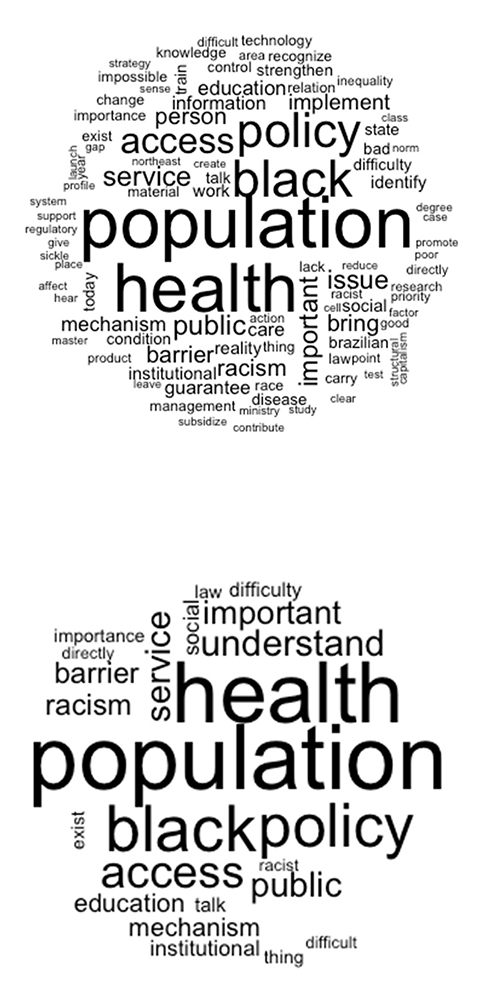
We also used the word cloud produced using the software IRAMUTEQ16. Regarding these observations, the words were presented according to the frequency with which they were mentioned, so that expressions highlighted are those that appeared most often in the conversations. Thus, we were able to identify which topics could emerge from these words, after verifying literature and thematic suggestions from the health workers themselves, who participated in the focus group. The word clouds are shown below in Figure 1, one elaborated for each encounter:
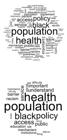
Word clouds of the meetings, whose thematic axes were: black population health and access to health services, and educational materials about promoting black people's health for health workers. Natal, Brazil, 2025.
We determined that the following topics should be addressed in the educational guide: the concept of health, social determinants, historical dimension, the National Policy for the Black Population, race, and color (self-determination), barriers to access and racism, affirmative action (quotas).
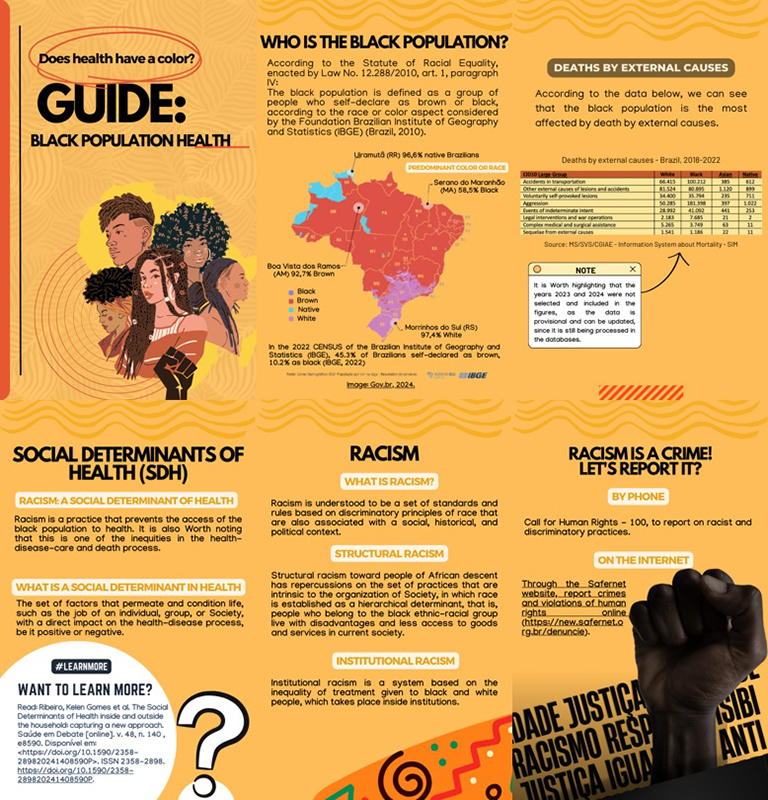
The educational guide is an excerpt from the dissertation "Participative development of a technological education to prevent structural racism in the access to health"22, developed according to the theoretical framework of qualitative research methods. One of the main unique aspects of these materials is the representativeness provided by the focus group, which included black health workers. Among the main characteristics and topics addressed in this product, the following stood out: the history of black movements, the Brazilian black population, the social determinants of health, the barriers of access, mental health, and racism. This material is available in the institutional repository of the Universidade Federal do Rio Grande do Norte, and it is available at the link https://repositorio.ufrn.br/items/0d8b3a1f-f06b-4baa-bc71-bd3bb4aa1ad4 (Figure 2)
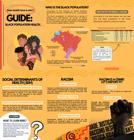
Illustrative layout of the guide "Does health have a color? Guide: Black population health", for the use of health professionals. Natal, Brazil, 2025.
DISCUSSION
The results of this research involve the discussion of topics related to the conditions and social determinants of the black population, in addition to the main strategies to deal with the health needs of this population. They also discuss educational technology and the fight against racism.
Thus, it is essential to highlight, in the historical and political setting, the formulation of the PNSIPN, whose goal is to reduce disparities in public health services, promoting integral health to all, especially considering the iniquities that affect Brazilian black communities. This policy is seen as an essential tool to deal with institutional racism. However, its implementation deals with many obstacles, such as the lack of appropriate training and knowledge, the lack of interest on the part of health managers and professionals, and the lack of information in the community itself. It is worth noting that this policy recognizes racism, social inequality, and institutional racism as crucial factors that influence the health of populations23.
Therefore, although some programs and policies seek to ensure health rights and equity for the black population, the inequity to which this population is subject is noticeable, considering they have the worst social and health indicators, low educational levels and income, limited access to health services, precarious living arrangements, and their positions in the work market are inferior. Therefore, when black and white people are compared, it can be noticed that the difference in their social positions and rights is a consequence of racism2.
Historically, during the process of slavery, the identity of the black population was denied, as their history, culture, and roots were silenced in a narrative dominated by the European. In this context, the black population was treated as invisible and considered inferior, which increased the racism ingrained in society. Even after slavery was abolished, this silencing continued. It was recognized by science as epistemic racism, meaning that the full expression of knowledge and culture of black people is treated as less valuable and prohibited24.
This historical process has consequences that can still be felt today. After slavery was abolished, the lack of an appropriate government structure and public policies that could protect the black population that had been enslaved led to racial segregation and social inequality. This situation led to significant disparities between the black and white populations.
The year 2020 stood out as a milestone in the United States, as the COVID-19 pandemic showed the difficult reality of the health inequality that affected the racial and ethnic minorities in the country, who were infected and died disproportionately but still have no equal access to treatment and vaccines. The lack of equal access to high-quality health care is, in part, the result of structural racism in the health policies of the USA, whose health system is structured to benefit the white population25.
A study about postoperative complications and death in children stands out in this regard, as it found that race is a critical social determinant of surgical results. The research showed that black children who were apparently healthy had a higher risk of postoperative death, complications, and severe adverse events than did their white counterparts26.
The first interviewee (P1) mentioned that one of the issues that influences this health condition is the denial of black beings, their rights, and the denial of racism itself, as it operates in society. It is worth noting that the invisibility of brown and black persons has a direct effect on their physical and mental health, and on their rights.
Therefore, it is essential to study African-Brazilian culture to understand its roots and history, given that, as P2 indicated, understanding the historical dimension is paramount to meeting the health needs of the black population.
In the setting of the discussion about racism, the importance of Decree No. 2.198/2023 stands out, as it implements anti-racist strategies in the field of health, seeking to promote ethnic-racial equity and fight against racism against black people and other minorities, in order to eliminate racism as a social determinant of health. These strategies to support this population go from social policies and programs to training, monitoring of racial indicators, and the promotion of affirmative action, in addition to publications and other initiatives27.
To reduce these inequalities, the actions adopted can involve training health workers to identify unconscious prejudice, increasing community resources associated with SDH, improving access to primary care services, and reforming federal and institutional policies to discourage discrimination and promote diversity and inclusion in the workforce in the health sector28.
The lack of knowledge from workers about public policies in the struggle against racism has a negative repercussion on the health of the black population. From this perspective, the National Humanization Policy (NHP) is an important element, as it aims to put into practice the principles of the Single Health System (SUS) by training and providing professional qualification, in a process that involves humanizing the healthcare of individuals. By correlating the topic of this study with that policy, we can note that health workers need qualifications to be able to meet the needs of the black population. This strategy can even help overcome the technicism in the field of health, promoting sensible and humane care to patients, so the needs of this population can be addressed and dealt with29).
Talking about humanization is an arduous task. Therefore, there are strategies for this process to be effective, such as the use of educational technologies that make it easier. In the context of black population health, educational strategies become necessary for health workers. Therefore, the questions raised this topic, especially regarding educational materials to break with the technical-mindedness of professionals.
When discussing technology, it is important to note that health technologies can be classified as hard, soft-hard, and soft. Soft technologies are focused on patient care, by embracing and listening; soft-hard technologies involve a set of technical-scientific knowledge that can help a group and aid in the building of educational materials, pedagogical resources, and others30. By reflecting this technology, the importance of educational materials stands out, as it becomes clear that technologies are not only medication and equipment, the "hard" technologies. Therefore, it is important to associate the other types of technology and understand their importance31.
In this setting, it is worth understanding that technologies can also be educational technologies, contributing to the formation and actions of the professionals, using technological resources for educational goals. It is worth highlighting that the use of these technologies has been more common in the work of health professionals, with health promotion in mind32.
The PNSIPN contributes to this educational character as it is a strategy to transform health practices, considering the importance of health education and the need to elaborate tools to inform, communicate, and educate. Thus, the statements of the participants of the focus group showed the need to create a guide to make it possible to share knowledge about the health of the black population, including topics about racism and health in the formation of the professional, through permanent education.
Thus, it became clear that dealing with the issue of racism in health services is necessary, and continued education and the application of educational technologies are effective approaches to do so. This strategy seeks to train health workers about the black population, facilitating the dissemination and democratization of this topic, in line with PNSIPN directives, in addition to helping prevent and fight against racism in health services.
During the process of participative development of this educational guide, we reflected on the choice of the title, which was inspired by the experience report "Does your practice have a color?", by addressing racial debates in Family and Community Medicine33. Thus, the title was selected based on this material and others, which were read throughout the creation process, and discusses the ethnic-racial discrimination in health services aimed at the black population. In line with this, the question/title "Does health have a color? Guide: Black population health" aims to raise a discussion and a reflection in the reader, as they get in touch with the materials for the first time.
The development of this educational material, based on the experiences of professionals and research on the topic, we believe that it should help improve the current understanding of the topic, allowing information to become more accessible to readers. It will be a complement with essential data to train and work with the black population, in addition to being an efficient tool to deal with racism and combat it in health services.
Still on the relevance of the struggle against structural racism in health, the work of nursing in the promotion of social justice involves many actions whose goal is to reduce inequality. The nurse must be engaged in implementing and disseminating educational materials, such as the guide elaborated in this study, to sensitize and qualify health workers about the specificities and needs of the black population, promoting a more humane and equal care.
Furthermore, nursing can actively contribute by adopting a critical posture in regard to care practices, promoting a type of care that recognizes the social and cultural vulnerability of individuals, seeking to eliminate access barriers, and ensuring respect for racial and cultural diversity.
By being a part of the multidisciplinary team and of the management of health services, nurses must be agents of change, promoting a culture of care that values diversity and fights against institutional racism, promoting social justice in health care. Thus, the nurse is an essential element of the construction of a more equal, just, and inclusive society, when it comes to health.
Regarding the limiting factors that affect this study, it is worth highlighting that a focus group in a virtual environment raises questions such as instable internet connection, which can affect the quality of the audio and video. Furthermore, physical interaction and proximity are lower, making it harder to interpret facial expressions and body language; distraction from one's domestic environment and difficulties ensuring equal participation are also factors that must be considered. Finally, it was also impossible to validate the content and appearance of the guide in this stage of the study. These are potential ramifications of this research.
FINAL CONSIDERATIONS
This study described the development of an educational guide, relying on the participation of black health professionals in the production and elaboration of its text, which ensured the representativeness and democratization of information for the black population.
The educational material named "Does health have a color? Guide: Black Population Health" was developed to have an innovative character, guiding health workers to reduce inequality through information and specific directives to fight against race prejudice in health services, stimulating self-declaration and racial data collection, early identification of health issues that are specific to the black population, and promoting egalitarian health while stimulating the central position of the black population. In such a way, it seeks to deal with the structural racism found in health services, promoting integral, embracing, and humanized care for black people.
We also expect to present evidence of content and appearance validity of the "Guide: Black Population Health", in future studies, in addition to further investigations about its implementation in the SUS healthcare network.
ACKNOWLEDGMENTS
To the post-graduation program in Health Management and Innovation (PPgGIS) at the Universidade Federal do Rio Grande do Norte (UFRN).
REFERENCES
-
1. Instituto Brasileiro de Geografia e Estatística (IBGE). Censo 2022: pela primeira vez, desde 1991, a maior parte da população do Brasil se declara parda [Internet]. 2023[cited 2024 Sep 13]. Available from: https://agenciadenoticias.ibge.gov.br/agencia-noticias/2012-agencia-de-noticias/noticias/38719-censo-2022-pela-primeira-vez-desde-1991-a-maior-parte-da-populacao-do-brasil-se-declara-parda
» https://agenciadenoticias.ibge.gov.br/agencia-noticias/2012-agencia-de-noticias/noticias/38719-censo-2022-pela-primeira-vez-desde-1991-a-maior-parte-da-populacao-do-brasil-se-declara-parda -
2. Silva DFL, Lyra TM, Silva JBR, Faustino DM. Para além do Racismo Institucional? uma análise do conteúdo da Política de Saúde para a População Negra. Ciênc Saúde Coletiva. 2023;28(9):2527-35. https://doi.org/10.1590/1413-81232023289.11602022
» https://doi.org/10.1590/1413-81232023289.11602022 -
3. Anunciação D, Pereira LL, Silva HP, Nunes APN, Soares JO. (Des)caminhos na garantia da saúde da população negra e no enfrentamento ao racismo no Brasil. Ciênc saúde coletiva. 2022;27(10):3861-70. https://doi.org/10.1590/1413-812320222710.08212022
» https://doi.org/10.1590/1413-812320222710.08212022 -
4. Ministério da Saúde (BR). Secretaria de Gestão Estratégica e Participativa. Política Nacional de Saúde Integral da População Negra [Internet]. Brasília (DF): Ministério da Saúde; 2013 [cited 2024 Sep 13]. Available from: https://bvsms.saude.gov.br/bvs/publicacoes/politica_nacional_saude_integral_populacao.pdf
» https://bvsms.saude.gov.br/bvs/publicacoes/politica_nacional_saude_integral_populacao.pdf -
5. Reis R. Boletim do dia da consciência negra [Internet]. ELSA Brasil; 2023 [cited 2024 Sep 13]. Available from: http://elsabrasil.org/boletim-do-dia-da-consciencia-negra
» http://elsabrasil.org/boletim-do-dia-da-consciencia-negra -
6. Silva SO, Berenguer AAS, Ricardo TMS, Lopes GDC, Sá MVGD, Santos DSM, et al. “Na verdade eu nunca participei e nem ouvi falar sobre”: a Política Nacional de Saúde Integral da População Negra na perspectiva de gestores e profissionais da saúde. Saúde Soc. 2022;31(4):e210969pt. https://doi.org/10.1590/S0104-12902022210969pt
» https://doi.org/10.1590/S0104-12902022210969pt -
7. Ministério da Saúde (BR). Política Nacional de Humanização (PNH) [Internet]. Brasília (DF): Ministério da Saúde ; 2013 [cited 2024 Sep 13]. Available from: https://bvsms.saude.gov.br/bvs/publicacoes/politica_nacional_humanizacao_pnh_folheto.pdf
» https://bvsms.saude.gov.br/bvs/publicacoes/politica_nacional_humanizacao_pnh_folheto.pdf -
8. Arruti JM, Pereira A, Sartori J, Sousa CJ, Gusmão HNB. O impacto da Covid-19 sobre as comunidades quilombolas [Internet]. 2021[cited 2022 Apr 29]. Available from: https://cebrap.org.br/wp-content/uploads/2021/01/Informativo-6-O-impacto-da-Covid-19-sobre-as-comunidades-quilombolas.pdf
» https://cebrap.org.br/wp-content/uploads/2021/01/Informativo-6-O-impacto-da-Covid-19-sobre-as-comunidades-quilombolas.pdf -
9. Souza DH, Rocha DGN, Nilza RA. Saúde da população negra na formação em saúde: perspectivas rumo à equidade racial. Cienc Saúde Colet [Internet]. 2024[cited 2024 Sep 13];29(7):e02992024. Available from: https://www.scielo.br/j/csc/a/npHB99dChHtLvsSXQTbQ5JR/?lang=pt
» https://www.scielo.br/j/csc/a/npHB99dChHtLvsSXQTbQ5JR/?lang=pt -
10. Souza VRS, Marziale MHP, Silva GTR, Nascimento PL. Tradução e validação para a língua portuguesa e avaliação do guia COREQ. Acta Paul Enferm. 2021;34:eAPE02631. https://doi.org/10.37689/acta-ape/2021AO02631
» https://doi.org/10.37689/acta-ape/2021AO02631 -
11. Portella JR, Maliszewski LS, Martins ESL. Técnica de amostragem “bola de neve virtual” na captação de participantes em pesquisas científicas. J Nurs Health. 2024;14(1):e1426636. https://doi.org/10.15210/jonah.v14i1.26636
» https://doi.org/10.15210/jonah.v14i1.26636 -
12. Campos CJG, Saidel MGB. Amostragem em investigações qualitativas: conceitos e aplicações ao campo da saúde. Rev Pesqui Qual[Internet]. 2022 [cited 2025 Jun 10];10(25):404-2. Available from: https://editora.sepq.org.br/rpq/article/view/545
» https://editora.sepq.org.br/rpq/article/view/545 -
13. Santos ACM, Santos GP, Cassiano AN, Rodrigues IDCV, Clemente HA, Silva CCS. Racismo e acesso à saúde da população negra: uma revisão integrativa. Rev Ciênc Saúde Nova Esperança [Internet]. 2024;17;22(3):413-25. https://doi.org/10.17695/rcsne.vol22.n3.p413-425
» https://doi.org/10.17695/rcsne.vol22.n3.p413-425 - 14. Bardin L. Análise de conteúdo. São Paulo: Edições 70; 2011.
-
15. Bento LA, Lima MDM, Borges MFC. Análise de similitude utilizada para identificar relações entre palavras dentro de um corpus textual. Rease. 2024;10(11):3137-43. https://doi.org/10.51891/rease.v10i11.16702
» https://doi.org/10.51891/rease.v10i11.16702 -
16. Carvalho DNR, Aguiar VFF, Apolinário DB, Bendelaque DFR, Pereira LCG, Figueira SAS, et al. Um olhar sobre o uso do software IRaMuTeQ® na pesquisa científica: estudo bibliométrico. Rev Enferm UFPI. 2024;13:e4280. https://doi.org/10.26694/reufpi.v13i1.4280
» https://doi.org/10.26694/reufpi.v13i1.4280 - 17. Teixeira E. Materiais didáticos para mediar processos educacionais em saúde: produção e tipologias. Porto Alegre: Moriá; 2022.
-
18. Ministério da Saúde (BR). Resolução nº 510, de 7 de abril de 2016 do Conselho Nacional de Ética em Pesquisa [Internet]. Brasília (DF): Ministério da Saúde ; 2016[cited 2024 Sep 13]. Available from: https://bvsms.saude.gov.br/bvs/saudelegis/cns/2016/res0510_07_04_2016.html
» https://bvsms.saude.gov.br/bvs/saudelegis/cns/2016/res0510_07_04_2016.html -
19. Ministério da Saúde (BR). Resolução nº 466, de 12 de dezembro de 2012 do Conselho Nacional de Ética em Pesquisa [Internet]. Brasília (DF): Ministério da Saúde ; 2012[cited 2024 Sep 13]. Available from: https://bvsms.saude.gov.br/bvs/saudelegis/cns/2013/res0466_12_12_2012.html
» https://bvsms.saude.gov.br/bvs/saudelegis/cns/2013/res0466_12_12_2012.html -
20. Alves LD. A divisão racial do trabalho como um ordenamento do racismo estrutural. Rev Katálysis. 2022;25(2):212-21. https://doi.org/10.1590/1982-0259.2022.e84641
» https://doi.org/10.1590/1982-0259.2022.e84641 -
21. Moura BF. Racismo afeta saúde desde o nascimento até a morte, diz especialista [Internet]. Agência Brasil; 2023 [cited 2024 Sep 13]. Available from: https://agenciabrasil.ebc.com.br/geral/noticia/2023-10/racismo-afeta-saude-desde-o-nascimento-ate-morte-diz-especialista
» https://agenciabrasil.ebc.com.br/geral/noticia/2023-10/racismo-afeta-saude-desde-o-nascimento-ate-morte-diz-especialista -
22. Santos ACM. Desenvolvimento participativo de tecnologia educativa para prevenção do racismo estrutural no acesso à saúde[Dissertação] [Internet]. Universidade Federal do Rio Grande do Norte, Natal (RN). 2024[cited 2024 Sep 13]. 101f., Available from: https://repositorio.ufrn.br/items/0d8b3a1f-f06b-4baa-bc71-bd3bb4aa1ad4
» https://repositorio.ufrn.br/items/0d8b3a1f-f06b-4baa-bc71-bd3bb4aa1ad4 -
23. Côrtes LS, Costa AM, Cunha ACR, Côrtes LS. Focus group as teaching strategy in Medical Residency. NTQR [Internet]. 2021[cited 2025 Jun 10];8:688-93. Available from: https://publi.ludomedia.org/index.php/ntqr/article/view/462
» https://publi.ludomedia.org/index.php/ntqr/article/view/462 -
24. Alves FAC, Côrtes GR. Raízes do epistemicídio negro: análise da produção científica do ENANCIB (1994-2019). Em Quest. 2023;29:e-124693. https://doi.org/10.1590/1808-5245.29.124693
» https://doi.org/10.1590/1808-5245.29.124693 -
25. Yearby R, Clark B, Figueroa JF. Structural racism in historical and modern US Health Care Policy. Health Affairs. 2022;41(2). https://doi.org/10.1377/hlthaff.2021.01466
» https://doi.org/10.1377/hlthaff.2021.01466 -
26. Johnson TF. Intersection of bias, structural racism, and social determinants with health care inequities. Pediatrics. 2020;146(2):e2020003657. https://doi.org/10.1542/peds.2020-003657
» https://doi.org/10.1542/peds.2020-003657 -
27. Ministério da Saúde (BR). Portaria GM/MS nº 2.198, de 6 de dezembro de 2023. Institui a Estratégia Antirracista para a Saúde no âmbito do Ministério da Saúde [Internet]. 2023[cited 2024 Sep 13];232-Seção1:81. Available from: https://www.in.gov.br/web/dou/-/portaria-gm/ms-n-2.198-de-6-de-dezembro-de-2023-528577869
» https://www.in.gov.br/web/dou/-/portaria-gm/ms-n-2.198-de-6-de-dezembro-de-2023-528577869 -
28. Chen J, Khazanchi R, Bearman G, Marcelin JR. Racial/ethnic inequities in healthcare-associated infections under the shadow of structural racism: narrative review and call to action. Curr Infect Dis Rep. 2021;23:17. https://doi.org/10.1007/s11908-021-00758-x
» https://doi.org/10.1007/s11908-021-00758-x -
29. Ferreira ER, Araújo FGL, Gomes MLS, Sampaio SMM, Souza AKP, Sousa DHAV, et al. A humanização do atendimento na atenção primária à saúde: a assistência humanizada na atenção primária à saúde. Braz J Health Rev [Internet]. 2022[cited 2024 Sep 13];5(1):1680-93. Available from: https://ojs.brazilianjournals.com.br/ojs/index.php/BJHR/article/view/43190
» https://ojs.brazilianjournals.com.br/ojs/index.php/BJHR/article/view/43190 -
30. Merhy EE. Micropolítica del trabajo en salud: teoría, métodos y aplicaciones [Internet]. Porto Alegre: ÚNICA; 2023[cited 2024 Sep 13]. Available from: https://editora.redeunida.org.br/wp-content/uploads/2025/11/Livro-Micropolitica-del-Trabajo-En-Salud.pdf
» https://editora.redeunida.org.br/wp-content/uploads/2025/11/Livro-Micropolitica-del-Trabajo-En-Salud.pdf -
31. Bender JD, Fachinni LA, Lapão LMV, Tomasi E, Thumé E. O uso de Tecnologias de Informação e Comunicação em Saúde na Atenção Primária à Saúde no Brasil, de 2014 a 2018. Ciênc Saúde Coletiva. 2024;29(1). https://doi.org/10.1590/1413-81232024291.19882022
» https://doi.org/10.1590/1413-81232024291.19882022 -
32. Lima AP, Missio L. Construção e validação de uma tecnologia educativa para educação em saúde no planejamento familiar. Serie-Estudos [Internet]. 2021[cited 2024 Apr 13];26(57):167-83. Available from: https://www.serie-estudos.ucdb.br/serie-estudos/article/view/1276
» https://www.serie-estudos.ucdb.br/serie-estudos/article/view/1276 -
33. Borret RH, Silva MF, Jatobá LR, Vieira RC, Oliveira DOPS. “A sua consulta tem cor?” incorporando o debate racial na medicina de família e comunidade: um relato de experiência. Rev Bras Med Fam Comunidade. 2020;15(42):2255. https://doi.org/10.5712/rbmfc15(42)2255
» https://doi.org/10.5712/rbmfc15(42)2255
Access to the set of data can be made via request to the corresponding author.

 Source: The authors, 2025.
 Source: The authors, 2025.