
 Usability of the ConectAPS-CRIE platform for management of special immunobiologicals in Primary Health Care
ABSTRACT
Objective: To evaluate the usability of the ConectAPS-CRIE platform in the management of special immunobiologicals in primary health care by nursing professionals.
Method: A usability evaluation study of biomedical technology, conducted in August and September 2024, in Campinas, São Paulo, Brazil. The usability assessment involved direct users of the software, who were nursing professionals from the vaccination room of a Health Center, a Reference Center for Special Immunobiologicals, and the Epidemiological Surveillance Service. The professionals completed a questionnaire containing the statements of the System Usability Scale (SUS), and individual and average usability scores were calculated.
Results: The average usability score was 82.5±17.9 points. The two professionals from the Reference Center for Special Immunobiologicals assigned the lowest scores (47.5 and 67.5), while the nurse from the Epidemiological Surveillance Service assigned an intermediate score (77.5), and professionals from the Health Center reported higher scores, ranging from 85 to 100 points.
Conclusion: The platform showed excellent average usability, with variations depending on the professional context, indicating greater ease of use by Health Center professionals and the need for adjustments to consolidate it as an effective tool in the management of special immunobiologicals.
Descriptors:
Nursing; Health care management; Primary health care; Biomedical technology assessment; Vaccination; Immunization schedule
RESUMO
Objetivo: Avaliar a usabilidade da plataforma ConectAPS-CRIE na gestão de imunobiológicos especiais na atenção primária à saúde pelos profissionais de enfermagem.
Método: Estudo de avaliação da usabilidade de tecnologia biomédica, realizado em agosto e setembro de 2024, em Campinas/SP, Brasil. A avaliação da usabilidade envolveu os usuários diretos do software, que foram profissionais de enfermagem da sala de vacina de um Centro de Saúde, Centro de Referência para Imunobiológicos Especiais e Vigilância Epidemiológica. Os profissionais responderam a um questionário com afirmações da System Usability Scale, sendo calculados os escores individuais e médio da usabilidade.
Resultados: O escore médio de usabilidade foi de 82,5±17,9 pontos. Os dois profissionais do Centro de Referência para Imunobiológicos Especiais atribuíram os menores escores (47,5 e 67,5), enquanto o enfermeiro da Vigilância Epidemiológica atribuiu um valor intermediário (77,5) e os profissionais do Centro de Saúde apresentaram escores maiores, variando entre 85 e 100 pontos.
Conclusão: A plataforma apresentou usabilidade média excelente, com variações por contexto de atuação, indicando maior facilidade de uso pelos profissionais do Centro de Saúde e a necessidade de ajustes para consolidá-la como ferramenta eficaz na gestão de imunobiológicos especiais.
Descritores:
Enfermagem; Gestão em saúde; Atenção primária à saúde; Avaliação da tecnologia biomédica; Vacinação; Esquemas de imunização
RESUMEN
Objetivo: Evaluar la usabilidad de la plataforma ConectAPS-CRIE en la gestión de inmunobiológicos especiales en la Atención Primaria de Salud por parte de profesionales de enfermería.
Método: Estudio de evaluación de la usabilidad de tecnología biomédica, realizado en agosto y septiembre de 2024, en Campinas, São Paulo, Brasil. La evaluación de la usabilidad involucró a usuarios directos del software, quienes fueron profesionales de enfermería de la sala de vacunación de un Centro de Salud, un Centro de Referencia para Inmunobiológicos Especiales y del servicio de Vigilancia Epidemiológica. Los profesionales respondieron un cuestionario con afirmaciones de la System Usability Scale (SUS), calculándose los puntajes individuales y el promedio de usabilidad.
Resultados: El puntaje promedio de usabilidad fue de 82,5±17,9 puntos. Los dos profesionales del Centro de Referencia para Inmunobiológicos Especiales otorgaron los puntajes más bajos (47,5 y 67,5), mientras que el enfermero de la Vigilancia Epidemiológica otorgó un valor intermedio (77,5) y los profesionales del Centro de Salud presentaron puntajes más altos, que variaron entre 85 y 100 puntos.
Conclusión: La plataforma presentó una usabilidad promedio excelente, con variaciones según el contexto de actuación, lo que indica una mayor facilidad de uso por parte de los profesionales del Centro de Salud y la necesidad de ajustes para consolidarla como una herramienta eficaz en la gestión de inmunobiológicos especiales.
Descriptores:
Enfermería; Gestión en salud; Atención primaria de salud; Evaluación de la tecnología biomédica; Vacunación; Esquemas de inmunización
INTRODUCTION
The Reference Centers for Special Immunobiologicals (CRIEs) were implemented by the Brazilian Ministry of Health in 1993, with the objective of making high-cost vaccines available to people with special clinical conditions, monitoring adverse events following vaccination, and distributing immunobiologicals to other health units1. Although Brazil is among the three leading countries in Latin America in vaccinating populations with special needs or clinical situations2, the centralization of CRIEs has limited access for the population living far from these centers3. Expanding the number of units does not fully solve the problem 3; it is necessary to integrate services4, especially Primary Health Care (PHC), whose accessibility, knowledge of the reality, and local planning capacity favor the expansion of vaccination coverage5.
To keep the vaccination schedule up to date in immunosuppressed patients, a study suggests that PHC units strengthen coordination with CRIEs6) . This need was highlighted in a study of patients undergoing liver transplantation and indicated for special vaccination schedules, which revealed that 82.2% sought vaccination at Basic Health Units (UBSs), while only 13.7% sought vaccination at CRIEs. Furthermore, the health professionals involved in the care of these patients themselves frequently recommended vaccination at UBSs7.
However, a study carried out in Fortaleza/Ceará, showed that nursing professionals in PHC vaccination rooms do not make requests for special immunobiologicals due to lack of knowledge of the request flow8. This highlights the need for efficient planning for the management of vaccination actions involving the acquisition, storage, distribution and administration of immunobiologicals, in addition to monitoring the flow of information across the various levels of management and execution (1.
The CRIE of Hospital de Clínicas (HC) of Universidade Estadual de Campinas (UNICAMP) adopts, as a strategy to expand population access, the distribution of special immunobiologicals on demand to health units in several municipalities, including the UBSs of Campinas, São Paulo, Brazil. However, there is no standardization regarding the request for these immunobiologicals or their monitoring in PHC.
As a strategic resource, the adoption of digital technologies has proven to be fundamental for the generation of knowledge and incorporation of practices in the healthcare area 9, in addition to contributing to the optimization of the organization of services10. Among technologies, software stands out as essential computer programs for the dissemination and transformation of information11. They must be developed and evaluated with a focus on their usability, which determines the ease of user interaction with the system12. Research that evaluated applications and software aimed at the practice of health professionals indicates that technologies with high usability provide intuitive navigation and have high potential for application in daily practice13-14) .
In this context, the creation of the ConectAPS-CRIE digital platform aims to fill an operational gap in the integration between services. This software is designed to assist in the management of special immunobiologicals in PHC. Validated for its functional performance and technical quality, it is a strategy to improve the organization of special immunobiological requests and the vaccination coverage of its specific target audience15). Therefore, evaluating the usability of ConectAPS-CRIE in practice, based on a pilot application, is essential for the tool to be not only technically functional, but also intuitive, effective and suited to the needs of healthcare professionals, encouraging their adherence and facilitating their use in routine services.
In view of the above, the present study aimed to evaluate the usability of the ConectAPS-CRIE platform in the management of special immunobiologicals in primary health care by nursing professionals.
METHOD
This is a study to evaluate the usability of the ConectAPS-CRIE biomedical technology, developed with the expectation that by creating a computer system, the developer will investigate the ease with which users can perform specific tasks when interacting with said system12.
The research report was structured according to the recommendations of the Standards for Quality Improvement Reporting Excellence (SQUIRE 2.0), and the presentation of the data followed the quantitative and descriptive approach.
The study was conducted in the city of Campinas, São Paulo, Brazil, which has 68 UBSs (Health Centers) based on the Family Health Program (FHP) logic . These UBSs are distributed across six Health Districts, each responsible for health planning and management in areas with approximately 200,000 inhabitants.
The pilot and evaluation were carried out at a Health Center (CS) and at the Epidemiological Surveillance (VE) in the Northwest District, and at the CRIE of the Hospital de Clínicas (HC) of Universidade Estadual de Campinas (UNICAMP). The selection of these units considered the link between the research and a Professional Doctorate Program that guides the implementation of applied studies in the student's place of work.
This choice enabled the contextualized application of the object of study, considering the researcher's prior knowledge of the organizational structure, work processes and institutional flows involved in the topic investigated.
The ConectAPS-CRIE platform was developed to facilitate the management of requests for special immunobiologicals in PHC, replacing the need for these requests to be completed on paper or by email15. Its areas include Login, Home Panel, Users, Units, Immunobiologicals, Patients, Requests, Reports, and Help. Its use allows services to register requests, track their status, and attach files to requests, such as reports or prescriptions, vaccination records, and other digital documents. This tool was previously validated by IT professionals and nurses and improved based on nonconformities identified during the process15. However, as of the writing of this article, the platform had not yet been implemented in healthcare services.
The pilot phase began on April 10th and concluded on August 10th, 2024, and followed the municipality's existing request flow. The vaccination room professional forwards the request for the special immunobiological to the corresponding district VE. The VE is responsible for evaluating the request, which, if it meets the criteria for acceptance, is authorized and sent to the CRIE. After approval by the CRIE, the vaccine is transported to the CS. As soon as the vaccination room professional receives the special immunobiological, they contact the patient to arrange for its administration.
The role of each service in ordering and delivering special immunobiologicals was considered, involving the CS, the VE of the Northwest District, and the CRIE. The professionals of the services were trained by the researcher on the purpose and use of the platform, and the availability of an instruction manual and the possibility of contacting the researcher in case of doubts or difficulties were also discussed.
Data regarding the usability assessment were collected in the months of August and September 2024. Direct users of the software participated in the evaluation during the referred period. The pilot project consisted of a nurse, three nursing technicians, and a nursing assistant from the vaccination room at the CS, a nurse from the VE of the Northwest District, and two nurses from the CRIE. This constituted a purposive, non-probabilistic sample without the adoption of exclusion criteria. No professional involved in these services refused to participate in the pilot project and, subsequently, in the evaluation.
Participants answered a questionnaire to assess usability, consisting of ten statements from the Brazilian Portuguese version of the System Usability Scale12, judged on a Likert scale, which has a score from 1 to 5, where 1 means “strongly disagree” and 5 “strongly agree”.
The System Usability Scale was chosen because it is a validated and widely accepted instrument for measuring the ease with which users can perform specific tasks when interacting with systems, software and applications12.
The calculation of the total score of the System Usability Scale was performed as follows: for each odd-numbered statement (statements 1, 3, 5, 7, and 9), the individual score was the score assigned by the evaluator subtracting 1, and for each even-numbered statement (statements 2, 4, 6, 8, and 10), the individual score was 5 minus the assigned score. Afterwards, the individual values were added and the result of this sum was multiplied by 2.5, with a satisfaction index that ranged from 0 to 100 points12.
In addition to the total score, the average usability score, obtained from the arithmetic mean of the participants' individual final scores, and the respective standard deviation were calculated.
To facilitate interpretation, the scores were classified as follows: up to 20.5 (worst imaginable); from 21 to 38.5 (poor); from 39 to 52.5 (average); from 53 to 73.5 (good); from 74 to 85.5 (excellent) and from 86 to 100 (best imaginable)16.
The project was approved by the Research Ethics Committee of Faculdade de Medicina de Botucatu of Universidade Estadual Paulista “Júlio de Mesquita Filho”, under protocol no 5,019,782, with two amendments submitted: opinions numbers 5,238,718 and 6,839,824. The research was also authorized by the Immunization Division of the Epidemiological Surveillance Center of the Government of the State of São Paulo, Primary Care of the Health Services Coordination of the Government of the State of São Paulo and the Municipal Health Department of Campinas.
Nursing professionals who agreed to participate in the research received and signed the Free and Informed Consent Form (FICF).
RESULTS
For a better understanding of the evaluated software, the main areas of the ConectAPS-CRIE platform (Home Panel and Requests) are presented in Figure 1.
The Home Panel includes: a welcome message and the number of requests, patients, units, and immunobiologicals registered; instructions on how the platform works; and a sidebar with icons for accessing other areas, namely: Users, Units, Immunobiologicals, Patients, Requests, Reports, Help, and Exit.
The Requests area contains a list of vaccines already requested for each patient, including the requesting unit, vaccine, date of birth, age, and request status. For each request, there are four icons in the Actions field: Status (view the request history), Attachments (view the file attached to the request or attach additional files), View (generates an individual report with patient and request data, which can be printed), Change (edit the request), and Delete. There is also the Insert New icon to add a new request.
During the pilot period, 11 patients and 14 requests for immunobiologicals were registered on the platform.

Eight nursing professionals who use the software evaluated the ConectAPS-CRIE platform: four nurses (two from CRIE, one from CS, and one from VE); three nursing technicians from CS, and one nursing assistant, also from CS.
The distribution of responses given to the System Usability Scale statements by nursing professionals is represented in Figure 2.
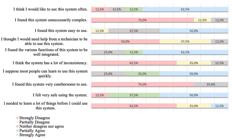
Distribution of responses to the System Usability Scale statements regarding the use of the platform by nursing professionals. Campinas, São Paulo, Brazil, 2024
The evaluation scores of the ConectAPS-CRIE platform by nursing professionals, using the System Usability Scale, are presented in Table 1.
The classification and frequency of usability evaluation scores assigned to the ConectAPS-CRIE platform by nursing professionals are represented in Table 2.
The average score obtained was 82.5±17.9, allowing the usability assessment of ConectAPS-CRIE to be classified as excellent.
DISCUSSION
This study evaluated the usability of the ConectAPS-CRIE platform from the perspective of the professionals involved in the services. It showed that nursing professionals (nurses, nursing technicians, and nursing assistants) assigned usability evaluation scores classified as average (12.5%), good (12.5%), excellent (25%), and best imaginable (50%). The average was 82.5±17.9 points, classified as excellent, indicating, in general, ease of use of the software. It is noteworthy that data collection, conducted immediately after the completion of the pilot phase, may have contributed to obtaining more accurate and reliable data, considering that participants' memories of the intervention remained fresh.
Participation in technology evaluation is essential, as it allows for the identification of weaknesses and guidance for improvements, making the software more appropriate for professional practice17). It is also important to ensure satisfactory levels of usability to enable its adoption in different care contexts, as the effective application of information and communication technologies in nursing practice still faces several challenges, such as difficulties in use, barriers to implementation and a lack of specialized technical support18.
Similar technology evaluation studies were found in the literature that obtained even higher averages13,20. A study on the usability of an educational hypermedia on reception and obstetric risk classification, also using the System Usability Scale, obtained a higher average (91.9 points). However, the study had, as a limitation, the lack of participation of the target audience in the evaluation process19.
Another study evaluated a software program to support logistical decisions in the organ procurement and transplantation process, obtaining an average score of 98.25 points on the System Usability Scale, being classified as "best achievable." The participants were nurses working in a transplant center, and the results indicated that the system was considered functional, easy to use, with accessible language and well-integrated information13.
A study evaluated a mobile application developed to help healthcare professionals optimize vancomycin doses in hospitalized patients. The usability of the application was verified by healthcare professionals and considered satisfactory. The study, however, used the Smartphone Usability Questionnaire (SURE) instrument, which, unlike the System Usability Scale, contains 31 analysis items14.
In the present study, despite the overall positive evaluation, there was divergence in individual responses regarding user satisfaction. Of note , the choice of "Strongly disagree" for the statements "I think I would like to use this system frequently" and "I felt confident using this system," as well as the statement "I needed to learn a lot before I could use this system," which received the response "Strongly agree."
The differences in scores also highlighted variability in participants' perceptions. Despite the mean being classified as excellent, the data indicate that the system's effectiveness can vary depending on the individual profile and the type of service the professional provides.
Regarding user profiles, a study with 10 specialist nurses evaluating the usability of a prototype application for emergency shift handover also obtained an excellent average (between 75 and 100 points in most cases). Two professionals, however, assigned lower scores (52.5 and 45 points), justifying the difficulty in handling and the need for technical assistance to learn how to use the application20, pointing to individual difficulties related to training or previous experience with technologies.
When analyzing the scores by location, it is observed that VE professionals assigned an intermediate value (77.5), while those from CS presented higher scores, ranging from 85 to 100, demonstrating greater familiarity or ease in using the platform, although with some internal variation. On the other hand, the two professionals linked to CRIE registered the lowest scores (47.5 and 67.5), which highlights a difference in the evaluation, depending on the activity carried out in each service.
High scores in the CS suggest a more favorable environment for using the platform, whether due to greater adherence, support, or professional profile. Lower scores in the CRIE may be related to the more specialized nature of the service, which requires, in addition to evaluating requests, managing the flow of information using the National Immunization Program Information System or a proprietary system with interoperability with the National Health Data Network (RNDS) to record the movement of special immunobiologicals1.
It was observed that the highest usability scores were mostly assigned by mid-level and technical nursing professionals. However, the CS nurse had the highest score among the participating nurses. These data suggest that perception of usability is more related to the context of work than to educational level, contradicting the expectation that less academic training would result in greater difficulty using the software.
The importance of PHC nurses appropriating technological advances in service management is highlighted, as a way of qualifying assistance and improving the care provided to users10. Although still little explored, information technologies have been used by these professionals as organizational tools, with emphasis on the National Regulatory System (SISREG) and the Electronic Citizen Record (PEC)10.
In this regard, the score assigned by the CS nurse suggests the acceptability of the platform, a consequence of its greater usability, in relation to other professionals. It is important to emphasize the importance of these professionals knowing, exploring and incorporating technologies into their practice to strengthen the organization of services10.
A study conducted in India on the implementation of an integrated health information system for primary care highlighted initial difficulties in adapting to the digital system. Over time, however, professionals reported significant benefits, such as easier record searches, faster report generation, and decision-making support. The study reinforces the need to consider contextual factors, offer adequate training, ensure ongoing support, and maintain dialogue with users to achieve the sustainability of digital solutions21.
From this perspective, the poor results obtained by CRIE professionals point to the need for further research into the factors that influence the platform's usability in this specific scenario. Thus, the study demonstrates that, for the implementation and adoption of new technological tools, studies are needed that explore their usability, considering the routines of healthcare professionals in different contexts.
In view of the results, it is clear that a limitation of the study was that the platform evaluation involved only one PHC unit and that its pilot was conducted over a short period of time. These factors limited the sample size, as a small number of professionals used the platform.
CONCLUSION
The usability assessment of the ConectAPS-CRIE platform, from the perspective of nursing professionals in the services involved, reveals, in general, good acceptance and ease of use, with an average score classified as excellent by the System Usability Scale. However, the variation in scores across different care settings suggests that the experience with the platform may be influenced by the profile of the professionals and the nature of the activities performed in each service.
Professionals working at the Health Center showed greater ease in using the tool, while those at the Reference Center for Special Immunobiologicals assigned the lowest scores, highlighting specific challenges related to the complexity of this service.
The findings reinforce the need for further research that explores, in a broader and more representative manner, the factors that affect the usability of the ConectAPS-CRIE platform in different contexts within the healthcare network. It is important to consider further adjustments to ensure its widespread acceptance and use. Such improvements will be essential for the platform to establish itself as an effective solution for managing these immunobiologicals, aiming to meet the specific demands of each service.
After improvements are made, the platform's implementation is planned to be expanded across several PHC units and specialized services, aiming to increase usage and user numbers, and to understand the specific nature of requests for special immunobiologicals. This way, the platform can improve workflows and make request management more accessible to services, making it easier for the professionals involved, and potentially impacting increased vaccination coverage among populations with special clinical conditions.
ACKNOWLEDGMENTS
To the Coordination for the Improvement of Higher Education Personnel (CAPES), for supporting the Postgraduate Program in Nursing - Professional Master's and Professional Doctorate Courses at Faculdade de Medicina de Botucatu, of Universidade Estadual Paulista “Júlio de Mesquita Filho” (Financing Code 001).
REFERENCES
-
1. Ministério da Saúde (BR). Secretaria de Vigilância em Saúde. Departamento de Imunizações e Doenças Imunopreveníveis. Manual dos Centros de Referência para Imunobiológicos Especiais[Internet]. 6. Ed. Brasília: Ministério da Saúde; 2023 [cited 2024 Aug 16]. Available from: https://www.gov.br/saude/pt-br/vacinacao/arquivos/manual-dos-centros-de-referencia-para-imunobiologicos-especiais_6a-edicao_2023.pdf
» https://www.gov.br/saude/pt-br/vacinacao/arquivos/manual-dos-centros-de-referencia-para-imunobiologicos-especiais_6a-edicao_2023.pdf -
2. Rombini MF, Mauas RP, Urueña A. Ranking de los programas de inmunización en América Latina: 2019. Rev Panam Salud Publica. 2022;46:e204. https://doi.org/10.26633/RPSP.2022.204
» https://doi.org/10.26633/RPSP.2022.204 -
3. Brandão LGP, Costa MD, Martins PS, Jesus- Junior SCA, Aguiar DF, Lemos AS, et al. Telemedicine in the National Immunization Program (Brazil): a promising tool. Vaccine: X. 2022;11:100188. https://doi.org/10.1016/j.jvacx.2022.100188
» https://doi.org/10.1016/j.jvacx.2022.100188 -
4. Parmejani PSS, Picone CM, Alves APPS, Sartori AMC, Ibrahim KY. Facilitating access to pneumococcal vaccine for people living with HIV: an experience report. Rev Esc Enferm USP. 2022;56:e20210563. https://doi.org/10.1590/1980-220X-REEUSP-2021-0563en
» https://doi.org/10.1590/1980-220X-REEUSP-2021-0563en -
5. Ministério da Saúde (BR). Secretaria de Vigilância em Saúde e Ambiente, Secretaria de Atenção Primária à Saúde, Secretaria de Saúde Indígena. Manual de microplanejamento para as atividades de vacinação de alta qualidade [Internet]. Brasília: Ministério da Saúde ; 2023 [cited 2024 Aug 16]. Available from: https://www.gov.br/saude/pt-br/vacinacao/publicacoes/manual-de-microplanejamento.pdf
» https://www.gov.br/saude/pt-br/vacinacao/publicacoes/manual-de-microplanejamento.pdf -
6. Gallucci MC, Luhn KR, Brito JC, Silva LV, Risso MF, Zafaneli MJ, et al. Avaliação da vacinação dos pacientes submetidos ao transplante de medula óssea em centro de referência. Rev Eletrôn Acervo Saúde. 2025;25:e17946. https://doi.org/10.25248/reas.e17946.2025
» https://doi.org/10.25248/reas.e17946.2025 -
7. Miranda MN, Ribeiro SP, Chaves FC, Costa e Telles FM, Gonzalez AM, Mota DO, et al. Low post-liver transplant vaccine awareness: analysis and educational strategy. Acta Paul Enferm. 2023;36:eAPE025834. https://doi.org/10.37689/acta-ape/2023AO0258344
» https://doi.org/10.37689/acta-ape/2023AO0258344 -
8. Silva CDG, Canto SVE, Moura ADA, Alencar OM. Avaliação do programa de imunização em região de saúde de Fortaleza, Ceará, Brasil. Braz. J. Health Rev. 2021;4(1):3801-15. https://doi.org/10.34119/bjhrv4n1-301
» https://doi.org/10.34119/bjhrv4n1-301 -
9. Coates A, Chung AQH, Lessard L, Grudniewicz A, Espadero C, Gheidar Y, et al. The use and role of digital technology in learning health systems: a scoping review. Int J Med Inform. 2023;178:105196. https://doi.org/10.1016/j.ijmedinf.2023.105196
» https://doi.org/10.1016/j.ijmedinf.2023.105196 -
10. Fernandes BCG, Silva Júnior JNB, Guedes HCS, Macedo DBG, Nogueira MF, Barrêto AJR. Use of technologies by nurses in the management of primary health care. Rev Gaúcha Enferm. 2021;42(esp):e20200197. https://doi.org/10.1590/1983-1447.2021.20200197
» https://doi.org/10.1590/1983-1447.2021.20200197 - 11. Pressman RS, Maxim BR. Engenharia de Software: uma abordagem profissional. 9ª ed. Porto Alegre: AMGH; 2021.
-
12. Lourenço DF, Carmona EV, Lopes MHBM. Translation and cross-cultural adaptation of the System Usability Scale to Brazilian Portuguese. Aquichan. 2022;22(2):e2228. https://doi.org/10.5294/aqui.2022.22.2.8
» https://doi.org/10.5294/aqui.2022.22.2.8 -
13. Costa JM, Meirelles BHS, Magalhães ALP. Software para apoio à decisão logística no processo de captação e transplante de órgãos. Rev Baiana Enferm. 2023;37:e52699. https://doi.org/10.18471/rbe.v37.52699
» https://doi.org/10.18471/rbe.v37.52699 -
14. Soares TCAE, Lima TM. Usabilidade de um aplicativo móvel de apoio aos profissionais de saúde para cálculos de doses de vancomicina. Semin Cienc Biol Saúde. 2024;45(1):35-44. https://doi.org/10.5433/1679-0367.2024v45n1p35
» https://doi.org/10.5433/1679-0367.2024v45n1p35 -
15. Braga CCC, Parada CMGL. Digital platform for management of special immunobiologicals in primary health care. Texto Contexto Enferm. 2023;32:e20230233. https://doi.org/10.1590/1980-265X-TCE-2023-0233en
» https://doi.org/10.1590/1980-265X-TCE-2023-0233en -
17. Bangor A, Kortum P, Miller J. Determining what individual SUS scores mean: adding an adjective rating scale. J Usability Stud [Internet]. 2009 [cited 2025 Apr 22];4:114-23. Available from: https://uxpajournal.org/wp-content/uploads/sites/7/pdf/JUS_Bangor_May2009.pdf
» https://uxpajournal.org/wp-content/uploads/sites/7/pdf/JUS_Bangor_May2009.pdf -
18. Cavalcanti HGO, Bushatsky M, Barros MBSC, Melo CMCS, Delgado Filho AJF. Evaluation of the usability of a mobile application in early detection of pediatric cancer. Rev Gaúcha Enferm. 2021;42:e20190384. https://doi.org/10.1590/1983-1447.2021.20190384
» https://doi.org/10.1590/1983-1447.2021.20190384 -
19. Ribeiro OM, Martins MM, Vandresen L, Silva JM, Cardoso MF. Usefulness of information and communication technologies: portuguese nurses’ look. Texto Contexto Enferm . 2021;30:e20190139. https://doi.org/10.1590/1980-265X-TCE-2019-0139
» https://doi.org/10.1590/1980-265X-TCE-2019-0139 -
20. Soares FMM, Mesquita KKB, Nunes RS, Araújo Filho JD, Fonseca LMM, Torres GV, et al. Hipermídia educativa em acolhimento e classificação de risco obstétrico: validação de conteúdo e usabilidade. Rev Gaúcha Enferm . 2022;43(esp):e20220108. https://doi.org/10.1590/1983-1447.2022.20220108.pt
» https://doi.org/10.1590/1983-1447.2022.20220108.pt -
21. Barbosa IS, Jaques AE, Radovanovic CAT, Andrade L, Dermatte LPG, Souza CM, Tonon MM. Development of a mobile application for emergency shift handovers using the National Early Warning Score. Rev Gaúcha Enferm . 2023;44:e20220130. https://doi.org/10.1590/1983-1447.2023.20220130.en
» https://doi.org/10.1590/1983-1447.2023.20220130.en -
22. Faujdar DS, Singh t, Kaur M, Sahay S, Kumar R. Stakeholders’ Perceptions of the Implementation of a Patient-Centric Digital Health Application for Primary Healthcare in India. Healthc Inform Res. 2021;27(4):315-324. https://doi.org/10.4258/hir.2021.27.4.315
» https://doi.org/10.4258/hir.2021.27.4.315
Access to the dataset may be granted upon request to the corresponding author.

 Source: authors' database, 2024
 Source: Authors' database, 2024