
 Development of a website on accessibility and care for people with acquired physical disabilities
ABSTRACT
Objective: To develop a website aimed at rehabilitation nurses, focused on accessibility and nursing care for individuals with acquired physical disabilities, and to assess its usability, experience and perception of use.
Method: A methodological study of technological development based on the DADI methodology (Definition, Architecture, Design, and Implementation), tested by 11 rehabilitation nurses selected by convenience sampling, in 2023. Data were collected through an online questionnaire evaluating usability, experience and perception of use, complemented by an open-ended question for suggestions. The data were analyzed using descriptive statistics and thematic analysis of the open-ended responses.
Results: The website "Nursing. People. Disability - Community" achieved an average score of 88.64 ± 8.49 on the System Usability Scale, indicating excellent usability. All participants found the information they were looking for, considered the valuable content for care practice, and recognized the clarity of the layout. Overall impressions exceeded the expectations of 81.8% of the participants. Suggestions included addressing topics such as home accessibility, acquisition of assistive products, and expanding the content on rehabilitation.
Conclusion: The website demonstrates high usability and meets the information needs of rehabilitation nurses regarding accessibility and care for individuals with acquired physical disabilities.
Descriptors:
Rehabilitation; Nursing Care; Disabled Persons; Social Inclusion; Educational Technology; Information Dissemination
RESUMO
Objetivo: Desenvolver um website direcionado a enfermeiros de reabilitação sobre acessibilidade e cuidados de enfermagem à pessoa com deficiência física adquirida, e avaliar a sua usabilidade, experiência e percepção de utilização.
Método: Estudo metodológico de desenvolvimento tecnológico baseado na metodologia DADI (Definição, Arquitetura, Design e Implementação), testado por 11 enfermeiros de reabilitação em Portugal, selecionados por conveniência, em 2023. A coleta de dados realizou-se através de um questionário online que avaliou a usabilidade, experiência e percepção sobre a utilização, complementado por uma pergunta aberta para sugestões. Os dados foram analisados com estatística descritiva e análise temática das respostas abertas.
Resultados: O website "Enfermagem. Pessoas. Deficiência - Comunidade" obteve uma pontuação média de 88,64 ± 8,49 na Escala de Usabilidade do Sistema. Todos os participantes encontraram as informações que procuravam, consideraram o conteúdo útil para a prática de cuidados e reconheceram a clareza do layout. A impressão geral excedeu as expectativas de 81,8% dos participantes. As sugestões incluíram abordar acessibilidade habitacional, aquisição de produtos de apoio e ampliação do conteúdo sobre reabilitação.
Conclusão: O website apresenta elevada usabilidade e atende às necessidades dos enfermeiros de reabilitação sobre informação para acessibilidade e cuidados a pessoas com deficiência física adquirida.
Descritores:
Reabilitação; Cuidados de Enfermagem; Pessoas com Deficiência; Inclusão Social; Tecnologia Educacional; Disseminação de Informação
RESUMEN
Objetivo: Desarrollar un sitio web dirigido a enfermeros de rehabilitación sobre accesibilidad y cuidados de enfermería a personas con discapacidad física adquirida, y evaluar su usabilidad, experiencia y percepción de uso.
Método: Estudio metodológico de desarrollo tecnológico basado en la metodología DADI (Definición, Arquitectura, Diseño e Implementación), probado por 11 enfermeros de rehabilitación seleccionados por conveniencia, en 2023. La recolección de datos se realizó mediante un cuestionario en línea que evaluó la usabilidad, la experiencia y percepción de uso, complementado con una pregunta abierta para sugerencias. Los datos se analizaron mediante estadística descriptiva y análisis temático de las respuestas abiertas.
Resultados: El sitio web "Enfermería. Personas. Discapacidad - Comunidad" obtuvo una puntuación media de 88,64 ± 8,49 en la Escala de Usabilidad del Sistema. Todos los participantes encontraron la información que buscaban, consideraron el contenido útil para la práctica asistencial y reconocieron la claridad del diseño. La impresión general superó las expectativas del 81,8% de los participantes. Las sugerencias incluyeron abordar la accesibilidad habitacional, la adquisición de productos de apoyo y la ampliación del contenido sobre rehabilitación.
Conclusión: El sitio web presenta una alta usabilidad y responde a las necesidades de los enfermeros de rehabilitación en cuanto a información sobre accesibilidad y cuidados a personas con discapacidad física adquirida.
Descriptores:
Rehabilitación; Atención de Enfermería; Personas con Discapacidad; Inclusión Social; Tecnología Educacional; Difusión de la Información
INTRODUCTION
Disability represents a significant global challenge. Currently, an estimated 135 million people live with some form of disability in the World Health Organization's European Region1, with approximately 10% of the Portuguese population having some form of disability2. Acquired physical disability occurs when a person develops a condition that affects their mobility or motor function, resulting from illness, injury, accident, or degenerative condition3, requiring adaptations in daily life and the environment.
People with acquired physical disabilities face mobility challenges when carrying out daily activities, in their social participation and professional integration4,5. Environmental, attitudinal, political, and social barriers restrict their full participation, contributing to social exclusion and reducing their quality of life6,7. Rehabilitation nursing plays a fundamental role in empowering these people for reintegration and exercising citizenship, promoting mobility, accessibility, and social participation8. Accessibility and social inclusion are essential components of the practice, as they ensure equal opportunities by eliminating architectural, social, and communication barriers. This allows people to live independently and have equal access to opportunities, rights, and services, allowing them to exercise citizenship with dignity and autonomy9,10.
To provide first-rate care, rehabilitation nurses need access to up-to-date, evidence-based information. In Portugal, continuing education in nursing has benefited from the development of digital platforms, such as the Portuguese Nurses' Association's EnForma, and the growing use of Massive Open Online Courses, which demonstrate high acceptance among professionals11. However, there is a shortage of digital resources specifically aimed at accessibility and specialized care for people with acquired physical disabilities, as well as gaps in professional training and the availability of adequate resources to effectively respond to the needs of this population 12-14.
Digital health, defined as the use of digital technologies to improve health, has transformed the delivery of care, information sharing, and interaction between professionals and patients15, and is progressively being incorporated into nursing with the potential to improve the quality of care, promote the integration of health services, and optimize care planning16,17. Websites are widely used in health care, offering education and training resources, tools for assessing clinical practices, and continuous access to evidence-based information. However, their quality and usability are essential to ensure acceptance and use by professionals18,19.
In this context, the guiding question of this study arises: How can we develop a website for rehabilitation nurses on accessibility and nursing care for people with acquired physical disabilities? To answer this question, the present study aims to develop a website for rehabilitation nurses on accessibility and nursing care for people with acquired physical disabilities, and to evaluate its usability, user experience, and user perception.
METHOD
Methodological study of the development of a website for rehabilitation nurses in Portugal, focusing on accessibility and nursing care for people with acquired physical disabilities20. The study followed an operational cycle consisting of two phases: website development and initial evaluation, including the identification of corrective measures.
In the first phase, the DADI website development methodology was used, which corresponds to four stages: Definition, Architecture, Design, and Implementation due to its clear, sequential, and adaptable structure21,22. In the Definition stage, objectives, target audience, and content were established through virtual meetings. The website aims to provide information and knowledge about accessibility and care for people with acquired physical disabilities. The content and structure were based on previous research by the research team4,23.
In the Architecture stage, the content was distributed hierarchically to ensure intuitive navigation, focusing on usability and user experience. In the Design stage, the visual style was defined with appropriate colors and fonts. Short texts with diagrams, images, and hyperlinks were prioritized. The images were developed with Bing Image. Creator®, the graphic design of some of the content was done with Canva®, and the logo was created with Looka Logo Maker®. In the Implementation stage, functionalities were tested to ensure navigability and consistency of the technology. The language is Portuguese from Portugal and access is free. Development took place between June and November 2023, with the support of a specialized technician.
In the second phase, rehabilitation nurses evaluated the website based on usability, experience, and user perception, aimed to exploring and improving the website before implementing it in a larger sample. Participants were selected by convenience, following the inclusion criteria: being a rehabilitation nurse, having at least five years of professional nursing experience, and being available to test the website and complete the evaluation questionnaire.
Participants were selected through the distribution of flyers at the congress of the Portuguese Association of Rehabilitation Nurses (December 2023), personal contacts, and private groups of rehabilitation nurses on Facebook®. On these platforms, we provided the email address and a QR code to access the website. On the website itself, a specific page directed participants to the evaluation questionnaire, hosted on Google Forms®. Nurses evaluated the website between December 2023 and March 2024. Eleven rehabilitation nurses participated, a number considered adequate for an initial evaluation, given that, to identify most usability issues, tests with 5 to 10 users are usually sufficient24.
Data was collected through an online questionnaire with closed-ended questions about usability based on the System Usability Scale25, experience, and perception of use, plus an open-ended question for suggestions. The second part of the questionnaire was about sociodemographic data.
For data analysis, the IBM SPSS® (Statistical) statistical software Package for the Social Sciences), version 29.0 was used. Descriptive statistics was used, with the calculation of absolute and relative frequencies, as well as measures of central tendency (mean) and dispersion (standard deviation), for the sociodemographic characterization of the sample and for the evaluation of the website's usability, the general user experience and the perception associated with its use. Responses to the open-ended question were subjected to a simple thematic analysis26, in which participants' suggestions were read and grouped by emerging themes, identifying recurring patterns in perceptions and suggestions for improvement regarding the website. The analysis was performed manually, without the use of specific software, organizing the responses into thematic categories based on the content of the suggestions provided by rehabilitation nurses.
Informed consent was obtained electronically from all participants who agreed to participate in the study. Data were collected anonymously and confidentially, ensuring that the information provided would be for research purposes only. The study was approved by the Research Ethics Committee of the Abel Salazar Institute of Biomedical Sciences of the University of Porto (2019/CE/P023(P300/2019/CETI).
RESULTS
The results will be presented according to the two stages carried out: website development and its assessment by rehabilitation nurses.
Website development
The website "Nursing. People. Disability - Community," created on the Google Sites® platform, can be accessed at: https://sites.google.com/view/enfermagem-pessoas-deficincia-?usp=sharing. Access is free and open, allowing rehabilitation nurses to access content on accessibility and care for people with acquired physical disabilities.
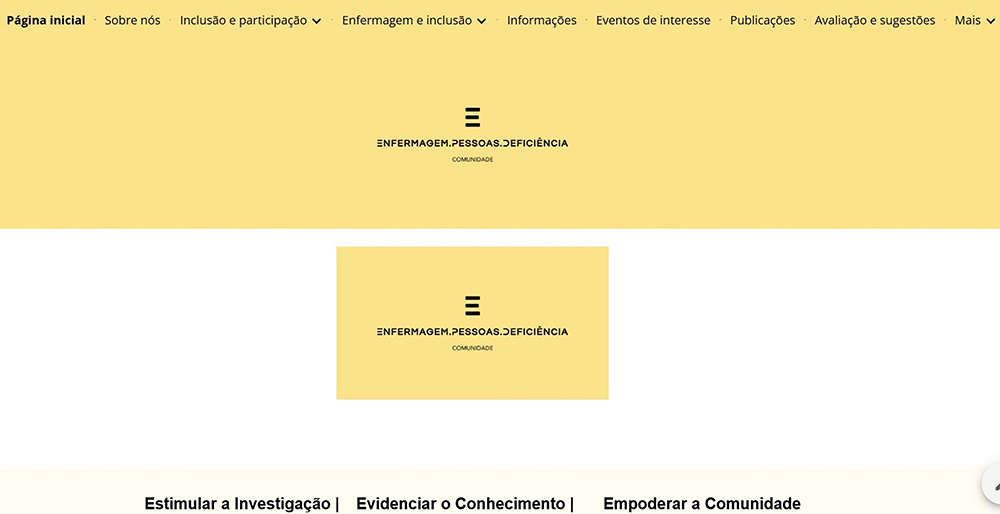
The homepage is easy to navigate and is divided into three sections. The top section contains the logo, and 10 menu options provide access to the remaining pages. The central section presents the project's objectives, an explanation of the logo and colors used, and a presentation of the research team members. The footer displays the research team's contact details and the partners associated with the project, as shown in Figure 1.

Home page of the website “Nursing. People. Disability - Community”. Vila Nova de Gaia, Portugal, 2023.
The website includes the following sections: About Us, Inclusion and Participation, Nursing and Inclusion, Information, Events of Interest, Publications, Evaluation and Suggestions, Contact Us, and Partnerships. The Inclusion and Participation page is divided into: Accessibility and Universal Design. The Nursing and Inclusion page is divided into Care, Education, Training, Care Guidelines, Non-Discrimination, and Policies. The Evaluation and Suggestions page is temporary and will be removed in the future, as it was created to host the evaluation questionnaire.
The website explores concepts such as inclusion and social participation, accessibility, and universal design. It presents proposed activities for community education and awareness, training, and public policies to support people with disabilities. It also provides useful links, events, and scientific publications. The first publication took place at the International Congress of Rehabilitation Nursing in December 2023.
Website evaluation process
The website was evaluated by 11 rehabilitation nurses with a mean age of 47.9 years (standard deviation = 11.48). Of the total, 72.7% were women and 27.3% were men. Regarding academic qualifications, 18.2% had a bachelor's degree, 36.4% a master's degree, and 45.5% a doctorate. The mean length of professional experience was 26.27 years (standard deviation = 13.73). Regarding the professional category, 27.3% were nurses, 18.2% nurse managers, 27.3% specialist nurses, and 27.3% teachers. Most (63.3%) worked in other units (63.6%), 27.3% in hospital units, and 9.1% in Integrated Continuing Care teams.
Website usability, assessed with the System Usability Scale (scores from 0 to 100), obtained a mean of 88.64 (standard deviation = 8.49), indicating excellent usability25. Most nurses considered the website easy to use (72.7%), with well-integrated functionalities (72.7%), and useful in practice (81.8%). On the other hand, 72.7% completely disagreed that it was complicated to use, and 90.9% that it required a lot of learning, as shown in Table 1.
The nurses' experience using the website was largely positive. All found the information they were looking for, found the content useful, and highlighted the clarity of the layout. They also recognized its usefulness both for their own care practices and for people with disabilities. The majority (90.9%) encountered no technical issues, although 50.4% suggested design improvements. Regarding accessibility, 81.8% considered the website accessible and identified functionalities that favor its use by people with disabilities, as shown in Table 2.
Evaluation of website perception revealed that most found that the overall impression of the website exceeded expectations (81.8%). Furthermore, ease of navigation (54.5%), logo design (63.6%), and color scheme (54.5%) exceeded users' expectations, as shown in Table 3.
Thematic analysis of open-ended responses (n=11 participants) identified four main themes of suggestions for website improvement: content expansion, navigation optimization, design enhancements, and recognition of positive aspects. The theme "Content Expansion" revealed the rehabilitation nurses' perceived need to enrich the website with additional topics, including housing accessibility, practical information on where to purchase technical aids, and expanded content on functional rehabilitation and rehabilitation in different contexts.
The Navigation Optimization theme focused on suggestions to improve the user experience, namely through the creation of thematic quick access and an alert system on the home page, aiming to facilitate the efficient location of specific content. The "Design Improvement" theme focused on improving the visual presentation, specifically of scientific publications, seeking greater graphic innovation and a more attractive and contemporary visual experience. The "Recognition of Positive Aspects" theme highlighted access to current legislation, scientific articles, and robust scientific evidence in the field of rehabilitation nursing for people with disabilities.
DISCUSSION
The study aimed to describe the development of a website for rehabilitation nurses on accessibility and nursing care for people with acquired physical disabilities, and to evaluate its usability, user experience, and perception. The results highlight the importance of digital resources for nursing practice and improving care delivery.
The use of the DADI methodology in the development of the website "Nursing. People. Disability - Community" proved to be effective in structuring the creation process in sequential and interdependent phases, reinforcing the applicability of this model in digital projects in the health area, corroborating studies that highlight the importance of a clear and adaptable structure in the development of websites21,22.
The website usability assessment, carried out using the System Usability Scale, obtained a score considered excellent, indicating that the interface is functional, clear and well adapted to its objectives and reinforcing usability as a determining factor for the acceptance and use of digital technologies by health professionals25. These data are in line with similar studies, which identify ease of use and perceived usefulness as crucial factors for the adoption of digital technologies by health professionals19,27. High usability is closely linked to satisfaction and intention of continued use, being an indispensable criterion in the evaluation of digital tools28.
In addition to usability, nurses reported ease in locating information and clarity in the presented content, which confirms the principles of user-centered design, already applied in digital health contexts and which prioritizes interfaces adapted to users' need 18. The positive experience reported strengthens the perceived usefulness of the website, one of the main determinants of technology acceptance12.
Another relevant point was the nurses' recognition of the website's practical usefulness for both care practice and people with disabilities, reinforcing its purpose of providing relevant information. Previous studies highlight the importance of digital tools in supporting clinical nursing practice by facilitating access to information and contributing to evidence-based decision-making14,21,22. Similar initiatives demonstrate that websites focused on sharing evidence, care protocols, and educational resources favor decision-making and promote greater autonomy among professionals in managing care for people with acquired physical disabilities3,12.
The suggestions collected in the open-ended question highlighted areas for improvement, with proposals for valuable corrective measures for the continuous enhancement of the website. Recommendations for expanding content stand out, such as the inclusion of topics on housing accessibility, given the impact of architectural barriers on the performance of daily activities of people with disabilities, their quality of life, and social inclusion; as well as information on locations to purchase assistive products, essential for independence and social participation4,6.
This study has some limitations that should be considered. The limited sample size and lack of longitudinal analysis, while adequate for a preliminary usability assessment, limit the generalizability of the results. Furthermore, participants were selected based on convenience, which may introduce selection bias. However, the data obtained provide a starting point for improving the website, and the implementation of identified corrective measures is recommended. Another significant limitation was the absence of individuals with acquired physical disabilities in the evaluation process. Their inclusion in future stages will allow for more robust validation of the relevance and usefulness of the information presented, ensuring that the website effectively responds to the specific care needs of this population. These limitations highlight the need for future studies with larger samples, a greater diversity of professionals, and monitoring of the website's ongoing use in real-life practice settings.
FINAL CONSIDERATIONS
The development of the website "Nursing. People. Disability - Community" sought to respond to the research question and proposed objectives, focusing on the creation of a digital resource aimed at rehabilitation nurses, with a focus on accessibility and nursing care provided to people with acquired physical disabilities.
The "Nursing. People. Disability - Community" website was developed based on the DADI methodology, allowing for the integration of relevant and accessible content. The website evaluation demonstrated excellent overall usability, with a positive user experience and perception. These results suggest that the website has the potential to support clinical practice, promoting knowledge updating and contributing to improving the quality of care provided. Finally, the commitment to continuous improvement will be maintained, with the implementation of corrective measures in the next phases of the project, ensuring the evolution of the website as a dynamic resource that is responsive to the needs of rehabilitation nurses.
REFERENCES
-
World Health Organization (WHO). The WHO European Framework for action to achieve the highest attainable standard of health for persons with disabilities 2022-2030 [Internet]. Copenhagen: WHO Regional Office for Europe; 2022[cited 2025 Mar 5]. Report No.: WHO/EURO:2022-6751-46517-67449. Available from: https://www.who.int/europe/publications/i/item/WHO-EURO-2022-6751-46517-67449
» https://www.who.int/europe/publications/i/item/WHO-EURO-2022-6751-46517-67449 -
Instituto Nacional de Estatística (PT). O que nos dizem os censos sobre as dificuldades sentidas pelas pessoas com incapacidades[Internet]. 2022[cited 2025 Mar 5]. Available from: https://www.ine.pt/xportal/xmain?xpid=INE&xpgid=ine_destaques&DESTAQUESdest_boui=588087444&DESTAQUESmodo=2&xlang=pt
» https://www.ine.pt/xportal/xmain?xpid=INE&xpgid=ine_destaques&DESTAQUESdest_boui=588087444&DESTAQUESmodo=2&xlang=pt -
Benedito MHA, Maia ER, Lacerda JFE, Feitosa JG, Pagliuca LMF. Prototype of a mobile application for cultural self-assessment in nursing care for people with disabilities. Rev Rene. 2024;25:e92837. https://doi.org/10.15253/2175-6783.20242592837
» https://doi.org/10.15253/2175-6783.20242592837 -
Pereira RSS, Cruz VV, Lourenço MCG, Machado WCA, Schoeller SD, Martins MM. People with acquired physical disabilities: from activities of living to rehabilitation nursing care. Texto Contexto Enfermagem. 2024;33. https://doi.org/10.1590/1980-265X-TCE-2023-0362en
» https://doi.org/10.1590/1980-265X-TCE-2023-0362en -
Lindsay S, Fuentes K, Tomas V, Hsu S. Ableism and workplace discrimination among youth and young adults with disabilities: a systematic review. J Occup Rehabil. 2023;33(1):20-36. https://doi.org/10.1007/s10926-022-10049-4
» https://doi.org/10.1007/s10926-022-10049-4 -
Lindsay S, Fuentes K, Ragunathan S, Li Y, Ross T. Accessible independent housing for people with disabilities: a scoping review of promising practices, policies and interventions. PLoS One. 2024;19(1):e0291228. https://doi.org/10.1371/journal.pone.0291228
» https://doi.org/10.1371/journal.pone.0291228 -
Reber L, Kreschmer JM, James TG, Coelho JD Junior, Deshong GL, Parker S, et al. Ableism and contours of the attitudinal environment as identified by adults with long-term physical disabilities: a qualitative study. Int J Environ Res Public Health. 2022;19(12):7469. https://doi.org/10.3390/ijerph19127469
» https://doi.org/10.3390/ijerph19127469 -
Ordem dos Enfermeiros (PT). Regulamento n.º 392/2019 das competências específicas do enfermeiro especialista em Enfermagem de Reabilitação [Internet]. 2019[cited 2025 Mar 05]. Available from: https://dre.pt/web/guest/pesquisa/-/search/122216893/details/normal?l=1
» https://dre.pt/web/guest/pesquisa/-/search/122216893/details/normal?l=1 -
Assembleia da República (PT). Convenção sobre os Direitos das Pessoas com Deficiência. Resolução da Assembleia da República n.º 56/2009 [Internet]. 2009[cited 2025 Mar 05]. Available from: https://dre.pt/pesquisa/-/search/493187/details/maximized
» https://dre.pt/pesquisa/-/search/493187/details/maximized -
Ordem dos Enfermeiros (PT). Regulamento n.º 350/2015. Regulamento dos Padrões de Qualidade dos Cuidados Especializados em Enfermagem de Reabilitação[Internet]. 2015[cited 2025 Mar 05]. Available from: https://diariodarepublica.pt/dr/detalhe/regulamento/350-2015-67552234
» https://diariodarepublica.pt/dr/detalhe/regulamento/350-2015-67552234 -
Padilha JM, Machado PP, Ribeiro AL, Ribeiro R, Vieira F, Costa P. Easiness, usefulness and intention to use a MOOC in nursing. Nurse Educ Today. 2021;97:104705. https://doi.org/10.1016/j.nedt.2020.104705
» https://doi.org/10.1016/j.nedt.2020.104705 -
Cintra MM, Faleiros F, Corbo LN, Okano LM, Vedana KGG, Dessotte CAM, et al. Development, validation and international certification of a health portal for people with disabilities. Rev Bras Enferm. 2022;75Suppl 2(Suppl 2):e20210082. https://doi.org/10.1590/0034-7167-2021-0082
» https://doi.org/10.1590/0034-7167-2021-0082 -
Hughes RB, Beers L, Robinson-Whelen S. Health information seeking by women with physical disabilities: a qualitative analysis. Disabil Health J Disability Health J. 2022;15(2):101268. https://doi.org/10.1016/j.dhjo.2022.101268
» https://doi.org/10.1016/j.dhjo.2022.101268 -
Galindo Neto NM, Áfio ACE, Leite SS, Silva MG, Pagliuca LMF, Áfio JA. Technologies for health education for the deaf: integrative review. Texto Contexto Enferm. 2019;28:e20180221. https://doi.org/10.1590/1980-265X-TCE-2018-0221
» https://doi.org/10.1590/1980-265X-TCE-2018-0221 -
World Health Organization (WHO). Digital Health [Internet]. 2021[cited 2025 Mar 05]. Available from: https://www.who.int/europe/health-topics/digital-health#tab=tab_1
» https://www.who.int/europe/health-topics/digital-health#tab=tab_1 -
Janes G, Chesterton L, Heaslip V, Reid J, Lüdemann B, Gentil J, et al. Current nursing and midwifery contribution to leading digital health policy and practice: an integrative review. J Adv Nurs. 2025;81(1):116-39. https://doi.org/10.1111/jan.16265
» https://doi.org/10.1111/jan.16265 -
Rouleau G, Gagnon MP, Côté J, Payne-Gagnon J, Hudson E, Dubois CA. Impact of information and communication technologies on nursing care: results of an overview of systematic reviews. J Med Internet Res. 2017;19(4):e122. https://doi.org/10.2196/jmir.6686
» https://doi.org/10.2196/jmir.6686 -
Nielsen J. Usability 101: introduction to usability [Internet]. 2012[cited 2025 Mar 05]. Available from: https://www.nngroup.com/articles/usability-101-introduction-to-usability/
» https://www.nngroup.com/articles/usability-101-introduction-to-usability/ -
Tran G, Kelly B, Hammersley M, Norman J, Okely A. The utility of website-based quality improvement tools for health professionals: a systematic review. Int J Qual Health Care. 2024;36(3). https://doi.org/10.1093/intqhc/mzae068
» https://doi.org/10.1093/intqhc/mzae068 - Polit DF, Beck CT. Essentials of nursing research: appraising evidence for nursing practice. Wolters Kluwer Health/Lippincott Williams & Wilkins; 2010.
-
Motta LD, Freitas AA, Janovik RX Junior, Blatt CR, Caregnato RCA. COVID-19 evidence for all: development of a learning object in health teaching. Rev Gaucha Enferm. 2021;42(spe):e20200281. https://doi.org/10.1590/1983-1447.2021.20200281
» https://doi.org/10.1590/1983-1447.2021.20200281 -
Tomazelli PDZ, Zocche DAA, Martins T, Artuso AR, Zanatta EA. Website diabetes news em pauta content validity and appearance. Texto Contexto Enferm . 2024;33:e20230222. https://doi.org/10.1590/1980-265X-TCE-2023-0222en
» https://doi.org/10.1590/1980-265X-TCE-2023-0222en -
Pereira RSS, Martins MM, Machado WCA, Pereira AI, Pereira AM, Chesani FH. Nursing care for social inclusion of people with acquired physical disabilities: an integrative review. Rev Port Enf. 2020;3(2):86-95. https://doi.org/10.33194/rper.2020.v3.n2.13.5827
» https://doi.org/10.33194/rper.2020.v3.n2.13.5827 -
Nielsen J. Why you only need to test with 5 users [Internet]. 2000[cited 2025 Mar 05]. Available from: https://www.nngroup.com/articles/why-you-only-need-to-test-with-5-users/
» https://www.nngroup.com/articles/why-you-only-need-to-test-with-5-users/ -
Martins AI, Rosa AF, Queirós A, Silva A, Rocha NP. European Portuguese Validation of the System Usability Scale (SUS). Procedia Comput Sci. 2015;67:293-300. https://doi.org/10.1016/j.procs.2015.09.273
» https://doi.org/10.1016/j.procs.2015.09.273 -
Ahmed SK, Mohammed RA, Nashwan AJ, Ibrahim RH, Abdalla AQ, M. Ameen BM, et al. Using thematic analysis in qualitative research. J Med Surg Public Health. 2025;6:100198. https://doi.org/10.1016/j.glmedi.2025.100198
» https://doi.org/10.1016/j.glmedi.2025.100198 -
Venkatesh V, Thong J, Xu X. Unified Theory of Acceptance and Use of Technology: a synthesis and the road ahead. J Assoc Inf Syst. 2016;17(5):328-76. https://doi.org/10.17705/1jais.00428
» https://doi.org/10.17705/1jais.00428 -
Saad M, Zia A, Raza M, Kundi M, Haleem M. A comprehensive analysis of healthcare websites usability features, testing techniques and issues. IEEE Access. 2022;10:97701-18. https://doi.org/10.1109/access.2022.3193378
» https://doi.org/10.1109/access.2022.3193378
Access to the dataset may be granted upon request to the corresponding author.

 Source: Authors, 2024. Available at: