
 Cross-cultural adaptation and metric analysis of the Adult Difficult Intravenous Access Scale for use in Brazil
ABSTRACT
Objective: to cross-culturally adapt and analyze the metric properties of the Adult Difficult Intravenous Access Scale into Brazilian Portuguese.
Method: methodological study carried out in two stages: 1) Translation of the scale from the original version in English to Brazilian Portuguese, including an assessment by a committee of nine judges, back-translation and semantic analysis; 2) Analysis of metric properties with 130 adults admitted to a hemodynamics unit in which difficult peripheral venipunctures occurred. Participants were followed up to check for the occurrence of difficult peripheral venipunctures. The instrument’s inter-rater reliability and predictive validity were analyzed. Data collection was carried out from February 2021 to April 2023 in Minas Gerais, Brazil.
Results: in the assessment carried out by the committee of judges, the items presented a Content Validity Index above 0.80, after the second round of assessment. Regarding semantic analysis, professionals considered the scale relevant, easy to apply and understand. The Kappa coefficient for individual items ranged between 0.68 and 1.0. For each item scored, adult patients are three times more likely to have difficult peripheral venipuncture.
Conclusion: the final version of the scale was considered clear, reliable, and easy to understand. The instrument enables a predictive score of difficult peripheral venipuncture in adults.
Descriptors:
Validation study; Peripheral Catheterization; Adult; Surveys and Questionnaires; Nursing
RESUMO
Objetivo: realizar a adaptação transcultural e a análise das propriedades métricas da Adult Difficult Intravenous Access Scale para o português do Brasil.
Método: estudo metodológico, realizado de fevereiro de 2021 a abril de 2023, em Minas Gerais, Brasil, em duas etapas: 1) Tradução da escala da versão original em inglês para o português brasileiro, avaliação por comitê composto por nove juízes, retrotradução e análise semântica; 2) Análise das propriedades métricas com 130 adultos admitidos em uma unidade de hemodinâmica em que se verificou a ocorrência de punção venosa periférica difícil. Foram analisadas a confiabilidade interobservadores e a validade preditiva do instrumento obtido.
Resultados: na avaliação realizada pelo comitê de juízes, os itens apresentaram Índice de Validade de Conteúdo acima de 0,80 após a segunda rodada de avaliação. Quanto à análise semântica, os profissionais consideraram a escala relevante, de fácil aplicação e compreensão. O coeficiente Kappa para os itens individuais variou entre 0,68 e 1,0. A cada item pontuado, o paciente adulto possui três vezes mais chances de ocorrência de punção venosa periférica difícil.
Conclusão: a versão final da escala foi considerada clara, confiável e de fácil compreensão. O instrumento viabiliza um escore preditivo de punção venosa periférica difícil em adultos.
Descritores:
Estudos de Validação; Cateterismo Periférico; Adulto; Inquéritos e Questionários; Enfermagem
RESUMEN
Objetivo: realizar la adaptación transcultural y el análisis de las propiedades métricas de la Adult Difficult Intravenous Access Scale al portugués brasileño.
Método: estudio metodológico, realizado en dos etapas: 1) Traducción de la escala de la versión original en inglés al portugués brasileño, evaluación por un comité compuesto por nueve jueces, retrotraducción y un análisis semántico; 2) Análisis de propiedades métricas con 130 adultos ingresados en una unidad de hemodinámica en los que se produjo punción venosa periférica difícil. Se realizó un seguimiento de los participantes para comprobar la aparición de venopunción periférica difícil. Se analizó la confiabilidad interobservador y la validez predictiva del instrumento. La recolección de datos se realizó de febrero de 2021 a abril de 2023 en Minas Gerais, Brasil.
Resultados: en la evaluación realizada por el comité de jueces, los ítems presentaron un Índice de Validez de Contenido mayor que 0,80, después de la segunda ronda de evaluación. En el análisis semántico, los profesionales consideraron que la escala es relevante, fácil de aplicar y comprender. El coeficiente Kappa para ítems individuales osciló entre 0,68 y 1,0. Cada ítem puntuado indica una probabilidad tres veces mayor de venopunción periférica difícil.
Conclusión: la versión final de la escala se consideró clara, confiable y fácil de entender. El instrumento permite una puntuación predictiva de venopunción periférica difícil en adultos.
Descriptores:
Estudio de Validación; Cateterismo Periférico; Adulto; Encuestas y Cuestionarios; Enfermería
INTRODUCTION
One of the activities in nursing professional practice is the peripheral venipuncture (PVP). Peripheral intravenous catheters (PIVC) are used in up to 90% of hospitalizations1-3. Due to several punctures and other factors that cause local complications, the use of PIVC has become a central element for the revision and redefinition of protocols regarding selection, insertion, and maintenance criteria 3-4.
Several PVP attempts may lead to stressful experiences for both professional and patient, who feels pain and discomfort5-6. With this in mind, researchers developed the Difficult Intravenous Access Score (DIVA Score) to identify how challenging venipuncture would be and improve successful first attempts5.
The first version of this scale was developed for the pediatric population5 and, in 2016, it was adapted and validated for surgical adult patients7. The scale has three factors: palpation, history of difficult PVP, recommendation for surgery, and vein diameter. The score varies from zero to five points, in order to measure the risk of failure in the venipuncture7.
Preserving the venous network by limiting the number of venipuncture attempts, and identifying a patient with difficult intravenous access are principles of infusion therapy8. In Brazil, not all services have medical-hospital services, such as ultrasound and transillumination, that can attend to the clinical needs of patients who are challenging for venipuncture9, as recommended by infusion therapy guidelines10-11. Since this is a predictive instrument that is easy to apply at the bedside, and considering that there are no studies involving the use of this scale in Brazil7,12, we found it necessary to validate and adapt the original version of the Adult Difficult Intravenous Access Scale (A-DIVA) for the Brazilian context.
This study aimed to carry out a cross-cultural adaptation of the A-DIVA scale into Brazilian Portuguese and to analyze its measuring properties.
METHOD
Type and place of study
Methodological study carried out in two stages: 1) Transcultural adaptation; 2) Analysis of A-DIVA metric properties. The stages are presented in Figure 1.
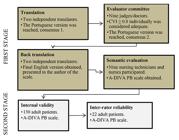
The entire process was carried out from February 2021 to April 2023. The first stage took place in a public university, and the second, in the hemodynamic unit of a public teaching hospital, both inland Minas Gerais.
According to the care protocol of the hospital being studied, the patient is sent to the hemodynamic unit from the admission and discharge service of the urgency and emergency units, or from other hospitalization or diagnostic units. The sectors attends cardiovascular specialties, endovascular procedures, interventionist radiology, also providing elective care and urgency/emergency services. This sector was chosen for data collection because its population is similar to the one used for the study that produced the original scale7. The institution has no infusion therapy team nor ultrasound equipment to help conducting PVP.
First stage - cross-cultural adaptation
The first stage was carried out from February 2021 to August 2022, including the following stages: translation, agreement about the versions, evaluator committee, back translation and agreement about the versions, comparison with the original version, and semantic evaluation.
The original version was sent to two independent Brazilian translators, both fluent in English. Both translated versions were compared by the researcher and the translators, so a consensual version could be achieved.
The participants of the evaluation committee were selected using information from the Lattes Platform and from the Directory of Research Groups of the National Council of Research and Technology Development (CNPq), and were all described as experts11.
To be selected, evaluators, in addition to having finished a doctorate, had to reach at least five points in the following criteria: having an MS in nursing (4 points); having produced a thesis about the topic of interest of this study as part of their MS (1 point); having produced a dissertation about the topic of interest of this study as part of their doctorate (2 points); clinical practice of at least one year in the area of interest (1 point); and having a certificate of clinical practice (specialization) in the area of interest of the study, having published works relevant for the field of interest, or having published articles on the topic in a specialized journal (2 points each)13. The fields of interest for this study were infusion therapy and validating measurement instruments.
Ten nurses were invited by email, but one was not available to participate. Evaluators were oriented to read the materials, and then, evaluate the equivalence between the original version, and the version produced after a consensus between translations was found.
The evaluation of the judges was carried out using two forms elaborated for this study using Google Forms®: a) demographic characterization, including sex (female or male), field (nursing, medicine, linguistics, biomedicine, psychology), academic formation in the doctorate, field of work (teaching, research, service), English level (beginner, intermediary, advanced), previous participation in the evaluation of instruments (yes or no); and b) instrument evaluation. For each item in the adapted version of the A-DIVA, four responses were possible14 (1 - non-representative item; 2 - item needs a large revision to become representative; 3 - the item requires a minor revision to become representative; 4 - representative item. Each item also had a space for suggestions and comments.
The suggestions of judges were grouped, analyzed, and changes whenever pertinent. The Content Validity Index (CVI) was calculated as follows: number of judges who evaluated the item as “needs minor revision to become representative” or “representative item”, divided by the total number of judges. The result was multiplied by 100. An individual CVI ≥ 0.80 was considered adequate14. After an analysis from the evaluators, the preliminary scale was sent to two translators who did not know the goals of the study and of the original version of the document, so a back translation could be done. The English version generated by the back translation was sent via email to the A-DIVA corresponding author7.
Nursing professionals who worked in the unit that participated in the study were invited. We sent invitations in an email that included the adapted version of the A-DIVA for Brazilian Portuguese, produced after an evaluation by the committee. Two forms were developed for the study using Google Forms®: a) demographic characterization, including sex (female or male), date of birth, professional category (nurse or nursing technician), field of work and time of professional experience; and b) an instrument for item evaluation, general scale evaluation (excellent, regular, and bad), ease of understanding of the items (very easy, easy, difficult, and very difficult), contributions to clinical practice (yes or no), and a field for questions and suggestions. Additionally, for each item, there were questions about its relevance (yes, sometimes, or no), difficulties in understanding (yes or no), whether responses are clear and consistent (yes or no), how the professional would say/express what the item means, with two last discursive questions.
Nine nursing technicians and nurses participated. The distribution of participants into professional categories was not intentional, but was determinant based on the availability of professionals in the field at the time of data collection. On the day chosen for the invitation, the prediction in the sector was of ten professionals, comprising two nurses and eight nursing technicians. However, one professional refused to participate. After a semantic analysis, the instrument was named Scale of Difficult Intravenous Access for Adults, Brazilian Portuguese version (A-DIVA PB).
Second stage - measuring properties
The second stage, validation and analysis of the measuring properties of the A-DIVA -PB version, comprised the following stages: internal validity and inter-rater reliability analyses14-16.
Data collection was carried out by the researcher, two aides graduated in nursing and trained for data collection, and members of a study group of vascular access and infusion therapy, from September 2022 to March 2023.
For the predictive criterion validity, in the sample size calculation, we considered a prevalence of 59.3%17 of difficult peripheral venipunctures (DPVP), 5% of precision and 95% of confidence interval for a finite population of 200 patients, finding a minimum sample of 130 participants.
130 adults aged 18 or older participated in the study. They were admitted into the hemodynamic unit during the data collection period, requiring a PIVC for their treatment or diagnosis. Adults who were being readmitted into the sector and had participated in the study before, even if they needed a new PVP, were excluded.
The calculation of the sample size to analyze the inter-rater reliability considered an expected intraclass correlation coefficient (ICC) of 0.9 between the A-DIVA PB scores, accepting results as long as they were not below ICC = 0.07 for a power of 80% and considering the significance level of α = 0.05, with 22 adult patients being observed.
Nurses, nursing technicians, and anesthesiologists routinely perform PVP in the admission room for hemodynamic procedures performed at the institution. Nonetheless, during data collection all PVPs were carried out by the nursing team, meaning we were unable to observe any PVPs executed by other professionals. The PIVC used had a gauge from 14G to 24G, being the ones standardized for hospital use.
To apply the A-DIVA PB, the following protocol was adopted, according with the study carried out to obtain the original version7: before the puncture, a tourniquet was placed at one end of the upper limb, at least ten centimeters proximal to the elbow fold, in order to dilate the target vein. The tourniquet was tightened, keeping radial artery pulsations. Veins on the dorsal and ventral surfaces of the upper limb were considered for evaluation for PVP.
Then, the possibility of identifying the vein was ascertained via palpation and visualization of the upper limb selected. The diameter of the vein was measured, in millimeters (mm), with a measuring tape placed on the vein when it became visible, after the tourniquet was applied. Veins whose diameter was below 2 mm were considered difficult to visualize or invisible. Regarding DPVP history, the patient was asked about trouble having PIVC inserted in the past. When it was not possible to acquire the information from the patient, reports from relatives/companions were considered, as well as medical records or reports from the health care team. Regarding surgery recommendations, medical recommendations were considered.
The A-DIVA version applied was formed by five items. The scores of the risk factors were evaluated to provide an approximate PIVC estimate, with all answers "yes" being added up7.
PVP was performed according to the protocol of the institution. Therefore, researchers did not interfere in the health care routine to carry out the procedure and choose the device. After inserting the PIVC, information related to the procedure was collected, in addition to demographic data and the clinical history of the patient.
Categorical variables (sex, self-declared skin color, item 1, item 2, item 3, item 4, and item 5) were analyzed using absolute and relative frequency distributions. Regarding quantitative variables (age, catheter gauge, number of PVP attempts, and scale score), we employed central tendency measures (mean) and variability measures (standard deviation).
Inter-rater reliability of A-DIVA PB was evaluated considering the internal consistency of the items, measured by the proportion in which they agreed. The Kappa (K) coefficient was also used for individual items. This property was evaluated by comparing the observations from two researchers who were members of the research team, graduated nurses and trained for data collection. They used the A-DIVA PB simultaneously and independently.
To measure the predictive validity of the A-DIVA PB, we applied a univariate logistic regression that was used for potentially predictive variables, considering scientific evidence and clinical experience. The main outcome of the study was the occurrence of DPVP; we considered that difficulties occurred whenever there was more than one attempt at inserting the PIVC(8,17). The results were considered significant at a significance level of 5% (p < 0.05).
Ethical aspects
This study respected all ethical from Resolution No. 466/2012, including secrecy and anonymity. The authors of the original version of the scale authorized its translation, adaptation, and application. The research project was submitted, evaluated, and approved by the Ethics Committee for Research with Human Beings (Certificate of Submission to Ethical Appreciation: 3784221.6.0000.8667). The goals of the research were made clear for all participants, as well as its risks and benefits. All of them signed the Informed Consent Form.
RESULTS
Cross-cultural adaptation
The evaluation committee was formed by nine female participants, graduated in nursing, who had doctorates. They worked in teaching and research (n= 06/66.7%) or teaching, research and care (n= 02/22.3%) in Minas Gerais (n= 4/44.5%), São Paulo (n= 3/33.3%), Pará (n= 1/11.1%), and Mato Grosso do Sul (n= 1/11.1%). All stated to have previous experiences with the validation of measurement instruments, eight had reasonable knowledge of the English language (89.9%), and one had advanced knowledge (11.1%).
The evaluation of the items in the scale was carried out in two rounds. In the first, items 1, 2, 3, and 5 of the consensus 1 Portuguese version had a CVI of 100%, while item 4 had a consensus of 78%. Doubts reported by evaluators regarding the final wording of item 2, "History of difficult peripheral venipuncture" were clarified, and the description of the item was changed to be related to a "previous moment" than that of the application of the scale.
Nevertheless, the doubts described did not interfere in the evaluation of the CVI, which showed that the item was representative. In the second round, evaluators suggested replacing the word "impossible" with "difficult" on items 1 and 3 of the scale. In turn, the translation of item 2 was kept closer to the writing of the original instrument. The CVI of the items was 100%.
Therefore, after this stage was concluded, the consensus 2 Portuguese version was back translated and sent to the authors of the original scale, who agreed with the results produced. According to the protocol of the original study, we determined that the score would not be stratified. The patient who scored at least one item in the scale is already predicted to be a patient with DPVP, requiring the professional to carefully analyze them.
The different A-DIVA versions are presented in Chart 1.
Nine nursing professionals with 1 to 14 years of experience participated in the semantic analysis. All participants evaluated the scale as being great. Six (66.7%) evaluated it as being very easy to apply. Regarding the global evaluation of the scale, participants classified it as "clear and objective", stating the scale "includes all factors involved in the classification of DPVP".
Metric properties
The application of A-DIVA PB was carried out in a sample formed by 130 adult patients, mostly male (n=67/51.5%) and self-declared brown (n=59/45.4%). Their age ranged from 19 to 87 years (mean= 63.9 years/SD ± 11.8 years).
Regarding their history, 105 (80.8%) mentioned having systemic arterial hypertension 53 (40.8%), diabetes, and 40 (30.8%), a history of DPVP.
Regarding PVP characteristics, in 127 (97.6%) a 20G or 22G PIVC was used in the veins of the center upper limb, such as in the forearm (n=73/53.2%) and in the back of the hand (n=24/18.5%). This choice was due to the fact that the radial right is preferred for the hemodynamic procedure. The number of PVP attempts varied from 1 to 6, and the prevalence of DPVP was 19.2%.
The answers, according to each A-DIVA PB, are described in Table 1.
Regarding inter-rater reliability analysis, Kappa coefficient values and significance level for each item in the instrument are presented in Table 2. Item 1, regarding the risk factor "Palpable vein", presented the lowest agreement between observers, reaching 86.4%. All items on the scale had statistically significant results (p ≤ 0.001).
The ICC was calculated considering the 0.86 (p ≤ 0.001) A-DIVA PB scores found by each observer, which was considered as adequate.
According with Table 3, the adults that scored on the items about palpation and visualization of the vein were from 15 to 16 times more likely to have DPVP, respectively (p<0.001).
DISCUSSION
To reach safe results in the process of building or adapting the instruments, the methodological pathway and the statistical analyses must be rigorous14. This was done in all stages of this investigation, especially in the evaluation carried out by a committee consisting of nine nurses, all of whom were doctors experienced in evaluating this type of instrument. The evaluation board showed a high agreement about the items. The same was true for the professionals who participated in the semantic evaluation. This allowed us to recognize that the A-DIVA PB is relevant for clinical practice, in addition to being easy to understand. Authors in systematic reviews have found that health conditions12 and demographic factors8 are considered to be risk factors for patients with difficult intravenous access.
Regarding the demographic profile of the participants of the analysis of metric properties, most were male (n= 67/51.5%), a result that differs from another which applied the A-DIVA7. A Brazilian study with a similar population found that 69;4%18of patients are males.
The prevalence of DPVP was 17%, and it was more common among women than men (n= 106/58% and 76/42%, respectively). In a study carried out in Portugal involving 100 participants, 92% were female; however, the results of DPVP were not compared taking into account the variable sex19.
The number of attempts at puncture varied from one to six, and 56.8% of PIVC used had a caliber of 20G. Similar results were found in a prospective study that found that, in 11.1% of peripheral venipunctures, two or more attempts were necessary, and that the most common PIVC caliber was 20G20.
A systematic review determined which were the risk factors associated with DPVP in adults, among which nine statistically significant variables stood out. They were: being female, non-visible veins, non-palpable veins, history of difficulties in PVP, acute or chronic alterations in upper limbs (one or both), previous PIVC during the current hospitalization, extreme body mass index, and variables related to the professional that is carrying out the technique21.
A study from Australia, aiming to identify and evaluate the quality of tools to screen for adults with trouble in venipuncture and managing them, selected 24 resources. 16 of them were evaluation instruments, and 9 were directives for clinical practices or scheduling strategies. Researchers pointed out that, among other instruments, the A-DIVA was selected as having promising psychometric properties, especially in its accuracy in identifying patients with difficulty with PVP7.
The A-DIVA PB was obtained after all standardized steps: the version comprising five items and the original version, keeping the predicted score. Each item (definition) describes a risk factor. In this study, the agreement among observers in the items varied from 86.4% to 100% for, meaning that all of them were significant.
In 2019, in the Netherlands, the scale was modified to include hospitalized adults who were under the risk of a DPVP, not only those with recommendation for surgery. In this version, the five evaluation items were kept, however, the diameter considered was 3mm22.
Palpation is the most common technique to identify vases for PVP in the institution under study. As technology advances, other options could be used in health care units, such as ultrasound22.
Regarding the risk factor "DPVP history", 46 (35.4%) adults scored in this item. The results suggested that this indicated a seven times higher chance of DPVP (p<0.001).
A prospective study carried out in the radiology service of a university hospital in Italy20showed that a history of DPVP was reported by 21.8% of patients. The risk factor "DPVP history" was considered as having a greater weight than other variables, such as visibility and palpability20.
Patients with a DPVP history require more time, and many attempts at a puncture, thus compromising the safety and the delay of the infusion therapy, drug infusion, solution infusion, or even that of blood components and blood products12.
The third item is related to the risk factor "Visible vein". When this is present, the odds of DPVP increase in 16 times (p<0.001). Visualization of the vein is considered crucial. The authors of a randomized clinical trial have observed that success at the first attempt of PVP happens in three situations: when the puncture is done by the naked eye (traditional technique), when aided by ultrasound, and when using infrared. The results showed success in 78.9% in the first group, 2.2% in the second, and 58.9% in the third23. In the original A-DIVA study, it was found that, when the risk factor "Visible vein" and "Palpable vein" were both present in the patient, the adult was 42.71 (p<0.001) times more likely to have a DPVP7.
It was shown that, regarding the total score, each item the adult scores in the scale increases three times the chances of DPVP p<0.001). DPVP was also defined as an outcome for the predictive validity by other studies12,22. However, in the adaptation of the A-DIVA as modified for European Portuguese, the authors chose to evaluate the total score found and correlated it with variables related to the patient and the procedure19.
Measuring instruments such as the A-DIVA PB can help Brazilian nursing workers to identify adults with DPVP by using a scale that is easy-to-apply at bedside, in order to preserve the patient's venous network throughout their stay. The scale can also guide conduct protocols, using technology in situations with higher scores and thus avoiding multiple punctures and other potential complications.
The authors of the original version of the scale7,22suggest applying A-DIVA in other populations and different departments or health care units. Although this study was carried out with nursing workers, the A-DIVA PB could be easily applied to other categories in addition to nursing teams (technical and higher education), including anesthesiologists and biomedics that carry out PVP.
The non-randomization of participants in the second stage of evaluation of the metric properties is considered to be a limitation of this study.
CONCLUSION
The cross-cultural adaptation and the analysis of the measuring properties of the A-DIVA produced a version denominated A-DIVA PB. A clear, reliable, and easy-to-understand scale. For each item that a patient scores in the A-DIVA PB, the chances of DPVP are three times higher.
The adoption of the scale and similar tools contributes to evidence-based practices and good decision making at the bedside. Although the A-DIVA PB can be used by other professionals, the nursing team, in particular, is the main responsible for its application, as it involves infusion therapy directly.
The A-DIVA PB application is recommended for other studies and clinical practice, including patients with different types of health care complexities in different specialties. Incorporating the A-DIVA PB can minimize the exposure of the patient to multiple PVP attempts, in addition to rethinking the choice of better devices and indicating the use of technology to help PVP assertiveness.
REFERENCES
-
1. Van Loon FH, Leggett T, Bouwman AR, Dierick-van Daele AT. Cost-utilization of peripheral intravenous cannulation in hospitalized adults: an observational study. Access J Vasc. 2020;21(5):687-93. https://doi.org/10.1177/1129729820901653
» https://doi.org/10.1177/1129729820901653 -
2. Chen S, O’Malley M, Chopra V. How common are indwelling devices in hospitalized adults? a contemporary point prevalence study in a tertiary care hospital. Am J Infect Control. 2020. https://doi.org/10.1016/j.ajic.2020.06.205
» https://doi.org/10.1016/j.ajic.2020.06.205 -
3. Yasuda H, Yamamoto R, Hayashi Y. et al. Occurrence and incidence rate of peripheral intravascular catheter-related phlebitis and complications in critically ill patients: a prospective cohort study (AMOR-VENUS study). J Intensive Care. 2021;9(3). https://doi.org/10.1186/s40560-020-00518-4
» https://doi.org/10.1186/s40560-020-00518-4 -
4. Pittiruti M, Pinelli F. GAVeCeLT Working Group for Vascular Access in COVID-19. Recommendations for the use of vascular access in the COVID-19 patients: an Italian perspective. Crit Care. 2020;24(1). https://doi.org/10.1186/s13054-020-02997-1
» https://doi.org/10.1186/s13054-020-02997-1 -
5. Yen K, Riegert A, Gorelick MH. Derivation of the DIVA Score: a clinical prediction rule for the identification of children with difficult intravenous access. Pediatr Emerg Care. 2008;24(3):143-7. https://doi.org/10.1097/PEC.0b013e3181666f32
» https://doi.org/10.1097/PEC.0b013e3181666f32 -
6. Kanaley RL, Gillette C, Schriefer J, Gottfried JA, Bramley J. Evaluation of the difficult intravenous access (DIVA) scoring in hospitalized pediatric patients. Br J Nurs. 2023;32(2):S18-S26. https://doi.org/10.12968/bjon.2023.32.2.S18
» https://doi.org/10.12968/bjon.2023.32.2.S18 -
7. Loon FHJV, Puijn LAPM, Houterman S, Bouwman ARA. Development of the A-DIVA Scale: a clinical predictive scale to identify difficult intravenous access in adult patients based on clinical observations. Medicine (Baltimore). 2016;95(16):e3428. https://doi.org/10.1097/MD.0000000000003428
» https://doi.org/10.1097/MD.0000000000003428 -
8. Bahl A, Johnson S, Alsbrooks K, Mares A, Gala S, Hoerauf K. Defining difficult intravenous access (DIVA): a systematic review. J Vasc Access. 2021;17:11297298211059648. https://doi.org/10.1177/11297298211059648
» https://doi.org/10.1177/11297298211059648 -
9. Assis LRS, Monteiro DAT, Bezerra MM, Contim D, Santos MA, Toffano SEM. Tomada de decisão para o uso de ultrassonografia para punção venosa periférica difícil em adultos: revisão integrativa. Rev Recien. 2022;12(37):315-22. https://doi.org/10.24276/rrecien2022.12.37.315-322
» https://doi.org/10.24276/rrecien2022.12.37.315-322 -
10. Nickel B, Gorski L, Kleidon T, Kyes A, DeVries M, Keogh S, et al. Infusion Therapy Standards of Practice, 9th Edition. J Infus Nurs. 2024;47(1S Suppl 1):S1-S285. https://doi.org/10.1097/NAN.0000000000000532
» https://doi.org/10.1097/NAN.0000000000000532 -
11. Australian Commission on Safety and Quality in Health Care. Management of peripheral intravenous catheters clinical care standard [Internet]. 2021 [cited 2024 May 16]. Available from: https://www.safetyandquality.gov.au/sites/default/files/2021-05/management_of_peripheral_intravenous_catheters_clinical_care_standard_-_accessible_pdf.pdf
» https://www.safetyandquality.gov.au/sites/default/files/2021-05/management_of_peripheral_intravenous_catheters_clinical_care_standard_-_accessible_pdf.pdf -
12. Paterson RS, Schults JA, Slaughter E, Cooke M, Ullman A, Kleidon TM, et al. Review article: peripheral intravenous catheter insertion in adult patients with difficult intravenous access: a systematic review of assessment instruments, clinical practice guidelines and escalation pathways. Emerg Med Australas. 2022;34(6):862-70. https://doi.org/10.1111/1742-6723.14069
» https://doi.org/10.1111/1742-6723.14069 -
13. Fehring R. Methods to validate nursing diagnoses. Heart Lung [Internet]. 1987 [cited 2023 Feb 04];16(6):625-9. Available from: https://www.researchgate.net/publication/40505773_Methods_to_Validate_Nursing_Diagnoses
» https://www.researchgate.net/publication/40505773_Methods_to_Validate_Nursing_Diagnoses -
14. Coluci MZO, Alexandre NMC, Milani D. Construção de instrumentos de medida na área da saúde. Cien Saude Colet. 2015;20(3):925-36. https://doi.org/10.1590/1413-81232015203.04332013
» https://doi.org/10.1590/1413-81232015203.04332013 -
15. Institute for Work & Health. Recommendations for the Cross-Cultural Adaptation of the DASH & QuickDASH Outcome Measures Contributors to this Document[Internet]. Toronto; 2007 [cited 2023 Feb 04]. Available from: https://www.researchgate.net/publication/265000941_Recommendations_for_the_Cross-Cultural_Adaptation_of_the_DASH_QuickDASH_Outcome_Measures_Contributors_to_this_Document/link/53fdd6140cf22f21c2f85143/download
» https://www.researchgate.net/publication/265000941_Recommendations_for_the_Cross-Cultural_Adaptation_of_the_DASH_QuickDASH_Outcome_Measures_Contributors_to_this_Document/link/53fdd6140cf22f21c2f85143/download -
16. Beaton DE, Bombardier C, Guillemin F, Ferraz MB. Guidelines for the process of cross-cultural adaptation of self-report measures. Spine. 2000;25(24):3186-91. https://doi.org/10.1097/00007632-200012150-00014
» https://doi.org/10.1097/00007632-200012150-00014 -
17. Armenteros-Yeguas V, Gárate-Echenique L, Tomás-López MA, Cristóbal-Domínguez E, Moreno-de Gusmão B, Miranda-Serrano E, et al. Prevalence of difficult venous access and associated risk factors in highly complex hospitalised patients. J Clin Nurs. 2017;26(23-24):4267-75. https://doi.org/10.1111/jocn.13750
» https://doi.org/10.1111/jocn.13750 -
18. Santana RF, Moraesi KN. Rastreamento de manifestações clínicas pós procedimentos no setor de hemodinâmica. REAS. 2023;23(1):e11662. https://doi.org/10.25248/reas.e11662.2023
» https://doi.org/10.25248/reas.e11662.2023 -
19. Santos-Costa P, Sousa LB, Van Loon FHJ, Salgueiro-Oliveira A, Parreira P, Vieira M, et al. Translation and Validation of the Modified A-DIVA Scale to European Portuguese: difficult intravenous access scale for adult patients. Int J Environ Res Public Health. 2020;17(20):7552. https://doi.org/10.3390/ijerph17207552
» https://doi.org/10.3390/ijerph17207552 -
20. Piredda M, Biagioli V, Barrella B, Carpisassi I, Ghinelli R, Giannarelli D, et al. Factors affecting difficult peripheral intravenous cannulation in adults: a prospective observational study. J Clin Nurs. 2017;26(7-8):1074-84. https://doi.org/10.12957/10.1111/jocn.13444
» https://doi.org/10.12957/10.1111/jocn.13444 -
21. Rodríguez-Calero MA, Blanco-Mavillard I, Morales-Asencio JM, Fernández-Fernández I, Castro-Sánchez E, Pedro-Gómez JE. Defining risk factors associated with difficult peripheral venous Cannulation: a systematic review and meta-analysis. Heart Lung. 2020;49(3):273-86. https://doi.org/10.1016/j.hrtlng.2020.01.009
» https://doi.org/10.1016/j.hrtlng.2020.01.009 -
22. Van Loon FHJ, Van Hooff LWE, Boer HD, Koopman SSHA, Buise MP, Korsten HHM, et al. The Modified A-DIVA Scale as a predictive tool for prospective identification of adult patients at risk of a difficult intravenous access: a multicenter validation study. J Clin Med. 2019;8(2):144. https://doi.org/10.3390/jcm8020144
» https://doi.org/10.3390/jcm8020144 -
23. Yalçınlı S, Karbek Akarca F, Can Ö, Uz İ, Konakçı G. Comparison of standard technique, ultrasonography, and near-infrared light in difficult peripheral vascular access: a randomized controlled trial. Prehosp Disaster Med. 2022;37(1):65-70. https://doi.org/10.1017/S1049023X21001217
» https://doi.org/10.1017/S1049023X21001217

 Source: Research data, 2023.