| Arable land input: land access |
Soy expansion resulting in unequal land distribution. |
Concentration of production processes favoring extensive export-oriented soy monoculture above smallholders. |
| Arable land input: Crop displacement |
Regionally varying food access problems and general uncertainties about the implications of the increasing relative weight of soy cultivation. |
Concentration of production processes favoring extensive export-oriented soy monoculture above local diversified food production. |
| Environmental inputs: Soil and agrochemical inputs |
In conjunction degrading soil quality which becomes a depletable production input. High reliance on agrochemical inputs which significantly cuts farmers profits and lead to trade balance deficits. |
Incorporation of the biological realm into the world economy through exploitation of soil nutrients and patenting of genetic material. Simple reproduction as a substantial share of the value-added agrochemical manufacturing remains abroad, while constituting a significant component in the final price of mainly uncrushed soy exports. |
| Environmental inputs: deforestation and biodiversity |
Extensive deforestation of the Cerrado region and loss of biodiversity, yet from 2006-2011 relatively success have been made in mitigating deforestation due to soy expansion in the Amazon. |
Incorporation of the biological realm into the world economy through exploitation of native vegetation and biosphere. |
| Labor inputs: employment |
Very low employment generation in the direct production phase. |
Conversion of labor through displacement of smallholders but only a low degree of reincorporation into production. |
| Labor inputs: labor conditions |
Indications of precarious labor conditions, though difficult to generalize. |
Conversion of labor into the cheapest possible factor input to production. |
| Governance structure of the commodity chain |
Strong foreign presence in the input structure, processing and international commercialization. |
Incorporation of the productive processes into an axial division of labor in which foreign MNC´s wield a high degree of market power. Direct production is nonetheless still dominated by domestic actors. |
| R&D inputs |
Some structural ramifications from domestic agricultural research and development efforts, though still high reliance on patented seeds. |
Simple reproduction is not the case due to the high degree of technological production inputs though incorporation of the genetic plant structure generates a certain degree of dependence on patented biotechnology. |
| Processing capacity |
Some significant value added gains from crushing, feed industries, and economic development in agro-industrial hubs, though most of soy production bypasses processing at this link. High degree of external corporate control. |
Simple reproduction due to lack of elaboration and structural ramifications, though is not the case for the smaller share of production being processed. Also some significant degree of spillover in food industries which diverge from this concept. Incorporation of processing into global corporate governance structures and Concentration of production processes on a single low value added capital-good for core food industries. |
 Modern Monoculture and Periphery Processes: a World Systems Analysis of the Brazilian soy expansion from 2000-2012
 Thumbnail
 Thumbnail
 Thumbnail
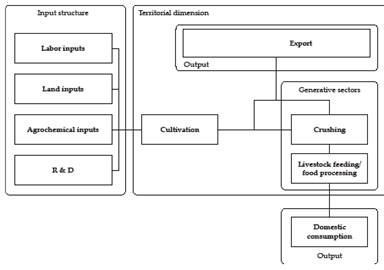 Sourse: Author’s elaboration.
 Sourse: Author’s elaboration.
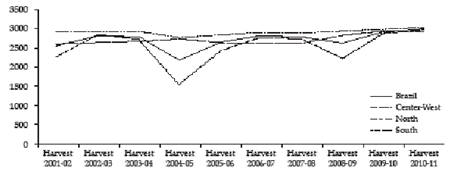 Sourse: