 Access as an object of analysis in rural advisory services
Abstract
Abstract Most Brazilian agricultural establishments lack access to rural advisory services. This absence perpetuates barriers to development, whereas access to research can identify ways to overcome them. This article analyzes access to rural advisory services as an object of study, systematizing its categories and identifying the state of the art of the topic in national and international scientific literature, as well as its situation in Brazil. The methodology was based on descriptive statistical analysis of data from the Agricultural Census and a systematic review. The results show that access to the service is associated with improvements in agricultural production and technology adoption, and with reduced food insecurity, while also revealing significant challenges faced by farmers worldwide, particularly in countries of the Global South and among small European farmers. It is evident that the topic lacks theoretical and methodological consolidation, hindering comparisons between territories. This paper proposes a synthesis of the categories of analysis – organization of origin, frequency of service, availability of the service in the territory, number of families per technician, satisfaction with the service, source of funding, among others – and highlights the relevance of a plurality of providers for the better appropriation of the service in different territories, expanding access.
Keywords:
plurality of providers; systematic review; territory
Resumo
Resumo A maioria dos estabelecimentos agropecuários brasileiros não acessa a assistência técnica e extensão rural. Essa ausência mantém barreiras ao desenvolvimento, enquanto pesquisas sobre o acesso podem indicar caminhos para superá-las. O artigo analisa o acesso à assistência técnica e extensão rural como objeto de estudo, sistematizando suas categorias e identificando o estado da arte do tema na literatura científica nacional e internacional, bem como sua situação no Brasil. A metodologia baseou-se na análise de estatística descritiva dos dados do Censo Agropecuário e em revisão sistemática. Os resultados mostram que o acesso ao serviço está associado a melhorias na produção agrícola, adoção de tecnologia e redução da insegurança alimentar, além de revelar desafios significativos enfrentados por agricultores em todo o mundo, especialmente em países do Sul Global e entre pequenos agricultores europeus. Evidencia-se que o tema carece de uma consolidação teórica e metodológica, dificultando comparações entre territórios. Propõe-se uma síntese das categorias de análise – organização de origem, frequência de atendimento, disponibilidade do serviço no território, número de famílias por técnico, satisfação com o serviço, fonte de financiamento, entre outras – e se destaca a relevância da pluralidade de prestadores para a melhor apropriação do serviço em diferentes territórios, ampliando o acesso.
Palavras-chave:
pluralidade de prestadores; revisão sistemática; território rural
1 Introduction
The sustainable development of rural areas remains a significant challenge, particularly in promoting food security and sustainable agriculture. Although agriculture has produced unprecedented results in terms of productivity, yield, and innovation – accounting for approximately USD 12.3 trillion, equivalent to 18% of global GDP – structural barriers persist that limit the development of these territories. Among these barriers, socioeconomic inequalities and negative environmental impacts resulting from intensive, technologically advanced agricultural activity stand out, exerting significant pressure on natural ecosystems and increasing the risks of water, soil, and air pollution (Plataforma Brasileira de Biodiversidade e Serviços Ecossistêmicos, 2024; Sesso Filho et al., 2024).
One of the main drivers of territorial development is rural advisory services, which play multiple roles, such as guiding production, integrating agricultural marketing, communicating rural issues, providing environmental education, offering political training, and guaranteeing rights. These roles can directly address these barriers and facilitate socio-technical innovation processes and the collective production of knowledge (Cruz et al., 2024; Davis & Franzel, 2018; Sulaiman et al., 2012). Rural advisory services, as a public policy and historical practice, emerged in various national contexts to support agricultural modernization and reduce regional inequalities. In Brazil, its formalization began in the 1950s, with rural extension programs focused on training farmers and disseminating technologies (Lourenzani et al., 2020; Freire, 2013).
Rural advisory services comprise specialized services provided by professionals with technical and scientific training, as well as interdisciplinary teams, aimed at promoting agricultural activities and strengthening rural organizations. Its function is to seek knowledge that deepens the awareness of decision-makers at different scales of action (Freire, 2013). The objectives range from improving agricultural production and enhancing organizational forms to building citizenship among rural populations, through services provided by various actors, including public institutions, private companies, civil society organizations, and independent farmers and professionals (Sulaiman et al., 2012). This pluralistic approach reflects the historical transformation of rural extension, which has shifted from centralized, disciplinary models to more adaptive, interdisciplinary systems that account for the specificities of each territory (Birner et al., 2009; Knierim et al., 2017).
This service operates in rural areas that bring together a diverse range of social and institutional actors, including farming families, their organizations, and other institutions. The challenges and opportunities posed by these material spaces of belonging create unique contexts in which knowledge, both technical and practical, serves as the link between service providers and actors within these territories. Given the unique contexts and diverse actors, the service must be tailored to each circumstance. In this sense, rural advisory services provide knowledge through advice, consultancy, and guidance to a diverse range of rural actors (Davis & Franzel, 2018).
The analysis of access is based on the assumption that models are more appropriate for specific circumstances. The single model, based on the theory of the diffusion of innovations, treated the State as the primary promoter of development (Diesel et al., 2012). In this context, the Green Revolution represented the most outstanding achievement of this model, which consisted of providing technical assistance and credit so that farmers could adopt improved seeds, plants, and animals, synthetic inputs, medicines, pesticides, agricultural machinery and equipment, as well as agricultural management techniques. However, the problem identified was the rigidity of the program — of Western origin applied to the Global South — and the high budget required. Analyses have identified significant losses and inefficiencies in many rural areas worldwide (Davis & Franzel, 2018).
Two proposals have emerged to counter the State's diffusion-of-innovations promotion: privatization of services and the plurality of service providers. On the one hand, the evaluation of privatization in the European Union led to service personalization and greater efficiency in large-scale production, but it favored only the most productive farmers, excluding most families (Labarthe & Laurent, 2013). The proposal for a plurality of providers, in turn, was first addressed to the African continent and aims to break with the notion of a single model, whether state-run or private, for better organizational appropriation of rural advisory services in each territory (Knierim et al., 2017).
In recent years, there has been a significant increase in publications dedicated to the topic of access to rural advisory services, highlighting its importance, especially for countries in the Global South, such as those in South America, Africa, and Asia (Barrantes-Bravo et al., 2017; Nyberg et al., 2025). However, no study to date has systematized the information produced or proposed a common path that offers methodological lessons for the area. Therefore, the objective of this study is to analyze access to rural advisory services and to systematize the main categories of analysis, drawing on national and international literature and data from the Brazilian Agricultural Census, thereby characterizing the state of the art and identifying research agendas to improve services in rural territories.
After presenting the theoretical foundation (section 2) and methodological procedures used in the selection of articles (section 3), studies from the international and Brazilian literature are discussed (section 4), drawing on data from the Agricultural Censuses, followed by an integrated analysis. In summary, categories for analyzing access to rural advisory services are proposed to inform a new research agenda (section 5).
2 Theoretical Foundation
Given this wide range of options, a method was developed to analyze which service is most appropriate for different circumstances. This perspective enables the analysis and planning of the service, taking into account contextual factors and the specific characteristics of each territory. These factors influence which services are most appropriate for a given situation or which can meet multiple demands and needs simultaneously (Birner et al., 2009).
The analysis assumes that approaches, funding, and service structures should be evaluated in light of contextual factors, families, and service performance, so that the plurality of providers is better aligned with the territories in which they operate. Some services are more personalized and self-funded, whereas others must be free and comprehensive (Birner et al., 2009).
Analyzing performance is relevant for identifying dimensions related to the management and execution of services, which are internal characteristics of the service offering. Linking the analysis of this performance (internal category) with the impact analysis (external category) helps identify the performance criteria most important for achieving the desired impacts (Birner et al., 2009).
Within this analysis of the performance of a plurality of rural advisory service providers, the study of access is situated. In the proposal by Birner et al. (2009), revisited by Faure et al. (2016), the analysis of performance emphasizes opportunity/timeliness rather than access. In the Brazilian context, marked by regional inequalities, access is a salient category for development, as most establishments lack access to services. The historical and regional context strongly influences who has access, reflecting patterns of socioeconomic and racial exclusion, as well as the geographic concentration of resources and services (Diniz & Clemente, 2021; Cruz et al., 2021).
According to data from the 2017 Brazilian Agricultural Census, approximately 4.0 million agricultural establishments do not receive technical assistance, representing 79.8% of the total. Therefore, this is a predominantly neglected scenario. The Census considers that the service is received when at least one member of the family responsible for the establishment receives specialized technical guidance from a qualified professional—such as an agricultural engineer, veterinarian, or home economist—with the purpose of transmitting knowledge and guiding production (Instituto Brasileiro de Geografia e Estatística, 2019).
Studies on rural advisory services do not explicitly define the concept of access. In general, establishments are considered to have access to the service when technicians in the agricultural sciences attend to them. There is no concept of access.
In the healthcare field, which has a long history of discussion of access, the topic is analyzed by distinguishing between accessibility studies and service utilization studies, in addition to formulating dimensions of analysis. They consider accessibility to be the degree to which the characteristics of service resources align with the population's demand process. This approach differs from studies on land use that focus on the reasons for use by the population, investigating the social, economic, and cultural factors of a territory (Giovanella & Fleury, 1996; Jesus & Assis, 2010). Based on this conceptualization, Giovanella & Fleury (1996) proposed the following dimensions for analyzing access:
-
Availability: the relationship between the quantity and type of service and the number of families and the type of needs;
-
Accessibility: the relationship between the location of the service and the location of families, considering resources, distances, and costs.
-
Accommodation: the relationship between the organization of service supply and how it accommodates the demand from families;
-
Financial capacity: the relationship between service prices and the ability of families to pay, directly or indirectly;
-
Acceptability: the relationship between families' attitudes toward the service, including the professionals and products, as well as the acceptance of service providers in performing that service.
Based on the history of the health field, some studies on access to rural advisory services can be classified as utilization studies. Therefore, it is essential to highlight that access is more than just the use of the service. Access is the condition under which a decision-maker is assisted by a service provider, whether from independent professionals, public institutions, civil society organizations, or private companies. This condition is related to the availability of the service and professionals in the territory, the frequency and cost of service, and its suitability to local demands and needs. Thus, more than just data on having received or currently receiving assistance, access should be understood as an object of quantitative and qualitative analysis for evaluating service performance in rural areas. From a theoretical perspective, access can be understood as a determinant of territorial and social equity, directly related to issues of spatial justice and the distribution of public and private resources (Abdallah & Abdul-Rahaman, 2016; Amrullah et al., 2023).
However, access does not consider the quality of service – that is, how the service will be provided – nor does it assess its relevance or suitability for the sustainable development of rural areas. A more comprehensive analysis requires mapping the political environment, the organizations involved, and characterizing the context, which is always unique, along with assessing the impact on families and the territory as a whole (Faure et al., 2016). This task, however, is broader than the scope proposed in this article.
3 Methodology
A systematic review of studies on access to rural advisory services was conducted using the Web of Science database, following the Systematic Search Flow method (Ferenhof & Fernandes, 2016). This method “was developed to systematize the process of searching the scientific database, to guarantee repeatability and avoid researcher bias” (Ferenhof & Fernandes, 2016, p. 556).
The method has the following phases: research protocol, analysis, synthesis, and writing.
-
The protocol phase defines the search strategy in the database, including the use of categories and logical operators, the use of a bibliographic organizer, the standardization of selection criteria, and the composition of the portfolio of analyzed articles.
-
The analysis phase aims to consolidate the data, defining the articles that make up the object of study and grouping the information.
-
In the synthesis phase, the data obtained in the analysis are extracted, organized, and interpreted, supporting the final phase of writing up the results.
The term for the service is used in various ways in the literature. In Brazil, state services typically use the term "rural advisory services" (assistência técnica e extensão rural, ATER), while other organizations use terms such as consulting or advisory services. The Global Forum on Rural Advisory Services (GFRAS) – a global governance body that brings together leading scientists – has agreed to name it the Rural Advisory Service (RAS). This terminological variation extends to other related expressions as well.
To encompass this plurality, the following search terms were used: Assistência Técnica e Extensão Rural, Extensão Rural, Rural Advisory Service, Extensión Rural, Comunicación Rural, Agricultural Extension, Agrarian Extension, and Assistência Técnica e Rural ou Agrícola, combined with the term access and their respective translations into English and Spanish.
The initial search identified 513 scientific articles that were organized by the Mendeley Reference Manager application. Next, titles, abstracts, and keywords were reviewed, selecting only those that included access to rural advisory services as an object of study. It was observed that most publications cited the topic only as a result or necessity, rather than as a central object of analysis, leaving 12 studies.
A complete reading of these 12 works identified, in their references, 11 additional articles that addressed access to technical assistance and 3 studies that analyzed the effects of service modifications on the inclusion and exclusion of certain populations. These 14 new articles were added to the sample, bringing the total to 26 studies. In addition, two reports and one book on the subject were identified in the citations and were included in the analysis of Brazilian studies (Table 1).
The final result comprised 29 studies. It is worth noting that no filters were applied to the publication period, enabling a comprehensive analysis of the different phases and approaches to the debate on access to rural advisory services (Figure 1).

- Systematic flow of searching for documents that studied access to rural advisory services. NOTE – # indicates the search stage; “” searches for the precise term; * does not restrict the suffix based on the selected letter.
In addition to analyzing each study, for the Brazilian case, data from the Agricultural Censuses of 1985, 1996, 2006, and 2017 were used to reinterpret the situation of access to rural advisory services in Brazil, since no national study has related access results in Brazil to international literature. The analysis of the census data was performed using descriptive statistics, with the independent variables being the receipt of technical guidance as declared by the managers of agricultural establishments and the organizational origin of this guidance. The dependent variables used were the type of agriculture, whether family-based or not, the social profile of the manager, such as gender, age group, race, education level, and information about the establishments, such as establishment size, economic activity group, and production value class (Instituto Brasileiro de Geografia e Estatística, 2019).
4 Results and Discussion
Research on access to rural advisory services has been conducted on virtually every continent, with particular emphasis on countries in the Global South. These studies are primarily based on descriptive statistical analyses of national censuses and on probabilistic and inferential tests applied to sample surveys. The main focus of these analyses is on factors such as receipt of technical guidance, information sources, the service's organizational origin, and the frequency of its provision.
4.1 International studies on access to rural advisory services
Studies conducted in Sub-Saharan Africa are the most numerous and have initiated the international debate on the subject. The prevailing context is one of strong dependence on agriculture for the population's employment, contrasting with its low contribution to the generation of national wealth, in addition to persistent challenges related to hunger, malnutrition, and migration (Kalinda et al., 1998; Ragasa et al., 2013; Wossen et al., 2017; Okello et al., 2023). Given these restrictions, research seeks to identify the economic and social factors that influence access and their impacts on technological adoption, productivity, and the well-being of rural populations.
Among the most established economic factors in African studies are the agricultural sector, farm size, access to credit, and pesticide use. Okello et al. (2023) found in Uganda that specialized establishments had more access than diversified ones, which confirms the greater presence of rural advisory services in specialized sectors associated with credit, such as cocoa in Cameroon, cassava in Nigeria, and maize in Ethiopia (Wossen et al., 2017; Kenfack Essougong et al., 2023; Gebresilasse, 2023). In general, studies indicate that larger establishments are more likely to have access to the service, except Wossen et al. (2017), who observed an inverse relationship in the case of cassava, due to the productive particularities of this crop in Nigeria, the world's largest producer. Since the use of pesticides is associated with specialized agriculture, there is also a positive relationship between this input and access to rural advisory services (Okello et al., 2023; Ragasa et al., 2013; Faye & Deininger, 2005; Kalinda et al., 1998). Although productive diversification does not show a positive relationship at the farm level, Faye & Deininger (2005) identified that the expansion of access to rural advisory services promoted greater regional diversification, with the adoption of coffee, fruits, vegetables, and beef and dairy cattle, associated with the use of hybrid seeds and chemical inputs.
The most established social factors influencing access to rural advisory services are gender and age. Women farmers face greater difficulties; predominantly female heads of household have limited access to technical guidance for the plots they cultivate. They are less likely to receive assistance than men. Ragasa et al. (2013) observed that, in Ethiopia, men exhibit higher productivity and greater adoption of technologies, particularly in intensive practices such as the use of improved seeds, pesticides, and soil conservation techniques. Mbo’o-Tchouawou & Colverson (2014) highlight that networks of local and pan-African women farmers have promoted greater female participation in decision-making and progress from a gender perspective. This aligns with Abdallah & Abdul-Rahaman (2016), who demonstrated that participation in groups and associations increases women's access to rural advisory services in Ghana.
This body of evidence led Nyberg et al. (2025) to advocate a rural advisory services approach that is sensitive to women farmers, taking into account normative, cultural, and structural aspects that perpetuate inequalities. This sensitivity implies a focused approach towards women and family relationships.
Regarding age, it was observed that younger heads of household with more agricultural experience tend to access the service more (Kalinda et al., 1998; Wossen et al., 2017; Okello et al., 2023), while advanced age shows a negative correlation with access (Kenfack Essougong et al., 2023).
The impacts of increased access to rural advisory services in African countries are largely positive: greater technological adoption, increased productivity, and improved social well-being. In Nigeria, Wossen et al. (2017) identified a 12% increase in the adoption of technologies for cassava production and a 10% reduction in relative poverty. Aremu & Reynolds (2024) observed that, despite access at only 16.1%, the service was associated with a 16% reduction in food and nutritional insecurity and a 64% increase in ownership of goods such as telephones, radios, televisions, and livestock.
Other studies corroborate these effects: Ogola et al. (2023) observed an average growth of 33.2% in milk productivity after access, and Gebresilasse (2023) identified a 6% increase in cereal productivity in priority districts of Ethiopia, with gradual and persistent positive effects over the years.
Based on these results, some authors advocate for structural changes in rural advisory services. Kalinda et al. (1998) and Kenfack Essougong et al. (2023) recommend participatory approaches for small producers and the expansion of the private sector's role to facilitate market access. Demand-driven models, in which farmers participate in defining innovation priorities, have proven effective. Okello et al. (2023) observed that, in Uganda, farmers with limited agricultural experience had greater access to NGO services, precisely because NGOs employ a participatory, family-based model.
Faye & Deininger (2005), analyzing a reformed system in Uganda with decreasing public subsidies, found increased access, greater technological adoption, productive diversification, and poverty reduction. They also found that 28% of farmers were willing to pay for the service, although only 14% received it. This willingness to pay was even higher in Kenya (49%), according to Nambiro et al. (2006), highlighting hiring restrictions.
The same authors found that free, state-run services remained the most valued, reinforcing the importance of inter-institutional coordination mechanisms between the public, private, and third sectors. Inkoom & Dadzie (2025) emphasize the need for assistance models with flexible pricing, content appropriate to climate change and local demands, and a focus on building trust in relationships.
In summary, African studies reveal a pattern of restricted access, concentrated in intensive, technologically advanced agriculture, associated with credit, input use, and male predominance. This selectivity perpetuates structural vulnerabilities. However, experiences with participatory approaches and subsidies for personalized services have demonstrated increased production and reduced vulnerabilities in rural areas.
Asian studies focus on the impacts of access on technology adoption, income, and socioeconomic barriers. The results indicate significant benefits of rural advisory services, including increased wheat productivity (Elahi et al., 2018), adoption of improved rice cultivars, and higher family income (Amrullah et al., 2023; Ricome et al., 2024). Furthermore, farmers have begun adopting practices to adapt to climate change, such as adjustments to the planting calendar, soil conservation, crop rotation, and agroforestry systems (Tanti & Jena, 2023), thereby aligning themselves with the sustainability goals promoted by rural advisory services. The results were explained by the quality of private consultancies associated with credit in Pakistan, and by the combined action of state assistance and farmers' networks in India and Indonesia. However, all studies identified significant socioeconomic barriers.
In Pakistan, the small size of farms, low levels of education, and high interest rates on loans linked to rural advisory services stand out (Elahi et al., 2018). In India, with an access rate of 39%, the constraints included low educational attainment, distance from services, and a focus of care on more responsive farmers (Tanti & Jena, 2023; Nagar et al., 2021). In Indonesia, where most farms are up to 0.5 hectares, the small size of the land was the main limiting factor (Amrullah et al., 2023). These barriers restrict access to specialized services, compromising the adoption of sustainable practices and the increase in family income.
In South and North America (excluding Brazil, which is treated separately), the results converge with those from African and Asian studies. In Peru, based on the 2012 Agricultural Census, the access rate was 10.2%, with private services predominating. The main factors associated with access were: land area exceeding 5 hectares, association membership, and access to credit. In Mexico, based on the 2007 census, access was only 3%, with rural advisory services perceived as the fifth most impactful factor on agricultural production, behind climate issues. Both studies conclude that more inclusive and flexible approaches are needed, integrating public services, new actors, and models geared towards small producers (Barrantes-Bravo et al., 2017; Cuevas Reyes et al., 2018).
European studies, while not directly addressing the concept of access, contribute to its understanding by analyzing the effects of service privatization. In the European Union, privatization was justified on the grounds of increasing the efficiency and autonomy of farmers; however, according to Labarthe & Laurent (2013), it led to reduced public coordination and individualized billing for services, which made small farms less visible and less well served. Prager et al. (2016) observed that, although the service has become more personalized, it has favored wealthier farmers and reduced investments in research and development due to the fragmentation of companies (Labarthe & Laurent, 2013; Prager et al., 2016; Knierim et al., 2017). Knierim et al. (2017) consider that, despite the almost inherent proactivity of these companies, their characteristics mean that they have a small number of clients, are vulnerable with respect to administrative support, have few exchanges with colleagues and few resources, influencing access to new knowledge and a limitation in interorganizational communication, especially in a competitive environment, which is that of European agriculture.
The reduced interaction between consultants and farmers has hindered the shared production of knowledge, especially among small producers who receive insufficient assistance (Labarthe & Laurent, 2013). Private services tend to adopt technology transfer approaches (Sutherland et al., 2017), which are poorly suited to contexts of restriction and social exclusion (Davis & Franzel, 2018). These small-scale farmers, despite their importance to rural development, have difficulty affording the costs of independent consulting. Sutherland et al. (2017) observe that they resort to social capital and informal knowledge networks, perceiving formal consultants as unreliable sources of productive guidance — useful only for obtaining subsidies. This trend of seeking rural advisory services for subsidy purposes was also identified in Pakistan (Elahi et al., 2018).
In summary, the privatization of rural advisory services in Europe has been selective, benefiting large producers and excluding smaller-scale farmers, thereby reinforcing inequalities and restricting the flow of knowledge. In light of this, several authors propose that commercial services be complemented by public and community initiatives, promoting integration between agricultural research and private organizations, with participatory methodologies and valuing local innovations (Rebuffel et al., 2015; Prager et al., 2016; Sutherland et al., 2017; Knierim et al., 2017).
In general, the international studies analyzed address access through different concepts—technical assistance, rural extension, or agricultural consulting— while considering organizational efficiency, public policies, and territorial contexts. Quantitative and descriptive methodologies predominate, based on agricultural censuses or statistical samples. The articles focus primarily on countries in the Global South, highlighting that restricted access to rural advisory services is more significant in these territories.
Multiple analytical categories were used: the variable "received or not received the service" was recurrent, whereas other, more specific categories, such as "number of consultants per sector," appeared in isolation. None of the studies, however, proposed a structured set of categories for studying access, revealing a theoretical and methodological gap that underlies the next stage of this work.
4.2 Studies on access to rural advisory services in Brazil
Studies on access to rural advisory services in Brazil are primarily based on data from the 2017 Agricultural Census. Before this period, only one government report and one book presented surveys and analyses of the national situation (Muchagata, 2003; Diesel et al., 2012). Both aimed to identify organizations providing rural advisory services, their operational capacity, and their scope of action, while addressing access as a secondary concern.
Another research report examined whether technical guidance was received in the country and confirmed that significant structural deficiencies persist (Peixoto, 2020). The Atlas of Rural Space (Instituto Brasileiro de Geografia e Estatística, 2020) presented access data with a detailed spatial interpretation of the 2017 Census. More recently, Cruz et al. (2021) examined access to the service among family farmers in relation to rural credit. Also noteworthy are regional studies that analyzed the topic in Goiás (Diniz & Clemente, 2020, 2021) and in Rio Grande do Sul (Camara et al., 2023; Diesel et al., 2012).
In general, the average rate of access to rural advisory services is 20.2% (Instituto Brasileiro de Geografia e Estatística, 2019), based on farmers' self-declarations of receipt of technical guidance. Historically, this rate was even lower: in 1985, access was only 10%, a period marked by the crisis in rural extension, resulting from the oil crisis and the exhaustion of the state model inherited from the Green Revolution (Lourenzani et al., 2020).
There are no systematic records from the 1970s, when state investment in the sector was most intense. The 1996 Census, however, revealed significant progress, with access doubling from the previous decade to 19.5% in 2006. Despite this, for more than twenty years, the index has remained stagnant at around one-fifth of establishments (Peixoto, 2020), even amid reformulations of public policies, new financial contributions, and private and third-sector initiatives. In 2017, Brazil had 1 million assisted agricultural establishments, compared with 5 million in 2019 (Instituto Brasileiro de Geografia e Estatística, 2019).
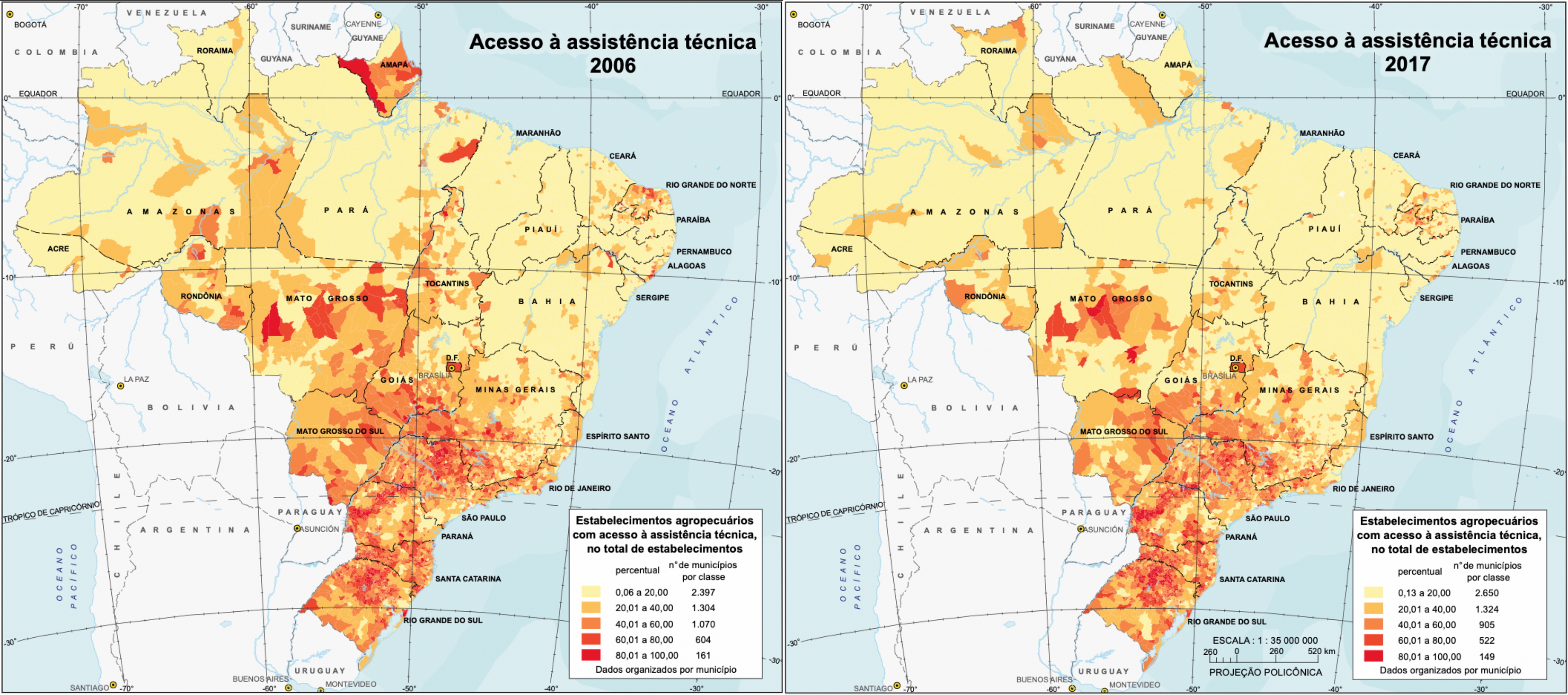
Regional inequalities are striking. Of the 149 municipalities, 5,500 in total, more than 80% of establishments report having received rural advisory services (Figure 2). In contrast, 2,550 municipalities have rates below 20%, indicating pronounced territorial asymmetry.
The South-Central region of the country has the highest access rates (26.1%), while the North and Northeast regions have only 8.3%. The state with the best performance is Santa Catarina, with 52% of establishments receiving assistance—a higher percentage than in other Brazilian states. Within the state of Santa Catarina, the Greater West and the Northern Plateau stand out, with over 60% and 61% access, respectively, regions in which cooperatives and integrating companies coordinate with the state service.
On the other hand, the southern plateau of Santa Catarina exhibits relatively low rates, with approximately 36% of establishments receiving assistance (Instituto Brasileiro de Geografia e Estatística, 2020), underscoring the persistence of regional disparities even in states with performance above the national average.
Even with the presence of rural advisory services throughout the national territory, there is a marked regional inequality in access, both in areas with less intensive and less organized agricultural activity, such as the North and Northeast, and in states where agriculture plays a central role in the export economy (Cruz et al., 2021). Camara et al. (2023) highlight that, although state rural advisory services have high capillarity, reaching about 98% of municipalities in Rio Grande do Sul and Santa Catarina, this does not necessarily translate into effective access by farmers. According to the authors, “the presence of municipal offices does not necessarily translate into a high coverage rate” (p. 12), since the declared receipt was close to 50% for both states (Instituto Brasileiro de Geografia e Estatística, 2019; Cruz et al., 2021).
The lack of a defined concept of access generates this problem. Service availability is different from usage. While state services may be almost entirely available in the southern states, they are not used by all families, who have been increasingly relying on non-public services (Cruz et al., 2021), such as cooperatives, integrators, independent professionals, and private planning companies (Instituto Brasileiro de Geografia e Estatística, 2019).
The data suggests that large-scale agriculture influences access to rural advisory services. In Goiás, for example, producers engaged in livestock (83%) and temporary crop (81%) activities access the service much more frequently than those engaged in permanent crop (12%) or vegetable farming (5%) (Diniz & Clemente, 2020). In Rio Grande do Sul, the concentration of the service occurs in regions with greater agronomic potential and intensive production, such as fruit growing, grains, and milk, while areas focused on extensive livestock farming and forests have low service rates (Camara et al., 2023; Diesel et al., 2012).
The size of agricultural establishments is also a determining factor. The data reveal a linear relationship between area and access: establishments with up to 100 hectares have 20% access, whereas those with 100-2,500 hectares and above 2,500 hectares have 38% and 69%, respectively (Instituto Brasileiro de Geografia e Estatística, 2019).
This trend repeats itself when considering the value of annual production. Among establishments with production up to R$25,000, 83% do not receive assistance, whereas among those with production above that value, the proportion drops to 39% (Instituto Brasileiro de Geografia e Estatística, 2019). In other words, the higher the income generated, the greater the access to the service. As in international studies, limited land and low productivity are strongly correlated with lack of access. Furthermore, assisted and higher-income establishments access more rural credit than those that do not receive assistance, such that the number of family farms obtaining credit in the South exceeds the total for the Southeast and Northeast combined (Cruz et al., 2021).
Among producers, family farmers have, on average, 18% access, whereas non-family farmers (employers, nurseries, institutions, etc.) have 27%. Regarding the type of production, organic farmers account for 28% of access (Instituto Brasileiro de Geografia e Estatística, 2019).
It can be inferred that the economic dynamism of agricultural activities increases access to services in certain territories, either because these activities have higher gross production values or because other forms of market integration, such as cooperatives and agro-industries, attract the presence of rural advisory services.
The data also reveal socioeconomic and identity-based selectivity. Establishments where the head of household is male (88%) and white (71%) have greater access, while those run by women (12%) or by black, brown, yellow, and indigenous people (29%) have significantly less access. In this sense, some authors hypothesize that technical assistance reproduces racist and patriarchal structures (Diniz & Clemente, 2021). Thus, the question arises: to what extent are racism, patriarchy, land limitations, and low income intertwined in explaining access to rural advisory services? Empirical studies with a territorial focus could offer new perspectives on this issue.
It can be inferred, therefore, that the most recurring profile of the rural actor without access is that of someone located in regions with low agricultural aptitude and reduced income, possessing little land and belonging to historically marginalized groups — Black, mixed-race, Asian, Indigenous, and/or women. This audience, even when located in economically dynamic territories, is less likely to receive technical assistance, according to the data analyzed.
Regarding the type of organization offering the service, the data shows that state-provided technical assistance is more equitable. However, it is not responsible for the majority of services in the country (43%). In general, the other organizations vary in importance depending on the region:
-
Cooperatives — predominate in the South, Southeast, and Goiás;
-
Integration companies — stand out in the South;
-
Independent professionals — excel in the Midwest and Southeast regions;
-
Planning companies — operate heavily in the South and Midwest;
-
NGOs are concentrated in the Northeast and North (Instituto Brasileiro de Geografia e Estatística, 2020).
Based on this analysis, it can be concluded that although rural advisory services have spread widely across Brazilian territories, they remain largely inaccessible to most rural families. Two main limitations of this selectivity can be interpreted:
-
Agricultural activities with less economic dynamism in certain territories tend not to develop with technical guidance, leading to greater difficulties in achieving their objectives;
-
The predominance of rural advisory services in intensive agriculture reinforces socioeconomic inequalities and negative environmental impacts, in addition to restricting innovation in other sectors where the rural sector has potential.
4.3 Categories for analyzing access to rural advisory services
Most of the studies analyzed sought to determine whether farmers receive rural advisory services, how often, the sources of information, and who provides it. However, the categories investigated varied across studies, indicating that the topic of access is not yet consolidated as a structured field of research, with categories verified in different social contexts, both nationally and internationally.
This scenario raises the question: What are the most appropriate categories for analyzing access to rural advisory services and their contribution to improved service utilization across different rural territories?
A proposal is presented to consolidate 15 categories from various studies for analyzing access to rural advisory services (Table 2).
The table presents the access categories, the most common unit of analysis, and references to studies that used these categories.
Less common categories include: availability, subject matter covered, number of farmers per consultant, number of consultants per sector, technology adoption, satisfaction with the service, funding sources, payment, and willingness to pay for the service. This lower utilization highlights the lack of consolidation in the production of information for this object of analysis.
Among the categories researched, there is no mention of the team and training of the extension workers. The closest descriptor is the number of consultants per productive sector, which provides an indication of the scope of the topic but does not capture possible interactions among consultants, i.e., teamwork. Additionally, extension worker training equips them with knowledge of both the subject matter and the sector in which they will work.
Therefore, the following are proposed as additional categories for research on access to rural advisory services: the number of technicians in the organization and the number of professionals by area of training (Table 2).
With these categories, it is possible to analyze the condition of use of rural advisory services in the territories, at different scales, including accessibility (indicators 1 to 3), frequency (indicator 5), availability (indicators 5 to 7), adequacy (indicators 8 to 12), and cost (indicators 13 to 15).
The proposed synthesis of categories enables us to understand access to rural advisory services as a qualitative and quantitative instrument for analyzing the performance of the plurality of actors interacting with rural families, territories, and subjects, both included and excluded. This synthesis synthesizes research from various regions and countries, enabling the development of a broad methodological framework to investigate access to technical assistance in rural areas. Furthermore, it offers elements for regional and local sample surveys, which are faster and more cost-effective than national censuses. It provides relevant information for the planning and evaluation of public policies for territorial-based rural advisory services.
5 Conclusions
The topic of access to rural advisory services remains underexplored globally, despite studies conducted on different continents. In Brazil, scientific production is more limited, with data available only from agricultural censuses and some regional surveys. This study reinforces the observation that the analysis of access to this service remains fragmented, with research categories that remain poorly consolidated.
Among the text's strengths is its ability to demonstrate the persistent socioeconomic inequality in access to the service, evidenced by both historical and current data. The study shows how factors such as farm size, income, production type, territorial location, gender, and race influence access to rural advisory services, revealing that historically marginalized families and territories are less likely to receive such services.
Furthermore, the importance of the plurality of service providers – state-run, cooperative, integrating companies, independent professionals, and NGOs – and how they impact the coverage and adequacy of the service in different territories is highlighted. These results reinforce the importance of recognizing the role of provider coordination and territorial governance in expanding access and improving the effectiveness of service actions.
However, weaknesses have been identified, especially the limited systematization of the analysis categories, which restricts a more detailed and comparable understanding of access across territories and countries. Furthermore, Brazilian analyses focus primarily on three categories—whether the farmer receives assistance, the source of information, and who provides the service—without considering important aspects such as frequency, territorial availability, technicians' training, topic relevance, cost, and service satisfaction. This gap limits the ability to assess service performance in relation to the specific demands of rural families and historically excluded territories. Therefore, it is recommended that interdisciplinary approaches incorporate social, economic, and spatial dimensions in an integrated manner, enabling more complex and representative analyses of the Brazilian rural reality.
Evidence suggests that, despite the expansion of rural advisory services in recent years, there is still marked selectivity: territories with less economic dynamism and families with historically marginalized profiles—women, Black people, Indigenous people, and low-income individuals—have significantly less access. This finding aligns with international studies indicating that socioeconomic inequalities and structural barriers influence service use. Therefore, it becomes essential to adopt territorialized actions that recognize the sociocultural and economic specificities of rural populations, promoting service strategies and training technicians with social sensitivity.
As areas for future improvement, this work suggests that Brazilian research should advance data collection by considering broader categories, such as the number of technicians per training area, the number of families per technician, service frequency, technological adoption, service satisfaction, and financing modalities. Adopting these categories would enable more precise and comparable analyses, facilitate the assessment of service delivery capacity, identify gaps, and promote public policies and private initiatives more appropriate to rural areas.
Furthermore, the use of statistical sampling methods at the regional or local scale could yield detailed information without relying on national censuses, aligning with international sampling practices. In addition, it is suggested that participatory methodologies be encouraged, in which farmers and technicians jointly contribute to defining indicators of the quality, relevance, and impact of services, thereby strengthening the legitimacy of public policies and the local appropriation of results.
Finally, it is recommended that institutional mechanisms be established for the continuous monitoring and coordination of rural advisory services, based on open, comparable information systems across territories. This initiative would enable the evaluation of program effectiveness and inform periodic adjustments, thereby enhancing transparency and accountability in the allocation of public and private resources. Furthermore, partnerships among universities, government agencies, private companies, independent professionals, and social organizations can help consolidate knowledge networks focused on innovation and the improvement of rural advisory services.
In summary, this study highlights that access to rural advisory services is a multifaceted phenomenon, conditioned by economic, social, territorial, and institutional factors, and is essential for understanding inequality in rural areas. Incorporating the suggested categories of analysis and attending to the plurality of service providers can help reduce inequalities, strengthen marginalized rural families, and positively impact the sustainable development of rural territories.
Acknowledgements:
Nothing to declare
Data availability:
The survey data is available upon request
How to cite:
Financial support:
Ethics approval:
JEL Classification:
References
-
Abdallah, A.-H., & Abdul-Rahaman, A. (2016). Determinants of access to agricultural extension services: evidence from smallholder rural women in northern Ghana. Asian Journal of Agricultural Extension, Economics & Sociology, 9(3), 1-8. https://doi.org/10.9734/AJAEES/2016/23478
» https://doi.org/10.9734/AJAEES/2016/23478 -
Amrullah, E. R., Takeshita, H., & Tokuda, H. (2023). Impact of access to agricultural extension on the adoption of technology and farm income of smallholder farmers in Banten, Indonesia. Journal of Agribusiness in Developing and Emerging Economies, https://doi.org/10.1108/JADEE-06-2023-0143
» https://doi.org/10.1108/JADEE-06-2023-0143 -
Aremu, T., & Reynolds, T. W. (2024). Welfare benefits associated with access to agricultural extension services in Nigeria. Food Security, 16(2), 295-320. https://doi.org/10.1007/s12571-023-01428-7
» https://doi.org/10.1007/s12571-023-01428-7 -
Barrantes-Bravo, C., Salinas-Flores, J., & Yagüe-Blanco, J. L. (2017). Factores que influencian el acceso a la extensión agropecuaria en Perú: buscando modelos más inclusivos. Agricultura, Sociedad y Desarrollo, 14(2), 205. https://doi.org/10.22231/asyd.v14i2.589
» https://doi.org/10.22231/asyd.v14i2.589 -
Birner, R., Davis, K., Pender, J., Nkonya, E., Anandajayasekeram, P., Ekboir, J., Mbabu, A., Spielman, D. J., Horna, D., Benin, S., & Cohen, M. (2009). From best practice to best fit: a framework for designing and analyzing pluralistic agricultural advisory services worldwide. Journal of Agricultural Education and Extension, 15(4), 341-355. https://doi.org/10.1080/13892240903309595
» https://doi.org/10.1080/13892240903309595 -
Camara, S. B., Boscardin, M., & Zarnott, A. V. (2023). Configuração da orientação técnica no estado do Rio Grande do Sul: um comparativo dos censos de 2006 e 2017. Extensão Rural, 30, e70699. https://doi.org/10.5902/2318179670699
» https://doi.org/10.5902/2318179670699 -
Cuevas Reyes, V., Baca del Moral, J., Cervantes Escoto, F., & Aguilar Ávila, J. (2018). Asistencia técnica en el sector agropecuario en México: análisis del VIII censo agropecuario y forestal. Revista Mexicana de Ciencias Agrícolas, 3(5), 943-957. https://doi.org/10.29312/remexca.v3i5.1386
» https://doi.org/10.29312/remexca.v3i5.1386 -
Cruz, N. B., Jesus, J. G., Bacha, C. J. C., & Costa, E. M. (2021). Acesso da agricultura familiar ao crédito e à assistência técnica no Brasil. Revista de Economia e Sociologia Rural, 59(3), e226850. https://doi.org/10.1590/1806-9479.2021.226850
» https://doi.org/10.1590/1806-9479.2021.226850 -
Cruz, J. E., Xavier, J. B., & Teixeira, S. M. (2024). Effects of technical assistance and rural extension actions on the quality of life of rural producers. Revista de Economia e Sociologia Rural, 62(3), e276710. https://doi.org/10.1590/1806-9479.2023.276710
» https://doi.org/10.1590/1806-9479.2023.276710 -
Davis, K., & Franzel, S. (2018). Extension and advisory services in 10 developing countries: a cross-country analysis Recuperado em 04 de setembro de 2025, de https://www.worldagroforestry.org/publication/extension-and-advisory-services-10-developing-countries-cross-country-analysis
» https://www.worldagroforestry.org/publication/extension-and-advisory-services-10-developing-countries-cross-country-analysis -
Diesel, V., Neumann, P. S., & de Sá, V. C. (2012). Extensão rural no contexto do pluralismo institucional: reflexões a partir dos serviços de Ates aos assentamentos da reforma agrária no RS Ijuí: Editora Unijuí. Recuperado em 04 de setembro de 2025, de https://issuu.com/vandiroe/docs/diesel_et_al._livro_pluralismo_inst
» https://issuu.com/vandiroe/docs/diesel_et_al._livro_pluralismo_inst -
Diniz, R. F., & Clemente, E. C. (2020). A questão do acesso aos serviços de orientação técnica no Brasil e no estado de Goiás. Revista Campo-Território, 15(35), 230-259. https://doi.org/10.14393/RCT153509
» https://doi.org/10.14393/RCT153509 -
Diniz, R. F., & Clemente, E. C. (2021). Desigualdades socioespaciais no acesso ao serviço de orientação técnica no Brasil e no Estado de Goiás: uma análise geográfica dos dados da agricultura familiar e não familiar nos Censos Agropecuários de 2006 e 2017. Revista Nera, 24(60), 123-151. https://doi.org/10.47946/rnera.v0i60.8361
» https://doi.org/10.47946/rnera.v0i60.8361 -
Elahi, E., Abid, M., Zhang, L., Ul Haq, S., & Sahito, J. G. M. (2018). Agricultural advisory and financial services; farm level access, outreach and impact in a mixed cropping district of Punjab, Pakistan. Land Use Policy, 71, 249-260. https://doi.org/10.1016/j.landusepol.2017.12.006
» https://doi.org/10.1016/j.landusepol.2017.12.006 -
Faure, G., Davis, K., Ragasa, C., Franzel, S., & Babu, S. (2016). Framework to assess performance and impact of pluralistic agricultural extension systems: the best-fit framework revisited (IFPRI Discussion Paper, No. 01567). Washington: IFPRI. https://doi.org/10.13140/RG.2.2.10224.05129
» https://doi.org/10.13140/RG.2.2.10224.05129 -
Faye, I., & Deininger, K. W. (2005). Do new delivery systems improve extension access? Evidence from rural Uganda. In International Association of Agricultural Economists Minneapolis: AgEcon. https://doi.org/10.22004/ag.econ.19405
» https://doi.org/10.22004/ag.econ.19405 -
Ferenhof, H. A., & Fernandes, R. F. (2016). Desmistificando a revisão de literatura como base para redação científica: Método SSF. Revista ACB, 21(3), 550-563. Recuperado em 04 de setembro de 2025, de https://www.researchgate.net/publication/325070845
» https://www.researchgate.net/publication/325070845 -
Freire, P. (2013). Extensão ou comunicação? (1. ed.). Paz e Terra. Recuperado em 04 de setembro de 2025, de https://www.academia.edu/38319324/Paulo_Freire_Extensão_ou_comunicação_pdf
» https://www.academia.edu/38319324/Paulo_Freire_Extensão_ou_comunicação_pdf -
Gebresilasse, M. (2023). Rural roads, agricultural extension, and productivity. Journal of Development Economics, 162, 103048. https://doi.org/10.1016/j.jdeveco.2023.103048
» https://doi.org/10.1016/j.jdeveco.2023.103048 - Giovanella, L., & Fleury, S. (1996). Universalidade da atenção à saúde: acesso como categoria de análise. In C. Eibenschutz (Ed.), Política de Saúde: o público e o privado (pp. 176-198). Rio de Janeiro: Editora FIOCRUZ. https://doi.org/10.7476/9788575412732
- Instituto Brasileiro de Geografia e Estatística – IBGE. (2020). Atlas do espaço rural brasileiro (2. ed.). Rio de Janeiro: IBGE.
-
Instituto Brasileiro de Geografia e Estatística – IBGE. (2019). Censo agropecuário Rio de Janeiro: IBGE. Recuperado em 04 de setembro de 2025, de https://censoagro2017.ibge.gov.br/templates/censo_agro/resultadosagro/index.html
» https://censoagro2017.ibge.gov.br/templates/censo_agro/resultadosagro/index.html -
Inkoom, E. W., & Dadzie, S. K. N. (2025). Cocoa Farmers’ Preference and Willingness to Pay for Climate-Smart Extension Services (CES): A Choice Experiment Approach. SAGE Open, 15(2), 21582440251335857. https://doi.org/10.1177/21582440251335857
» https://doi.org/10.1177/21582440251335857 -
Julius, A. (2012). Effects of Farmers’ Level of Education and Cooperative Membership on Access to Agricultural Extension Services in Abuja, Nigeria. Trends in Agricultural Economics, 5(4), 104-114. https://doi.org/10.3923/tae.2012.104.114
» https://doi.org/10.3923/tae.2012.104.114 -
Jesus, W. L. A., & Assis, M. M. A. (2010). Systematic review about the concept of access to health services: Planning contributions. Ciência & Saúde Coletiva, 15(1), 161-170. https://doi.org/10.1590/S1413-81232010000100022
» https://doi.org/10.1590/S1413-81232010000100022 -
Kalinda, T. H., Shute, J. C., & Filson, G. C. (1998). Access to agricultural extension, credit and markets among small-scale farmers in southern Zambia. Development Southern Africa, 15(4), 589-608. https://doi.org/10.1080/03768359808440033
» https://doi.org/10.1080/03768359808440033 -
Kenfack Essougong, U. P., Slingerland, M., Mathé, S., Giller, K. E., & Leeuwis, C. (2023). Farmers’ access, demand, and satisfaction with innovation support services and their determinants: the case of the cocoa sector in Central Cameroon. Journal of Agricultural Education and Extension, 30(4), 617-647. https://doi.org/10.1080/1389224X.2023.2249501
» https://doi.org/10.1080/1389224X.2023.2249501 -
Knierim, A., Labarthe, P., Laurent, C., Prager, K., Kania, J., Madureira, L., & Ndah, T. H. (2017). Pluralism of agricultural advisory service providers – Facts and insights from Europe. Journal of Rural Studies, 55, 45-58. https://doi.org/10.1016/j.jrurstud.2017.07.018
» https://doi.org/10.1016/j.jrurstud.2017.07.018 -
Labarthe, P., & Laurent, C. (2013). Privatization of agricultural extension services in the EU: Towards a lack of adequate knowledge for small-scale farms? Food Policy, 38(1), 240-252. https://doi.org/10.1016/j.foodpol.2012.10.005
» https://doi.org/10.1016/j.foodpol.2012.10.005 -
Lourenzani, A. E., Vieira, S. C., Bernardo, C. H., & Satolo, E. G. (2020). The history of rural extension in Brazil: from reproduction to reflection. Historia Actual Online, 52(52), 45-56. https://doi.org/10.36132/hao.v2i52.1868
» https://doi.org/10.36132/hao.v2i52.1868 -
Mbo’o-Tchouawou, M., & Colverson, K. (2014). Increasing access to agricultural extension and advisory services: how effective are new approches in reaching women farmers in rural areas? International Livestock Research Institute. Recuperado em 04 de setembro de 2025, de https://books.google.com.br/books?id=shDlAwAAQBAJ&printsec=frontcover&hl=pt-BR#v=onepage&q&f=false
» https://books.google.com.br/books?id=shDlAwAAQBAJ&printsec=frontcover&hl=pt-BR#v=onepage&q&f=false -
Muchagata, M. (2003). Perfil dos serviços de assistência técnica e extensão rural para agricultores familiares e assentados no Brasil Recuperado em 04 de setembro de 2025, de https://edisciplinas.usp.br/pluginfile.php/5226672/mod_resource/content/0/Relatorio_Nacional_Perfil_das_Instituições_de _Assistência_Técnica_e_Extensão.pdf
» https://edisciplinas.usp.br/pluginfile.php/5226672/mod_resource/content/0/Relatorio_Nacional_Perfil_das_Instituições_de -
Nagar, A., Nauriyal, D. K., & Singh, S. (2021). Improving farmers access to agricultural extension services delivery systems: Lessons from a field study in western Uttar Pradesh, India. Journal of Tropical Agriculture, 59(2), 206-214. Recuperado em 04 de setembro de 2025, de https://jtropag.kau.in/index.php/ojs2/article/view/1110
» https://jtropag.kau.in/index.php/ojs2/article/view/1110 -
Nambiro, E., Omiti, J. M., & Mugunieri, G. L. (2006). Decentralization and Access to Agricultural Extension Services in Kenya. In International Association of Agricultural Economists Minneapolis: AgEcon. https://doi.org/10.22004/ag.econ.25246
» https://doi.org/10.22004/ag.econ.25246 -
Nyberg, Y., Mackay, H., Wilson, M., Samkunde, M., & Wetterlind, J. (2025). Supporting access and implementation of agricultural extension services for female smallholder farmers – a systematic review. International Journal of Agricultural Sustainability, 23(1), 2505387. https://doi.org/10.1080/14735903.2025.2505387
» https://doi.org/10.1080/14735903.2025.2505387 -
Ogola, P. A., Ngesa, F., & Makanji, D. L. (2023). Influence of access to extension services on milk productivity among smallholder dairy farmers in Njoro Sub-County, Nakuru County, Kenya. Heliyon, 9(9), e20210. https://doi.org/10.1016/j.heliyon.2023.e20210
» https://doi.org/10.1016/j.heliyon.2023.e20210 -
Okello, D. M., Akite, I., Atube, F., Kalule, S. W., & Ongeng, D. (2023). Examining the relationship between farmers’ characteristics and access to agricultural extension: Empirical evidence from northern Uganda. Journal of Agricultural Education and Extension, 29(4), 439-461. https://doi.org/10.1080/1389224X.2022.2082500
» https://doi.org/10.1080/1389224X.2022.2082500 -
Peixoto, M. (2020). Assistência técnica e extensão rural: Grandes deficiências ainda persistem. In J. E. R. Vieira Filho & J. G. Gasques (Eds.), Uma jornada pelos contrastes do Brasil: cem anos do Censo Agropecuário (pp. 323-338). Brasília: Ipea. https://doi.org/10.38116/978-65-5635-011-0/cap23
» https://doi.org/10.38116/978-65-5635-011-0/cap23 -
Prager, K., Labarthe, P., Caggiano, M., & Lorenzo-Arribas, A. (2016). How does commercialisation impact on the provision of farm advisory services? Evidence from Belgium, Italy, Ireland and the UK. Land Use Policy, 52, 329-344. https://doi.org/10.1016/j.landusepol.2015.12.024
» https://doi.org/10.1016/j.landusepol.2015.12.024 -
Ragasa, C., Berhane, G., Tadesse, F., & Taffesse, A. S. (2013). Gender differences in access to extension services and agricultural productivity. Journal of Agricultural Education and Extension, 19(5), 437-468. https://doi.org/10.1080/1389224X.2013.817343
» https://doi.org/10.1080/1389224X.2013.817343 -
Rebuffel, P., Lemoine, C., & Faure, G. (2015). Difficult access to advisory services for small farms : the situation in Mayotte. Agricultures, 24(5), 269-276. https://doi.org/10.1684/agr.2015.0771
» https://doi.org/10.1684/agr.2015.0771 -
Ricome, A., Faye, A., Fall, C. S., & Gomez y Paloma, S. (2024). The impact of access to agricultural advisory services on input use and farm performance: evidence from Senegal. Agribusiness, https://doi.org/10.1002/agr.21932
» https://doi.org/10.1002/agr.21932 - Plataforma Brasileira de Biodiversidade e Serviços Ecossistêmicos – BPBES. (2024). Relatório Temático & Sumário para Tomadores de Decisão – Água: biodiversidade, serviços ecossistêmicos e bem-estar humano no Brasil Campinas: BPBES.
-
Sesso Filho, U. A., Lopes, R. L., Gonçalves Junior, C. A., Esteves, E. G. Z., & Sesso, P. P. (2024). Produto Interno Bruto e pegada hídrica do agronegócio: comparativo entre países. Revista de Economia e Sociologia Rural, 62(4), e274229. https://doi.org/10.1590/1806-9479.2023.274229pt
» https://doi.org/10.1590/1806-9479.2023.274229pt -
Sulaiman, V. R., Hall, A., Kalaivani, N. J., Dorai, K., & Reddy, T. S. V. (2012). Necessary, but not sufficient: critiquing the role of information and communication technology in putting knowledge into use. Journal of Agricultural Education and Extension, 18(4), 331-346. https://doi.org/10.1080/1389224X.2012.691782
» https://doi.org/10.1080/1389224X.2012.691782 -
Sutherland, L.-A., Madureira, L., Dirimanova, V., Bogusz, M., Kania, J., Vinohradnik, K., Creaney, R., Duckett, D., Koehnen, T., & Knierim, A. (2017). New knowledge networks of small-scale farmers in Europe’s periphery. Land Use Policy, 63, 428-439. https://doi.org/10.1016/j.landusepol.2017.01.028
» https://doi.org/10.1016/j.landusepol.2017.01.028 -
Tanti, P. C., & Jena, P. R. (2023). Perception on climate change, access to extension service and energy sources determining adoption of climate-smart practices: A multivariate approach. Journal of Arid Environments, 212, 104961. https://doi.org/10.1016/j.jaridenv.2023.104961
» https://doi.org/10.1016/j.jaridenv.2023.104961 -
Wossen, T., Abdoulaye, T., Alene, A., Haile, M. G., Feleke, S., Olanrewaju, A., & Manyong, V. (2017). Impacts of extension access and cooperative membership on technology adoption and household welfare. Journal of Rural Studies, 54, 223-233. https://doi.org/10.1016/j.jrurstud.2017.06.022
» https://doi.org/10.1016/j.jrurstud.2017.06.022
Conflicts of interest:
Correspondence
Juliano Vitória Domingues. juliano.tche@gmail.comAssociate Editor:

 Source: authors (2025).
 Source: