 Low Carbon Brazilian Beef: challenges in sustainable production and conscious consumption among consumers in Rio de Janeiro
Abstract
Resumo A percepção e a intenção de compra em relação à “Carne Baixo Carbono (CBC)” foi avaliada através de uma pesquisa online com 851 consumidores de carne bovina residentes no estado do Rio de Janeiro, Brasil. Foi utilizado a Associação Livre de Palavras, solicitando que os participantes descrevessem as primeiras quatro palavras que lhes viessem à mente diante do estímulo “CBC”. Em seguida, a análise conjunta foi empregada para investigar a intenção de compra de carne bovina, considerando diferentes fatores no rótulo, em duas condições experimentais: Com e sem informação sobre a definição da CBC. As associações ao meio ambiente foram mais relatadas por mulheres, pessoas de 46 a 65 anos, com maior nível educacional e renda familiar. O acesso à informação sobre CBC aumentou a intenção de compra, mas o preço foi o fator que mais determinou essa intenção. A alegação de sustentabilidade e bem-estar animal foram atributos percebidos positivamente. No entanto, constatamos que os consumidores não relacionam os aspectos ambientais à qualidade sensorial da carne. Ações incisivas de comunicação deverão ser criadas para desconstruir a percepção do consumidor de que o avanço da pecuária sustentável não impactará negativamente no sabor da carne e, consequentemente, no bem-estar do próprio consumidor.
Palavras-chave:
consumidor; pecuária de baixo carbono; sustentabilidade; análise conjunta; associação livre de palavras
Resumo
Abstract The perception and purchase intention regarding “Low Carbon Brazilian Beef (LCBB)” was evaluated through an online survey was conducted with 851 beef consumers residing in the state of Rio de Janeiro, Brazil. Free Word Association was used by asking participants to describe the first four words that came to mind when faced with the stimulus “LCBB”. The conjoint analysis was then used to investigate the intention to buy beef, considering different factors on the label, in two experimental conditions: With and without information on the definition of LCBB. Environmental associations were most reported by women, people aged 46 to 65, those with higher educational levels and family income. Access to information about LCBB increased purchase intention, but price was the most determining factor. Furthermore, the claims associated with sustainability and animal welfare were attributes that were perceived positively. However, we found that consumers do not associate environmental aspects with the sensory quality of meat. The incisive communication actions must be created to deconstruct the consumer’s perception that the advancement of sustainable livestock farming will not negatively impact the taste of meat and, consequently, the well-being of consumers themselves.
Keywords:
consumer; low carbon livestock; sustainability; conjoint analysis; free word association
1. Introduction
The agricultural sector is an emitter of greenhouse gases (GHG) that has attracted attention and been subject to criticism. It is well known that meat production, with pasture management as it is practiced in Brazil, can cause environmental impacts. The action of deforestation for the purpose of agriculture, lack of adequate pasture management in areas already anthropized, degradation rates of pasture areas, low carbon stock in the soil and lack of investment in the genetic improvement of animals are among the causes of these impacts (Gurgel & Laurenzana, 2016; Almeida & Alves, 2020). However, numerous initiatives intended to reduce emissions in Brazilian agriculture, by encouraging the adoption of practices that represent low-carbon agriculture, also deserve to be publicized.
It should be noted that, as an emerging country in global negotiations, Brazil is not obliged to declare targets for reducing total GHG emissions. However, almost 15 years ago, at a United Nations conference (COP-15), the country took a favorable stance on the issue, presenting voluntary mitigation actions, aiming to reduce harmful emissions into the environment (Nationally Appropriate Mitigation Actions – Namas). Ever since, progress has been made in reducing degraded pasture areas, combating illegal deforestation, promoting crop-livestock and crop-livestock-forest integration systems, promoting the direct planting system, and biological nitrogen fixation, in addition to the use of biofuel and the expansion of agroforestry systems in the country (Abreu Lima & Lemos, 2023).
To organize the planning of the above and other actions, a low-carbon agriculture plan, or ABC Plan, was established as national policy in 2010. The ABC Plan brings together a set of actions aimed at promoting sustainable technologies and practices in the agricultural sector, with the goal of reducing greenhouse gas (GHG) emissions and ensuring the sustainability of the production system. The actions include the implementation of integrated agriculture and livestock systems or integrated crop-livestock-forestry systems, improving soil quality, establishing commercial forests, restoring preservation areas or forest reserves, and other practices that promote sustainable production targeted at low GHG emissions (Brasil, 2024). Through agricultural projects, Brazilian farmers can access specific credit lines to operationalize low-emission production practices. The second phase of the ABC Plan, the Sectoral Plan for Climate Change Adaptation and Low Carbon Emission in Agriculture, called ABC+, has the goal of reducing carbon equivalent emissions by 1.1 billion tons in the agricultural sector by 2030. Gueiros et al. (2023) presented an interesting discussion regarding the commitment of emerging countries towards climate change and analyzed differences in engagement in the adoption of conservationist production practices in different Brazilian states.
Carbon accounting in food production systems is a topic that is also of interest to consumers (González et al., 2020; Rondoni & Grasso, 2021; Majer et al., 2022; Ran et al., 2022; Xu et al., 2023). To satisfy consumer demand and meet their expectations, issues such as animal welfare, production efficiency, sustainability, climate change, environmental impact and food safety are topics included in the list of quality cues for various foods, especially beef. The different perceptions that consumers have about the quality of meat, regarding intrinsic and extrinsic characteristics, affect their product intention to purchase and choice (Liu et al., 2022).
Therefore, in this article, we present a Brazilian initiative included on the Low Carbon Livestock Platform and led by the Brazilian Agricultural Research Corporation (EMBRAPA). The aim of this platform is to consolidate and strengthen sustainability initiatives in the livestock sector through the development of concept brands aimed at livestock products that have had their emissions reduced or fully compensated during the production process (Alves et al., 2019). Low Carbon Brazilian Beef (LCBB), one of the concept brands proposed by Embrapa, is a guarantee seal for beef from livestock systems that employ recovery practices and the sustainable management of pastures and/or adopt silvopastoral systems (Almeida & Alves, 2020).
The state of Rio de Janeiro, recognized as an important social and cultural center of Brazil, is the third most populous state in the country, with approximately 17 million inhabitants (Instituto Brasileiro de Geografia e Estatística, 2024). The city of Rio de Janeiro, the state capital, has stood out for its innovative sustainability and environmental preservation initiatives. Among these initiatives, the Sustainable Development and Climate Action Plan has been key in aligning municipal policies with the 2030 Sustainable Development Goals Agenda (Rio de Janeiro, 2024). Therefore, this study was conducted with beef consumers residing in the state of Rio de Janeiro, with the aim of assessing their perceptions and purchase intentions regarding Low Carbon Brazilian Beef. The choice of Rio de Janeiro as the focus of the research is justified by its demographic relevance, economic importance, and leadership role in sustainability discussions in Brazil. Understanding the perceptions of Rio de Janeiro’s consumers is essential for identifying challenges and opportunities in implementing sustainable livestock systems and promoting the consumption of LCBB.
2. Theoretical Foundation
Numerous factors influence consumers’ perceptions, attitudes and behavior, making food a complex choice filled with symbols (Cancellieri et al., 2022; Poulain, 2021; Sproesser et al., 2022). In many studies, it has been highlighted that consumer perception regarding meat is mainly associated with its quality (Font-i-Furnols & Guerrero, 2014; Henchion et al., 2017; Araújo et al., 2022; Cardona et al., 2023). However, quality is a subjective assessment, dependent on the perceptions and needs of individuals (Henchion et al., 2017). Furthermore, according to Hocquette (2023), meat consumption decisions are becoming increasingly challenging and are influenced by individuals' personalities and attitudes. When making food purchase decisions, consumers tend to create expectations about its quality, which may or may not be confirmed after consumption (Deliza & Ares, 2018). In the literature, it is clear that the formation of meat quality expectations is based on intrinsic attributes (color, texture, flavor, fat content and marbling) and extrinsic attributes (price, brand, origin, quality certifications) (Font-i-Furnols & Guerrero, 2014; Cardona et al., 2023).
Although affordable price and sensory quality stand out as the main factors in the purchase of in different countries (Liu et al., 2022; Rolfe et al., 2023), credibility attributes are increasingly being considered in food choices (Araújo et al., 2022; Cardona et al., 2023). These attributes are signs of product quality that cannot be evaluated or verified by the consumer, but are confirmed through other actors, such as regulatory bodies and the industry (Henchion et al., 2022). Animal welfare, sustainability, traceability, and health and ethical concerns are some of the credibility attributes (Alonso et al., 2020; Araújo et al., 2022; Henchion et al., 2022; Hötzel & Vandresen, 2022; Cardona et al., 2023). Additionally, Hötzel & Vandresen (2022) indicate that consumers are more demanding, looking for meat products that not only provide sensory, sanitary and nutritional quality, but also comply with ethical production standards. Magalhães et al. (2023) also found that animal welfare, environmental impact, indiscriminate use of agricultural products, food adulteration/contamination, and loss of trust in production systems due to the COVID-19 outbreak are credibility factors influencing Brazilian consumers' beef purchasing intentions. However, the importance that consumers attach to these attributes varies (Rolfe et al., 2023).
Consumers’ attitudes towards information about carbon accounting on food labels have also been a widely discussed topic (Thøgersen & Nielsen, 2016; Rondoni & Grasso, 2021; Majer et al., 2022; Ran et al., 2022; Holenweger et al., 2023; Ang et al., 2024; Chen et al., 2024). Labels related to carbon sequestration in beef signal to consumers the adoption of techniques that allow the neutralization or mitigation of enteric methane emissions during the beef cattle production process. In Brazil, the main existing seals are the concept brands of “Carbon Neutral Brazilian Beef” and “Low Carbon Brazilian Beef”, both developed by the Brazilian Agricultural Research Corporation (EMBRAPA). International research reinforces this trend. Chen et al. (2024) found that Chinese consumers are inclined to pay for beef products with carbon-neutral labels. Holenweger et al. (2023) observed that, although the impact is still small, carbon footprint labels have a positive influence on food choices.
The intention behind the Carbon Neutral Brazilian Beef (CNB) is to certify beef obtained from beef cattle produced in integration systems such as silvopastoral (LFI - livestock-forest integration) or agroforestry (CLFI - crop-livestock-forest integration) systems, with the compulsory introduction of trees. According to Alves et al. (2015), the arboreal component allows the neutralization of enteric methane emitted by cattle, ensuring a thermally comfortable environment, guaranteeing the animals’ well-being. Low Carbon Brazilian Beef (LCBB), the object of study in this article, is a guarantee seal for meat from livestock systems that employ recovery practices and the sustainable management of pastures and/or adopt silvopastoral systems (Almeida & Alves, 2020). According to Almeida & Alves (2020), these methods allow the reduction of enteric methane emitted by cattle through the sequestration and fixation of carbon in the soil. The study conducted by Freitas et al. (2022) demonstrated that LCBB enables increased meat production with lower per capita emissions and less carbon accumulation in the soil compared to conventional management. The study by Silveira et al. (2023) corroborates these results, demonstrating that adopting LCBB can increase profitability, maintain soil carbon stocks, mitigate GHG emissions and promote efficient land use.
Nevertheless, LCBB is still an innovative seal in the Brazilian market and not widely known to consumers. In this respect, the information on product labels should improve individuals’ understanding and contribute to a possible change in consumer behavior (Ran et al., 2022). According to Hartmann et al. (2021), the greater the knowledge and awareness about the environmental impact of food, the greater the possibility of consumers adopting more sustainable consumption behaviors. In a study conducted by Lucchese-Cheung et al. (2021a) regarding the CNB concept brand, the rejection, disbelief and indifference shown by 25% of Brazilian consumers were associated with their lack of knowledge regarding this new certification. This is supported by previous research, which showed that the understanding and appreciation of sustainable labels improved when consumers were properly informed about their meaning (van Loo et al., 2014; Hartikainen et al., 2014; Annunziata et al., 2019; Meyerding et al., 2019; Aprile & Punzo, 2022). Williams et al. (2023) emphasized the importance of consumer knowledge and awareness to increase the effectiveness of beef sustainability labels and encourage their adoption.
To date, there are no studies on the perception and willingness to buy meat labeled as “Low Carbon”. Therefore, this article seeks to expand the database of information available in the literature on consumer perception related to this sustainable technology.
3. Methodology
3.1 Experimental design
Data were collected via an online questionnaire from a sample of 909 individuals living in Rio de Janeiro State, Brazil. The population of the state of Rio de Janeiro is characterized by socio-economic diversity, covering both metropolitan areas and inland regions, which makes it possible to obtain a representative and heterogeneous sample of consumers. A company specializing in market research was hired to apply the questionnaire in 2023. Convenience sampling was used, a non-probabilistic method in which participants are selected based on their availability to participate in the study (Andrade et al., 2016; Bornstein et al., 2013). The eligibility criteria were being over 18 years old and consuming beef. The study was approved by the Ethics Committee of the Federal University of Rio de Janeiro, Macaé Campus (CAAE 65492922.6.0000.5699).
The questionnaire initially classified the participants according to their consumption profile, including in the study only those who declared that they were omnivores or flexitarians. A total of 58 respondents did not self-identify as meat consumers and were therefore excluded. Free word association was then used to investigate consumer perception regarding LCBB, resulting in 851 participants who provided valid responses (excluding responses consisting of sequences of characters without coherent meaning). Then the sample was randomly divided into two groups. In the first group, 429 participants accessed and read information on LCBB as defined by Almeida & Alves (2020): “Low Carbon Brazilian Beef (LCBB) is a certification for beef produced in agricultural systems that adopt sustainable practices and low greenhouse gas emissions”. The participants in the second group (n= 422) were provided with no information. Then, the conjoint analysis methodology was used to evaluate the effect of different label variables on the participants’ intention to purchase beef. The experimental schema can be seen in Figure 1.

Table 1 contains a description of the sociodemographic characteristics of participants who answered the free word association (n=851), and of the randomly divided groups (with information about LCBB, n=429, and without information about LCBB, n=422) to evaluate the intention to purchase through conjoint analysis. The sociodemographic profile of the participants was diverse and varied according to the study conditions. However, the majority of participants were female, aged between 26 and 35, held a high school or higher education, had a family income of 1 to 3 minimum wages, and were employed.
Sociodemographic characteristics of the participants (%), distributed into the two groups of consumers (those provided with information on LCBB and those not provided with this information).
3.2 Free word association
Free Word Association is a projective technique used to understand consumers’ perception of food products. This methodology was chosen for the present study because it is capable of provoking a spontaneous response and affective manifestation from individuals, allowing access to the representation of their thoughts and feelings (Guerrero et al., 2010; Gambaro, 2018).
To access associations, interviewees can declare words, ideas, terms, thoughts, phrases or sensations that spring to mind when faced with a stimulus (Steinman, 2009). In this study, the participants were given the following instruction: “Write down the first four words, associations, thoughts or feelings that come to mind when you think about “Low Carbon Brazilian Beef”. No description, photograph of or information about LCBB was provided to them.
The words mentioned by the respondents were analyzed using content analysis (Guerrero et al., 2010). Initially, the frequency of words considered valid was observed. Terms with similar meanings were then grouped into different categories through inductive coding by triangulation (Guerrero et al., 2010; Ares & Deliza, 2010). The same procedures were applied by the researchers to group the categories into different dimensions (Guerrero et al., 2010). The number of mentions for each category and dimension was determined by counting the respondents who used similar words in the LCBB stimulus (Ares & Deliza, 2010). The dimensions, categories and number of mentions as shown in Table 2, in the results section. The chi-square test was used to evaluate statistical differences in the frequency of mentions of dimension among consumer groups with different sociodemographic characteristics. A chi-square test per cell was employed to identify the source of variation in the global chi-square (Symoneaux et al., 2012).
Number of mentions of the dimensions and categories obtained through the free word association task.
3.3 Conjoint analysis
The conjoint analysis methodology based on classification was used to gauge the participants’ intention to purchase vacuum-packed beef rib eye roll. A set of attributes and their respective levels are selected and combined according to an experimental design to quantify and estimate the consumer’s general evaluation, enabling the identification of segments according to the participants’ responses (Green & Srinivasan, 1990). The method estimates utility, product acceptance or any other dependent variable for different levels of attributes, measuring their relative importance in consumers’ perceptions (Steenkamp, 1987).
Table 3 presents the factors and levels chosen for this study. Claims are a particularly important tool used to provide consumers with information (Aprile & Punzo, 2022; van Loo et al., 2021). The levels selected for this factor were determined from a literature review (Almeida & Alves, 2020; Alonso et al., 2020; Burnier et al., 2021; Font-i-Furnols & Guerrero, 2022; Araújo et al., 2022). Price is known to be an indicator of extrinsic quality that influences consumer choice (van Loo et al., 2014; Hötzel & Vandresen, 2022; Font-i-Furnols & Guerrero, 2022). Furthermore, it can be an obstacle to making more sustainable purchasing decisions (Gleim & Lawson, 2014). Consequently, evaluating this attribute is important for building communication action plans. The levels of this factor were selected based on the average prices found in Brazilian supermarkets for 1 kg of cooled vacuum-packed beef loin cuts, with an increase (high price) and reduction (low price) of 20% in this average.
Considering the number of factors and levels, 16 (41x22) different potential combinations of the product could have been obtained. However, to minimize respondents’ fatigue, a fractional factorial design was used, generating eight treatments. This method allows a reduction of the evaluations obtained, maintaining orthogonality between levels and subsequent estimates of partial utilities by creating a subset of all possible effects (Hair et al., 2010).
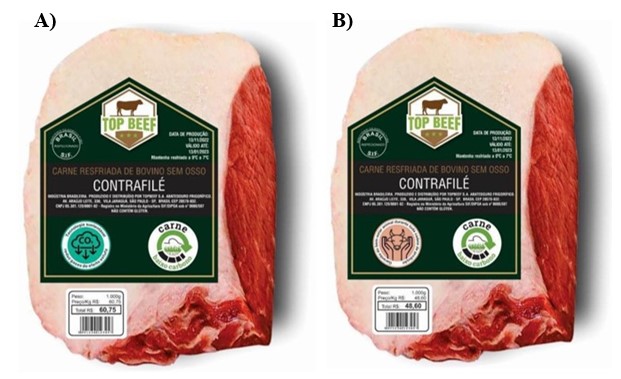
The eight images of vacuum-packed beef prototypes contained the mandatory information on the label determined by Brazilian law and the name of a fictitious brand (TopBeef). Examples of the prototypes are shown in Figure 2. The participants had access to each of the images and were asked to evaluate their intention to purchase using a structured 7-point scale (1: definitely would not buy to 7: would definitely buy).

Example of prototypes presented in the research process to evaluate the purchase intention for vacuum-packaged beef: (A) Prototype 2; and (B) Prototype 3.
The intention to purchase scores were evaluated using analysis of variance (ANOVA) in accordance with the model proposed by Næs et al. (2001), as follows:
For significant effects, differences between means were calculated using Tukey’s test (p≤0.05). The individual utility and relative importance of conjoint variables were calculated as proposed by Green & Srinivasan (1978). Individual utility estimates the preference that respondents attribute to each level of each factor of the product, while relative importance estimates the importance of each factor (Hair et al., 2010). Statistical analyses were performed using R language (R Core Team, 2023) with the following packages: lmerTest (Kuznetsova et al., 2015) and conjoint (Bak et al., 2018).
3. Results and discussion
The words mentioned by Brazilian participants from Rio de Janeiro in the free word association task were classified into 31 categories, which were compiled into 11 dimensions, as explained in section 3.2. Table 2 shows the frequency that each category and dimension was mentioned by the participants. The most cited dimensions were “Positive perceptions”, “Associations with the environment”, “Sensory attributes”, “Health and nutrition” and “Consumption and culinary preparations”.
Significant differences were identified in the frequency of citations of dimensions mentions based on gender, age, education level and family income (p<0.001), as shown in Tables 4 and 5. Women, people aged between 46 to 65 years, with a higher education levels and family income above 3 minimum wages, associated LCBB more frequently with environmental and sustainability aspects, citing the dimension “Associations with the environment”. On the other hand, men, younger participants (18 to 35 years old), with a lower educational levels and income, mainly mentioned the dimensions “Sensory attributes” and “Consumption and culinary preparations”. In general, women are more concerned with sustainability, animal welfare, and health issues compared to men (Grunert et al., 2014; Apostolidis & McLeay, 2019; Alonso et al., 2020; Michel et al., 2021; Cardona et al., 2023). Men tend to recognize animals more as a food source, while women reject the association of protein with death and blood, showing more empathy for the animal (Lucchese-Cheung et al., 2021b; Milfont & Sibley, 2016). These results can contribute to the development of targeted strategies for specific audiences. Environmental campaigns may be more effective for women and older individuals with higher educational levels and income, while campaigns focused on sensory attributes would be more suitable for men, younger people and those with lower family income.
Frequency of mention of the categories identified in the free word association about LCBB considering gender, age, education and family income.
Frequency of mention of the categories identified in the free word association about LCBB considering gender and age, education and family income.
A conjoint analysis was conducted to evaluate the intention to purchase of beef by the two groups of participants according to previous information on LCBB, namely: Group 1 (n= 429), respondents received information on the definition of LCBB (With information on LCBB); and Group 2 (n= 422), they did not receive any information (Without information on LCBB).
The ANOVA results indicate that there was a significant difference (p≤0.05) in purchase intention between the two groups (5.2 vs 5.0), suggesting that the information about LCBB provided to the respondents increased the purchase intention scores for beef, as presented in Table 6. This result is consistent with the literature (Hartikainen et al. 2014; Rondoni & Grasso, 2021; Font-i-Furnols & Guerrero, 2022; Araújo et al., 2022; Aprile & Punzo, 2022), which highlights the role of information on changing consumer behavior, especially with regard to sustainable consumption. As reported by de Araújo et al. (2022), the perception of quality and the consumer’s attitude towards meat depend on prior experiences. Therefore, providing information can increase consumer knowledge and awareness, thus promoting the adoption of sustainable labels (Williams et al., 2023).
The individual utility and relative importance of the factors and levels used in the conjoint analysis to evaluate intention to purchase of groups of consumers provided with information about LCBB and with no information about LCBB.
The results indicated that gender, age, family income and occupation had significant effects (p≤0.05) on the intention to purchase of Brazilian respondents from Rio de Janeiro who received information about LCBB (data not shown). A higher mean was observed among female participants who were in work, with a similar distribution between age and income groups. Meanwhile, women who did not receive information about LCBB, and whose family income was between nine and fifteen minimum wages and with a similar age distribution, showed greater purchase intention.
As a result of the conjoint analysis, it was observed that the relative importance of the factors included in the analysis reflected the preferred order of the attributes that consumers considered important for the intention to purchase of vacuum-packed beef loin cuts. The order was price (47%), claim (27%) and the LCBB seal (26%), irrespective of whether information was provided on the definition of LCBB (Table 6). Individual utility values revealed consumers’ preference for each factor level (Hair et al., 2010). As shown in Table 6, consumers from Rio de Janeiro preferred to buy beef with sustainability and animal welfare claims and with the presence of the LCBB seal, but showed a negative intention to purchase beef without a claim. This suggests that this information can increase the credibility of the product and favor the consumer’s purchase decision. These findings confirm the role of extrinsic attributes as indicators of credibility or trust that influence consumers’ purchase attitudes (Araújo et al., 2022; Cardona et al., 2023).
Price was the most important variable that affected the intention to purchase vacuum-packed beef. Other studies have also identified price as the main extrinsic attribute for purchasing beef (Magalhães et al., 2022; Groot & Henrique, 2021; Hötzel & Vandresen, 2022; Hough & Contarini, 2023; Liu et al., 2022). Consumers expressed greater purchase intention for low-priced beef, regardless of the presentation of information about LCBB. The participants associated LCBB with the “High Price” category, related to the terms “high cost”, “expensive”, “high price” and “luxury” (Table 2). This result reveals that although the product offers benefits related to sustainability and animal welfare, price remains the most important attribute that influences the intention to purchase beef and can act as a barrier to the consumption of new sustainable technologies. This point is supported by Rolfe et al. (2023) and Williams et al. (2023), who found that, for meat consumers in Australia and the UK, price is more important than the statement about greenhouse gas emissions and environmental concerns.
As reported by Lucchese-Cheung et al. (2021b), products that present, through their symbols, values considered important to consumers, have a greater chance of being chosen for consumption. Recent research has highlighted the sensory characteristics of meat as one of the main attributes evaluated by consumers at the time of purchase and which influence product acceptance (Groot & Henrique, 2021; Magalhães et al., 2022; Cardona et al., 2023; Viegas et al., 2015). In this study, consumers from Rio de Janeiro established a relationship between expected hedonic characteristics (tasty, delicious, full of flavor and good) and expected sensory characteristics (tenderness, flavor, juiciness and odor) with LCBB. However, an interesting finding of this work was that the sensory claim had a negative contribution to the purchase intention of consumers who received information about the meaning of LCBB (-0.05) and a positive contribution in the absence of this information (0.05). This result suggests that educating consumers about a new sustainable technology can increase their awareness and appreciation for the product's socio-environmental attributes. Similarly, Aprile & Punzo (2022) reported that adequate consumer knowledge about the content of labels contributes to greater preference for products with sustainability claims. The study by Viegas et al. (2015) found that, for consumers in Portugal, Lisboa and Porto, the quality of beef was predominantly a sensory issue and little influenced by safety, environment and animal welfare. However, in the case of this study, among Brazilian consumers residing in Rio de Janeiro, information about sustainability reduced the perception that an environmentally correct product is tasty. This result should be considered as a theme for proposing a communication action plan for the concept brand with consumers.
5. Conclusion
The environmental impact generated by livestock production has become a global concern. Brazil, one of the world’s main beef producers, can contribute with new production technologies to mitigate greenhouse gas emissions. In this respect, Low Carbon Brazilian Beef (LCBB) is a promising concept brand for the sustainable development of livestock farming. This study provides unprecedented data on the perceptions of Brazilian consumers living in the state of Rio de Janeiro, Brazil, about the LCBB and the main attributes that affect beef intention to purchase. The results provide valuable data for policymakers and companies in the state of Rio de Janeiro to expand the low-carbon meat market. In addition, this data can be applied throughout Brazil to boost the adoption of this sustainable technology.
Our results have shown that consumers’ perception of LCBB and the role of different label attributes in beef purchase intention are complex. Differences between sociodemographic characteristics were emphasized, showing that women, individuals aged between 46 to 65 years, with a higher educational level and family income associate environmental aspects when thinking about LCBB. The findings reinforce that price is also the attribute that has the greatest effect on intentions to purchase beef, and may constitute a barrier to the consolidation of this new sustainable technology in the market, if the concept brand is sold at a relatively higher price than its conventional equivalent. It remains to be seen at what point, in absolute value, consumers begin to perceive the concept brand as being very expensive. This is a suggestion for future research. Likewise, as the sensory characteristics of the sustainable product were perceived negatively, another study could build an information campaign to demystify this notion among consumers. After all, sustainable production could soon be the hallmark of Brazilian animal protein supply.
The limitation of this study is that it used a sample of consumers residing only in the state of Rio de Janeiro. It is recommended that future research expand the analysis to include a representative sample from the whole of Brazil, to gain a more comprehensive understanding of the perception and purchase intention in relation to LCBB. Furthermore, the results revealed a possibility of a significant gap between intention and behavior because what consumers declare (their attitude) is not necessary what they do (their behavior). Although consumers showed a positive intention to purchase beef with socio-environmental attributes, such as the LCBB label, this intention was influenced by price, with the lowest cost being prioritized. Future studies could investigate how the environmental attributes of beef impact actual beef choices.
Acknowledgements
The authors thank the Coordination for the Improvement of Higher Education Personnel – Brazil (CAPES) – Finance Code 001. We acknowledge the financial support of Embrapa (Brazilian Agricultural Research Corporation) and Federal University of Mato Grosso do Sul.
-
How to cite:
Lopes, C. M. A., Cheung, T. L., Andrade, J. C., & Deliza, R. (2025). Low Carbon Brazilian Beef: challenges in sustainable production and conscious consumption among consumers in Rio de Janeiro. Revista de Economia e Sociologia Rural, 63, e288737. https://doi.org/10.1590/1806-9479.2025.288737
-
Financial support:
The authors thank the Coordination for the Improvement of Higher Education Personnel – Brazil (CAPES) – Finance Code 001. We acknowledge the financial support of Embrapa (Brazilian Agricultural Research Corporation) and Federal University of Mato Grosso do Sul.
-
Ethics approval:
The study was approved by the Ethics Committee of the Federal University of Rio de Janeiro, Macaé Campus (CAAE 65492922.6.0000.5699).
-
Data availability:
Research data is available upon request.
-
JEL Classification: C83, D12, Q13, Q56.
References
-
Abreu Lima, R. C., & Lemos, F. K. (2023). Brazilian agriculture and the Global Environmental Agenda. In N. Søndergaard, C. D. Sá & A. F. Barros-Platiau (Eds.), Sustainability challenges of Brazilian agriculture: governance, inclusion, and innovation (pp. 85-105). Cham: Springer International Publishing. http://doi.org/10.1007/978-3-031-29853-0_5
» http://doi.org/10.1007/978-3-031-29853-0_5 -
Almeida, R. G., & Alves, F. V. (2020). Diretrizes técnicas para produção de carne com baixa emissão de carbono certificada em pastagens tropicais: Carne Baixo Carbono (CBC). Campo Grande: Embrapa Gado de Corte. Retrieved in 2024, July 23, from https://www.embrapa.br/en/busca-de-publicacoes/-/publicacao/1120985/diretrizes-tecnicas-para-producao-de-carne-com-baixa-emissao-de-carbono-certificada-em-pastagens-tropicais-carne-baixo-carbono-cbc
» https://www.embrapa.br/en/busca-de-publicacoes/-/publicacao/1120985/diretrizes-tecnicas-para-producao-de-carne-com-baixa-emissao-de-carbono-certificada-em-pastagens-tropicais-carne-baixo-carbono-cbc -
Alonso, M. E., González-Montaña, J. R., & Lomillos, J. M. (2020). Consumers’ concerns and perceptions of farm animal welfare. Animals, 10(3), 385. http://doi.org/10.3390/ani10030385
» http://doi.org/10.3390/ani10030385 -
Alves, F. V., Almeida, R. G., & Laura, V. A. (2015). Carne carbono neutro: um novo conceito para carne sustentável produzida nos trópicos. Brasília: Embrapa Gado de Corte. Retrieved in 2024, July 23, from http://www.infoteca.cnptia.embrapa.br/infoteca/handle/doc/1056155
» http://www.infoteca.cnptia.embrapa.br/infoteca/handle/doc/1056155 -
Alves, F. V., Almeida, R. G., Laura, V. A., Costa Gomes, R., & Bungenstab, D. J. (2019). Marcas-conceito e a proposta de uma Plataforma de Pecuária de Baixo Carbono. Brasília: Embrapa Gado de Corte. Retrieved in 2024, July 23, from https://www.embrapa.br/en/busca-de-publicacoes/-/publicacao/1112917/marcas-conceito-e-a-proposta-de-uma-plataforma-de-pecuaria-de-baixo-carbono
» https://www.embrapa.br/en/busca-de-publicacoes/-/publicacao/1112917/marcas-conceito-e-a-proposta-de-uma-plataforma-de-pecuaria-de-baixo-carbono -
Andrade, J. C., Nalério, É. S., Giongo, C., Barcellos, M. D., Ares, G., & Deliza, R. (2016). Influence of evoked contexts on rating-based conjoint analysis: case study with lamb meat. Food Quality and Preference, 53, 168-175. http://doi.org/10.1016/j.foodqual.2016.06.013
» http://doi.org/10.1016/j.foodqual.2016.06.013 -
Ang, M. Y. A., Pontes, N., & France, C. (2024). Unsustainable burgers? Deploying carbon footprint labels to enhance sustainability perceptions of animal-based food products. Journal of Retailing and Consumer Services, 76, 103567. http://doi.org/10.1016/j.jretconser.2023.103567
» http://doi.org/10.1016/j.jretconser.2023.103567 -
Annunziata, A., Mariani, A., & Vecchio, R. (2019). Effectiveness of sustainability labels in guiding food choices: Analysis of visibility and understanding among young adults. Sustainable Production and Consumption, 17, 108-115. http://doi.org/10.1016/j.spc.2018.09.005
» http://doi.org/10.1016/j.spc.2018.09.005 -
Apostolidis, C., & McLeay, F. (2019). To meat or not to meat? Comparing empowered meat consumers’ and anti-consumers’ preferences for sustainability labels. Food Quality and Preference, 77, 109-122. http://doi.org/10.1016/j.foodqual.2019.04.008
» http://doi.org/10.1016/j.foodqual.2019.04.008 -
Aprile, M. C., & Punzo, G. (2022). How environmental sustainability labels affect food choices: assessing consumer preferences in southern Italy. Journal of Cleaner Production, 332, 130046. http://doi.org/10.1016/j.jclepro.2021.130046
» http://doi.org/10.1016/j.jclepro.2021.130046 -
Araújo, P. D., Araújo, W. M. C., Patarata, L., & Fraqueza, M. J. (2022). Understanding the main factors that influence consumer quality perception and attitude towards meat and processed meat products. Meat Science, 193, 108952. http://doi.org/10.1016/j.meatsci.2022.108952
» http://doi.org/10.1016/j.meatsci.2022.108952 -
Ares, G., & Deliza, R. (2010). Studying the influence of package shape and colour on consumer expectations of milk desserts using word association and conjoint analysis. Food Quality and Preference, 21(8), 930-937. http://doi.org/10.1016/j.foodqual.2010.03.006
» http://doi.org/10.1016/j.foodqual.2010.03.006 -
Bak, A., Bartlomowicz, T., & Bartlomowicz, M. T. (2018). Package ‘conjoint’. Toronto. Retrieved in 2022, November 10, from https://cran.utstat.utoronto.ca/web/packages/conjoint/conjoint.pdf
» https://cran.utstat.utoronto.ca/web/packages/conjoint/conjoint.pdf -
Bornstein, M. H., Jager, J., & Putnick, D. L. (2013). Sampling in developmental science: situations, shortcomings, solutions, and standards. Developmental Review, 33(4), 357-370. http://doi.org/10.1016/j.dr.2013.08.003
» http://doi.org/10.1016/j.dr.2013.08.003 -
Brasil. Ministério da Agricultura e Pecuária. (2024). Plano ABC e ABC+. Brasília. Retrieved in 2024, July 23, from https://www.gov.br/agricultura/pt-br/assuntos/sustentabilidade/planoabc-abcmais
» https://www.gov.br/agricultura/pt-br/assuntos/sustentabilidade/planoabc-abcmais -
Burnier, P. C., Spers, E. E., & Barcellos, M. D. (2021). Role of sustainability attributes and occasion matters in determining consumers’ beef choice. Food Quality and Preference, 88, 104075. http://doi.org/10.1016/j.foodqual.2020.104075
» http://doi.org/10.1016/j.foodqual.2020.104075 -
Cancellieri, U. G., Petruccelli, I., Cicero, L., Milani, A., Bonaiuto, F., & Bonaiuto, M. (2022). Reputation and emotion: How the mind drives our food preferences and choices. Food Quality and Preference, 101, 104637. http://doi.org/10.1016/j.foodqual.2022.104637
» http://doi.org/10.1016/j.foodqual.2022.104637 -
Cardona, M., Izquierdo, D., Barat, J. M., & Fernández-Segovia, I. (2023). Intrinsic and extrinsic attributes that influence choice of meat and meat products: techniques used in their identification. European Food Research and Technology, 249(10), 2485-2514. http://doi.org/10.1007/s00217-023-04301-1
» http://doi.org/10.1007/s00217-023-04301-1 -
Chen, X., Zhen, S., Li, S., Yang, J., & Ren, Y. (2024). Consumers’ willingness to pay for carbon-labeled agricultural products and its effect on greenhouse gas emissions: evidence from beef products in urban China. Environmental Impact Assessment Review, 106, 107528. http://doi.org/10.1016/j.eiar.2024.107528
» http://doi.org/10.1016/j.eiar.2024.107528 -
Deliza, R., & Ares, G. (2018). Consumer perception of novel technologies. In A. Rosenthal, R. Deliza, J. Welti-Chanes & G. Barbosa-Cánovas (Eds.), Fruit preservation: novel and conventional technologies (Food Engineering Series, pp. 1-20.). New York: Springer. http://doi.org/10.1007/978-1-4939-3311-2_1
» http://doi.org/10.1007/978-1-4939-3311-2_1 -
Font-i-Furnols, M., & Guerrero, L. (2014). Consumer preference, behavior and perception about meat and meat products: An overview. Meat Science, 98(3), 361-371. http://doi.org/10.1016/j.meatsci.2014.06.025
» http://doi.org/10.1016/j.meatsci.2014.06.025 -
Font-i-Furnols, M., & Guerrero, L. (2022). Understanding the future meat consumers. Meat Science, 193, 108941. http://doi.org/10.1016/j.meatsci.2022.108941
» http://doi.org/10.1016/j.meatsci.2022.108941 - Freitas, A. C. R., Santos, F. C., Almeida, R. G., Silveira, M. C. T., Albuquerque Filho, M. R., Macedo, M., Pereira, M. A., Figueiredo, A. B. A., Barbosa, T. A., & Andrade, H. M. (2022). Low Carbon Beef: a case study in a sandy soil from Brazilian Cerrado (Poster presentation). In Proceedings of the 8th International Greenhouse Gas & Animal Agriculture Conference, Orlando, Florida.
-
Gambaro, A. (2018). Projective techniques to study consumer perception of food. Current Opinion in Food Science, 21, 46-50. http://doi.org/10.1016/j.cofs.2018.05.004
» http://doi.org/10.1016/j.cofs.2018.05.004 -
Gleim, M., & Lawson, S. J. (2014). Spanning the gap: an examination of the factors leading to the green gap. Journal of Consumer Marketing, 31(6-7), 503-514. http://doi.org/10.1108/JCM-05-2014-0988
» http://doi.org/10.1108/JCM-05-2014-0988 -
González, N., Marquès, M., Nadal, M., & Domingo, J. L. (2020). Meat consumption: Which are the current global risks? A review of recent (2010-2020) evidences. Food Research International, 137, 109341. http://doi.org/10.1016/j.foodres.2020.109341
» http://doi.org/10.1016/j.foodres.2020.109341 -
Green, P. E., & Srinivasan, V. (1978). Conjoint analysis in consumer research: issues and outlook. The Journal of Consumer Research, 5(2), 103-123. http://doi.org/10.1086/208721
» http://doi.org/10.1086/208721 -
Green, P. E., & Srinivasan, V. (1990). Conjoint analysis in marketing research: New developments and directions. Journal of Marketing, 54(4), 3-19. http://doi.org/10.1177/002224299005400402
» http://doi.org/10.1177/002224299005400402 -
Groot, E., & Henrique, R. L. P. (2021). Saliência, relevância e determinância da carne bovina para os consumidores de Dracena (SP): uma nova abordagem metodológica. Revista de Economia e Sociologia Rural, 60(4), e246908. http://doi.org/10.1590/1806-9479.2021.246908
» http://doi.org/10.1590/1806-9479.2021.246908 -
Grunert, K. G., Hieke, S., & Wills, J. (2014). Sustainability labels on food products: consumer motivation, understanding and use. Food Policy, 44, 177-189. http://doi.org/10.1016/j.foodpol.2013.12.001
» http://doi.org/10.1016/j.foodpol.2013.12.001 -
Gueiros, C., Jodoin, S., & McDermott, C. L. (2023). Jurisdictional approaches to reducing emissions from deforestation and forest degradation in Brazil: Why do states adopt jurisdictional policies? Land Use Policy, 127, 106582. http://doi.org/10.1016/j.landusepol.2023.106582
» http://doi.org/10.1016/j.landusepol.2023.106582 -
Guerrero, L., Claret, A., Verbeke, W., Enderli, G., Zakowska-Biemans, S., Vanhonacker, F., Issanchou, S., Sajdakowska, M., Granli, B. S., Scalvedi, L., Contel, M., & Hersleth, M. (2010). Perception of traditional food products in six European regions using free word association. Food Quality and Preference, 21(2), 225-233. http://doi.org/10.1016/j.foodqual.2009.06.003
» http://doi.org/10.1016/j.foodqual.2009.06.003 - Gurgel, A. C., & Laurenzana, R. D. (2016). Desafios e oportunidades da agricultura brasileira de baixo carbono. In J. E. R. Vieira Filho & J. G. Gasques (Eds.), Agricultura, transformação produtiva e sustentabilidade. Brasília: Instituto de Pesquisa Econômica Aplicada.
- Hair, J. F., Anderson, R. E., Babin, B. J., & Black, W. C. (2010). Multivariate data analysis: a global perspective (7th ed.). Upper Saddle River: Pearson Prentice Hall.
-
Hartikainen, H., Roininen, T., Katajajuuri, J. M., & Pulkkinen, H. (2014). Finnish consumer perceptions of carbon footprints and carbon labelling of food products. Journal of Cleaner Production, 73, 285-293. http://doi.org/10.1016/j.jclepro.2013.09.018
» http://doi.org/10.1016/j.jclepro.2013.09.018 -
Hartmann, C., Lazzarini, G., Funk, A., & Siegrist, M. (2021). Measuring consumers’ knowledge of the environmental impact of foods. Appetite, 167, 105622. http://doi.org/10.1016/j.appet.2021.105622
» http://doi.org/10.1016/j.appet.2021.105622 -
Henchion, M. M., De Backer, C. J., Hudders, L., & O’Reilly, S. (2022). Ethical and sustainable aspects of meat production; consumer perceptions and system credibility. In P. Purslow (Ed.), New aspects of meat quality: from genes to ethics (pp. 829-851). Duxford: Woodhead Publishing. http://doi.org/10.1016/B978-0-323-85879-3.00001-5
» http://doi.org/10.1016/B978-0-323-85879-3.00001-5 -
Henchion, M. M., McCarthy, M., & Resconi, V. C. (2017). Beef quality attributes: a systematic review of consumer perspectives. Meat Science, 128, 1-7. http://doi.org/10.1016/j.meatsci.2017.01.006
» http://doi.org/10.1016/j.meatsci.2017.01.006 -
Hocquette, J. F. (2023). Consumer perception of livestock production and meat consumption; an overview of the special issue “Perspectives on consumer attitudes to meat consumption”. Meat Science, 200, 109163. http://doi.org/10.1016/j.meatsci.2023.109163
» http://doi.org/10.1016/j.meatsci.2023.109163 -
Holenweger, G., Stöckli, S., & Brügger, A. (2023). Carbon footprint labels involving traffic lights foster sustainable food choices. Food Quality and Preference, 106, 104813. http://doi.org/10.1016/j.foodqual.2023.104813
» http://doi.org/10.1016/j.foodqual.2023.104813 -
Hötzel, M. J., & Vandresen, B. (2022). Brazilians’ attitudes to meat consumption and production: Present and future challenges to the sustainability of the meat industry. Meat Science, 192, 108893. http://doi.org/10.1016/j.meatsci.2022.108893
» http://doi.org/10.1016/j.meatsci.2022.108893 -
Hough, G., & Contarini, A. (2023). Can low-income consumers choose food from sustainable production methods? Current Opinion in Food Science, 51, 101035. http://doi.org/10.1016/j.cofs.2023.101035
» http://doi.org/10.1016/j.cofs.2023.101035 -
Instituto Brasileiro de Geografia e Estatística – IBGE. (2024). Brasil/Rio de Janeiro: população. Rio de Janeiro: IBGE. Retrieved in 2022, November 10, from https://cidades.ibge.gov.br/brasil/rj/panorama
» https://cidades.ibge.gov.br/brasil/rj/panorama -
Kuznetsova, A., Brockhoff, P. B., & Christensen, R. H. B. (2015). Package ‘lmerTest’. Retrieved in 2022, November 10, from https://cran.uib.no/web/packages/lmerTest/lmerTest.pdf
» https://cran.uib.no/web/packages/lmerTest/lmerTest.pdf -
Liu, J., Ellies-Oury, M. P., Stoyanchev, T., & Hocquette, J. F. (2022). Consumer perception of beef quality and how to control, improve and predict it? Focus on eating quality. Foods, 11(12), 1732. http://doi.org/10.3390/foods11121732
» http://doi.org/10.3390/foods11121732 -
Lucchese-Cheung, T., de Aguiar, L. K., Lima, L. C. D., Spers, E. E., Quevedo-Silva, F., Alves, F. V., & Giolo de Almeida, R. (2021a). Brazilian carbon neutral beef as an innovative product: consumption perspectives based on intentions’ framework. Journal of Food Products Marketing, 27(8-9), 384-398. http://doi.org/10.1080/10454446.2022.2033663
» http://doi.org/10.1080/10454446.2022.2033663 -
Lucchese-Cheung, T., Spers, E. E., Pereira, M. W. G., & Dias, P. C. S. P. (2021b). Beef acceptance index proposition. Revista de Economia e Sociologia Rural, 59(2), e223297. http://doi.org/10.1590/1806-9479.2021.223297
» http://doi.org/10.1590/1806-9479.2021.223297 -
Magalhães, D. R., Çakmakçı, C., Campo, M. D. M., Çakmakçı, Y., Makishi, F., Silva, V. L. D. S., & Trindade, M. A. (2023). Changes in the current patterns of beef consumption and consumer behavior trends: cross-cultural study Brazil-Spain-Turkey. Foods, 12(3), 475. http://doi.org/10.3390/foods12030475
» http://doi.org/10.3390/foods12030475 -
Magalhães, D. R., Maza, M. T., Prado, I. N. D., Fiorentini, G., Kirinus, J. K., & Campo, M. D. M. (2022). An exploratory study of the purchase and consumption of beef: geographical and cultural differences between Spain and Brazil. Foods, 11(1), 129. http://doi.org/10.3390/foods11010129
» http://doi.org/10.3390/foods11010129 -
Majer, J. M., Henscher, H. A., Reuber, P., Fischer-Kreer, D., & Fischer, D. (2022). The effects of visual sustainability labels on consumer perception and behavior: a systematic review of the empirical literature. Sustainable Production and Consumption, 33, 1-14. http://doi.org/10.1016/j.spc.2022.06.012
» http://doi.org/10.1016/j.spc.2022.06.012 -
Meyerding, S. G., Schaffmann, A. L., & Lehberger, M. (2019). Consumer preferences for different designs of carbon footprint labelling on tomatoes in Germany: does design matter? Sustainability, 11(6), 1587. http://doi.org/10.3390/su11061587
» http://doi.org/10.3390/su11061587 -
Michel, F., Hartmann, C., & Siegrist, M. (2021). Consumers’ associations, perceptions and acceptance of meat and plant-based meat alternatives. Food Quality and Preference, 87, 104063. http://doi.org/10.1016/j.foodqual.2020.104063
» http://doi.org/10.1016/j.foodqual.2020.104063 -
Milfont, T. L., & Sibley, C. G. (2016). Empathic and social dominance orientations help explain gender differences in environmentalism: a one-year Bayesian mediation analysis. Personality and Individual Differences, 90, 85-88. http://doi.org/10.1016/j.paid.2015.10.044
» http://doi.org/10.1016/j.paid.2015.10.044 -
Næs, T., Kubberød, E., & Sivertsen, H. (2001). Identifying and interpreting market segments using conjoint analysis. Food Quality and Preference, 12(2), 133-143. http://doi.org/10.1016/S0950-3293(00)00039-2
» http://doi.org/10.1016/S0950-3293(00)00039-2 -
Poulain, J. P. (2021). Food in transition: The place of food in the theories of transition. The Sociological Review, 69(3), 702-724. http://doi.org/10.1177/00380261211009092
» http://doi.org/10.1177/00380261211009092 - R Core Team. (2023). R: a language and environment for statistical computing. Vienna: R Foundation for Statistical Computing.
-
Ran, Y., Lewis, A. N., Dawkins, E., Grah, R., Vanhuyse, F., Engström, E., & Lambe, F. (2022). Information as an enabler of sustainable food choices: a behavioural approach to understanding consumer decision-making. Sustainable Production and Consumption, 31, 642-656. http://doi.org/10.1016/j.spc.2022.03.026
» http://doi.org/10.1016/j.spc.2022.03.026 -
Rio de Janeiro. Prefeitura do Estado. (2024). Plano de Desenvolvimento Sustentável. Rio de Janeiro. Retrieved in 2024, July 23, from http://www.rio.rj.gov.br/web/universidade-rio/plano-de-desenvolvimento-sustentavel#:~:text=O%20Plano%20estabelece%20metas%20para,qualidade%20para%20os%20seus%20cidad%C3%A3os
» http://www.rio.rj.gov.br/web/universidade-rio/plano-de-desenvolvimento-sustentavel#:~:text=O%20Plano%20estabelece%20metas%20para,qualidade%20para%20os%20seus%20cidad%C3%A3os -
Rolfe, J., Rajapaksa, D., De Valck, J., & Star, M. (2023). Will greenhouse concerns impact meat consumption? Best-worst scaling analysis of Australian consumers. Food Quality and Preference, 104, 104755. http://doi.org/10.1016/j.foodqual.2022.104755
» http://doi.org/10.1016/j.foodqual.2022.104755 -
Rondoni, A., & Grasso, S. (2021). Consumers behaviour towards carbon footprint labels on food: a review of the literature and discussion of industry implications. Journal of Cleaner Production, 301, 127031. http://doi.org/10.1016/j.jclepro.2021.127031
» http://doi.org/10.1016/j.jclepro.2021.127031 -
Silveira, M. C. T., Santos, F. C., Almeida, R. G., Albuquerque Filho, M. R., Viana, J., Vilela, L., & Pereira, M. A., Feijo, G. L. D., Macedo, M. C. M., Alves, F. V., Oliveira-Paiva, C. A., Oliveira-Paiva, C. A., Simeão, R. M., Figueiredo, A. B. A., Freitas, A. C. R. & Barbosa, T. (2023). Produção de carne com baixa emissão de carbono em pastagens tropicais: resultados de validação das diretrizes técnicas em fazenda comercial. Begé: Embrapa Pecuária do Sul. Retrieved in 2024, July 23, from https://www.infoteca.cnptia.embrapa.br/infoteca/handle/doc/1158163
» https://www.infoteca.cnptia.embrapa.br/infoteca/handle/doc/1158163 -
Sproesser, G., Ruby, M. B., Arbit, N., Akotia, C. S., Alvarenga, M. S., Bhangaokar, R., Furumitsu, I., Hu, X., Imada, S., Kaptan, G., Kaufer-Horwitz, M., Menon, U., Fischler, C., Rozin, P., Schupp, H. T., & Renner, B. (2022). Similar or different? Comparing food cultures with regard to traditional and modern eating across ten countries. Food Research International, 157, 111106. http://doi.org/10.1016/j.foodres.2022.111106
» http://doi.org/10.1016/j.foodres.2022.111106 -
Steenkamp, J. B. E. (1987). Conjoint measurement in ham quality evaluation. Journal of Agricultural Economics, 38(3), 473-480. http://doi.org/10.1111/j.1477-9552.1987.tb01065.x
» http://doi.org/10.1111/j.1477-9552.1987.tb01065.x - Steinman, R. B. (2009). Projective techniques in consumer research. International Bulletin of Business Administration, 5(1), 37-45.
-
Symoneaux, R., Galmarini, M. V., & Mehinagic, E. (2012). Comment analysis of consumer’s likes and dislikes as an alternative tool to preference mapping. a case study on apples. Food Quality and Preference, 24(1), 59-66. http://doi.org/10.1016/j.foodqual.2011.08.013
» http://doi.org/10.1016/j.foodqual.2011.08.013 -
Thøgersen, J., & Nielsen, K. S. (2016). A better carbon footprint label. Journal of Cleaner Production, 125, 86-94. http://doi.org/10.1016/j.jclepro.2016.03.098
» http://doi.org/10.1016/j.jclepro.2016.03.098 -
van Loo, E. J., Caputo, V., Nayga Junior, R. M., & Verbeke, W. (2014). Consumers’ valuation of sustainability labels on meat. Food Policy, 49, 137-150. http://doi.org/10.1016/j.foodpol.2014.07.002
» http://doi.org/10.1016/j.foodpol.2014.07.002 -
van Loo, E. J., Grebitus, C., & Verbeke, W. (2021). Effects of nutrition and sustainability claims on attention and choice: an eye-tracking study in the context of a choice experiment using granola bar concepts. Food Quality and Preference, 90, 104100. http://doi.org/10.1016/j.foodqual.2020.104100
» http://doi.org/10.1016/j.foodqual.2020.104100 -
Viegas, I., Santos, J. M. L., & Fontes, M. A. (2015). Percepção dos consumidores relativamente à carne de bovino: cenários de escolha a partir de grupos de discussão. Revista de Economia e Sociologia Rural, 53(Suppl.1), 49-62. http://doi.org/10.1590/1234-56781806-94790053s01004
» http://doi.org/10.1590/1234-56781806-94790053s01004 -
Williams, V., Flannery, O., & Patel, A. (2023). Eco-score labels on meat products: Consumer perceptions and attitudes towards sustainable choices. Food Quality and Preference, 111, 104973. http://doi.org/10.1016/j.foodqual.2023.104973
» http://doi.org/10.1016/j.foodqual.2023.104973 -
Xu, Y., Xian, B., Ren, Y., Wang, Y., Lang, L., & Wang, B. (2023). Do carbon labels increase Chinese consumers’ willingness to pay for carbon-labeled agricultural products? Journal of Cleaner Production, 434, 140299. http://doi.org/10.1016/j.jclepro.2023.140299
» http://doi.org/10.1016/j.jclepro.2023.140299
Edited by
-
Associate Editor: Ana Claudia Machado Padilha
Research data is available upon request.