
 One hundred years of Dutch disease in Macondo: the rise and collapse of coffee and oil booms in Colombia
This paper aims to advance the empirical understanding of Dutch disease in Colombia by integrating theory, history, and econometrics. It first reviews the main analytical traditions and argues that the canonical Corden-Neary model cannot fully account for Colombia’s long run trajectory, motivating the adoption of a broader heterodox perspective. The empirical contribution is twofold. First, a descriptive historical analysis traces the evolution of coffee and oil booms and their relationship with structural change over the twentieth century. Second, a difference VAR is estimated to examine the short run statistical linkages among the real exchange rate, the industrial share of GDP, and the export shares of coffee and oil. The results indicate that, coffee shocks generate stronger industrial gains than oil; real depreciation temporarily supports manufacturing; industrialization shows strong path dependence; and commodity booms repeatedly induce real appreciation consistent with Colombia’s long run pattern of cyclical overvaluation.
JEL Classification: O11; O14; F41; F44; N16.
KEYWORDS:
Dutch disease; industrialization; real exchange rate dynamics; commodity booms; Colombian economy
 Thumbnail
 Thumbnail
 Thumbnail
 Source: Own calculations based on
 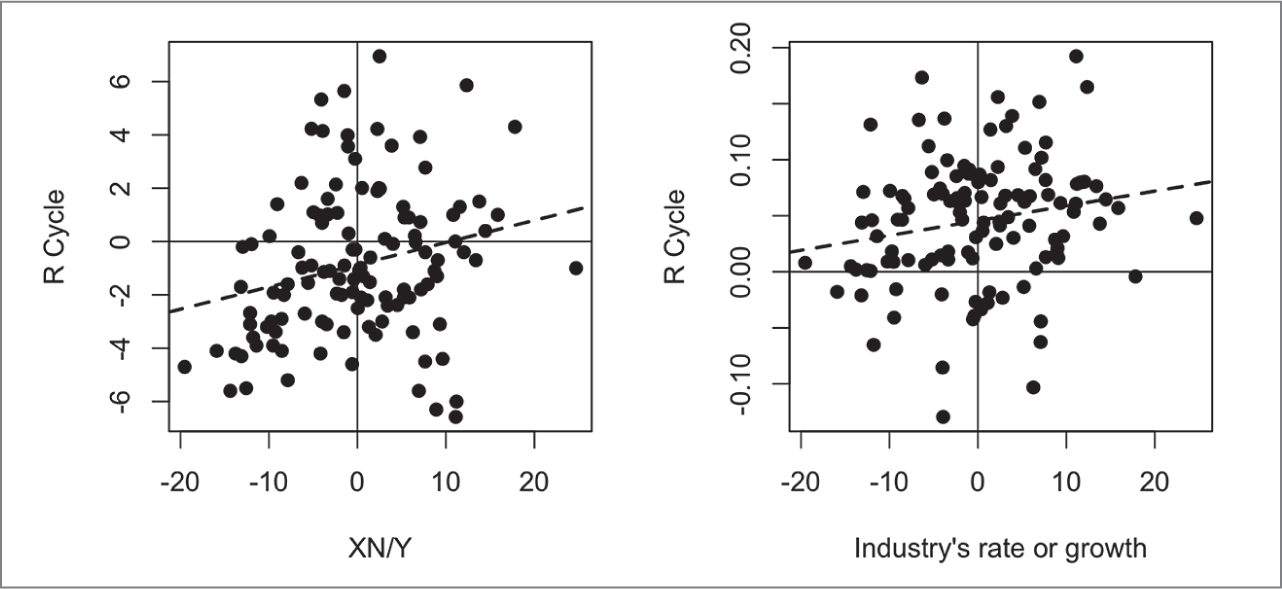 Source: Own calculations based on data from
  Source: Own calculations.