
 One hundred years of Dutch disease in Macondo: the rise and collapse of coffee and oil booms in Colombia
ABSTRACT
This paper aims to advance the empirical understanding of Dutch disease in Colombia by integrating theory, history, and econometrics. It first reviews the main analytical traditions and argues that the canonical Corden-Neary model cannot fully account for Colombia’s long run trajectory, motivating the adoption of a broader heterodox perspective. The empirical contribution is twofold. First, a descriptive historical analysis traces the evolution of coffee and oil booms and their relationship with structural change over the twentieth century. Second, a difference VAR is estimated to examine the short run statistical linkages among the real exchange rate, the industrial share of GDP, and the export shares of coffee and oil. The results indicate that, coffee shocks generate stronger industrial gains than oil; real depreciation temporarily supports manufacturing; industrialization shows strong path dependence; and commodity booms repeatedly induce real appreciation consistent with Colombia’s long run pattern of cyclical overvaluation.
JEL Classification: O11; O14; F41; F44; N16.
KEYWORDS:
Dutch disease; industrialization; real exchange rate dynamics; commodity booms; Colombian economy
INTRODUCTION
The economic history of Colombia resembles, in many respects, the solitude that García Márquez attributes to Macondo, a century long condition shaped by external shocks, commodity dependence, and frustrated attempts at structural transformation. Episodes of coffee, oil, and mineral booms have repeatedly promised modernization, yet their macroeconomic consequences have often reinforced the very vulnerabilities they were expected to overcome. Dutch disease mechanisms help explain why these bonanzas resulted in long run stagnation rather than sustained development. In this sense, Colombia’s experience can be read as a form of economic solitude: a persistent structural trap rooted in a developmental model overly reliant on natural resource exports.
Such enduring vulnerability suggests that Colombia’s commodity booms cannot be understood merely as episodic events, but rather as components of a longer developmental trajectory. From this perspective, the Colombian Dutch disease literature faces the unresolved challenge of integrating successive commodity cycles into a unified long run analytical framework. Existing studies tend to examine isolated booms, whether coffee, oil, bananas, or capital inflow episodes, without clarifying how these recurrent shocks cumulatively shaped the country’s structural trajectory. As a result, we still lack an explanation that connects the historical sequence of appreciation cycles, external financing surges, and shifts in productive specialization to Colombia’s persistent pattern. This fragmentation leaves unresolved a central question: whether Dutch disease in Colombia has been episodic or a permanent structural condition.
This article makes four contributions to the study of Dutch disease in Colombia. First, it provides an exhaustive and historically grounded review of the literature, synthesizing a century of research that remains dispersed across theoretical, temporal, and sectoral lines. Second, it offers a novel examination of the competing theoretical frameworks used to analyze Dutch disease, neoclassical, new developmentalist, and post-Keynesian, by establishing a set of analytical categories that allow for systematic comparison across schools of thought. Third, it constructs a long run dataset spanning 1905-2024 that traces the evolution of Colombia’s export structure, industrial performance, and real exchange rate, thereby enabling a century long assessment of structural change. Fourth, it delivers a systematic empirical identification of the mechanisms linking commodity booms, exchange rate appreciation, and deindustrialization through a VAR in first differences, showing that appreciation shocks and commodity surges interact to produce cumulative and path dependent patterns of structural regression.
The article proceeds as follows. Section 2 offers a comprehensive review of the literature, synthesizing a century of research on Dutch disease in Colombia. Section 3 develops the theoretical framework by comparing neoclassical, new-developmentalist, and post-Keynesian approaches. Section 4 turns to the empirical analysis, examining the historical evolution of Colombia’s export structure, industrial dynamics, and real exchange rate cycles, and subsequently assessing Dutch disease mechanisms through a difference VAR. Section 5 concludes.
LITERATURE REVIEW
The persistence of a primary export pattern in Colombia, characteristic of peripheral economies, has triggered an extensive academic debate on Dutch disease as an expression of structural dependence. Consequently, a substantial body of literature has emerged, which can be organized along several analytical dimensions. First, from a theoretical standpoint, the dominant approach has been the neoclassical framework adapted from Corden and Neary (1982). Numerous contributions on the Colombian case fall within this tradition (Edwards, 1984, 1986; Gaviria, 2015; Goda and Torres, 2015; Kamas, 1986; López et al., 2016; Meisel, 2010; Posada, 1992; Puyana and Oxon, 1994; Reina et al., 2018; Sierra and Manrique, 2014; Suescún, 1997; Wunder, 1992). Nonetheless, alternative perspectives have also emerged as significant contributions, particularly post-Keynesian approaches (Botta, 2017; Botta et al., 2017) and structuralist analyses (García, 2002; Ocampo, 2015).
A second dimension involves a temporal approach, in which eight export boom super cycles associated with Colombia’s main primary commodities, bananas, coffee, and oil, are identified between 1910 and 2003 (López et al., 2016; Meisel, 2010; Posada, 1992). A third dimension corresponds to the spatial approach, which examines the differentiated regional impacts of the oil and mining energy booms, highlighting their strong territorial heterogeneity (Meisel, 2010; Reina et al., 2018). Finally, a fourth analytical layer focuses on the uneven sectoral effects within the manufacturing structure, particularly during the extractive boom of the early twenty first century (Sierra and Manrique, 2014).
Another category closely aligned with the purpose of this paper, yet not encompassed within the four dimensions discussed above, seeks to interpret Dutch disease in Colombia over the past one hundred years by examining the commodities and additional drivers that underpinned its eight export booms: bananas, oil, and, as the emblematic protagonist of the twentieth century, coffee. To these real sector factors, a more recent analytical strand adds the financial dimension of the balance of payments, emphasizing how capital account liberalization amplified the symptoms of currency appreciation and external dependence, thereby redefining the traditional channels through which boom episodes are transmitted.
A comprehensive, century long analysis of Dutch disease in Colombia must begin with the existing literature, which has largely evolved through isolated studies focused on individual commodity cycles. The first manifestation is traced to the banana boom (1910-1920), when coffee expansion displaced bananas through cost increases generated by real appreciation (Meisel, 2010). Throughout the twentieth century, the literature centered on coffee bonanzas as the main source of external windfalls, emphasizing their structural effects on the productive and monetary framework (Edwards, 1984, 1986). Coffee remained Colombia’s dominant export and the principal driver of macroeconomic cycles, with major booms occurring between 1927 and 1985 (Ocampo, 2015; Posada, 1992). By the end of the century, a structural change occurred as petroleum replaced coffee as the leading export, producing two major cycles: one quantity driven in the early 1990s and another price led between 2003 and 2008. More recent analyses link Dutch disease symptoms to the post-1990 financial liberalization, as capital inflows, particularly foreign direct investment, amplified appreciation pressures and deepened vulnerabilities typical of commodity led booms (Botta et al., 2017; García, 2002).
Since the early twentieth century several authors highlight that not all commodity booms operate through identical mechanisms. Edwards (1984, 1986), Kamas (1986) and Puyana and Oxon (1994) agree that coffee booms tend to be shorter, more labor intensive, and rooted in small private producers, creating wider employment and domestic linkages than oil, whose enclave structure and high foreign ownership constrain spillovers. Wunder (1992) emphasizes that the duration and intensity of each boom determine the persistence of structural distortions. Meanwhile, Edwards (1986) also notes that fiscal policy is less effective in managing coffee revenues than oil rents, which can serve as stabilization instruments.
Given the long historical period under analysis, multiple factors interacted, shaping the specific features of each Dutch disease episode. The literature also stresses that several variables may either intensify or mitigate its effects. These include the degree of capital mobility, the exchange rate regime, whether fixed or flexible, the presence of sterilization mechanisms, and trade policy instruments such as tariffs. Exogenous elements, like the income performance of trading partners, and domestic policies, including industrial and institutional arrangements, also play a decisive role. For instance, the National Federation of Coffee Growers historically contributed to price stabilization and income smoothing, moderating the macroeconomic transmission of external shocks.
As shown in the preceding review, existing studies on Dutch disease in Colombia remain fragmented across theoretical, temporal, and sectoral dimensions. Building on these contributions, the present work offers a comprehensive historical account of a hundred years of Colombian commodity cycles, identifying the dominant products and mechanisms shaping each episode. Methodologically, it advances beyond the orthodox Corden-Neary paradigm by employing a heterodox framework that integrates structural, monetary, and financial dimensions of Dutch disease dynamics.
DUTCH DISEASE AND STRUCTURAL CHANGE: A THEORETICAL FRAMEWORK OF COMPETING APPROACHES
The term Dutch disease originated as a fear of de industrialization, the concern that resource booms may erode a nation’s productive and technological base. As Gylfason (2018) explains, interpretations diverge between those who regard it as a benign reallocation of resources and those who see it as a genuine pathology, whereby the economy fails to advance toward more complex and sophisticated sectors. Within this debate, Corden (1984), Corden and Neary (1982), and van Wijnbergen (1984) represent the first tradition, which formalized the phenomenon through a neoclassical framework centered on relative price adjustments and intersectoral factor mobility captured by microeconomic spending and resource movement effects. In contrast, the second tradition, formulated by Bresser-Pereira (2008, 2020), Bresser-Pereira et al., (2016), and Botta (2010, 2017) advance a developmentalist interpretation that situates the phenomenon within the macroeconomics of structural change, emphasizing how exchange rate misalignment and financial globalization constrain industrial deepening and technological learning.
Inspired by Dow (1998), we construct eleven analytical categories to differentiate the theoretical approaches to Dutch disease. As noted, two broad strands can be identified: the neoclassical and a second one that may be subdivided into the new developmentalist and post-Keynesian schools. The selected methodological categories are: (1) hierarchy of commodities and productive structure, (2) time, (3) micro or macro foundation, (4) real or monetary analysis, (5) currency hierarchy, capital flows, and development finance, (6) income distribution, (7) role of the state, (8) employment, (9) role of demand and supply, (10) theory of value, and (11) political economy perspective. The following table summarizes how each model addresses these dimensions, serving as the basis for selecting one of them as the analytical framework of this study.
Comparative Theoretical Approaches to Dutch disease: Neoclassical, New-Developmentalist, and Post-Keynesian Perspectives
Corden and Neary’s model (1982, 1984) builds a three sector, small open economy with a representative agent optimizing in real terms under full employment and flexible prices. The framework assumes no monetary sector, neither domestic money nor reserve currency, and posits market clearing relative prices as the main coordination device. Factor payments follow productivity, implying no distributional conflict or political economy dimension. Output is supply determined, while demand remains neutral. Resource and spending effects emerge when a boom in the traded sector attracts capital and labor away from manufacturing and agriculture, reflecting sectoral factor intensities. The model thus explains relative price shifts without invoking macro dynamics.
Subsequent refinements introduce real world frictions through theoretical imperfection tools: partial wage rigidity, imperfect capital mobility, and portfolio diversification. Foreign capital inflows and domestic investment decisions adjust the real exchange rate and the extent of deindustrialization. Despite these imperfections, the framework remains real, static, and equilibrium based, with state intervention confined to neutralizing temporary distortions rather than reshaping structural allocation. Later contributions sought to overcome this limitation. Van Wijnbergen (1984) introduced learning by doing as a dynamic externality in the traded goods sector, showing that productivity growth depends on cumulative experience and thus that temporary booms can have lasting developmental costs. Ros (2022), in turn, reinterprets Dutch disease using developmentalist elements, such as scale economies and structural linkages, but still relies on neoclassical instruments like production functions, factor reallocation, and real side adjustments to capture structural change.
Secondly, the post-Keynesian structuralist model developed by Botta (2010, 2017) explains Dutch disease as the outcome of the interaction between productive specialization and external financial dependence. The framework connects a resource exporting sector with a Kaleckian manufacturing sphere, where growth depends on capacity utilization and investment. Foreign direct investment and portfolio inflows create a currency hierarchy that exposes the economy to foreign currency debt. Exchange rate appreciation under these conditions triggers cumulative financial and productive fragility. The system is demand led, yet adjustment operates through monetary and balance sheet channels rather than labor markets or income distribution.
Within the eleven analytical categories, the core element of Botta’s model is the incorporation of external financing as a key driver of structural and monetary dynamics. The framework assigns hierarchical importance to manufacturing, measured through its share in GDP, and relies entirely on macroeconomic mechanisms without representative agents. Time and money are central, as the analysis is dynamic and focuses on the convergence of key variables. Nonetheless, the model does not incorporate income distribution, employment, or an explicit theory of value, nor does it address political economy.
In the third place, the new developmentalist model (Bresser-Pereira, 2008, 2020; Bresser Pereira et al., 2016) identifies the real exchange rate as the central variable explaining structural change and long-term growth. It assumes a permanently overvalued currency, which ceases to be a mechanism of factor allocation and becomes instead a dynamic variable driven by investment demand. Profitability, and therefore investment, depends on the exchange rate: appreciation compresses profits, discourages industrial investment, and reinforces premature deindustrialization. The sequence of causality runs from the exchange rate to profitability, from profitability to investment, and from investment to growth and employment.
Under this framework, the model integrates the hierarchies of commodities and currencies. Manufacturing functions as the primary source of increasing returns and technological learning, while the currency hierarchy ties the national economy to the reserve currency. The relative price of the domestic currency against the reserve currency shapes the path of structural change, productivity, and income distribution. Classical value theory provides the basis for understanding Ricardian rents and their implications for exchange rate overvaluation and Dutch disease, while other macro prices, such as wages and interest rates, are shaped by power relations rather than pure market equilibrium. The model operates in the absence of rational representative agents; instead, the macroeconomic gains from industrialization diffuse throughout the system, as suggested by Young (1928) and by certain Kaldorian models (Blecker and Setterfield, 2019).
The framework is both supply and demand led: investment, exports, and consumption shape growth, while productive capacity expands through industrial sophistication that offsets Dutch disease. The state plays a central role in coordinating macroeconomic and industrial policy and in regulating the five macro prices, the exchange rate, interest rate, profit rate, wage rate, and inflation rate, through consistent policy instruments. Finally, political and social groups influence the state’s capacity for coordination and macroeconomic stability. For these reasons, the new-developmentalist approach constitutes the most refined critique of the neoclassical Dutch disease framework and serves as the analytical foundation for this work.
EMPIRICAL ANALYSIS OF CYCLICAL OVERVALUATION AND STRUCTURAL CHANGE IN COLOMBIA
To advance a heterodox interpretation of Dutch disease in Colombia, this article adopts an empirical strategy grounded in both historical breadth and structural analysis. It begins by assembling a long run dataset spanning 1905-2024, capturing the real exchange rate, total and industrial output, the industrial share of GDP, the export composition of coffee, oil, bananas, gold, manufactures, and other goods, and the current account balance relative to GDP11. Building on this foundation, the study first traces the historical trajectory of these variables to identify persistent patterns in Colombia’s external and productive structure. It then turns to a more rigorous econometric assessment, estimating a VAR in first differences to examine the structural mechanisms linking commodity booms, exchange rate movements, and industrial performance.
Long run patterns of Dutch disease: export composition and the dynamics of the industrial sector and the real exchange rate
Figure 1, specifically the panel labelled the export share of key commodity sectors, offers a useful entry into Colombia’s historical export dynamics, indicating that the country’s meaningful integration into world markets took shape during the twentieth century, when coffee emerged as the central driver. Although coffee cultivation had expanded steadily since the 1870s, by 1905 it already accounted for nearly 40 percent of total exports (Banco de la República, 2004). Throughout the twentieth century, coffee remained the country’s dominant export commodity, reaching peak shares of over 80 percent in 1924 and 1954, and 64 percent in 1978. Petroleum constituted the other significant commodity cycle shaping the country’s export structure. Oil exploration began in 1926, and for roughly two decades petroleum represented close to 20 percent of total exports before declining sharply and nearly disappearing by the early 1980s. Subsequent policy incentives prompted a remarkable recovery, making oil the leading export by 2024 and reaching a historical high of 44 percent in 2013, thus displacing coffee as the economy’s main external earnings source. Other products, such as bananas and gold, contributed intermittently to export revenues but never matched the systemic weight of coffee or oil. Meanwhile, the category of “other exports” increased from 3 percent in 1955 to 71 percent in 2006, suggesting greater diversification, though still concentrated in primary agricultural and mineral goods such as coal, ferronickel, emeralds, and flowers.

Long Run Trends in Colombia’s Export Structure, Manufacturing Sector, and Real Exchange Rate (1905-2024)
Consistent with the interpretations of Findlay and O’Rourke (2007) and Reinert (2007), the trajectory depicted in Figure 1 illustrates how Colombia entered the world economy under unequal power relations that confined it to a peripheral role as a supplier of primary commodities activities marked by declining productivity dynamics and unfavorable terms of trade. This structural condition echoes the diagnosis advanced by Bresser-Pereira et al. (2016), who argue that economies unable to shift from commodity dependence to more sophisticated sectors tend to exhibit a chronic or permanent Dutch disease.
The middle panel of Figure 1, which traces manufacturing activity in Colombia from 1905 to 2024, makes evident the existence of two long cycles. The first, lasting until 1975, is one of sustained expansion: manufacturing’s share of GDP rose consistently, and industrial output grew faster than the overall economy. This expansion occurred in the aftermath of the Thousand Days War, when the state undertook significant reconstruction efforts, expanded infrastructure, and facilitated the importation of machinery and equipment (Misas, 2019). Notably, however, the period between 1920 and 1930 shows a marked slowdown in industrial growth, precisely when coffee prices and exports surged and foreign capital inflows financed major infrastructure projects. This prosperidad al debe phase has been widely interpreted as an early episode of Dutch disease or premature deindustrialization (Palma, 2019). Following the 1929 crash, Colombia, like much of Latin America, adopted an inward looking, state led industrialization strategy (Bértola and Ocampo, 2013), which sustained manufacturing growth until the mid-1970s.
The second cycle, beginning in 1975, is characterized by a sustained industrial decline that continues today. The turning point coincided with one of the most prolonged and intense coffee booms on record (Edwards, 1984; Kamas, 1986), and unfolded alongside successive episodes of large external inflows: the debt driven liquidity surge of the late 1970s, the coffee boom of the mid-1980s, the extensive liberalization of the capital account combined with the emergence of major new oil fields over the course of the 1990s, and the commodity super cycle of the early twenty first century. Instead of revitalizing manufacturing, these extraordinary external inflows deepened the economy’s dependence on natural resource rents and foreign capital, consolidating a four decade long process of deindustrialization.
In sum, the evidence reveals two major deindustrialization phases, 1920-1930 and 1975-2024, each unfolding amid surges of natural resource income and abundant external funding that undermined the dynamism of manufacturing. Yet, viewed through a new developmentalist lens, these episodes reflect a deeper structural pattern. Colombia’s persistent inability to build a complex and technologically advanced productive base suggests that Dutch disease may have been a permanent condition, with the two downturns representing unsuccessful moments in the long and unfinished transition toward productive sophistication.
The bottom panel of Figure 1, which displays the evolution of the real exchange rate (R) over the full period of analysis, is essential for interpreting the long run behavior of Dutch disease in Colombia. Decomposing the series with the Hodrick-Prescott filter reveals the pattern that new developmentalist authors describe as cyclical overvaluation: recurrent episodes in which the currency depreciates, reaches a peak, and then moves toward a trough of significant real appreciation. Eight such cycles appear clearly, 1905-1913, 1913-1928, 1929-1956, 1957-1966, 1967-1983, 1984-1996, 1997-2012, and 2013-2024, each with distinct intensities, durations, and speeds of adjustment. The 1913-1928 cycle is particularly illustrative: the 1920 peak and subsequent decade long appreciation reflect the dual boom in coffee prices and capital inflows associated with Wall Street exuberance. Likewise, the 1967-1983 cycle exhibits continuous appreciation from 1975 to 1983. The cumulative frequency and depth of the later cycles are consistent with hysteresis in Colombia’s productive structure, a mechanism that helps explain the long and persistent deindustrialization phase observed since the mid-1970s.
A second salient feature is the long run trend of the real exchange rate, which follows three distinct regimes. The series remains broadly stable around its mean from 1905 to 1929, then enters a prolonged depreciation from 1930 to 1992, and stabilizes once again thereafter. This extended depreciation period corresponds to decades in which the Colombian state adopted an increasingly interventionist stance, by using exchange rate policy episodically as a complementary tool for industrialization and for strengthening the economy’s international position. In this sense, exchange rate management helped counteract the pattern of cyclical overvaluation emphasized by the new developmentalist literature, thereby mitigating Dutch disease pressures during much of the mid twentieth century.
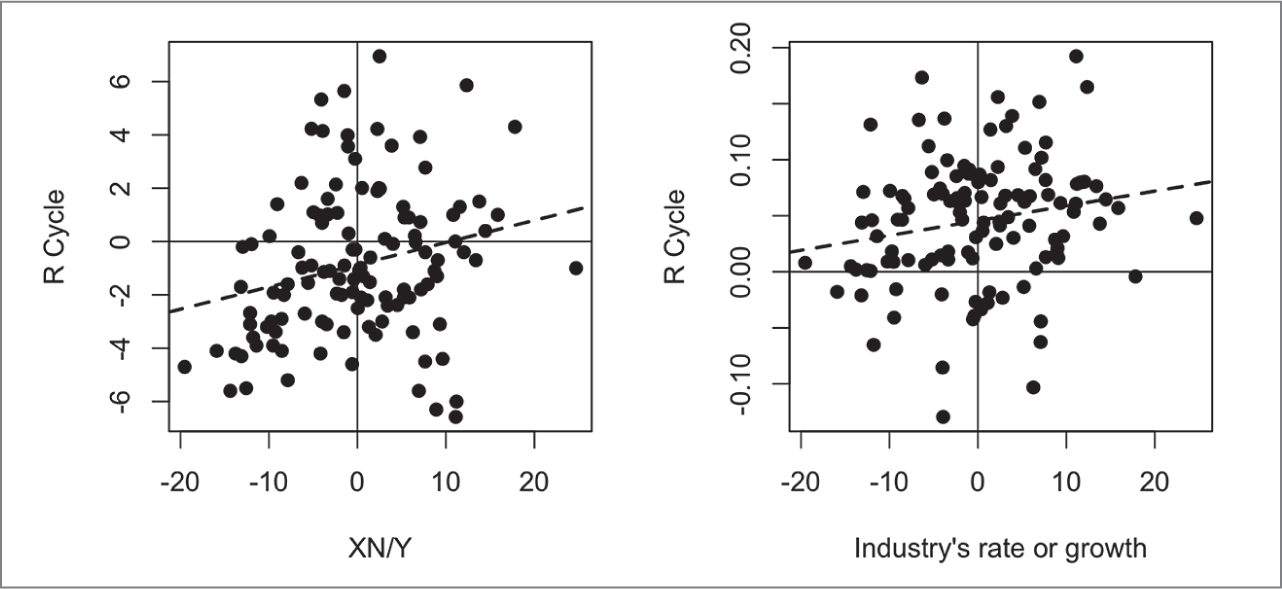
As shown in Figure 2, particularly in the trend lines of the dispersion diagrams, a third salient feature of the real exchange rate is its capacity both to facilitate current account adjustment and to support industrial growth. The former operates through improved international competitiveness for Colombia’s nontraditional exports and through a simultaneous moderation of import growth, while the latter reflects the positive effect of a more competitive exchange rate on industrial profit rates, thereby stimulating investment and strengthening the sector’s growth performance.

A difference VAR to assess Dutch disease mechanisms
This section applies a more rigorous quantitative method to assess the statistical linkages among the central variables identified in the preceding theoretical and historical analysis. Although most of the series are available from 1905, the sample is restricted to 1929-2024 because the historical availability of oil export data sets the effective temporal boundary. Within this period, the export shares of coffee and oil, the industrial share of GDP, and the real exchange rate are employed to evaluate the mechanisms associated with Dutch disease. The empirical framework relies on either a VAR or a VEC model, depending on the results of the unit root and cointegration tests performed on the series.
Unit root tests were conducted using both the Augmented Dickey-Fuller (ADF) and the Elliott-Rothenberg-Stock (DF-GLS) procedures applied to the variables in levels. The results indicate that the export shares of coffee (CX) and oil (PXEMP), as well as the industrial share of GDP (INDY), are non-stationary in levels but become stationary after first differencing. In contrast, the real exchange rate (R) rejects the unit root hypothesis at the 5 percent level under the ADF specification with a deterministic trend. Johansen cointegration tests were applied only to the variables classified as I (1), that is, all series except the real exchange rate. The results indicate that no cointegrating vectors were detected. Consequently, the empirical model proceeds with a VAR in first differences.
Based on the lag selection criteria, a two-lag VAR was retained, as the LR test, FPE, and AIC jointly point to this specification. The full set of diagnostic tests was then conducted. The LM tests show no evidence of serial correlation at lags 1-3, and the joint heteroskedasticity test does not reject the null of homoscedastic residuals (p = 0.21). The multivariate normality test rejects the null due to excess kurtosis in the first residual component; however, departures from normality of this type are common in long historical macroeconomic series and do not affect the consistency of the VAR estimates. Finally, all characteristic roots lie strictly inside the unit circle, confirming that the model satisfies the stability condition required for valid impulse response analysis.
The impulse-response functions (IRFs) provide a dynamic representation of how short run variations in each variable react to an orthogonal shock in the others, allowing us to trace the timing, magnitude, and direction of these adjustments.
Figure 3 focuses on two rows of relevance: the responses of the industrial share of GDP (DINDY) and those of the real exchange rate (DR). The second row shows that manufacturing responds positively to both coffee (DCOFFE) and oil (DOIL) booms, though the magnitude of the coffee shock is considerably larger. This pattern is consistent with the arguments advanced by Kamas (1986) and Puyana (1994), who stress that the coffee economy was characterized by a wide distribution of land ownership, stronger domestic linkages, greater market expansion, and broader income dispersion, all of which stimulated internal demand. Oil, by contrast, displays the typical features of an enclave sector, with revenues concentrated in a single institutional node, the state, whose fiscal transmission mechanism, filtered through royalties and centralized spending, limits the breadth of spillovers. In the IRFs this asymmetry is clear: the oil boom generates a mild positive effect in the early periods but turns negative thereafter. Industry also exhibits strong path dependence, as DINDY reacts persistently to its own shock, reflecting the cumulative effects of input-output complementarities, internal market creation, and employment generation. This persistence reinforces the idea that industrialization and deindustrialization are self-reinforcing processes: once a trajectory is set, endogenous mechanisms either promote further productive upgrading or deepen structural regression. The depreciation shock raises industrial activity for about two years before the effect reverses, suggesting that ongoing policy support is necessary to prevent renewed structural decline. This pattern is consistent with the new developmentalist diagnosis of cyclical overvaluation, whereby recurrent appreciation episodes progressively erode the foundations of industrial growth.

Impulse Response: Industrial Share of GDP, Real Exchange Rate, Coffee Exports, and Oil Exports
The fourth row of Figure 3 reports the responses of the real exchange rate. Both commodity booms lead to real appreciation, with the effect being markedly stronger for coffee, an outcome that mirrors its larger and more persistent share of total exports throughout the historical period. This pattern reinforces the interpretation that Colombian commodity cycles, particularly those driven by coffee, exerted sustained appreciation pressures that interacted with the dynamics of cyclical overvaluation highlighted in the previous sections.
CONCLUSIONS
The Colombian experience over the past century suggests that Dutch disease has not been an episodic disturbance but rather a persistent structural condition. By placing successive coffee and oil booms within a unified long-run narrative, this article has shown that Colombia’s insertion into the world economy as a primary commodity exporter has repeatedly reinforced a pattern of cyclical real exchange rate overvaluation, fragile industrialization, and incomplete structural transformation. The Macondo metaphor is thus more than literary: it captures a developmental trajectory in which each new boom promises modernization, yet the underlying productive structure remains trapped in a narrow pattern of specialization and external dependence.
The empirical analysis reinforces this interpretation. The historical evidence from 1905-2024 documents how coffee and oil alternated as leading export commodities, while manufacturing underwent two major phases of deceleration and decline coinciding with periods of abundant external income and capital inflows. The difference VAR for 1929-2024 shows that coffee booms generate stronger short-run industrial gains than oil, but both commodities induce real appreciation, with coffee exerting the larger and more persistent effect. The real exchange rate temporarily supports industrial activity when it depreciates, yet its positive effect is short-lived and easily reversed. Moreover, the strong path dependence of the industrial share of GDP underscores that both industrialization and deindustrialization are cumulative processes: once the productive structure moves in a given direction, endogenous mechanisms tend to amplify rather than offset that trajectory.
These findings lend support to a new developmentalist reading of Dutch disease in Colombia. They suggest that managing commodity booms requires more than short-term macroeconomic fine tuning; it demands an exchange rate regime and an industrial policy framework explicitly oriented towards sustaining competitiveness in manufacturing and promoting technological upgrading. Policy instruments such as countercyclical fiscal rules, active reserve accumulation, capital account management, and targeted industrial support are essential to counteract the appreciation pressures associated with commodity and capital flow surges. While the empirical strategy employed here is limited by data constraints and by the reduced form nature of the VAR approach, most notably the lack of information to model financial account effects or to derive an industrial equilibrium real exchange rate, the results point to a clear conclusion: without deliberate efforts to break the historical pattern of cyclical overvaluation and enclave type booms, Colombia risks remaining, like Macondo, locked into a form of economic solitude in which each new boom reproduces, rather than resolves, its structural vulnerabilities.
-
1
The empirical dataset used in this study is based primarily on the Historical Statistical Series of Colombia (Banco de la República, n.d.), which provide data on total GDP, the current account balance, the real exchange rate, and the composition of exports. To ensure historical continuity, the current account and real exchange rate series were extended using the GRECO database (Banco de la República, 1999) and Meisel (2010). Industrial GDP and the industrial share of output were obtained from Ocampo (2023) and subsequently linked to the Banco de la República series (Banco de la República, n.d.), resulting in a unified annual dataset covering 1905-2024.
Data Availability Statement
The dataset supporting the findings of this study is constructed from publicly available historical sources, primarily the Historical Statistical Series of Colombia (Banco de la República), the GRECO database, and complementary series from Ocampo (2023) and related sources. These data were compiled, harmonized, and extended by the authors to produce a unified long-run annual dataset covering the period 1905–2024. The processed dataset and replication materials used in the analysis are available from the corresponding author upon reasonable request.
REFERENCES
-
Banco de la República (s.f.), Series estadísticas históricas de Colombia, disponible en: https://www.banrep.gov.co/es/estadisticas-economicas/series-estadisticas-historicas-colombia (consultado en: 19 septiembre 2025).
» https://www.banrep.gov.co/es/estadisticas-economicas/series-estadisticas-historicas-colombia - Banco de la República, GRECO − Grupo de Estudios de Crecimiento Económico Colombiano (1999), El desempeño macroeconómico colombiano: Series estadísticas (1905-1997), (2a. versión), Banco de la República, Bogotá, D.C., Colombia.
- Bértola, L. and Ocampo, J.A. (2013), El desarrollo económico de América Latina desde la Independencia, Fondo de Cultura Económica, Ciudad de México, México.
- Blecker, R.A. and Setterfield, M. (2019), Heterodox macroeconomics: models of demand, distribution and growth, Edward Elgar, Cheltenham, UK and Northampton, MA.
- Botta, A. (2010), “Structuralist macroeconomics and the new developmentalism: the case of Brazil”, Metroeconomica, Vol. 61 No. 4, pp.775-811.
- Botta, A. (2017), “Dutch disease-cum-financialization booms and external balance cycles in developing countries”, Brazilian Journal of Political Economy, Vol. 37 No.3, pp.459-477.
- Botta, A.; Godin, A.; Missaglia, M. (2016), “Finance, foreing (direct) investment, and the Dutch disease. The case of Colombia”, Economía Política, Vol. 33 No. 2,pp.265-289.
- Bresser-Pereira, L.C. (2008), “The Dutch disease and its neutralization: a Ricardian approach”, Brazilian Journal of Political Economy, Vol. 28 No. 1, pp.47-71.
- Bresser-Pereira, L.C. (2020), New developmentalism: development macroeconomics for middle income countries. Routledge, London and New York.
- Bresser-Pereira, L.C.; Oreiro, J.L.; Marconi, N. (2016), Macroeconomia desenvolvimentista: teoria e política econômica do novo desenvolvimentismo, Elsevier, Rio de Janeiro.
- Corden, M. (1984), “Booming sector and Dutch disease economics: survey and consolidation”, Oxford Economic Papers, Vol. 36 No.3, pp.359-380.
- Corden, M. and Neary, P. (1982), “Booming sector and de-industrialisation in a small open economy”, The Economic Journal, Vol. 92, pp.825-848.
- Dow, S.C. (1996), The methodology of macroeconomic thought: a conceptual analysis of schools of economics Edward Elgar Publishing, Northampton, MA.
- Edwards, S. (1984), “Coffee, money and inflation in Colombia”, World Development, Vol. 12 No. 11-12), pp.1107-1117.
- Edwards, S. (1986), “Commodity export prices and the real exchange rate in developing countries: coffee in Colombia”, Edwards, S. and Ahamed, L. (Ed.s.), Economic adjustment and exchange rates in developing countries, University of Chicago Press, Chicago, pp.233-266.
- Findlay, R. and O’Rourke, K.H. (2007), Power and plenty: trade, war, and the world economy in the second millennium, Princeton University Press, Princeton, NJ.
- Garcia, J.G. (2002), “Liberalización, cambio estructural y crecimiento económico en Colombia”, Cuadernos de Economía, Vol. XXI No.36, pp.190-243.
- Gaviria, N. (2013), Boom de commodities y enfermedad holandesa en Colombia: ¿Importa la cuenta de capitales? Trabajo de grado en Economía. Universidad EAFIT, Medellín, Colombia.
-
Goda, T. and Torres García, A. (2015), “Flujos de capital, recursos naturales y enfermedad holandesa: el caso colombiano”, Ensayos sobre Política Económica, Vol. 33, pp.197.206, disponible en: https://doi.org/10.1016/j.espe.2015.07.001
» https://doi.org/10.1016/j.espe.2015.07.001 - Gylfason, T. (2018), “Dutch disease”, Beaud, M.P. and Beaud, M.L. (Ed.s.), The Palgrave Dictionary of Economics, Palgrave Macmillan, Londres, pp.3112-3116.
- Kamas, L. (1986), “Dutch disease economics and the Colombian export boom”, World Development, Vol. 14 No. 3, pp.393-403.
-
López González, M.; Torres Gómez, E.E.; Giraldo González, S. (2016), “The evolution of Colombian industry in the context of the energy-mining boom: symptoms of the Dutch disease?”. Cuadernos de Economía, Vol. 35 No. 68), pp.475-490, available at: https://doi.org/10.15446/cuad.econ.v35n68.54255
» https://doi.org/10.15446/cuad.econ.v35n68.54255 - Meisel Roca, A. (2010), “Enfermedad holandesa y exportaciones de banano en el Caribe colombiano, 1910-1950”, Cuadernos de Historia Económica y Empresarial, No. 26, Banco de la República, Sucursal Cartagena, Colombia.
- Misas, G. (2019), Regímenes de acumulación y modos de regulación: Colombia 1910-2010, Vol. I, 1989-2010 Universidad Nacional de Colombia, Bogotá, Colombia.
-
Ocampo, J.A. (2023), Crecimiento económico colombiano y sus efectos sobre el desarrollo social y regional, 1905-2019, Banco de la República, Bogotá, D.C. Colombia, disponible en: https://doi.org/10.32468/Ebook.664-470-9
» https://doi.org/10.32468/Ebook.664-470-9 - Palma, J.G. (2019), “Desindustrialización, desindustrialización ‘prematura’ y ‘síndrome holandés’”, El Trimestre Económico, Vol. 86 No. 344, pp.901-966.
- Posada, C.E. (1992), “Macroeconomía y café en Colombia: un sumario de los efectos macroeconómicos de la economía cafetera”, Lecturas de Economía, No. 37, pp.11-39.
- Puyana, A. (1994), “La enfermedad holandesa y las bonanzas petroleras y cafeteras en Colombia: algunas consideraciones en torno a experiencias propias y ajenas”, Montoya, J.G. and Thoumi, F. (Ed.s.), Auge cafetero, petróleo y economía colombiana, Tercer Mundo Editores, CENIT, Universidad Nacional de Colombia, Bogotá, Colombia, pp.51-75..
- Reina, L.; Alejo, D.; Devia, N. (2018), “Análisis regional de Colombia y su maldición de recursos naturales: cambios institucionales tardíos” EURE, Vol. 44 No. 131, pp.125-149.
- Reinert, E. S. (2007), How rich countries got rich... and why poor countries stay poor, Constable, London.
- Ros, J. (2022), La riqueza de las naciones en el siglo XXI: desarrollo económico, crecimiento e instituciones, Fondo de Cultura Económica, Ciudad de México, México, pp.386-409.
- Sierra, L.P. and Manrique, K. (2014), “Impacto del tipo de cambio real en los sectores industriales de Colombia: una primera aproximación”, Revista CEPAL, Vol. 114, pp.127-144.
- Suescún, R. (1997), “Commodity booms, Dutch disease, and real business cycles in a small open economy: the case of coffee in Colombia”, Borradores de Economía, No. 60, Banco de la República, Bogotá, D.C., Colombia.
- Urrutia, M.; Pontón, A; Posada, C.E. (2004), El crecimiento económico colombiano en el siglo XX: aspectos globales Banco de la República, Bogotá, Colombia, Fondo de Cultura Económica, Ciudad de México, México.
- Van Wijnbergen, S. (1984), “The ‘Dutch disease’: a disease after all?”, The Economic Journal, Vol. 94 No. 373, pp.41-55.
- Wunder, S. (1992), La enfermedad holandesa y el caso colombiano Banco de la República, Subgerencia de Estudios Económicos, Cartagena, Colombia.
- Young, A. A. (1928), “Increasing returns and economic progress”, The Economic Journal, Vol. 38 No. 152, pp.527-542.
-
Editor responsible for the evaluation process:
Luiz Carlos Bresser-Pereira

 Source: Own calculations based on
  Source: Own calculations based on data from
  Source: Own calculations.