
 Central Bank Digital Currencies (CBDCs) and Instant Payments: alternatives to global digital asset markets for Brazil and India
ABSTRACT
This article aims to analyse the strategy of central banks in emerging market economies (EMEs) as they navigate the increasing digitalized financial landscape. Evidence indicates a trend of declining physical cash usage, particularly among younger adults. This study utilizes qualitative data from Brazil and India, sourced from the Bank of International Settlements (BIS) spanning 2012-2020, and incorporates an extrapolation exercise to support its findings. This shift towards digital payments has raised concerns regarding the potential loss of monetary autonomy and domestic macroeconomic stability. However, some central banks in EMEs, such as in Brazil and India, have proactively advanced in the implementation of Central Bank Digital Currencies (CBDCs) and fast payment instruments to address the rapid growth of unregulated global digital asset markets.
KEYWORDS:
Central bank digital currencies; emerging market economies; cash ratios
RESUMO
Este artigo tem como objetivo analisar a estratégia dos bancos centrais em economias de mercado emergentes (EMEs) à medida que navegam um cenário financeiro cada vez mais digitalizado. As evidências indicam uma tendência de declínio no uso de dinheiro físico, principalmente entre adultos mais jovens. Este estudo utiliza dados qualitativos do Brasil e da Índia, obtidos do Bank of International Settlements (BIS) abrangendo 2012-2020, e incorpora um exercício de extrapolação como suporte para seus argumentos. Essa mudança para pagamentos digitais levantou preocupações quanto à potencial perda de autonomia monetária e estabilidade macroeconômica doméstica. No entanto, alguns bancos centrais em EMEs, como no Brasil e na Índia, avançaram proativamente na implementação de Moedas Digitais (CBDCs) e instrumentos de pagamento instantâneo para lidar com o rápido crescimento de mercados globais de ativos digitais não regulamentados.
PALAVRAS-CHAVE:
Moedas digitais de banco central; economias de mercado emergentes; índices de caixa
INTRODUCTION
With the development of information technologies and data transmission, there has been a growing interest in payment systems. Advances in fintech, have transformed traditional payment transactions. Concurrently, the range of assets with money attributes has increased, significantly changing the role of Central Banks over the last decade.
Diminishing cash use has placed retail financial innovations - cryptocurrencies, global stablecoins and private payment providers - on the radar of regulators worldwide. Fintech firms, with their platforms for billions of clients around the world could enable the substitution of domestic currencies by transnational private digital ones in the near future.
This article analyzes the growing impact of private digital payment platforms on monetary stability, examining how central banks are reacting to this new environment. Central Bank Digital Currencies (CBDCs)1 and fast payment systems are institutional responses to these innovations. When transactions are pulled away from the domestic banking network and into private ecosystems, economic stability could be threatened in the medium to long term, diminishing the central bank’s ability to set interest rates, control money supply and manage inflation (Subbarao, 2022). CBDCs could offer a safer, centralized alternative, with specific opportunities for emerging market economies2.
The motives driving developing economies’ interest in implementing CBDCs can be summarized as follows: financial inclusion, support for existing payment systems, promoting efficiency and resilience, combating illicit transactions, cyber risks, addressing bank disintermediation and financial stability concerns, facilitating cross-border payments, and, importantly, preserving monetary sovereignty (Soderberg et al., 2022).
To substantiate the central bank-led transformation in Brazil and India, four measures of cash-share in payments are analysed for these countries, using annual BIS data (2012-2020) based on Khiaonarong & Humphrey (2019). Our best (preferred) index is then used in a linear regression prediction exercise (MathCad) to estimate possible future trends in cash shares, based on previous annual data. The observed decline in currency in circulation is attributed to younger adults’ preferences in using less cash. This directly corroborates the central banks’ heightened awareness of international trends, emphasizing the need to enhance digital payment system resilience, thorough viable alternatives, thereby safeguarding monetary autonomy over the domestic economy.
This paper is divided into four more parts. Section 1 provides a theoretical overview of the monetary system. In Section 2, we delineate how emerging market economies (EMEs) have stronger motivations to issue a fiat digital currency liability than advanced economies (AEs). To illustrate this argument measures of cash use in Brazil and India, are presented in Section 3, to demonstrate these decreasing trends. In a subsection (3.1) the authors delineate better what could be a CDBC in Brazil and in India. The final section provides concluding comments.
1. THE MONETARY SYSTEM AND WHY ISSUE A CENTRAL BANK DIGITAL CURRENCY?
One of the central bank’s mandates is to ensure that payment systems function smoothly and that reserves adequately respond to changes in money demand. To maintain the stability of the unit of account and the means of payment, traditional settlement and custody systems must be safe, economical, handle high volumes of daily transactions, and accommodate growth in payment volumes quickly, efficiently and at low costs3 (BIS, 2018).
Borio (2019) emphasizes that there has been a strong tendency to overlook payment mechanisms and assume that they operate smoothly in the background. Money is much more than a mere convention; it is also a social institution. It requires infrastructure to ensure its widespread acceptance, the fulfilment of contracts, and the reliability of implemented systems. The high volume of payments in modern economies underscores their crucial importance.
Trust must be embedded within these mechanisms, as they are the social fabric, that maintains the monetary system. To secure both price and financial stability, the central bank relies on its balance sheet to supply the means of payment, set interest rates, and manage foreign currency reserves (Borio, 2019).
Given that CBDCs could have potentially destabilizing consequences for the financial system, why then study the possibility of implementing them? The primary impetus for these changes in policy thinking stems from long-standing global trends: the increasing velocity in payments, globalization, the rise of big tech, and demographic change.
The quest for speedier payments is old (Carstens, 2019). Faster systems for retail payments have emerged, allowing the public to receive funds within seconds, anytime and anywhere. Real-time gross settlement systems (RTGS) have been accelerating payments since the 1980s. On the other hand, globalization has increased demand for international payments, and since most of them still rely on bilateral relationships between commercial banks, this provides noteworthy power to big tech companies. Digital payment methods from big tech companies have unprecedented network and scale advantages. If adopted on a global scale and in a very short time, they could quickly establish themselves as a new unit of account4.
Retail financial and payment innovations (cryptocurrencies, global stablecoins and private payment providers) have pushed financiers, market regulators and academics to rethink whether central banks should, in fact, reinvent national currencies. That said, Central Bank Digital Currencies (CBDCs) could serve as a tangible marker of trust in money (Chen et al., 2022) aiding central banks in maintaining their role as the anchor of the monetary system.
Extensive work on CBDCs is being done worldwide (Boar et al., 2020), gaining traction after the Bahamas launched a live retail CBDC (the Sand Dollar) in 2020. Nigeria followed in 2021 with the issuance of the eNaira. The Eastern Caribbean and China released pilot versions of their respective DCash and e-CNY, with more to come. According to a 2021 BIS survey (Kosse & Mattei, 2022), about 68% of central banks consider that they are likely to issue a retail CBDC in the short or medium term. A share of 90% of central banks reported to be engaged in some form of CBDC work.
Simultaneously, the market capitalization of cryptocurrencies grew 3.5 times in 2021, reaching 2.6 trillion. These facts have raised instability concerns, spurring central bank interest in CBDCs. On average six out of ten central banks stated that this growth has accelerated their work on digital fiduciary liabilities, with a special interest in retail CBDCs (Engert; Fung, 2017; Khianarong; Humphrey, 2019; Boar et al., 2020; Kosse; Mattei, 2022; Soderberg et al., 2022; Chen et al., 2022).
Motivations are described depending on country specificities. One of these particularities is demographic change, a strong force behind decreasing cash usage (Khianarong & Humphrey, 2019). As younger adults tend to favor non-cash payment methods, this progression will be hard to stop or reverse, as they form a larger percentage of the labour force. Nonetheless, a more complete assessment of these motivations depends on the nature of a CBDC, its design, and the resulting trade-offs. Complexity plays a role in implementation, which drives different outcomes. In other words, effects would depend on its attributes, which are difficult to predict, given the extent of the innovation implemented. In the next section, specificities regarding EMEs will be put forward, directing our discussion.
2. CBDCS IN EMERGING MARKET ECONOMIES
The benefits of issuing a CBDC should definitely outweigh costs and risks. When tailored and perfectly aligned to the country’s national context, it could offer a range of public benefits. Top motivations for CBDC issuance vary significantly across EMEs, with no single factor consistently dominating (Chen et al., 2022). Policy goals often differ across jurisdictions, reflecting domestic challenges, as they seek to maintain monetary policy autonomy.
CBDCs present a potential tool to offer a digital form of payment that is cheaper to operate. Similar to fast payment mechanisms, they could enhance efficiency as an additional backup against concentration risks in a few private alternatives. By directly and indirectly competing with existing payment forms, CBDCs could lower barriers to entry for firms seeking to offer new services, providing an open infrastructure that establishes the “rules of the game”, creates markets and delivers benefits to customers (Engert; Fung, 2017; Chen et al., 2022).
The public sector subsidizes the cost of developing certain functions that private initiatives would not find profitable. Retail CBDC projects are carried out primarily with domestic payments in mind, as design features are crucial to increasing financial resilience while developing solutions and improving access. The availability of digital infrastructure, mobile phone and internet penetration, the level of competition in payment systems, and governance arrangements are also factors that shape motivations toward CBDC issuance and their added value (Feyen et al., 2021; Chen et al., 2022; Kosse; Mattei, 2022).
Nonetheless, banking history, currency crises, and unsustainable monetary and fiscal policies, coupled with weak growth and high inflation, undermine trust in the public sector, making private options more attractive to users in EMEs. This raises significant concerns if higher volumes of transactions begin to occur through private payment providers and digital currency exchanges.
Ultimately, cryptocurrencies, stablecoins and private digital assets could render monetary policy transmission less effective, especially in countries that face political, economic and financial distress. Countries with large cross-border inflows may face difficulties in maintaining international reserves, creating liquidity and redemption shocks, since foreign exchange (FX) markets are shallower in EMEs (Soderberg Et Al., 2022: Chen et al., 2022: Feyen et al., 2021).
Large-scale domestic adoption could inhibit the monetary authority’s effective oversight. By accessing “off-chain” exchanges, citizens circumvent authorities, making information virtually inaccessible. These activities, occurring outside safety net perimeters, may considerably increase risks. Resource constraints may severely hinder authorities in EMEs from adjusting their surveillance. And, if these assets increase in market share, authorities may lack control over operations involving residents (Feyen et al., 2021; Rogoff, 2022).
Emerging market economies will likely act as hosts to entities, potentially headquartered elsewhere. Relying on exchange and custody functions from intermediaries and cross border wallet providers that elude “host” supervisory reach calls for additional regulatory frameworks. While the largest investors in cryptocurrencies may reside in advanced market economies, the uses and harms may primarily affect EMEs5.
The alternative hypothesis posits that, over time, physical cash may be replaced by other instruments. Literature primarily focuses on the benefits of digital cash, its potential necessity, and its possible consequences. Specifically, Feyen et al. (2021) address the potentialities of digital money (stablecoins and CBDCs), examining whether motivations for adoption could differ between them. Factors relate to both the supply side (the digital money provider) and the demand side (the end user, household, or business).
Following Khiaonarong & Humphrey (2019), we direct our discussion to measures of cash use across Brazil and India, focusing on the demand side of digital cash. Using annual BIS data from 2012 to 2020, we analyze measures of usage, concluding that the two best proxies show a decreasing trend in both countries. After analysing specificities for Brazil and India, policy goals treated in this section will gain clearer dimensions regarding practical decisions that the Reserve Bank of India (RBI) and the Brazilian Central Bank (BCB) are taking toward implementing a digital fiat liability. Without a competitive edge over currently used deployments, cash can continue to decline to such low levels that the issuance of a digital form no longer amasses benefits to central banks.
3. MEASURES OF CASH USE IN BRAZIL AND INDIA
To measure changes in cash use, it is possible to estimate these indexes on a per-person basis, as a ratio to GDP, using household consumption or cash expenditures plus the value of other payment instruments. We follow Khiaonarong & Humphrey (2019), calculating four ratios to find the best (containing the most information with the available data) for the Brazilian and Indian economies.
The first ratio, currency in circulation (CIC) to nominal GDP (CIC/GDP), roughly reflects cash use in a country. The second measurement takes the value of household consumption and subtracts the value of all non-cash payment instruments used for domestic payments, estimating the residual as cash use: 𝑅𝑒𝑠𝑖𝑑𝑢𝑎𝑙 𝐻𝐶 = 𝐻𝐶 − (𝐶𝐴𝑅𝐷 + 𝐸 − 𝑀𝑜𝑛𝑒𝑦).
Assuming that money withdrawn from ATMs is entirely spent on household items, this value can be related to the value of domestic consumption: 𝐶𝑎𝑠ℎ 𝐻𝐶 = 𝐴𝑇𝑀/𝐻𝐶. This comprises our third approach. However, the denominator lacks more precise estimations to include cash-purchased consumption goods and current direct substitutes.
The fourth and final ratio uses the value of ATM cash withdrawals as a ratio to cash plus the value of the currently most popular payment instrument that substitutes for cash: 𝐶𝑎𝑠ℎ 𝑆ℎ𝑎𝑟𝑒 = 𝐴𝑇𝑀 ⁄ (𝐴𝑇𝑀 + 𝐶𝐴𝑅𝐷 + 𝐸 − 𝑀𝑜𝑛𝑒𝑦). The main difference from the previous measure is that the denominator is smaller, conveying the best proxy according to Khiaonarong & Humphrey (2019)6.
Even though the dataset is small, we can try to identify if cash use is falling in Brazil and in India and pose questions as to why this is occurring. The Bank for International Settlements (BIS) was the source for annual data (2012-2020). The following variables were taken from country tables:
-
Total banknotes and coins in circulation (total value in billions of USD); a proxy for Currency in Circulation.
-
Card7 and e-money payments (in value in billions of BRL/INR): used to approximate major cash substitutes in household final consumption expenditures.
-
Cash withdrawals (with cards) within the country in BRL/INR billions (a proxy for ATM withdrawals).
-
Final consumption expenditure as a percentage of GDP, taken from World Development Indicators, used to estimate household consumption (HC) participation in nominal GDP for Brazil and India.
-
Nominal GDP in billions of BRL/INR and in billions of USD.
Table 1 shows all four estimations for Brazil and India, from 2012 to 2020. Neither country’s ratio of currency in circulation (as total value in USD of banknotes and coins in circulation) to nominal GDP (CIC/GDP) nor residual cash use in terms of household consumption (household consumption minus the value of card and e-money payments) are the best measures to approximate cash use. The first ratio’s main flaw is that the denominator does not exclusively reflect the value of consumption goods bought with cash. The underlying issue with the second measurement is that it is overestimated, since it does not consider most non-cash payments (only cards and e-money) that go into household consumption.
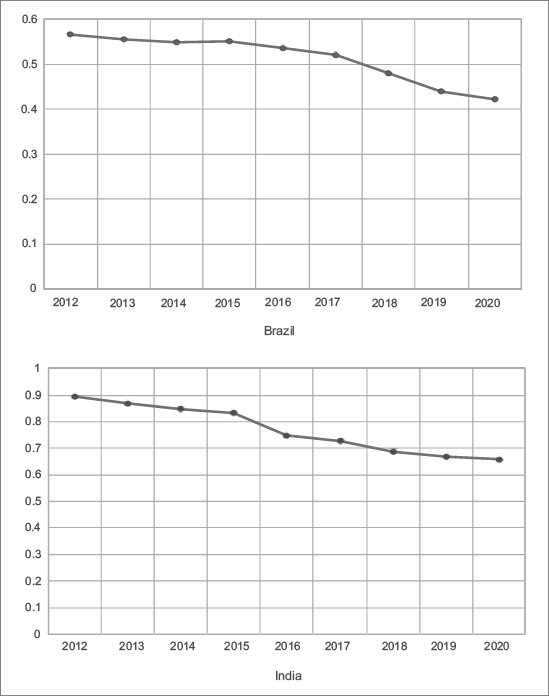
The last two estimations (Cash HC and Cash Share) are better approximations (Graphs 1 and 2) compared to previous ones. Cash to household consumption (Cash HC) comprises a more precise ratio, than CIC/GDP, focusing only on variables that account for family spending on consumer goods through cash withdrawn from ATMs. Overall, there is a decreasing linear trend for both Brazil and India. Brazil shows stronger peaks (2015) and valleys (2018), and a slight rising trend in 2019-2020. Demonetization in 2016 accounted for the strongest downward movement in India and the subsequent inertia in decreasing money use.

Annual Cash HC ratio for Brazil and India (2012 -2020) based on Khiaonarong & Humphrey (2019)

Annual Cash Share (ratio) for Brazil and India (2012-2020) based on Khiaonarong & Humphrey (2019)
Eight years of data through Cash Share ratio (Graph 2) show slowly decreasing cash use as younger adults favor non-cash payment methods (cards, mobile phones) over cash, while the reverse applies for older adults (Khiaonarong & Humphrey, 2019). According to a research study by PayPal (2021) “The Third Wave of Fintech Innovation”9, natural demographic change plays into declining cash use as younger consumers report relatively higher usage of electronic payments. The negative percentage change of cash share (last column of Table 1) for Brazil and India further corroborates the observed downward trend.
To improve the Cash Share index, a proxy for the value of personal checks would need to be added to the current estimation. Values of large-value corporate checks could overestimate calculations. Multiplying the average value per bank card by the number of check transactions is an interesting alternative. Credit and debit transfers are also not considered due to interbank payments used by governments and businesses (Khiaonarong; Humphrey, 2019).
A plot of annual observations of cash use over time would be very similar to a reverse Gompertz S-Curve10. Cash use would fall, gather speed, reach an inflection point, and then start a slow downward trend until cash use is very small. As society moves toward the end of physical currency, there is reason to believe that it will remain popular with consumers (Brazilian respondents of the PayPal survey indicated cash usage in 38% of daily situations) at least in the short to medium term. As the digital preference of “Millennials” (born between 1981 and 1996) solidify, cash will be gradually replaced.
A linear prediction algorithm was used to return future expected values of Cash Share measures. Assuming that the data are at equal time intervals, the linear prediction method in Mathcad provides a function, that uses existing data to estimate points lying beyond the existing ones11.
As you increase the number of n (previous values) larger than m (future predicted values), this might produce undesirable results, since extrapolated values are computed based solely on past values. The function calculates a weighing factor for each prior value used for predictions. For m unknowns, the function needs m equations to work. It builds estimations from the following model:
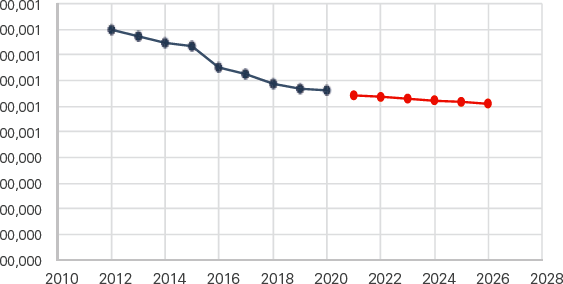
Where x is the time series and c is the vector of weighing factors. Useful when data are smooth and oscillatory, linear prediction, 𝑝𝑟𝑒𝑑𝑖??𝑡 (𝑦, 𝑛, 𝑚) is typically used for extrapolation hypothesis. For length (v = 9) data points, (m = 6) and (n = 5), Cash Share ratio predictions for Brazil and India are presented in Graphs 3 and 4 below.

Annually observed and predicted Cash Share ratio for Brazil (2012-2026) through Mathcad predict function

Annually observed and predicted Cash Share ratio for India (2012-2026) through Mathcad predict function
The blue dotted lines represent the observed data, and the red dotted lines represent the predicted values. While highly aware of data limitations, the last five years could still be used as templates for future observations. In both cases (Brazil and India), a decreasing progression will be difficult to stop or reverse for the predicted years (2021-2026).
3.1 CBDCs in Brazil and in India
In light of the results in the previous section, the implementation of a reliable alternative, such as CBDCs or fast payment instruments, may be best before private cash substitutes become so widespread that the viability of domestic alternatives would be in doubt. The adoption speed and market share of new payment methods depend on various attributes (user cost, supplier cost, and convenience) in competition with characteristics of payment instruments already used for similar transactions: “the greater convenience of digital cash depends on the method of access” (Khiaonarong & Humphrey, 2019, p. 24).
Credit and debit card payments are very popular, but they are also vulnerable to alternative means that have lower cost of acceptance. Recently, there has been a surge in transfers made via the internet with digital identification tied to deposit accounts. Deemed cheaper and more convenient than using a card at a terminal, instant payments, like Pix, UPI, Codi (Alfonso et al., 2020), and Target, are among these new instruments replacing person-to-person payments. Increased convenience, flexibility and safety (PayPal, 2021) alone are unlikely to generate enough demand for digital cash or CBDCs in countries where instant payments have already been implemented. If a CBDC is just as good as an instant payment option, why switch?
The point rests on the idea that, for the Brazilian Central Bank (BCB) and the Reserve Bank of India (RBI), Pix and UPI were the primary mechanisms employed to broaden financial inclusion. Nonetheless, broad coverage, interoperable systems, network effects, and potential long-term positive externalities that are difficult to measure presently, are stronger arguments to understand why the Brazilian Central Bank (BCB) engaged in such an enterprise.
Pix was made public in November 2020. The Instant Payment System (SPI), which manages Pix, is a centralized infrastructure for the settlement of fast payments among different institutions. It is a unique architecture for Real-Time Gross Settlement (RTGS) via messaging on the Brazilian Central Bank reserve transfer system (STR). Payments are cleared through specific-purpose accounts, which direct participants in the system maintain with the BCB, and are called Instant Payment Accounts (CPI). Overdraft is not allowed (BCB, 2020, 2020a, 2021).
Launched for public use in August 2016, UPI is an Indian network for real-time payments - an around-the-clock platform that offers a set of Application Programming Interface (API) specifications to facilitate online payments. The goal was to create a uniform and affordable payment system, integrating disparate systems with varying service levels into a nationwide platform. Built over the Immediate Payment Service (IMPS) infrastructure, UPI is used as a switching mechanism to enable digital instant payments among financial institutions (NPCI, 2021).
CBDCs would not have these overlapping functions. The digital Real (Drex) is being envisioned as an asset on the commercial bank ledger, backed by the central bank. Its infrastructure will be intermediated and decentralized: a synthetic CBDC (sCBDC). Rather than a stablecoin or a special type of e-money, a synthetic CBDC (sCBDC) replicates and preserves the current two-tier architecture of the monetary and payments system by allowing private sector entities to issue currency or payment instruments that represents liabilities on commercial banks, backed one-to-one by central bank reserves (Soderberg et al., 2022; Araujo, 2022).
The structure of the Brazilian CBDC will serve not as a currency widely disseminated among population for daily use, but a wholesale asset, serving as the foundation of a smart payment platform. Banks will monetize their deposits, through tokenization12, issuing stablecoins backed by the Brazilian CBDC. These arrangements would preserve the public-private partnership in providing liquidity to the market (Araujo, 2022).
The Brazilian Central Bank (BCB) envisions it as a platform for smart contracts, an environment to innovate using technologies such as programmable money, enabling new functionalities beyond those brought by Pix. Programmability and composability allow individuals to transform their deposits into tokens capable of accessing services provided by this new platform. Under the explicit commitment that payment service providers convert them into CBDCs on demand. New functions could be unlocked by wholesale CBDCs, such as the tokenization of deposits (M1). According to the BIS (2022), this could facilitate new forms of exchange, including fractional ownership of securities and real assets, allowing for innovative financial services that extend significantly beyond payments.
Tokens issued by PSPs and fully backed by reserves at the central bank would inherit all applicable regulations and features from their originating assets, such as reserve requirements, liquidity constraints, portfolio risk, and backstops, thus ensuring stability and parity between these tokens and fiat currency (Araujo, 2022).
The Reserve Bank of India (RBI) is currently working toward a phased implementation strategy, examining use cases that could be implemented with little or no disruption (Sankar, 2021). Regarding the design features of the digital Rupee, not much can be said, other than it will have a hybrid architecture (Auer & Böhme, 2020)13 similar to the Brazilian CBDC. To bypass the need to build new capabilities, central banks prefer to shift responsibilities to commercial banks and authorized intermediaries to continue onboarding users, enforce KYC rules and handle retail payments in a “Hybrid/Intermediated/Synthetic CBDC” model.
Despite the intention that a CBDC provides a safer alternative to private virtual currencies, it remains unclear how this will be achieved in India (Priyadarshini & Kar, 2021). Motivations and policy priorities include: fostering financial inclusion, responding to dwindling use of paper currency, enhancing the efficiency of banking, facilitating international payments, heightening fiscal transparency, and to meet public’s need for digital currencies (Sankar, 2021). These reasons are broadly shared with Brazil, particularly the declining use of cash.
Eichengreen et al. (2022) provides a skeptical rationale behind CBDC issuance. According to the authors, proponents fail to acknowledge that some of the goals attached to CBDCs, can be advanced at a lower cost and with less risk through alternative means. This point becomes true for India, with its already existing Unified Payments Interface (UPI), and ongoing financial inclusion efforts. Contrary to the latter, Priyadarshini & Kar (2021) consider that it is not a question of if, but when and in what form a CBDC should be introduced in India.
One of the primary concerns, particularly for Brazil and India is that payments migrate away from UPI and Pix to private stablecoins14, to exchanges in unregulated digital currency markets or single large payment providers. Cost efficiencies, speed, and reach, driven by network effects offered by their extensive presence in social media, could become hard to compete with in the absence of an institutionalized alternative.
In some countries like China15 and Sweden, the use of alternative payment services offered by private entities (e.g., mobile payment system such as Swish, Alipay and WeChat) has become so dominant that they could pose monopoly risks, high entry barriers with non-interoperable services to the customer and potential misuse of data, with safety and technology risks. Tightening regulation might not be enough to ensure secure transactions, to protect consumers, and mitigate systemic risk to the financial system in the face of concentrated market power and “too big to fail” characteristics (Priyadarshini; Kar, 2021; Eichengreen et al., 2022).
There are also macro-level angles of interest related to EMEs: 1) the likely consequences of CBDC issuance in terms of the ability to conduct monetary policy, and 2) the possible effects on the domestic economy if major advanced economies (AEs) adopt CBDCs and allow cross-border transactions.
These questions include the effect of payment innovations on prices, exchange rates, and seigniorage (Engert & Fung, 2017), particularly currency substitution. Edwards (2021) argues that the digital accessibility of currencies (like the USD or Euro) in an emerging country would lead to a decline in transaction costs for using foreign currency as a medium of exchange and/or a store of value. An increase in the degree of currency substitution through global CBDCs and global stable coins (GSCs) would have a negative effect on seigniorage16 by reducing its base.
In a not-too-distant future, global stablecoins could be accepted more widely. Unregulated and denominated in foreign currencies, they could become a threat to domestic monetary policy in the absence of a CBDC. Emerging markets will benefit from the implementation of stronger macroprudential regulations, and central banks could minimize budgetary effects by issuing digital cash earlier, before cash use falls to minimum levels (Khiaonarong; Humphrey, 2019; Sankar, 2021; Pryadarshini; Kar, 2021; Araujo, 2022).
Subbarao’s (2022) comment, “festina lente”, clearly expresses the necessary cautiousness and urgency toward the demands placed on EME central banks. Instruments that function both as cash and as financial assets could have significant international spillovers if permitted across borders. These premises accentuate the importance of remaining internationally competitive, protecting national interests, and ensuring digital and financial security.
Justifications are largely outside the domestic context, with most major economies in the world, viewing the development of a national CBDC and its interoperability as a major driver of international payments. This envisions a global system where only sovereign-backed digital currencies are trusted (Sankar, 2021; Pryadarshini; Kar, 2021; Araujo, 2022).
Some emerging market economies (EMEs) also depend on low-value cross-border remittances (Raskin & Yermack, 2016). In 2019, these transfers reached the US$ 551 billion mark, exceeding official development assistance by a factor of three (prior to the pandemic), and were on track to overtake foreign direct investment (FDI) flows.
Carefully managed with intergovernmental cooperation, CBDCs could be used in cross-border payments to lower dependency on intermediaries, mitigate potential risks, reduce costs, and yield economic gains for families and entrepreneurs.
As with instant payments, the domestic context plays into the main challenges for financial inclusion, such as adequate digital infrastructure (broadband coverage), affordable electronic devices, digital financial literacy, and ensuring population accessibility (Araujo, 2022). Half of all Indians do not own a smartphone capable of downloading a central bank app and digital wallet to transact over a 3G network. Adequate internet connectivity coverage may also be lacking in relevant and relatively remote areas (Eichengreen et al., 2022).
In this case, for many central banks, fiduciary digital liabilities (CBDCs) will not offer significant advantages over fast payment systems in terms of increasing the financial inclusion of the unbanked population. Pix and its use during the pandemic helped reach what is probably the limit of that inclusion in Brazil, given the current level of broadband and internet access (Araujo, 2022). Fast payment systems could offer more immediate improvements to specific user groups and broad adoption comes from reducing payment frictions.
As seen above, CBDCs could be an alternative instrument that can affect the competitive structure of the payment system, supporting new digital technologies (Chen et al., 2022). Even if the RBI focuses on CBDC design, exploring offline payments functionality, any improvement in financial inclusion would require extra efforts to address the root causes of exclusion in both countries.
Functionally, the Brazilian CBDC will be very different compared to Pix. As an instrument to enhance financial inclusion, CBDCs will be “less controversial in countries where cash use is still very important for a wide range of transactions and substitutes for cash are relatively new and not firmly established” (Khiaonarong; Humphrey, 2019, p. 26). In many OECD countries, substitutes (i.e., bank cards, instant payments, mobile phone payments) are already widespread, as in Brazil and India.
CONCLUSIONS
In recent decades, technology and the internet have become pervasive in electronic devices, permeating nearly every aspect of our economy. Evidence was presented indicating a reduction in physical currency use, showing that younger adults tend to use less cash in this new digitalized environment. This decreasing trend is expected to continue in both countries.
Coupled with the emergence of private payment providers, these societal transformations indicate that, without a digital version of fiat currency, it is possible that cash will be almost entirely replaced by other, more competitive private instruments over time. This puts extra pressure on EME central banks to provide a suitable response. Migration to large platforms, unregulated digital currency markets, and international stablecoins increasingly challenges central banks institutionality.
This article aims to analyze the strategy of central banks in mitigating problems that may be caused by the growth of digital payment providers. In light of risks regarding the monetary sovereignty of emerging countries, central banks have begun to propose new instruments, such as instant payments and CBDCs.
Although Pix is not a CDBC (an obligation held against the Central bank) as Kosinski (2021) observes, there is a political objective in the institution of Pix and CBDC’s, which is to maintain the central bank’s control over the Brazilian monetary space. Resourceful solutions to promote the digitalization of payment methods, providing functionalities similar to these services but with the legal-political coverage and the prerogatives of state control, are being pursued.
Implementing a CBDC presents difficulties, including choices in a rapidly evolving field and development costs. Countries are seeking to strike a balance between preserving key aspects of the traditional financial system and updating their role in the digital era. Exploring the intermediated operational model, central banks maintain a two-tier system where the private sector has a major role as a partner to the monetary authority. To limit competition with bank deposits, there is a preference for a “payment-focused CBDC”, one that steers away from “store of value” attributes. Concurrently, they do not envision offering remuneration on CBDCs, preferring limits on balances and transaction values that could cause disintermediation and major monetary policy implications (Chen et al., 2022).
In hindsight, central banks have decided to take on the role of advancing the digitalization of payment systems largely because no private service has managed to do so, or could even provide such a service without state-driven support. These facts lead us to argue that CBDCs are an interesting alternative, but only in jurisdictions where digital substitutes are not already universal and are needed to promote broader inclusion. Cases for Central Bank Digital Currencies (CBDCs) in Brazil17 and India encompasses a broader view of what to expect from the future monetary system.
REFERENCES
- ADRIAN, T.; MANCINI-GRIFFOLI, T. (2021) “Making the digital money revolution work for all”. In: International Monetary Fund. IMF Blog. Washington DC., July 29.
- ALFONSO, V.; TOMBINI, A.; ZAMPOLLI, F. (2020) “Retail payments in Latin America and the Caribbean: present and future.” Basel, BIS Quarterly Review, December.
- ARAUJO, F. (2022) “Initial steps towards a central bank digital currency by the Central Bank of Brazil”. In: Bank For International Settlements. Monetary and Economic Department. CBDCS in Emerging Market Economies. BIS Papers No 123. p.31-37.
- AUER, R.; BÖHME, R. (2020) “The technology of retail central bank digital currency”. BIS. Quarterly Review.
- BANCO CENTRAL DO BRASIL, (2020) Resolução no1 de 12 de agosto de 2020. Institui o arranjo de pagamentos do Pix e aprova o seu regulamento. Brasília, DF: Banco Central do Brasil.
- BANCO CENTRAL DO BRASIL (2020a). Relatório de Economia Bancária do Banco Central: 2019. Brasília, DF. June. Site: BCB.
- BANCO CENTRAL DO BRASIL (2021) Sistemas de Pagamentos Brasileiro (SPB). Brasília. DF.
- BANCO CENTRAL DO BRASIL (2022). Real Digital: contextualização. Brasília.DF.
- BANK FOR INTERNATIONAL SETLLEMENTS (2018) “Cryptocurrencies: looking beyond the hype”. In: Bank For International Settlements. Annual Economic Report: June 24.
- BANK FOR INTERNATIONAL SETTLEMENTS (2022) “The future of the monetary system”. In: Bank For International Settlements. Annual Economic Report: June 2022. BIS. Annual Economic Report, Chapter 3. p. 75-115.
- BOAR, C.; HOLDEN, H.; WADSWORTH, A. (2020) “Impending arrival-a sequel to the survey on central bank digital currency”. Basel, BIS Paper, n. 107, 2020.
- BORIO, C. (2019) “On money, debt, trust and central banking”. Basel: Bis Working Paper, No.763.
- BRAINARD, L. (2019) “Update on Digital Currencies, Stablecoins, and the Challenges Ahead”. Speech on the Monetary Policy, Technology, and Globalisation Panel at Monetary Policy: The Challenges Ahead, an ECB Colloquium Held in Honour of Benoît Coeuré. Frankfurt, December. Site: IDEAS.
- CARSTENS, A. (2019) “The future of money and payments.” [Speech made in] Dublin: Central Bank of Ireland, 2019. Site: SUERF. SUERF Policy Note. n.66, April.
- CHEN, S et al. (2022) “CBDCs in emerging market economies”. BIS Papers No 123. p. 1-21.
- DUARTE, A et al. (2022) “Central banks, the monetary system and public payment infrastructures: lessons from Brazil’s Pix”. Basel, BIS Bulletin. No.52.
- DWYER, G. (2015) “The economics of Bitcoin and similar private digital currencies”. Journal of Financial Stability. Amsterdam: Elsevier. v. 17, p. 81-91.
- EDWARDS, S. (2021) “Central Bank Digital Currencies and the Emerging Markets: the currency substitution challenge.” Cambridge: National Bureau of Economic Research Working Paper n. 29489, p.1-17.
- EICHENGREEN, B.; GUPTA, P.; MARPLE, T. (2022) “Central Bank Digital Currency for India?” New Dehli: National Council of Applied Economic Research Working Paper n. 138. p. 1-31.
- ENGERT, W; FUNG, B. (2017) “Central bank digital currency: motivations and implications”. Bank of Canada. Staff Discussion Paper, n.16, 2017.
- FEDERAL RESERVE. (2022) “Money and Payments: The U.S Dollar in the Age of Digital Transformation”. Washington DC, FED, January.
- FEYEN, Erik et al. (2021) “What does digital money mean for emerging market and developing economies?” BIS Working Papers, No. 973.
- KHIAONARONG, T.; HUMPHREY, D.; ALWAZIR, J. (2019) “Cash use across countries and the demand for central bank digital currency”. IMF Working Paper No.19, p. 46.
- KOSINSKI, D.S. (2021) “A digitalização dos meios de pagamento: o Pix e as central bank digital currencies em perspectiva comparada”. Textos de Economia, Florianópolis, v. 24, n. 1, p. 01-26, Jan/Jul, 2021. Universidade Federal de Santa Catarina.
- KOSSE, A.; MATTEI, I. (2022) Gaining momentum-Results of the 2021. BIS Papers. No. 125. May.
-
NATIONAL PAYMENTS CORPORATION OF INDIA (NPCI). UPI Faqs. Mumbai, India. Site: NPCI. Retrieved from: Retrieved from: https://www.npci.org.in/what-we-do/upi/faq Access date: 10 Jun. 2021.
» https://www.npci.org.in/what-we-do/upi/faq - PAYPAL. (2021) Research Study: The Third Wave of FinTech Innovation. California, Oct.18, 2021. Site: Pay Pal Newsroom. Global Public Policy Research Team.
- PRIYADARSHINI, D.; KAR, S. (2021) : Central bank digital currency (CBDC): critical issues and the Indian perspective”. New Dehli: Dehli University Enclave, September. (Institute of Economic Growth Working Paper, no.444).
-
PTC MATHCAD. Linear Prediction. Cambridge, USA. Mathsoft Engineering & Education, Inc. Site: PTC Mathcad Help. Retrieved from: Retrieved from: http://support.ptc.com/help/mathcad/en/index.html#page/PTC_Mathcad_Help/linear_predicti on.html Access date: 11 July 2022.
» http://support.ptc.com/help/mathcad/en/index.html#page/PTC_Mathcad_Help/linear_predicti on.html - RASKIN, M.; YERMACK, D. (2016) “Digital Currencies, Decentralized Ledgers, and the Future of Central Banking”. Cambridge: NBER Working Paper 22238.
-
ROGOFF, K. (2022) What’s the Crypto regulation endgame? New York. June 6. Site: Project Syndicate. Retrieved from: Retrieved from: https://www.project-syndicate.org/commentary/will-advanced-economies-ban-cryptocurrencies-by-kenneth-rogoff-2022-06?barrier=accesspaylog Access date: 13 June 2022.
» https://www.project-syndicate.org/commentary/will-advanced-economies-ban-cryptocurrencies-by-kenneth-rogoff-2022-06?barrier=accesspaylog - SANKAR, T. R. (2021) “Central Bank Digital Currency - Is This the Future of Money”. [Speech made in] Mumbai: Reserve Bank of India, July 22, 2021. Site: RBI. Reserve Bank of India (RBI) Bulletin.
- SODERBERG, G et al. (2022) Behind the Scenes of Central Bank Digital Currency: Emerging Trends, Insights, and Policy Lessons. Washington DC, February. Site: IMF. IMF FinTech Notes. 2022/004.
- SUBBARAO, D. (2022) Emerging markets must “make haste slowly” on CBDCs. New York. Jan 26, 2022.
- TUT, D. (2022) Bitcoin: Future or Fad? Canada: MPRA Paper No. 112376, March.
-
1
A Central Bank Digital Currency (CBDC) is defined as a digital liability on the central bank’s balance sheet that is widely available to the public - a digital fiat currency fully backed by the central bank. In this respect, they are analogous to paper money but different from existing forms of digital commercial bank money.
-
2
According to IMF data, CBDCs are being analysed, piloted, or are likely to be issued in at least 110 countries. Examples range from the Bahamas’ Sand Dollar (already in use) to the People’s Bank of China’s e-CNY pilot project and the Brazil’s Digital Real (Drex) (FED, 2022; Adrian & Mancini-Griffoli, 2021).
-
3
Scalability is important because, despite payment volumes being many multiples of the GDP, the expansion of their use do not lead to a proportional increase in costs (BIS, 2018).
-
4
Lael Brainard (2019) was quite blunt in exposing the potential pitfalls of the emergence of a digital global stablecoin, backed by a basket of sovereign currencies, Facebook’s late Libra (Diem) project.
-
5
On the other extreme are countries that are looking to adopt Bitcoin as fiat currency. Knowing that El Salvador is already a fully dollarized country sets it apart from other Latin American countries where the dollar circulates in cash alongside the local currency. However controversial it may be, relying on a highly volatile asset as a store of value, a means of payment, and a unit of account, with low accountability toward the population’s resources, has led many analysts to question the level of acceptance of this new form of private “money” among Salvadorans (Edwards, 2021). Caution needs to be exercised on arbitrary decision-making that are potentially harmful to EMEs and especially the most vulnerable.
-
6
There is still a problem of insufficient information on the value of other important payment deployments (i.e., instant payments) used to purchase consumption goods, and over-the-counter bank data of cash usage.
-
7
Cards include domestically issued ones for local and overseas purchases.
-
8
Household consumption (HC) used to estimate Residual Cash and Cash HC was calculated based on nominal GDP in billions (of BR/INR) and final consumption expenditure (in percentage of GDP).
-
9
This survey, commissioned by PayPal (2021) explores emerging and evolving trends in Fintech. The research study draws upon data collected from a survey of 4,000 individuals from four markets: China, Brazil, the U.S. and Germany.
-
10
“Logistic and Gompertz growth or S-curves have been used in a variety of situations to forecast the adoption and dispersion of new technologies in industry and consumption (e.g., the adoption of the telephone and TVs) and can be adapted to forecast the possible future use of cash (Khiaonarong; Humphrey, 2019, p. 16)”.
-
11
The function uses Burg’s method to calculate autocorrelation coefficients for the last m points in v, which are then used to predict the value of m+1, creating a moving window that is m points wide. Knowing that v is a real data vector of equally spaced data samples, m and n are positive integers, 0 < m < length (v) -1. In practice, m should be much smaller than length (v) (PTC MATHCAD, 2022).
-
12
A decision regarding the use of token-based technology for the digital Real has not yet been reached. The BCB is still considering other, more centralised architectures. The term ‘token’ is used to simplify our argument. Whatever platform is chosen to issue the digital Real, PSPs will provide private money regulated by the BCB, offering the same technological functionality (Araujo, 2022).
-
13
In this model, a direct claim on the central bank is combined with a private sector messaging layer.
-
14
Stablecoins are digital currencies whose value is pegged (collateralized) to a fiat currency or a basket of currencies (Tut, 2022, p. 7). They have the highest potential for becoming a widely accepted method of payment, because, like Tether, a widely adopted stablecoin, they maintain their value at par with another currency, in this case the US dollar. They are particularly useful for “reducing” volatility in the cryptocurrency market, through investors, who are seeking to redeem or exit their positions. New types of stablecoins are emerging, generally issued by financial intermediaries and exchanges, like Coinbases’ stablecoin the USD Coin (USDC).
-
15
China has seen near-universal adoption of digital payments, with 94% of mobile transactions supported by Tencent or Alibaba (Priyadarshini & Kar, 2021).
-
16
“Seigniorage is paid on the stock of domestic money relative to GDP”. If there is a reduction in costs when using foreign currencies (through currency depreciations and high inflation), this ratio goes down, and the amount of seigniorage collected declines (Edwards, 2021, p. 9).
-
17
In the Brazilian case, in accordance with recent central bank reports, a sCBDC (synthetic CBDC) will be the main element of a platform for smart payments, connecting current sources of liquidity to a digital asset ecosystem.
-
*
The authors thank CAPES for financial support.
-
JEL Classification:
E41; E42; E58.

 Source: Bank of International Settlements (BIS) and World Bank (2022). Author’s calculations.
 Source: Bank of International Settlements (BIS) and World Bank (2022). Author’s calculations.
 Source: Author’s calculations.
 Source: Author’s calculations.