 Development of sustainable polymeric membranes produced with green solvents
Abstract
Polymeric membrane separation technologies have gained widespread prominence in many applications, including water and wastewater treatment to remove contaminants of emerging concern (CEC). These technologies can be recognized as sustainable separation techniques due to their scalable potential and low energy consumption. However, the membranes are usually prepared with organic solvents such as N-methyl-2-pyrrolidone (NMP) and dimethylacetamide (DMAc), which are toxic and harmful to the environment and human health. Furthermore, these solvents are being banned in some countries and included on lists of substances of high concern. Therefore, finding environmentally sustainable solvents (green solvents) to produce “green membranes” has been a matter of great interest. The objective of the present study is the development of porous membranes, prepared with green solvents, Cyrene (Cyr) and γ-Valerolactone (GVL). The membranes were prepared by the phase inversion technique using Polysulfone (PSF), Polyvinylpyrrolidone (PVP) and Cyr or GVL or a mixture of both solvents. In this work, it was possible to produce membranes with both green solvents, as well as using a mixture of them. The membranes were characterized and tested for removing a CEC (Rosuvastatin) from water. Rosuvastatin rejection of 80% was achieved for membranes produced with a mixture of green solvents Cyr and GVL. These results are promising, as they make the membrane production process more sustainable as recommended by the 2030 Agenda through the 17 SDGs.
Keywords:
Sustainable Membranes; Eco-Friendly Solvents; Cyrene; γ-Valerolactone; Contaminants of Emerging Concern
1. Introduction
The environmental occurrence of contaminants of emerging concern (CEC) poses risks to humans and the environment as they seriously threaten the ecosystem (Khan et al., 2023; Sulaiman et al., 2015). These contaminants include pharmaceutically active compounds (PhACs), personal care products (PCPs), surfactants, and other unregulated substances (Giacobbo et al., 2023; Khanzada et al., 2020).
PhACs (human and veterinary medicines) represent a source of increasing concern as they are found in wastewater, surface water, drinking water and groundwater in concentrations from ng L-1 (surface water, groundwater) to mg L-1 (hospital and municipal wastewater). Conventional water and wastewater treatments are not completely effective in removing these contaminants as they are not designed to remove these highly recalcitrant and low concentration compounds (Dolar; Ćurić; Ašperger, 2023; Narwal et al., 2023). Therefore, developing new and more efficient technologies for removing CECs from water and wastewaters is still a matter demanding more studies.
Membrane technologies are gaining attention, being implemented in water and wastewater treatment processes to remove CECs, due to their scalable potential and low energy consumption for operation (Hidalgo et al., 2023). Among the membrane technologies, reverse osmosis (RO) and nanofiltration (NF) are in evidence for removing CECs, as several studies report that they are capable of removing between 82% and 97% of these contaminants from wastewater, mainly by the fact that most CECs have molecular weight (MW) in the range of the molecular weight cutoff (MWCO) of RO and NF membranes (Giacobbo et al., 2023).
NF membranes have advantages, as they have low energy requirements and compatible MWCO to remove CECs (Hidalgo et al., 2023). However, the fabrication of these membranes requires the usage of toxic organic solvents, N-methyl-2-pyrrolidone (NMP) and dimethylacetamide (DMAc), to solubilize organic polymers such as polysulfone (PSF) (Jiang et al., 2021; Ong; Wong; Chai, 2022).
In fact, organic solvents represent a serious risk to the environment and human health. This resulted in a proposed ban on NMP by the US Environmental Protection Agency (EPA) due to its possible reproductive toxicity, while DMF and DMAc were included on the list of Substances of High Concern (US-EPA, 2019). Therefore, the need to find less hazardous alternatives to these solvents, such as non-toxic solvents from renewable sources, is imperative.
In this context, green solvents are non-toxic, biodegradable, non-volatile and produced from renewable resources. Some green solvents have been used in the fabrication membranes, such as Cyrene™ (Cyr) and γ-Valerolactone (GVL) (Ong; Wong; Chai, 2022; Rasool; Vankelecom, 2021; Tomietto et al., 2022). Cyr is an aprotic, non-toxic and polar solvent similar to NMP, but obtained from a renewable and biodegradable source (Milescu et al., 2019), while GVL is non-toxic and have a high boiling point (207 ° C). Both Cyr and GVL are obtained from the acid hydrolysis of cellulose-based biomass (wood) (Rasool; Vankelecom, 2021). Marino et al. (2019) reported that Cyr can be a good alternative to replace conventional solvents in the fabrication of polymeric membranes, delving deeper into the issue of solubilization of polymers in the solvent. Rasool et al. (2021) produced NF membranes based on different polymers, including PSF prepared with GVL as a bio-based green solvent and obtained Rose Bengal (RB) rejections of around 90% for the different types of polymers.
As membrane technologies increasingly appear in industrial applications, the need for membrane preparation to become a greener process is increasingly important. According to principles 5 and 7 of green chemistry, solvents and the use of renewable raw materials are central aspects. Furthermore, there are still few studies on the preparation of membranes with sustainable solvents for application in removing CECs from water and wastewater. Therefore, considering the concern for sustainable development and membrane performance, this work was designed to adopt Cyrene™ and γ-Valerolactone as green solvents along with PVP as pore-forming agent in the preparation of PSF-based membranes. The membranes were produced using the phase inversion method, followed by characterization by scanning electron microscopy, determination of contact angle, pore size and porosity. Then, they were evaluated for permeate flux and rejection of reference solutes and an emerging contaminant.
2. Materials and methods
2.1 Materials
All reagents used in the present study were of analytical grade. The membranes were prepared from PSF (Solvay, Belgium), PVP 40 kDa (Dinâmica, Brazil) and Cyrene™ or γ-Valerolactone (Sigma Aldrich, Brazil). Sodium alginate, NaCl, Na2SO4 (Dinâmica, Brazil) and Rosuvastatin (purchased from a compounding pharmacy) with a purity level greater than 99%, which were used to characterize the rejection properties of the membranes. Table 1 presents the physical and chemical parameters of the green solvents Cyr and GVL in comparison with the conventional solvents NMP and DMAc.
Physicochemical characteristics of green (Cyr and GVL) and conventional (NMP and DMAc) solvents (National Center for Biotechnology Information. PubChem Compound Summary [s. d.])
2.2 Membrane preparation and formulation
Casting solutions were prepared in a reactor by dissolving 15% PSF and 2.5% PVP in Cyr, GVL or in a mixture of both solvents (25%, 50% and 75%). These mixtures were subjected to constant stirring, using an IKA RW 20 Digital mechanical stirrer (Biovera, Brazil) at a temperature of 80°C until a homogeneous solution was obtained. Solutions were placed in an ultrasound bath for 1 h to remove air bubbles. Then, they were spread evenly on a glass plate using an extender with an opening of 200 μm. After the solution evaporated in air for 60 seconds at room temperature (23 ± 3 °C), it was transferred to a coagulation bath containing distilled water at room temperature for phase inversion . After solidification, the membranes were left for 24 hours in distilled water to remove residual solvents. Finally, the membranes were stored in a 1% sodium metabisulfite solution to prevent deterioration due to drying out or microbial growth. The composition of the casting solutions utilized to prepare the membranes is displayed in Table 2.
2.3 Membrane characterization
The membranes produced in the present study were characterized according to their: i) functional groups, using Fourier transform infrared spectroscopy; ii) hydrophilic nature, due to the contact angle measurement; iii) morphology, by scanning electron microscopy (SEM); iv) structural properties, evaluated in terms of porosity and average pore size; and v) performance in filtration and rejection of reference solutes (sodium alginate, sodium chloride and sodium sulfate) and a CEC (rosuvastatin).
FTIR spectra were obtained using a Perkin Elmer (model Spectrum 100 FTIR) spectrophotometer at wavenumbers from 4000 to 400 cm-1. Membrane samples were analyzed in film form with ATR.
The contact angle values were measured in the Surfaceware software, which were processed in the Surftens software and the values were obtained from the average of 5 drops in each sample, as described in Sacilotto et al. (2022).
Using the wet-dry gravimetric method, the porosity of the membranes (ε; %) was determined (Kumar et al., 2021). A 3 x 3 cm2 membrane sample was dried in a vacuum oven at 40 °C for 24 hours. The weight of the sample was measured on an analytical balance. Whereupon, the membrane sample was then immersed in deionized water for 24 hours, after which the soaked sample was removed, carefully dried with soft paper to remove excess water from its surface, and its weight was immediately measured on an analytical balance. Its thickness was determined using a precision digital gauge. The porosity of the membrane was then calculated using the Eq. (1) (Kumar et al., 2021):
where Ww is the weight of the wet membrane sample (g); Wd is the weight of the dry sample (g); A is the top area of the wet membrane sample (cm2); l is the thickness of the wet membrane sample (cm); and ρ is the density of water (1.0 g cm-3).
The Guerout-Elford-Ferry equation (Eq. (2)) was used to calculate the average pore radius (rm) of the membranes using porosity and pure water flow data (Kumar et al., 2021):
where η is the viscosity of water (8.9 × 10⁻⁴ Pa s); l is the thickness of the membrane sample (cm) in the wet state; Q is the volumetric water flow rate (m3 s-1); A is the top area of the wet membrane sample (cm2); and ΔP is the operating pressure (0.1 MPa).
The morphology of the membrane was characterized by a Tescan SEM (England), model Vega 3, with an Oxford EDS detector and an acceleration voltage of 30 kV. Superficial and transversal analyses of the membranes were carried out. The membrane samples were cryogenically fractured with liquid nitrogen, to avoid deformations in their cross-section, and then metallized with gold for subsequent SEM analyses.
2.4 Filtration experimental procedure
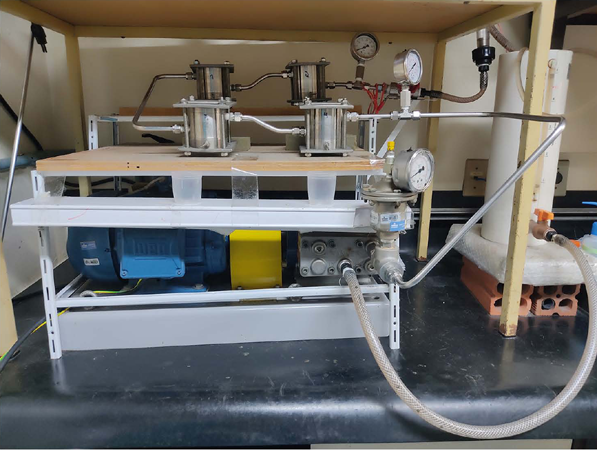
Filtration experiments were performed using a bench-scale ultrafiltration (UF)/NF equipment (Figure 1), as described in previous articles (Giacobbo, 2015), using a membrane surface area of 14. 5 cm2.

First, the membranes were compacted with circulation of distilled/deionized water (conductivity less than 2 µS cm-1), pressurized at 1 bar for the C100 membrane and at 30 bar for the other membranes. Compaction was performed for 120 min. Then, the membranes were characterized according to their permeability to pure water (LPW ), at ΔP of 0.3–1 bar for the C100 membrane and 15–30 bar for the others. A heat exchanger coupled to an ultrathermostatic bath was used to keep the temperature constant (25 ± 0.5 °C) in all permeation runs. LPW is a parameter used to evaluate the flow of water that passes through a given membrane area, at different pressures, and is usually represented in L h-1 m-2 bar-1 or kg h-1 m-2 bar-1. So, considering the membrane used is inert to the solvent and incompressible under pressure, the permeate flux (J) of pure water is proportional to the operating pressure (Zou et al., 2023). Equations (3) and (4) are used to calculate the hydraulic permeability and permeate mass flux (kg h-1 m-2), respectively.
Where M is the mass of the permeate (kg), A is the surface area of the membrane (m2) and t (h) is the permeate collection time. Considering that Cyr tends to form membranes with larger pore sizes (Marino et al., 2019), the C100 membrane, whose Cyr is the single solvent used in its preparation, a 600 mg L-1 sodium alginate solution was employed to evaluate its rejection capacity. These experiments were carried out in full recirculation mode, where the sodium alginate solution was filtered individually, with a feed flow rate of 100 L h-1 and operating pressure of 1 bar at 25 °C. After a stabilization time of 30 minutes, permeate and feed tank samples were collected to determine the alginate concentration by the spectrophotometric method and subsequent rejection calculation.
The other membranes were evaluated for salt rejection (NaCl and Na2SO4). These tests were carried out individually with each salt diluted in deionized water at 600 mg L-1, with a feed flow rate of 100 L h-1, pressure of 20 bar, at 25 °C, with the samples collected after a period of stabilization of 30 min. Next, the rosuvastatin rejection capacity was evaluated under the same operating conditions (pressure, feed flow rate, temperature, and stabilization time) as the salt rejection tests. However, ROS tests were conducted with aqueous solutions of 5 mg L-1, i.e., at a concentration similar to those observed in wastewater from the pharmaceutical industry (Giacobbo et al., 2023). The rejections of the solutes or contaminants studied were determined according to Equation (5), whose CF and CP are the concentrations in the feed and permeate, respectively.
This PhAC was selected for the present study because, in addition to having a high consumption, it is among the most detected PhACs in wastewater. ROS is used to control blood cholesterol levels, is among the best-selling drugs in the world and was the third most prescribed drug in the United States in 2015 (Giacobbo et al., 2023). The physicochemical characteristics and structural formula of the Rosuvastatin is presented in Table 3. It was purchased from a compounding pharmacy and had a purity level greater than 99%.
Physicochemical characteristics and structural formula of Rosuvastatin PhAC (Giacobbo et al., 2023).
2.5 Analytical methods
The concentrations of sodium alginate and rosuvastatin were determined by spectrophotometric methods, whose calibration curves were obtained by measuring the absorbance at the wavelength of maximum absorbance of each compound, i.e., at 210 nm and 242 nm, respectively, in a T80 + UV-Vis spectrophotometer (PG Instruments, Lutterworth, UK). All experiments and analyses were carried out in at least two replicates. The membranes were washed between each experiment with circulation of distilled/deionized water or pH 10 solution in cycles of 120 min, at 30 °C, flow rate of 300 L h-1 and pressures below 1 bar.
3. Results and discussion
3.1 Fourier transform infrared spectroscopy (FTIR)
FTIR analyses were carried out on membranes produced with Cyrene and γ-Valerolactone to determine their functional groups and to assess the possible presence of some solvent residue. The FTIR spectra of the membranes are shown in Figure 2.

The membranes have functional groups characteristic of the materials from which they were manufactured (PSF and PVP), and no functional groups specific to the solvents used. According to Hackett et al. (2024) carbonyl groups peaks from Cyr, and GVL appear in FTIR spectra at 1700 to 1800 cm-1, and none of the spectra shown in Figure 2 presented vibrations in this range, demonstrating the absence of residual solvents in the membranes.
On the other hand, characteristic vibrations of the PSF are observed. According to Júnior (2020), the peak at 3059 cm-1 is attributed to a symmetric C–H aromatic stretching vibration, 2.972 cm-1 corresponds to an asymmetric axial deformation of C–H, and 2.868 cm-1 represents a vibration of H–C–H asymmetric stretching. For (Li; Sun; Sun, 2021), the vibrations at 1509 cm-1 and 1483 cm-1 are characteristic of a benzene ring with a polysulfone structure. Nevertheless, for Li et al. (2021), the peaks at 1366, 1239, and 1074 cm-1 are characteristic of S=O vibration, C–O–C ether bond vibrations, and symmetric stretching vibration of the sulfoxide group, respectively, while peaks at 1328 and 1290 cm-1 correspond to asymmetric stretching vibrations of the sulfoxide group. Meanwhile, according to Milescu et al. (2019), the presence of PVP is associated with the detection of C=O at 1667 cm-1, pyrrolidinyl radical at 1483 cm-1 and C–H asymmetric stretching at 2972 cm-1.
3.2 Membrane morphology
The influence of two green solvents, Cyr and GVL, and their mixture in different proportions on the morphology of PSF membranes was evaluated by SEM. The upper surface and cross section of the membranes were evaluated and the micrographs obtained are shown in Figure 3.

Micrographs of the top surface and cross section of PSF membranes with Cyr and GVL solvents.
From the images of the upper surface of the membranes shown in Figure 3, it is possible to observe that they are porous and this characteristic is more striking for membranes from dope solutions with higher concentrations of Cyr. For example, the two membranes with the most visible pores are the C100 membrane (Figure 3a) whose Cyr was the single solvent used, and the C75G25 membrane (Figure 3e), which has much more Cyr (75%) than GVL (25%). For kinetic considerations, the interdiffusion rate between Cyr and water would be affected by the viscosity of the casting solution, since the high viscosity of Cyr increases the viscosity of the casting solution , leading to a slower demixing process, and therefore, to a membrane with a more spongy-looking structure (Milescu et al., 2019). The surface porosity of the membranes is directly related to the solvent exit and non-solvent entry velocities during their production by phase inversion.
In the cross sections of the membranes observed in Figure 3, it is possible to better visualize the morphological differences by varying the two green solvents or their mixing proportions. The structures of the membrane sublayers are related to the type of interface formed in the phase inversion. The denser the interface, the slower the pore formation process, making mass transfer between the polymeric solution and the coagulation bath more difficult. As a result, the nuclei expand for a longer time, forming structures called macrovoids (Santos Costa et al., 2019). These macrovoids are observed in the C100 membrane, whose Cyr is the only solvent used in its preparation. Conversely, the other membranes that were prepared with GVL or with some proportion of this solvent have a homogeneous spongy structure, as this solvent diffuses into the non-solvent more quickly than Cyr (Dong et al., 2020). Indeed, the morphological structures of membranes can influence hydrophilicity, which in turn, is related to the porosity and average pore size of the membranes, which directly impacts their filtration performance.
3.3 Hydrophilic properties
The hydrophilic properties of the membranes produced were evaluated by contact angle measurements and are shown in Figure 4. According to the contact angle conditions reported by Njobuenwu et al. (2007), θ < 90° indicates that the solid is wetted by water (hydrophilic) and e θ > 90 ° indicates that the solid is not wetted by water (hydrophobic), the limits θ = 0° and θ = 180° indicate complete wettability and complete non-wettability, respectively. Based on the results presented in Figure 4, all membranes produced in this study using green solvents are hydrophilic, which corroborates the results obtained by Tomietto et al. (2022). The G100 membrane displayed the greatest hydrophilic character, with a contact angle of 44.0 ± 1.9°. This behavior may be related to the surface chemistry, porosity and average pore size of the membrane, since membranes with more polar portions, with a greater number of pores and with a larger average pore size have greater wettability, since they absorb more water (Milescu et al., 2019). The C100 membrane has a contact angle of 65.9 ±4.13°, which is similar to the values (66.9 ±1.30°) found by Hackett et al. (2024). In the other membranes (C75G25, C50G50, C25G75), the contact angles varied from 58° to 63°; however, the difference between these values is almost imperceptible, since the three membranes have a fraction of Cyr in their composition and they all have the same percentage of polymer.

Contact angle images of PSF membranes with the green solvents Cyr and GVL obtained by the sessile drop method. Mean value ± standard deviation.
3.4 Porosity and average pore size
The determination of membrane porosity values was carried out based on the interaction of factors, such as number of pores, average pore size and polarity. The values obtained for porosity and average pore size of the membranes produced with the solvents Cyr and GVL or with a mixture of them in different proportions are shown in Table 4.
From the porosity and average pore size values shown in Table 4, it can be seen that the C100 membrane has the lowest porosity, 52.56%, and the largest average pore size (4.08 nm) among the membranes evaluated. This corroborates with what was observed in the micrograph images in Figure 3, in which it is possible to visualize macrovoids in their morphology. C25G75 was the membrane that presented the highest porosity (85.45%) and the lowest average pore size (1.44 nm) values. The average pore size decreased as the percentage of GVL in the dope solution increased; that is, as the viscosity of the dope solution decreased compared to the PSF/Cyr dope solution (Dong et al., 2020). These results also corroborate that which is observed in the micrographs in Figure 3. So, the morphological structure, porosity and hydrophilicity of the membranes are important properties in filtration and reference solute rejection tests.
3.5 Filtration and rejection tests for reference solutes
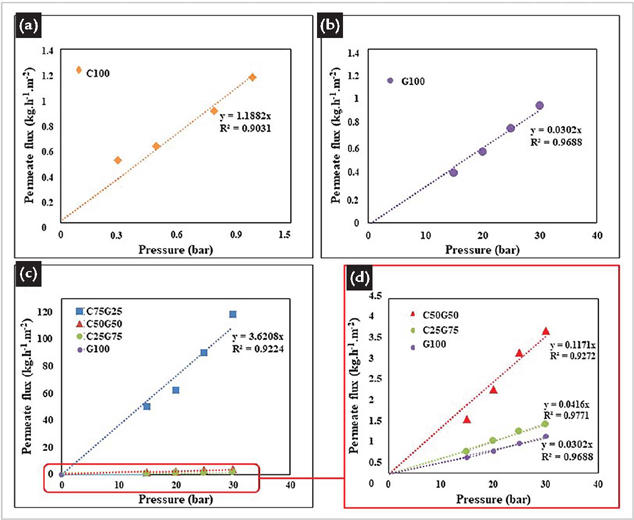
Initially, the compaction step was carried out in the UF/NF system, which is important to remove the residues of solvents used in the membrane fabrication process and in the permeation process. After the compaction step, the mass flux permeate was determined using Equation 4. The graphs of permeate flux versus operating pressure are shown in Figure 5.

Hydraulic permeability performance of PSF membranes produced with Cyr and GVL solvents and a mixture of them in different proportions.
As mentioned previously, the C100 membrane has macropores in its structure and because of this, it was not possible to subject this membrane to pressures greater than 1 bar. As can be seen in Figure 5a, at a pressure of 1 bar this membrane presented a permeate flux of 1.2 kg h-1 m-2. These results are prominent and even better than those reported in literature, where Milescu et al. (2019) did not obtain permeate fluxes at 1 bar with polymeric membranes prepared with Cyr under conditions similar to those employed in our study. The G100 membrane has a homogeneous morphological structure with an average pore size of 2.60 nm, which may be related to the low permeate flux (1 kg h-1 m-2) reached at a pressure of 30 bar (see Figure 5b).
Among the membranes tested at 30 bar (Figures 5c and 5d), the C75G25 membrane showed the highest permeate flux values (120 kg h-1 m-2, at 30 bar), while the other three displayed lower and very close permeate flux values, ranging from 1 to 3.5 kg h-1 m-2 at 30 bar (Figure 5d). This performance may be related to the higher percentage of Cyr solvent, which tends to form larger pores, and the addition of a percentage of GVL solvent that can increase the stability of the pore structures (Dong et al., 2020). The rejection values obtained for reference solutes and ROS are shown in Table 5.
Rejection results (R) for Sodium Alginate, NaCl, Na2SO4 and Rosuvastatin for membranes prepared using green solvents.
From the rejection values for reference solutes presented in Table 5, it is possible to see that the membrane produced only with the solvent Cyrene (C100) presents less than 10% rejection for sodium alginate, whose MW is 60 kDa. This low rejection is probably due to the passage of sodium alginate through the macropores visible in the SEM images illustrated in Figure 3. This indicates that this membrane can be used to remove larger compounds, probably particles and colloids. As for the G100 membrane, the permeate volume was so small that it made sample collection for ROS analysis unfeasible, also making it impossible to determine ROS rejection. This behavior is similar to that found by Hackett et al. (2024). On the other hand, membranes prepared with solvent mixtures (Cyr and GVL) in different proportions showed ROS rejection values greater than 50%, with emphasis on the C25G75 membrane. This membrane achieved 80.57% ROS rejection and the second-highest permeate flux, which may be related to the fact that it has the smallest average pore size among the membranes analyzed (1.44 nm), indicating a good performance for removing this CEC and others with similar or greater MW. In fact, these values are still below those achieved with commercial membranes (e.g., Giacobbo et al. (2023) reported rejections of 96-98% for Rosuvastatin using two NF commercial membranes, NF90 and NF270, supplied by FilmTec-DuPont). Even so, they are promising, and indicate the need for further research.
4. Conclusions
This research was designed to adopt Cyrene and γ-Valerolactone as green solvents to produce sustainable PSF membranes. From the results obtained, it was possible to produce membranes with these green solvents, which are porous, with the C100 membrane having larger pores compared to the others. Furthermore, the membranes obtained are hydrophilic and the C50G50 and C25G75 membranes have the highest porosity values. Based on the permeate flux values obtained with pure water and the rejection values for the reference solutes, we demonstrate that it is possible to produce more sustainable membranes using green solvents and achieve rejections of up to 80% for CEC as Rosuvastatin. These results are promising, since they indicate that it is possible to replace conventional organic solvents with green solvents for the production of polymeric membranes, even though green solvents are around seven times the value of conventional solvents, as they are produced on a small scale. Increasing production scale, the value of these solvents will decrease. This replacement of conventional solvents with green solvents would reduce the footprint caused by membrane production, making the process more sustainable as recommended by Agenda 2030 through the 17 SDGs. Additional studies are needed to improve the performance of these membranes and enable their production on a commercial scale.
Acknowledgments
The authors are grateful to the Brazilian funding agencies (CNPq, CAPES, FINEP and FAPERGS) by the financial support and to Laprom (Mineral Processing Laboratory – UFRGS) for the SEM analyses.
References
-
BORGONI JÚNIOR, Nério. Preparação e caracterização de membranas de polisulfona-poliuretano para recuperação de água de processos têxteis industriais simulados. 84 f, 2020. Tese (Doutorado) - Universidade de Caxias do Sul, [s. l.], 2020. Available at: https://repositorio.ucs.br/11338/6823.
» https://repositorio.ucs.br/11338/6823. - DOLAR, Davor; ĆURIĆ, Iva; AŠPERGER, Danijela. Removal, adsorption, and cleaning of pharmaceutical on polyamide RO and NF membranes. Polymers, [s. l.], v. 15, n. 12, 2023.
- DONG, Xiaobo et al. Comparison of two low-hazard organic solvents as individual and cosolvents for the fabrication of polysulfone membranes. AIChE Journal, [s. l.], v. 66, n. 1, p. 1-14, 2020.
-
DONG, Xiaobo et al. Eco-friendly solvents and their mixture for the fabrication of polysulfone ultrafiltration membranes: an investigation of doctor blade and slot die casting methods. Journal of Membrane Science, [s. l.], v. 614, n. July, p. 118510, 2020. Available at: https://doi.org/10.1016/j.memsci.2020.118510.
» https://doi.org/10.1016/j.memsci.2020.118510. - GIACOBBO, A. Recuperação de polifenóis e polissacarídeos de efluentes vinícolas através de processos de separação por membranas. 2015. 196 f. Tese (Doutorado) - Universidade Federal do Rio Grande do Sul - UFRGS, Porto Alegre, 2015.
- GIACOBBO, Alexandre et al. Ultrafiltration and nanofiltration for the removal of pharmaceutically active compounds from water: the effect of operating pressure on electrostatic solute - membrane interactions. Membranes, [s. l.], v. 13, n. 8, 2023.
-
HACKETT, Cannon et al. Polysulfone ultrafiltration membranes fabricated from green solvents: Significance of coagulation bath composition. Separation and Purification Technology, [s. l.], v. 332, n. Aug. 2023, p. 125752, 2024. Available at: https://doi.org/10.1016/j.seppur.2023.125752.
» https://doi.org/10.1016/j.seppur.2023.125752. - HIDALGO, M. et al. Prediction of flux and rejection coefficients in the removal of emerging pollutants using a nanofiltration membrane. Membranes, [s. l.], v. 13, p. 868, 2023.
-
JIANG, Xinnian et al. Understanding the role of substrates on thin film composite membranes: a green solvent approach with TamiSolve® NxG. Journal of Membrane Science, [s. l.], v. 635, n. June, p. 119530, 2021. Available at: https://doi.org/10.1016/j.memsci.2021.119530.
» https://doi.org/10.1016/j.memsci.2021.119530. - KHAN, Nadeem A. et al. Emerging membrane technology and hybrid treatment systems for the removal of micropollutants from wastewater. Desalination, [s. l.], v. 565, n. June, 2023.
-
KHANZADA, Noman Khalid et al. Removal of organic micropollutants using advanced membrane-based water and wastewater treatment: a review. Journal of Membrane Science, [s. l.], v. 598, n. Aug. 2019, p. 117672, 2020. Available at: https://doi.org/10.1016/j.memsci.2019.117672.
» https://doi.org/10.1016/j.memsci.2019.117672 -
KUMAR, Mahendra et al. Fouling resistant, high flux, charge tunable hybrid ultrafiltration membranes using polymer chains grafted graphene oxide for NOM removal. Chemical Engineering Journal, [s. l.], v. 408, n. Oct. 2020, p. 127300, 2021. Available at:: https://doi.org/10.1016/j.cej.2020.127300.
» https://doi.org/10.1016/j.cej.2020.127300 -
LI, Lan et al. Crown ether functionalized polysulfone membrane coupling with electric field for Li+selective separation. Journal of the Taiwan Institute of Chemical Engineers, [s. l.], v. 123, p. 87–95, 2021. Available at: https://doi.org/10.1016/j.jtice.2021.05.041.
» https://doi.org/10.1016/j.jtice.2021.05.041 -
LI, Xiaojiao; SUN, Hong-bin; SUN, Xudong. Polysulfone grafted with anthraquinone-hydroanthraquinone redox as a flexible membrane electrode for aqueous batteries. Polymer, [s. l.], v. 234, n. Sept., p. 124245, 2021. Available at: https://doi.org/10.1016/j.polymer.2021.124245.
» https://doi.org/10.1016/j.polymer.2021.124245 -
MARINO, T. et al. New frontiers in sustainable membrane preparation: Cyrene™ as green bioderived solvent. Journal of Membrane Science, [s. l.], v. 580, n. Februar y, p. 224 –234, 2019. Available at: https://doi.org/10.1016/j.memsci.2019.03.034.
» https://doi.org/10.1016/j.memsci.2019.03.034 - MILESCU, Roxana A. et al. Fabrication of PES/PVP water filtration membranes using cyrene®, a safer bio-based polar aprotic solvent. Advances in Polymer Technology, [s. l.], v. 2019, 2019.
-
NARWAL, Nishita et al. Emerging micropollutants in aquatic ecosystems and nanotechnology-based removal alternatives: a review. Chemosphere, [s. l.], v. 3 41, n. Aug. p. 139945, 2023. Available at: https://doi.org/10.1016/j.chemosphere.2023.139945.
» https://doi.org/10.1016/j.chemosphere.2023.139945 -
NATIONAL CENTER FOR BIOTECHNOLOGY INFORMATION. PubChem compound summary for CID 10975499, (1S,5R)-6,8-dioxabicyclo[3.2.1]octan-4-one. [S. l.], [s. d.]. Available at: https://pubchem.ncbi.nlm.nih.gov/compound/Dihydrolevoglucosenone. Access at: 26 mar. 2024.
» https://pubchem.ncbi.nlm.nih.gov/compound/Dihydrolevoglucosenone. -
NJOBUENWU, Do. Determination of contact angle from contact area of liquid droplet spreading on solid substrate. Leonardo Electronic Journal of Practices and Technologies, [s. l.], v. 6, n. 10, p. 29-38, 2007. Available at: http://193.226.7.140/lejpt/A10/029_038.pdf.
» https://doi.org/193.226.7.140/lejpt/A10/029_038.pdf -
ONG, Y. F.; WONG, Y. T.; CHAI, P. V. Green synthesis of graphene oxide polysulfone membrane using dimethyl sulfoxide as green solvent. Materials Today: Proceedings, [s. l.], v. 64, p. 1655-1660, 2022. Available at: https://doi.org/10.1016/j.matpr.2022.06.010.
» https://doi.org/10.1016/j.matpr.2022.06.010 - RASOOL, Muhammad Azam; VANKELECOM, Ivo F.J. γ-Valerolactone as bio-based solvent for nanofiltration membrane preparation. Membranes, [s. l.], v. 11, n. 6, 2021.
- SACILOTTO, Daiana Guerra; COSTA, J. Soares; FERREIRA, Jane Zoppas. Superhydrophobic stearic acid deposited by dip-coating on AISI 304 stainless steel: electrochemical behavior in a saline solution. Materials Research, [s. l.], v. 25, n. i, p. 1-8, 2022.
- SANTOS COSTA, Everton dos et al. Preparação e estudo mecânico de membranas poliméricas a partir de blendas de quitosana/amido. [s. l.], p. 1-10, 2019.
-
SULAIMAN, Saleh et al. Stability and removal of atorvastatin, rosuvastatin and simvastatin from wastewater. Environmental Technology (United Kingdom), [s. l.], v. 36, n. 24, p. 3232-3242, 2015. Available at: https://doi.org/10.1080/09593330.2015.1058422.
» https://doi.org/10.1080/09593330.2015.1058422 - TOMIETTO, Pacôme et al. Sustainable fabrication and pervaporation application of bio-based membranes: combining a polyhydroxyalkanoate (PHA) as biopolymer and Cyrene™ as green solvent. Journal of Membrane Science, [s. l.], v. 643, n. Oct. 2021, 2022.
- UNITED STATES ENVIRONMENTAL PROTECTION AGENCY. Risk evaluation for N-methylpyrrolidone ( N M P), (n.d .). [S. l.], 2019.
-
ZOU, Dong et al. Fabrication of hydrophobic bi-layer fiber-aligned PVDF/PVDF-PSF membranes using green solvent for membrane distillation. Desalination, [s. l.], v. 565, n. June, p. 116810, 2023. Available at: https://doi.org/10.1016/j.desal.2023.116810.
» https://doi.org/10.1016/j.desal.2023.116810