 Hydrodemolition and drill and blast: A new way to improve tunnel contour quality
Abstract
Drill and Blast is one of the most utilized excavation methods due to its cost and adaptation capability. One undesirable feature, however, is the contour shape quality of the blasted cavity. It is usually larger and rougher than planned. This characteristic is related to the crack generated by blasting that propagates until it finds a discontinuity. Some methods for overbreak and roughness control are used but they are far from perfect. One option is to replace explosives with the High-Power Abrasive Water Jet (HPAWJ) Technique for rock cutting the perimeter; a necessary step before execution of the Pre-Splitting Technique. These two techniques can create one free surface, with good roughness, capable of avoiding the crack propagation during the blast process. In this article, through a qualitative comparative research, an adaptive cycle is proposed, based on Drill and Blast, that uses HPAWJ for cutting the perimeter. In addition to the improvement on the tunnel wall roughness, this change can reduce the excavation-damage zone and the overbreak, which leads to a reduction of the amounts of shotcrete and muck, consequently reducing the need for transportation.
Keywords:
drill and blast technique; shape contour quality; hydrodemolition.
1. Introduction
Around the world Drill and Blast (D&B) is widely used as an excavation method. It has good potential for short tunnels (when the high initial investment on a specific equipment is not reasonable), and for abrasive rocks (that induce excessive wear of the drag bit) or non-conventional cross sections (involving non-circular or excessive bit). It has a well-defined operational cycle composed of drilling, charging, stemming, blasting, ventilation, mucking and supporting. As the product of overbreak (additional rock debris) and tunnel wall roughness, one characteristic is the irregular contour shape, making the final cross section larger than initially planned. (Chapman et al., 2010)
Even for economical or technical factors, the overbreak and the associated roughness are undesirable in most underground structural constructions. According to Chapman et al., (2010), some alternatives have been utilized to minimize the impact of tunnel contour quality on the lining structure and costs. The most widespread technique is the “Smooth Cut Detonation Technique”, also recognized as "Perimeter Control Blasting" or "Contour Blasting". This method involves executing a series of precise detonations in perimetrical holes. The approach includes drilling closely spaced holes and filling them with a small amount of explosive. These holes are usually called “trimmers” or “outer shots” and are triggered last. The primary objective of this technique is to minimize overbreak and roughness on the sides of the excavation. An alternative method is the “Pre-Splitting Technique”, where perimeter holes are blasted before the main blast rather than afterward. The underlying concept is that small cracks form between perimeter holes, creating a fractured rock surface between them. This way, this surface would have the capability of preventing the cracks in the planned contour rock mass from propagating to the outside when the explosives are detonated. However, the cracks oftentimes deviate in the direction of some pre-existing weakness within the ground. A way to improve the Pre-Splitting Technique is replace the control blasting in perimeter holes by another rock cutting method.
Even though it has been utilized for excavation purposes since the eighteenth century, it was only recently that High-Power Abrasive Wate Jet (HPAWJ) technology has highlighted as option for rock cut. Depending on the geotechnical parameters, HPAWJ can achieve a significant volumetrical removal rate and be easily controlled, helping in the creation of a free surface capable of preventing crack propagation.
Through a comparative analysis of overbreak control methods and the potential of HPAWJ technology in rock excavation, this article proposes an adaptive cycle based on a Drill and Blast technique that uses a High-Power Abrasive Water Jet (HPAWJ) for perimeter cutting. The adaptive cycle is hypothetical and based on laboratory and field tests, needing further investigations.
2. The influence of tunnel shape quality on structural performance and lining and cost
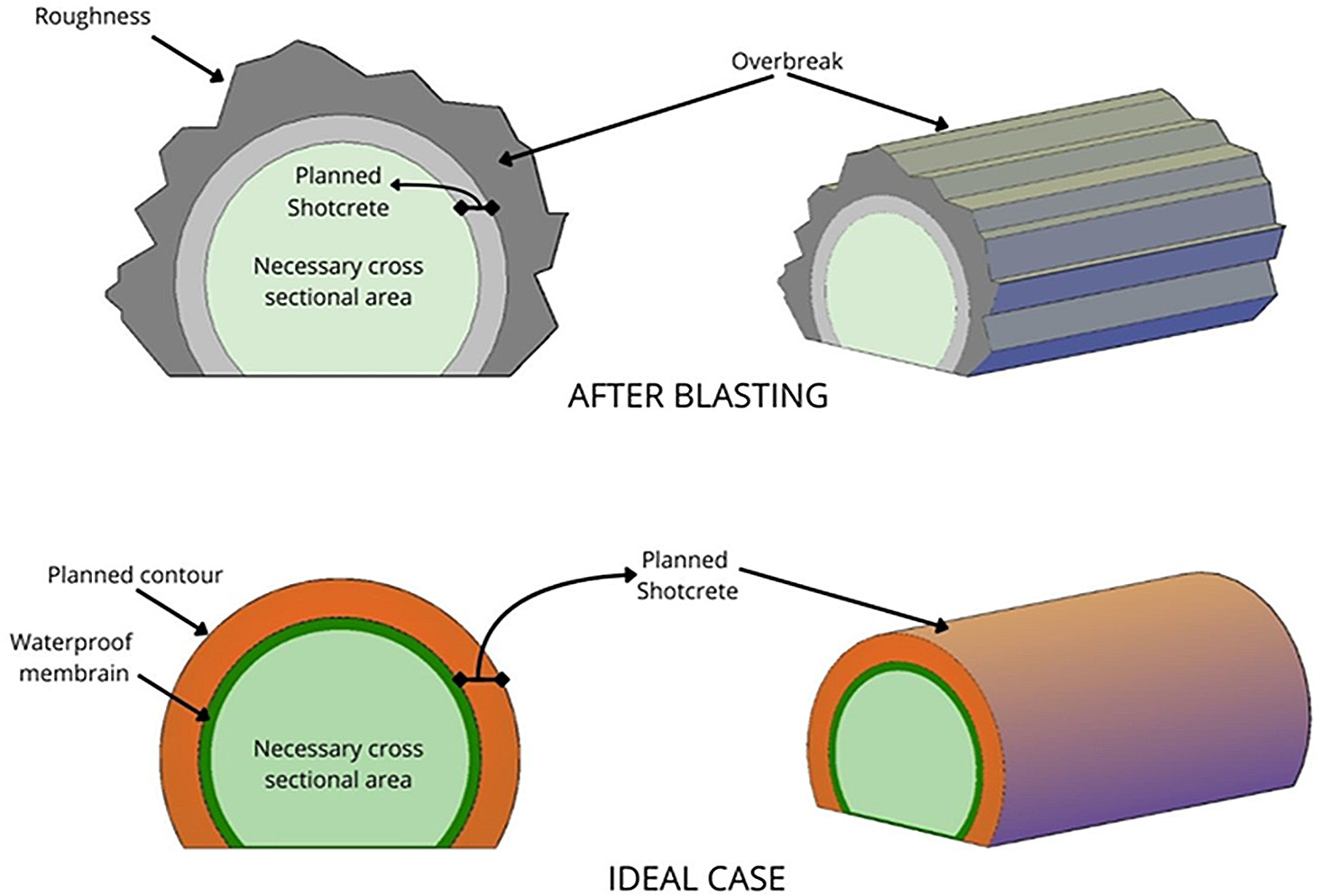
The final shape of the tunnel is influenced by the characteristics of overbreak and roughness. Concepts are illustrated in Figure 1. While overbreak refers to the excess rock mass that breaks off that exceeded the planned contour after blasting, roughness is defined as the random variations on the tunnel surface in comparison with the main surface. Therefore, as emphasized by Kim and Bruland (2015), when evaluating the overall condition, it is more favorable to consider not only the overbreak and contour roughness individually but also their combined impact.
Ideal case: necessary cross-sectional area, planned contour, waterproof membrane and planned shotcrete in the details and. After blasting: overbreak volume and roughness. (Kim and Bruland, 2015)
The quality of the excavation contour has been the focus of several studies. Regarding to overbreak, various parameters can influence the total value. Some of these are under the control of project designers, while others relate to geological conditions. (Costamagna et al., 2021; Cardu et al., 2021)
According to Barpi and Peila (2012), the magnitude of overbreak depends on several aspects, these are: A) geological conditions of the rock mass; B) the quality of drilling of the blasting hole pattern (particularly at the periphery of the tunnel); C) the adequacy of the blasting scheme used; D) the scaling activity and E) the skill of the drilling shift, which relies on the ability to execute a precise drilling pattern, thereby minimizing the risk of creating over profiling due to incorrectly directed peripheral boreholes. It is also worth noting that the tendency is for contractors to allow a large safety margin in the blasting design. This happens because it is cheaper to fill an excessive overbreak than to work in an underbreak. Concerning the thickness of the overbreak, Schmitz (2003) brings a usual range of (0.05 - 0.10) m in compact and stable rock mass with few joints, (0.15 - 0.30) m in fractured, unstable rock masses and 0.5 m in a compact stable rock with larger joint space.
For quality contour shape evaluation, several performance indexes have been proposed. In the works of Adoko and Zhalel (2020), Costamagna et al (2021), and Cardu et al. (2021), it is possible to find extensive reviews about the issue. The most important are: overbreak area index; overbreak distances index and Tunnel Quality index.
While the overbreak area index (equation 01) can be defined as the percentual increment between the design and the excavated sections, the overbreak distance index (equation 02) has a different approach. It is evaluated as the distance between the design and the excavated contour. The maximum overbreak distance depends on each country, in Italy and Norway the maximum are Ovdist = 0.07.√Ad . (Costamagna et al., 2018).
Another two models were suggested in Bruland and Solvik (1987), Kim and Bruland (2009), and Kim and Bruland (2015). In the last two publications, there are suggestions of indexes to quantify the quality contour: Tunnel Contour Quality Index (TCI) and Tunnel Contour Quality for Construction cost (TCIC).
Whereas, according to Kim and Bruland (2015), the TCI (Equation 02) evaluates the overall geometric characteristics of a tunnel contour, considering three parameters regarding overbreaks (Ov, RCL and V0), three weights (W1, W2 and W3), three correction factors (C1, C2 and C3) and one range adjustment constant (CR), TCIC (equation 03) consists of two parameters (f(V) and f(A)), two weights (W0 and WRCL) and one constant, for range adjustment (C).
From both an economic and technical perspective, overbreak and elevated roughness values for the tunnel walls are generally undesirable in the majority of underground structural constructions. According to Borio and Peila (2009) and Barpi and Peila (2012), the irregular shape of tunnels has negative impacts on the shotcrete lining, resulting in cracking and local collapses. Stelzer and Golser (2002) examined small-scale models and concluded that the lining tends to deform more than a homogeneous one.
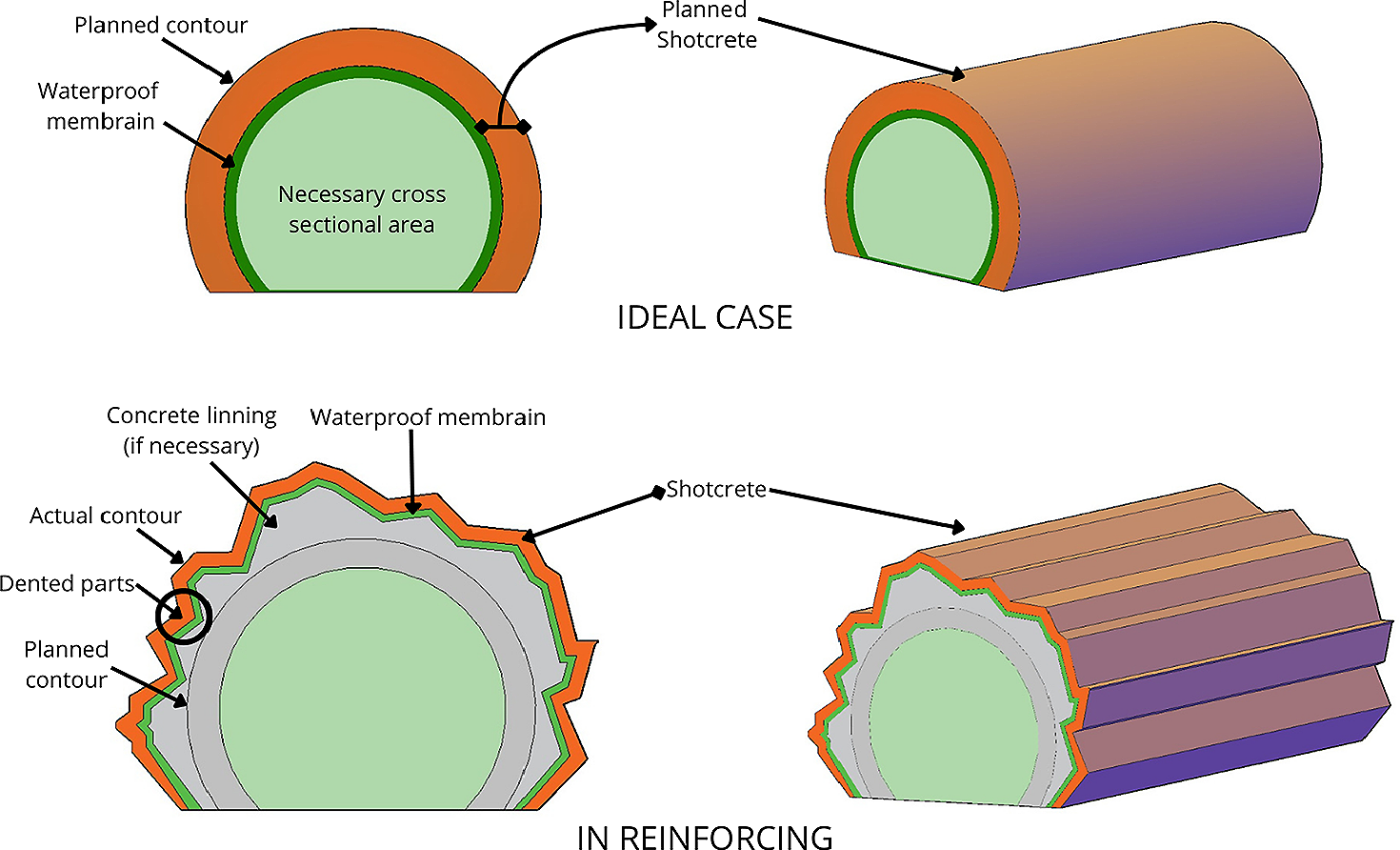
In Ibarra et al., (1996a), Maerz et al., (1996b), Kim and Bruland, (2015) there is a discussion on the influence of overbreaks and roughness on construction costs. As Figure 2 shows, they claim that higher overbreak causes an increase in the need for mucking removal and additional shotcrete. Besides this, part of the costs associated with blasting, such as drilling, charging and explosive costs, are wasted to excavate undesirable rock mass. It is worth saying that the authors mention an increase in waterproof membrane costs due to the increased area needed. Mcknow (1996) has a different approach and argues that the resulting overbreaks and damage to remaining rock can lead to safety problems.

Necessary cross section area, planned contour, waterproof membrane and shotcrete in details. (Kim and Bruland, 2015)
Furthermore, Costamagna et al. (2018) argues that poor contour quality has a negative impact over the advancing rate, convergence, time schedule and safety. Strong analysis of the contour influence over the excavation-damage zone (EDZ) are describe in Adoko and Zhalel (2020). They affirm that the more extensive overbreak, the more significant the EDZ.
Measurement of profiles at specific points or along axes can be accomplished using topographic methods. According to Costamagna et al. (2021), traditional topographic methods (such as total station and theodolite) and contact methods (like finger probes and tape extensometers) are commonly used, but photogrammetry and terrestrial laser scanning (TLS) are becoming increasingly significant.
While photogrammetry can provide a 3D model with low cost and high-quality images, TLS methods are less affected by variations in light and airborne particles. This is because TLS systems use direct laser measurements, which are less susceptible to changes in environmental conditions, such as light intensity and airborne particulates, ensuring more consistent and reliable data acquisition. (Costamagna et al., 2021)
Another way to quantify the overbreak, suggested by Ibarra et al. (1996b) and shown in Equation 05 is based on numerical regression, whose data has been collected in the Aquamilpa Hydroelectric Power project, in Mexico, and involves two parameters: Perimeter Powder Factor (PPF) and Rock Mass Quality (Q-barton).
The well known Rock Mass Quality System utilizes six parameters. They are: rock quality designation, number of joint sets, joint roughness number, joint alteration number, water reduction factor and stress reduction factor. In turn, the Perimeter Powder Factor is calculated by dividing the weight of explosives in the perimeter blast holes and the next inner row by the volume of rock within this annulus. Notably, this calculation excludes consideration of the "lifters" in the invert. (Ibarra et al., 1996b)
To reasonably control the overbreak, it is important to keep the drilling accuracy, essential types and quantities of explosives. The greater the size of the blast round and the specific charge (quantity of explosives per blasted volume), the higher the likelihood of causing a detachment, and consequently, excessive overbreaks. The design of peripheral charges should not be a primary factor in mitigating overbreaks. (Mancine and Cardu, 2001; Wyllie and Mah, 2004).
3. Hydrodemolition for rock cutting
Several works have been dedicated to analyze the HPAWJ in the last decades. The first was Hood (1977), who examined the efficacy of mechanical excavation tools with and without the auxiliary of water jets. The conclusions indicate that the water jet at 400 bars has a positive impact over the excavation performance. Pritchard and Reimer (1980) confirmed the positive impact. They also suggest a significative reduction of excavation force and disc cutter wear.
In recent years, Ciccu and Grosso (2010), through experimental studies, affirm that water jet assistance is effective in improving the performance of mechanical excavation tools and Wang et al. (2020), who proposed a different cutting strategy, affirms that HPAWJ may allow more efficient Tunnel Boring Machines (TBMs)
According to Wilson et al. (1997), the integration of HPAWJ technology into Road Headers was instantaneous. The benefits realized through HPAWJ can be succinctly expressed by noting that, in the absence of High-power water jet assisted cutting (HPWJAC), a machine weighing 100 tons was required to cut rocks with a strength exceeding 1200 bars. The introduction of HPWJAC significantly reduced this requirement to only 35 tons.
The utilization of High-Power Abrasive Water Jet (HPAWJ) in alternative excavation equipment has spurred further development. A significant milestone was reached with the introduction of a petroleum drill rig concept detailed in Maurer et al. (1973). This proposed an oil drilling rig relying on HPAWJ as the primary technology for rock cutting. However, progress was impeded by low power capacity and issues related to leaks. The concept was revisited by Santos et al. (2018). The idea proposed is to weaken the ground by pre-drilling and allow a set of mechanical enlargers excavate only the edges, reducing mechanical wear.
Since the nineties, HPAWJ technology has found application in methane drainage in coal mines in China. Lu et al. (2013) proposed a coal mining drilling equipment capable to excavate rock in two stages. In the first one with HPAWJ, and the subsequently, with mechanical enlargement. Also in China, Kim and Song (2015) published an extensive study of control vibration of drill and blast excavation. The experimental and simulating results show a significative reduction of vibration with offset surface.
It's worth noting that in all approaches described above, the water jet plays a secondary role as an assisting technology for mechanical excavation tools. Only in Jeng et al. (2004), Noronha et al. (2012), Nygardsvoll (2014) and Santos et al. (2018), the possibility of HPAWJ being used as the main excavation technology in a TBM was discussed. In Santos et al. (2018), moreover, can be found a model of a TBM that combines HPAWJ with diamond wire in an innovative excavation cycle. This concept was called “Water Jet Tunnel Boring Machine - WJTBM”. According to the authors, a series of experiments examined water jet performance and concluded that there was an expressive removal volumetric rate in soft rock (like sandstone) and insignificant for hard rock (like granite).
These experiments were conducted in the tunnel laboratory of the Santa Catarina Federal University and utilized an Aquadyne® BlastMax 500 DS high-pressure pump with abrasive line injection. The experimental setup is describe Table 1.
The analysis was both quantitative and qualitative, taking into account the depth and shape of the cut. While the depths were 7 mm for granite and 62 mm for sandstone, the cut (as show in Figure 3) was more precise in sandstone than granite.

In (a) and (b): High power abrasive water Jet cut in granite; in (c) and (d): High power abrasive water Jet cut in sandstone.
Jeng et al. (2004) also describes field experiments with HPAWJ for rock excavation. The article analyses four rock types: Granite, sandstone, slate and meta-sandstone. With power input of almost 400 kW, maximum flow rate of 193 l/min, maximum working pressure of 1000 MPa and nuzzle diameter of 3.2 mm; the penetration rate and volumetrical rate indexes were significant. Above, in Table 2 and Figure 4, it is possible find information about results and figures that illustrated the fields experiments described.
Excavation performance of High-power abrasive water jet for rock cut. Should be highlighted the removal rate and penetration rate performance for soft rock. (Adapted of Jeng et al. (2004)).

Appearance of (a) sandstone, (b) slate, (c) granite and (d) meta-sandstone after field experiments conducted by Jeng et al. (2004).
As emphasized by Ciccu and Grosso (2010), the high-power water jet (HPAWJ) technology emerges as a promising and environmentally friendly option for mining and engineering applications. However, a notable drawback lies in its elevated energy demand, surpassing that of certain mechanical methods. Nevertheless, the integration of HPAWJ with less energy-intensive excavation methods, such as explosives, holds the potential for increased success and efficiency. The potentialities of HPAWJ were also confirmed by Natarajan et al. (2020) that HPAWJ provides opportunities in drilling of rocks, concretes and other materials types.
4. Proposed operational cycle
As shown in Figure 5, the operational cycle proposed has, as the main innovation, an offset cut on a planned contour. This cut could measure (0.05 - 0.10) m of width by 5.0 m of depth (similar to pull in the D&B method) and can be executed by the HPAWJ method. The idea is to avoid the propagation of cracks from the excavated area to the rest of the rock mass.

The cycle proposes the introduction of a perimeter cutting stage executed by HPAWJ technology.
If we consider soft rock, cavity with a length of 30,0 m, width of 0.1 m, and depth of 5.0 m, besides the removal rates presented in Jeng et al. (2004) for sandstone (table 1), the additional time for HPAWJ operation is approximately 82.41 minutes.
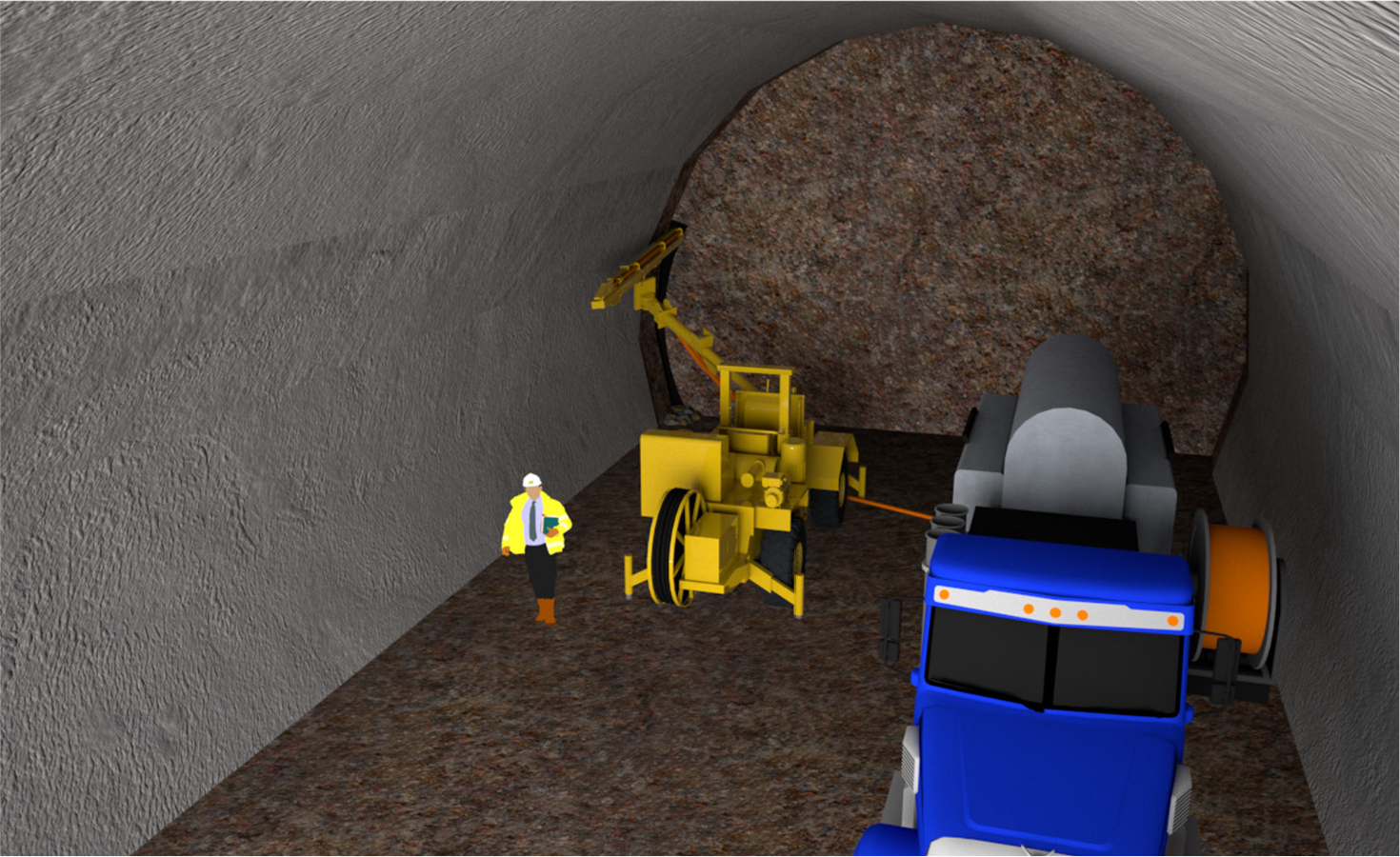
This phase requires a HPAWJ equipment with a drive system and a water supply tank available at the excavation front. The drilling system itself (e.g., jumbo) can be used with few adaptations. Ensuring the safety of the operators is essential. The use of specific collective and individual protective equipment is necessary.
The drilling process, necessary to blast the remaining core rock, can be executed according to the previously defined drilling plan. Probably the presence of a free surface will result in a smaller number of holes or smaller holes. The same impact is expected in the charging phase. It is also possible that less explosives will be necessary. The power factor, which is different for perimetrical holes, will be the same for every hole in the proposed cycle. According the results present in Kim and Song (2015), lower vibration level and less significant EDZ than the traditional Drill and Blast technique are expected.
While the effect is not expected in the ventilation phase, the reduction of the overbreak will have a positive influence over the mucking and transporting phase. In the same way, it is expected a positive impact over the reinforcing and revestiment phase. This will be the product of less damage on rock mass during the excavation process.
The round total time should not be increased. It is expected that the hydrodemolition time required will be similar to the scaling time, which is not necessary in the proposed cycle. Furthermore, there will be a reduction in mucking and transporting time due to the reduction of the overbreak.
5. Conclusions
The quality contour of a Tunnel excavated by the Drill and Blast method used are not the most suitable. Undesirable characteristics, mainly overbreak and roughness of the tunnel wall, are a consequence of geological, explosive and blasting parameters. Some methods can minimize this effect. However, their performances are less than adequate.
This article proposes an hypothetical operational cycle (based on field and laboratory results) that introduces a previous offset cut in the traditional drill and blast methods. The creation of a free face prevents cracks and shock waves from propagating to the outer rock mass excavation region. Besides, the improvement in the roughness of the tunnel wall, there is expected a reduction of the overbreak, the quantity of shotcrete, lower vibration level and less muck, as well as a reduction in the need for transportation. Further theoretical and experimental studies are necessary to prove the concept feasibility for tunnel excavation.
Acknowledgments
This work received financial support from the Brazilian Government through CNPq (Conselho Nacional de Desenvolvimento Científico e Tecnológico), FINEP (Financiadora de Estudos e Projetos) and Civil Engineering Departments of Universidade Federal de Santa Catarina (UFSC) and Universidade de Estado de Santa Catarina (UDESC).
References
- ADOKO, A. C.; ZHALEL, M. A methodology for assessing rock mass damage in underground mining. In:INTERNATIONAL CONGRESS ON ROCK MECHANICS ISRM, 14, 2019. p. 103.
- BARPI, F.; PEILA, D. Influence of the tunnel shape on shotcrete lining stresses. Computer Aided Civil and Infrastructure Engineering, v. 27, n. 4, p. 260-275, 2012.
- BORIO, L.; PEILA, D. How tunnel boundary irregularities can influence the stresses in a shotcrete lining. Geoingegneria Ambientale e Mineraria - GEAM, v. 47, n. 2, p. 45-52, 2009.
- BRULAND, A.; SOLVIK, Ø.. Analysis of roughness in unlined tunnels. In: INTERNATIONAL CONFERENCE - UNDERGROUND HYDROPOWER PLANTS, 1987, Oslo. Proceedings [...] . Oslo: 1987. v. 1, p. 701-709.
-
CARDU, Marilena; GODIO, Alberto; OGGERI, Claudio; SECCATORE, Jacopo. The influence of rock mass fracturing on splitting and contour blasts. Geomechanics And Geoengineering, [S.L.], v. 17, n. 3, p. 822-833, 18 mar. 2021. Informa UK Limited. http://dx.doi.org/10.1080/17486025.2021.1890234
» http://dx.doi.org/10.1080/17486025.2021.1890234 -
COSTAMAGNA, Elisa; OGGERI, Claudio; SEGARRA, Pablo; CASTEDO, Ricardo; NAVARRO, Juan. Assessment of contour profile quality in D&B tunnelling. Tunnelling and Underground Space Technology, v. 75, p. 67-80, maio 2018. Elsevier BV. http://dx.doi.org/10.1016/j.tust.2018.02.007
» http://dx.doi.org/10.1016/j.tust.2018.02.007 -
COSTAMAGNA, Elisa; OGGERI, C; VINAI, R. Damage and contour quality in rock excavations for quarrying and tunnelling: assessment for properties and solutions for stability. Iop Conference Series: Earth and Environmental Science, v. 833, n. 1, p. 012137, 1 ago. 2021. IOP Publishing. http://dx.doi.org/10.1088/1755-1315/833/1/012137
» http://dx.doi.org/10.1088/1755-1315/833/1/012137 - CICCU, R.; GROSSO, B. Improvement of the excavation performance of PCD drag tools by water jet assistance. Rock Mechanics and Rock Engineering, v. 43, n. 4, p. 465-474, 2010.
- CICCU, R.; GROSSO, B. Improvement of disc cutter performance by water jet assistance. Rock Mechanics and Rock Engineering, v. 47, n. 2, p. 733-744, 2014.
- CHAPMAN, D.; METJE, N.; STÄRK, A. Introduction to tunnel construction. London: Spon Press, 2010.
- FENN, O.; PROTHEROE, B. E.; JOUGHIN, N. C. Enhancement of roller cutting by means of water jets. In: PROCEEDING OF RAPID EXCAVATION AND TUNNELING CONFERENCE, New York, p. 341-356, 1985.
- HOEK, E.; BRAY, J. D. Rock slope engineering. New York: Spon Press, 1981.
- HOOD, M. A study of methods to improve the performance of drag bits used to cut hard rock. 1977. 318 f. Thesis (Doctorate) - Philosophy, Faculty of Engineering of The University of Witwatersrand, Johannesburg, 1977.
- IBARRA, J. A.; MAERZ, N. H.; FRANKLIN, J. A. Overbreak and underbreak in underground openings part 2: causes and implications. Geotechnical and Geological Engineering, v. 14, n. 4, p. 325-340, 1996.
- JENG, F.; HUANG, T.; HILMERSSON, S. New development of waterjet technology for tunnel excavation purposes. Tunnelling and Underground Space Technology, v. 19, p. 438-439, 2004.
- KIM, Y.; BRULAND, A. A study on the estimation of the Tunnel Contour Quality Index in a drill and blast tunnel. In: INTERNATIONAL SYMPOSIUM ON ROCK FRAGMENTATION BY BLASTING, 9., 2009, Granada. Proceedings [...]. Granada: p. 507-513, 2009.
- KIM, Y.; BRULAND, A. A study on the establishment of Tunnel Contour Quality Index considering construction cost. Tunnelling and Underground Space Technology, v. 50, p. 218-225, 2015.
- KIM, J.; SONG, J. Abrasive water jet cutting methods for reducing blast-induced ground vibration in tunnel excavation. International Journal of Rock Mechanics and Mining Sciences, v. 75, p. 147-158, 2015.
- KOUZMICH, I. A.; MERZLYAKOV, V. G. Schemes of coal massif breakage by disc cutter and high velocity. In: NORTH AMERICAN WATER JET CONFERENCE, 2., 1983, Rolla. Proceedings [...]. Rolla: North American Water Jet Conference, 1983.
- LU, Y. et al. Hard rock drilling technique with abrasive water jet assistance. International Journal of Rock Mechanics and Mining Sciences, n. 60, p. 47-56, 2013.
- MAERZ, N. H.; IBARRA, J. A.; FRANKLIN, J. A. Overbreak and underbreak in underground openings Part 1: measurement using the light sectioning method and digital image processing. Geotechnical and Geological Engineering, v. 14, n. 4, p. 307-323, 1996.
- MANCINI, R.; CARDU, M. Scavi in roccia-gli esplosivi. Benevento: Hevelius Edizioni, 2001.
- MAURER, W.C. et al. High-pressure drilling. Journal of Petroleum Technology, v. 25, n. 07, p. 851-859, 1973.
- MCKOWN, A. F. Perimeter control blasting for underground excavations in fractured and weathered rock. Bull. Assoc. Eng. Geol., v. 23, n. 4, p. 461-478, 1986.
- NATARAJAN, Y. et al. Abrasive Water Jet Machining process: a state of art of review. Journal of Manufacturing Processes, v. 49, p. 271-322, 2020.
- NORONHA, M. A. M. On the development of a micro tunnelling machine with water jet technology. In: INTERNATIONAL NO-DIG CONFERENCE, 30., 2012, São Paulo. Proceedings [...]. São Paulo: International No-Dig Conference, 2012.
- NYGÅRDSVOLL, E. Application of water jet cutting for tunnel boring. 2014. 83 f. Thesis (Master) - Industrial Economics, Department Of Industrial Economics, Risk Management And Urban Design, University Of Stavanger, Stavanger, 2014.
- PRITCHARD, R. S. Effects of waterjet slotting on roller cutter forces. In: NORTH AMERICAN SYMPOSIUM ON ROCK MECHANICS, 21., 1980, Rolla. Proceedings [...] . Rolla: North American Symposium on Rock Mechanics, 1980.
- SANTOS, R. P. New concept of tunnel boring machine: high performance using water jet and diamond wire as rock cutting technology. REM - International Engineering Journal, v. 71, p. 9-17, 2018.
- SANTOS, R. P. Inovações em broca: utilização de jato de água com alto conteúdo energético e alargadores mecânicos como princípio de escavação. In: CONGRESSO NACIONAL DE ENGENHARIA DE PETRÓLEO, GÁS NATURAL E BIOCOMBUSTÍVEIS, 3., 2018, Salvador. Anais [...]. Salvador: 2018.
- SCHMITZ, R. M. Line infrastructure and the role of engineering geology in analysing overbreak, part I: theoretical considerations. Ingeokring Newsletter, v. 10, n. 2, p. 31-41, 2003.
- STELZER, G.; GOLSER, J. Untersuchungen zu geometrischen Imperfektionen von Spritzbetonschalen-Ergebnisse aus Modellversuchen und numerischen Berechnungen. In: SPRITZBETON-TECHNOLOGIE 2002 CONFERENCE, 1., 2002, Alpbach. Proceedings [...]. Alpbach: Spritzbeton-Technologie Conference, 2002.
- WANG, F. et al. Rock breaking performance of TBM disc cutter assisted by high-pressure water jet. Applied Sciences, v. 10, n. 18, 2020.
- WILSON, J. W.; SUMMERS, D. A.; GERTSCH, R. E.. The development of waterjets for rock excavation. In: INTERNATIONAL SYMPOSIUM ON MINE MECHANISATION AND AUTOMATION, 4., 1997, Brisbane. Proceedings [...]. Brisbane, 1997.