Public policies on entrepreneurship: An analysis of the Brazilian legislative agenda between 2011 and 2024
Abstract
Objective: To characterize the public policy proposals for entrepreneurship that were processed in the National Congress between 2011 and 2024. Methodology: The proposals were collected using the Selenium package in Python, then organized and classified by the authors according to types of public policy. Descriptive analyses were then performed based on the date of the proposal, its type, and the political party of the proposing representative. These elements were important for understanding how the themes evolved in different types, as well as among representatives across the political spectrum.
Results: The results indicate that the period from 2019 to 2023 exhibits more proposals and that the themes most addressed by the authors of the policies were "target group measures" and "entry/exit barriers". The right wing has more legislators dealing with issues related to entrepreneurship, especially those related to "entry/exit barriers" and "financing". Theoretical/methodological contributions: The study highlights the use of data collection through web scraping and the classification of ongoing projects according to a typology of public entrepreneurship policies. Relevance/originality: Provide evidence on the early stages of public policy formulation, filling a gap in the literature. Social/management contributions: Point out that most policies focus on reactive measures to meet the demands of specific groups, rather than on actions that can generate long-term competitive conditions, such as innovation and infrastructure.
Keywords:
Public policies for entrepreneurship; Legislative; Typologies.
Resumo
Objetivo: Caracterizar as propostas de políticas públicas de empreendedorismo que tramitaram no Congresso Nacional entre os anos de 2011 e 2024. Metodologia: As proposições foram coletadas por meio do pacote Selenium da linguagem Python, organizadas e classificadas pelos autores com base em uma tipologia de políticas públicas de empreendedorismo. Em sequência, análises descritivas foram realizadas com base na data da proposta, tipo e partido do deputado proponente. Este último elemento foi importante para compreender como ocorre a evolução do tema em diferentes tipos, bem como são representados dentro de espectros políticos.
Resultados: O período de 2019 a 2023 apresentou mais proposições e as temáticas mais frequentes pelos autores das políticas foram “medidas para grupos específicos” e “barreiras de entrada e saída”. O espectro de direita possui mais legisladores tratando dos temas que abordam o empreendedorismo, sobretudo aqueles ligados aos temas de “barreiras de entrada e saída” e “financiamento”.
Contribuições teóricas/metodológicas: Destaca-se o uso da coleta de dados por meio de web scraping e da classificação dos projetos em andamento de acordo uma tipologia de políticas públicas de empreendedorismo. Relevância/originalidade: Fornecer evidências sobre as fases iniciais da formulação de políticas públicas, suprindo uma lacuna presente na literatura.
Contribuições sociais / para a gestão: Apontar que a maior parte das políticas se concentra em medidas reativas para suprir demandas de grupos específicos, e não em ações que podem gerar condições competitivas de longo prazo, como inovação e infraestrutura.
Palavras-chave:
Políticas públicas de empreendedorismo; Legislativo; Tipologias.
INTRODUCTION
The mortality rate of Brazilian nascent ventures after five years varies from 17% to 29%, depending on their legal nature, according to Sebrae (2023). The reasons that could minimize these rates involve elements such as access to credit, access to customers, and reduction of charges and taxes (SEBRAE, 2020). Some of these issues are associated with the managerial capacity of the business. However, other factors are linked to the conditions under which the enterprises operate. Thus, given the positive role of the state in shaping these conditions, one of the most effective ways to foster entrepreneurship and small businesses is through supported by public policies (Bernasconi & Espinosa-Cristia, 2020).
A public policy is the conduct carried out to address a collectively relevant problem (Secchi et al., 2019). Entrepreneurship public policies, in turn, aim to assist entrepreneurs by creating conditions that facilitate access to resources, mitigate barriers, and promote a culture of valuing entrepreneurship in a given location (OECD, 2020).
To understand the role of public policies, researchers oftenemploy typologies, since they contribute to the interpretation of the phenomenon based on analytical criteria (Secchi et al., 2019). Public policy typologies can be understood as “(...) ways of classifying the content, actors, styles, and institutions in a public policy process” (Secchi et al., 2019, p. 30). Similarly, researchers in the field of entrepreneurship have created typologies to understand how implemented public policies are configured in this area. Lundström and Stevenson (2005) suggested six types of entrepreneurship public policy. Based on an analysis of the policies in operation by the Brazilian federal executive branch, Borges et al. (2018) expanded Lundström and Stevenson’s (2005) typology to eight types.
This study expands and transfers the analysis of entrepreneurship public policy typologies to actions guided by the federal legislature in order to understand, in the public policy formulation phase, how this agenda is structured in the context of the Brazilian National Congress. The government agenda can be considered the list of formal or informal priorities for public issues that deserve attention (Secchi, 2012).
This research aims to characterize the public policy proposals on entrepreneurship that were debated in the National Congress between 2011 and 2024. The focus is to fill a gap in studies on the early stages of the public policy cycle. Arshed (2017), Smallbone (2016), and Arenal et al. (2021) emphasize that entrepreneurship public policies research is focused mainly on the implementation and evaluation stages. Capella (2020) also mentions that, for a long time, agenda studies were not among the central concerns of the Brazilian community of public policy researchers. Furthermore, according to Silva et al. (2019), policymakers and academics oftenfocus on large companies, neglecting measures that benefit small businesses. Therefore, we shed light on the public policies applied to the context of small and new businesses.
Based on this analysis, it is possible to identify how the theme is presented in the legislative environment, highlighting which types of policies, according to the categories of Borges et al. (2018), emerge most frequently, as well as which themes, legislators, and ideological orientations are most present. It is also important to note that, within the formulation phase, the specific focus of this work is on agenda setting, represented here by the bills that have been processed by the Legislative Branch since 2011, which are considered in two groups: those approved and those not approved yet. Thus, it can be considered that agenda setting emerges as a preceding process that provides the input for action. It is an intrinsically political process that involves the social construction of problems, the persuasion of decision-makers and the general public, the clash between different problems, and also between different representations of these problems (Lima & Papi, 2020; Capella, 2018).
THEORETICAL BACKGROUND
This section has been divided into two parts. The first, entitled Public Entrepreneurship Policies, discusses part of the literature that argues for public policies aimed at entrepreneurship. The second, entitled Typologies for Understanding Public Entrepreneurship Policies, explains the concept of typologies for public policies and the motivation for their use in this study.
Public Policies for Entrepreneurship
According to Höfling (2001), public policies consist of a government project implemented by the state. In other words, they mean the "state in action". Souza (2006), in turn, emphasizes that public policy is a multidisciplinary field designed for government actions, both to put them into practice and to analyze and propose changes in their implementation. Entrepreneurship public policies correspond to a section of the state's action through which public institutions support entrepreneurs, creating a more favorable environment (Audretsch & Beckmann, 2007). Public policies manifest themselves in various ways, and researchers constantly seek to include them in the analysis of the phenomenon of entrepreneurship.
Teixeira et al. (2023)identified the effects of gender policies alongside entrepreneurship policies for women entrepreneurs. According to the authors, such policies help mitigate barriers that prevent women’s participation in entrepreneurship, such as reducing gender discrimination and promoting social welfare for female business owners. The change in the social perception of women in entrepreneurial roles, according to Kobeissi (2010), also arises as a consequence of gender policies and works in conjunction with women's empowerment to leverage female entrepreneurship.
Another example of an entrepreneurship policy is the Individual Microentrepreneur (MEI) program, established in 2008. According to Tondolo et al. (2024), the MEI improves the access to social security and inserts groups into the production system, promoting inclusion and providing stability for entrepreneurs. In addition, the policy has a significant social impact, especially for low-income people, providing an opportunity to increase income and access new markets (Tondolo et al., 2024).
The National School Feeding Program (Programa Nacional de Alimentação Escolar - PNAE) is also an example of entrepreneurship policy, as it establishes that at least 30% of resources must be invested in the purchase of products from rural family entrepreneurs to supply school meals. According to Teixeira et al. (2020), the program promotes greater income generation, improves quality of life, and encourages diversity among rural entrepreneurs. The PNAE can also strengthen regional trade by providing more sustainable production. It also creates healthier food habits in the local school community (Teixeira et al., 2020).
Further examples of entrepreneurship public policies in the Brazilian context can be found in the literature. Table 1 summarizes a set of studies published in recent years about the topic. The most frequent theme was "Individual Microentrepreneurs", with 16 papers published in recent years. Next was "Public policies on entrepreneurship and innovation", with four papers, all of which were more recent studies.
For a better understanding of public policies and how they work, different typologies were developed according to various analysis criteria (Secchi et al., 2019). This provides a deeper understanding of the actions of these public policies. According to Secchi et al. (2019), classification serves to identify institutions, their themes, and those who promote these policies, enabling greater knowledge about how they work. The next subsection focuses on typologies of entrepreneurship public policies.
Typologies for Understanding Public Entrepreneurship Policies
Audretsch et al. (2007) propose a framework that organizes entrepreneurship public policies based on determinants that can influence entrepreneurial activity. Each of the rectangles in Figure 1 refers to the determinants of entrepreneurship, and the circles connected to each rectangle represent the channels of public policy intervention that influence these determinants.
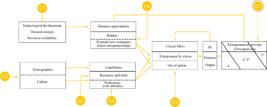
The first circle (G1) represents policies that impact the number, type, and accessibility of opportunities, influencing the market size. Such policies are mainly attributed to factors that stimulate technological development. The second (G2) refers to policies that affect the number of potential and future entrepreneurs, for example, immigration and regional development policies. The third circle (G3) represents policies that have an impact on the capabilities and resources of potential entrepreneurs, attributed to materials, financial capital, and intangible factors. The fourth (G4) is organized around policies aimed at individuals' preferences for becoming entrepreneurs influenced by the educational and cultural system. The fifth circle (G5) deals with policies aimed at the decision-making processes of potential entrepreneurs, the most relevant in this case being taxation policies, social security regimes, and labor market legislation. The sixth circle (G6) involves intervention policies aimed at promoting entrepreneurship by intervening in market accessibility, for example, through bankruptcy laws. Finally, the seventh circle (G7) touches upon some of the sources of a possible divergence between the actual level of entrepreneurship and the “equilibrium” level, in which, depending on the nature of this discrepancy, the government can intervene through policies that leverage or limit entrepreneurship (Audretsch et al., 2007).
Lundström e Stevenson (2005) developed another typology based on policy content. This typology was expanded by Borges et al. (2018) after an analysis of Brazilian Executive Branch entrepreneurship public policies. Based on the typology of the former, Borges et al. (2018) included types “infrastructure” and “technology and innovation”, as described in Table 2.
METHODOLOGICAL PROCEDURES
This study is qualitative-quantitative in nature. It is qualitative in terms of data since its primary source comes from unstructured data (texts). It is quantitative in terms of analysis, as the information was synthesized using descriptive statistics. Documentary research was conducted between February and August 2024, based on the extraction of textual data from draft bills or bills already approved by the Chamber of Deputies between 2011 and 2024. This website also includes the Senate, due to the need for proposals to also be processed by that institution. Content analysis was performed, with categories previously determined based on the type of entrepreneurship public policy proposed by Lundström e Stevenson (2005) and adapted by Borges et al. (2018). New categories emerged and were included in this study, as presented in the next section.
The search was conducted in two steps. First, the terms “entrepreneur”, “entrepreneurship”, and “entrepreneurial” were used in the search engine of the Chamber of Deputies website. Based on the results, 29 new words were added for the second search, namely: “entrepreneurship”, “to undertake”, “entrepreneur”, “female entrepreneur”, “individual microentrepreneur”, “microentrepreneurship”, “startup”, “microenterprise,” "small business", "MPE", "My First Business Program", "Simples Nacional", "microcredit", "female entrepreneur", "female entrepreneurship", "business registration", "CGSIM", "Redesim", "CNPJ", "Sebrae","PAB", "CRED+", "entrepreneurial education", "entrepreneurial training", "self-employed", "SIMEI", "self-employed worker", "self-employment", and "employer". For draft bills, filters were added to access only those that were part of the following categories: bills (PL), complementary bills (PLP), and conversion bills (PLV). For approved bills (laws), only proposals that originated in the federal legislature were used as filters.
After collecting the links associated with the different search terms, an individual loop was performed using the Selenium package, which is used for data scraping. This tool assists in interacting with web pages through a programming interface and allows one to automatically extract data, fill in text fields, and click buttons (Chauhan et al., 2023). Selenium works in different programming languages, and we used the Python programming language version. Selenium performs interactions and extracts the specified data. This tool reduces manual efforts, ensuring greater accuracy in data collection, and allows reproducibility in data collection.
Regarding the data, the following attributes were extracted: the hyperlink to the proposal page, the hyperlink to the PDF with the text of the proposal, the summary, the date of submission of the proposal, the authors of the proposal, the political parties of the authors, and their federal unit. For those approved, in addition to this information, the following were added: the hyperlink to the legislation page, the law number, the date of the law, and the origin. Each of the terms for the draft bills returned a certain number of proposals. In total, after the end of the loop for each term, a tabular structure with 4,531 results was consolidated. After processing and removing duplicates, the database had 3,213 results. The same data processing was applied to the database of approved proposals, which initially returned 3,082 bills. After processing and removing duplicates, 1,697 results remained. After excluding records prior to 2011, a total of 2,749 proposals were obtained for initial classification in relation to draft bills and 357 for those approved.
The next step consisted of classification by two of the researchers on the type of entrepreneurship public policy associated with the bill. In cases of disagreement, a third researcher acted to define the classification. Many cases were classified as “not applicable” because the term searched was used generically. An example of this is Bill 10.3028/2018, which proposes to change the name of an INSS (Brazil’s Social Security Institute) agency in honor of an important local entrepreneur. Another example is Bill 5236/2016 on the establishment of the Brazilian mining code, the creation of the National Mining Agency, and the National Council for Mineral Policy. Although the terms "entrepreneur" or "enterprise" were used, there is no specific provision for smaller enterprises. After this data processing, 688 proposals were retained, of which 619 were draft bills and 69 were approved.
In addition to classification by type, an analysis was carried out based on their political spectrums, according to Zucco and Power (2024), who constructed a scale ranging from -1 to 1, where negative values correspond to the right-wing political-ideological right and positive values to the left-wing. Adaptations were necessary in the classification of Zucco and Power (2024) due to changes since the study was conducted. Some political parties merged during this process (e.g., DEM and PSL became UNIÃO), and others changed their names (e.g., PPS became CIDADANIA). In this case, the political spectra of the former parties mentioned in the article were extended to the new names. Three parties did not appear in the study by Zucco and Power (2024): PMB; PMN, which is currently called MOBILIZA; and PTdoB, which became AVANTE, which justified the exclusion of these cases in the analysis of the political spectrum. Finally, as some approved proposals referred to Provisional Measures (MPV), and their origin comes from the Executive Branch, the political spectrum of the party of the President of the Republic in office at the time was assigned.
The descriptive analyses and visualizations were created using the R language with the RStudio development environment. The graphs were generated using the ggplot2 package, and the tabular analyses were calculated using the dplyr package and Excel.
RESULTS AND DISCUSSION
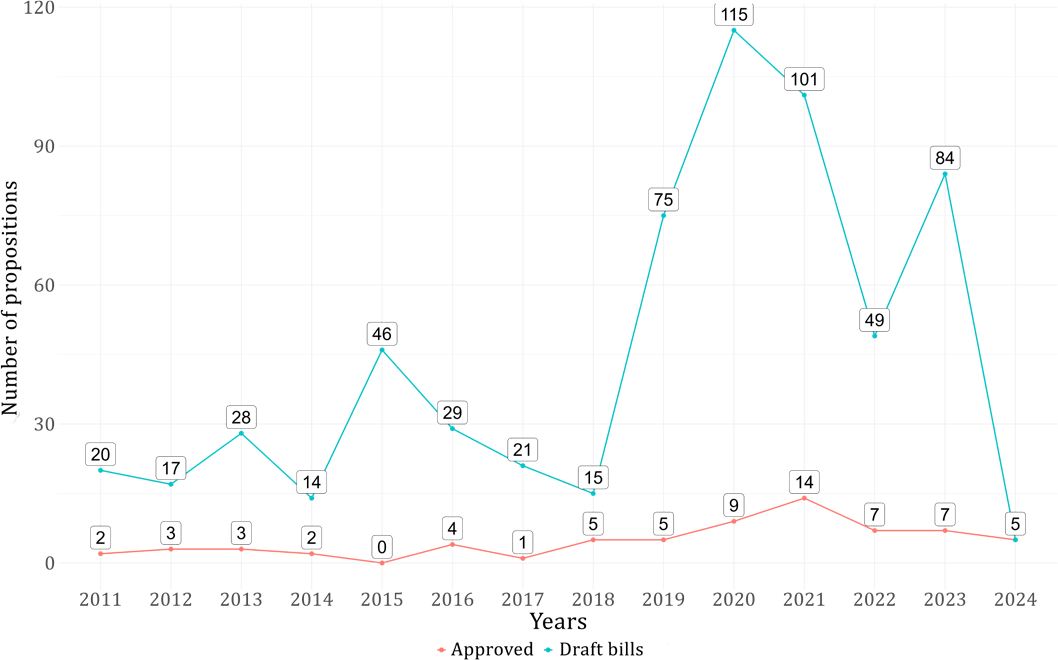
Figure 2 describes the number of draft and approved proposals over the years. The period with the highest incidence of both types was between 2019 and 2023. It is worth noting that the COVID-19 pandemic occurred during this period, and many measures were urgently added to the agenda to support entrepreneurs at that time. In 2022, there was still a large volume of draft proposals (49), despite a drop compared to previous years. In 2023, the number rose again to 84 proposals. For those approved, the number varied between 2 and 7 projects in the years out of the pandemic period.

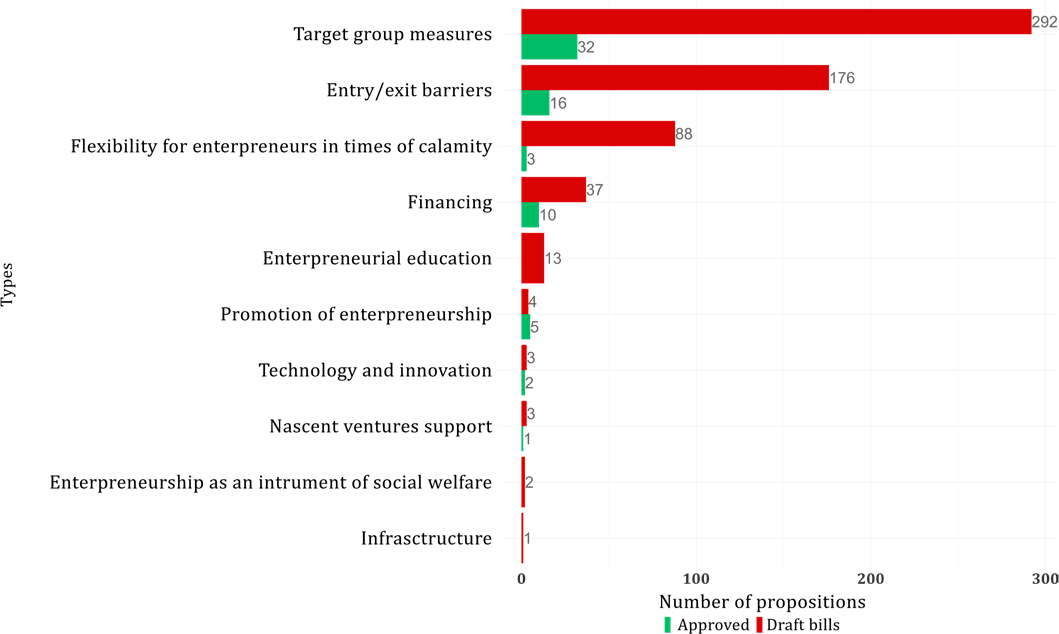
Figure 3 shows the number of draft and approved bills by category. Two new categories emerged in the analysis: "flexibility for entrepreneurs in times of calamity" and "entrepreneurship as an instrument of social welfare". Among all categories, the one with the highest frequency, both for draft and approved projects, was "target group measures", with 292 and 32, respectively. Exceptionally for this category, we chose to delve into the content to assess how the proposals are classified within the same type. The category "entry/exit barriers" comes in second place, with 176 draft projects and 16 approved. In third place for draft projects is "flexibility for entrepreneurs in times of calamity" with 88 projects, and in fourth place is "financing" with 37 projects. Among the approved projects, some categories emerged only a few times, ranging from 1 to 13 projects, and other categories did not obtain any results (e.g., "entrepreneurship as an instrument of social welfare", "infrastructure", and "entrepreneurial education").
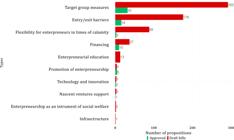
There are few projects, both draft and approved, related to encouraging entrepreneurial culture, measures to support start-ups, and the transfer of technology and innovation to businesses. This shows that such issues have not been a priority on the Brazilian legislative agenda, despite their importance for promoting long-term development. According to Borges et al. (2018), the promotion of new companies should be one of the central focuses of policies. Regarding technology and innovation policies, Bittar and Di Serio (2024) state that investment in innovation for entrepreneurship would be essential, as it improves and stimulates the conditions for entrepreneurship. Furthermore, the authors suggest that micro and small businesses have not been prioritized in innovation policies in Brazil. Another finding consistent with Borges et al. (2018)was the low number of proposals focused on infrasctructure.
Delving into the content of the types, Table 3 illustrates each one, as well as the description and examples of bills.
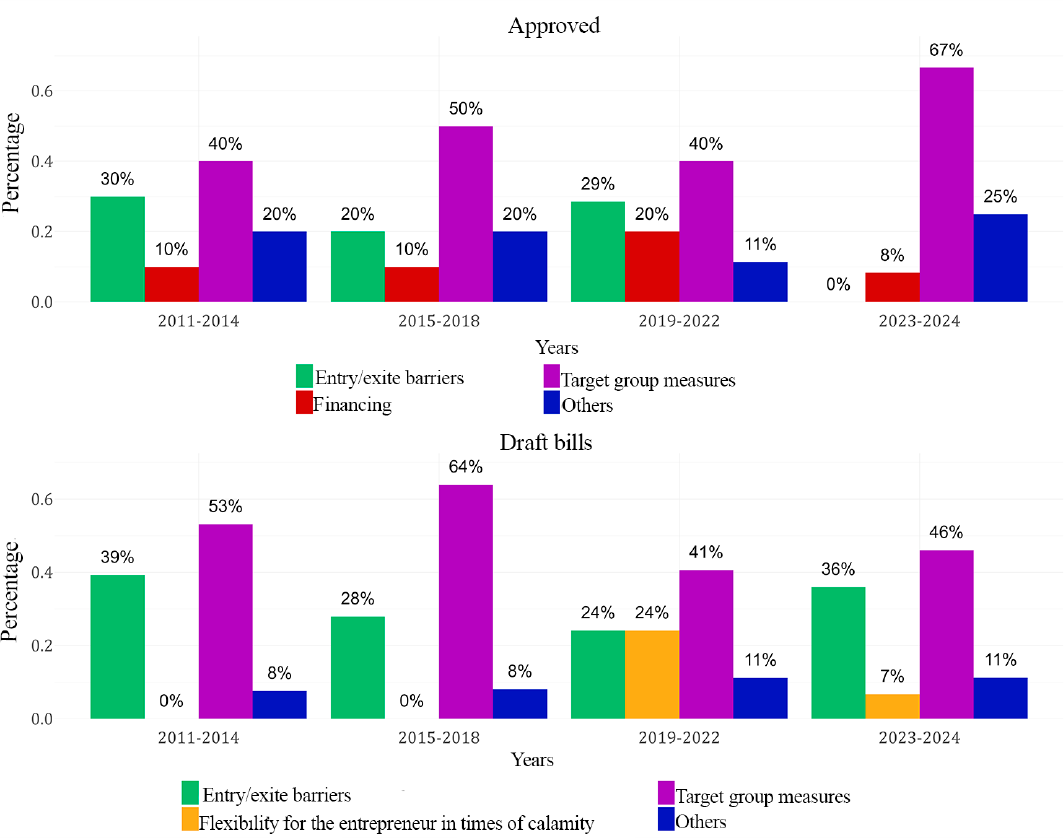
Regarding the types most addressed in each legislature (Figure 4), most of the proposals can be classified as "target group measures", both among those drafted and approved. The topic "entry/exit barriers" corresponds to the second highest percentage in most terms. In addition, the categories "flexibility for entrepreneurs in times of calamity" and "financing" peaked during the pandemic. The other categories, all with values below 20%, were classified as "others".

These results, with a broad concentration in the category “target group measures” reinforce the presence of a government agenda more focused on short-term resolutions targeted to specific groups than on promoting a long-term entrepreneurial culture. This phenomenon was also observed by Lundström and Stevenson (2005), who identified that many countries saw the need to create an entrepreneurial culture, but few created strong and comprehensive policies to foster it. They also noted that countries with a stronger entrepreneurial culture were those that invested more in measures to promote entrepreneurship.
As indicated in the methodology, the type "target group measures" was classified into subcategories. The type "entry/exit barriers" was the most prevalent (260 bills or laws passed). This was followed by the types "financing", "flexibility for entrepreneurs in times of calamity", and "promotion of entrepreneurship", with 24, 16, and 10 bills or laws passed, respectively. Other types emerged, such as “infrastructure”, “nascent ventures support”, and “entrepreneurial education”, but with less representation.
Based on Audretsch's et al. (2007) framework, it was possible to classify some of these categories into the government intervention channels proposed by the authors. Channel G2, which influences demographic, structural, and cultural factors, was the most prevalent and can be associated with "target group measures". Meanwhile, channel G5, which deals with taxation, entrepreneurial options, and market accessibility, can be associated with "entry/exit barriers". We can also cite some examples of policies. For G1, there are policies that support innovative entrepreneurship (PLP 462/2017, PLP 272/2022, PL 5162/2020). In relation to G2, there are policies aimed at minority groups and regional development (PL 894/2023, PL 4971/2023, PL 1964/2015). For G4, we note policies that include entrepreneurship in the educational curriculum (PL 3426/2021, PL 1378/2023), and for G5, policies aimed at individual microentrepreneurs with a view to reducing tax bureaucracy (PLP 46/2021, PLP 171/2015).
Based on the results and previous studies, it can be observed that most of the proposals tend to be reactive, with measures aimed at specific groups or particular moments, such as the pandemic. However, more strategic and long-term actions, such as innovation and infrastructure, become secondary on the agenda. Arsed et al. (2016), in a study in the United Kingdom, also identified that policies were more focused on the short term and that the interests of public policy makers tend to stand out.
The results were also analyzed in relation to the political spectrum of the authors of the bill, based on the classification of Zucco and Power (2024). Thus, it was identified that, in total, 280 proposals have representatives of right-wing parties as their first author; 206 are from representatives of the center and 185 from left-wing politicians. To understand the representation of these spectrums in the Legislature, we calculated the proportion of parties from each spectrum in the House of Representatives and the Senate in the last four legislatures. We observed an increase in the representation of the right in the House of Representatives since the 2018 elections and a gradual increase in the Senate until it obtained a majority after the 2022 election.
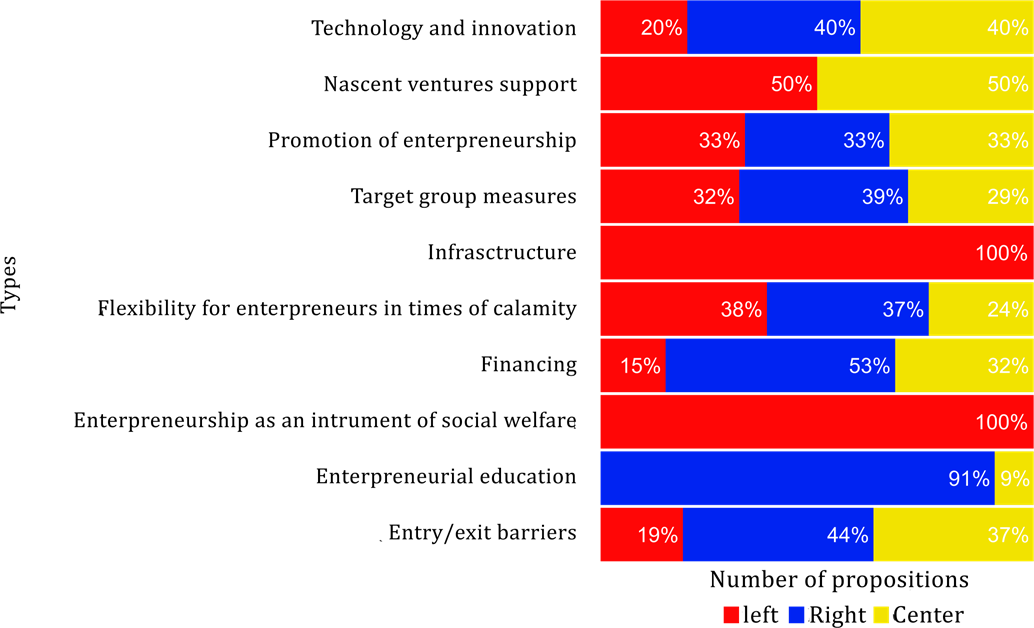
The number of types for each political spectrum is presented in Figure 5. Some categories show a predominance of certain spectra, and others have a greater balance between political forces. On the one hand, the right wing has greater representation in the categories "entrepreneurial education" (91%), "financing" (53%), "entry/exit barriers" (44%), and " target group measures " (39%). The right shares power with the center, with 40% for each spectrum, in the category "technology and innovation." On the other hand, the left is the only one that presents proposals in "entrepreneurship as an instrument of social welfare " and "infrastructure," but shares strength with the center in "nascent ventures support", with 50% for each spectrum, and in "flexibility for entrepreneurs in times of calamity", with 38% representation for the left and 37% for the center. The only category that registered balance among all political forces was "promotion of entrepreneurship", with 33% for each.
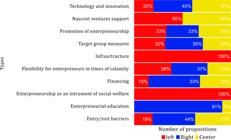
Legislators on the left present proposals related to topics where the social benefit is more explicit, such as "entrepreneurship as an instrument of social welfare", "entrepreneurial flexibility in times of calamity", and "infrastructure". The lower prevalence of projects by the left may be due to its lower representation in recent years. According to a survey conducted by the authors of this study, from the legislature that began in 2011 to that of 2024, the representation of this spectrum in the Chamber of Deputies fell by 10%. In contrast, the right wing is prevalent in topics such as "entrepreneurial education", "financing", "technology and innovation", and "entry/exit barriers" and has been gaining ground in proposals since its representation in the legislature increased. The center often follows the right, standing out on issues such as "nascent ventures support", "promotion of entrepreneurship", and "technology and innovation".
Based on these findings, it is clear that entrepreneurship is not an issue exclusive to one political side (Debus et al., 2017). Both sides identify with the central theme, but in different ways for different sub-themes. This evidence is in line with Bennett et al. (2023), who identified that right-wing parties tend to have a market-oriented view, while left-wing parties seek to favor redistribution and greater state intervention. Something similar is presented by Debus et al. (2017) and Vinod (2005), who affirm the predilection of right-wing parties for themes focused on market interests more than left-wing parties. The results of this study are in line with the literature, showing that right-wing parties are more consistent with policies focused on the free market, competitiveness, and reducing bureaucracy, while left-wing parties have a more inclusive perspective, standing out in policies related to minority groups.
CONCLUSIONS
When analyzing the types of proposals, it is clear that there is a higher frequency of proposals dealing with entry/exit barriers and aimed at specific groups - either draft or approved - such as rural entrepreneurs, women, and people with disabilities, among others. Themes aimed at assisting nascent ventures and promoting entrepreneurship did not emerge in the scope analyzed, which was also noted in a previous study on the Brazilian Executive Branch. Types associated with innovation and infrastructure were also not very prevalent, even though these are measures that can boost the competitiveness of new businesses. Thus, it can be concluded that the Brazilian legislative agenda gives low priority to more strategic and long-term issues.
When analyzing the number of types per legislature, it is clear that types such as "target group measures"were more concentrated during the 2015 terms. The category "entry/exit barrier”, on the other hand, saw a decline in the 2015 and 2019 terms but was the type that received the most attention after " target group measures". It should also be noted that the subcategory within "target group measures" with the highest number was "entry/exit barriers". However, there was a greater emergence of the type "entrepreneurial flexibility in times of calamity" during the pandemic period (2019-2022) to the detriment of others. These and other typologies served to understand the role of public policies, contributing to the interpretation of the phenomenon analyzed.
Regarding the themes with the highest representation by political spectrum, it was found that the right wing has a large majority in the proposals, especially those that bring proposals for "entry/exit barriers", "financing", "technology and innovation", and "target group measures", compared to the other spectrums. The high proportion of proposals coming from the right wing may be influenced by its large representation in government, which, since the 2018 elections, has increased its seats in the Chamber of Deputies and Senate. The left wing represents a lower percentage in different themes, emerging with a higher percentage in more social agendas, such as "entrepreneurship as an instrument of social welfare" and "entrepreneurial flexibility in times of calamity", converging with the debates present in the literature on the thematic predilection of different political spectrums in relation to entrepreneurship.
One point stands out: most types seem to be related to a reaction to short-term measures (e.g., entry/exit barriers) or reactions to specific groups (e.g., measures for women, the homeless population, family farmers, etc.). Despite the relevance of these types, there are still considerable gaps in proposals related to the consolidation of an infrastructure that is in line with the reality of small and medium-sized enterprises (SMEs). Another gap stems from the lack of proposals aimed at innovation for SMEs. Given these findings, it can be observed that there is a prevalence of reactive and short-term measures, which are generally linked to serving specific groups with greater appeal to legislators. These proposals end up overshadowing measures that could have a structural and long-term effect, such as the consolidation of a more favorable business environment through improved infrastructure and innovation for SMEs. For practical change, these issues should be addressed in future entrepreneurship public policies.
Changes in the House of Representatives may have led some authors to leave office, which resulted in a loss of momentum and inhibited the progress of their draft proposals in older legislative terms. As a result, there is a possibility that older proposals were left behind. This would also explain the greater number of proposals in more recent terms, as they would have greater pressure and force from their representatives. It is suggested that future studies seek to understand the reasons that lead a bill to be processed more quickly, as well as to be approved. In addition, the use of the web scraping and classification method used in this work stands out as a reference for the development of studies focused on the description of public policies in different spheres (state and municipal), which can also be applied in other contexts, such as social or news networks, which would allow the extraction of statements from people and media outlets on various topics. Despite the limitation presented, it is understood that the objective of this study was achieved with the identification of the themes most present in the Legislative Branch's public policy proposals..
Related item (isTranslationOf):
How to cite:
Translation / Proofreading:
Open Science: Data availability
The entire dataset that supports the results of this study has been made available on SciELO Data from the REGEPE Entrepreneurship and Small Business Journal and can be accessed at the following DOIs:
References
-
Arenal, A., Feijoo, C., Moreno, A., Ramos, S., & Armuña, C. (2021). Entrepreneurship policy agenda in the European Union: A text mining perspective. Review of Policy Research, 38(2), 243-271. https://doi.org/10.1111/ropr.12416
» https://doi.org/10.1111/ropr.12416 -
Arshed, N. (2017). The origins of policy ideas: The importance of think tanks in the enterprise policy process in the UK. Journal of Business Research, 71, 74-83. https://doi.org/10.1016/j.jbusres.2016.10.015
» https://doi.org/10.1016/j.jbusres.2016.10.015 -
Arshed, N., Mason, C., & Carter, S. (2016). Exploring the disconnect in policy implementation: A case of enterprise policy in England. Environment and Planning C: Government and Policy, 34(8), 1582-1611. https://doi.org/10.1177/0263774X16628181
» https://doi.org/10.1177/0263774X16628181 - Audretsch, D. B., & Beckmann, I. A. M. (2007). From small business to entrepreneurship policy. In D. B. Audretsch, I. Grilo, & A. R. Thurik (Eds.), Handbook of research on entrepreneurship policy (pp. 36-53). Edward Elgar.
- Audretsch, D. B., Grilo, I., & Thurik, A. R. (2007). Explaining entrepreneurship and the role of policy: A framework. In D. B. Audretsch, I. Grilo, & A. R. Thurik (Eds.), Handbook of research on entrepreneurship policy (pp. 1-17). Edward Elgar.
-
Barbosa, M. de F. N., & Emmendoerfer, M. L. (2022). Políticas públicas de empreendedorismo no contexto do desenvolvimento local sustentável: Um arranjo metodológico. Revista Gestão e Desenvolvimento, 19(2), 232-258. https://doi.org/10.25112/rgd.v19i2.2998
» https://doi.org/10.25112/rgd.v19i2.2998 -
Barboza, R. A. B., Fonseca, S. A., & Ramalheiro, G. C. de F. (2017). O papel das políticas públicas para potencializar a inovação em pequenas empresas de base tradicional. REGE - Revista de Gestão, 24(1), 58-71. https://doi.org/10.1016/j.rege.2016.10.001
» https://doi.org/10.1016/j.rege.2016.10.001 -
Behling, G., Mendes Drozdek Pereira, C., Cordeiro Mazzoleni, E., Schilickman Baccin, S., & Cesar Lenzi, F. (2015). Microempreendedor individual catarinense: Uma análise descritiva do perfil dos empreendedores individuais em Santa Catarina. Navus - Revista de Gestão e Tecnologia, 5(1), 65-78. https://doi.org/10.22279/navus.2015.v5n1.p65-78.217
» https://doi.org/10.22279/navus.2015.v5n1.p65-78.217 -
Benatti, L. N., Silva, E. E. da, & Prearo, L. C. (2021). Individual microentrepreneurs and economic development in the municipalities of São Paulo from 2010 to 2014. REGEPE Entrepreneurship and Small Business Journal, 10(2), e1676. https://doi.org/10.14211/regepe.e1676
» https://doi.org/10.14211/regepe.e1676 -
Bennett, D. L., Boudreaux, C., & Nikolaev, B. (2023). Populist discourse and entrepreneurship: The role of political ideology and institutions. Journal of International Business Studies, 54(1), 151-181. https://doi.org/10.1057/s41267-022-00515-9
» https://doi.org/10.1057/s41267-022-00515-9 -
Bernasconi, O., & Espinosa-Cristia, J. F. (2020). No politics, no society: Questioning the justification of entrepreneurship in Chilean public policies. Revista de Administração de Empresas, 60(2), 131-143. https://doi.org/10.1590/s0034-759020200206
» https://doi.org/10.1590/s0034-759020200206 -
Bittar, A. de V., & di Serio, L. C. (2024). Do innovation policies support micro and small enterprises to overcome barriers? Innovation & Management Review, 21(2), 137-152. https://doi.org/10.1108/INMR-12-2021-0234
» https://doi.org/10.1108/INMR-12-2021-0234 -
Borges, C., Bezerra, É. D., Silva, G., Andreassi, T., & Ferreira, V. D. R. (2018). Entrepreneurship policy in Brazil: Its focus and gaps. International Journal of Entrepreneurship and Small Business, 34(2), 183-203. https://doi.org/10.1504/IJESB.2018.092026
» https://doi.org/10.1504/IJESB.2018.092026 -
Campanha, L. J., De Lorenzo, H. C., Fonseca, S. A., & De Oriani E Paulillo, L. F. (2017). Formulation and implementation, convergences and deviations: Facets of the individual microEntrepreneur (MEI) public policy in the local plan. Gestão & Produção, 24(3), 582-594. https://doi.org/10.1590/0104-530X3896-16
» https://doi.org/10.1590/0104-530X3896-16 - Capella, A. C. N. (2018). Formulação de políticas públicas Enap.
-
Capella, A. C. N. (2020). Estudos sobre formação da agenda de políticas públicas: Um panorama das pesquisas no Brasil. Revista de Administração Pública, 54(6), 1498-1512. https://doi.org/10.1590/0034-761220200689
» https://doi.org/10.1590/0034-761220200689 -
Castaño, M. S., Méndez, M. T., & Galindo, M. Á. (2016). The effect of public policies on entrepreneurial activity and economic growth. Journal of Business Research, 69(11), 5280-5285. https://doi.org/10.1016/j.jbusres.2016.04.125
» https://doi.org/10.1016/j.jbusres.2016.04.125 -
Chauhan, R., Negi, A., & Manchanda, M. (2023). An extensive review on web scraping technique using Python. In 2023 Second International Conference on Augmented Intelligence and Sustainable Systems (ICAISS) (pp. 1134-1138). IEEE. https://doi.org/10.1109/ICAISS58487.2023.10250745
» https://doi.org/10.1109/ICAISS58487.2023.10250745 -
Corseuil, C. H. L., Neri, M. C., & Ulyssea, G. (2014). Uma análise exploratória dos efeitos da política de formalização dos microempreendedores individuais Instituto de Pesquisa Econômica Aplicada. http://www.ipea.gov.br/portal/images/stories/PDFs/TDs/td_1839.pdf
» http://www.ipea.gov.br/portal/images/stories/PDFs/TDs/td_1839.pdf -
Costanzi, R. N., Barbosa, E. D., & Ribeiro, H. V. M. (2014). A experiência do microempreendedor individual na ampliação da cobertura previdenciária no Brasil. Revista do Serviço Público, 62(4), 387-406. https://doi.org/10.21874/rsp.v62i4.79
» https://doi.org/10.21874/rsp.v62i4.79 -
Debus, M., Tosun, J., & Maxeiner, M. (2017). Support for policies on entrepreneurship and self-employment among parties and coalition governments. Politics and Policy, 45(2), 338-371. https://doi.org/10.1111/polp.12205
» https://doi.org/10.1111/polp.12205 - Emmendoerfer, M. L., de Araújo, J. F. F. E., Valadares, J. L., & Morais, M. C. A. (2021). Empreendedorismo em políticas públicas no contexto da economia criativa brasileira. Revista Reuna, 26(2), 91-110.
-
Feltran, A. de A., Rodrigues, I. V., Silva, J. V. C. da, Guide, M. H., Urquiza, P., & Ribeiro, G. (2022). Transição de microempreendedor individual para microempresa: Alterações necessárias para o processo. Revista Ibero-Americana de Humanidades, Ciências e Educação, 8(10), 859-874. https://doi.org/10.51891/rease.v8i10.7204
» https://doi.org/10.51891/rease.v8i10.7204 -
Fonseca, P. C., Emmendoerfer, M. L., Silva, L. F. T. B. e, & Emmendoerfer, L. (2008). A formação dos circuitos turísticos mineiros: Uma política pública descentralizada e democratizante? Revista Acadêmica Observatório de Inovação do Turismo, 2(4). https://doi.org/10.17648/raoit.v2n4.3611
» https://doi.org/10.17648/raoit.v2n4.3611 -
Foss, L., Henry, C., Ahl, H., & Mikalsen, G. H. (2019). Women’s entrepreneurship policy research: A 30-year review of the evidence. Small Business Economics, 53(2), 409-429. https://doi.org/10.1007/s11187-018-9993-8
» https://doi.org/10.1007/s11187-018-9993-8 -
Freire, C. T., Maruyama, F. M., & Polli, M. (2017). Inovação e empreendedorismo: Políticas públicas e ações privadas. Novos Estudos CEBRAP, 36(3), 51-76. https://doi.org/10.25091/S0101-3300201700030004
» https://doi.org/10.25091/S0101-3300201700030004 -
Höfling, E. M. (2001). Estado e políticas (públicas) sociais. Cadernos Cedes, 21(55), 30-41. https://doi.org/10.1590/S0101-32622001000300003
» https://doi.org/10.1590/S0101-32622001000300003 -
Julião, F., Leone, R. J. G., & Veiga Neto, A. R. (2014). Fatores determinantes da satisfação de usuários do Programa Microempreendedor Individual. Teoria e Prática em Administração, 4(1), 156-179. https://doi.org/10.21714/2238-104X2014v4i1-18322
» https://doi.org/10.21714/2238-104X2014v4i1-18322 - Kingdon, J. W. (2003). Agendas, alternatives, and public policies (2nd ed.). Longman. (Obra original publicada em 1984)
-
Kobeissi, N. (2010). Gender factors and female entrepreneurship: International evidence and policy implications. Journal of International Entrepreneurship, 8(1), 1-35. https://doi.org/10.1007/s10843-010-0045-y
» https://doi.org/10.1007/s10843-010-0045-y -
La Rovere, R., Santos, G., & Inhan Matos, L. (2019). Percepções sobre políticas para a promoção do empreendedorismo no Brasil e suas implicações para a discussão sobre capacidades estatais. Desenvolvimento em Debate, 7(2), 29-47. https://doi.org/10.51861/ded.dmdn.2.003
» https://doi.org/10.51861/ded.dmdn.2.003 -
Lemos, C. T. M. L., Mendes, D. P., & Mattos, S. H. (2020). Programa Microempreendedor Individual: Benefícios e desempenho das empresas. Revista Expressão Católica, 9(1). https://doi.org/10.25190/rec.v9i1.3222
» https://doi.org/10.25190/rec.v9i1.3222 -
Lima, L. L., & Papi, L. P. (2020). Planejamento e políticas públicas: Intencionalidades, processos e resultados (1a ed.). UFRGS. https://lume.ufrgs.br/handle/10183/212555
» https://lume.ufrgs.br/handle/10183/212555 -
Lundström, A., & Stevenson, L. A. (2005). Entrepreneurship policy: Theory and practice (1st ed.). Springer. https://doi.org/10.1007/b104813
» https://doi.org/10.1007/b104813 -
Machado, D. de Q., Diniz, G. M., Ogasavara, M. H., & Matos, F. R. N. (2015). Doing Business: Uma análise comparativa das regulamentações no BRICS. Revista de Administração Contemporânea, 19(3), 355-373. https://doi.org/10.1590/1982-7849rac20151450
» https://doi.org/10.1590/1982-7849rac20151450 - Mathias, L., & Freitas, P. (2024, 4 de outubro). Pesquisa inédita mostra distância entre discurso da esquerda e anseios do eleitor. Veja, 2913, 10-15.
-
Melo, M. R. F., Teles, A. B., Andrade, J. C., & Prazeres, K. S. (2020). Contribuições do Programa Micro Empreendedor Individual para a redução do mercado informal: Uma análise sobre as causas da informalidade. Revista de Administração de Roraima - RARR, 9(1), 100-115. https://doi.org/10.18227/2237-8057rarr.v9i1.5228
» https://doi.org/10.18227/2237-8057rarr.v9i1.5228 -
Morais, M. C. A., Emmendoerfer, M. L., Vitória, J. R., & Mendes, W. de A. (2022). Socioeconomic determinants of the individual micro-entrepreneur (IME). REGEPE - Revista de Empreendedorismo e Gestão de Pequenas Empresas https://doi.org/10.14211/ibjesb.e2070
» https://doi.org/10.14211/ibjesb.e2070 -
Natividade, D. R. (2009). Empreendedorismo feminino no Brasil: Políticas públicas sob análise. Revista de Administração Pública, 43(1), 231-256. https://doi.org/10.1590/s0034-76122009000100011
» https://doi.org/10.1590/s0034-76122009000100011 -
OECD. (2020). International compendium of entrepreneurship policies OECD Publishing. https://doi.org/10.1787/338f1873-en
» https://doi.org/10.1787/338f1873-en - Oliveira, J. M. (2013). Empreendedor individual: Ampliação da base formal ou substituição do emprego? (Radar n. 25). Instituto de Pesquisa Econômica Aplicada (Ipea).
-
Otto, I. M. C., & Vieira, J. de C. (2020). Empreendedorismo no Brasil: Resultados das políticas públicas para pequenos negócios / Entrepreneurship in Brazil: Results of public policies for small businesses. Brazilian Journal of Development, 6(11), 84279-84298. https://doi.org/10.34117/bjdv6n11-005
» https://doi.org/10.34117/bjdv6n11-005 -
Rodrigues, B. L. N. (2020). A política pública do Micro Empreendedor Individual. Boletim Economia Empírica, 1(1). https://www.portaldeperiodicos.idp.edu.br/bee/article/view/4009
» https://www.portaldeperiodicos.idp.edu.br/bee/article/view/4009 - Sarfati, G. (2013). Stages of economic development and public policies for entrepreneurship and for micro, small, and medium enterprises (MSMEs) from a comparative perspective: The cases of Brazil, Canada, Chile, Ireland, and Italy. Revista de Administração Pública, 47(1), 25-58.
-
Sebrae. (2020). Pesquisa de sobrevivência das empresas https://drive.google.com/file/d/1w8geGHr_gZpmEoV9iov4kcPSuvbZshTT/view
» https://drive.google.com/file/d/1w8geGHr_gZpmEoV9iov4kcPSuvbZshTT/view -
Sebrae. (2023). A taxa de sobrevivência das empresas no Brasil https://sebrae.com.br/sites/PortalSebrae/artigos/a-taxa-de-sobrevivencia-das-empresas-no-brasil,d5147a3a415f5810VgnVCM1000001b00320aRCRD
» https://sebrae.com.br/sites/PortalSebrae/artigos/a-taxa-de-sobrevivencia-das-empresas-no-brasil,d5147a3a415f5810VgnVCM1000001b00320aRCRD - Secchi, L. (2012). Formação da agenda: Método de Policy Advocacy para ensino de políticas públicas. Administração Pública e Gestão Social, 4(1), 32-47.
- Secchi, L., Coelho, F. S., & Pires, V. (2019). Políticas públicas: Conceitos, casos práticos, questões de concursos (3a ed.). Cengage Learning.
-
Silva, A. B. da, Lopes, J. E. de G., Filho, J. F. R., & Pederneiras, M. M. M. (2011). Um estudo sobre a percepção dos empreendedores individuais da cidade de Recife quanto à adesão a Lei do Micro Empreendedor Individual (Lei Mei - 128/08). Revista da Micro e Pequena Empresa, 4(3), 121-137. http://doi.org/10.6034/183
» http://doi.org/10.6034/183 -
Silva, G., Di Serio, L. C., & Bezerra, É. D. (2019). Public policies on innovation and small businesses in a swinging economy. BAR - Brazilian Administration Review, 16(3), e180140. https://doi.org/10.1590/1807-7692bar2019180140
» https://doi.org/10.1590/1807-7692bar2019180140 - Silveira, A., Do Carmo, H. M. O., & Dos Santos Souza, R. (2017). Microempreendedor Individual (MEI): Benefícios e desafios da legislação brasileira para a aplicação na prática da ação. Revista Livre de Sustentabilidade e Empreendedorismo, 2(1), 117-137.
-
Silveira, G. B., Santos, I. C. dos, & Leão, N. C. de A. (2022). Empreendedorismo no Brasil em crise (2014-2017): Uma análise de resultados sob o enfoque da competitividade, inovação e prosperidade. Desenvolvimento em Questão, 20(58), e12444. https://doi.org/10.21527/2237-6453.2022.58.12444
» https://doi.org/10.21527/2237-6453.2022.58.12444 -
Smallbone, D. (2016). Entrepreneurship policy: Issues and challenges. Small Enterprise Research, 23(3), 201-218. https://doi.org/10.1080/13215906.2016.1270227
» https://doi.org/10.1080/13215906.2016.1270227 - Souza, C. (2006). Políticas públicas: Uma revisão da literatura. Sociologias, 8(16), 20-45.
-
Souza, D. L. de, Souza, J. B. de, Pasin, L. E. V., & Zambalde, A. L. (2016). Empreendedorismo e desenvolvimento local: Uma análise do Programa Microempreendedor Individual em Minas Gerais, Brasil. Desenvolvimento em Questão, 14(37), 262-292. https://doi.org/10.21527/2237-6453.2016.37.262-292
» https://doi.org/10.21527/2237-6453.2016.37.262-292 - Teixeira, D. M., Peixoto, C. A., Pagotto, D. P., & Borges, C. V., Jr. (2020). Impactos do PNAE para o empreendedor familiar rural brasileiro. Revista Livre de Sustentabilidade e Empreendedorismo, 5(2), 109-132.
-
Teixeira, D. M., Borges, C. V., Jr., & Almeida, M. I. S. de. (2023). The relationship between gender policies and the creation of businesses by women. REGEPE Entrepreneurship and Small Business Journal, 12(3), e2438. https://doi.org/10.14211/regepe.esbj.e2438
» https://doi.org/10.14211/regepe.esbj.e2438 -
Teixeira da Silva, T., de Souza Santana Silva, P., Almeida dos Santos Alves, S., Rogério Rizzo, M., & Rocha Athayde, T. (2017). Microempreendedor Individual e seus aspectos de transição. Revista Magistro, 1(15). https://publicacoes.unigranrio.edu.br/magistro/article/view/4012
» https://publicacoes.unigranrio.edu.br/magistro/article/view/4012 - Tondolo, L. P., Borges, C., Jr., Emmendoerfer, M. L., & Ferreira, V. D. R. S. (2024). Resultados e disfunções na utilização da política do microempreendedor individual (MEI) por empreendedores de baixa renda. Revista Livre de Sustentabilidade e Empreendedorismo, 9(2), 204-226.
-
Valentim, E. C. do R. B., & Peruzzo, J. F. (2018). O empreendedorismo nas políticas públicas de trabalho e geração de renda. Argumentum, 10(1), 261-275. https://doi.org/10.18315/argumentum.v10i1.18362
» https://doi.org/10.18315/argumentum.v10i1.18362 -
Vasconcelos, K. S. L. de, Ferreira, M. D. O., & Besarria, C. D. N. (2017). Microempresário informal: Determinantes da evasão fiscal na previdência social. Acta Scientiarum. Human and Social Sciences, 39(1), 19-27. https://doi.org/10.4025/actascihumansoc.v39i1.33862
» https://doi.org/10.4025/actascihumansoc.v39i1.33862 -
Vinod, H. D. (2005). Common ground in promotion of entrepreneurship and human rights. Conference on Entrepreneurship and Human Rights at Fordham University, Lincoln Center Campus, New York Social Science Research Network. http://dx.doi.org/10.2139/ssrn.767484
» http://dx.doi.org/10.2139/ssrn.767484 -
Vitória, J. R., Martins, B. C. L., Emmendoerfer, M. L., & Fioravante, A. S. A. (2015). Estado, políticas públicas e os desafios para a descentralização: A experiência da Secretaria de Estado de Cultura de Minas Gerais. Administração Pública e Gestão Social, 7(4), 206-217. https://doi.org/10.21118/apgs.v7i4.809
» https://doi.org/10.21118/apgs.v7i4.809 -
Zucco, C., & Power, T. J. (2024). The ideology of Brazilian parties and presidents: A research note on coalitional presidentialism under stress. Latin American Politics and Society, 66(1), 178-188. https://doi.org/10.2139/ssrn.4470209
» https://doi.org/10.2139/ssrn.4470209

 Note: Adapted from
  Note: Elaborated by the authors.
 Note: Elaborated by the authors.
 Note: Elaborated by the authors.
 Note: Elaborated by the authors.