 Sustainable universities: the role of accounting, management and ESG
ABSTRACT
Purpose This study examines how accounting, management, and Environmental, Social, and Governance (ESG) practices influence sustainability strategies in universities included in the UI GreenMetric ranking. The goal is to understand the mechanisms through which internal governance, strategic planning, and measurement systems contribute to sustainable development within Higher Education Institutions (HEIs).
Design/methodology/approach The research adopts a quantitative approach involving 106 HEIs listed in the GreenMetric ranking. The data collection instrument was developed through methodological triangulation. First, a Systematic Literature Review (SLR) identified theoretical constructs and recurrent indicators of sustainable university management. Second, institutional reports were analyzed to map practices already implemented in leading institutions. Third, a structured questionnaire—validated by experts—captured the perceived relevance and level of implementation of accounting, management, and ESG practices. This integrated design enabled the identification of variables, patterns, and interrelations that shape sustainability strategies in HEIs.
Findings The results reveal convergence in the sustainability practices adopted by ranked universities, highlighting governance, measurement systems, and financial-managerial controls as central drivers of performance. Correlational analyses show that planning mechanisms, especially those grounded in accounting and ESG metrics, significantly enhance stakeholder engagement and the institutional capacity to implement sustainability strategies. The findings demonstrate that accounting and management systems do not merely support reporting but actively structure decision-making, resource allocation, and long-term sustainability outcomes.
Practical implications The study offers a diagnostic pathway for HEIs seeking to improve sustainability governance, showing which mechanisms most effectively strengthen planning and engagement.
Originality/value This research advances the understanding of how accounting and ESG practices shape sustainability strategies in universities, integrating managerial, operational, and governance perspectives through a robust multi-source methodological design.
Keywords
Universities; Sustainability; ESG; Accounting; Management
RESUMO
Objetivo Este estudo examina como as práticas de contabilidade, gestão e Environmental, Social, and Governance (ESG) influenciam as estratégias de sustentabilidade de universidades listadas no ranking UI GreenMetric. O objetivo é compreender de que modo governança interna, planejamento estratégico e sistemas de mensuração contribuem para o desenvolvimento sustentável nas Instituições de Ensino Superior (IES).
Design/metodologia/abordagem A pesquisa adota uma abordagem quantitativa com 106 IES presentes no ranking. O instrumento de coleta de dados foi desenvolvido por meio de triangulação metodológica. Primeiramente, uma Revisão Sistemática da Literatura (SLR) identificou construtos teóricos e indicadores recorrentes de gestão universitária sustentável. Em seguida, relatórios institucionais foram analisados para mapear práticas já consolidadas em instituições de referência. Por fim, um questionário estruturado—validado por especialistas—capturou a relevância percebida e o nível de implementação das práticas de contabilidade, gestão e ESG. Essa integração metodológica permitiu identificar variáveis, padrões e inter-relações que moldam as estratégias de sustentabilidade nas IES.
Resultados Os achados revelam convergência nas práticas de sustentabilidade adotadas pelas universidades ranqueadas, destacando governança, sistemas de mensuração e controles gerenciais-financeiros como fatores centrais de desempenho. As análises correlacionais mostram que mecanismos de planejamento, especialmente aqueles baseados em métricas contábeis e ESG, ampliam o engajamento dos stakeholders e fortalecem a capacidade institucional de implementar estratégias sustentáveis.
Implicações práticas O estudo oferece um caminho diagnóstico para IES que buscam aprimorar sua governança da sustentabilidade, indicando os mecanismos mais eficazes para fortalecer planejamento e engajamento.
Originalidade/valor A pesquisa avança a compreensão sobre como práticas contábeis e ESG estruturam estratégias de sustentabilidade, integrando perspectivas gerenciais, operacionais e de governança por meio de um desenho metodológico robusto.
Palavras-chave
Universidades; Sustentabilidade; ESG; Contabilidade; Gestão
1 INTRODUCTION
Technological development and the increasing pressure to adopt mechanisms that foster sustainable development have intensified the demand for innovation in sustainability practices. Universities, often regarded as laboratories of innovation, play a central role in this process, as they are responsible not only for generating knowledge but also for implementing and testing strategies that measure and improve sustainability performance (Puzzonia et al., 2018).
For innovations to be effective, they must be incorporated into institutional routines. Ávila et al. (2017) and Leal Filho et al. (2019) highlight that embedding sustainability into daily university processes is essential to overcoming barriers to its adoption in Higher Education Institutions (HEIs). This requires aligning teaching, research, and extension activities with practical initiatives that address real-world sustainability challenges, thereby reinforcing the importance of integrating innovation into academic and administrative processes (Leal Filho, 2011; Leal Filho et al., 2021). Aligning activities means that all stakeholders, including society, academics, and researchers, take shared responsibility for the process and results of research and innovation, which, through engagement, will enable new knowledge to be applied in society (Volker et al., 2023).
Innovations generate not only educational and social benefits, but also financial advantages, particularly when they strengthen institutional processes and promote stakeholder engagement. By bridging theory and practice, universities can establish partnerships and strengthen their role in advancing the sustainability debate (Lozano, 2013; Brusca et al., 2018; Garlet et al., 2021). However, evidence indicates that sustainable planning in HEIs remains limited. According to Leal Filho et al. (2019a), challenges such as managerial perceptions, lack of resources, and insufficient stakeholder engagement often hinder progress, while limited technical expertise further constrains effective implementation (Gordon & Fischer, 2015).
Another structural weakness lies in the absence of mandatory reporting requirements on sustainability performance, which discourages many institutions from systematically monitoring and disclosing their practices (Leal Filho et al., 2019a; Sudaryati & Raharja, 2022). In this context, management and accounting functions emerge as critical enablers of sustainability in HEIs, as they provide the tools and skills required to measure, control, and transparently report institutional performance, thereby strengthening stakeholder confidence and engagement (Leal Filho et al., 2019a; 2019b).
The field of accounting and governance can contribute to mitigating environmental and social problems through the disclosure of reports, transparency of information, and strategic decision-making (Comoli, Tettamanzi & Murgolo, 2023). In recent years, Environmental, Social and Governance (ESG) practices have gained prominence as comprehensive frameworks that integrate social responsibility, environmental management, and institutional governance. Applied to universities, ESG has the potential to improve both external indicators—such as sustainability rankings—and internal performance metrics, while enhancing the institution’s legitimacy and reputation in society (Puzzonia et al., 2018).
Universities have become universal institutions of higher education and global knowledge production, focusing on a strong mission to develop industrial and territorial innovation in addition to their already established missions of education and scientific research (Ruano-Borbalan, 2024). Universities have a direct sustainable impact on the academic community and the regions where they are located, which provides opportunities to reduce negative impacts, apply social practices in teaching, research, extension, partnerships, and management, and assist in the transition to sustainable lifestyles (Finatto et al., 2024). ESG-focused practices and strategies developed by universities generate greater identification and connection between students and institutions, in addition to increasing institutional credibility and stakeholder confidence (Lin & Chen, 2025).
This study positions itself at the interface between accounting and management as pillars of ESG governance (G) in higher education institutions, responsible for structuring planning, monitoring, and disclosure to stakeholders. By integrating governance practices in the E and S dimensions when supported by institutional reports, we advance our understanding of how universities operationalize sustainability in a systemic way.
Given this scenario, it is essential to understand how management, accounting, and ESG interact to promote sustainable development in higher education. This study addresses the following research question:
How can accounting, management, and ESG practices influence the actions and strategies of universities listed in the Green Metrics ranking toward sustainable development?
To answer this question, the objective of this research is to analyze the influence of accounting, management, and ESG practices on the sustainable strategies of universities that make up the Green Metrics ranking. Thus, the study positions itself at the interface between accounting and management as pillars of ESG governance (G) in higher education institutions, responsible for structuring planning, monitoring, and disclosure to stakeholders. By integrating governance practices in the E and S dimensions when supported by institutional reports, we advance our understanding of how universities operationalize sustainability in a systemic way.
Given the context presented, this study contributes by clarifying the technical role of accounting and management in university ESG governance and proposing an empirically grounded framework that integrates evidence from RSL, institutional documents, and questionnaire data.
2 UNIVERSITIES AND SUSTAINABILITY
The growing challenges imposed by population growth, the intensification of natural resource consumption, and the demands of economic development have consolidated sustainability as a central theme in governments, businesses, and educational institutions (Leal Filho et al., 2021). In this context, universities stand out for their dual role: on the one hand, they are responsible for training professionals capable of acting critically and proactively in sustainability-related fields; on the other, they contribute directly to knowledge production, policy formulation, and the design of solutions that address global sustainability challenges (Lozano et al., 2015; Brusca et al., 2018; Lozano; Bautista-Puig; Barreiro-Gen, 2022). Higher Education Institutions (HEIs), therefore, occupy a strategic position at the forefront of sustainable innovation, being able to foster new perspectives, disseminate good practices, and generate impacts that transcend the academic environment (Garlet et al., 2021).
Despite this recognized relevance, the literature highlights that the institutionalization of sustainability in HEIs still encounters numerous barriers. Limitations associated with planning, managerial perceptions, scarcity of resources, low engagement of institutional actors, and weaknesses in organizational culture represent persistent obstacles that hinder advances in sustainability policies (Ávila et al., 2017; Brandli et al., 2015; Leal Filho et al., 2017; Gordon & Fischer, 2015). In addition, the absence of mechanisms that ensure effective monitoring and mandatory disclosure of sustainability performance compromises transparency and makes it difficult to systematize actions capable of guiding consistent strategies (Leal Filho et al., 2019b; Sudaryati & Raharja, 2022). In this sense, good management practices and adequate governance structures emerge as fundamental instruments for overcoming these barriers, not only by strengthening control mechanisms and stakeholder participation, but also by ensuring that sustainable initiatives become an integral part of institutional routines (Ávila et al., 2019; Leal Filho et al., 2019a).
In this regard, the literature increasingly recognizes the role of management and accounting in strengthening sustainability within HEIs. Accounting, through its ability to measure, control, and report, is capable of providing reliable information that supports decision-making, enhances legitimacy, and fosters transparency in the use of financial, social, and environmental resources (Bebbington & Larrinaga, 2014; Gray, 2010; Brusca et al., 2018). Management, in turn, by aligning institutional processes with sustainable objectives, creates favorable conditions for innovation and engagement of the academic community. However, although the potential of these areas is evident, their effective use in promoting sustainability in HEIs is still incipient, with studies showing that socio-environmental accounting and integrated reporting practices remain underdeveloped (Habib et al., 2021).
Measurement and disclosure mechanisms such as sustainability rankings have gained prominence in this scenario by offering parameters for comparing performance among universities and encouraging advances in the adoption of sustainable practices (Wijiastuti & Nurhayati, 2021). Nevertheless, these rankings often present limitations, as they do not capture the complexity of institutional dynamics, which reinforces the need for new metrics capable of assessing sustainability in a more comprehensive and integrated way (Leal Filho et al., 2019b). It is in this debate that the Environmental, Social, and Governance (ESG) framework has been incorporated into the university context, positioning itself as a promising alternative to evaluate and guide institutional performance from a holistic perspective (Naffa & Fain, 2021; Lima et al., 2022). By encompassing environmental, social, and governance dimensions, ESG has the potential to generate internal and external benefits, improve performance in sustainability rankings, expand the institution’s legitimacy before society, and enhance its international competitiveness (Ferriani & Natoli, 2021).
Although its importance is increasingly recognized, the application of ESG in higher education remains an incipient field of research. Empirical studies still reveal fragmented analyses, with limited emphasis on the integration between ESG practices, accounting, and management as complementary drivers for sustainable development in universities (Al-MaaDeed & Marques, 2020). This gap is particularly relevant because, according to recent studies, the successful adoption of ESG in HEIs depends directly on the creation of governance structures that ensure planning, monitoring, and disclosure of information to stakeholders, as well as on the engagement of managers and accounting professionals who can adapt management tools to institutional specificities (Leal Filho et al., 2019b; Lima et al., 2022).
Universities, as centers of learning, find the right target audience to develop projects and improvements proposed by the SDGs, which often end up adopting practices that lead to the implementation of ESG criteria (Finatto et al., 2024). When ESG criteria are included in curricula, students develop practical skills and abilities for sustainable business strategy and corporate social responsibility, which aligns with what is expected in the job market (Nurillayev, 2024).
Universities are systematically investing in and incorporating ESG dimensions into activities and operations, such as promoting sustainable mobility on bike paths, greenhouse gas emission reports, investment in photovoltaic plants, fostering collaboration and inclusion, and aligning practices with the objectives of the 2030 Agenda and corporate strategies (Rosa et al., 2025).
Considering these aspects, it is evident that universities are called upon to act not only as agents of education and research, but also as protagonists in the incorporation of sustainability into their institutional strategies. The integration of management practices, accounting instruments, and ESG principles can contribute to breaking down barriers historically identified in the literature—such as the scarcity of resources, the lack of stakeholder engagement, and the fragility of organizational culture—while simultaneously strengthening the role of HEIs as promoters of innovation and sustainable development. Thus, analyzing how these dimensions interact becomes essential for advancing knowledge in the field and for supporting both theoretical and practical contributions to sustainability in higher education.
3 METHOD
This study was divided into two methodological stages in terms of approaching the problem, one qualitative and the other quantitative. It is characterized as descriptive, carried out through research. To develop the qualitative stage, the study method consists of three phases: a) a systematic literature review (SLR); b) an analysis of sustainability reports; and c) consultations with experts on the subject. Based on the consolidation of the qualitative phase, the research instrument applied in the quantitative stage of the study was developed.
To understand the qualitative stage, the following phases were developed:
3.1 Systematic Literature Review (RSL)
This international reach, combined with the substantial number of participating HEIs, highlights the relevance and influence of the ranking within the academic community. Based on this population, the next step was to present the procedures adopted for data collection. The development of the data collection instrument followed three complementary steps: a) a systematic literature review (SLR); b) an analysis of sustainability reports; and c) consultations with subject matter experts. The objective of the SLR was to identify which accounting, management, and environmental, social, and governance (ESG) practices influence the sustainability performance of universities included in the Green Metrics ranking in the literature. This triangulated approach—based on academic literature, expert insights, and documentary evidence from HEIs—provided a solid foundation for the development of the remaining stages and ensured greater robustness and reliability of the results.
The systematic literature review was conducted in the Web of Science (WoS) database, following established SLR protocols. VOSviewer was used exclusively for bibliometric analysis of RSL studies. The first search used the string “ESG and Universit” *, identifying 497 publications between June 2013 and June 2022. A second search targeted the intersection between accounting and sustainability in higher education, resulting in 164 publications indexed in WoS.
In both reviews, inclusion and exclusion criteria were applied to ensure rigor in the selection of articles. The criteria included: (a) publication in peer-reviewed journals of recognized quality; (b) publication within the defined time frame; and (c) direct relevance to the topics under investigation. Based on these parameters, 497 articles from the first search and 164 articles from the second were retained for final analysis.
The systematic literature reviews were conducted in two complementary stages. The first review used the search sequence “environmental, social, and governance” and “university*,” covering the period from June 13, 2013, to June 13, 2022, and identified 497 studies indexed in the Web of Science database. The second review, in turn, investigated the intersection between responsibility, university, and sustainability, using the sequence “responsibility” and “university” and “sustainability” in the same time interval, initially resulting in 2,505 studies. In both reviews, inclusion criteria (publications in peer-reviewed journals, within the defined period, and adhering to the theme) and exclusion criteria (books, duplicate documents, articles outside the period, or unrelated to the object of analysis) were applied. After screening, 497 articles remained in the first review and 164 in the second. The selected material was submitted to content analysis and processing in Vosviewer software, allowing the systematization of scientific evidence on ESG, accounting, and sustainability in Higher Education Institutions.
The research developed with RSL is shown in Figure 1.

3.2 Documental Analysis
In addition to conceptual issues, the review also allowed us to observe the variables addressed in the literature that permeate the theme of ESG, accounting, and universities.
The literature review revealed a set of variables associated with sustainability in universities, distributed across different categories. In environmental terms, the use of clean technologies stands out (Almeida et al., 2020). In social terms, the creation of institutional partnerships stands out (De Souza et al., 2015). In terms of governance, the literature points both to the need to meet stakeholder demands and to the development of specific programs focused on sustainability (Leal Filho et al., 2021). The management category brings together variables such as institutional planning (Leal Filho et al., 2021; Almeida et al., 2020), innovation (Ávila et al., 2019), process control and promotion of sustainable development (Sudaryati & Raharja, 2022), as well as attention to legislation and regulation (Almeida et al., 2020). Finally, in the area of accounting, practices such as accounting for investments in sustainability (Zanluca & Zaluca 2017) were identified.
In addition to the literature, an analysis was conducted of the sustainability reports of the top-ranked universities in the UI GreenMetric ranking. In environmental terms, practices such as environmental education and energy and water management emerged, highlighted by UC Davis, as well as the greening of campuses, observed at the State University of Maranhão, and the adoption of green campus programs, as in the case of the Persian Gulf University. In addition, measures aimed at waste treatment emerged, such as at Tokat Gaziosmanpaşa University, and at reducing the consumption of disposable products, as evidenced by Wah University.
In the social pillar, initiatives for direct assistance to society through health programs and consulting services (Don State Technical University) stood out, in addition to promoting access to education and support for employees (State University of Maranhão). Retention scholarships, open courses, and partnerships with civil society organizations were also identified as inclusion strategies, with the latter strongly present at the University of the Persian Gulf.
Accessibility to university facilities, as evidenced by the State University of Maranhão, reinforces the social role of institutions. In the field of governance, internal control and institutional reorganization practices were highlighted, as well as the creation of specific sustainability councils, as observed at Samara Polytech. In management, the study pointed to the implementation of sustainability-oriented management programs (UC Davis) and sustainable bidding processes. In accounting, practices related to revenue and expense control and the recording of investments in sustainability appear to be central, with an emphasis on the Western University of Timisoara. Analysis of the institutional reports of the highest-ranked universities in the Green Metrics ranking reinforced the presence of similar variables, but also brought new elements to light.
In the environmental field, practices such as the preservation of green areas (Putra Malaysia University, Universitas Indonesia, and Diponegoro University), the use of renewable energy, the installation of LED lamps, and waste treatment programs were recurrent. Universities such as the University of Connecticut stood out for encouraging sustainable food practices, while digitization and water management were identified at institutions such as Universitas Indonesia, Diponegoro, and the American University in Cairo. Reductions in the use of plastics and vehicles were also reported, as well as efforts to mitigate the carbon footprint.
In the social dimension, actions focused on relations with society (Gulf University), community partnerships (Carleton University), and improvements in quality of life (Universitas Indonesia) emerged. Cultural development and the involvement of faculty and students in sustainable projects were highlighted by Carleton University and the University of Groningen. In terms of governance, inter-institutional collaborations (Carleton University), institutional sustainability policies (Universidad Autónoma de Nuevo León and University of Groningen), and the development of specific master plans were identified. Management was marked by planning (University of Groningen), cooperation networks, implementation of integrated systems, and ISO certifications (Nottingham Trent University). Finally, accounting stood out for the search for operational cost reduction, the use of digital accounting to reduce paper consumption (Universidad Autónoma de Nuevo León), and the dissemination of information for decision-making.
The consolidation of these stages allowed for the development of an integrated set of variables, synthesized into five main dimensions. In the environmental sphere, areas such as renewable energy, water management, preservation of green areas, waste treatment, reduction in the use of plastics and vehicles, and control of the carbon footprint stand out. In the social field, initiatives focused on access to education, quality of life, work support, housing and food, cultural promotion, open courses, and community relations are noteworthy. The governance dimension incorporates variables related to policy formulation, sustainability reports, master plans, stakeholder participation, and internal control mechanisms. In the accounting area, there are practices for recording and controlling investments, using environmental and digital accounting, and disclosing information to support decision-making. Finally, in the management area, actions such as monitoring programs, sustainable bidding processes, responsible purchasing from suppliers, and training professionals to work in the area of sustainability stand out.
3.3 Questionnaire
For the methodological organization and structuring, this study adopted the same model applied by Ávila (2017): a quantitative and descriptive research, conducted through a survey with Higher Education Institutions (HEIs) listed in the Green Metrics ranking. Data collection was carried out using a structured questionnaire.
The questionnaire was developed and validated based on reports, interviews, and dialogues that sought to clarify concepts and approaches related to the research topic (Denzin; Lincoln, 2011).
To obtain the necessary information for the research stages, email addresses of sustainability representatives from 912 HEIs listed in the Green Metrics ranking (2021 edition) were collected. The choice of this ranking is justified by its global relevance, as it evaluates institutions based on five sustainability indicators and is recognized as the most comprehensive assessment of sustainability in higher education. After validation, the instrument was sent to the 912 institutions, resulting in 106 valid responses, which define the study sample.
3.4 Analytical Integration
The combination of data from the three steps shows the main issues presented in the literature and also the practices already being developed by educational institutions. Table 1 summarizes the main practices found through the qualitative study.
Based on the information gathered, a strong emphasis was observed on environmental dimensions, particularly in areas such as energy consumption, water management, and waste treatment. Regarding the social dimension, issues related to inclusion and support projects emerged as relevant, while in the governance dimension, findings highlighted investment in sustainability-oriented initiatives and the establishment of dedicated sustainability offices or sectors within HEIs.
The validated instrument, comprising 44 Likert-scale questions, was designed to measure the degree of applicability of practices across the environmental, social, governance, management, and accounting dimensions. The questionnaire was distributed via email to representatives of the 912 universities listed in the ranking, with communication directed to either the rectory or the sustainability office of each institution. A total of 106 valid responses were obtained, which constitute the study sample.
For statistical treatment and inference, the data were analyzed using SPSS software, a widely recognized tool in academic research. Initially, descriptive statistics (frequency distribution and standard deviation) were employed to characterize the responses. Subsequently, exploratory factor analysis and correlation tests were conducted to identify relationships among the study variables.
The next section of the study shows the results obtained through the analysis of the material collected with the research instrument.
4 RESULTS AND DISCUSSION
As presented in the methodology section, the information collected in the RSL (3.1) from the 497 articles in the first review plus the 164 articles in the second review, added to the information collected in the document analysis (3.2) enabled the structuring of the questionnaire, which was sent to 912 educational institutions, with the participation of 106 respondents, whose results will be presented in this section. The inferences made from the results of the questionnaire were made using SPSS software.
4.1 Descriptive Analysis
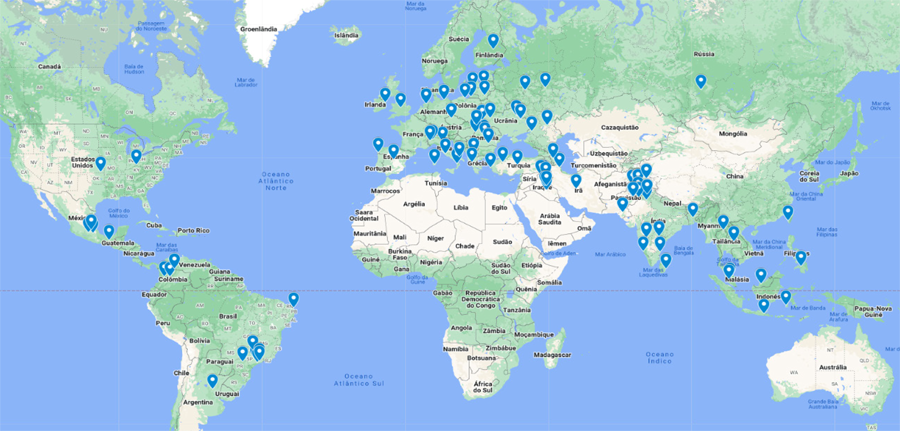
The questions were answered by rectors (7), vice-rectors (5), directors (21), managers (27), those responsible for the rankings (22), professors (24), 83% of whom are public institutions and 17% private HEIs, and from different regions of the world, Figure 2 shows the layout of the institutions responding to the study.

In order to identify the questions relating to the descriptive analysis of the answers obtained in the study, SPSS software was used to identify the frequency of the answers obtained and their standard deviation. Table 2 shows the results obtained based on the alternatives related to the environmental aspect.
The results highlight initiatives such as the conscious use of equipment, the optimization of resource, energy, and office material consumption, as well as investments in digitization and the implementation of sustainable mobility alternatives (e.g., bike paths and reduced reliance on motor vehicles).
Although a relatively high standard deviation was observed, this can be explained by the different emphases placed on water-related initiatives, since much of the existing research in HEIs has traditionally focused on waste management and energy consumption. These areas have been central to studies investigating new technologies and strategies for monitoring and efficiency (Soares et al., 2020; Menon; Suresh, 2022). Furthermore, as highlighted by Horan and O’Regan (2021), part of this performance is influenced by the metrics established by sustainability rankings, reinforcing the importance of standardized mechanisms for evaluating multiple dimensions of sustainability.
With regard to digitization, information technology emerges as a strategic element, given the specific nature of HEIs. The adoption of digital systems contributes to greater efficiency and performance control, facilitates faster access to information, and reduces the use of office materials through tools such as cloud-based storage (Bianchi; Sousa, 2016).
Concerning the social performance of the institutions, Table 3 presents the frequencies and standard deviations of the responses obtained from the HEI sample.
With regard to the social aspect, the institutions analyzed encourage the development of science in order to seek cultural enrichment, demonstrating their role in society. Likewise, despite having a high standard deviation, it can be seen that there is a movement towards access to education and the formation of partnerships with society.
With regard to infrastructure for people with special needs, the frequency of responses was 4, with a standard deviation of more than 1. This indicates that the frequencies obtained in the responses tend to be different between the institutions in the sample.
With regard to the issues found in the research, according to Leal Filho et al., (2021) higher education institutions are not only institutions focused on teaching and research, HEIs have a great social role, both in the development of society and in the training of future leaders, who have the capacity and ability to solve society’s challenges, in this context, the participation of academics in themes and projects focused on the development of sustainability, drives the development of sustainable thinking (Menon; Suresh, 2022).
As the last pillar of the ESG, an analysis was also carried out of the institution’s governance aspects, and the data obtained from the data collection on this variable is shown in Table 4.
As for the last ESG pillar analyzed, the governance aspects of the educational institutions that make up the sample, it can be seen that although it is not yet very prominent, the institutions with good performance in the rankings tend to have councils focused on campus sustainability, and there is also a constant search for control of the EI, through audits and the publication of reports for stakeholders.
Sustainability councils can be effective instruments for the sustainability performance of institutions, since they are considered the center of various activities, having defined strategies to reduce energy and water consumption, as well as other social issues related to the campus, can be fundamental for controlling and adjusting possible problems encountered in the sustainable development of the institution (Budihardjo et al., 2021).
Highlighted in the results obtained is the search for dissemination through social networks, which brings the university closer to the academic community and society, since these issues are publicized and have the potential to impact other institutions. Similarly, there is a constant search for partnerships between institutions, which according to Brandli et al. (2015) and Ávila et al. (2019) are issues that drive the breaking down of sustainability barriers.
Although the results show the sample’s perception of issues relating to the governance of institutions, a high standard deviation can be seen in several questions, thus demonstrating that the perception of actions relating to governance in HEIs is different among the institutions analyzed. The same applies to management, the results of which are shown in Table 5.
When it comes to the management of educational institutions, researchers such as Leal Filho et al., (2019a) and Gordon; Fischer, (2015), point out that planning is a fundamental issue for the development of sustainability in HEIs, based on the results obtained, the institutions that make up the sample have an average of 3.92, with regard to the incorporation of sustainability in their planning, however, they have a standard deviation greater than 1, which can identify that the answers are not uniform throughout the sample.
Likewise, motivated by the movement developed by the sustainability rankings, programs to promote the adoption of sustainability have been developed in order to reduce CO2 emissions and there are also projects aimed at reducing the consumption of office supplies.
In addition, it should also be noted that there is a search for purchases from local suppliers and sustainable bidding, with 3.57 and 3.51 respectively in their average response. This finding may indicate that the institutions are constantly concerned about the quality of the products used, as well as encouraging local producers, ideas that are in line with the findings of Leal Filho et al. (2021), who emphasize that the role of HEIs is not only in teaching and research, but also in the development of society and the region in which they carry out their activities.
As presented by Barbieri (2011), accounting plays an important role in terms of disclosure, control and adoption of sustainability, functioning as an important tool with regard to sustainable development. In this context, the results obtained with regard to the descriptive analysis of accounting are presented in Table 6.
As far as accounting is concerned, it can be seen that its activities within institutions are not just about recording information, but also about controlling and disseminating accounting information. In addition, because it contains information that is relevant to decision-making, its reports are important tools for the institution’s management. It is also possible to observe their role in relation to the development of the institution, by noting that in some cases accounting professionals participate in the institution’s decision-making processes.
These findings are in line with those of Leal Filho et al. (2019a), who emphasize that planning is fundamental for the development of the institution, since, by having information on the institution’s investments and financial control, accounting professionals can provide reliable and accurate information on the institution’s performance, aiding decision-making.
It is also worth pointing out that the high standard deviation in all the questions referring to accounting may be an indicator that the relationship between accounting and sustainability is innovative and that not all institutions, despite adopting some practices, have a perception of the real role of accounting in the sustainable development of HEIs. Given the descriptive analysis of the study, the next section aims to demonstrate the results obtained through exploratory factor analysis.
4.2 Exploratory Factor Analysis
The SPSS software was also used to develop the study’s exploratory factor analysis, which was carried out in order to identify the composition of the research constructs. It was also necessary to carry out the Kaiser-Meyer-Olkin (KMO) test and Barlett’s test of sphericity. The result of the KMO test was 0.897 and the Chi-square test was 4056.801, showing p<0.001, indicating that factor analysis is suitable for this study (Hair et al., 2009).
After identifying that the factor analysis is suitable for the study, an analysis of the communalities was carried out, since some questions showed results lower than 0.5, their removal from the analysis was necessary. Two stages of exclusion were necessary, since after the first, some variables did not show significant results.
After excluding the questions in the first stage, a new KMO test was carried out, showing a result of 0.912, and also with regard to Bartlett’s test of sphericity, with p<0.001, thus being acceptable for factor analysis, however, the variables EN001, SO08, GOV02, GOV09, MAN09, showed communalities of less than 0.5, making a new round of exclusions necessary.
After this second stage, 27 variables remained, which had a KMO of 0.90 with significance p<0.001. Next, the total variance explained was identified, in which the eigenvalues above 1 were taken into account, grouping the data into six factors which explain 72.538% of the total variation.
The factor analysis resulted in the extraction of six principal components with eigenvalues greater than 1, which together explained 72.54% of the total variance in the data. The first component had an eigenvalue of 12.161, accounting for 45.04% of the variance, highlighting its predominant weight in the model structure. The second component explained 9.79% of the variance (eigenvalue of 2.642), followed by the third, with 5.35% (1.446). Components four, five, and six explained 4.65% (1.255), 3.99% (1.078), and 3.72% (1.004) of the variance, respectively. These results indicate good representativeness of the factors, since the cumulative percentage exceeds 70%, a level considered adequate in applied social science research.
After identifying the number of factors, we proceeded to analyze their composition. Table 7 shows each of the factors found and also their respective factor loadings.
Given the six factors, as explained by Nina-CuchiIllo; Nina CuchiIllo (2021), it is necessary to check the reliability of the data presented. In this sense, the group of 27 variables was added to the SPSS software in order to present its reliability, returning a Cronbach’s alpha of 0.951, indicating that the data has an acceptable value.
4.3 Framework Accounting, Management and ESG at universities
With the aim of proposing a framework for accounting, management, and Environmental Social and Governance (ESG) to promote sustainable development, it was created from the sum of the results of all the steps described in the method applied in this work. namely the systematic literature review and document analysis that generated the questionnaire applied, and the descriptive and exploratory analyses of its results, which allowed us to synthesize and present the construction of each concept in the study, in this case, ESG, accounting, and management.
Therefore, this section presents a structure capable of providing important information for the development of sustainability in HEIs through Figure 3 below.

Figure 2 highlights key issues to be addressed by institutions aiming for sustainable development, as well as the unification of accounting and management processes, in order to achieve good results in ESG reporting based on the following logic:
-
Strategic Level (Governance): policies, committees, management accounting for ESG, transparency.
-
Tactical Level (Integration/Operations): partnerships, infrastructure, waste management, community engagement.
-
Operational Level (KPIs): examples of metrics by dimension (E, S, G).
In addition, the results highlight that social and environmental practices, combined with good control and disclosure methods, can boost universities’ sustainability levels. After discussing the quantitative steps of the study and the development of the Framework, the next section aims to present the study’s conclusions and recommendations.
5 CONCLUSIONS
With regard to the three ESG pillars (environmental, social, and governance), the findings indicate that sustainability performance is particularly influenced by resource consumption, the use of renewable energy, and initiatives associated with green campus development in the environmental dimension. In the social pillar, aspects related to inclusion and the impact of academic activities on society were highlighted, while in the governance pillar, stakeholder participation and the formation of partnerships emerged as key factors.
From an accounting and management perspective, elements such as strategic planning, cost control, the creation of sustainability councils, the use of digital technologies, and the incorporation of sustainability into the institutional mission were identified as significant drivers of sustainability performance. Institutions that integrate sustainability into their mission and establish dedicated boards for sustainability management tend to achieve superior performance, particularly through innovation in processes and routines. These institutions also demonstrate greater reliance on management and accounting mechanisms to engage stakeholders in practices related to disclosure, resource consumption, sustainable procurement, and energy efficiency.
The analysis also revealed important correlations. One of the most relevant is between the adoption of sustainability practices and their financial impact on HEIs. This relationship represents a crucial tool for engaging stakeholders, as such impacts can be evidenced through accounting and management reports, which serve as key instruments for control, transparency, and legitimization of institutional activities in the eyes of society. Another relevant correlation concerns the role of management and accounting in strategic planning and the creation of sustainability committees, supporting the development of initiatives related to social inclusion, local supplier engagement, digital innovation, renewable energy use, and resource management.
This study offers several practical contributions, by demonstrating how accounting and management can be leveraged as fundamental tools for measuring, controlling, and disclosing sustainability impacts, thereby fostering the adoption of sustainable practices in HEIs. It also provides social contributions, by revealing how institutions are working to engage society and promote inclusion.
From a theoretical standpoint, the integration of management and ESG discussions enabled the identification of essential aspects for institutions seeking to embed sustainability in their practices, contributing to the advancement of academic debate on the subject.
In terms of limitations, the study acknowledges conceptual restrictions and the limited number of responses obtained, which may reflect biases related to convenience sampling or respondents’ areas of activity, potentially constraining the scope of the analysis.
REFERENCES
- Al-Maadeed, M., & Marques, M. A. (2020). Challenges for higher education in crisis stricken times-The effects of Covid-19 in preparing universities for future. Tajseer Journal, 2(2).
- Almeida, F. G. D., Silva, F. P., & Leite, J. C. (2020). Práticas de sustentabilidade em Instituições de Ensino Superior: uma revisão integrativa. Revista de Gestão e Secretariado, 11(1), 224-250
- Ávila, L. V., et al. (2019). Barreiras internacionais para a inovação e sustentabilidade em universidades. Litterarius, 18(1).
-
Ávila, L. V., et al. (2017). Barriers to innovation and sustainability at universities around the world. Journal of Cleaner Production, 164, 1268-1278. https://doi.org/10.1016/j.jclepro.2017.07.023
» https://doi.org/10.1016/j.jclepro.2017.07.023 -
Ávila, L. V., et al. (2019). Barriers to innovation and sustainability in universities: An international comparison. International Journal of Sustainability in Higher Education https://doi.org/10.1108/IJSHE-05-2018-0090
» https://doi.org/10.1108/IJSHE-05-2018-0090 -
Barbier, E. B., & Burgess, J. C. (2020). Sustainability and development after COVID-19. World Development, 135, 105082. https://doi.org/10.1016/j.worlddev.2020.105082
» https://doi.org/10.1016/j.worlddev.2020.105082 - Barbieri, J. C. (2011). Gestão ambiental empresarial: Conceitos, modelos e instrumentos (3a ed.). Saraiva.
-
Bebbington, J., & Larrinaga, C. (2014). Accounting and sustainable development: An exploration. Accounting, Organizations and Society, 39(6), 395-413. https://doi.org/10.1016/j.aos.2014.01.003
» https://doi.org/10.1016/j.aos.2014.01.003 -
Bianchi, I. S., & Sousa, R. D. (2016). IT governance mechanisms in higher education. Procedia Computer Science, 100, 941-946. https://doi.org/10.1016/j.procs.2016.09.249
» https://doi.org/10.1016/j.procs.2016.09.249 -
Brandli, L. L., et al. (2015). The environmental sustainability of Brazilian universities: Barriers and pre-conditions. In W. Leal Filho (Ed.), Integrating sustainability thinking in science and engineering curricula (pp. 63-74). Springer. https://doi.org/10.1007/978-3-319-09474-8_5
» https://doi.org/10.1007/978-3-319-09474-8_5 -
Brusca, I., Labrador, M., & Larran, M. (2018). The challenge of sustainability and integrated reporting at universities: A case study. Journal of Cleaner Production, 188, 347-354. https://doi.org/10.1016/j.jclepro.2018.03.292
» https://doi.org/10.1016/j.jclepro.2018.03.292 -
Budihardjo, M. A., et al. (2021). Sustainable solid waste management strategies for higher education institutions: Diponegoro University, Indonesia case study. Sustainability, 13(23), 13242. https://doi.org/10.3390/su132313242
» https://doi.org/10.3390/su132313242 -
Comoli, M., Tettamanzi, P., & Murgolo, M. (2023). Accounting for 'ESG'under disruptions: A systematic literature network analysis. Sustainability, 15(8), 6633. https://doi.org/10.3390/su15086633
» https://doi.org/10.3390/su15086633 - Denzin, N. K., & Lincoln, Y. S. (Eds.). (2011). The Sage handbook of qualitative research SAGE.
- De Souza, C. D., De Filippo, D., & Casado, E. S. (2015). Impacto do Programa de Apoio a Planos de Reestruturação e Expansão das Universidades Federais Brasileiras (REUNI) na atividade investigativa: crescimento, qualidade e internacionalização. Em Questão, 21(3), 336-367.
-
Ferriani, F., & Natoli, F. (2021). ESG risks in times of Covid-19. Applied Economics Letters, 28(18), 1537-1541. https://doi.org/10.1080/13504851.2020.1854444
» https://doi.org/10.1080/13504851.2020.1854444 -
Finatto, C. P., Fuchs, P. G., Aguiar Dutra, A. R., & Guerra, J. B. S. D. A. (2024). Environmental, social, governance and sustainable development goals: promoting sustainability in universities. International Journal of Sustainability in Higher Education, 25(6), 1121-1136. https://doi.org/10.1108/IJSHE-11-2022-0361
» https://doi.org/10.1108/IJSHE-11-2022-0361 - Garlet, V., et al. (2021). Abordagem da sustentabilidade nos planos de desenvolvimento institucional das universidades federais brasileiras. Amazônia, Organizações e Sustentabilidade, 10(1).
- Gordon, G., & Fischer, M. (2015). Strategic planning in public higher education: Management tool or publicity platform? Educational Planning, 22(3), 5-17.
-
Gray, R. (2010). Is accounting for sustainability actually accounting for sustainability… and how would we know? An exploration of narratives of organisations and the planet. Accounting, Organizations and Society, 35(1), 47-62. https://doi.org/10.1016/j.aos.2009.04.006
» https://doi.org/10.1016/j.aos.2009.04.006 -
Habib, M., et al. (2021). Impact of strategic orientations on the implementation of green supply chain management practices and sustainable firm performance. Sustainability, 13(1), 340. https://doi.org/10.3390/su13010340
» https://doi.org/10.3390/su13010340 - Hair, J. F., et al. (2009). Análise multivariada de dados Bookman Editora.
- Horan, W., & O'Regan, B. (2021). Developing a practical framework of sustainability indicators relevant to all higher education institutions to enable meaningful international rankings. Sustainability, 13(2), 629.
-
Larrán Jorge, M., & Andrades Peña, F. J. (2017). Analysing the literature on university social responsibility: A review of selected higher education journals. Higher Education Quarterly, 71(4), 302-319. https://doi.org/10.1111/hequ.12122
» https://doi.org/10.1111/hequ.12122 -
Leal Filho, W. (2011). About the role of universities and their contribution to sustainable development. Higher Education Policy, 24(4), 427-438. https://doi.org/10.1057/hep.2011.16
» https://doi.org/10.1057/hep.2011.16 - Leal Filho, W. (2011). Applied sustainable development: A way forward in promoting sustainable development in higher education institutions. In W. Leal Filho (Ed.), World trends on education for sustainable development. Peter Lang Scientific Publishers.
- Leal Filho, W., Wu, Y. C. J., Brandli, L. L., Avila, L. V., Azeiteiro, U. M., Caeiro, S., & Madruga, L. R. D. R. (2017). Identifying and overcoming obstacles to the implementation of sustainable development at universities. Journal of Integrative Environmental Sciences, 14(1), 93-108
-
Leal Filho, W., et al. (2021). Mapping sustainability initiatives in higher education institutions in Latin America. Journal of Cleaner Production, 315, 128093. https://doi.org/10.1016/j.jclepro.2021.128093
» https://doi.org/10.1016/j.jclepro.2021.128093 -
Leal Filho, W., et al. (2021b). A framework for the implementation of the Sustainable Development Goals in university programmes. Journal of Cleaner Production, 299, 126915. https://doi.org/10.1016/j.jclepro.2021.126915
» https://doi.org/10.1016/j.jclepro.2021.126915 -
Leal Filho, W., et al. (2019b). Sustainability and procurement practices in higher education institutions: Barriers and drivers. Journal of Cleaner Production, 231, 1267-1280. https://doi.org/10.1016/j.jclepro.2019.05.202
» https://doi.org/10.1016/j.jclepro.2019.05.202 -
Leal Filho, W., et al. (2019a). The role of green and sustainability offices in fostering sustainability efforts at higher education institutions. Journal of Cleaner Production, 232, 1394-1401. https://doi.org/10.1016/j.jclepro.2019.05.284
» https://doi.org/10.1016/j.jclepro.2019.05.284 -
Lima, C. S., et al. (2022). Towards sustainable development: A systematic review of the past decade's literature on the social, environmental and governance and universities in Latin America. International Journal of Sustainability in Higher Education https://doi.org/10.1108/IJSHE-08-2021-0334
» https://doi.org/10.1108/IJSHE-08-2021-0334 -
Lin, S. T., & Chen, K. S. (2025). ESG Strategies in Educational Quality Management: An Empirical Study on Fostering Student Loyalty and Sustainability. Sustainability, 17(8), 3723. https://doi.org/10.3390/su17083723
» https://doi.org/10.3390/su17083723 -
Lozano, R., et al. (2015). A review of commitment and implementation of sustainable development in higher education: Results from a worldwide survey. Journal of Cleaner Production, 108, 1-18. https://doi.org/10.1016/j.jclepro.2014.09.048
» https://doi.org/10.1016/j.jclepro.2014.09.048 -
Lozano, R., et al. (2013). Declarations for sustainability in higher education: Becoming better leaders, through addressing the university system. Journal of Cleaner Production, 48, 10-19. https://doi.org/10.1016/j.jclepro.2011.10.006
» https://doi.org/10.1016/j.jclepro.2011.10.006 -
Lozano, R., Bautista-Puig, N., & Barreiro-Gen, M. (2022). Developing a sustainability competences paradigm in higher education or a White Elephant? Sustainable Development https://doi.org/10.1002/sd.2282
» https://doi.org/10.1002/sd.2282 -
Menon, S., & Suresh, M. (2022). Development of assessment framework for environmental sustainability in higher education institutions. International Journal of Sustainability in Higher Education. https://doi.org/10.1108/IJSHE-05-2021-0202
» https://doi.org/10.1108/IJSHE-05-2021-0202 -
Naffa, H., & Fain, M. (2021). A factor approach to the performance of ESG leaders and laggards. Finance Research Letters, 102073. https://doi.org/10.1016/j.frl.2020.102073
» https://doi.org/10.1016/j.frl.2020.102073 -
Nina-Cuchillo, J., & Nina Cuchillo, E. E. (2021). Análisis de confiabilidad: Cálculo del coeficiente Alfa de Cronbach usando el software SPSS. Academia - Accelerating the World's Research. https://doi.org/10.13140/RG.2.2.14486.73285
» https://doi.org/10.13140/RG.2.2.14486.73285 -
Nurillayev, E. (2024). Embedding ESG in finance education: the impact of ESG education within graduate finance programs on ESG-related problems. International Journal of Sustainability in Higher Education, 1(1), 1-18. https://www.emerald.com/insight/1467-6370.htm
» https://www.emerald.com/insight/1467-6370.htm -
Puzzonia, M., et al. (2018). The impact of ESG investment: How company and university can collaborate to realize it with local innovation. Journal of Intercultural Management, 10(3), 171-194. https://doi.org/10.2478/joim-2018-0054
» https://doi.org/10.2478/joim-2018-0054 -
Rosa, M. R. D., Moggi, S., Boscarioli, C., & Freitas Zara, K. R. D. (2025). Examining the implementation of UN sustainable development goals in Brazilian universities. International Journal of Sustainability in Higher Education, 26(5), 1138-1171. https://doi.org/10.1108/IJSHE-02-2024-0117
» https://doi.org/10.1108/IJSHE-02-2024-0117 - Ruano-Borbalan, J. C. (2024). New missions for universities in the era of innovation: European and global perspectives for excellence and sustainability. International Journal of Chinese Education, 13(1), 2212585X241234334.
-
Santos, A. C., Neumann, M., & Mattiello, K. (2021). Inserção curricular da temática sustentabilidade em cursos de graduação em ciências contábeis de universidades públicas paranaenses. Contabilidade Vista & Revista, 32(3), 73-97. https://doi.org/10.22561/cvr.v32i3.6620
» https://doi.org/10.22561/cvr.v32i3.6620 - Soares, F. O., Madruga, L. R., & Bordin, R. (2020). Energy efficiency in public buildings: A case study in a Federal University. International Journal of Development Researc h, 10(09), 40660-40665
-
Soares, A. E. P., et al. (2021). Water conservation potential within higher education institutions: Lessons from a Brazilian university. Urban Water Journal, 1-9. https://doi.org/10.1080/1573062X.2021.1917495
» https://doi.org/10.1080/1573062X.2021.1917495 -
Sudaryati, D., & Raharja, S. (2022). Sustainability reporting by state universities in Indonesia: An examination of influential characteristics. Webology, 19(1). https://doi.org/10.14704/WEB/V19I1/WEB19072
» https://doi.org/10.14704/WEB/V19I1/WEB19072 -
Völker, T., Mazzonetto, M., Slaattelid, R., & Strand, R. (2023). Translating tools and indicators in territorial RRI. Frontiers in Research Metrics and Analytics, 7, 1038970. https://doi.org/10.3389/frma.2022.1038970
» https://doi.org/10.3389/frma.2022.1038970 -
Wijiastuti, T. N., & Nurhayati, S. (2021). The effectiveness of discovery blended learning on concept understanding and student motivation. Research Horizon, 1(4), 150-156. https://doi.org/10.54518/rh.1.4.2021.150-156
» https://doi.org/10.54518/rh.1.4.2021.150-156 - Zanluca, J. C.; Zanluca, J. S. História da Contabilidade. Portal de Contabilidade.

 Source: Authors (2025)
 Source: Author’s with support from My Maps (2024)
 Source: Prepared by the author Adapted from Grecu & Ipiña (2014)