
 Profiles and motivations of disaster volunteers: a proposed framework in the brazilian context
ABSTRACT
Purpose Environmental disasters have caused various human, ecological, and economic damage worldwide. To reduce the potential damage and save lives in the short term, the volunteers are involved in support in disaster situations. Given this scenario, studies on volunteers who work in disaster contexts in Brazil proved to be an interesting and necessary research topic.
Design/methodology/approach This research employed a qualitative methodology, utilizing 16 semi-structured, in-depth interviews to gather data. The process of selecting participants was carried out through the snowball sampling technique, focusing on individuals volunteering in disaster response within the Brazilian setting. Following data collection, a thorough content analysis was undertaken. The motivations uncovered through this analysis were then meticulously compared and contrasted against the Volunteer Functions Inventory (VFI), which is rooted in the psychological functionalist theory of volunteerism.
Findings The findings of this study advance the literature by confirming four motivations for volunteers to act in disasters, as identified in the VFI: values, enhancement, protective, and social. Additionally, this study contributes by bringing to light two new motivations, knowledge, and readiness, which emerged from the content data analysis. The study also advances by clustering the behavior profiles determined from these motivations as expert, sensitive, altruistic, beginner, and social.
Originality/value Based on the results, a Disaster Volunteer Framework was proposed, which serves as a basis for developing public policies for the government and assists institutions that work in disaster management in attracting new volunteers.
Disaster; Volunteers; Motivation; Profiles; Brazil
RESUMO
Propósito Os desastres ambientais têm causado vários danos humanos, ecológicos e econômicos em todo o Mundo. Para reduzir os potenciais danos e salvar vidas a curto prazo, surgem os voluntários envolvidos no apoio em situações de desastre. Diante desse cenário, estudos sobre voluntários que atuam em contextos de desastres no Brasil revelam-se um tema de pesquisa interessante e necessário.
Design/metodologia/abordagem Esta pesquisa adotou uma metodologia qualitativa, com 16 entrevistas semiestruturadas e em profundidade. O processo de seleção dos participantes foi realizado por meio da técnica de amostragem bola de neve, concentrando-se em voluntários que atuam em resposta a desastres no contexto brasileiro. Uma análise de conteúdo detalhada foi realizada. As motivações descobertas foram então cuidadosamente comparadas e contrastadas com o Inventário de Funções do Voluntariado (VFI), que é baseado na teoria funcionalista psicológica do voluntariado.
Descobertas Os resultados deste estudo avançam a literatura ao confirmar quatro motivações dos voluntários para agir em desastres como os identificados no VFI - valores, aprimoramento, proteção e social. Além disso, este estudo contribui ao trazer à tona duas novas motivações, conhecimento e prontidão que emergiram da análise dos dados de conteúdo. O estudo também avança ao agrupar os perfis de comportamento determinados a partir dessas motivações como especialista, sensível, altruísta, iniciante e social.
Originalidade/valor Com base nos resultados, foi proposto um Quadro de Voluntariado em Desastres que serve de base para o desenvolvimento de políticas públicas para o governo e auxilia as instituições que trabalham na gestão de desastres na atração de novos voluntários.
Desastre; Voluntários; Motivação; Perfis; Brasil
1 INTRODUCTION
Disasters denote the need for support in managing events such as, explosions, fires, leaks, and dam ruptures (Darlington et al., 2019; Environmental Protection Agency, 2020). Thus, volunteers emerge to help mitigate the absence of the State in disaster prevention and relief activities; these individuals are people who engage in unpaid activities to assist the affected population, including search and rescue (Alexander, 2010; Clary, & Snyder, 1999; Monllor, Pavez, & Pareti, 2020), sometimes even putting their lives at risk.
In most developed countries, emergency and disaster management relies heavily on a workforce of professionals and, to varying degrees, volunteers affiliated with official agencies. These volunteers are classified as formal (Whitaker, McLennan, & Handmer, 2015). Actions organized by the government in Brazil mobilize formal volunteers linked to the public authorities, who are primarily civil servants or linked to an organization that acts voluntarily in disaster situations under the management of Civil Defense (Londe, Loose, Marchezini, & Saito, 2023).
However, in addition to formal volunteers, spontaneous or informal volunteers are involved in voluntary action and are not linked to any organization (Monllor et al., 2020; Whitaker et al., 2015). This volunteering can occur before, during, or after a disaster or emergency event (Whitaker et al., 2015). Early disaster studies examined the phenomenon of “convergence” to classify people involved in disaster-affected areas according to their roles (Fritz & Mathewson, 1957). Initial convergence studies led to a growing interest in collective behavior and the role of the community and other groups in emergency and disaster response, with these studies extensively documenting the roles played by citizens in disasters (Whitaker et al., 2015). Definitions of volunteers in emergency and disaster contexts focus on activities and outcomes rather than the characteristics and motivations of the volunteers themselves (Whitaker et al., 2015). According to Butt, Hou, Soomro, and Maran (2017), gaining insight into the motivations of volunteers can enable organizations to better leverage volunteers’ experiences and participation. Nonetheless, questions concerning volunteer retention remain open for exploration. Volunteer organizations need to comprehend the needs and motivations of their volunteers to improve retention rates.
The significance of volunteers transcends national boundaries, with many countries affected by disasters relying on their commitment and support (Daddoust et al., 2021; Haupt & Azevedo, 2021; Monllor et al., 2020). Brazil, in particular, exhibits a pronounced reliance on volunteer services in such circumstances (Silveira et al., 2019). Despite the crucial role of volunteers in disaster response, there remains a gap in understanding the drivers behind such voluntary engagement. Isolated efforts, such as the inquiry by Silveira et al. (2019), have emerged, exploring the reliance on volunteerism against a backdrop of dwindling public resources. This study specifically probed the incidence and role of volunteer efforts in Brazil’s environmental conservation sectors. Conversely, scholarly investigations into the motivations for volunteerism within Brazil have been limited, often confined to developing theoretical frameworks for analyzing volunteer motivations within the context of smaller municipalities (Cavalcante, Souza, & Mól, 2015). Consequently, there is an imperative need for comprehensive research to elucidate the motivational determinants of volunteer work within Brazil, particularly as consensus is lacking regarding the factors that galvanize volunteer participation in disaster-related scenarios.
Addressing the lacuna in literature on volunteer motivations within the context of Brazilian disaster relief, this study endeavors to delineate the profiles of disaster volunteers, elucidating their initial motivations through the prism of the psychological functionalist theory of volunteerism (Snyder, 1993). Informed by the Volunteer Functions Inventory (VFI) — a seminal model articulated by Clary, Snyder, and Ridge (1992) and a predominant tool in the evaluation of volunteer motivations — this research adopts an exploratory, qualitative methodology. Specifically, it comprises 16 comprehensive interviews with individuals who have volunteered in Brazilian disaster scenarios. This investigative framework applies the psychological functionalist perspective to interpret the multifaceted motivations of volunteers, positing that individuals serve to fulfill different psychological functions through volunteerism. The ensuing chapters will expound upon the theoretical underpinnings, methodological approaches, empirical findings, and the broader implications of this study, integrating them within the established corpus of volunteerism research.
2 THEORETICAL FRAMEWORKS
2.1 Volunteer motivations
The motivations of individuals in volunteering have been discussed in numerous studies to date. Akintola (2011) analyzed why individuals became volunteers as AIDS (acquired immunodeficiency syndrome) caregivers in religious organizations in South Africa and reported 11 motivations, more notably: promoting benefits to the community, avoiding idleness, enhancing their careers, learning new skills, personal growth, attracting good things, and recognition in the community. Wymer (1997) addressed volunteering in the general context in the United States and identified that values such as self-esteem and empathy are determining motivations for volunteer work.
In the context of volunteering in Brazil, Cavalcante et al. (2015) addressed a proposition of a theoretical model to analyze volunteer motivation, whereby the sample is limited to “Pastoral da Criança da Diocese de Pesqueira” volunteers, a catholic church volunteer service to promote kids’ health, in Pernambuco State. The results pointed to five profiles: altruistic, affective, friendly, adjusted, and wise. Techima, Tsujimoto and Silva (2004) identified the relationship between motivations for volunteer work and the individual’s career anchor with volunteers from two educational institutions. The study observed that the volunteers performed volunteer work because of the immense desire to help the community and reported that people take responsibility guided by core values that fulfill an inner need to make the world a better place.
Other countries also presented results based on individuals’ motivations when it comes to disaster volunteers. The study by Martínez et al. (2021) aimed to design and validate an instrument to select spontaneous volunteers during natural disasters in Chile and highlighted five competencies: knowledge, skills, behavior, motivation, and social desirability. In the context of the COVID-19 pandemic, Chow, Kiat, Gilbert, King and Shahdadpuri (2021) explored the motivational factors underlying volunteer Malaysian healthcare workers in COVID-19 response operations and highlighted that frontline health volunteers during a pandemic are motivated by altruism, the sense of duty, and new experiences, and the activities encourage self-enhancement, leadership, and social awareness.
2.2 Volunteer Functions Inventory
The Volunteer Functions Inventory (VFI) draws from Snyder’s functionalist theory (1993), which delves into the underlying motivations for volunteering. This functionalist viewpoint, as outlined by Clary et al. (1992) and Snyder (1993), delves into the myriad reasons, purposes, and goals that form the bedrock of psychological phenomena. Essentially, it examines the psychological functions individuals’ beliefs and actions fulfill (Snyder, 1993, p. 253). Within this framework, it is posited that the impetus behind an individual’s decision to volunteer may stem from a combination of altruistic and self-serving motives.
VFI is one of the most widely used approaches to assess the underlying motivations for volunteering, and it was developed in the context of Germany using a systematic literature review that included 48 studies from different volunteering cultures and settings (Oostlander, Güntert, Van Schie, & Wehner, 2014). Clary et al. (1992) developed the VFI based on six motivations: i) values: refers to expressing values related to altruistic and humanitarian concerns; ii) understanding: motivations aimed at acquiring or improving skills, experiences, and knowledge; iii) social: motivations influenced by friends, family, or a social group; iv) career: motivation directed toward professional development and growth; v) protective: motivation directed toward protecting the ego or escaping unpleasant feelings; and vi) enhancement: refers to seeking improvements in well-being through volunteer activities (Clary et al., 1992).
According Clary et al. (1998), although a volunteer activity may appear identical to everyone involved, the grounds for acting may be quite different. A volunteer may be motivated by different motivations simultaneously, which may change over time. Several studies have already addressed the VFI as a basis for their findings (Apel, & Coenen, 2020; Chacón, Gutiérrez, Sauto, Vecina, & Pérez, 2017; Oostlander et al., 2014). The motivations proposed in the VFI and other complementary studies aiming a classification of volunteers and their motivations are listed in Table 1.
Following the seminal study by Clary, Snyder, and Ridge (1992), subsequent research has examined one or more of the six motivations proposed in the Volunteer Functions Inventory (VFI) (Butt et al., 2017; Chow et al., 2021; Erasmus & Morey, 2016; Randle et al., 2007; Treuren, 2014; Wymer, 1997). Additionally, these studies have identified new motivations observed in specific roles and contexts (Butt et al., 2017), such as Empathy and Self-esteem, proposed by Wymer (1997); Religious, investigated by Berger (2003); Altruistic, initially analyzed by Dolincar and Randle (2007); Enthusiast, investigated by Randle et al. (2007); Readiness, observed in the studies of Zagelbaum et al. (2014); Enrichment, analyzed by Erasmus and Morey (2016), though the combination of the functions “understanding” and “enhancement”; Egoistic, investigated by Butt et al. (2017); and, more recently, the four new motivations proposed by Chow et al. (2021): Self-growth, Sense of duty, Societal awareness, and Teamwork.
The investigation of the literature on volunteer motivations, consolidated in Table 1, indicates a clear consensus on which motivations are present in volunteers who act in disaster-related events. This finding is consistent with the work of Nassar-McMillan and Lambert (2003), even after 20 years. In a more recent study, Whitaker et al. (2015) found that research on disaster volunteers is focused on understanding activities and outcomes rather than the characteristics and motivations of the volunteers themselves.
Considering this scenario observed in the literature, we conclude that it is necessary to understand the motivational factors for volunteer involvement in disaster events and, specifically, to identify how Brazilian volunteers’ motivations manifest themselves in this sense, after bringing to light the motivations of volunteers present in the VFI and the studies that have emerged from these first set of motivations, the following chapter describes how data collection and analysis took place.
3 METHOD
With views to analyzing the profiles of disaster volunteers in Brazil based on their motivations, this exploratory study employed a qualitative approach and data collection through semi-structured in-depth interviews (Flick, 2008)
Hence, the script for the interviews was built from five major temporal blocks seeking to identify the motivations listed by the interviewees for doing volunteer work. These blocks were: i) initial engagement and motivations; ii) activities and motivations during volunteering; iii) feelings and post-volunteering effects; iv) characteristics and fundamental elements in the volunteering activity; v) specific identification of motivations for volunteering. Thus, from broader questions and their results, we sought to deductively identify the motivations arising in different stages of the volunteering process. These identified motivations were then compared and contrasted with the VFI and other dimensions that have emerged in the literature on the subject (Table I).
The interviewees were selected non-probabilistically by convenience (snowball technique) and occurred in October and November 2020 with 16 volunteers. They were performed online via the Zoom Meeting and Google Meet applications and lasted ~30 min each. The data were recorded and transcribed for later analysis, generating 74 pages and 36,840 words. The selection criterion consisted of the interviewees having previously participated as disaster volunteers in the Brazilian context. Therefore, four search methods were used to identify the participants: i) volunteers registered in a Brazilian disaster management organization; ii) invitation through the social network Facebook in the following groups: “Ser Voluntário RJ”, “Grupo Anjos da Vida RJ”, “Voluntários Porto Alegre”, and “Voluntários por Amor”; iii) contact made with the National Public Security Force; and iv) invitation through an university in Santa Catarina State with a disaster volunteer project. The profile of the interviewees is presented in Table 2.
After obtaining the data, content analysis was performed against the backdrop of the categories identified in the literature (Bardin, 2011); this analysis was divided into coding and categorization, and the categories were then crossed with the profiles of the volunteers identified. In the first stage of analysis (coding), the transcribed data were tabulated and examined by three researchers who skimmed the texts. From this reading and initial coding, 16 dimensions related to the motivations for acting as volunteers in disasters were identified. Since these dimensions were highly similar and overlapping, we categorized these dimensions anchored by the previously studied theory. At the end of this analysis cycle, it was possible to consolidate the organization of the codes into categories that identified the motivations as four categories present in the VFI previous study (values, enhancement, protective, and social) as well as inserted two new categories to label passages that were important to the research topic and that were not contemplated in the previously analyzed studies (Gibbs, 2009). This happens because, during the coding and categorization process, the authors realized that there was a need to create codes to express latent categories not previously identified in the literature review; thus, two categories (knowledge and readiness) emerged from the study data. The codes identified in the data their corresponding categories, and their origin, are listed in Table 3.
The second stage of analysis consisted of grouping the motivations identified to present the profiles of disaster volunteers in Brazil. To this end, we identified that some motivations have stronger relations among them. Hence, through the six motivations found in the content analysis, this study mapped six profiles of disaster volunteers in Brazil identifying the strength of the motivations in each profile by analyzing the interviewees’ dialogues and the intensity in which the motivations were mentioned in each interview. For each motivation, the number of speeches (frequency) was mapped, and the variations were classified by levels (high, moderate, and low) for the connection between them to be identified and enable us to visualize each profile’s characteristics. Based on this procedure, the six profiles of disaster volunteers in Brazil were identified as expert, sensitive, altruistic, social, orderly, and beginner.
For each of these profiles, the respective motivations, and the intensity in which they occur were associated. The third and final stage of the study was based on developing a framework with the main motivations and their respective representativeness in the profiles of disaster volunteers in Brazil.
4 RESULTS
This section aims to present and discuss the research results. Through the content analysis, the framework of Disaster Volunteers in Brazil was developed with three levels of construction: i) identification of motivations to act as disaster volunteers, ii) grouping of motivations in behavior profiles identified based on these motivations, and iii) construction of a Framework of Disaster Volunteers in Brazil.
4.1 Motivations
In our study focusing on disaster volunteering in the Brazilian context, we identified six motivations that led an individual to volunteer in disaster situations based on the deductive VFI (values, enhancement, protective, and social) and inductive dimensions originated in the content analysis (knowledge and readiness).
4.1.1 Values
According to the VFI, externalizing this motivation can be materialized in the opportune performance of volunteering because it provides an ideal or at least favorable link for acting as a defender of a cause or group in a critical situation considered important at that moment by the individual. Hence, this motivation uses elements like altruism and empathy (Clary et al., 1992). Although this motivation is often linked to an individual’s altruistic attitude, it can also be seen as an opportunity to express oneself through prosocial behavior (i.e., actions that benefit others directly or indirectly through various causes, Butt et al., 2017). In our study, it was identified that this motivation is formed by a combination or sum of motivational elements that are pointed out in the VFI as like altruism, empathy and a genuine concern for the well-being of others.
In several quotes of the interviewees, there are elements that supported the need to provide help to people involved in disaster events as follows in the example:
“...there are going to be times that you’re going to be carrying the stretcher and helping people or getting injured people off the scene...” (Interviewee C).
The following elements in the statements of the interviewees support the motivation based on values:
“...there are volunteers who just serve water, helping people get hydrated, being willing to help, having a smile on your face, it’s a simple gesture, ah, I volunteered to serve water, it’s okay, you’re helping thousands of people, a society, a neighborhood” (Interviewee D).
“...it struck me that now in this pandemic we were seeing many people needing help, suffering, and I started to reflect a little more on that” (Interviewee E).
In this way, the construction of the motivation based on values was possible because the findings were reinforcing a modus motus, with the perspective of building a better society, using values as empathy to put themselves in the other’s situation and understand their needs and pains. This motivation corroborates the values and attitudes that the respondents consider exemplary, such as helping others, doing good and acting in favor of causes they deem morally right or that reflect their ethical and social ideals, as we identified during the analysis.
4.1.2 Enhancement
Volunteering also has the function of increasing people’s esteem, delivering an appreciation for their actions by giving the individual the importance they sought in volunteering. This appreciation is perceived by volunteers and drives them to continue to feel even better about themselves (Clary et al., 1992). Several results arising from volunteering can satisfy one’s motivation for enhancement, including feelings of autonomy, a sense of accomplishment, recognizing the value of voluntary service, being called upon to assist, and receiving recognition for their contributions (Vecina et al., 2013).
The interviewees who reported this motivation find the valorization of their actions in volunteering through the appreciation of the differences and connection between people, believing that, in this way, they help develop their full potential. As noted below:
“...this connection between different people, of different races, different places, different opinions and that don’t care about this, you know, I think that at that moment nobody cares about any difference, it’s all about the comradeship, so this is very gratifying for me to be able to believe in people” (Interviewee H).
Still, we found elements related to enhancement that directed towards religiosity and spirituality, the latter being used to describe some pro-volunteer movements, justifying that they search for greater meanings when performing these activities. Therefore, nurturing these religious and spiritual beliefs and values is a materialization of the elements of faith and emotion that helps to construct enhancement, as exemplified in the quote below:
“...I identify a lot with the spiritual issue, so I think that since I had these experiences, it is for a greater reason; what moves me is my faith” (Interviewee G).
We observed that enhancement is a striking feature in motivation. It refers to the objectives of personal fulfillment and happiness in volunteer work. Enhancement is often based on personal overcoming and strengthening relationships to improve levels of improvement and well-being, fostering a sense of personal significance through the recognition and appreciation of their contributions.
4.1.3 Protective
Protective motivation seeks an escape from unpleasant feelings, and this person may find an opportunity for relief from these feelings in volunteering, acting as a protective barrier; thus, this motivation helps to forget these negative feelings (Clary et al., 1992). Research has demonstrated that volunteering reduces loneliness among widows (Carr et al., 2017) and enhances the well-being of the elderly (Chi et al., 2021). That is why, in the protective motivation, life history ends up leading to strong emotions that precede volunteering; such characteristics of this motivation were identified in our analysis and are exemplified in the following quotes:
“I suffered an accident when I was little, and the firefighters were the ones who helped me… I felt the need to do something for them and ended up joining the firefighting activity” (Interviewee P).
“...my mother worked in a very beautiful project of the Catholic church with underweight children; I remember I was little, and I accompanied her, I remember my mother, in this project, in this dialogue with social inequality, with the issue of helping others” (Interviewee D).
“...as a boy scout at the age of 8 or 9... scouts are always called upon to help in the aftermath of a disaster... there was a flood, and we, despite being children, went to help fold clothes, and that made a big impression on me” (Interviewee A).
We noticed in our analysis that traumatic elements, losses, and other incidents that mark people’s lives end up leaving lasting scars that are remembered in adverse moments of “why” they are there doing volunteer work. Thus, there is a purpose or satisfaction in giving back the help received to overcome moments of instability, be it structural, economic, or even emotional, such as the loss of loved people. We also identified that humanitarian support activities since childhood contribute to strengthening and boosting this motivation at higher levels. We believe that this motivation can propel someone into volunteering, as it seeks to alleviate or prevent emotional states, providing a sense of purpose and contribution to the well-being of others.
4.1.4 Social
For the VFI, the social function of volunteering is a result of influence from friends, family, or a social group whom they regard or desire; in other words, they are motivated by these references that they consider of paramount relevance, leading to the satisfaction of their social needs (Clary et al., 1992). In essence, individuals may volunteer to enhance their social relationships (e.g., volunteering to spend more time with friends and family) or due to normative influence (e.g., volunteering to gain approval and esteem from others). Research indicates that these social factors increase volunteers’ engagement in volunteer activities (Mcdougle et al., 2011).
We observed in our analysis that a characteristic of this motivation is the need for activities or work in groups by affinities and spirit teams. As exemplified below:
“Knowing how to work in a team and knowing your place in the team... when you are in a team and know what each person has to do, where each one is going to act... respecting this is very important for things to happen” (Interviewee G).
We also noticed that this motivation tends to connect people by circles of relationships and may promote a snowball effect in a possible sharing chain for this type of volunteering, reaching out and prospecting new people for this context, which is evidenced in the excerpt below:
“...since she was a person very close to me, she publicized disaster volunteering a lot, I thought it was super interesting when I saw it, so it was the first time I invested in a program like that” (Interviewee E).
We found that social motivation was presented as a reason for wanting to be part of something (i.e., belonging), which is commonly associated with the influence of friends and relatives. This indicates that volunteering offers social rewards, including establishing a social identity, fostering a sense of belonging, and receiving recognition from peers.
4.1.5 Knowledge
While the VFI presents the career motivation, which deals with volunteers seeking to learn skills that will help them take advantage of job opportunities and professional contacts (Clary et al., 1992), our study identified the opposite.
The knowledge motivation is present in research on informal volunteers. Scanlon et al. (2014) describe Amsterdam’s safety procedures, which anticipate the participation of volunteers when they have the necessary skills and knowledge to complete emergency management tasks successfully. Other research also contributes to a similar understanding, demonstrating that people who volunteer to respond to a disaster offer their time, knowledge, skills, and resources to help others in times of crisis (Daddoust et al., 2021; Whitaker et al., 2015). Such motivational reinforcements were verified in our analysis and are exemplified below.
The knowledge motivation presented evidence that acting in disasters due to their profession makes these people happy and feel professionally fulfilled, thereby driving emotions that transcend only the work itself as demonstrated in the excerpt below:
“...it is human dignity; I feel that I can give the other [person] a space of human dignity, which is to assume their pain, their place of fragility, and to be sheltered. This is why I have this feeling of accomplishment, of what I chose when I chose psychology as a profession... so I think that psychology has a great contribution to make in this context, and unfortunately, in Brazil, we do not have psychologists in the Civil Defense” (Interviewee D).
It was also identified that the failure and/or inability of public agencies leads volunteers to share knowledge, often teaching and training the population and helping other volunteers involved who are not trained/professionalized in the events and exemplified in the following quote:
“...we pass on this subject so that the population is prepared for when the competent entities arrive... because it is very important for us to know that before the firefighters or civil defense arrives, it is the population that is there, and if you don’t have the means to help people in a disaster, the catastrophe will be even greater” (Interviewee I).
Our study highlights how volunteers motivated by knowledge not only bring critical skills to disaster response but also serve as educators and facilitators within their communities, enhancing resilience and preparedness in times of crisis.
4.1.6 Readiness
Although not present in the VFI, readiness appears in the study by Zagelbaum et al. (2014) in the context of disaster medical care volunteers, evidencing that they are trained, experienced, and marked by a strong willingness to act in an emergency. Other studies that have focused on the context of health activities in disasters have also highlighted readiness as a differential (Atkinson, 2021; Bazan, Nowicki, & Rzymski, 2021). Readiness has strong pillars of rationality; they are motivations with characteristics that aim to strike a balance between reason and emotion for activities in this type of context; we identified this in our analysis of the interviewees, and it is described below:
“...to exercise this availability to help these people, even because to help someone, you have to be well too, it’s a whole movement so that the person has this availability” (Interviewee M).
“...I need to] physically push myself, using my body... because I have the physical and mental strength to volunteer in disasters” (Interviewee K).
The volunteers who show this motivation do a self-analysis of their physical or emotional situation to precisely exercise their readiness to be ready for volunteering at any time. Thus, we identified the search for balance in this motivation, trying not to put themselves at risk and not hinder other people’s actions in the events. This approach not only enhances personal safety but also optimizes their effectiveness in supporting others during crises. Thus, integrating readiness into volunteer motivations enriches our understanding of how individuals prepare themselves responsibly for impactful community service.
4.2 Profiles
Upon identifying the motivations of disaster volunteers in Brazil, we subsequently categorized these motivations into distinct profiles (Clary et al., 1992). This categorization was performed a posteriori, informed by the motivations’ characteristics and their prevalence in participants’ responses. The establishment of these profiles is a central finding of our study, as it serves multiple purposes. Firstly, it groups together motivations that share similar traits, facilitating a nuanced analysis of volunteer motivations. Secondly, it assigns a relative intensity to these motivations—categorized as weak, moderate, or strong—thereby providing a more detailed understanding of how these motivations manifest among volunteers. Lastly, it highlights the defining characteristics of each identified profile, specifically: Expert, Social, Sensitive, Beginner, Orderly, and Altruistic.
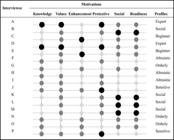
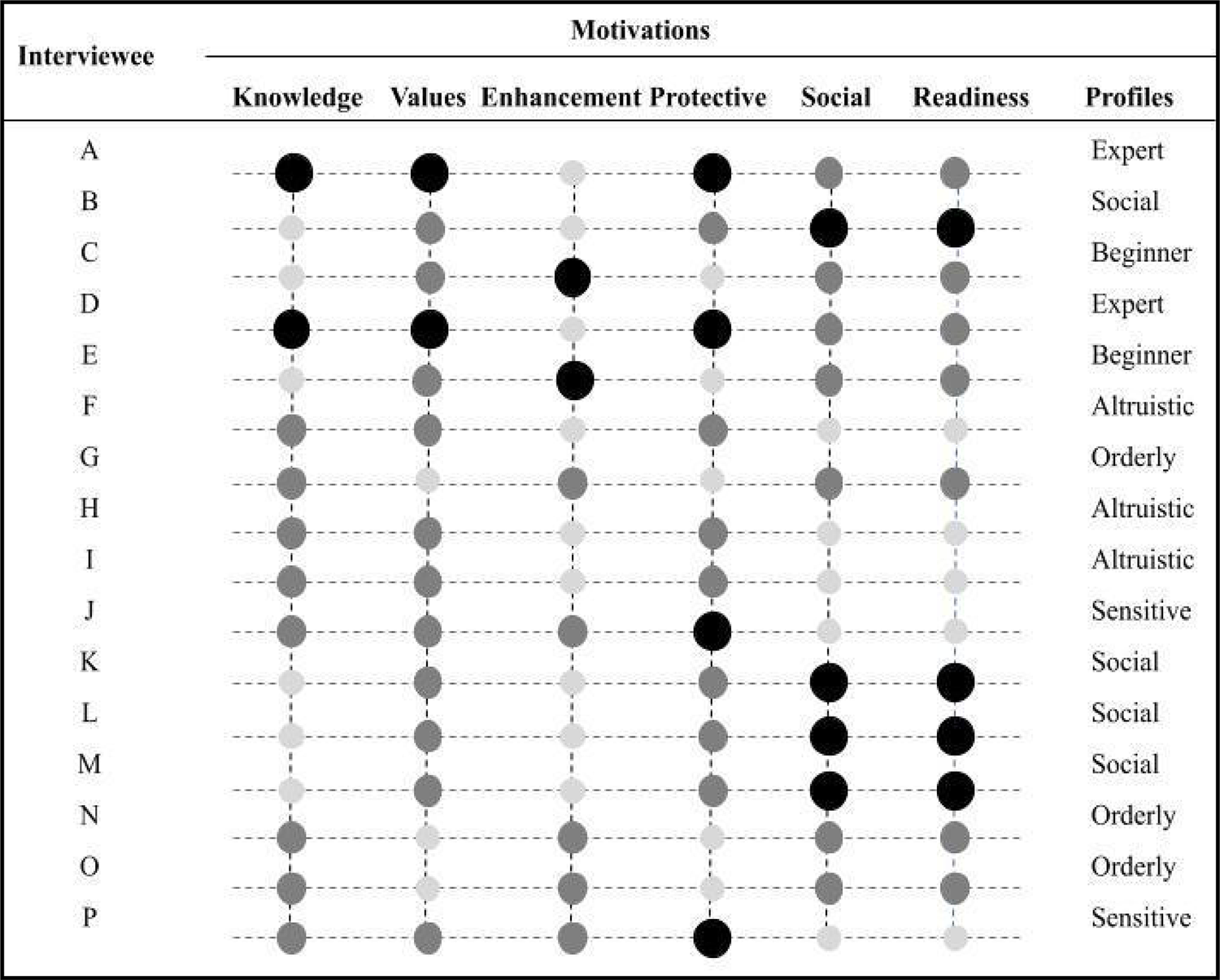
To better visualize the results, the framework of Disaster Volunteers in Brazil was prepared to better interpret the grouping of motivations according to their strength in each profile (i.e., the order of the motivations according to their representativeness in each profile). Moreover, it is essential to emphasize that the results presented show that the motivations are present in all profiles, and the strength criterion was identified through the relations of the motivations according to their intensity in the interviewees’ statements. The proposed profiles according to their motivations are presented in Figure 1. The strongest shades represent the most intense motivations in each profile, followed by moderate and weaker ones. For example, interviewee A was classified into the expert profile because their most intense motivations were knowledge, values, and protective, followed by social and readiness with moderate intensity, and finally, enhancement motivation with lower intensity. All interviewees were classified using the same intensity logic for each profile, as follows:
Besides being technically qualified, the volunteers who present the expert profile have knowledge as their motivational pillar. This profile shares the knowledge acquired and activities required for prevention, whether with the ecosystem in which they are inserted, with other volunteers, or with the affected community. These values linked to knowledge are carried in equity to another characteristic: protection, which is often linked or marked to their life history. These initial impulses related to protection make these volunteers get involved and continue for long periods in these activities, leading them to a high degree of experience in disaster actions and, consequently, acting expertise (Daddoust et al., 2021). Their most significant motivations are knowledge, values, and protective, in addition to being the predominant ones in this profile. Nevertheless, volunteers classified as experts are also moderately motivated by readiness and social and enhancement, albeit at a lower intensity.
The social profile is characterized by the ease of living with different types of people; consequently, these volunteers are influenced by people close to their personal or professional circle, making the initial motivations of wanting to be part of or belonging to groups the link to disaster events. Social motivation is marked most intensely by readiness and social motivations (Atkinson, 2021; Bazan, Nowicki, & Rzymski, 2021), moderately by values and protective, and less intensely by knowledge and enhancement.
The sensitive volunteer profile is built on their strong emotions and sensitivity to the situations presented and motivated by empathy with the situation of those involved in disasters. Sensitive volunteers are initially motivated mainly by protection (Clary et al., 1992) and moderately by enhancement, knowledge, and values. This profile also presents social and readiness motivations, although less significantly. Among the personal characteristics of the volunteers classified in this profile, one can highlight their professions, as they are professionals from areas that do not involve functions related to disasters but who get involved in volunteering as a way of helping those affected.
The beginner profile has a short period of experience in disasters (less than a year). These individuals have more personal motivations, such as motivations for personal development and overcoming (Clary et al., 1992), such as enhancement in a more intense way, and readiness, social, and values in a moderate way. The beginner volunteer is also motivated by knowledge and protective, albeit with less representative traits for this profile.
The orderly profile has strong traces of balance among its motivations and corresponds to volunteers who already work with activities that require knowledge, physical and emotional condition, and being willing to carry out volunteer work. They are moderately marked by the motivations social, knowledge, readiness, and enhancement, and less intensely by protective and values; however, these traces of balance in the motivations work as a systematic exercise for the goal of being ready and in conditions to act at any time in these activities.
Lastly, the altruistic profile seeks to contribute to the well-being of others without considering personal interests to act in disasters. These individuals dedicate themselves to others in a completely supportive manner in a denial of the instinct of selfishness. These initial predispositions place altruistic volunteers involved in activities that seek to help the community and are also moderately marked by motivations such as knowledge, values, and protective, and subtly by motivations such as enhancement, social, and readiness. Altruist individuals act in voluntary activities and do not require incentives because their primary purpose as volunteers is to help those involved in disasters.
The orderly and altruistic volunteers did not present any motivation with greater intensity, but together, the motivations with moderate representativeness could translate critical characteristics of this profile. It is important to note that factors such as length of time as a volunteer, profession, and disaster experience were also considered for classifying the profiles. Nonetheless, as much as personal characteristics are recognized in the analysis, the motivational factors were determinant in the classification.
The diversity among the six volunteer profiles involved in disaster response highlights a rich array of motivations that both differentiate and complement each other. Each profile, from the expert to the beginner, demonstrates unique combinations of motivations such as knowledge, values, protection, social interaction, readiness, enhancement, and altruism. This diversity not only underscores the complex interplay of personal motivations within volunteerism but also emphasizes the importance of aligning these motivations to enhance effectiveness in disaster response efforts. Understanding these varied motivations allows for better strategic deployment of volunteers, ensuring that their skills and passions are effectively harnessed to meet the diverse needs of communities in crisis.
5 DISCUSSIONS
Although research on volunteer motivations and profiles have already been proposed in other contexts of action and other countries, it is understood that given the importance and impacts caused by disasters in Brazil and the understanding that each context requires volunteers with distinct motivations and profiles, this study presents relevance and purpose. Thus, our study advances the literature by confirming some of the motivations to volunteer work present in the previous VFI study as values, enhancement, protective and social (Clary et al., 1992). Also, this study contributes by bringing to light two knew motivations, knowledge, and readiness, that emerged from the content data analysis. On the other hand, while the VFI presents the motivations career and understanding in its scope, our study did not identify them in the context of Brazilian disaster volunteers. Career motivation refers to volunteers seeking to learn skills that will help them take advantage of job opportunities and professional contacts (Clary et al., 1992). In contrast, our study identified the opposite: knowledge motivation encompasses volunteers who already possess relevant skills and are willing to share them in their volunteer work. Understanding refers to volunteers who seek to learn skills for themselves without a specific goal, and this motivation was also not identified in our findings (Clary et al., 1992). We also found that readiness, which was marked by the willingness to always be ready to perform as a volunteer, took physical or emotional aspects into consideration. Despite not being present in the VFI, other studies in the context of disaster health activities have also highlighted readiness as a differentiator in volunteering (Atkinson, 2021; Bazan et al., 2021; Zagelbaum et al., 2014).
Our study also advances the literature by grouping motivations into profiles; to this end, factors such as length of time working, experience as a disaster volunteer, and profession were considered for the classification. Moreover, the intensity of the motivations in each profile also differentiates them because they are all present in the profiles presented, but with different intensities. The profiles’ classification aims at identifying current and incoming volunteers given that, by observing similarities in their personal characteristics with the motivations of each profile, volunteers may perceive a feeling of belonging to a social group (Tajfel, & Turner, 1979), and this may further motivate them to act in disasters because they identify with a group with similar motivations and objectives.
Based on the motivations and profiles of Brazilian disaster volunteers analyzed in this study, specific public policies can be defined to organize the role of volunteers who act in a catastrophe (McLennan, Whittaker & Handmer, 2016), where practical and collaborative management is necessary to mitigate the effects and assist the affected population (Dynes, 1994). Public policies can generate a work plan in response to the emergency and subsequent recovery (Whitaker et al., 2015), in this sense, we recommend to address the following strategies: i) Established protocols to define the roles of each participant - official responders, formal volunteers, and informal volunteers (Scanlon, Helsloot & Groenendaal, 2014; Whitaker et al., 2015); ii) Management and communication structure, especially with information and communication technologies, to improve the effectiveness of actions and avoid conflicts or omissions in relief work (Harrald, 2006; McLennan et al., 2016); iii) Preparatory courses with an emphasis on the main types of events and the nature of hazards, emergencies, and disasters, enabling basic knowledge and collaborative action in disaster situations (Alexandre, 2010; McLennan et al., 2016); and iv) Volunteer registration programs in disaster contexts, with a prior registration of the skills and availability of those interested in coordinated activation when necessary (Dynes, 1994; McLennan et al., 2016).
6 CONCLUSIONS
This study sought to analyze the profiles of disaster volunteers in Brazil based on their motivations. The results were developed through content analysis based on 16 semi-structured interviews, arriving at six motivations: knowledge, values, enhancement, protective, social, and readiness. After identifying the motivations, they were grouped according to the intensity present in the interviewees’ speeches to arrive at six profiles of Disaster Volunteers in Brazil: expert, social, sensitive, beginner, orderly, and altruistic.
As a theoretical contribution, this study advances the existing literature by analyzing the motivations of Brazilian volunteers in the context of disasters, since previous research is grounded on volunteering in other contexts of action (Cavalcante et al., 2015; Silveira et al., 2019). When it comes to the Volunteer Functions Inventory, this study innovates by identifying two new specific motivations for the disaster context: knowledge and readiness. These motivations serve to enrich the functionalist perspective (Snyder, 1993) by introducing a nuanced dichotomy between altruistic and self-serving motives. Specifically, the motivation for “knowledge” embodies a dual aspect — altruistically contributing valuable skills for the collective benefit and deriving personal fulfillment from such contributions. These motivations proposed by functionalist theory, suggesting a more intricate understanding of the motivations underpinning volunteer work. Moreover, the expansion of the VFI to include these motivations represents a direct challenge to and evolution of the inventory, advocating for its adaptability to encompass a more extensive range of volunteer motivations that reflect the distinct demands of varying volunteering contexts, such as disaster scenarios.
The construction of volunteer profiles based on an amalgamation of motivations further exemplifies how this study extends beyond the functionalist framework (Snyder, 1993). By categorizing motivations into profiles considering variables such as duration of volunteer service, experience in disaster volunteering, and professional background, this research not only identifies specific motivational constructs but also investigates their complex interrelations and their collective influence on volunteer behavior. This multidimensional approach to understanding volunteer motivations contributes a significant layer of depth to functionalist theory, suggesting that volunteer motivations are not only diverse but are also interrelated and subject to variation across different contexts and individual experiences (McLennan, Whittaker & Handmer, 2016).
Disaster volunteer profiles are also an important theoretical and managerial contribution, once they can both bring new academic confirmatory studies on profiles identified and be used to classify volunteers enrolled in institutions databases according to their main characteristics, leading to a more fulfilling and efficient disaster management by these institutions. This study also demonstrates the practical applicability of functionalist theory to real-world challenges, specifically in the domain of disaster management. This theoretical-practical synthesis not only reaffirms the relevance of functionalist theory but also expands its scope to address the particular nuances of disaster volunteerism, thereby providing a framework for the development of more effective public policies and disaster management strategies.
Furthermore, as an empirical social contribution, this study also presents a diagnosis for governments and organizations willing to motivate individuals who identify with one the profiles to act as disaster volunteers, in addition to recommending public policies and strategies to establish a work plan in response to the emergency and subsequent recovery (Whitaker et al., 2015). Studies, such as by McLennan et al. (2016), have shown a growing expectation that volunteers will play a more significant role in disaster management in the future. Thus, the findings reported herein may assist in developing public policies for government and disaster management institutions in attracting new volunteers.
Despite the promising data found, the diversity among the volunteers studied (demographic characteristics and length of time working), requires a more in-depth analysis with a higher number of volunteers to confirm the motivations and profiles identified hence, the difficulty in identifying disaster volunteers in the entire Brazilian territory is emphasized. In this sense, quantitative research with primary data collection is recommended for future studies to validate the motivations and characteristics of each profile found. Finally, we suggest studies to identify the motivations of volunteers in other scenarios and countries of operation as each context requires volunteers with different motivations and profiles.
REFERENCES
-
Akintola, O. (2011). What motivates people to volunteer? The case of volunteer AIDS caregivers in faith-based organizations in KwaZulu-Natal, South Africa. Health policy and planning, 26(1), 53-62. https://doi.org/10.1093/heapol/czq019
» https://doi.org/10.1093/heapol/czq019 -
Alexander, D. E. (2010). The voluntary sector in emergency response and civil protection: review and recommendations. International Journal of Emergency Management, 7, p. 151. https://doi.org/10.1504/IJEM.2010.033654
» https://doi.org/10.1504/IJEM.2010.033654 -
Apel, D., & Coenen, M. (2020). Motivational and educational starting points to enhance mental and physical health in volunteer psycho-social support providers after the 2013 flood disaster in Germany. International Journal of Disaster Risk Reduction, 43(101359). https://doi.org/10.1016/j.ijdrr.2019.101359
» https://doi.org/10.1016/j.ijdrr.2019.101359 -
Atkinson, D. (2021). Preparing for the worst: South African municipalities' readiness to manage disasters related to potential shale gas mining. International Journal of Disaster Risk Reduction, 65(102537). https://doi.org/10.1016/j.ijdrr.2021.102537
» https://doi.org/10.1016/j.ijdrr.2021.102537 - Bardin, L. (2011). Análise de Conteúdo, Almedina, São Paulo, SP.
-
Bazan, D., Nowicki, M., & Rzymski, P. (2021). Medical students as the volunteer workforce during the COVID-19 pandemic: Polish experience. International Journal of Disaster Risk Reduction, 55(102109). https://dx.doi.org/10.1016/j.ijdrr.2021.102109
» https://dx.doi.org/10.1016/j.ijdrr.2021.102109 -
Bennett M. (2015). Religiosity and Formal Volunteering in Global Perspective, in Hustinx L., von Essen J., Haers J. and Mels S. (Ed.s). Religion and Volunteering. Nonprofit and Civil Society Studies, Springer Cham. https://doi.org/10.1007/978-3-319-04585-6_5
» https://doi.org/10.1007/978-3-319-04585-6_5 -
Berger, J. (2003). Religious Nongovernmental Organizations: An Exploratory Analysis. Voluntas: International Journal of Voluntary and Nonprofit Organizations, 14, 15-39. https://doi.org/10.1023/A:1022988804887
» https://doi.org/10.1023/A:1022988804887 -
Butt, M. U., Hou, Y., Soomro, K. A., & Acquadro Maran, D. (2017). The ABCE model of volunteer motivation. Journal of Social Service Research, 43(5), 593-608. https://doi.org/10.1080/01488376.2017.135
» https://doi.org/10.1080/01488376.2017.135 -
Carr, D. C., Kail, B. L., Matz-Costa, C., et al. (2017). Does becoming a volunteer attenuate loneliness among recently widowed older adults? The Journals of Gerontology: Series B, 73(3), 501-510. https://doi.org/10.1093/geronb/gbx092
» https://doi.org/10.1093/geronb/gbx092 -
Cavalcante, C. E., Souza, W. J. D., & Mól, A. L. R. (2015). Motivação de voluntários: proposição de um modelo teórico. RAM -. Revista de Administração Mackenzie, 16(1), 124-156. https://doi.org/10.1590/1678-69712015/administracao v16n4p12-1
» https://doi.org/10.1590/1678-69712015/administracao -
Chacón, F., Gutiérrez, G., Sauto, V., Vecina, M. L., Pérez, A. (2017). Volunteer functions inventory: A systematic review. Psicothema, 29(3), 306-316. https://doi.org/10.7334/psicothema2016.371
» https://doi.org/10.7334/psicothema2016.371 -
Chi, K., Almeida, D. M., Charles, S. T., et al. (2021). Daily prosocial activities and well-being: Age moderation in two national studies. Psychology and Aging, 36 (1), 83. https://doi.org/10.1037/pag0000460
» https://doi.org/10.1037/pag0000460 -
Chow, C., Kiat, G. S., Gilbert, T. C. S., King, W. H., Shahdadpuri, R. (2021). Enhancing frontline workforce volunteerism through exploration of motivations and impact during the COVID-19 pandemic. International Journal of Disaster Risk Reduction, 66(102605). https://doi.org/10.1016/j.ijdrr.2021.102605
» https://doi.org/10.1016/j.ijdrr.2021.102605 -
Clary, E. G., Snyder, M. (1999). The motivations to volunteer: Theoretical and practical considerations. Current Directions in Psychological Science, 8(5), 156-159. https://doi.org/10.1111/1467-8721.00037
» https://doi.org/10.1111/1467-8721.00037 -
Clary, E. G., Snyder, M., & Ridge, R. D. (1992). Volunteers' motivations: A functional strategy for the recruitment, placement, and retention of volunteers. Nonprofit Management and leadership, 2 (4), 333-350. https://doi.org/10.1002/nml.4130020403
» https://doi.org/10.1002/nml.4130020403 -
Clary, E. G., Snyder, M., Ridge, R. D., Copeland, J., Stukas, A. A., Haugen, J., Miene, P. (1998). Understanding and assessing the motivations of volunteers: a functional approach. Journal of personality and social psychology, 74(6), 1516-1530. https://doi.org/10.1037/0022-3514.74.6.1516
» https://doi.org/10.1037/0022-3514.74.6.1516 -
Daddoust, L., Asgary, A., McBey, K. J., Elliott, S., & Normand, A. (2021). Spontaneous volunteer coordination during disasters and emergencies: Opportunities, challenges, and risks. International Journal of Disaster Risk Reduction, 65 (102546). https://doi.org/10.1016/j.ijdrr.2021.102546
» https://doi.org/10.1016/j.ijdrr.2021.102546 -
Darlington, S., Glanz, J., Andreoni, M., Bloch, M., Peçanha, S., Singhvi, A., & Griggs, T. (2019). Brumadinho Dam Collapse: A Tidal Wave of Mud. The New York Times, https://www.nytimes.com/interactive/2019/02/09/world/americas/brazil-dam-collapse.htmz [7 October 2020].
» https://www.nytimes.com/interactive/2019/02/09/world/americas/brazil-dam-collapse.htmz -
Dolnicar, S., Randle, M. (2007). What motivates which volunteers? Psychographic heterogeneity among Volunteers in Australia. Voluntas: International Journal of Voluntary and Nonprofit Organizations, 18(2), 135-155. http://dx.doi.org/10.1007/s11266-007-9037-5
» http://dx.doi.org/10.1007/s11266-007-9037-5 -
Dynes, R. R. (1994). Community Emergency Planning: False Assumptions and Inappropriate Analogies. International Journal of Mass Emergencies & Disasters, 12 (2), 141-158. https://doi.org/10.1177/028072709401200201
» https://doi.org/10.1177/028072709401200201 -
Environmental Protection Agency. (2020). Emergency Response, United States. https://www.epa.gov/emergency-response [October 2020].
» https://www.epa.gov/emergency-response -
Erasmus, B., & Morey, P. J. (2016). Faith-Based Volunteer Motivation: Exploring the Applicability of the Volunteer Functions Inventory to the Motivations and Satisfaction Levels of Volunteers in an Australian Faith-Based Organization. Voluntas, 27, 1343-1360. https://doi.org/10.1007/s11266-016-9717-0
» https://doi.org/10.1007/s11266-016-9717-0 - Flick, U. (2008). Introdução à pesquisa qualitativa. (3a ed.), Artmed, Porto Alegre, RS.
-
Fritz C. E., & Mathewson J. H. (1957). Convergence behaviour in disasters: a problem of social control. Publication 476. Committee on Disaster Studies, National Academy of Sciences - National Research Council. Washington DC. https://archive.org/details/convergencebehav00fritrich/mode/2up
» https://archive.org/details/convergencebehav00fritrich/mode/2up - Gibbs G. (2009). Análise de dados qualitativos. Artmed, Porto Alegre, RS.
-
Harrald, J. R. (2006). Agility and Discipline: Critical Success Factors for Disaster Response. The ANNALS of the American Academy of Political and Social Science, 604(1), 256-272. https://doi.org/10.1177/0002716205285404
» https://doi.org/10.1177/0002716205285404 -
Haupt, B., Azevedo, L. (2021). Crisis communication planning and nonprofit organizations. Disaster Prevention and Management, 30(2), 163-178. https://doi.org/10.1108/DPM-06-2020-0197
» https://doi.org/10.1108/DPM-06-2020-0197 -
Londe, L. R., Loose, E. B., Marchezini, V., Saito, S. M. (2023). Communication in the Brazilian civil defense system. International Journal of Disaster Risk Reduction, 95 https://doi.org/
» https://doi.org/ -
Martínez, P., Jaime, D., Contreras, D., Moreno, M., Bonacic, C., & Marín, M. (2021). Design and validation of an instrument for selecting spontaneous volunteers during emergencies in natural disasters. International Journal of Disaster Risk Reduction, 59 (102243). http://dx.doi.org/10.1016/j.ijdrr.2021.102243
» http://dx.doi.org/10.1016/j.ijdrr.2021.102243 -
Mcdougle, L. M., Greenspan, I., & Handy, F. (2011). Generation green: Understanding the motivations and mechanisms influencing young adults' environmental volunteering. International Journal of Nonprofit and Voluntary Sector Marketing, 16(4), 325-341. https://doi.org/10.1002/nvsm.431
» https://doi.org/10.1002/nvsm.431 -
McLennan, B., Whittaker, J., & Handmer, J. (2016). The changing landscape of disaster volunteering: opportunities, responses, and gaps in Australia. Nat Hazards, 84 (3), 2031-2048. https://doi.org/10.1007/s11069-016-2532-5
» https://doi.org/10.1007/s11069-016-2532-5 -
Monllor, J., Pavez, I., Pareti, S. (2020). Understanding informal volunteer behavior for fast and resilient disaster recovery: an application of entrepreneurial effectuation theory. Disaster Prevention and Management, 29(4), 575-589. https://doi.org/10.1108/DPM-05-2019-0151
» https://doi.org/10.1108/DPM-05-2019-0151 -
Nassar-McMillan, S. C., Lambert, R. (2003). The Relationship Between Volunteers: Work Behaviors and Background and Preparation Variables. Journal of Adult Development, 10, 89-97. https://doi.org/10.1023/A:1022487831429
» https://doi.org/10.1023/A:1022487831429 -
Oostlander, J., Güntert, S. T., Van Schie, S., & Wehner, T. (2014). Volunteer functions inventory (VFI): Psychometric properties of the German adaptation and construct validation. Diagnostica, 60 (2), 73-85. https://doi.org/10.1026/0012-1924/a000098
» https://doi.org/10.1026/0012-1924/a000098 -
Randle, M. J., Grün, B., & Dolnicar, S. (2007). Segmenting the Volunteer Market: learnings from an Australian Study. https://ro.uow.edu.au/commpapers/374/ [7 October 2020].
» https://ro.uow.edu.au/commpapers/374/ -
Scanlon, J., Helsloot, I., Groenendaal, J. (2014). Putting it All Together: Integrating Ordinary People into Emergency Response. International Journal of Mass Emergencies & Disasters, 32(1), 43-63. https://doi.org/10.1177/028072701403200103
» https://doi.org/10.1177/028072701403200103 -
Silveira, W. J., Jr., Souza, J. P. M., Santana, L. D., Moura, A. S., Souza, C. R., & Fontes, M. A. L. (2019). The role and the precariousness of volunteer work in Brazilian protected areas. Global Ecology and Conservation, 17.https://doi.org/10.1016/j.gecco.2019.e00546
» https://doi.org/10.1016/j.gecco.2019.e00546 - Snyder, M. (1993). Basic Research and Practical Problems: The Promise of a "Functional" Personality and Social Psychology. Personality and Social Psychology simplein, 19(3), 251-264.
- Tajfel, H., Turner, J. C. (1979). An integrative theory of intergroup conflict. In W. G. Austin and S. Worchel (Ed.s.). The social psychology of intergroup relations. Brooks/Cole, Monterey, CA, 33-37.
-
Techima, D. A., Tsujimoto, E. A., Silva, G. M. (2004). Âncoras de carreira e voluntariado: análise do perfil e motivação de voluntários. In VII Seminários em Administração FEA-USP (VII SemeAd 2004): 10 e 11 de agosto de 2004. Universidade de São Paulo, São Paulo, SP. http://sistema.semead.com.br/7semead/ . [18 September 2021].
» http://sistema.semead.com.br/7semead/ -
Treuren, G. J. M. (2014). Enthusiasts, conscripts, or instrumentalists? The motivational profiles of event volunteers. Managing Leisure, 19 (1), 51-70. https://doi.org/10.1080/13606719.2013.849506
» https://doi.org/10.1080/13606719.2013.849506 -
United Nations Office for Disaster Risk Reduction and World Meteorological Organization. (2023). Global Status of Multi-Hazard Early Warning Systems. Geneva, Switzerland: UNDRR. https://www.undrr.org/publication/global-status-multi-hazard-early-warning-systems-2023 [9 March 2024].
» https://www.undrr.org/publication/global-status-multi-hazard-early-warning-systems-2023 -
Vecina, M. L., Chaco´n, F., Marzana, D., et al. (2013). Volunteer engagement and organizational commitment in nonprofit organizations: What makes volunteers remain within organizations and feel happy? Journal of Community Psychology, 41(3), 291-302. https://doi.org/10.1002/jcop.21530
» https://doi.org/10.1002/jcop.21530 -
Whitaker, J., McLennan, B., & Handmer, J. (2015). A review of informal volunteerism in emergencies and disasters: Definition, opportunities, and challenges. International Journal of Disaster Risk Reduction, 13, 358-368. https://doi.org/10.1016/J.IJDRR.2015.07.010
» https://doi.org/10.1016/J.IJDRR.2015.07.010 -
Wymer Jr, W. W. (1997). Segmenting volunteers using values, self-esteem, empathy, and facilitation as determinant variables. Journal of Nonprofit, & Public Sector Marketing, 5 (2), 3-28. https://doi.org/10.1300/J054v05n02_02
» https://doi.org/10.1300/J054v05n02_02 -
Zagelbaum, N. K., Heslin, K.C., Stein, J.A., Ruzek, J., Smith, R. E., Nyugen, T., & Dobalian, A. (2014). Factors influencing readiness to deploy in disaster response: findings from a cross-sectional survey of the Department of Veterans Affairs Disaster Emergency Medical Personnel System. BMC Emerg Med, 14 (16). https://doi.org/
» https://doi.org/
Edited by
-
Edited by:
Jordana Marques Kneipp

 Notes: Black dot = high score; grey dot = moderate score; light grey dot = low scoreSource: Prepared by the authors, 2022